Economy

Government expected to renew growth strategy

From our UK edition

The word flying around Westminster this evening is that the government is going to announce a fresh package to stimulate growth tomorrow. In line with recent reports, the expectation is that new enterprise zones will be unveiled. Enterprise zones are, of course, the linchpin of the chancellor’s current strategy, offering generous tax breaks for start-up industries, relaxed planning regulations and investment in state-of-the-art broadband, so this would not be a novel move. But an announcement would be timely nonetheless.

Inflation rises yet again

From our UK edition

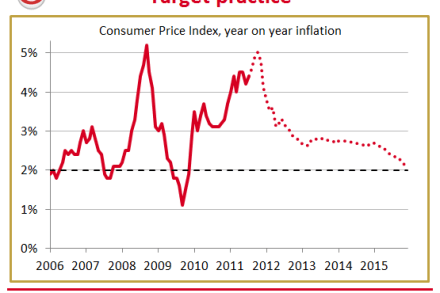
"Inflation destroys nations and societies as surely as invading nations do. Inflation is the parent of unemployment. It is the unseen robber of those who have saved. No policy which puts at risk the defeat of inflation - however great the short-term attraction - can be justified". That was Margaret Thatcher, speaking in 1980 when inflation was much higher but British politicians actually cared about it. You won't even hear the Governor of the Bank of England denounce today's figures: CPI at 4.4 per cent and the traditional measure of inflation, RPI, at 5.0 per cent. It is seen as just another statistic. The government has also chosen to announce that rail fares will be rising by 8 per cent. George Osborne is in charge of getting inflation right.

Cameron and Miliband’s differences

From our UK edition

David Cameron and Ed Miliband both gave speeches on the riots this morning and the political dividing lines between the two are becoming more and more apparent. Cameron argues that these riots were about culture not poverty, Miliband thinks you can’t ignore inequality. Cameron believes that society needs two parent families, Miliband that it is about parental responsibility. Cameron doesn’t want an enquiry, Miliband does. The challenge for Cameron now is to turn the social analysis in his speech, which I think was broadly correct, into actual policy. Already in Conservative circles, people are saying that if Cameron really does want to support two parent families then surely he must use the tax system to both encourage marriage and help those who are married.

Back to the drawing board as Eurobonds look dead in the water

From our UK edition

Watch her lips: no Eurobonds. Angela Merkel’s Finance, Minister Wolfgang Schauble has told Der Spiegel: "I rule out Eurobonds for as long as member states conduct their own financial policies and we need different rates of interest in order that there are possible incentives and sanctions to enforce fiscal solidity.” Merkel’s government is making its depositions ahead of tomorrow’s Eurozone summit, rebutting the moves made by other member states over the weekend to introduce Eurobonds, a step towards political integration. Those proposals were backed by Nicolas Sarkozy, with whom Merkel is meeting in private this afternoon.

Desperate times

From our UK edition

You have to hand it to the Eurocracy: it is nothing if not determined. The recent horrors on the stock market have concentrated minds in Brussels and across continental capitals. The headline news is that France, Italy, Spain and Belgium have placed a temporary ban on short-selling, but that’s just one counter-measure that has been introduced in the last 24 hours. And you’ll notice that these schemes are piecemeal; there is no grand plan as yet to calm the markets. First, Spain has bent a suppliant knee before the European Commission to secure restrictions on Romanians seeking work. This is momentous: the first time that border restrictions have been re-imposed within the EU.

The public wants firmer action

From our UK edition

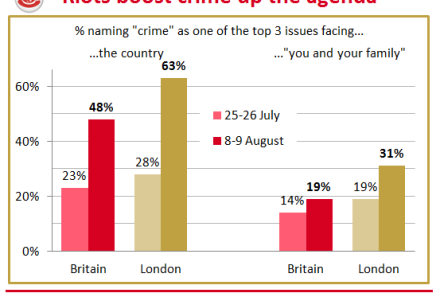
Judging by today's YouGov polls, the riots have pushed crime sharply up the national agenda: it now ranks second, behind only the economy. In all, almost half of Brits think crime is one of the top three issues facing the country, more than double the number who said so a fortnight ago. The effect has, unsurprisingly, been strongest in London, where around two-in-three now see crime as a major concern: As for the causes of the riots, the majority blame "criminal behaviour" and "gang culture". Contrary to what Harriet Harman may insinuate, just eight per cent blame the government's cuts, and this is largely the 16 per cent of Labour voters who put the blame at the Coalition's door.

Osborne’s debt dilemma

From our UK edition

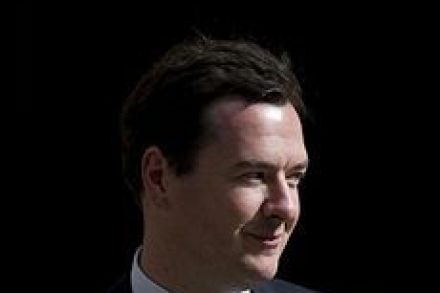
If there's one sentiment that defines George Osborne's article for the Telegraph today, it’s that there is no need for us Brits to panic. The economic convulsions of the past few days, contends the Chancellor, serve to prove that the coalition was right to approach deficit reduction as it has. "The alternative of more spending and yet more borrowing is now frankly ludicrous," he says, "and places those who advocate it on the outer fringes of the international debate." He has a point. As I blogged on Saturday, there are reasons to believe that we'd be hurtling towards a credit downgrade and higher borrowing costs were it not for the fact that our debt-GDP ratio is set to decline by 2015.

Why Obama is still odds on for re-election — just

From our UK edition

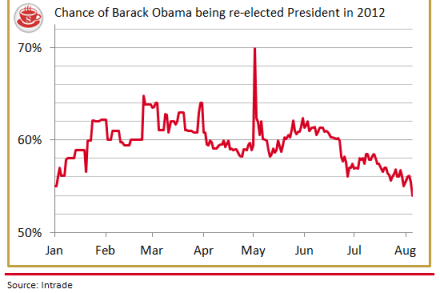
A credit downgrade, unemployment at 9.1 per cent, spluttering growth — the economic cards are certainly stacked against Obama for his re-election in 2012. But here's the thing: American punters still think that he's more likely to win next November than not. Perhaps that's because, contrary to Clinton's famous slogan, it's not actually all about the economy. According to Nate Silver's analysis of the last 25 presidential elections, a better rule of thumb is "it’s half the economy and half everything else, stupid". So if Obama's losing the first half, what about the "everything else"?

Would the Darling Plan have satisfied the credit rating agencies?

From our UK edition

Why have we retained our AAA credit rating despite, by S&P's figures, suffering a larger debt-GDP ratio than America? The Taxpayers' Alliance's Matthew Sinclair answers the question in some detail here, but one passage from S&P's own analysis stands out. They explain that: "When comparing the U.S. to sovereigns with ‘AAA’ long-term ratings that we view as relevant peers–Canada, France, Germany, and the U.K.–we also observe, based on our base case scenarios for each, that the trajectory of the U.S.’s net public debt is diverging from the others. Including the U.S., we estimate that these five sovereigns will have net general government debt to GDP ratios this year ranging from 34% (Canada) to 80% (the U.K.), with the U.S.

America continues to unravel

From our UK edition

The humbling of America — the cover theme of this week’s Spectator — continues with S&P stripping Uncle Sam of his AAA credit rating. The debt downgrade, it says, “reflects our opinion that the fiscal consolidation plan that Congress and the administration recently agreed to falls short of what, in our view, would be necessary to stabilize the government’s medium-term debt dynamics.” In other words: Obama’s still addicted to debt, and it’s time to stop pretending that his government’s IOU notes rank among the safest investments on earth. Its analysis seems to be pretty much that made by Christopher Caldwell in his brilliant cover story.

The markets wax and wane

From our UK edition

CoffeeHouser 'Ben G' had it right in his comment underneath my earlier post: 24 hour news really does struggle in the face of economic crisis. This morning, all the talk was of a debt-induced apocalypse. Earlier this afternoon, the headlines were about the markets "rallying" after better-than-expected data on the US labour market. And now the BBC website's main headline is that "turmoil in the stock market persists," despite those very same labour market figures. Oh yes, it's difficult to present a consistent front as the money merchants sway and buckle in the breeze. That said, the economic fundamentals remain discouraging. It shouldn't be forgotten that yesterday's losses were extraordinary; in many cases, the worst since the early days of the Credit Crunch.

A Gloomy Decade?

From our UK edition

Tim Montgomerie is in full-on never waste a crisis mode today. Given the doom plastered across all the front pages (The Sun excepted) this is a good time for wheeling out old favourites: With the world economy facing such a bleak decade this is no time for half measures. We need to be cutting taxes on business and funding them with deeper cuts in the over-sized state. We should be suspending environmental measures that are imposing heavy and futile costs on our manufacturing industry. We shouldn't be loading new regulations on our banks until the economy is strong again. We need them to be lending.

Fasten your seatbelts…

From our UK edition

It has, to paraphrase Margo Channing, already been a bumpy night — and it's only going to get bumpier today. The latest news is how the Asian markets have trembled at what's happening in the West. Japan's main stock index is down 3.7 per cent. Australia's is down 4.2 per cent. Hong Kong's 5.3 per cent. And even oil futures joined in with the collective nosedive, which is continuing as the European exchanges open this morning. All of which adds to the catalogue of horror that was written yesterday. CoffeeHousers will read plenty of grim comparisons in the papers today, not least that yesterday's plunge in the Dow Jones was the worst since 2008.

Government split over policing the internet

From our UK edition

Business Secretary Vince Cable was on strident form this morning, pledging to drop controversial web-blocking from the government’s plan to tackle internet piracy. But his Conservative colleagues at the Department for Culture, Media and Sport (DCMS), Ed Vaizey and Jeremy Hunt, disagree. Ed Vaizey, the minister responsible for the creative industries, is to chair a meeting on 20th September with internet service providers, copyright holders and other stakeholders, and web-blocking is on the agenda. Originally, the government proposed blocking broadband access at addresses (both real and virtual) where illegal downloads took place.

Moving slowly towards the future

From our UK edition

Yesterday’s leak of Vince Cable’s response to the Hargreaves report into the Digital Economy Act (DEA) set tongues wagging. The headline was as expected: ‘web-blocking’, the practice whereby copyright infringers are barred from internet access, will be dropped because it is unworkable. In line with Hargreaves’ recommendations, Cable also plans to remove restrictions on using copyright material to create parodies, which is excellent news for Downfall enthusiasts. And he will rationalise copyright law to legalise supposedly forbidden practices like copying CDs onto an i-Pod. Finally, Cable has permitted an exception from copyright for data mining for research purposes.

An open letter to Will Straw about deficit reduction…

From our UK edition

…or why the US cuts are actually faster than, and just as deep as, ours. Dear Will, We hope you don't mind us writing a letter-form response to your latest post on Left Foot Forward, which argues that the "coalition government's cuts are deeper and faster than the Tea Party's". But, as we see it, there are several problems with your figures which are easier to explain in a conversational format. Here they are, as best as we can express them: i) The first obvious problem comes when you say that Obama set out $83 billion of deficit reduction for 2012 in his March Budget. Actually, he didn't.

The IMF manages to please everyone

From our UK edition

A bet-hedging sort of report into the UK's economy from the IMF today, which largely supports George Osborne's deficit reduction plan, but will also give some encouragement to his detractors. By way of a summary, here are the parts that might satisfy Osborne himself, as well as Vince Cable, Ed Balls and Mervyn King: The passage that the Chancellor will flash around Westminster comes on the very second page of the IMF document. "Strong fiscal consolidation is under way," it reads, "and remains essential to achieve a more sustainable budgetary position, thus reducing fiscal risks.

The House of Representatives passes the debt deal, as Giffords returns

From our UK edition

After all that, the House of Representatives has passed the bill to raise America's debt ceiling, by 269 votes to 161. But, for all the economic significance of last night, it was the vote of one woman that really set proceedings alight. Congresswoman Gabrielle Giffords returned to the floor of the House for the first time since surviving an assassination attempt in January, to vote 'yes': And in less heartening news, Vladimir Putin has described America as a "parasite" on the global economy.

Pickles lands a small blow for growth

From our UK edition

Eric Pickles’ decentralisation revolution continues, with the announcement that Whitehall is relinquishing control over car parking restrictions in town centres. From now on, town halls will decide how much space will be devoted to parking and at what price. It is hoped that this will stimulate commerce in the localities by improving the experience of high street shoppers.      This, I concede, is not the most thrilling news ever to have graced these pages. But it is quite significant nonetheless. It was understood that Pickles was unlikely to achieve this objective, due to Whitehall’s intransigence.