Economy

Fears heighten as the Eurocrisis rumbles on

From our UK edition

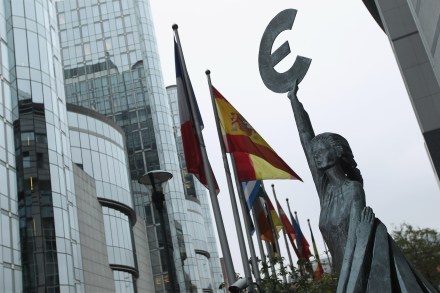
For all the coverage of hacking, pasty tax and the like, the continuing crisis in the eurozone remains the most significant political story. Until it is resolved, it is hard to see how the UK returns to robust economic growth. I suspect that the market reaction to a Hollande victory will be limited as it is already pretty much priced in. Those expecting a degringolade will be disappointed. However, if Hollande does actually try and implement some of his more extreme ideas, the markets could take fright. What is far more worrying than France is Spain. There’s a growing sense of inevitability that the Spanish banks will need a bailout before the autumn.

Waiting for Growth

From our UK edition

With apologies to the Beckett Estate... Two tramps appear on stage. They are dressed in white tie and tails and wearing top hats. Their clothes are dirty and shabby; their hats gleam. The stage is bare, apart from a mound of earth and a tree. Which appears to be dead. ACT ONE: David: [gloomy] It's too much for one man. On the other hand what's the good of losing heart now, that's what I say. We should have thought of it a million years ago, in the nineties. George: What do you expect, you always wait till the last moment. David: [Ponders this] The last moment... Hope deferred maketh the something sick, who said that? George: It is an election, isn't it? David: [Despairingly] Why don't you help me? George: There's nothing to show. David: Suppose we repented?

Cameron’s Euro line

From our UK edition

One line jumped out at me in David Cameron’s Marr interview this morning. When Andrew Marr asked him if he thought we were halfway through the Euro crisis or nearing the end of it, Cameron replied: ‘I don’t think we're anywhere near half way through it.’ Cameron clearly does not believe that any resolution to the crisis is in sight. Given that, as long as the Eurozone crisis rumbles on it is hard to see how the British economy returns to robust growth, this is immensely significant. It does, though, make me wonder if the government’s approach to the crisis should now change.

Cameron on the defensive

From our UK edition

‘As things stand, I don’t believe Jeremy Hunt broke the ministerial code,’ said David Cameron to Andrew Marr earlier this morning. But the prime minister reiterated that he would act if new evidence came to light when Jeremy Hunt gives evidence to the Leveson inquiry. Cameron also indicated that he would not wait until Leveson reports in October to punish a breach of the ministerial code. And if Leveson does not clear up the issue, then the Hunt case would be referred to Sir Alex Allan. ‘I know my responsibilities,’ Cameron said time and again. In addition to putting Jeremy Hunt on probation, Cameron took the opportunity to defend his own conduct with News Corp executives.

Osborne’s turning point

From our UK edition

As Paul Goodman suggests, there is something significant about Liam Fox's article for the Daily Telegraph this morning. It's not that we haven't heard similar from the former Defence Secretary before — we have. It's more that his economic prescriptions are being made, we learn from the Sun, with the ‘explicit approval’ of his buddy George Osborne. And what are those prescriptions? Well, the main one is for further spending cuts, and Fox also waxes enthusastic about greater deregulation and about protecting the defence budget (at the expense of international aid). He also has some firm advice for the Lib Dems.

The Austerity Myth

From our UK edition

On the global scale of hackish irritation, the American left's persistent determination to misdiagnose the reasons behind Britain's faltering economy cannot be considered the most grievous pundit-crime. Nevertheless, it remains annoying. Here, for instance, is Joe Klein: Word now comes that Great Britain has slipped back into recession after several years of David Cameron’s austerity experiment. It seems, yet again, that John Maynard Keynes has been proven right. Real Keynesianism–government deficit spending–is essential when economies go bottom up. This can mean more government programs or lower taxes, or a combination of the two. That would seem to be plain vanilla logic, right?

Balls’s argument is detached from reality

From our UK edition

So who killed the recovery? Ed Balls points to a ‘recession made in Downing St,’ and has gone on a victory tour today. ‘I have consistently warned David Cameron and George Osborne for over a year that going too far and too fast on spending cuts would backfire,’ he says. ‘Arrogantly and complacently they ignored those warnings, and the country is paying a heavy price.’ Facts are always the remedy to an outbreak of Balls. The government releases monthly spending figures, which show an increase overall. That’s due to the rising cost of debt and dole, you might say, but strip those two out and you have what the ONS calls ‘core government spending’.

Britain’s longest downturn

From our UK edition

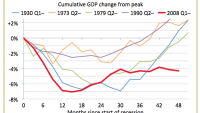
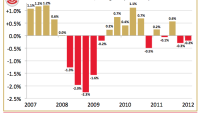
As of today, we now have four years’ worth of GDP figures since the UK first went into recession — and they don’t look pretty. By this point in the 1930s, we’d already fully recovered from the Great Depression.

The economy adds to Cameron’s woes

From our UK edition

This morning brought the economic news that the coalition has been dreading: the country has double dipped. Now, this is based on preliminary figures which may well be revised up. But, as Pete says, the political impact of this story will be huge. The government’s handling of the economy has now been caught up in this whole argument about competence. It provides quite a back-drop to Rupert Murdoch’s testimony today. PMQs today has now taken on a special significance. Ed Miliband has two massive targets to aim at, the Jeremy Hunt revelations from yesterday and these GDP figures. For Cameron it will be his most testing appearance at the despatch box yet. One other thing to watch is what effect these developments have on the polls in London.

Our economy fell back into recession

From our UK edition

Or at least technically-speaking it did. The figures released this morning suggest that the economy shrank by 0.2 per cent in the first quarter of this year, which is the second quarter of shrinkage in a row after last winter's 0.3 per cent fall. The numbers are tiny, but the politics is huge. It's a double dip — and you can expect Ed Miliband to mention that fact again and again in PMQs later, with dread accompaniment from Ed Balls and his hand gestures. There are some caveats, of course. This is only a preliminary estimate, so the Office for National Statistics could revise it upwards at some point. It's also the slightest of slight downturns.

The Eurocrisis persists

From our UK edition

Holland and Hollande; they're the non-identical twins that are causing palpitations across Europe today. Holland, because the country's Prime Minister yesterday resigned after failing to agree a package of cuts for his country’s budget. Hollande, because he's the socialist candidate set to win the presidential election in France, probably eroding that country’s commitment to fiscal consolidation in the process. The markets quivered in fear at this morning’s headlines — and what they mean for the eurozone — even if they have, in some parts, slightly recovered since. It’s all another reminder that the Eurocrisis just isn't going away — neither for countries such as France and the Netherlands, nor for George Osborne.

QE is a government hijack, says King

From our UK edition

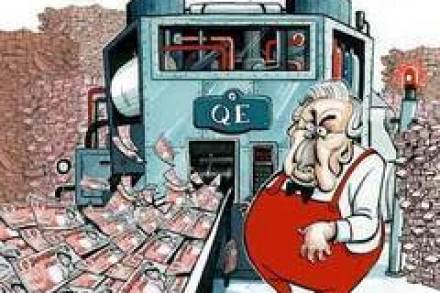
While Mervyn continues to inflate our universe via Quantitative Easing, another Mr King — Stephen, the chief economist of HSBC — has issued a report saying QE is a way for governments to ‘hijack the credit system’. ‘The financial system is being rigged via acts of financial repression as governments look for new ways of funding excessive debts,’ says King in his bluntly worded report. While he doesn’t cite the UK or Sir Merv by name, it’s clear that reference is being made to QEs I and II, the government’s preferred means of stimulating lending through lowering borrowing costs.

Is Alexander ushering in Austerity Squared?

From our UK edition

23rd April, 2012 — mark it down in your calendars, CoffeeHousers. For, after weeks of froth and fury about tax, today’s the day when the government focused on spending cuts again. In a speech to the Institute for Fiscal Studies, Danny Alexander has announced what are, in theory, a couple of new restraints on spending. First, government departments will have to share information about their spending with the Treasury on a monthly basis, and let Osborne & Co. pore over it. And, second, they will also have to find extra capacity in their existing budgets for unforeseen expenditure, rather than just relying on the Treasury’s central reserve.

Lewis Hamilton vs Ed Miliband

From our UK edition

Every so often, British sportsmen are prevailed upon not to go to certain countries, in protest at some usually-hideous policy. Now it’s the turn of our racing drivers. Yvette Cooper said on Question Time last night that, at the very least, Jenson Button and Lewis Hamilton should pull out of the Formula One race this weekend. Ed Miliband wants the race to be cancelled. What baffles me is that the racing drivers should be seen as so controversial, whereas (so far as I can tell) neither Cooper nor Miliband has had anything to say about the British government approving the sale of arms to Bahrain long after its uprising started in Feb 2011.

Britain will contribute again to the IMF

From our UK edition

Britain will contribute $15 billion (£10 billion) more to the International Monetary Fund. This means that there will be no need for another parliamentary vote on UK funding of the IMF as it is within the limits set by parliament in its last vote on the matter. This news has emerged in a joint statement by Australia, South Korea, Singapore and the UK; the UK’s $15 billion contribution is in proportion to this country’s voting share in the organisation. In terms of the politics of this decision, it is interesting that the Australian Liberals, the Tories’ sister party Down Under, are going to back the increase in the Australian contribution despite being in opposition.

British jobs, British workers and this government

From our UK edition

Chris Grayling gave a speech today that mirrored his response to the recent work experience brouhaha: punchy, practical and broadly persuasive. Except there were some parts that might cause a few jitters, and which are certainly representative of jitters along Downing Street. First, this passage: ‘It's easy to hire someone from Eastern Europe with five years' experience and who has had the get-up-and-go to cross a continent in search for work. But those who look closer to home find gems too. Very often the surly young man in a hoodie who turns up looking unwilling to work can turn into an excited and motivated employee.’ And then this: ‘I personally think that anyone who offshores customer service is mad.

Planet London & Planet Edinburgh

From our UK edition

Sure, the Economist's cover story has received heaps of attention these past few days but it's not the most interesting or even the most important cover story published by a British political magazine last week. Though I would say this, Neil O'Brien's "Planet London" article for the Spectator is the piece the Scottish National Party should be more interested in. O'Brien makes a compelling case that London is now, more than ever, a place apart. Its triumph is both magnificent and dangerous. Magnificent because London is, in ways scarcely conceivable forty years ago, a global behemoth; dangerous because of the distorting effect this must have on British politics. In significant ways, O'Brien suggests, London has left the rest of the United Kingdom behind.

No ‘poll shock’, but some interesting findings nonetheless

From our UK edition

Despite the Times’s headline (‘Poll shock as new U-turn looms’), there’s nothing particularly surprising in the toplines of today’s Populus poll. It merely confirms the trends already exposed by other pollsters: a widening Labour lead (Populus has it at nine points, up from four last month) and increasing discontent with the coalition (Populus has the government’s net approval rating at minus 24, down from minus 3 in September). Beneath the toplines though, there are some interesting details.

Anders Borg: Europe’s best finance minister

From our UK edition

In the current issue of The Spectator I interview Sweden’s Anders Borg, perhaps the most successful conservative finance minister in the world — both in his economic track record, and the accompanying electoral success. His response to the crash was a permanent tax cut to speed the recovery. At the time, everyone told him it was madness. But Borg is unusual amongst finance ministers, in that he is a trained economist. To him, madness lay in repeating the formula of the 1970s and expecting different results. Last year, Sweden celebrated the elimination of its deficit. It’s perhaps worth mentioning a few other points which I didn’t fit into the interview. 1. Revenge of the nerds.