Drink

At least we still have wine

From our UK edition

Even in recent heat, the English summer can be magical. As long as there is shade, a pool and a steady supply of cooling wine, there is so much to enjoy. Trees, flowers, songbirds, butterflies: dolce far niente works here too. But thinking can be the snake which insinuates itself into Eden. Susan Hill’s Simon Serrailler books are always excellent train reading and the latest was no exception, even if the principal character always puts one in mind of Turner’s supposed reply to someone who said that they had never seen a sunset like the one which he had painted. ‘But don’t you wish you could?’ It is hard to believe that there are many actual policemen like Simon Serrailler – more’s the pity. There are other reasons for pity.


Beware the cocktail bore

From our UK edition

The man at the posh London bar stood with our drinks but wouldn’t give them to us. He had a lecture to deliver first, for cocktail culture – or ‘mixology’ as the craft is now known – is nothing if not didactic. As I looked enviously out at the people with pints of beer across the way, I wearily reflected on how the message to the customer has hardened in the years since cocktail bars with American ambitions crossed the pond. It is: the £19 you’re paying for the drink isn’t enough. You need to be quiet and listen, for you’re not just a drinker: you’re a supplicant. Be that as it may, I felt my eyes violently glaze over as the man redescribed, in even more verbose detail, what we had already pored over on the menu.

London’s best martinis with a twist

From our UK edition

The martini is experiencing something of a renaissance. This old standard is appearing front and centre on menus across London, reworked to showcase new flavours and techniques. Within the simple framework of clear spirit, vermouth, an optional dash of bitters and an olive or twist, bartenders are finding infinite room for creativity. Not only is this a refreshing antidote to the tiresome orthodoxy that has historically dogged the martini – ‘Just wave the gin in the direction of France!’ – it’s further proof that London is the global capital of the cocktail. The martini may not have been invented here, but our bartenders are certainly showing the world what this old classic can do.

Should you really pair Pimm’s with oysters?

From our UK edition

Imagine a camel train, crossing the great desert. The remaining water is rancid; the beasts’ humps are shrunken. Death looms. Then suddenly, there is the sound of a fountain plashing and the scent of sherbet. Old Abdullah, who has done the journey often, as he has been reminding everyone for ten days and making his companions increasingly homicidal, is vindicated. The oasis is at hand. Although Londoners, afflicted by heat, may feel affinity with those sons of the desert, our conditions are not so dire. For a start, there are many more oases, in the form of bars or clubs. That brings us to Pimm’s, that admirable method of rehydration. According to the sources, Mr Pimm invented the drink to accompany oysters. Eh?

Think pink: there’s no shame in quaffing rosé in England

From our UK edition

In the battle of ideas, it is sometimes necessary to make a tactical withdrawal. That is now the case over climate change. This should not be confused with a full retreat. But in the circumstances, those who insist on the need for lifestyle changes have a point, at least when it comes to wine. Some time ago, I propounded a dictum. Rosé should only be drunk south of Lyon. One could start quite early – 10.30 perhaps, opening the first bottle while brushing away the final crumbs of croissant. Apart from a very few serious wines, it would not matter if the stuff were cooled to ice-lolly temperature. But in this heat, there is no shame in quaffing rosé in England. Other wines can be problematic. Freedom and whisky gang thegither.

Tolosa Winery: my latest discovery

Writing about and — the necessary preliminary — drinking wine is a voyage of discovery. I won’t say that any new vineyard has made me feel quite like “stout Cortez” who, according to Keats, “star’d at the Pacific — and all his men/ Look’d at each other with a wild surmise—/ Silent, upon a peak in Darien.” But wine is in a deep sense about more than the fermented juice of the grape. It is about place — terroir, of course, but also place in a larger sense: place as habitation, place as community, which means place as the stage whereon manners, romance, technique and custom perform for the gods of pleasure. It is also about history and personality and their distillate: money, which ushers in snobbery and its accoutrements.

tolosa

My memorable night at the Carlton Club

From our UK edition

‘Club’ is a four-letter word. Whenever a club is mentioned in the press, it will inevitably be portrayed as a sinister meeting place where men gather in secret to plot against the common weal. If only. The main point about all clubs is that they are fun. That is true in St James’s. It is also true in the working-men’s clubs of the north and Midlands. That said, the Carlton Club could claim to be a special case, although anyone entering its portals in the hope of coming across louche behaviour would be disappointed (almost always). But it could be regarded as a trustee of the Conservative party. As such, it has provided the setting for crucial events, most notably in 1922.

The best coastal pubs for a pint by the sea

From our UK edition

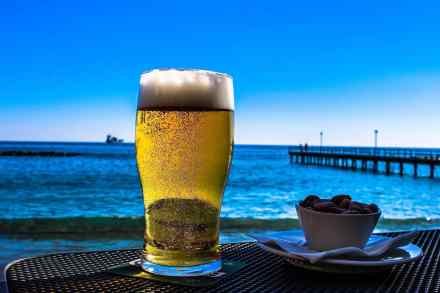
There are few pints as good as the one you drink after a day on the beach. The sea air, the promise of a good fish and chips on the way, and the phantom warmth of a sunburn settling in all make that beer or cider taste even sweeter. British beach pubs can sometimes let the views pick up what the service lets down but this doesn’t have to be the case. Here to make sure your post-paddle pints are spot on perfect are some of the best places in the country to drink by the seaside. Xylo Taproom – Margate, KentXylo taps into Margate's artistic vibe This stylish microbrewery sits on the corner of Margate’s fashionable Old Town, offering a great view of the beach and the Harbour Arm.

A voyage through fine wine off Sardinia

From our UK edition

One could get used to this. I come from seafaring stock, albeit distant. ‘Anderson’ suggests Viking antecedents, especially as my forebears came from the Shetland Islands. Yet there must have been something wrong with the first Anderson. Other Vikings reached Normandy, Sicily, even Byzantium. At the very least, they found the odd monastery to plunder. Later, their Norman descendants compensated for cultural destruction with cultural creation. But to endure the rigours of crossing from Norway and then disembark on Shetland? Was my remote ancestor seasick, or mutinous, or did he rape the cabin boy? We will never know. A millennium or so later, life at sea was rather different. We were on a yacht, cruising between Sardinia and Corsica.

My approach to wine? Wishful drinking

From our UK edition

I fancy myself as a bit of an oenophile and during the lockdowns, when my local branch of Majestic was forced to close, I joined The Wine Society and started buying wine from a variety of online sellers such as Vivino and Goedhuis & Co. The upshot is that I get three or four emails a day from these companies and have become an expert in deconstructing their sales patter. The common theme is to coddle the self--deception of the buyers that they aren’t full-blown alcoholics – heaven forfend! – but are obsessed with wine for some other, entirely respectable reason. For instance, Goedhuis is currently promoting a ‘platinum selection for the Jubilee weekend’ on the assumption that its customers are going to be hosting garden parties this bank holiday.

The learned drinkers

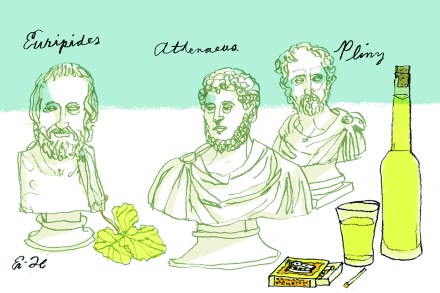
Some of my readers may be unfamiliar with Athenaeus of Naucratis, a shadowy Egyptian-born Greek who floruit somewhere in the Roman Empire during the reigns of Marcus Aurelius, Commodus and Septimius Severus, i.e., around 200 AD. Athenaeus was a rhetorician, grammarian and epicure. But he is known to posterity primarily as the author of The Learned Banqueters (Δειπνοσοφισταὶ), a sprawling, miscellaneous work that touches on, well, just about everything: food, philosophy, fermentation, fabulation and many other subjects, not all of which begin with the phoneme “f.” Henry James called the three-volume Victorian novel a “loose baggy monster.” None was so loose or so baggy as Athenaeus’ compendium. There is a bit of Petronius’s Satyricon (c.

athenaeus

The perfect pairing of books and wine

From our UK edition

In the West End of London there is an alley which insinuates its way between the Charing Cross Road and St Martin’s Lane. It is called Cecil Court, and the Salisbury pub is close at hand. Those are clues. The area around Cecil Court has been owned by the Salisbury branch of the Cecil family since the 17th century. For a long period, it was not a salubrious area. At least one local was hanged. Others were transported. There may have been a whorehouse or two. The ambience resembled a cross between Fagin’s kitchen and Mistress Quickly’s Boar’s Head, with Doll tearing the sheets. Then everything changed, thanks to Victorian morality and political pressure. The Third Marquess of Salisbury was a devout churchman as well as a prime minister.

The horror of gluten-free beer

From our UK edition

I was reminded of the worst liquid that I have ever consumed. It was the last occasion on which I drank Coca-Cola, nearly 50 years ago. To be fair to Coke, this bottle was at room temperature, and the room was in the Anatolian peninsula, during the ferocity of high summer. A group of us were travelling in a battered old bus, still four hours by bad roads from Izmir, hot water and cold beer. Having run out of bottled water, we needed something to stave off dehydration. The village offered a choice: well water or parboiled Coke. An aristocratic French leftie was moved to a declamation: ‘Moi, j’ai un horreur de Coca-Cola.’ I concurred.

A taste of la dolce vita in Tuscany

From our UK edition

Amid the grandeur of old Edinburgh, in the lee of the castle, is one of the finest buildings in Scotland: George Heriot’s School. But Heriot’s is more than an architectural gem. It is an epitome of Scotland as it used to be, before the Scottish esprit de corps succumbed to kailyard grievance-mongering under the rule of Sturgeon the tricoteuse and her Nationalist administration. George Heriot, ‘Jingling Geordie’ as he was nicknamed after the coins supposedly jingling in his pockets, was one of many Scotsmen who went south to make their fortune after the Union of the Crowns in 1603. ‘The noblest prospect a Scotsman ever sees is the high road… to England’ applied then as well as in Dr Johnson’s time.

Bargain Brazilian wines

Some people think that wine is a serious business. I am often tempted to think that myself, but then I remember an amusing cartoon by James Thurber called “The Wine Snobs.” It shows four people sitting around the dinner table, each holding up a glass of wine. There is an air of resigned dubiousness emanating from the table as whole. But the W.S. himself sports a big smile and says enthusiastically “It’s a naive domestic Burgundy without any breeding, but I think you’ll be amused by its presumption.” Been there, done that. We’ve tasted some pretty fancy wines together in this column, and I hope there will be plenty more to come. At the end of the day, though, wine for most of us is chiefly about pleasure and camaraderie, not connoisseurship.

brazilian

The wine of the Wild Geese

From our UK edition

The Irish rarely understate their achievements. Yet there is one exception. Over the centuries, the links between Catholic Ireland and the Bordeaux wine trade have been fruitful. O’Brien (Pepys’s Ho Bryan, now Haut Brion), Lynch, Barton and many other names: these are enduring memorials to a fruitful relationship. But the best-known Hibernian exiles were warriors. From the 16th century onwards, Irish soldiers served with distinction in continental armies. Their numbers increased after the Battle of the Boyne. London wanted to break the power of Gaelic, Catholic Ireland for all time, and one way of doing so was to expropriate the native landowners. Many of them decided to repair their fortunes elsewhere. They became known as the Wild Geese.

War, wine and the brilliance of Beychevelle

From our UK edition

If only toasts and good wishes were weapons of war. At every serious repast I have attended since the invasion began, someone has raised a glass to the heroes – and heroines – of Ukraine. The rest of us have responded with a blend of solemnity and moist-eyed emotion. One’s emotions are strange. I can read about the deaths of warriors on the battlefield, now riding with the Valkyries on their way to Valhalla, and merely respond with a dry-eyed salutation.

A St Patrick’s Day guide to Irish whiskey

From our UK edition

In the fifth century, Ireland suffered from a reptile dysfunction – it happens to the best of us. Pesky pagan snakes were everywhere, slippery anti-Christian evangelists making a nuisance of themselves, shedding their skin, swallowing hamsters whole and sticking their tongues out at everyone. But then the great Irish hero St Patrick came along. Except, Patrick, who had an Irish name (anglicized from Phádraig), was actually English. When he was 16, he was kidnapped and taken to Ireland as a slave, held there for six years before a brave escape back to England. Then, rather surprisingly given that ordeal, he decided to go back and preach Christianity. And now he’s a saint. Well done him.

The story of Tuscany’s all-female winery

From our UK edition

The inhabitants of Tuscany and Umbria can claim to be the most civilised beings on the planet, even exceeding the Afrikaners and the Ulster Prods. In the farms, villages and hill towns, there is an easy understanding of life’s pleasures, naturally including food and drink. One might describe it as prelapsarian, except that Adam and Eve did not drink wine – which surely justifies the Fall. Well done, that serpent. It is easy to imagine the course of events on a typical morning in a typical village. Lorenzo has decided to visit the dottore. His wife has been nagging him about his liver, insisting he cuts back on grappa. What nonsense, as he is sure that the dottore will confirm. But when he arrives at the surgery, the nurse is oddly evasive.

A toast to Victorian Britain

From our UK edition

Across oceans and continents, less favoured nations produce more history than they can consume. In these islands, the English — as opposed to the Scots and the Irish — merely consume a lot of well-written military history. The other evening, stimulated by a few decent bottles, someone raised a hoary question. If we could have been born in an earlier century — pre-20th — which would we have chosen? What epoch was worthy to compare with the Antonines and those Good Emperors, as praised by Gibbon? The consensus was that, assuming a strong constitution and plenty of money, the long 19th century in Britain, from the end of the Napoleonic Wars to 1914, would have been as good as any. Of course, we must restrain the roseate glow of retrospect.