Digital art

Make art free, not digital

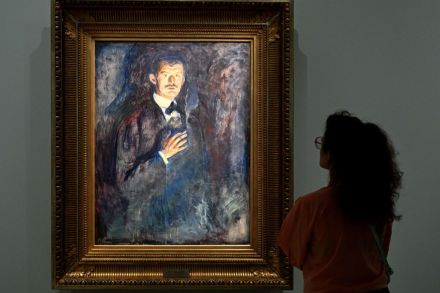
If you won the lottery tomorrow and suddenly had the money to invest in art, what would you prefer: a work from Picasso’s Cubist period (Guitar on a Table, 1919), or an NFT made from AI-based images and shapes? On the one hand, Picasso’s Guitar on a Table isn’t his most famous or even most interesting work — by 1919, the radicalism of Cubism had begun to wane. But on the other, NFTs are a relatively unproven market with dubious artistic merit, and have been linked to art crime, money laundering, and even allegations of human trafficking. If Picasso couldn’t persuade you to ditch the digital art, what about a painting by Renoir, a sculpture by Rodin, or a triptych of paintings by Francis Bacon?
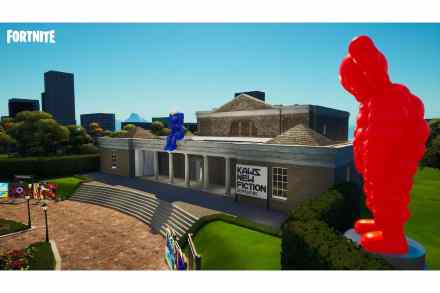
An ouroboros of vacuity that is immune to its own failure: Kaws online at the Serpentine Gallery

From our UK edition

The second most interesting thing about this digital exhibition is that it is not for art critics like me. I first had to download Fortnite, before bumbling through the introductions and menus for roughly half an hour, accidentally playing a match for a few minutes before figuring out how to access the ‘island’ in the game where one sees the exhibition. Once inside, Kaws’s usual character statues and cartoonish abstractions looked much worse than the photos online because my utilitarian laptop doesn’t have the processing power to run the game at high resolution. Needless to say, the recreation of the gallery space in the game is nothing like being in a gallery.

The art of storing and unveiling

From our UK edition

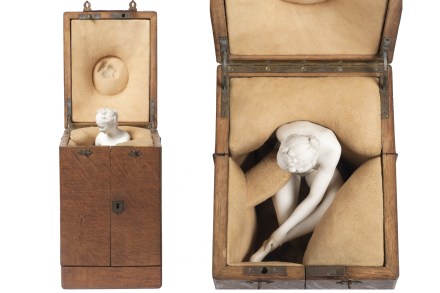
‘Put beauty first and what you get will be used forever,’ said Roger Scruton in his BBC documentary Why Beauty Matters. The philosopher’s neat elision of beauty and utility is perfectly embodied by Étienne Maurice Falconet’s nymph, who is to be the star of a forthcoming lecture by Waddesdon Manor curator Juliet Carey. This small marble figure would be far less remarkable were it not for the elegance of the 19th-century wooden box in which she is housed. Exquisite, flesh-like pillows of chamois fill the space around the nymph’s form: the box and the sculpture seem at one, as though locked in a dance. The nymph has been stored this way since the 19th century when Edmond de Rothschild commissioned a set of boxes for his collection from Chenue.

It’s almost touching that the NFT world sees itself as radical

From our UK edition

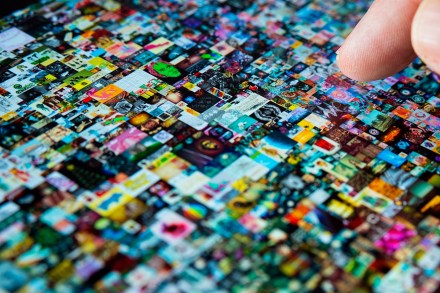
Some things are explained so many times that they become unexplainable: we can only relate to them as something complicated that needs to be explained. The global financial crisis was like this. Crypto-currencies were like this too. The newest thing that exists to be explained is the world of non-fungible tokens, or NFTs. NFTs are collectible digital objects. They are created with a technology called the blockchain, which unalterably and uniquely records their provenance. This means that if I mint an NFT of an image — a cartoon of Donald Trump, say, sitting naked astride the Capitol — I can prove definitive ownership of the image, no matter how many copies exist. In other words, NFTs can be authenticated, which means they can be sold.