Declaration of Independence

Will the Supreme Court allow a ‘creed’ to kill America?

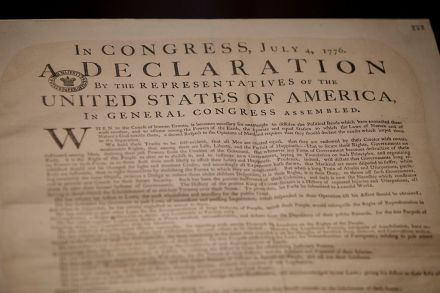
Supreme Court Justice Neil Gorsuch’s tour to tout his new children’s book about the Declaration of Independence should have been uneventful. But then Gorsuch decided to talk about what America is. On Fox News, with the New York Times and in the pages of the Wall Street Journal, Gorsuch kept staking out his view on what makes America special: America has no religion, no race, no people at all really, but instead a singular majestic idea. “We’re a creedal nation, right,” Gorsuch told the Times. “I mean, we don’t share a religion, we don’t share a race, we share an idea, OK? And that idea has to be passed down generation to generation through history, as we discussed.
The Senator from Virginia vs. the Declaration of Independence

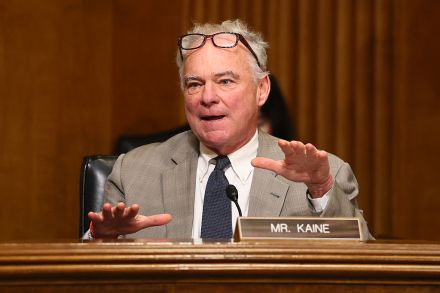
At a Senate confirmation hearing Wednesday, Senator Tim Kaine of Virginia – Hillary Clinton’s 2016 running mate – decided to pick a fight not with the nominee before him so much with the American founding itself. In a remarkable four-minute speech, clips of which went viral, Kaine challenged the very idea of natural rights – that is, the belief that human beings possess fundamental freedoms simply by virtue of being human, not because government chooses to grant them. His lecture was provoked by a seemingly uncontroversial statement.

Tim Kaine

Freedom is still the Revolutionary War’s legacy

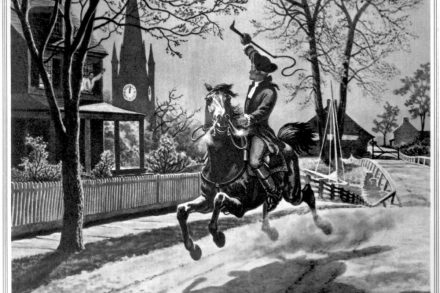
When the first shot rang out at dawn on Lexington Green, a decade of frustration and growing alienation between the American colonies and the British government boiled over into armed conflict. By the time the British staggered back into Boston on the evening of April 19, 1775, having fought a running battle for twenty-five miles from Concord’s North Bridge and losing at least 73 killed, the American Revolution had begun. Like many turning points in history, the encounter at Lexington Green was not planned. British troops acting on the orders of General Thomas Gage were on their way to capture arms and munitions stored by the Massachusetts militia when they ran into Lexington’s “Minutemen” drawn up on the Green.

Have Americans got George III all wrong?

Americans are rarely accused of underestimating themselves, but might they in fact be a greater people than they think? That thought has regularly occurred to me over the past three years while I was researching and writing my new biography of their last king, George III, and especially when I read Richard Brookhiser’s insightful comment in his recent book Give Me Liberty, where he points out that Britain’s thirteen American colonies in the 1760s and early 1770s were among “the freest societies in the world.

George iii