David miliband

Unite back Ed Miliband

From our UK edition

Ed Miliband has secured a clean sweep of the major unions. That poses Miliband a problem in the future – centrist opponents can characterise him as ‘the union candidate’ with all its negative connotations. In the meantime, Miliband’s chances of becoming the next Labour leader have been greatly enhanced.   Ed Balls, however, is effectively finished. Balls will recognise this, and will be considering his next move. Now his ambition is to be shadow chancellor, and, as Paul Waugh argued yesterday, David Miliband is the candidate most likely to offer him that, or so the theory goes.  It is, if you'll excuse the expression, all eyes on Balls.

Balls to back David?

From our UK edition

Paul Waugh sees it as his duty to pass on little drops of intrigue, and this one’s a dollop. If, as is expected, Unite back Ed Miliband tomorrow, the clapped-out Balls juggernaught will finally croak: there is no chance of him winning without Unite’s backing. There is a widespread rumour that Balls will pull out and back David Miliband. Waugh explains why: ‘The scenario painted to me is this: by dropping out and backing David M, his chances of becoming Shadow Chancellor are greatly enhanced. (The assumption here is that Ed Mili can't offer him Shadow Chancellor because the top of the ticket would just look too unbalanced...that's an assumption some will challenge).’ Only time will tell.

Brotherly love | 22 July 2010

From our UK edition

Ed Miliband will give his second preference vote in the Labour leadership contender to his brother, he tells the New Statesman’s Jason Cowley.   The Ed Miliband interview is part of a really rich set of profiles of the Labour leadership candidates. Diane Abbott inadvertently reveals that it is David Miliband who is taking the duties of a future Labour leader most seriously with her complaint that he is the leadership candidate who insisted on a meeting to find out what the duties of the victorious candidate would be at conference.    Both Eds offer quite left-wing prospectuses. Ed Balls argues that Labour didn’t lose because it lost touch with ‘middle England’.

David Miliband Makes a Fool of Himself

From our UK edition

I'm not convinced I share James's view that David Cameron's "1940 moment" counts as a howler, far less a "quite spectacular mistake" (and I suspect James doesn't really think it that either). It's pretty obvious that the Prime Minister simply slipped-up. I think he knows that in 1940 the United States had yet to enter the war and that it's abundantly obvious that he meant to say that the UK was the US's junior partner "in the 1940s". We know this because in his interview with Sky News Cameron was repeating lines he used in his Wall Street Journal column this week in which he wrote: I am hard-headed and realistic about U.S.-U.K. relations. I understand that we are the junior partner—just as we were in the 1940s and, indeed, in the 1980s.

Mandelson’s miscalculation

From our UK edition

Peter Mandelson’s decision to support Gordon Brown right to the end enabled him to cease being a purely factional figure in the Labour party. The multiple standing ovations he received at the last Labour conference were a recognition of that. As he put it, he was now the prince of stability not darkness. It was easy to see how Mandelson could become one of the elder statesmen of the party. But The Third Man has thrown all this away. Mandelson is once more a highly factional figure. He has admitted that he wouldn’t have stopped his Cabinet colleagues toppling Brown if they could have and that Labour would have done better at the election under a different leader.

The Balls deterrent

From our UK edition

There have been many interviews with Peter Mandelson this week, but I don’t think any of them have got as much out of him as Patrick Wintour has in today’s Guardian: ‘For he is quite clear in the interview that Labour would be probably be in power now if it had been possible for Brown to be replaced by a consensual alternative. "If you really force me, I think probably it would make a 20 to 30 seat difference to the result. They would have gone to 280 and we would have gone up to 270. They probably would have been the largest party, but not by a decisive margin." Asked why, then, he tolerated Brown's continuation in office he says: "I felt a sense of personal loyalty.

The unions start to swing behind Ed Miliband

From our UK edition

Bear with me, CoffeeHousers, while I return to the Labour leadership contest. You see, the GMB has this afternoon announced that it is backing Ed Miliband for the job – which is a fairly significant intervention. This is first endorsement from one of the major trade unions, and it overshadows the support that David Miliband has received from lower league organisations. The question now is whether Unite and Unison will follow GMB's lead. Many expect that they will. The influence of the unions in internal Labour elections has, in the past, been overstated. But there's reason to believe that they'll wield quite some power over this contest.

Labour still don’t get it

From our UK edition

As Pete asked at the weekend, will Labour ever start love-bombing the Lib Dems? Ed Miliband has mumbled that he wouldn’t oppose a possible Lib-Lab coalition, but that’s about it. According to the irreproachable Lord Mandelson, David Miliband and Ed Balls were opposed to a coalition and presumably remain so. Labour has greeted the government’s Liberal Democrats with jeers and contempt, particularly over the VAT rise, which passed last night without amendment. Now, John Denham, an arch-pluralist who has long dreamt of forming a ‘progressive coalition’, has told the Fabian Review that Nick Clegg would be the price of any Lib-Lab coalition.

Tony Blair, everywhere

From our UK edition

To be honest, these Mandelson memoirs are already losing their lustre. I was planning to do a summary of this morning's revelations, as yesterday – but swiftly lost the will. It's not that this first draft of New Labour's history is unappreciated, of course. But so much of it is just plain unsurprising: ministers thought Labour was cruising for an electoral kicking; Alistair Darling proposed a VAT hike; David Miliband was considering running for the leadership in 2008; and so on and so on. Sadly, it's not quite enough to enliven this grey morning in Westminster. One general observation does emerge from the latest extracts, though: the omnipresence of Tony Blair.

Mandelson and Miliband kick open the hornets’ nest

From our UK edition

Oh joy, Labour are at war again.  The animosities which have largely been kept in check since the election are now piercing through to the surface again – and it's all thanks to Peter Mandelson's memoirs.  After the ennobled one's insights about Gordon and Tony in the Times yesterday, Charlie Whelan is shooting back from the pages of the Sunday Telegraph.  And, elsewhere, Brown is said to have told friends that "this is going to be a very difficult time for me."  Yep, it's just like the glory days of last summer. Amid all this, there's a sense that Mandelson and David Miliband have coordinated their efforts to trash Brown and, by extension, his "advisers".

Miliband’s analysis simply confirms his own weakness

From our UK edition

John Rentoul, who knows a successful Labour leader when he sees one, is having palpitations about David Miliband’s latest hustings speech. Everyone seems to be in fact. I’ve taken a look, following the Berkeleian principle that if everyone thinks something is important it invariably is. It’s a good speech. At last, one of the Labour leadership contenders has attacked Gordon Brown. Under Gordon Brown, Miliband argues, Labour’s failings, spin and high-handedness intensified. An expression about Sherlock and excrement comes to mind, but the first stage in a party’s renewal is to admit defeat, acknowledge failure and offer contrition. David Miliband has begun that process, which can only serve him well.

David Miliband’s monetary advantage

From our UK edition

If cash was the one and only determining factor in elections, then David Miliband would have the Labour leadership contest sewn up.  As figures released today show, he's raked in a hefty £185,000 in donations to his campaign.  That's over 6 times more than Ed Balls has managed, and 12 times his brother's total. Miliband's monetary advantage is eyecatching in itself. But it also lets him trigger one of his electoral ploys. Smartly, if cynically, he has pledged to contribute one-third of his donations to a "fighting fund to help Labour win seats back at the next election". So the more cash he has in the coffers, the more he can hand over to Labour.

The side effects of the AV debate

From our UK edition

Ok, so the general public doesn't much care for this AV referendum – and understandably so.  But at least it has added a good slug of uncertainty into the brew at Westminster.  Already, curious alliances are emerging because of it – Exhibit A being Jack Straw and the 1922 Committee.  And no-one's really sure about what the result of the vote will be, or whether it will deliver a killing blow to the coalition itself. But regardless of what happens on 5 May 2011, it's clear that one group is already benefitting from the prospect of a referendum: the Labour leadership contenders.  Until now, they've been distinguished by their indistinguishability on policy grounds.

Three questions about the AV referendum

From our UK edition

So now, thanks to Left Foot Forward and reports this morning, we know: the referendum on an alternative vote system will take place on 5 May 2011, the same day as same day as the English local, Scottish Parliamentary and Welsh Assembly elections.  There are plenty of ins and outs, whys and wherefores - most of which are neatly summarised by David Herdson over at Political Betting.  But here are three questions that pop into my head, and are worth idly pondering on this sluggish Friday morning: 1) Does this strengthen the divide or weaken it?  Holding the AV referendum on the same day as local and regional elections was always on the cards: it's the best way to ensure a relatively high turnout, and it smoothes the logistics of it all.

Miliband stamps out an English battleground

From our UK edition

Well, CoffeeHousers, I've read David Miliband's article for the latest New Statesman so that you don't have to.  And let me tell you: it's classic Miliband the Elder.  Sure, the central theme - how Labour can reconnect in the English heartlands - is perceptive enough, and it runs through a few home truths which Miliband's opponents have avoided thus far.  But what could have been a passionate rallying cry ends up reading a little cool and dreary. I mean, "Labour needs a revived politics of Englishness rooted in a radical and democratic account of nationhood"?  Maybe so, but only the wonkiest of wonks will be nodding along enthusiastically. Nevertheless, one passage did jump out at me.

Are you serious Mr Miliband?

From our UK edition

Just before the voting on the Budget started, all Tory and Lib Dem MPs received a letter from David Miliband calling on them to vote against it. Attached to the letter were more than 1500 other signatories who Miliband had got to sign on to his letter online. It was a gimmick, but not a bad one.

Different Miliband, similar deceit

From our UK edition

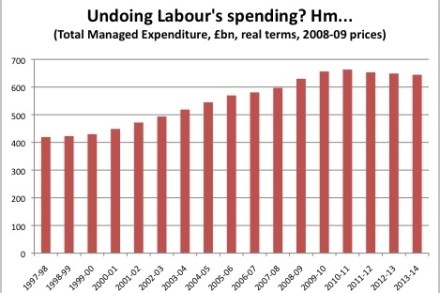
First, David Miliband was telling Brownies about the public finances.  Now, his brother's at it too.  Here's what he told the Daily Politics earlier: "Over thirteen years, Labour did increase spending on public services … In the coming five years, the Conservative coalition wants to undo all of that increase in spending.  So they want to return to a time before 1997.

Miliband the conman

From our UK edition

Who'd have thought it? There's David Miliband getting all self-righteous about the "cons" in George Osborne's Budget, when - oh dear - he slips in a small con of his own.  Here's the relevant passage: "[The Budget] was avoidable. Labour set out plans to cut the deficit by half over the next Parliament. The Tories have chosen to cut the whole of the deficit and more to the tune of £32billion in public services and £11billion in welfare." And here, going off Labour's own plans, is what he should have written: "[The Budget] was avoidable. Labour set out plans to cut the structural deficit by 'more than two-thirds' over the next Parliament.

Union backing is an indication of how far David Miliband has shifted to the left

From our UK edition

Paul Waugh has news that David Miliband has received the backing of USDAW, the shop workers’ union. Block union voting is a thing of the past, but this endorsement is a surprise nonetheless. It’s lazy to categorize Miliband as a ‘Blairite’, but he is certainly on the right of the party – vigorously pro-European, pro-business and an avowed social democrat. USDAW’s general secretary John Hannett is said to be impressed by Miliband’s defence of Labour’s record in office. To be honest, Diane Abbott is the only candidate who has lacerated the Blair/Brown governments, all the others are ‘proud of our record in government but recognise the need for change.

Miliband turns Brownite

From our UK edition

Well done David Miliband, for writing an article in the Guardian that is free of wonkery and abstractions. Miliband deserves applause for being the first Labour leadership contender to address public spending cuts with reasoned analysis, not ideological retorts. Also, he is right to urge George Osborne not to sell the public stakes in RBS and Lloyds at a bargain price. But his central thesis merits censure. He perverts recent history to fit an avowedly left-wing analysis of public spending. Miliband writes: ‘Let's take the deficit argument head on. We need to remember what the Tories want the country to forget: it was falling tax receipts – not rising spending – that primarily caused the deficit to rise.