David cameron

David Cameron’s draft resignation letter in the event of a Yes vote

From our UK edition

As told to Jonathan Foreman... To my fellow citizens I would like to apologise for the role I have played in the dismantling of the United Kingdom. I am sure there is little need for me to tell you that I never dreamed that my Prime Ministership would be the Union’s last, or that I would be the person ultimately responsible for the needless destruction of one of the most successful polities in the history of Europe and indeed the world. However, I must take responsibility for what has happened. First of all, the blame is mine for allowing the referendum question to be worded in a way that inevitably favoured the secessionist cause. As is obvious now, I should have insisted on wording such as: 'Do you think Scotland should leave the United Kingdom?
David Cameron’s final plea to Scottish voters

From our UK edition

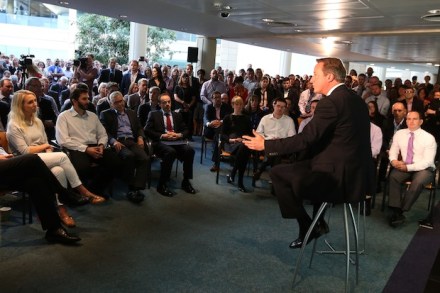
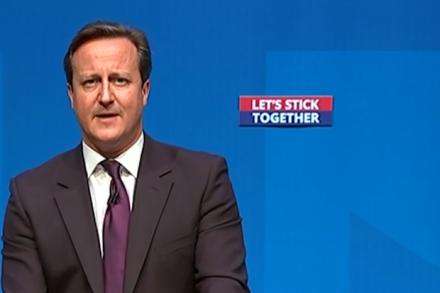
David Cameron has just delivered one of the best speeches of his career in Aberdeen. It was emotional, sincere, clear. The Prime Minister pleaded with Scots to stay in the United Kingdom. It ranged from warnings that this would be a permanent separation - 'when people vote on Thursday they are not just voting for themselves, but for their children and grandchildren and the generations beyond'- to powerful images of something the peoples of the Union have built being torn apart: 'For the people of Scotland to walk away now would be like painstakingly building a home – and then walking out the door and throwing away the keys. So I would say to everyone voting on Thursday, please remember. This isn’t just any old country. This is the United Kingdom. This is our country.

Like it or not, Isis are Muslims. Calling them ‘monsters’ lets us off the hook

From our UK edition

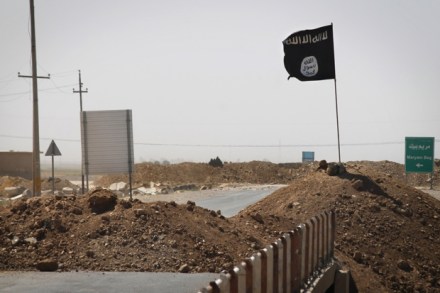
There are various pieties that politicians observe in the wake of some barbarity committed by Islamic fundamentalists and duly David Cameron observed them in his statement yesterday about the murder of David Haines. Of the perpetrators, he observed: 'They are killing and slaughtering thousands of people – Christians, Muslims, minorities across Iraq and Syria. They boast of their brutality. They claim to do this in the name of Islam. That is nonsense. Islam is a religion of peace. They are not Muslims, they are monsters.' I really wish he wouldn’t. It doesn’t add anything whatever to our understanding of Isis to say that they are not Muslims but monsters.

What would the Tory party really do if Scotland voted ‘yes’?

From our UK edition

Even when it is at peace, the Conservative party deals in hypotheticals all of which involve David Cameron being ousted in one way or another. That's why backbenchers have been wargaming what will happen to David Cameron if Scotland votes 'Yes' next week. It's why 1922 Committee executive members have been calling fellow MPs, or pouncing on them in the corridors (one spent a good long time lurking in one particular corridor in Parliament yesterday, snaring backbenchers) to find out what they would do if the worst happens in the referendum. Everyone agrees that a 'Yes' vote would be seriously damaging to the Prime Minister and that it would lead to a vote of no confidence. Serial troublemakers are making detailed plans for this to happen.

Podcast: Stay with us, Scotland!

From our UK edition

With only seven days to go until the referendum, urgent action is needed to help save the Union. In this week’s issue, we asked Spectator readers to write to Scottish voters, saying why they are hoping for a ‘No’ vote. The response was extraordinary. You can read some of the letters here. Fraser Nelson is joined by Tom Holland and Leah McLaren to discuss what else can be done to save the Union at this late stage. They also take a look at Canada and Quebec, and how their union managed to survive not one but two referendums. It’s safe to say that Westminster has gone into full panic mode. If a ‘Yes’ vote passes, Cameron and Miliband’s jobs could both be on the line. But how should they respond to the threat of the country breaking up?

What it means for your savings if Scotland votes yes

From our UK edition

[audioplayer src="http://traffic.libsyn.com/spectator/TheViewFrom22_11_Sept_2014_v4.mp3" title="Fraser Nelson, Tom Holland and Leah McLaren discuss how we can still save the Union" startat=50] Listen [/audioplayer]I bet that until a few days ago you thought the referendum in Scotland was a mildly amusing sideshow. Perhaps you still do. Perhaps you are convinced that the ‘silent majority’ that Better Together are so sure will step up to the plate at the last minute really exist. Perhaps you think that the reasons many people are giving for voting ‘yes’ are so vague that voters will change their mind on the day. Or even if they don’t you might think it is all an irrelevance.

The result of the Scottish referendum will be seismic whether yes or no

From our UK edition

It is very difficult to see how David Cameron would survive a 'Yes' vote in the Scottish referendum. There are certainly Conservatives who are making detailed plans to oust the Prime Minister if Scotland does vote to leave. But it is also worth noting that a 'No' vote would not ensure an easy ride for the Conservative leader with his party. A number of Tory backbenchers are unsettled by the speed at which the parties have moved to promise devo-more. They say they can't see the point at which the government moved from resisting devo-max to all three Westminster parties promising a significant transfer of powers. And they will cause trouble on the English question.

Cameron and Miliband have panicked well today

From our UK edition

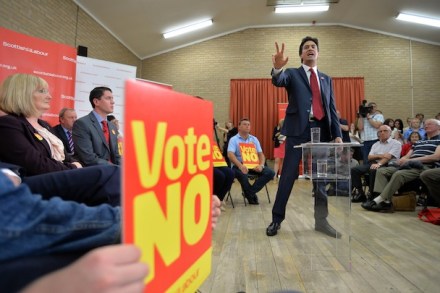
While Westminster sent its own plea to Scottish voters, David Cameron and Ed Miliband were both making fine, impassioned speeches that both tried to scotch the SNP line that a 'Yes' vote was the only way to achieve a fairer Scotland. David Cameron had to address to specific - and quite beguiling - argument that this is Scotland's chance to get rid of the Tories, that from independence onwards, it will never be governed by parties poorly represented within its borders. He did so by being a little attention-seeking: 'I think the third thing that can come across in the remaining part of this campaign is the scale of the decision that Scottish people will be taking in eight days' time.

Cameron, Clegg and Miliband head to Scotland to make the case for the Union

From our UK edition

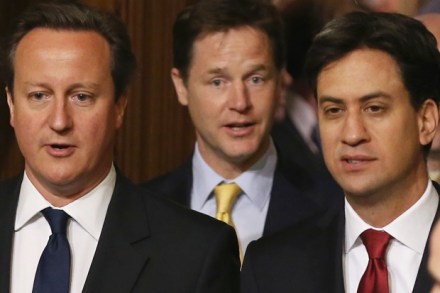
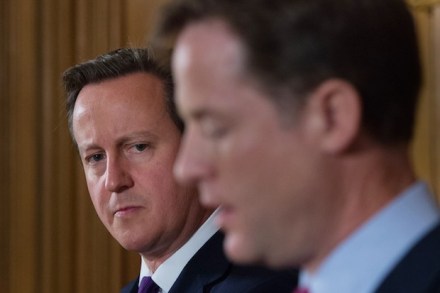
David Cameron, Nick Clegg and Ed Miliband are combining forces and heading to Scotland tomorrow to make the case for the UK. Here's their joint statement: 'There is a lot that divides us - but there's one thing on which we agree passionately: the United Kingdom is better together. That’s why all of us are agreed the right place for us to be tomorrow is in Scotland, not at Prime Minister’s Questions in Westminster. We want to be listening and talking to voters about the huge choice they face. Our message to the Scottish people will be simple: "We want you to stay."' The presence of the three party leaders is meant to show that Westminster will deliver on its promises about further devolution to Scotland.

Cameron and Clegg’s last-ditch attempts to save the Union

From our UK edition

After the panic in Westminster over the weekend about the Sunday Times' poll putting 'Yes' in the lead came the something-must-be-dones. David Cameron said he would 'strain every sinew' to fight for a 'No' vote. But today his official spokesman was quizzed on the suggestion that he might have pulled out of a planned visit to Scotland this week (James reported in his Mail on Sunday column yesterday that the Prime Minister would stay down south this week 'to leave the coast clear for Labour'). The spokesman said: 'The Prime Minister will be in Scotland ahead of the election…There has been no change to the plan.

The unions hated Gove because he actually cared about social mobility

From our UK edition

There’s an interesting interview in The Guardian this weekend with one of the most famous teachers, or ex-teachers, in Britain, Katharine Birbalsingh. You’ll probably know her. She’s the woman with fabulous hair who got a standing ovation at the Tory Party conference for a speech about a broken education system – ‘it’s broken because it keeps poor children poor’ – which confirmed the existence of ‘a culture of excuses, of low standards”. It was more or less a vindication of Michael Gove, then Education Secretary, and all he stood for. Now she says she regrets that speech – ‘it ruined my life. I should probably have kept my head down’.

Letters: Andrew Roberts on Cameron, and a defence of Kate Bush

From our UK edition

Advice for Cameron Sir: David Cameron once saved my life from a school of Portuguese man o’ war jellyfish, so now’s the time for me to save his political life with this advice: to do nothing. The British people are a fair-minded lot; they will give him another term in office because he and George Osborne have delivered the best growth rates in Europe despite the monstrous overspending and boom-bust of the Blair-Brown years. Every newly incoming ministry since the war has been re-elected — except Ted Heath’s, which broke all the rules anyhow — and this one will be too. Douglas Carswell is an intelligent man who has made a stupid mistake.

Can the Tory party locate its secret weapon?

From our UK edition

It used to be said that loyalty was the Tory party’s secret weapon. But this supposed strength hasn’t been very apparent in recent years. Indeed, at times, it seems that the Tory party hasn’t quite recovered from the demons unleashed by Margaret Thatcher’s ouster twenty-odd years ago.   Douglas Carswell’s defection means that Westminster, when it is not panicking about the Scottish referendum, is chuntering about whether his move to Ukip is the harbinger of a bigger Tory split to come, one that The Spectator explores this week. Worryingly for the Tory loyalists, there are people on all sides of the party are preparing for this fight.  As one Tory MP tells me, ‘It has that civil war quality to it: people just want to harm the other side.

Podcast: Tory civil war, Scotland’s political soul and naked photos of celebrities

From our UK edition

Do the Tories think they’ve already lost the election? Their behaviour is certainly beginning to suggest so. In this week’s issue, James Forsyth and Isabel Hardman discuss the civil war that is raging in the Conservative party. A party that should be readying itself for victory is now preparing to tear itself apart in opposition. But can Cameron do anything about this? Isabel, James and Fraser Nelson weigh up his options in this week’s podcast. It’s a different story up in Scotland. The referendum debate has ignited politics, and galvanized both sides of the political spectrum.

Support grows for British air strikes against Isis

From our UK edition

If there is a strategy buried under the 'no strategy' response by the US and the UK to Isis, it seems to be that David Cameron and Barack Obama have preferred to make the case for greater military involvement by waiting for everyone else to get frustrated that nothing is happening. Where a few weeks ago, there was plenty of muttering about the polls and the public being weary of intervention, we see today that voters are starting to push for greater UK involvement. They are not, of course, in favour of boots on the ground (one of those phrases that is as worn out now as a very old boot, along with 'knee-jerk response'): the Sun's poll finds 58 per cent of voters are against ground troops.

Justine Greening interview: ‘It’s about understanding what it’s like to start from scratch’

From our UK edition

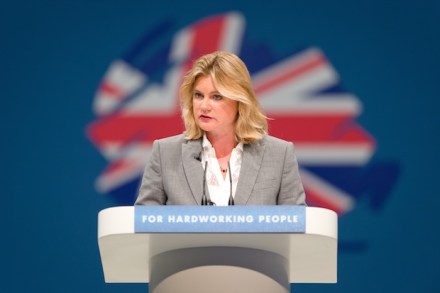
[audioplayer src="http://traffic.libsyn.com/spectator/TheViewFrom22_4_Sept_2014_v4.mp3" title="Isabel Hardman, Fraser Nelson and James Forsyth discuss the Tory civil war" startat=60] Listen [/audioplayer]Justine Greening wants to talk about social mobility. If it is not immediately obvious why the Secretary of State for International Development wants to talk about this issue, it becomes clear. Growing up the daughter of a steel worker gave her an insight into what it’s like to struggle, she tells me, when we meet in a conference room overlooking Parliament Square. She says she feels that the Tories are not pushing as hard on social mobility as they ought to be. Ms Greening thinks the issue needs a champion.

Justine Greening: Cameron’s government needs more people who have worked at Morrisons

From our UK edition

[audioplayer src="http://traffic.libsyn.com/spectator/TheViewFrom22_4_Sept_2014_v4.mp3" title="Isabel Hardman, Fraser Nelson and James Forsyth discuss the Tory civil war" startat=60] Listen [/audioplayer]David Cameron is in need of advice right now and there’s plenty of it in the new Spectator – not least from Justine Greening, his International Development Secretary. Her interview with Melissa Kite makes clear that the party needs to focus more on social mobility – and tell the story which is not exactly hardly embodied by its Etonian and Pauline leadership.

PMQs sketch: Was Carswell right all along?

From our UK edition

Calamities crowd in every side. Nuclear-armed Russia is already waging war with Europe, according to our NATO ally, Lithuania. At home, Douglas Carswell’s defection threatens to rob the Tories of power. Yet these crises were barely mentioned at PMQs. One source of international conflict has been resolved, at last. Is the name Islamic State? Or is it ISIS? Or is it IS? Or is it Isil? Isil it is. Both leaders used that term today as they condemned the latest savageries. Cameron made a vague attempt at karaoke Churchill. And no one particularly minded that it wasn’t up to much. ‘A country like ours will not be cowed by these barbaric killers … Our opposition to Isil will continue, at home and abroad. ... We will not waver in our aim of defeating terrorism.

Justine Greening: the Tory message on social mobility ‘has been diluted’

From our UK edition

This feature is a preview of this week's Spectator, out tomorrow: Justine Greening wants to talk about social mobility. If it is not immediately obvious why the Secretary of State for International Development wants to talk about this issue, it becomes clear. Growing up the daughter of a steel worker gave her an insight into what it’s like to struggle, she tells me, when we meet in a conference room overlooking Parliament Square. She says she feels that the Tories are not pushing as hard on social mobility as they ought to be. Ms Greening thinks the issue needs a champion. She never says so explicitly, but clearly this is her pitch to take on that mantle.