Dating

Real life | 23 February 2017

From our UK edition

Unexpectedly re-available is a very good phrase. I have often seen it applied to house advertisements and thought how fabulously impertinent it sounds, so I am asking the agents to attach it to the description of my flat now that it is back on the market after a right old hoo-ha with the buyer from hell. Unexpectedly re-available is a grammatical tongue-twister, and a euphemism that manages to be both enigmatic and facetious at the same time. I also like it because it speaks to me on a personal level. I have been unexpectedly re-available countless times and I wish I had thought of saying so whenever I went on one of those dreadful dating websites. Unexpectedly re-available, due to time wasters. Well appointed, in good decorative order. Traditional yet versatile.

The pick-up artists who seduced a country

From our UK edition

Many years ago, when I was a mere slip of a features journalist, I spent a weekend learning how to be a pick-up artist. Amazing. You assume it won’t work, that sort of thing, but it totally did. Towards the end of the second night, having not said an unscripted word in about half an hour, I found myself in the VIP room of a London nightclub, being gazed at in rapt adoration by a wildly attractive twentysomething blonde. Seriously, people don’t normally look at me like that. It was special. And then I ran away, terrified, because I had a girlfriend. My guide through all this was a man called Neil Strauss, author of a book called The Game.

Dating apps are making mixed-attractiveness couples a dying breed

From our UK edition

“Is she really going out with him?’ asks the old Joe Jackson song about a mixed-attractiveness couple. ‘They say that looks don’t count for much — there goes your proof.’ High society used to abound with couples in which the woman was far more beautiful than the man. But while we can still point to famous aesthetically mismatched partners (pudgy Trump and pulchritudinous Melania anyone?), the mating patterns of the young now mean we are witnessing the death of the mixed-attractiveness couple. This is thanks to the way millennials fall in love — more often than not, online. They flick through potential matches on sites such as Match.com and MySingleFriend with distressing rapidity, discounting anyone they don’t fancy straight away.

The perfect mismatch

From our UK edition

“Is she really going out with him?’ asks the old Joe Jackson song about a mixed-attractiveness couple. ‘They say that looks don’t count for much — there goes your proof.’ High society used to abound with couples in which the woman was far more beautiful than the man. But while we can still point to famous aesthetically mismatched partners (pudgy Trump and pulchritudinous Melania anyone?), the mating patterns of the young now mean we are witnessing the death of the mixed-attractiveness couple. This is thanks to the way millennials fall in love — more often than not, online. They flick through potential matches on sites such as Match.com and MySingleFriend with distressing rapidity, discounting anyone they don’t fancy straight away.

Mrs May the ‘Student Killer’ should count the cost of her visa crackdown

From our UK edition

In the post-Brexit landscape whose shape was barely glimpsed in G20 discussions at Hangzhou, one thing is clear: soon we’ll have to stop waffling about trade deals and start pushing British products the world wants to buy. One such is education, at our universities, independent schools and English-language colleges — an export sector calculated in 2011 by the now defunct Department for Business, Innovation and Skills to be worth £17.5 billion. Not only does this sector attract foreign exchange, plug funding gaps for cash-strapped universities and support thousands of jobs, it also lays the ground for future relationships with students who return home to embark on business careers.

Your problems solved | 9 June 2016

From our UK edition

Q. When going out to dinner I’ve found some people will send everyone a list of the other guests so we can avoid the ‘What do you do?’ questions. I’ve now taken to doing it myself. I like this approach. However, when I asked a friend to tell me who my fellow guests would be at her dinner party, she became very angry and refused. As a result I missed talking to someone I really wanted to meet until we were putting out coats on to go. Is it very naff to provide pre-lists? J.T., London W11 All guests would much rather know who else is coming, what they do and what the gossip is — but to circulate an advance list is a bit unsubtle and smacks of networking.

One night in the backwoods

From our UK edition

When I was 38, I let a drunk pick me up in a bar. You know, just to see if I still had it. It was raining. It was a November evening, and I was somewhere in the backwoods of the Adirondacks. I was driving from Rhode Island to Toronto, staying in motels. Taking my time. Getting lost. His name was Billy Ray and he was from the south. The land of Spanish moss and blurred boundaries and antique sentences delivered in a languid drawl. Beautifully dressed, an elegantly ruined bachelor of 48, he looked 65. He said he was related to the man who had invented Coca-Cola and had never had to work. ‘I really have had the most wonderful life, you know.’ I had started talking to him because he looked more interesting than the book I was reading.

Why women shouldn’t be expected to go Dutch on dates

From our UK edition

I have a female friend who refuses to let men pay for dinner on dates, no matter how much they insist on picking up the tab. She’s not alone: many women feel that if they want equality and agency, they have to hand over their credit card at the end of a romantic meal. I, on the other hand, feel surprised and a little affronted on the rare occasion when a man expects me to go Dutch, for one simple reason: women spend such a disproportionate amount of time and money getting ready for dates, we shouldn’t be expected to pay extra for dinner. This week, a Twitter hashtag called #HowToGetReadyForADate started trending. Most of the tweets were jokes, but many also referenced the amount of time women take to prepare for a date versus men. From a man: 'Showering is overrated.

The Spectator podcast: Brexit, and the return of political lying | 28 May 2016

From our UK edition

To subscribe to The Spectator’s weekly podcast, for free, visit the iTunes store or click here for our RSS feed. Alternatively, you can follow us on SoundCloud. Are David Cameron and George Osborne using the same techniques of deceit deployed by New Labour in the run-up to the Iraq war? In his cover piece this week, Peter Oborne argues that's just what is happening. He says that in their EU campaign, the Chancellor and Prime Minister have put dirty tricks back at the heart of government. But Matthew Parris in his column says that in politics there’s no point complaining about being lied to. That’s the cry of the bad loser. Both Peter and Matthew join Fraser Nelson on the podcast.

Dating stinks

From our UK edition

[audioplayer src="http://feeds.soundcloud.com/stream/265889180-the-spectator-podcast-the-lying-game-the-art-of-post.mp3" title="Ariene Sherine and Cosmo Landesman discuss dating" startat=1244] Listen [/audioplayer] I am crouching with a tall paper bag over my head, with holes cut out for eyes, nose and mouth, while sniffing a stranger’s hairy armpit. All the faces around me are equally obscured by paper bags, and each is inhaling the scent of underarms; we look for all the world like a very niche branch of the Ku Klux Klan. This is not a gathering of white supremacists or strange fetishists, but an ultra--modern speed-dating night called Romancing the Armpit, and I am here to find love.

The Spectator podcast: Brexit, and the return of political lying

From our UK edition

To subscribe to The Spectator’s weekly podcast, for free, visit the iTunes store or click here for our RSS feed. Alternatively, you can follow us on SoundCloud. Are David Cameron and George Osborne using the same techniques of deceit deployed by New Labour in the run-up to the Iraq war? In his cover piece this week, Peter Oborne argues that's just what is happening. He says that in their EU campaign, the Chancellor and Prime Minister have put dirty tricks back at the heart of government. But Matthew Parris in his column says that in politics there’s no point complaining about being lied to. That’s the cry of the bad loser. Both Peter and Matthew join Fraser Nelson on the podcast.

Love at first sight | 31 March 2016

From our UK edition

Now the kids are back for the school holidays, I have a licence to watch complete trash again. No more brooding Scandi dramas (though Follow the Money is shaping up very nicely — plus, as an added bonus, its anti-windfarm theme is really winding up Guardian readers) — just pure televisual soma, such as the masses use to anaesthetise themselves after another thankless day in their veal-fattening pens. First Dates (C4, Fridays), for example. You wouldn’t want to pig out on more than one episode at a time but it’s about as perfectly formed a TV experience as you’ll get: you laugh, you cry, you gawp, you cringe; you feel uplifted by the stories with happy endings and reassured by the ones without as you realise — hurrah!

Dear Mary | 17 March 2016

From our UK edition

Q. I have a deep crush on an army officer I’ve met through work. He is decisive, practical and doesn’t waste a word. I am charmed. How can I hint that I’m interested and would like to be asked out? We are due to meet in about a month’s time. I am almost 40 and haven’t dated properly for years post a brief marriage. He, I suspect, is mid-to-late forties. My 21-year-old students suggest asking him for a drink. Surely not? Any advice? He is shorter than me by the way. — Name and address withheld A. Virtually all nice men are shy of making passes and will do so only if certain that there is no risk of rebuff. Look for a (short) play or concert local to your meeting, ideally in a small pop-up venue.

Letters | 3 March 2016

From our UK edition

What might have been Sir: Harry Mount points out that Boris Johnson is two years older than David Cameron (Diary, 27 February). Both, however, began their careers in the same year. On 15 June 1988 I interviewed David Cameron for a post in the Conservative Research Department; on 26 July it was Boris’s turn (‘Johnston’ in my diary). The former was signed up to cover trade and industry issues (memorably forgetting the trade figures when Mrs Thatcher asked him for them). Boris was invited to follow in the footsteps of father Stanley, who had been the department’s first environment expert in the Heath era. But journalism lured him away. Would they have forged a lifetime’s close and harmonious friendship if Boris had reached a different decision?

Whatever happened to ‘Snog first, talk later’?

From our UK edition

Sometimes I sit my nieces down and treat them to tales of dating in the dark ages, before iPhones arrived to save teenkind. Poor nieces. Though they scuff their Uggs on the carpet and stare longingly at the door, I carry on. When I was your age, I say, we had no access to boys. Those of us at mixed schools had a few limp options, and the rest relied on miracles: a hottie met by chance on holiday; a friend’s brother’s friend. There was no social media, no looking someone up, so unless you bagged your hottie sharpish he vanished. Boys surfaced like rare sea-mammals for single sightings before sinking back into the fathomless unknown. No googling! Can you believe it, nieces? They can’t. They’re the Snapchat generation, born as the century turned.

Erica Jong’s middle-aged dread

From our UK edition

Who’d get old? Bits fall off, your loved ones start dropping like flies and, perhaps worst of all, the only afternoon delight you’re up to is a cup of tea and a soporific radio play. Wealthy New Yorker Vanessa Wonderman, Erica Jong’s 60-year-old narrator, isn’t there yet, but she can see it coming down Fifth Avenue with its headlights on. Her parents are slowly and painfully quitting the world; her husband Asher, 15 years her senior, is succumbing to illness and certainly not capable of elaborate bedroom antics; and her acting career has faltered in the predictable absence of decent parts for middle-aged women.

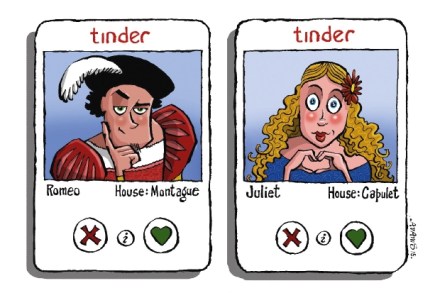
Not ready for real love? Tinder is the one for you

From our UK edition

There was once a time when finding a twenty-something on a dating site was as rare as finding a pensioner in a branch of a Hollywood Bowl. Having an online dating profile was a last-ditch attempt at love reserved only for those intent on finding a long-term partner. Match.com, E Harmony, Guardian Soulmates; the clue was in the name. An earnest, humourless amalgamation of abstract nouns promising everlasting love. They were websites that boasted of their high marriage rates and whose users all listed 'the great outdoors' as a hobby. Dating sites were not entered into lightly.

Podcast: why modern love is rubbish and is Ed Miliband an honourable opposition leader?

From our UK edition

In the age of Tinder and online dating, is modern love rubbish? On this week’s View from 22 podcast, Melissa Kite, Cosmo Landesman and Camilla Swift discuss this week’s Spectator cover feature on why romance is being killed off by digital dating. Is it more brutal or reflective of real life to ruthlessly chase someone on their looks alone through apps and websites? Is it a tragedy that young romantics are missing out on the art of courtship? James Forsyth and David Skelton also discuss the Tories’ gamble to woo working class voters ahead of the election.

I wouldn’t want to be a girl in the age of Tinder

From our UK edition

My foray into the world of online dating was short-lived. Within a few hours of my profile going live, a deluge of young men in their early twenties began to bombard me with messages. I was shocked and somewhat delighted. At my age, I had expected mostly sad widowers and maybe the odd divorced equine veterinarian, encouraged by the pictures of me on my horses. To attract a clamour of Ashton Kutchers was beyond my wildest dreams because, although I was now undoubtedly in the cougar age group, I really hadn’t seen myself as a Demi Moore. When I opened the messages, however, any notion that these handsome young men were about to whisk me on a romantic dinner date, then marry me on a windswept beach, evaporated.

Dear Mary: What can I do about my neighbours’ downmarket recycling?

From our UK edition

Q. Since recycling was introduced in our village, the wall at the end of our drive has become the depositing point for some neighbours as well as for us. Unfortunately their detritus is not sophisticated and while our green boxes are filled with wine bottles of respectable appellations, theirs is crammed with cheap lager tins. The recycling lorry comes before our friends are up so I’m not concerned about them, but more distant acquaintances on their way to work inevitably see the boxes, and we can’t invite them all to dinner to establish our credentials. How can we persuade our neighbours to keep their empties to themselves? — J.C., Taunton, Somerset A. This is a non-problem. In fact you should be pleased.