Conservative party

Playing the war game

From our UK edition

Over at ConservativeHome, Tim Montgomerie has written about a ‘war game’ that Portland PR held yesterday. The idea was to explore the various challenges that would face the next government. Portland had gathered together an impressive group including key Tory advisors, a senior figure from the Blair government, a former US government official, a senior military bod and a fair few hacks including yours truly. The thing that struck me once the exercise was done was just how buffeted by events the Cameron government is going to be. It will inherit a global situation that is as bad as the economic situation, if not worse, and a slew of other underappreciated problems such as the risk of an energy crunch.

Mission accomplished for Cameron’s cost-cutting speech

From our UK edition

So what has David Cameron achieved with his speech on "cutting the cost of politics" yesterday?  Quite a lot, judging by this morning's papers.  The coverage it receives ranges from wholehearted scepticism in the Guardian to front-page celebration in the Daily Mail, but - more importantly, from a Tory perspective - it steals the thunder from Alistair Darling's public spending speech.  The Chancellor's innuendo about "nasty Tory cuts" is much less resonant when juxtaposed against the Tory leader calling for cuts in MPs' perks, whether those cuts are regarded as populist or not. What's more, Cameron has drawn quotes from Labour and the Lib Dems that may look a little silly in time.

One giant leap for David Cameron?

From our UK edition

It's a busy day here at Spectator Towers, so we'll have more on Cameron's speech on "cutting the cost of politics" later.  For now, here's Sky's edited footage, and you can find a great summary over at ConservativeHome.

Sir George Young to replace Alan Duncan

From our UK edition

After Alan Duncan's demotion, it's emerged that Sir George Young is to fill the position of shadow leader of the Commons.  It's a canny move by David Cameron: Young is the chairman of the Commons' Standards and Privileges Committee, and was a popular choice among Tories to replace Michael Martin as Speaker.  As Paul Waugh says, Young did get the Telegraph Treatment, but you imagine he'll be seen as a much cleaner pair of hands than Duncan, especially in the wake of the infamous "rations" video.  Now, how long before someone points out that Young is another Old Etonian...

Alan Duncan demoted from shadow cabinet

From our UK edition

So was the "rations" video a gaffe too far?  The news has just come in that Alan Duncan has been demoted from the shadow cabinet, going from shadow leader of the Commons to shadow prisons minister.  Having spoken to various Tory sources, I understand that the decision was made in an "amicable" meeting between Duncan and Cameron – where the former acknowledged he has become a "lightning conductor" for public anger over expenses – and that, apparently, Duncan is "relaxed and relieved" to be working under Dominic Grieve. Some people might be surprised at the timing: many expected Cameron to hold off until next year, so as not to rile any backbenchers who broadly agreed with Duncan on expenses.

New Com Res poll has the Tories 16 points ahead

From our UK edition

Andrew Grice has just blogged about a new poll in the Indy tomorrow which has the Tories 16 points ahead. The poll also shows that the majority of the population favour scrapping Trident. However, the public wants real term increases in health and education spending every year.

Are the Tories actually doing ok in the North?

From our UK edition

Over at the indispensable UK Polling Report, Anthony Wells runs the rule over the latest Telegraph/YouGov poll: "The Telegraph today has looked at their Yougov poll and decided it shows the Conservatives doing badly in the North. For what it’s worth, it doesn’t even do that - it shows the Conservatives 2 points behind in the North, an aggregate of government regions in which they trailed the Labour party by 19 points in 2005 - so it actually shows a swing to the Conservatives of 8.5 points in the North, marginally better than this poll suggests they are doing in the country as a whole. That, however, is beside the point, since even if the Telegraph had correctly interpreted what the figure meant, it would still be meaningless.

Labour may outflank the Tories on health and overseas aid spending – but will struggle to do so on reform

From our UK edition

If you want some insights into where Labour are going next, then do read this story in today's Guardian.  The main points are that Brown and Darling have agreed not to spare the health and international development budgets from cuts; that Labour's public spending cuts will be set out over the next couple of months, beginning with a couple of speeches this week; and that Labour wants to frame its cuts as a return to the public service reform agenda.  As one "cabinet source" tells the paper: "The new economic context is a challenge for us, but New Labour in its original form never saw spending more money as the only solution. We need to revisit the original New Labour approach of public service reform.

Buckingham Conservative Association Executive Committee stands behind Bercow

From our UK edition

Tim Montgomerie reports that a senior source at CCHQ has said that John Bercow will not stand as an official Conservative candidate at the general election, and therefore party members will not be required to vote for him.   So, will they be for or against Bercow? Councillor Netta Glover, the Buckingham Association’s deputy chairman and political officer, told me that the executive committee were “standing firm behind Mr Bercow”, and that Tory party rules stated that “anyone seeking an official nomination against the speaker would be barred by the returning officer” – so de-selection can be discounted.

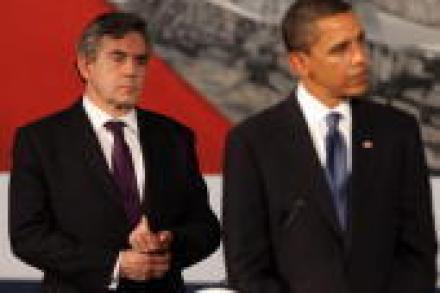
Obama and Cameron: who thought what about whom?<br />

From our UK edition

Remember that New Statesman article about Obama calling Cameron a "lightweight"?  Well, the Journalist Closest to Obama, Richard Wolffe, has a different take.  Here's what he told the Today programme this morning, courtesy of the ever-alert Andrew Sparrow: "He had a strong impression, a strong reaction, to both Cameron and Brown. It was right at the end of his foreign trip. And he was really taken with Cameron. He and his aides thought that he had energy and verve, a dynamism that suggested he was a good candidate – remember this was a candidate at the time, not a president. And there was bonding that took place which you might not expect of two people at the opposite ends of the political spectrum.

If Britain hasn’t returned to growth by the end of the year, will it still be ‘no time for a novice’?

From our UK edition

Looking at the OECD’s latest economic forecast it seems that the UK—unlike the US and the Euro-Zone--will not return to growth by the end of this year. (Although, one can’t help but wonder if Brown will start heralding zero percent growth in the fourth growth). Indeed, the OECD projects that the UK economy will shrink by 4.7 percent over this year as a whole—although the worst appears to be behind us with the rate of shrinkage slowing since the last quarter of 2008 and the first quarter of this year.   As Kevin Maguire suggests today, Labour’s election strategy is likely to be that Britain is not out of the woods yet and so it is still no time for a novice.

Can Cameron learn from Wilson?

From our UK edition

Few Tories will enjoy looking back on 1974, but they may find it useful to study the second Wilson government and its successor, the Callaghan government, when it comes to the question of Europe.  Back then, we had a government coming to power in the midst of a severe economic climate, and which sought to change the pro-European course that its predecessor had set, including by re-negotiating Britain’s relationship with the EU and by appealing to fraternal parties in France and Britain. However, it ultimately ran into blades of domestic discontent and international indifference. The question is: could this end up being the story of a Conservative government from the middle of next year? Sure, there are key differences between then and now.

The Sky debate could be a lifeline for Brown

From our UK edition

As the Megrahi case grows more serious by the day, one thing should be cheering up those in the Brown bunker: Sky’s plan to host a debate among the party leaders. Now, Brown might be the only party leader yet to have agreed to the debate but he is the one with the most to gain from it. If Brown is to have any hope of stopping David Cameron from winning the next election outright, he needs a game changing moment—and a debate might just produce one. The first televised leaders’ debate will be a hugely hyped event. One has to imagine that it would draw a huge TV audience and a ton of media coverage. It would provide the clunking fist with the perfect platform to land a blow on David Cameron.

Cameron should be wary of taking the moral high ground in opposition

From our UK edition

I’ve just re-read Cameron’s article in the Times and it contains one section that might come back to haunt him, should he become Prime Minister. He writes: ‘Many will be disgusted by the suggestion that ministers in Whitehall encouraged al-Megrahi’s release — and did so for commercial reasons. Diplomacy often involves hard-nosed backroom deals. It would be naive to think otherwise. But there need to be lines you are not prepared to cross; values you will not compromise, whatever deal you broker. I believe even to hint that a convicted terrorist could be used as makeweight for trade is a betrayal of everything that Britain stands for.’  I agree with Cameron.

Cameron is the winner of the al-Megrahi scandal 

From our UK edition

It is clear that the al-Megrahi release has damaged Labour, not least because their collective refusal to condemn, or at least have an opinion on, the release of the Lockerbie bomber has confirmed that the government is totally out of touch with public opinion. On the other hand, David Cameron has played a blinder. In stark contrast to the Prime Minister’s Trappist monk act, Cameron has led this issue, voicing considered condemnations of Kenny MacAskill’s decision, the government’s reticence and the its supposedly ethical foreign policy. Cameron writes a piece in today’s Times branding the entire affair a ‘fiasco’ and a ‘failure of judgement by the Scottish government...the British government...and the Prime Minister’.

Political viewing

From our UK edition

If you feel like wearing a political anorak on this sunny bank holiday Monday, then here's a video history of the Conservative Party which the Tories have updated for the launch of the new 'History' section on their website. Alastair Cooke introduces the whole project on the Blue Blog, here.

Lisbon treaty moves closer, but Tories stay mum

From our UK edition

Sometimes if you fear something intensely or hate something very strongly, it can cloud your otherwise excellent judgement and analytical foresight. That seems to be happening to many euro-sceptics when they talk or think about the Lisbon Treaty and the forthcoming second Irish referendum. They do not like the treaty and so will find it almost unthinkable that the Irish will vote yes. But a 'yes' vote looks like the most likely scenario.  That will mean that the British Conservatives have to be less mealy-mouthed about their post-referendum strategy; if the treaty is ratified will they try to re-open the document if they win power or let sleeping dogs lie?

The Tories’ tax question

From our UK edition

So should the Tories announce tax rises ahead of the next election?  According to Andrew Grice in today's Independent, they're certainly thinking about it: "There is a growing recognition among shadow Cabinet ministers that, if they win power, spending cuts could only be half the picture, as they would also need significant tax rises to fill the black hole in the public finances. That is why Mr Cameron and George Osborne won't rule out tax increases. The big debate among the Tory high command now is whether to announce some tax increases before the general election. Mr Cameron is reluctant to unveil a detailed 'shadow Budget'.

Public scepticism about Labour’s record on education

From our UK edition

Isn't it funny how things work out?  I imagine the government once thought they'd get credit for the ever-improving GCSE and A-level pass rates, but now results day just rekindles the debate about slipping standards - and rightly so.  Ed Balls may have tried to divert attention on to the Tories this morning, but he can't really escape the verdict of this ComRes poll commissioned by Newsnight.  Here are the main results: 67 percent of respondents said Labour hasn't lived up to Tony Blair's "education, education, education" vow. 52 percent said Labour hasn't improved the overall quality of education.  41 percent said they have. 47 percent said the standard of state education has deteriorated since 1997.  43 percent said it hasn't.

Is Theresa May priming a second Freud Review?

From our UK edition

In some respects, Theresa May has delivered an effective speech on unemployment and the benefits system today.  It touches on all the tragic indicators - the 6 million people on out-of-work benefits, the high levels of youth worklessness, the shocking consequences of welfare ghettoes etc. - and re-states, in no uncertain terms, the Tories' commitment to welfare reform.  She even partially responds to those critics who thought she'd been drafted into the shadow welfare role to be "softer" on single mums than Labour, by instead attacking the state for encouraging lone parents "not to bother trying to work until their youngest child was sixteen".