Conservative party

One Nation

From our UK edition

David Cameron received a standing ovation after he proclaimed “Don’t dare lecture us about poverty”,  illustrating that compassionate conservatism is a central issue to the Conservative party. Today, David Cameron will set out his blueprint to eradicate poverty, which, together with education reform and the promotion of the family, form the compassionate case. Cameron is expected to say: “Our alternative to big government is not no government. Our alternative to big government is the big society, but we understand that the big society is not just going to spring to life on its own: we need strong and concerted government action to make it happen. We need to use the state to remake society.

The pressure’s on Osborne

From our UK edition

The Times tempted fate today with its splash boasting about the confidence and the strong pound. Fitch Ratings has today said that Britain’s AAA debt rating is more at risk than that of any other major nation because it needs “the largest budget adjustment” - ie, the most cuts - because Britain has the largest fiscal mess, and by some margin. (Sterling is off today on the news). But then Fitch says, more or less, that it’s banking on George Osborne’s first budget to sort the mess out. “Our stable rating outlook reflected our expectation that the U.K. government will articulate a stronger fiscal consolidation program next year.” The Conservatives should be proud of that verdict, but also anxious.

Keeping the lights on

From our UK edition

It may have come ten years late, but Ed Miliband’s decision to bypass planning processes for nuclear plants is welcome. Britain faces unprecedented energy insecurity, with widespread power cuts predicted from 2017. Rather than trust Vladimir Putin not to turn the top-off whenever he’s feeling piqued, or to rely on the totally unreliable Colonel Gadaffi, or import energy, the government will increase nuclear output to 25 percent of national production. To achieve this, government will act with almost dictatorial reach to circumvent local communities and their right to determine the scale and scope of local construction. Expense has long been an argument against nuclear power and each of the ten proposed reactors will cost £5bn.

Can Clarke serve in a Cameron government?

From our UK edition

Despite his pronounced Europhile views, a Politics Home insider poll suggests that Clarke can remain in the Shadow Cabinet and join a prospective Euro-sceptic Cameron government. As Clarke is signed up to the Cameron plan, I doubt that Europe is necessarily the problem. Concern arises from Clarke's apparent unwillingness to fulfil the duties of his brief. One think tank supremo is quoted by Pol Home saying: “No. It isn’t just Europe, it’s his non-fondness to work hard, master a brief, do the hard slog. He likes being on television, but there’s more to being a Secretary of State than that, and plenty of current non-frontbenchers who would work.” This objection relates to Clarke’s age as well, but is age necessarily a problem?

Charles Krauthammer’s Crazy, Lazy Complacency

From our UK edition

Charles Krauthammer isn't as reliably and consistently wrong as Bill Kristol, but he's also determined to see the sun shining for Republicans. Thus: The Obama coattails of 2008 are gone. The expansion of the electorate, the excitement of the young, came in uniquely propitious Democratic circumstances and amid unparalleled enthusiasm for electing the first African-American president. November '08 was one-shot, one-time, never to be replicated. Nor was November '09 a realignment. It was a return to the norm -- and definitive confirmation that 2008 was one of the great flukes in American political history. Now this may be true. But one may also say that with unemployment climbing to more than 10% of the population no incumbent party can expect to escape a backlash.

Why the Euro-sceptics are quietly confident

From our UK edition

On Wednesday afternoon few of us would have thought that the row over the Tories’ Europe policy would appear to have died down by Friday afternoon. There have been a couple of resignations from the Tory front bench in the European Parliament, a few MPs have mouthed off and a French foreign minister has launched a spectacular—and stupidly phrased attack on it. But it is all quiet out there now. The main reason for this is that the Euro-sceptics are quietly confident. The overwhelming mood among those I have spoken to is that Cameron either has to get the powers back he said he would and show that his measure to prevent any further transfers of sovereignty are effective or there will have to be at some point after 2014 an in or out referendum.

Positive polls for Cameron’s European policy

From our UK edition

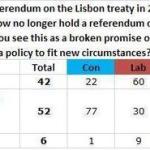
So, has he got away with it? The press reaction to the Tories’ new European policy has been generally positive, or at least understanding that Cameron did the best he could in impossible circumstances. Only the Daily Mail and Melanie Phillips voiced ideological objections. More importantly, Messrs Davis, Redwood, Cash et al have not broken ranks – this reflects the policy’s essential euroscpeticism as much as it does party discipline. Most important of all, the above Politics Home poll suggests that the public back the long-term policy, adapted to new circumstances, and do not think that Cameron has broken a promise.   But, the overwhelming majority want a referendum on renegotiating Britain’s engagement with the EU.

A bit of French stock in play

From our UK edition

Describing foreign dignitaries as ‘castrated’ and ‘autistic’ is terribly Gallic. As a rule, British politicians tend not to invoke ‘sensitive conditions’ to aid their critiques and the force of their rhetoric. I can’t imagine Chris Bryant, for instance, describing David Cameron’s euroscepticism as ‘autistic’ – he’d probably even baulk at describing it as ‘political halitosis’, preferring wink-wink, nudge-nudge gags about “cast-iron guarantees”. It is because this expansive sensationalism is so alien to our political culture that Pierre Lellouche’s comments sound so provocative and make Mr Cameron’s ambitions look unrealisable, with Europe seemingly united against him.

Is it Possible to Have a Twit-Scoop?

From our UK edition

I was interested to see the Observer story at the weekend about Lord Ashcroft accompanying William Hague to Washington.  I tweeted this on October 23rd. I even teased Iain Dale and Tim Montgomerie about Ashcroft now dominating Tory foreign policy as well as domestic policy.  Does this count as a micro-scoop?

There is only one question that frightens Brussels

From our UK edition

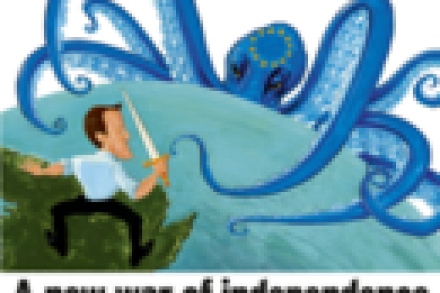
So David Cameron will let it rest there after all.  And in fairness to him, he can do nothing else. Thanks to the Blair/Brown stitch up, Britain has no options left. It never did. Cameron knows that and today’s speech was just a longwinded way of saying it. He is right not to promise what he calls a “made-up referendum”, that would accomplish nothing other then vent rage. But nor should he kid us all that he is going to renegotiate some powers back from Brussels. That would need the unanimous approval of all other member states, and it would never be granted. If Britain were to repatriate powers, then who would ask next? Where would it stop? The post-Lisbon EU is more powerful, bullying (as we saw with Ireland and Czechs) and it will refuse any request Cameron makes.

Unconditional surrender

From our UK edition

The front benches on both sides felt that they had to say that they accepted Kelly in full and so Harriet Harman and Sir George Young did just that. One member of the shadow Cabinet told me earlier this week the only option for the political class is unconditional surrender. But it does seem like there might be some areas where Kelly is watered down. The bit of Sir George Young’s statement that stood out to me was on commuting rules, where the shadow Leader of the House said: “As Sir Christopher says, IPSA will need to look closely at the proposals in this report. There are legitimate concerns with aspects of it, particularly the rules surrounding who was expected to get back to their constituencies at night.

What Cameron should now say about Europe

From our UK edition

The accusations of betrayal being hurled at David Cameron are, for the reasons I outlined earlier, deeply unfair. It is Labour that has broken its promise, not the Tories - a point that the Tories should be shouting from the rooftops. Also, Euro-sceptics should remember that Cameron did keep the pledge he made during the leadership to take the party out of the EPP despite the many siren voices urging him to renege on this commitment.  The whole referendum question, though, is turning into one of trust. Part of the reason for this is that the Tory leadership always seems slightly embarrassed by the issue of Europe.

One in five children live in jobless households

From our UK edition

The Guardian reports this morning that, “One in five – two million – British children now live in households where neither parent has a job.” This is an incredibly worrying statistic. The evidence suggests that worklessness is corrosive and soul-destroying. A child growing up in a workless household will, for obvious reasons, tend to have limited ambitions and opportunity. Obviously, as the economy recovers this number should go down — the recent rise indicates that many of these parents have been laid off in recent months. But even before the credit crunch really kicked in, there were more than 1.8 million children living in workless households.

Cameron hasn’t broken a pledge on Europe

From our UK edition

With the Czech constitutional court’s decision removing one of the final barriers to ratification of the Lisbon Treaty, attention is turning to what the Tories will do next. What we know they won’t do is hold a post-ratification referendum. This is prompting cries of betrayal from some. But this charge is unfair. Cameron’s “cast-iron pledge” has been overtaken by events — the treaty will already have been ratified by the time Cameron comes to power and so a referendum would only be demonstrative. This is one of those instances where an analogy can be instructive.

Rebranding Republicanism

From our UK edition

Nate Silver says that while the Democratic "brand" is of marginal value in about half the country, the Republican "brand" is pretty toxic across two thirds of those United States. So, he has an idea: You can actually make the argument -- although maybe it's not a good one -- that Republicans should in fact find a way to pull a Blackwater and switch their party ID when nobody is looking, from Republican to capital-C Conservative. This would probably involve at least some degree of bona fide structural change, and undoubtedly some near-term trauma: an orchestrated chaos. But the 'conservative' brand is just as powerful as it ever was in America, whereas the Republican brand is as weak as it has been. Actually, this isn't a terrible idea by any means.

A Republican Resurgence?

From our UK edition

So, tomorrow's off-off-year elections looks as though they will provide encouraging news for the Republican party. The special election in upstate New York may have been chaotic - it's not often that GOP bigwigs endorse the Conservative challenger to the GOP candidate, nor that often that the Republican candidate drops out and endorses the Democratic candidate - but it looks as though Doug Hoffman, the Conservative "insurgent" in the 23rd Congressional District may well prevail. Add this to the likely GOP triumph in Virginia's gubernatorial contest and the possibility of defeating Governor Corzine in New Jersey and you can see how you could construct a pretty decent The GOP is Back Baby! narrative.

A Grieve error

From our UK edition

The Conservative leadership claims that a British Bill of Rights would serve to guide judges in interpreting the European Convention on Human Rights and so give Britain some discretion in how the rights which exist in the Charter — many of which are vague — are applied in this country. But in the new issue of Standpoint the eminent legal commentator Joshua Rozenberg reports that Dominic Grieve, the shadow justice secretary and a firm supporter of the ECHR, thinks that a British Bill of Rights would only be introduced towards the end of a Cameron first term and might well not be on the statue book by the end of it. Grieve tells Rozenberg, "I would like to think we could do it in the course of a parliament".

The Euroball is rolling

From our UK edition

Well, it hasn’t taken long, but outright opposition to the Tories’ new stance on Europe is underway. Conservative Home has a copy of an email sent by Bill Cash calling for a full referendum on the Lisbon Treaty. Here’s the key section: ‘As David Cameron has said, we need an association of member states. In order to achieve this, we cannot simply cherry-pick individual aspects of the treaty and call for renegotiation of those. We need a full referendum on Lisbon as we were promised and as we voted in the House of Commons. No ifs or buts. This is about the Government of the United Kingdom operating in line with the democratic wishes of the electorate.

The Tories’ new line on Europe

From our UK edition

Tim Montgomerie has the scoop that the Tories will not hold a referendum on Lisbon if it has been ratified by the next general election. A vote on Lisbon once it had been ratified would only have had moral force so the Tory policy shift is not a betrayal of Euro-scepticism. However, the party will seek a ‘manifesto mandate’ to begin negotiations to repatriate powers. The challenge for the Tories is to persuade the other member states to allow Britain to take back powers.  As Tim says, the Tories will need a savvy negotiator with strong Euro-sceptic instincts to take charge of this process. To my mind, Theresa Villiers, a former MEP who knows her way around the European system and is a strong Euro-sceptic, would be ideal for this task.