Conservative party

Portillo: the Tories won’t succeed in cutting public spending – they’ll have to raise taxes

From our UK edition

Ever the contrarian, Michael Portillo makes a case that you don't hear from many on the right in his interview with Andrew Neil on Straight Talk this weekend.  George Osborne has given "a fair amout of detail" about the Tories' debt-reduction plans, he says, but that could be the wrong approach: "I wouldn’t seek probably to give very much more detail ....  You know, I was with Margaret Thatcher when she came in to Government in 1979, we faced a big public spending problem.  It was terrible.  It was a hard slog but she didn’t cut public spending.  I was Chief Secretary between ’92 and ’94 – big public spending problem – I was trying to cut public spending; I did not succeed in cutting public spending.

Elected police commissioners are a test of whether the Tories are serious or not about their agenda

From our UK edition

Sir Hugh Orde, the head of the Association of Chief Police officers, has issued another broadside against Tory plans for locally elected police commissioner. Orde has warned that senior police officers will resign over the plans and that, “Even the perception that the police service of this country… is under any political influence, I think that suggests you cannot argue that you are a proper democratic society.” This is an absurd argument. The idea that you are not a proper democratic society because the police commissioner is accountable to the public via the ballot box is obviously nonsense. But the Tories will face a lot of this kind of criticism as the police, a totally unreformed public service, close ranks against the idea.

The problem with Brown’s latest Big Idea

From our UK edition

There's some very readable stuff in this week's Economist (including a leader which outlines what Brown's government should – but almost certainly won't – do with its "last months in power").  But if you read only one article from it, make sure it's the Bagehot column and its dissection of Brown's latest Big Idea: public service guarantees.   These are the pledges-turned-legal entitlements which popped up throughout the Queen's Speech – such as the "guarantee" that patients will have hospital treatment within 18 weeks of being referred by a GP.  As Bagehot points out, it's a problematic approach: 'To be worth the manifesto paper they will be printed on, public-service guarantees need to be readily enforceable.

Cameron goes Blond

From our UK edition

In their party political broadcast last night, the Tories endorsed a community right to buy. The idea is that communities would be offered first refusal to take over and run local amenities that are faced with closure. For example, the community would be able to take over a Post Office rather than see it shut down. Community groups would also be able to bid to run publicly provided assets such as libraries. It is a policy that has doorstep appeal and also positions the Tories where they want to be. Thatcher offered individuals a right to buy, Cameron offers communities a right to buy. The intellectual inspiration for this policy is Phillip Blond, the so-called Red Tory, who first proposed the idea back in July: 'Create a community right to buy.

Hoist by his own petard

From our UK edition

The Queen’s Speech contained some worthwhile bills. Parents will face orders when a child breaches antisocial behaviour rules, and the Flood and Water Maintainence Bill, whilst unlikely to rival the 1911 Parliament Act in the annals of Westminster, is welcome, responsible legislation. I can even see that if you’re that way inclined, which I’m not, Harman’s Equality Bill has something to commend it. The remainder of the programme is a political landmine, presenting benevolences that mask incendiary conceits. Clever politics theoretically, but in the rush to prime the fuses, and with little thought for these bills’ practical application, this incomparable government has blown itself up.

A paper-thin Queen’s Speech

From our UK edition

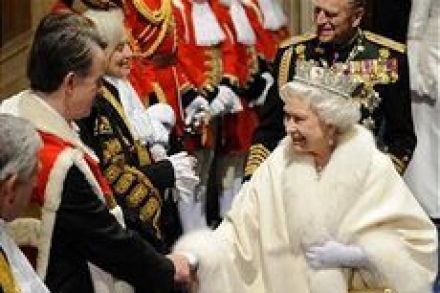
Even before the Queen had trundled back to Buckingham Palace, Mandy had let the cat out of the bag. Speaking on BBC News he said of the Gracious Speech, ‘All these laws are relevant … and achievable. It will be for the public to decide whether they want them or not.’  There you have it. The greatest power in the land admits the Queen’s Speech is Labour’s manifesto. The response to the Gracious Speech is an enjoyably ragged parliamentary occasion, full of ancient traditions and even more ancient jokes. Frank Dobson proposed the Humble Address and spoke with pride about his Holborn constituency where the anti-Apartheid movement had been born.

The Prince is playing politics

From our UK edition

Lord Mandelson argues in the Evening Standard that Labour’s legislative programme has the Tories running for cover. The forthcoming debate should prove this thesis to be nonsense. 7 minutes of largely rehashed policies, including all the old favourites – equality, the ‘smarter’ state and so forth, is unlikely to give Cameron sleepless nights. I suspect Mandelson knows this as there is little substance to his argument. The article contains more insinuations than an episode of Midsomer Murders. Mandelson writes:     ‘David Cameron seems to be getting a little rattled. Following his flustered performance at PMQs last week, he seems shocked and disconcerted to be facing a political fight again.

Things are as they seem

From our UK edition

Steve Richards writes a stirring defence for what is likely to be Labour’s last legislative programme. Richards argues that if you suspend your disbelief and ignore everything you have read about current political situation and you will see not a tired, regressive government but a radical political force. ‘Perhaps none of the proposals will be implemented by the election. Maybe they will all turn into dust, but they mark a departure from cautious incremental approaches usually adopted by the Government. The Conservatives' equivalent proposals have an echo with the mid 1990s, while their Euro-scepticism takes us further back, and their plans for spending cuts to 1981.

Cameron fires a broadside at ‘petty’ Brown

From our UK edition

David Cameron has written an apoplectic editorial in the Times condemning Gordon Brown’s partisan hijacking of the Queen’s Speech. Here is the key section: ‘We are mired in the deepest and longest recession since the Second World War, with deep social problems and a political system that is held in contempt. The State Opening of Parliament tomorrow ought to be about radical ideas to deal with this triple crisis. Instead, by all accounts, the Queen’s Speech will be little more than a Labour press release on palace parchment. Don’t take my word for it. As The Times reported yesterday, a Cabinet minister has been boasting about the contents of the speech. What was said? That it was the most ambitious since Labour had come to power?

Eastern uprising

From our UK edition

The spirit of Hereward the Wake is stalking the Fens again. It is very tempting to characterise Elizabeth Truss' opponents, nicknamed the ‘Turnip Taliban’, as a collection of Rigsbys thwarted in their ambition to find the permissive society on the one hand, and plain reactionaries on the other. Not least because Melissa Kite reveals in today’s Telegraph that the TT’s self-appointed Chief-Mullah, Sir Jeremy Bagge, who has taken to traversing his estates in a Pashtun turban to mark his celebrity, venerates women in the following terms: “I have absolutely nothing against women. Who cooks my lunch? Who cooks my dinner?...Women, you can’t do without them?” One might almost think that men were their equals.

Going broke and going for broke

From our UK edition

The Times has a fascinating story on how Labour’s lack of cash is forcing it to give up on seats and groups of voters. The paper reports that seats with a majority of less than 3,000 have been effectively written off. So even before the campaign has begun, Labour is basically forfeiting 60 seats. By contrast, the Tory marginal seat operation — funded by Lord Ashcroft’s cash — is pushing further and further up the Tory list of target seats. (I was talking to one Tory candidate recently who thought that the resources poured into her seat — currently held by Labour — in the last 18 months or so had made it an almost certain gain for the party, barring disaster during the campaign).

The Tory leadership could be talking like Boris soon

From our UK edition

So Boris is attacking the 50p tax rate again - and rightly so.  In his Telegraph column today, the Mayor of London repeats the lines he pushed in April: that the measure will drive business talent away from our shores, that it will damage London's competitiveness, and that it could actually lose money for the Exchequer.  It all comes to a punchy conclusion: "What Gordon Brown wants to do is therefore economically illiterate." I imagine a few commentators will see that last line as a veiled attack on the Tory leadership, given that they're committed to the tax rate too.  But, as Tim Montgomerie says over at ConservativeHome, and going off conversations with Tory types, I doubt that Cameron and Osborne would disagree with the thrust of Boris's article.

Under starter’s orders | 16 November 2009

From our UK edition

The parties are limbering up for the longest, and possibly the bitterest, election campaign in living memory. Recent asides and statements indicate that Wednesday’s Queen's Speech will be the most political that New Labour has delivered.  This morning’s Times and FT give an amuse bouche of the package with which Labour intend to “smoke out the Tories”. The FSA will be furnished with powers to punish those dastardly bankers, including the power to rip up contracts that encourage excessive risk. Also, Labour will provide free home care for 350,000 people; NHS patients will receive free private care if they are not treated within 18 weeks; and pupils will have the opportunity to take free on-to-one home tuition.

Cutting MoD staff will not win wars

From our UK edition

Liam Fox has made clear that the Conservative Party is planning to slash the number of civilian posts at the Ministry of Defence as a way of balancing the military budget if they win the general election in 2010. "We have 99,000 people in the Army and 85,000 civilians in the MoD. Some things will have to change - and believe me, they will," Fox has said. But if the Conservatives thought they had stumbled across a sure-fire criticism of Labour’s way of war, in The Times, ex-soldier, author (and, I will wager, future MP) Patrick Hennessey asks the public not to lay off the “MoD desk-jockeys.” 'The MoD deploys civilian staff into operational theatres.

Last man standing

From our UK edition

That Gordon Brown is still the prime minister proves that it isn’t only Peter Mandelson who is a fighter not a quitter. It became clear this week that Brown will fight to the bitter end, and that Labour’s election strategy has emerged through him. Labour depicts the Tories as Bullingdon boy toffs and crazed Thatcherite cutters; Brown is the stern, serious figurehead, the still small voice of calm at the vanguard of Labour’s arguments on immigration and the economy.   Matthew d’Ancona’s Sunday Telegraph column details how Brown has returned to the fore this week and delivered policy statements aimed exclusively at maintaining Labour’s core support.

Cameron’s licence fee cut – and how he’ll pay for it

From our UK edition

All hail, Jeremy Hunt, the axe man. Cameron’s first tax cut will be a licence fee cut* – and Hunt is planning to axe some stations to pay for it.  Hunt is thinking of axing 1Extra, apparently, with BBC3 and BBC4 already under threat. Also under Hunt’s axe would be the National Lottery’s runnng costs. The Sunday Times apparently has the details tomorrow, but I give Hunt this warning: if he even tiptoes in the direction of Cbebbies then he will have a revolution on his hands. Parents depend on it now, utterly. Personally, I’d pay £100 a year just for it – just for its kid-sedating powers. But it makes you think: digital television does allow a subscription model and the BBC could well spin off many of these channels.

In answer to your questions

From our UK edition

So, what is The Spectator coming to? Dishing out trophies to Harman and all these Labour types? Has the editor's chair made me crawl up to people like Harman and Darling? Am I angling for a political seat? The comments to my earlier blog post raise some excellent points - about politics, polemic and The Spectator itself. I thought they deserved a response in a post rather than a comment. The Spectator's tradition of honouring talent on all sides of the political divide in its annual awards is a long one:  La Harman was our 24th Parliamentarian of the Year. While Harman was speaking, Boris and I were holding her trophy and looking at the names that hers would be engaved next to.

No Brits likely in top EU jobs

From our UK edition

The process to pick the two new EU jobs - that of Council President and High Representative - is nearing completion and Britain looks set to walk away empty-handed. Tony Blair's candidacy is unacceptable to many EU leaders - both because of his record, particularly over the Iraq War, and because of Britain's odd-man status in Europe. Last night at the Queen's Diplomatic Reception, a senior ambassador remarked to me that if Blair had really wanted the EU job, he should have started lobbying for it a few years ago - or at least shown a post-No 10 interest in European affairs. Blair, said the envoy, could have given a speech in Berlin, an interview in a French paper and so on. But he did not.

British jobs for British workers

From our UK edition

Further to Alan Johnson’s immigration statement on Monday, Gordon Brown will give a speech on the topic. The intention is to re-engage with core voters who have defected to the BNP. In an interview with the Mail, Brown acknowledged that the public were right to be concerned, especially in times of economic uncertainty and hardship. Brown is expected to tighten migrant employment controls so that migrants are only used where there are labour shortages. He will strengthen the ‘Labour Market Test’ by extending vacancy exclusivity for UK citizens from 2 weeks to a month, and pledges to retrain British workers. The proposals are welcome and the rhetoric is tough, giving some weight to the maligned call of ‘British jobs for British workers’.

The centre left asks how? Well, here’s how

From our UK edition

The One Nation sentiments that David Cameron expressed at last night’s Hugo Young lecture have been almost uniformly applauded. Labour’s sneers about Cameron being an uber-Thatcherite are isolated from mainstream. Only Johann Hari dissents, suggesting that because Cameron is an OE and comfortably off it follows that ‘he has never known’ a poor person. Of course, if Cameron were the re-incarnation of Lord Salisbury, then Dave would have ample understanding of, and who knows perhaps even intimacy with, the various retainers, ostlers, scullery maids and farriers in his employ. Patricians have long since retired to enjoy what’s left of their estates, and Cameron’s sentiments are genuine and inflect his politics, simple as that.