Conservative party

Burnham’s exocet misfires

From our UK edition

The sword of truth is working overtime this afternoon. First, Andy Burnham writes a letter to David Cameron demanding answers about a £21,000 donation from John Nash, chairman of CareUK, to the office of, oh dear, Andrew Lansley. As Paul Waugh notes, a conflict of interest scandal looms here because CareUK is a private firm that makes £400m running GP surgeries and so forth for the NHS. But the truth will out as they say. It turns out that the Chairman of BUPA, Lord Leitch, wasted £5,000 on Gordon Brown’s unopposed leadership campaign. BUPA also does rather well out of the NHS. The indefatigable Waugh has dug up this gem from a speech Leitch made to the Lords: 'When we debate healthcare in the UK, all too often the focus is on the NHS alone.

The cost of saving the Army

From our UK edition

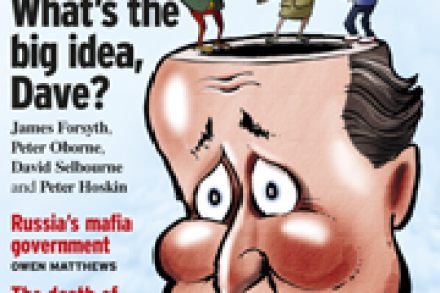
We have led the magazine this week on coming Tory defence cuts, with a brilliant piece by Max Hastings. Look closely at the cover image (our second by Christian Adams) and you can see the guillotine blade will hit he RAF and Navy guys before the Army. This, Hastings argues, will be the effect of the Tory Strategic Defence Review. And even this will leave cuts of up to 20 per cent across the defence budget under the Tories. How could Cameron justify that, in this dangerous world of ours? David Cameron prepares the ground today with an important speech in Chatham House promising “one of the most radical departures in security policy we’ve seen in decades”. He goes on to say that “We need to do much better at stopping wars from ever starting.

The Tories may raid the aid budget to fund the military

From our UK edition

The think tank, Chatham House, is the next venue for Cameron’s intermittent policy blitz. He will unveil his national security strategy, part of which, the Telegraph reports, will enable the government to raid the international development budget to fund military projects. ‘The Conservatives are committed to increasing the international development budget to meet a United Nations target of spending 0.7 per cent of gross national product on aid. However, some Tories believe the party can honour that pledge by counting some spending done by the Ministry of Defence as development aid, since the work of the Armed Forces contributes to the development of countries like Afghanistan.

Labour put “guarantees” at the heart of their campaign

From our UK edition

Does Gordon Brown look like the kind of guy who can keep a promise?  Because that's the main question which stands in the way of Labour's election strategy, if Andrew Grice's revelations in the Indpendent are anything to go by.  According to Grice, Labour are going to repeat their trick from 1997, and focus on five or so pledges – what Downing St now calls "guarantees" – during their election campaign.  It's not certain what they'll be yet, but Grice reports that Labour MPs are being instructed to concentrate on the following policies in their constituencies: -- Training or further education will be provided for all school-leavers and a job or training for jobless young adults. -- Suspected cancer patients will receive their diagnosis within one week.

Getting rid of the 0.7 percent aid target

From our UK edition

A leader in yesterday’s Times concentrated on the Conservatives’ aid policy – and, in particular, their commitment (shared by the government and by plenty of developed nations) to spend 0.7 percent of gross national income on development assistance. There was much to like in the article, but it misses a few key points and trains too much fire at the Tories. The key points to make about the 0.7 percent commitment is that it is not based on any assessment of how much money is needed to achieve any defined set of objectives, and has not been revised since it was set forty years ago to take into account new trends – such as remittances from migrant workers, a rise in philanthropic giving, or the role of China and India.

Getting the balance right

From our UK edition

So what's happened to the Tories' policy-a-day blitz that was meant to fill all of January?  Tory announcements and speeches were happening thick 'n' fast at the beginning of last week, and, obviously, we had Cameron's speech yesterday – but it hasn't been quite as non-stop as we were led to believe.    This is intentional.  As James has already pointed out, the Tories were all too happy to let Labour scrap underneath the limelight last week.  And there's also a realisation that they may have been overdoing it previously.  Some Tories around Westminster are now talking more of one Big Announcement per week.   That sounds about right to me, and deals with some of the qualms I raised before Christmas.

Turnbull savages chancellor Brown

From our UK edition

Andrew Turnbull, who was permanent secretary at the Treasury from 1998 to 2002 and Cabinet Secretary from 2003 to 2005, has previous when it comes to criticising Gordon Brown. But his recent piece in the FT — ‘Six steps to salvage the Treasury’ — is one long barely coded attack on the PM. Take this line: “First and perhaps foremost, it [the Treasury] needs a strong ministerial team – a chancellor who wants to be chancellor for the full term rather than coveting the prime minister’s job.” Interestingly, Turnbull comes out in favour of the Tories’ plans to create an Office of Budgetary Responsibility. I know this is derided by some as yet another quango, but I actually think it will be an important reform.

A sensible Tory rethink on marriage tax breaks

From our UK edition

There's something quite refreshing about David Cameron's plan to offer a tax break to married couples.  It says, simply: this is what I believe.  And it does so in spite of polling data and strategic arguments to the contrary.  This is one area where you certainly couldn't accuse the Tory leader of caring too much about what other people think.  But refreshing or not, that doesn't make it good policy.  Of course, there's a tonne of empirical data which demonstrates the benefits of marriage.  That's important and persuasive.  But, as I've written before, there are reasons to doubt the efficacy of a tax break in particular.

Cameron takes a brave line on family policy

From our UK edition

David Cameron’s speech today at the launch of Demos’s Character Inquiry was both brave and significant. His message was that it is parenting, not material wealth, that plays the most important role in determining a child’s prospects in life. As Cameron put it, ‘What matters most to a child’s life chances is not the wealth of their upbringing but the warmth of their parenting.’ This message is easily caricatured — ‘Millionaire Cameron says poverty doesn’t matter’ — but it is important and, as recent academic research shows, true. (This is not to say, that poverty doesn’t matter, it clearly does, but that material poverty is not the sole determinant).

Cameron has the positioning right – but fiscal questions remain<br />

From our UK edition

Here, CoffeeHousers, is my take on this morning's Cameron interview: 1. General demeanor: excellent, articulate, confident. The complete opposite from Brown. It does make you think that he should wipe the floor with Brown in the TV debates. 2. “Last week we saw William Hague and George Osborne going to Afghanistan together. First shadow Chancellor, the man who is going to be in charge of the money, on the frontline seeing what is going on in Afghanistan”. Indeed, but the NHS pledge and deficit cut pledge imply deep cuts to the military. To govern is to choose, and Cameron has made his choice: NHS spending before the military.

The NHS is unfair, why should it remain sacrosanct?

From our UK edition

I’ve just heard a truly shocking story. A neighbour, left brain damaged by a haemorrhage, arrived at St Richard’s hospital in Chichester on Tuesday afternoon for her check-up. She was discharged at 2 am. No beds or ambulances were available and she was sent out into the night, and of course a blizzard.   One shouldn't extrapolate that this represents standard NHS care; it doesn’t. But care is hindered by a lack of resources and facilities. Despite throwing money at the NHS, vast areas of the country remain ill-equipped, and not merely at Britain’s rural extremities. For example, there is no specialist cardiac unit between London and Portsmouth. Feel your left arm go tense in Petworth and start trusting to God.

Security and Defence Review 101

From our UK edition

Defence geeks are waiting to see how the Conservative Party intends to conduct a Security and Defence Review, if they are elected. By the time a new government comes to power, the Ministry of Defence will in all likelihood have produced a Green Paper, setting out initial thoughts on the future of the military, which is meant to lead on to a more substantive Strategic Defence Review.  But if the Tories want a process (and ultimately plans and ideas) that encompasses not only the MoD, but also the Foreign Office, DfiD, the security services and even parts of the Home Office, then a new kind of institutional vehicle will have to be set up. There are, broadly speaking, three options.

Darling’s honesty is good news for the country – but tricky news for Labour

From our UK edition

Well, well, well - Darling's Times interview, which James reported earlier, sure is a significant moment, and one which more than deserves a place on the spending cut timeline which I put together last week.  In fact, let's see what it would look like alongside a few of the most recent entries: 9 December 2009: Pre-Budget Report 2009 forecasts Public Sector Net Borrowing of £176 billion, and Public Sector Net Debt of £986 billion, in 2010-11. 10 December 2009: Alistair Darling puts in a bizarre performance on the Today programme, claiming that the PBR implies that departmental budgets would remain “pretty much flat.” 10 December 2009: The IFS works out that the PBR implies departmental budget cuts of around 19 percent over three years.

In preparing for war, the Tories differ from Labour in one respect – they would be prepared

From our UK edition

In today's Times, and on the occasion of George Osborne and William Hague's visit to Helmand, the Tories are publishing proposals for how to improve the Government's approach to post-conflict operations. Their central idea: to create a stabilisation force in the military, complete with the necessary expertise, training and so on to win the peace after combat. If it was not already abundantly clear, the Iraq Inquiry has shown how ill-prepared the British state – civil service, military and government – was for post-combat reconstruction. Though much has changed since the Iraq War – e.g.

What’s it all about, Dave?

From our UK edition

This morning, I drove past one of the Cameron adverts - “I’ll cut the deficit, not the NHS” - and that Bacacharch & David song came into my head: "What’s it all about, Alfie?" It’s been in my head, in fact, ever since his Oxford speech last weekend. Just what is the Big Idea? We seek to answer the question in this week’s magazine with four pieces. James Forsyth says that any hunt for Cameron’s ideology will be in vain, because he doesn’t really have one. He doesn’t like –isms and there will never be a Cameronism. David Selbourne, one of Britain’s leading political philosophers, has written a scathing piece. (“I’m afraid this is merited” he said in the email, when his sent his piece).

The plot’s gunpowder is extinguished

From our UK edition

The atmosphere is flat in Westminster today. The plot finally fizzled out this morning but not before having highlighted how little support in the Cabinet Brown has. It was telling that it was Shaun Woodward, not anyone more high profile, who turned up on the Today Programme to defend the PM. Plots that wound but do not kill Brown are perfect for the Tories. They make the voters see Labour as divided and add to the mood that it is time for a change. This one also had the benefit of being ideally timed from a Tory perspective, obscuring a week which had seen Cameron make a rare blunder. YouGov’s latest poll does show the Tories on course for a majority, no small achievement considering the base they are starting from.

An intriguing PMQs – overshadowed by events

From our UK edition

After the hubbub about Hewitt ‘n’ Hoon’s plot to unseat Gordon Brown, PMQs is perhaps a distant memory. It’s certainly made my review a little later than usual. But better late than never, as today’s clash was a bloody and intriguing contest with both party leaders on combative form. Cameron seemed unusually relaxed, glib and self-confident. Perhaps he’d been tipped off about the plot. Or perhaps he’d been thrilled by the sight of his beautifully groomed coiffure in the bathroom mirror this morning. If he spent as much time on his manifesto as he did on his hair there’d be no talk of a hung parliament. But this didn’t seem to bother him today and he laid happily into the Prime Minister over the budget deficit.

What we have learnt today

From our UK edition

Three things stand out to me from today. First of all there is little Cabinet love for Brown: there was no stampede of Ministers rushing out to offer their support to him and several have yet to say anything. Also many of the statements of support contained precious little enthusiasm for Brown. The second thing is that you can't bring down a Labour leader without support from the bulk of the Parliamentary party. This plot is simply too narrowly constructed. Finally, the Tory reaction has been intriguing. On the one hand they are delighted. They know that the electorate hates divided parties. They are also aware that it covers up a bad week for them. But on the other hand, they get very jumpy at the thought that the plot might succeed.

PMQs live blog | 6 January 2010

From our UK edition

Stay tuned for live coverage of PMQs from 1200. 1159: Should be kicking off soon.  You can watch proceedings live here. 1202: And here we go.  Brown starts with the usual condolences for fallen British servicemen - and adds a tribute for the late Labour MP, David Taylor. 1204: Brian Donohoe asks for an update on the attempted terrorist attack on Christmas Day.  Brown lists new security measures, and says that he's looking to better coordinate intelligence efforts. 1206: Cameron now.  He adds condolences for British servicemen and David Taylor. 1207: The Tory leader starts with our debt problem.  He lists international organisations - the OECD etc. - which have warned about Britain's debt.

The Tories are frustrating, but Labour is unelectable

From our UK edition

Ok, Coffee House has given the Tories short-shrift in recent weeks, but this is a reaction born of frustration. The election should be a walkover. At their best, the Tories have the radical policies, and to a certain extent the team, to rescue Britain from its current Labour-inflicted quandary. Yet the party remains tentative, fearful of its own shadow. It should not be. Labour deserves to lose, and not only in retribution for its record: the governing party has embarked on an open internecine war and is completely unelectable in consequence.