Conservative party

Cameron versus Balls

From our UK edition

The real clash at PMQs today was between Ed Balls’ heckling and David Cameron’s temper. Balls was in a particularly chirpy mood. He started off his impression of an Australian slip fielder as soon as the Prime Minister arrived at the despatch box. The flat lining gesture made an early appearance, along with his signals telling Cameron to calm down.   But the moment when Balls seemed to really get under Cameron’s skin was when he pointed at the overwhelmingly male Treasury bench as Cameron talked about the importance of getting more women on boards. Two questions later, Cameron responded to a Balls’ heckle by saying that ‘the shadow Chancellor is wrong, even when he’s sitting down.

The Greek land mines that Cameron must avoid

From our UK edition

When the topic of Greece comes up at PMQs, David Cameron will need to avoid stepping on three land mines. The first task is not to say anything about what is going on in Athens, or Rome for that matter, that will exacerbate market anxieties. The second is a diplomatic challenge, to avoid anything that would sour Britain’s pitch ahead of the G20. The third, and perhaps most difficult one, is to keep his own backbenchers on side.   An ever growing number of Tories doubt that a 17 member Euro and fiscal union is in Britain’s, or Europe’s, interests. Already, some Tory backbenchers are talking about going to Greece, if invited, to campaign for a No vote. Cameron will need to avoid antagonising this group.

Exclusive: The BBC to apologise for wronging Tyrie

From our UK edition

Here's one for newswatchers: a lesser spotted on-air apology from the BBC. During the Conservative Party conference, you may remember, they purported to show footage of Steve Hilton taking Andrew Tyrie into a corner to persuade him of the government's line. But they are about to publicly admit, during the 5pm bulletin on the BBC News Channel, that they misrepresented what actually happened — and they're sorry about it. Peter Oborne detailed the misrepresentation in his column last week; drawing attention to the clarifying blog post that the BBC's James Landale graciously wrote on the matter, two weeks ago.

International aid in the dock

From our UK edition

The pledge to almost double Britain's international aid budget was made in the boom years, when the government actually had money. In the bust, there is something deeply strange — almost perverse — about borrowing money from China and giving it to India. It's time to reassess Britain's aid commitment, and The Spectator is having a debate about it tomorrow night. I hope CoffeeHousers will be able to come because it is, I think, a crucial issue. Alan Duncan is the man to thanks — or blame, depending on your point of view — for the Tories committing to spend 0.7 per cent of economic output on foreign aid.

The Great Repatriation Question

From our UK edition

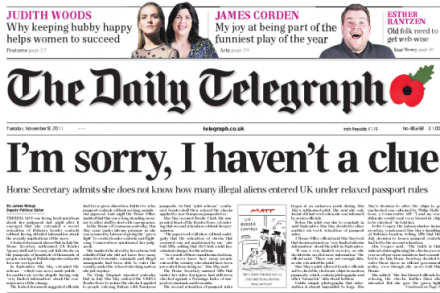
And the word of the weekend is ‘repatriate’. Not only do we have yet another poll showing that the British public, when asked, would prefer to tug powers back from Brussels, but there's also this eyecatching story in the Daily Telegraph. No.10, we're told, is pushing Whitehall departments to determine just exactly where Europe's influence could be counteracted. There is also a backbench group of Tory MPs providing covering ideas.  So why hasn't this been happening before now, particularly given how frustrated those around David Cameron have become with the constant torrent of EU directives? Part of the answer is that the events of the past week have made all this more urgent. But part of it is that, actually, this work has already been going on in Whitehall.

Daylight scrapping time

From our UK edition

Aha, the Spectator's cover story is gathering pace. If you were tuned into The BBC's Daily Politics just now, then you will have enjoyed a preview of the terrific scrap this time-shifting proposal could provoke. They had on both Rebecca Harris MP, who is pushing for us to move to Central European Time (CET), and Peter Hitchens, who revealed in his article for us that the government is minded to back the idea (as well as describing Harris as "one of those homogenised, UHT female Tory MPs"). The pair were, of course, mediated by Andrew Neil. We shall try to secure video of the discussion, if possible.

The government goes cuckoo

From our UK edition

The government has, this morning, confirmed The Spectator's cover story: that it is considering supporting Rebecca Harris’s bill to move Britain onto Central European Time. As we argue in the magazine, such a move would be a huge mistake both practically and politically. Under the new regime, anyone living north of Manchester would have to endure two months of the year when it was dark when they started work at 9am. Any government that supported this move would look like a government of southerners, by southerners for southerners. The consequences for the Union could be horrendous too. Just imagine what a propaganda gift the new time would be for Alex Salmond.

Europe’s new battlefield

From our UK edition

The long flight from Australia should give David Cameron plenty time to think about Europe, and how it just won't go away. He didn't want this battle — not now, not ever. But in the Daily Telegraph today, the first in what will be a weekly column, I lay out the battlefield that awaits him on his return. First, this bailout is not the end. A trillion Euros needs to come from somewhere, and today the Chinese are being tapped up — God knows what we'll agree to in return. But that doesn't address what is, as Mervyn King has said, a solvency issue rather than a liquidity issue. And the tighter these Eurozone countries squeeze together, the more tension we can expect.

Labour aren’t capitalising on the government’s woes

From our UK edition

Ipsos MORI's latest monthly political monitor is just out, and it doesn't bring much good news for either the government or the opposition. 63 per cent of respondents are dissatisfied with the government and 54 dissatisfied with David Cameron — both the highest proportions since the election. On the public's number one issue — the economy — just 36 per cent say the government's done a good job. And even wose, a whopping 77 per cent say they've done a bad job of keeping unemployment down — hardly surprising considering unemployment has risen by 100,000 since the election. But while all this presents a great opportunity for Labour, other numbers show how bad a job they're doing at taking advantage of it.

Ellwood returns as PPS to the Minister for Europe

From our UK edition

Tobias Ellwood has been appointed as PPS to the Europe Minister David Lidington. The vacancy had been created when Adam Holloway decided to resign from the job so that he could vote for the EU referendum motion. This appointment is a nifty piece of party management. Ellwood was Liam Fox’s PPS but when Fox resigned, the new Defence Secretary Philip Hammond decided, to the resentment of some Tory backbenchers, not to keep him on. Instead, Hammond chose to appoint Clare Perry, a member of the 2010 intake who had worked for George Osborne and Hammond in opposition. Some Tory MPs, and particularly those who felt passed over, saw this as evidence that the party was being run by a clique. Ellwood’s return will be seen as an olive branch from the Cameroons to the party.

Cable’s latest embarrassment

From our UK edition

"None of this will stop me talking out against tax avoidance." So says Vince Cable, rather hilariously, in response to being fined £500 for failing to pay £25,000 of VAT on his media work. You've got to hand it to the Business Secretary: it is an ingenious, if convoluted, way to top up the public finances. Although there are questions about whether other people would have got off quite so lightly.    You might say, as Vince's people are this morning, that this is the sort of mistake that can befall anyone — particularly someone so busy as a Cabinet minister. But this isn't just anyone. This is Vince Cable, who has staggered between embarrassment, inconsistency and insubordination ever since the coalition government was formed.

No, Barack Obama is not the Second Coming of George McGovern

From our UK edition

On the other hand, Rich Lowry - editor of National Review and therefore a man who should know better - offers this pithy analysis of American under Obama: [N]one of this should be surprising since the Democrats, despite the Clinton interlude, never stopped being a McGovernite party, and Obama is a McGovernite figure For the love of god, this is poppycock on stilts. I have no idea how, as Daniel Larison says, honouring an agreement signed by a Republican president that promised to withdraw American troops from Iraq can be construed as any kind of "McGovernite" policy. Indeed, for this to make any kind of sense I think you have to conclude that Richard Nixon and Henry Kissinger must have once been "McGovernites" too since they wanted to end an overlong war too.

Has the EU debacle hurt Cameron?

From our UK edition

Leaving aside Cameron's relationship with his own backbenchers for now, how has yesterday's vote affected the public's view of him? The first proper hint comes from today's YouGov poll (conducted on Sunday and yesterday), which asks respondents to rate the qualities of each of the party leaders. Among the public as a whole, there is no significant change in views of the Prime Minister since last month. But there is a change in what Conservatives think of him, and not in the direction Cameron would like. Now just 40 per cent of Tory voters think Cameron is honest, down from 53 per cent last a month ago. And a mere 19 per cent say he's "in touch with the concerns of ordinary people," down from 31 per cent.

Why this is not the time for an EU referendum

From our UK edition

Having spent five hours in the debate last night, one thing was absolutely clear: we are all Eurosceptics now. So why did I choose to vote against the motion? It is because I believe that anger and frustration alone will not resolve our justifiable grievances towards the EU; we need a clear-eyed strategy to move forward.    We can all agree that Europe in its current form is not working for us. We have passed powers to Brussels at the cost of undermining the sovereignty of Parliament. Regulations that hinder our growth have not only been adopted but gold-plated, and with the Lisbon Treaty we are saddled with a constitution that no-one wanted and no-one voted for.

Cameron needs a new management style

From our UK edition

There seem to be three schools of thought among those close to the leadership about last night's rebellion. One even now maintains that the issue was handled as well as it could have been and blames the rebels for all the trouble. These people don't seem to realise that what they are saying is effectively that the Conservative parliamentary party is unmanageable. The second group says that the issue of Europe sends the Conservative party loopy. But they also concede that Number 10 got caught up in the madness too. The third lot are the ones who have grasped the significance of last night's events. Despite being loyalists, they are in no doubt about the need for Cameron to change his style of party management.

The coalition bares its tensions over Europe

From our UK edition

Here's an irony: last night's EU fandango was the fifth largest vote in favour of the government this year. And yet there is little about the situation that is favourable to the government this morning, as the story moves on from Tory splits to coalition ones.  It started with Michael Gove's appearance on the Today Programme earlier. The Secretary of State for Education put in a much more conciliatory performance than William Hague managed yesterday; praising the "cordiality" of the Tory rebels, and reassuring them that the Tory leadership would like to see specific powers returned from Europe "in this Parliament".

Europe Minister’s PPS quits over referendum vote

From our UK edition

Adam Holloway, PPS to the Europe Minister David Lidington, has just effectively quit his job by giving a speech setting out his intention to vote for the motion. That the Europe Minister’s PPS is walking over this issue is an embarrassment for the government and a sign of how strongly opinion on this issue is running. The most striking thing about William Hague’s speech was the near silence in which it was listened to on the Tory benches. When Hague mocked the motion, he didn’t draw laughs from even the most sycophantic backbenchers. Whatever happens tonight, this debate has widened divisions on the Tory side. There is a real danger that without urgent action, up to a third of the backbenches will become actively hostile to the Prime Minister.