Conservative party

Clegg tries to rebuild EU bridges

From our UK edition

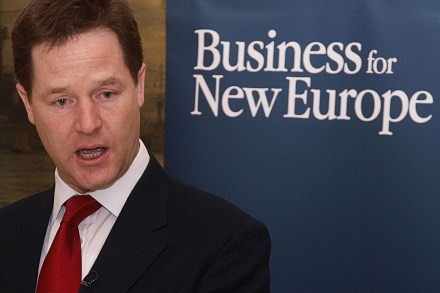
What are the Lib Dems up to? On Tuesday, Clegg, Cable, Alexander, Huhne and Laws met with 'Business for New Europe', a group of pro-European business leaders, in what the FT describes as as 'a very public display of engagement with business over Europe' and the front page of today's Mail calls 'plotting to rally business chiefs against Cameron over Europe'. It is, of course, not surprising to see senior Liberal Democrats talking to pro-EU business people and advocating more engagement with Europe. But it does highlight what will be a key goal of the Lib Dem leadership over the next few months: building bridges with Europe, particularly to reconnect with traditional, europhile Lib Dem supporters following the PM's veto last week.
A victory for Labour, but not necessarily for Ed Miliband

From our UK edition

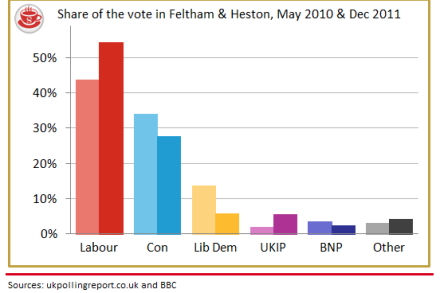
‘This result... is a victory for Labour that shows the progress we are making under Ed Miliband's leadership; a vote of confidence in the way that Labour is changing...’ Or, rather, it isn't. Whatever Labour's winning candidate in Feltham and Heston, Seema Malhotra, says, this byelection result was little more than an unsurprising Labour victory in a Labour area. The opinion polls, as we know, show more comprehensively what people think of the ‘progress’ that Labour is making under Ed Miliband's leadership. And it's far from a vote of confidence. Which isn't to say that Malhotra underperformed in her byelection victory, last night. Not at all. Labour actually increased their share of the vote — from 43.

The veto arguments rumble on

From our UK edition

The Times has a very interesting story (£) today on page 17. It claims that David Cameron had agreed to inform Nick Clegg if it appeared that Britain was going to be isolated at last week’s European Council. The significance of this is that it suggests that the Lib Dems believed they would be consulted before the government vetoed anything. This news emerges after senior Liberal Democrats have privately questioned why their leader did not insist that Cameron only use the veto once he had Clegg’s explicit agreement. The Times also reports that this negotiating protocol did not envisage a situation where Britain was left in a minority of only a couple of countries.

Dave’s ‘troubleshooters’ policy is right — but it needs working on

From our UK edition

David Cameron has finally announced the way forward on his pledge to ‘turn round the lives of 120,000 of Britain’s troubled families’ — and it is good news. These families combine behaviour that is harmful or disruptive to the rest of society with reliance on benefits, social housing and other services, reinforcing the sense that they are taking a lot from their fellow citizens while giving nothing positive back. And although dealing with their problems is expensive, they already cost government and society a lot of money, as the Prime Minister is rightly emphasising today.

Cameron’s warning to his applauding backbenchers

From our UK edition

David Cameron was greeted with a full-on, desk banging reception at the 1922 Committee. The applause only stopped when the chief whip told the assembled backbenchers to sit down. The Prime Minister’s message was that the next year is going to be even tougher than the 1979-81 period. He argued that the government needed to be even bolder to show that it wasn’t just a technocratic government but one motivated by a desire to help families who do the right thing, but sadly no MP pressed him on how that fitted with the coalition decision to increase out of work benefits by more than 5 per cent. One other interesting thing was that Cameron stressed to his party that they had to reach 2015 with the coalition in good order.

Miliband crumples to a new low in PMQs

From our UK edition

Inept, useless, incompetent, maladroit, hopeless, clumsy, crap. With thesaurus-rifling regularity Ed Miliband comes to PMQs and delivers a performance which is inept, useless, incompetent, maladroit, hopeless, clumsy and crap. The only virtue the Labour leader has is consistency. He’s consistently worse than last week. In theory he should have scored some damage today. Unemployment is soaring. Growth seems grounded. Cabinet ‘partners’ scuffle in public whenever they get the chance, and Nick Clegg changes his mind as often as he changes his socks. And Miliband’s tactics had some merit too. By disinterring the PM’s New Year Statement from January 2011 he was able to open up the Coalition’s wounds and have some seasonal fun at their expense.

Cameron pummels Miliband in PMQs

From our UK edition

Today, was yet another reminder that David Cameron knows just where to hit Ed Miliband to make it hurt. After a few questions on the economy, Miliband moved to Europe — the coalition’s greatest vulnerability. Miliband joked that it was ‘good to see the deputy Prime Minister back in his place’, before mocking the coalition’s divisions over Europe. Cameron began his reply by saying it was no surprise Tories and Lib Dems don’t agree on Europe before saying that the split on the issue could be exaggerated: ‘it’s not like we’re brothers or anything,’ Cameron said in his most mocking tone. At this line you could see the Labour benches deflate and one of his aides visibly winced.

Clegg in the spotlight

From our UK edition

All eyes at PMQs will be on a man who isn’t speaking, Nick Clegg. His refusal to attend the Prime Minister’s statement on the European Council means that today he will be the centre of attention. Labour will attempt to embarrass him as much as possible, trying to highlight both the divisions in the coalition and the impotence of the deputy PM. For its part, the press will read an awful lot into his body language every time Cameron mentions the E or V words.   The worry for the coalition is that this split over Europe is just going to keep repeating. There are going to be many more European summits where Britain will be in the minority between now and 2015.

Labour reach out to the Lib Dems (again)

From our UK edition

Others have already been there, but it's still worth noting Douglas Alexander's article for the lastest issue of the New Statesman. Much of it, it's true, is a predictable attack on David Cameron's recent activity in Brussels. But slightly more surprising is the fact that, rather than criticising the coalition in toto, Alexander saves his ire for the Tories and reaches out to the Lib Dems. Here's the relevant passage: ‘The roots of what happened on the night of Thursday 8 December lie deep in Cameron's failure to modernise the Tory party. Just because he puts party interest before the national interest, there is no reason others should do the same.

Was the PM reasonable?

From our UK edition

As the effects of last week's European Council become clear, debate about the rights and wrongs of David Cameron's diplomacy hinge on one question: were his demands ‘reasonable and modestly expressed’, as a source in No 10 put it to me? Everyone knows that there were chronic failures in the run-up to the meeting itself. I laid a few of them out in an earlier post, but, basically, they amount to a failure of prioritisation: the UK eroded the goodwill it needed by fighting tooth-and-nail on every issue beforehand, thereby blocking things that other EU states care about but which are not important, except symbolically, to the British. International — and especially European — cooperation is about give-and-take. It cannot just be take.

Where we are now

From our UK edition

Reading through the paper's this morning, it's even clearer that we didn't learn much from that marathon Europe debate yesterday. But here are my thoughts, anyway, on where it leaves us: 1) Ed Miliband lacked credibility from the outset. As Malcolm Rifkind put it, he’s had three days to work out whether he’d have signed that Treaty or not — and he still can’t make his mind up. God knows Cameron is vulnerable on this, but he won’t be hurt being attacked for indecision by a man who still cant make any decisions. 2) Clegg’s misjudgment, cont? First, Clegg backed Cameron after the veto. Now, he says he disagrees with Cameron.

Clegg ducks Cameron’s conciliatory speech

From our UK edition

The text of David Cameron's statement on the European Summit was clearly designed as balm for the coalition's wounds. He devoted a large chunk of it to defending Britain's membership of the European Union in a clear effort to reassure the Lib Dems about the future direction of European policy. But this effort was rather undermined by the absence of the deputy Prime Minister. This was, predictably,  the story of the session. In response to repeated Labour questions about where Clegg was, Cameron replied 'I'm not responsible for his whereabouts. I'm sure he is working very hard.' Nick Clegg has now given a TV interview in which he has escalated the coalition divide over Europe.

Expect today’s eurosceptic celebrations to be muted

From our UK edition

The real Tory celebration of David Cameron's veto will be on Wednesday. Then, behind closed doors, Cameron will address the 1922 Committee of Tory backbenchers. With no Lib Dems present, the Tories will be able to thump the desks and be rude about the EU without worrying about what their coalition partners might think. But in the chamber today, Tory MPs are being urged to be calm and forensic. The whips keep pointing out to ambitious MPs that a question on what Labour's position is would be most helpful. Eurosceptics, though, should be in good cheer today even if Cameron's statement is more downbeat than they would like.

Cameron’s winning the popularity contest over Europe

From our UK edition

It's no surprise that David Cameron's actions in Brussels last week appear to be popular with the voting public, but it is significant nonetheless. The Times is carrying a Populus poll today (£) which suggests just how difficult Labour and the Lib Dems will find it to recapture ground over the Continent. 57 per cent of respondents say that ‘David Cameron was right to exercise Britain's veto’, against only 14 per cent who believe he was wrong to do so. And it turns out that 49 per cent of the folk who voted Lib Dem at the last election support the PM too. With one particular exception (which we shall get on to below), most of the poll's other findings will both hearten and embolden the blue half of the coalition.

The coalition’s latest anxiety attack

From our UK edition

It is starting to feel like the build-up to the AV referendum again, if not worse. No longer the casual bonhomie of the coalition's early days, but a great show of mutual distrust and loathing between the Lib Dems and Tories. There was Nick Clegg's interview on the Marr Show earlier, of course, which James has already blogged about. There are rumours that Vince Cable is set to quit. And there is also Paddy Ashdown's caustic article in the Observer, which he has followed by attacking, Major style, the Tory ‘bastards’ on Sky this morning. For their part, many of those ‘bastards’ are looking on at the Lib Dems' pain with glee, eager to make it worse. Some of this is probably choreographed.

Clegg blames the Tory Eurosceptics

From our UK edition

Nick Clegg has just given a quite astonishing interview to Andrew Marr in which he accused David Cameron of being incapable of getting a good deal for Britain because of pressures from within the Conservative parliamentary party. When Marr asked him if things would have been different if Lib Dems had been in Brussels, Clegg said they would have been because he is ‘not under the same constraints from my parliamentary party.’ Clegg described Cameron as being trapped between the ‘intransigence’ of the French and Eurosceptics in the Conservative party. Intriguingly, the deputy Prime Minister blamed the French for there being no negotiation about the British asks.

The sort of influence we can live without

From our UK edition

David Cameron’s decision, in the wee hours of Friday morning, to make clear that he would veto the proposed treaty change will have many far-reaching effects. One is that other European leaders know that Cameron is prepared to follow through on a threat to veto. As Charles Moore says in The Telegraph today, the dynamic that has existed throughout this country’s participation in the European project — that “Britain huffs and puffs, but always agrees in the end” — has now changed. This morning, those close to the Tory leadership were pointing out that a Cameron threat to, for example, veto the budget next year will be taken far more seriously than it would have been previously.

What Cameron can do next

From our UK edition

What now? That’s the question. This morning it looks not like 17 versus 10, but like 1 versus 26, which is a cold and lonely place for Britain to be. But it is also the right place to be. David Cameron asked for a little and got less. He had to act as he did and will reap the benefit electorally and among his MPs. Labour’s position is not just politically weak, but also unrealistic: it has been clear for weeks it was not possible to run a ‘periphery strategy’ as the 10 states outside the Euro have different incentives to Britain and different long-term aims. And the idea that the last Labour government had better links to the continent is laughable.