Conservative party

Choice — easy to talk about, a slog to deliver

From our UK edition

The birth of the White Paper on public service reform was a tortuous business — but, now it's been out for several months, the government is keen to make the most of it. David Cameron is launching an ‘updated’ version today, with a few new proposals contained therein. He also has an article in the Telegraph outlining those ideas, including the one that seems to be getting the most attention: draft legislation to give people a ‘right to choose’ their public services. It feels like both an important and potentially inconsequential moment all at once. Enshrining choice in the laws of this land is a powerful symbol that people shouldn't have the state's idea of ‘good’ foisted upon them.

Riots report undermines the Tory diagnosis, but spreads itself too thin

From our UK edition

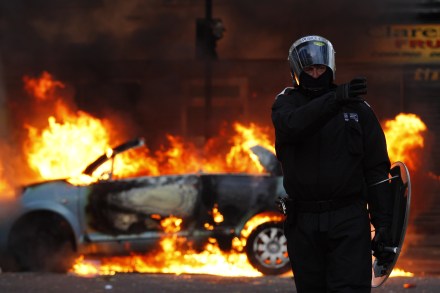
After last August’s riots the debate became quickly polarised. Were socio-economic factors like unemployment to blame, or was it all down to the individual choices of the rioters? David Cameron and other Conservative ministers knew which side of this debate they wanted to be on. They had been taken by surprise by the riots, initially failing to realise how serious things were, but when they got back from their holidays they set out a clear and confident line, brushing off most questions about links to the state of the economy or youth attitudes, and condemning the riots as ‘criminality pure and simple’. The soundbite was deliberately simplistic; Conservative ministers’ actual views were more complex.

Another five-point ‘pledge card’ from Labour

From our UK edition

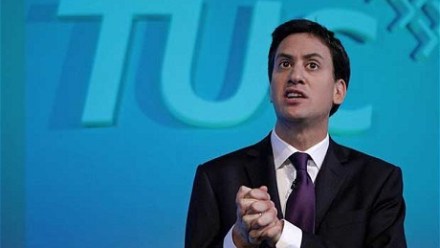
There is no PMQs today, so Ed Miliband is filling the time as gainfully as he can with a speech bashing the Tories. Unsurprisingly, he's making rather a lot of last week's Budget — particularly the 50p tax cut and the frozen personal allowance for pensioners — as well as of Peter Cruddas's recent indiscretions. And so David Cameron will be described as ‘out of touch’ and all that. But there is something else with today's speech: a prop, in the form of a five-point ‘pledge card’. I don't think we've had one of these from Labour for a couple of years now, although they do tend to reserve them for general election campaigns. Miliband's will focus on helping, in his own words, ‘squeezed middle families in these tough times’.

Lansley has won, in a way

From our UK edition

At two thirty this afternoon, the Deputy Speaker announced to the House of Commons that the Queen had granted Royal Assent to the Health and Social Care Act. It seemed fitting that the House was debating assisted suicide at the time. The agonies of watching this cursed legislation twitch and stumble its way onto the statute book were enough to make anyone with half a concern for well-ordered public policy start Googling the names of Swiss exit clinics. Albeit there would have been the risk that Number 10 had already paid for Andrew Lansley's ticket to join you there. Suddenly, though, the politics of health are very different. Mr Lansley, for all the opprobrium he has borne, has his Parliamentary mandate. He has won.

The Tories’ perception problem

From our UK edition

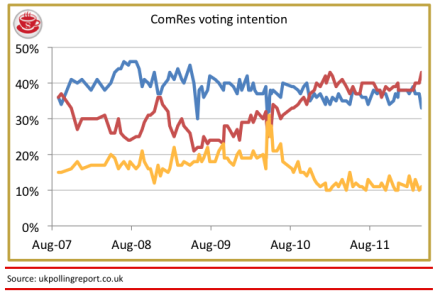
Introducing Ed Miliband, Labour's best hope since Tony Blair. Oh, I'm kidding, of course — but it's still striking that, this morning, Labour have their biggest lead in a ComRes poll for seven years. And the size of the lead? Ten points, but it could be even bigger. The Peter Cruddas revelations fell right in the middle of ComRes's polling. Apparently, those interviews conducted after Sunday had Labour with a 17-point lead. Of course, you can slap every caveat across this that you like: we're still ages away from the election; one poll does not make a trend; the 17-point figure is based on a subset of a subset of people; and so on. But this ComRes poll, and a few others out today, will still jangle nerves and fray tempers along Downing Street.

Replacing control orders: an unsatisfactory compromise 

From our UK edition

A small silver lining for David Cameron in the ‘cash for access scandal’: on a quieter day, today’s report on the coalition’s replacement of control orders with ‘Terrorism Prevention and Investigation Measures’ (TPIMs) might have got more attention. The report, published by the Independent Reviewer of counter-terrorism legislation, David Anderson QC, makes for difficult reading for ministers. Before looking at the detail of the report, it is worth remembering that control orders were always a second-best policy.

Transparency isn’t just for scandals…

From our UK edition

While the #cashforcameron scandal (as it is being called on Twitter) rumbles on, the calls for state funding of political parties are increasing. But as James said yesterday, and as I argued on Sky News afterwards, this is not the answer — and it seems that the majority of the public agree. Yesterday's YouGov poll had 59 per cent of its respondents opposing the idea of taxpayers funding political parties. But will transparency work instead? Blowing open the doors on all meetings and donors would certainly help the public see who is donating what and the effect (if any) that money is having on policy — but only if it is properly followed through.

How will the Lib Dems respond?

From our UK edition

The key thing to watch for during Francis Maude’s statement is the Lib Dem reaction. At the moment, the Tories can rebut Labour’s criticisms of them by pointing to both union funding and the Ecclestone affair. But if their coalition partners start turning up the volume on this story, then the Tories are in a far more difficult position. What will drive the Lib Dems is their desire to get a deal on party funding. The Lib Dems are very keen to reduce the advantages that the Torties and Labour have on this front and this scandal presents the perfect opportunity to press for a restrictive cap on donations and more state funding for political parties.

Cameron u-turns on donor secrecy — but what now?

From our UK edition

One distinct feature of the ‘cash for access’ row is that we've seen it all before. And not just the glutinous mix of politics and money, but also the debate over what should be done to fix it. Last November, Sir Christopher Kelly, chair of the Committee on Standards in Public Life, released a report into the funding of political parties that featured many of the options we're hearing today. It landed on 24 recommendations, of which one stood out: ‘the only safe way to remove big money from party funding is to put a cap on donations, set at £10,000’. But to prevent a subsequent shortfall in parties' funds, it also proposed that state funding be increased to the tune of an extra £23 million.

The problem for Cameron is his proximity to the problem

From our UK edition

The happiest news for David Cameron this morning is that the ‘cash for access’ story hasn't quite made it onto every front page. But that's it, really, so far as the glad tidings are concerned. All the rest is poison for No.10. The Prime Minister is now fighting off calls — including from his own MPs — to release the names of those donors who enjoyed dinner at his Downing Street flat. Labour are, of course, pressing for him to go further than an internal party inquiry, and launch an independent investigation instead. Today's furore is not going to simmer down after a few days, or even after a few weeks. In several respects, all this is trickier for Cameron than, say, the expenses scandal.

Transparency, not state funding

From our UK edition

Cutting the 50p rate was economically the right thing to do, but the politics of it are hugely complicated. The biggest danger is that it bolsters the sense that the Conservatives are the political wing of the privileged classes. For this reason, it is particularly unfortunate for the Conservatives that it is this Sunday that The Sunday Times has done an expose (£) on how potential donors were being lured with the offer of supper with Cameron and Osborne and the chance to influence policymaking. Labour are already trying to link the two, asking the Prime Minister to ‘provide details of all donors who have made representations, both written and orally, on changes to the 50p tax rate’.

Why access Cameron? The Lib Dems would be an easier target…

From our UK edition

Why would anyone pay £250,000 to change Tory policy when the Liberal Democrats would do it for £2.50 and a hug? The brilliant Sunday Times investigation today makes you wonder whether businessmen don't actually realise that out that, in this coalition, it doesn't matter what you persuade David Cameron of. Policy is decided by horsetrading with the Lib Dems, who wield disproportionate power (for good or for ill). For example, Osborne was personally inclined to bring the top rate of tax down to 40p, but the Lib Dems told him they'd only allow this in exchange for their mansion tax. Cameron refused to do the deal, so 45p it was. The rise in capital gains tax was a Lib Dem demand, and would only be changed by Lib Dem agreement.

The ‘next big scandal’ detonates under Cameron

From our UK edition

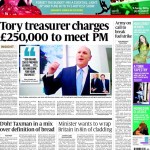
‘It will be awesome for your business.’ So said Peter Cruddas, co-treasurer of the Tory party, as he tried to peddle access to David Cameron for £250,000 a shot. Only he wasn't talking to businessmen this time; he was talking to a couple of investigative reporters from the Sunday Times (£), who were armed with dictaphones and video cameras. And, as the resulting footage shows, he blustered himself over the edge. A ‘premier league’ of donors was spoken of, whose ideas are ‘fed in’ to Downing Street's policy process. There was a claim that the biggest donors can be invited for dinner at Cameron's private flat in No.10, where they can ask him ‘practically any question [they] want’.

Previewing my Week in Westminster

From our UK edition

I’m presenting Week in Westminster at 11am on Radio Four today, and get to choose four topics for discussion. My political nodes were, of course, amputated for the purposes of this production. Here are the topics I chose: 1. Young vs Old. Osborne stepped on a landmine on Thursday: he didn’t expect his pension tax (minor, as Charles Moore argues in the Telegraph) to cause such a reaction. But I suspect he hadn’t realised the depth of feeling in this emerging clash of the generations. Osborne’s idea for freezing pensioners’ tax threshold was lauded on Twitter but lambasted in (most of) the press.

What did the public make of the Budget?

From our UK edition

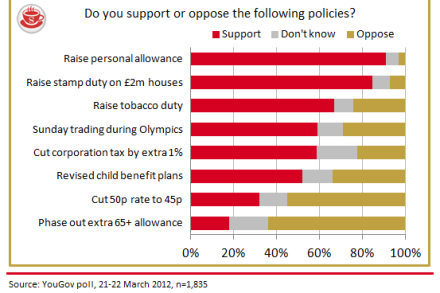
After weeks of hearing what people think about the policies that Osborne might’ve adopted, we now have the first evidence of what they make of the Budget itself. Today’s YouGov poll lists eight of its main policies, and it seems they fit into three broad groups. First, the very popular ones: raising the personal allowance and increasing stamp duty for £2 million houses. Second, those backed by the majority but not so overwhelmingly: the corporation tax cut, the child benefit changes, Sunday trading during the Olympics and the tobacco duty rise. And finally, the unpopular measures: cutting the 50p tax rate and phasing out the extra personal allowance for over-65s.

Cameron’s minimum pricing plan is politically risky

From our UK edition

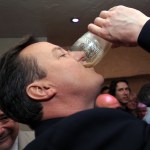
David Cameron’s plan for a minimum price for alcohol is one that several of his Cabinet colleagues, including the Health Secretary, have grave reservations about. But the Prime Minister’s personal enthusiasm for the policy has overridden these reservations. To my mind, a minimum price for alcohol is not a good idea. I expect that the effect of it will be to shift those who are intent on getting drunk, off beer and wine and onto spirits, whose prices will probably remain unchanged. Tory MPs also tend not to like the idea, viewing it as an unnecessary interference with the market. Indeed, I suspect there’ll be a fair few Tory backbenchers who vote against this policy in the Commons. This isn't the only political complication the idea throws up.

Osborne needs to speed up

From our UK edition

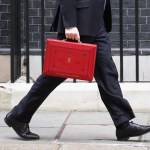
Will the Budget make a difference? Nowadays, we have a quick and easy guide: Box 3.1 from the Office for Budget Responsibility — otherwise known as the ‘blind bit of difference’ test. Sure, Budgets can make your hot takeaway lunch 20 per cent more expensive and your cigarettes cost £7.50 a packet, but the question, in a recession, is whether any stardust can be found between its pages. Whether it will be do anything for jobs, the deficit or economic growth. The Budget nowadays is handed to the OBR in advance of publication and assessed for its impact on the economy. The verdict: speeding up the corporation tax cut (another welcome move, and brave of Osbrone to do it during a deficit period) may add 0.

Tory MPs welcome the Budget

From our UK edition

George Osborne and David Cameron have just addressed the 1922 Committee of Tory backbenchers. They received the traditional desk banging reception and Tory MPs seemed in good spirits as they left the meeting. Interestingly, they were nearly all relaxed about the increase in the personal allowance, believing that they would get the credit just as much — if not more than — the Liberal Democrats. One told me that ‘the public view this as a Conservative government when things are going well and a coalition one when things are going badly’. Perhaps the biggest piece of news out of the meeting is that Osborne offered Tory MPs considerable encouragement that the 45p rate will not become a permanent feature of the tax system.