Conservative party

Why Boris will struggle to become PM

From our UK edition

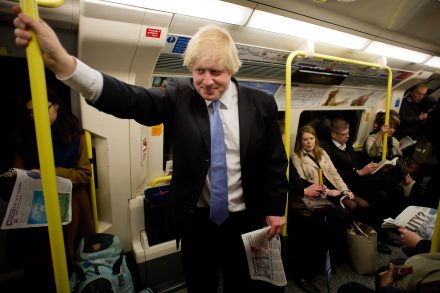
‘Just three months ago’, writes Tim Montgomerie in today’s Times (£), ‘it was almost fanciful to imagine Boris as a future leader.’ Notwithstanding today’s news, it still is. The idea that, unless David Cameron ‘finds an election game-changer, the party might very reluctantly reach for the blond-coloured nuclear button,’ is a great story. But, even if the rumours that the Mayor is planning to stand for Parliament again are true, securing the leadership of the Conservative Party is going to be very difficult indeed. Here’s why.
A dreadful turnout

From our UK edition

There are two major stories behind the headline results this morning: the rejection of elected mayors and the low voter turnout. Of these, I think the second is the most significant. You can apportion some of the blame to the dreary weather, if you like. But, still, a predicted turnout figure of 32 per cent? That's hardly encouraging. First, though, we shouldn't exaggerate the situation. This wouldn’t be the lowest turnout figure for any local election in history — but the lowest since 2000, when the figure was less than 30 per cent. And it’s also true that turnout has risen for the past three general elections, even if we’re still some way down on the 83.9 per cent achieved in 1950.

Where we stand this morning

From our UK edition

The results so far have been good but not spectacular for Labour. The BBC’s national vote share projection has them on 39 percent, the Tories on 31, and the Lib Dems on 16. These numbers would deliver a comfortable Labour majority on both the old and new boundaries. Strikingly, UKIP is averaging 14 percent in the wards it is standing in. This is an impressive result given that UKIP traditionally doesn’t do that well in local elections where Europe is less of an issue.

The early signs from the local elections

From our UK edition

Tonight, there seems to be a general acceptance that Boris has won London. The talk is of a four points plus victory. But it is worth, of course, remembering that no votes have been counted and there’s been no exit poll. But, sadly, it appears that there will be few other mayoralties created this evening. The opposition of the local political establishment appears to have triumphed in nearly all the cities holding referendums on whether or not to have a mayor. Their loss is Liverpool’s gain which will benefit considerably if it is the largest city outside London with a mayor.

15 (other) cities to watch

From our UK edition

Forget London. Odds are that Boris will win re-election while Labour becomes the largest party on the GLA. There are far more exciting battles going on around the country. Here’s the state of play in 15 cities outside the M25: 1. Birmingham. After strong gains in 2011, Labour are looking to depose the Conservative-Lib Dem coalition and regain the overall majority they held here until 2003. They need just five gains to do so — and, with 18 Tory seats and 13 Lib Dem ones up, that shouldn’t prove too difficult. Both of the coalition parties are simply in damage limitation mode. 2. Glasgow. Labour held a majority here for three decades, but lost it just a few weeks ago through resignations.

Boris wins the popularity contest

From our UK edition

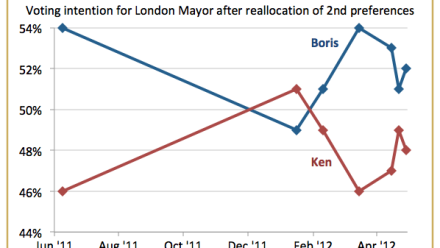
So, after all that, it looks like today’s London Mayoral will be just a little bit of history repeating. YouGov’s final poll predicts that Boris will defeat Ken in the second round by 53 to 47 — exactly the same result we saw four years ago. The third place finisher will probably be the same too: the poll has Brian Paddick getting 7 per cent in the first round, ahead of Siobhan Benita and UKIP’s Lawrence Webb on 4 and Green Jenny Jones on 3. If Boris does overcome Labour’s partisan advantage in London, it won’t be mainly down to his achievements in office. In fact, voters are split 39-38 between Ken and Boris on who’s achieved more as Mayor (although Ken did, of course, have four more years than Boris has so far).

What would count as a success for Labour?

From our UK edition

In today’s English council elections, there’s no doubt that Labour will do better than in 2008 — the last time most of these seats were contested. Experts Colin Rallings and Michael Thrasher predict that they’ll improve their ‘national equivalent vote share’ by 13 points compared to four years ago. But how many seats can they pick up of the back of that improvement? Rallings and Thrasher say a figure of 700 would justify a five-point lead in the polls. LSE’s Tony Travers expects Labour’s gains to be around 700-800, and says that: ‘If Labour only manage to put on a further 500 seats, that would be seen as seriously underperforming expectations. Ed Miliband will need 900 gains for a good night.

The View from 22 — 3 May 2012

From our UK edition

Here, CoffeeHousers, is this week's episode of The View from 22 podcast. In this episode, Leah McLaren returns to the Spectator a decade on from her infamous cover story attacking British men to explain how she's now fallen in love with one (0:30). James Forsyth and Neil O'Brien from Policy Exchange examine the Tories' lack of progress in the North (6:48) and how elected Mayors will help. Fraser joins in for a discussion of today's local elections and why Labour has the most at stake (16:10). You can listen below with the embedded player or subscribe through iTunes. As ever, we'd love to hear what you think, good or bad.  The View from 22 - 3 May 2012.

Why Labour supporters should shun Ken

From our UK edition

The single funniest thing about the London mayoral election has been watching the Left trying to excuse tax avoidance. After I revealed that his idol, Ken Livingstone, had saved a fortune by channelling six-figure earnings through a personal company, the Guardian’s Dave Hill pleaded that Ken’s previous condemnations of tax-dodgers ‘had been aimed at extremely rich people — which he isn't,’ so that’s all right, then. The Independent’s Owen Jones frothed that ‘the 1 per cent have an interest in demonising Ken Livingstone.’ But, Owen, Ken is the 1 per cent!

Boris has won already, says bookie

From our UK edition

We may still be 19 hours away from the polls opening — and more than 48 away from hearing the result — but bookmaker Paddy Power has already paid out £20,000 to punters who bet on Boris. It’s a publicity stunt by the company, but one that's unlikely to backfire, with the pollsters agreeing that Boris is set for re-election — the only question seems to be how much he’ll win by. YouGov show him 4 points ahead of Ken in the second round, ComRes have him up by 8, Survation 10 and Populus 12. Paddy Power says that 94 per cent of the bets they took on the race in the 24 hours before they paid out were for Boris. Similarly, Ladbrokes announced yesterday that 88 per cent of the cash bet had been for the current Mayor.

The political effects of all this hacking talk

From our UK edition

I doubt that many votes will be moved by the split report on hacking of the Culture, Media and Sport select committee. This is not a subject that sets the public's pulse racing. But all this hacking talk does create political problems for David Cameron. First, it obscures his attempt to talk about other things that matter more to the electorate. This was rather summed up yesterday when the News at Ten led on him facing questions in parliament about Jeremy Hunt rather than the speech he had had to cancel about the economy. This is a particular problem given that the next six weeks at least are going to be dominated by the appearances of various Cabinet ministers and politicians at the inquiry.

Gove gets covering fire

From our UK edition

Good teaching matters; that’s something we don't need to be taught. But how much does it matter? What are its measurable benefits? Today’s education select committee report collects some striking, if pre-existing, research into just those very questions, and it is worth reading for that reason. There is, for example, the IPPR’s suggestion that ‘having an “excellent” teacher compared with a “bad” one can mean an increase of more than one GCSE grade per pupil per subject.’ Or there’s the American study which found that the best teachers can ‘generate about $250,000 or more of additional earnings for their students over their lives in a single classroom of about 28 students.

Tricolour Britain

From our UK edition

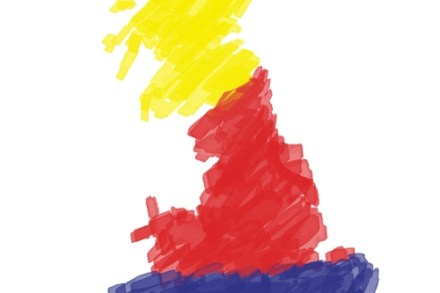
With unionists getting grubbed in Scotland and Labour being driven to near-extinction in vast swathes of the south, a new map of political Britain is emerging. In my latest Telegraph column, I called it ‘Tricolour Britain’ — the SNP at the top, Tories at the bottom and Labour stuck in the middle (with Wales). Policy Exchange has today released research which throws more light on this slow-mo political segregation. I thought CoffeeHousers may be interested in what strike me as the top points.   1. Scottish Tory Syndrome is when a once-dominant party loses and doesn’t recover. The party has failed to capture the imagination of voters, so when its apparatus is knocked down there’s no political force to bring it back.

Cameron goes on the attack to defend Hunt

From our UK edition

I don’t think I’ve ever seen David Cameron as angry as he was for that urgent question on Jeremy Hunt. He had clearly decided that attack was the best form of defence and went for his Labour critics in the most aggressive manner possible. But he did make one important concession in his opening answer when he said that if there is evidence of wrongdoing by the Culture Secretary, ‘I will not wait until the end of the Leveson inquiry to act’. In other words, Hunt’s appearance before Leveson will decide his fate. The dynamic in the Cameron-Miliband exchanges was genuinely personal. Cameron told the House that ‘we’ve learned something about the Labour leader today and it is something he’ll regret’.

Boris drops the f-bomb (again)

From our UK edition

More ‘colourful language’ from Boris Johnson today. Interviewed by the BBC about his reported attempts to secure sponsorship from News International while they were being investigated for phone hacking, he dismissed the claims as ‘f***ing b****cks’.

An anti-Labour leaflet in a pro-Labour font

From our UK edition

The leaflet pictured above landed on my doorstep in Peckham last week. It's the most interesting piece of election literature I've received this year — not because of its words, but because of its graphic design. If you read it closely, it appears to be an official communication from the Tories. The legally mandated imprint declares it to be ‘Promoted by Ian Sanderson on behalf of the Conservative Party, both of 30 Millbank, London SW1P 4DP’ — and that would accord with its strongly anti-Ken Livingstone text. If you don't examine it closely, however, it appears to be an official communication from Labour. The highlighted details are red, and all the text is set in the Labour party's favourite font, Neo Sans.

Modernisation comes to the 1922 Committee

From our UK edition

Christopher Chope is the only officer of the 1922 Committee who will be challenged by the 301 Group backed slate of broadly pro-leadership candidates. It is running two candidates for the two posts of secretary: Charlie Elphicke the popular, campaigning MP for Dover and Karen Bradley, the MP for Staffordshire Moorlands. Where the slate is running the most candidates is for the executive, full list below. But here great care appears to have been taken to come up with an inclusive list. For example, the group is supporting Adam Holloway who resigned as a PPS to vote for the EU referendum motion. It is also endorsing Penny Mordaunt, one of the leading Tory opponents of Lords reform.