Columbia University

Choosing mob rule at UCLA 

A big part of the social contract for a modern society is an agreement that citizens will grant the state a monopoly on the use of legitimate violence in exchange for that state protecting its subjects, including from mobs within the state and other illegal behavior. The expectation is that the rules will be enforced fairly and equally, or the contract loses legitimacy.  The United States has a First Amendment that protects speech to a level that doesn’t exist in other countries, including speech that is openly supportive of terrorism and mass murder. In this regard, the groups organizing campus protests are putting on a fine civics lesson for everyday Americans exhibited by the main groups behind many of the current college protests we are witnessing.


ucla

Dems torn as pro-Palestine protests rock universities

Columbia University’s pro-Palestinian protests are inspiring a nationwide movement while the Democratic Party finds itself split in two. A group of twenty-one House Democrats called on Columbia’s president, Minouche Shafik, to end the encampment or resign as progressives such as Representatives Alexandria Ocasio-Cortez and Jamaal Bowman joined in the Manhattan university’s protests Friday.The Democratic Party struggles with clashing opinions regarding the broader conflict as well as concerns over electability — particularly as “uncommitted” voters sent a message to President Joe Biden in the primary over his handling of the Israel-Hamas war.

Congress approves massive foreign aid package

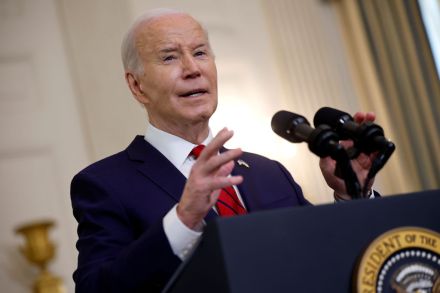
President Joe Biden signed the foreign aid package, which features $95 billion for Ukraine, Israel and Taiwan, on Wednesday after the bill swiftly moved through Congress. The breakdown of aid is as follows: $61 billion for Ukraine, $26 billion for Israel and $8 billion for Taiwan.Speaker Mike Johnson infuriated some of his Republican colleagues by even negotiating on the legislation, let alone bringing it to the House floor for a vote; he previously said he would not move any foreign aid until Democrats agreed to give additional funds for border security. Instead, after the Senate rejected the border security bill HR-2 and Johnson rejected the Senate-negotiated immigration package, the speaker made moves to go ahead with sending money abroad anyway.

On the ground at the People’s University for Palestine (formerly Columbia)

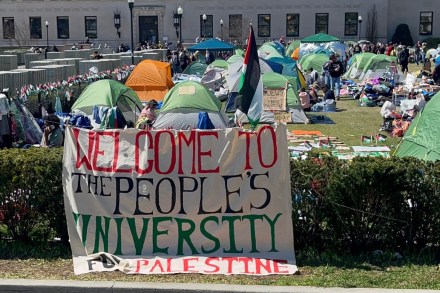
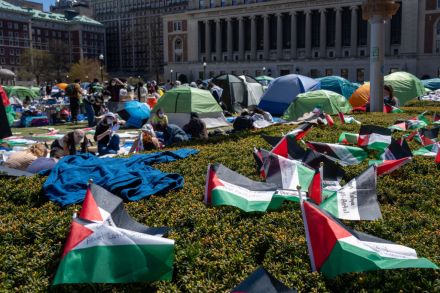
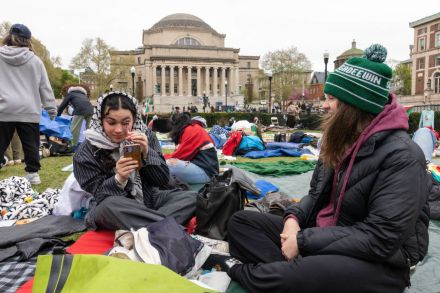
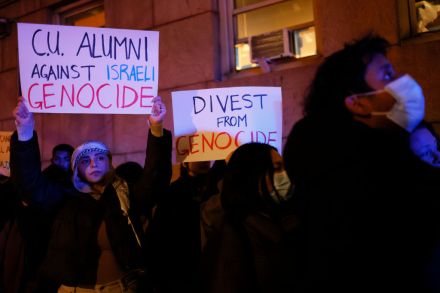
New York I’m on Columbia’s campus today. Sorry, I mean, “The People’s University for Palestine.” I graduated from the university in May 2020. My alumni ID allows me access. A couple of days ago, student protesters started occupying the South Lawn, in front of Butler Library. The police force was called in. Some arrests were made. The police were able to clear the eastern half of the lawn, but the western half remains occupied. Students have pitched tents. Hand-painted signs hang from clotheslines that stretch around the lawn. “Welcome to the People’s University for Palestine.” “Free All Palestinian Prisoners. Ceasefire Now.” “While You Read Gaza Bleeds.” “Admitted Students Enroll in Revolution.” Palestine flags and keffiyehs are everywhere.

columbia

Congress speaks up on anti-Israel campus protests

Raucous anti-Israel protests at Ivy League Columbia University — which have spread to other campuses following the administration’s crackdown on encampments erected by student activists — are becoming a hot topic on Capitol Hill.Republicans are eager to point out the protests are merely a symptom of the larger rot within academia; college administrators for years tolerated left-wing activists breaking university policy (and often rewarded them for their efforts) while resisting the representation of conservative voices on campus. This posture has allowed radical, hate-filled movements to foment among increasingly progressive student bodies.

At Columbia… that’s all, folx!

Undoubtedly the best moment in the testimony of Minouche Shafik, the President Columbia University, before the House Committee on Education and the Workforce last week was elicited by Representative Jim Banks. Why, he wanted to know, was the word “folks” spelled “folx” throughout an official guidebook for the School of Social Work? Shafik coyly suggested that perhaps the authors did not know how to spell, which might well be the case. But you cannot watch her squirming response without feeling the hot, sticky, and slightly nauseating air of disingenuousness wash over the proceeding.  “Folx,” as Shafik must be aware, is just the latest instance of weaponized orthography disseminated by the academic left. Think “Latinx” and you are on the right track.

columbia university
university college

Will US colleges’ brand power survive falling standards?

Nike. Supreme. Ralph Lauren. Abercrombie and Fitch. Harvard and Yale. On the streets of Budapest, style-conscious teenagers have collapsed the distinction between the Ivy League and streetwear. Maybe Americans still balk at wearing the logo of schools they didn’t get into, but the market for collegiate apparel in Eastern Europe is not limited to alumni, students and ambitious high-schoolers. Even kids with no interest in (or chance of) going to Harvard are drawn by the power of its name. Meanwhile, American higher education is being convulsed by a social-justice revolution that upends the basis of these schools’ claims to exclusivity.

Our strangled language on Israel and Gaza

As a left-wing sympathizer to the Palestinian cause, I cringed when I heard reports that college students around the country, including at Columbia University, my alma mater, had expressed support for Hamas’s murder of Israeli civilians on October 7. My first thought was that “woke” students had lost their minds — confusing the perfectly legitimate defense of Palestinian rights with the usual laundry list of “resistance” clichés that pay little attention to history, morality or the subtleties of the English language.

The slow death of ‘balanced literacy’

To start a fire, you need a match, something that burns and air. So to speak. If you don’t have a match, you can use flint, but that takes patience and skill. What you burn should have a low combustion point. And the air should have sufficient oxygen. Starting a fire, like starting anything, has predicates: the things you need before you can truly started. But when it comes to education, some people believe we can go directly to the steak sizzling on the grill, never mind the preliminaries. This hastiness never works out very well. The latest example is the slow death of “balanced literacy.” That’s the approach to teaching children how to read that was championed by Professor Lucy Calkins, from her perch at Columbia University’s Teachers College Reading and Writing Project.

literacy

The problem with Ovid

'The Rotation Method’ is one of the most amusing sections of Kierkegaard’s Either/Or. The second-most famous melancholy Dane has some good advice for dealing with irritating absurdity: cultivate arbitrariness when confronted with flagrant examples of it. There is someone whose conversation you find insufferable. What to do? Kierkegaard’s narrator has some tips: ‘I discovered that he perspired copiously when talking. I saw the pearls of sweat gather on his brow, unite to form a stream, glide down his nose and hang at the extreme point of his nose in a drop-shaped body.’ There is much about cultural life today that can be profitably approached with the Rotation Method.

columbia

Andrei Serban and the importance of acting out

During my study in the theater division at Columbia University’s School of the Arts, Romanian emigree acting professor Andrei Serban was legend. Beloved by acting students, lauded by faculty, he was tenured, established, and had seemingly free reign over his department. Despite that, he recently resigned over the administration’s push for trans inclusivity and faculty identity diversity. In an interview with Romanian TV show Profesioniștii (The Professionals), Serban detailed the two major reasons for his departure. As head of a hiring committee, he was told by the Dean of the School of the Arts to hire a person based on their identity factors, and not the person who he thought was best for the job.

andrei serban