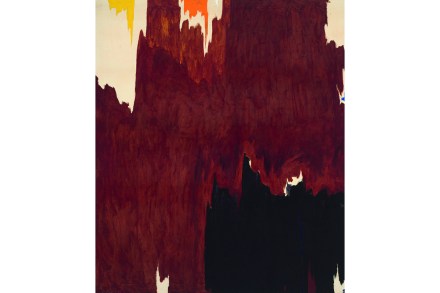
‘The possibilities of paint are never-ending’: Sir Frank Bowling interviewed
From our UK edition
‘I’m full of excitement waiting for this to dry out,’ Sir Frank Bowling exclaims. We are sitting in his studio, a room in a quiet Victorian yard that survives amid the tower blocks of Elephant and Castle. In front of us a semi-finished canvas – a glorious welter of yellow and orange in diverse modulations – is pinned to the wall. It’s executed in acrylics, a water-based material. Bowling, like Turner – one of his heroes – believes in using buckets of water, sometimes more or less literally. ‘I don’t always use conventional tools to mark the surface,’ he confides. ‘Sometimes marks are made by a brush, sometimes by simply flinging the paint at the canvas.’ Such matters have long fascinated Bowling.