Catholic church

Letters | 13 September 2018

From our UK edition

No debt without credit Sir: Liam Halligan and William Galston set out, convincingly, all the causes and effects of the 2008 crash, painting a doom-laden picture of the future of the world (‘The world the crash made’, 8 September). Not once do they mention China, which has to be the beneficiary of the consequential increase in global debt. Neither mentions that for every debtor there is a creditor. When I first worked in the financial world many years ago, the US was the world’s biggest creditor, Glass Steagall reigned supreme and, with growth slow but steady, everything seemed under control. But the Big Bang and Clinton’s repeal of GS opened the floodgates, allowing personal greed to determine the operation of the financial system.
Striking the right note

From our UK edition

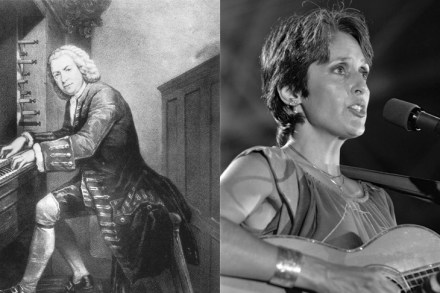
I was at a funeral the other day at which the music was so inspiring that I struggled to feel sad. That’s fair enough, you may think — but the person in the coffin was my own mother. This is a difficult point to explain in cold print, but there are reasons why I wasn’t grief-stricken at the death of the person who meant most to me in the world. My mother Pamela loved my sister and me with a passion; she radiated holiness, but in an unobtrusively English way. She was also a very private person, sometimes driven to distraction by her attention-seeking son. She never sought — and never received — any official recognition of her decades of service to the Catholic Church.

If Pope Francis resigns it could tear the Catholic Church apart | 28 August 2018

The allegation by a former senior Vatican diplomat that Pope Francis vigorously covered up sex abuse is looking more credible by the day. Archbishop Carlo Maria Viganò, former apostolic nuncio to the United States, says he told Francis in 2013 that Cardinal Theodore McCarrick, retired Archbishop of Washington, was a serial abuser of seminarians. The Pope ignored him, he claims – and lifted sanctions placed by Benedict XVI on McCarrick. Moreover, he fully rehabilitated the old man, who became one of his most trusted advisers. Viganò has called on Francis to resign.

Pope Francis ‘covered up for sex abuser McCarrick’ and must resign, says senior archbishop

Pope Francis stands accused this morning of covering up the crimes of ex-Cardinal Theodore McCarrick of Washington, one of the most senior and sinister sex abusers in the history of the Catholic Church. The allegation comes from the Vatican’s former apostolic nuncio to the United States, Archbishop Carlo Maria Viganò, 77, who has called on the Pope to resign. In a devastating 11-page written testament, Viganò says Francis lifted severe sanctions imposed on McCarrick for sexual wrongdoing by Pope Benedict XVI, the existence of which has not been made public until now.

pope francis mccarrick viganò

US Catholic bishops could be forced out of office by a horrific dossier on sex abuse

A Pennsylvania grand jury report released last night has revealed that the Catholic Church in six dioceses systematically and sneakily covered up sexual abuse by priests on a horrifying scale. The American Church has now been plunged into the worst crisis in its history. The 884-report comes less than a month after the revelation that ex-Cardinal Theodore McCarrick, former Archbishop of Washington DC, was a compulsive predator. His serial molestation of seminarians was an open secret, and cannot possibly have come as a surprise to some of his friends in the US hierarchy. The grand jury report – which examined only a tiny fraction of America’s nearly 200 dioceses – has set off an explosion of rage from US Catholics on social media, including many priests.

Social conservatism is dead

Just before Ireland voted overwhelmingly to end the country’s constitutional ban on abortion, Catholics in the fishing village of Clogherhead could be seen storming out of Sunday mass halfway through the service. Why? Their parish priest had come on too strong. He had not only ordered them how to vote but also supplied grisly details of an abortion procedure. Presumably some of them voted to repeal the eighth amendment. The ‘Yes’ campaign couldn’t have won its two-thirds majority without the support of practising Catholics. Very few of these, we can assume, were militantly pro-choice. Instead, they were reassured by promises that any future law would be limited in its impact — and determined to ignore a Catholic hierarchy contaminated by child abuse.

Papal surrender

Just before Ireland voted overwhelmingly to end the country’s constitutional ban on abortion, Catholics in the fishing village of Clogherhead could be seen storming out of Sunday mass halfway through the service. Why? Their parish priest had come on too strong. He had not only ordered them how to vote but also supplied grisly details of an abortion procedure. Presumably some of them voted to repeal the eighth amendment. The ‘Yes’ campaign couldn’t have won its two-thirds majority without the support of practising Catholics. Very few of these, we can assume, were militantly pro-choice. Instead, they were reassured by promises that any future law would be limited in its impact — and determined to ignore a Catholic hierarchy contaminated by child abuse.

Could Dublin’s preachy liberals save Ireland’s abortion ban?

From our UK edition

Could there be a Trump-style upset when the Irish vote next month on whether to repeal the country's ban on abortion? That's the question I discuss in the latest Holy Smoke podcast with my guest Tony Trowbridge, an Australian who became an Irish citizen when he was studying law at Trinity College, Dublin, in the 1970s. He's watched the country's transformation from something close to a Catholic theocracy into a society dominated by strident-but-smug media-savvy liberals. Irish political correctness is, if anything, even more preachy and joyless than the American variety. In that respect it's reminiscent of Irish Catholicism, which paradoxically used to have an almost Calvinist feel to it. No wonder the Church's moral authority evaporated so quickly when the abuse scandals surfaced.

The waffler and the thunderer: why Anglicans and Catholics will never unite

From our UK edition

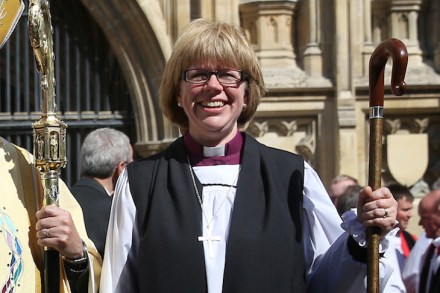
Last week The Spectator published a fascinating and mischievous piece by Ysenda Maxtone Graham entitled 'A tale of two Sarahs: the cuddly bishop vs the terrifying cardinal'. The first Sarah is Sarah Mullally, who is just about to take office as the first woman Bishop of London; she's a former nurse – indeed, the former Chief Nursing Officer and therefore Dame Sarah Mullally in her own right. But Hattie Jacques she ain't: she's friendly and 'inclusive' – i.e. fluent in churchspeak waffle after only two years as a suffragan bishop. The second is Cardinal Robert Sarah (pronounced Sar-AH), African-born Prefect of the Congregation for Divine Worship.

A tale of two Sarahs

From our UK edition

If you’re looking for a snapshot of the state of global Christianity today, a good place to start would be by looking at two violently contrasting Sarahs: Bishop Sarah, and Cardinal Sarah. One is Anglican, the other Catholic; one white, the other black; one bland, the other terrifying. Both are tipped to be leaders of their respective churches: Bishop Sarah as a future archbishop of Canterbury; Cardinal Sarah as a possible pope. I wonder which of them Jesus would prefer to be stuck on a desert island with. Sarah Mullally, the Bishop of London--elect, comes across as about the most upbeat, smiley person you could hope to meet.

Five years of Pope Francis: five things you need to know

From our UK edition

Five years ago, the name of the Pope was announced from the balcony of St Peter's and I was given less than an hour by the Daily Telegraph to write an article about a man I knew virtually nothing about. Cardinal Jorge Bergoglio, the Jesuit archbishop of Buenos Aires, had been fairly low down on the list of candidates acceptable to liberals – i.e. someone not in the mould of Benedict XVI. Sure enough, the new Pope Francis appeared wearing a plain white mozzetta or shoulder-cape; the BBC reported that he'd refused to put on the ermine-trimmed red velvet number sported by his predecessors, declaring that 'the carnival is over'. Actually, the carnival was just beginning: we were treated to one gesture after another of high-profile humility.

Time is running out for the ‘Dictator Pope’ as a new scandal hits Rome

From our UK edition

Cardinal Oscar Maradiaga of Honduras, one of the most influential figures in the Catholic Church, has been accused of receiving hundreds of thousands of dollars from a Catholic university in his ceremonial role as its chancellor – and of investing more than $1.2 million in London financial companies, some of which has now allegedly vanished. These claims form part of a set of spectacularly damaging but unproven allegations by the widely read Italian media outlet L'Espresso. You can read the report here; it also speculates about a 'close and unseemly relationship' between a bishop close to Maradiaga and a mysterious man apparently posing as a priest.

Cathar country

From our UK edition

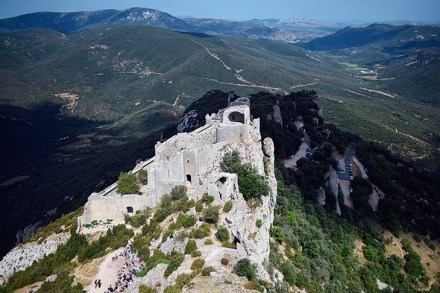
I once spent three months living in the Languedoc, writing my first novel. The highlight was the few days I allowed myself away from my monastic schedule to visit Cathar country. I’d been dying to see it because the castles and the landscape are so stark and dramatic, the history is so dark, bloody and weird, and because I wanted to try cassoulet in its proper location. I can’t remember much about the various cassoulets I tried except that, though it’s impossible to go wrong with goose, sausage and beans, none of them was quite as good as the one I laboriously recreated at home from a recipe in my Larousse Gastronomique. But you never forget the castles, such as Peyre-pertuse, jutting, as so many of them do, from a vertiginous, craggy, razor-back ridge.

Sado-erotic review

From our UK edition

The Olivier describes Salomé by Yaël Farber as a ‘new’ play. Not quite. It premièred in Washington a couple of years ago. And I bet Farber was thrilled at the chance to direct this revival at the National’s biggest and best equipped stage. She approaches the Olivier’s effects department like a pyromaniac in a firework factory. She wants everything to go off at once. And it does. Goatherds yodel. Bells bong. Flutes warble. Birds parp. A revolving conveyor belt twirls spare actors around the stage in dizzy circles. Chord surges swell and fade on the soundtrack. Kneeling shepherdesses sift mounds of soap powder into mahogany salad bowls.

A square dance in Heaven

From our UK edition

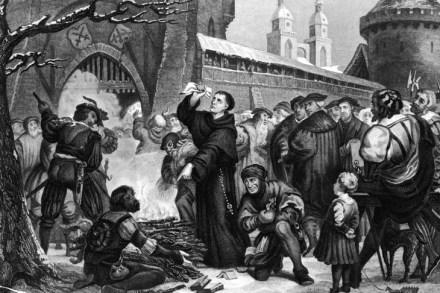
It’s 500 years since Martin Luther pinned his 95 Theses to the door of the Castle Church in Wittenberg, sparking what would come to be known as the Protestant Reformation. His superficial complaint was against the corrupt practice of indulgences, the Catholic Church teasing money out of the gullible and persuading them that they could buy their way into Heaven. But what Luther, a professor of theology, really wanted was for God to be made accessible to everyone and for worship to be more intimate, more direct, and in the vernacular, not Latin. We think of him now as a man of the text, who believed that faith was so important its meaning should not be withheld by the priesthood or clouded by that ‘dead’ language.

Pope is planning to retire, say allies – but only once he’s appointed enough liberal cardinals

From our UK edition

Allies of Pope Francis are saying that he's planning to follow the example of Benedict XVI and retire. But he'll only do so once he's appointed enough liberal cardinals to make sure that the next conclave doesn't elected a conservative who will interpret Catholic doctrine more strictly than he does. This, at least, is what allies of the Pope have been telling colleagues – claiming that they've heard it from the pontiff himself. (Francis himself is a notorious chatterbox and so are some of the cardinals close to him.) The Pope, now 80, apparently wants to hold three more consistories at which he will bestow the red hat on bishops who share his vision of reform (whatever that may be: the details are still sketchy, four years in).

The plot against the Pope | 12 March 2017

From our UK edition

On the first Saturday in February, the people of Rome awoke to find the city covered in peculiar posters depicting a scowling Pope Francis. Underneath were written the words: Ah, Francis, you have intervened in Congregations, removed priests, decapitated the Order of Malta and the Franciscans of the Immaculate, ignored Cardinals… but where is your mercy? The reference to mercy was a jibe that any Catholic could understand. Francis had just concluded his ‘Year of Mercy’, during which the church was instructed to reach out to sinners in a spirit of radical forgiveness. But it was also a year in which the Argentinian pontiff continued his policy of squashing his critics with theatrical contempt.

The plot against the Pope

From our UK edition

On the first Saturday in February, the people of Rome awoke to find the city covered in peculiar posters depicting a scowling Pope Francis. Underneath were written the words: Ah, Francis, you have intervened in Congregations, removed priests, decapitated the Order of Malta and the Franciscans of the Immaculate, ignored Cardinals… but where is your mercy? The reference to mercy was a jibe that any Catholic could understand. Francis had just concluded his ‘Year of Mercy’, during which the church was instructed to reach out to sinners in a spirit of radical forgiveness. But it was also a year in which the Argentinian pontiff continued his policy of squashing his critics with theatrical contempt.

Letters | 26 January 2017

From our UK edition

What is a university? Sir: As a former Russell Group vice chancellor, I think that Toby Young’s appeal for more universities (Status anxiety, 14 January) needs several caveats. First, what is a university? Recently some have been created by stapling together several institutions without any substantial element of research and renaming them as a university. There is even some suggestion that research is inimical to good teaching, because some university researchers with a duty to teach shirk it. But the presence of a weighty research community lends a university an invaluable ambience. In America, many colleges that teach only to the bachelor degree are well regarded without possessing the title of university.

The Knights of Malta must understand that they are a religious order – not a country

From our UK edition

There are some strange goings-on in Rome at the moment. Two of the world’s smallest sovereign states, both headquartered there, are having a spat over who is in control. The head of the Knights of Malta, the former Guards officer now Grand Master, Fra’ Matthew Festing has announced he will step down. He has been obliged to do so by his oath of loyalty to the Pope. Their clash of wills arose after he refused to co-operate with a papal commission of enquiry. The dispute came about when a senior official of the Sovereign Military order of Malta (The Knights of Malta), the Grand Chancellor Albrecht Freiherr von Boeselager, was forced out under protest. He was instructed to resign by Festing. He initially refused to go, but was reminded of his oath of obedience – so he went.