Caracas

The Maduro raid was a triumph of American innovation

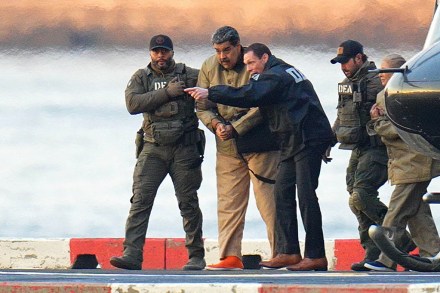
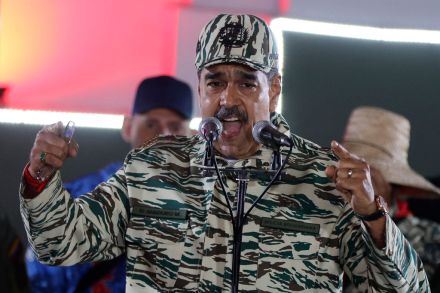
In the early hours of Saturday, January 3, Caracas went dark. Power failed across much of the city as strikes and cyber-attacks disabled critical systems. What followed was not a conventional invasion, but one of the most audacious special forces operations in modern history. Within hours, Nicolás Maduro and his wife, Cilia Flores, had been seized from the heart of Venezuela’s largest military complex. No tanks rolled through the streets. No territory was occupied. The operation succeeded not through brute force alone, but because of something far more decisive: overwhelming American dominance of intelligence, networks, surveillance and infrastructure.
maduro american

Venezuela prepares for clashing inaugurations

A new presidential term is set to begin officially in Venezuela on January 10. Despite the electoral commission’s failure to release the results of the July 28 election, Nicolás Maduro’s swearing-in appears inevitable. Opposition leader Edmundo González Urrutia, however, says he’ll be inaugurated as the country’s new leader. Will he return to Caracas? That’s the question Venezuelans keep asking, with González Urrutia having promised exactly that. “I am going to return to Venezuela to take the responsibility that 8 million citizens gave me,” he told Infobae five days ago after meeting with Argentinian president Javier Milei. This week he also met with President Biden, Uruguayan president Lacalle Pou and Panamanian president José Raúl Mulino.

What Trump really wants from Venezuela

When the headlines scream “narco-wars” and pundits wag their fingers about “fentanyl,” it is tempting to reduce Donald Trump’s Venezuela policy to one issue: drugs. A convenient shorthand – but also a red herring. Read closely and a very different logic emerges.  Drugs matter, and the effort is to some degree about exactly that. Yet so does immigration. Venezuela’s hydrocarbons also matter – and they matter even more in a world where OPEC has been deliberately constraining supply to keep oil prices high.   Deploying narcotics as a public justification is smart politics.

Venezuelans topple Chávez statues as they reject Maduro victory

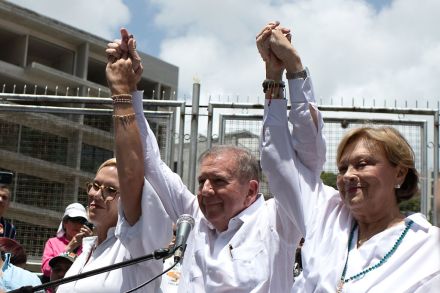
Nicolás Maduro’s rival Edmundo González and opposition leader María Corina Machado told reporters at around 6:30 p.m. Monday that with more than 70 percent of votes counted, González is more than doubling Maduro’s votes. During the press conference, both candidates emphasized peaceful protests, especially as thousands began taking to the streets the day before, when the country’s electoral council declared that Maduro had won with 51 percent of the vote. They called on voters to gather at 11 a.m. Tuesday. “I speak to you with the calmness of the truth,” González said to his cheering supporters from outside his campaign’s headquarters in Caracas. “We have in our hands the tally sheets that demonstrate our categorical and mathematically irreversible victory.

maduro

Things are about to get ugly in Venezuela

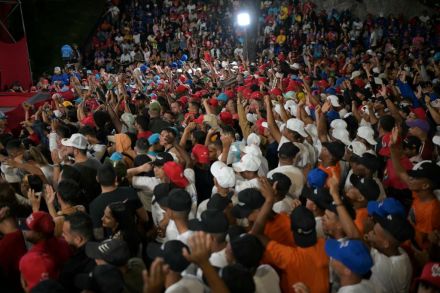
At 3:45 a.m., the sun was not yet out in the Venezuelan valley of Caracas, but Andrés, a twenty-two-year old who lives in the outskirts, woke up and with the Gloria Al Bravo Pueblo national anthem at maximum volume, roused his family too. From deep in the valley, Natalia showed up to the polls at 7 a.m. She then headed back to pick her elderly parents; “they can skip the line now,” she tells me.  Like them, thousands of others got up Sunday morning with a mission: make the Venezuelan presidential election — the most consequential one in twenty-five-years — fraud-proof. The logic: the world has to see what Venezuelans see, eyes don’t lie.  “It's 5 a.m. and we have work!,” said the face of the opposition, María Corina Machado.

venezuela

Why Russia is flaunting its ships in the Caribbean

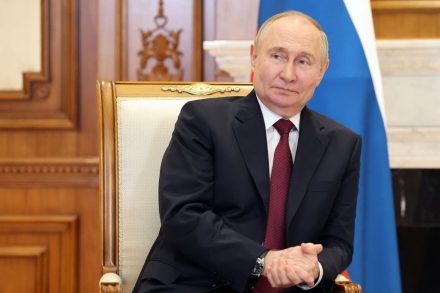
Two Russian ships docked Tuesday in Venezuela’s La Guaira port, twenty miles away from Caracas. The stop comes after military exercises were conducted in the Atlantic, with four vessels stopping in Havana late last month. This is all part of a decades-long “look-at-us” operation, also known as a “show the flag” move, as Russia’s defense ministry puts it. While Russia’s presence in Cuba and Venezuela is not a new phenomenon, conflict in the East has only accelerated their muscle-flexing in the West. These movements mark Russia’s first extensive military exercises in the hemisphere in five years, as well as their first deployment of a nuclear submarine in close proximity to the US since the Cold War.

Russia

The Venezuelafication of American streets

My grandma loves to joke about how she got a tooth knocked out by a motorizado (biker) in the Venezuelan capital of Caracas. “¡Dame el aro!” (Gimme the hoop!) exclaimed what looked like an off-duty bodyguard. “My hoop? What the hell?” Grandma thought to herself, before realizing the man was talking about her wedding ring.  “I never wear it when we go to church; I must’ve forgotten that day,” she tells us, in what feels like a skit. “I don’t know what got into me, but after the man pointed at his pocket and said he had a revolver, I said, ‘I have one too!’” “Show me,” the motorizado inquired as my frozen grandpa thought to himself, “What the hell is she talking about?

venezuelafication