Benefits

All is not quiet of the welfare front

From our UK edition

Welfare is fast becoming this parliament’s Ypres Salient - strategically critical, it is constantly contested. £20bn on social housing, £100bn on out of work benefits and £billions on universal benefits: welfare reform is where spending cuts are most conspicuous. A rhetorical confrontation is building and various tactical dispositions are being made. The Staggers’ George Eaton has an analysis that assumes that Labour’s current wedge-strategy (which I critiqued here) is not working because it is avowedly sectional, privileging those who might be caricatured as ‘undeserving’. Eaton argues that Labour must ‘launch a defence of the hard pressed majority’; those who work but still stand to lose, particularly families.

The Lib Dems, breaking doors in anger

From our UK edition

This one, from the Mail on Sunday, needs adding to the scrapbook: "Colchester MP Bob Russell’s fury over the Coalition’s housing benefit cuts boiled over at a stormy private meeting with the Deputy Prime Minister. To the astonishment of fellow Lib Dem MPs, it ended with Mr Russell storming out and slamming the Commons’ committee room door behind him. Witnesses said last night: ‘He took the door off its hinges.' In a bizarre twist, Mr Russell’s ally and fellow Lib Dem MP Mike Hancock - himself a fierce critic of Mr Clegg - tried to spare his colleague’s blushes by creeping back the following morning to repair the door before Commons authorities noticed it was even damaged.

The Tories rally after the Spending Review

From our UK edition

It's just one poll, but today's YouGov effort for the Sunday Times seems to underline many of the themes of recent weeks. It has the Tories on 42 percent, 5 points ahead of Labour on 37 percent, and with the Lib Dems on 13 percent. So the Spending Review – accompanied, as it has been, by rows over housing and child benefits – has not yet had a precipitous effect on the Tories' poll rating. If anything, YouGov have had the blue vote rallying since 20 October. As always we should be wary of drawing too many conclusions from the shifting landscape of opinion polls and surveys, but some of YouGov's subsidiary findings could help explain the Tories' position. First up, 72 percent of respondents back the coalition's plan to impose a cap on housing benefit.

Housing benefit reform is a Good Thing

From our UK edition

Dressed with his effortless prose, Matthew Parris has a point (£) that proves why he is the leading commentator of the last two decades. Housing benefit reform is his subject and he urges his readers reject the legends that have accrued around the issue - not Boris, not Polly Toynbee, not shrill councils, not rapacious landlords and definitely not the government. No one, he says, has the numbers but there are several certainties: ‘The outcomes may not prove nearly as brutal as this week’s predictions. What (as I asked above) can we know? We know that comparisons with Paris are ludicrous. All of our big cities are speckled with very large-scale “social” housing of a type that is suited only to the income groups for which it was constructed.

Voters think the new generations look old and tired

From our UK edition

There’s an intriguing detail in the latest YouGov poll. The number of people seeing Labour as old and tired is back up to 44 percent, which is where it was before Ed Miliband became leader.   The concern for Labour must be that the youthful, vigorous optimism that Ed Miliband is trying to promote hasn’t cut through to the public yet. Admittedly it is early days. But first impressions do matter in politics. Indeed, I must admit to being slightly surprised that the Tories are still generally ahead in the polls. I thought that the spending review would push Labour into the lead.   Something that, contrary to the media perception, might be helping the Tories is the ongoing rows over housing benefit and child benefit.

More perspective on housing benefit

From our UK edition

A useful reminder of the opinion polls on housing benefit from ConservativeHome's Harry Phibbs: "...in coming out with such hyperbole Labour show themselves to be out of touch with the voters. An ICM poll in June asked: "Do you support or oppose imposing a maximum weekly limit of £400 on Housing Benefit." Support was 68% with 23% opposed. Even among Labour voters there was strong support - by 57% to 35%. A YouGov poll in August asked: "Here are some policies the coalition government have announced in their first hundred days. For each one please say if you oppose or support it?" Among them was: "Putting a limit on housing benefit." 72% expressed support. 17% said they were opposed.

Some perspective on housing benefit

From our UK edition

Depending on who you read, the planned £400 a week cap on housing benefit is either comparable to Nazi concentration camps, death squads in Brazil, or ethnic cleansing in the Balkans Critics have ranged from the Mayor of London to the ultra Left. So it is worth taking a moment to get some perspective. Firstly, the general caps on housing benefit don't even impact on social tenants because they pay lower, subsidised rents, (though the £26,000 cap on the total amount of benefits per household might hit them). But for housing benefit claimants in the private sector outside London, less than 1% are affected by the cap. And even in London 9 out of 10 of private renters claiming housing benefit will be totally unaffected.

Boris v Dave, this time it’s serious

From our UK edition

Make no mistake about it, Boris Johnson’s rhetorical assault on the coalition’s housing benefit plan is a direct challenge to David Cameron’s authority. The two best-known Conservatives in the country are now involved in a battle that only one of them can win.   Boris told BBC London this morning: "What we will not see and we will not accept any kind of Kosovo-style social cleansing of London. "On my watch, you are not going to see thousands of families evicted from the place where they have been living and have put down roots." What is infuriating the Tory machine is not only Boris’s criticisms, but the language that he is used—which makes Labour’s talk of social cleansing sound positively moderate.

Another fine mess | 28 October 2010

From our UK edition

You know that child benefit cut for higher-rate taxpayers? Yeah, well, it may not be quite as straightforward as the government have hitherto indicated. In an important post on his Wall Street Journal blog, Iain Martin sets out a problem that is exercising nerves and minds in the Treasury: simply put, there's no existing method for establishing whether mothers (who receive child benefit) are living in a household which pays tax at the higher rate.

Weak, weak, weak

From our UK edition

Weak again. For the second session in a row Miliband was feeble at PMQs. He opened in his quiet-assassin mode with a quickie question. ‘There are reports that the government is planning changes to housing benefit reforms. Are they?’ Clearly he meant to wrong-foot Cameron by tempting him into admission which could be instantly disproved. But Cameron simply denied the suggestion and Miliband had no embarrassing disclosure to fire back with. Pretty duff tactics there. He fared slightly better when he asked Cameron what advice he’d give to a family facing a 10 percent cut in housing benefit after the chief bread-winner had been unemployed for a year. Cameron replied that unlimited benefits ‘are a serious disincentive to work.

The new fairness battleground

From our UK edition

The f word, fairness, got another outing today at PMQs as David Cameron attempted to defend the coalition’s proposed housing benefit changes from attack by Ed Miliband. Cameron’s argument was that it isn’t fair for people to be subsiding people on housing benefit to live in houses that they couldn’t afford to live in themselves. On this, I strongly suspect that most people in the country agree with him. If Labour wants to turn housing benefit into a big issue, the wedge will work to the Conservatives’ advantage. However, what should be worrying the coalition is that the changes to housing benefit will have to be implemented by local authorities, many of which strongly disagree with the policy.

The pros and cons of tweaking the housing benefit cuts

From our UK edition

It says a lot about the Lib Dems that a meeting between their party leader and deputy leader can throw up so many policy differences. When Nick Clegg and Simon Hughes chatted behind closed doors yesterday, the latter sought concessions over the coalition's housing benefit cuts – the cuts that Clegg then had to defend in the House. This morning, it was reported that he might just get some of them, even though Downing St are denying the story. Regardless of the outcome, the situation is reminiscent of the child benefit cut for higher-rate taxpayers. A policy was announced, only for the coalition to start pulling back from it in the face of both internal and external opposition.

Labour tries to prise Osborne and IDS apart

From our UK edition

Labour’s spin is less dexterous now that Alistair Campbell and Peter Mandelson have passed into night; but it can still artfully disguise politics as principle. Douglas Alexander is at in the Guardian, fanning the dull embers of George Osborne and IDS’ summer spat. He renews the offer of cross-party dialogue that he made on Andrew Marr last Sunday, before retreating, saying: ‘But beneath the talk of "we're all in this together" (a phrase specifically recommended for repeated use by Republican pollster Frank Luntz), what the chancellor announced on welfare was largely a laundry list of cuts that penalise the vulnerable and the working poor.

The IDS plan approaches consensus status

From our UK edition

Plenty of attention for Nick Clegg's listening, reading and smoking habits this morning, as well as his appearance on the Andrew Marr show. But it is another of Marr's guests who has made perhaps the most important intervention of the day: the shadow work and pensions secretary, Douglas Alexander. Here's how the Beeb website reports it: "Mr Alexander also said he backed 'in principle' the coalition's plan to replace all out-of-work benefits with a single 'universal credit' payment. He said such a move was 'sensible' but he would be 'scrutinising' the government 'very carefully' over its £2bn start-up costs." If true, then it leaves the the parties in a surprisingly similar position on welfare.

Now is the time for reform

From our UK edition

Throughout the country debates on the spending review have begun in earnest. Some of the most important questions in these debates will centre around the economics of consolidation, as I discussed on a recent radio show containing Professor Joseph Stiglitz. I also set out to discuss these issues at the launch of the Orwell Prize. In my remarks I focussed on the general case for eliminating the structural deficit within a Parliamentary term and less on the specifics of the approach that the Coalition has taken to achieving this goal (which I have outlined some thoughts on here). I made five key points.   First, consolidation is not based on extreme economic theory that has failed wherever it has been tried. This claim is not supported by the evidence in many countries.

IFS: The Spending Review was regressive – sorta

From our UK edition

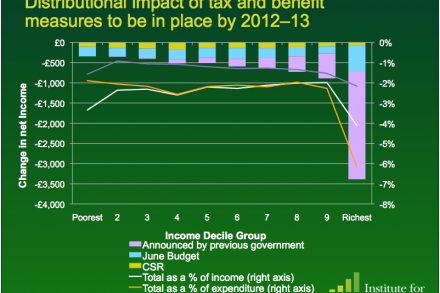
The second half of the IFS briefing was all about the distributional effect of the Spending Review. And you know what that means: decile charts – and lots and lots of them. As it happens, there were some areas of agreement between the IFS and the Treasury figures. Both, for instance, say that the welfare measures set out in yesterday's Spending Review will affect the least well-off the most. But there was one main area of disagreement. The Treasury says that its combined tax and welfare measures up to 2012-13 will be broadly progressive. The IFS says that they will be regressive. This is exactly the same issue that cropped up in August, when the IFS was commissioned to write a report by the End Child Poverty Campaign.

The ‘progressive’ debate re-opens

From our UK edition

Busy times indeed for the numbercrunchers and policy wonks. I'm at what is, in effect, the Institute for Fiscal Studies' third post-Budget briefing of the year: one for Darling's final Budget, one for the Emergency Budget and one, now, for the Spending Review. We're half-way through, but we've already been served a hefty chunk of meat: the IFS's analysis of what yesterday's Spending Review meant for public spending and for welfare. So far, there are mixed tidings for the coalition. The IFS's acting director Carl Emmerson - who is filling in now that Robert Chote has departed for the OBR - set the tone with his opening remarks. "By 2015," he pointed out, "departmental spending will be lower under this government than it would have been under Labour".

Doing things right, but in the wrong way

From our UK edition

In today’s spending review, George Osborne was absolutely right to hold the line on eliminating the structural deficit within one parliamentary term. In the Emergency Budget released earlier this year the coalition won fiscal credibility (and breathing space from international financial markets) by setting that goal. Failing to follow through on this goal at the first sign of difficulty would have damaged the government’s credibility and reputation in the eyes of international markets.   The Chancellor was also absolutely right to highlight the need for public service reform and to look to the welfare budget to provide some large and early savings.

The axe hovers over welfare (and welfare cheats)

From our UK edition

As we know, education and defence have now had their budgets settled – another two ticks alongside the checklist. But that still leaves the third member of the coalition's trio of sticky settlements unresolved: welfare. The "quad" of David Cameron, George Osborne, Nick Clegg and Danny Alexander will meet today to bash out the final details. Yet some of their key talking points and decisions have already made it into the papers (especially in this article (£) in the Sunday Times). Here's my round-up, along with brief comments: 1) Crackdown on welfare cheats. George Osborne sets the tone with his article in the News of the World (now also behind a paywall). "A welfare cheat," he writes, "is no different from someone who comes up and robs you in the street.

Labour to propose raising the top rate of income tax?

From our UK edition

Peter Hain is wizened counsellor to young king Ed, or gives that impression at least. The two are close, which makes Hain’s recent comments on tax noteworthy. Hain describes universal benefit as ‘non-negotiable’, adding: "If you start driving a coach and horses through universality you're effectively saying to middle Britain, 'you've got no stake in the welfare state.' I think the Tories and Liberals are making a very big mistake on child benefit. There's an answer to people on higher incomes and that's they pay higher taxes. And that is the answer to squaring that circle.