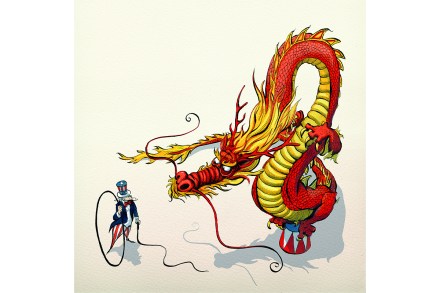
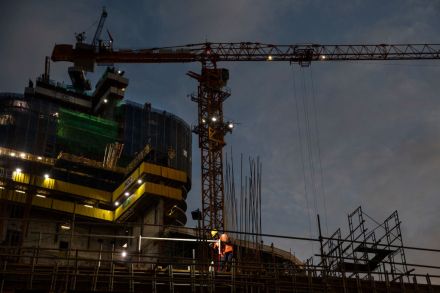
Belt-Road Initiative

Where is today’s equivalent of the Free Tibet movement?

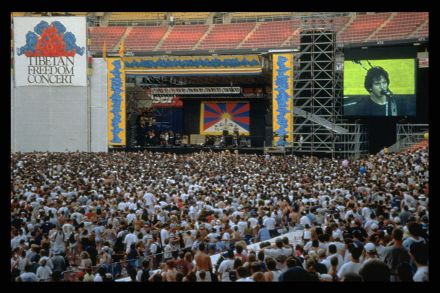
Remember “Free Tibet?” The Tibetan Freedom Concert, a series of music festivals that began in 1996, featured such impressive acts as the Beastie Boys, Red Hot Chili Peppers, Smashing Pumpkins, Rage Against the Machine, U2 and A Tribe Called Quest. An entire generation of young Americans — enchanted with “the other” of Tibetan Buddhism — had no qualms condemning what they believed to be an authoritarian Chinese regime. And why not? The People’s Republic of China, however much they fumed over international denunciations of the Tibetans, seemed weak, and incapable of silencing the Western entertainment industry’s indignation. These days, not so much. The NBA apologizes for players or coaches who criticize Beijing’s actions in Hong Kong.
free tibet

Pompeo’s principles

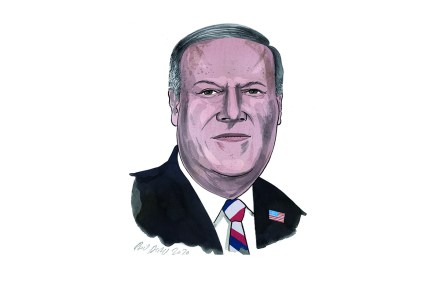
‘Come in.’ Burly, brisk and maskless, Mike Pompeo indicates a chair before the marble fireplace. ‘It’s all right if we’re six feet — or two meters — apart.’ We are meeting at the State Department the day after Pompeo’s return from Qatar, where US negotiators have opened discussions with the Taliban and other Afghan factions on an end to the war in Afghanistan. It’s also the day before the signing of the Abraham Accords between Israel and the UAE and Bahrain. Cheerful and perhaps a little tired, Pompeo exudes forceful confidence: a man who knows what needs to be done. As Secretary of State since 2018, Pompeo has been the strategist who has translated Trump’s generalities into the specifics of policy.

We need a Pompeo Plan to tame the dragon

It is traditional that the serious statesperson should respond to a crisis such as COVID-19 by calling for a ‘new Marshall Plan’. The New York Democrat Chuck Schumer wants one for the domestic economy. The Texas Democrat Julián Castro wants one in Central America. A chorus of European leaders, some of them democratically elected, wants one for the European Union. It is only a matter of time before the Trump administration wants one too, but on its own terms, in order to counter the threat of China. Call it Marshall’s Law. Between 1948 and 1951, the Marshall Plan or European Recovery Program (ERP) transferred $12 billion (c. $130 billion in today’s money) to western Europe, most of it to Britain, France and Germany.

marshall plan

WHO ate all the pangolins?

Got a cough, cold, rheumatic fever? According to the World Health Organization what you might really need is a good dose of pangolin scales. This is the surprising advice coming from a UN agency which has been accused of cozying up too closely with China and which in a little noticed development last year, decided to officially endorse Traditional Chinese Medicines (TCMs). In mid-2019, the WHO ratified the grandly titled 11th International Statistical Classification of Diseases and Related Health Problems (ICD-11). When it comes into force from January 2022, for the first time TCMs will be regarded as having met ‘the diagnostic classification standard for all clinical and research purposes’.

pangolins WHO

Geopolitical jockeying in a time of pandemic

You might think a global pandemic and the worst crisis since World War Two would lead to a welcome, if temporary tamping down of military activity in already tense and contested environments. Yet even as the novel coronavirus ravages the world, old fashioned geopolitical jousting continues in Asia, reminding us that the passing phase of COVID-19 will simply return much of the world to the status quo ante of great power competition. In a strange way, the ongoing military activities and geopolitical jockeying of China and the United States in Asia’s vital waterways is almost comforting.

south china sea

China’s Belt and Road Initiative is neo-Imperialism

China’s Belt and Road Initiative (BRI) is touted by Beijing as an attempt at multinational economic cooperation and development, comprising everything from foreign direct investment to the development of infrastructure. However, the purpose of the BRI is not economic or cultural but strategic, and is an effort to mask the expansion of Chinese power. In its strategic intent, the BRI should be considered an imperial project alongside the likes of the British East India Company (EIC) or the Dutch East Indian Company, Vereenigde Oostindische Compagnie (VOC).  With the BRI, China is exercising the 'imperial excuse', just as the EIC and VOC did centuries ago.

belt and road initiative