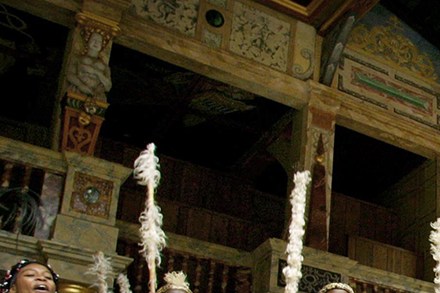
Macbeth in Swahili? There might even be improvements
Let’s start with some low-hanging fruit. When, in Henry V, the king inspires his army before Agincourt, the Danish translator – here, Niels Brunse – can hope for a relatively easy win: ‘Vi fa, vi muntre fa, vi flok af brodre.’ Or, in the classic Schlegel-Tieck version of Macbeth, now rooted in German literature, the cursed usurper finds that tomorrow and tomorrow ‘Kriecht so mit kleinem Schritt von Tag zu Tag’. Linguistic kinship, comparable speech rhythms, shared verse forms: sometimes the happy not-so-few, the global band of brothers (and sisters) who translate Shakespeare out of English, face a stiff but still feasible task. Even in familiar languages, though, pitfalls await in every line. Surely, Richard III’s opening soliloquy will slip smoothly into French?