Angela merkel

Finessing the coalition’s EU referendum lock

From our UK edition

The Coalition Government’s proposal for a 'referendum lock' on future transfers of powers to the EU has already been branded “worthless” by some Tory backbenchers . It’s easy to share their frustration at the Coalition’s lack of interest in EU reform so far. After all, the Government has chosen to opt in to the European Investigation Order; signed up for new EU financial supervisors; and chosen not to challenge the UK’s participation in the eurozone bailout (making British taxpayers potentially liable for up to £8 billion in loans to eurozone governments). However, the referendum lock is still significant. New crises, situations and politicians’ egos will always drive the need for another treaty and further integration.

Battling for the budget rebate

From our UK edition

A plain speaking man, Janusz Lewandowksi. This week, the EU Budget Commissioner said, not without a clear note of pleasure, that 'the rebate for Britain has lost its original justification.' The EU veers between incompetence and arrogance. Baroness Ashton embodies the former, Lewandowski the latter. His statement encapsulated why a majority of Britons want out of this club into which they have never been allowed to enter. Put simply, it was hectoring and counter-factual. Mrs Thatcher negotiated the rebate to balance Britain's net contribution, which was excessive owing to Germany and France's disproportionate profit from the Common Agricultural Policy (the most glorious misnomer).

Cameron’s intervention causes uproar

From our UK edition

Iain Dale has news of fresh ruptures in the Tories’ controversial European grouping. Here are the details: This is an intriguing development. Perhaps the combination of being in government, the balance of the coalition and Cameron’s markedly improved relations with Merkel and Sarkozy (whose parties are aligned with the EPP) brings the need for fresh European alliances? Most of the controversy surrounding the CRG is unfounded but it certainly damaged Cameron at home and abroad. I’m told that the Tories have no intention of shifting allegiance, and that the original plan was for Kirkhope and Kaminski to share the chairmanship if possible.

The euro crisis is an opportunity for Cameron

From our UK edition

Gerard Baker has written the cover piece for this week’s magazine and it’s a must read. In it, he explains why ‘closer fiscal union’, as Rompuy terms it, is not to Germany’s advantage: ‘Any attempted fiscal union might well yield to Germany the biggest single vote in how much to raise in taxes and how to spend it. But it could still be outvoted by an alliance of smaller countries. Such a set-up would become an institutionalised mechanism by which German taxes will be siphoned off permanently to weaker European states.

Cameron’s European balancing act

From our UK edition

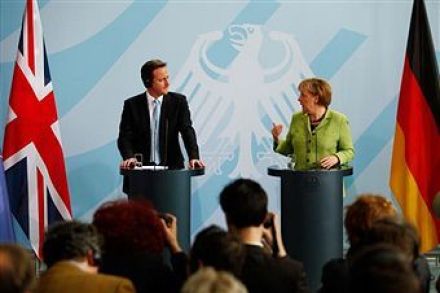
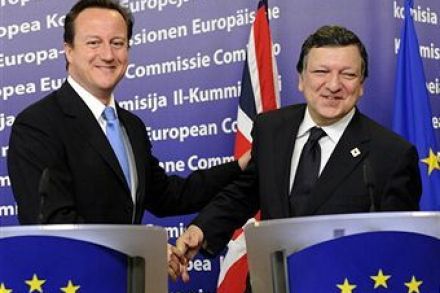
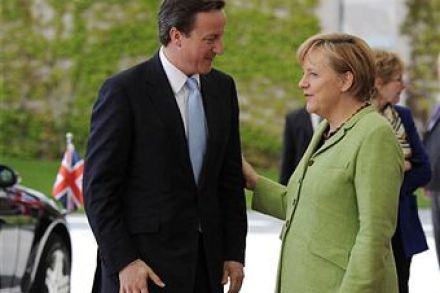
So David Cameron strides onto the European stage today, with his first EU summit since becoming Prime Minister. And early signs are that it's going to be a peculiar day for him. As Ben Brogan writes in the Telegraph, Europe seems to be liking the (liberal-democratised) Tories more than they thought they would. Sarkozy is, apparently, "smitten" with our PM, while Angela Merkel "has come to admire his directness". So after pitching himself against the Lisbon Treaty, and broadly selling himself as a eurosceptic over the past few years, Cameron now faces the prospect of cuddles over the coffee and croissants in Brussels. Like I say: peculiar. I suspect Cameron will be keen to avoid being hugged too tight, though.

German lessons

From our UK edition

Angela Merkel's fall from favour is something David Cameron ought to bear in mind as he looks for lessons to guide his term in office. The German chancellor could do no wrong when she was first elected. A new "Iron Lady", she was seen as a giant among pygmees. Tony Blair was leaving the scene, Nicolas Sarkozy had yet to be elected, the newspapers swooned, the voters applauded. Mrs Merkel was respected in the US and Europe. She made her unwieldy coalition with the Social Democrats work, almost singlehandedly picked the NATO secretary-general and ruled over EU meetings.

Goodbye Euro?

From our UK edition

I have just visited the two countries that are making the headlines in the European newspapers – Germany and Greece. During my trip, I met officials, journalists, and key advisers to both Prime Minister Papandréou and Chancellor Merkel. Sitting on the flight back to London I have regrettably come to the conclusion that the Euro is probably done for – or that Greece will default inside the Eurozone. Until now, I have dismissed the pessimists, thinking that the Euro would be saved. But after my trip I have changed my view for a number of reasons. Nothing I saw in Greece has convinced me that the Greek government is able, ready and willing to oversee the kind of austerity programme required to restore faith in its economy.

Don’t mention ze Europe

From our UK edition

The Conservative Party’s departure from the European People's Party came down to a choice of expediency over principle. If you are inclined to accept that Britain will stay in the EU and that membership helps this country - even if it requires some compromises - you will likely find the move unfortunate. If you are more concerned about the principles at stake – and feel that Britain’s loss of sovereignty has gone too far – and do not care about the loss of influence on the legislative process, you are likely to be in favor of the Tory move.   David Cameron is keen to keep the issue of Europe away from the campaign - and he is likely to succeed.

Germany to the EU: no more integration

From our UK edition

A Conservative Party article of faith has been the belief that other Europeans are innately more pro-EU than the British. In the past, this has undoubtedly been the case. Poll after poll has shown that Britons see the EU differently than most other Europeans. But as I have argued before, times are changing on the continent. In an article in the Frankfurter Allgemeine Zeitung (not a Europhile newspaper by any stretch), Germany's new politics is explained.

Germany, where art thou?

From our UK edition

It is more than 100 days since Guido Westerwelle became Germany’s foreign minister and the questions about Germany’s diplomatic introspection remain. They may have even grown and are becoming problematic for Berlin’s allies.   Chancellor Schröder appeared to follow a Sonderweg, a philosophy that saw Berlin move away from old notions of peacemaking and away from old alliances, such as that with the United States. At times, he seemed to want a new axis between Paris, Berlin, and Moscow, making Germany a go-between between East and West, a kind of post-modern Tito. Angela Merkel’s first term addressed the worst excesses of the Schröder years, but the vagaries of coalition government meant that Germany continued in awkward mode.

The prospect of another EU treaty is a huge problem for reformer Brown

From our UK edition

It seems there must be discussion about a potential European Monetary Fund, and an organisation to manage Europe’s economies that circumvents Maastricht, to avert future fiscal crises. So much for Lisbon, the treaty to end all treaties. Quite why no one, especially the treaty's opponents, acknowledged the possibility of a member state's financial collapse whilst Lisbon was being ratified during the recession is a mystery. However, all that is past. The question for the future is will there be a referendum this time round? Adrian Michaels, rightly, point out that the Tories’ eurowars are likely to be renewed at the most inopportune time for Cameron. But Cameron will offer a referendum; his European policy dictates that he must. A further treaty is a problem for Brown.

Cancel the London Afghanistan Conference

From our UK edition

In a few weeks time, a slew of foreign ministers will descend on London to attend a conference on Afghanistan. No.10 will use the event to sell Gordon Brown as a statesman, confidently dealing with the nation’s threats. The Conservatives, in turn, will probably try to score the usual points about Britain’s failure, alongside its NATO allies, to make any in-roads in the fight against the Taliban. Together with Tony Blair’s evidence to the Iraq Inquiry, the conference may create one of the few moments in the drawn-out election campaign when the three party leaders stop talking about the NHS and focus on national security issues instead.

Europe: ignoring the Lisbon Treaty when it suits them

From our UK edition

Is Greece too big to fail? When the Eurozone project was up and running, its taxpayers were promised: this was not a system where they’d have to bail out a badly-run country like Greece or Italy (or Brown’s Britain, were we members). But this rule (a clause in the Lisbon Treaty) is being torn up with various assurances from Germany and the ECB that they Greece is too big to fail – and they’d rather put their taxpayers’ wonga on the table than risk their precious promise. I made this point in my News of the World column yesterday (that bit not online). Here’s the story: 1. The Eurozone did have a clear ‘no bailout’ promise.

Why my money is on Balkenende

From our UK edition

When it comes to the position of the first European President, the worst thing to be is the frontrunner as Tony Blair found out the other week. As soon as you emerge as the favourite, everyone concentrates on why you might not be suitable for the job. So, I suspect that Herman Van Rompuy, the Belgian PM and current frontrunner, will not end up getting the job. It is hard to see how Britain could accept a candidate who is a federalist and aspires to EU-wide taxes. Also, as a friend who has his ear to the ground on these matters just told me, the rest of Europe will be unwilling to look like they just rolled over when the French and the Germans suggested a candidate.   But if not Van Rompuy who? Well, tucked up nicely on the rails is the Dutch PM Jan Peter Balkenende.

What would the Tories take back from Europe?

From our UK edition

Assuming that the Lisbon Treaty is ratified, that the Conservative Party wins the next election and that Angela Merkel and Nicola Sarkozy want Britain to remain in the European Union, what “sovereignty package” will EU leaders come up with for Prime Minister Cameron, so that the Tory leadership can placate its eurosceptic base? The deal cannot be cosmetic, but make it too tough and other EU leaders will not want to compromise.

Sarkozy revs up Franco-German motor, leaving Britain behind

From our UK edition

Last week, French President Sarkozy spoke to the annual gathering of his country’s ambassadors. Since he came to power, the French leader has used the annual event to welcome his countrymen back from their holidays and garner a few headlines. This year proved no different with an attack on the Iranian regime receiving the most attention. In a powerful line, the French president pointed out: "It is the same leaders in Iran who say that the nuclear programme is peaceful and that the elections were honest. Who can believe them?" He went on to say that he thought tougher sanctions would have to be discussed if Tehran does not change its position. But the speech was boilerplate Sarkozy – expansive, energetic, and ambitious.