American civil war

America is too fat for another civil war

Pundits and YouTubers these days love to warn of the inevitable civil war, as they sit in their comfortable, air-conditioned home studios, sowing division and unrest. And it is true: in recent years, America has faced a growing epidemic that threatens not only the health of its citizens but also the stability of society. But it’s not right versus left: it’s Dunkin’ versus Krispy Kreme, battling for the soul of America. Our nation’s obesity crisis has reached alarming levels, with a significant portion of the population struggling with weight-related issues. However, I’d argue the physical limitations of an overweight nation could be the very thing that saves us from ourselves.

war

Revisiting Gettysburg

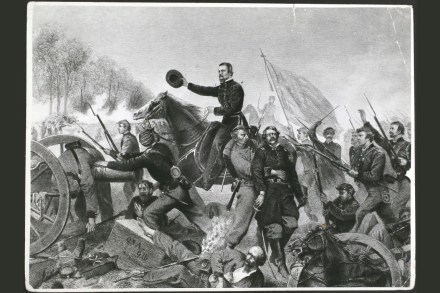
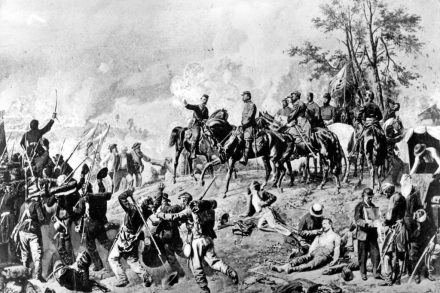
The Civil War, said Gore Vidal, is “the great single tragic event that continues to give resonance to our republic.” Gettysburg was its climacteric battle, and Ron Maxwell’s epic Gettysburg (1993), filmed on and around the battlefield, is the definitive cinematic treatment of the most consequential, written-about and argued-over military engagement in the history of the United States. (I would call it the most stirring as well but then I remember the words of the eminent historian J.G. Randall, best-known for his four-volume Lincoln the President: “That there was heroism in the war is not doubted, but to thousands the war was as romantic as prison rats and as gallant as typhoid or syphilis.

Gettysburg

What does a ‘proportionate’ response to Hamas look like?

As the world stumbles through the fog of war following the savage attacks on Israel by Hamas last week, I thought it might be worth pondering two things.  First, since the news is full of headlines warning against Israel’s conducting a “disproportionate” response, I wonder what a “proportionate” response to the wholesale murder and mayhem perpetrated by Hamas would look like?  Second, I know that I am not alone in sensing that the attack, though brutal, was but the opening gambit of a plan whose origin and course is, as of this writing, still unknown to the public. As to the first, this was the strophe: on October 7, hundreds of Hamas terrorists suddenly and without warning swarmed across the border separating the Gaza Strip and Israel.

gaza proportionate hamas

Lincoln’s hideaway

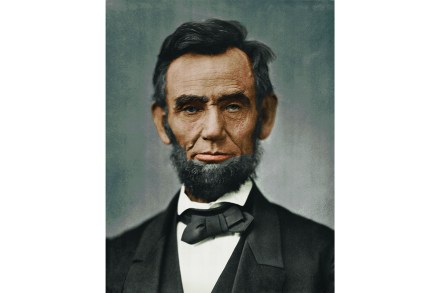
I hope Abraham Lincoln rests in peace. He got little of it as president. What solace he did find often came during stays in what today is known as President Lincoln’s Cottage, a thirty-four-room Gothic Revival home three miles north of the White House. This little-known site is where he, his wife Mary and son Tad lived for thirteen months during summers and falls from 1862 to 1864 — key periods when he wrote the Emancipation Proclamation, when the Battle of Gettysburg was fought, and when he was struggling to win reelection. Lincoln escaped to this 300-acre hideaway, the former home of a banker set on a wooded breezy plateau, to flee the heat — and the White House. His son Willie had died there of typhoid at just eleven, shortly before his first stay.

Lincoln

Monuments and memorials in Maryland

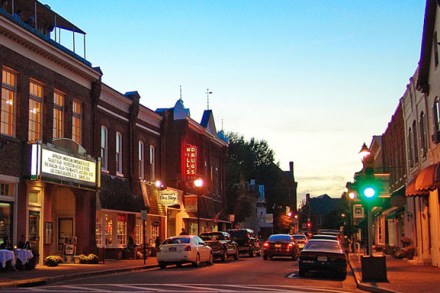
Easton, Maryland Three weeks before the election, I went to an event here in Easton where writers of various kinds — journalists, historians, speechwriters — read texts about political rhetoric and discussed them around a seminar table. Is rhetoric a set of tricks, as Socrates said, or an art, as Aristotle would have it? Lately politicians seem so constrained by propriety that they cannot say anything at all. Barack Obama ended his speech to the Democratic National Convention in August with ‘God bless.’ Sorry, God bless what? America? Joe Biden? Or did someone sneeze? In front of the Talbot County Courthouse in Easton is a beautiful monument to the 85 ‘Talbot Boys’ who fought in the Civil War.

maryland

The next so-called civil war

Batavia, New York On a brutally hot and wasp-swarming late summer mid-afternoon I walk our town’s old cemetery, as is my wont — hey, if I’m gonna live here for eternity I may as well get to know the neighbors. Walt Whitman swooned over one of this boneyard’s residents, and I have come to read the relevant passages to the boy who rests under the sod. His name was Stewart Glover, and he appears in Whitman’s diaristic Specimen Days to illustrate ‘the terrible and tender realities’ of war-death. Glover, Whitman tells us, grew up in Batavia with his father, John Glover, ‘an aged and feeble man’. (I dunno: his gravestone says Pop lived to the ripe age of 83, dying in 1873.

civil war

Cotton, slaves and arrogance: the message of Gone with the Wind

In an op-ed in the Los Angeles Times last week, filmmaker John Ridley urged HBO Max to remove Gone with the Wind from its platform. HBO Max capitulated right away, temporarily withdrawing the film until it can ‘return with a discussion of its historical context and a denouncement of [its racist] depictions’. As HBO weighs how to address what Ridley and others have described as the film’s romanticizing of slavery, I would encourage them to use the message of the movie itself as their guide.Gone with the Wind is about the perils of romanticizing. The movie begins with young men romanticizing the impending Civil War. ‘War! Isn’t it exciting, Scarlett?’ exclaims one of the Tarleton twins.

gone with the wind

Why secession beckons

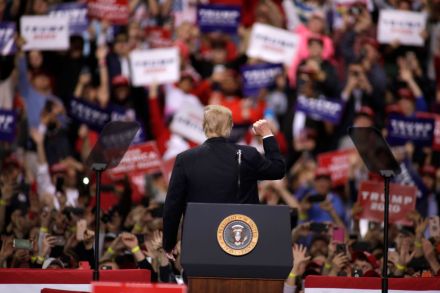
The craziness of our politics makes you wonder what’s round the bend. After the ‘resistance’, the pussy hats, the non-stop crises and the permanent impeachment, what could be the next shoe to drop? The answer is a breakup of the country, as I argue in my new book, American Secession.Americans have never been more divided, and we’re ripe for secession. The bitterness, the gridlock, the growing tolerance of violence, invite us to think that we’d be happier were we two different countries. In all the ways that matter, save for the naked force of law, we are already two nations.And if that’s where we are today, where might we be in an easily imaginable future, where Trump wins reelection and gets a couple more appointments to the Supreme Court.

split

America is way too fat to fight another civil war

Since 2016 there’s been a great deal of irony-free discussion about a second American Civil War. This ongoing commentary is not merely another symptom of Trump derangement syndrome. It has appeared in the form of serious thought experiments, popular novels, clickbait punditry, in interviews of academics, by authors on the Left, the Right, and even The New Yorker. When Thomas E. Ricks asked a group of national security thinkers what the chances were of conflict breaking out in the next 10 to 15 years, the rough consensus was that there was a 35 percent chance it would happen. Nearly a third of Americans polled believe a Civil War will break out before 2023. Everybody, it seems, is a young boy playing with regiments of tin soldiers.

america too fat civil war