Alaska

The Alaska summit went much as expected

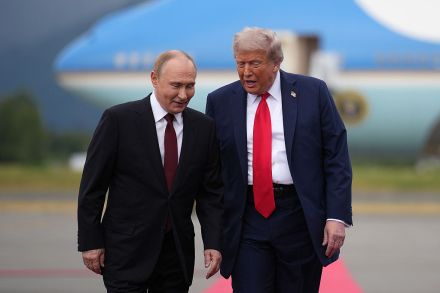
The summit between Presidents Donald Trump and Vladimir Putin ended predictably, without a ceasefire deal or, it seems, assent on much else. Trump said “Many points were agreed to, and there are just a very few that are left,” but failed to offer any details. Even if true, the leftovers are critical, and the gulf between the two governments on the war remains huge. Critically, Putin cares more about security than image or economics, and understandably believes that he would lose leverage by agreeing to halt military operations before winning the concessions he demands from Ukraine. Nevertheless, the summit improved, however slightly, the prospects for negotiating an end to the war.

Trump Putin

Trump, Putin, and the hidden power of the Bering Strait

Ahead of the Trump-Putin summit in Alaska to discuss Ukraine, President Trump said there would be “some land swapping.” He waxed lyrical about “prime real estate.” The summit’s location is a good example of land swaps and prime real estate and is in a region of growing geopolitical importance.   In 1867 Russia "swapped" Alaska for $7.2 million in a deal mocked as Seward’s Folly after Secretary of State William H. Seward who negotiated the exchange. It turned out to be a snip. Commercially viable oil was discovered three decades later and has brought in more than $180 billion in revenue since Alaska became a state in 1959.

Trump Putin Alaska Bering Strait

What Trump’s executive orders will do

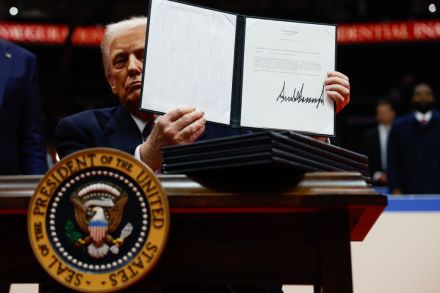
The newly sworn-in President Trump had a busy inaugural day. Between swearing into office and waving a saber around while dancing to “YMCA” at an inaugural ball, he also signed several executive orders and proclamations. After signing his cabinet and other nominations, President Trump’s first order of business was to proclaim that all flags should be flown at full staff for this and all future inauguration days. Following the inaugural parade, President Trump signed a bevy of additional executive documents as thousands of his supporters cheered.

Donald Trump dominant on Super Tuesday

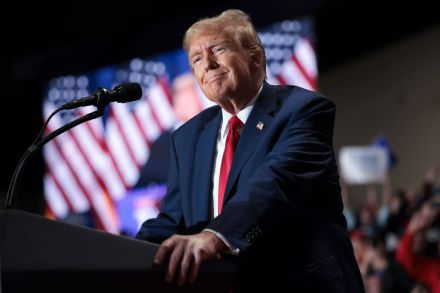
Donald Trump is cleaning up in the Republican primaries on Super Tuesday. The 45th president has secured victories in Alabama, Alaska, Arkansas, California, Colorado, Maine, Massachusetts, Minnesota, North Carolina, Oklahoma, Tennessee, Texas, Utah and Virginia. Nikki Haley's sole victory is in Vermont. President Biden also bagged easy wins in Alabama, Arkansas, California, Colorado, Iowa, Maine, Massachusetts, Minnesota, North Carolina, Oklahoma, Tennessee, Utah, Vermont and Virginia. The Democrats also held caucuses in American Samoa and Iowa on Tuesday. Biden won Iowa with 91 percent of the vote, but lost American Samoa to unknown businessman Jason Palmer.

trump super tuesday

Alaska prisons drop policy banning Catholic Mass

The Alaska Department of Corrections reversed its policy banning alcoholic wine from religious ceremonies in prison facilities on Friday, following a report from The Spectator. The interim policy, which was issued on June 6 and signed by Commissioner Jennifer Winkelman, stated that "no altar wine or other alcoholic beverages will be used by anyone who is involved with any activity. The use of a non-alcoholic substitute (juice) for altar wine may be considered." The policy effectively banned Catholic masses, which require alcoholic wine in order to be considered valid, from the prison system. Catholic prisoners would thus be unable to fulfill their holy obligation to attend Mass each Sunday.

alaska mass

Alaska prisons effectively ban Catholic Mass

The Alaska Department of Corrections has instituted a new policy that banned the use of altar wine during religious ceremonies, effectively barring Catholic Mass from being offered at correctional facilities. "No altar wine or other alcoholic beverages will be used by anyone who is involved with any activity. The use of a non-alcoholic substitute (juice) for altar wine may be considered," the interim policy established on June 6 reads. 816.01-IPPMDownload The interim policy effectively bans Catholic masses, which require a priest to consecrate and consume both bread and wine in order for the Mass to be considered valid.

catholic mass alaskan prisons

Sarah Palin isn’t done yet

Sarah Palin was defeated by Democrat Mary Peltola on Wednesday in a special election to fill the late Don Young’s seat in the House. She lost by a margin of 3 percent amid Alaska’s first ranked-choice voting election. Ranked-choice voting is when voters get to select their second, third, and so on choices of candidates in a field, rather than choosing just one candidate. Though left-leaning publications like the New York Times have wasted no time in declaring “defeat for MAGA Republicans,” such a conclusion is premature. Palin’s failure to win four short months in Congress does not necessarily mean conservatism has been repudiated. It mostly reflects the warped mechanics and unintuitive strategies of ranked-choice voting.

Lisa Murkowski doesn’t need the Republican Party

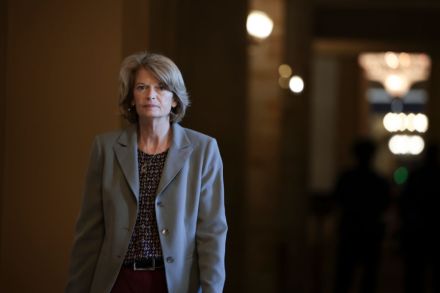
The Alaska Republican Party no longer wants Lisa Murkowski. That's just fine by her. In a traditional one-person-one-vote system, Murkowski would be sweating bullets right about now. The Alaskan Republican Party has censured her and endorsed Kelly Tshibaka, the former commissioner of the state's Department of Administration. President Trump has also thrown his weight behind Tshibaka. Murkowski has repeatedly voted against the Republican Party and Alaskan interests on key issues. In any other situation, she would be losing her seat — and for good reason. Fortunately for Murkowski, this year will be the test of Alaska’s ranked-choice voting (RCV) system. The ballot measure, which passed narrowly in 2020, established a nonpartisan top-four primary and RCV for the general election.

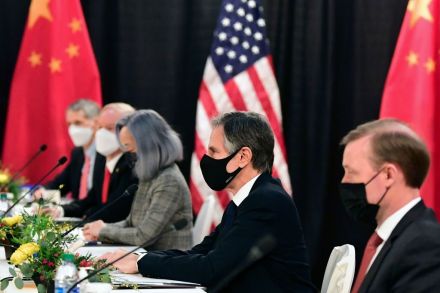
A diplomatic disaster in Alaska

It goes without saying that when conducting high-level diplomacy, you don’t insult the other party at a joint press conference before the negotiations begin. And if you choose to do something so foolish, you must be ready when the other party retaliates in its response. It is incredible that secretary of state Antony Blinken and national security adviser Jake Sullivan did not understand this when they began talks with their Chinese counterparts in Alaska yesterday. At what was supposed to be perfunctory two-minute statements by the US and Chinese delegations to the press before the talks began, Blinken and Sullivan criticized Chinese activities against the Uighurs, in Hong Kong and Taiwan, as well as for cyber attacks on the US and economic coercion of US allies.

alaska