Abandonment

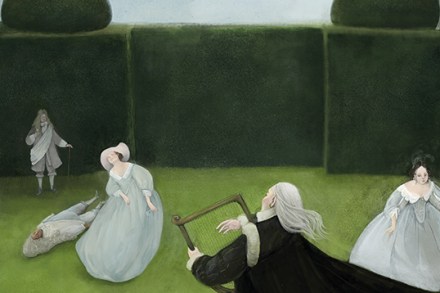
A broken bond: Gaining Ground, by Joan Barfoot, reviewed

From our UK edition

When a girl turns up at an isolated cabin in Canada, unannounced and uninvited, the woman busy thinning the lettuce has no idea who the stranger is. But then the woman has trouble remembering even her own name. ‘“Are you Abra Phillips?” asks the girl. “Am I?” the woman ponders, conscious that the words “mean something” to the girl,’ writes Joan Barfoot in the opening pages of Gaining Ground, a Canadian feminist classic now republished nearly 50 years after it first appeared as a debut novel entitled Abra. ‘I think, finally, that I must be; there is no one else to connect with this name,’ continues the protagonist, who we soon learn has been alone in the cabin for the past nine years, all but living off the land after walking out on her family.
The agonies of an abandoned wife: Mrs Dickens, by Emily Howes, reviewed

From our UK edition

For every smog-spitting chimney in Victorian London there was a woman tasked with keeping the hearth clean, both physically and morally. This ‘angel in the house’, as Coventry Patmore dubbed her, lived entirely for her family, but above all for her husband. With her organs tightly compressed beneath a whalebone corset, she ministered to his every need and forgave him all his worldly sins. She was, in short, not a real woman but an ideal. In Mrs Dickens, Emily Howes exercises the novelist’s prerogative to flesh out an ideal, to show how the real woman beneath her halo of thorns suffered.

Motherless friends: Kin, by Tayari Jones, reviewed

From our UK edition

Set in the American South during the Jim Crow era, Tayari Jones’s Kin follows the parallel lives of Annie and Vernice. The ‘cradle friends’ are both motherless, Annie having been abandoned and ‘Niecy’ orphaned, leaving them with a painful ‘wound’. They are as vulnerable as ‘unshucked, naked peas’. Though they are trauma-bonded, the ways in which they approach their lives differ hugely. As her mother is still somewhere out there, Annie becomes fixated on finding her and ‘trying to climb back in her womb’. She’s unable to move forward until she arrives at a resolution. Tracking her mother down becomes ‘the point of her whole life’ – much to Niecy’s dismay: ‘Finding your mama won’t fix you.

Songs of murder, rape and desertion

From our UK edition

A century ago, the Orkney poet George Mackay Brown was settling into his first term at Stromness Academy. His schooldays were to prove a dismal grind, but English lessons brought moments of magic. He was especially intrigued by poems – ballads, mostly – signed simply ‘Anon’. The name of the poet was lost – and perhaps there hadn’t been just one but a host of craftsmen in the making of each of these wonders. They were the creation of a tribe, the inheritance of a community, songs ‘seraphically free/ Of taint of personality’. Today, as publishers bust themselves to promote the cult of individual authors, it’s a thrilling, liberating notion.

A redemptive fable: Night Watch, by Jayne Anne Phillips, reviewed

From our UK edition

The Appalachians have become fashionable fictional territory. Following Charles Frazier’s Cold Mountain and Barbara Kingsolver’s Prodigal Summer and Demon Copperhead comes Jayne Anne Phillips’s Night Watch. Like Cold Mountain, it is set largely in the aftermath of the American civil war, but, for all its wealth of detail, it is less a historical account than a redemptive fable. As befits a portrait of a society riven by war, the novel unfolds in a series of discrete episodes. Its dominant consciousness and first-person narrator is 12-year-old ConaLee, who lives in a remote hillside cabin with her mother Eliza, infant brothers and sister and violently abusive ‘Papa’.