1970s

The artist who left no physical record of her work

From our UK edition

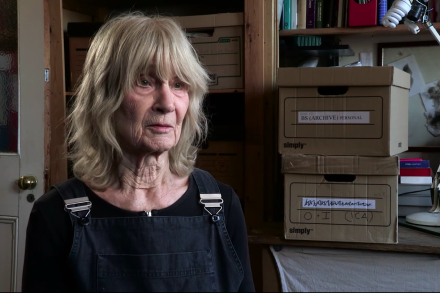
While locked-down galleries compete to keep their artists in the public eye — or ear — by uploading interview podcasts, a treasure trove of earlier recordings is being overlooked. Artists’ Lives, part of the British Library’s oral history archive, is a collection of interviews with 370 artists, 200 of which are available on the British Library Sounds website. As an account of British art of the past century they are more comprehensive than Vasari’s Lives and more reliable, coming as they do from the horse’s mouth. They are also exhaustive. But for those who haven’t got all day to follow the fascinating career of Guyanese-born Frank Bowling RA through 17 hours of recordings, edited extracts are now available as Voices of art.
The empress of art

From our UK edition

Somewhere in the bowels of the Tehran Museum of Contemporary Art is a portrait from a lost world. Its subject is a beautiful young woman: Her Imperial Majesty, Empress Farah Pahlavi of Iran. The condition of the work, however, a luminous print by Andy Warhol from 1977, is so bad that it could be a metaphor for Iran itself. Fundamentalist vandals have slashed at it with knives. The Empress — forced into exile when the Iranian Revolution overthrew her husband, the Shah, two years after the portrait was completed — discovered this upsetting news while watching French TV in her Paris apartment. ‘Seeing that, I said, “They are stupid”,’ she tells me. ‘Instead of tearing it they could have sold it!’ One day, she hopes to see it on display again.

The 1975: A Brief Inquiry Into Online Relationships

From our UK edition

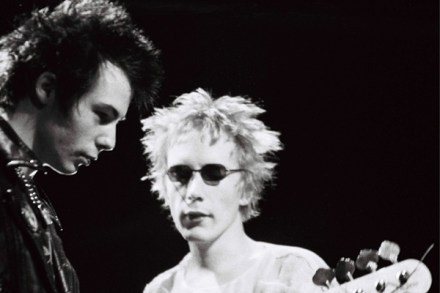
Grade: C A derided year in pop music, 1975 — and yet a great one. The mainstream was horrible, but we had Neil Young’s Tonight’s The Night, Patti Smith’s Horses, Guy Clarke’s Old No. 1 and Television just beginning to break through. It is in the lacunae, before the next big wave, that we hear the most inventive music, which is why ’75 — with Queen and disco hogging the charts and the blind alleys of prog and metal as your only alternative — was so good. But I suppose you want to hear about the band, The 1975 — one of Britain’s biggest. Oh, Britain. The 1975 are a bunch of middle-class Mancs led by a gobby SJW junkie — hell, what’s not to like.

Four play | 14 May 2015

From our UK edition

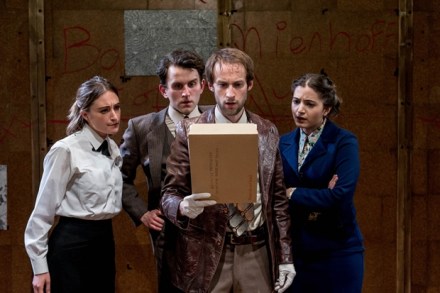
If Julian, Dick, George and Anne had become terrorists they’d have called themselves The Angry Brigade. It’s such a Wendy house name. The quartet of violent outcasts met in a Camden squat in the late Sixties and moved to Stoke Newington where they rented a house to deflect unwanted attention. They began planting bombs around London in the hope of jerking the proles from their consumerist trance and sparking a communist war. They preferred catchy locations for their fireworks: the Albert Hall, a BBC film unit, an MP’s garden. And it took the cops ages to track them down and sling them in jail. James Graham’s new play uses a neat staging device. There are four terrorists and four detectives, and the same actors play both hunters and quarry.

Don’t mock Elvis’s style – he was ahead of the curve

From our UK edition

In the giftshop at the new Elvis exhibition at the Dome, you can buy your own version of his flared white jumpsuits. I can’t think of anyone who could wear one and not look ridiculous — particularly if they had a bit of a weight problem. But Elvis, who would have turned 80 this year, managed to pull it off. This selection of the best Elvisiana from Graceland is full of the sort of kitschy excess that would sit so awkwardly on anyone else: his outsized solitaire diamond ring, the gold phone by his bedside table, the Harley-Davidson golf carts he used to rocket through Graceland’s grounds.

The Best of Me is more of a sleepie than a weepie – especially when our old friend No Sexual Chemistry makes an appearance

From our UK edition

Take tissues to The Best of Me, I’d read, as it’s such a weepie, so I took tissues, being a weeper at weepies — I still dab my eyes whenever I even think about War Horse — but it was rubbish advice. You don’t need tissues for this film. Instead, you need to line up several triple espressos, as many cans of Red Bull as you can reasonably manage, two matchsticks (one for each eye, obviously), replacement matchsticks for when the weight of your eyelids proves too much and they snap, plus a small hammer to knock yourself in the side of your head when you find yourself bored out of your mind and dropping off anyhow. Actually, this may be rather unfair, as I did laugh inappropriately on a few occasions, so I must have been slightly awake for some of it.

Coming soon – the Bank of Miliband. Be very afraid.

From our UK edition

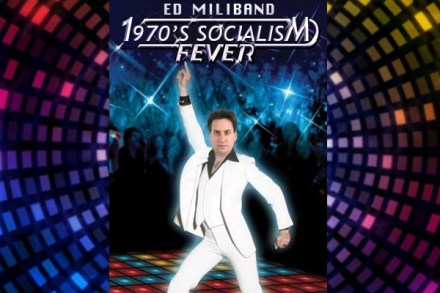
If you think bankers do a bad job of banking, just wait until government tries its hand. This seems to be what Ed Miliband is proposing today: a Labour government would set up two new banks, to challenge the existing five big ones. And so his 1970s revival continues. There’s no evidence that new banks would help much, as the Bank of England Governor has already indicated. But as I say in my Telegraph column today, Ed Miliband isn't too worried about lack of evidence. He's proposing to be a different kind of political leader. His list of ‘predators’ – ie, nasty businesses to whom he promises to give six of the best - grows longer all the time.

Rotten, vicious times

From our UK edition

A.N. Wilson recalls the worst decade of  recent history and the death throes of Old England There was a distressing news story the other day about a man who did not declare his father’s death because he wanted, like a character in Gogol, to go on claiming his late parent’s benefits. The smell eventually alerted neighbours to what was going on. The person I pitied was the pathologist who performed the autopsy, eventually declaring that the man had died of natural causes. Presumably this verdict could only be reached after hours of prodding putrescent limbs and organs with a scalpel. A similar feeling of pity arises when contemplating Dominic Sandbrook’s close scrutiny of Britain in the last five years of that terrible decade the 1970s.