-
AAPL
213.43 (+0.29%)
-
BARC-LN
1205.7 (-1.46%)
-
NKE
94.05 (+0.39%)
-
CVX
152.67 (-1.00%)
-
CRM
230.27 (-2.34%)
-
INTC
30.5 (-0.87%)
-
DIS
100.16 (-0.67%)
-
DOW
55.79 (-0.82%)
Reform is rapidly gaining on the Tories
The great British public seems to have got over its feelings of anger and disillusionment towards the Conservative party. It is mainly just laughing at the Tories now. The descent into outright ridiculousness brought about by the centrist ‘sensibles’ who currently run the Tory show came across loud and clear in last night’s seven-way ITV debate.
Twice the audience responded with spontaneous giggles at the answers given by Penny Mordaunt. The first burst of titters came when she described our education system as world class. In fact, there is much international data to back this up, at least for England where Conservative reforms have paid dividends in rising standards. But such is the extent of public derision for the Tories that almost nobody seems prepared to believe this.
This was the one huge laugh of the ITV debate. Some standups would kill for that volume.
— Edwin Hayward (@edwinhayward) June 13, 2024
It came as a result of Nigel Farage's question for Penny Mordaunt.
(Each party representative got to ask one free question to one other party representative of their choice. He chose her.) pic.twitter.com/vkM88Di5MM
Then, the most raucous burst of laughter came when Mordaunt was challenged by Nigel Farage on the betrayal of promises to reduce immigration made in four successive previous Tory manifestos. Why, asked Farage, would anyone believe the same promise now being made for a fifth time? ‘Because of the record of this prime minister,’ she said – bringing the house down in the process. ‘Enough, that’s fine, I’m happy,’ replied a delighted Farage.
His tail was up anyway given that, less than an hour before the debate began, a new YouGov poll had for the first time put Reform ahead of the Tories (by 19 points to 18). It was just one poll, and within the margin of error, but it is hugely symbolic. Especially as Farage had confidently predicted such a ‘crossover’ opinion survey when he launched his campaign in Clacton.
Elections guru John Curtice, an altogether more objective source, this morning told the BBC that polls taken since the start of this week showed a clear trend of the Conservatives losing further ground, Labour also dropping back a bit and both Reform and the Liberal Democrats rising. A pollster texted me to say he thought that under YouGov’s old methodology – they have controversially just changed the way they weight their data – the scores from the latest poll would have been Reform 18, Conservative 15.
Reform is the perfect receptacle for a giant right-wing protest vote
The notion that the most successful party in the history of democratic politics anywhere on the planet could record such a poll score midway through a general election campaign is utterly extraordinary. It is surely also proof of a contention that I have been advancing in these pages for many months: that in the current era Tory centrism of the kind that took David Cameron into Downing Street 14 years ago and is now being advanced by Rishi Sunak holds no widespread appeal. The so-called ‘centrist dads’ have all defected to Labour or the Lib Dems and aren’t coming back anytime soon. Meanwhile, the natural Tory vote demands much stronger responses to the anxieties of the age – excessive immigration, the rise of radical Islam and a breakdown in everyday law and order being chief among them.
The Reform party gets all this and in Farage has a brilliant campaigner to let the relevant voters know that it feels their pain. Whether it would actually be capable of governing sensibly hardly matters: it is the perfect receptacle for a giant right-wing protest vote.
The Conservatives, by contrast, have Sunak, who has turned out to be as clueless a campaigner as he is a strategist. Since he called the election everything seems to have gone wrong: another set of gargantuan legal migration figures landed with a thump, illegal migration via the Channel boats was shown to have hit a record high, the economy is flat-lining again according to new official statistics and NHS waiting lists are pushing even further upwards.
In an era when most voters are full of angst about an obvious social recession that is dragging down non-pecuniary living standards, he has fallen back on a narrow and frankly unbelievable pitch about tax cuts.
When Sunak brought back David Cameron and sacked Suella Braverman last November it told voters on the right all they needed to know about his administration. ‘Daddy’s home,’ purred one centrist Tory commentator. For the mass of the right-leaning electorate this was exactly the problem. The Tories may have further yet to fall.
A royal wager and three more for Ascot
Patriotic racegoers will be hoping the King and Queen are winning owners at next week’s prestigious Royal Ascot meeting. A year ago, the William Haggas-trained Desert Hero duly obliged in the royal colours and the same horse will be among their runners next week too.
However, the royal couple could have one of their string in the winners’ enclosure as early as tomorrow when SERRIED RANKS contests the Churchill Tyres Supporting Macmillan Sprint Handicap. This contest, however, will take place at York racecourse (3.35 p.m.), more than 200 miles away from the Berkshire track.
I am pretty confident that the Ralph Beckett-trained, three-year-old gelding will step up on his seasonal debut at Sandown in April when he was only fifth of the nine runners. Serried Ranks was boxed in at a crucial point in that race and was not given a hard time by jockey Rossa Ryan when his chance had gone.
Serried Ranks, who will be ridden by Hector Crouch tomorrow, will be better suited by tomorrow’s six furlongs rather than Sandown’s one-furlong shorter trip. He is also highly likely to come on for his first run of this campaign.
There are dangers aplenty in this 19-runner field, all competing for a first prize of more than £50,000. However, back Serried Ranks each way at 14-1 with Ladbrokes or Coral, both offering five places. SkyBet is offering an extra place but its odds are only 10-1.
We are, of course, only four days away from the start of Royal Ascot and I put up four horses for the meeting in last week’s column. A week on, the five-day declarations for some of the handicaps are now available too.
My favourite two handicaps at the meeting each year are the two staying races on day one (Tuesday): the Ascot Stakes over a distance of two miles four furlongs and the Copper Horse Handicap over one mile six furlongs.
In the Ascot Stakes, the Irish horses, notably any runners from the Willie Mullins yard, always have to be considered. However, as usual, given Mullins strong record at the meeting, the odds on his runners are often cramped. Mullins’ horse My Lyka is currently favourite for the Ascot Stakes at around 4-1 and that seems plenty short enough to me.
As usual, I am going to go in search of value and the horse I like at a big price is TRITONIC for the Alan King yard. The Wiltshire-based, dual-purpose handler has his horses in really good form and he also has a good record at the royal meeting.
Tritonic is not one for the mortgage as he occasionally throws in a poor run amongst the good ones but don’t forget he was third in the Ascot Stakes last year off a mark of 100. That proved he stays this marathon trip on the flat and he comes into this year’s contest on a 5 lbs lower mark.
There will be more places available after the 48-hour declarations on Sunday but I am not sure that the 20-1 will still be on offer. That price is readily available from most bookies but back him with Betfred as the firm is also offering five places not four like its rivals.
In the Copper Horse Handicap, later on day one, the two horses I like are not guaranteed to make the cut for the race with a maximum field of 16 runners, so I will leave that race alone for now.
In the Kensington Palace Stakes on Wednesday, a handicap for fillies and mares over a mile, I really fancy a couple of outsiders. Both horses are trained by handlers that I really rate.
Trainer Hughie Morrison loves nothing more than a Royal Ascot winner and his filly, AZAHARA PALACE, made a highly-impressive seasonal debut when beating a decent field at Leicester last month with plenty in hand.
Back her each way at 25-1 with Betfred, once again with that bookie paying five places rather than four. Once again, there will be plenty more places on offer next week but the 25s may well have gone.
In the same race, I can’t resist an each way play on ELIM for the up-and-coming Ed Bethell yard. During the close season, the North Yorkshire handler could not hide his enthusiasm for this filly who won two of her three starts last season.
Her fourth at Redcar last month on her seasonal debut was clearly a prep race for bigger things after she returned from a injury received last year. Back Elim each way too, this time at 33-1 with Paddy Power, Betfair or SkyBet, all paying four places.
Once again, the competition in this race is red-hot and Owen Burrows’ filly, Rowayeh, is another who could also outrun her odds if she gets her preferred good ground.
All being well, I will be writing a daily column at Royal Ascot next week, with my tips appearing on the morning of each weekday’s racing.
Pending:
1 point each way Serried Ranks at 14-1 in the Churchill Tyres Supporting Macmillan Sprint Handicap, paying 1/5th odds, 5 places.
1 point each way Alyanaabi at 16-1 in the St James’s Palace Stakes, paying 1/5th odds, 3 places.
1 point each way Tritonic at 20-1 in the Ascot Stakes, paying 1/5th odds, 5 places.
1 point each way Azahara Palace at 25-1 in the Kensington Palace Stakes, paying 1/5th odds, 5 places.
1 point each way Elim at 33-1 in the Kensington Palace Stakes, paying 1/4 odds, 4 places.
1 point each way Jasour at 11-1 in the Commonwealth Cup, paying 1/5th odds, 3 places.
1 point each way Isle of Jura at 12-1 in the Hardwicke Stakes, paying 1/5th odds, 3 places.
1 point each way Shartash at 10-1 in the Queen Elizabeth II Jubilee Stakes, paying 1/5th odds, 3 places.
Last weekend: – 2 points.
1 point each way Popmaster at 20-1 in the John of Gaunt Stakes, paying 1/5th odds, 4 places. Unplaced. – 2 points.
2024 flat season running total + 9.1 points.
2023-4 jumps season: + 42.01 points on all tips.
2023 flat season: – 48.22 points on all tips.
2022-3 jumps season: + 54.3 points on all tips.
My gambling record for the past eight years: I have made a profit in 15 of the past 17 seasons to recommended bets. To a 1 point level stake over this period, the overall profit of has been 517 points. All bets are either 1 point each way or 2 points win (a ‘point’ is your chosen regular stake).
A left-wing government would spell tragedy for France
It has been the craziest week in French politics for decades but for the Republic’s police it’s business as usual. On Tuesday night, they were called to the Trocadero in the centre of Paris to search for four individuals who had violently mugged three Americans. Four youths of Moroccan origin, the youngest of whom was 11, were taken into custody.
A day later in Marseille, a known drug dealer was gunned down in what police believe was a tit-for-tat killing between rival cartels. A few hours later, in the same city, a man was shot dead by police after he had thrown a Molotov cocktail at officers.
The left’s philosophy has for the last half century held sway among France’s cultural and media elite
It has been a busy year for the police in France, what with the spiralling lawlessness and the preparation for next month’s Olympics. But they could soon have more time on their hands if the left-wing coalition wins the upcoming parliamentary elections.
The coalition includes Jean-Luc Mélenchon’s La France Insoumise (LFI) and Philippe Poutou’s New Anti-Capitalist party. Both parties have long-running manifesto pledges to radically reform the police if ever elected, which includes disarming them and removing them from ‘sensitive’ estates where their presence is deemed provocative.
The 72-year-old Mélenchon, who along with the leader of the Communists, has put himself forward as a potential prime minister in the event of a left-wing victory on 7 July, seems to have a particular animus against the police. During campaigning for the 2022 Presidential election, Mélenchon said: ‘There are a lot of people who hate the police, it’s time to realise that’. When a journalist asked if he was one of them, he declined to answer.
Gérald Darmanin, the Interior minister, condemned Mélenchon’s ‘hateful and systematic attacks on police officers’ and said they are ‘ad hominem attacks on the legitimate authority of the Republic’.
Darmanin was asked a question of his own this week. If it came to voting for either a National Rally candidate or one of Mélenchon’s LFI in the election, who would it be? Neither, he replied.
A similar response came from Gerard Larcher, the doyen of the centre-right Republican party and the president of the Senate. Earlier in the week another Republican Grandee, Xavier Bertrand, vowed: ‘Never the National Rally, never Marine Le Pen’.
Both these men are Baby Boomers, or, as the French call them the ’68’ Generation, a reference to the events of May 1968, when France underwent a cultural and social revolution. Another Republican from that generation is Bruno Retailleau, who leads the party in the Senate. He has railed this week against the ‘demagogy’ of Marine Le Pen, and like Bertrand and Larcher refuses the idea of any form of right-wing coalition with Le Pen’s National Rally.
In contrast, the former Socialist president François Hollande is enthusiastic about the left-wing alliance. He, and many others from the centre-left, are prepared to overlook the anti-Semitism and pro-Hamas positions of many within LFI and the New Anti-Capitalist party. Similarly, Hollande has no problem partnering with the Communist party, an ideology responsible for the deaths of 100 million, and counting.
Last November, Serge Klarsfeld, France’s most renowned Holocaust memorial campaigner, praised Marine Le Pen for ridding her party of her father’s views but expressed his despair that the world’s oldest hatred was now being pushed by LFI, though he added ‘that the far left has always had an anti-Semitic tradition’.
People like Hollande can ignore this fact because they believe, like all of the left who emerged from 1968, that virtue is on their side. As the distinguished philosopher Pierre-André Taguieff explained in an essay last year, while the right believes the left is wrong and misguided, it is prepared to debate.
Not the left. They regard the right ‘as the incarnation of evil’ and are ‘characterised by ideological intransigence and an endless blindness to socio-political reality’.
This philosophy has for the last half century held sway among France’s cultural and media elite. The Republican party knows that the far left is more of a danger to France than Marine Le Pen but they don’t want to be seen as ‘evil’ among polite society, so they go along with Macron’s view of Marine Le Pen as the ‘devil’. Macron may not be a Boomer in age, but in ideology he is a classic 68er.
The Republicans’ cowardice in refusing an alliance with the National Rally could let in the left. A poll on Thursday revealed that the left-wing coalition is gathering momentum among its voters; 28 per cent intend to back it, three per cent behind Le Pen’s score. Macron’s ruling Renaissance is a distant third on 18 per cent.
France is lawless enough as it is. But if the left comes to power then the thin blue line will be removed and citizens risk being left at the mercy of drug lords, Islamists and gangsters.
Watch more on Spectator TV:
The trouble with Thames Water
On the day the election was called, I turned on the tap but nothing came out. The sudden stoppage was hardly a surprise: I live in a ‘Thames Water hotspot’ and can’t drive ten minutes in any direction without encountering at least one road closure as the water pipes are dug up. It’s got to the point where I mutter, ‘ah, Thames Water’ every time I hit traffic. More often than not, the plastic barricades and temporary traffic lights duly appear, accompanied by signs bidding me not ‘to overtake cyclists’ in the narrow portion of road left.
With Thames Water likely heading for collapse, government takeover looms
Such closures punctuate the London suburbs, from the big operation which caused delays at two junctions for four months, to countless little digs at roadsides. I call them ‘digs’ rather than ‘works’: actual workmen, after all, can be hard to spot.
Thames Water, which serves nearly a quarter of England, is in crisis. The recent advisory notice to the residents of a Surrey village not to drink tap water was just the latest in a series of operational failures. The company’s ageing infrastructure leaks around 600 million litres of water a day and its failing systems have led to the dumping of billions of litres of untreated sewage into our waterways. Henley town council has just issued a vote of ‘no confidence’ in the company.
The company’s operational failings are matched by financial mismanagement on a vast scale. Despite being billions in debt – now over £18 billion – it has paid over £200 million in dividends to other companies owned by its parent group in the last five years. Investors are refusing to inject more capital, so the company has been lobbying government and the regulator to allow it to increase both customer bills and dividend payouts, the former by as much as 59 per cent over the next five years.
What does the public think about all this? If the conversation I had with local residents last week is anything to go by, they have no idea of the scale of the problem. A big hole had been dug in the street next to mine, plastic barriers and a big red sign announcing that the road was CLOSED. My suspicions were immediately aroused, but the three people staring into the hole assured me the road was being ‘fixed’ by the council.
Then we spied a ‘TW’ painted on the ground in bright blue. It was the footprint of the beast. ‘Margaret Thatcher wouldn’t have allowed this,’ someone remarked as we looked in vain for a sign detailing the duration of the works.
Thames Water was privatised by Thatcher in 1989 on the advice of the investment bank Rothschild, which is also advising the company on its current difficulties. The company’s largest shareholder is a Canadian pension fund; other investors include the Chinese government and the UK’s university pension scheme. Between 1990 and 2022, it paid out over £7 billion in dividends.
What seems likely is that British consumers will pay ever-larger amounts for less-than-potable water. With Thames Water appearing to be heading for collapse, government takeover in the form of special administration looms. Its potential collapse is one of the big crises a Labour government might have to deal with after the election. But the major parties are keen to avoid re-nationalisation. Instead, hopes are pinned on the ‘recovery regime’ Ofwat – the water regulator – is concocting for Thames Water and other debt-laden water companies. Those close to the discussions say that companies with ‘recovery regime’ status would be given more ‘realistic’ targets for reducing sewage and water leaks and outages, along with lower fines or no fines at all.
The official reasoning is that companies need ‘help’ to break the cycle of fines for breaches and under-investment. But it looks as if Ofwat is behaving like the father of the dissolute young aristocrat of yesteryear, and bailing him out again. The regulator is so enamoured that it has awarded Thames Water a prize: nearly £17 million of taxpayers’ money for ‘innovation’.
Ensuring a safe, reliable water supply for the population is one of the prime functions of government and yet the parties proposing to govern the country could hardly have any less interest in our failing infrastructure.
Is complacency part of the problem? In Britain, we tend to assume that development and GDP will underwrite our access to life’s necessities for evermore. But having spent time in less-developed countries, I think such a conviction is unfounded. Living in Lisbon – a much poorer place than tourists believe – I learnt to keep a stock of mineral water as the supply could go off without notice. In Tirana, the Albanian capital celebrated for its hipster recovery from communism, apartment blocks are decked with water tanks to compensate for the lack of a city-wide supply.
For me, the message of London’s blockaded streets is clear: maintain it or lose it. Water and sanitation depend on politics and economics in Britain, just as they do in Africa.
Meanwhile, the disruption in London looks set to get worse. In my borough alone, ten roads are to be closed for up to eighteen months. No one will be allowed to drive or park on them, and additional streets will be closed if Thames Water says so.
No one has appeared to fix the hole in the street next to me. Residents have dismantled the barricades and are driving around it. And I’ve decided to set up a rainwater harvesting system. It’s better to be safe than sorry.
Exclusive: How many XL Bullies live in your area?
In the past few years, you may have noticed a terrifyingly large breed of dog stalking the streets of Britain: the infamous XL Bully.
An offshoot of the American Pit Bull Terrier, it’s hard to miss an XL Bully when you pass one in the street. Often weighing more than nine stone (or 57 kg) and with males at least 20 inches tall at the shoulders, they are defined by the government as ‘heavily-muscled’, with a blocky head, and a physique ‘suggesting great strength and power for its size.’
The breed can probably be summed up best though as a kind of hellhound on steroids. XL Bullies seem to have a remarkable propensity for violence, with this one breed believed to be responsible for the number of fatal dog attacks in the UK rising to at least 16 in 2023.
In October last year – after a spate of XL Bully attacks and a viral video showing an XL Bully attacking a girl and two men in Birmingham – the government announced that it would add the breed to the dangerous dogs list. Since February, it has been illegal to own an XL Bully without an exemption certificate, and registered dogs have to be kept on a lead and wear a muzzle outside.
It appears the ban has not stopped the attacks though, with two people killed by XL Bullies since February. In May, a woman in east London was killed by her two XL Bully dogs – both of which were registered. Only this week, a man in Bolton was in court after his XL Bully, named ‘Menace’, attacked another dog.
The problem of XL Bully dogs has clearly not gone away. That is why The Spectator submitted a freedom of information request to the Department for Environment, Food & Rural Affairs, to find out where the 50,000 registered XL Bully dogs live in England and Wales.
Now, for the first time, we can reveal how many XL Bullies live in your local area.
The data shows that the worst place in the country for XL Bully ownership is in Croydon, where there are 219 XL Bullies in the CR0 postcode region. The second worst hotspot is the S5 postcode area just north of Sheffield, where there are 189 of these dogs, followed closely by an area of Warrington with 182 Bullies.
You can find out how many XL Bullies live in your area by entering the first part of your postcode here:
It’s worth stressing that while XL Bullies frequently attack their own owners, members of the public, or friends and acquaintances of XL bully owners, can often be caught up in their horrific attacks.
This week, a court heard how a young woman has been terrified to leave her home after she was attacked by two Bullies in her local park. The woman reportedly fell to the ground after being bitten multiple times by the dogs. (The owner denies two counts of being in charge of a dangerously out of control dog.)
In May 2023, a 37-year-old man was looking after an XL Bully called Poseidon for his friend, when the animal turned on him, biting his scalp and the back of his neck for ten to 15 minutes until he went into cardiac arrest and suffered catastrophic blood loss. The doctor on duty that day said it was the ‘single worst trauma case’ he’d seen in his ten-year career.
Frequently, children are victims. In 2021, a ten-year-old boy in Caerphilly was mauled to death by an XL Bully named ‘Beast’ when visiting someone else’s home after playing nearby. He had ‘unsurvivable’ injuries from the attack. A 17-month-old baby girl was killed in 2022 when an XL Bully dog snatched the child from her mother’s arms.
We can only hope that the government ban stops more attacks like this from happening. Unfortunately, given the sheer number of XL Bullies still in Britain, it seems that more deaths are inevitable.
Has snooker sold its soul?
Snooker is just the latest sport to succumb to the eye-watering sums of money on offer from authoritarian regimes. Saudi Arabia will host its first ranking event in August, with a £2 million prize fund – the highest of any tournament outside the World Championship. It follows the Riyadh Season World Masters of Snooker, held in March, which came complete with a new ‘golden ball’ and a maximum break of 167 – a crass addition to a game that usually takes pride in its traditions. A massive $500,000 jackpot bonus was offered to any player who could pot the golden ball. Steve Dawson, the chairman of the World Snooker Tour, admitted it was: ‘something we have never seen in 150 years since snooker was invented.’ But what price history when there’s big money to be made?
‘I want to be pampered. Anyone wants to pamper me, I’m your man’
All of the top snooker stars have signed up to play, and several of them came out in support of the opportunity to earn more money. ‘I don’t get involved in any of the politics, no matter where I play,’ Mark Allen said, according to the BBC. ‘It’s just the way I am. I’m here to provide for my family and my family’s future and get more money. That’s all I’m worried about.’ That’s certainly one way of looking at it. It’s simply a case of following the money, and the Saudis have oodles of it.
Meanwhile, the seven-time world champion Ronnie O’ Sullivan has been signed up to a three-year ambassadorial role by the Saudis. This is how he puts it: ‘I want to be looked after. I want to be pampered. Anyone wants to pamper me, I’m your man.’ The Saudis are more than ready to do as much pampering as it takes. The bigger question is what the Saudis might want in return for their dosh, in particular what kind of control they might seek over the future of the sport. Is anyone involved in snooker even asking the question? Is, for example, the new golden ball simply a one-off gimmick, or a prelude to dispensing with other snooker’s rules and traditions?
Just as significant is the question of what happens to the World Snooker Championship itself and its historic base at the Crucible Theatre in Sheffield. Could the Saudis acquire the rights and move the tournament to the Middle East? Is that the real end game? The current contract to host the event in Sheffield runs until 2027 – 50 years after it was first held there.
The Crucible is more than just a venue; it is snooker’s spiritual home, serving as the backdrop to some of the sport’s most memorable moments, including Alex Higgins’s emotional triumph in 1982. The 1985 black-ball final was watched by a huge television audience of 18.5 million people. Even so, the facilities are outdated and the venue cramped. In other words, a solution needs to be found and soon.
The Saudis, naturally enough, may offer one, with Turki Alalshikh – one of the most powerful figures in Saudi sport – rumoured to be taking an interest. Lurking in the wings is China, also rather keen on developing its growing links with snooker, which first gained a foothold in the country during the 1980s. China hosted the World Open in March, with other tournaments in the offing. Snooker is not short of unsavoury regimes with deep pockets, prompting questions about whether the sport is in danger of selling its soul.
Lurking behind such questions is the broader issue of ‘sportswashing’ – whereby autocratic regimes such as Saudi Arabia invest vast sums in the sports sector. It is a form of reputation laundering, using high-profile events to project a favourable image of a country around the world, and in the process help to draw attention away from any wrongdoing. In the case of Saudi Arabia, that means using big sport to suggest that the country is a benign and normal place rather than a living hell for political dissidents and women seeking equal rights.
Snooker, in welcoming the embrace of the Saudis, is merely following in the footsteps of football, boxing and golf. The tragedy is that no one in the sport – from its governing bodies to its superstars – appears to care too much about the implications and consequences of selling out to the Saudis and other autocratic regimes.
My doomed run for parliament
I had always been interested in politics but had not done anything practical until the rise of Nigel Farage’s Ukip. He was proving a thorn in the side of David Cameron in 2013, which attracted my admiring attention, so I decided to try and get involved. Despite having done my bit for European unity by fathering a half-French daughter and a half-Austrian son, I had always been fundamentally hostile to the EU – an artificial and undemocratic structure inimical to British interests and traditions – so it seemed obvious that Ukip was the party for me.
A large poster of me was defaced with a Hitler moustache – an episode I found deeply humiliating
I was summoned to a hotel in Gillingham, Kent, for a test to see if I was suitable for the approved list of Ukip candidates. The test consisted of a quiz to explore my political knowledge, and me making an impromptu pitch explaining why I would be an exemplary candidate. I fielded a trick question designed to test my fealty to Farage himself. Q: ‘Isn’t he inclined to fall out with those around him?’ A: ‘Yes, but as Churchill said “He who has no enemies hasn’t lived”.’ And that was about it: Bingo! I was in. (I later discovered that this quote is attributed to Oscar Wilde rather than Churchill, but Winston’s name is sacred to Ukippers, and I doubt that Oscar would have had the same sort of resonance).
A few days later I was told that I was on the list, and invited to a candidates’ selection meeting at Eastleigh in Hampshire, where a parliamentary by-election was pending, following the conviction of the sitting Lib Dem MP Chris Huhne for perverting the course of justice over a speeding offence. The meeting was decidedly democratic as it was open to any Eastleigh residents to turn up and help choose their prospective Ukip MP.
About 30 people did so, and listened to speeches from four of us hopefuls, who included Diane James, a future party leader, and Ray Finch, who had stood for the seat previously. Against such experienced rivals I thought I stood no chance, but dutifully gave my spiel anyway. I guessed that my chances had marginally improved when the fourth candidate, a political newbie like me named Iain Mckie, stood up, suffered a sudden attack of stage fright, and was temporarily lost for words, emitting a loud ‘oh, bugger!’
After the speeches, we were all ushered into a side room to await our fate while the public voted. Two of us were to be selected, with the final choice resting with Ukip’s national executive committee who were meeting in London the next day. We were summoned back and I was amazed to hear that I was one of the chosen pair along with Diane James. I returned home feeling a mixture of fear and elation. What if I actually won?
As it turned out, the NEC wisely chose Diane to stand at Eastleigh, but though slightly disappointed, I felt I would earn brownie points if I went along to help her campaign, and it was on this visit that I was first introduced to Nigel Farage. Nigel is one of those lucky people who only has to appear to attract attention, like iron filings to a magnet. This mysterious stellar power became clear as we trailed around town in his wake meeting the good folk of Eastleigh, and I felt energised and optimistic about the campaign.
If I had been the candidate, I would have promised to give one quarter of my MP’s salary to local charities and I’m sure that if Diane had made such a pledge she would have won. As it was, the Lib Dem candidate squeaked in by a whisker ahead of her, but Diane’s 28 per cent, beating all other parties, was the best by election result achieved by Ukip up to then. For a brief shining moment I imagined that the road to Westminster was opening before us.
Thus encouraged, I applied for other constituencies. I got on the short list at Portsmouth and finally succeeded on my third attempt when I was picked at a packed public meeting to be Ukip candidate for Eastbourne. In the meantime, I became one of ten candidates standing for the party in the southern region for the 2014 European parliamentary elections. Nigel of course headed the list.
Ukip was riding high at this point and as I spoke at public meetings across the south I felt the unmistakable sense of momentum building. At one point the polls predicted that the party would make a clean sweep in the Euros, electing all ten of us. A morale boosting day trip with Nigel to the enemy citadel that is the European parliament in Brussels fed the fantasy that I would soon be scoffing frites on the Grande Place and adding my breath to the hot air emitted in that Tower of Babel. I asked one of our MEPs how he justified drawing a salary from an institution that we despised. ‘We are taking the Devil’s cash,’ he replied, ‘to do God’s work’.
I travelled to Southampton where the Euro results were collated, and once again Nigel appeared in his pomp, master of all he surveyed. He was elected along with six other Ukippers in the south, meaning I had just missed out – again. We adjourned to a hotel to celebrate the triumph and found a wedding feast in progress. Nigel was greeted by a raucous chorus of ‘There’s only one Nigel Farage,’ Demonstrating yet again his popularity as a man of the people.
I turned my attention to ‘nursing’ Eastbourne ahead of the 2015 general election. This involved a crash course in local issues like the uncertain future of the local hospital, cultivating the local media, and holding meetings with local clubs and interest groups. Eastbourne has often been a two-way marginal, swinging between the Tories and the Lib Dems with the regularity of a pendulum, and even if I wasn’t elected myself, if I drew down enough votes I could be the decisive factor in who was.
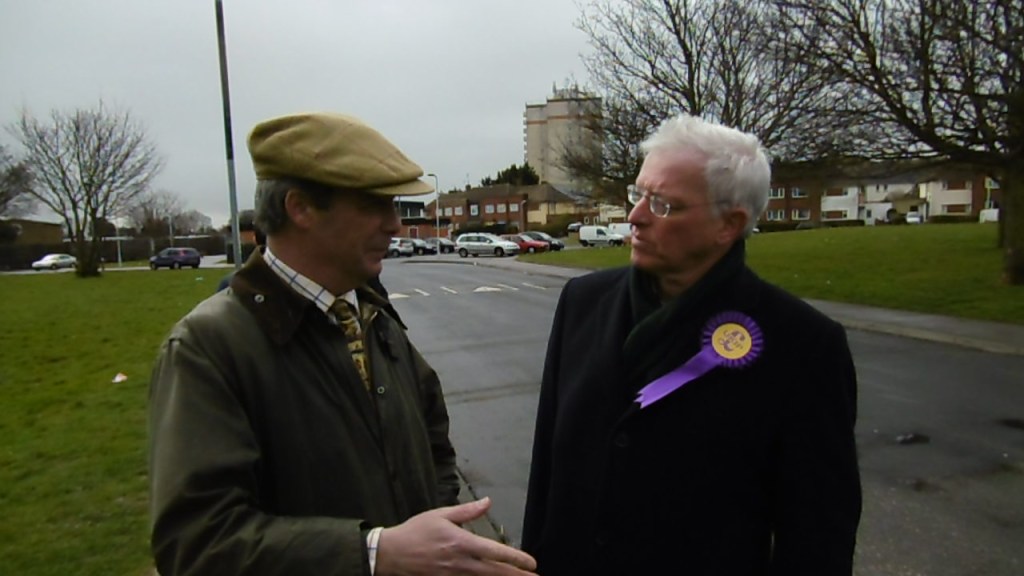
Unlike today’s Reform UK, which is a top down party, Ukip had been building a grassroots organisation for years. I had to keep on good terms with my local party committee, not all of whom had voted for me to be the candidate. But I attracted a small coterie of regular stalwarts who hit the streets with me in daily door-to-door canvassing: an essential but sometimes dispiriting part of a candidate’s life.
I employed some tricks of the trade, such as learning the names of householders from the electoral roll before ringing their doorbell so that they could be greeted by name – a vital personal touch, though on one occasion it backfired on me. Finding that I was about to canvass a certain Mr Nigel Jones, I made bold to assume that I could count on my namesake’s vote – only to be swiftly told that he was a keen Liberal Democrat.
On another occasion while canvassing a council house I was told to ‘get my racist arse’ off the man’s property – the only instance of direct personal abuse that I received, though a large poster of me was defaced with a Hitler moustache – an episode I found deeply humiliating. My agent was a former Labour party official who spent most of our time together in an Italian restaurant, but whose long electoral experience was invaluable.
The half-hour daily commute to and from my home in Lewes was embarrassing as well as irksome
A filmmaker friend lent his camera and expertise to help me make a campaign video. I was filmed buying the fruit of local market traders, naively canvassing some visiting French schoolgirls, and being assured by a sympathetic housewife that I had her support. It cost me thousands but I doubt it shifted a single vote. I was the only one of the six candidates who did not actually live in Eastbourne, and the half-hour daily commute to and from my home in Lewes was embarrassing as well as irksome, until the problem was solved when I began a relationship with one of my keenest canvassers and was able to use her flat as my base.
At one of several packed public meetings shortly before polling day, I played what I thought would be my strong suit of pledging one quarter of my MP’s salary to the threatened local hospital, and challenged the other candidates to do likewise. None took up the gauntlet that I had thrown down.
At last polling day dawned; I had spent some valuable time helping Nigel Farage’s own campaign in Thanet, but as the Eastbourne electors cast their votes I was on the ground, canvassing until the last minute and receiving high levels of support on outlying council estates (and far less in the posh central areas). After a pub lunch I snatched a few hours’ kip. It was going to be a long night. At the count, I patrolled the trestle tables where the votes were counted, paranoically suspicious that leftie council workers would cheat and hide my votes. It went down to the wire with the sitting Lib Dem MP Stephen Lloyd telling me half an hour before the declaration that he thought he had just winged it.
He was wrong. The Tory Caroline Ansell was in by a wafer thin 733 votes. I had come third in a field of six, beating Labour, the Greens and an independent. All my efforts had harvested me 6,139 votes – 11.6 per cent, which, although in line with other Ukip candidates in the election, was still disappointing after so much hard work and so many months of effort. Disappointing, in a roundabout way, for David Cameron too, whose surprise victory obliged him fulfil his promise to hold the fateful Brexit referendum. Though my own personal efforts had ended in failure, the party’s sole goal was finally achieved – which was a kind of consolation.
After the speeches, my girlfriend and I headed off in her car to watch the dawn come up over Beachy Head. I looked nervously at her as we reached the summit of the notorious suicide spot: what if her own disappointment compelled her to loosen the handbrake and give us a Thelma and Louise ending? I need not have worried. The following evening, quite exhausted, we kept an appointment in Windsor to hear Dr David Starkey lecture on Magna Carta and trying to stay awake. My political career was over.
Who picks up the tab?
I tend to steer clear of large group meals but the last time I went there was a very awkward moment. When the bill arrived, I saw two individuals tapping away on a calculator app before announcing the exact amount of money they were prepared to put on the table. ‘I didn’t have a starter,’ chimed one. ‘I only had one cocktail,’ said the other tightwad.
When the bill came it was divided equally – except that the couple counted themselves as one person
We were at an inexpensive Mexican restaurant, with two cocktails for the price of one, yet this pair insisted on working out to the last penny what they had each consumed. No one else minded subsidising the others, because that’s what happens when you go out for dinner in a group – somebody always orders the most expensive wine and drinks way more than anyone else, the ribeye steak costs twice as much as the mushroom risotto – and some poor bugger only has the green salad and tap water.
Well, here are my rules for paying the bill. If I invite a friend or friends to a restaurant, I will pay for everyone, from those on low incomes to those who could afford to buy the restaurant several times over. And when the bill arrives, I do not scrutinise it to check if I have been charged correctly, but just hand over my card, or even discreetly slip away to settle up out of sight.
Some people do take liberties when eating with a group insofar as they are more likely to order extravagantly precisely because the cost is being shared. This is beyond rude. I remember one time I wanted to try a quite pricey bottle of wine when I was out with three friends, and insisted that I pay for it because it was my choice (we had all been perfectly happy with the house white prior to that, and although they offered up half-hearted protests, everybody knew it was only fair).
And what about heterosexual dating? Does the man pay? Is there an assumption from the woman that he will? If so, how many times? Men usually earn more than women, but if this is not the case, why should he?
A little bit of chivalry can be lovely, and certainly an improvement on what happened to a young woman I know recently. They had met online and when deciding where to go for a first date he suggested a rather expensive wine bar. When they arrived, he ordered his drink, paid for it on his card, and let her order hers.
Some circumstances are even clearer. For example, another journalist asks for advice on a story you have covered in the past, and suggests meeting for coffee or a drink. You give them the dirt, and hand over a contact or two. I would be beyond miffed if they were to suggest splitting the bill.
One of the most outrageous stories I have ever heard on this topic is about what happened when a group of friends went out, two of whom were a couple. When the bill came it was divided equally – except that the couple counted themselves as one person. You might think this is unbelievable, but I bet you have encountered a scenario where a couple brings one bottle of wine between them to a party. Of course, if they were go into a party on their own, they wouldn’t dream of specifically seeking out a half-bottle to bring.
A good way to distinguish meanness from a tight budget is to have the discussion early on, as soon as you arrange to go to dinner. If somebody says to me ‘That sounds absolutely lovely, but isn’t it quite an expensive place? I am on a tight budget,’ then I have two choices: I can either say that I will pay as it was my suggestion and I’d really like to treat my friend or make it clear it’s their company I am seeking (as opposed to a fancy dinner) and book somewhere much cheaper instead.
Etiquette can be a nightmare, but in the main, your good manners and instinct should guide you in the right direction. And if you only had a Diet Coke, while the others have thrown down a load of Château Margaux 2005? Maybe suggest the cinema next time.
Who is the real opposition to Labour now?
Nigel Farage tried to claim at the start of Thursday’s TV debate that Reform was the real threat to Keir Starmer, given it has just passed the Conservatives in the polls (more from Katy on that here). Penny Mordaunt, of course, didn’t want to entertain the idea of her party being in opposition, but she did want to accuse Farage of being a ‘Labour enabler’, something he threw right back in her face by claiming that actually voting Tory was a vote for Labour.
It was striking that in this debate, Mordaunt was prepared to acknowledge Farage was actually in the room: in the first one, she had pretended he wasn’t there at all and had directed all her attacks at Angela Rayner.
Mordaunt had a much bigger problem than the Reform leader, though. It was, like Farage himself, a noisy problem, but it was coming from the audience. They kept laughing at her. I’ve heard fewer laughs from a Have I Got News For You studio audience than I have from the bunch in tonight’s ITV debate. They seemed to find Mordaunt’s claims utterly hilarious. Whenever she complained that Labour was the party of high taxes, or tried to talk about the Conservatives’ record on the NHS, or immigration, or schools, the audience started laughing. On education, Mordaunt said: ‘I think it is world class and we have improved.’ Laughter. ‘Well,’ she said, trying to quell the chuckles. ‘When we took office, literacy rates were trailing the world, now they are leading them. We have 90 per cent of all schools are good or outstanding.’
When asked by Nigel Farage why should anyone believe in the fifth Tory manifesto promising to cut net migration given none of the previous pledges had been met, Mordaunt elicited more hilarity with this response: ‘Because of the record of this Prime Minister!’ It is not just that voters look back over the past 14 years and don’t see a record to trust, it is also that they include Sunak in that, rather than think he is a fresh start. Speaking of 14 years, Mordaunt totally deserved the laughs she got when she managed to tell Angela Rayner that Labour had wasted 14 years without coming up with a policy. Rayner could hardly believe her luck that Mordaunt had not so much created an open goal, but had taken the ball from one end of the football pitch and kicked it in there herself. ‘You’ve been in government for 14 years!’ she exclaimed.
Mordaunt, who is normally one of the more gifted and confident Conservative performers, had spent the first seven-way debate doing the best she could with a bad situation, but tonight even she didn’t seem to have a grasp of how to handle things. The one thing worse in politics than being laughed at is being pitied, but both are signs of a terminal illness for a party in an election campaign.
Watch more on Spectator TV:
Reform overtakes Tories in new poll
Here we go. This evening the Reform party has overtaken the Tories according to a new YouGov poll. The survey for the Times found that support for Nigel Farage’s party has increased by two points in the past few days to 19 per cent, with the Tories one point behind on 18 per cent. The fieldwork took place after Conservative party released its manifesto on Tuesday – therefore suggesting that the launch failed to improve Tory fortunes. The poll puts Labour on 37 per cent, meaning Keir Starmer is on course for a super majority.
So, what will this poll mean for Tory morale? As I wrote in Sunday’s Election Insider email, many Conservative candidates have seen it as a matter of when not if Reform overtook their party after Farage announced his return to frontline politics. It means it won’t come as a huge surprise to already down beat Conservatives. However, it will still deal a big blow to the party – and add to a sense of despair amongst Tories that half way into the campaign the polls are looking worse than when they started – rather than narrowing. Expect more candidates to sound alarm over the state of play as they worry the party could be reduced to double figures come 4 July – particularly if more polls show the same. Given the mixed polling on Reform so far, there will also likely now be a debate as to how various pollsters are weighting the Reform vote – with Farage accusing some of underreporting – and some Tories are sceptical whether it is as big as various polls make out.
Yet there is one ray of light in the findings. It found that 80 per cent of those backing Reform believe a very large majority for Keir Starmer would be ‘a bad thing for the country’. That suggests the Tories could be on to something with their latest messaging. In recent days, Sunak has warned against giving Labour a blank cheque while the Defence Secretary Grant Shapps has said it is time to stop Labour winning a super majority. If they can land the message with Reform voters that a vote for Reform will mean just this then some could yet switch to Tory. However, this is no sure thing – and Farage and his supporters will cease on the latest polling as evidence for his claim that his party is best placed to provide opposition to a Starmer-led Labour government.
The illiberal implications of Labour’s manifesto
Labour’s election manifesto may not have much in terms of extra spending, or any substantial plans. But it sends a green light to activists in government, schools, universities and corporations to carry out their illiberal cultural revolution without restraint.
It promises to introduce ethnicity pay gap reporting requirements for ‘large employers’ and upgrade the focus on hate crime. Compliance departments will emphasise going beyond the letter of the law, leading to discriminatory quotas and speech suppression. The manifesto promises a ban on ‘conversion therapy’ for trans people that will make it risky for adults to question a young person’s decision to change pronouns, take puberty blockers and undergo gender reassignment surgery.
But the biggest change is in mood music, with Labour enthusiastically embracing the identitarian Equality Act, which activists in institutions have used to justify speech policing, political indoctrination and anti-white male discrimination. This will accelerate an ongoing shift in the country’s public culture.
Woke is not – as the left has convinced itself – a simple right-wing epithet, but an analytic concept that describes something real in the world. Woke may be precisely defined as the making sacred of historically marginalised race, gender and sexual identity groups. From these hallowed attachments comes the view that the overriding aim of society is to enforce equal outcomes and emotional harm protection for historically disadvantaged groups.
The ideology’s power does not stem from a system of thought, like Marxism, but from emotional attachments to the experience of particular identity groups: blacks, gays, women, transgender people. This means those who offend even the most hypothetically sensitive member of a sacred group must be cancelled while institutions should discriminate against whites, males or Asians to hit their Diversity, Equity and Inclusion (DEI) targets.
The culture war between woke activists and those who resist them is not an amusing sideshow, but a struggle for the very heart of our civilisation. Will we be free, truth-based and a cohesive nation, or will we descend into an Orwellian nightmare of speech policing in which we are forced to mouth false mantras (‘trans women are women’, ‘systemic racism’, ‘diversity is our strength’) we don’t believe while the state turns British schoolchildren against their national past.
This is not confined to the campus but reaches into almost every aspect of public life, from schools, universities and government to the military, police and private sector.
Starmer chastises those who worry about Social Justice indoctrination as distracting us from real problems like the cost of living. This is what authoritarian regimes tell protestors in Hong Kong, Iran and Georgia.
Would he stand by as every Union flag is replaced with a Chinese flag – after all, what does it matter when people are focused on their pocketbooks? If not, why are we supposed to keep our heads down as Progress Pride or Black Lives Matter insignia conquer public spaces while a new Calendar of Saints decrees a parade of identity festivals, from International Transgender Awareness Day and ‘International Day to Combat Islamophobia’ to Black History Month?
Labour wants conservatives to stick to the sandbox of economics and foreign policy, leaving culture to progressive experts in the institutions. Their top line is that the nasty right is ‘stoking the culture wars.’ The subtext is that Labour will deflect political scrutiny away from the cultural revolution in our institutions so it can continue to fly under the radar. ‘Dear activist teachers, civil servants and DEI administrators, the Tory restraints are off and you are free to let rip.’ The messaging has even worked with an important swath of Conservatives who are willing to act as its useful idiots.
Of course, the culture war concerns more than culture. Woke hypersensitivity means we can’t openly debate immigration, crime, the family and education without being accused of racism or sexism. This leads to difficulty deporting illegal immigrants, addressing fatherlessness or punishing bad behaviour, whether in the street or in class. This produces multiple policy failures such as the Rotherham child sexual exploitation scandal, world-leading levels of single parenthood or Clapham ‘acid’ attacker Abdul Ezedi who entered the country illegally, committed a sex crime and was permitted to stay because he claimed to be Christian. An insufficiently patriotic young population combined with DEI virtue-signalling also likely contributes to the country’s failure to meet its military recruitment targets, kneecapping Britain’s foreign policy.
This is not a passing fad, but an acceleration of our post-1960s left-liberal moral order. Where McCarthyism cut against the grain of the younger generation, woke is being propelled by them. For instance, Britons under 25 split over whether J.K. Rowling should be dropped by her publisher while few over 45 think this way. No wonder a majority of British young people agree that ‘Israel should not exist’ while just a fifth demur. It will take more than the Cass Review and free speech editorials in the mainstream media to reverse this slow-motion train wreck.
Beneath the noise of the news cycle, the most far-reaching legacy of New Labour was its unspoken cultural revolution in the form of large-scale immigration and a surge of institutional Diversity, Equity and Inclusion (DEI) on the back of its 2010 Equality Act.
Likewise, the most significant impact of Starmer’s government could be to unleash the full force of progressive illiberalism in British society.
Trump takes Capitol Hill
Welcome to Thunderdome. Donald Trump took to Washington today in a series of meetings with business leaders, House members and senators in what was clearly meant to be a rousing “yes I’m still in charge” play. But it was also a Trump who seemed nervous about his prospects, particularly as it relates to how the abortion issue will be a drag on him in November:
Abortion has emerged as Democrats’ most potent political weapon in the two years since Roe v. Wade was overturned, a reality the former president acknowledged during a closed-door Capitol Hill meeting.
In addition to asserting that GOP lawmakers and candidates need to talk about abortion “correctly,” Trump argued the issue should be left to the states and stressed support for exceptions, according to multiple members in attendance.
The former president told his congressional allies that abortion has “cost” the GOP politically, but that it is “too important to ignore.”
He argued that Democrats are the “radicals” on the issue and “support abortion so far along that nobody supports that,” calling Republicans the “party of common sense.”
Trump’s position is largely in-line with where the Republican establishment and campaign apparatus are — urging Republicans to stress state-level solutions that include reasonable exceptions.
The intrigue: while Trump was speaking to lawmakers, the Supreme Court threw out its biggest abortion-related case since overturning Roe, saying that doctors opposed to a commonly used abortion pill, mifepristone, lacked legal standing.
Use of the drug has increased since Roe was overturned, and Thursdays high court action further complicates GOP efforts to restrict abortion access.
Representative Mike Kelly, a vocal advocate for strict abortion restrictions, said the former president’s comments signaled that a second Trump administration wouldn’t pursue federal limits on access.
“I think it will be as simple as exactly what it should be from the beginning: fifty states have the ability to make a decision, why turn it over to the federal government?” Kelly said.
“With the [Senate] filibuster, we’re not going to get any strong pro-life or pro-abortion policies passed. So the reality is: it is going to be at the state level,” said Representative Don Bacon.
The insistence among evangelicals is that Trump name a clearly pro-life running mate, as opposed to his commitments in 2016 which were all about the court. Democrats have tried to pin Republicans down with numerous show votes on the topic in the past several months, including today on IVF. But there’s little proof any of these show votes are actually working. Instead, they may be an indication of how little the Democrats have to run on in 2024.
The stalking-horse presidential candidate
Joe Biden isn’t really running for president, argues Charles C.W. Cooke.
I do not offer this observation in a conspiratorial tone. Joe Biden won the 2020 election legitimately; he is currently serving as the rightful occupant of his office; and he remains eligible to run again, to win again, to take office again, and to exercise all the levers of power that the Constitution would grant his office during a second term. Instead, I mean that Biden is operating as a stand-in, a widget or a MacGuffin, whose primary purpose is to make it to November 5 of this year without expiring. Most candidates have plans for their coveted four years; Biden has none. He does not expect to be there, and the public agrees with his hunch.
This, if I may borrow a phrase from the Trump years, is “not normal.” Per recent polling, 62 percent of voters think that, if Biden is reelected, he will die in office. Never, in the modern era, have voters been asked to cast a ballot for a candidate who they believed was unlikely to see the end of his term. In 2008, 20 percent of Americans thought that John McCain was too old. In 1996, 27 percent of Americans thought that Bob Dole was too old. In 2024, a whopping 86 percent of Americans believe that Biden is too old to be president of the United States. In effect, Biden’s candidacy represents a sort of reverse Keynesianism, built atop the flippant promise that, in the short run, he’ll be dead. And they say that our politics has lost its ambition!
That Joe Biden has been transmuted into little more than a game token is routinely implied by the substance of our political conversations. Inevitably, discussions of Donald Trump’s candidacy revolve around what will happen if Donald Trump wins the presidency, and, inevitably, discussions of Joe Biden’s candidacy revolve around what will happen if… Donald Trump wins the presidency. Filter out the partisan hallucinations in which Biden is cast as a successful chief executive, and you will find little more than anti-matter left within the residue: Biden must win, because Donald Trump must not, and, because Biden must win, then Biden cannot be too old or too incompetent or too misguided, because if Biden is too old or too incompetent or too misguided, then Donald Trump might win, and, as was established earlier, Donald Trump must not win. This, perhaps, is why Biden so often likes to say, “Don’t compare me to the Almighty, compare me to the alternative.” The alternative is all he’s got — and, at his age, irritating the Almighty is a risky idea, indeed.
The fruits of this approach have been extremely peculiar. If political correctness is defined as the repetition of mantras that everybody knows to be untrue, the Democrats’ 2024 pitch might be defined as the elevation of “ought” over “is” alongside the berating and exiling of anyone who declines to play their proper role within the charade. Yesterday, Biden’s approval rating dropped to a record-low 37 percent in the 538 average of polls, and, instead of absorbing this information as if it were part of the fabric of our shared reality, the political establishment elected to lash out at the messengers. In and of itself, this is odd. But what makes the whole thing so utterly, startlingly, unfathomably weird is that the people who were responsible for this outburst are the very same people who will immediately begin orchestrating Biden’s removal if he manages to win in November after all.
Will voters care about Hunter’s verdict?
How much will Hunter’s verdict matter?
Hunter Biden’s conviction Tuesday on three felony offenses represents another dark moment for a family that has endured a series of tragedies and comes after a trial that laid bare the strain his addiction put on the president and relatives who have rallied around him.
The unprecedented felony conviction of a sitting president’s son raises the possibility that Hunter Biden will face some prison time, and leaves him with a criminal record going into a separate tax-evasion trial that is currently set for September. His sentencing could occur in October, just weeks before President Biden’s expected rematch with Republican Donald Trump — who made history with his own felony conviction last month.
The political impact of the conviction is muddled: the president and his allies have made a point recently of branding Trump a “convicted felon,” a label his son now also carries. Trump and his fellow Republicans have criticized Hunter Biden over his business dealings but have mostly avoided doing so over the gun case, and there is little sign in polling that voters paid attention to the proceedings in Delaware.
On the flip side, it does matter to the extent that it removes a point of attack from the Biden arsenal. They’d like to make Donald Trump out to be uniquely unqualified… but now they can’t.
Don Jr., kingmaker?
Apparently that’s the role he’d like to have:
For now, he’s a gatekeeper for the party his seventy-seven-year-old father has remade in his own image. Trump Jr. is like his father in some ways: he enjoys trash-talking on social media and campaigning, but isn’t as attracted to the day job of governing that would come with running for and winning public office.
With his father’s backing, he’s become adept at working the internal politics of the Republican Party.
He elevates his friends (including Vance and Indiana Representative Jim Banks). “With the exception of his dad, I’m not sure I’ve seen anyone who has a stronger natural connection to our base,” Vance said.
Trump Jr. has developed a multi-platform messaging network to build his brand. His Triggered podcast on Rumble is popular with MAGA enthusiasts and likely will expand beyond its current twice-a-week schedule, a person familiar with his social media strategy told Axios.
One more thing
Are the names on Donald Trump’s veep list really the final roster of his consideration? There are some notable names missing if so. But there are also some names that people consider just included out of respect. Does anyone really think Trump is going to pick Ben Carson? That said, the list includes three people at least who have very clear ambitions toward higher office — Rubio, Cotton and Vance. Does Trump want someone who’s running right away? We’ll know soon enough — though we won’t know if Kamala Harris will debate any of them.
Why Labour’s plans are so vague
Keir Starmer has deliberately pursued a strategy of revealing as little as possible, boasting today that his manifesto didn’t contain any surprises. In between his verbal tic about his father being a toolmaker, Starmer has been least at ease in the TV debates, and it was in the first of these that he said more than he probably intended to. Asked by ITV’s Julie Etchingham whether he had any advice for ‘Gareth on his way to Berlin [for the Euros]’ about leadership, Starmer replied:
‘You need a strategy for winning. So it depends on your opponent and what the issue is.’
It isn’t telling us what it is going to do in detail because that would scare the horses
The Labour leader is of course right. You need to win first. He seemed to be thinking about the Jeremy Corbyn years, when plenty of thought was given to the ends and none to the means. Corbyn even made an analogy at his party conference about a football team which had lots of supporters, without mentioning whether or not they actually won any games. Starmer’s whole election strategy has been formed in response to that experience.
The remark probably didn’t make much sense to voters, who are still going to be wondering after today’s manifesto launch what Labour would do after it won an election. Politics is, despite the total obsession of people like Starmer, not all that much like football: winning the game is the start, rather than the ultimate objective.
And yet in this election we are getting no more details about what exactly is going to happen once Labour is in power. Much of the stuff of real consequence will be announced after everyone is in position and has had a chance to ‘look at the books’. This phrase, repeated almost as often as the toolmaker line, is the pitch-rolling for some pretty tough decisions about tax and spend. It will also form the basis for policymaking across government, even if those decisions have already been made.
That’s not to say that Starmer hasn’t thought at all about what he wants to do once he is in government: he spent a considerable amount of time before this election ensuring his shadow ministers were getting training and mentorship from outside organisations. He has been far better-prepared than Tony Blair was in 1997, when the newly-elected Prime Minister was a bit baffled by what a private office would do for him. Blair also had not put the thought into public service reform, for instance, that Starmer already has done. When I interviewed him for my book on the NHS, Blair was very clear that he had not done very much thinking at all about the health service. He had made a pledge that made no sense on the number of people waiting, rather than the amount of time they were waiting. He had also appointed a health secretary in Frank Dobson who had very different political instincts to him, and whose main preoccupation in the early years was not reform as such but trying – unsuccessfully – to dismantle the internal market and stopping the reorganisation of London hospitals. Starmer’s frontbench team have spent years thinking and writing about what they want to do with the NHS.
Labour has already largely looked at the books. It’s just that it isn’t telling us what it is going to do in detail because that would scare the horses. That does make sense as an election strategy, even if it does bore the rest of us a little bit.
A bigger question than what Labour wants to do, though, is how Starmer intends to do it, and whether he has the mettle to see it through. We have learned from the way he has transformed the Labour party internally that he is prepared to be ruthless. We have learned that he will drop a policy when it no longer suits him, which is either opportunism or a valuable ability to respond to reality rather than – as so often happens in governments of all stripes – pursuing a policy that manifestly won’t work for the simple reason you once said you’d do it and you don’t want to lose face.
But we also know that Starmer likes to mollify factions within the party by announcing one policy they’ll hate and then backing something else – often totally unrelated – that they’ll love. Hence the manifesto commitment on Palestinian statehood, which some think is meant to keep activists from getting too worked up about the party not promising to scrap the two-child benefit limit.
The biggest question that we just do not know the answer to is whether Starmer would use his supermajority – if he gets it – to answer some of the big questions in British politics today. If he does win a big majority, then he could ram through reforms to the NHS and social care, for instance, early on. He might, though, worry that this would burn up too much political capital too soon – though in my view, this would be a mistake as your political capital always depreciates as time goes on, even in a big majority. In fact, especially in a big majority, because a supermajority does not guarantee hundreds of MPs marching mutely through the lobbies. It could precipitate the balkanisation of the party. Tory leaders have learned that a majority can end up being quite hollow quite quickly. So does Starmer have a strategy for having won? We don’t know yet.
Labour’s dangerous pledge to ban conversion therapy
An incoming Labour government will enact legislation that could prevent gender-questioning children getting the help they need to come to terms with their biological sex. That is the only conclusion it is possible to draw from Labour’s manifesto, released this morning, which says:
Labour’s approach is wishful thinking at best, and reckless abandon at worst
‘So-called conversion therapy is abuse – there is no other word for it – so Labour will finally deliver a full trans-inclusive ban on conversion practices, while protecting the freedom for people to explore their sexual orientation and gender identity.’
There is a glaring omission in this word salad. What actually is conversion therapy? If it is abuse, as Labour seems to claim, then no new legislation is needed. Harmful, coercive and abusive practices are already illegal, and rightly so. Ten years ago, that seemed to be a settled issue and it would have seemed ridiculous for a political party to talk about it ahead of an election.
But in more recent years, the rainbow lobby has pushed hard on securing a conversion-therapy ban. At the same, children have been encouraged to question their gender. These children may end up being the collateral damage from Labour’s plans.
The worry is that Labour’s new law will have a chilling effect on therapists whose job it is to help children work through their issues. If a therapist questions a child who wants to change their gender identity, they could easily end up fouling foul of this kind of law. Labour might promise to prevent that from happening, but it won’t be Starmer in the dock when – possibly many years later – a former client complains that their therapist was trying to prevent them from changing their gender identity.
It does not help that gender identity is impossible to define without resorting to circular reasoning or citing sexist stereotypes. I might be transsexual but I have no secret knowledge of what mysterious quality defines someone’s gender identity. And I wouldn’t trust anyone else claiming to know either. ‘Gender identity’ is a lazy label applied to explain away the distress that some people have with their sexed bodies, which can be caused by a host of different conditions.
If Labour’s law is passed, parents, teachers, youth group leaders, and indeed anyone who works with children might need to watch their language when talking to children. Say a mother is told: ‘Mum, I think I am a non-binary, trans-femme demi-sexual nymph’, and she replies, ‘Don’t be stupid, that’s nonsense. You are a boy, now get on with your homework.’ That could end up being defined as conversion therapy. It may seem unlikely, but until recently the UK prison service had a policy that placed male rapists in women’s jails. It is never safe to take common sense for granted.
In the next breath the Labour manifesto talks about the Gender Recognition Act. The party pledges to modernise this ‘intrusive and outdated law’. If it is outdated, then why not repeal the Act? It’s not as if anyone needs a GRC to live their best life following gender transition. Everyone now has the right to marry someone of either sex, and the Equality Act protects transsexuals from discrimination and harassment. It’s not clear to me why anyone needs to turn their birth certificate into a piece of legal fiction.
Labour does at least see the importance of a diagnosis from a specialist doctor before someone changes their legal identity. This is a good thing. If the state is going to allow people to change all their legal documents, then some gatekeeping is needed. But the safeguards are limited when a specialist report can be bought for a fee.
Also in the manifesto is a promise to support the implementation of single-sex exceptions. That’s easy for Starmer to say, it’s rather harder for service providers to hold the line when faced with a transwoman who swears blind that they really are a woman and they have all the documentation to prove it. Even a phone call to the authorities would not help. Under Section 22 of the GRA it is a criminal offence for the official at the far end to disclose this information.
Labour’s approach is wishful thinking at best, and reckless abandon at worst. The party might mean well but when it comes to sex and gender either it does not understand the issues or it does not want to understand them. Voters cannot say that they were not warned when they go to mark their crosses on 4 July.
‘Trumpists and Communists’ on Ukrainian NGO list fight back
A US government-affiliated Ukrainian NGO, texty.org.ua, published a list last week of all the Americans “impeding aid to Ukraine.” There are 388 individuals and seventy-six organizations on the list, including members of the conservative media Alex Jones, Tucker Carlson, members of Congress and a few Spectator writers. The piece is titled “Rollercoaster: From Trumpists to Communists. The forces in the US impeding aid to Ukraine and how they do it.”
“The title of this article oversells the product: it is a substantively thin piece, largely an excuse to smear a large group of Americans who have been skeptical of aid to Ukraine in one form or another,” Senator J.D. Vance and Representative Matt Gaetz wrote in a letter to secretary of state Antony Blinken on Tuesday. “But it is being broadcast as a part of a coordinated media strategy that has all the hallmarks of a US-targeting influence operation.” The letter calls for four items of information from Blinken by June 28, including grant agreements and awards given by the State Department to texty.org.ua.
“The accusations are laughable on their face,” journalist James Carden, who is included on the list, told The Spectator. “And they should be treated with absolute contempt, but it would be a mistake to take it seriously.”
The Spectator reached out to several people named on Ukraine’s NGO site. “Other than the fact that they butchered the spelling of several names… all I can say is that I am proud to be on the list,” Dr. Sumantra Maitra, senior fellow at the Center for Renewing America, said. “It’s clarifying to see the State Department-funded Ukrainian NGOs showing their true colors and creating blacklists, demonstrating how utterly Soviet they still are.”
Doug Bandow responded to the claims texty.org.ua made about the Cato Institute. “I am not an isolationist… Neither Cato nor I endorse Donald Trump’s foreign policy.” Bandow further commented on what is becoming a theme: “It is outrageous that the US government funds an organization that attacks Americans for their policy positions and public expressions.”
Texty, however, assures us at the bottom of their article that, “The project is funded exclusively by the readers of texty.org.ua.”
“This NGO is ideologically committed to mayhem and destruction, and it only speaks for itself,” journalist Jordan Schachtel told The Spectator. Christopher Bedford from the Blaze said: “It’s been like this from the beginning. Anyone who has even cast a shred of doubt on our latest necessary war is an enemy of the state. While it’s obviously concerning to see American media outlets and politicians on an enemies list by a State Department-funded NGO, it’s not surprising. State hasn’t had American interests at heart for a long, long time.”
“Sending weapons and cash to Ukraine without a goal is just another reason American foreign policy is a sad joke in the 2000s,” Harry J. Kazianis, senior director of National Security Affairs, said. “And it seems the American taxpayer always foots the bill — and gets nothing in return.”
The list has been circulating on X and turned into quite the joke. texty.org.ua entered some “supplemented data” on June 8 which reads: “This is a Statement of Facts. Neither ‘a List of Enemies’, nor ‘a Kill-List.’” They further clarify that the article is not an accusation but a “study of the political and media context that influences government decisions.”
And yet the project consistently implies that everyone on the list is a propagator of Russian propaganda — and Texty occasionally refutes this supposed propaganda with cute red drop-down fact-check items. Some of them read “Why Ukraine’s victory is essential for the democratic world,” “The Ukrainian government has not banned any churches” (except the Russian Orthodox Church, which they slyly admit they “severed ties with”) and “Why is it wrong to recognize the ‘DPR’ and ‘LPR’?”
“Having members of my family mowed down by Russian tanks in Budapest in 1956 I am most definitely not pro-Russian,” republican strategist Roger Stone said. “After the unification of East and West Germany, the United States agreed in both the Budapest Memorandum and the Minsk Accords not to push Ukraine into NATO, which is to say, not to mount offensive NATO missiles on the ground in Ukraine pointed at Russia. I believe the Biden administration’s efforts to force Ukraine into NATO is in violation of both of these agreements.” He concludes with, “While I am not pro-Russian, I am definitely anti-war.”
This supposed Russian propaganda that media heads are spreading is more accurately about being wary of sending $107 billion to prolong the war and reach elusive ends. “It’s fair to say Defense Priorities has been skeptical about aid to Ukraine without opposing it; we are especially concerned by its lack of connection to a realistic and clearly defined strategy,” Ben Friedman, policy director at Defense Priorities, wrote.
Republican representative Jim Banks of Indiana sent a letter to his colleagues on the House Appropriations Committee on Tuesday, asking them to end US support to Texty. The committee on Tuesday passed a resolution effectively defunding the NGO, according to Fox News.
In short, the State Department sends money to a Ukrainian NGO so that NGO can call out conservatives and “communists” for blocking aid to Ukraine and being “in the pocket of the Kremlin,” as Carden put it. And despite Texty’s assertion that “this is a statement of facts,” the whole debacle is a prime example of political duplicity.
Watch: Dawn Butler’s bizarre campaign rap
Today’s a big day in the election calendar. This morning, Labour launched its official manifesto, while campaigners hit the three-week countdown until the big day. As even the Tories seem to have accepted that the 5 July will see a victory for Sir Keir and his Starmtroopers, one Labour candidate seems to be especially enjoying herself on the election trail.
Dawn Butler, standing in new constituency Brent East, is ramping up her campaigning as polling day looms ever closer. Taking a leaf out of the SNP’s book – after Falkirk candidate Toni Giugliano created a Spotify song in an attempt to woo voters – Butler has decided that the best way to convince her constituents that she’s their woman is to release an, um, rap video. It’s certainly one way to get noticed…
‘We got 21 days to go. We got 21 days to go,’ the Labour lefty sang to the camera. ‘If you like me let me know, let me out the shadow, we got 21 days until they gotta go.’ Blasting the Prime Minister for leaving D-day early, Butler labelled Rishi Sunak a ‘liar’, slammed the Tories as being ‘too corrupt’ and rapped that the ‘Labour party are here to stay’. You do still need to get voted in first, Dawn…
While Labour continues to poll well, recent surveys from JL Partners show that over a fifth of 18 to 34 year olds still haven’t registered to vote, with the figure increasing to 30 per cent in the 18-24 year old group. Butler’s latest intervention is a plea to those considering staying at home on polling day – ’21 days to say who you like’ – but Mr S has some doubts about how well it’ll work. While some of Butler’s colleagues have praised her efforts – ‘This is amazing!’ commented Scottish Labour MSP Paul Sweeney – others have been less kind. Labour candidate for Birmingham Erdington, Paulette Hamilton, wrote that it was ‘very different’ while other users were quick to slam the cringe-fest, with one writing: ‘I just want serious people in politics, discussing serious things, seriously.’ Quite.
Watch the clip here:
Why did Nathan Wade agree to this CNN interview?
It was the power of love that halted Georgia’s election subversion case against Donald Trump, saving the former president for now from another possible conviction. Now, the emergence of juicy details of the romance — what Cockburn really wants to learn from the case — are being stymied. Nathan Wade, the former lover of Georgia attorney general Fani Willis and a former prosecutor in the racketeering case, sat down with CNN’s Kaitlan Collins on Wednesday. Collins did her best to draw out the timeline of the affair when the interview was unfortunately interrupted.
What Wade did reveal is that he is still close with his former fling. “We are great friends. We speak regularly. The conversation has changed though,” Wade said. “Our conversations have shifted to ‘how are you, how are you handling the threats that are coming your way, are you being safe?’”
After Collins asked when the romance began, the interview quickly derailed. Wade at first protested that the exact dates should not be an issue when his media team suddenly stepped in. “Do you want to go off mic for a second,” asked an unnamed media consultant. The two proceeded to huddle in the corner by a sparsely populated book shelf to discuss the simple question.
Upon returning to his seat with an awkward smile and short stare-down with Collins, Wade was forced to respond after the questions was repeated. “The public has a clear snapshot that this is clearly just a distraction,” Wade said, attempting to distract from the distraction with his own distraction. “It is not a relevant issue in this case and I think that we should be focusing on more of the facts and the indictment in the case.” He also added that since the relationship is a pending issue before the circuit court of appeals he would not want to say anything that would “jeopardize the case.”
Wade and Willis can’t seem to get the story straight between each other either. The former prosecutor said they broke up in June or July of 2023 while the Fulton County attorney general says the fling ended in August, the same month Trump was indicted. Willis also insists she only became intimate with Wade after hiring him — but sources close to both, including Wade’s divorce lawyer, say they began dating before 2021.
Still, Wade somehow believes he isn’t responsible for the case’s delay until after the 2024 presidential election. “I don’t believe my actions played a role in it at all,” he said. Wade resigned from the case in March after Fulton County Superior Court judge Scott McAfee ordered that either he or Willis be removed from the prosecution team. His fling with Willis is what then gave Trump grounds to file an appeal to have Willis disqualified from the counsel. Anyone hoping for another Trump conviction better look elsewhere then Georgia’s romance-riddled courtroom. Perhaps to other states filing similar cases in which Trump is currently an unindicted co-conspirator…
Keir Starmer’s manifesto will disappoint Tory spin doctors
Keir Starmer and the Labour party today launched a manifesto that’s good enough to win this election and presented it in a commensurate manner. If that comes across as damning with faint praise then this is what your author intended. After all, there was – as Beth Rigby of Sky News noted in her question to Starmer – no new policy and no discernible retail offer for voters in the entire manifesto.
Starmer made a virtue of that, stressing that all Labour’s ambitions to provide better public services and build a fairer society depended on economic growth picking up to provide the funds to make them happen. He even had his no doubt carefully chosen audience dashing to don the hair shirts, winning strong applause from it as he told Rigby: ‘It’s not about pulling rabbits out of the hat. I am a candidate to be prime minister, not a candidate to run the circus.’
For now Labour is well in the ascendancy
And Starmer – very much performing at the ceiling of his abilities – even managed a competent ad lib when responding to a heckler by declaring ‘we gave up being a party of protest five years ago, we want to be a party of power’.
As the event wore on, so the flaws and niggles started to show. For example, ITV’s Robert Peston pointed out that Starmer could not guarantee sufficient growth in his first year in power to avoid having to impose some public spending cuts and even potentially across-the-board austerity.
The Labour leader replied: ‘We are not going to return to austerity. I am never going to allow a Labour government to do that to public services. Never.’ But that carte blanche assurance totally cut across his earlier message that the old-style Labour obsession with how the national cake gets shared out was over and that growth was a pre-condition for funding adequate public spending.
Starmer also name checked Labour’s wrong-headed plan for a new Race Equality Act that will define any disproportionate outcomes by ethnicity, whether over-achievement or under-achievement, as being the result of unconscionable ‘structural racism’. This further racialising of basically everything is going to be a divisive disaster should it actually get implemented.
The outrageous gerrymander of giving 16-year-olds the vote also made the manifesto, without any accompanying plan to allow that age group to drive, serve on juries, buy alcohol in pubs or get married. Hopefully Nigel Farage will be proven correct in his assessment that those now entering their mid-teens, especially boys, are turning rightwards politically at a rate of knots. Were Labour’s cynical manipulation of the franchise to rebound on it in 2029 then it would take a heart of stone not to laugh.
But for now Labour is well in the ascendancy. The central messages that it can be trusted with the public finances, will not throw around taxpayers’ money like confetti at a wedding and will not increase the rate of income tax, national insurance or VAT were all satisfactorily communicated by Starmer.
Labour’s event managers also got some members of the public in at the start to do the human stuff that Starmer struggles with, including a man whose NHS cancer treatment delays had left him terminally ill. That packed a far more impressive emotional punch than did Rishi Sunak wheeling on Gillian Keegan at the Tory launch to talk about growing up working class.
So we can award a six out of ten to Starmer. There was no trouble at mill, no hue and cry and horses were left grazing unfrightened in the fields. Any Tory spin doctors looking for material with which to set off a stampede of nervous voters back to the flagging blue team are liable to be disappointed.
Labour’s habitual vote will turn out in force for it on 4 July, along with sufficient floating voters to require a Tory team operating at peak capacity to stop it in its tracks. And we all know that’s not where the Tories are right now.
Join Fraser Nelson, Katy Balls and Kate Andrews for a post-election live recording of Coffee House Shots in Westminster, Thu 11 July. Bar opens 6.30pm, recording starts 7pm
Does Labour have the stomach to tackle welfare reform?
Regardless of who wins the coming election, taxes are going up. Spending plans from both Labour and the Tories suggest the tax burden – already at a post-war high – is going to do nothing but rise. During last night’s Sky News debate, Rishi Sunak laid the blame at the two ‘once in a century’ events the country has just emerged from. But the truth is that a huge part of these tax rises is needed to fund an ever-growing welfare bill. Analysis published this morning shows that one in every £44 of state spending will be spent on sickness benefits by the end of the decade.
The report, published by the Resolution Foundation, shows that incapacity benefits spending will rise faster than pensions over the next parliament. The problem is the simply staggering level of those out of work due to long-term sickness. Other figures released this week by the Office for National Statistics show those deemed too sick to work again hit a record high of over 2.8 million Britons. And as the below graph shows, this is a trend that has been coming for some time, exacerbated by the pandemic and lockdowns – but not caused by them.
In his manifesto launch on Tuesday, Sunak warned that this rise was ‘unsustainable’. But as Kate Andrews pointed out, he has left it too late to address what is the most serious issue facing the country as it prepares to go to the polls. Figures from the DWP revealed on The Spectator’s data hub show how that spending is set to surge with nearly 1,000 more people going onto sickness and disability benefits every day.
This morning’s report highlights how over the last 16 years overall welfare spending has grown from 10 per cent of GDP to 11.2 per cent now. Almost all of that increase is accounted for by sickness benefit and pensions spending as welfare for those looking for work and children has been reduced.
Labour for their part say they will bring down sickness benefits by tackling the record high NHS waiting lists, but improving the overall health of the UK is not going to happen over the course of one parliament. The truth is, as Tom Waters from the Institute for Fiscal Studies (IFS), has told the Times the number of new claims (currently 40,000 a month) needs to be drastically cut. To do that, he said, will ‘require substantially tightening the assessment to make it much harder to qualify’.
Cutting benefits or tightening up the assessment regime is something a Labour government is going to find very difficult to stomach. But if they do not make a serious attempt to do so, the tax burden won't be coming back to more normal levels anytime soon. In fact, the IFS has said that to cover the already forecasted spending increases with income tax would mean raising the basic rate of tax by 4p – something no government wants to do. Whoever takes over the DWPs offices in Caxton House in three weeks' time has a hell of a job on their hands.
Macron has unleashed political chaos on France
It is difficult to see how France will emerge from next month’s election peacefully. Flames are licking at the edges of the Republic and the man who lit the tinder was Emmanuel Macron when he called a snap election for 30 June and 7 July.
Macron held a most unpresidential press conference on Wednesday in which he lashed out at his enemies but offered no explanation as to why he reacted the way he did on Sunday evening. There are some in France who believe it was a temper tantrum. Emmanuel Macron has suffered few humiliations in his effortless rise to the top. Sunday’s battering in the European Elections was the first and his response was one of petulant rage, like the small boy who destroys his toys on being denied what he wants. As Robert Menard, the mayor of Beziers, explained to an interviewer, Macron’s ‘narcissism is stronger than his political logic’.
France is fracturing along class lines
He has unleashed chaos; in a week of mayhem, Wednesday was the most deranged day yet. It began with Macron’s febrile press conference. In criticising the decision of the centre-right Republicans to ally with Marine Le Pen’s National Rally, Macron described their leader, Eric Ciotti, as having made ‘a pact with the devil’.
Does that mean the 31 per cent of French who voted for the NR in Sunday’s European elections are devil-worshippers? As Le Pen said last week: ‘Every time Macron opens his mouth he sends more people to my party’.
Macron also attacked the Communists, Greens and Socialists for forming their own coalition, with Jean-Luc Melenchon’s La France Insoumise. There was a further addition to this coalition on Wednesday: the New Anti-Capitalist party. (NPA). It is a relatively small party, but its extremism is well-documented. It celebrates attacks on the police and it issued a statement in October the day after Hamas murdered 1,200 Israelis in which it expressed its ‘solidarity with resistance struggles against oppression and occupation’.
NPA banners and Palestinian flags were among those carried by the thousands of demonstrators who have marched through the streets of Paris, Lyon, Toulouse and other cities this week in a show of strength against what they call the ‘fascism’ of the National Rally. In Nantes, a French flag was ripped from a balcony and destroyed.
The NPA describes itself as a party of the working class but in truth the majority of the working-class vote for Le Pen. The demonstrators, many of them masked and clad in black, are predominantly bourgeois. Among them may well have been members of the Union of Magistrates, which represents a third of magistrates in France.
They issued a statement on Tuesday calling on its members ‘to mobilise against the rise to power of the far right’. It is not the first time this union has marched; last September they joined a demonstration against the police, worsening relations further between the judiciary and the police.
This is a civil war of class. It is not the ‘fascism’ or ‘racism’ of Le Pen’s party that upsets the left, it’s the fact that most of her voters are provincial working-class. This is a problem, too, for the centre-right Republicans, or at least the grandees of a party that are as haughty and out of touch as those of Britain’s Conservatives.
On Tuesday, the president of the party, Eric Ciotti, announced that he wanted an alliance between the Republicans and the National Rally. On Wednesday, he was banished from the party after an emergency meeting. Ciotti appeared on television on Wednesday evening to claim he was the victim of a ‘putsch’, one orchestrated by among others François-Xavier Bellamy.
Bellamy led the Republicans’ European elections campaign and he shares Marine Le Pen’s views on immigration and Islamism. Bellamy, however, is a professor of philosophy from the more upmarket area of Paris. He may not want to be associated with the riff-raff that vote for the National Rally.
The final drama on an astonishing day was the implosion of Eric Zemmour’s Reconquest party. His vice-president, Marion Marechal – the niece of Le Pen – was expelled after she denounced Zemmour’s decision to run candidates against the National Rally in the election. Unity, not rivalry, was her message, supported by two other senior figures in the party. Zemmour launched a vicious tirade against Marechal in a TV interview. Accusing her of breaking the ‘world record for betrayal’, Zemmour said she was abandoning the party activists ‘like dogs… to join her family clan’.
The rupture almost certainly ends Zemmour’s foray into politics. Without Marechal and other senior figures, the Reconquest party has little attraction. One of the main reasons it never took off was Zemmour; he could never connect with voters beyond his own metropolitan bourgeois milieu. A good journalist but a poor politician.
France is fracturing along class lines. It is the Anywheres against the Somewheres, the Progressives against the Traditionalists, and what Melenchon calls his ‘New France’ against the Old France.
For the moment the civil war is being fought with words. But it is hard to see how such a bitterly divided country will be able to heal after the election.