-
AAPL
213.43 (+0.29%)
-
BARC-LN
1205.7 (-1.46%)
-
NKE
94.05 (+0.39%)
-
CVX
152.67 (-1.00%)
-
CRM
230.27 (-2.34%)
-
INTC
30.5 (-0.87%)
-
DIS
100.16 (-0.67%)
-
DOW
55.79 (-0.82%)
How will Starmer handle reshuffles?
Will Keir Starmer keep David Lammy on as foreign secretary? That sort of question would not normally be at all relevant until about midday on the day after an election, but the result has become such a foregone conclusion that everything has sped up. The Labour leader was today asked whether Lammy would go into the Foreign Office after the election, given there have been persistent rumours that he won’t.
Starmer replied that:
I’m not going to be lured through your question into naming cabinet if we get that far. But I’m absolutely clear that we will return to stability and ensure that we have the right people in the right place and they’re getting on with the job and not being chopped and changed every few months, because that has been so bad in terms of delivery for this country and it has put investors off putting their money into this country. That has been very, very bad for our economy.
He pointed out that portfolios like housing and justice, where there are quite visible crises, have had nearly a dozen ministers holding them in 14 years.

He is undoubtedly right that too many reshuffles are bad for good government, but it is also a point that incoming prime ministers often make. David Cameron was one of them, and by the time he had finished in office, he had contributed four housing ministers to that tally. He didn’t want to have lots of reshuffles, but ended up having to do them anyway. Some of those changes were for reasons out of his control: someone elsewhere in government resigning unexpectedly, a sacking, and so on. But others were because Cameron felt ministers weren’t performing well in certain roles, and that he needed to bring on new talent in the Conservative party. The latter wasn’t just something he wanted to do because he cared about encouraging the next generation of politicians: it was also a tool of party management.
If you leave bright and ambitious people on the backbenches for too long, they tend to cause your government trouble, either by being bitter and resentful or because they end up doing incredibly inconvenient things like actually reading legislation and trying to scrutinise the government rather than sucking up to it.
Starmer will have the same considerations. Not all of the shadow ministers are the very best the Labour party will have to offer after the election. There are going to be some very talented new MPs who want to get going with contributing to a Labour government as quickly as possible – and who won’t be blind to the possibility that they’re better qualified and more able than some of the ministers who are in place largely because they were among the few people who stuck with Labour during its wilderness years. They won’t need to be promoted immediately, and neither should they be, but the pressure will grow on Starmer to make the most of his new generation of talented MPs.
Deepfake porn site targets female politicians
Just when you think the election campaign can’t get any madder, it does. Now it transpires that a ‘deepfake’ porn site has posted a slew of doctored images bearing the likenesses of 30 female politicians – including deputy Labour leader Angela Rayner to senior Tory Penny Mordaunt. You couldn’t make it up…
The targets of the dodgy photos – produced using artificial intelligence – are not confined to one particular party. As well as Rayner and Mordaunt, an investigation by Channel 4 News found that outgoing Tory Dehenna Davison and left-wing Labour candidate Stella Creasey were also featured. Davison has slammed the revelations as ‘disturbing’ and ‘violating’, while vocal feminist campaigner Creasey raged:
I felt absolutely sick to my stomach when you contacted me to let me know. It’s a form of sexual abuse. I am in the position where obviously I had to tell my partner about it because none of this is about sexual pleasure, it’s all about power and control.
Creating a sexually explicit deepfake image was to be made a criminal offence by the government in April, as an amendment to the Criminal Justice Bill, but progress on this was curtailed by the dissolution of parliament the following month. The safeguarding minister Laura Farris has since promised that the Conservatives would continue ahead with the legislation if they win the election, while Sir Keir’s Labour lot and the Lib Dems would also support the Criminal Justice Bill.
The chairman of the Electoral Commission John Pullinger warned only months ago that deepfake pornography could come up in the 2024 campaign and it appears that predictions about 2024 being the ‘AI election year‘ have certainly come to pass. At least there’s only one more full day of the campaign to go…
Slowly, then suddenly: the sad story of Joe Biden’s decline
“How did you go bankrupt?” Bill asked.
“Two ways,” Mike said. “Gradually and then suddenly.”
Those were Hemingway’s words in 1926’s The Sun Also Rises.
A century later, they apply to Joe Biden, not financially but politically. For him, the sun is not rising. It’s setting.
“Gradually and then suddenly” is the story of Joe Biden’s physical and cognitive decline. “Gradually and then suddenly” is how his army of enablers in the media, the Democratic Party and the donor base abandoned his defense. “Gradually and then suddenly” is how he gifted his party and his country with a full-scale political crisis, centered on a president who no longer appears fit for office and whose vice president (and presumptive successor) is widely disliked.
Years ago, Ronald Reagan wrote, elegiacally, that the sun was setting on his life. But by then, he was a former president, living in retirement on his ranch. He was not occupying the Oval Office, holding down the most powerful and demanding job on earth.
Joe Biden is. The public no longer thinks he is fit to do that job. They reached that firm conclusion after watching the debate Thursday night and then hearing nothing from Biden’s allies to convince them otherwise. Whatever voters think of Biden’s performance for the last three-plus years, they simply don’t think he can continue. They are certain he won’t last another term and wonder if he will make it to the end of this one. They didn’t vote for the country to be governed by his staff.
That situation is a tragedy for Joe and his family and a source of anguish for his friends. He deserves our sympathy. But what doesn’t deserve sympathy is Joe’s decision, backed by his family and close associates, that he should stay in the race and remain on the job.
That decision affects all Americans. We depend on the president to lead the country and keep us safe in a dangerous world. That’s why Joe Biden’s decline goes far beyond a family tragedy. It’s a national tragedy and a palpable danger.
The debate made that danger conspicuous, unavoidable and indelible.
The “indelible” part is devastating politically. Most voters think, quite rightly, that the president is impaired, not temporarily but permanently. He may have good days and bad days, but he didn’t just have one bad night, as his defenders say. It was a bad night, certainly, but it was more than that. Joe Biden is visibly frail and forgetful, suffering long-term decline.
That impression has taken hold over the past few days and may already be set in concrete. If Joe cannot break it — a nearly impossible task — then he is doomed politically. Since he is currently atop the Democratic ticket, his fate will doom a lot of down-ballot contests as well.
In the past, the media would have helped, spinning relentlessly for Joe. Not this time. Why? Mostly because the debate was telecast and Joe’s performance was painfully evident to viewers. That meant the media couldn’t mediate. It couldn’t stand between voters and the candidates.
Media commentators immediately recognized the catastrophe. On left-wing channels, anchors and commentators were almost in tears after the debate. They knew viewers would no longer accept Karine Jean-Pierre’s earlier claim that multiple videos of Joe’s infirmity were “cheap fakes.”
The result is like a scene from the great 1933 Marx brothers’ movie, Duck Soup. “I saw you with my own eyes,” says Mrs. Teasdale, played by Margaret Dumont. Chico Marx, playing Chicolini, gives the immortal reply, “Well, who you gonna believe? Me or your own eyes?” That’s the White House’s problem, now that the public has seen Biden’s infirmity with their own eyes. Knowing that, the media finally refused to play Chicolini. It marked their first refusal since Biden won the nomination four years ago.
The media are hardly alone. Biden’s other enablers are backing away. Reports are that Democratic donors and elected officials are in full-scale panic behind the scenes. Expect more reporting on that as pressure builds for Joe to step down. Who knows, some may even use their names.
That leaves only Jill, Hunter and the White House doctor denying the obvious. The doctor, who turns out to be a little-known osteopath, signed a letter on February 28 saying that “President Biden is a healthy, active, robust eighty-one-year-old.” Yeah, sure.
Healthy, active, and robust as Dr. O’Connor claims Biden is, the president may decide to hang on. It’s his decision to make, unless his cabinet invokes the Twenty-Fifth Amendment.
But Biden’s departure wouldn’t solve the Democrats’ problems or the nation’s. His vice president, Kamala Harris, has achieved the near-impossible: lower ratings than Joe Biden. She earned it. She has accomplished nothing as vice president, driven her staff away and treated the public to speeches that are best described as “insulting to the intelligence” and “word salads.”
Democrats know Kamala won’t be effective atop the ticket. But they also know that replacing her would likely alienate black women voters, who are essential for Democratic victories. The party has played identity politics for decades — and they are stuck with the results.
If Kamala doesn’t head the ticket, then who? There are lots of potential candidates, mostly governors of blue and purple states, but none of them dominates the list. In fact, none may want the nomination, which looks like a sure loser and would doom any future run.
The result is a first-class mess, with no easy solutions. The best summary is a line that closed each episode of a 1950s situation comedy, The Life of Riley. The beleaguered father of the family, Chester A. Riley, would sit on the front steps, a hangdog look on his face, and mutter, “What a revoltin’ development dis is.” That phrase should emblazon the welcome mat at the Biden White House.
Will the IDF ever leave Gaza?
Israel has started another round of strikes in Khan Younis, having left the Gazan city in April. This isn’t the first time that Israeli forces had to return to areas from which they’ve already withdrawn. As Hamas terrorists flee current fighting zones, such as Rafah in southern Gaza, the Israeli Defence Forces (IDF) need to stop them from re-establishing fighting capabilities elsewhere.
Having advised Palestinian civilians to leave areas in which terrorist infrastructure and activity exist in Khan Younis, the IDF has carried out several strikes last night and today. This was also in response to a barrage of rockets fired from the area into Israel by the terrorist organisation the Palestinian Islamic Jihad on Monday. The back-and-forth is likely to continue for some time.
Since the start of the war, Hamas suffered thousands of casualties and a considerable blow to its military capabilities. Much of its ability to fire rockets into Israel and operate effectively in Gaza has been diminished, and most terrorists now operate in small, uncoordinated guerrilla forces. Hamas’s ability to effectively control Gaza has also been severely compromised. But the organisation has not been defeated. It remains in defiance of a deal for the release of 120 Israeli hostages in return for a temporary, but prolonged, ceasefire, and there are still many pockets of armed resistance that cause daily Israeli casualties, as it recruits more fighters to its ranks.
IDF officials have warned that Hamas cannot be fully destroyed. This has been cause of some tension between the army and Benjamin Netanyahu, who insists that destroying the terror organisation remains the war’s goal.
Israel has been reducing forces in Gaza for the past few months, and plans to reduce them even further now. This represents a move to a new, less intense, phase of the war. However, there’s a risk that this phase could turn into a prolonged war of attrition for the IDF.
The lack of a ruling power in Gaza, especially one that could successfully keep Hamas from rebuilding its power, makes the IDF’s presence essential. Following a withdrawal of some of the forces, Israel is likely to keep troops in two key strategic locations in the strip; Netzarim corridor, which divides north and south Gaza, and the Philadelphi corridor, connecting Egypt to the Gaza Strip. Control of those will help prevent Hamas from rebuilding its power, for example by stopping the prolific arms smuggling from Egypt into Gaza, and can stop Hamas from carrying out further attacks against Israel, as well as provide the IDF easy access to operate against terrorists.
Keeping forces in Gaza will take a heavy toll on the IDF. Reserve soldiers have already made huge personal sacrifices by serving since October 2023, leaving behind careers and families. Soldiers are fatigued from months of intense fighting and are facing the prospects of another war, this time against Hezbollah and possibly Iran. Soldiers will also face constant threats from terrorists, drone and RPG attacks and roadside bombs.
Policing Gaza isn’t something that the IDF has an appetite for
Holding territory for a prolonged time period, with no exit plan and no strategic outlook, will likely be unpopular in Isreal, especially as casualties mount. In comparison, the IDF’s long presence in southern Lebanon, between 1985 and 1999, became deeply unpopular and resulted in a hurried, poorly planned withdrawal of forces that helped Hezbollah establish itself as a significant military and political force in Lebanon.
The IDF is understandably unhappy about the prospect of remaining in Gaza without a plan for a local government to eventually take over. Hamas’s loss of power has also led to a dramatic rise in crime by local armed gangs. If the IDF remains in Gaza for low-intensity fighting, it may be required to restore law and order, which will necessitate a lot of resources and investment, and place soldiers at even greater risk. Policing Gaza isn’t something that the IDF has an appetite for.
Netanyahu’s plan to withdraw forces risks being criticised by the Israeli public, smilingly giving Hamas what they’ve wanted all along, but without the return of hostages. The lack of political will in Israel to find a long-term solution for Gaza, complicates things and risks involving Israel in a long-term, unwanted stay in Gaza. Netanyahu’s mantra of achieving ‘total victory’ has turned out to be unrealistic, especially without finding an alternative to Hamas that will remove it from power permanently.
The BBC’s Miriam Cates hit job doesn’t add up
This morning we witnessed BBC cant at its finest. It came in the form of an exposé of the Tory candidate Miriam Cates. This self-styled voice of conservative reason was once a trustee of a church that promoted ‘conversion therapy’ for gay people, the Beeb reports.
It spares no detail. Ms Cates’ old church carried out ‘exorcism’ rituals designed to drive out the ‘demon of homosexuality’ from those in its wicked grip, we are told. The political undertone of the Beeb’s handwringing is unmistakable: are we sure we want religious oddballs like Cates in parliament?
The BBC attack on Cates is thin gruel
But here’s the thing: the BBC’s alarm at the attempted casting out of ‘gay demons’ in 21st-century Britain would carry more weight if the Beeb itself hadn’t lined up with a far more insidious and irreversible form of ‘gay correction’ in recent years.
I’m referring to the trans ideology and its promotion of medical interference into the lives of teens who, for the most part, would have grown up to be perfectly healthy gay men or lesbians. You cannot feign horror over the exorcism of gays in one breath and then support the hormonal ‘improvement’ of gays in the next. Not if you want to be taken seriously, anyway.
The BBC attack on Cates is thin gruel. It is awful that the church in question – St Thomas Philadelphia in Sheffield – appears to have ‘endorsed and supported’ the conversion of homosexuals into heterosexuals. As if such a thing were even possible. One gay man says he was subjected to an ‘exorcism’ at the church. There were reportedly internal discussions about driving out the ‘demons of… homosexuality [and] lesbianism’. Guys, the 12th century called – it wants its ideas back.
It is mad stuff, for sure. But Cates had nothing to do with it. She was not a trustee of the church in 2014 when that homophobic exorcism reportedly took place. She says she was not party to any discussions of conversion therapy. The BBC said it has ‘not found any evidence Cates had direct knowledge of gay conversion therapy taking place, (even if) the report found that it was openly discussed and part of the church’s culture during the time she was a member, and some of her time as a trustee.’ In response to the Beeb’s report, Cates said that she does not support such so-called therapy. Bad luck, BBC: Cates is not the God-bothering handmaiden of homosexual correction you seem to think she is.
But if the BBC is still interested in flushing out members of the political class who support the transformation of gays into straights, I can point it in the right direction.
It might peruse the Labour benches, for a start, where there are politicians who have noisily supported the medical treatment of ‘trans kids’. Where there are self-styled ‘trans allies’ who’ve demanded the right of young people to access puberty-blocking drugs in order that they might stave off the dreaded onset of sexual maturity with an eye for fully changing their gender in the future.
Is this not gay conversion therapy too, only dolled up in the finery of ‘trans rights’? If a teenage girl who was likely to grow up to be a lesbian is instead put on drugs to turn her into a ‘boy’, and possibly given a double mastectomy later in life, is that not a species of conversion? Is that not also an ‘exorcism’, medical rather than religious, of a person’s homosexuality, in this case by turning a gay girl into a supposedly straight boy?
How about when a teen boy in a muddle over his sexuality is put on a conveyor belt of drugs and possibly surgery when he’s old enough, with the aim of making him the ‘correct’ gender? Is this not an attempted and quite brutish conversion of a gay male into a supposedly straight female?
For years now, whistleblowers at gender-identity clinics have been raising the alarm about kids being subjected to an underhand form of conversion therapy. One clinician told the Times that the hormonal treatment of effeminate boys and tomboy girls feels like ‘conversion therapy for gay children’.
Clinicians report that many of the youngsters they see are clearly discovering their homosexuality and, for whatever reason, feel uncomfortable with it. So, in a bid to escape their feelings, and the homophobia of their peers, they opt to be trans instead. Hey presto, the lesbian is now a boy, and the gay boy a girl. Out, out, gay demon.
That BBC report on one of the vanishingly few churches that reportedly carries out exorcisms of gay people feels like a colossal distraction from the truth of conversion therapy in Britain today. Which is that it is happening not in dimly-lit churches, but in bright, ostensibly science-based clinics. And it’s cheered on by godless liberals and leftists who would balk at the pressing of a crucifix onto the head of a homosexual but have no problem with the hormonal treatment of youngsters who are very likely just gay. As I say, cant.
There’s so much doublespeak in the trans idea. Consider Labour’s promise to ban ‘conversion therapy’ on the basis of both sexuality and gender. What this means is that it will be harder for parents and therapists to discourage the youngsters in their care from ‘changing gender’. So it will be easier for young lesbians and gay boys to be converted into the opposite, supposedly right sex. Try to get your head around that: what is presented as a war on conversion therapy will actually enable conversion therapy – the new conversion therapy, that is, where confused youths are hormonally delivered from the burden of their homosexuality.
There’s a profound irony. Miriam Cates, in questioning the excesses of trans activism, is a better ally to young gays than her fuming critics – including the BBC, which has so often failed to speak up about the ‘transing’ of gay kids. Put that in your pipe, Auntie: the woman you write off as a Christian nutter is more likely to save gay youths from conversion than you ever are.
Trump’s ‘hush-money’ sentencing delayed to September
Donald Trump’s sentencing in the controversial New York “hush-money” case, which was set for July 11, has been postponed.
“The July 11, 2024, sentencing date is… vacated,” reads a letter from Judge Juan Merchan to the former president’s defense team. “The Court’s decision will be rendered off-calendar on September 6, 2024 and the matter is adjourned to September 18, 2024, at 10 a.m. for the imposition of sentence, if such is still necessary, or other proceedings.”
The news comes following Monday’s Supreme Court presidential immunity ruling, in which the justices ruled that President Trump had “absolute immunity from criminal prosecution for actions within his conclusive and preclusive constitutional authority” and said he was “entitled to at least presumptive immunity from prosecution for all his official acts.” In requesting a delay, Trump lawyers stand ready to attempt to vacate his conviction.
Despite the Supreme Court’s ruling, it is unlikely for Merchan to overturn the jury’s verdict. Still, the delay, if anything, is a political setback, considering that the case signifies the first conviction of an American president.
The Trump campaign sent out a fundraising email at 2 p.m. “BREAKING FROM TRUMP: DA AGREES TO DELAY MY SENTENCING IN MY RIGGED NEW YORK CONVICTION!,” it begins.
“Moments ago, I just appealed my RIGGED conviction in New York after our HUGE Supreme Court win,” it continues. “A PRESIDENT NEEDS IMMUNITY! The Witch Hunt trial against me should’ve NEVER happened, but soon, WE WILL BE VICTORIOUS!”
The original schedule had the sentencing just days before the start of the Republican National Convention, where Trump was set to be formally nominated for president.
The idea of the Republican Party nominating a “sentenced criminal” may have excited some Democrats, but for now, they’ll have to make do with “convicted felon.” Trump faces up to four years in prison after being found guilty on thirty-four felony counts of falsifying business records; however, he may receive probation, or as little as a few weeks in jail.
The Democratic lawmakers who are recognizing Biden’s decline
When it comes to President Joe Biden’s decline, some Democrats are in denial, or are at least pretending to be. A few representatives, however, have acknowledged the problem with Biden’s age, with some are even calling for him to step down after the disastrous debate. The Democratic Party is currently a mess, and the general reaction from some senior White House staff has reportedly been, “What the hell is happening?” CNN host Jake Tapper tweeted that Democratic governors held a call yesterday afternoon, organized by Governor Tim Walz of Minnesota, with no staff and no one from the Biden, though it is unclear what, if any, decisions were made.
Here’s a breakdown of the Democratic lawmakers who have publicly suggested Biden is unfit to run.
Mike Quigley
Mike Quigley is a Democratic representative serving in Illinois’s 5th congressional district. “I think [the president’s] four years are one of the great presidencies of our lifetime, but I think he has to be honest with himself,” Quigley said in a CNN interview on Tuesday. When asked to clarify whether or not he would be open to a new candidate Quigley said: “I think what I’m stressing is that it has to be his decision… It wasn’t just a horrible night.”
Jamie Raskin
Raskin serves as a Democratic representative for Maryland’s 8th congressional district. “Obviously, there was a big problem with Joe Biden’s debate performance,” he said in an interview with MSNBC’s Ali Velshi. There were “very honest, and serious and rigorous conversations taking place at every level of our party,” Raskin said.
Sheldon Whitehouse
Whitehouse is a Democratic senator from Rhode Island. He told a local TV station Monday that he barely recognized Biden as he struggled to respond to Trump. “I think like a lot of people I was pretty horrified by the debate,” he told Providence 12 News. “The blips of President Biden and the barrage of lying from President Trump were not what one would hope for in a presidential debate.”
Lloyd Doggett
Doggett is from Austin, Texas and serves as a Democratic US congressman. “President Biden has continued to run substantially behind Democratic senators in key states and in most polls has trailed Donald Trump,” Doggett said in a statement Tuesday. “I had hoped that the debate would provide some momentum to change that. It did not. Instead of reassuring voters, the president failed to effectively defend his many accomplishments and expose Trump’s many lies.”
Doggett’s announcement is unique in that he specifically called for Biden’s withdrawal from the ticket in an official written statement.
James Clyburn
Clyburn is a congressman in South Carolina and a top ally of the Biden White House. Clyburn said Biden should “stay the course” after the debate, but also that Biden had a “poor performance” at the debate, calling it “strike one.” Clyburn was asked Friday if he thinks there’s a better Democrat to communicate the party’s platform, and he responded: “No. There’s no better Democrat.”
In a recent MSNBC interview, though, Clyburn said of Kamala Harris: “I would support her if [Biden] were to step aside.” And when asked if the party should work around Harris, Clyburn said: “No. This party should not, in any way, do anything to work around Ms. Harris. We should do everything we can to bolster her whether she’s in second place or at the top of the ticket.”
There may be more potential Biden-deniers to come. For the time being though, most prominent Democrats seem to be committed to supporting Joe Biden as the Democratic candidate, including Chris Coons, Hakeem Jeffries, Nancy Pelosi, Raphael Warnock, Gavin Newsom and John Fetterman.
The clue to Shakespeare’s sexuality lies in the sonnets
The question ‘Was Shakespeare gay?’ is not very rational. It might be a little like asking ‘Was Shakespeare a Tory?’. Some of his scenarios might coincide with later developments – Jaques trying to pick up Ganymede in As You Like It (gay), or Ulysses’s speech on degree in Troilus and Cressida (Tory). But the historical conditions are not there. No doubt there have been people keen on same-sex relations since the dawn of time. But the possibilities of a social identity embedded in the word ‘gay’ didn’t exist in the 16th century, nor the medical diagnosis from which the word ‘homosexual’ arose. Nor will ‘sodomite’ do. That describes some very different sexual tastes and practices through history.
Will Tosh uses the word ‘queer’, which will seem distasteful to many survivors of queer-bashing now. I think, too, that it has been rendered useless as a descriptive term by the recent tendency of any straight couple under 30 who have ever shared a bottle of nail varnish so to describe themselves. Probably what we can conclude is that, for early modern society, these were acts and not fundamental states of being – sins and temptations that people might be more or less prone to, and more or less given to indulging. Somewhere in that ‘more or less’, we might guess, lay Shakespeare. But we don’t know, and we don’t have a word for it.
Still, we know what we are talking about: same-sex desire. There is a fair amount of it in Shakespeare’s works; but there is no real suggestion, in the biographical traces, that he had a weakness in that direction. There are some bitchy comments by contemporaries about him, from Robert Greene’s ‘upstart crow’ to Ben Jonson saying he had ‘small Latin and less Greek’. One of them, surely, would have made a cutting remark about a fondness for boys. For something resembling evidence, we have to look to the plays and poems.
Tosh has written a well-informed book that places these expressions of desire in two contexts. The first is the historical one – of where same-sex society might have flourished or been tolerated. The second is the literary one – of the points in the late 16th century when literary fashion encouraged expressions of same-sex feeling, or where conventions of representation might have permitted a more explicit performance of the illicit practice than we understand now, or than would have been permitted offstage then.
The moments in the plays when it arises have been much dwelt on by recent writers. Some of them seem to me pretty unconvincing, and Tosh, too, appears to overstress intense male friendships – such Romeo and Mercutio’s – as containing same-sex desire. The Renaissance was keen on intimate friendship as extolled by Cicero. What it genuinely was, was friendship. Those treatises weren’t written in bad faith, and the devotion we see in The Two Gentlemen of Verona isn’t a romantic passion. (The devoted friendship between heterosexual men must now, in reality, be the most neglected form of love in existence.)
But there are signs of same-sex desire, some classical, when Thersites castigates Achilles and Patroclus in Troilus and Cressida; some more original, in Othello, when Iago queasily invents his own ravishment by Cassio when they were sharing a bed. When Jaques opens the fourth act of As You Like It by saying to Ganymede ‘I prithee, pretty youth, let me be better acquainted with thee,’ we certainly glimpse a morose and unsociable queen trying out a supremely ineffective pick-up line. It might be observed, too, that relationships in some plays in modern times have been given a strongly homo-erotic flavour without violating the existing psychology. The rivalry and passion between Coriolanus and Aufidius, for instance, works very well onstage if there is a gleam of sexual tension there.
It may have been the case that the homoerotic frisson was heightened at the time, too, by the fact that the love scenes between heroes and heroines, often disguised as boys for the purposes of the plot, were in fact a man kissing a boy onstage. This becomes an acute point in Twelfth Night and As You Like It, with a marriage ceremony performed between two actors, both in male dress. Tosh is good at unearthing works by contemporaries that take Shakespeare’s inventions in this line further. I wish he’d mentioned Jonson’s extraordinary play Epicoene, in which an old grump is persuaded to marry a silent woman who turns out to be ferociously voluble. It’s only at the curtain that the woman’s wig is whipped off, and the audience informed that they haven’t been watching a boy playing a woman; the main character has been cheated into marrying a boy disguised as a woman.
That the sonnets were written by
a man who had overpowering feelings
for another man is undeniable
Some of this was the product of literary fashion. Tosh does a good job of explaining how the sex-disguise comedy relates to mythical dramas such as John Lyly’s Galatea. The notably lascivious descriptions of Adonis’s charms, rather than Venus’s, in the best-loved of Shakespeare’s narrative poems, are usefully surrounded by a bunch of other pretty-boy Ovidian mini-epics.
Where fashion fails is when we come to exhibit A in the was-Shakespeare-gay case: the sonnets. They are resolutely unlike other erotic sonnet cycles of the time – no classical personae, such as in Richard Barnfield’s smutty boy-on-boy ‘The Affectionate Shepherd’. (Barnfield is the one writer who seems to have paid a price for his tendencies. Tosh makes a convincing case that he was dropped sharply by patrons and disinherited by his wealthy father for this reason.) Shakespeare’s sonnets aren’t conventional exercises, like Venus and Adonis. The only explanation for them appears to be that they are something like statements from personal experience, like Donne’s love poems. That experience is irrecoverable; but the impression that these were written by a man who had overpowering feelings for another man is impossible to deny.
This is an interesting book, with plenty of useful references to works by Shakespeare’s contemporaries, both well known (Christopher Marlowe’s Edward II) and now forgotten (Thomas Peend’s Hermaphroditus and Salmacis). But I do think that the case is strongly inflected by our present-day concerns, and I remain unconvinced that early modern playwrights have anything to contribute to the current trans debate. It’s true that characters frequently disguise themselves as the opposite sex. But they also disguise themselves as walls (A Midsummer Night’s Dream) and occasionally turn into trees, clouds or showers of gold. Shakespeare and his contemporaries believed a lot of odd things. They thought that bears were born as inchoate blobs which their mothers had to lick into bear-shape, for instance. Shakespeare clearly thought that Bohemia had a coastline, that the ancient Romans had clocks and billiard tables, and that identical twins didn’t have to be the same sex.
Even so, I don’t see any sign that he, or anyone at that time, seriously supposed that someone born a man could really be a woman, or become one. It might be a way of talking – as when Lady Macbeth asks to shed her womanly characteristics to become more ruthless. Or it might simply be a fantastic event, like the gods descending. None of this has anything to do with today’s bundle labelled LGBTQIA+, compared to same-sex activity, and it shows a certain historical solipsism to flatten out the past to fit better with our interests. What one wants from a book about Shakespeare is not an explanation about how same-sex desire in the 1590s was much like ours on a Friday night down the Royal Vauxhall Tavern. Rather, one wants to be shown how very strange and curiously distinct it might have been.
Nevertheless, this is an engaging, enthusiastic and informative book about one facet, long denied or ignored, of the most teasing and various of all great writers.
Echoes of Tom Brown’s School Days: Rabbits, by Hugo Rifkind, reviewed
The year is 1993 and 16-year-old Tommo has been moved from a day state school of 2,000 pupils in brown blazers that ‘when it rained… smelled of shit’ to Eskmount, an elite Scottish boarding school, where boys wear kilts and put their ‘cocks on your shoulder’ when you’re working in the library (easier in a kilt) and routinely hang ‘smaller kids in duvets… out the window’. The horseshoe effect in schooling terms: the more expensive, the more savage.
Hugo Rifkind’s Rabbits opens with a bang: ‘When the shotgun went off under Johnnie Burchill’s brother’s chin, word had it, the top of his head came off like the top of a turnip lantern.’ It is reminiscent of Donna Tartt’s The Secret History. We do eventually learn what really happened to Douglas Burchill, dead at 19, but at the heart of the novel is a lonely adolescent trying to find his footing. Tommo is parentless: ‘My mum was in hospital… my dad was in Hollywood, and I lived with a cat.’ Rifkind captures a boy’s inability to process his mother’s mortality: ‘I hugged her now like she was a bunch of delicate lightbulbs in a bag.’
‘Souping’ involves chucking a jug of milk mixed with haggis and ketchup over another boy’s head
Tommo desperately wants to belong, and does manage to join the inner circle, who take him to house parties in crumbling castles with chain-smoking teens getting drunk on wine. He has the wry humour of a Holden Caulfield – ‘Windy, grey, Edinburgh, March. One of those days when you can really see why the Romans left’ – and his character portraits are vivid and funny. A girl, Zara, is described as having ‘hair she kept throwing about, like she was a horse’s bottom’.
The novel captures the awkwardness of boyhood, of fierce friendship, the danger of neglect and navigating girls who treat Tommo like ‘mould’. Beneath the ‘blazing hedonistic delight’ lies the metallic aftertaste of vomit and fear. Despite Tommo’s older sister Annie saying, with ‘tipsy venom’, ‘You’re one of them now’, Tommo feels he is in ‘butler class’, not quite upstairs or downstairs, somehow lingering on the stairwell.
There are many terrors when trying to fit into the upper echelon: ostracisation, hidden grammatical tests (the plural of pheasant is not ‘pheasants’) and the sartorial agony of trying to dress for a shoot. Rifkind nails the blood-chilling brutality of the upper classes. The men are brutish, but the women are the crueller, as the lady of the house says: ‘You’re the boy… who tries to stay. In other people’s houses. For as long as they’ll let him.’ There’s a vignette when Tommo goes round to a warm middle-class household where mums are nice and there is neither snow nor the crimson gore of gralloching (gutting a deer), but you miss the dark glamour of the aristos.
Eskmount is a school where boys ‘fashion their Remembrance poppies into ninja darts’ and who regularly pass out at the army camp. Then there’s the lexicon of hazing. ‘Souping’ involves chucking a jug of milk mixed with haggis and ketchup over another boy’s head. There are echoes of Tom Brown’s School Days throughout and one can’t help but recall Charles Spencer’s recent memoir A Very Private School. Rifkind’s message reads afresh in today’s political climate: ‘posh’ adolescents are vulnerable, have feelings and deserve to be protected as much as any other young person.
Nevertheless, Tommo breezes into Cambridge and the trials of university, in comparison, are ‘nothing: mayflies after you’ve fought off bats’. Yet still he is haunted by the fear of expectation: ‘The greater the scented potential, the bleaker I felt.’ Shotguns, drugs, kilts, testosterone and a lonely-boy hero caught up in a murder mystery is a dangerous combination. It is not obvious what is autobiography and what is fiction here, but Rifkind has clearly drawn a world he knows extremely well.
The important business of idle loafing
In our godless, post-industrial, hyper-competitive world, rest is seen merely as recuperation: it’s when we man-machines ‘recharge our batteries’, as the cliché goes, before dashing back to the factory or work-station. It’s a negative concept. You rest for a reason, which is to avoid burnout.
All you should really do to be happy is read light novels or self-help books, advises Montaigne
But as this charming and subtle meditation on the subject from a grand French historian shows, rest used to be far more than just taking time off. It is a religious concept. Take the rest enjoyed by Adam and Eve in Milton’s Paradise Lost. In the Garden of Eden, work is a mere condiment to the important business of sweet loafing:
They sat them down and, after no more toil
Of their sweet gardening labour than sufficed
To recommend cool Zephyr, and make ease
More easy…
And I don’t need to remind you that unrest in the form of hard toil and pain in childbirth were God’s punishments for Adam and Eve’s ‘disobedience’.
But God also demands rest in the form of the sabbath. So, in the Old Testament, rest was a duty. It meant something like ‘remembering God’. The seventh day, says Exodus, will be ‘a day of complete rest, consecrated to Yahweh’. It’s not a fun day: ‘You must not light a fire.’ But it’s not for sleeping. And every seventh year will also be dedicated to God: ‘The land is to have its rest, a sabbath for Yahweh.’
Rest, in Alain Corbin’s telling, as the centuries move on, becomes a more personal matter. During the Middle Ages, life should be lived virtuously in order to secure eternal rest after death. Hence the word requiem, meaning rest. Sacred music, says Corbin, is all about the hope for sweet repose.
As for the Benedictines, they weren’t too keen on rest. Being a Christian involved the full-time hard work of praying and manual labour. Rest for even a moment and the demons will take full advantage of the slacking helmsman – ‘a great storm springs up; the vessel is submerged’, as the 17th-century essayist Bossuet remarks of the Benedictine approach.
Pascal reckoned that man, by nature, actually hated resting. Hence his bustle and activity: ‘Man finds nothing so intolerable as to be in a state of complete rest,’ he writes in the Pensées. Nevertheless, diverting pastimes such as gambling and fighting and working achieve little and probably cause harm: ‘The sole cause of man’s unhappiness is that he does not know how to stay quietly [demeurer en repos] in his own room.’
The witty Montaigne sought rest. He argued that ambition was the enemy of tranquillity. All you should really do to be happy is read light novels or self-help books, he advises – ones which ‘console me and counsel me how to control my life and death’. This is more easily done, of course, when you have a legion of servants to perform the boring work of running your estates while you go for long walks.
So rest is the ultimate purpose of the busy. It’s the goal of life – call it retirement – and of the afterlife – call it eternal peace. But, perhaps weirdly, rest can also be a terrible punishment. Exile, says Corbin, was a dreadful disgrace for the 17th-century French courtier. And most of us would rather not be sent to prison. However, periods of enforced idleness can lead to new philosophical insights. Take these words of Comte Roger de Bussy-Rabutin, banished by Louis XIV for writing about the king’s activities in his books: ‘Since God willed it so, I am as fond of the gentle and peaceful life I have led for the past few years as I am of a more eventful one. I made sufficient noise in the past.’
With the advent of the factory, rest was relegated to the sidelines: ‘The freedom to take a short break was driven out by the constant rhythm of the machines.’ It was only later in the 19th century that moralists and doctors began to argue that rest was important. This was partly a result of the hunt for a cure to the ravages of tuberculosis. Doctors confined patients to the sanatorium (and remember the Saki short story ‘The Rest Cure’?).
Corbin concludes by saying that rest can be found easily enough. Just lie down on a patch of grass. Maybe take this book with you and let it fall from your hands every few pages in your own little Eden.
Nothing rivals a traditional Chinese banquet for opulence
In February 1985 I had the good fortune to be a guest in Hong Kong at the Mandarin hotel’s 21st birthday celebration, a lavish three-day reconstruction of the sort of imperial banquet given during the Qing dynasty by the Kangxi emperor (1654-1722) and his grandson the Qianlong emperor (1711-1799). Kangxi started the custom of banqueting during his tours of southern China – he made six between 1684 and 1707. These provincial feasts were relatively informal affairs, often held in a tent, quite different to the stifling protocol of the imperial court at Beijing, and combined some aspects of the ruling Manchu ‘Man banquet’ with the native Han Chinese ‘Han banquet.’ The full three-day Manchu-Han feast was mostly restricted to Beijing.
It was from these imperial tours, and the burgeoning cookery book publishing industry, exemplified by Recipes from the Garden of Contentment, written in 1792 by the Hangzhou poet Yuan Mei (whom Thomas David DuBois calls ‘China’s rouge and roguish gourmet’), that a national, as opposed to strictly regional, Chinese cuisine developed. Chefs were then recruited and ingredients gathered from the whole of the Middle Kingdom. And they and their feasts were the means by which the ethnically different Manchus, who were people of the north, discovered the culinary superiority of the south, particularly of Cantonese chefs. DuBois tells us:
The traditional diet of the Manchus was heavy on meat, especially pork, but also fish and deer. Their annual feasts were orgies of meat, where it was considered impolite to do anything but gorge.
With the passing of time, ‘the Manchu-Han Feast changed from a precisely managed diplomatic event to a type of cuisine’. I was surprised to learn that my opulent 1985 reconstruction has been reproduced, DuBois says, ‘by local governments, hotels, tourism boards, television shows and famous chefs’. (I remember how the Mandarin’s Man Wah restaurant was completely redecorated for each dinner, the menus reading like a list of endangered species – civet, bear’s paw, heron – and for the last evening, costumes were made for us that allowed us to appear in imperial drag.)
Most of the ‘seven banquets’ of the book’s title are metaphorical, but DuBois concentrates on one that appears in an 1868 recipe collection, the technique-light Flavouring the Pot, which splits the feast into Han and Manchu tables, ‘and has now become a veritable butcher’s shop. The 25 dishes listed include a whole sheep and suckling pigs’, plus chicken and duck; but ‘perhaps reflecting the dining practices of the Qing court, beef is notably absent’.
The menus at the Mandarin read like a list of endangered species – civet, bear’s paw, heron
Not only is beef missing; milk, butter and cream, which appear in earlier banquets, have also gone. When I first went to China in 1980, I was told that lactose intolerance was the norm; but in present-day China, with its franchise restaurants and takeout and delivery culture, all dairy foods are consumed, even processed cheese (it took a long time to allay Chinese suspicion of cheese). Milk is imported from New Zealand, but China also has a large home-grown milk industry now, which has been riven by the usual adulteration and corruption scandals.
Policy changes in the 1990s resulting in vast economic growth have led to China catering to its own consumer market, and even becoming a net soy bean importer – with soy beans providing most of the country’s cooking oil and the main feed for pigs. By the late 1990s, McDonald’s and KFC were commonplace in China’s cities. Globalisation had arrived. Wet markets began to be outflanked by supermarket chains, as were traditional single-outlet restaurants by franchises. For urban dwellers, the key concept was convenience. China’s joining the World Trade Organisation, DuBois says, ‘took existing food trends and added rocket fuel. In many places local favourites had been completely replaced by global brands, national chains and standardised tastes’.
There has, of course, been a reaction to all this. Some consumers still seek authenticity in their diet. This doesn’t only refer to recipes, but the rejection of genetically modified organisms and plastic packaging or embracing organic food. There is even a movement to restore the consumer’s relationship to farming, the Community Supported Agriculture network, with its Little Donkey and Shared Harvest farms. Government departments officially recognise and certify heritage ‘famous old brands’, such as Jinhua ham, Zhenjiang dark vinegar and Sichuan’s Pi Country bean paste, in parallel with western terroir-certified products such as Champagne or Parmigiano Reggiano. Online commerce has benefitted many of these localised heritage producers, with platforms such as JD.com and Taobao.com.
There is a downside to convenience – not just packing waste, but ‘what the delivery model has done to restaurant dining’. The delivery app seems to have transformed the larger cities, with hire bikes ubiquitous and ride-hailing turfing out the taxi industry. Starting out in 2010, ‘the two major delivery platforms, Eleme (‘are you hungry?’) and Meituan, says DuBois, were each backed by a big tech company, with its existing infrastructure. The success of delivery apps depends on the food being cheap and offering a lot of choice; on the other hand, ‘even the most carefully prepared meal will suffer significantly from being packed in a plastic box and allowed to cool to room temperature on the back of a scooter’, DuBois points out. And ‘the solution is the same one they use on aeroplanes: cram the food with strong tastes – chilli, vinegar, oil, salt and MSG’.
In the 1990s the original hotpot restaurant Hidilao was known for its ‘extreme hospitality’, giving manicures to sitting customers or sending their shoes out to be cleaned (shades of the Qing emperors’ banquets). It is now a big chain, an early adopter of the ‘chef-free’ restaurant, where the preparation is done off-site in centralised kitchens, and its own locations (centrally owned, not franchised) are still known for their service. ‘When you order online,’ says Dubois (who lives in China), ‘everything arrives together: food, sauces, paper tablecloths, disposable plates and an electric chafing dish’, which you place in its original box for later collection. A bit like room service.
What is the next chapter in this accessible, riveting history of Chinese food? Alternative protein? Vegan pork mince? Kitchenless apartments? I expect DuBois will be a good guide for China food-watchers.
Imprisoned for years on Putin’s whim
Imagine: it’s 16 December 2004 and you are a middle-ranking banker living in Moscow – prosperous but ordinary, a long way below oligarch level. You are looking forward to a New Year’s trip with your family to Prague – the hotel is booked; your young son is excited. Your phone rings while you are at lunch: an investigator whom you’ve never heard of asks you to come and answer a few questions. You ask if tomorrow will do. ‘No, you must come today,’ insists the caller. ‘It’ll take around 20 minutes.’ What do you do?
If this were the beginning of a thriller, Vladimir Pereverzin would have instantly made his way to the secret lock-up with the false identity documents and gone on the run. As it was just an ordinary day in a so far ordinary life, however, he trotted over to meet the investigator at the ministry for internal affairs. And so began an incomprehensible, hallucinatory, seven-year nightmare. Arrested, searched, threatened by a drunk cop and told to confess, Pereverzin still couldn’t understand what it was he was being accused of. Finally his interrogator came clean. ‘We’re not interested in you. Give us a statement against Brudno, Lebedev and Khodorkovsky, and you can go home and live your life.’
From 1998-2002 Pereverzin had worked for Yukos, the oil company owned by Mikhail Khodorkovsky, one of the richest men in Russia and the only oligarch to campaign for free speech and pluralism. In 2003 Khodorkovsky was arrested, tried and given a nine-year sentence – a ‘Kafkaesque procedure’, as Masha Gessen called it. Many of the ‘crimes’ he was accused of were either criminalised after the event or were perfectly legal. At the same time ten others were picked up, including poor Pereverzin: the most random victim of the Yukos case, he’d never met the owner, nor the other employees with whom he was meant to have conspired. He refused to give false evidence. Despite the lack of proof, Pereverzin was found guilty of embezzling $13 billion and laundering $8 billion. He got 11 years in the camps.
Russian prisons have often been described as a microcosm of the country as a whole. This book, written in 2013 and now skilfully translated by Anna Gunin, is evidence of just how far towards total dictatorship Russia had advanced even then. The corruption and arbitrariness of the Russian legal system itself seems unchanged since the days of Solzhenitsyn’s Gulag Archipelago. In Pereverzin’s case, there was a political motive for finding him guilty; judging by the many examples he gives, however, it seems that blatant falsification is endemic even in ordinary criminal cases. ‘There is no presumption of innocence… [which is] evident in the paltry number of acquittals.’ In countries with the rule of law, about 20 per cent of trials end in acquittals. In Russia, the authorities don’t bother with such niceties. If a confession is not forthcoming, no matter. ‘You can be charged with the most monstrous, unthinkable crime and be convicted without any evidence.’ Pereverzin’s guess is that around 30 per cent of the prison population is innocent, hence the Russian proverb: ‘Poverty and prison can befall any man.’
Once Pereverzin arrives in his first camp, he discovers that in some respects the system has moved with the times. Whereas in the 1930s and 1940s the camps were designed to provide slave labour for industrialisation projects, in these capitalist days camp officials use their free labour to run all sorts of private side hustles – manufacturing breeze blocks, painting portraits, making portable barbecues, socks or shoddy furniture. Just as in Soviet times, the ‘thieves-in-law’ or criminal hierarchy control some of the camps. In Pereverzin’s experience, they seem to do it rather better than the authorities, so long as you are not a snitch or a paedophile or gay.
Most of the prison population aren’t gangsters, just utterly brutalised, ignorant, alcoholic or drug-addicted recidivists. People who’ve whacked their neighbour with an axe during a drunken argument, or killed their wife while on a bender, or beaten a shopkeeper to death for a few thousand roubles. These are the men who are now being sent to the ‘meat-grinder’ – the front lines in Ukraine. They are the ones terrorising the occupied Ukrainian territories as well as their hometowns on their release.
Pereverzin tells their stories with a laconic wit; but survival in this unpredictable and violent world is not a given. It helped that he was physically strong and that he had money – not the billions he was accused of taking, but a lot compared with his fellow inmates. The Prisoner makes my heart sink for all the opponents to the war who have been jailed in Russia in the last couple of years, many of them old and frail. Pereverzin had a bit of luck in 2012 when, due to a change in the law, he was unexpectedly released after seven years and two months. It seems unlikely that today’s political prisoners will be so fortunate.
Why would anyone choose to live in Puerto Rico?
From the eastern Atlantic, the US looks boringly uniform. Yet Alaska is almost as different from Alabama as Turku is from Turkey. If you travel the length of the Mississippi, food, laws, customs and lingo change as surprisingly as along the Danube. Particularism is rife. In two counties in Vermont, there are warrants for the arrest of George W. Bush. In some parts of the South, you must step across a county line to evade laws against alcohol. In Indiana, where I live, every county sets its own time zone and you have to keep adjusting your watch on your way to Chicago.
In this land of anomalies, nowhere is odder than Puerto Rico. It is an ‘associated’ state, but not a state of the union. Natives are US citizens, with every constitutional right except the one that America most over-values: equal and unfettered suffrage. Puerto Ricans take part in presidential primaries but, unless they move to the mainland, cannot vote in general elections. The archipelago has one non-voting representative in Congress – which can override the autonomy of the legislature in San Juan. In official documents, the use of estado (which signifies ‘state’ in Spanish) to mean ‘commonwealth’ in English magnifies confusion. Cases abound of minor officials miscasting Puerto Ricans as foreigners.
This tissue of absurdities, which has enveloped Puerto Rico since Congress conceded devolution in 1952, does not seem to have done the islanders much good. Rich by hemispheric standards, they are on average the poorest people in the US. The political elite remains small, inbred and plutocratic. A yankee veneer hardly enhances the typically corrupt gleam of Caribbean politics. US bailouts kept the archipelago afloat during the past decade’s succession of bankruptcies, hurricanes, earthquakes and intractable political bust-ups, without even trying to boost stagnant demographics or reverse economic decline.
As in devolved Britain, there is no consensus about the future. Constitutional referendums tire voters. Most people, if they vote at all, support the status quo, rather in resignation than hope. Full statehood – the cynosure of other territories the US empire arrogated in the 19th century – is attractive to some islanders and horrifying to most people on the mainland. Independence is the professed option of politicians who want to create a constituency for themselves, but they would be the first to repine were it ever achieved: it would subvert their raison d´être.
There are, however, romantics who cling to outmoded nationalist tropes, misguidedly associating independence with ‘freedom’. Jorell Melendez-Badillo is among them. He can afford to be a nationalist, as he works at the University of Wisconsin and can evade the misery of living in his native land. The pages of his book string together a sketchy, patchy ‘history of resistance’. The result is highly misleading: the colonial regimes, under the Spanish monarchy and since 1898 under US paternalism, ruled only by courtesy of quislings and collaborators. Melendez-Badillo’s ‘resistance’ includes ineffective and often risible marginals, such as Pupa Tribal (a 1960s activist who doubled as a spiritualist medium), the ‘Street Transvestites Action Revolutionaries’ of the next decade and many ephemeral sodalities of demo-happy hippies. Since the author never says what he means by ‘nationhood’, his assumption that it qualifies Puerto Rico for sovereignty remains unconvincing.
His ignorance is startling. I stopped counting the serious errors of fact or formulation after spotting 61 in the first 50 pages. For someone purporting to write authoritatively about Spanish Puerto Rico it is unpardonable, for example, to ascribe the work of Pedro Mártir to the mid-16th century or to call a Dutch invader ‘Hendricksz’, or mistranslate ‘Cortes’ (the representative assembly of the monarchy) as ‘court’ or ‘courts’. Even when undistorted by solecisms, redundancies, mistranslations and tendentious language, the prose staggers between clichés. Modish gobbledegook alternates with mawkish sentiment. ‘Tourism represents a violent act,’ the author assures us. Anti-corruption measures are a ‘functionally pathologising’ stratagem of US capitalism. He addresses his ‘partner in life’ as ‘the engine that pushes me to continue producing work that will hopefully contribute to those freedom futures we so desire’. Interlocutors who like the US and cite Cuba as a cautionary example are denounced as ‘xenophobic and racist’.
Meléndez-Badillo is not merely naive: he suffers from a form of moral myopia that seems to be a generational affliction among young US academics – too numerous to be well selected and too garrulous to be properly reflective. Instead of focusing on getting the facts right and expressing them clearly, he treats history as an arena for political posturing and sententious grandstanding: a source of exemplars of vice or virtue, praise or blame. ‘I am never coming back here,’ said Meléndez-Badillo’s grandfather on leaving Puerto Rico for the mainland. The grandson, who seems unaware of the advantages of life inside the US, might well stay in Wisconsin.
The Karakachan sheepdog is a match for any bear – but not for modern society
Kapka Kassabova is celebrated for her poetic accounts of rural communities dwelling at the margins of modernity, but also along a border zone in the southern extremity of her native Bulgaria. In her previous book, Elixir, her chosen people were the Muslim Pomaks of the Rhodope Mountains, with their ancient herbalist traditions. In Anima, she explores the world of transhumance pastoralists, known in Bulgarian as the Karakachan and in Greek as the Sarakatsani.
It is not so long ago that the Greek component of this extraordinary sheep-herding tribe acquired cultural cachet in this country. American and English anthropologists hurried off to study and write about them (notably J.K. Campbell in Honour, Family and Patronage, 1964). In the first quarter of his book Roumeli, Patrick Leigh Fermor described a romantic encounter with a Sarakatsani wedding party. What these writers reflected was a deep regret for the waning of nomadism in the European landscape. Kassabova catches here the dying echo of its last voices.
Transhumance may be recognised by Unesco as an intangible expression of human heritage, but it is almost entirely extinguished as a lifestyle. Even the people with whom the author resides and whose lives she describes with enormous sympathy and insight are not themselves nomads. They are largely well-educated Bulgarian ecologists, motivated to salvage a trinity of domesticated animals which have long been the foundation of the Karakachan way of life. These are an indigenous, now endangered, breed of horse; the curly-horned Karakachan sheep (which, the author suggests, may be some of the oldest genetic stock in the world); and lastly their dogs.
About a dozen of these dogs, which are themselves called Karakachan, are permanent extras in Anima. They frequently loom up to cover the author’s legs in slobber or nip her ankles. In fact there is barely a person named who isn’t bitten by them, and ironically it is this aggression that Kassabova cherishes. These huge hounds, which probably gave rise to Aristotle’s account of the ‘Molossus’ – the war dog from the Epirus mountains, that could take on and overwhelm lions and elephants – are easily a match for bears and wolves.
Karakachan herders traditionally kept them in packs to surround and defend their livestock and, as a consequence, these dogs are party to a deep symbiosis with Bulgaria’s brown bears and wolves. The canines keep sheep predation at bay. They therefore permit attitudes of tolerance and acceptance among the local shepherds and farmers, so that bears, wolves and sheep can all thrive in one place.
Kassabova makes it clear that what has really destroyed the pastoral lifestyle is the ‘wolf’ of modern society. Greek and Bulgarian nationalists imposed arbitrary physical boundaries. The communists reduced the Karakachan to penury by stealing their flocks for collective state farms. The proponents of intensive agriculture have now bred animals that have no relationship with place, no resistance to disease, and are ‘used as food machines, trophies and toys’. The former way of life, according to Kassabova, ‘is collapsing: genetically, ecologically, economically and ethically’. Her hope is for a return to the past virtues and historic breeds of the nomads.
The communists reduced the Karakachan to penury by stealing their flocks for collective state farms
There is undoubtedly an element of romance in Kassabova’s arguments, but she is herself iron-hard and courageous, both on the page and in life. The pastoral regime she describes ‘requires three things: liking your own company, liking the animals and liking the outdoors – plus not being afraid of anything’. She acknowledges her own fear of bears, and her account of high-altitude shepherding is filled with tales of casual death for animals and people, of alcoholism, broken relations and lost dreams.
In many ways Anima is a book devoted to conflict, not merely because the shepherd’s life is one of solitude and hardship, where the average day is 12 hours of work and a salary of €6,000 a year. Roaming across the high pastures, Kassabova sees all our lives with clarity. The ‘lower’ and ‘upper’ worlds become shorthand for a dichotomy at play both in her text and among the wider pastoral community. The book’s vision hinges on the tension between a realm of mountains, animals, sun and sky and an underworld in which most of us experience increasingly interior lives, in a ‘culture of deep fakes’ circling inside cyberspace. ‘We are,’ she writes ‘a monoculture. Like those fields of single crops that go on for miles. The single crop is Anthropos. We have built a flat, boring world for ourselves on top of the original one.’
She suggests that atop her mountain, attending to sheep, dogs and howling wolves, is the real world. ‘The higher you went,’ she writes, ‘the harder physical survival became; the more equal you felt to everything. Persons disappeared and essence remains. There is just one essence in all of life. Anima.’
The assassination of Georgi Markov bore all the hallmarks of a Russian wet job
In September 1978 Georgi Markov, a Bulgarian émigré writer, waited at a bus stop on Waterloo Bridge on his way to work at the BBC World Service. Feeling a sting in his right thigh, he looked round to see the man behind him picking up his apparently fallen umbrella. The man apologised in a foreign accent and hastily crossed the road where he hailed a taxi. Markov felt feverish that night, was admitted to hospital and within four days was dead. ‘The bastards poisoned me,’ he told doctors, as they struggled to identify what was wrong with him.
‘The bastards poisoned me,’ Markov told doctors, as they struggled to identify what was wrong with him
What was wrong was ricin, a poison with no antidote. It was identified after Markov’s death by a combination of alert medical staff and scientists at the Porton Down research establishment. The ‘bastards’ were the communist government of Bulgaria, headed by the dictator Todor Zhivkov, who had ordered the murder. The ricin pellet and its delivery mechanism – the umbrella – were provided by Russia’s KGB. The man who fired it was Francesco Gullino, an Italian conman, smuggler and pornographer, who had been recruited by the Bulgarian intelligence service.
The background to the murder was Markov’s career as a writer in his native country, where he made the necessary compromises to become a member of the Writers’ Union and was befriended by Zhivkov. However, his writing sailed too close to the wind and he had to flee, becoming one of a number of Bulgarian dissidents who broadcast the truth about their country via the BBC and other organisations such as Radio Free Europe. His revelations about the luxuries of Zhivkov and the communist elite provoked the dictator to seek Russian help in eliminating him. They called such actions Wet Jobs.
More recent poisonings in the UK by the Russians themselves – of Alexander Litvinenko and the Skripals – have accustomed us to the idea that this is what Russian governments do to people who oppose them. Not before time: in Lenin’s earliest days he established the Special Room, later called Laboratory 12, to make poisons. But until Markov and his unfortunate successors, it was never widely acknowledged in the West. Putin has now written it into Russian law and publicly boasts of it.
The Umbrella Murder, an engaging account by the Danish journalist and TV documentary producer Ulrik Skotte, is no mere recitation of what has been published before. Rather, it is a description of the author’s 30-year search for Markov’s killer, culminating in a confession on camera. It is a model for every would-be investigative journalist, a triumph of teamwork, persistence and essential record-keeping.
The story began in a Copenhagen café when Skotte, then a young TV sports reporter, met Franco Invernizzi, an Italian filmmaker with anarchist leanings, who claimed to be sitting on ‘the biggest story of the century’. He had identified the notorious Umbrella Murderer, he said. Indeed, he knew the killer, but needed help to prove it. It could be dangerous, he warned, not only because the man was a known killer – possibly a multiple killer – but because he was protected by mysterious bodies who did not want the truth to come out.
Skotte was sceptical but interested. Unable to get his employers to take the case seriously, he proceeded in his own time and at the expense of his family, disentangling Invernizzi’s wilder conspiracy theories from what was evidence-based. And there was evidence – a confusing mass of papers, tapes and film accumulated by Invernizzi in his obsessive quest. As a result of the collapse of the Soviet empire, there were also released Bulgarian files that pointed to Gullino as the man. Gullino was interviewed by Scotland Yard but, in the absence of a confession and without the missing pages of files, there could be no prosecution. Invernizzi, however, convinced Skotte that between them they might nail the villain on camera and on tape. But it could be a long, difficult and perhaps dangerous job.
And so it proved. The book is as much about Skotte’s evolving relationship with Invernizzi as it is about his gradual understanding of who Gullino really was, how he came to have done what he did, whether he was still involved in Wet Jobs and who, if anyone, was protecting him. His previous employers? The Mafia? The Russians? The Italians? Neo-Nazis? (He liked to photograph women in Nazi uniform.) A drugs cartel? At times Skotte is infected by Invernizzi’s conspiracy mania. He fears he’s being followed. He sees someone and thinks: ‘He looked like a spy.’ But after Invernizzi’s death in mysterious circumstances, Skotte gathers a good team around him and they investigate the hard way – through meticulous, boring, detailed research.
The climax is worth the wait. They track Gullino down and confront him. He died shortly after, unpunished but not unexposed, aware that we knew the whole sordid story of a shiftless life of squalor and deceit.
A tale of impossible love: The End of Drum Time, by Hanna Pylväinen, reviewed
In the arctic borderlands in the 1800s Finns and Swedes have come to live among the Sami. Missionaries and traders, they have brought alcohol and Protestant teaching. ‘Mad Lasse’ is what the locals call the preacher, and mostly they keep their distance, staying with their reindeer out on the tundra, following their ancient customs.
Some, though, have been awakened. Hanna Pylvainen’s novel opens with Biettar, a Sami widower, brought to church by an earthquake – by a voice he heard among the tremors. In his fur trousers, stinking of smoke and reindeer, he falls to his knees before Mad Lasse, declaring himself with God.
So the preacher exerts his pull, but then so does the trading post next to the church. Its shelves are stocked with brannvin and vodka, and its proprietor is all too willing to allow Sami debts to rack up ahead of the annual reindeer cull. Before his conversion, Biettar drank away most of his herd there. His son, Ivvar, seems bent on drinking away the rest – until, leaving the post one morning, losing his footing and slipping on the ice, his hand is caught by Willa, the preacher’s eldest daughter.
Their flirtation is beguiling. Each as cautious as the other, each as smitten too, what starts as an unlikely friendship spills into something irresistible – and dangerous for both. When church and family step between her and Ivvar, Willa flees for the tundra, just at the start of the reindeer migration.
The girl’s induction into the Sami allows Pylvainen to show this world to the reader without the grind of exposition. Through Willa’s eyes, we experience the harsh beauty of the land and life; but through Ivvar’s, we see how difficult it will be to support this new love. Willa is an incomer with no herd to merge with his own.
Willa doesn’t know it, but she has been taken in by her rival. Risten had wanted Ivvar. Her family herd is one of the largest, and their marriage might have saved him from destitution. So this is a tale of impossible love, and a very good one too: our sympathies are tugged this way and that with great and delicate skill.
But it also explores the impossibility of borders, of settlement in nomad lands, of painful, inevitable change. The End of Drum Time is a novel of large ideas and beautiful details. Pylvainen’s characters are alive, her prose deft, her story’s conclusion sad and satisfying – uplifting too, against the odds. I’m already looking forward to her next.
Portrait of an artistic provocateur: Blue Ruin, by Hari Kunzru, reviewed
Whatever happened to the likely lads and lasses of the East London art scene at the high noon of Cool Britannia? Hari Kunzru’s seventh novel, Blue Ruin, loads much else on to its ideas-rich plate – not least a pandemic yarn set in the panic-stricken spring of 2020. At its core, however, his plot traces contrasting afterlives from the Sensation generation. It reconnects three survivors – two male artists and the woman both loved – from a time when making conceptual art could feel like ‘a kind of social repair’, even a ‘utopian laboratory’.
In his earlier career, Kunzru himself seemed to belong in a gilded group of younger British authors. As with several of his peers, the opportunities of America lured him, and the promise, or peril, of Atlantic crossings underpins Blue Ruin. Recent books (White Tears and Red Pill) have carried topical themes – from ‘cultural appropriation’ to alt-right ideology – on a stream of deft story-telling about men in crisis. Blue Ruin first feeds its interrogation of the artist’s vocation, and the ‘penumbra of money’ that frames it, into a fictional memoir of high ideals and low life in 1990s Hackney bohemia, ‘riled up on cheap triples and terrible London cocaine’. Later, it stages a plague-year farce on an isolated estate in upstate New York during the ‘Armageddon time’ of the first Covid wave.
Jay, our mixed-race narrator and one-time artistic provocateur from the Thames estuary, is by 2020 a broken-down deliverer of groceries in New York. Weakened by Covid, he sleeps in his car amid ‘the anxious sweat of precarity’. By pure fluke, the app sends him to a pretty house in a vast private wood where, behind her mask, he recognises Alice, the French-Vietnamese lover who, two decades earlier, left him for his fellow artist Rob. Jay has not just disappeared from the scene but made ‘vanishing into a project’: a Reggie Perrin of the gallery game. His chance encounter with Alice – and eventually Rob, who married her and has also holed up on the estate lent to them by a plutocratic patron – prompts a deep dive into memory. It turns Blue Ruin’s first half into a sort of YBA Brideshead.
You expect bittersweet satire and savoury roman-à-clef sleaze. Kunzru niftily does some of that. But he also treats Jay’s artistic idealism earnestly, indeed tenderly. This bright lost kid shuns the creation of ‘statement objects for the rich’ in favour of performance pieces about ‘the struggle of staying alive’. The works erase themselves, as Jay will obliterate his career. Art buffs will recall Michael Landy, whose ‘Break Down’ involved the artist destroying his possessions. Alice, initially a privileged dilettante straight from Pulp’s ‘Common People’, slides from ‘disaffected princess’ to desperate junkie, trapped with Jay in her aunt’s sepulchral Knightsbridge flat. Rob, a slobby Mancunian saviour, breaks her self-destructive spell. Alice will become a super-efficient manager to this feckless but fêted man-child.
Blue Ruin resembles a collage: two (or more) novels pasted together, with each realm and register vivid but separate. After Jay’s sour-sweet London retrospect, the pandemic-era imbroglio in Alice and Rob’s security-fenced ‘paradise’ arrives with a crashing change of gear. Jay hides in a barn until discovered by gun-toting Marshal, Rob’s taskmaster-dealer, sheltering from infection with his girlfriend, Nicole. The quintet’s dialogue-driven stand-offs have a fine comic crackle: a Chekhovian sitcom vibe amid the organic veg boxes. However, this sits uneasily beside Jay’s wistful narrative of his years of drift, when he tried both to submerge himself as ‘a creature of the periphery’ and ‘deform the artworld by my invisibility’. Jittery, predatory Marshal sees that Jay’s AWOL period, his protracted ‘Fugue’, can itself be reset within ‘the frame of art’ – and, of course, profit.
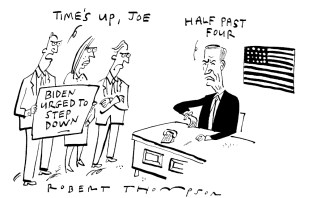
Rob lurches the other way. Marshal acquires, for the absent proprietor, a painting by a ‘macho’ German heavyweight, ‘the incarnation of European seriousness’, who once employed (and exploited) Rob himself. This triggering memento sends the no-longer-fashionable ex-YBA over the edge while Jay inches towards a ‘formal close’ – and a return to art’s cash-lined fold.
With its divergent elements of Künstlerroman, period satire, think-piece and social comedy, Blue Ruin hardly manages to make its montage of styles cohere. Yet Kunzru tears zestfully into each scenario with a keen eye and ear for mood and voice, whether in rundown East London streetscapes of ‘weird gaps and hidden places’, or the elite bunkers of the early pandemic (‘That’s what it’s all about now. High security parkland’). As a portrait of the artist, and of contemporary art, Blue Ruin never quite achieves a ‘formal close’. All the same, its fragments glitter and glow.
Islands of inspiration: a poet’s life on Shetland
Shetland comprises an archipelago of some 300 islands and skerries situated roughly half way between London and the Arctic Circle. Stereotyped by many outsiders as bleak and somehow ‘on the edge’, according to the poet Jen Hadfield’s stylish memoir – about her 17 years of living there – it can be more illuminating to see these places as somehow central to everything.
Visiting Foula, Hadfield overcomes her vertigo, finding the island ‘peaceful and dreadful’ all at once
Storm Pegs is as much an account of the author finding new personal bearings as a series of magic lantern slides about insular life. The title alludes to a traditional piece of perforated wood used by mariners to keep track of their whereabouts: you stuck the peg in a hole and navigated accordingly. The subtitle stresses that she is an incomer (a sooth-moother). She arrived in her twenties for a literary festival, and now dwells in a precarious caravan, mentally mapping her position in the busy flow of the world.
The story – in 32 loosely seasonal chapters – opens on a turbulent January day when Hadfield is violently seasick aboard the ferry crossing from Orkney. For someone leery of the sea, fearful of depths and heights (to say nothing of gales, drinkers and dogs), making a home on West Burra might not seem like the obvious option. It is a hardscrabble new life – ‘I look quite a lot like Worzel Gummidge,’ she writes, as she forages for whelks or spoots (razor-clams). But for all the setbacks and winter ‘darknesses’, she manages to make it intriguing (though I still cannot share her enthusiasm for folk festivals or Icelandic stockfish).
There are some wonderful, cannily observed set pieces: a skyfall shower of small fishes; the hunt for a rare tuber (roseroot, used by Sherpas to lend stamina at altitudes); the honing of a scythe; a night-time swim/dance in the bioluminescent surf (da mareel); and even her spell in a marine lab examining farmed salmon poo, which is full of micro-monsters. Beneath her gaze, places gradually unfold in language that repeatedly catches the listening eye – no surprise from someone who, in 2008, was the youngest ever recipient of the T.S. Eliot Prize. Her descriptions are often multi-sensory (‘the comforting, foosty old-library smell of summer cliffs that have baked in the sun all day’) or even synaesthetic (‘the sea’s edge, which was frosty-blue clear, like the taste of toothpaste’). It is an intense, mostly delicious read.
Finster is a word for ‘discovery’ in the Shaetlan dialect, and this nicely fluid book concerns the everyday business of finding things out. Beachcombing – an activity central to many island cultures – becomes for Hadfield almost an obsession, and she confesses to her gradual ‘cupidity’. Chief treasure among such ‘sea returns’ are the ‘sea beans’, tropical seed pods that occasionally arrive on the Gulf stream from as far away as the Amazon. She even secures a travel grant to research their origin by visiting the obscure Mexican fishing village of Punta Allen. By some coincidence, I not only began reading Storm Pegs aboard a storm-lashed Orcadian ferry but I had also just returned from a visit to Punta Allen myself.
I have never been to Shetland, but Hadfield’s exhilarating evocation of a journey to Foula did remind me of St Kilda, with its similar history of brinksmanship and cragsmen braving the cliffs (their most prized ropes were heirlooms woven from women’s hair). She overcomes her fears and vertigo, finding the island ‘peaceful and dreadful all at once’ – both foul and fair, as it were.
Despite a Nordic overlap, Shetland and Gaelic cultures would appear relatively distinct, but from my own 50 years of visiting a family croft in the Hebrides I caught certain island affinities, not least a penchant for nicknames. On Harris, I met a nonagenarian who had once, in his youth, been very briefly to America – and was thereafter always known as ‘the Yank’. Here, too, the chapters are peopled with characters such as ‘the Plumber’ (who addresses her simply as ‘Poet’), ‘Cobbler’ (no one knows why), the ‘Pirate’ (encountered on Tinder, but I won’t spoil the tale) and her neighbour ‘Magnie’, an elderly fisherman and storyteller who likes to say ‘Whomsoever’ by way of farewell after a long conversation.
Hadfield is spellbound by Shaetlan – ‘it struck me immediately as a poetic language’ – and her book is prinked with glinting examples (backed up by a glossary) that include hairst blinks (flashes of summer lightning), stroopy (a teapot spout; penis), peerie breeks (‘little trousers’, for paired cods’ roes) and a sign on the local store’s fruit shelf – ‘Please dunna birse da pears, it buggers dem’ – which is teetering on the brink of a rap lyric.
Her depiction of island life bears little resemblance to televised Shetland noir images, but is largely elemental – the moods of the ocean and the hectic weather become personified, especially the bullying gales (‘The wind is trying to roll back my eyelids over a matchstick’). This is a great, bright birl of a book – thoroughly beguiling. Whomsoever.
Nigel Farage is not the future
Nigel Farage is the most misunderstood politician in Britain. Vilified by the liberal media as ‘far right’ and mistaken by nationalists as a kindred spirit, the Reform party leader doesn’t fully comport with the pub bore caricature sketched by his enemies nor with the blokey everyman persona lapped up by his admirers. He is a wilier, more elusive beast, as his comments on the French elections remind us. Speaking to UnHerd ahead of the first results, Farage warned that victory for the RN would be a ‘disaster’, saying the party would be ‘even worse for the economy than the current lot’.
Dis-moi que ce n’est pas vrai, Nigel! It’s a statement sure to have friend and foe alike twisting themselves into political pretzels. The RN, or National Rally, is the nationalist party headed by Marine Le Pen which, together with its allies, has come out on top in first-round voting for the National Assembly. Surely Farage would be happy for his fellow far-right Russian stooges, his detractors will cry. Why is Nigel siding with the centrist establishment against patriotic populists, his supporters will wonder.
The answer is that, given a choice between the status quo liberalism of Ensemble (the Emmanuel Macron aligned electoral bloc) and the political prescriptions of RN, the Reform leader would choose Ensemble every time. Not out of any particular affection for a movement of metropolitan technocrats but because they are friendlier to the Anglo social and economic model than Le Pen. Farage isn’t ‘far right’ but much closer to a bog-standard Essex Man Thatcherite. He’s for tax cuts, spending cuts, deficit reduction, light-touch regulation and privatisation, all the golden oldies of the Eighties. Put Brexit and immigration to one side and there’s not much he and George Osborne could find to disagree on.
Le Pen is a very different creature. Her politics have very little in common with the Gladstonian liberalism of Margaret Thatcher. She is a statist, an economic populist, a spending and subsidy enthusiast. She is for farmers and unionised workers and sceptical of big business and the market. Put immigration and Islam to one side, and there’s not much she and the left of the Labour party could find to disagree on.
Douglas Murray has asked why Britain is such an outlier in a Europe moving right. The answer is that Europe is not moving right, it is moving on from liberalism. Where populists and nationalists are in power or in the ascendancy, they got there with a platform departing from the liberal status quo. In most cases, that means rejecting both the social liberalism of mass immigration, multiculturalism and progressive identity politics and the market liberalism that has challenged the European social model in recent decades and especially since the financial crisis. This is broadly true of RN but also Viktor Orbán’s Fidesz, Geert Wilders’ PVV, and Giorgia Meloni‘s Brothers of Italy. (A major exception is AfD in Germany, which though hostile to social liberalism remains loyal to the market variety.)
As with so much else when it comes to Europe, Britain is an island apart. Our right-wing parties are not in rebellion against the market liberal model, they are its enforcers. The Conservatives and Reform are largely as one in espousing the establishment economics that has governed more or less since the 1980s, albeit with significant interruptions during the global financial crisis and the Covid-19 pandemic. Tax cuts good, public spending bad, slash the deficit and let the market take care of the rest. So wedded are British conservatives to this penny-pinching accountancy that they will pursue it to its most unconservative ends, as in the first seven years of this government when ministers allowed police numbers to fall by 20,000 in the name of austerity.
Farage isn’t ‘far right’ but much closer to a bog-standard Essex Man Thatcherite
Nigel Farage offers no challenge to Tory economic liberalism, save that he would prefer it if they were much more liberal. Shrink the state, rip up regulations, and the lads in the City could do with another tax cut. God knows, they’ve got it tough. The irony will not be lost on Farage that the fiscal policies he promotes reward the very people who hate (and occasionally attempt to debank) him while punishing those who make up his political constituency. Note that Reform’s ‘contract’ with the British people says nothing about maintaining the pensions triple lock and instead pledges to ‘review’ a system ‘riddled with complexity, huge cost and poor returns’. That certainly sounds like more spreadsheet liberalism at the expense of Reform’s baby boomer base. If only he could be brought round to the merits of mass immigration, Farage would be the patron saint of FT subscribers.
One group unlikely to venerate him is younger voters. The most recent Opinium poll shows just one in ten Britons aged 18 to 35 is planning to vote for Reform. Yet the RN just won a third of the same age cohort. It’s not as straightforward as French youth being more nationalist. The key issues in this election have been wages, energy prices and pension reforms. It is precariousness that troubles les jeunes français and while this led almost half to vote for the far-left New Popular Front, it delivered those also concerned about immigration into the arms of Jordan Bardella, the RN’s 28-year-old candidate for prime minister. But while Bardella proposes to continue the sort of social spending which older French people enjoyed in their youth, Farage’s Reform has nothing to say to Gen Z or millennial Brits, whom the party’s modal voter considers to be woke snowflakes still renting only because they buy too many avocados.
There are few reasons to see Nigel Farage as the way forward for the British right
So it’s hardly surprising that Nigel Farage isn’t keen on Marine Le Pen and the RN. Rather than ‘far right’, he is really a malcontent of boomer liberalism, railing against the social outcomes of the post-1980s consensus while wishing to maintain the economic conditions that create them. He is ideologically hostile to the populist, nationalist and common good economics practised and advocated elsewhere in Europe by leaders and thinkers whom his followers and opponents would consider his natural allies. His natural ally is fellow boomer-whisperer Donald Trump.
When the liberal left casts Farage as a 20-a-day Oswald Mosley, it commits a cardinal sin of politics: misunderstanding the enemy. Farage flirts now and then with incendiary rhetoric but if he is the apogee of national populism in Britain, we will be very lucky indeed. I suspect, however, that he won’t be. A few years back, New York Times columnist Ross Douthat observed: ‘If you dislike the religious right, wait till you meet the post-religious right.’ I’d suggest to progressives that the same applies to Reform’s leader: if you dislike Farage, will till you see who comes after him.
But the misunderstanding is bipartisan. Nationalists who put their faith in Farage are not only fooling themselves, they are postponing the realignment they wish to see on the British right. Baby boomers will not be with us forever and yet without them Faragism is nothing. A populist British right isn’t going to win over millennials or Gen Z with nostalgia, NIMBYism, and the economic prescriptions of Milton Friedman. It is not enough to be post-liberal. Right-wingers must be pro-social, giving young people a rewarding place in a well-ordered society that aims for sodality, coherence and dignity as much as it does autonomy, diversity and growth. Thursday will deliver a much-deserved reckoning for the Conservatives but there are few reasons to see Nigel Farage as the way forward for the British right.
Listen to more on Coffee House Shots:
Should the BBC be mocking Ronaldo’s tears?
Portugal squeezed through to the Euros quarter finals last night after a penalty shoot-out victory against plucky Slovenia. Or perhaps I should say Cristiano Ronaldo’s Portugal squeezed through, as whatever Roberto Martinez’s team does and however much or little their 39-year-old talisman contributes, the story always seems to be about him.
The Beeb used to be fair-minded and respectful, even of the game’s rascals
This time it was a tale of two penalties – one missed in normal time and one scored in the shootout. A flood of tears from Ronaldo followed the former and made it seem as if the living legend was having an on-field breakdown – though he soon recovered. That provoked some cruel mockery from our state broadcaster’s football coverage, or perhaps I should say Gary Lineker’s BBC football coverage, as everything the BBC sports department does seems to be about him.
The BBC dubbed the Portuguese legend ‘Misstiano’ in their highlight reel and Lineker followed this up by posting a tweaked image of himself from Italia 90 with his erstwhile, and famously lachrymose, teammate Paul Gascoigne replaced by an image of Ronaldo. This has caused considerable upset, with John Terry, former Chelsea and England defender branding the BBC ‘a disgrace’. And when John Terry calls you a disgrace, well…
Where should our sympathies lie? One the one hand, since taking offence and having no sense of humour, or proportion, now seem to be central tenets of our new national religion, I’m inclined to be heretical, shrug my shoulders and say ‘so what?’ The BBC’s ‘jokes’ were not particularly funny (‘Misstiano’… hmmm), but, you know, free speech and all that. I would certainly hate to see a directive sent down from the Director General forbidding mickey taking of super wealthy footballers for fear of upsetting their delicate sensibilities.
Plus, as many online commentators on this issue have pointed out, Ronaldo has considerable form in the disrespect stakes, and we could start from his wink to camera on getting Wayne Rooney (his Manchester United teammate) sent off in the World Cup in 2006. That was a while ago, of course, and could be put down to youthful indiscretion. But, to paraphrase a review of a Spinal Tap album, Ronaldo’s ‘emotional growth rate cannot even be charted.’ He’s still at it, mocking opponents, showboating, and making obscene gestures to the crowd. Perhaps, he deserves all he gets.
Or perhaps not. Say what you like about Ronaldo (and I have) he has two things in his favour in my book. One is perhaps trivial, his absolute refusal to have a single tattoo anywhere on his body, and the other, rather more important, is his undiminished and seemingly indefatigable passion for the game. That passion might be more solipsistic than one would ideally expect of a team captain, but there is no doubt he loves, and lives football. To see that mocked leaves a nasty taste.
And say what you like about the BBC (and I have) but one thing its sports coverage used to have over its rivals was dignity. It is hard to imagine a Barry Davies or a John Motson or a Des Lynam making fun of a professional sportsperson’s distress after failing at a crucial moment. To see that gone also leaves a nasty taste.
In the old days the BBC would have passed over the crying incident without much comment, allowing us to make our own minds up over whether this was a moment deserving of sympathy or a petulant meltdown. The Beeb used to be fair-minded and respectful, even of the game’s rascals. I well remember Barry Davies in the 1986 World Cup, a few minutes after Diego Maradona had cheated England with his ‘hand of God’ goal, saluting his brilliant second with ‘You have to say that’s magnificent’. I miss that BBC.
The modern BBC sports coverage, well, really the modern BBC everything coverage, seems to be all about worshipping at the altar of diversity, and an obsession with connecting with the youth. Everything has to be hyped up with splashy graphics, and/or set to music, always with some cheeky low-grade humour attached, as if the audience are teenagers with the attention span of a goldfish and their fingers poised on their remotes to flip channels at the first sign of seriousness.
Which makes me pine for, not just Davies and Lynam, but perhaps especially Peter Allis, who was perhaps the master, respectful of the professionals but capable of a subtly barbed criticism of the sporting superstars whose triumphs and tragedies he witnessed. But only when there was a worthwhile point to be made.
I remember when the golfer Nick Faldo stopped to put on his Rolex before lifting the Open Championship trophy before about a thousand photographers, Allis made his arch and richly meaningful comment: ‘Oh yes, mustn’t forget that.’
That’s the way to do it.