-
AAPL
213.43 (+0.29%)
-
BARC-LN
1205.7 (-1.46%)
-
NKE
94.05 (+0.39%)
-
CVX
152.67 (-1.00%)
-
CRM
230.27 (-2.34%)
-
INTC
30.5 (-0.87%)
-
DIS
100.16 (-0.67%)
-
DOW
55.79 (-0.82%)
I voted for Kamala Harris – but I’m not surprised she lost
In the end, I voted for Kamala Harris, but I always knew she was destined to lose. After all, if Harris was having trouble convincing me – a mixed-race gay Northern Californian – to get behind her, her chances were worrisomely slim. And the Harris campaign – rushed and reckless, relying on the same tired playbook that failed Hillary Clinton in 2016 – appears to have lost the vast American middle in spectacular fashion.
Harris had plenty more to offer – if only she hadn’t been so afraid to let it loose
The biggest problem for Harris is that she wasted every opportunity to make herself seem interesting. Here is a woman born to immigrants, educated at both Howard, among the most prominent of America’s historically black universities, and California’s public higher education system; a big-city prosecutor with a nifty millennial, multi-racial family who somehow managed to still appear banal and out of touch. A woman overflowing with #intersectionality – with stakes in endless communities, yet never seeming to truly belong to any. A candidate whose race and gender were her most crucial selling points, even as her campaign – along with Harris’s celebrity proxies and media surrogates – refused to engage with what her race and gender might actually mean.
I waited for a reason to make Harris my own, but found it hard to find one. Her campaign – mired in cowardice and timidity – continually danced around her most unique selling points without ever really hitting the dance floor. This is why Harris performed so poorly among crucial voting blocs like black and Jewish voters who will inevitably be blamed for her loss.
Rather than authentically engaging with race and class and gender and religion, Harris stuck to a well-edited script of middle-class modesty that never quite worked with her sleek suits and multiple Vogue covers. Her campaign may have tried to play her as ‘moving beyond’ identity politics, but her real mistake was that voters never learned what all of these identities actually meant to Harris.
Rather than speak openly about her distinct racial heritage, her immigrant parents, her marriage to a white man – any attempt to pierce Harris’s racial veil was shut down and silenced.
I wanted to hear Harris talk about her mixed-race family – not her fake tenure flipping French fries at McDonald’s. Trump directly challenged Harris’s racial bona fides – crudely and with vulgarity. But instead of bravely taking Trump on – perhaps her own version of Obama’s now legendary “More Perfect Union” speech in 2008 – Harris merely dismissed her rival, insisting such talk was just ‘the same old show’ as a plaintive mainstream media looked on.
The same thing happened for Harris with gender – and with Jews. Harris is 60 and childless, another American anomaly which the Trump–Vance campaign tried to weaponise against her. JD Vance was clearly churlish when bemoaning ‘childless cat ladies’. But he offered Harris an opportunity to open up about not having children, how this has shaped her worldview and what it might mean for the increasing number of other Americans like her.
Harris stuck to a well-edited script of middle-class modesty
Instead, Harris clapped back with charges of misogyny while talking up a parentage to stepchildren who were nearly grown when she married their father. All around were quaking gasps of lame ‘how dare he’ when Harris should have been brave and vulnerable and told us how she feels not having kids of her own. Aren’t feelings, after all, what progressives care about most?
The same thing with Jews and Israel and Judaism. My mum is Jewish, my dad African-American – another Harris-world similarity. She and me and we are not like most American Jewish families – particularly at a moment when Jewish families are enduring unimaginable levels of antisemitism.
As she and Biden dithered over their support for Israel, Jews needed to clearly hear what being part of a Jewish family has meant for Harris. We Jews needed to know how, and why, she is – even if by marriage – one of us. Instead, the Harris campaign sent out husband Douglas Emhoff as the nation’s top Jew, while approving deep dives into her journey through the Black Church.
Ultimately, Harris’s entire campaign these last five months has felt contrived and expedient, rather than profound and personal. When the numbers come up showing that many Black and Jewish voters backed Trump, they’re bound to be blamed for failing to deliver Harris the White House. But the blame is all on Harris. Voting for an end to Trumpism may have been enough for folks like me to check ‘Harris’ at the ballot box, but most people needed more. Harris had plenty more to offer – if only she hadn’t been so afraid to let it all loose.
What does Trump’s win mean for America’s allies – and its enemies?
When Donald Trump won his first-ever election in 2016, the world woke up the next morning in a collective state of shock and disbelief. Washington’s allies in Europe were caught completely unprepared; all of a sudden, they had to contend with a leader who relished needling them for all kinds of sins, real and perceived. America’s allies like Japan and South Korea, whose defence policies depend almost entirely on a stable alliance with the United States, were now forced to deal with a man who threatened to use those alliances as leverage to extract greater defence spending in Tokyo and Seoul. Latin America didn’t know what to believe, and frankly neither did many Americans.
Trump should schedule a phone call with Putin relatively early
Nobody is shocked this time around. Or at least they shouldn’t be. Unlike in 2016, when foreign governments failed to do their homework, US allies and partners spent the year before the US presidential election trying to reconnect with Trump’s inner circle. Japan, South Korea, Germany and others all sent delegations, quietly, to Washington, D.C., New York and Florida to hobnob with Trump and his closest advisers because they understood Trump 2.0 was a very realistic possibility. That possibility has become reality in what is arguably the most impressive political comeback in US political history.
It has only been 20 hours or so since Trump was declared the winner, yet a lot of ink has already been spilled about what the returning president may do over his next four years. Israeli Prime Minister Benjamin Netanyahu’s government is cautiously optimistic that a second Trump administration will essentially provide Israel free rein to go after its enemies in Gaza and Lebanon. Ukraine is obviously terrified at what’s in store given Trump’s loud proclamations that the nearly three-year-long war is a waste of US taxpayer money (Ukrainian President Volodymyr Zelensky wrote a congratulatory tweet to Trump as soon as the race was called, hoping for good times ahead).
Much less attention, however, is devoted to what Trump’s foreign policy priorities should actually be during a second term. This, rather than what Trump could do, is the more important subject. The first 100 days will be a pivotal moment for Trump to make his mark and chip away at some of the big problems that impact international security and America’s own role in the world. His kitchen cabinet and incoming security team will be whispering in his ear about what to prioritise and what to discard, but if I were in the room with him, I’d focus on three major lines of effort.
First, Trump should de-prioritise the Middle East in US grand strategy. There are approximately 43,000 US military personnel deployed in the region, an increase from the usual 30,000 courtesy of the 7 October 2023 Hamas attacks on Israel. Since then, the region has been a cauldron of violence and unpredictability. US policy has been – and remains – entirely contradictory and counterproductive, with US diplomats jetting to various regional capitals to work on ceasefire agreements in Gaza and Lebanon at the same time Washington continues to send offensive weapons systems to Israel. Netanyahu has happily taken the weapons but largely spurned the diplomatic efforts. Whenever rumours of a deal are close, the cautiously sunny optimism disappears shortly thereafter.
Trump won’t ban weapons sales to Israel, of course. And even if he did, such a move would cause a huge amount of consternation on Capitol Hill, which remains staunchly committed to defending Israel and aiding its war effort. Yet what he can do, and what would be far more popular, is bring US military forces back to their pre-7 October level. He should also finally give the order to withdraw the roughly 2,500 US troops who remain stuck in Iraq and Syria carrying on with a counter-Isis mission that local actors are capable of fulfilling themselves. The last thing Trump needs early in his presidency is to wake up one morning and find out that a drone launched from an Iranian-backed militia struck a small US base and killed three or four Americans.
Second, Trump must translate his campaign rhetoric about the war in Ukraine into concrete action. That means getting tough with Zelensky and Vladimir Putin alike. Trump should schedule a phone call with Putin relatively early (despite the shock and dismay the Washington, D.C. commentariat will feel with such a thing) and tell him in no uncertain terms that US–Russia relations are unlikely to get much better as long as the war continues. Putin won’t like this and may doubt Trump’s sincerity, but if Trump is serious about negotiating a peace settlement, he can’t afford to give away any leverage he currently possesses over Moscow. In turn, Trump needs to be just as honest and forthright with Zelensky, whose ultimate objective for the war – a full Russian withdrawal from all occupied Ukrainian territory – remains as naive as it is unachievable. The message: if you want the US to keep supporting you, Volodymyr, you can no longer ignore the realities on the ground, which are trending to Russia’s advantage.
Third, Trump should solidify communication with China. Despite the systemic rivalry between the two superpowers, the US–China relationship is the most important on the planet. The interdependence is such that a full breach would be too economically catastrophic to both sides. So-called de-risking will continue, particularly in industries deemed strategic, but an outright decoupling is out of the question. Nobody would win in such an arrangement. Just as important, Washington and Beijing have to find a way to institutionalise communication channels across the board, from the very top to the working levels. This will take a considerable amount of legwork on the part of both countries and might not even be possible; China, for example, has a habit of shutting down normal discussions to penalise the US for policies it disagrees with. But Trump, who got along with Chinese President Xi Jinping during his first term (until Covid-19 hit, that is) should at least make the effort. War, either by mishap, miscalculation or choice, is too unfathomable to even contemplate.
None of these recommendations will get Trump in the history books. But they will go a significant way towards clearing some of the mess he will find on his desk in the Oval Office.
The slippery business of catching a snake
Dante’s Beach, Ravenna
It is strange how events elide and create a pattern whose significance remains elusive. I had just returned from a raid under the cover of the night on a huge field near our house a mile from the sea. I had about 50kg of ripe tomatoes in plastic bags in the back of my battered old seven-seater Land Rover Defender and was wondering if, as an impoverished father of six, I could use the Thomist defence: ‘It is not theft, properly speaking, to take secretly and use another’s property in a case of extreme need: because that which he takes for the support of his life becomes his own property by reason of that need’ (Aquinas, Summa Theologica).
‘Not until you flog the Defender you can’t,’ I heard the chorus of faces in the ancient gallery chant. But then as I parked outside our house, I saw through the windscreen the most amazing shooting star to the north, which obviously settled the matter in my favour. Don’t ask me why but take it from me: that shooting star was the work of God and not of the Devil. And it was a gigantic thumbs-up splashed across the night sky.
Paolo’s big idea is that artists have been, if not actually possessed by Satan, most definitely piloted by him
As luck would have it, the next day my old friend Paolo, who currently manifests as a poet and art historian, presented his degree thesis at the Accademia di Belle Arti in Ravenna on L’Estetica di Lucifero (The Aesthetics of Lucifer). In Italy, anyone can listen to such presentations and there were about 30 there, mostly young women, to hear his highly seductive and instructive romp through the history of Satan and how he has been depicted in words and pictures since the year dot.
Paolo’s big idea is that artists since the French Revolution have been, if not actually possessed by Satan, most definitely piloted by him, and as a result art is ugly and the only antidote is beauty – to achieve it, however, will require mass exorcism.
The rot began with Milton in 1667 with his depiction of Lucifer in Paradise Lost as a heroic fallen angel and was compounded by Byron’s transformation of Lucifer in the early 19th century into a heroic fallen human. Byron – let us not forget – had the most serious love affair of his life right here in Ravenna with the married Teresa Guiccioli shortly before his death. All is lost by the time we get to the 20th century, via Baudelaire et al., and Picasso’s ‘Les Demoiselles d’Avignon’ (1907), which depicts – says Paolo – nothing short of a Satanic ritual. Satan, in a word, has become God, and art an empty commodity like Warhol’s ‘Brillo Box (Soap Pads)’ (1964). Just look how ugly it all is.
Needless to say, Paolo – who has luxurious jet black hair tied in a bun and who that afternoon wore a knee-length purple silk scarf and a strategically unbuttoned shirt – was awarded the equivalent of a starred first on the spot. Bravo! Dante, who is buried just round the corner and wrote The Divine Comedy wandering round here after being banished from Florence, is a hard act to follow. But Paolo is a worthy pupil and has at least found hell on Earth, perhaps even heaven, in the shape of our nudist beach.
To resuscitate poetry from its comatose state he makes it visual. That means, for example, displaying poetry on walls, like graffiti, and in computer situations. Also on human flesh. So Paolo wanders the local nudist beach in search of bodies. And he does so naked, equipped with the tools of his trade.
Me, I hate that the nudists have stolen the best bit of our beach by occupying it and refusing to leave. That said, Paolo’s bodypainting poetry, as he calls it, is a pretty cool idea. It involves an intense conversation between him and his (usually female) prey from which emerges the poem that gets written on their body. He posts photos of the results on his website Poetry Everywhere.
Be all this as it may, what about the snake? Who sent the snake into our house the very next day? And what does it mean?
My wife Carla, who became a devout Catholic only after meeting me perhaps to defend herself from me, listens to the Catholic radio station, Radio Maria, whose editor, Padre Livio, talks non-stop about the Devil as the ‘astuta serpe’ (cunning snake).
Snakes, for us believers, are tricky. This particular snake was about 25 inches long and as black as night and just outside the ground-floor bedroom of Giovanni Maria, who is 12. It then disappeared behind his desk. No doubt it was a baby whip snake, not a venomous viper, which we have in the nearby forest by the sea, but they grow up to two metres long and are exceptionally aggressive. With intense effort we moved everything in Giovanni Maria’s bedroom, including his gigantic wardrobe, in an attempt to find the snake. With gloved hands, we even checked inside shoes. In vain. So the astuta serpe remains on the loose in our house. I pray that it has crossed to the other side like in Harry Potter on Platform 9¾ at King’s Cross.
Carla, who thinks she knows me inside out, said: ‘Are you sure you actually saw a snake?’ It is a question that depresses me in that it questions my sanity. But would it be better if I had seen the snake, or I had not?
My run-in with Greta Thunderpants
The anger management counsellor stormed through the door and shouted at me to turn the heating up. Hello to you too, I thought, but I was polite because I realise we are going to get difficult customers doing B&B in West Cork, where tourists come from all over the world.
At first, however, I didn’t know that this woman storming round my house was a psychotherapist. I just thought she was spectacularly rude. She was wearing a woolly hat and big coat, even though it was a typically mild West Cork autumn day, about 17°C.
She got right in my face as she declared the house too cold at 11 a.m., having demanded at the last minute to check in four hours early. ‘What’s your heating system?’ she barked, eyeing the brand new radiators in the hallway.
‘Er, actually it’s Swiss, with very efficient insulated piping…’ but she yelled: ‘OIL?’ And she pronounced it in a way that made clear she was appalled on an environmental level.
She had long brown hair, and was in her forties, or possibly her thirties; it was impossible to tell with the woolly hat. She said she was visiting her sister down the road and had been told there was no room for her to stay there.
She was so obnoxious I decided there had been some sort of row at the family home and she had been told to check into a hotel. No doubt she had submitted a list of complaints to her sister, as she was doing here, within seconds of her arrival.
After lodging her environmental objections to the way my house was heated, she complained that she could not find anywhere to have a series of beauty treatments. ‘I want my hair done, my nails done and a massage – in the same appointment!’ she barked.
But that was in hand, she said, because she had demanded a local hairdresser accommodate her. She was marching about the hallway looking for the heating controls, so I told her to wait and I went out to the boiler room, fired it up, and came back to find her still pacing up and down.
I now felt it likely that this ghastly woman was in her thirties because she had to be a millennial to have the gall and stupidity to demand all-day heating at full blast while complaining about oil.
These snowflakes are the environmental problem: they are the big consumers, with their love of luxury and buying stuff online, and they are the weaklings, the ones who aren’t hardy enough to put on a jumper and not have the heating on all day in 17°C, at the first whiff of a winter breeze.
Imagine, if you will, how the puny, vegan Just Stop Oil demonstrators would fare if we all said: ‘Fine, you’re right. We will stop oil. And obviously because we can’t produce enough energy from wind or solar, and we’ve fired up all the coal-fired power stations we have to bridge the gap, we’re just going to bring in new laws to limit everyone to a few hours heat a day.’
Imagine them squealing and shivering. Off this climate warrior stormed upstairs in front of me as I tried to show her to her room, and as I opened the door to reveal the immaculately finished guest bedroom with its new en suite, fluffy towels, luxury linens and complimentary tea and coffee, she stormed round the room barking: ‘What about the wifi code?! What about if I want this radiator turned up?! I can’t be cold!’
I left Greta Thunderpants to settle in and was in the kitchen ten minutes later when she stormed in there, having flung open the hallway door which shuts off the main house from the backstage areas.
‘I have a BIG ask! Fine, if you can’t do it,’ she said, with a face that made clear it would not be fine. ‘I want to do ALL my washing!’ Of course she did. ‘No problem,’ I said, in the name of avoiding bad reviews, and I showed her to the washing machine.
She harrumphed and asked where the drier was. Amazing how these climate activists don’t mind wasting water and electricity on the most profligate appliances.
I said I didn’t have one, but she could use the radiators, which were blasting out heat. She said this wouldn’t be acceptable and she would have to find a garage with a public drying machine.
I felt like asking if she would like me to order her a helicopter or private jet to get her there, but I buttoned my lip.
The next morning she informed me by message on the booking site, while in her room, that she would not be checking out on time as she was ‘on a Zoom call’. When she did leave, she threw open the door with a bang and stormed off, her thumping angry footsteps battering the hallway floor.
As she screeched down the drive, I found everything in her room – the duvet, ornamental throws, wet towels – all strewn across the floor. Rubbish had been thrown vaguely at the bin but not into it. Furniture was, inexplicably, pulled out from the walls. The whole room was pretty much trashed.
It was only then that I looked her up. She was, her website claimed, a world-leading expert in compulsive behaviour, anger, stress, anxiety and relationship problems. She could transform negative unhealthy patterns of relating to people into joyful and meaningful ones. Perhaps she just chooses not to.
Bridge | 9 November 2024
The only end play I have ever understood is the throw in. I know when to use it. I know how to use it. And I can see it quite early in the play. But that’s it. I still don’t know how to spot (never mind execute) a squeeze, despite being told 100 times to ‘run all your trumps and leave an entry to both hands’. I never quite dare to run all my trumps. And then there is the mysterious ‘Dummy Reversal’ which came up while I was watching my teammates, Thor Erik Hoftaniska and Thomas Charlsen on BBO, playing for Norway in the World Bridge Games, identified and explained by the commentators.
E/W put on a lot of pressure, but 5♥ seemed more than playable when dummy went down.
Hoffa ruffed the Spade lead and played a top Heart and another to dummy, discovering the very annoying trump break. It was time for a small Club from dummy and the King was taken by the Ace and a small Club returned towards the Jack. West didn’t want to give declarer the whole suit, so he followed with the ♣8, and East could ruff dummy’s ♣J and continue forcing declarer. South ruffed again and played another Club to West’s ♣9, who naturally forced the South hand yet again.
Thor Erik had no more trumps in hand, and the Clubs were not yet set up, but something else had happened: dummy was out of black cards! Declarer went to dummy with a Diamond to draw the remaining trump, and when Diamonds turned out to be 3-3, he had his 11 tricks on a classic – albeit unplanned – ‘Reverse Dummy’ play!
The problem with Dawn Butler
We hear a lot about white supremacy these days. But for some reason we rarely hear about black supremacy. I wonder why? There’s a lot more of it around.
For Butler, describing someone as white or as trying to be white is clearly a great insult
While it is vanishingly difficult to find an overt white supremacist in British public life, it is extremely easy to identify their black counterparts.
As exhibit A I would present the Labour MP Dawn Butler. I have written about her once before, in 2020, when Ms Butler was in a car that was stopped by police. At the time I speculated that the coppers may have pulled the vehicle over in the hope of reclaiming the whirlpool bath that Butler had treated herself to at taxpayers’ expense a few years before. But it was not to be. The incident simply gave Butler the chance to tour the television studios claiming, with great originality, that the British police are ‘institutionally racist’.
Butler was back in the news this past week because of her response to the election of Kemi Badenoch as Conservative party leader. Some naive Tories imagine that Badenoch’s appointment is somehow going to snooker the furthest fringes of the Labour attack machine. They could not be more wrong. Those fringes are populated by people who will call anyone anything they want, however nonsensically. Erstwhile restraints like consistency, honesty or sanity do not hinder them. In 2022 the charmless Labour MP Rupa Huq attacked Kwasi Kwarteng (then, briefly, chancellor of the Exchequer) as ‘superficially black’.
Inevitably, after the news of Badenoch’s victory, it was Butler’s turn again. She retweeted a post describing the Tory leader as ‘white supremacy in blackface’ and ‘the most prominent member of white supremacy’s black collaborator class’. While this is something that most people will rightly regard as utterly crackers, there are a few things worth noting about it.
First is the apparent view that a surprising number of people on the ‘progressive’ side of politics hold, which is that a person’s politics should not be decided by their intellect but by characteristics over which they have no say. These ‘progressives’ take it as axiomatic that anyone who is not white must always vote for the political left, as should anyone from a sexual minority. Also anyone who is unfortunate enough to be born white and heterosexual but is willing to provide temporary proof that they are not, at present, an active member of the KKK.
This is an unfortunate misunderstanding of the left. But it is not evidence of malice per se. Butler on the other hand now exhibits something different. Because for her, describing someone as white or as trying to be white is clearly a great insult. Butler does not seem to believe that skin colour should not matter. She apparently believes it should matter a great deal – and that her skin colour makes her superior. We have her own words to go on.
Last month, to kick off another ‘black history month’, Butler posted a video online that was bonkers even by her standards. It was a sort of vainglorious rap video. I have watched it quite a number of times and still cannot believe it. If you too don’t believe what I am about to relate, you will just have to go online and watch it for yourself.
At the beginning of the number, Butler chants: ‘You wanted to see me broken?/ Head bowed and tears in my eyes?/ More fool you, you didn’t realise/ That my strength is powered by your lies.’ Quite who the ‘You’ is in this is not made clear but you can make the reasonable assumption that they are white. She goes on: ‘You are the wrong one./ The violent one./ The weird one./ Whereas I, I am the chosen one./ Because I am of the first ones.’ I will give us all a brief moment to recover from that – but only to reflect on those last two lines. There used to be a moratorium in public life on allowing people to go around proclaiming themselves ‘the chosen one’. It is widely regarded as a sign of mental sickness. In Jerusalem it is known as ‘Jerusalem syndrome’ and sees a number of people confined each year. But what to make of that follow-on claim – ‘I am of the first ones’? For elucidation we must, I fear, once again, return to the verse of Dawn Butler.
‘You see this skin I’m in?/ This beautiful mahogany brown?/ The skin you don’t like, I believe./ So why you try so hard to achieve/ By burning yourself in the sun? /For me there’s no need / Because I am the chosen one./ For I am of the first ones.’
To conclude Butler says: ‘You, my friend, don’t matter.’ Then there’s yet more stuff about being the chosen one and the first one, before she reaches the searing insight: ‘You created a structure/ That made you seem great./ When the simple reality is/ It is all fake.’
Enough. It is time to come to some conclusions about Butler’s work. If a white MP made a video describing themselves as the chosen one because they have ‘white skin’ unlike all these ‘loser’ black people, then I think it would be fair to say that their career would be over pretty sharpish. The grandiosity would be laughed at, but the white supremacy would be the death knell.
Yet what Butler has been displaying for some time, like a number of others on the Labour left, is the exact black counterpart to that. Butler does not appear to think she is the equal to her fellow countrymen. She seemingly believes she is superior to them if they are not of her skin colour.
There is a term for that. The one I mentioned at the start. Perhaps we should start using it more often.
Did I deny my son a shot at the Premier League?
When my youngest son Charlie was seven he was talent-spotted by a QPR scout who saw him playing football in the park and invited to try out for the junior academy. I struggled to take this seriously – he still couldn’t ride a bicycle – but duly turned up at a ‘sports academy’ in Willesden, a secondary school, where the trials were held. To my astonishment, a QPR coach told me Charlie had potential and offered to enrol him in a programme that involved spending two hours every Wednesday evening at this school. This wasn’t the junior academy, but a level below. Charlie was keen and after talking it over with Caroline we decided to give it a whirl.
Some of the kids couldn’t cope and would burst into tears – driving their fathers round the bend
Within a few weeks of him starting, I began to get cold feet. This school in Willesden wasn’t easy to get to on public transport and was an hour’s drive from our house in Acton. Then there was the fact that Charlie’s odds of becoming a professional footballer were vanishingly small. According to Richard Allen, former head of talent identification at the Football Association, less than 0.5 per cent of the players signed by professional teams under the age of nine end up playing for the first team – and Charlie was a long way from being signed. Finally, there were the other dads.
The coaching took place inside a wire cage and the dads would cling to the outside, screaming at their sons. They knew this was a gladiatorial arena in which only a handful, if any, would make it to the next round and they wanted their lads to be among them. This wasn’t run-of-the-mill encouragement, but blood-curdling threats. I got the impression that many of these men had fantasised about being professional footballers themselves and were vicariously pursuing their dreams through their offspring. Some of the little scraps, barely bigger than toddlers, couldn’t cope with the pressure and would burst into tears, driving their fathers round the bend. Afterwards, you saw them being dragged towards the car park, repeatedly told how ‘shit’ they were. And in case you think this is an example of ‘toxic masculinity’, some of the boys were accompanied by their mothers and they were far, far worse.
I don’t believe in mollycoddling children, but even I found this a bit much. The reason the parents cared so much wasn’t just because of their own thwarted ambitions. They also had dollar signs in their eyes. To be fair, they may not have been thinking of the jewellery and cars their children would buy them – they wanted them to do well. For many, it was a bit like buying their kids premium bonds. The odds were poor, but this was their one chance of hitting the big time.
And it was that, above all, that persuaded me to withdraw. Unlike most of these other children, Charlie would have all sorts of opportunities in his life. This wasn’t his ‘one shot’. Why, then, get his hopes up when it would almost certainly end in disappointment? Even if he was signed by QPR, the odds of him walking out at Loftus Road were 200 to one. During that winnowing process, he would be spending most of his time playing football instead of studying and, when he was spat out, he might have no GCSEs or A-levels to fall back on. I know from conversations with ex-cons that prisons are full of young men who’d been enrolled in football academies and, when they didn’t make it, turned to crime. Indeed, the first team at Wormwood Scrubs is said to be better than QPR’s.
So, I pulled Charlie out after four weeks and have never regretted it. Until last month, that is, when something happened that gave me pause. During my son’s brief career as a QPR recruit, he befriended another seven year-old – Botan Ameen – who was tapped up at the same time. I became friendly with his dad and, because he lived nearby, we would take it in turns to drive the boys. But unlike me, Botan’s dad stuck with it and, in due course, his son signed for QPR. He was let go last year aged 16 – so wasn’t among the 0.5 per cent – but picked up by Swindon Town, a club in the fourth tier. And on 8 October he made his first team debut in a cup game against Bristol Rovers and scored a goal, helping them to victory.
I know what’s going to happen next. Botan, who has already played for the Iraqi under-20s team, is going to become the highest scorer in League Two next season, then get bought by QPR and score the goal that seals their promotion to the Premier League in 2026. After we’ve finished celebrating in the stands, Charlie will turn to me with an accusatory look and say: ‘That could have been me, Dad.’
The Battle for Britain | 9 November 2024
How to buy a house that isn’t on the market
There are many, mutually reinforcing causes of the property crisis: it is too easy to borrow; there are too many people; there aren’t enough houses; what houses do exist are in the wrong place; and many houses have the wrong people living in them. Solutions exist to all of these, some of which involve building and some of which don’t.
In south-east England it is not uncommon to find people living in
£1 million homes who are skint
Today we are going to focus on the fifth problem. Too many people are living in houses which are too big for them. In south-east England it is not uncommon to find people living in £1 million homes who are otherwise skint. I know someone who lives on a long road of four-bedroom houses where they are the only household of more than two. This is daft.
The problem is psychological not structural. Intriguingly, one financial adviser tells me that there is an ironclad behavioural pattern among retirees: unless you downsize before the age of 72, you will never do it unless driven by highly adverse financial or medical circumstances. It isn’t clear why this is – perhaps, once you reach 72 or so, you are reluctant to risk the inconvenience and cost of moving, only to have to repeat the procedure four years later. If this is true, it would be comparatively easy to nudge people into early downsizing by offering a limited-window, stamp-duty holiday to downsizers aged, say, 60 to 72.
But there is another psychological approach which could increase liquidity in the property market. You simply redefine what it means for a house to be ‘on the market’.
Writing in the Telegraph, Tristan Rutherford explained how, on returning to the UK, he was unable to find a suitable house in Lichfield. So, following the example of Alan Sugar, he wrote to the owners of 25 suitable homes that were not for sale. Five wrote back, expressing an interest. Three included an invitation for a tour. He duly found his home.
This finding fascinates me. None of these 25 homes was ‘on the market’. But five people were willing to sell when given an offer. Logically, this makes no sense. But I suspect it isn’t logical – it’s psychological.
I’ve therefore been carrying out an experiment. Whenever speaking to an audience of 200 people or so, I ask the audience to raise their hands if their house is on the market. I then ask if anyone would consider selling if presented with a reasonable offer. Every time I have tried this, more than four times as many people respond to the second question as the first. I even got the same result in Canada.
What is going on here? Why are people more reluctant to ‘put their house on the market’ than they are to sell? Is it that people hate estate agents even more than they hate moving house? Plausible, but I don’t think that’s it. I suspect that once you see your house as being for sale, you enter a state of limbo where you no longer derive any pleasure from your ownership of your home.
If someone offers to buy your house, however, you bypass any uncertainty or fear of rejection. It’s a bit like dating: you wouldn’t go on Tinder if you’re happily married, but if Jessica Chastain/George Clooney invited you out for a drink, you might rethink your living arrangements a bit.
The solution to this is surprisingly easy. Government simply mandates that all homes are for sale all the time. There is no obligation to sell – you could simply quote a ridiculously high price. A website called chimnie.co.uk gives a glimpse of what this might look like. It would be a disaster if we applied the same principle to dating – it would lead to massive promiscuity and family breakdown. But in all other markets, we call promiscuity ‘liquidity’, and it’s exactly what families need.
Dear Mary: How can we get our messy little boys excused from formal lunches?
Q. To my surprise I have been asked to give a eulogy at the funeral of someone I knew only quite well. I accepted more out of embarrassment than for any other reason but I will feel rather bogus delivering this encomium when there will be much closer friends present who may rightly be annoyed by my taking on this commission. Advice, Mary? – Name and address withheld
A. Your name, which has not actually been withheld from Dear Mary, suggests you may have been chosen for status reasons. A funeral is not a time to be mean-spirited however, and the key thing to remember about a eulogy is that it is not about you. You should figure minimally in your address (no doubt you are well practised in this). Research – by talking to others who knew the subject well – is mandatory. It is vital to get the facts right because mistakes will discredit the whole. You can name the suppliers of material to foster their sense of inclusion.
Q. My sister is involved with a very grand older man in his sixties. He insists that our sons, aged two and four, sit at the table with us in the formal dining room for lunch as he himself learnt table manners this way as a small boy. This is nerve-racking as the children make a terrific mess on the white linen tablecloths and so the whole table has to be changed. How can we politely ask for them to be excused?
– F.E.H., Taunton
A. Bring some large linen table napkins with you. Lay one down in front of each son. These will vastly restrict the area of spillages and can be removed at the end of lunch, leaving the main tablecloth intact.
Q. A friend, who is spoilt and eccentric, is also very good company. She has moved to a fabulous central apartment in Lisbon and invited two of us to stay. Our reservation is that she has no palate whatsoever and will have no interest in going out to restaurants which, for us, would be a major factor in visiting Lisbon. (She has been known to turn up to dinner parties and refuse the food because she has had a sandwich at home.) It would be frustrating to be near to brilliant restaurants but have to eat sandwiches instead. What should we do?
– Name and address withheld
A. If your friend is indeed eccentric she may not think it odd when you declare that, by a remarkable coincidence, both of your cleaners in England are Portuguese with sons who own restaurants in Lisbon. You have promised you would patronise these while staying in the city. Say: ‘This will give you a bit of breathing space from us while we nip out and eat in them.’
How Maggie took her whisky
The whirligig of time brings in his… astonishments. Who would have thought it? Even a couple of decades ago, the notion that the Tory party could be led by a black woman would have seemed incredible. I remember 1975, and the doubts that were expressed about Margaret Thatcher: much louder than any adverse comment about Kemi Badenoch now. There seemed to be a widespread belief that the country was simply not ready for a female PM.
When she was PM, she had to be dissuaded from serving English wine in No. 10
I recall a lunch with Barbara Castle not long after the 1979 election. A former street-fighting termagant, she seemed to have eased into post-partisan serenity. When I confessed that I was a Tory, she merely responded with a tut-tutting smile, as if I was an errant grandson. ‘Of course I wanted you Tories crushed under foot,’ she said with a flash of the old passion. ‘But I knew that if this happened, everyone would say that it had been folly to choose a woman, and any progress towards equality would have been set back for 25 years.’
There is another factor in the slow march towards the benign regimen of women: Mrs Thatcher as a feminist influence. Before 1975, the men in charge of law firms or counting-houses – and it was always a man in those days – would almost all have spoken with one voice on the subject of hiring female employees. ‘The sweet little things. But where would they sit? Which lavatories could they use? Everyone knows that they’re no use for one week a month, and they’d distract the young men. And if by a miracle the girl did turn out to be some good, she’d only go off to get married and have babies. Jolly good thing too, but rather a waste of all our time.’ Yet within a few months, it was precisely chaps like that who were proclaiming that Maggie’s the best man we’ve got – while also wondering, when about to reject an able girl, whether they might be turning down the next Margaret Thatcher.
Thinking back to those days reminded me about Maggie and drink. Just after she won the leadership, she was asked if the Thatchers would be opening a bottle of champagne.
‘Oh no,’ she replied. ‘I’m not sure we’ve got any at home.’ She was probably telling the truth. In those days, the less sophisticated upper middle-classes – i.e. most of them – regarded champagne as a drink for weddings or very special occasions and not as an habitual aperitif. Denis concentrated on snorts: gin or Scotch. In his memsahib’s case, it would have been Scotch, well-diluted.
In later years, that changed. Once Thatcher left office, Peter Morrison stayed on as her PPS, even though he had helped to lose her the leadership. Peter would not have known how to pour a weak whisky. He did not quite crush the cap after opening the bottle, but little would be left. Late-ish in the evening, people observed that Margaret would often seem a little tipsy. No wonder, after three or four Morrison-scale glasses. As she no longer had enough to do and was producing more adrenaline than she could consume, the effect was compounded.
She never took much interest in wine, even when excellent bottles were on offer. Indeed, when she was PM, she had to be dissuaded from serving English wine in No. 10. In recent years, there have been improvements in English wineries, but even so. It might be tempting for a state banquet with President Macron as the guest of honour, but only if the Channel Fleet had been alerted (I take it that we still have a Channel Fleet).
‘The Tories are not dead, only sleeping,’ Tony Blair once warned his party. This time, the nap might be shorter. British politics is about to enter an exciting phase. I not only hope that Kemi will be as good as I think. I believe that she will be as good as I hope.
Does ‘nestled’ offend you?
‘Shockin’!’ exclaimed my husband, almost biting a chunk out of his whisky glass.
I had read to him an enquiry from Michael Howard KC, leader of the Admiralty Bar since 2000. ‘As your husband does not seem to have been enraged yet by the use of nestled as a (presumably) transitive verb in the passive voice (“nestled in the rolling Cotswold landscape” etc), perhaps I could persuade you to inveigh against this widespread abuse.’
I began by asking my husband why he found the usage so shocking. He said something about it resembling sat as in ‘sat in the corner, the child surveyed the room’. But nestled has long been established even as an attributive adjective: Elizabeth Barrett Browning wrote in 1856 of ‘little naked feet drawn up the way/ Of nestled birdlings’.
Centuries earlier, the transitive verb had been used in the passive with the meaning ‘settled’. ‘My life was nestled/ In the summe of happinesse,’ wrote the Jesuit poet Robert Southwell in a poem published shortly after his martyrdom in 1595.
An example in the Oxford English Dictionary from 1990 comes close to the reviled abusage: ‘Nestled amid the rugged peaks of the Chilean Andes, the elusive cathedral stands of the alerce cedar, Fitzroya cupressoides, are found in the Southern Hemisphere’s last intact expanses of temperate rain forest.’ There is plenty of intransitive nestling too, as in a 19th-century example: ‘The country-houses of planters… nestling in orange groves.’Nestle is a verb ending in -le with a frequentative or a diminutive sense that goes back to Old English. If I understand the objection it is to nestling that resembles the cloying language of menus and restaurant reviews: ‘The chunky haddock fillet was nestled in a bed of sea-fresh mussels and steamed chard in a pool of delicate, boozy cream sauce’ – that sort of thing. It won’t do.
Not even close: how Trump confounded the pundits
It was supposed to be close. On the eve of election day, Donald Trump was up just 0.1 per cent in the RealClearPolitics polling average. FiveThirtyEight projected a tiny Trump advantage. PredictIt had Kamala Harris ahead. A celebrated pollster ran 80,000 simulations, and Harris won 50.015 per cent of them, versus 49.985 per cent for Trump.
And it made some sense to expect a close result. With the exception of Barack Obama’s victories, every US election since 2000 has been close. In two cases, 2000 and 2016, the winner didn’t win the popular vote, which before then hadn’t happened since 1888, when Benjamin Harrison beat Grover Cleveland.
What makes American politics abnormal is that partisanship has become akin to sectarianism
But it wasn’t close at all – and so Trump has replicated Cleveland’s achievement in 1892, when he became the first president to secure a second non-consecutive term.
If American politics were normal, Trump’s victory would never have been in doubt. On nearly all the key issues, he was always well ahead. For likely voters, the economy was the clear number one concern. Although abortion, Harris’s signature issue, had overtaken immigration in some recent polling, it was far less important than inflation, the sin for which voters simply could not forgive Joe Biden’s administration – to which, after all, Harris belonged throughout. Now Harris has joined the list of sitting vice presidents who failed to win the presidency, along with the likes of Hubert Humphrey and Al Gore.
What makes American politics abnormal is that partisanship has become akin to sectarianism. Indeed, it is beginning to remind me of growing up in Glasgow, where the tribal rift – extending into every aspect of life – was between Catholics and Protestants.
A 2023 poll published in Newsweek showed that 21.5 per cent of US citizens would only date someone with the same views, compared with 14.7 per cent of a wider, global sample. A 2021 survey of college students, reported in the Washington Post, found that 71 per cent of Democrats wouldn’t date someone with opposing opinions. Parties have become denominations, if not faith communities. ‘6 per cent or fewer marriages are between a Democrat and a Republican,’ according to the New York Times.
In this climate, Democrats find it very hard to acknowledge the simple realities of Trump’s appeal – an appeal going far beyond his white, middle-American, middle-brow base. Even I began to worry in the final days that Trump might fall short, for two reasons.
You might have expected the older, conservative candidate to lead with the over-65s. He didn’t. A late ABC News poll put Harris ahead among voters over 65 by five percentage points – a ten-point swing since 2020. The final New York Times/Siena College poll had Trump and Harris neck and neck with 65+ people, who are between 27 per cent and 33 per cent of voters in swing states. According to Fox News, in Pennsylvania – the most important battleground state – Trump was five percentage points behind with oldies.
Trump took two risks in the final phase of the campaign. ‘At the suggestion of Elon Musk, who has given me his complete and total endorsement,’ he told the Economic Club of New York on 4 September, ‘I will create a government efficiency commission tasked with conducting a complete financial and performance audit of the entire federal government and making recommendations for drastic reforms.’ By the end of October, Musk was talking about a new Department of Government Efficiency (DOGE for short, a crypto in-joke about his favourite meme coin) that would cut $2 trillion from the federal budget. I could think of nothing better calculated to terrify retirees in Pennsylvania. $2 trillion is very close to the combined cost of Social Security and Medicare, programmes on which many elderly Americans rely.
Just as disconcerting to them, I thought, was Trump’s decision to join forces with former presidential candidate Robert F. Kennedy, Jr. who opposed the Covid vaccines that saved a significant number of older voters’ lives in 2021. ‘I’m going to let him go wild on health. I’m going to let him go wild on the food. I’m going to let him go wild on medicines,’ Trump said. ‘I said he could… do anything he wants. He wants to look at the vaccines. He wants everything. I think it’s great.’ Fact: 93 per cent of Americans 65 and over have been fully vaccinated against Covid, much the highest share of any age-group.
In this context, Trump’s Madison Square Garden rally on 27 October also looked to me like hubris. From Hulk Hogan ripping off his red T-shirt to the comedian Tony Hinchcliffe’s description of Puerto Rico as ‘a floating island of garbage in the middle of the ocean’, the whole thing seemed like an exercise in undecided-voter alienation.
Yet none of it mattered. It is interesting to see why. True, Biden helped offset the Puerto Rican damage by saying: ‘The only garbage I see floating out there is [Trump’s] supporters.’ But the Trump campaign seized the moment. They had their man drive a garbage truck and then wear a garbage man’s red vest at a rally in Green Bay, Wisconsin. This was typical of the campaign’s nimbleness.
Compare and contrast with the Harris campaign’s technique of simply refusing to answer questions about their candidate’s policy positions. Over the past few months the news website Axios asked for Harris’s views on more than a dozen issues, ranging from the death penalty to the rights of illegal immigrants brought to the US as children. In every case the answer was ‘No comment’.
The Democratic machine looked formidable. More than two-fifths of voters were contacted by the Harris campaign in the last few weeks, according to Gallup, compared with just over a third by the Trump campaign. In two successful presidential runs, Obama’s campaign never did better than 33 per cent. A total of 58 per cent of Democrats heard from Team Harris; just 40 per cent of Republicans heard from Team Trump.
But it turns out that the far better funded Harris campaign was wasting resources with a scattergun approach, contacting voters who are neither persuadable nor in key states. I certainly received many more text messages purporting to be from Harris herself than from any Trump campaign source. ‘Niall, it’s Kamala Harris,’ began the last one. ‘I am turning to you because you are among my most dedicated supporters.’ Whichever AI the Harris campaign used had a serious hallucination problem if it put me in that category.
Watch more on SpectatorTV:
Does being right-wing make you violent?
I notice that the police are not treating the killings of those children in Southport as a terrorist attack. While the principal suspect has been charged with allegedly producing ricin and allegedly possessing a PDF document called ‘Military Studies in the Jihad Against the Tyrants: the al Qaeda training manual’, we have been told that no terror motive has been established.
The possibility that the perpetratoris a bit wacko is not allowable: it’s the politics that’s to blame
My friend and colleague Douglas Murray dealt, admirably, with the Southport business last week. But speaking more generally, the suspicion many people have that we are being treated as children who cannot be trusted to control ourselves when we are presented with information that may gravely disappoint us seems to be correct – and it has ramifications for the unspoken contract between the people and the government and indeed beyond.
It has long since got past the point where we simply nod wryly when informed that the perpetrator of some atrocity was a ‘Norwegian’ when we have seen the photographs and arrived at the conclusion that he was the least Norwegian-looking chap one could ever imagine. But that of course plays into the hands of those who wish to deny us reality, because if someone is a national of a certain country then that is all there is to it – and any comments to the contrary are ‘racist’. And yet, of course, the people who are lying to us know that they are lying, because there is no sudden investigation on their part into the hitherto latent threat posed to us by these weird, violent, fish-obsessed Scandinavians. They know that to call a perpetrator ‘Norwegian’ is just another example of crowd control and is essentially meaningless.
If he is not Norwegian then he is almost certainly mad. (In fairness he could well be mad and Norwegian.) This is the final redoubt of those who are charged with the task of telling us, officially, what the hell is going on. We very quickly discover that the perpetrator of the latest atrocity against us all was afflicted with mental health issues. There was evidence, we will be told, that he was a loner. That he wrestled with inner demons. That he was not quite right in the head. Crazier, as the Americans put it, than a shithouse rat.
This is at first sight a difficult allegation to refute. Anybody who believes that it is morally decent to go out stabbing people to death simply because they are probably not adherents of the same faith as yourself and that having done so you will be rewarded by the services of 72 virgins – really fit virgins, too, like those chicks in Made in Chelsea except, as I say, virgins – is clearly beyond the scope of the word ‘doolally’. You might argue that all such acts of terrorism are committed by people who, by definition, are insane. In which case the derogation becomes meaningless.
Except that it isn’t – and to understand why we need to turn our attentions to a real Norwegian maniac, Anders Breivik. He murdered 69 members of the Norwegian Labour party’s youth branch at their summer camp on the island of Utoya in 2011, having already killed eight people with a van bomb at a Norwegian governmental office in Oslo. I think it is fair to say that Breivik was ‘far right’ – and this is important.
The first inquiry into the mind of Breivik concluded that he was, indeed, mad as a box of frogs. But in so doing, it aroused the fury of the left and, essentially at their request, a second inquiry was convened which ‘proved’ that Anders Breivik was as sane as you or I. The point here was that the left could insist, therefore, that a right-wing, racist mindset almost necessarily leads to acts of what we would otherwise call psychotic violence. In other words, the political beliefs are the cause of the violence, not the troubled mindset of the perpetrator. In taking this stance the left is able to argue that merely to advance a right-wing point of view is to give succour to people who might very well decide to go out and do a bit of ad-hoc machine gunning.
To a certain degree, this is the view of the authorities in the UK regarding right-wing violence. On the frankly very rare occasions that we see an instance of far-right violence, the possibility that the perpetrator might be a bit wacko is not allowable: it is the politics which caused him (it is nearly always ‘him’) to do something which was obscene in its violence and intent and to assume he is crazy is simply incorrect thinking.
So, too, the ‘far-right’ protestors who took to the streets in this country at the end of July. Having observed the tail end of some of these riots and spoken to a few people linked to the participators, it struck me that they were basically coked-up football hoolies who would cease their rioting as soon as the football season began the following week. That is exactly what happened. But my view was pilloried because I did not give enough agency to their politics: the courts, however, did give agency to their politics and banged them up for rather longer than many people might have expected.

And yet when it comes to Islamist terrorism, the faith itself is always exonerated and so the authorities are left with the necessity of explaining to the public that the perpetrator must, ergo, be a nutter. The same rules do not apply. Indeed liberal western politicians will go further and insist that such acts of jihad are contrary to the tenets of Islam, as if they were Koranic scholars from Lahore polytechnic.
This doublethink breaks the bond between a people and its government. And the consequence is that more and more people begin to believe that there is indeed a conspiracy and that perhaps they should do something about it. The lying begets the violence, then.
The night I was turned away from the Ivy
How the mighty can fall. I was overwhelmed by the approbation I had received for my one-woman show, Behind the Shoulder Pads at the Adelphi Theatre. Standing ovations would erupt several times during our performance. The roar of the greasepaint and the smell of the crowd were heady as my co-star (my hubby Percy) and I took our bows to wild applause and cheering. At the after-party at Rules, the oldest and most revered restaurant in London, we were inundated with admiration and support from everybody there. Two nights later, still glowing from all the attention, Percy, my daughter Katy and I went to the Curzon Cinema in Victoria, our first visit to a big screen for six months. Percy had booked the Ivy Victoria for between 7.45 and 8 p.m., informing them that it would be ‘after the movie ended’. We showed up a few minutes before eight to be greeted firstly by a look of ‘Who the hell are you?’ followed by a reproving: ‘You’re very late so we don’t have a table for you now.’ While Percy cajoled and entreated with various hostesses, managers and waiters, Katy and I slunk to the bar trying to ignore the amused expressions of the seated diners. After a highly embarrassing and frustrating ten minutes we left, caught a cab to the ever-welcoming Frantoio where we enjoyed a first-rate repast, great service and appreciation for our patronage. As I’ve been going to the original Ivy in West Street since I was 16, that brought me down a peg or two.
The movie we saw was The Apprentice. It was a fascinating look at Donald Trump’s rise from a 27-year-old innocent-looking builder to a 42-year-old titan of industry. He was portrayed magnificently by Sebastian Stan but not as a caricature. The man who was his mentor and taught him all he knew about winning was one Roy Cohn, a creepy tiny creature brilliantly played by Jeremy Strong. It was an enjoyable film, with a fascinating narrative, a beginning, a middle, and an end, unlike too many of the recent offerings. I like to be entertained when I go to the cinema, not lectured at or ‘disturbed’ and come out feeling that I’ve wasted a couple of hours on some woke nonsense. But I had to laugh at the trailers offering a promotion for ‘dog day afternoons’, where your canine friend can sit on your lap and enjoy the movie with you, saliva running like the Orinoco and celebrating that this world has finally ‘gone to the dogs’.
It’s distressing that the morbid language from this new government about our economic future has caused so many wealthy individuals to up sticks and jet off to greener pastures, leaving charities with their own ‘black holes’. I am a patron of Shooting Star Hospices for children with end-of-life conditions, and we have lost so many wealthy supporters we are struggling to sell enough tables for our 20th anniversary gala and auction, so crucial to our funding, on 23 November. There’s still time for a donation, Lord Alli… you’re the only one left!
Thinking about government payouts, and pensions, I started working at age 16 for £3.10 a week as a trainee in the Maidstone Repertory Company. I was an assistant-assistant stage manager, an assistant-assistant prop master and prompter, and I understudied the role of the ‘maid’ in just about every play written by western dramatists. It was regularly a 15-hour day, six days a week, but I learned so much from watching those brilliant rep actors hone their craft and it’s sad to realise repertory companies no longer exist. And as a bonus for my efforts, my father made me sign up for national insurance. I proudly paid my dues working on stage and in films and TV (Yes, Keir, acting is ‘work’). But when the time came to receive my pension, the DWP had no record of me! Yes, Joan Collins does not exist in their books, nor does Joan Reed or Joan Newley or Joan Kass, so I’ve never received a penny from the government, much less the winter fuel allowance. I hear you say: ‘Oh, but look what you receive from Dynasty reruns!’ The answer is nada, zilch, rien. The cast of Dynasty are not lucky recipients of major residuals like the actors from Friends, so the alumni are still jobbing actors.
I’m scared of AI. I know we must move with the times but there are so many aspects I find truly horrifying. Videos of tiny toddlers wearing the most bizarre costumes while carrying weird animals strutting down a fashion runway with smug expressions on their baby faces keep popping up on my Instagram feed. I know that AI can perfectly replicate voices, evinced by the rebirth of Michael Parkinson’s interviews, and developers can also create facial likenesses, although apparently AI is prevented from creating an exact replica of anybody’s face – thank goodness for small mercies. Percy experimented recently, asking the AI bot to generate a picture of me. The result was a hybrid version of Anita Dobson and Shirley Ballas.
Inside Kemi Badenoch’s first shadow cabinet
At her first shadow cabinet as Tory leader, Kemi Badenoch walked into the room and declared that there were ‘still too many people’. Various advisers hastily left. It was an indication of how she plans to do things differently. Even the invitation list for politicians has been slimmed down – the shadow attorney will not attend, and some roles have been axed, such as deputy leader. No ‘readout’ of discussion topics was emailed to hacks afterwards to update the lobby on what happened.
Kemi Badenoch can start off her leadership by pitching herself ason the same side as rural voters
The reason? Badenoch wants shadow cabinet meetings to be a safe space for political debate. She herself has been stung by leaks from these meetings in the past. Her decision to ‘rip into’ Rishi Sunak over mistakes in the Tory campaign in the first shadow cabinet after the election quickly leaked to the press.
According to those present, this week’s gathering was, thankfully, a tamer affair. ‘We’re in the honeymoon stage,’ says one attendee. Though that didn’t stop light sniping. ‘Half the room didn’t know what to do or how it worked,’ says one figure. Others focused their attention on the leadership runner-up Robert Jenrick, now shadow justice secretary. Jenrick and Badenoch entered the room together. ‘He looked like he was walking into the last supper,’ says a colleague.
Iain Duncan Smith gave a presentation on how to do opposition well. While a respected figure, it raised some eyebrows around the table given his own struggles as leader. He urged the new front bench to wage the war of the flea. He explained that the Labour government represented a big elephant and it was the job of the remaining Tories to do the job of the flea: they can’t match their opponent in size but they can annoy and confuse.
As for the general strategy, the new Tory co-chairman Nigel Huddleston was asked what the plan was to win back Reform party voters. He said he was looking into it. The most interesting intervention came at the end of the meeting from Jenrick. After a rather bitter leadership contest, he made a big point of calling for unity. ‘Your success is our success,’ he told Badenoch. The comments landed well with the new leader – but not everyone was convinced. ‘It was the most insincere thing I’ve ever seen,’ said one colleague afterwards.
The question of party unity still hangs over Badenoch. Like Duncan Smith, she won only the support of a third of MPs in the parliamentary rounds. It means some in the party are already speculating as to whether she will lead them into the general election. Two of her leadership rivals – James Cleverly and Tom Tugendhat – have opted to return to the backbenches. Both could position themselves as an untainted candidate to step in should Badenoch’s leadership go awry.
In a bid to reach out, she gave two key roles to former leadership contenders: shadow chancellor to Mel Stride and shadow foreign secretary to Priti Patel. As well as the appointment of Jenrick (who, to the dismay of Badenoch allies, declared his job before the official announcement), two of his backers have made it round the table: Victoria Atkins as shadow environment secretary and Ed Argar as shadow health secretary. However, neither are hardcore Jenrick types. Instead, they were the MPs his campaign pointed to to say he had support from the party’s one-nation wing. ‘The Tory right is not really there,’ says one shadow cabinet member. ‘It’s a very “one-nation” team.’
None of the architects of Jenrick’s campaign has been given a plum job. Danny Kruger, who led it, missed out on a senior shadow cabinet role. Neil O’Brien managed only shadow minister of state in education. ‘[O’Brien] committed the cardinal sin of being a member of the 2017 intake who didn’t back Kemi,’ says a party aide, pointing to how a large part of Badenoch’s support comes from the MPs elected with her in 2017.
If this is Badenoch’s honeymoon, she could do with some quick wins. For David Cameron and William Hague, a key goal was to show that the party was changing. Hague shared a room with his fiancée at party conference, which at the time was seen as a rather modern thing to do. Cameron hugged huskies and went green. ‘It’s important to do something no one would expect the Tories to,’ says a former aide. Badenoch is adamant that she won’t rush into policy decisions – a move praised by one Cameron-era adviser on the grounds ‘it comes back to haunt you’ – and instead is planning policy commissions.
Yet there is still some low hanging fruit. One is farmers. In Labour’s first Budget, Rachel Reeves has handed Badenoch an easy win by capping agriculture property relief. It is an issue on which the whole Tory party agrees – Badenoch can start off her leadership by pitching herself as on the same side as rural voters, many of whom abandoned the Conservatives at the last election. With Labour MPs now representing 100 countryside seats, winning these voters back is an important part of any recovery.
Second, something that hurt the Tories at the last election was Labour’s efforts to woo the business community. It meant there was no open letter from business leaders warning against a Labour government – as happened in 2015. Instead, they were praising Reeves. Now that firms face a triple whammy of new workers’ rights, employer national insurance and the rise in the national living wage, the Tories have a chance to repair relations. The new shadow business secretary, Andrew Griffith, wants to make reconnecting with small businesses his number one objective.
Finally, gender. Few questions make Keir Starmer wince more than ‘What is a woman?’ (although he also struggles with ‘What is a working person?’). This month, the Supreme Court could rule on the legal definition of a woman in a landmark case involving the Scottish government, as part of the long-running battle over whether someone who is biologically male can legally be referred to as female under the Equality Act. Badenoch could lead the charge here on strengthening the Act – something Starmer is likely to shy away from. It’s no coincidence that Nigel Farage often starts Reform rallies by explaining what a woman is as he rails about wokeness.
If Starmer’s Labour starts to look flea-bitten, Badenoch will know the first part of her leadership is going to plan.
Listen to Coffee House Shots, The Spectator’s daily politics podcast, with Katy Balls:
Reality check: why the Democrats lost
For the past decade, Donald Trump has been the most famous and influential man on the planet. But he had too many failures and electoral defeats to his name to be able to claim he dominated a whole political era. That changed on Tuesday night.
Trump will be remembered as both the 45th and the 47th President of the United States. At the time of going to press, he is very likely to win full control of Congress. He is even likely to win the popular vote – making him the first Republican to do so in 20 years. All of this will allow him to impose his will on the nation to a much greater extent than he did during his first term in office.
Every country is vulnerable to this form of political appeal
Back in 2016, the whiff of aberration hung over Trump’s success. His opponents could maintain that his victory was a strange historical fluke. Some put it down to foreign interference. Political scientists confidently pronounced that he represented the final, Pyrrhic victory of a declining electorate – the last, desperate stand of the old white man.
But aberrations tend not to happen twice, and 2024 puts the last nail in the coffin of that distorted interpretation. Though some cable-news hosts may be tempted to replay their previous hits in the coming months, nobody will believe Trump is the Manchurian Candidate this time around. It’s clear he put into action the advice given to the Republicans by Reince Priebus after the second defeat to Barack Obama: court minority voters who the party traditionally conceded to the Democrats. Trump’s victory is due not to old white men but to his success in building a deeply multi-ethnic coalition – as his crushing victory in Florida, a state that long ago became ‘majority minority’, attests.
The Democrats mistakenly tried to campaign on the idea that this election was about democracy and the future of the Republic. This tactic was wrong not only because voters care more about issues like inflation, but because the Democrats aren’t trusted on such issues any more than the Republicans. According to an exit poll in Pennsylvania, three out of four voters in the state believe that democracy in the US is threatened; but among those who do, it was Trump, not Harris, who had the edge.
This hints at the fundamental fact of the past decade, a fact that elite discourse has still not fully confronted: citizens’ trust in mainstream institutions has been shattered. Corporations and the military, universities and the courts, all used to enjoy a modicum of residual trust. That trust is now gone. It’s unlikely to return any time soon.
The extent to which most people now mistrust mainstream institutions is in many ways disproportionate. Despite Trump’s apocalyptic description of its current state, the US remains one of the most affluent and successful societies in the history of humanity. And while ideological excesses have significantly weakened America’s institutions in recent years, these institutions remain capable of impressive work. For every ridiculous article about racism in the knitting community that the New York Times publishes, it also prints sober reports about important world events.
And yet, the wound is self-inflicted. A small cadre of extreme activists obsessed with an identitarian vision of the world – a vision that pretends to be left-wing but in many ways parallels the tribalist view that historically characterises the far right – has gained tremendous influence in recent times. And even those institutional insiders able to keep this influence at bay through clever rearguard actions were rarely willing to oppose them in explicit terms.
This was one of the most consequential vulnerabilities of Kamala Harris’s campaign. While running for the Democratic primaries in 2019, she wedded herself to a slew of wildly unpopular identitarian positions. Sensing the political winds had shifted, she did not reprise her flirtations with the idea of defunding the police or decriminalising illegal border crossings. But neither did she have the courage to directly call out the ideological foundations of these positions – or to reassure millions of swing voters that she would be willing to stand up for common sense when doing so might risk inspiring a pushback within her coalition.
Trump is far outside the American cultural mainstream. (Yes, I believe that to be true even after his unexpectedly strong result.) But the problem is that Harris, the Democratic party and the wider establishment institutions with which they are associated are also far outside the American cultural mainstream.
Harris’s campaign had many opportunities to address this issue. She could have asked her supporters not to self-segregate by race and gender the moment she became the nominee. She could have defended a woman’s right to choose without condoning late-term abortions and stood up for the value of vaccines while acknowledging pandemic-era overreach by public health authorities. She could have chosen to make her case to the millions of swing voters who listen to Joe Rogan’s podcast, the most popular in the country. But she did not do any of that. It’s unclear whether this was through fear and indecision or ideological conviction and a distorted perception of reality.
Trump has, since his entry into politics, been the spearhead of a populist international. And so his ability to come back from the political dead – reconquering the White House even after his refusal to accept the outcome of the 2020 election had seemingly rendered him radioactive – should serve as a loud warning to moderates in other parts of the world.
Brazilians managed to oust Jair Bolsonaro. Poles managed to send the Law and Justice party to the opposition benches. It would be tempting to conclude that this closes the chapter on those political forces. But from the Peronists in Argentina to the Fujimoris in Peru, populists have, again and again, proved to be much more adept at returning to power than their contemporaries assumed.
This makes it all the more important for citizens of other countries to resist the temptation to judge Americans over the coming days. Already in the international media, especially in Europe, there’s been a tendency to blame Trump’s re-election on every conceivable stereotype about Americans as racist, sexist and bigoted.
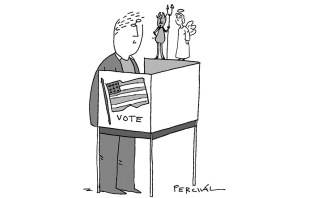
But while every populist incarnates some of the particular qualities of their specific national context, it should by now be amply evident that every country is vulnerable to this form of political appeal. French and German elites have done a somewhat better job of protecting their nations’ institutions from the ideological capture that has contributed to the profound breakdown in trust in the American establishment. But many of the same trends are well under way in those countries too. And sooner or later, voters who strongly distrust their own institutions are likely to vote for an anti-establishment bullfighter of their own.
Until this week, it was still possible to hope that Trump would be remembered as a historical blip, an outsider who somehow turned a few elections into a contest over his ideas and personality, before exiting the political scene in disgrace. Today, it seems much more probable that he has cemented his standing as the figurehead of a political movement which will lastingly transform the politics of the US – and, perhaps, much of the democratic world.
Trump will almost certainly attack some of the constitutional checks on his power over the course of the next four years. He may very well sell out key American allies in central Europe and the Far East. Democrats should stand up to him when he does. That, after all, is the role of the opposition – and protecting the system of checks and balances that has allowed America to weather previous periods of deep partisan polarisation must be a priority. And if Trump should overplay his hand, as well he might, he could quickly lose the support of those swing voters who just gave him such a resounding showing.
But Democrats would be making a big mistake if they simply reverted to the #resistance playbook which has failed to inflict a decisive defeat on Trump or his movement in the past. What they need to do if they want to ensure that the Trump era lasts 15 rather than 30 or even 50 years is much harder than that: they must build a political coalition broad enough to win durable and sizable majorities against politicians of Trump’s ilk. And that will be impossible without a serious reckoning with the ways in which they, and the wider ecosystem for which they stand, have lost the trust of most Americans.
My time as the speaking clock
Ask young people today if they know that they can dial a number to hear the time and you would probably be met with blank stares. Why would you pay to phone a speaking clock when the time is right there in front of you on your watch or phone screen?
However, if you were young in bygone days you may have memories of getting parental permission to phone ‘TIM’ and hear somebody telling the time… precisely. In fact, every year millions of people still phone this service – now the BT Speaking Clock – almost 90 years after its introduction.
It was launched by the Post Office on 24 July 1936 and was aimed at folk who did not have a clock or watch to hand. Before that you had to phone the exchange operator to settle any dispute as to what the correct time was and, of course, mechanical timepieces were not always reliable. The Speaking Clock is a very accurate service indeed, to within five milliseconds (5/1000th of a second). Even Big Ben takes its time from it.
The service was originally accessed by dialling 846, which coincided with the letters T.I.M. – giving it its colloquial name. However, this code was only used on the telephone systems for the major cities. Other numbers were 952, followed by 80 and 8081 until it was standardised as 123 in the early 1990s. Calls to the Speaking Clock increase on four very time-sensitive days: as midnight approaches on New Year’s Eve; when the clocks change in March and October; and on Remembrance Sunday for the two-minute silence.
Nowadays other services are available but the BT Speaking Clock remains an emblem of accuracy and one that still uses a real voice. The first ‘golden voice’ belonged to Ethel Jane Cain, an exchange operator for Croydon. Unfortunately a slight speech impediment was detected at the end of some sentences and apparently it took months to eradicate this from the glass discs on to which her voice was recorded. The other permanent voices have belonged to Pat Simmons 1963-1985; Brian Cobby 1985-2007; Sara Mendes da Costa 2007-2016; and, well… me.
I have had that privilege since 9 November 2016 after I entered and won a competition run by BT and the BBC for Children in Need. I have the first Scottish voice and, as is the trend these days, it is somewhat removed from the Received Pronunciation of previous ones.
The recordings took place over two sessions at the BT Tower in London and although the technology bore no resemblance to that in 1936, the script was remarkably similar. It was broken up into segments of hours, minutes and seconds and the well-known phrases of ‘at the third stroke’ and ‘precisely’ were of course still there.
Eight years on, I’m still asked for the time when out and about and I’m sure there are those who think that I tell the time, live, every day. I’ve been asked if I’m having a day off or if someone else is covering for me as I make my way round the supermarket. A personal favourite: ‘This speaking clock job – what are the hours like?’ It’s even been suggested that my epitaph should read ‘At the third stroke…’.
Meet me in St Louis
Garry Kasparov retired from competitive chess in 2005, but has proved that at the age of 61 he remains competitive at the highest level. That is an extraordinary achievement in an time when just five of the world’s top 100 active players are older than 50. The former world champion joined a powerful field in St Louis for nine rounds of ‘Chess 9LX’ played at a rapid time control. Chess 9LX, in which the pieces on the back rank are shuffled at the start of the game, is an ideal format for Kasparov, who can count on pure chess skill, without worrying about his outdated knowledge of opening theory.
Three wins, three losses and three draws placed him in the middle of the final table, but his score could easily have been higher, given that he had an advantageous position against tournament winner Fabiano Caruana (see game below) as well as runner-up Hikaru Nakamura. With more time in the latter game, Kasparov might well have found the win that was available in the final position when he agreed to a draw.
To set up the game below, place the pieces in the following position: Ra1, Qb1, Bc1, Bd1, Ne1, Kf1, Ng1, Rh1. Black’s setup mirrors that: Ra8, Qb8, etc.
Fabiano Caruana – Garry Kasparov
St Louis Chess 9LX, October 2024
1 e4 c5 2 Ngf3 Ngf6 3 c3 b6 4 Be2 Bb7 5 e5 Nd5 6 d4 cxd4 7 cxd4 e6 The contours of the position closely resemble some lines of the Alapin Sicilian in vanilla chess, which begins 1.e4 c5 2.c3 8 Nd3 Be7 9 Bd2 f5 10 h4 Nec7 11 h5 Qd8 12 h6 A premature push, perhaps counting on the passive 12… g7-g6 and forgetting Kasparov’s more spirited response. g5 13 Qd1 O-O Castling rules are peculiar in this format. Here, move the Black king from f8 to g8 and the rook from h8 to f8.14 Rc1 Kh8 15 Rh5 g4 16 Nfe1 Rc8 17 Nc2 Qe8 18 Rh2 Qg6 19 g3 Bg5
19…f4! would have posed huge problems to Caruana. For example, 20 Nxf4 Nxf4 21 Bxf4 Rxf4! 22 gxf4 g3 devastates the kingside, or 20 gxf4 g3 21 Rg2 Nc3! 22 bxc3 Bxg2+ 23 Kxg2 gxf2+ 24 Kxf2 Bh4+ and again the attack is too strong. 20 Bxg5 Qxg5 21 Ke1 f4 22 Qd2 Qg6 23 gxf4 g3 24 Rg2 Qxh6 25 Rxg3 Nxf4 26 Nxf4 Rxf4 27 Ne3 Qh2 28 Bd3 (see diagram)
Caruana has defended stubbornly. Kasparov’s next move, attempting to bulldoze the f2-pawn, backfires. Rcf8? 28…Bc6! keeps better chances 29 Nf1! Knight retreats are one of the most common blindspots in chess. This intermezzo ensures that the queens will be exchanged, so White can play Rxc7 in safety. Qh4 30 Rxc7 Rxf2 31 Qg5 Black resigns
Despite its advantages, events in the Chess 9LX format are still relatively rare. The naming confusion doesn’t help. It was christened Fischer Random chess, and the erratic American’s endorsement was obviously a mixed blessing. So the later rebrand to the neutral ‘Chess960’ made sense, that being the number of permitted start positions. More recently, the announcement of a forthcoming $12 million ‘Freestyle’ Chess Grand Slam series (with Magnus Carlsen’s involvement) looks set to raise the variant’s profile. (Intriguingly, Carlsen will face Caruana in a short Freestyle match in Singapore, just days before the start of the Classical World Championship between Ding and Gukesh on 25 November.) I happen to like the name Freestyle, but the prismatic nomenclature calls to mind the splintered political factions in The Life of Brian. And what have the Romans done for us? Well, I suppose we have them to thank for the numerals in Chess 9LX.
No. 826
White to play and mate in 2. Composed by Otto Wurzburg, the Pittsburgh Gazette Times, 1917. Answers should be emailed to chess@spectator.co.uk by Monday 11 November. There is a prize of £20 for the first correct answer out of a hat. Please include a postal address and allow six weeks for prize delivery.
Last week’s solution 1 Qd8+ Kh7 2 hxg3 Rh5+ 3 Qh4 and White won quickly.
Last week’s winner Ilya Iyengar, Cambridge