-
AAPL
213.43 (+0.29%)
-
BARC-LN
1205.7 (-1.46%)
-
NKE
94.05 (+0.39%)
-
CVX
152.67 (-1.00%)
-
CRM
230.27 (-2.34%)
-
INTC
30.5 (-0.87%)
-
DIS
100.16 (-0.67%)
-
DOW
55.79 (-0.82%)
Is the war in Ukraine any closer to ending?
Is the latest round of Russia-Ukraine peace talks, sponsored by the United States and currently under way in Geneva, likely to hasten the war’s end? Donald Trump seems to believe so. On Friday, President Trump claimed that “Russia wants to make a deal, and Zelensky will have to hurry. Otherwise, he will miss a great opportunity. He needs to act.” Europe, for its part, remains deeply skeptical and is urging Ukraine to fight on. As the EU’s Foreign Affairs chief Kaja Kallas told the Munich Security Conference last week, “the greatest threat Russia presents right now is that it gains more at the negotiation table than it has achieved on the battlefield.”
Despite Trump’s claim that Putin is ready to end the war, there is as yet no sign of any newfound spirit of compromise from the Russian side. Kremlin spokesman Dmitry Peskov yesterday said that the principal issue for Moscow was “the demands we have put forward” on territory – namely, an insistence that Kyiv surrender the 20 percent of Donbas that Russian forces have so far not succeeded in taking. Russia’s deputy foreign minister Mikhail Galuzin – a member of the Russian delegation at the Geneva talks – made the bizarre suggestion that Ukraine could be temporarily transferred to UN rule while it held new parliamentary and presidential elections, as well as a possible referendum on ceding territory. And former culture minister Vladimir Medinsky, head of the Russian delegation, claimed that Russians are “ready to lose millions and live on bread and water for the sake of the special military operation.” Hardly conciliatory talk.
Trump is growing impatient to get a deal done
Medinsky – who, like the Kremlin’s chief White House negotiator Kirill Dmitriev, was born in Ukraine – is a longstanding hardliner well known for his love of Putin-style pseudo-historical lectures on Russia’s destiny. It was Medinsky who represented the Kremlin in the first rounds of peace talks in Minsk, Antalya and Istanbul in the weeks immediately after the February 2022 invasion. His new prominence in the latest round of talks seems to mark a shift from the two rounds of strictly military-technical talks held recently in Abu Dhabi between the chiefs of Russian and Ukrainian military intelligence to a focus on political, social and religious issues.

That does not bode well. As well as territory, the Kremlin has demanded reforms of Ukrainian laws on the use of the Russian language, on Soviet-era symbols and monuments, and the lifting of a ban on the part of the Ukrainian Orthodox Church still loyal to the Moscow Patriarch. That is what Putin continues to refer to as the “de-nazification” of Ukraine, a key Russian war aim.
Ukraine’s delegation is led by Rustem Umerov, secretary of Ukraine’s national security and defense council; David Arakhamia, head of Zelensky’s parliamentary party; and presidential chief of staff Kyrylo Budanov – until recently the ruthless and highly effective chief of Ukraine’s military intelligence agency. Missing is Zelensky’s former chief of staff, consigliere and business partner Andrei Yermak, who was fired last year after his close associates were arrested for embezzling hundreds of millions of dollars in state funds.
Arakhamia, Umerov and Budanov are rumored in Kyiv political circles to be more willing to swallow a deal with Moscow than Zelensky. Whether this represents a genuine divergence of judgment or something more calculated is an open question. But it is clear that Zelensky’s room to maneuver is shrinking by the day.
Public support for Zelensky and his Servant of the People party is eroding as corruption allegations pile up. His grip on a parliamentary majority is precarious and rides largely on Arakhamia’s ability to hold things together – the same Arakhamia who now appears to be pulling in a different direction. The arrest over the weekend of former energy minister Halushchenko, pulled by Western-backed anti-corruption police off a Poland-bound train on the border as he attempted to flee Ukraine, represents another blow to Zelensky’s credibility.
On the practical side, it appears a 20-point peace plan that Kyiv and Brussels have been pushing – their attempt to supersede the 28-point document Washington had hammered out with Dmitriyev and Umerov – is going nowhere. The Ukrainians also have to contend with a parallel set of negotiations conducted directly between the Kremlin and White House representatives Steve Witkoff and Jared Kushner, Trump’s son-in-law, which has reportedly included a Russian offer of $12 trillion in mineral and business deals once peace is concluded.
Zelensky said on Saturday that he hoped the Geneva talks would prove “serious, substantive… but honestly sometimes it feels like the sides are talking about completely different things.” He’s right. Russia has made it clear that it will not move from its hard-line demands. Trump is growing impatient to get a deal done. Ukraine is slowly drifting toward concessions, however reluctantly and fitfully. Europe, even though it has taken over funding and arming Kyiv, is not even in the room.
Meanwhile, even as the delegations traveled to Switzerland, Russian bombs and missiles continued to slam into energy infrastructure targets across swathes of Ukraine, inflicting severe damage on the power network in the southern port city of Odessa. The timeline of a final peace deal is uncertain – there are too many variables, too much noise. But the deal’s rough outline – territorial losses for Kyiv plus some kind of security guarantees from the West – is clear.
Entirely absorbing – and wonderfully tense: Cairn reviewed
Grade: A–
A cairn, as readers will know, is a pile of stones often placed to mark a grave. Yikes. Not the most encouraging title to give to a videogame about someone trying to climb a mountain. Aava is a dedicated rock-climber determined to make the first solo ascent of Mount Kami, despite the countless lives it has already claimed. Equipped with chalk, rope, pitons, climbing tape and a limited supply of snacks and bottled water, not to mention a friendly robot that follows you around picking up your pitons and screening your calls, off you set.
The heart of the game – though the story contains surprising emotional and thematic depth – is the climbing simulation. You position Aava’s limbs one by one, reading the rock-face to find holds and cracks that will take your weight. Choose unwisely, and you’re toast. This, the game completely nails. If you’ve ever done any climbing, you’ll know how it feels when your fingers start to cramp or your knees start shaking uncontrollably just before you fall off. Here’s a game, amazingly, that captures exactly that moment. Likewise, the sublime relief of topping out on a ledge after a long tricky bit.
It’s entirely absorbing – and wonderfully tense. Cold, thirst, hunger, exhaustion, darkness and abrasions to your hands add cumulative extra challenges to your ascent. You must scavenge where you can and marshal your resources. Climbing – since so much of it is about proprioception, your sense of your own body in space – seems an unlikely candidate for a simulation game, but here’s one that triumphs. With its cartoonish but not too cartoonish visuals, it’s very pretty, too.
A highlight in an otherwise dull season: Pierrot Lunaire reviewed
Even if Schoenberg’s song cycle Pierrot Lunaire is never going to feature on anyone’s Desert Island Discs, it stands as a work of rich and complex resonance shot through with all the neurotically introverted obsessions behind expressionism. Through Albert Giraud’s 21 opaque lyrics, scored atonally for a soprano who declaims rather than sings them, accompanied by seven instruments, it presents some sort of parable of the tormented artist adrift in a hostile world. Perhaps one can’t be charmed by the result, yet its power is undeniable: it grips even when it baffles and repels.
Perhaps one can’t be charmed, yet its power is undeniable: it grips even when it baffles and repels
Glen Tetley’s ballet, dating from 1962 but still fresh and forceful, makes Pierrot Lunaire’s obscurities more palatable and approachable. Without making much attempt to illustrate visually the symbolist imagery of the German texts, it constructs a simple narrative in which the lonely, guileless, romantic Pierrot falls prey to the scheming of the worldly-wise Brighella and Columbine – though what they want from him is never made clear.
Tetley intended to show in Pierrot someone who, like himself, was ‘as much inspired by life at one time and terrified by life at another time, who wants to encounter life but repeatedly recoils from it as well’. The stage is bare except for a square tower of steel scaffolding, designed by Tetley’s regular collaborator Rouben Ter-Arutunian. It has multiple significances for Pierrot – his childish playing frame, a perch from which he swings, a point of safety and observation, but also a cage that traps him. At one point, Brighella and Columbine take control of this structure, becoming puppet masters who string Pierrot up and dance him around like a marionette. At the abrupt conclusion, all three characters stand together on a high rail, Brighella and Columbine flanking Pierrot in what could be interpreted as either a happy resolution or an unhappy coercion.
Tetley has rather fallen out of fashion since he died in 2007, but here I was reminded what a fine choreographic craftsman he was. Born in Cleveland, Ohio, he served in the navy during the war and then attended medical school before dance captivated him. Prominent among his early mentors were Jerome Robbins and Martha Graham, from whom he inherited an aesthetic grounded in clarity and simplicity. There’s no decoration or clutter in Tetley’s style: it is precisely disciplined, with everything made firmly legible and purposefully carved, stripped almost clinically to its essence and perhaps short of warmth. Virtuosity for its own sake he deplored, and I guess he would deem most of today’s dance-makers to be mere gimmick-mongers.
I missed Pierrot Lunaire when it was last produced by the Royal Ballet on the main stage in 2007, but I am so old that I have vivid memories of Christopher Bruce in the title role for Rambert’s production in the 1970s. Marcelino Sambe won’t efface them. Coached by Bruce, he danced the title role with impeccable assurance, but didn’t pitch it right expressively for the modest dimensions of the Linbury – his facial suggestions of the pathos of bruised vulnerable innocence seemed excessively semaphored and externalised.
As his tormentors Brighella and Columbine, Matthew Ball and Mayara Magri were spot-on in conveying corrupt glamour, and the musical performance was first-class, with Alexandra Lowe a marvellously poised soloist. An intriguing alternate cast includes Joshua Junker, Natalia Osipova and the company’s exciting new signing Patricio Reve.
I can’t say that I madly enjoyed it, but Pierrot Lunaire is a serious work, and this revival, honouring Tetley’s centenary, must rank as a highlight of the Royal Ballet’s otherwise very dull season.
Foot-to-the-floor entertainment: How to Get to Heaven from Belfast, Lisa McGee’s sequel to Derry Girls, reviewed
How do you follow a great sitcom? Judging from How to Get to Heaven from Belfast and Small Prophets, the answer is by keeping the same sort of characters, having a plot about a missing woman and adding a touch of the supernatural.
Both shows – Lisa McGee’s successor to Derry Girls and Mackenzie Crook’s to Detectorists, respectively – also reflect a slightly mad (in theory) but wholly justified (in practice) confidence that the goodwill established by a much-loved series means viewers will go wherever you lead them, no matter how strange things become.
And in McGee’s case, they become very strange indeed. How to Get to Heaven began as if we were in for a dark, rather solemn thriller. ‘I still dream about that night sometimes,’ a voice-over intoned as four frightened sixth-form girls from Belfast watched a burning shack in the woods.
A few seconds – and 20 years – later, three of them were experiencing carefully varied forms of middle-aged regret. Dara (Caoilfhionn Dunne) was a stressed-out family carer, mourning the life she didn’t have; Robyn (Sinead Keenan), a stressed-out mother, mourning the one she did; and Saoirse (Roisin Gallagher), a stressed-out TV writer infuriated by the world of television. All three then received an email from Gaye, the sister-in-law of Greta – the fourth girl in the opening scene, estranged from the others ever since – telling them that Greta had died and inviting them to her wake in Donegal.
Once they set off, the tone lurched again – this time into a broad comedy where, as the one-liners zinged, the women’s resemblance to Orla, Michelle and Erin from Derry Girls grew ever stronger.
Yet, if this is already sounding a bit of a hodgepodge, the show was barely clearing its throat. Arriving in the small town of Knockdara, the women booked into a hotel where the owner subjected them to a blizzard of stage Irish and the folks in the bar cackled gothically. Matters turned even more gothic when the three went to Greta’s spooky, isolated family home where, rather than a wake, they found just four family members apparently engaged in a competition as to who could be the most sinister.
And that was before we discovered that the emailing Gaye didn’t exist and that Greta’s death wasn’t as it seemed. It was also before – with the jokes still rumbling away – the women had all seen ghosts, Saoirse had developed a Thelma and Louise-style crush on a local hunk and the action had moved to a luxury resort in Portugal for a White Lotus-style showdown on a yacht featuring a female psychopath with a Dolly Parton fixation. Meanwhile, the satire on Saoirse’s TV world sporadically returned, to be joined by ruminations on Catholicism and the effects of trauma.
After the four episodes I’ve watched, the disparate elements, far from coalescing, are continuing to pile up and simply jostle together. But this, I would suggest, is sort of the point. McGee seems to have given herself permission to throw in whatever interests her and while it’s technically possible that everything will be neatly tied up by the end, at this stage that would feel almost like a betrayal of what’s gone before: a show that, if anything, prides itself on its own messiness.
Odder still, that pride might well be warranted. Fans of coherence should certainly look elsewhere. But what McGee gives us instead is exhilarating, foot-to-the-floor entertainment and (not in the Irish sense) the wildest of rides.
Small Prophets is a lot gentler and more controlled. It’s also a lot more realistic – except perhaps for the fact that the plot concerns a bloke in a northern suburb creating tiny truth-telling homunculi in glass jars.
Pearce Quigley plays Michael, the bloke in question – who, like the two leads in Detectorists, is an entirely unselfconscious eccentric (as opposed to ‘a bit of a character’) quietly going about his life without caring much about what people make of him or what else is going on in the world. Seven years ago, his girlfriend Clea disappeared and now he spends his time working in a DIY superstore – where he’s formed a deeply touching friendship with young Kacey (Lauren Patel) – and visiting his father Brian (Michael Palin, no less) in a local care home.
Brian doesn’t always remember that Clea has gone, but one day when he does, he recommends creating those homunculi – the recipe for which he got from an Italian mystic while doing National Service – who’ll be able to tell Michael what happened to her. By the end of this week’s second episode, the first of them had duly appeared.
As in Detectorists, the result has a winning blend of mild melancholy, calm acceptance of the way these people are and something approaching defiance about their right to be so. It is, in short, completely lovely.
Should Reform commit to lowering the minimum wage?
The unemployment rate has risen to 5.2 per cent, the highest non-Covid level since 2015. Unemployment is now up by a quarter since Labour took office. Youth unemployment is also at its highest level (16.1 per cent) since 2015 and has likewise grown since Labour were elected. Over the past year the rise in unemployment in the UK has been (by some margin) the fastest in the G7.
Reform might not fancy going into a general election with a slogan aimed at young people of: ‘Vote for us and we’ll cut your wages.’
Youth unemployment rising is particularly sensitive because at the 2024 general election Labour had a manifesto commitment to have the same minimum wage for younger workers as for adults. Under the current rules those aged 18 to 20 have a lower minimum wage (£10 per hour) than those over 21 (£12.21 per hour). Minimum wages for workers under 21 were already raised more rapidly in 2025, and a further catch-up rise for younger workers is due in April.
It’s natural to blame the rise in youth unemployment partly on these minimum wage increases – though in fact unemployment in the under 25 age group has not risen in proportional terms as rapidly as unemployment overall. Richard Tice, Reform’s newly-minted shadow business, trade and energy secretary, was put under pressure on LBC on this point on Tuesday. He was asked whether Reform would cut the minimum wage for young people. He said the matter would have to be considered, without committing to anything specific.
Pressed further as to whether Reform was proposing cutting the wages of millions of young people he noted that those without jobs get no wage at all, but made the point that policies that have bad effects when introduced may also be problematic to unwind (presumably because the process of doing so may itself create other losers).
In a sense, one assumes Reform welcomes this kind of detailed scrutiny and challenge. They are receiving it precisely because opinion polls have for many months indicated that they would win a general election if it were held now. On the other hand, they might not fancy going into such a general election with a slogan aimed at young people of: ‘Vote for us and we’ll cut your wages.’
This is a classic problem faced by political parties that stand on a platform of wide-ranging reform. Any reform inevitably creates losers as well as winners. The political pressure is then to tone down claims of comprehensive wide-ranging reform and instead focus on a few easier standalone issues.
That could be a bad mistake, though. In think-tank world one of the most famous wide-ranging reform programmes was that implemented by the Labour government in New Zealand in the 1980s. It is often referred to as ‘Rogernomics’ after the Labour finance minister Roger Douglas (I should perhaps declare an interest in that he was, in the 1970s, a good mate of my father’s).
After he left office, Douglas wrote a book in the 1990s called Unfinished Business. A key argument of that book was that a comprehensive wide-ranging reform package is, perhaps counter-intuitively, more likely to gain political support than doing reforms a bit at a time. The reason is that in any well-conceived comprehensive package even those that gain overall may lose out from some individual measures.
By presenting the whole coherent package, the overall net gainers can see a significant advantage to themselves. If only individual measures are proposed then their support may be lukewarm (if their gains are low) or they may be opposed (if they lose out).
A challenge for Reform in the years leading up to the next general election is that if they cannot produce a coherent overall package, they may struggle to avoid their opponents cherry-picking the negative impacts of their programme and showing who loses out, much as Tice experienced this time.
How Greece carried the arts to rustic Rome
‘Cultural cringe’, that lovely Aussie coinage, perfectly describes the Roman attitude towards Greece. The curators don’t say so, but it is the theme of this inspired exhibition.
By the time the Romans finally took control of mainland Greece in 146 BC with the Battle of Corinth, they had long admired everything Greek. That date marks roughly the middle of the Hellenistic period, during which Greek culture and language dominated the Mediterranean and the Middle East. In comparison with Greeks, Romans were oafs – and knew it.
In comparison with Greeks, Romans were oafs – and knew it
After the battle, Corinth was flattened – quite an oafish thing to do – and emptied of all its works of art, which were sent to Rome. The droll story went round that the commander, Lucius Mummius, was such a prize oaf that he told the carriers if any works of art were lost they would have to replace them with new ones. But the effect was dramatic: the trickle of Greek goodies reaching Rome had turned into a flood.
From then on, aspirational Romans defined themselves by how many Greek works of art they could acquire. They also imported Greek philosophers, teachers and doctors, and as many artists and architects – not so easy – as possible. A reverse traffic developed, as the Roman upper classes sent their sons to Greece to be properly educated: Julius Caesar went, and so did Brutus (‘Et tu, Brute?’). Athens was the Eton of the ancient world, Rhodes more a kind of Winchester.
The paradox of the conqueror conquered was recognised by Horace in the 1st century BC: ‘Graecia capta ferum victorem cepit et artes intulit agresti Latio’ (‘Conquered Greece charmed her coarse conqueror and carried the arts to rustic Rome’).
It is a recurring phenomenon in human history, and was later exemplified in the relationship between England and France, as that great classicist Alexander Pope realised in his ‘Imitation of Horace’ of 1737, in reference to the Duke of Marlborough’s victories:
We conquer’d France, but felt our captive’s charms;
Her arts victorious triumph’d o’er our arms.
Just as educated Romans proved their sophistication by speaking Greek, so posh English people in the 18th century spoke French. Both were adopting the language of what they perceived as a more civilised society.
Athens was the Eton of the ancient world, Rhodes more a kind of Winchester
That grim old republican, Cato the Censor, spent his long life moaning about the decline of Roman virtue under the corrupting influence of the Greeks (and he didn’t trust their doctors). But by the time he died in 149 BC such doubts were being voiced by only a handful of other grumpy old men in the public baths. It is a measure of the cultural dominance of Greek – and, to be fair, of Cato’s own genius – that his writings in Latin were critical in having, by a whisker, prevented that language being supplanted by Greek as the literary medium of Rome.
This elegant exhibition is very large (1,800 things to look at), and so it is fitting that one of the first works you see is a colossal gilt-bronze statue of Hercules, discovered in the Forum Boarium (the Roman cattle market) and dating from the end of the 1st century BC. Nearby are two bronzes of the 5th century BC, a life-size horse and the hindquarters of a giant bull, both found in Trastevere. They are followed by an astonishing array of marble sculptures, most of them Greek originals. This alone makes the exhibition special, since Roman collectors quickly discovered that there were not enough originals to go round, so that home-made copies of Greek masterpieces were churned out to meet demand. Telling the difference between the two has bedevilled the appreciation of Greek art ever since.
Among so many treasures I would single out ‘Two girls playing ephedrismos’ (piggy-back), carved in the 2nd or 3rd century BC and found in Piazza Dante. It displays the most complex carving of the figures, executed with consummate skill. Then there are three early statues of fine quality (5th century BC) from the famous group showing the destruction of Niobe and her children (see below).
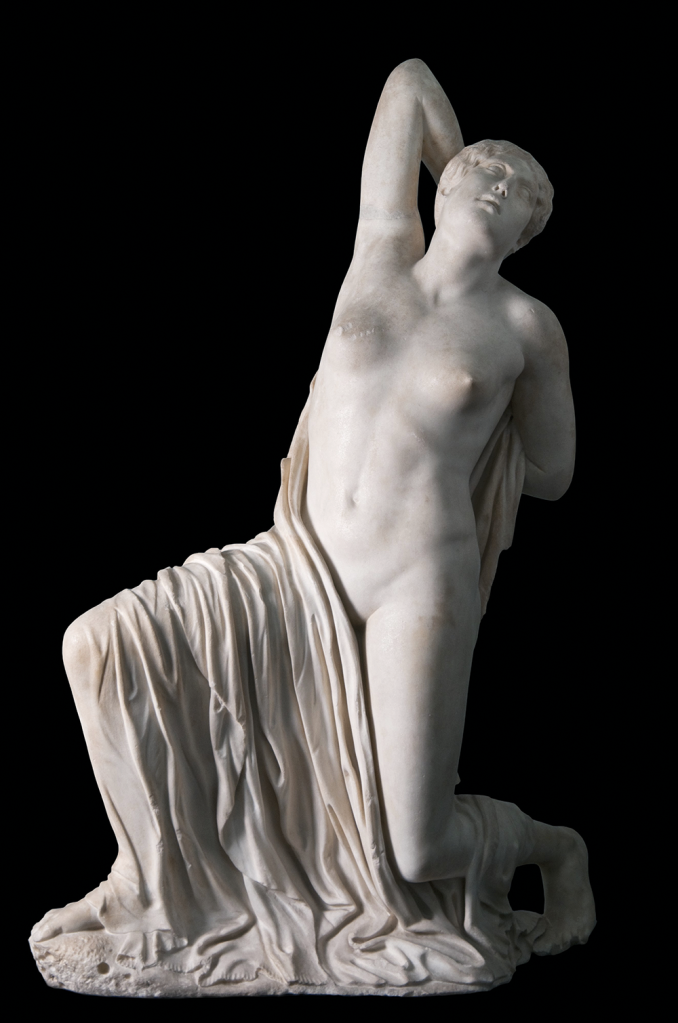
In the 18th century there was a complete set of these figures at Villa Medici in Rome, which formed the basis of Johann Winckelmann’s glorification of all things Greek in his influential writings. When he first published his ideas in 1755, Winckelmann hadn’t actually seen them, which suggests that he was not easily embarrassed. Nonetheless, it was perhaps a mercy that he was murdered before his great friend, the painter Anton Mengs, worked out that these hitherto iconic statues were only Roman copies.
Augustus boasted: ‘I found Rome brick and left it marble.’ Once upon a time, in a land not that far away, marble had adorned Greek democracy. It became the face of empire.
John Mulaney at his best is unstoppable
John Mulaney appeared to be just another of those identical, slick, clean-cut, young comedians in suits until Covid. But all was not well. In December 2020, a bunch of his showbiz pals staged an intervention and sent him to rehab for his addictions to cocaine and various prescription drugs. Out of rehab, he promptly parted from his wife, the artist Annamarie Tendler, and met the actress Olivia Munn. As he noted in Mister Whatever, his latest show, when their son was born, he and Munn had known each other for ‘nine months and 45 minutes’. They are now married.
There was a woman in the front row wearing pyjamas emblazoned with his face
Mulaney’s crash provided both the substance, so to speak, and the context for his 2023 Netflix special, Baby J, a hilarious account of his addiction and recovery that managed to keep to self-mockery rather than self-pity, despite its darkness. (If you want illegal prescription pills, he noted, always find the doctor with the lowest internet rating from patients.) It was also an acknowledgment that Mulaney knew he had lost a lot of trust from the millennials who expected their cultural heroes to live blameless lives.
Mister Whatever does not have that sharpness. All of Mulaney’s TV specials have been tightly scripted hours, riddled with callbacks and laser-focused on the big laughs. (To see that at its best, look up his routine ‘There’s a horse in the hospital’ on YouTube; it remains the most concise description of the first Trump administration in the culture.) This show is shaggy. Mulaney was on stage for the best part of two hours – he noted that one fan had complained his sets were getting longer and longer – and some of its material felt stretched.
A long routine about his son seemed as if he’d fallen into the common belief of creative people that they’re the first people to have had children. Parents are well aware children say peculiar things, and that birthday parties are a shitshow. We don’t need to be told again, even when formulated in an interesting way. Ditto a long closing bit about how much he hates his new clothes dryer compared with the one from his childhood.
It’s not a show without risks, however. The centrepiece of it pondered his relationship with Munn’s family. Her mother was a Vietnamese refugee, and Mulaney had to build up to the routine about being financially responsible for 13 Vietnamese Americans: any time a comedian has to preface a routine by saying he is not being racist is likely to be uncomfortable. ‘I’m going to be doing voices,’ he said. ‘Yes, I’m going there.’ It couldn’t be racist, he insisted, because it was true.
Parts of it were very funny, but parts of it were odd. Finding a Vietnamese woman in the audience, he asked if all Vietnamese people stole, or just his in-laws. They don’t all steal, came the response, which might have served as a note of caution. And repeating Vietnamese racism against Cambodians doesn’t stop it being racist. It was unsettling, even as the laughs came.
Mulaney’s earlier specials often dwelt on the darkness of childhood, albeit presented with a broad grin. Underage drinking and youthful drug use came up again and again. Sexual abuse, or the fear of it, was a staple. His father’s weird emotional distance was a fixture. In retrospect, the content of Baby J shouldn’t have been a surprise, given how strange Mulaney could be beneath the surface sheen.

But in Mister Whatever, it felt as though he didn’t quite know what his subject actually was. This was a jam-band kind of a set, in which the core elements were there, but seemed less important and exciting than the bits where he went off into extemporisation. A long detour into the mind of RFK Jr. – ‘For 2028 we’re going to give everybody … mumps!’ – was hysterical.
Mulaney is a charming comedian. For all his slickness, he is no oleaginous Jimmy Carr, nor a confronter like Dave Chappelle. He wants to be liked, and he is very likeable. Clearly a lot of people love him: there was a woman in the front row of this massive theatre wearing pyjamas emblazoned with his face, which must have been unnerving. I think he’s wonderful, too, and I shall be seeing this show when it comes to London. Mulaney at his best is unstoppable. This wasn’t his best, but I still laughed more in two hours than I had in years.
Doesn’t put a foot wrong: The Secret Agent reviewed
Kleber Mendonca Filho’s The Secret Agent, which is about an academic on the run during Brazil’s brutal military dictatorship, won two Golden Globes, and has been nominated for four Oscars, and it’s truly special even if it is languorous and sprawling. It is one of those long films (two hours and 40 minutes) populated by so many characters you may well find yourself praying: ‘Please let me keep track of who’s who.’ Do hang on in there. It will all come right and be so worth it.
The house is run by Dona Sebastiana, who may now be my favourite film character ever
The film is set in 1977 which, an intertitle tells us, with some understatement, was a period of ‘great mischief’. It has an opening scene that will likely become iconic as it’s so brilliantly tense. We see a yellow VW Beetle and its driver, Marcelo (Wagner Mouro), pulling into a rural, dusty gas station. A corpse is lying on the forecourt, having been shot. It’s been there for days. No one cares. The police turn up and they don’t care. The police start to interrogate Marcelo about his car – You have your licence? Would you say this tyre was bald? – as they work their way up to demanding a bribe. This is slow, drawn out and, somehow, so fraught that you are holding your breath. This Brazil is colourful, vibrant, vivid but underneath? Danger everywhere.
Marcelo is heading to a safe house for dissidents in his hometown, Recife. The house is run by Dona Sebastiana, who may now be my favourite film character ever. She’s a 77-year-old, bird-like, chain-smoking ‘communist-anarchist’ who is so gloriously alive it makes you wish all older women could be portrayed on screen in this way. She is played by Tania Maria, who is sensational. (Unbelievably, it’s her first acting role. She is otherwise a seamstress whom Filho spotted when making a previous film in her hometown.) Anyway, Marcelo is awarded an apartment which also houses a two-faced cat. The cat isn’t bitchy. It really does have two faces. The cat is called Liza and also Elis. But if weirdness isn’t your thing it does stop there. Apart from ‘the hairy leg’, but we’ll get to that.
The Secret Agent is essentially a political thriller with the main narrative propulsion coming from wanting to know why Marcelo is on the run, but it’s so much else besides. There are hitmen and a hitman hired by the hitmen. There’s an evil businessman/politician. There is Marcelo’s search for his own mother, his romance with a neighbour and his relationship with his young son. There’s the corrupt chief of police. There’s the harassment of a German Jew. And, in the present day, we have two university students transcribing tapes of interviews Marcelo gave to the resistance. It sounds a lot because it is a lot, yet I did manage to keep track of who’s who, amazingly. As for ‘the hairy leg’, it’s a human one found inside a dead shark that later comes to life and kicks gay people. A bit of a head-scratcher, plus it rather took me out of the film, but from what I now understand it’s a metaphor for the violence meted out by the dictatorship, especially to minorities, as based on an urban legend. Brazilians will get it, I was told.
Elsewhere, it doesn’t put a foot wrong. The 1970s are brilliantly captured (the cars!) and there isn’t a bum note when it comes to performances. Mouro, who has been nominated in the Best Actor category, is entirely commanding even though Marcelo is a quiet, self-contained man who doesn’t say much more than necessary. It adds up to a film about ordinary people living with oppressive political realities and, from what I understood of the ending, a country that would rather not remember. The other nominations, by the way, are for Best Picture, Best International Feature Film and also Best Casting. That’s for Tania Maria, I’m sure.
What a masterpiece. What a man: Borodin at the Barbican reviewed
Gianandrea Noseda conducted the London Symphony Orchestra last week in a programme of Stravinsky, Chopin and Borodin. The Stravinsky was a relative rarity – the divertimento from The Fairy’s Kiss – and Chopin’s F minor concerto was played by Seong-Jin Cho, a pianist with a large following and a soaring reputation. Full disclosure: I was there for the Borodin, his Second Symphony of 1877. What a masterpiece, and what a man! Alexander Borodin was a scientist of international standing and a campaigner for women’s rights. Deeply in love with his wife, and an inveterate rescuer of stray cats, he was, he confessed to Liszt, ‘only a Sunday composer’. ‘But after all,’ replied the wizard of Weimar, ‘Sunday is a special day.’
Everything that Borodin composed exudes character; even the fragments that he left, orphaned, when his heart failed suddenly at the age of 53. Alone among the ‘Mighty Handful’ of St Petersburg composers his raw inspiration was on a par with that of his (equally doomed) friend Mussorgsky, and only the fact that Borodin’s genius was sunny where Mussorgsky’s was dark has denied him a comparable level of acclaim. As a melodist, Tchaikovsky was his only serious rival, though they were very different animals. Borodin’s melodies pour out, molten and sweet, aching with nostalgia even while they shine with hope.
As for the Second Symphony, it’s so direct, so stirring and so irrepressibly loveable that it’s easy to overlook just how original it is. Borodin’s materials and construction methods – his rugged blocks of brass, the honey-and-garlic harmonies, that luminous woodwind writing – hurl their cues down the decades to Stravinsky, Shostakovich and Ravel. Hearing this miniature epic played live for the first time in years (not for want of trying), it struck me that there’s hardly a bar where you could mistake Borodin for any of his western contemporaries. ‘Magnificently courageous, in expression and no less in restraint’ was how Hubert Foss described Borodin’s Second, back in 1950, and how right he was; how very, very right.
Anyway, apologies: you want to know about the concert. Well, the LSO and Noseda were born to handle the primary colours and rhythmic trip hazards of middle-period Stravinsky, and if the audience was lukewarm, it wasn’t the performers’ fault. The Fairy’s Kiss dates from 1928, and it’s derived from Tchaikovsky – an awkward, cubist mash-up that falls straight into the uncanny valley between Tchaikovsky’s heartfelt warmth and (Vaughan Williams’s term) Stravinsky’s modernist monkey tricks.
Next it was over to Cho and Chopin, with Noseda and his orchestra doing everything in their considerable power to lift the teenage composer’s classroom orchestral writing on to the level of the pianism. Are we still allowed to call piano playing ‘aristocratic’? Cho’s was: sensitivity coupled to dignity, with a natural sense of rhythm and occasional wholly unaffected flashes of fantasy. He bowed to the orchestra, hand clasped to heart, and it was good to see that virtuosity as self-effacing as this can still draw such uninhibited applause.
Finally we came to the Borodin and, yes, I was determined to enjoy it. Noseda and the LSO did it proud, from the strings’ mordant down-bows in the opening motif to the thunder of the timpani (proper horsemen-across-the-steppe stuff) as the first movement gathered pace. In the Scherzo, the cellos practically swung their off-centre melody. The yearning horn and clarinet solos in the Andante were tender and proud, and Noseda took the finale – the most exhilarating of all Russian symphonic finales – at a fair lick, but with enough lift and spring for it to feel like a dance. The audience, again, seemed underwhelmed. Perhaps we don’t hear Borodin as much as we used to (or ought to). At any rate, there was one happy critic.
Opera North has revived Phyllida Lloyd’s 2006 production of Peter Grimes, which ‘bowled over’ my late Spectator colleague Michael Tanner, and still comes across powerfully two decades later. True, it looks more familiar now. Lloyd was not to know that a bare stage and an enveloping blackness (even in the Sunday morning scene) would become the default visual style for productions of Grimes. It must have seemed very original back when it was new.
But the revival director, Karolina Sofulak, has retained Lloyd’s focus on storytelling, and while that makes for a less layered narrative, it doubles the emotional punch. There’s no doubt here that Grimes (John Findon) is basically blameless, or that his relationship with Ellen (Philippa Boyle) is sincere. Findon captures Grimes’s lumpen bewilderment, with a voice that shades from muted bluntness to the vaulting, half-mad gleam of a man who can see beyond the horizon, but can’t negotiate human society. The Opera North orchestra under Garry Walker mirrors his mood swings: one minute rough-cut and raw, then breaking open in sprays of iridescent, aqueous beauty. Well worth catching, if you can.
The art of conspiracy
If you lived anywhere near Kilburn half a decade ago, you might have noticed the messages one of our neighbours kept spray-painting over our walls and bridges. They’d appear overnight across a fairly wide swathe of north-west London, always in an immediately recognisable loopy handwriting, and the content was always recognisably loopy too. This person was trying to communicate something, but it was hard to tell exactly what. The messages said things like ‘STAND UP TO BLACK MASSES’ and ‘MERCY FROM DR HACK’ and ‘TAKE MERCY UNTO ME TAKE IT OUT OF IT’.
Every few days for about a year, I would come across another one of these messages, and try to piece together exactly what the author was trying to tell me. There was something going on in the world, something bad. It had to do with hospitals and doctors, in particular the sinister Dr Hack, but also with Satanic rituals, and sometimes other bits and pieces from the news would be strewn in there, all mushed together into the general frantic senselessness. I found it strangely compelling. I wanted to know more about this reality. But the author was keeping their cards close to their chest, and I couldn’t exactly ask. All I had to work with was this cryptic novel being released sentence by sentence in underpasses at night.
Even the most devoted cultist is, in some sense, having fun
Some conspiracy theories are more interesting than others. The most boring kind is also the most popular. Somewhere, there’s a sinister cabal of elites, some shadowy ‘They’, who keep themselves alive by eating babies’ adrenal glands, and are secretly plotting to wipe out the rest of the world’s population. What’s strange about this theory – aside from the baby-eating – is that these elites keep mysteriously failing to follow through on their plans. Despite the pandemic and the vaccine and 5G and everything else, the world’s population is still stubbornly here.
On a day-to-day level, what ‘They’ actually seem to be doing is putting on a highly elaborate play for you. Fake political divisions, fake mass shootings, fake terrorist attacks, sometimes fake wars. The most basic form of conspiracism is to insist that everything you see through the media and its system of images, from the Moon landings to 9/11, is in some sense not real. The point of all this fakery is to distract you, so you don’t notice what ‘They’ are planning. In practice, believing in this kind of theory tends to involve obsessively following the news every second of the day, but constantly announcing that you don’t think any of it means anything. This is a generally sad and pointless way to spend your life, but a lot of people seem to like it.
Luckily, there are better kinds of deranged paranoia out there. It might be boring to claim that everything we know about the world is a lie, but sooner or later the conspiracy theorist has to give an account of what’s real.
Last month, a terrifying image circulated on TikTok: a Google satellite view of the eastern seaboard of the United States, including some kind of enormous undersea geological formation in the shape of a snake’s head just off the coast of Virginia. It isn’t actually there, but that hardly mattered. The story was that Leviathan – the biblical sea monster, the one God taunts Job with, the one you will not be able to hook – had awakened from his 1,000-year slumber, and was now rising from the depths to devour the Earth. This was, apparently, the reason for the cold weather in the region. Credulous people might reach for explanations like ‘It’s January’ and ‘That’s winter’, but those with eyes to see knew that the US government was controlling the weather, creating artificial snowstorms to send Leviathan back into hibernation. Not for good reasons, obviously. It was just trying to protect the naval bases in the area from the creature that ‘esteemeth iron as straw, and brass as rotten wood’.
A lot of people were talking about Leviathan awakening off the Virginia coast. Did any of them truly believe it? Harder to say. There are plenty of credulous types out there, but most of them were probably having fun. It’s fun to imagine that the miserable cold weather outside your window is part of a convoluted narrative involving a secret war between some shady government agency and an Old Testament kaiju. It’s fun to invent stories about things.
Some conspiracy theories are beautiful. There are people who have spent years, even decades, making up miniature worlds in their heads, perfect jewelled creations that work according to a brilliant logic that doesn’t exist in the real one. Among my favourites is the ‘new chronology’ proposed by the Russian mathematician Anatoly Fomenko, who compared the regnal periods of Roman Emperors, Egyptian Pharaohs and Israelite kings, and found a pattern; he concluded that these were all the same people. We only think otherwise because historians have taken different accounts and assumed they referred to different time periods. In fact, Jesus Christ was the same person as Pope Gregory VII and the Byzantine emperor Andronikos I Komnenos; he was born around 1150 in Crimea. (In Fomenko’s version of history, almost everything that ever happened took place in Russia.)
Others are genuinely haunting. Flat Earthers believe the world is a flat disc with the North Pole at its centre; the Sun is about 32 miles wide and spins along the Equator, and Antarctica is a wall of ice surrounding us on all sides. But they have different ideas about what’s beyond that ice wall. Some think it rises into the firmament, the crystal dome surrounding our little universe. Others believe in something called ‘Infinite Plane Theory’, in which there are other undiscovered continents out there beyond the ice. Unlike the firmament model, Infinite Plane Theory can explain the 24-hour sunlight during the Antarctic summer. Antarctica is lit by more than one star: there’s a place where you can see an alien sun, floating over an entirely unknown world.
One of the most elaborate recent conspiracy theories is QAnon, which held that everything that happened in Donald Trump’s first presidential term was cover for a clandestine operation against an international cabal of child-trafficking Satanists. What looked like politics – tax cuts, cabinet reshuffles, that sort of thing – was actually something else. But Trump was constantly giving secret signals to his true followers, letting them know what was really going on through a series of codes hidden in ordinary statements, catty tweets or hand gestures. For instance, the act of drinking a bottle of water with two hands was interpreted as a signal that mass arrests would be coming imminently. Nothing is random; everything in the world is delivering a secret meaning. Soon, believers were assembling this tissue of coded messages into an entirely parallel universe, in which World War Three was secretly being fought in deep underground tunnels across the world, and practically every Hollywood celebrity had been arrested, flown to Guantanamo Bay, executed for treason and then replaced with a body double or a lifelike robot, which would then continue to act in films as if nothing had happened.
At QAnon’s peak, it might have had millions of adherents. Many really did believe in this stuff; it could take over their lives. There are forums for their grieving family members, who’ve had to accept that someone they love is now incapable of thinking or talking about anything other than the mole children and the secret bases on Mars and the coming storm. But I think even the most devoted cultist is still, in some sense, having fun. Their mad narrative makes the world a more beautiful place, charged with meaning, rich with secrets; it lets them work creatively with the world instead of just passively accepting it.
In a way, conspiracy theory is exactly the same as art. The conspiracist and the artist both take a world in which things simply happen and replace it with a world in which everything is deliberate. The only difference is that the artist is confined to their own work. The conspiracist gets to attribute their own inventions to an all-powerful cabal, which means they can work on a much larger scale. They can rewrite all of history; they can dream our boring ordinary spherical reality into entirely new shapes.
This is the problem with artistic responses to conspiracy theory, like the ones currently being shown at the Warburg Institute’s Conspiracies exhibition: most of the time, the best art about conspiracy theory will be made by the conspiracists themselves. Next to them, artists – who have reputations to protect, after all – are too tepid and cautious. The introduction to the exhibition feels the need to sternly note that conspiracy theories ‘drive political campaigns, cultivate moral panic, and promote racism and hatred of difference’. Which might be why most of the artists exhibited have chosen not to really deal with the substance or even the aesthetics of conspiracy theory in any meaningful sense.
Most of the time, the best art about conspiracy theory will be made by the conspiracists themselves
Caspar Heinemann contributes two dashed-off pen drawings of Unabomber Ted Kaczynski as a woman, which supposedly prompt questions about ‘how we understand the role of nature and technology in relation to subjecthood and society’. These are displayed alongside some cardboard boxes covered in gaffer tape, with which Heinemann ‘conjures an aesthetics of secrecy’. Instead of conspiracy, Hannah Black takes on the randomness of the world that conspiracy theory annuls, through an elaborate but unimpressive A-level project based on Fortuna’s wheel. A big plastic wheel spins; when it stops a light shines through it on to one of a collection of basically tedious objects.
The work that comes closest to the lurid intensity of actual conspiracism is Sam Keogh’s ‘The Unicorn Crosses a Stream Cartoon’, in which a 16th-century tapestry is interrupted with fragments of modern life, CCTV cameras, smartphones, plus a mysterious sign that Friedrich Engels described as the ‘secret identity stamp of the peasants’. It’s a fun melange; you could spend a few minutes working out the connections between the images, as with Aby Warburg’s own brilliant clusters of portentous forms. But it’s a shame that none of what our professional artists can come up with is as creative or as arresting as the alien worlds strange and nameless people create on walls at night.
Is BrewDog finished?
The news that the Scottish beer company BrewDog has put itself up for sale has been greeted with a mixture of sorrow and shrugs by drinks commentators and enthusiasts. Those who have been stalwart fans of BrewDog – an organisation that always valued PR stunts as much as it did brewing –will mourn its diminished presence in our high streets and pubs, as well as the potential end of beers like Punk IPA and Elvis Juice. While those who viewed the company as a triumph of style over substance may now feel vindicated by their belief that the craft beer renaissance in Britain was always driven as much by hype as good drinks.
If you visit BrewDog’s gigantic, hubristic bar in Waterloo, which is nothing less than a management consultant’s fantasy of what a huge pub should be, it is a uniquely depressing experience
BrewDog has not shut up its doors just yet, but has instead brought in the financial experts AlixPartners to try and see whether the company can be divided up into its component parts – presumably the high street bars, its brewing arm and its other ventures, including its hotels or ‘DogHouses’ – and continue to trade. They have informed their understandably apprehensive workers that the move is ‘a normal and prudent step’, taking place in ‘a challenging economic climate’, and that if they act appropriately now, it would lead to the ‘long-term strength and sustainability’ of the company. Many of its 1,400 staff are unconvinced, citing everything from the recent closure of ten bars – including my local in Oxford, which was bizarrely situated on the Cowley Road in the east of the city and so lacked footfall – to many of their working hours being cut from 32 to 24 a week.
The news comes at a time when BrewDog has been facing a perfect storm of problems and woes. Its cofounder Martin Dickie, who launched the business with James Watt in 2007, left the company last year, citing ‘personal reasons’. It has not helped that, in 2021, BrewDog was accused of intimidating staff and creating ‘a culture of fear’.
It has shuttered its Scottish distillery, which produced spirits such as Lonewolf Gin and Abstrakt Vodka, and has continued to lose vast amounts of money year after year. Those so-called ‘Equity Punks’, individuals who invested small sums in the company with the promise of considerable profits when the company went public, are unlikely to be rewarded with any significant return on their investment – if, of course, they ever see their money back at all.
The decline of BrewDog is symptomatic not only of public weariness with overhyped brands that cannot deliver on their promises, but also of the rise and fall of craft beer itself. When Watt and Dickie’s company emerged in 2007, it chimed with public interest in unusual, interesting beverages that were miles away from the gassy lagers and old-school ales that most pubs sold. Yet as most independent breweries have been bought up by the huge conglomerates they once challenged – if you think Beavertown or Meantime are ‘craft’ any more, I have a bridge to sell you – so BrewDog has now gone full corporate. If you visit its gigantic, hubristic bar in Waterloo, which is nothing less than a management consultant’s fantasy of what a huge pub should be circa 2015, it is a uniquely depressing experience, and put into sharp relief by the rather homelier (and cheaper) charms of the Wetherspoon next door.
It may be that BrewDog can rise, like a pint-swilling phoenix, from the ashes, and that its undeniably drinkable beers (mine’s a Hazy Jane) will continue to be found in bars and supermarkets throughout the country. Yet at a challenging time for every aspect of the hospitality industry, it seems most likely that the beer empire will be coming to a shuddering halt before too long. Look on my bevvies, ye mighty, and despair.
Why I helped invade the Chagos Islands
Peros Banhos, Chagos Islands
On Monday at 08.52 local time, 02.52 GMT, I waded ashore to the Chagos archipelago alongside four islanders who had come to establish a permanent settlement – which they hope will make it impossible for the Starmer government to hand the territory to Mauritius.
We had managed to come this far in absolute secrecy. We worried that our passage to the Chagos Islands might be interrupted by either a British patrol boat or even a Chinese submarine. So, we bought a boat in Thailand and provisioned it in Sri Lanka. Then we made the five-day ocean passage from the port of Galle in Sri Lanka to the northernmost islands of the Chagos archipelago.
We hope that the physical presence of Chagossians on the islands will allow them to assert rights they have always had but which have been ignored by successive British governments
When we entered the British government exclusion zone – an act that carries a theoretical three year prison sentence – the only sign of another vessel was a wreck beached on one of the atolls. The wind was whipping through the branches of the coconut trees, and the water was choppy. But our little dinghy bobbed up and down and had no trouble navigating the coral reef. Then we were standing on surely one of the most beautiful and isolated beaches in the world.
I am writing this now on that beach, on Île du Coin, part of the coral atoll of Peros Banhos, the main inhabited island in the archipelago until, 50 years ago, British officials decided to evict the Chagossians. I first became interested in the Chagos issue because of the sheer insanity of giving away the US-British base on Diego Garcia, part of the archipelago, to an ally of China, Mauritius. But as I learned more about the history of these islands and Britain’s shameful role in it, friends and I decided to do what we could to help these people return home.
Among our party is Michel Mandarin, who, at 72, is one of only a few hundred native-born Chagossians. He was 14 at the time of the déraciné, or uprooting, forced onto overcrowded boats by British officials who told the quite deliberate lie that there was no indigenous population on Chagos, only guest workers. Michel remembers being dumped on the quayside in Mauritius, his family having to sleep on a neighbour’s floor, in a tin shack.
Another of those with us is Antoine Lemettre, aged 67. He told me as a small child he had to scavenge for rotten vegetables thrown out by a market in Mauritius to feed his family. As our sailing boat approached the archipelago, he wept as he recalled the poverty and discrimination his family endured in Mauritius. ‘Everyone from the Chagos Islands was suffering the same pain,’ he said.
The Chagossians – the ones I have come to know – do not want to be Mauritian. They want to remain British – and we should count ourselves very lucky in that. What was done to them was a literal crime against humanity – the forcible removal of a native population. Let’s see whether or not Sir Keir Starmer wants to evict them from their islands again. Let’s see whether he wants to commit another crime against humanity. You would think that, as a human rights lawyer, he might want to avoid that.
On the little dingy with me was Misley Mandarin, First Minister of the Chagossian government in exile – except that it’s not in exile anymore. He was brought up in Mauritius, where he was made to sit at the back of the class, because he was Chagossian, but left to join the British Army as a cook. Until recently, he worked as a bus driving instructor at Transport for London, but left that job to join our very long Indian Ocean crossing to settle – permanently – the Chagos Islands.
Misley is a natural leader. He set foot on the Chagos Islands wrapped in the archipelago’s distinctive flag – blue and white stripes, a coconut palm tree, and the Union Jack – and declared in booming voice: ‘God save the King.’ And then, ‘God Save America’.
While planning this trip, I found several philanthropists who shared our concerns about Chagos, and we used their money to buy provisions and a lot more to give the Chagossians a toehold on the islands. We are unloading sacks of rice and lentils, fishing nets and fishing lines, solar panels and batteries, buckets, spades, hammers, nails, an enormous boom box, and (my personal contribution) a gallon bottle of Ponzu sauce – fish will be their main source of food here. As we arrived, one of our party reached down and plucked a fish out of the teeming waters.
We hope that the physical presence of Chagossians on the islands will allow them to assert rights they have always had but which have been ignored by successive British governments. Enough is enough. These people must be allowed to come back.
Their presence on the island could be decisive in breaking the Starmer government’s curious obsession with handing over the islands to Mauritius. That would be a catastrophically stupid mistake. We are now in a world of great power rivalry and the base at Diego Garcia is critical to our security. We’re about to put that in danger, so we must wish the Chagossians well in their attempt to resettle these islands – and stop this crazy surrender of sovereignty to Mauritius by a generation of politicians who have no idea of what human rights really mean.
Inflation is down – but for how long?
Britain seems to be turning a corner. Figures just released by the Office for National Statistics show the rate of inflation fell to 3 per cent in January, having risen to 3.4 per cent at the end of last year.
This downward trend is in line with forecasts from the Bank of England which expect inflation to hit its 2 per cent target in April. If that trend holds true, then the slowdown in prices won’t just be welcomed by struggling shoppers. This government – whichever ‘phase’ it is now in – has pegged its success and failure to addressing the cost-of-living crisis.
Structurally the things that make Britain expensive – namely energy and labour costs – are not about to drastically reduce
There will be relief too in Threadneedle Street where the Bank of England’s decisions of the past few years have contributed to allowing inflation to run far hotter than it did in other countries.
The main contributors to today’s fall came from transport and food. That was thanks to petrol and diesel prices dropping between December and January as well as falling air fares. High food prices in January last year, as well as the impact of VAT being slapped on private school fees, have now worked their way out of the inflation series too, which has also helped drop the rate. It wasn’t all good news though with prices rising in hotels and restaurants.
Significantly, falling inflation will translate into lower borrowing costs for the government as gilt yields fall (yields drop as the value of bonds improve). They are already down significantly compared with a year ago thanks to the market predicting that inflation would fall. For the Chancellor, it means billions of her fiscal headroom has been secured. That said, we still have a ‘moron premium’ compared with the rest of G7 thanks to our continued political instability, as you can see in the below graph.
Mortgage holders should see a benefit to these falling borrowing costs too with the market already banking on an 80 per cent chance of a rate cut when the Bank of England’s rate setters next meet in a month’s time. That probability will likely increase after today’s inflation figures. Elsewhere, yesterday’s poor labour market figures, which saw unemployment continue to creep up and wage growth easing, make it easier for the Bank to cut rates further too.
The government, and the Chancellor, deserve some credit for falling inflation – having previously been partly responsible for pushing it up (via minimum wage, NI and private school VAT among other things). It cannot be ignored that Rachel Reeves’s second Budget did contain measures on regulated prices like energy and tickets that are having a noticeable impact on CPI. But questions are now being asked about how long this price damping trick will work.
If Reeves and Starmer are right, then longer-term expectations of inflation – both within households and businesses – drop as people are reassured and wage demands reduce, suggesting we’ll stay at the inflation target for a decent period. But there’s good reason to doubt this outcome too.
Structurally the things that make Britain expensive – namely energy and labour costs – are not about to drastically reduce. And so it may be that the inflation-busting measures Reeves announced in her Budget had a temporary effect. Then, come next November, price rises start accelerating again and so Reeves – now fully committed to cutting the cost of living – has to pour billions more into again holding regulated prices down. The trick then looks unsustainable, unaffordable, and could lose its impact on inflation expectations. If that happens, long-term low inflation could really become a thing of the past.
How many right-wing parties do we really need?
Reform has topped every national poll for a good long while – benefitting, as the Greens also have and the Lib Dems haven’t (because there are limits), from a combination of public fatigue and disgust with the two old main parties. But there are other new kids on the right-wing block, both fronted by ex-associates of Nigel Farage and former Reformers. We now have Ben Habib’s Advance and Rupert Lowe’s Restore.
First things first. These both sound like team names from The Apprentice. And this is fitting, because the kind of spatting, squabbling and blame-throwing that we see in Lord Sugar’s boardroom is now being acted out on the political stage.
If everybody who finds Nigel Farage irritating starts up a party, we will end up with ballot papers a mile long
If everybody who finds Nigel Farage irritating starts up a party, the ballot papers will be a mile long. Why stop with just two? We could all have our own right-wing party. I think I’ll call mine Revive Albion. I’ve already got my launch video planned: a drone camera swoops down, alighting on my wax-jacketed form as ‘In a Monastery Garden’ plays. I look out at a foggy fen or misty peak, jingle some heavy pre-decimal coinage, then throw the dog a stick.
Its all so tawdry, the kind of hair-splitting and purity spiralling that we normally associate with the left; there is a reason that the People’s Front of Judea and the Judean People’s Front in Life Of Brian were coded as left-wing. Nowadays the right cannot join in that laughter quite so heartily.
The launch of Restore Britain, in particular, is an only very slightly less camp version of the storyline in Dynasty when spurned ex-wife Alexis Colby ran in the gubernatorial election for the state of Denver against Blake Carrington. I can see Rupert Lowe in shoulder pads striding into Reform HQ: ‘God damn it, Nigel, you and your floozy Zia tried to put me in prison, but so help me I will tell the world the truth about the great Farage.’
These personal animosities are being adorned in the oddest of veils. Restore is accusing Reform of being more of the same establishment politics. If Reform had welcomed Rishi Sunak or Jeremy Hunt, they might have a point. But painting Suella Braverman and post-semaglutide Robert Jenrick as pillars of the Old Order is positively scatty. Whatever else they might be, they are not that.
Restore also comes with some ill thought-out carping about the centrality of Christianity and ethnicity to the British identity. These are interesting concepts to mull over in the abstract, but putting them front and centre in a political campaign in 2026 is astonishingly tin-eared. It feels like a debate from a hundred years ago, as if Restore might suddenly shout: ‘Down with William Joynson-Hicks!’ Turning the clock back a century is a big ask. To be brutally frank, given the current diabolical state of things, I’d be happy enough just to get it back to 2009.
All of this interpersonal sniping, roasting, dissing and dunking between politicians – and I include Farage vs Kemi in this too – is hugely unconvincing. We all surely know by now that it counts for absolutely nothing. Farage and Kemi throwing bricks at each other would seem more plausible if Farage and Jenrick hadn’t been doing exactly the same just weeks ago.
As a right-wing voter, I quite like them all – Farage, Habib, Lowe and Badenoch. They have all impressed me, and they have all also tested the strength of my patience. All this sordid squabbling clouds the central issue.
The problem wasn’t the system. The problem was, and is, the wet end of the Conservative party. All of this fussing and fiddling on the right of the right is a direct result of indulging the other end. The Brexit vote and the majority won in 2019 were instructions from the electorate that were resisted and/or ignored. The influence on the Tories of the Rudds, Barwells and Gaukes – the cautious, mustn’t-scare-the-horses continuation of Blair – are the only reason that Reform exists at all, and the only reason this terrible Labour government is in power (though obviously the Truss interlude didn’t exactly help).
As with Truss, this is silliness at a time of great seriousness. The rape gang scandal is one of the very worst things that has ever happened in this country. Leftists are now going door-to-door seeking non-compliant Jews. The government is sneaking in blasphemy laws and cooking up the forbidding of ‘Islamophobia’. Fresh outrages occur at the rate of about three per day. It is not a time for bickering and argy-bargy, particularly as the public won’t have the chance to vote in a real poll for years.
Because though Starmer may well be kicked out in a few weeks, Labour are not going to abandon government until the very last possible moment; after all, they have no reason to. That last moment is 15 August 2029, which is another 1,274 days – I make that another 3,822 outrages. By then we could well be ready for anything else, and some kind of an alliance, however constituted. It is ludicrous that Farage, Badenoch, Lowe and Habib are not pulling together.
My message to the right is to bury your hatchets, suck up whatever you have to suck up, and save us.
How many right-wing parties do we really need?
Reform has topped every national poll for a good long while – benefitting, as the Greens also have and the Lib Dems haven’t (because there are limits), from a combination of public fatigue and disgust with the two old main parties. But there are other new kids on the right-wing block, both fronted by ex-associates of Nigel Farage and former Reformers. We now have Ben Habib’s Advance and Rupert Lowe’s Restore.
First things first. These both sound like team names from The Apprentice. And this is fitting, because the kind of spatting, squabbling and blame-throwing that we see in Lord Sugar’s boardroom is now being acted out on the political stage.
If everybody who finds Nigel Farage irritating starts up a party, we will end up with ballot papers a mile long
If everybody who finds Nigel Farage irritating starts up a party, the ballot papers will be a mile long. Why stop with just two? We could all have our own right-wing party. I think I’ll call mine Revive Albion. I’ve already got my launch video planned: a drone camera swoops down, alighting on my wax-jacketed form as ‘In a Monastery Garden’ plays. I look out at a foggy fen or misty peak, jingle some heavy pre-decimal coinage, then throw the dog a stick.
It’s all so tawdry, the kind of hair-splitting and purity spiralling that we normally associate with the left; there is a reason that the People’s Front of Judea and the Judean People’s Front in Life Of Brian were coded as left-wing. Nowadays the right cannot join in that laughter quite so heartily.
The launch of Restore Britain, in particular, is an only very slightly less camp version of the storyline in Dynasty when spurned ex-wife Alexis Colby ran in the gubernatorial election for the state of Denver against Blake Carrington. I can see Rupert Lowe in shoulder pads striding into Reform HQ: ‘God damn it, Nigel, you and your floozy Zia tried to put me in prison, but so help me I will tell the world the truth about the great Farage.’
These personal animosities are being adorned in the oddest of veils. Restore is accusing Reform of being more of the same establishment politics. If Reform had welcomed Rishi Sunak or Jeremy Hunt, they might have a point. But painting Suella Braverman and post-semaglutide Robert Jenrick as pillars of the Old Order is positively scatty. Whatever else they might be, they are not that.
Restore also comes with some ill thought-out carping about the centrality of Christianity and ethnicity to the British identity. These are interesting concepts to mull over in the abstract, but putting them front and centre in a political campaign in 2026 is astonishingly tin-eared. It feels like a debate from a hundred years ago, as if Restore might suddenly shout: ‘Down with William Joynson-Hicks!’ Turning the clock back a century is a big ask. To be brutally frank, given the current diabolical state of things, I’d be happy enough just to get it back to 2009.
All of this interpersonal sniping, roasting, dissing and dunking between politicians – and I include Farage vs Kemi in this too – is hugely unconvincing. We all surely know by now that it counts for absolutely nothing. Farage and Kemi throwing bricks at each other would seem more plausible if Farage and Jenrick hadn’t been doing exactly the same just weeks ago.
As a right-wing voter, I quite like them all – Farage, Habib, Lowe and Badenoch. They have all impressed me, and they have all also tested the strength of my patience. All this sordid squabbling clouds the central issue.
The problem wasn’t the system. The problem was, and is, the wet end of the Conservative party. All of this fussing and fiddling on the right of the right is a direct result of indulging the other end. The Brexit vote and the majority won in 2019 were instructions from the electorate that were resisted and/or ignored. The influence on the Tories of the Rudds, Barwells and Gaukes – the cautious, mustn’t-scare-the-horses continuation of Blair – are the only reason that Reform exists at all, and the only reason this terrible Labour government is in power (though obviously the Truss interlude didn’t exactly help).
As with Truss, this is silliness at a time of great seriousness. The rape gang scandal is one of the very worst things that has ever happened in this country. Leftists are now going door-to-door seeking non-compliant Jews. The government is sneaking in blasphemy laws and cooking up the forbidding of ‘Islamophobia’. Fresh outrages occur at the rate of about three per day. It is not a time for bickering and argy-bargy, particularly as the public won’t have the chance to vote in a real poll for years.
Because though Starmer may well be kicked out in a few weeks, Labour are not going to abandon government until the very last possible moment; after all, they have no reason to. That last moment is 15 August 2029, which is another 1,274 days – I make that another 3,822 outrages. By then we could well be ready for anything else, and some kind of an alliance, however constituted. It is ludicrous that Farage, Badenoch, Lowe and Habib are not pulling together.
My message to the right is to bury your hatchets, suck up whatever you have to suck up, and save us.
Gen Z won’t actually read Wuthering Heights
When Wuthering Heights (first published in 1847) is splashed across the front page of the Daily Mail as a free offer to readers and sells more than ten thousand copies in a month, you know that this says something significant about our current cultural tastes.
Just as Mr Darcy’s soaking shirt was a pivotal moment for millennial women in the 1990s thanks to the television adaptation of Jane Austen’s Pride and Prejudice, so another screen version of a 19th century novel written by a woman has captured the imagination of young adults, Gen Z.
It is, however, doubtful just how many of those who buy Emily Brontë’s Wuthering Heights as a book will manage to read over 300 pages. A generation weaned on Twitter/X and TikTok is obviously unused to paragraphs of more than 140 characters, and comprehending the complex plot and Victorian vocabulary of this convoluted classic is clearly proving a challenge to some.
Already social media is awash with complaints from baffled influencers who say that getting to grips with Brontë’s prose is giving them ‘brain rot’. But the trigger for the current Wuthering mania is of course not the original novel itself, but the latest movie version starring Jacob Elordi and Margot Robbie that went on general release this week.
Anyone who saw director Emerald Fennell’s 2023 film Saltburn, which also starred Elordi and had Robbie as a co-producer, will have some idea of what to expect from the new film. That bizarre tale of effete aristos, class snobbery, and perverse eroticism has already acquired a cult status with its scenes of Irish actor Barry Keoghan drinking Elordi’s semen-flavoured bath water and copulating on his freshly dug grave.
Stand by, then, for shots of BDSM action, and Robbie’s character Catherine Earnshaw masturbating in the wild Yorkshire moorland setting that never featured in Brontë’s tortured tale. For this is a very 21st century vision of her novel, just as the 1939 film of the story, starring Merle Oberon as Catherine and Laurence Olivier as her demon lover Heathcliff spoke to a different Britain in that era that was as tightly buttoned as one of Olivier’s fancy waistcoats.
Social media is awash with complaints from baffled influencers
Already, in our racially obsessed times, the new film has been attacked because Elordi is white. Brontë specifically stated that Heathcliff is a gypsy, yet in some critics’ eyes, Fennell clearly missed a politically correct trick in not having him played by a black actor.
The bewilderment of new readers coming to the novel with fresh eyes is excusable given the sheer oddness of the story born of Brontë’s extraordinary imagination. Whatever liberties Fennell has taken with the story cannot match the sheer brute power of Brontë’s gothic creation. Above all, it is the dark mystery of Heathcliff that has drawn our fascination across the centuries. Where does he come from and where does he go? How did he acquire his wealth when he reappears at the farm? What is the real nature of his consuming love for Catherine? The consummation of their love cannot come in this life but is only possible posthumously when Heathcliff commands that he is buried alongside Catherine, so that their bodies will finally meet and mingle as they decompose together.
Any director is entitled to interpret the only novel produced by Emily in any manner that they see fit, and endow her story with their own interests and obsessions, but the saga of the three doomed Brontë sisters and their tragic lives is quite strange and striking enough in its own right to stand on its legs unaided, without adding the props of our own contemporary embellishments to their tales.
How miraculous it is, after all, that the unlikely setting of a bleak parsonage in a remote Yorkshire village nurtured not one, not two, but three literary geniuses of first-class stature who briefly overcame disease, prejudice and provincial isolation to produce works of art that continue to amaze and enthrall us today.
Charlotte, Emily and Anne Brontë are rightly hailed as heroines of feminism, but their lives and works far outstrip the narrow boundaries of such fashionable causes: they are astounding evidence of the triumph of the human spirit in the face of pitiless adversity. No wonder that we find them difficult to understand in our debased age.
Why is Greggs trying to sell me a matcha latte?
Last week I was in a branch of Greggs, in the small market town in north Wiltshire where I live. Behind the sausage rolls, steak bakes, corned beef pasties and trays of vanilla slice was something that almost made me drop my Tesco meal deal in shock. A machine dispensing matcha lattes.
Greggs, the last bastion of brown food in the post-Ottolenghi era is now retailing aspirational green, radioactive TikTok slurry … in Wiltshire. A cheerful, democratic, brute-force provider of cheap calories in culturally legible form has collided with a beverage whose main function is performative wellness. It felt less like innovation than a stitching error. Two incompatible worlds roughly bolted together, animated despite never quite cohering.
I think I must have been staring at the matcha machine for longer than was strictly necessary when the old boy behind me also looked at it.
‘Is it mint?’ he asked the woman behind the counter. No. ‘Pistachio?’ No. He frowned.
‘Spinach?’
‘Matcha,’ she said.
‘Right,’ he said, and ordered a tea and a cheese-and-onion pasty.
Which raises a basic but unvoiced question. What, exactly, is matcha? For anyone who has been living under a rock for the past five years, (or who has had the good sense not to leave Wiltshire), matcha is a type of powdered green tea.
Unlike the stale green tea bags mouldering at the back of the cupboard, and kept, alongside the chamomile, for visiting neurotics, matcha is not something you casually lob into hot water. It is the entire tea leaf, dried and ground to powder, then whisked into suspension and swallowed whole.
The result is faintly bitter and, crucially, extremely green. It tastes, broadly speaking, like lawn. Once, it may have had something to do with Japanese tea ceremony but has gradually metastasized into a global Instagram-powered phenomenon, acquiring the sort of malignant ubiquity usually only associated with David Beckham or prostate cancer.
Such is the extent of its rise that last summer it briefly made the news after poor harvests in Japan raised the possibility of a shortage. Cue global panic.
I used to write guidebooks to Japan. For years I assumed matcha was still about Japan, or about the particular strain of cultural aspiration we like to project onto it. Seeing it in Greggs disabused me. It is no longer anything to do with Japan, ritual or even tea.
It tastes, broadly speaking, like lawn
I have not done any market research on this and am not especially qualified to diagnose it. But if I had to put my finger on what this mania is really about, I would say it has less to do with Japan than with greenness. Not as a colour, exactly, but as a mood. The way people choose art because it matches the curtains. The low, steady hum of self-improvement.
Which is to say: it means cold plunges filmed from three angles. It means morning routines narrated like hostage videos. It means grown adults gurning at ring lights. It means women in aggressively engineered athleisure wear who look like they have had their arses vacuum-packed into their leggings.
All of which would be depressing but unsurprising were it to take place in a pastel-coloured café in Peckham. What is surprising is where it has ended up.
Because Greggs, clearly, wants a piece of this.
The more I thought about it, the less this felt like a cultural shift and the more it felt like a demographics exercise. Somewhere in Greggs, I imagine, someone has looked at a chart and noticed a cluster of people who take photographs of drinks and talk about gut health, and decided Greggs ought to have something for them too. It is the same logic that gave us Beyoncé in a cowboy hat. Not because anyone was crying out for banjo, but because crossover expands the footprint.
Greggs is supposed to be the antidote to all this. Out here, on the Wessex steppe, food is meant to be that yellowy pastry brown. Brown fills you up. Brown is hot. Brown comes in a paper bag. Brown leaves grease on your fingers. Brown is eaten quickly. A sausage roll does not claim to support cognitive clarity.
Matcha has not arrived in Greggs because Britain has developed a deeper interest in Japanese food culture. It has arrived because we are extremely good at aesthetic scavenging, and extremely bad at resisting wellness snake oil.
You cannot now encounter matcha without being told it is clean, calming, focused or intentional. It does not merely contain caffeine. It contains a superior form of caffeine. It connects you to ritual. It is antioxidant-rich. It is ceremonial. It is grounding. It is mindful. It is a small act of self-care performed in liquid form. The product remains flavoured milk. The vocabulary inflates around it like packaging foam. I was doing exactly that.
There is a streak in our national character that is permanently xenophilic, permanently neophyte and permanently ripe for exploitation by marketing spivs. We are marks. Give us a foreign noun, a vaguely exotic backstory, and a claim about antioxidants, and we will queue politely.
My sausage, bean and cheese melt appeared. I wanted to know how long they’d had the matcha machine. About two weeks. I wondered if people were choosing it instead of tea. No. I enquired if she’d noticed a different sort of customer coming in. Not really. I wondered if it had made any difference at all. None. Vive le Wiltshire.
The Great Boomer Declutter is under way
The Great Wealth Transfer has never felt more under way. Boomers who own more than half of owner-occupied housing in Britain are now grappling with the practicalities of downsizing. It is estimated that in the next 20 or 30 years, boomers will pass down between £5.5-7 trillion worth of assets and, according to Savills, around £2.9 trillion of that is held in property.
Boomers who are living in houses that they have been in for decades are looking to their millennial children to shoulder some of the burden of their boomer junk, prompting much Swedish death cleaning and decluttering. This seems like a fair trade given that in many cases, these children stand to inherit their fortune; better still for them, this is set to double by 2035.
Hat stands, granny’s dinner service, rocking horses and other odds and sods all need homes and, no, they haven’t heard of Vinted or Facebook Marketplace. ‘Do you want this torch darling?’ shouts my mother thrusting a plastic red contraption with its rusty spring jumping out in my face. ‘And here are some valances for the children’s beds. You should really cover up a mattress darling, it looks frightful!’, she barks. ‘And what about this dress that I wore in 1972 to my coming out ball? Won’t Beatrice want to wear it some day? Tell her I was once a size 6 too!’. The bags of GCSE files, valances and torches just keep coming down the M4.
‘Don’t stop her,’ whispers my brother on a voice note from Los Angeles where he lives. ‘She’s not going to be able to downsize with all that rubbish in her house’ he instructs. ‘Let her bring it to you.’ After a load of old letters from my youth arrived I collapsed in an armchair reading them over Christmas with a large glass of damson gin. I promptly forgot about the incriminating evidence until my youngest child found a photo of me kissing someone. When he innocently announced that he has found a photo of Mummy kissing Daddy (it wasn’t Daddy) it darkens even the worst of January evenings.
Although Millennials in Britain are set to receive an ‘inheritance boom’ this will not be confined to assets – they’ll also inherit the Boomer clutter. Known as The Great Stuff Transfer, Millennials are faced with a considerable amount of junk that their Boomer parents have acquired over the years and are either too sentimental, frail or disincentivised to let go of. Hoarder disorder, therefore, can worsen with age. According to a survey by The British Heart Foundation those aged over 74 wait up to 33 months before discarding an item they no longer use.
Caroline Bell from Savills who has been selling homes for 35 years advises thus: ‘Start small. According to our latest client survey, more than half of downsizers have owned their home for over 20 years. If you are clearing a house that has been lived in for decades, the prospect may seem overwhelming. The important thing is to make a start somewhere, even if it’s just a single drawer. One thing leads to another.’
Indeed. A Panasonic stereo (missing its remote of course) was brought by my mother from the Cotswolds along with an old iron that looks as if it might spontaneously combust any moment. My brother’s hideous Argos chrome bed from the 1990s was even threatened but thankfully I managed to stop delivery of it in the nick of time. My old pine desk bought in Stroud circa 1992 will soon be winging its way to me along with the drawers all intact and untouched since 1998. In these drawers hold Royal Enclosure passes from 1997, a draft invitation I sent to my teen pin-up Paul Nicholls (of Eastenders fame) to my 16th birthday party and some ski passes from Val d’Isère.
The decluttering continues. The most recent visit brought floral flasks with no lids, a ballgown with pins all over it that turned out to be quite a painful exercise, several chipped cut crystal bowls and lots of packs of turquoise fishnet tights from New Look in Stroud. When I see my GCSE physics folder about to be thrown out, I am caught in a moment of both nostalgia and nausea. I remember whiling away the hours in our au pair’s kitchenette on the top floor of the house where I grew up teaching myself about positive and negative circuits. The only way I could crash through the boredom threshold was by speaking to myself as if I was the teacher, don’t ask me why.
It occurs to me that I need to engage in some emotional decluttering. Unsurprisingly, there’s no category for that on eBay.
How Clavicular’s ‘looksmaxxing’ took over New York Fashion Week
Elena Velez’s F/W 2026-27 New York Fashion Week show centered on “looksmaxxing”: the internet-inspired pursuit of physical perfection at any cost. The runway presentation examined a generation raised under fluorescent ring lights and the judgment of the social-media algorithm. And she capped the night off with a feature from Clavicular, one of the X algorithm’s current favorite characters.
Velez, still in her early thirties, stands out as one of the few designers fluent in the language of the internet. The cultural current is dominated by self-optimization taken to its logical extreme. Faces are flattened into grids, bodies are dissected by comment sections, desirability is quantified in followers, likes and engagement rate. Looks run the show, now more than ever. For the average person, physical appearance now carries the same weight as in the fashion world, shaping how we are judged and valued every day.
Velez also courts controversy, by gathering right-wing personalities and liberal fashion journalists in the same room, such as in her 2023 Longhouse-themed show and her 2024 Gone with the Wind-themed salon (I modeled in both). This creates tension and gives her shows a transgressive charge.
This year’s runway theme was transformation so extreme it borders on violence. Models wore chin straps engineered to carve sharper jawlines, dental apparatuses that looked like torture devices, prosthetics that exaggerated cheekbones, brows and clavicles into hyper-idealized proportions. Corsets, Velez’s signature piece of clothing, cinched waists to near-impossible measurements. Bandages were wrapped around faces and torsos, hinting at fresh surgical interventions, as if the models had stepped onto the catwalk mid-recovery. The collection blurred beauty and brutality, seduction and self-harm. The message was about ascension more than enhancement – and what it takes to “mog” in a world where mediocrity can feel like social death. The designer staged a question in latex, steel boning and surgical gauze: what are we willing to become in order to be seen?
Velez went beyond symbolism. She deployed real figures who embodied that ethos. Take Liv Schmidt, the 23-year-old founder of the Skinni Société, a subscription-based community that coaches followers toward what she calls a “skinni mindset.” Schmidt’s brand looks to reframe thinness as a moral and social achievement more than an aesthetic preference. Through daily step targets, meticulous food tracking and relentless messaging about restraint, she has cultivated an audience of young cosmopolitan women.
Schmidt’s rise has therefore been controversial. She was slammed for promoting disordered eating. A Wall Street Journal exposé in 2024 led to her ban from TikTok ban. Schmidt was unapologetic and recast her philosophy as empowerment – a “rebirth,” in her words, rather than restriction. In Velez’s show, her presence functioned as an artifact more than an endorsement, a parable about how aspiration can curdle into ideology.
But the star of the evening was Braden Peters, better known online as Clavicular. The 20-year-old streamer broadcasts his looksmaxxing exploits to a vast audience of zoomers. He walked in Velez’s collaboration with Remilia Corporation and wore a unisex “Universal Work Suit” inspired by Yakuza tailoring. On his perfect body, the garment looked less like clothing and more like armor.
To understand the charge of Clavicular’s appearance, you have to understand looksmaxxing itself. The phenomenon originated in the recesses of incel forums around the mid-2010s and evolved into a broader online movement by the 2020s. Looksmaxxing is the relentless quest to maximize one’s physical attractiveness – “ascending” from average to elite through a hierarchy of “mogging” (dominating others in looks). Entry-level practices, or “softmaxxing,” include skincare, gym routines and mewing (pressing the tongue against the roof of the mouth to supposedly reshape the jaw). But you can escalate to “hardmaxxing.” Surgeries like bimaxillary osteotomies (double jaw surgery), fillers, steroids, even controversial tactics like “bone smashing” (hitting the face with hammers to fracture and redefine bones) or using methamphetamine to suppress appetite and stay lean. The community obsesses over metrics like clavicle width (hence Clavicular’s moniker), facial harmony and body fat percentages. The trend has exploded on TikTok, drawing in young men disillusioned by societal pressures and amplified by Clavicular himself, who’s been profiled in the New York Times as the face of this hypermasculine vanity.
Clavicular livestreams injections and documents recovery periods in real-time. In an ecosystem saturated with AI-generated faces and curated influencer feeds, his efforts come across as authentic (whatever that means anymore) works of performance art. Clavicular doesn’t perform beauty so much as the pursuit of it. The reckless and aspirational process is the spectacle.
Unlike the biohackers or longevity crowd, who claim their pseudoscientific efforts are in pursuit of health and extended lifespans (think Bryan Johnson’s blood transfusions or Dave Asprey’s bulletproof coffee), Clav is brutally honest. Forget wellness – he admits his focuses are dominance, status and appeal. Study after study has shown that attractiveness confers measurable advantages – higher earnings, lighter criminal sentences, greater social influence. Looksmaxxing is the most literal expression of will to power available to young people who feel sidelined. Can’t control the market or the system? At least you can control your appearance. Clavicular injects fillers, breaks bones and pushes boundaries that others avoid. That’s what makes him so watchable
In Clavicular’s runway moment, he “mogged” the room. That which began in anonymous forums has crossed into high fashion, physical space, institutional legitimacy. The algorithm has stepped onto the runway.
Obama late on the late Jesse Jackson
So farewell then, Reverend Jesse Jackson. The civil-rights hero and two-time Democratic presidential candidate died this morning, aged 84.
Given his titanic status as an African-American leader, the first living president, former or current, to issue a statement was, naturally… Donald Trump.
“He was a good man, with lots of personality, grit, and ‘street smarts,’” wrote Trump on Truth Social just before 8:30 a.m. “He had much to do with the Election, without acknowledgment or credit, of Barack Hussein Obama, a man who Jesse could not stand.”
In fact, at the time of writing, Obama still hadn’t posted about the Reverend (former presidents Biden and Clinton issued statements this morning). The 44th president finally spoke up at 12:50 p.m., two minutes after this email was sent.
Thanks for reading Cockburn’s Diary from The Spectator. Subscribe for free to receive new posts and support his work.
Cockburn casts his mind back to the 2008 election campaign, when Jackson was caught on a hot mic discussing Obama in rather un-Christlike terms. “I want to cut his nuts out,” the pastor said during a broadcasting break. “Barack, he is talking down to black people.”
On the topic of the late Reverend Jackson, Barack isn’t talking to any people…
On our radar
ON YOUR NOEM Secretary Kristi Noem’s spokesperson Tricia McLaughlin is leaving the Department of Homeland Security. Her departure follows controversies around ICE enforcement and Noem’s relationship with her top aide, Corey Lewandowski.
ALIENS EXIST The Transportation Security Administration is now required to refer to all non-US citizens as “aliens.”
FALSE ALARM The Spectator’s London office was evacuated yesterday afternoon following a false report of a bomb threat. Everyone is safe.
The trials of Tracey
The freelance journalist Michael Tracey has always maintained a hardscrabble independence from any faction, sometimes striking left, other times right. Now he has embarked on his loneliest mission yet: to show that the Epstein saga is all flummery, nothing more than a moral panic. Tracey has spent the past few months standing vigil on X and Substack, attacking what he views as misinformation and challenging the vague calls for “accountability” for those who have appeared somewhere in the files.
Two days ago Tracey set out his stall: “I’m not just going to arbitrarily throw my hands in the air and start ignoring a wildly destructive mass hysteria engulfing much of the world right now, when I personally have uniquely comprehensive knowledge as to why the grounds for the hysteria are false. Someone’s gotta do it.”
Tracey, who has often been accused of contrarianism, has attacked everyone from Joe Rogan, who he accused of “SHEER LUNACY,” to the scuzziest of engagement-farming influencers (no, it was not in fact revealed in the files that Ellen DeGeneres feasts on human flesh). Probably someone had to step up to moderate some of the excesses of the Epstein fallout, but Cockburn certainly doesn’t envy Tracey this task.
Moore problems
Governor Wes Moore of Maryland, increasingly bandied about as a Democratic presidential candidate, said in a Sunday night town hall with CBS News’s Norah O’Donnell that he will “bow to no one,” as though he’s King Kong or some brave little hobbit. Well, Presidents’ Day certainly tested Moore’s defiance: he came under direct fire from the big man in the White House himself.
At issue is a sewer line breach in Maryland that has caused a “massive Ecological Disaster” in the Potomac river, according to President Trump. On Truth Social, Trump blamed Moore, saying, “This is the same Governor who cannot rebuild a Bridge,” referring to the Francis Scott Key Bridge, which is currently under reconstruction but won’t be done until at least 2030. “I cannot allow incompetent Local ‘Leadership’ to turn the River in the Heart of Washington into a Disaster Zone,” Trump said, with that exact capitalization scheme.
Moore did not bend. His spokesperson claimed that the federal government is responsible for the sewage leak, and that the Environmental Protection Agency refused to participate in Friday’s congressional hearing about the problem. “Apparently the Trump administration hadn’t gotten the memo that they’re actually supposed to be in charge here,” Moore’s spokesperson said. “The Potomac isn’t a talking point, and the people of the region deserve serious leadership that meets the moment.” Hopefully the two sides figure out how to work together soon. In the meantime, Cockburn is panic-buying Brita filters.