-
AAPL
213.43 (+0.29%)
-
BARC-LN
1205.7 (-1.46%)
-
NKE
94.05 (+0.39%)
-
CVX
152.67 (-1.00%)
-
CRM
230.27 (-2.34%)
-
INTC
30.5 (-0.87%)
-
DIS
100.16 (-0.67%)
-
DOW
55.79 (-0.82%)
A White House Correspondents’ Dinner hangover
By now, you have surely got a flavor of the White House Correspondents’ Dinner and all the accompanying parties that took place over the weekend. After all, the DC media has nothing to talk about other than itself. The President long ago chose not to attend, and that the intimation was that members of his administration should skip the “MSM” events too. There were fewer celebrities than ever – not least because the White House Correspondents’ Association got rid of the comedian who was set to provide the entertainment. The gargantuan TIME after-party – your correspondent saw the entry tally at over 2,470 when he arrived at 11:30 – smelled like feet due to the Raclette on the rear terrace. But let Cockburn escort you around the bits you might have missed.
The ABC reception ahead of the dinner was perhaps the most overwhelming: the room was so darkly lit that it gave the impression of being concussed. “I feel like I’m in an aquarium,” one of Cockburn’s comrades noted, as they gravitated toward the light of the bar. It contained all the ingredients of a good time – telegenic, well-dressed guests, plenty of alcohol, a DJ – but it was impossible to get a photo, or get served. Far less tricky was the Swiss Embassy, whose bartenders turned a blind eye to your correspondent swiping beers from the side of the bar through the night.
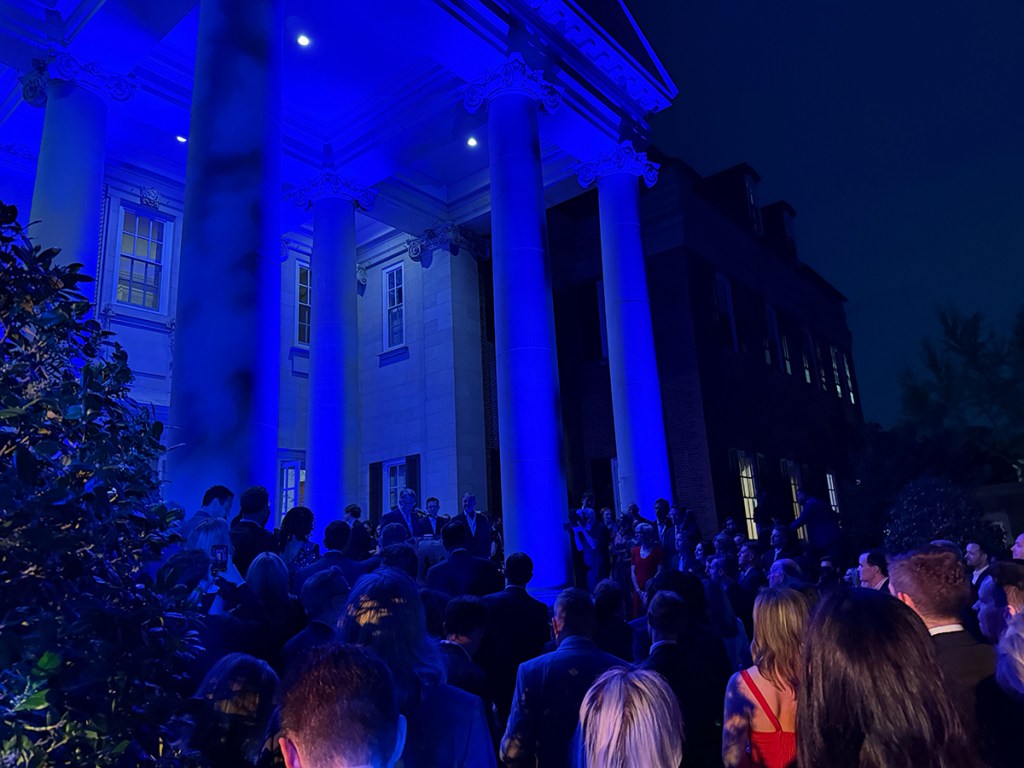
A bevy of administration officials was spotted Saturday at the Occidental for the launch of Omeed Malik’s $500k private members’ club – which sounds like a Marc Andreessen groupchat made flesh – while Marco Rubio and Kari Lake made an appearance at Butterworth’s the same night. A number of officials also popped up at the Daily Mail’s boozy Friday night bash at the British Embassy: Cockburn sidestepped Dr. Oz and his wife under the porch while attempting to avoid the rain, and apparently VA Secretary Doug Collins was also present. One highlight of the evening was observing War Room cohost Natalie Winters – a current Mail favorite – getting a frosty reception from Fox News’s Kennedy (Kennedy, you may recall, wrote in January that Winters dresses like she “wants to be a hostess at Hooters”). Eventually the pair bonded. Your correspondent also snapped a picture of Winters posing with Taylor Lorenz:
So this happened 🙃@TaylorLorenz pic.twitter.com/SgcmKWrYrR
— Natalie Winters (@nataliegwinters) April 26, 2025
Over on Twitter alternative BlueSky, the progressives are accusing the former Washington Post columnist of making a “MAGA heel turn.” “I think these people’s brains can only think in terms of team sports,” Lorenz told Cockburn. On less friendly terms with Winters: a group of Mail reporters who declined the opportunity to be introduced to their star subject. Cockburn suggests they locate their inner Bill Maher.
The British Embassy also hosted CNN’s hangover brunch in glorious Sunday sunshine. Cockburn clocked a lot of network talent – Jake Tapper, Wolf Blitzer, Brian Stelter, David Chalian – before peeling off to the well-stocked Bloody Mary bar. Here he heard a novel suggestion on how to make the weekend less weird from the Washington Free Beacon’s Jon Levine: “They should let Trump pick the comedian next year,” he said, “then he’ll come.” Tony Hinchcliffe, your time is now.
The most eclectic mix of guests could be found at Substack’s Saturday shindig at the Line, which counterprogrammed the dinner. Cockburn spotted Mehdi Hasan chatting to former GOP congressman Joe Walsh – oh to be a fly on the wall – as well as Cenk Uygur, Michael Cohen, Rick Wilson, Alex Berenson, Tina Brown, Meghan McCain, Tara Palmeri and Sean Spicer. Come to think of it, Cockburn thinks Spicer was at every event he was at.
But no, the main folk at the WHCD parties were journalists and influencers – Oliver Darcy’s Thursday party for his Status newsletter at the Wharf was almost exclusively occupied by the former. And many of them were struggling. “It sounds cheesy, but folks seem to be holding on a little bit longer in hugs,” one Washington observer told Politico Playbook Friday. Not close enough for some of you, apparently.
On our radar
PRIME TIME Amazon has nixed the idea of displaying tariff costs on its products after President Trump complained to CEO Jeff Bezos.
CANADA GOOSED Mark Carney’s Liberals won Canada’s election last night, with his main rival Conservative Pierre Poilievre losing his seat.
CENTURION President Trump is set to mark his 100th day in office with a speech in Warren, Michigan, tonight.
Desperate Democrat files Trump impeachment articles
Congressman Shri Thanedar, 70, is a Democrat running for reelection who is set to face an upstart challenger from within his own party in 2026. So Thanedar just announced, via a deeply cringe video, that he wants to impeach President Donald Trump – yes, again.
Coincidence? Perhaps not. Impeaching Trump has long been a cause célèbre for the Democratic party faithful, and Thanedar and his infamously dubious toupee are the latest to hop on that train.
The replies to his video are as grotesque as you’d expect from Elon Musk’s X. Many went the predictable “bobs-and-vagene” route, mocking Thanedar for his Indian accent and horrible backdrop. “This will be your greatest victory since getting Hank Azaria fired from playing Apu,” one response read. “this looks like a CGI composite of every race and every gender, even the imaginary ones,” wrote Michael Malice.
The Thanedar affair could offer a learning opportunity: to take a step back, stop the fundraising gimmicks, lower the rhetoric, get better hairpieces and #BeBest. Instead it’s another grim chapter on Washington’s worst excesses.
Birdwatching
President Trump welcomed the Super Bowl-winning Philadelphia Eagles to the White House Rose Garden yesterday afternoon. During his remarks, the President recounted being at the game in New Orleans. “I was there along with Taylor Swift, how did that work out?” he said, to laughs. Swift, as well as being a prominent Democrat, is dating defeated Kansas City Chiefs tight end Travis Kelce, who had played terribly.
The President also praised Eagles running back Saquon Barkley, with whom he had golfed at the weekend. “He’s a handsome guy but I wouldn’t wanna tackle him,” Trump joked.
“He called all the players ‘huge people’ 10+ times,” one attendee told Cockburn.
Trump reiterated his support for the “tush-push”: a contentious Eagles play otherwise known as the “brotherly shove” in which the quarterback Jalen Hurts is pushed over the line by his team-mates. The President first revealed his support for the play in a Spectator interview two months ago. Hurts opted not to attend, citing “scheduling conflicts.” Other high-profile players who skipped the trip included A.J. Brown, Jalen Carter and DeVonta Smith.
One man wouldn’t have missed it for the world: notorious head of security “Big” Dom DiSandro. “This is a guy, they say he loves Trump,” the President said. “I had Saquon give him a big beautiful hat last night.”
Sign up here to get Cockburn’s Diary in your inboxes on Tuesdays and Fridays.
Pay no heed to the misleading Trump approval ratings
When it comes to Donald Trump and his achievements during his first 100 days, who are you going to believe, the New York Times or your lyin’ eyes?
By “the New York Times,” incidentally, I do not mean just that one woke media outlet masquerading as a source of news.
No, I take the Times as a metonym for the entire propaganda industrial complex, the giant dispenser of politically correct nostrums and seismically sensitive Keeper of the Narrative.
Thus it is that the Times is a reliable dispenser not of that sort of information we denominate “news” – that is, what is actually happening and who is involved in making it happen.
On the contrary, the Times is primarily a source of emotional mirrors: grateful reflections that flatter and reinforce their readers’ prejudices, figures of self-esteem, moral cynosures.
So it is that on the run up to Trump’s 100th day in office (or, taking into account his first term, his 1,560th day), the Times was on the barricades shouting that Trump’s approval rating was in free fall, that his voters had “buyers’ remorse,” that it was only a matter of time before the old consensus of corruption was restored and the world was set right again: AOC, Stacey Abrams, Jamie Raskin and Chuck Schumer forever!
ABC: “Donald Trump has the lowest 100-day job approval rating of any president in the past 80 years, with public pushback on many of his policies and extensive economic discontent, according to a new ABC News/Washington Post/Ipsos poll.”
New York Post: “President Trump battered by brutal polls that show his approval sinking – including one revealing the lowest ratings since World War Two.”
Et very much cetera.
And what are we to make of these rituals of excoriation?
Apart from their value as symptoms of psycho-pathology, not much. The whole campaign of delegitimization-by-poll-numbers is part of what a writer for Townhall called “another liberal media psyop.”
Polling themselves, they get the reassuring results they crave. What they miss is the reality of Trump’s extraordinary activity and multiple successes on the ground.
This is something that the commentator Larry Kudlow articulated in a searing column about “fake polls.”
Why was Trump elected? To close the border. He has done that. The polls about that little accomplishment, which Joe Biden said was impossible, are off-the-charts positive.
Why was Trump elected? To purge the country of illegal immigrants. Unless you are a district court judge, you think Trump’s success on this score its terrific. Tom Homan is a new folk hero.
Why was Trump elected? To end the discriminatory insanity of DEI: a race- and sex-based two-tier system of anti-white, anti-male, anti-normal prejudice. Once again, in the space of just a few months, Trump has made gigantic strides. The people love it.
Why was Trump elected? To end the forever wars and pursue a national-interest-based, peace-through-strength foreign policy. This, too, he is making a reality.
Why was Trump elected? To level the economic playing field internationally, to end the practice of other countries taking advantage of the United States and “ripping us off.” Everyone knows that this is exactly what Trump’s tariffs are designed to accomplish: to establish a practice of free trade that is also fair trade and that gives priority to American workers and American industry. It’s early days yet, but already you can see that it is working.
Why was Trump elected? To put our fiscal house in order. To do something about the unsustainable $37-trillion federal debt and end the regime of self-dealing fraud and abuse that that become the chief export of the United States government. Accomplishing this will be a long, complicated task, but what splendid inroads Elon Musk’s Department of Government Efficiency has already made. Musk will be taking a back seat on DoGE soon, but the ball he got rolling will continue and will pick up speed and effectiveness.
Donald Trump signed his 140th executive order just a couple of days ago. He has instigated a far-reaching counter-revolution in the way government does – or, rather, has avoided doing – its business. The Times and other organs of the propaganda press squeal and stamp their little feet. District court judges try to stymie Trump’s counter-revolution. They might as well try to stop a locomotive with a twig.
Donald Trump is busy making America great again. The whiners, hysterics and losers who can’t abide the tonic atmosphere of liberty are caterwauling in their misery. As Dante said in another context, non ragioniam di lor, ma guarda e passa: “Let us not pay them any attention, but look and pass on.”
Bridget Phillipson’s Ofsted reforms are a mess
In 1902, Holly Mount School in Bury was shut down following a scandal over alleged brutality against the children. The next year, the House of Commons noted that one reason why the abuse was allowed to continue for so long was because of infrequent and cursory inspections, which one MP said were nothing but ‘hard officialdom’. Over a century later, it seems little has changed: school inspections are still ‘hard officialdom’.
Ofsted’s reputation for being bureaucratic, punitive and demoralising has only worsened since the suicide of head teacher Ruth Perry in 2023, after her primary school was downgraded to ‘inadequate’. Ofsted has proposed a series of reforms, but Julia Waters, Ruth Perry’s sister, has argued that the new system is ‘rushed’ and ‘fails to learn’; it is simply repeating all the ‘same risks as before.’
Teachers are no longer expected to just be subject specialists, but disciplinarians, mental health champions, surrogate social workers, pastoral role models, PSHE experts and parents by proxy
She is right: the new ‘report card’ is a rushed botch job. All it does is promise semantic tweaks rather than actual reform. Rather than a single-word judgement, schools will now be graded on nine areas: leadership, curriculum, teaching, achievement, behaviour, attendance, personal development and well-being, and inclusion and safeguarding. Each area will then be ranked in a traffic-light system as either ‘causing concern’, ‘attention needed’, ‘secure’, ‘strong’, or ‘exemplary’, with Nandos-style colour-coding for emphasis.
Bridget Phillipson can boast all she likes that these report cards will give ‘rich, granular insight’ and allow Ofsted to better ‘tailor its support’ for struggling schools. Yet all Ofsted has actually done is broaden the assessment criteria for schools, and put the single-word judgements through a thesaurus. It was tasked with creating a new system that would reduce the pressure on schools, but this does the exact opposite. This approach is not only more complicated but more demanding, as schools must demonstrate more and more with less and less time.
A more detailed report card only works if inspectors and schools are given the time, space and resources to make fair and consistent judgements. Any changes to the process therefore need to be practical rather than linguistic: they should look at how the inspections are conducted, as well as what criteria to include. Currently, inspectors are usually only in schools for one or two days, which is nowhere near enough time to make a trustworthy, holistic and contextualised judgement about a school. Before 2005, inspectors were there for at least a week, in teams of up to 15 people; now on average there are around four.
This slimming down of the service explains why inspections have been reduced to a tick-box, regulatory exercise, but one with potentially damning consequences. Trust between Ofsted and schools has completely broken down, and there seem to be only two options for repairing this relationship. The first is to reduce the expectations placed on schools by bringing Ofsted back to its core purpose. Over the years, Ofsted has moved away from primarily evaluating teaching and learning, and now makes critical decisions in dozens of peripheral areas where expectations are higher and higher. By continually expanding its remit, Ofsted has become about overreach rather than rigour.
However, this first option seems unlikely to happen. Teachers are no longer expected to just be subject specialists, but disciplinarians, mental health champions, surrogate social workers, pastoral role models, PSHE experts and parents by proxy. The ever-increasing range of roles and duties means ever-increasing ways in which schools can be held accountable. This seems to be reflected in the proposed report card, which wants to broaden the scope of inspections rather than minimise them.
This leaves the second option. As counter-intuitive as it may seem, Ofsted needs more time in schools, not less. Too many schools currently operate in a culture of fear because they know that they may be called upon to prove a dizzying amount of evidence at a moment’s notice, and that their reputation hinges on a 48-hour inspection snapshot. The current brevity of inspections has eroded trust in the process: in a survey of over 11,000 teachers, over two thirds of respondents agreed that an inspection could not accurately judge a school in three days or fewer, and just 10 per cent of secondary school teachers said that the judgements were very useful for parents. This scepticism is also an important factor behind the teacher recruitment and retention crisis: in an NEU survey, 92 per cent of teachers said that inspections were a source of major stress.
This myopic obsession with single word judgements therefore misses the wider picture: the way these inspections are conducted is currently not fit for purpose. If we want to judge schools by more measures, then we need more inspectors, more training for inspectors, and more time for inspectors to properly evaluate a school. If we want report cards to be thorough and comprehensive, then the inspections themselves need to be thorough and comprehensive, and not done on a shoe-string in a whirlwind.
The polls are wrong (again) on Trump
“Trump has lowest 100-day approval rating in 80 years,” screamed ABC News at the start of this week. The ABC News/Washington Post poll, conducted by Ipsos to mark Trump’s 100th day in office, was one of a handful that have shown Trump’s approval rating dipping below 40 percent for the first time.
There is just one problem: the pollsters who are showing the worst numbers for Trump are the ones who got the election most wrong.
Take the ABC/WaPo/Ipsos poll, that showed Trump on 39 percent approval. In their final poll of the 2024 cycle, they found a three-point lead for Kamala Harris. Ipsos’s other poll for Reuters had a two-point advantage for Harris nationally. Trump ended up winning the popular vote by one and a half points.
CNN, whose polling is conducted by SSRS, puts Trump on a paltry 41 percent approval rating this week. But at the election they had Harris ahead in the state of North Carolina, six points ahead in Wisconsin and five points ahead in Michigan.
What of the New York Times/Siena College poll, often more respected? They have Trump on 42 percent approval. But look at their performance in the swing states just six months ago: they had Harris leading by three points in Nevada, two points in North Carolina, two points in Wisconsin, and one point in Georgia. In fact, they had Trump leading only in the state of Arizona: in reality, he won every swing state. Conveniently, the only other polling firm with Trump’s approval below 40 percent (AP-NORC) did not publish a voting intention poll in 2024.
You would think the editors of these esteemed media outlets would have thought twice about re-hiring their pollsters after November. But the show goes on. Since moving to the States three years ago, I have been astonished at how the mainstream media continues to reward pollsters who have singularly failed at predicting elections. In Britain, they would have been booted out within 24 hours of the result. Instead we are in a world where the least accurate polls are getting the most airtime.
What is happening in these polls? The same problem as in November: the pollsters are over-representing Harris voters. The CNN poll has more 2024 Harris voters than Trump voters. Pollster John McLaughlin has pointed out that the Ipsos poll also has more Harris voters than Trump voters. In the New York Times survey, the sample is composed of 38 percent 2024 Trump voters to 38 percent Harris voters. Trump won the popular vote, and if you want accurate surveys of voters as they are in 2025, you need to reflect that in your sample.
No polling firm is perfect, but I am confident that my firm J.L. Partners gets closer to the truth. We sample and weight based on 2024 vote to make sure we have the right amount of Trump 2024 voters. We also utilize a mixed method approach, including in-app polling that picks up voters as they are gaming or online shopping on their phones. That approach – which picks up less politically interested voters – made us the most accurate pollster of 2024, and one of the only firms to give Trump a popular vote lead.
Our numbers are not rosy for Donald Trump. His approval rating is around 45 percent, down from around 50 percent a few weeks ago. The decline to his ratings in the last few days is real, just less dramatic than people say it is.
And rather than due to some systemic aversion to Trump, the reason for the decline is more nuanced. When we ask Trump voters why they feel more negative about the president, they answer tariffs. But dig into the data, and this does not seem to be about tariffs in and of themselves, but the administration’s changed position on tariffs. Whereas before Trump had a clear story on his tariffs plan and voters had a sense he sticks to his guns, they are now confused as to what the purpose was. That has led to doubt about their savings and the impact on their wallets.
If the President wants to turn around his numbers, he needs to demonstrate to his voters that he has that plan – and put it into action. Voters respect Trump most – and any politician in the 2020s – when they demonstrate strength and certainty. That sense has wavered in the last few weeks for voters, but it is in no way lost forever. There is plenty that voters are eager to praise the administration for too: especially their performance on the border which is named by voters as the President’s biggest achievement to date.
None of this might make a difference to the fact the Republicans could be in dire trouble in 2026. Regardless of whether Trump is on 39 percent, 45 percent, or 50 percent approval, Democrats could benefit from a natural turnout advantage next November to win back Congress. In our survey a few weeks ago that had Trump on 54 percent approval, we still had the Democrats leading the Republicans by six points when it came to how people would vote for Congress.
If that is true, then there is an argument Trump should not be listening to the polls at all. If he only has two years, he might be better off putting my profession to the back of his mind and focusing on what he wants to achieve. It might be best for the President to ignore the pollsters – and especially those that were wrong wrong wrong just six short months ago.
Being Mr. Meghan Markle is no honeymoon
Prince Harry and Meghan Markle are finally enjoying their “honeymoon period.” Or they are according to the Duchess of Sussex, who made the statement on a fawning podcast as part of a brand building media blitz – and who certainly seems to be enjoying herself.
But has she asked her husband if he’s reveling in their belated honeymoon quite as much as she is? Once the spare to the throne, his presence as her forlorn shadow at events to honor her now appears largely surplus to requirements even to Meghan.
“That man loves me so much,” she gushed on Montecito neighbor Jamie Kern Lima’s podcast on Monday. She likened their relationship to a video game where you “slay the dragon, save the princess.” An analogy that firmly implies she is the glittering prize and he should be happy with winning her hand.
“You have to imagine, at the beginning, everyone has butterflies, and then we immediately went into the trenches together right out of the gate, six months into dating,” Meghan added. “So now, seven years later when you have a little bit of breathing space, you can just enjoy each other in a new way, and that’s why I feel like it’s more of a honeymoon period for us now.”
As ever, Meghan’s truth does not necessarily accord with everyone else’s reality.
It’s been a tough week for Harry as Mr. Meghan Markle. His wife undermined his latest warning about the dangers of social media for children by posting photos of their own children on Instagram. He bombed at the Hollywood aviation awards. And he was snubbed by Meghan at the Time100 Summit.
All while his brother Prince William looked every bit the senior statesman with world leaders at the Pope’s funeral in Rome.
Harry’s public troubles began in New York last week. While unveiling a memorial dedicated to the memory of children whose families believe harmful online behavior contributed to their deaths, he demanded stronger protection for young people from the dangers of social media. He was “grateful” that his children were still too young to be online, he said.
Too young, that is, unless Archie and Lilibet are helping Meghan promote her brands.
Meghan used their three-year-old daughter to promote her jam, or rather “preserves” as she calls them (jam has too much sugar, apparently), on social media on Sunday. She posted an Instagram Story showing her stirring her homemade strawberry preserves, saying, “What do you think Lili?” A child’s hand can be seen and a voice purporting to be Lili – but sounding strangely AI – is heard saying, “I think it’s beautiful.”
Meghan also posted Instagram pictures of Lili and son Archie, five, in her rose garden, tastefully obscuring their beautiful red hair and faces. How discrete.
Harry’s woes were compounded during his trip to New York by his wife’s apparent lack of interest in him. When he stepped out of the couple’s car at the TIME event on Wednesday, he reached out to Meghan to hold her hand. But – right in front of the waiting paparazzi – she ignored him, turned away and instead enthusiastically hugged a woman waiting to greet her.
A blushing Harry grimaced, as if he instantly knew the media would seize on it (he was correct), then awkwardly adjusted the back waistband of his trousers under his jacket and dutifully trotted through a door behind his wife as she was ushered in by staff and security. Was it take your husband to work day?
Once inside the auditorium at Jazz at Lincoln Center, Harry was forced to take a literal back seat, applauding enthusiastically from the audience as Meghan trotted out some of her signature lines, such as, “Part of what is really, really important is that love language of taking care of people also feeds me.”
Meghan, wearing a $4,000 Ralph Lauren suit, gave her soft keynote speech promoting her show, podcast, lifestyle brand and family. This marked a stark contrast with the other speakers, such as Yulia Navalnaya, who talked about fighting for human rights after her late husband, the prominent Russian opposition leader and critic of President Vladimir Putin, died in prison.
Making Harry’s recent “whining” about being stripped of his UK security details seem petty. Then Harry was off – alone – to the Living Legends of Aviation Awards, where last year he was honored for his work as an Apache helicopter pilot in Afghanistan.
From the stage at the Beverly Hills Hotel on Friday, Harry thanked the first responders who risked their lives to save those devastated by the California fires, but also took a petulant shot at organizers with a joke that didn’t land well. “I feel like I picked the short straw,” he began.
“Someone had to host a bunch of pilots and firefighters, that’s where they are, there are five tables. I agreed with the organizers that it would be a good idea, let’s get them along. I did not agree to hosting two of the tables.”
The sad contrast with William could not be more obvious, royal biographer, writer and broadcaster Hugo Vickers tells The Spectator. “One of them is doing a good job for the United Kingdom and the Commonwealth. And the other’s doing nothing.”
Vickers believes Haz, as he is nicknamed by Meghan, is hanging on to his wife for dear life, “Harry is petrified of her and petrified of losing her. It is a nasty syndrome. And maybe I’m wrong, maybe they’re blissfully happy, but he doesn’t look happy.
“Now he’s just sort of dangling about in the background of Meghan’s various other things she’s promoting.”
Vickers added that the Sussex children’s appearances on Meghan’s Instagram makes them “awful pawns in the middle of this game.”
“All this gooey talk that you get from Meghan about connectivity and love and stuff doesn’t seem to extend to her own family, does it? She’s playing silly games with them. I just have a horrible feeling it’s all going to end badly somehow.”
How much longer can this go on? The old Harry, with his jack-the-lad swagger and roguish sense of humor, was hugely popular with the public, the royals and the media. His former friends, who were pushed aside when he met Meghan, miss that version of Harry. We miss that Harry.
Perhaps it is time for the prince to pack away his paranoia, apologize and start building bridges with his father, brother and the media, if it is not too late and he loses the petering goodwill toward him that still remains. That couldn’t possibly be more humiliating than this flower-sprinkled existence as Mr. Meghan Markle.
The mystery of Spain’s blackout
Early yesterday afternoon, I walked home from my local supermarket empty-handed. In the Andalucian town of Antequera, the power and internet had just disappeared, card machines weren’t working and I had no cash. As I tried to remember what I had in the cupboards, I passed a woman on the street shouting up to someone on a balcony, ‘It’s all over Spain, France, Germany and Portugal’. Whatever she was talking about, I thought, it obviously had nothing to do with the power outage. It had been a windy night. A pylon had probably been brought down somewhere nearby.
The blackout revealed a fact about our society that we don’t like to confront: as well as giving us power and freedom, our technological sophistication also makes us vulnerable
The woman I passed wasn’t entirely accurate, but she was closer to the truth than I was. At around 12.30 p.m. local time yesterday, the entire Iberian peninsula, as well as a small part of southern France, suffered a massive power outage. A blackout on this scale hasn’t occurred in Europe since 2003, when 55 million people across Italy and parts of Switzerland were out of power for 12 hours. Eduardo Prieto, Operations Director at Spain’s grid operator REE, called it an ‘absolutely exceptional event’. It revealed a fact about 21st century society that we don’t like to confront: as well as giving us power and freedom, our technological sophistication also makes us vulnerable.
In many parts of Spain, yesterday’s outage – or ‘apagón masivo’, to call it by its wonderfully dramatic Spanish name – lasted into the early hours of Tuesday morning. Spain’s interior ministry declared a national emergency and deployed 30,000 police officers to keep order. Madrid’s Metro system was plunged into darkness and 35,000 passengers were rescued from inter-city trains halted in the middle of nowhere. Over 300 flights were cancelled and the Madrid Open tennis tournament was suspended. ATM screens went blank and traffic lights shut down. As afternoon turned to evening, the cheap, Chinese-run bazaars – Spain’s equivalent of Poundland – were busy with people buying candles and LED lights. It felt like the pandemic all over again.
Today, Spain and Portugal are almost completely back to normal – but the investigations are only just beginning. El Pais reported that yesterday’s power loss was caused by a five-second disappearance of 15 GW of generation – double the amount produced by Spain’s five nuclear power plants combined. But what triggered that remains unknown. At a press conference early yesterday evening – when large areas of the country were still off-grid – Spain’s Socialist prime minister, Pedro Sanchez, said that he didn’t know what had caused the outage and that he was not ruling out any hypotheses.
The absence of facts provides plenty of room for speculation. According to Reuters, the Portuguese grid operator REN is considering the possibility that the blackout was caused by a ‘very large oscillation in the electrical voltages, first in the Spanish system, which then spread to the Portuguese system’. Unsubstantiated rumours are circulating that a rare atmospheric weather event in Spain might have caused that voltage fluctuation.
In a somewhat reckless announcement early yesterday afternoon, the conservative premier of Andalusia, Juan Moreno, claimed that ‘everything points to the fact that a blackout of this magnitude could only be due to a cyberattack’. But the Spanish and Portuguese authorities, as well as the EU Commission’s vice president and energy commissioner Teresa Ribera, have all said that there is no evidence to support this theory.
Still, the most sinister possibility has to be investigated. The National Cryptologic Center and the Joint Cyber Command – which operate as part of Spain’s National Intelligence Centre and ministry of defence, respectively – are investigating the possibility of a cyberattack. The question here is whether Spain and Portugal were the victims of an attack similar to that made on Ukraine by Russian hackers in late 2015, which left over 200,000 people without power for six hours. As one expert told El Pais, though, ‘a blackout of this scale through a cyberattack would be [much more] complicated because there are many segmented electrical networks’.
Walking the pitch-black streets last night, as the outage entered its twelfth hour, I began to feel edgy. Disembodied voices and bobbing lights punctuated the darkness. There was a beautiful starry sky overhead which I was in no mood to appreciate. It occurred to me that, with another couple of days of this, or even another 24 hours, things would start to get difficult. Many people would be out of cash and low on food, my partner and I included. Communication channels would remain broken, the economy would start to tank. What happens then? That’s an unsettling question – and the fact that it didn’t have to be answered on this occasion doesn’t make it disappear
How will Mark Carney govern?
Canada went to the polls on Monday. The election campaign only ran for 37 days, but it was a wild ride with shifts in political momentum that few could have predicted.
Liberal Prime Minister Mark Carney, who replaced Justin Trudeau on March 14, won last night. It’s the fourth consecutive Liberal win, but it will be its third straight minority government. Conservative leader Pierre Poilievre had the best result for the Conservatives since 1988 but ended up losing his seat. Left-leaning parties like the Bloc Quebecois (BQ), Greens and New Democrats (NDP) all lost seats and popular support, too.
This could lead to an unusual series of political scenarios for both main parties.
Carney may be forced to cobble together a wild and woolly coalition to keep this minority parliament around for maybe a year or two
Carney could end up with168 seats or below in a 343-seat Parliament. He needs 172 seats for a majority. Unlike Trudeau, he won’t be able to rely on the NDP, Canada’s socialist alternative, as a reliable coalition partner since they dropped from 24 seats to a maximum of seven seats. It’s the NDP’s worst showing in 63 years and puts them below the 12 seat limit required for official parliamentary status. NDP leader Jagmeet Singh also lost his seat and will resign as party leader.
Carney may be forced to cobble together a wild and woolly coalition to keep this minority parliament around for maybe a year or two. He could work with the BQ, but that would be undesirable for most Canadians. Why? The BQ is nationalist, sovereigntist and specifically focused on the province of Quebec. A federalist party like the Liberals can’t partner with them in a viable way.
Alternatively, Carney could give the NDP official party status and work with them if the two parties reach a combined total of 172 seats. That’s less risky, but will remind Canadians of the controversial Liberal-NDP supply and confidence agreement that kept Trudeau in power for way too long in the previous parliamentary session. The only other option is to piece together coalitions with small parties and individual MPs on a case-by-case basis. It could be done, but it’s tedious work and prone to failure.
Poilievre is in a curious position, too. He defied most opinion polls and did well in most provinces and regions. His vote share actually exceeded that of my old friend and boss, former Prime Minister Stephen Harper, who led three governments in Canada. In spite of this, Poilievre lost his seat in the riding of Carleton in a shocking upset. It was a stunning result for the 45-year-old Poilievre, who has served in the House of Commons continuously since 2004. In fairness, every riding in the Ottawa region where Carleton is situated saw Conservative candidates get beaten on election night. That’s hardly a silver lining for Poilievre. He must ensure he maintains the confidence of Conservatives to lead the party in spite of holding no parliamentary seat. Based on his successful night, the long knives won’t be out for him just yet. He’ll need to rectify this situation quickly, of course.
Putting all this aside, it’s surprising that Canada is facing the possibility of a third straight Liberal minority government.
The Conservatives had been leading in the polls for over two years. While Poilievre had contributed to Trudeau’s downfall with his fiscally conservative policies and outside-the-box thinking, the gap between the two parties was largely caused by Trudeau. His mediocre, ineffective leadership was defined by an embarrassing (and massive) list of personal mistakes and political blunders. This included: three older instances of wearing blackface, two ethics violations, still-unresolved allegations of Chinese election interference in the 2019 and 2021 elections, allowing a Nazi to be honoured in Parliament and more.
Trudeau finally stepped down on 6 January. Carney, former Governor of the Bank of Canada and Bank of England, entered the Liberal leadership race, gained momentum and ultimately won in a landslide. Few doubted he was more intelligent and capable than Trudeau, but winning an election seemed like a long shot. His political inexperience, bland personality and him taking charge of a party made up of Trudeau-era loyalists would surely work against him.
Until, that is, Donald Trump’s tariffs changed the course of the election. Trump’s tariff threat wasn’t surprising. He had implemented tariffs during his first presidential term, and warned that 25 per cent tariffs on Canada and Mexico were forthcoming last November, too. What no one expected was the President making Canada one of his main targets. Annexing Canada as the ‘51st US State’ went from a joke to a serious topic, and Trudeau was mockingly referred to as ‘Governor’. Many Canadians became angry, resentful and lashed out. They saw Trump and Poilievre as the same sort of politician. Even though there was no truth to this, some Canadians created their own truth.
When Carney became Prime Minister in March, he took full advantage of these unplanned distractions. He suggested Poilievre was a Canadian-style Trump and a threat to national sovereignty. Carney’s baseless message of being the only Canadian political leader who could handle Trump was accepted almost at will. Poilievre’s 25-point lead collapsed and the Liberals were in command.
Yet, the political pendulum swung once more. When Carney met with Canadians during the campaign hustings, many didn’t like what they saw. His political inexperience has been heightened by his massive ego, thin-skinned approach to criticism and aloof personality. He had no original policies or ideas, keeping much of Trudeau’s terrible agenda and stealing from the Conservatives. He performed poorly in both leadership debates. He didn’t seem to have the backbone to take on Trump, either.
This led to some last-minute buyer’s remorse about Carney and a renewed resurgence in support for Poilievre. It wasn’t enough to bring down the Liberals, but left Canada with another minority government, a solid Conservative opposition with a leader currently outside Parliament, and the prospect of yet another early election. What happens next? That’s anyone’s guess.
What lessons are there from Canada’s election for Kemi Badenoch and Keir Starmer? James Heale and Michael Martins join Patrick Gibbons on the latest Coffee House Shots podcast:
Watch: Labour MP attacks Ed Miliband
Ding ding ding! The gloves are coming off, as Scottish Labour backbencher Brian Leishman today took aim at Net Zero Secretary Ed Miliband in the Commons over Grangemouth. First bashing both the SNP and previous Tory governments, Leishman turned the guns on his own government minister.
Today marks the day that all oil refining in Scotland has come to an end, after the company that runs the refinery, Petroineos, notified staff that operations had ceased and the first group of redundant workers will be leaving the plant, with 200 to lose their jobs by the end of June. Hitting out at Labour pre-election promises on the future of Scotland’s oil plant, Leishman raged:
Mr Speaker, today is the end of over a century of refining at Grangemouth. Scotland once again is a victim of industrial vandalism and devastation – and I do not want anyone in this chamber to dare mention a ‘just transition’ – because we all know that the Conservatives were in power and the SNP, currently in Holyrood, did nothing to avert this catastrophic decision happening.
I put it to the Secretary of State that the Labour leadership in the general election campaign said that they would step in and save the jobs at the refinery. What has changed and why have we not done the sensible thing for Scotland’s energy security?
Shots fired! It’s not the first time Leishman has taken aim at Labour over Grangemouth either, lambasting Sir Keir Starmer at PMQs earlier this year too. Appearing rather taken aback at the strength of Leishman’s question, a bumbling Miliband acknowledged the ‘important role’ the oil plant has in Scotland before insisting that the Labour lot had ‘put money in to help the workers’ and made an investment commitment in partnership with the SNP government. He continued: ‘We are absolutely committed to building the future for Grangemouth communities, and we look forward to working with him and members across the House to do that.’ Not that this is of much use to the workers being made redundant now, however…
Watch the clip here:
The Maggie Chapman saga is a new low for the Scottish Parliament
The Scottish Parliament’s equalities committee has voted against removing Green MSP Maggie Chapman as deputy convenor following her attack on the Supreme Court.
The fight might not be over
At a rally in Aberdeen in the wake of the judgment in For Women Scotland Ltd v. The Scottish Ministers, in which Lord Hodge found for a unanimous panel that the term ‘sex’ in the Equality Act 2010 referred to biological sex, Chapman, an outspoken advocate of gender ideology, decried ‘bigotry, prejudice and hatred that we see coming from the Supreme Court’.
This prompted the Faculty of Advocates to call for Chapman’s resignation as deputy convenor of the Holyrood committee responsible for equalities legislation, human rights and civil justice. The legal body accused the Green MSP of an ‘egregious breach’ of the Judiciary and Courts (Scotland) Act 2008, which states that MSPs ‘must uphold the continued independence of the judiciary.’
Chapman has been defiant, saying that she appeared at the rally not in her capacity as deputy convenor but as an MSP representing her trans and non-binary constituents. The Scottish Tories’ Tess White moved a motion this morning to strip Chapman of her vice chair position, arguing that her continued presence in the role undermines the perception of the committee, particularly in relation to matters of civil justice.
Today’s outcome – four votes against removal, three for – was no real surprise. The three MSPs from the genderist SNP voted to protect Chapman. (Chapman voted against her own removal, of course.) The two Tories voted for removal, and were joined by Labour’s Paul O’Kane, a long-time supporter of trans rights who cast his vote after Chapman rebuffed his opportunity to withdraw her comments.
The fight might not be over. I understand the Scottish Tories are looking at any procedural moves that could put the matter before the whole parliament, forcing every MSP to take a stance on the record.
Today marks another low for the Scottish Parliament, a category with a lot of competition. MSPs have voted along ideological lines to say that no committee convenor or deputy convenor can be removed for speech made outwith that capacity. The libertarian in me takes some grudging comfort in that but I suspect Chapman’s supporters will come to regret the precedent they have set. This is a parliament which, if the polls are correct, will soon contain a number of Reform MSPs, a category of politician not known for shying away from incendiary comments. No doubt they would find a rationale for punishing an opponent as readily as they found one for excusing a mate, but that would be one more example of a broken, capricious, dishonourable parliament.
Kneecap’s phoney punk act has been unmasked
If someone pulled on a Ku Klux Klan hood and went up on a stage and shouted ‘Up the KKK!’, what would you think of that person? Call me a literalist but I’d think that person supports the KKK. I would interpret his donning of the pointy hood and his singing of the KKK’s praises as fandom for that monstrous movement. No one gets into a KKK cloak by accident.
Kneecap expect us to believe that even though they’ve waved the Hezbollah flag, they don’t actually support Hezbollah
And yet Kneecap expect us to believe that even though they’ve waved the Hezbollah flag and hollered ‘Up Hezbollah!’, they don’t actually support Hezbollah. Even though one of them posed with a book of speeches by Hezbollah’s late leader – a book that refers to Jews as ‘apes and pigs’ – they’re not Hezbollah fans. ‘We do not, and have never, supported Hamas or Hezbollah’, said the Belfast rappers in a statement last night.
I don’t know about you, but I normally manage to avoid draping myself in the paraphernalia of movements I don’t support. I have never found myself on a stage wrapped in the Isis flag. I have never accidentally bellowed ‘Up the Taliban!’ to a few thousand squealing youths. So what’s Kneecap’s problem? Perhaps the poor dears have some Tourette’s-like affliction that compels them to praise groups they don’t actually like.
This is the news that the Kneecap lads are furiously backtracking on their more controversial comments. They found themselves in the eye of a media storm after footage emerged showing them waving the Hezbollah flag at one of their gigs while yelling ‘Up Hamas, up Hezbollah’. Another clip allegedly shows one of them saying ‘The only good Tory is a dead Tory’ and ‘Kill your local MP’. Such guerrilla cosplay might get their bourgeois fans hot under the collar, but it has caused a stink among more sensible folk.
Counter-terror cops said they’re looking into Kneecap’s seeming expressions of support for Hamas and Hezbollah. The band lost their work visas for the US. Festivals threatened to drop them. So now Kneecap are repenting. We don’t support Hamas or Hezbollah, they cry. We’re all about ‘love, inclusion and hope’, they insist. They’re even offering ‘heartfelt apologies’ to those hurt by their words.
This has to be one of the funniest and saddest spectacles of arse-covering we’ve ever witnessed. What self-respecting punk buckles at the first whiff of infamy? Sid Vicious is turning in his grave at the sight of these balaclava-wearing phonies saying ‘We’re sorry’ less than a week into a media crisis. It’s Kneecap summed up: they cosplay as cultural insurgents in their daft knitted headwear, yet the minute the dollars threaten to dry up they plead for forgiveness. They’re punks until the cops come knocking.
It isn’t only Kneecap’s hypocrisy that has been exposed – so has the left’s. Leftish activists and commentators have rallied to the band’s defence. It is an outrage, they say, that politicians and police want to silence these boys from Belfast. Whatever happened to freedom of speech, they’re asking.
Well, you should know. This is the same left that blacklisted feminists for the speechcrime of saying people with penises are not women. It’s the same left that conspired in the resuscitation of the regressive tyranny of blasphemy by branding all criticism of Islam ‘Islamophobia’. It’s the same left that took to the fainting couch whenever someone cracked an un-PC gag. That’s what happened to free speech: you people killed it.
You can’t institute a regime of ostentatious offence-taking in which contrarians get cancelled morning, noon and night and then act all horrified when it comes for people you like. Surely what’s good for the gender-critical goose is good for the Israel-hating gander? ‘No, no, we only want you to censor people we disapprove of’, the left is basically saying, like some blue-haired, genderfluid Nero giving a thumbs up or thumbs down to the speech rights of all mere mortals.
I’m going to say it: if you are more offended by someone saying ‘Trans women are men’ than you are by expressions of support for Hamas’s army of anti-Semites that killed more Jews in one day than anyone else has since the Nazis, then there is something seriously wrong with you. That’s more than hypocrisy: it’s bigotry. To deny Jews the protections of political correctness, to expect this ethnic group alone to have to hear gravely offensive words, is racism masquerading as progressivism.
I am a free-speech fundamentalist. I don’t want to see anyone cancelled for what they say. That includes Kneecap. Let them rap. But someone is going to have to explain – and quick – why Lucy Connolly is rotting in a cell after tweeting ‘Set fire to all the…hotels’ while Kneecap roam free despite allegedly saying ‘Kill your local MP’. My view? Both should be free.
Watch: Poilievre concedes defeat before Portillo moment
Dear oh dear. Canada’s election results came in early this morning, revealing that – despite only being leader of the Liberal party for two months – ex-Bank of England governor Mark Carney wiped the floor with Conservative rival Pierre Poilievre. And not only did Poilievre’s party lose the election, he even lost his parliamentary seat. Talk about a double whammy…
In the early hours of Tuesday morning, excitement heightened among Canada’s Liberals as Carney’s party was projected to soar to victory in the election. As James Heale wrote for Coffee House this morning, what the economist has pulled off is nothing short of exceptional. At the start of the year, the Liberal party was languishing behind the Conservatives in the polls and even in the lead up to the vote, Carney and Poilievre were neck-and-neck. But as polling day neared and Donald Trump’s attitude towards Canada soured, Carney’s centrist lot managed to gain the upper hand – and currently the Liberals are within touching distance of securing a majority. Golly!
There was no elation in Conservative HQ however as the numbers came in. Just months ago, Poilievre was on track to lead a supermajority Conservative government. Now, he has been turfed out of parliament altogether, after more than two decades, in his very own Portillo moment. Conceding defeat this morning through gritted teeth, Poilievre lamented to his supporters: ‘Change did not get over the finish line tonight. Change takes time.’ Well, after twenty years in frontline politics, he should know eh?
Watch the clip here:
Why Merz’s free US-EU trade idea is a non-starter
Ever since President Trump started his tariff war earlier this month, the European Union’s response has been surprisingly clear. It should retaliate with tariffs of its own. It should focus on its own economic sovereignty. And it should make sure that targeted American industries feel the consequences. In other words, it should hit back, and hit back hard. And yet the incoming German chancellor Friedrich Merz has proposed a very different response: a grand Atlantic free trade pact. But can he convince Brussels to get on board?
It is certainly a break from the past for the man who next week will take over as Europe’s most significant politician. As he prepares to form his new government, the incoming German chancellor has proposed a free and open trading agreement with the United States. All the tariffs on both sides of the Atlantic would be taken down, and so would the regulatory barriers that make it harder for companies to trade across borders.
In effect, it would turn into a transatlantic single market. ‘If we can offer this to the Americans, then it could be a chance for us to create a great opportunity for the US and Europe out of the current crisis,’ he told a Christian Democrat party conference in Berlin.
Merz is of course completely right. If both the US and Europe are to have any hope of matching the growing economic power of China, then it would make a lot more sense for them to strengthen both their economies with free and open trade than to descend into a tit-for-tat tariff war that damages both sides. Indeed, the UK should be throwing its enthusiastic support behind Merz’s proposal. A free trade area covering both the US and Europe would be a huge boost for Britain’s economy.
The trouble is, it is not going to happen. The bureaucratic machine in Brussels won’t like it because it reduces its power too much.
It is not just that it would involve scrapping the protectionism in industries such as agriculture and cars that have been a core feature of the EU ever since it was founded. It would also mean curbing the power of Brussels to lay down rules for everything from product standards to monetary policy to deficits and even working hours and employment law. The EU has made huge claims for its role as a ‘regulatory superpower’ – even though it was never clear how that benefitted anyone apart from the regulators – and it won’t surrender that lightly.
As German Chancellor, Merz may well be the most powerful politician in Europe. But unless he is willing to dismantle the Brussels bureaucracy, his grand plan for free trade with America is dead on arrival.
SNP politicians back anti-gender ruling Green MSP
Despite denouncing the Supreme Court judgment that backed the biological definition of a woman, Green MSP Maggie Chapman has bafflingly managed to survive an attempt to remove her from her role as Deputy Convener of the Equalities Committee in the Scottish parliament. It seems the eco-activists can get away with anything these days…
When Chapman took to the streets of Aberdeen some weeks ago to fume about the ‘bigotry, prejudice and hatred that we see coming from the Supreme Court’, women’s rights campaigners, fellow politicians and legal experts were quick to hit out at her remarks. Not only does she hold a leadership position in Holyrood’s equalities committee (a group that has been urged to interact with For Women Scot in the wake of the judgment) but, under the Judiciary and Courts Act, MSPs must uphold the independence of the judiciary – which the eco-zealot quite demonstrably failed to do. Scottish Tory MSP Tess White last week tabled a motion calling for the removal of Chapman from her role, which was voted on today. Yet, despite the Green MSP’s clear rejection of the ruling, she managed to survive attempts to oust her. How very curious…
It transpires that all the SNP MSPs on the committee voted for Chapman to remain in situ – despite nationalist First Minister John Swinney himself condemning her comments as ‘wrong’. It’s not the first time the Nats have joined forces with Patrick Harvie’s barmy army over the gender wars, and today’s development suggests that not all in the SNP have accepted the Supreme Court ruling either. Meanwhile three unionist politicians from both the Conservative and Labour parties moved against Chapman – but thanks to the environmentalist refusing to abstain and backing herself in the vote, she has kept hold of her job. Defending herself, the Green politician insisted: ‘I have never questioned the Court’s right to make the ruling that it did – but that does not mean that I must agree with it. I don’t.’ Good heavens…
Scottish Labour are understood to be seeking an apology from the lefty activist who has remained unrepentant about her damning indictment of the highest court in the land. Will she at least offer this up? Don’t hold your breath…
This Remembrance Day in Israel, ‘they deserved it’ is in the air
On the eve of Israel’s Remembrance Day, as sirens pierce the quiet of Israeli streets and the nation stands still to honour its fallen, something different will be happening far beyond Israel’s borders. This year, the pain pulses through the hearts of Jews across the diaspora. The grief is no longer distant – it is raw, personal, and inescapable. The surge in anti-Semitism, venomous and unapologetic, has woven our fates together.
Yom HaZikaron, Israel’s Remembrance Day for fallen soldiers and victims of terror, has always been a deeply Israeli ritual. The massacre on 7 October, the hostages still held in Gaza, suspended between life and death, and the high death toll in the war, make this Remembrance Day particularly painful, with so many families joining the ever-growing circle of loss. Mine among them: four members of my family have been killed by Hamas and Hezbollah since October 2023. Two were mother and son killed by a Hezbollah missile while tending to their farm in northern Israel. Since last Remembrance Day, 320 soldiers and 79 civilians have been killed in the war or from acts of terrorism.
Diaspora Jews – a community that I have been a part of for over 16 years, since leaving Israel – while emotionally connected, have often observed from the periphery. 7 October shattered that distance.
In Britain, where hostility festers in protests, on campuses, and in the casual venom of social media, Jews feel the weight of being targeted. The atrocities of 7 October, when families were slaughtered, hostages taken, homes burnt to the ground, and communities razed, were not met with universal horror. Instead, some celebrated. Others justified. A 2024 poll among UK university students, revealed that 29 per cent found Hamas’s attack to be an ‘understandable’ act of resistance. A further 35 per cent were ‘unsure’ if the attack was justified or an act of terrorism.
The chilling refrain – ‘they deserved it’ – still echoes in the air.
While British Jewish identity and loyalty remains firmly rooted in Britain, the community is also bound by a grief that transcends borders, because the hatred that killed them stalks us too. Across the UK, there has been a rising tide of antisemitism, spiking 589 per cent since 7 October, according to the Community Security Trust. But each synagogue defaced, each slur hurled, each Jewish student harassed, tightens the thread connecting us and Israel’s loss. We mourn not just the dead, but the humanity that fails to mourn with us.
This Remembrance Day, the Jewish diaspora stands shoulder to shoulder with Israel, not out of politics, but out of shared survival. The hostility directed at our very existence as a group, is a bridge that links us to the parents who bury their children, the soldiers who will never return, those young people who just wanted to dance and found their death at the hands of sadistic terrorists.
That unity, though born of pain, has also been forged in resilience. The Jewish diaspora, scattered yet unyielding, finds strength in Israel’s fight for survival. We mourn. We light candles, sing prayers, and hold fast to the stubborn hope that has carried us through centuries of darkness. We grieve as one, but we also stand as one – unbowed, unafraid, and fiercely defiant.
The day after Remembrance Day, Israel will celebrate its 77th Independence Day. From the depths of sorrow, the nation will rise in joy, marking the miracle of its existence – a testament to a people who, despite every attempt to erase them, endure.
For the diaspora, this too is personal. Israel’s independence is our beacon of hope that no amount of hatred can extinguish. As we join in spirit, we celebrate the unbreakable thread that binds us all.
Yet, this moment is shadowed by a growing menace: criticism of Israel’s policies has morphed into something darker – a questioning of Israel’s very right to exist and, by extension, the Jewish people’s right to self-determination. In Britain and beyond, voices deny Jews the legitimacy of a homeland, distorting and weaponising the concept of Zionism, framing it as immoral. This is no mere policy debate; it’s a rejection of our history and our right to define our future.
As we remember Israel’s sacrifice, we affirm our hope and a belief in a future where anti-Semitism, and the jubilation in the death of Jews, will no longer be tolerated.
Kneecap apologises to families of murdered MPs
Well, well, well. The Tories, Labour and even the SNP condemned Irish rap band Kneecap on Monday over a 2023 clip that seemed to show the trio calling for violence against politicians. Now, it transpires, the republican band is attempting to row back. The emergence of video footage – that appeared to show one of the group saying ‘The only good Tory is a dead Tory. Kill your local MP’ – sparked outrage across the UK. The hip-hop trio last night finally issued an apology to the families of Sir David Amess and Jo Cox, the two UK parliamentarians tragically killed in constituency surgery attacks over the last decade, by way of a Twitter post. But 18 months on from when the remarks were made, it all seems too little too late…
Taking to Twitter, the group wrote:
To the Amess and Cox families, we send our heartfelt apologies, we never intended to cause you hurt. Establishment figures, desperate to silence us, have combed through hundreds of hours of footage and interviews, extracting a handful of words from months or years ago to manufacture moral hysteria.
Let us be unequivocal: we do not, and have never, supported Hamas or Hezbollah. We condemn all attacks on civilians, always. It is never okay. We know this more than anyone, given our nation’s history. We also reject any suggestion that we would seek to incite violence against any MP or individual. Ever. An extract of footage, deliberately taken out of all context, is now being exploited and weaponised, as if it were a call to action. This distortion is not only absurd – it is a transparent effort to derail the real conversation.
Er, right. Scotland Yard is reportedly looking into the clip – alongside footage from a 2024 gig in which one band member appeared to yell about proscribed terrorist organisations: ‘Up Hamas, up Hezbollah.’ Charming…
Alongside the leaders of various UK political parties, Amess’s daughter Katie also blasted the band for the ‘stupidity’ of their comments, saying she was ‘gobsmacked at the stupidity of somebody or a group of people being in the public eye and saying such dangerous, violent rhetoric’. The Prime Minister’s spokesperson has condemned the comments as ‘completely unacceptable’ and suggested the group’s government funding could be cut, Scotland’s First Minister called for the group to be banned from a Glasgow festival and Tory leader Kemi Badenoch has demanded Kneecap face prosecution over their remarks. The group may have offered up a semblance of an apology now but will it be enough to let them off the hook? Stay tuned…
A mammoth 100 days of Trump’s America First foreign policy
One hundred days into the second Donald Trump presidency, his presence in the Oval Office represents the largest sea change in US foreign relations since the end of the Cold War.
Within the space of fewer than four months, Trump has forced Ukraine to deal with reality, by delivering hard truths about what ending the war will require. He has deployed J.D. Vance to shock the international system, with tough messages to our allies in Europe and Asia. Trump’s declaration of a litany of cartels as foreign terror organizations has kicked off a redirection of our relationship with Mexico, Panama and the Western hemisphere. His close relationship with Israel, a clear break with Joe Biden’s approach, has shifted expectations for the Middle East. The possibility of strikes on Iran’s nuclear program are higher than ever – so, too, is the potential for armed conflict between India and Pakistan. And just last night, Trump’s boisterous challenge to Canada – and repeated invitations for them to become the 51st state – has led, unfortunately for their once rising conservatives, to a once unthinkable Liberal party hold.
One notable shift since retaking office has been the President’s rhetoric regarding Russia. He seems increasingly frustrated with Vladimir Putin’s behavior, and while the president’s statements tend to run to the priority of peace, he seems to be irritated at Russian intransigence. His social media post on Putin, “maybe he just doesn’t want to stop the war, he’s just tapping me along,” is a rare public admission that he may have misjudged another world leader whose moves he has, in the past, defended as logical. If the Kremlin proves to be the major block to ending the war, Trump may be willing to get tougher on Russia than once thought.
Above all, though, the conversation at this moment is dominated by a new Cold War with China. Here, the chaotic nature of the President’s trade war is already having the most impact, with the falling port traffic indicative of what’s to come. The best we can hope for is that this war can stay cold. As Walter Russell Mead writes today:
World tensions are rising, not falling. The danger that escalating tensions between the two superpowers and their associates could trigger a war that nobody wants is more prevalent than ever. Neither China nor the US at this point wants to turn their Cold War hot. Even so, their rivalry increases the escalatory potential of crises wherever their interests collide.
What all this means for the future depends a great deal on how Trump and his team prioritize American interests over the demands of the decaying international order. They have bitten off quite a lot all at once, and additional events could set off dominoes as yet unseen. The next hundred days could bring resolutions in a number of these policy areas, but tensions can only build for so long – and given that the old decrepit international order ignored so many fundamental problems while growing fat and happy with the way things were, those tensions are coming from everywhere.
Trump ran on a promise to restore American strength and reorient the country for the future. After 100 days, it’s clear achieving that goal may be even harder than his supporters imagined.
Donald Trump was Mark Carney’s greatest asset
This election could have been a lot worse for Canada’s Conservatives. As I write, they have taken 41.7 per cent of the popular vote, their highest share since 1988, and are on track to pick up two dozen seats. They have also managed to make inroads with young people and unionised workers – groups that are famously hard for right-wing parties to win over.
Yet the victor of the night was Mark Carney, who will have a thin but real minority to work with as prime minister of Canada, and now the Conservative leader Pierre Poilievre is expected to lose his seat. Ill-informed pundits will say that the Tories threw away their double-digit lead ahead of the election, but it would be far more accurate to say that Carney’s Liberals closed the gap, and then some.
The Liberals, of course, had help, in the form of the President of the United States of America. Whatever the reason for Donald J. Trump’s sudden interest in acquiring Canada – which if nothing else appears to be entirely sincere – his increasingly unhinged interventions since December, coupled with the punitive tariffs he tried out on Canada created a rally around the flag effect, which greatly benefited the Liberals.
The Conservatives pointed out in vain that the last decade of Liberal governance has been a complete disaster. There has been almost no economic growth; runaway house prices have made home ownership impossible for an entire generation; Canada’s immigration system has all but collapsed; and there has been a steep rise in violent crime thanks to the government’s catch-and-release policies. Yet Canadian voters – particularly older ones (the young seemed more interested in quality of life issues) – decided that this was going to be a Trump election. And so it was.
The Liberal party, possibly the most ruthlessly cynical political machine left in the Anglosphere, played the Trump card to its fullest extent. Not a day passed without some fresh accusation that Pierre Poilievre was a miniature Trump, ready to sell out Canada at the first opportunity (the fact that Carney was apparently far more conciliatory than he let on publicly in his only phone call with Trump was glossed over).
At one point, Liberal staffers snuck into a right-wing conference and planted fake MAGA-themed memorabilia, so they could accuse the Conservatives of Trumpism. The operation was only discovered because some of the staffers involved – who still work for the Liberal party – bragged about their scheme in a pub. If the Trump connection did not exist, the Liberals would have to invent it.
The Liberal party, possibly the most ruthlessly cynical political machine left in the Anglosphere, played the Trump card to its fullest extent
Truth be told, Carney and the Liberal party did not run a particularly good campaign. He was accused of lying about his role in moving the headquarters of the investment company he chaired from Canada to the United States. He defended a Liberal candidate who said his opponent should be kidnapped and delivered to the Chinese government for a bounty. Carney snapped at reporters when challenged. He copied many of Poilievre’s policies, sometimes very crudely. But in the face of Trump, none of this really mattered in the end.
What lessons are there for conservatives, both in Canada and elsewhere? First, Poilievre’s basic message worked, and would have made him prime minister at any other time. He managed to galvanise young people who aren’t on the housing ladder, as well as blue collar and unionised workers, with his housebuilding and growth message.
But the headline takeaway remains Trump’s entirely negative role in the election. Last year, many conservatives outside America (including some in Canada) either openly or secretly welcomed Trump’s victory and hoped for some positive spillover in their own countries. But Poilievre’s defeat is a reminder that Trump has shown he has the reverse Midas touch time and time again, especially when it comes to right-wing movements outside his own country.
To put it simply: if you are not American, America First is going to be bad for your country. Trump seems to have contempt for right-wing politicians elsewhere. Just as he spoke far kindlier of Carney than Poilievre (whom he repeatedly attacked), he has been notably warmer toward Sir Keir Starmer than toward Kemi Badenoch. Traditional centre-right parties that are serious about power need to insulate themselves from Trump. Canada won’t be the American President’s last foreign victim.
Does Meghan Markle believe she’s still a royal highness?
When Prince Harry and Meghan Markle staged their dramatic departure from the royal family five years ago, there were various conditions attached to their ‘Megxit’. One of the most insistent was that the pair were no longer allowed to use their HRH, or Royal Highness, titles. These were solely reserved for those working royals who are expected to perform often arduous and tedious duties, rather than a pair of chancers who saw the opportunity to monetise their birthright (him) and the chance to cash in on an advantageous marriage (her).
Meghan must content herself with jam-making, podcasts and effortful attempts to stay in the public eye
However, old habits have a habit of dying hard, and even Meghan can be forgiven for having moments of wondering ‘what might have been’ had she remained a rather talked-about member of ‘the Firm’. During a recent podcast interview it emerged that, should one be fortunate enough to receive a gift from Meghan – perhaps a pot of her notorious As Ever-branded raspberry jam – it is likely to come with a note, on monogrammed paper no less, reading ‘with the compliments of HRH The Duchess of Sussex’. Is this an exercise in wish fulfilment, or an apparent oversight?
Most neutral observers would assume that the HRH period of her life had come to an end when she and her husband left Britain for California. But the existence of these cards either suggests that Meghan and Harry had an awful lot of spares knocking about on their departure, or, alternatively, that it has suited her to continue to use her former HRH billing whenever an opportunity presents itself. (Amusingly, given the likelihood that this news would have become public before now had the compliments cards been sent out in quantity, it seems that this is either a very recent development or that relatively few of these gifts have been given. Who can blame her, given the no doubt considerable costs of postage?) In any case, this is a clear violation of the agreement that Meghan and her husband reached with the late Queen not to use their titles after they flounced off to Montecito and their new lives.
A (put-upon) spokesperson for the Sussexes has issued an unconvincing denial, saying ‘they do not use HRH titles’. This is a surprisingly definite statement given that there is now clear visual indication to the contrary.
If we were to be generous, we might say that it barely matters how Meghan chooses to embroider her stationery. If she wishes to continue to believe that she is HRH in her own self-created kingdom, then who are we to judge?
The whole affair brings to mind the increasingly hapless efforts of Edward, Duke of Windsor, to have his wife Wallis Simpson given the HRH title that he craved for her, something sternly resisted by the Palace and regarded with disinterest by Wallis herself. Yet there was at least one occasion when the title was used freely and with great respect, and that was when Edward and Wallis visited Nazi Germany in October 1937. Had the Duke been installed as a puppet monarch in the event of Hitler conquering Britain, no doubt Wallis could have had all the HRH branding that she might have desired.
It is unlikely, although not entirely impossible, that Harry and Meghan will return to the country in triumph to reign in the event that Britain is invaded by a fascist power. In the meantime, she has to content herself with jam-making, podcasts and increasingly effortful attempts to remain in the public eye.
Still, there has been one particularly terrifying-sounding premonition of things to come. It seems almost inevitable that she will write her own autobiography, following on from her husband’s Spare, and that while we muse on what it might be called (Suited?), she suggested that ‘people are often curious about whether I’d write a memoir, but I’ve got a lot of life to live before I’m there’. No doubt this much-lived life will continue to be led in public, complete with HRH monogrammed compliments cards and all.
Taxing milkshakes won’t solve the obesity crisis
It was supposed to be the broadest shoulders who were going to fund the government’s overspending. Now it seems to be the broadest bellies, too. The government is to extend George Osborne’s sugar tax to milkshakes and other milk-based drinks. It is also to consult on lowering the threshold at which the sugar tax becomes due on drinks from 5 grams per 100 ml to 4 grams. That will see hundreds of products become liable for the levy – many of whose recipes had already been changed to avoid the sugar tax. A lower threshold of 4 grammes would add an average of 18 pence to the price of a litre of soft drink.
What taxes on food do is to impose regressive levies on the poor
It says much that the initiative to increase the sugar tax seems to have come from the Treasury. Health secretary Wes Streeting, on the other hand, said last year that he did not wish to increase taxes on food during a cost of living crisis. If the aim of a sugar tax is mostly to improve our health, surely the government would be congratulating drinks companies on changing their recipes to lower sugar content. Instead, they are being treated as tax avoiders who must now be struck by having the goalposts moved.
But then has the reformulation of sugary drinks done much to improve health anyway? The sugar tax may or may not have contributed to a lowering of sugar intake; contrary to what many people may imagine, per capita sugar intake in Britain has been on a downward trend since the 1970s, and has fallen by around a third since then. Obesity, however, has moved very much in the opposite direction and has continued to increase since the sugar tax was introduced in 2016. If we are fatter, it is either because we are eating more of other kinds of food – or because we are taking less exercise.
That is the point about food: unlike tobacco, and a lesser extent alcohol, fats and sugars are not poisons. They can be part of a perfectly healthy diet – unless, that is, they are eaten to excess. This is why food taxes are always doomed to failure: what might be a healthy meal for an active person might be grossly too much food for another.
The Conservatives’ efforts to control portion sizes in restaurants – which they tried to do through voluntary agreement with the threat of legislation if that failed – ignored something which should have been obvious: if you are a 6ft 18-year-old who has been playing rugby all afternoon, your need for calories is vastly different from your 4 ft 8, 80-year-old grandmother who has spent the day knitting. Trying to regulate how much they eat through one standard, government-approved portion size is ridiculous.
What taxes on food do achieve, however, is to impose regressive levies on the poor. It is inevitable that it is they who will end up paying the most, proportionally, because they spend a higher percentage of their income on food. Moreover, the new tax on milkshakes will not apply to drinks prepared in cafes and restaurants, only on prepared drinks sold in containers. Those who can afford to eat out regularly will dodge much of the levy.
If we want to reduce obesity there really is only one way, which is to educate people about the dangers of being overweight – just as the government did with smoking from the 1960s onwards. That approach was hugely successful at reducing smoking prevalence. No one can be under any illusions that smoking is very likely to kill you. Yet with obesity a different approach seems to rule: we are told not to ‘fat shame’ people. Obesity is treated as a disease, rather than as the result of poor decisions. Blame is transferred from the individual to the food industry. This approach has failed miserably, and raising the sugar tax will do nothing to change that.
What caused Spain’s blackout?
By six o’clock this morning, electricity had been restored to 99 per cent of Spain. Restoring people’s sense of security and a full return to normality, however, will take much longer. Portugal has been similarly affected as, briefly, were parts of southern France.
The sudden outage occurred at 12.33 p.m. yesterday, leaving Madrid without electricity for hours. Where I am in Ávila, seventy miles from the capital, the lights didn’t come on again until 1.30 in the morning.
Spain’s prime minister Pedro Sánchez said that an investigation was being carried out into the ‘sudden’ loss of electricity generation. ‘It has never happened before,’ he said yesterday evening. ‘All state resources have been mobilised from minute one.’
That didn’t, of course, prevent opposition leader Alberto Feijóo complaining. At 4.50 p.m. yesterday, when Sánchez had still not yet addressed the nation, he deplored the lack of information given to citizens: ‘It is very important that the electricity blackout is not compounded by the government’s information blackout.’ He later reiterated his complaint but added that the government could, of course, count on his party’s support. He also expressed his ‘solidarity’ with citizens, especially with those suffering ‘very distressing situations’.
There were scenes of chaos all over Spain, especially in the major cities. In Madrid, by 2 p.m., people had poured out of the underground into the streets. The city centre, reports El País, Spain’s centre-left newspaper of record, had become a flood of people ‘wandering around like headless chickens’. For many, the only way home was on foot and without Google Maps, they were at a loss. Despite the huge traffic jams which formed, it was a good day for taxi drivers – although with no functioning traffic lights, driving was not easy. Huge queues formed at supermarkets as people rushed to buy bread and fuel for barbecues.
Here in Ávila, people rushed to buy batteries for their battery-operated radios. Some of the shops promptly hiked the price from €3 (£2.55) to €10 (£8.50). There was panic when the hospital’s emergency heating system kicked in, emitting clouds of smoke; from a distance it seemed as if the hospital was on fire. In fact, though, there was no problem at all. There was a total news blackout (no radio) for eight minutes, apparently.
All over Spain, public transport faced disruptions – often for many hours – and mobile phone networks went offline. Sánchez said that some 35,000 people had been rescued from trains, but many were still stranded eleven hours after the outage. At the airports hundreds of flights were either delayed or cancelled. Fortunately, many of the nation’s hospitals were oases of calm, thanks to their backup generators. Many people were trapped in lifts. No information regarding casualties and fatalities is yet available.
This morning, Sánchez reconvened with the National Security Council, chaired by King Felipe VI, to assess the ongoing situation. The cause of the blackout remains unclear, with Sánchez affirming that all possible explanations continue to be investigated.