-
AAPL
213.43 (+0.29%)
-
BARC-LN
1205.7 (-1.46%)
-
NKE
94.05 (+0.39%)
-
CVX
152.67 (-1.00%)
-
CRM
230.27 (-2.34%)
-
INTC
30.5 (-0.87%)
-
DIS
100.16 (-0.67%)
-
DOW
55.79 (-0.82%)
Welcome to the Age of Jerks
How screwed is Britain? I’ve checked with the Impartiality Police. They said stick to the facts. Like many ailing, ageing western democracies, we’ve had low growth, soaring debts and flat living standards for nearly two decades. Have our politicians met the moment? You tell me. Perhaps, as The Spectator has long advocated, we need some heretical and brave thinking to improve our prospects and make sense of the giant forces – of technology, ecology and demography – that are reshaping our world at a dizzying rate. For a decade, I have tried to rebalance the news, from events to trends. The result of all this: a new podcast from the Today franchise, called Radical.
I’ve always had a soft spot for the word. When I was at Downing College, Cambridge, my don said that when he sat the All Souls exam in Oxford, where you write about one word for three hours, his word was ‘radical’. It comes from Latin radix, for root. Though now associated with upheaval, the etymology carries a different sense, closer to ‘the root of the matter’. If writing about the word today, I would argue that the radical spirit, long associated with the left, now animates the transatlantic right.
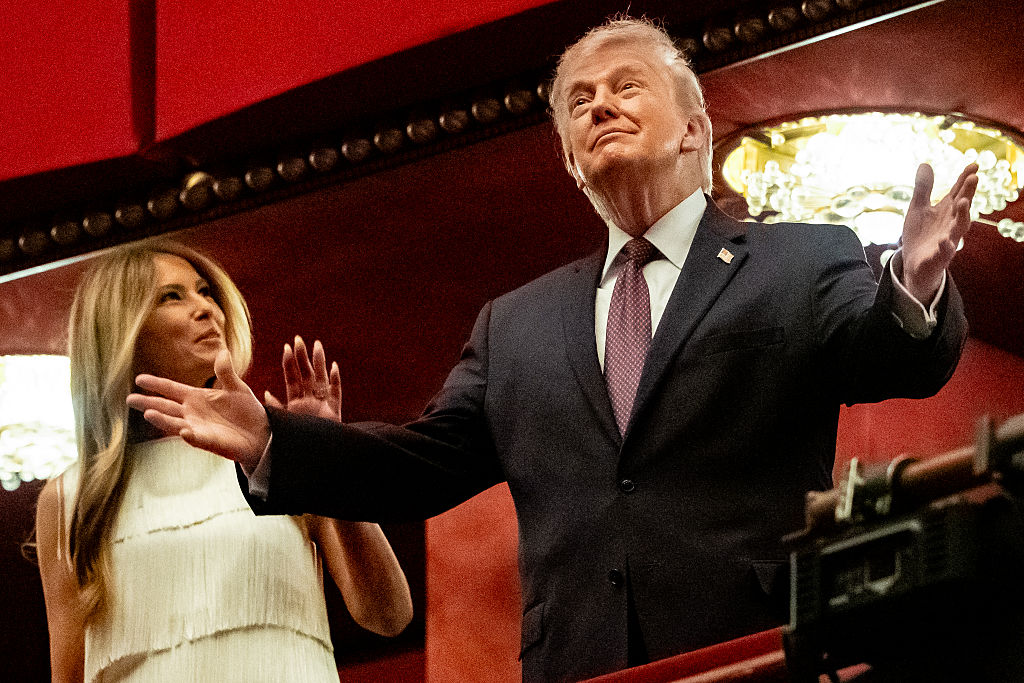
On last week’s episode, Dr James Orr, the Cambridge theologian and friend of J.D. Vance who is becoming to Nigel Farage what Keith Joseph was to Mrs Thatcher, described the ambition of his new thinktank, the Centre for a Better Britain. I reminded him of the lovely line from William Buckley, in his 1955 opening editorial for the National Review, that a conservative is one who ‘stands athwart history, yelling Stop!’ I suggested the elegiac conservatism of Michael Oakeshott and Roger Scruton has been succeeded by the missionary zeal of Peter Thiel and Elon Musk, who stand afore history, yelling ‘Go!’ Dr Orr believes this is not just because of the marriage between MAGA and assorted techno-utopians; nor is it a response merely to the rampaging globalisation chronicled in Vance’s memoir, with its Scrutonian title of Hillbilly Elegy. He argues that 1789 to 2016 was an Age of Liberalism, and now we’re suffering the birth pangs of a new epoch.
What should we call it? Such is the rate of technological innovation today, some people call it The Great Acceleration. Sadly, that’s been and gone. AI, which is underhyped rather than overhyped, will speed up history as never before. For instance, I suspect the future of work is Head (AI), Hand (Robots), Heart (Us, we hope). Acceleration is the rate of change of speed. The rate of change of acceleration is jerks. This is the Age of Jerks.
At Lord’s the other week, I spoke to a former prime minister. This kind soul wondered aloud if PMQs is the optimal use of a PM’s time. It eliminates half of Wednesday and much of Tuesday, so around 20 per cent of the week. The arguments for PMQs are familiar. Of course PMs hate it, you may say. But would a monthly interrogation by the liaison committee, while annoying for bulletin editors and keyboard warriors, better serve democracy?
I put this to Kemi Badenoch, whom I have just interviewed for TV. She said she likes the current arrangement. I shall remind her of that if she becomes prime minister. Watching the edit, I wondered if I am encouraging too many tears on television. Recently, in a BBC pilgrimage to India, I cried when thinking about my dear departed dad. Mrs Badenoch has a similar moment when talking about her late father. It was a revealing moment from a politician who’s not normally known for her vulnerability.
I strongly believe in rote learning poetry. I can recite, verbatim, most of Gray’s ‘Elegy Written in a Country Churchyard’, Satan’s unanswerable temptation in Book IX of Paradise Lost, and several of Shakespeare’s sonnets. I do it partly to combat cognitive decline. In the week of BBC scandals about Gaza, Glastonbury and MasterChef, I dutifully turned my attention to a denser verse – the BBC editorial guidelines – but found the decline accelerated.
The problem with experts
Danny Kruger’s brave defence of Christianity in the history of this country, which he recently delivered to an empty House of Commons, has won much praise. His words reminded me of when the same thing happened the other way round. As fourth-century Rome was Christianised by imperial decree, the distinguished senator Symmachus spoke up for the old pagan religion which had been degraded by the removal of the Altar of Victory from the Senate. He expressed his thoughts in the voice of the city herself, thus (Gibbon’s translation): ‘Pity and respect my age, which has hitherto flowed in an uninterrupted course of piety. Since I do not repent, permit me to continue in the practice of my ancient rites. Since I am born free, allow me to enjoy my domestic institutions. This religion has reduced the world under my laws. These rites have repelled Hannibal from the city, and the Gauls from the Capitol. Were my grey hairs reserved for such intolerable disgrace?’ Symmachus did not prevail, and the Senate dethroned Jupiter by a big majority. Given the political pressures, Gibbon writes, ‘it is rather surprising that any members should be found bold enough to declare… that they were still attached to the interest of an abdicated deity’. Kruger was showing similarly lonely boldness. There is a difference, however. The old Roman religion was defenceless except on grounds of custom. It did not contain the seeds of its own renewal. Kruger’s defence of his country’s past Christianity, by contrast, looked to the future. ‘A new restoration is needed now, with a revival of the faith, a recovery of a Christian politics and a re-founding of this nation on the teachings that Alfred made the basis of the common law of England…’ He ended: ‘This is a mission for the Church under its next leader… it is a mission for this place – the old chapel [on the site of whose altar the Speaker’s chair now sits] that became the wellspring of western democracy – and for us, its members; and it is a mission for our whole country. It is the route to a prosperous modernity founded on respect for human dignity, responsibility for the created world and the worship of God.’ That resonates.
Many say that domestic political motives underlie the cabinet’s promise to recognise the statehood of Palestine. Less has been said about its intellectual model. I suggest it is the Good Friday Agreement, coming from Jonathan Powell who, now as then, advises Labour prime ministers on how to deal with terrorists. Such suspicions were confirmed by a letter in Monday’s Times from Tom Kelly, the Blair spin doctor who was also involved in the Ulster peace process. He said terrorists rely on a simple argument: ‘That violence is the only way to get the world to take their cause seriously.’ Disprove that argument and the terror weapon fails: ‘That is how we ended the IRA’s campaign of violence and that is how Hamas could be stopped too.’ ‘But politics needs to be seen to work,’ Kelly continues, ‘and the recognition of Palestinians’ right to determine their own future is a first step.’ There are numerous fallacies in this reasoning (e.g. Hamas seem to have gained kudos in the West by mass murder), but there is also a key difference between the Northern Ireland situation and that in Gaza. In the first, the British prime minister was the most important player. In the second, he is of almost no account. It is dangerously hubristic to propose what you have so little part in delivering.
We generalists skate on thin ice and often rely on experts to start forming our views. For me, a current case in point is Javier Milei. I have never been to Argentina, and know little about it, so I have no idea whether its President is saviour or charlatan. I naturally turn for guidance to two economic writers whom I admire, Niall Ferguson and Ambrose Evans-Pritchard. Both have written about Milei recently. Ferguson hails Milei’s ‘glorious call to the authentic capitalists in the audience to rise up against their ancient enemy – the state’ and says that ‘The result of [his] shock therapy has been a stunning recovery’. Evans-Pritchard complains that ‘The Austro-libertarian free marketeer is not so free when it comes to the currency. He has allowed the peso to move within wider bands but it is still 30 per cent overvalued’. He has made his country yet more in hoc to the IMF (‘479 per cent of the country’s quota’). Kemi Badenoch should not praise him: ‘His circus-act adventurism has nothing in common with the great tradition of British conservatism.’ Oh dear. What am I supposed to think?
I was recently talking to a friend who recalled her childhood drives from home in East Anglia to the Sussex coast. In the early 1960s, there were no relevant motorways and so the journey passed through central London. To while away the time – on similar journeys I remember counting legs in the names of pubs (44 for The Cricketers) – her family would compete for how many black people (a complete novelty to them) they could see out of the car window. A typical total for the journey was eight. This little memory conveys the change more readily than all statistics.
In Poland, they want to build a new deep-water container port at Swinoujscie in the Baltic. This challenges existing German ports. Such disputes used to be settled by force of arms, but now we are all much nicer, and so German economic interests are being surreptitiously advanced through a court case brought by a body claiming environmental motives. Its name, in English, is the harmless-sounding Living Space Pomerania. The original German, however, is Lebensraum Vorpommern, which may help explain why feelings are running high.
‘It is 80 years since nuclear weapons were first used,’ says the BBC. True, but it is also 80 years since they were last used. So the theory of deterrence has worked, so far.
How bad can August storms get?
Injury time
England bowler Chris Woakes won a standing ovation for coming out to bat against India at the Oval with his arm in a sling after dislocating his shoulder – although in the event he didn’t have to face a ball before England lost. Some other sportsmen who carried on while injured:
— Franz Beckenbauer played out half an hour of extra time during the semi final of the 1970 football World Cup, also with his arm in a sling after dislocating his shoulder.
— Manchester City goalkeeper Bert Trautmann played the last quarter of an hour of the 1956 FA Cup Final with a broken neck after colliding with a Birmingham City player. His side won 3-1.
— Tiger Woods won the 2008 US Open in spite of playing with a torn anterior cruciate ligament and two stress fractures in his leg.
World class
The government wants to ban universities from taking foreign students where they have a high drop-out rate. Which countries sent the most students to Britain in 2023/24?
India 166,310
China 149,885
Nigeria 57,505
Pakistan 45,720
US 23,250
Hong Kong 17,258
Malaysia 12,760
Bangladesh 12,285
Saudi Arabia 9,680
Source: Higher Education Statistics Authority
Road toll
How do deaths from drink-driving compare with those from driving under the influence of illegal or medical drugs? In 2023, 869 drivers died in road accidents. Of those:
— 771 were tested for alcohol, which was found in 171 cases.
— 27 were tested for medical drugs likely to cause impairment; 23 were positive.
— 612 were tested for ‘drugs of misuse’, of which 131 were positive.
Source: Department for Transport
Storm surge
Scotland and the north of England were hit by unusually strong storms by August standards. How bad can August storms get?
— On 14 August 1979 a storm struck the Irish Sea during the Fastnet Yacht Race, with wind speeds of up to 63mph. Of 303 boats which began the race, only 86 finished; 15 competitors and 6 spectators died.
— On 25 August 1986 ex-Hurricane Charley struck the British Isles with winds of up to 65mph. Ireland was especially affected, with 7.8in of rain in 24 hours.
Hiroshima and the continuing urgency of the atomic age
In August 1945, Group Captain Leonard Cheshire was stationed on the Pacific island of Tinian as an official British observer of the dropping of the atomic bombs on Hiroshima and Nagasaki. Two decades later, he wrote for The Spectator about his experience. For him, the attack on the two cities represented ‘the ‘destruction of the impotent by the invincible’. Nevertheless, he argued that the Allies had been ‘undeniably’ right to carry out the bombings since the attack ended ‘the most terrible war’ and prevented an extremely bloody invasion of Japan.
By 1965, the emphasis in public discussion had shifted from ‘the suffering that the world was spared’ to the dead – the 120,000 estimated to have been killed instantly by the blasts, and the many more who died later from burns, radiation sickness and starvation. Although Hiroshima had been a substantial military base, around nine in ten of those killed were civilians.
The debate remains intractable. Supporters suggest the bombings ended the war as swiftly as possible against a Japan prepared to fight to the last man; opponents argue that Emperor Hirohito was already considering surrender and that the bombings were uniquely grotesque acts of revenge.
Reflecting later, Cheshire argued that the bomb should have been dropped offshore first, as a warning. Not doing so left the ‘honour and the justice of our cause… degraded in the eyes of the world’.
The bombings remain the only use of nuclear weapons in an armed conflict. Despite the proliferation of other existential threats, the 80th anniversaries of Hiroshima and Nagasaki this week should not only serve as an opportunity to relitigate historical debates, but also as a reminder of the continuing urgency of the atomic age.
A third of a century on from the Cold War’s end, nuclear weapons remain a live issue. Last week, Donald Trump sent two nuclear submarines towards Russia in response to the former Russian president Dmitry Medvedev grandstanding about his country’s lethal capabilities. In June, the US struck three facilities in Iran to hobble Tehran’s nuclear programme. The same month, Keir Starmer announced the purchase of F-35 planes capable of delivering nuclear weapons, ending a quarter of a century of reliance on submarine-launched ballistic missiles.
It was the threat of mutually assured destruction that kept the Cold War from turning hot
Britain is not alone in looking to adapt and expand its nuclear arsenal. Poland, Germany and Japan have all recently toyed with acquiring or hosting nuclear weapons, as the dependability of the US nuclear shield has come into doubt. Fiona Hill, a foreign affairs scholar and former deputy assistant to the president of the United States, recently predicted that the number of nuclear powers could double in the next 20 years.
For disciples of deterrence theory, this unprecedented rate of proliferation highlights the enduring relevance of nuclear weapons as a tool of peace. It was the threat of mutually assured destruction that kept the Cold War from turning hot. A similar fear helped nuclear-armed India and Pakistan step back from war over the recent terror attacks in Kashmir. The political scientist John Mearsheimer has argued that Russia would have been deterred from invading Ukraine if Ukraine had not surrendered its nuclear weapons in 1994.
The abstractions of international relations tend to obscure the fact that diplomacy and war are practised by irrational, quarrelsome and bigoted human beings. Undoubtedly, nuclear weapons have raised the stakes for any country considering an attack on a fellow nuclear power. But the human appetite for destruction has not been nullified.
Even if the Cold War avoided a direct US-Soviet exchange, tens of thousands still perished in proxy wars from Korea to Angola. It was only thanks to the restraint of shrewd statesmen that crises over Cuba and the Middle East did not escalate past the point of no return. Today’s leaders may not possess the same perspicacity. The shadow cast by Hiroshima and Nagasaki has prevented the use of nuclear weapons for eight decades. There is no guarantee that it will continue to do so.
The US pursuit of the nuclear bomb was expedited by the fear of what would happen if the Nazis acquired such a weapon first. The desire to stall Iran’s nuclear programme today stems from a conviction that the ayatollahs are fanatical enough to carry out their threats against Israel. As Cheshire put it, the ‘evil is not so much in the bomb itself’ but ‘in the hearts of men’.
The further proliferation of nuclear weapons would mean an increase in the potential for devastation far beyond what the world witnessed at Hiroshima and Nagasaki. Disarmament may be an unlikely prospect amid a new age of great power competition. But today’s statesmen should heed the words inscribed on the Hiroshima Peace Memorial, erected in what was once the city’s busiest commercial and residential district: ‘Let all the souls here rest in peace, for we shall not repeat the error.’
Portrait of the week: Migrant treaty kicks in, car finance claim kicked out and a nuclear reactor on the moon
Home
A treaty with France came into operation by which perhaps 50 small-boat migrants a week could be sent back to France in exchange for asylum seekers in France with family connections to Britain. Yvette Cooper, the Home Secretary, could not say when the returns would begin. The number of migrants arriving in England in small boats in the seven days to 4 August was 1,047; the total for the year reached more than 25,000 at a faster rate than ever. The population of England and Wales rose by 706,881 in a year, the Office for National Statistics estimated, to 61.8 million by June 2024, of which only 29,982 was by natural increase, the rest being net migration. The Guardian reported that 2.99 million of the 6.23 million patients in England awaiting care have not had either their first appointment with a specialist or a diagnostic test since being referred by a GP.
The government would miss its borrowing target by £41.2 billion, according to the National Institute of Economic and Social Research; the answer was to raise taxes. The Supreme Court ruled that millions could not claim compensation for car dealers having received hidden commission from lenders when customers signed up for car finance before 2021. But the court upheld one type of claim, so the Financial Conduct Authority will consult on running a compensation scheme, to cost between £9 billion and £18 billion. The Charity Commission rebuked all parties to a dispute between the Duke of Sussex and the chairwoman of Sentebale, the charity he founded, but found no evidence of systematic ‘misogynoir’. Civil service internships will be offered in future only to students from ‘lower socio-economic backgrounds’, based on the occupations of their parents when the applicant was 14; butchers and dustmen would do, and even train-drivers. LNER warned passengers not to travel north of Newcastle on the day of Storm Floris. A failure at the Swanwick air traffic control centre cancelled hundreds of flights. Heathrow airport said it would spend £49 billion on improvements, including £21 billion on a third runway.
Two men appeared in court charged in connection with the rape of a 12-year-old girl in Nuneaton; Warwickshire Police said: ‘Once someone is charged with an offence, we follow national guidance. This guidance does not include sharing ethnicity or immigration status.’ Mohammed Fahir Amaaz, aged 20, was convicted of assault and actual bodily harm against two policewomen at Manchester airport last year. Tommy Robinson was arrested at Luton airport in connection with an alleged assault at St Pancras station last week. Dame Stella Rimington, the first woman director-general of MI5, died aged 90. Lord Desai, the economist, died aged 85. India won the fifth Test by six runs.
Abroad
President Donald Trump of the United States enjoyed another bout of throwing tariffs around: 39 per cent for Switzerland, 35 per cent for Canada, 50 per cent for Brazil. He then said he was sacking the head of the Bureau of Labor Statistics, Erika McEntarfer, after estimates of job growth in May and June were revised. Mr Trump said two nuclear submarines would ‘be positioned in the appropriate regions’ in response to ‘highly provocative’ comments by the former Russian president Dmitry Medvedev. Mr Trump had said: ‘Russia, I think it’s disgusting what they’re doing,’ after more drones and missiles were launched against Ukraine than ever. After street protests, MPs in Ukraine overturned legislation passed a week earlier that had removed the independence of two anti-corruption agencies. A big oil depot fire near Russia’s Black Sea resort of Sochi was blamed by Moscow on a Ukrainian drone attack. Eight countries of Opec+ (including Russia) agreed to produce more oil. BP announced its biggest discovery in 25 years: an oil and gas field off Brazil. Nasa hatched plans for a nuclear reactor on the moon.
Benjamin Netanyahu, the Israeli Prime Minister, resolved to reoccupy the Gaza Strip fully. Hamas declared that it would not agree to disarm unless a sovereign Palestinian state was established. Canada said it would recognise Palestine as a state in September. The International Committee of the Red Cross was ‘appalled’ by videos of two emaciated hostages in Gaza.
A boat with 157 migrants from the Horn of Africa sank off the coast of Yemen and only 12 were rescued. The Pope said mass for a million young people at Tor Vergata on the outskirts of Rome. Aalborg Zoo in Denmark appealed for guinea pigs and horses, to feed its lions and tigers. CSH
Inside the Mohammed Hijab trial
Mohammed Hijab sat at the back of the courtroom and ate doughnuts while his lawyer, Mark Henderson, delivered his closing submission. ‘You will have seen that my client is argumentative, can be provocative,’ said Henderson. ‘Some people might think that he is a bit of a smart alec, a bit too cocky.’ Hijab reclined in his chair and licked the sugar from his fingers.
Hijab acted like a schoolboy throughout last month’s four-day trial at the Royal Courts of Justice. He laughed and shouted while giving evidence. ‘It’s an unsalvageable case, Greg! It really is!’ he yelled at The Spectator’s legal counsel Greg Callus at the end of his second day in the stand, leaning over the side.
Well, he lost. Hijab sued The Spectator and Douglas Murray over Douglas’s column of 24 September 2022, claiming that Douglas had misrepresented what he said in a speech in Leicester during the sectarian disorder there three years ago. In his ruling this week, Mr Justice Johnson has confirmed that what Douglas wrote is ‘substantially true’.
We can now repeat it: Mohammed Hijab is a street agitator who whipped up his followers in Leicester during the unrest there between Muslims and Hindus. He mocked Hindus, and claimed that they must live in fear because they have been reincarnated as ‘pathetic, weak, cowardly people’.
On 18 September 2022, with Leicester in chaos, Hijab travelled there from London and made sectarian tensions worse. ‘Let me tell you something,’ he said to a gathered crowd of mostly masked Muslim men. ‘All due respect, actually no due respect, yeah, if they believe in reincarnation, yeah, what a humiliation and pathetic thing for them to be reincarnated into some pathetic, weak, cowardly people like that. I’d rather be an animal.’
In his column, Douglas said that Hijab had attacked Hindus in this speech; in court, Hijab said that he had only criticised Hindutva (extreme Hindu nationalists). Hijab tried to argue that it was possible that a Hindutva could be a non-Hindu. Therefore, Douglas had defamed him. When asked by Callus to name a non-Hindu Hindutva, Hijab struggled. In the moment, he could only think of one: Benjamin Netanyahu. He later remembered two others: Tommy Robinson and Douglas Murray.
Phrases such as ‘not credible’, ‘not consistent’, ‘untenable’ and ‘confected’ fill the judgment
Hijab’s case was a pile of unbelievable claims of this kind. At one point, the court was played a video of a seminar he hosted in April 2022, before the disturbances in Leicester, where he openly smirked while asking Hindus about their belief in reincarnation. The Spectator’s lawyers wanted to show that he had form for ridiculing the religion. ‘What would you choose to be? A bear or a gorilla?’ Hijab said in the video. ‘I would rather be a bear because if a bear and a gorilla had a fight, the bear would win.’ ‘Is she the one with the four arms?’ he also said, when referring to a Hindu deity.
Hijab continued to smile in the stand as these clips were played, then tried to claim to the court that they showed him a ‘humble learner’ making genuine enquiries. Of course he was not mocking Hindus. The judge did not buy any of it. Phrases such as ‘not credible’, ‘not consistent’, ‘untenable’ and ‘confected’ fill his judgment. He calls Hijab a liar.
Hijab has previously tried to bully British publications who cross him, threatening them with lawsuits worth many hundreds of thousands of pounds in damages and legal fees. In this case, Hijab said that three contracts with three organisations had been cancelled because of Douglas’s article. The Spectator argued, and Johnson agrees, that the messages showing that these unevidenced contracts were apparently cancelled as a result of the article in order that Hijab could claim damages were contrived and implausible.
Hijab’s evidence for these damages verged on comic. In one instance, a man who intended to ‘cancel’ Hijab’s ‘contract’, who had known him for years and called him ‘bro’ over WhatsApp, informed Hijab of the news over email. He addressed him formally, as if they’d never met, with the formal salutation of ‘Dear Mr Hegab’. (Mohammed Hegab is Hijab’s real name.) It seemed Hijab and his mates wanted this flimsy evidence to look more official.
When Hijab was not shouting, smirking, lolling in his chair or eating doughnuts, he looked at a printout of Douglas’s column, the one he was suing over, with Douglas’s caricature at the top. Hijab had been desperate to ‘debate’ Douglas for years, and had hoped that the two would meet in court. In the end, he didn’t get the satisfaction, because Douglas wisely decided not to attend.
Watch Max discuss the trial on Spectator TV:
Rattigan’s films are as important as his plays
A campaign is under way to rename the West End’s Duchess Theatre after the playwright Terence Rattigan. Supported as it is by the likes of Judi Dench and Rattigan Society president David Suchet, there’s evidently a desire to right a historical wrong. Author of classics such as The Browning Version, The Winslow Boy and Separate Tables, Rattigan was known for his poise, melancholy and restraint, all of which put him at odds with the coterie of upstart writers of the 1950s – still amusingly known as the Angry Young Men.
It’s an oft-repeated chapter of theatre history that arch-kitchen-sinkers such as John Osborne made the environment virtually impossible for Rattigan to work in. Rattigan joked about it at the 1956 opening of Look Back in Anger. It was as if Osborne were saying, ‘Look, Ma, I’m not Terence Rattigan!’ he quipped. However, the Rattigan-bashing was always an empty indulgence. Osborne himself admitted as much on these very pages in 1993, writing: ‘I have been intrigued by the success of the current revival of Terence Rattigan’s The Deep Blue Sea. Rattigan was under the general frown when I first joined the Royal Court Theatre in 1956, and both George Devine and Tony Richardson were appalled when I confessed to being moved by the play.’
Perhaps a Rattigan Theatre would indeed lay some of the ghosts to rest. But on first hearing news of the campaign, another thought occurred: Rattigan deserves a cinema as well. Film was arguably much kinder to him than theatre ever was in the low ebbs of his career. It supplied him with constant work, saw some of his best adaptations, and allowed his writing to weather the storm.
Without his breakout play French Without Tears (1936), British cinema wouldn’t have acquired one of its classic rogues, Rex Harrison, whose name it thrust into the spotlight. But French Without Tears was chiefly important because its adaptation in 1940 was Rattigan’s first collaboration with director Anthony Asquith – and the first success of his screen career. Few could match Asquith’s ability to adapt stage classics for film. The son of liberal prime minister Herbert, Asquith junior had directed an Oscar-nominated Pygmalion (1938), with Leslie Howard and Wendy Hiller, as well as the most celebrated version of The Importance of Being Earnest (1952), with Edith Evans as the definitive Lady Bracknell.
Like so many British artists, Rattigan and Asquith were drafted into propaganda duties during the war. And it resulted in their first truly great work, The Way to the Stars (1945). The film had a Who’s Who cast – Michael Redgrave, John Mills and Trevor Howard, all of whom would return to work with Asquith and Rattigan – and in its quieter moments, observing the grin-and-bear-it times of a British bomber base, hinted at their true creative potential.
Postwar, Asquith returned to Rattigan’s stage work with an adaptation of The Winslow Boy in 1948. It perfectly captured the it’s-just-not-cricket mentality of the original play with its story of a boy unjustly expelled from naval college. Rattigan would take up these themes again (to lesser effect) in The Final Test (1953), but The Winslow Boy had the advantage of Robert Donat in the lead role at the height of his powers.
The Browning Version may be one of the most quietly devastating English films ever made
Asquith’s take on The Browning Version was another great example of his refusal to follow the growing spectacle – albeit much of it magnificent – of contemporaries such as David Lean and Michael Powell. Refraining from visual tricks or even much of a musical score, Asquith allows Rattigan’s poise and melancholy to speak for itself. It may be one of the most quietly devastating English films ever made. And as the retiring classics teacher who may or may not be missed by his pupils, Michael Redgrave gives one of his most heart-wrenching performances as Crocker-Harris.
Rattigan was not tied to Asquith, and pursued multiple projects outside of his preoccupation with upper-middle-class England. He created the original screenplay for Brighton Rock (1948), for example, Graham Greene’s story of wide-boy knife gangs directed by John Boulting. It was reworked before reaching the screen but Greene crucially retained Rattigan’s vision of the work as a thriller rather than an intellectual treatise. The Boultings kept Rattigan’s change of ending, too, in which a gramophone recording of Pinkie (Richard Attenborough) jams on ‘I love you…’ before he lays into his love interest.
Rattigan didn’t generally shy away from the brutality of romantic relationships. The Deep Blue Sea (1955) is testament to that. Influenced by the relationship between Rattigan and actor Kenneth Morgan, the play’s curtain-twitching portrait of a squalid postwar London is still one of his most unflinching of love stories. Vivien Leigh was cast as Hester, the spurned lover of RAF pilot Freddie, played by Kenneth More, who had transferred from the original play. More suggested that Leigh brought too much glamour to the part. Yet with Leigh’s mental health deteriorating and her personal life crumbling, she appears in hindsight to have been all too right for The Deep Blue Sea.
Rattigan then teamed up with Leigh’s husband Laurence Olivier on The Prince and the Showgirl (1957), but Rattigan’s last great screen work was his collaboration a year later with Delbert Mann on the Oscar-nominated Separate Tables. Another of his tragic ensemble pieces, the film saw a wealth of stars gathered in a run-down Bournemouth hotel, all forced to examine their lives after the revelation of a scandal involving the retired Major Pollock played by David Niven. Niven has the film to thank for the only Oscar win of his career, and Rattigan for his second nomination. (He received his first in 1952 for scripting David Lean’s The Sound Barrier.)
What happened next might have been the apex of Rattigan’s screen career yet turned out to be the beginning of the end. In 1960 he had started working with the Rank Organisation to adapt his T.E. Lawrence play Ross. It was to star Dirk Bogarde and Asquith was slated to direct. But there was a problem: another Lawrence film was already in the works. Out of respect to David Lean – and under some pressure from Lawrence of Arabia producer Sam Spiegel – the studio pulled the plug on the project. Bogarde called it his ‘bitterest disappointment’.
Rattigan and Asquith ploughed on, assembling star-studded casts for two further movies, The V.I.P.s (1963) and The Yellow Rolls-Royce (1964), with all favours from friends called in. But even with Rattigan’s work finding new audiences on television, the 1960s were relentlessly unforgiving. His last screenplay of note was the wonderful musical adaptation of Goodbye, Mr Chips (1969), with Peter O’Toole, before he fled into creative (and tax) exile to Bermuda. A knighthood in 1971 and a minor reconciliation with the theatre industry before his death in 1977 did little to remedy his unhappiness.
The West End rediscovers Rattigan’s work almost every decade. But the screen never forgot him. Terence Davies’s hypnotic version of The Deep Blue Sea (2011) with Rachel Weisz and Tom Hiddleston converted a whole new generation.
Rattigan no doubt deserves a theatre. His contribution continues to enrich the British stage – especially in its deeply English themes, its styling and restraint. But his dedication to the screen suggests a Rattigan cinema wouldn’t go amiss either.
Wittily wild visions: Abstract Erotic, at the Courtauld, reviewed
If you came to this show accidentally, or as a layperson, it could confirm any prejudices you might have about avant-garde sculpture. Pretentious, ugly and resorting to kink. Those pendulous string bags, that enormous turd – gimme a break.
Except that would be a mistake. Because the work here is the real thing: the 1960s originals that spawned a million imitations and parodies. The exhibition is perhaps a little cool about selling itself, so allow me. This is a snapshot of the work of three artists around the time they all took part in a 1966 New York show called Eccentric Abstraction. Two of the artists, Louise Bourgeois and Eva Hesse, were nascent superstars.
Bourgeois, then in her fifties, was working with ‘soft, yielding’ materials such as plaster and wax for the first time. But she could already conjure Brothers Grimm-style psychodrama from any innocent old coil of splat. Her aesthetic was well under way: a phallus cast from pigmented urethane rubber, and hanging from a metal wire, is titled ‘Fillette’ (1968-9) or ‘little girl’. ‘Lair’ (1962), a charismatic latex cowpat, is structured so you can peep voyeuristically into its glutinous interior.
A small auxiliary show of her drawings downstairs reveals work and life colliding – as they tend to. ‘I have discovered this morning… a wax for children, a kindergarten crayon, I think it’s called a Crayola… which is a great help because I have hundreds of them floating around the house… whereas my elegant litho crayons or negative crayons I am unable to keep. People walk away with them, at school and at home,’ she recorded in an audio diary in 1975, a quote displayed alongside repetitive, self-soothing sketches.
The self-contained totem-like sculptures from the 1960s remained key pieces in her arsenal – Robert Mapplethorpe photographed her with ‘Fillette’ under one arm in 1982 – although her vision expanded into whole rooms, towering spiders and mises-en-scène. By the time she died in 2011 aged 98, even the wider world had caught on.
The long run at life was not granted to Eva Hesse, the other star here. She died of a brain tumour aged 34, precociously visionary, wittily wild. A wounding loss. Selma Blair played her in a docudrama. Born in Hamburg in 1936, she came to England on the Kindertransport aged two and thence to New York. She studied under Josef Albers at Yale and had a decade on the scene with close muckers Donald Judd, Yayoi Kusama, and Sol LeWitt.
These are the real thing: the 1960s originals that spawned a million imitations and parodies
Her work when it is exhibited is sometimes all the more poignant because of the way it has decayed, being made of deliberately transient material such as latex that has dried and cracked. As she once observed: ‘Life doesn’t last; art doesn’t last.’ But the work selected here is durable stuff, playfully assertive, and presented more or less as it would have been before there was any aura of canonisation about her, when she was just another young turk. ‘Addendum’ from 1967 is a teasing yet formal line-up of papier-mâché mounds, extruding over-long cords. ‘Endless repetition can be considered erotic,’ Hesse wrote that year. Mysterious and compelling.
Bourgeois could conjure Brothers Grimm-style psychodrama from any innocent old coil of splat
The third artist, Alice Adams, was a trained weaver who, in the radical spirit of the 1960s, put down her loom and started manipulating tarred rope, chain-link fencing and rusted steel cable. It was a response to the intense redevelopment of Manhattan in the 1950s and 1960s, which at the time made her feel ‘physically injured’. Now 94, she gives cheerful testimony about the strange looks she got in builders’ yards and the steel cable she gleaned when the YMCA on 92nd Street was broken up. She was subsequently drawn towards land art and, like Anthony Caro, advised on infrastructure projects. Her 2023 partial remake of ‘Big Aluminium 1’ (1965, see below), hangs here like a vast sex-ed diagram made out of chicken wire.

These works summon the senses, their materiality and sense of process analogous with corporeality and bodily change. Whether they are erotic is, of course, debatable. Yes, playfulness and wit is here, but pleasure? For those with an interest in post-minimalism, this is a resounding yes.
The excruciating tedium of John Tavener
The Edinburgh International Festival opened with John Tavener’s The Veil of the Temple, and I wish it hadn’t. Not that they were wrong to do it; in fact it was an heroic endeavour. Drawing on three large choirs, members of the Royal Scottish National Orchestra and a sizeable team of soloists, this eight-hour performance was the sort of occasion that justifies a festival’s existence – the kind that, done well, can transform your perceptions of a work or a composer. It was certainly done well, and it certainly transformed mine. I’d never much minded the music of John Tavener. By the fifth hour of The Veil of the Temple, I was beginning to detest it.
To Tavener’s many fans, I can only apologise, pleading the defence that musical marathons do not usually trouble me (just try and keep me away from a Götterdämmerung). Credible colleagues described The Veil of the Temple as a masterpiece, and the EIF, clearly, was pushing the boat out. They’d replaced the stalls of the Usher Hall with beanbags and the Festival’s artistic director Nicola Benedetti gave a preliminary pep talk, urging us to come and go as we pleased. (The Ladyboys of Bangkok were performing just across the road).
Again, it was impressively done. Tavener created the piece in 2003 as a dusk-to-dawn vigil in the Temple Church, and while the Edinburgh performance ran from 2.30 p.m. to 10.30 p.m. the director Thomas Guthrie had been engaged to recreate that sense of ritual. Choirs processed around the hall; there were lighting effects and at the start of each new section a soloist lit a candle. Sofi Jeannin conducted unflappably, and the Monteverdi Choir handled the trickier passages with its usual finesse. The National Youth Choir of Scotland sounded luminous and utterly tireless, while the Festival Chorus gave it their best shot. The soloists sang with conviction, and the occasional solos from the duduk player Hovhannes Margaryan were ravishing.
But still: the tedium. God, the tedium. Satie aside, composers who operate over an epic span of time generally seek to create a sense of movement; of growth. Not Tavener. He begins with a soprano solo, a blast on a Tibetan temple horn and a bell, before working through an hour-long meditation on a mish-mash of religious texts. Some are delivered in lush, melismatic choral harmonies, others are chanted unaccompanied and some are simply intoned at excruciating length on a single note. That was the first cycle. Then the bell clanged, the horn bellowed, and Tavener moved on to the second, which was almost identical. And then the third, and so on: six huge, slowly thickening variations on material that was wearing thin within the first hour.
There is no fast music to speak of, and Tavener’s choral rhapsodies typically unfold over a static drone. The music just stands there, revolving and self-regarding. Individual sections are gorgeous; you could pull ten minutes out of any choral episode and create an exquisite self-contained miniature. But repeated at this sort of length, it felt like being caressed with velvet until your skin rubs raw and starts to bleed. Seated upstairs in the middle of a row, I was effectively locked in place, screaming inwardly. A ten-minute break five hours in allowed a relocation downstairs to the beanbags, where the knowledge that I could (if necessary) escape made the ordeal more bearable.
Eight hours of glassy-eyed sonic masturbation under a monk’s habit. The things we do for art
There was a pay-off, of sorts. After seven hours there’s a seismic shift: brass and percussion enter and Tavener co-opts Tristan und Isolde and The Waste Land to generate the catharsis that his own ideas are impotent to express. Even that outstayed its welcome, though the audience exploded in cheers (roughly two thirds of them stuck it out to the end). I just kept thinking of Archbishop Colloredo’s injunctions to Mozart about keeping sacred music concise. Tavener professed the Orthodox faith but western churches have traditionally regarded ostentatious displays of piety as obnoxious, if not actually sinful. And this one went on for eight hours. Eight hours on a summer day in a beautiful city. Eight hours of glassy-eyed sonic masturbation under a monk’s habit. The things we do for art.
That doesn’t leave much space for the Three Choirs Festival, where Samuel Coleridge-Taylor’s 1903 passion oratorio The Atonement (think Parry rescored by Elgar) received an affectionate and energetic revival under Samuel Hudson, with a spectacular solo turn as Pontius Pilate from the great Mark Le Brocq. Poor Coleridge-Taylor. He rambles, for sure, but he strives, too, and at his best he touches the heart. How harshly we judge our second-rate romantics! And how we indulge our celebrity minimalists. No one’s going to programme The Atonement at Edinburgh any time soon, but I’d re-hear it three times in succession sooner than endure another five minutes of The Veil of the Temple.
The terrifying charisma of Liam Gallagher
You’d have thought Wembley Stadium was a sportswear convention, so ubiquitous were the three stripes down people’s arms from all the Adidas merch: veni, vidi, adi. Pints drunk: 250,000 a night, apparently. All along the Metropolitan line pubs noted an Oasis dividend. At a corner shop, I was sold an official Oasis Clipper lighter. It’s surprising Heinz hasn’t yet offered an Oasis soup; you get a roll with it.
Plainly, an awful lot of people have missed Oasis. And an awful lot of people – Noel and Liam Gallagher included – saw the chance to make an awful lot of money from their reformation. I don’t think any of them – neither fans nor entrepreneurs – will have been disappointed. At Wembley, the atmosphere was remarkable. Not least because it wasn’t the beery, coked-up event one might have feared. The main spectacle on view was an unusual one: a sea of loved-up men.
Wherever two men or more stood alongside each other, arms were draped around one another, faces raised to the sky to holler one more chorus. On stage, backed by video screens that for once were being terrifically deployed, the two Gallaghers, plus their four accomplices, were hailed as though they had come to return the world to happier times.
You don’t need to be a genius to work out why Oasis work in stadiums. Their songs are huge, simple, and not meant for dancing to. Dancing is something one does as an individual, and Oasis songs are meant for the collective: it’s why their tempi are so sluggish – they are a surprisingly slow band. Their songs are meant for the vast bounce of a crowd pogoing in unison, or waving phone cameras to. The majority of the set was made up of ballads that are around 80 beats per minute on record or mid-paced chuggers that clock in at around 110: the exact amount of time between beats needed to spring up, land, and spring up again.
It also helps that Noel Gallagher’s lyrics are designed to be hollered. They are mostly nonsense, of course, but the occasional diamond shines out, hitting all the harder for being surrounded by doggerel: ‘Is it worth the aggravation/ To find yourself a job when there’s nothing worth working for?’ He has a gift for words that sound profound when sung, but mean nothing – he could have had a thriving career making up imaginary proverbs.
The night was brought to life by Liam, who remains a star of terrifying charisma. Even stock-still, bucket hat pulled down, cagoule pulled up, he was extraordinary. Age has done nothing to dim his apparent rage, and it’s the anger that he throws into his singing that makes the band compelling and gives the songs meaning.
The Gallaghers were hailed as though they had come to return the world to happier times
But that anger reflects something else. When Oasis broke through in the early 1990s, I was only a few years out of school, where I had been badly bullied. The Gallagher brothers were bullies: it was there in the cruelty they casually meted out in interviews to rivals, peers, anyone who had crossed their sights, even each other. And they were funny with it, as bullies often are. Even now, deep into middle age, the two of them – but Liam especially – sometimes sound as though they’re itching to stomp on someone.
When I’d been a kid, independent music had been my escape from people such as the Gallaghers, who were plentiful at my Slough state school. And when Oasis became the biggest band not just in independent music but in Britain, it felt as though the school bullies had taken over indie. At the time of their success, I truly resented them – and I resented all those bands who previously wouldn’t have said boo to a goose but suddenly, in their wake, affected a charmless swagger.
It’s an uncomfortable truth that an edge of tension, the slight threat of something, makes rock exciting. But it does. At 56, I’m old enough not to care any longer that they’re bullies. And to the vast number of young people who turned up, it’s irrelevant. Oasis aren’t an indie band. They’re the Rolling Stones for my kids’ generation: famous old men who sing very famous songs. They’re not even a band any longer; they’re holy relics.
A mafia drama like no other
The Kingdom is a mafia drama like no other. It’s directed by Julien Colonna whose father was a Corsican mob boss who died in 2006 (officially in a car crash although it’s generally believed he was ‘whacked’). And it’s told through the eyes of a young girl. Think of it as The Godfather from the point of view of a teenage Connie Corleone. Or The Sopranos from the perspective of Meadow. Or just take it for what it is, which is tense, brilliant and rivetingly convincing.
The film is set in Corsica in 1995 at a time when the island was experiencing deadly mob feuds as well as intense conflicts between nationalist groups. Colonna has deployed locals rather than professional actors which adds to that believability. The cast is led by Ghjuvanna Benedetti who is stunning in every possible way. She plays 15-year-old Lesia – roughly the age Colonna would have been in 1995 – and she’s our point of view.
She lives with her aunt in a village where school is out for the summer. (I’m a sucker for what I call ‘the one long hot summer’ film.) She flirts with a handsome boy. She heads to the beach with her friends. After a hunt she field-dresses a strung-up boar. Blood splatters her face. It’s expected. It’s the Corsican way. Violence is customary, always in the air.
Her summer changes when she is whisked away to stay with her father Pierre-Paul (Saveriu Santucci). He’s a crime boss, holed up in a villa, on the run from the police as well as rival gangsters. Their tit-for-tat killings appear to have been going on for ever. He adores her but he does not know her. Lesia isn’t a talker. She is quietly watchful and sullen but he promises her a week of fishing and swimming.
It’s all change again, however, when Pierre-Paul and assembled ‘uncles’ gather round the television and watch a report on a car bomb that may well have been intended for him. From now on it’s all safe houses, disguises, overheard conversations, glimpses of Pierre-Paul sending his lieutenants out in bullet-proof vests with guns. He tries to return her to the village but she smuggles herself back. At some level she comprehends that she has a limited time in which to bond. They’re on the run together and she must now face the dangerous realities of his world and ‘the kingdom’ that he has created and that she will inherit. Or will she? Will she be able to break the cycle of retribution? (Colonna’s father’s father was also murdered by the mafia. Not a ‘car crash’. Shot dead.)
I doubt you’ll be able to take your eyes off Benedetti for a single second
The film is understated, naturalistic, sultry, intimate, with a pervasive undercurrent of dread while Lesia and her father’s relationship grows deeper. Pierre-Paul treats his daughter tenderly and with affection yet she knows, as do we, that he is capable of truly brutal acts elsewhere. How do you love a man like that? It certainly doesn’t make being a mobster look like any fun, even though the fabulous cinematography makes Corsica looks stunning. You want to tell them: ‘Pack it in and go for a nice swim, fellas!’
It’s not, I should have said, an especially bloodthirsty film. Most of the ‘whackings’ take place off camera, although it does ramp up at the end. The performances are terrific – as is the chemistry between the two leads. And I doubt you’ll be able to take your eyes off Benedetti for a single second.
It’s Colonna’s first major film and I hope there are many more. He may get to live a long life.
What a slippery, hateful toad Fred Goodwin was
Make It Happen is a portrait of a bullying control freak, Fred Goodwin, who turned RBS into the largest bank in the world until it came crashing down in 2008. Fred the Shred’s character makes him a tough subject for a drama. His morning meetings were called ‘morning beatings’ by terrified staff. He ordered executives to pitch him an idea in the time it took him to eat a banana. Inciting arguments between staff amused him and he once sacked an employee for saying ‘I tried’ instead of ‘I succeeded’. He was obsessed with colours and fabrics and he personally oversaw the design of the carpets and even the handwash at the bank’s headquarters.
But James Graham’s play offers us very few clues about the origins of his character flaws. We learn nothing of Goodwin’s childhood or his family, and his romantic side is confined to a hasty fling with a female employee. All we see are the outward workings of his soul. And it’s ugly. It’s also suburban. He’s just another corporate hyena who happens to roam across an exceptionally broad hunting ground. As a person he’s as much fun as a Dalek.
The story is told through his relationship with the upbeat Alistair Darling and the morose, brooding Gordon Brown (Andy Clark) whose personality seems eerily similar to Goodwin’s. At times, Brown threatens to take over the drama. Lurking in Goodwin’s office is the spirit of his mentor, Adam Smith, played by Brian Cox. It’s hard to play a ghost on stage because the undead have no stake in real-life events, and Cox portrays him as an amusingly cantankerous buffer who reacts with outrage when he learns that his legacy has been misappropriated by greedy bankers. He wants them to read his other book, The Theory of Moral Sentiments, but Goodwin has never heard of it.
Cox works well with the excellent Sandy Grierson who plays Goodwin as a slippery, hateful toad. The script is a little over-busy and it keeps flitting from one genre to another. Bits of history give way to snatches of drama and dance routines. There are communal songs, displays of video graphics and amusing props for parodies of TV game shows. But it seems perfunctory rather than dazzling. The production feels like a town-hall pageant designed to give employment to every artisan and mummer in the district. The level of ambition is low and the actors have to deal with a scruffy set composed of platforms, wooden steps and boxy angular backdrops. Lazy work. The crowd in Edinburgh seemed to like this show without loving it. That’s about right.
Palestine: Peace de Resistance is a one-man cabaret by Sami Abu Wardeh who was brought to Britain from Kuwait as a kid and raised in Battersea. His Palestinian father taught him Arabic and he learned English from his Liverpudlian mum. He’s a gifted performer with lots of personality and he uses the conflict in Gaza as a pretext to showcase his many talents. He dances, sings, plays the guitar and does pretty good bird impressions too. His parody of a Spanish flamenco artiste is spot-on. He links his material very tenuously to a history of anti-colonial uprisings across the world but he says little about Palestine itself, except ‘free Palestine’. Britain seems to infuriate him. So does British history. ‘I am here because you were there,’ he yells accusingly at the crowd, finding them guilty of actions committed before they were born by governments they didn’t elect. Sami is luckier than most because he has the option of settling overseas in a region more closely aligned with his outlook. But he prefers Britain. Good for him.
Another professional malcontent, Katie Boyle, recounts her tribulations as a white migrant in America. She dislikes her mother, Catholicism and Ireland where she was born and raised. She moves to America where she dislikes Republicans, Texas and Arizona which ‘is full of coloniser energy’. Right-wing Americans amuse her because ‘they hate gay people even though they dress
like them’.
This is a puzzling production. The title refers to Roe vs Wade which suggests a show about the politics and morality of abortion. Instead, it’s a list of incoherent grievances. With Donald Trump’s second inauguration, Boyle foresees America ‘sinking into fascism’. At the very same moment she applies for US citizenship. Is she complicit in the political trend she affects to disparage? Better not ask.
Another political tribunal at Monkeypox Gospel. A camp New Yorker, Ngofeen Mputubwele, finds Belgium guilty of spreading the disease across the world. He tells us that monkeypox was incubated in the Congo by hungry locals whose diet of bushmeat caused the virus to develop. The first case was recorded in 1970. The Belgians, he adds, withdrew from the Congo 1960. His accusation doesn’t quite add up. Maybe no one will notice.
Worth watching for Momoa’s gibbous-moon buttocks alone
If you enjoyed Apocalypto – that long but exciting Mel Gibson movie about natives being chased through the jungle with (supposedly) ancient Mayan dialogue – then you’ll probably like Chief of War, which is much the same, only in Hawaiian. Like Apocalypto, it even has sailing ships appearing mysteriously from Europe with crews that serve the role of dei ex machina, rescuing endangered native protagonists at key moments.
This time our based-on-a-true-story hero is Ka’iana, the 18th-century Maui chieftain who succeeded in uniting the four warring island kingdoms (Oahu, Maui, Molokai and Lanai) and turned them into the kingdom of Hawaii. He is played by Jason Momoa – to you, Khal Drogo from Game of Thrones; to the drooling masses, Aquaman – looking buffer than ever and sporting a fine pair of buttocks which you get to see bulging from his thong like gibbous moons in every other scene.
Obviously the first thing that comes to mind about Hawaii – apart from maybe ‘Book ’em Danno’, Magnum P.I. and The White Lotus – is man-eating sharks. Sure enough, that’s how we first meet Ka’iana. He is on his outrigger, with those familiar stabilising floats, in search of a huge shark to kill heroically. This he does by first chucking some kind of narcotic into the water and then, using himself as bait, lassoing it over the head and – having first thanked the shark spirit for his sacrifice – climbing astride it and stabbing it. According to amateur experts on the internet this is not a wholly accurate representation of Hawaiian shark-hunting techniques.
Another thing that they’ve got a bit wrong is the weaponry. This surprises me. You’d think, this being a labour of love from the world’s leading Hawaiian actor, the show being bravely filmed not in English and so on, that they would have taken enormous pains with the details of native warfare. Before gunpowder intruded, it was, of course, all brutal hand-to-hand combat. Elite warriors were trained in a martial art called Kapu Ku’ialua, focused on joint-locking and bone breaking. They also used spears, slings and clubs, including the leiomano, which is like a paddle with tiger-shark teeth set into the edges. Apparently – so the war buffs on Reddit say – the club (studded with the teeth and bones of conquered enemies) used by Ka’iana is the wrong shape and more like the ones used by Native Americans. I love this pedantry.
Also, while we’re still doing solecisms, the women are all horribly overdressed. In real 18th-century Hawaii, we wouldn’t only have been entranced by Ka’iana’s delightful buttocks but also by the even lovelier breasts of all the womenfolk, none of which would have been covered. In fact, apart from when they were in ceremonial dress – including tall, splendidly cumbersome feather helmets – they wore little but their elaborate tattoos.
On the evidence of the two episodes so far, I’d say its main flaws are a slightly ponderous over-reverence – the scenes telling us about ancient Hawaiian mythology and prophecies go on a bit – and an undue reliance on implausibility in the action scenes. For example, in one sequence, where Ka’iana has been cornered by his pursuers at the top of an apparently insurmountable cliff, the show gets round the problem by cutting to a scene where he’s now at the bottom, no longer followed, and very handily near a secret cave in which – extraordinary coincidence – there happens to be a beautiful female stranger of royal blood who is up for tending his wounds.
You’d probably have more fun being beaten to death with a tiger-shark-teeth paddle
None of this is going to put me off watching. I like rooting for Momoa’s noble, musclebound character (though I doubt his real-life counterpart was quite so flawless); the baddies are properly scary, evil and brutal; and, with seven episodes still to go, there’s plenty of room for expansive adventure before we get to the inevitable epic final battle scene. I hope, for example, they cover the curious episode in Ka’iana’s life where he became the first native chief to leave Hawaii, participating in an expedition with English fur trader John Meares on a 1787 expedition to China.
Tell you what you don’t want to be watching, though: Too Much. It’s allegedly a rom-com – written by the unfunny and overrated Lena Dunham – and it invites you to sympathise with the travails (largely autobiographical, one gathers) of an overweight, needy, woke, aggressively feminist, generally hateful New York woman who comes to London to live like a Brontë sister. But you don’t sympathise with her. Not remotely. In fact, you’d probably have more fun being beaten to death with one of those paddles with the tiger-shark teeth sticking out of the sides.
The tragic decline of children’s literature
The other day, leafing through T.H. White’s The Once and Future King, which enchanted me as a child, I was bedazzled all over again. This time, though, it wasn’t the plot and characters that gripped me, but something better: vocabulary. ‘Summulae Logicales’, ‘Organon’, ‘astrolabe’, ‘metheglyn’, ‘snurt’, ‘craye’, ‘varvel’, ‘austringer’, ‘yarak’: all appear, exuding magic, within the first few pages. Ten points if you know what ‘yarak’ means.
The Once and Future King (1958) is a masterful retelling of the Arthurian cycle, both comic and tragic, following the young Arthur, known as ‘Wart’, as he grows into the legendary King; and these fascinating words are not pretentious, but appropriate. The ‘Summulae Logicales’(a work of Aristotelian logic) and the ‘Organon’(a selection of Aristotle’s works) are what Wart studies: White himself called the Arthurian cycle a work of Aristotelian tragedy. The ‘astrolabe’ and ‘metheglyn’ provide a sense of the historical period; the others are medieval forms (‘snurt’ is ‘snore’, ‘craye’ is ‘craw’) or technical hawking vocabulary.
Did this concatenation of obscure wordiness deter young readers? Did generations of children recoil from such stunners as ‘undulating’ and ‘ponderous’? I don’t think so, and in any case, this literary texture hardly prevented the book becoming a bestseller. As a child, I gloried in those words (particularly ‘austringer’: use that every day if you can). The meaning of each can be intuited from context: ‘Kay began walking off in the wrong direction, raging in his heart because he knew that he had flown the bird when he was not properly in yarak.’ You let ‘yarak’ flow over you, its two mysterious syllables hinting at something sharp and hawkish (it means, by the way, the ‘proper condition for hunting’. The hawk is young, and not yet trained. Isn’t that splendid?).
Re-reading many older children’s books now, I find myself noting the differences between them and their modern counterparts. One of the first books I read was Ursula Moray Williams’s Gobbolino, the Witch’s Cat (1942), aimed, my 1980s Puffin edition proudly announces, at ‘those who have developed reading stamina’. The sentences are long and shapely; in them you’ll find ‘heliotrope’, ‘unfurl’, ‘becalmed’, ‘pinnacles’, and so on. In The Pirates’ Mixed-Up Voyage (1983) Margaret Mahy hurls ‘complicated’ words at children, and discusses determinism vs free will. Yet four-year-olds listen along gleefully. Joan Aiken, Leon Garfield, Anne Fine, Geraldine McCaughrean, Jenny Nimmo: all are sophisticated, their prose dotted with semi-colons and Latinate words. These were successful novelists enjoyed by hundreds of thousands, if not millions, of children.
What’s happened? Some time ago, an editor queried my usage of the word ‘holloway’ in Wildlord, a novel for 12-year-olds upwards. What exactly was the problem? Would a child throw the book down on reaching this apparent unfamiliarity? I didn’t think so, and fought for ‘holloway’, and it stayed in. I haven’t won every battle, though; and I wonder how many other authors give in.
Most children hunger for new words, to sense the edges of a world expanding beyond their horizons
Part of all this stems from the prominence of the international market. If it doesn’t fly in America, then it can’t in Britain, goes the thinking. Marketing departments hold sway. What has worked before, they intone, hierophantically (there you go), will work again. So vocabulary is kept to the level of Globish; the style is flat and colloquial; it’s easily translated, and easily disseminated, but will it sing in a child’s mind, or set it alight like White did mine? With a massive decline in children reading for pleasure, this trend will become worse, as publishers attempt to lure children away from screens with increasingly desperate pandering.
All of this baffles me. Most children hunger for new words, to sense the edges of a world expanding beyond their horizons. As Wart himself thinks, he ‘did not know what Merlyn was talking about, but he liked him to talk. He did not like the grown-ups who talked down to him, but the ones who went on talking in their usual way, leaving him to leap along in their wake’.
How wondrous it would be to open a brand-new, commercially oriented children’s book, and stumble upon a ‘militate’ or a ‘quinquereme’. Let’s hope that publishers learn to have faith once again in their young readers, and that in future years more children are immersed, bathed, in words both familiar and unfamiliar.
Or else I confidently predict yet more books about farts, burping, and that dread word, ‘poop’, which, sadly, no longer has anything to do with decks.
Will Ben Stokes be fit for the Ashes?
What a marvellous summer this has been for Test cricket, which is sadly at risk of becoming an endangered species. The dramatic world of the T20 franchise, fuelled by the outrageous success of the Indian Premier League (IPL), has pushed traditional Test cricket uncomfortably close to the margins. The Test matches began with South Africa’s remarkable win over Australia at Lord’s in the World Test Championship final in June. This has been followed by a thrilling drawn series against India. These matches have perfectly illustrated the greater variety and more exciting possibilities the two-innings game has to offer. In two-innings cricket a side can be bowled out for 40 in the first innings and go on to win the match. If the side batting first is bowled out for 40 in a one-innings game, we all must find something else to do after lunch. These Tests have also underlined the huge importance of the delicate balance between bat and ball. With apologies to the IPL, cricket at its best is not a game of four sixes an over. The T20 franchise’s decision to shorten the boundaries has effectively turned the world’s best bowlers into nothing more than cannon fodder.
Unfortunately, the matches with India have brought with them a murky historical legacy. To say the least, tempers have become frayed. England claim that the Indians have become unpleasantly entitled while the Indians complain that the attitude of their opponents is one of arrogant colonialism. It was as though the two sides were being captained not by Ben Stokes and Shubman Gill, but by Robert Clive and Siraj-ud-Daulah, the team captains at the battle of Plassey in 1757. India now rules the cricketing world and produces 85 per cent of the game’s worldwide television income. England and Australia ruled the game for many years, so who can blame India for relishing the fact that their turn has come? Memories of patronising treatment by England in the past remain. But England also now play in a more aggressive, Bazball style, as Stokes and England’s head coach, Brendon McCullum, arrange the game in their own uncompromising way. It is an explosive mix.
On an altogether lighter note, my wife Valeria and I entertained that impeccably dressed doyen of The Antiques Roadshow, John Bly, to lunch the other day at the Chelsea Arts Club. Some years ago, Bly and I took our stage show to the Edinburgh Festival. It was The Antiques Roadshow vs Test Match Special: Arthur Negus bowling to John Arlott. As dapper as ever, Bly still presides with his son, James, over the family antique business in Tring that was founded in 1891. During lunch, he told me that earlier this year he had been rung up by a friend who was organising a conference at a posh London hotel. His principal speaker had pulled out with two days to go. Would John fill the gap? He said cheerfully that he would do his best, but his enthusiasm was dampened when he heard that the subject to be discussed was ‘Breastfeeding in Africa’. However, he was able to pick the brains of a friend who was a nutritionist in a London children’s hospital. Two days later, John arrived at the venue confident he would not let his friend down. He pushed his way through the crowd to the ballroom where he was surprised to see a big notice proclaiming: ‘JOHN BLY ON PRESS FREEDOM IN AFRICA.’
English cricket’s main imponderable at the moment is of course Stokes’s torn shoulder muscle, which kept him out of the fifth Test at the Oval. Will he be fit for the Ashes, which are up for grabs in Australia this winter? England without a fully fit Stokes brings to mind Samson after Delilah had got to work with the scissors. Will we ever bowl them out and then will we make enough runs? And all of that before it comes to bowling changes and field placings, let alone the prevailing mood in the dressing room. Stokes will go to Australia, but will he be firing on all cylinders?
Finally, back to Norfolk. Our bees have enjoyed this summer’s weather just as much as Test cricket’s aficionados. The buddleia on our terrace, which has also thrived in the constant sun, has been full of bees. I have been reminded of the old beekeepers’ proverb about the decreasing value of honeybee swarms as the summer moves on:
A pint in May
Is worth a truss of hay,
A pint in June is worth a silver spoon,
A pint in July
Isn’t worth a fly.
I’m learning to swim – at 37
It’s humiliating to admit that at 37, I can’t swim. I’ve spent most of my life embarrassed about not having a skill familiar to most children. It’s not as though I can blame never having had lessons. I did. Each week, with my nine-year-old classmates, I would trundle off to our local leisure centre in Oldham for compulsory classes.
I didn’t hate them, but I didn’t exactly enjoy them either. My limbs flailed and I disliked that stench of chlorine. Any skills I picked up by the end of the year atrophied. I found myself returning to the pool with increasing infrequence. My insecurities deepened, turning into an insurmountable, all-encompassing fear of the water.
At the beach, I would walk on the edge of the sea, allowing the water to lap at my ankles before I retreated to dry sand. On most holidays, I went with a friend who also had the same phobia. The pair of us would sit on the edge of the pool and merely dip our feet in. Over the years, I mustered enough courage to stand in the shallow end, with my arms resting on the edge just to be on the safe side.
I’m not alone, either. Roughly one in three adults in the UK can’t swim. When it comes to South Asian women (myself included), the stats are dismal: 76 per cent of us can’t swim 25 metres. There are several reasons for this, but the main one is that Muslim women are conditioned not to show their skin. And, as ridiculous as the burkini is, I do at least credit it with allowing Muslim women to enjoy the pool like everyone else. On one holiday in Abu Dhabi, I saw quite a few burkini-clad Arab women and even young girls in the hotel pool. What is rather depressing, though, is that the men are quite comfortable wearing regular shorts, while their wives and daughters must cover up.
This year, I finally decided I would learn to swim. Or rather, my friend Carl decided for me, having taught himself when he was younger. ‘If I can teach myself, I’m sure I can get you to swim!’ he insisted. He promised – threatened – to have a go.
And so, during a trip to Berlin in May, Carl said it was time to confront my fears. As I watched children leaping about in our hotel pool, I wanted to die of shame. If theycan do it, then surely so can I. ‘The trick is just to float,’ Carl said. ‘Once you know how to float, it’s easy.’ OK, but how to get to that point?
First, he got me to put my head in the water. Eventually, I built up the confidence to submerge my head fully. Slowly, and with a lot of encouragement, my anxiety began to disappear. Within an hour, I became aware of the lightness of my body. ‘Being able to float without panicking is the key step,’ Carl said later. ‘After you’ve got that, the actual swimming is just a bit of technique.’
I then decided it was time to hone my skills, so I booked private lessons in Wembley. Ellis, my instructor, asked me to show her what I could do, before handing me a noodle, as she instructed me on the basics of kicking. Kick from the hips, not from the knees, she told me. She also got me to blow a stream of bubbles out of my nose and then later my mouth, which I hated. How do people get used to this, I wondered. Ditto getting water in the ears. But the main trick to swimming is to let go of the fear and trust that the water will do most of the work.
It’s a process, as they say. I can’t yet swim, but I am learning to trust that I will. That’s what I’m still missing. Trust not just in the water, but myself.
The day I went to Noel Gallagher’s house for tea
In front of me, a sea of lads in bucket hats and Adidas, with pints. Behind me, a sea of lads in bucket hats and Adidas, with pints. A luxuriantly barneted Richard Ashcroft is concluding his warm-up act and tells us to give it up for the greatest rock’n’roll band in the world, which those in Wembley on the last Wednesday in July do with abandon.
A montage of headlines flashes across huge screens about the reunion – the hatchet being buried, the dynamic pricing queue to buy tickets that was so long everyone joked Oasis would have split up again by the time it was your turn to shell out.
And then the brothers strolled on. Liam in a bucket hat and zipped cagoule with a rollneck collar, scowling but still managing to look like sex on a stick. Noel, lean and buff in a tartan shirt. Were they… holding hands? Was this a showmance, or had the healing – helped by the billion quid the global reunion tour was reportedly generating – begun?
I texted Noel afterwards. ‘Sank three pints, cried twice and my bucket hat fell off during the Poznań.’
I’ve spent time with Noel twice, which was why I got tickets. Once, we were both guests on a Scandi chat show. Noel was asked if he would swap out Liam for Boris, and I was asked if I’d swap Boris for Liam. You’ve got to roll with it, as they say.
A month later, the Sunday Times asked me to interview him. He agreed. Then I got calls and emails from his management team threatening to pull out if I mentioned Liam. ‘He has chronic fatigue with people talking about his brother,’ I was told. ‘Fear not,’ I assured them. ‘Possibly more than any living journalist on this planet, I feel his pain.’
The shoot was at Kenwood House, all sparkled up with festive lights. Bored, I read on my phone as the photographer got Noel to pose. All he could do was put him in different places as he never changed expression. As it was ending, the photographer called me over. ‘One for your scrapbook for you, doll,’ he said, and made me stand with Noel for all of two seconds in front of the Christmas tree. Then we hopped into the convoy back to Supernova Heights to do the chat. Noel made me a cup of tea, then we sprawled on one vast leopard-skin sofa, amid the guitars and black-and-white blow-ups of Bowie and the Beatles. My tape recorder was balancing on a cushion, tea on a coffee table. And of course, I asked about Liam.
Would he get the band back together to mend Broken Britain? If Noel and Liam could patch it up, I said, then people would realise there was more that united us than divided us, blah blah. Noel gave me a stony look. ‘I’d be doing it for other people,’ he said. ‘That wouldn’t be enough for me.’
That was five years ago. Now here we are at the height of the 2025 tour, and Liam is putting a tambourine on his bucket hat and singing his guts out. Banger follows banger as dusk falls and phone lights come on and the ecstatic, oceanic mood builds. Noel sings ‘Stand By Me’, a song he wrote when he had food poisoning. Behind him, photos of the Gallagher family flash up on vast screens. The boys, Noel, Liam, Paul; the council house they grew up in; Peggy the matriarch, Dad… and this is when I tear up for the second time (the first was when I saw the queue for the loos) as I take in the images – their journey, yes! Like the royal family, the Gallaghers are every family, and we can understand our own dramas through theirs.
It was seeing their humble roots in a two-up, two-down in a Manchester street… the ascendance and then sudden detonation of Oasis, the biggest bust-up between brothers since Cain and Abel… and seeing them here, together, transcendent and triumphant, as if this moment was written in their lyrics and in the stars. ‘Stand By Me’. ‘Don’t Look Back in Anger’. What that montage told 90,000 of us was that even though they had the world in the palm of their hand, all the money, all the fame, what mattered was Nan and Mam and fam. Even if it’s not entirely true, it worked its magic on the beery, soppy crowd.
When my interview came out, the editor of the Sunday Times mag had somewhat double-crossed us and put the photo of Noel and me on the cover instead of a moody portrait shot, so I sent him an apologetic note. Noel replied immediately: ‘My management had called me getting themselves in a fury about some nonsense about YOU being in a fury about the cover? I must say putting a bird on the cover with a rock star without prior warning is a bit unfair particularly as you had no chance to get dolled up (no offence!). As I say I did eventually get to read the piece. And I must pull you up on one thing: You said we were drinking PG Tips in my kitchen!!??? HOW FUCKING DARE YOU!!!!!! Anyone who is anyone knows that PG Tips are for squares. I haven’t had PG Tips in the house since 1998 (a moment of weakness as I’d JUST given up cocaine and was refusing to go to the supermarket). It was YORKSHIRE TEA we were drinking!’ Etc.
Bless his cotton socks, Noel also replied to my text which ended telling him it was a magnificent show, which it was. ‘Thanks Blondie! Wasn’t bad for a Wednesday.’
I love Noel and Liam. They have what my friend Sophia calls ‘throwdown’. I can’t believe I saw them live even if Our Kid, i.e. Liam, says: ‘I just sing the songs and fuck off.’ I hope they are back together, not just for the Catherine wheel of cash that is Oasis 2025.
Deluded Americans are descending on Ireland
The American girl was listing her reasons for moving to Ireland in protest at Donald Trump. ‘I cannot stay in a country where Roe vs Wade has been overturned. Did you know abortion is restricted in a lot of states? Oh no, I cannot wait to live in Ireland.’
We are becoming used to Americans staying at our B&B while they are house-hunting in Ireland during a fit of pique. We let it all go over our heads. But the question remains. Why are these migrating anti-Trumpers so daft? They are flouncing out of America to come to Ireland in a reverse ferret of how the journey across the Atlantic has been done for centuries.
When they explain their reasoning, they couldn’t bark up a wronger tree if they tried. Although I would say, in their defence, the way Ireland markets itself is very misleading, with all the rainbow Pride flags and Palestinian embassies.
But liberal Americans don’t seem to understand that this is the image, tailored for tourism and EU grants, I suspect. The practical reality is very different.
As wonderful as the Emerald Isle is, they’re going the wrong way across the Atlantic. ‘From Galway to Graceland’ is the song title. There is no song entitled ‘From California to Carlow’. Or Cork. Or Kerry. No young person living in New York or Los Angeles has ever dreamed of leaving the lights, the shops, the theatres and the endless opportunities to get on a boat to Rosslare to begin working on a cattle farm and going down the chipper for their dinner.
But a whole load of overprivileged Yanks are descending on Ireland in a huff, invoking their Irish ancestry and sitting in the rain declaring ‘This will show Trump!’ – while Trump is enjoying White House room service and sunning himself in Palm Beach.
I call it the Rosie O’Donnell syndrome. The actress and comedian makes no sense when explaining why she has moved from New York and Hollywood to Dublin, allegedly because she doesn’t ‘feel safe’ surrounded by people who voted for Trump.
I often amuse myself during the long, dark West Cork summer evenings by imagining Ms O’Donnell trying to call out a plumber. ‘I wonder if she’s had a blocked loo yet, or an overflowing gutter,’ I remark to the builder boyfriend. ‘No bother!’ says the
BB, impersonating a plumber who is not going to turn up. Ms O’Donnell keeps insisting it’s all fantastic. Maybe the locals are saying ‘Top of the morning to you, Rosie!’ to amuse themselves. But at some point she’s going to have someone say the following to her, very impatiently: ‘So do you want to go on the waiting list for a call-out for a quote for a new bathroom in six months’ time or not?’
The way Ireland markets itself is very misleading, with all the rainbow Pride flags and Palestinian embassies
When the two girls from California came to stay at our B&B, they burst through the kitchen doors as we were eating our dinner and launched into a gushing speech about how much they loved Ireland and felt at home in Ireland, having been here a day. Yeah, all right, I thought.
We don’t tend to get five-star reviews from people who’ve just landed that morning. We get five-star reviews from people who’ve been on the road a week or two, and who fall into our red-hot, full pressure showers with a gratitude that’s bordering hysteria.
These two were at the idealistic stage. It only took them two minutes to get on to Trump and a pro-choice rant which we could have done without, for we were eating a plate of linguine.
One girl stood outside smoking and asked if we had any weed, while the other girl made herself comfortable on the kitchen sofa and started explaining what happens to women in southern US states where abortion is restricted. She could not live in that kind of country. She wanted to live in a society where there was completely unfettered freedom for women in the pro-choice arena. That’s why they were in Ireland on a mission to investigate relocating here…
The BB looked at me, pausing the forking of linguine into his mouth.
‘Er,’ I said. And I put my fork down. ‘Are you sure we can’t offer you some pasta?’
No, they said, they had just had pizza. ‘Ice cream?’ I said. ‘Go on. Have some ice cream.’ They said that would be nice.
So I got five flavours of ice cream out of the freezer and set them on the table with bowls and spoons and the girls sat down at the table.
I said: ‘You do know Ireland is Catholic, don’t you?’ They looked blank, then started gushing again. ‘We just love it here! We feel right at home, don’t we?’ ‘We do! The people are wonderful! So welcoming! We’re going to be so happy here!’
While one puffed on a vape and the other ate ice cream, they told us how much they despaired for their country. They said there was some hope for women’s rights and liberal ideology, though, because of the nice Muslim Democratic candidate being lined up for mayor of New York. By now, the BB and I were sitting there with our mouths slightly ajar, saying nothing. What was spilling out of their brains made no more sense than if they’d told us they were going to put the raspberry ripple in the oven to keep it frozen.
They finished slagging off America, then went to bed saying they had to be up at 7.30 a.m. to go to Blarney Castle. The next day they came down at noon and said they might give the Blarney Stone a miss. They were going just to get in the car and drive and see where the road took them.
‘That sounds like an excellent plan,’ I said, wondering if the road would be so good as to take them back to the airport.
My clandestine night at the theatre
Kenya
The poster for the Edinburgh University Shakespeare Company’s production of Much Ado About Nothing had a hippie design, with flowers and psychedelic colours. ‘In a false quarrel there is no true valour,’ announced one flyer. Quite pointedly, I had not been invited to see the play, but I decided I should go and so when the Pleiades was low in the sky and an old lion was roaring in the valley, I set off from my farm in Kenya. First light rose over the Aberdares as bright-faced children hefting satchels ran alongside the road to school. In the Rift Valley I joined the suicidal game of driving in Africa, dodging matatu taxis and Congo-bound juggernauts, reaching the joyous mayhem of Nairobi hours later. I lounged about at the Muthaiga Club for the rest of the day, chatting with fellows at the bar about beef cattle. After the ritual humiliation of airport security, I settled down for the flights to Scotland.
Near Waverley station I checked into my Premier Inn room and sat for a while on the single bed, or stood at the window like Larkin’s Mr Bleaney, watching the frigid wind tousling the clouds. What was needed, I decided, was a disguise. On the Royal Mile, I browsed ‘See Ya Jimmy!’ tam o’shanters, with attached ginger wigs and beards, plus tartan kilts and sporrans. An Indian shop sold fetching cowboy hats. On Cockburn Street I found huge dark glasses with mirror lenses. In the end, I settled for a big woolly hat, then wandered past bagpipe players all day, hoping not to bump into anybody who might recognise me.
I arrived at the Pleasance Theatre minutes before the curtain went up. The house thronged with undergraduates dressed for freezing Edinburgh New Town flats, loudly enjoying themselves before the play began. I sunk deeply into a seat right at the back of the auditorium, with the woolly hat pulled down over my ears and my coat collar raised. The production was staged not in Renaissance Sicily, but a hippie scene, like 1960s London – as if the guys in Withnail & I had finally met some women.
I sat with rapt anticipation, hanging on every line, not really because I like this play; I was searching for a different kind of meaning. I waited for Claudio – his every stage entry, his every line and all his silences. His expressions, his movement, were dearest to me and so familiar, since I had held him in my arms as my newborn son in the delivery room 22 years before. I had loved him as a baby, as a toddler with golden spun hair, the barefoot lad who got thorns in his toes on the farm, the youthful cross-country runner, and the young man who had been my closest friend.
I waited for Claudio – his every stage entry, his every line and all his silences. All was dear to me
During the interval, I slipped out, smoked a cigarette in the street, then ducked back in to catch the second half. As I strained my eyes across the length of the theatre, I saw my boy had changed in the months since I was last with him, his face altered by encounters, adventures and thoughts from which I had become remote – a change, I felt, that was hard to recognise and from which I was excluded. It made me unutterably sad, wishing I could reach out with long arms to embrace and kiss him. ‘O, what men dare do! What men may do! What men daily do, not knowing what they do,’ said Claudio. All the dialogue had become a series of clues, of messages passing between us. We hadn’t spoken since I broke up with his mother, you see, and I was now with another woman.
Before the applause had ended, I jammed the woolly hat down over my ears again, hunched into my overcoat and sped out into Edinburgh’s night. I trod quietly down the cobbled streets back to the Premier Inn, where I ordered a burger and a pint. I felt a perverse sense of accomplishment that I had not been seen. Then I felt deep regret for the hurt I had caused him, this boy of mine playing Claudio at the end of his university days. And also my daughter, who would be seeing the play the next night.
Early next morning, heading for the train at Waverley station, I passed a glass screen on which I saw these words engraved for all travellers to see: ‘O what a tangled web we weave/ When first we practise to deceive.’ I nodded in agreement: ‘Yes, you’re right, Sir Walter Scott.’ And then there was another of his quotes up there, speaking to me: ‘Life is dear even to those who feel it as a burden.
Bridge | 9 August 2025
After an enjoyable week playing in the European Transnational Championships in Poznan recently (the Mixed Teams), I had time to spare before catching my flight home. The Open Teams had just begun, so I decided to kibitz for a while. I chose to sit behind the iconic Swedish player Peter Fredin, who I’ve been following keenly ever since he opened a strong No Trump against me with nul points many years ago. My partner and I never guessed we were cold for a grand slam. I soon found out that he was famous for his uncanny ability to read both cards and players. Opponents aren’t even safe saying ‘Thank you’ when dummy goes down: he’ll glean some information from the way they say it.
He was partnering Artur Malinowski, another player with fantastic imagination and flair. It was a promising combination, and I wasn’t disappointed. On this deal, Malinowski was South. Put yourself in his shoes:
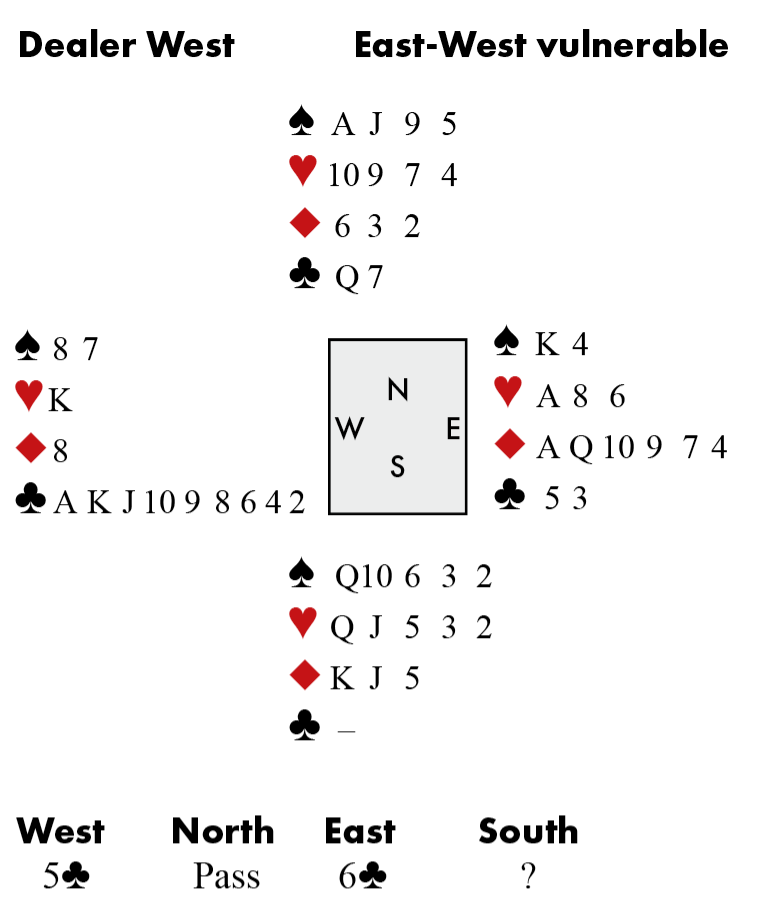
Being green vs red, you’d like to make a Michaels cue-bid showing both majors – but not at the seven-level. Most other Wests also opened 5♣️, quite a few Easts raised to 6♣️, and in both cases, the majority of Souths passed. Some Souths doubled, but were left regretting it when their partners passed (6♣️ was cold). One South bid a fearless 6♥️.
Malinowski’s choice? A brilliant 6♦️! He knew he’d be doubled. His plan was to redouble. He was confident that Fredin would be on the same wavelength, and realise it was an SOS, showing the other two suits. He was right: West doubled, Malinowski redoubled, and Fredin pulled to 6♥️, which East doubled. Three down was -500, a great score compared to -1370. Only one other brave South (a top Swedish player) bid 6♦️, but when he then redoubled, his partner passed. Minus 4000 is a score neither will forget in a hurry.