-
AAPL
213.43 (+0.29%)
-
BARC-LN
1205.7 (-1.46%)
-
NKE
94.05 (+0.39%)
-
CVX
152.67 (-1.00%)
-
CRM
230.27 (-2.34%)
-
INTC
30.5 (-0.87%)
-
DIS
100.16 (-0.67%)
-
DOW
55.79 (-0.82%)
Portrait of the week: Angela Rayner resigns, Poland downs Russian drones and Israel bombs Qatar
Home
The government shuddered when Angela Rayner resigned as housing secretary, deputy prime minister and deputy leader of the Labour party after being found to have breached the ministerial code by Sir Laurie Magnus, the independent adviser on ministerial standards. He said she had followed advice from a legal firm when not paying enough stamp duty on her new flat in Hove, but ignored a recommendation to seek expert tax advice. Sir Keir Starmer, the Prime Minister, called her ‘the living embodiment of social mobility’.
He then threw himself into a great big cabinet shuffle, in which Yvette Cooper became Foreign Secretary and was replaced as Home Secretary by Shabana Mahmood, who was replaced as Justice Secretary by David Lammy who also became Deputy Prime Minister. Peter Kyle became Business Secretary and was replaced as Science Secretary by Liz Kendall who was replaced as Work and Pensions Secretary by Pat McFadden. Rachel Reeves remained Chancellor of the Exchequer, and soon limited departmental use of the emergency Treasury Reserve. The ruling National Executive Committee of the Labour party, which controls the appointment of the deputy party leader, promised a new one by 25 October. At the bottom of a new league table of NHS hospitals was Queen Elizabeth Hospital in King’s Lynn, Norfolk, which needed props to keep ceilings up. Members of the Rail, Maritime and Transport union went on strike all week, closing the London Underground.
In Parliament Square 890 people were arrested for displaying support for Palestine Action, proscribed as a terrorist organisation. After a week of choppy weather that saw no migrants crossing the Channel in small boats, 1,096 arrived in one day, bringing the total for the year to more than 30,000. A woman died when an inflatable failed; three bodies were taken ashore in France. Shabana Mahmood proposed suspending visas for countries that were not willing to make migrant-return agreements. The government was considering putting asylum seekers on military sites, said John Healey, the Defence Secretary. Nadine Dorries, a former Conservative culture secretary, joined Reform, which held a lively party conference. The next day she was among the guests at the wedding of Zac Goldsmith to Hum Fleming, along with Boris Johnson and the Queen’s son Tom Parker Bowles. The Duke of Sussex laid a wreath at the grave of the late Queen in Windsor. The Duchess of Kent died at the age of 92.

Abroad
Polish and Nato aircraft shot down Russian drones over Poland. The main building of the Ukrainian government in Kyiv was set on fire during Russian air strikes. President Emmanuel Macron of France said that 26 countries had pledged to be part of a ‘reassurance force’ in Ukraine if peace is reached with Russia. President Vladimir Putin commented: ‘If some troops appear there, especially now while the fighting’s going on, we proceed from the premise that these will be legitimate targets for destruction.’ Fashion designer Giorgio Armani died aged 91. Carlo Acutis, a British-born Italian who died at the age of 15 in 2006, was canonised.
Israel carried out an air strike on Hamas leaders in Doha, the capital of Qatar. Israel destroyed four high-rise blocks in Gaza City in four days and urged residents to flee south. US Immigration and Customs Enforcement said a raid at a Hyundai plant in Folkston, Georgia, found 475 people – mostly South Koreans – illegally working there. Boko Haram jihadists killed more than 60 people in Nigeria’s Borno State. A funicular railway car crashed in a Lisbon street, killing 16. Rupert Murdoch’s elder son Lachlan will take control of the family’s media holdings. In a birthday book for Jeffrey Epstein in 2003, published by a Congressional committee, Lord Mandelson allegedly wrote: ‘Wherever he is in the world, he remains my best pal!’
François Bayrou, the French prime minister, was defeated in a vote of confidence by 364 votes to 194 as the country faced a debt crisis; Emmanuel Macron chose Sébastien Lecornu as his fifth PM in two years. Gold rose above $3,600 per troy ounce. Norway’s Labour party won another term but the anti-immigration Progress party made the biggest gains, coming second. Shigeru Ishiba resigned as prime minister of Japan after less than a year. After K.P. Sharma Oli resigned as prime minister of Nepal, young people protesting against corruption set fire to parliament. CSH
Why I gave up on the Tories
The days between my leaving the Tories and joining Reform were an odd uneven time. It was the hardest decision I have ever made – I’d been a Conservative party member for 30 years, after all. Before the announcement, only three people knew what I was planning to do. In Westminster almost everything leaks so we kept the information tight. Once I had made up my mind, Nigel Farage and I held several clandestine meetings in a secluded room in a Mayfair members’ club to decide how to break the news. I initially rather fancied defecting on the eve of the Conservative party conference, for maximum impact. But in the end we decided to drop the story in the Daily Mail on Thursday night. In Birmingham the next day, Nigel would reserve an extra 15 minutes during his opening speech at the Reform conference to introduce me. I would say a few words to the audience. Deed done.
In the days beforehand, as Keir Starmer dithered over what to do about Angela Rayner, I began to panic. I feared my defection would be blown out of the water by her tax-dodging exploits. Nigel, however, disagreed. He reasoned that the unfolding Rayner debacle fed into the now established narrative that the two traditional parties of power were as bad as each other. They had repeatedly failed the public and the nation for years, both divided, both incapable of governing with honesty or competence. As a Labour party member said to me: ‘We were supposed to be better than your lot – it looks like we might be worse.’
Rayner should have gone on Wednesday, of course, the moment she was caught red-handed. But it seems she thought she was untouchable. Like most MPs, she believed it was one rule for us and another for them. It took a rapid report issued by Sir Laurie Magnus into her conduct before Starmer had the cojones to allow her to resign. The Prime Minister hand-wrote Rayner a grovelling and vomit-inducing letter in which he fought for his own political life. If he had sacked her, it would have hastened the end of the Starmer/Reeves duo, as the wall of far-left MPs in the Labour party came crashing down upon them.
Jeremy Clarkson summed up the moment better than anyone in a tweet. He pointed out that we, the taxpayers, have paid for Angela Rayner her entire life. Her education, her wages at the council, her MP salary, and it was the compensation paid to her son via the Treasury which provided the deposit for her party pad in Hove.
When Nigel welcomed me to the stage in Birmingham, I hadn’t prepared a speech (I certainly had no idea that my entrance would involve pyrotechnics and smoke jets). I figured that if I didn’t know in my heart what it was I wanted to say, then I didn’t deserve to be there. When I walked on, accompanied by pumping music and fireworks, in a white suit and with one of those microphones which curl around the ear and sit close to your mouth, I must have looked like an aged pop star. But the words came. I had made the right decision.
Not that most of my bitter former colleagues see it that way. The refrain parroted in Tory circles is that Reform is ‘a one-man personality cult’. Conversely, I have always been bemused by how those on the left of the Tory party, the wets and the modernisers, when challenged on their political views, leap to the defence that ‘the party is a broad church’, as though this is a virtue of conservatism. That, unlike socialists, conservatives could stretch their views across the political spectrum and that it works. In fact, as has been demonstrated on repeated occasions, when you are in government and have MPs to the left and the right, ‘broad church’ actually means ‘divided’ and ‘dysfunctional’.
I left the conference to go to the Cotswolds for the society wedding of the year, of Zac Goldsmith and Hum Fleming. Away from the screech of the media, it was the perfect antidote to politics. Beautiful, happy children running around, laughter and love in the air. Living in the Cotswolds, I still find it a novelty that you can watch the seasons as they change day by day. In the city, the change in temperature is all that one notices, not blackberries swelling, sloes weighing down branches or conkers waiting to fall. Early on Sunday morning, my four-year-old granddaughter and I went to the hedgerows, each with a basket to fill, as the moon still rested on the horizon. Lawns were dotted with fallen green apples; damsons were ripe. Fruitful days as we hover between summer and the autumn. As Sylvia Plath once wrote of this interregnum between the seasons: ‘The best of the summer gone, and the new fall not yet born. The odd uneven time.’
The return of Keir vs Andy
When Labour MPs met to hear from their leader on Monday, there was one group who felt particularly aggrieved. In the government’s reshuffle following the resignation of Angela Rayner, the party’s powerful north-west caucus had suffered a ‘machine gunning like nothing else’, in the words of a senior party official. Some 40 per cent of the reshuffle casualties are from this region. The changes risked, in the words of one aide, ‘reopening the whole Keir and Andy psychodrama’.
Within hours, Andy Burnham, the mayor of Greater Manchester, had duly attacked Keir Starmer’s new ‘London-centric’ line-up. Lucy Powell, a close Burnham ally, who was sacked as leader of the Commons, announced that she was running to replace Rayner as Labour’s deputy leader. Bridget Phillipson, the Education Secretary, has been drafted as No. 10’s preferred candidate. The race provides a litmus test of internal party opinion. ‘How many people want to be unhelpful to Keir?’ asks a loyalist MP.
It seems the answer is a lot. The Labour party has always been an uneasy coalition of factions, blocs and interests, in which geography plays its part. Wales and Scotland have been traditional power bases, and devolution has created new ones for Burnham and others in the north of England. One risk for Starmer is that, like Rishi Sunak before him, new caucuses spring up and entrench party divisions. This week’s launch of ‘Mainstream’ – a Burnham-backed soft-left group – is viewed with suspicion by some loyal to the Starmer project, who fear it amounts to a Burnham leadership vehicle.
A string of bad polls is only exacerbating Labour tensions. More than a third of the refreshed cabinet are on course to lose their seats to Reform UK at the next election, including Phillipson. The Runcorn by-election in May was a preview for forthcoming electoral battles throughout this parliament. Nigel Farage’s party seized the former Labour stronghold by just six votes.
In recent months, Reform has spread northwards. There are now more than 200 branch officers across the north-west and in excess of 150 in the north-east and north Yorkshire. Reform strategists believe Lancashire, Doncaster and County Durham are ripe for growth. Much like Harold Wilson, Labour’s greatest northern politician, Farage enjoys plotting manoeuvres while puffing on his pipe early in the morning. He believes that in 2029 he can forge a similar coalition in the north to the one Boris Johnson created ten years earlier.
The Caerphilly by-election and upcoming Welsh Senedd elections will prove instructive in how best to reach voters in post-industrial, non-metropolitan areas. Polling for Merlin Strategy suggests that 80 per cent of voters across the north want to nationalise steel and water – policies which Reform has been trumpeting. Labour MPs begrudgingly acknowledge that Farage’s message of ‘broken Britain’ has cut through in communities with depleted and dilapidated high streets.
Nigel Farage believes that in 2029 he can forge a similar coalition in the north to Boris Johnson’s in 2019
Reform’s mission in the north has been helped by the decline of the Tory campaign machine. The Harrogate and Knaresborough Conservative Association – a seat held by the Tories until last year – is typical of this picture. Its last accounts show that ‘a small number of volunteers’ now run the association and a third party is required to provide campaign support. ‘Dissatisfaction with the party at a national level’ is blamed for falling membership.
With some 12,000 council candidates required for 2026 and 2027, the Tories face real difficulty in getting enough names forward. Activists tell a grim tale of dwindling branches in which it is increasingly hard to get people to door-knock or register as candidates. Councillors say they feel like ‘lambs to the slaughter’. One summarises the mood: ‘We’re all going to get wiped out anyway so I might as well not bother with the fight.’
This process has been accelerated by Reform’s wooing of high-profile and effective councillors, such as former Tory group leaders in Lancashire, Preston and Burnley. At a national level, the party hopes that the recent defections of former MPs Sir Jake Berry and Nadine Dorries will enable Reform to access northern business and donor networks that might have once bankrolled the Tories.
Labour’s loyalists argue that talk of the government abandoning the north is overblown. In parliament, Jonathan Reynolds, the new chief whip, is a popular figure in the party, as well as a County Durham boy who will work to alleviate any regional tensions. Outside parliament, Labour is keen to stress a northern identity. The Good Growth Foundation – whose founding chairman Tim Allan is No. 10’s new executive director of communications – will shortly release polling on political attitudes in the north.

Inside Downing Street, the hope is that a crackdown on migration will retain such seats in 2029. Shabana Mahmood, the new Home Secretary, has hit the ground running. ‘I’m going to be bringing my A-game, I hope you will too,’ she told staff on arrival. ‘If you don’t, you know where the door is.’ Not everyone in Whitehall has got the message yet. A day before the reshuffle, a collection for refugee charity Care4Calais was organised in the Old Admiralty Building. ‘No fundraising was carried out,’ said a Home Office spokesman. ‘Are they serious?’ retorts a Labour aide.
Starmer hailed last week’s reset as ‘phase two’ of his government. ‘Morgan’s last gamble’ is how one Labour source prefers to describe it – a reference to Starmer’s chief of staff. The Morgan McSweeney strategy of winning over patriotic voters worked last year. But some within his party fear that next time, if the election is framed around keeping Farage out of office, they will have alienated progressive voters by trying to ‘out-Reform Reform’.
It seems extraordinary to suggest that a Prime Minister with such a commanding majority is in any kind of danger just one year after an election. Yet if the government’s performance does not improve, more Labour figures will start publicly demanding a change of strategy in the spring. For now, the debate will be conducted via the proxy war of the deputy leadership. Expect Burnham, the king across the Manchester ship canal, to lead the charge at every stage.
The Pret plunge isn’t quite what it seems
Gold goes on up: having risen by an unprecedented 40 per cent in a year to pass $3,600 (or £2,675) per ounce by the beginning of this week, even its most ardent devotees are wondering how long the surge can last. Much of the rise clearly represents a stampede towards the most traditional of safe havens, in anticipation of market storms ahead as well as fears over inflation and Donald Trump’s threat to the independence of the US Federal Reserve.
But it also has to do with a secular shift in the economic world: de-dollarisation, as favoured by the busload of US-hating heads of states who partied with Xi Jinping and Vladimir Putin in Beijing a couple of weeks ago. The switch is illuminated by news that global central bank reserves held in US Treasury bonds are currently at their lowest level since the 2008 crisis, while central bank gold holdings are at their highest since the mid-1990s.
Everything Trump does to his own economy and everything he threatens to do abroad is likely to deter even neutral nations from lending him more money by filling their vaults with his Treasury’s paper – while the world’s bad (and sanctioned) actors will continue to develop non-dollar payment and trade systems that are beyond US scrutiny or interception. China and Russia being the world’s largest gold producers, the role of gold in de-dollarisation looks certain to grow.
Crypto technology will be in the mix too. But gold – tangible, portable, immutable – will always be an innately trusted means of exchange. Its price may peak in the near term, but while the world’s would-be great powers go on rattling their sabres, its long-term value must continue to rise.
Lucky strikes?
In which case, should you be buying into the trend, whether in bullion, exchange-traded funds or gold-mining shares? ‘Short-term traders might need to reduce expectations,’ says our very own veteran investor Robin Andrews, who’s still celebrating the doubling of the share price of Fresnillo and more modest rise of Hochschild, two Latin American gold and silver miners he tipped here in April. But if the sector’s big names have all done well, he says, late investors in the gold game might look at lesser-known exploration companies with access to capital.
Greatland Resources in Australia and New Found Gold in Canada are both ‘lower-risk bets that should reward the patient investor’. Higher-risk stocks ‘poised for take-off’ include Ariana Resources, with production in Turkey and gold deposits in Zimbabwe, and Kefi Minerals, currently raising finance for a mine in Ethiopia. As ever, do your own research; but never say we don’t offer exotic ideas to distract from the prevailing gloom.
Reshuffle kerfuffle
In halcyon days when Labour ministers still dreamed of growth, Jonathan Reynolds spoke of ‘supercharging the economy with pro-business decisions’. But none was forthcoming in his brief tenure as business secretary and indeed it’s fair to say his legacy amounts to almost nothing of any kind, his only significant appearance in this column being a note in May that he had ‘perhaps wisely’ no-showed as a speaker at a northern industrial banquet.
Then again, Reynolds was by no means the most embarrassing of the 17 holders of the business portfolio since the turn of the century; that would be a contest between long-forgotten Stephen Byers for Labour and Jacob Rees-Mogg’s walk-on in the tragicomedy of Liz Truss. But what are we to make of his successor, the former science minister Peter Kyle? Just another apparatchik with zero private-sector experience and (unlike, say, Peter Mandelson) no talent for charming business chiefs into believing you’re here to help?
Not quite. The most interesting fact about the highly articulate Kyle is that he was a youthful protégé of the late Dame Anita Roddick, founder of the Body Shop cosmetics chain, who created an apparently anti-capitalist ethical brand that was also a hugely lucrative high-growth enterprise. That is, in a sense, exactly the trick Labour business ministers need to pull off.
And of course the key to the trick lies in persuading global investors to back the UK despite a barrage of hostile tax and workplace legislation. Until Baroness Gustafsson resigned as a junior minister last week, that task fell to her. She carried big-tech cred as co-founder of the Cambridge-based cyber-security venture Darktrace, sold last year to US private equity for $5.3 billion.
Her successor Jason Stockwood – a former director of the dating site Match.com who was Labour’s losing mayoral candidate (to Reform) for Greater Lincolnshire – hardly looks like a step up. But he’s also co-owner of Grimsby Town FC, the League Two club that last month knocked Manchester United out of the EFL Cup. In these desperate times, might that count as a positive omen?
Pret fall
‘Pret plunges to £525 million loss’ was a headline that must have had many metropolitan sandwich-munchers thinking: ‘Rayner’s gone, the Tube’s on strike, MasterChef’s in turmoil, and now Pret… Which pillar of civilisation will fall next?’
In fact the ubiquitous chain’s colossal 2024 deficit was caused by a write-down of goodwill (the intangible value attributed to the brand) on the part of the owner, the Luxembourg-based, German-owned JAB Holding – and it probably tells us more about private-equity balance-sheet alchemy than it does about malaise in the high street. Pret’s like-for-like trade actually rose by 2.8 per cent last year, and despite soaring workforce costs it continues to add new outlets in the UK and US.
There’s even a possibility of a public share offering, the irony being that the better the brand is recognised in New York, the likelier the listing of this sterling British success story will end up over there, rather than on London’s fading stock exchange.
Letters: White working-class pupils have been forgotten
In the way of justice
Sir: Robert Jenrick is right to suggest that, as well as leaving the European Convention on Human Rights (ECHR), Britain needs to reform its judiciary (‘Something’s gone very badly wrong’, 6 September). Although Britons already had all the rights and freedoms we needed under common law, Tony Blair, for entirely political reasons, granted the ECHR jurisdiction here for the first time under his 1998 Human Rights Act. Unlike common law, continental law, beloved of the ECHR, does not rely sufficiently on either precedent or the letter of the law. This permits continental judges too much latitude, obstructing certainty, permitting political judgments and inviting activism.
With the arrival of ECHR jurisdiction, British judges saw a huge opportunity to increase their influence. This tendency was exacerbated by another disastrous Blair innovation: the creation of the Supreme Court in 2009. In the depressing 27 years since 1998, ECHR jurisdiction has poisoned our legal system, politicised our judiciary and emboldened leftie lawyers to bring the law into contempt.
When Britain departs the ECHR, it should also close the Supreme Court and send the Law Lords back to the House of Lords, where they belong. Furthermore, the decisions of judges throughout the land should be subject to democratic parliamentary scrutiny when they ignore precedent. This would demonstrate in the clearest terms that the highest court in the land is the High Court of parliament with common law at its heart.
Gregory Shenkman
London SW7
Good Council
Sir: I read Philip Patrick’s article on the British Council with interest, but I’m not sure I totally agree with all his observations (‘Spy on the wall’, 6 September). I was a soldier from 1971-2011: I was decorated, and was once badly wounded. I went on operations six times. In the past 20 years, I spent much time all over central and eastern Europe (including Russia) and came away with the highest regard for the men and women of the British Council. A few years after the fall of the Berlin Wall, I spent a couple of years in Ukraine, Georgia and Moldova setting up a project to ‘resettle’ the tens of thousands of servicemen of the unemployed second echelon of the Warsaw Pact. I made a plan and the British Army gave me two officers, a bagpipe-playing Scots officer from the Royal Army Education Corps, and a brilliant RAF Tornado pilot. The project was not expensive and was so successful that Nato HQ asked me to repeat it two years later in Serbia and Montenegro.
I worked with British Council staff a lot and found them to be articulate, helpful and willing, and each with a quality of determination and selflessness that I have since noticed in others doing similar work.
Lt Col (retd) Philip Schofield
Zeals, Wiltshire
Bad Council
Sir: The nastiness John Gilhooly experienced when he bravely cut the Wigmore Hall free of the Arts Council’s purse strings (Arts, 6 September) is nothing new; it has a history of arrogantly ignoring the wishes of music lovers. When it refused to help the D’Oyly Carte Opera Company, which had been bringing the innocent joy of Gilbert and Sullivan to the nation since the 1870s, its report sneeringly likened the company to an old actress ‘well past her prime, waddling into the distance to a well-deserved and peaceful death’. Even when members as diverse as Alan Clark and Tony Benn supported the company with an early day motion in the Commons, the Council would still not supply the funds which could have saved what the MPs regarded as a ‘quintessentially part of English culture’. Better if the Company had survived and the Council had been put to rest.
Charles Simon
Leicester
A forgotten cohort
Sir: Barometer (30 August) notes that Bridget Phillipson now concedes white working-class pupils are underperforming at GCSE. This sudden revelation should provoke weary recognition. The Spectator’s cover in July 2020 declared: ‘The white working class are being left behind.’ Yet after seven education secretaries and a parade of initiatives, here we are: another minister blinking at the obvious.
For decades, the white working class have been an inconvenient cohort in education – too large to ignore, too politically awkward to champion. They are not a ‘targeted group’, they tick few funding boxes and their plight resists the language of structural injustice. So while others have (rightly) been supported, they have slipped further behind, while being told the problem is simply a lack of aspiration. Now, at last, a minister is willing to speak the truth. But recognition is not reform. Action is needed.
Neil Salter
Whitby, N. Yorks
Birmingham gems
Sir: Your reviewer of the excellent-sounding Craftland: A Journey Through Britain’s Lost Arts and Vanishing Trades (Books, 6 September) rightly laments the loss of Luton’s hat makers and the bodgers of the Chilterns. But mention should be made of Birmingham’s remarkable Jewellery Quarter. In late Georgian and Victorian streets near the city centre, 40 per cent of the country’s jewellery is still made. Here are jewellery makers and shops, gold smelters, diamond merchants, silversmiths and enamellers, plus the School of Jewellery and the assay office with its anchor mark proudly adorning its exterior. As a member of the Royal Birmingham Society of Artists, I have got to know the area well, but it was only a year ago that I discovered that my great-grandfather, Ludolph Lowenstein, was a diamond merchant and goldsmith with premises right next to the School of Jewellery. This year the Jewellery Quarter was awarded World Craft City status, an accolade it richly deserves.
Ed Isaacs
Wolverhampton
Autism isn’t a ‘superpower’
A very warm welcome for Margaret Thatcher inside autism’s ever-growing tent – if she can find space to wield her handbag. I could even lead the welcoming party myself as I am in there – according to some of my friends – on account of my unusually good ability to recall dates and a liking for solitude.
As for Thatcher, she has gained entry on the strength of her biographer Tina Gaudoin’s diagnosis, which is based around the former PM’s absence of a sense of humour (or at least an inability to share the jokes of her male, public school-educated colleagues), a lack of embarrassment, her ‘special or restricted interests’ and a tendency to see the world in black and white.
Is there going to be anyone left outside the autism tent in future? Can anyone say, for example, that they don’t feel a bit awkward in some social situations, or that they don’t have a passing interest in some kind of object – be it wading birds or diesel locomotives – which other people find a bit dull?
If you are sure you are not autistic then I recommend you take an online test, such as the one which has just given me a score of 17 out of 30, putting me in the ‘borderline indication’ band. ‘Sometimes people say I am being rude, even though I think I am being polite’; ‘I notice small changes in people’s appearances’. Answering ‘yes’ to either of those will shove you a little way down towards the autism spectrum.
A lot of them are just Barnum statements – things we think are true of ourselves but not so true of others. ‘I frequently get so strongly absorbed in one thing that I lose sight of other things’; ‘I prefer to do things the same way over and over again.’ And the favourite question I have seen in these tests: ‘I prefer to read a book rather than go to a party.’ The possibility it might depend on the relative quality of the party and the book seems not to occur; if seeing things in black and white is an autistic trait then whoever designed the test is certainly on the spectrum.
Another of the questions goes: ‘I have trouble working out other people’s intentions.’ Well, I don’t have any problem working out the intention of the makers of the test, which ended with me being invited to undertake a full assessment at a cost of £2,250.
Autism has been jumped on by opportunistic quacks who can see it is a fashionable diagnosis. But there is more to it than that. There is a ‘neurodiverse’ movement which actively seeks to expand autism diagnoses for political reasons. The more people inside the tent, goes the thinking, the more society will understand the condition and the better life will be for autistic people.
People perfectly able to function in society are grabbing the resources and attention from people who cannot
Sorry, but I am going to disagree with that. What is going on is that people who are perfectly able to function in society are grabbing the resources and attention from people who clearly cannot.
The neurodiverse movement is based on a simple conceit: that autistic people are all essentially geniuses, but whether or not they are able to express those skills and achieve great things depends on how society treats them. They are trying to sell us a Hollywood idea of autism, where people triumph against adversity through determination and courage. It is fed by genuine examples of autistic people showing themselves to have remarkable abilities, such as the artist Stephen Wiltshire, who is able to make incredibly detailed drawings of buildings from memory. There used to be a term for this: ‘idiot savant’, now thankfully reduced to just ‘savant’.
It is a lovely idea that all autistic people are like this. We now have Albert Einstein, Leonardo da Vinci, Steven Spielberg, Vincent van Gogh, Alfred Hitchcock, Thomas Edison and Alexander Graham Bell all in our tent, according to some.
Sadly it is all rot. I know a lot of autistic – I mean genuinely autistic – people through my daughter (who has severe learning difficulties but was not, until a couple of years ago, regarded by any professional as autistic). While I would love to think that some great talent resided deep within them all, I’m afraid few are going to be gracing the honours boards of our great universities, however much effort is put into their care. The mundane reality is they are all disabled, to a greater or lesser extent, and that few of them will ever succeed in living independently – and even fewer are going to invent something or produce great works of art.
Does society really see such people any more, now that autism has been grabbed by the neurodiverse crowd? Claiming an autism diagnosis when you are perfectly able to function, with maybe just the odd eccentricity, might help you in some way in the age of victimhood.
One possible return is extra time in exams. Or there is cash under the racket that is personal independence payments. But you are not helping people who really need help; rather you are drawing help away from them. You are diluting the condition of autism to the point of meaninglessness.

The questions asked in these autism tests break down into two types: there are the questions which relate to personal preferences as to how you spend your time, and there are the questions which relate to an inability to read humans in some way. The reason that I – and possibly you, too – get a score high enough to put me in the supposedly autistic spectrum is because I’m not the Duchess of Alba and I can’t face a party every night, nor indeed more than about once a fortnight. But when it comes to the other questions, I score zero. No, I don’t have any trouble telling when I am boring other people, nor whether they are happy, sad, angry or pleased, nor when they are being ironic or scheming.
The questions which the online autism tests should really be asking are these: can you get yourself dressed, can you feed yourself, do a bit of housework, get out of the house by yourself and do a bit of shopping, hold down the most basic of jobs – and can you actually read this test at all? If you can’t answer ‘yes’ to those, then you really do deserve to be classified as having a disability.
Otherwise, please call yourself eccentric, antisocial, an oddball or something which doesn’t deflect attention away from the genuinely autistic.
How to raise a patriot
‘Good news for patriots,’ said one of our most celebrated national newspapers this week: ‘Your numbers are likely to swell.’ This was on the editorial page, where the opinions of the paper are laid out, and it referred to a poll conducted by ‘More in Common’ which had found, to everyone’s surprise, that British teenagers are pretty patriotic. About half of all 16- and 17-year-olds feel proud of their country, it found, which is more than their parents.
It was an interesting poll for anyone considering the rise of Reform and how that might interact with the incoming slew of teenage voters. Interesting too for those of us in liberal London, trying to keep the flickering pilot light of patriotism alive in our children’s tiny, K-pop-infested minds. (What’s K-pop? Just pray you never know.)
What struck me about that editorial was the use of the word ‘Your’. Not ‘Good news for patriots, our numbers are likely to swell’, but ‘your ranks’ – you patriots, as if patriots were a laughable special-interest group, like rubber fetishists. This great square-rigger of a national newspaper felt comfortable assuming that even its centre-right readers find patriotism ridiculous – that the burst of youthful national pride reported in its news pages was an amusing anomaly. But it’s wrong. The kids aren’t patriotic because monobrowed racists have infested their Twitter feeds, or because all those St George crosses draped from lampposts have inflamed their feeble senses. They’re patriotic because loving your country is a completely normal response to living in it. And because, with any luck, the snobbish revulsion so many educated English men and women feel at the sight of their own flag is starting to fade.
It is globalism, not patriotism, that’s the delusion – that seems clear to me. I have friends and colleagues who have done their damnedest to raise their children as citizens of the world, at home with all and every creed and culture, without recognising that they themselves are happily rooted in this country. They look back with fondness at Beatrix Potter, Enid Blyton, C.S. Lewis; come over all misty at the thought of Cornwall or Devon or the sight of a Georgian facade. They love dogs the way that the British have always loved dogs, since long before the Romans arrived, and they’re perfectly happy to feel a sense of spiritual belonging that reaches back to Britain’s pre-Christian past. Ironically, for a gang of Europhiles, it’s the Romans that give them the ick – and Empire.
But you don’t have to love every twist of your country’s history to be a patriot. I’m deeply proud of my family, for instance – but I’d have to be round the twist to approve of everything they’ve ever done. To be proud in this way is to feel a sense of belonging and responsibility – and isn’t that just what we always say young people need?
These kids are patriotic because loving your country is a normal response to living in it
So send in the children to school with strings of George Cross flags, drape them over the desks. No – I’m joking. It’s quite possible, with the Met the way they are, that even writing that constitutes a hate crime. What I do suggest though is that, cheered by the patriot poll, we work away like Jesuits for the formation of more British souls, ensuring the ranks of patriots have swelled even more by the time the pollsters return.
I’ve already mentioned my debt to Lord Moore of Etchingham for recommending the Ladybird ‘Adventures from History’ series, written mostly by the fabulous L. du Garde Peach. My son’s current favourite is King Alfred the Great – nothing like the sight of a Viking warlord on his knees converting to Christianity to help digest a packed lunch. Then there’s Rosemary Sutcliff.
Aris Roussinos wrote a recent essay for UnHerd urging readers to revive their interest in mythic Britain and to rediscover Sutcliff, the great postwar writer of historical fiction. ‘In today’s circumstances, where it is not hard to see a nascent British nation-state struggling to be born from the collapsed star of Empire, the stirring tales of imperial derring-do suitable for Edwardian prep schools will not do. What is required here is something homelier, cosier, more nostalgic and intimate: something of “ourselves alone”, as an earlier nationalist movement phrased it.’ Roussinos in particular recommends Sutcliff’s great Arthurian novel Sword at Sunset, written in what she described as trancelike ‘possession’.
For the junior patriot, I’d recommend Sutcliff’s Arthurian trilogy for children – The Sword and the Circle, The Light Beyond the Forest, The Road to Camlann – which my nine-year-old and I have just read together. One of these days I’ll tell you more about the unbeatable sex ed and relationship lessons you can cover with a pre-teen just by reading and discussing Sutcliff’s King Arthur story. In the first few chapters there’s unbearable lust (Lancelot and Guinevere), unplanned babies (Mordred), one-night stands (Lancelot and Elaine), brave men undone by vengeful nut-jobs (Morgause).
For the purpose of patriotism, it’s far more than just a tale of England at a particular time and place. ‘At one level it is the story of King Arthur’s knights searching for the cup of the Last Supper,’ wrote Sutcliff. ‘On a deeper level, like The Pilgrim’s Progress, it is an account of man’s search for God. But the medieval Christian story is shot through with shadows and half-light and haunting echoes of much older things; scraps of the mystery religions which the legions carried from end to end of the Roman Empire; above all, a mass of Celtic myth and folklore.’
Patriotism doesn’t have to lead to nationalism. Understanding the history and myths of your country, and having the sense that you belong to them, makes it easier to understand the history and myths of others. Conversely, if you try to belong to all nations equally, you’ll belong to, and care for, none.
The wild world of the ‘Ozempic safari’
Safari log: 3.56 p.m. and the Land Rover is parked up on the savannah. Inside, we wear dark glasses and muted clothes. Minutes pass and we still can’t spot the animal we have come to see. We are told that she only comes out at certain times of day, that she is shy.
No, we’re not actually in Africa; we’re in a prep school car park in the Home Counties, on what is known as an Ozempic safari. We have gathered to spot the ‘Mounjaro Mummies’ prowling around after the summer holidays. It’s wild, in all senses. It’s also socially and morally dubious.
Word on the street is that the number of Mounjaro Mummies has swelled after the two-month break, their transformations taking place away from the daily scrutiny of the school run. Given that we can’t get a proper look at them without being too obvious, we have come to operate a stake-out system.
We know exactly what to look for: sunken faces, slightly wasted arms and, of course, dramatic, envy-inducing weight loss. I’m talking at least three dress sizes dropped and a slightly reptilian facial expression – the sort that Sharon Osbourne and Serena Williams now display. This is weight loss we all know can’t be achieved in two months by restricting your calorie intake and doing pilates. The ‘wellness’ jig is up: throw your Lululemon leggings away. Third-wave body positive feminism has lost. Really, we should stick a white flag on top of the Land Rover.
From the privacy of the car, the drumbeat is one of disapproval. ‘It’s extremely irresponsible as a mother,’ one of us says, adding: ‘These women would feel so much better if they did it the right and honest way.’ ‘I don’t want my children to see vanishing women, it’s impossible to explain to them,’ another says. ‘Fair enough if you’re obese or you have diabetes,’ I chip in, adjusting my Ray-Bans, ‘but this is recreational Ozempic use for the rich; body positivity is now only offered as a sop to those who can’t afford to be on the pen.’ Widespread nods.
Given that the price of Mounjaro has risen by 170 per cent in recent months, you need to be in a certain wealth bracket to afford it at all – not that it matters on our chosen safari plain. Estimates suggest that 1.5 million people in the UK are injecting weight-loss drugs, or GLP-1 agonists, with 90 per cent of these paying privately for the privilege. It is thought that more than half are using Mounjaro, soon to be the most expensive of all. The Waitrose classes – and that’s us – are prepared to pay.
Soon enough, upon spotting a woman in athleisure clothes and a baseball cap, we discuss what it means to be thin. We tiptoe around the idea that thinness, as a tenet of female socialisation that we millennial women grew up with, has always meant sacrifice. You can’t leapfrog dedication, discipline and pain, we seem to be saying. ‘I’ve never missed a day,’ one says, describing how she has exercised religiously all her life. I think of the time I nearly fainted from hunger on the District line as a dieting teenager. ‘Nothing tastes as good as skinny feels’ – until you collapse.
We know what to look for: sunken faces, slightly wasted arms and, of course, envy-inducing weight loss
The Republic of Skinny is a strange place. Most of its long-term residents want to credit their size to discipline and personal responsibility rather than genetic good fortune or, heaven forbid, wealth. But if thinness is available more easily, its social capital becomes devalued. What does it mean to be skinny if any old person can do it? Where do we stand now?
In the Republic of Skinny, something serious has happened and we all know it: the walls have crumbled, and a new structure has emerged. But the new structure looks flimsy and jerry-built to our eyes. In short, we think it is cheating; or as the critic Kat Rosenfield has put it, the ‘equivalent of buying indulgences instead of performing atonement’.
I look out of the window and see a woman I have long suspected to be on Ozempic, but her weight loss is too subtle for me to call it. I dimly remember that she didn’t eat any sandwiches under the gazebo on speech day.
Ozempic and other GLP-1 agonists that work by restricting appetite, or turning off the ‘food noise’, have begun a medical revolution. Curiously, though, we don’t talk enough about the social revolution they have engendered – the way in which they have affected how women look at other women.
Once, being fat meant moral decrepitude or a certain kind of laziness. Consider the old euphemisms – ‘she’s let herself go’ or ‘she’s chunked up a bit’.What if instead we saw metabolism and appetite as a peculiar nexus of biological facts, environmental forces and genetic tendencies rather than moral choices? What if we began to see the discovery of semaglutide as an unalloyed force for good? What if, indeed.
But I don’t see this intra-female empathetic turn whereby the use of weight-loss drugs is framed as a feminist choice to finally give women a break from the patriarchal tyranny of having to stay slim. Instead, I see women viewing each other with suspicion and derision. I see women hoarding frightful examples of liver failure, dysentery and – worst of all – weight regain as examples of the Faustian pact of ‘the skinny pen’.
Psychologists at the University of Melbourne, researching the psychosocial consequences of women undergoing plastic surgery, concluded that ‘perceptions of attractive women are worsened when these women decide to seek cosmetic surgery’. What will the study of the psychosocial effects of weight-loss drugs among women tell us, I wonder? I suspect it will read as an obituary for liberal feminism.
Safari log: 4.22 p.m. A hush descends in the car. We have spotted a real one. I can’t quite believe my eyes: she is not so much slimmed-down as an entirely different woman. Her jeans hang off her, her posture is different, her twig-like arms are shown off in a sleeveless Sézane top. I strain my eyes to get a look at her face but I’m too slow; she has darted off like a gazelle. Our assembled group is quiet. I probably shouldn’t, but I declare to the group that I think she looks amazing. Nobody says anything.
Will assisted dying become a cover for abuse?
Every year, thousands of stories of abuse pour into Compassion in Care, a charity that supports whistleblowers in the care sector. Volunteers manning the charity’s helpline hear of old people dismissed as ‘end of life’, deprived of food and water, abandoned in corners with neglected bedsores, needlessly sedated to make them less time-consuming.
And now, says the charity’s founder and director Eileen Chubb, a former care whistleblower herself, they are bracing for ‘a massive increase in abusive cases’. That’s if the assisted suicide bill, which begins its journey through the Lords this week, becomes law. ‘We can foresee whistleblowers contacting us,’ Chubb tells me, ‘saying people died who didn’t want to die but were pushed into it, and the system failed them.’
That system is already far too ready to put people on a pathway towards death. ‘I’d be rich if I had a pound for every time someone says, “Don’t bother the doctor, she’s old and she’s going to die anyway.”’ Helpline volunteers regularly hear anguished stories from carers and families about old people denied basic care and attention. Four-fifths of callers mention the withdrawal of fluids.
Now, Chubb says, those same callers are disturbed by the prospect of a law which would institutionalise a state death service. ‘What we’re hearing is people constantly saying, “We’re really worried. It’s hard enough as it is. If you speak up and try to save a life, the attitude is – there’s something wrong with you, you should just turn a blind eye like the rest of us”.’
Many people in care will fall within the broad remit of the bill: those with a terminal diagnosis who might die in the next six months. The bill allows someone meeting that definition to receive lethal drugs, even if their sole reason for seeking an assisted death is depression, financial concerns or feeling like a burden.
Abuse victims, Chubb points out, are often too ashamed to tell others what is happening; and often, they want to die. ‘We’re going to fail them twice,’ she says. ‘Once because we let them be abused and once because we’re going to let them die because of their despair at being abused.’
Even without becoming law, the bill is already having an effect. Chubb has heard from carers who have tried to report abusive practices and ‘one of the abusive staff has turned round and said to them, “Well, this is all going to be legal soon”. People’s perception is that the right to life has shifted.’
Even if there were no abuse in care – and Chubb believes its scale is seriously underestimated – the crisis in the sector would still be a subject most of us would rather not dwell on. There isn’t enough money: local authorities say they have a total funding shortfall of £54 billion over the next five years, and in one survey a third of social care providers said they were considering leaving the market altogether. There aren’t enough staff: almost 400,000 people are stuck on waiting lists for care. Meanwhile, the population is rapidly ageing. By 2040, a fifth of the adult population in England is expected to be living with major illness.
Much of the care sector sees this bill as a new bias towards death, hardwired into the machine
Only the reluctance to think about hard realities can explain why so little has been said, in this context, about assisted suicide. Apart from Matthew Parris, who believes it would be a ‘healthy development’ if assisted suicide is ‘considered socially responsible – and even, finally, urged upon people’, few are prepared to make the link. Yet the warning lights are flashing. Care England says the sector is ‘under consulted, uncertain, and unprepared’, after a survey in which just 13 per cent of care homes said they would be able to manage the introduction of assisted suicide. The Orders of St John Care Trust – the country’s second-biggest not-for-profit care provider – has said the legislation poses a ‘substantial’ risk to older people. ‘It is without question,’ it says, that some people will consider assisted suicide ‘to protect the prospects of their loved ones and not because they wish to die’.
There is another, more systemic, kind of pressure, the charity warns. Older people in social care are seen as ‘a problem without a solution’, a burden on society. But at least, under the current law, they are not constantly wondering if they should request a dose of lethal drugs from the doctor. ‘A change in the law may unintentionally create a constant burden of deliberation, additional pressure through witnessing the choices of fellow residents to opt for assisted dying and potentially a stressful environment where residents perceive they are being continuously assessed about whether they qualify.’
The bill’s supporters have framed it as a targeted intervention, aimed at resolving a few tragic cases. But much of the care sector sees it as a change that will affect the whole of society: a new bias towards death, hardwired into the machine.
Few people have worked harder to improve care standards than Professor Keri Thomas. A former GP, she founded the Gold Standards Framework Centre in 1998; it is now the leading charitable training provider for the three million frontline staff in end-of-life care. Professor Thomas also chairs the Coalition for Frontline Care, a partnership of major organisations which calls for better training and the integration of health and social care.
Speaking in a strictly personal capacity, she describes the bill as ‘terrifying’. She can see the case for it, but says there is ‘a lack of safeguards for those at their weakest’. The gaps in current provision make the frail and ill even more vulnerable under the proposed legislation. ‘Assisted dying is not a “choice” if care is not yet good enough for everyone,’ she says. ‘People could be whisked along this system pretty quickly. And it’s a fully-funded free system, which is not what most people are getting. It could be easier to die than to live.’
The details of the bill only deepen her alarm. For instance, the text allows doctors to bring up the subject even when the patient hasn’t thought of it. ‘It feels so wrong to say, “Take these tablets and see you in three months… and have you thought of assisted dying?”. Most people do seek guidance from their doctors or other carers, and if one of the things you’re encouraged to bring up is assisted dying – that automatically says, “You’re on the scrapheap”.’
There is also no requirement for the assessing doctors to know the patient who is requesting an assisted death. That makes it much harder, Thomas says, to understand the patient’s wider context, history and current situation. ‘Is this person very depressed, and with some help and support they could change their mind and feel able to face life again? Is this what they really want? If no one knows the person making the request, to me that’s a real red flag.’
How widespread are those concerns? Doctors in general are split on the question, but the specialisms with most experience of end-of-life care are more likely to oppose the bill. The Association for Palliative Medicine and British Geriatrics Society, the big representative bodies, are firmly against it.
‘I’ve come across lots of patients who are probably subtly being abused by their families,’ says Dr Julie Barker, end of life clinical lead for NHS Nottingham and Nottinghamshire. ‘By which I mean manipulated. Sometimes that’s to go into a care home, sometimes that’s to alter wills. I know that a lot of my colleagues out there, in the medical profession, in the nursing profession and in carers groups, are concerned that that dynamic will be aggravated by the assisted dying bill.’
‘I’ve come across lots of patients who are probably subtly being abused by their families’
The bill’s proponents point to a series of checks and procedures: two doctors have to sign off on the request, as does a panel featuring a psychiatrist, lawyer and social worker. But the panel are only there to confirm that the person has six months to live and has basic decision-making ability. They are not there to help them get better support or to suggest that they reconsider. In fact, the Royal College of Psychiatrists has come out against the bill, because it does not give psychiatrists the chance to do their job of helping those with an unmet need.
The panel are also asked to detect coercion, but they don’t have any special investigative powers. They can ask third parties to testify, for instance, but unlike a court they can’t force them to give evidence.
Dr Barker is not reassured. ‘Even though I’ve done lots of specialist safeguarding, I wouldn’t feel confident currently in assessing for coercion. And I would say, objectively, I’m probably one of the most aware people among my profession.’
On the subject of safeguards, Eileen Chubb is even more sceptical. The proposed panels, she points out, are very similar to existing Safeguarding Adults Boards. ‘I’ve gone to hundreds of these so-called investigations, with the families of people in care. It is an absolute farce. It looks great on paper and it ticks a lot of boxes, but in reality most abuse is not even investigated.’
Even when it is investigated, complacency and battle-weariness mean that only ‘the bare minimum’ is actually done. When I suggest that coercion could instead be reported to the police, she laughs.
Yet the impact of the legislation would go far beyond those being coerced. Under the bill’s terms, anyone with a six-month diagnosis could receive an assisted death simply because they were poor, homeless, depressed, isolated or afraid. Assisted suicide, introduced like this, looks less like mercy than like a gigantic abdication of responsibility.
Dr Barker fears we are ‘sleepwalking’ into a huge societal change ‘in terms of how we respond to some of the most vulnerable people in our communities’. Chubb is more direct: ‘I’m horrified at the level of ignorance among so many of the MPs arguing for this. They don’t live in the real world.’
Save our sausages!
Who first thought of grinding up all those little unused odds and sods from an animal carcass and stuffing them into a bit of intestine? Many people, apparently. Sausages are one of those products which, while seemingly not intuitive, emerged independently all around the world thousands of years ago.
As far as we can tell, sausages have been produced since we began butchering animals. The first record of sausage-making is from around 2,000 bc: an Akkadian cuneiform tablet from Mesopotamia mentions intestines filled with forcemeat. Sausages feature in The Odyssey as a simile for Odysseus tossing and turning in bed (‘When a man besides a great fire has filled a sausage with fat and blood and turns it this way and that and is very eager to get it quickly roasted’). And in Aristophanes’s comedy The Knights a sausage seller is elected leader because his skills translate well to the art of politics: ‘Mix and knead together all the state business as you do for your sausages.’
The Romans brought sausages to Britain, and our word ‘sausage’ comes from the Latin for ‘salt’, which makes sense, as sausages probably began as a form of preservation. Around the world, sausages are often smoked or cured, but in the UK, our heritage sausages tend to be raw. The character of British sausages comes principally from their use of rusk alongside the lean meat and fat and spices. The rusk soaks up juices as the sausage cooks, retaining the sausage shape and making the sausage succulent. The ‘banger’ came about during the periods of rationing around the world wars, when sausages had higher water content, which would cause them to explode in the pan with a bang. Historian Diane Purkiss identifies a hyper-regionality: ‘British sausages are the island equivalent of cheese in France… they are du terroir.’ Today, Britain is thought to produce more than 400 different types of sausages.
Bismarck supposedly once compared laws and sausages: it is better not to see them being made. Although probably misattributed, the sentiment perseveres: many fear what lies beneath the sausage casing. But seeing the sausage made – a good sausage – is actually a beautiful thing: the lean and the fat ground first separately and then together, the meat piped into a seemingly endless tube, before being deftly separated into links and hand-knitted into bunches.
When it comes to the sausage’s reputation, mechanically recovered meat (MRM) has a lot to answer for. MRM is the paste which can be collected from carcasses when they’re pressure blasted after the decent cuts have been removed, and it was widely used in budget sausages in the 1970s and 1980s. The result is what Jonathan Meades called ‘abattoir slurry in a condom’. Today, any MRM has to be declared on the label and doesn’t count towards the meat content.
Those who know exactly how the sausage gets made are in crisis. Andrew Keble, who runs sausage company Heck, reckons that sausage supply is being strangled by Gen Z’s reluctance to get their hands dirty. The younger generation, he says, can’t handle working in a factory because they want to work from home, despite good wages and working conditions. Companies such as his are investing in automation, but are still stymied by a lack of workforce. Is this the way the sausage ends? Not with a banger but a whimper.
Nick Ferrari’s big fat Provençale wedding
It was the morning after the night before and I was picking glass out of my leg by a pool, blotting the blood trickling down my calf with a navy spotted handkerchief. I was trying to work out how the shards of glass came to be there… and then it came back to me.
But first, let’s rewind. I was taking my seat on the British Airways 10 a.m. flight to Nice. ‘Not another one!’ a woman right behind me in steerage complained. ‘Is this some special flight or something?’
I stowed my Globe-Trotter in the overhead locker and made eye contact with her. ‘Piers Morgan is up front,’ she explained. ‘And that’s Matt Goss.’ She pointed to a tidy man minding his own business a few rows ahead. I couldn’t pick Goss (one half of the 1980s boy band Bros) out in a line-up, but this man did look familiar, as celebs do.
I texted Piers in 1A: ‘I’m behind you!’ He texted back: ‘Do you want me to send you back some champagne?’ I told him I had a Pret breakfast pot, thank you, adding, to annoy: ‘By the way, you’re not even the most famous person on this flight.’
As I stood in the Avis queue, ‘Matt Goss’ approached. ‘Hello Rachel,’ he said, to my slight shock, and came in for a hug. Which was fine, except I’ve never met Matt Goss. We wouldn’t know each other from Adam. Still, moving on, I had to pick up my car, check into a hotel in Mougins, squeeze into a skimpy Roberto Cavalli number and then get to LBC breakfast legend Nick Ferrari’s wedding to the glorious Clare Goodwin, a radio exec at our parent company Global. ‘I’m hand luggage only,’ I warned Clare from the plane, ‘so wearing very little.’
I arrived at the nuptials just as Piers and family were alighting from a pearlescent Porsche Uber limo, Celia Walden wearing even less than I was. Everyone was on the sweeping sun terrace. It was so hot that the men were sweating through their jackets and any exposed flesh and faces were roasting to a shiny red.
The bridal couple descended Hollywood-style from two opposing staircases and met in the middle for a kiss-clasp and an aaaah. Then there was a brief ceremony. Christopher Biggins, in pink linen, officiated and said we needn’t worry about the cost of coming to the south of France as we could expense it all to Global – hollow laughter from the bosses – and then Piers was made to do
an ironic reading (Luke 14:7-11, a homily about the virtues of humility and low places) and concluded: ‘See you on top table then!’
Have you ever been in a roomful of gobby broadcast veterans at a media wedding in the south of France?
Dinner, speeches, dancing. It was very special to celebrate the happy couple’s love. Clare is a sweetie, Nick a softie: when he said he realised that he was beginning to fall ‘helplessly in love’ with Clare (possibly at the rugby at Twickers, where he has a debenture) a tear came to every jaded eye.
But. Have you ever been in a roomful of gobby broadcast veterans at a media wedding in late August in the south of France? From Kelvin MacKenzie via Gloria Hunniford and Jane Moore and Andrew Pierce to Piers Motormouth Morgan himself? Who all love the sounds of their own voices and have plenty to say, especially after several hours’ boozing? Well I have, and it was hot and noisy and even hotter and noisier when the live band played and everyone took to the floor.
I remember Andrew Pierce flaunting a new blond barnet and importuning young producers… me having a detailed ballroom dancing lesson from a bearded young man… but the broken glass?
Trying to recall events, I have a distinct memory of one of the young persons present circulating with a bottle of vodka and making everyone do shots.
It was then things really kicked off. The men all took their tops off. Nick Ferrari unpeeled his shirt
‘No, thank you,’ I said to Jimmy, twerking barefoot by this stage. But he wouldn’t take no for an answer, so I swigged and handed the bottle back to him and the next thing I knew the bottle crashed and exploded on the dance floor, and I took the opportunity to skip off towards the bar for some further cooling refreshment.
It was then that things really kicked off. The men all took their tops off. Nick Ferrari unpeeled his shirt. The dance floor was a writhing mêlée of sunburnt male flesh. Camilla Tominey, the designated driver, and I thought it was time to make our excuses and we skedaddled.
‘The end was absolute carnage,’ Clare updated me later. ‘People asleep in bushes. People asleep outside. Grabbing vodka bottles. The French were looking on flabbergasted. Goodness knows what the topless episode was about!’
So that was Nick and Clare’s big fat Provençal wedding, and this, my thank-you letter to them. It was like the 1960s, basically. If you can remember it, you weren’t there. A proper rager.
Oh, almost forgot: speaking of who wasn’t there, Matt Goss. This is because it was the Spandau Ballet hitmaker Gary Kemp. I’d sat next to him at a lunch. Couldn’t have been nicer. I knew I knew him from somewhere.
The anarchy of a breakfast buffet
The Portuguese guest wanted an egg, but she didn’t want it to look like an egg. She came down to breakfast with her seven-year-old son and asked me to disguise two eggs by frying them on both sides so the yolks didn’t show.
I’ve been getting to grips with the dietary habits of the travelling public all summer, so much so that I’m almost used to a peculiar trend that I can only describe as pretend veganism.
My B&B guests seem to be balanced on a capricious meat-vegan knife edge which defies all logic and prediction, with most of them eating either some meat or some dairy, but never both. Only the French can be relied upon to eat everything, followed by the Irish and the Germans. Everyone else can go every which way.
As a result, I wait until someone tells me what they want before offering them food that will offend them. You can, however, have a good guess based on the amount of face jewellery. This Portuguese lady had a nose ring and had just come from touring the bottom end of the Mizen Head, where she had been camping in wigwams and tipis for so long that the child had demanded a night in a bed. When they arrived late, the little boy was so happy he could be heard leaping on and off the king divan.
The next morning I cooked a full Irish for a couple in another room, whose nationality defied me until I narrowed it down to him being Scottish and she French or vice versa. I couldn’t work it out because their accents kept swapping, but they ate everything.
After they left, the Portuguese lady came down to the kitchen with her little boy and said she smelt something wonderful. She did not want to sit in the dining room, so I let them sit at the kitchen table. Here we go, I thought, eyeing the self-service buffet.
The builder boyfriend insists this is cheaper, and we should only do the buffet, but he has no idea, because he doesn’t watch what happens when guests descend on a buffet.
They strip it from end to end, putting into bags what they can’t force down gullets, until you have to restock it daily, making it ten times the cost of just doing everyone a fry-up.
‘Do you see how wrong you are about the buffet? Your self-service breakfast of cereals and toast leads to anarchy’
Having successfully steered the Franco-Scottish couple into the dining room to serve them a finite breakfast, I attempted to intercept the Portuguese mother and child as they came down the stairs, but she breached the barricades and wandered about the kitchen, asking what the wonderful smell was.
‘Bacon and egg,’ I informed her. ‘Would you like some?’ She looked appalled. They didn’t eat meat.
I asked her to tell me, therefore, exactly what she wanted. Two eggs fried both sides, she said, explaining that the eggs must be made to look completely white and must not on any account run or be capable of having things dipped in them. Some brown toast. A cup of tea for her, black. And a cup of warm milk for the child… with cinnamon.
I began rifling through the larder cupboard and found some, to my amazement. They ate several helpings of cereal while I fried two eggs into a concrete hard structure. One of these they then judged too egg-like still, so I had to fry it harder, whereupon they tucked into them, on thickly buttered toast.
After this, they made their way along the breakfast bar again, the child requesting more cinnamon to sprinkle on muesli. The BB came in at this point and gave the dis-appearing breakfast bar such a horrified look that I had to push him back out of the kitchen in case he lost it and made a sarcastic comment.
‘Do you see how wrong you are about the buffet now?’ I asked him later. ‘Your simple self-service breakfast of cereals and toast leads to anarchy. You cannot allow unending bread buttering and cereal box stripping to ensue. It’s anarchy I tell you. Anarchy!’
Now that he had seen the bottomless breakfast in progress, I felt I was on stronger ground with my business plan of cooking every customer a fry-up, or nothing, and making them sit at a table in the dining room to eat it and then leave.
The Portuguese lady made breakfast so long, serving and re-serving herself and her son cereals and yoghurts, that in the end even the child got bored with sprinkling cinnamon and went back upstairs to jump on and off the bed.
After an hour, in a desperate bid to make breakfast end, I asked her where she was heading next. I already knew, of course.
They’re all tearing round the Ring of Kerry in a desperate hurry to get to the Cliffs of Moher, before driving cross-country to Dublin to fly home and boast about how they’ve ‘done’ the Wild Atlantic Way, the invention of which is genius marketing on the part of the Irish tourist board, because it spreads the tourist spend around the entire island of Ireland, and inserts an element of panic into it.
The sheer weight and speed of tourism this summer, with Europeans desperate to get from Dublin to Dingle, Donegal and Derry in the driving rain, for reasons they don’t entirely understand, has meant that people like us in the boondocks are fully booked because we take the overflow from more famous places.
The Portuguese lady said they were heading to Killarney next, but she wanted to see castles on the way.
‘You have to see castles when you come to Ireland, don’t you?’
I said I wasn’t sure that you did. Possibly she was thinking of Scotland. I said there was a small ruined tower nearby. She said she wanted a castle that was big and fancy. Was this nearby castle big and fancy?
What she wanted from Ireland made no more sense than her fried hard egg. So I told her the castle was amazing and she would love it. Whereupon she finally relinquished her grip on a box of Kellogg’s Crunchy Nut and hurried off to see an old turret with the top missing.
My favourite memory of Geoff Lewis
To be a great jockey takes character as well as ability and Geoff Lewis, whom we have lost at 89, had that in spades. As the sixth of a Welsh labourer’s 13 children, he put in a 5.30 a.m. milk round before he went to school. When the family moved to London, and before he started on five shillings a week as an apprentice to Ron Smyth in Epsom, he was a diminutive pageboy at the Waldorf hotel, a role that wasn’t aided by his severe stutter. ‘It was sometimes so bad,’ he once said, ‘that if I paged somebody they’d probably left before I could get the name out.’
The film clips of Mill Reef recycled on Lewis’s death were a reminder of what a special horse he was in 1971, winning the Derby by two lengths, the Eclipse by four and the King George VI and Queen Elizabeth Stakes by six before going on to scorch clear of the champion filly Pistol Packer and take the Prix de l’Arc de Triomphe. Sensibly, the previous autumn when he was hired as his stable jockey by Noel Murless, Lewis accepted the job only with the proviso that he would continue to be free to ride Mill Reef for Ian Balding and he partnered him to every one of his 12 victories.
My favourite Lewis story dates from his days as a trainer just up the road from me in Epsom. A bloodstock agent called to interest him in a yearling: ‘He’s lovely Geoff. Real good bone, sound limbs, a straight mover. Honestly the only thing I can find to criticise is that he’s got little balls.’ ‘L-l-little b-b-balls,’ replied the trainer. ‘I’ve got l-l-little b-b-balls and I won the Derby!’
The only time that stutter became a problem, his fellow jockey Jimmy Lindley once told me, was when Lewis and Lester Piggott were up before the stewards after a mid-race fracas. Never one to miss an opportunity, and aware that Lewis’s stutter became worse when he was agitated, Piggott made an allegation so monstrous against Lewis that he turned red with fury and became literally incoherent. After three minutes the stewards gave Lester the race. As a trainer Lewis proved a good judge of what was in his yard: a former assistant told me of the year he backed himself to train 60 winners. He hit the total and every lad in the yard was given £1,200 in days when that was still money.
The trainer with a yardful of talent right now is William Haggas. Last Saturday was Haggas Day with a vengeance. At Haydock he ran three horses in two handicaps worth £50,000 to the winner. Valiancy took the first at 4-1, then in the Old Borough Cup the Haggas-trained The Reverend at 7-2 won, beating his 7-1 stable companion Dramatic Star by a neck.
I was at Ascot where Maureen Haggas was in charge of the stable’s six runners. The first, the two-year-old Sea The Stars colt Maltese Cross, was beaten only a neck over a mile by Brian Meehan’s useful River Card, who had the benefit of previous racecourse experience. The next three races all went to Haggas runners: Crown of Oaks won the 1m2f handicap by six lengths, the Frankel-sired Tenability completed a four-timer holding off Ralph Beckett’s Push The Limit in a final furlong duel, and the fillies handicap went to 2-1 favourite Abloom, a truly handsome dark grey.
At that point I suggested to a happy Mrs Haggas that what we ordinary punters needed was merely to touch the hem of a Haggas-owned garment. Admittedly their Binhareer was only third in the next race but you ignore Haggas horses this autumn at your peril. Tenability is improving with every run and if the ground is soft (which Mrs H. says doesn’t happen that often at Newmarket) then Crown of Oaks could be a real prospect for the Cambridgeshire.
Form matters but sometimes coincidence helps. When I visited Dominic Ffrench Davis’s Lambourn yard last year, when many of the inmates were owned by Kia Joorabchian’s Amo Racing, the first box I entered contained the strapping grey Mirabeau owned appropriately by the Ffrench revolution. Spotting him at Ascot dropped back to seven furlongs and running on ground to suit, I could not resist an investment at the 40-1 then available. Ridden by Stevie Donohoe he finished a promising third at 20-1 and my 8-1 a place became a value bet. Sadly the Amo juggernaut has moved on from Lambourn to Newmarket under different management, but Dominic showed at that time what he could do with some decent horses. It would have shown a little more style if Joorabchian had still sent him two or three.
The other decent each way value bet for me on Saturday incidentally was the 12-1 starting price for Kind of Blue in Haydock’s Sprint Cup. He got stuck in traffic and bumped by a rival in the same Wathnan ownership but still finished second. I’ve already started backing him for the Ascot sprint on Champions Day.
Bridge | 13 September 2025
The Chairman’s Cup – the flagship teams’ event of the Swedish Bridge Festival held in Orebro at the end of July – set a new record for the number of teams entering: up 19 to 157 in total. This despite it clashing with the American Summer Nationals, which attracts a lot of the European Pros. It’s now so large that they are considering a different format, as qualifying only the top 32 teams out of nearly 160 is too narrow a window.
The final was contested by two Swedish teams – actually a rarity in itself – and featured, as is the norm these days, some hyper-aggressive bidding from both sides.
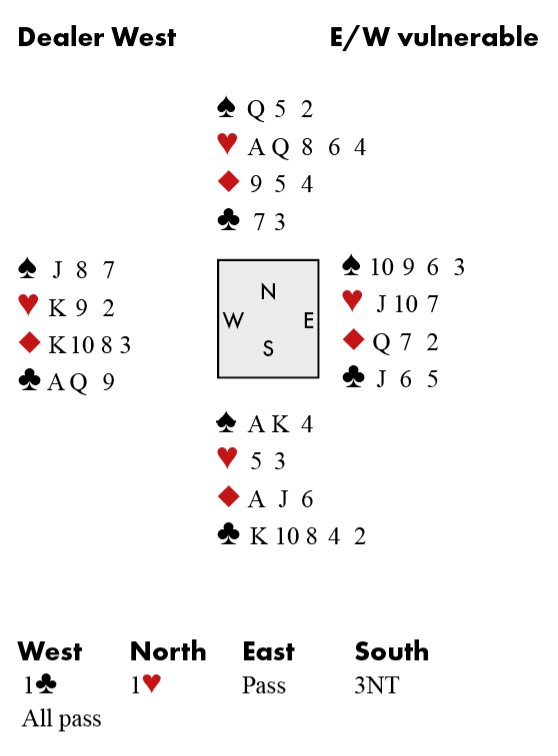
South was a bit squeezed for bids at his turn; both 2♣ and 2NT would have shown support for Hearts, so 3NT it was, and West annoyingly found the best lead of the ♦3 to East’s Queen.
South won and went after Hearts, but he had to try to keep East off lead, or a Diamond through would kill him. A heart to the Queen went well, and South carefully came back to hand with a Spade to play another Heart up. Again West played low, so the Ace won and luckily both defenders followed to the third round. Had West played his King at any earlier stage, South was of course ready to let him hold the trick.
West had an exit in Spades, but it did not help him; declarer simply cashed his two good Hearts and the last Spade, and could then throw West on lead with either minor to receive his ninth trick.
I doubt there’s a better ravioli in London: The Lavery reviewed
The Lavery in South Kensington is named for Sir John Lavery, official artist of the Great War and designer of the currency of the Irish Free State, who lived here, though he died in Ireland and is buried in Putney. Lavery, of course, would no longer recognise South Kensington as his home, and his white, monumental mid-Victorian house – it’s too cold to be compared to a wedding cake, it’s a power cake – is now a fashionable restaurant and ‘event space’, which I put in quotation marks so you know I didn’t write the words ‘event space’, I just typed them out.
In houses like The Lavery, I wonder how tall the Victorians were in their heads. I like high ceilings – I am not Paul Doll, fictional commandant of Auschwitz in Martin Amis’s The Zone of Interest, who wondered how he would gas people in a theatre – but this is absurd. It reminds me of the giant’s house in Mr Greedy (the foundation text for restaurant critics) if the minimalist faction at House & Garden got their hands on it. The scale is inhuman: but we are in Kensington, and inhuman is to be expected.
The dining room is white – I know the paint will not call itself that, it will have an elaborate Almanach de Gotha or Crufts’s name, but I call it white because it’s white to me. White signifies purity and status. White must be scrubbed clean by others with less money, which is why rich women love it. It’s a scream for notice – who will love you but the maid?
There is an original fireplace in grey marble, which looks out of place – I am not just saying that – and spindly chairs for slender bodies; sharp purple flowers, the kind that draw blood when you touch them; and modernist lighting: triangles hung upside-down, for instance, as if being tortured for their secrets. They light the art-curious rich of west London. This is the Frieze crowd. I know them by their sharp haircuts and over-large spectacles. They look like Italians forced to live underground, far from sunlight, or anyone in a Tilda Swinton film. Aesthetics matter: this is not style as identity, but substitute for lack of identity. This aside, the food is superb. It is delicate, pretty Italian food: the portions are for people who prefer to watch food than eat it, but you can always order all of it, and we did. Pretension, like running for buses, is exhausting.
And so we eat Tuscan salami with house pickles; mozzarella di bufala with roasted peach, bresaola and nasturtium; ravioli with ricotta, zucchini, parmesan, cultured butter and flowers (there are flowers, but I doubt a better dish of this kind is to be found in London); a veal chop with yellow pepper, anchovy and parsley; overcooked, over-buttered new potatoes, the only bad dish; an almond tart with strawberries and cream; two dense globes of ice-cream (chocolate and coffee); Lincolnshire poacher cheese.
It’s the old song – love the food, loathe the people, but South Kensington is the land of the psychopath restaurant. I haven’t forgotten Dorsia, long-closed but named after the restaurant in American Psycho where Patrick Bateman could never get a table. Dorsia was Bateman’s ever-receding dream: F. Scott’s Fitz-gerald’s boats against the current, borne back ceaselessly into the past. The Lavery is a better restaurant than Dorsia, not being fictional, but Dorsia, being fictional, is more self-aware.
Is Angela Rayner ‘humble’?
Just before the earth opened up, Sir Keir Starmer said of his deputy: ‘Angela came from a very humble background, battled all sorts of challenges along the way, and there she is proudly.’ We all know what pride comes before.
Humble seemed a genteel word to use. Deprived would have sounded harsh; poor too Victorian; working-class too Your Party. Anyway, the humble background had to be thrown off. Hers was not the professed outlook of the writhing Uriah Heep (seen as a ‘red-headed animal’ by David Copperfield). ‘“Be umble, Uriah,” says father to me, “and you’ll get on. It was what was always being dinned into you and me at school; it’s what goes down best. Be umble,” says father, “and you’ll do!” And really it ain’t done bad!’ But it was not enough, and Uriah turned to self-enrichment by falsifying documents.
But Mr Dick, the engaging simpleton in David Copperfield, counts humility as a virtue when talking of the schoolmaster Dr Strong, who is ‘Not proud in his wisdom. Humble, humble – condescending even to poor Dick’. Here condescending bears a meaning different from today’s. It acquired the sense of ‘betraying a feeling of superiority’ a little after the publication of David Copperfield in 1850.
Mr Dick, who makes kites, honours the Doctor’s name with a ritual. ‘I have sent his name up, on a scrap of paper, to the kite, along the string, when it has been in the sky, among the larks. The kite has been glad to receive it, sir, and the sky has been brighter with it.’
Confusion of pride and humility is a common reaction to success. Katie Price, brought up in Hove, of modest if not humble stock, has just had a record in the charts. ‘No. 3… thank you everyone!’ she said. ‘I am so humbled.’
Uriah refers to humiliation as ‘eating humble pie’, a jesting play on numble pie, made from the innards of a deer. Numble is from the Latin lumbulus, ‘part of the loin’. Humble itself went without an aspirated aitch until the 19th century. Perhaps Uriah was one of the last to leave it off.
The Battle for Britain | 13 September 2025
How America could save free speech in Britain
The only holiday the Youngs had this summer was a week in Norfolk for the Hunstanton tennis tournament. I’m too hopeless to enter myself, but my friend Nell, who has a house nearby, organised a different competition that I was more suited to. It involved making an ‘elevator pitch’ for a policy that would fix broken Britain. What made it challenging was the panel of judges was chaired by Lord Butler, a former cabinet secretary who is also Nell’s dad. The problem I focused on, needless to say, was the free speech crisis.
My proposal was to leave the European Convention on Human Rights, repeal the Human Rights Act and replace it with a Bill of Rights Act incorporating the first ten amendments of the US Constitution into UK law. Instead of the European Court of Human Rights, the ultimate guarantor of our civil liberties would be the US Supreme Court. Henceforth, British citizens would enjoy the protection of the First Amendment.
The objections from the panel came thick and fast. To begin with, the US Constitution, unlike the European Convention, isn’t designed to apply to more than one country. The First Amendment begins: ‘Congress shall make no law…’ How would that constrain our parliament? Wouldn’t making our courts subordinate to the Supreme Court involve a surrender of sovereignty? And was I really advocating a right to bear arms? No, the only way to make this work would be for Britain to become the 51st state. I was tempted to reply: ‘Yeah, and?’ But I could see I’d lost the room.
However, running this up the flagpole gave me another idea – a more modest way of harnessing the might of the US to defend free speech. Why not include a joint commitment to upholding freedom of expression in a future trade agreement? Something like: ‘We the undersigned reaffirm our shared commitment to democracy, the rule of law and the protection of fundamental rights and freedoms of individuals, including the long-standing guarantees of freedom of expression and association as set out in the First Amendment to the Constitution of the United States.’
Believe it or not, there is a precedent: the European Trade and Cooperation Agreement between the EU and the UK, ratified in 2021, includes the following wording: ‘The basis for cooperation under this part is the parties’ long-standing respect for democracy, the rule of law and the protection of fundamental rights and freedoms of individuals, including as set out in the European Convention on Human Rights, and the importance of giving effect to the rights and freedoms in that Convention domestically.’
Why not include a joint commitment to upholding freedom of expression in a UK-US trade agreement?
Admittedly, those words have a legal meaning that a comparable commitment to upholding the principles of the First Amendment in a US-UK trade agreement would not. And there’d be no equivalent international court capable of holding our feet to the fire. Nevertheless, it would have huge political significance. The Americans could argue they took this to be a binding promise and any resiling from it would therefore jeopardise the Atlantic alliance. It would be a way of giving effect to J.D. Vance’s warning that if European countries want to continue to enjoy the military protection of the United States they need to do a better job of upholding free speech.
Would the Labour government baulk at making such a commitment? I don’t think Keir Starmer would have much choice if the Trump administration held out the carrot of a free trade agreement. God knows he needs some good news on the economic front, and it would enable him to claim a victory that eluded his Conservative predecessors. No, the leader who would need convincing would be Donald Trump, particularly if it meant scrapping the 10 per cent tariffs on British imports.
But, oh, what a prize. If Starmer’s government committed to upholding ‘the long-standing guarantees of freedom of expression and association as set out in the First Amendment’, we could lobby for the repeal of all those laws fettering our free speech, such as the Malicious Communications Act, as well as stymie Labour’s efforts to prohibit ‘Islamophobia’ and impose a ‘banter ban’ in Britain’s pubs. It would be the beginning of alignment between America’s free speech protections and ours. We wouldn’t become the 51st state, but our shared commitment to freedom of expression could be the basis for deeper cooperation and the strengthening of economic and social ties.
America, it’s time once again for the new world to come to the rescue of the old. Do not let Britain become the North Korea of the North Sea.

Event
Americano Live: Is America Great Again?
Why three is the magic number in these Ashes
And so it begins, the Great Debate: no, not who will be deputy leader of the Labour party but the infinitely more important – and certainly more interesting – matter of who will be trudging out at No. 3 to bat for England in the first Ashes Test at Perth, which is now ominously close. Almost as close as the moment the first bars of Slade’s ‘Merry Xmas Everybody’ starts plinking round the supermarket.
For some, the choice of Ollie Pope or Jacob Bethell is like saying whether you’d rather be buried or cremated. And sure, the days of Jonathan Trott, Ian Bell and the great Nasser Hussain might be long gone. But No. 3 could be the key position in these Ashes. The England hierarchy has shielded Bethell and protected Pope, who has the knack of whacking a big hundred and then not many.
These Australians were one of the great sides but are now reaching the end of days. Pretty soon Mitchell Starc, Josh Hazlewood, Pat Cummins and Nathan Lyon will be heading for the commentary box. Steve Smith, once the best batsman in the world, is not even the best in the team any more. The first Test is crucial: if Australia lose, then the cracks that are already there – top order batting, for example – could open real fissures. You wouldn’t want to be a fledgling Aussie opener facing an ultra-high-speed artist like Jofra Archer.
And so to No. 3: Bethell is an exceptional strokemaker. He may be more of a swinger than Pope, and you wouldn’t back either to bat out half a day for a draw. But both players show just how far Test cricket has come.
Would you want to go back to the old grinding days? The great Aussie opener Bob Simpson, who died last month, batted 743 balls for his 311 at Old Trafford in 1964 – a strike rate of 41.77. Perhaps England’s greatest No. 3, Ken Barrington, scored nearly 7,000 runs in 82 Tests but was hardly a livewire at the crease. Against a weak Kiwi team in 1965, he took an hour to get off the mark and nearly two days to make 137. In the current England set-up, both Harry Brook and Jamie Smith have scored 80-ball Test hundreds.
Bethell’s sensational 76-ball century at the weekend, even in a dead one-day rubber against a weary South African side, thrust the 21-year-old’s questionable brilliance right back into the Ashes debate. He made his Test debut at No. 3 against New Zealand, where he scored an unbeaten 50 off 37 balls to lead England to an easy eight-wicket victory.
Perth will be hot and dry and fast, with a bunch of hostile Aussies wanting to give the England team some stick
But Perth isn’t going to be anything like that. It will be hot and dry and fast, with a bunch of hostile Aussies wanting to give this unfeasibly youthful-looking Englishman some stick – ‘G’day mate, does your nanny know you’re here?’ But Bethell went to Rugby School on a sports scholarship at the age of 12, where he should have picked up plenty of tips on how to deal with a sledging Aussie.
There might not be the certainty of the England No. 3 as there once was (Ted Dexter anyone?). But we are where we are. Will the England management team of Rob Key, Brendon McCullum and Ben Stokes have the nerve – and the ruthlessness – to sacrifice their vice-captain, the always amiable Pope, in favour of the relatively untried Bethell? I hope so. The Ashes could depend on it.
In our ceaseless quest to hail the unsung heroes of British sport, salutations to the 78 doughty souls from Truro who were willing to make the mammoth 880-mile round trip to Carlisle for their National League fixture. An astounding journey, with doubtless its share of Ginsters’ best, especially as it ended in a 3-0 defeat in what you might call the cathedral city derby. But it was a record trip for a football league game, so well done you Tinners.
Dear Mary: Do I have to read the romantic novel my neighbour has based on me?
Q. A woman in our village has written a romantic novel in which one of the leading characters is said to be based on me. I understand that the character is glamorous but he is also preposterous. While I know that, technically, such a fictional portrait is a compliment to the person it is modelled on, as long as not libellous, I don’t really like the idea of my neighbour ‘scoring points’ over me while simultaneously mocking me. I therefore don’t want to read the novel as I fear it may undermine me. However, we are a close-knit community and I don’t want to be unsupportive by not reading it, as this novel has allegedly been the financial saving of her. I know I will be expected to comment, as we run into each other all the time. What should I say to her – and to others who cannot wipe the smiles from their faces when they ask me what I think of the book?
– Name and address withheld
A. Tell those who ask that you are longing to read it, but you have been told by a friend with your best interests at heart that you should not do so – pause for dramatic effect – ‘because it will make me much more conceited than I already am’.
Q. When driving, my husband and I always like to do a sweep of houses of architectural interest that are nearby. These days, however, we sometimes come across new owners of a territorial type, who intercept one in the drive, or run out of the front door to confront us and who are clearly not sympathisers. When required to deflect aggression from those who would not understand the concept of a sweep, what is the best excuse to give for our presence? One cannot know the names of their neighbours to pretend to have been looking for that house.
– B.L., London SW3
A. The safest thing is to say: ‘I’m frightfully sorry. I thought this was my grandson’s potential new boarding school. I know it is around here somewhere but I can’t remember the name.’
Q. May I pass on a tip to readers? My husband and I boarded a 7 p.m. train at Edinburgh heading for London on Sunday. We were to arrive in London at midnight when all restaurants would be closed. We were dismayed to hear that there was no buffet on board and no trolley as we were both starving. My husband brilliantly worked out that the train would come into York at a certain time on a certain platform, and ordered two pizzas to be delivered direct to our carriage. He was able to open the door on the platform and take them in.
– A.G., Florence
A. How extremely kind of you to share this very valuable tip.
Write to Dear Mary at dearmary@spectator.co.uk