-
AAPL
213.43 (+0.29%)
-
BARC-LN
1205.7 (-1.46%)
-
NKE
94.05 (+0.39%)
-
CVX
152.67 (-1.00%)
-
CRM
230.27 (-2.34%)
-
INTC
30.5 (-0.87%)
-
DIS
100.16 (-0.67%)
-
DOW
55.79 (-0.82%)
Liz Truss sacks Kwasi Kwarteng
Liz Truss has sacked Kwasi Kwarteng as chancellor. It is a truly remarkable development. Truss and Kwarteng were even more part of a joint political project than David Cameron and George Osborne. The mini-Budget was an expression of their joint beliefs: his dismissal is a sign of how bad things really are. Less than six weeks into her premiership and she has sacrificed her closest ideological ally to try and shore up her position.
Truss will hold a press conference at 2 p.m. In it, we can expect a U-turn on freezing corporation tax to be announced – the markets assume it is happening and with the Bank of England’s intervention coming to an end this afternoon, not announcing one would risk sending the markets into a tailspin.
The two most likely candidates to replace Kwarteng are Nadhim Zahawi, who did the job over the summer in Boris Johnson’s ‘zombie government’ and Sajid Javid, who has been chancellor before and knows Bank of England Governor Andrew Bailey well, having appointed him to his current role. What is certain is that whichever of them takes the keys to No. 11 will have immense power. Truss cannot afford to lose a second chancellor.
J.K. Rowling laughs all the way to the bank
In Harry Potter and the Sorcerer’s Stone, Ron Weasley uses a levitation spell to knock a troll unconscious. On Thursday evening, his creator J.K. Rowling repeated the feat on Twitter. The world’s most highly paid author was asked how she slept at night, “knowing you’ve lost a whole audience from buying your books?”
“I read my most recent royalty cheques and find the pain goes away pretty quickly,” she replied.
I read my most recent royalty cheques and find the pain goes away pretty quickly. pic.twitter.com/s4gl9rlqxl
— J.K. Rowling (@jk_rowling) October 13, 2022
Now, Cockburn has always been a fan of J.K. Rowling, but her recent years on the right side of the culture war has seen her find a new audience, consisting of people with common sense. In case you missed it, the author was “canceled” in 2019 for expressing support for Maya Forstater, a woman lost an employment tribunal over comments she has made on social media about trans people.
J.K.’s tweet of support read:
Dress however you please.
Call yourself whatever you like.
Sleep with any consenting adult who’ll have you.
Live your best life in peace and security.
But force women out of their jobs for stating that sex is real?
#IStandWithMaya #ThisIsNotADrill
The Gen Z loons that once formed a substantial part of the author’s fan base are now spending their days scribbling bitchy tweets. Meanwhile, J.K. is laughing all the way to Gringotts, with an estimated net worth of around $1 billion.
This isn’t the first time the author has absolutely obliterated Twitter trolls. In 2017, someone tweeted her saying they were going to burn all of her books and movies. In true J.K. fashion, she replied with “Well, the fumes from the DVDs might be toxic and I’ve still got your money, so by all means borrow my lighter.” Crucio!
It’s been a good week for Rowling after Tom Felton, who played Draco Malfoy in the Harry Potter movies leapt to her defense. Cockburn was glad to see this, as it seems that every other young cast member has conveniently forgotten that they owe their whole career to the fifth bestselling female author of all time.
Felton told the Times of London, “I’m often reminded, attending Comic-Cons in particular, that no one has single-handedly done more for bringing joy to so many different generations and walks of life.”
J.K.: in the words of Ron Weasley, don’t let the muggles get you down.
Great! Another podcast about feminism
Politics, feminism, sex, TikTok. These four topics will form the heart of Emily Ratajkowski’s new podcast High Low with Emrata. Doubtless Cockburn speaks for everyone when he says: praise the gods, a podcast about feminism is just what the market is missing.
The new Sony-produced series will consist of two episodes per week. One will see the model and swimwear entrepreneur sit down for intimate conversations with special guests. Perhaps she’ll diverge from the Meghan Markle playbook and actually let her guests speak. The second will have Ratajkowski’s own commentary on current events. Cockburn is sure you’re just as excited as him to hear what the model has to say about the Electoral Count Act of 1887 and ballot harvesting.
The thirty-one-year-old supermodel recently declared that she was in her “bitch era” on TikTok, where she uses her substantial following to air her feminist takes and thoughts on toxic masculinity. This comes as no surprise to Cockburn: Ratajkowski recently filed for divorce from her husband of four years Sebastian Bear-McClard, after allegations that he was a “serial cheater.”
Anyway, the latest example of Emily’s TikTok polemicizing is too good not to share. While weighing in on the discourse surrounding Blonde, the controversial Marilyn Monroe biopic based on Joyce Carol Oates’s novel, Ratajkowski condemned the “fetishization of female pain,” before going on to vividly describe her plans to fight back against society’s obsession with female suffering. All well and good… until Ratajkowski later admitted she had not even seen the movie. Why not judge a book by its cover, right?
Cockburn feels that celebrity podcasts would add more value to the broadcasting world if their hosts start by sticking to what they know. For instance, wouldn’t Em’s podcast perform better from a video element? Cockburn has a feeling that would make audiences more likely to tune in…
The sectarian shame of Ireland’s women’s football team
How bad is Irish nationalism’s sectarian problem? In the somewhat Panglossian world occupied by nationalist and republican activists and politicians – boosted by recent census and election results – it doesn’t really feature in the discussion.
At the recent ‘Ireland’s Future’ conference in Dublin, attended by thousands of people, the grubby stuff – the legacy of the Troubles and all – barely featured amidst the hopeful mood music and good vibes. The sight of the Republic of Ireland’s women’s football team celebrating their World Cup qualification in Glasgow earlier this week with the pro-IRA chant of ‘Oh, Ah, Up the ‘RA” – a line taken from a Wolfe Tones song – struck a discordant tone.
A group of young women, born largely in the supposed golden era of the peace process, deciding the best way to celebrate their sporting triumph was to sing this song was strange. Have they not got better songs to sing given the Irish musical lexicon? Uefa, the inimitably useless regulator of European football, have begun an investigation and the Football Association of Ireland have apologised.
It seems a forlorn hope given Sinn Fein’s increasing hegemony
A grimly recurring feature of present day Ireland – north and south – is that young people of both persuasions continue to sing and do stupid, sectarian and crass things. Sport, particularly the rivalry outsourced to Scotland between Rangers and Celtic, continues to serve as a conduit for this sort of thing. Gaelic football, despite some effective PR, also continues to be blighted by casual sectarianism.
So in that sense, the jolting video footage from the Hampden changing room is not surprising. It is typical of an ingrained ignorance that no amount of peace processing seems able to shift. But what does it specifically say about the state of a political and cultural movement – allegedly engaging in a concerted effort of persuading unionists of its merits – that celebrating a group of terrorists has become part of its default party playlist?
The reaction from elements of Irish society was interesting, for all the wrong reasons. Rob Wotton, a Sky Sports News presenter, interviewing Irish player Chloe Mustaki was swiftly cast as the villain for having the temerity to ask if the situation ‘highlighted the need for education on issues like this’ amongst the Irish squad.
An Englishman having the audacity to talk about educating an Irish woman, given Albion’s many perfidies over the years, was seen by some as ‘problematic’. Having been on the receiving end of the IRA’s attentions – bombing pubs and shopping centres, that sort of thing – one can’t quite imagine why ‘the Brits’ might feel entitled to take a view.
How has this sanitising of a group which has killed and mutilated thousands of Irish people come around, to the extent they are now treated as some sort of kitsch cultural reference point? Could it have anything to do with the biggest party in the Republic being led by a woman who said there had been no alternative to IRA violence during the Troubles?
Michelle O’Neill, the Sinn Fein leader in Northern Ireland, responded to this week’s events by saying that since the FAI were investigating the matter ‘we should leave it at that’. Quite the shoulder shrug from someone who purports to be the ‘First Minister for all’ in Northern Ireland.
For victims of the IRA and unionists, if this manifestation of Irishness really is a taste of the early days of a supposedly better nation, it will be a distinctly unappetising prospect. Better minds and more courageous voices within Irish nationalism really must grasp the nettle and take this head on if they are serious about their referendum pretensions. That seems a forlorn hope given Sinn Fein’s increasing hegemony.
Celtic Symphony, the song which contains the offending lyric, has risen up the Irish music charts in recent days. Ireland’s young footballers are far from alone in being comfortable with this song. It seems that Ireland’s future remains fettered by its past and seemingly, people are ok with that.
Why won’t Graham Norton speak up for JK Rowling?
Is silence still violence? I’m just wondering because this week Graham Norton was asked about the deluge of hateful slurs and threats that are frequently fired at JK Rowling and he dodged the issue. Instead he rambled on about how celebs should not comment on difficult topics like transgenderism. So was his silence on the misogynistic monstering of JK Rowling an act of violence?
‘Silence is Violence’ is the radical slogan du jour. It was popularised by Black Lives Matter. There were moments over the past couple of years when you couldn’t browse the internet for five minutes without encountering a post saying that anyone who keeps schtum on hatred and violence is helping to compound that hatred and violence. But it seems this judgment is not equally applied. Silence on hatred against racial minorities? That’s violence. Silence on the rape threats, death threats and sexist hate that are aimed at Rowling and other women who are critical of the trans ideology? That’s fine.
It was during an appearance at the Cheltenham Literary Festival that Norton remarkably chose to skip over the persecution of Rowling. He was making fun of ‘men of a certain age’ like John Cleese who complain about being cancelled. Then the host, Mariella Frostrup, brilliantly turned it around.
Norton ridiculed the entire concept of cancel culture
Old blokes are an ‘easy target’, she said. What about JK Rowling, she asked, a woman who is ‘deluged with…anger, rage and attempts at censorship’?
Norton’s response? A flat, perfunctory ‘Yeah’ and then he moved on to talk about the need for more expert commentary over celebrity chatter.
It was a stunning misstep for such a seasoned broadcaster. Men, listen — if someone asks you about the vile harassment of JK Rowling merely for expressing her opinions you say: ‘It’s very bad’, okay? I don’t care if you don’t actually think it’s very bad, though that would be odd — you still need to say it. We blokes cannot just look the other way as Rowling is threatened with sexual assault, threatened with death by pipe bomb, doxxed and subjected to sexist insults every single day, all because she believes men cannot become women. Many other ‘gender-critical’ women experience similar. It’s time more men offered these women solidarity, or at least empathy.
For the record, I don’t believe ‘silence is violence’. I never liked that slogan. It always struck me as an intolerant diktat — ‘If you don’t buy into all our BLM ideas, then you are part of the problem of racial violence!’ But silence on injustice can certainly be cowardly. And the silence from the media and much of the literary set on the irrational demonisation of Rowling for the crime of wrongthink is certainly that. Mr Norton, surely you know you don’t have to agree with everything someone says to acknowledge that it is wicked to dehumanise and try to silence that person?
Norton ridiculed the entire concept of cancel culture. Actually it’s ‘accountability culture’, he said. People who have been free to say whatever they want for decades are now finally being held accountable, that’s all. What a chilling phrase that is — ‘accountability culture’. It seems to me that behind that bland, HR-style phrase there lurks an unforgiving desire to shame and punish anyone who holds the supposedly wrong views.
‘Who watches the watchers?’, we used to say about censorship in the old days. Well, who holds to account the accountability police? Why should they get to decide who must be held accountable? Why must Rowling be held accountable for expressing biological facts but hardcore trans activists don’t have to be held accountable despite saying awful things? Why is John Cleese ‘held accountable’ for allegedly being offensive, but the once notoriously offensive Frankie Boyle is not? Could it be that Cleese holds ‘wrong’ beliefs, especially on political correctness, which he criticises, while Boyle has bizarrely become a BBC-style correct-thinker in recent years?
Of course that’s what it is. ‘Accountability culture’ really means the isolation of people who say things the establishment doesn’t want to hear. It’s always been the way. Galileo was ‘held accountable’ by the Inquisition, critics of the King were ‘held accountable’ by the Star Chamber, and provocative playwrights were ‘held accountable’ by Mary Whitehouse. Now we all have the pleasure of being held accountable by the likes of Graham Norton. Happy days.
Liz Truss’s immigration conundrum
The Conservatives – in office since 2010 – are now into their fourth successive manifesto pledge to bring down immigration, which remains well over 200,000 annually. Naturally, Liz Truss is said to be weighing up increasing it further. Some of those in the Treasury believe that visa liberalisation is the quickest way to growth. From the Treasury’s perspective, and that of the new Chancellor Jeremy Hunt, immigrants represent an excellent deal: you don’t have to pay for their education or childhood, instead simply importing units of homogeneous labour fully formed. What’s not to like? Open the borders and watch the line go up!
Home Secretary Suella Braverman disagrees. She would like to cut migration substantially, as would many other Conservative MPs. Truss, already having lost a chancellor over her disastrous mini-budget, appears to believe that the best course of action is to pick yet another fight. Having appointed Braverman to run immigration policy, Truss is now cutting her out of decisions on…immigration policy, with the latest flashpoint the potential liberalisation of visas for Indians as part of a new trade deal.
This tension between Prime Minister and Home Secretary does not seem sustainable
This tension between Prime Minister and Home Secretary does not seem sustainable. Nor, in the long term, does Truss’s mooted plan to increase growth by opening the borders. Adding people to the British economy will make it larger. That is uncontroversial. But what we actually care about is the incomes and living standards of the people who already live in Britain. And from this perspective, our big problem is low levels of income per person, which migration only marginally impacts.
The routes through which it does affect living standards can be ambiguous. The first and most obvious objection to bringing in more people is that the sum of migration from outside the European Union has turned out to be a net fiscal drain. In many cases, new arrivals have not contributed enough in taxes to pay for the services they receive from the government. This means that over the longer term – particularly as they raise families and retire – the people already resident in Britain have ended up making transfers to the new arrivals rather than receiving them.
This is not an insurmountable barrier, but the British state is understandably squeamish about discriminating between long-term residents on the basis of their origins. A better argument is that the new immigration system sets a higher income bar for arrivals – possibly not sufficiently high, but higher – and could be raised to a level where a positive contribution is expected.
Over the longer term, migration is generally thought to be a net good for the public finances; migrants are young (offsetting an ageing population) and have children, growing the population, the economy, and the government’s ability to borrow. And any differences in contributions driven by culture – such as the number of children in families – will drop away, particularly as migrants acculturate to Britain.
The last point does matter though. One of the main Conservative objections to higher immigration is that conservatives, by definition, tend to quite like the country, and want to preserve its culture. Adding several hundred thousand new Britons to it every year inevitably results in cultural changes. This is generally accepted, even by those in favour of higher migration; when people praise the virtues of diversity or fascinating new foods, they are implicitly claiming that change will happen and will be good. When other people point to other changes driven by the same phenomenon and say they dislike them, it isn’t really consistent to dismiss them out of hand.
But perhaps the biggest barrier is that the British state is determined to make sure that immigration, which could be mutually beneficial, ends up feeling zero sum: where any benefit to new arrivals is offset by costs to the people already living here. The main way it does this is by blocking the construction of new houses, forcing people to compete for a relatively small existing stock, and by providing public services which respond slowly to increased demand, resulting in short-term deterioration until funding catches up.
In turn, this suggests a simple point: if Truss and the Treasury want to increase growth, improve living standards, raise productivity, and win support for migration, then the first step should be fixing planning.
What does the 6 January subpoena mean for Trump?
Poor Donald Trump. The 6 January committee has subpoenaed him. The New York attorney general is seeking to put the kibosh on his new Trump II organisation. The Supreme Court has rejected his bid to stymie the Mar-a-Lago investigation. What next? Will it turn out that Jared or even — gasp! — Ivanka has been ratting him out to the feds about his hoarding of secret documents at Mar-a-Lago?
Far from ending with his ousting from the White House, the Trump show has become an unending pageant of new plot twists. The central actor remains Trump and Trump alone, intent on hogging the spotlight in one way or another.
Far from ending with his ousting from the White House, the Trump show has become an unending pageant of new plot twists
The biggest revelation today was that Trump himself was fully aware that he had lost the election but terrified that his supporters would cotton on to the fact that he was a loser. Apparently he and his confederates were already plotting in October to announce, win or lose, that he had won big time. One of his aides reported that Trump, as is his wont, was watching the television after his defeat and expostulated, ‘Can you believe I lost to this effing guy?’ Another aide, Cassidy Hutchinson, stated that Trump complained, ‘I don’t want people to know we lost… This is embarrassing. Figure it out.’
No one did. Trump’s shambles of a presidency had already reached its terminus with the Covid-19 pandemic when he demonstrated his flagrant inability to contain the virus inside his own White House, let alone the nation. His preening and posturing, complete with a Mussolini-style appearance on the White House balcony where he defiantly ripped off his mask after returning from Walter Reed hospital, underscored rather than disguised his ineptitude. He was a commander-in-chief who wasn’t commanding.
When it came to disrupting the election, though, he did have a motley crew of forces to lead, and they followed the leader. ‘The vast weight of the evidence presented so far,’ said Representative Liz Cheney, ‘has shown us that the central cause of 6 January was one man, Donald Trump, who many others followed. None of this would have happened without him. He was personally and substantially involved in all of it.’
Whether the House subpoena against Trump will go anywhere is another matter. It keeps the spotlight on him, ensuring that he will have to respond to queries about his culpability for 6 January in the coming weeks. In this regard, it may help the Democrats’ electoral prospects a smidgen. But the likelihood of a Republican takeover of the House means that it will be null and void. Trump’s mandate is not only for the GOP to protect him in the coming months but to turn the tables on the Democrats by subjecting the Biden administration to a host of investigations, including targeting Attorney General Merrick Garland, the premier foe of the former guy.
For his part, Garland may well decide to indict Trump after the midterm elections for his purloining of classified documents. Nothing represents a greater threat to Trump. Should the GOP win both the Senate and the House, the political atmosphere in Washington might well go supernova.
This article first appeared on The Spectator World.
In praise of Jacob Rees-Mogg, the secret centrist
These are hard times for centrists, though we should be used to that by now. My tribe – clever, technocratic, sometimes liberal and sometimes smug – has been losing arguments and elections consistently for several years, often deservingly. We may know all about how policy works, but we haven’t been great at politics.
A common centrist lament comes from looking at the current government and despairing at the way libertarian ideologues have taken control, running the country according to the ideas found in Institute for Economic Affairs pamphlets and Allister Heath columns. Is there no one in government who is prepared to take a pragmatic, what-works approach to policy?
Well, I have good news for my anguished centrist chums. We do indeed have a friend in high places, a minister who is open to ideas regardless of their political complexion, interested in evidence and concerned about the situation of the disadvantaged. His name is Jacob Rees-Mogg.
No, this isn’t a joke, though I suspect it may raise a smile from the man himself. I really am arguing that JRM has centrist tendencies.
Let’s start with boilers. Earlier this week Rees-Mogg was on ITV, where among other things he explained that people can cut their gas use and gas bills by turning down the flow temperature on their combi boilers. So what? Isn’t that just common sense?
These days, appealing to the other side and talking to people who disagree with you are rather out of fashion
Yes, but it’s common sense that Liz Truss thinks government has no business sharing with the public. The PM vetoed a public information campaign on energy demand reduction assembled by Rees-Mogg’s business department, because she has ideas about the ‘nanny state’ or something. So, Rees-Mogg went on TV to get the information out there anyway.
This is the sort of practical politics we centrists like – I wrote a whole column earlier this year castigating politicians for not having the wit and courage to do exactly what Rees-Mogg did this week.
Then there’s the Guardian. A staple of centrist politics is appealing across party lines. Our default view of politics is that Tories should do more to appeal to Labour voters, and Labour should do more to court Tories. ‘Elections are won in the centre’, we like to say. (Where the electoral ‘centre’ is, is a tricky question. The awkward truth is that centre-ground opinion is probably less economically liberal and more socially conservative than a lot of centrists assume.)
These days, appealing to the other side and talking to people who disagree with you are rather out of fashion. En vogue instead is staying in your own political comfort zone. Labour people cheerily talk about hating Conservatives. The Conservatives chose as their leader the candidate with the lowest appeal to Labour voters. Truss is the core-vote candidate intent on showing just how small that core is.
Yet this week a cabinet minister went to the Guardian to write an op-ed directly addressing voters who don’t naturally support him, and appealing for their support. Yes, Rees-Mogg again.
His piece was about renewable energy. Centrists like it, because it works and the main objections to it are political and often silly. Rees Mogg likes it too, because it means more British jobs and less British dependence on imported gas.
And just for good measure, Rees-Mogg is again in dispute with the PM over solar energy, where she has some regrettably illiberal ideas about banning farmers using their own land to install solar panels if they want to.
A third piece of evidence is less visible but possibly more significant than the two above. It’s welfare policy. It might surprise some people to know that the cabinet ministers resisting moves to impose real-terms cuts in welfare include the Business Secretary. His colleagues report that Rees-Mogg has been resolute in opposing policies that would make people on low incomes (40 per cent of universal credit recipients are in work) poorer.
Defying Liz Truss over the nanny state. Standing up for green energy and the poor. Appealing across the political divide. When Michael Gove did stuff like this he was hailed as a compassionate genius by many of my commentariat brethren. Where’s the celebration of Jacob Rees-Mogg, the secret centrist?
Here, I should clarify my point. In case it needs saying, I’m not really trying to argue that Jacob Rees Mogg is a centrist politician. Nor am I endorsing him and all his various policy positions. I’m just saying I agree with him on some things. And disagree on others.
And this is the real point. People are complicated, and so are politicians. They very rarely, if ever, fit perfectly into the cookie-cutter shapes that common political labels describe. So ‘right-winger’ Jacob Rees-Mogg sometimes does very centre-ground things. But because we all find simplified narratives easier and more comforting (my side are all good people: their side are all bad) such nuance is often overlooked.
The example of Rees-Mogg is valuable for another reason too, and that’s because it’s a challenge to my tribe. We pride ourselves on putting evidence before ideology, pragmatism before parties. That should mean working with anyone who agrees with us, who does the things we consider ‘sensible’.
Yet centrists are as prone to blind spots as any other group. How many people in the sensible centre were willing to recognise that Theresa May’s attempts at Brexit were the most centrist way to resolve that agony? We got Boris and a harder Brexit partly because centrists helped kill May’s compromises. Tory hardliners helped too, with Rees-Mogg among them.
This week too, he’s been doing things that centrism abhors, such as attacking the Office for Budget Responsibility (OBR). Centrists like independent institutions like the OBR, and not just because they’re run by People Like Us. It’s because they work: just ask our friends in the bond markets if you don’t believe me. Rees-Mogg is wrong to attack the OBR, just as he was about Brexit.
But so what? Why not dislike the man’s positions on Europe and economics while agreeing with him on energy or welfare? It’s possible, and should be utterly normal, to agree with someone on some things and disagree with them on others. That is – or should be – an article of centrist faith.
But today, where are the centrists, liberals and greens endorsing Jacob Rees-Mogg on solar or benefits? If he’s right about something, he’s right. So, in a turbulent week, take a moment to note and praise the overlooked centrism of Mr Jacob Rees-Mogg.
Are falling house prices really a tragedy?
Higher interest rates are making borrowing less affordable, so the average buyer has less to spend on a new property. Halifax found that the house price reduction has already begun, with a 0.1 per cent drop last month. Falling house prices can be a harbinger of economic doom – this kind of decline usually signals the imminent start of a recession.
Many will treat lower house prices as a tragedy. Oxford Economics has described the current predicament as ‘the most worrying housing market outlook’ since just before the 2008 financial crash. Homeowners will see their wealth shrink, at least on paper. Recent buyers with loans larger than the value of their property could end up in negative equity.
But let’s look at this with some perspective. Oxford Economics is forecasting house price falls of around 13 per cent across next year and the year after, taking the price of average properties to levels not seen since… March last year. House prices would still sit around seven or eight times higher than median earnings.
In other ways, a fall in house prices would not be such a bad thing. When buyers assume housing is a bet that can only pay off, it drives prices even higher. Lower house prices could reduce bubbles in future by making buyers more cautious when purchasing. It’s notable that YouGov has consistently found around half of Britons want house prices to go down, while just 5 per cent want them to continue rising.
It is reductive to think a fall in house prices will solve deep-seated issues
It’s also unhelpful, from a personal perspective and for the broader economy, for so much wealth to be locked up in property; it would be much better if we were investing savings into productive capital to help grow the economy, rather than in stagnant property.
Rising house prices have also driven serious wealth inequality, particularly between young and old. The former were lucky enough to be born early enough to afford a decent property on an average salary. The latter are deeply frustrated by the difficulty of achieving the security of homeownership available to previous generations.
This housing dynamic raises issues for the Conservative party. On one hand, homeowners vote in large numbers for Conservatives and exercise political power to block developments in their local area. On the other hand, conservatism offers little for younger generations who don’t own much, delay starting families, and (understandably) see fundamental unfairness in the system. This creates a long-term electoral challenge.
But it is reductive to think that a fall in house prices will solve these issues. A drop in property prices driven by higher interest rates do not make houses more affordable. And just because buyers are paying less to purchase a home, does not equate to increased availability of housing. Higher interest rates just mean buyers will be approved for smaller loans, and thus pay less, but end up with similar repayments. But in reality, buyers are paying more to the bank less to the previous owners.
Nor are lower house prices likely to fix the rental market. A recent study from rental platform Ocasa suggests the number of properties available for rent have nosedived by 40 per cent over the past three years. This reduction in supply, probably driven by landlords selling up in fear of proposed stricter regulations, helps explain the astronomical rent increases being experienced in British cities over recent months. There’s a further risk that higher mortgage repayments force landlords to increase rents or sell their properties, meaning a further reduction in rental properties – and therefore higher rents.
The only meaningful way to make housing more affordable is to build enough homes to satisfy our needs – something the UK has failed to do for decades. There is further bad news on this front. Robert Colvile from the Centre for Policy Studies highlights how the UK’s five largest housebuilders have lost half their value this year on the stock market. This is driven by the expectation that they will build far fewer homes because of higher input costs and lower potential returns. It’s rational for property developers to hold on to empty plots of land until the market begins to bounce back.
So, the government is facing another big headache. Not only will existing homeowners become frustrated with the declining value of their properties, but there will be fewer new homeowners and less economic activity in construction.
The best the government can do is to implement some (much-needed) supply-side reforms to the planning system: this will help to enable enough building work to keep house prices from reaching credit-fuelled astronomical highs in future. It would also bring about the end of the boom-bust model housing market model.
One partial answer to the current predicament lies in ‘street votes’ – enabling smaller communities to agree to gentle densification of their blocks – an idea the government is intending to implement. This would come with the added advantage of creating sites for the smaller housebuilders who are most likely to struggle during this current downturn.
If house prices only decline because of higher interest rates, that’s a bad thing. But if increasing the availability of homes drives down the value of existing homes, it can only be a good thing.
The markets have rebounded – but how long for?
So, no Black Friday. The pound is steady, the FTSE100 up 1.5 per cent, the FTSE250 up more than 3 per cent. Just as fears grew that the end of the Bank of England’s gilt-buying programme could send pension funds to the brink and precipitate a fresh market crisis, the opposite happens: markets embark on a rebound.
It won’t necessarily last, of course. The long, miserable decline of stock markets and gilt markets this year has been punctuated, as ever, by periods of optimism, only for a fresh slide to begin. But for the moment it seems as if the big story that is driving markets is the expectation that Kwasi Kwarteng’s mini-Budget will see more U-turns – possibly as early as today – or even be dumped altogether. The Chancellor flew back early from an IMF meeting in Washington, catching the last plane to London. That hints that some announcement will be made today.
The trouble is that a major U-turn on tax cuts is now built into market expectations
The trouble is that a major U-turn on tax cuts is now built into market expectations. If Kwarteng does not make such an announcement a lot of investors are going to be very disappointed. If they sense that the Chancellor is only prepared to make minor changes to the tax-cutting programme, it could be a different story by lunchtime. There is also the effect of US inflation figures to look at. US consumer prices, it was revealed yesterday, are still growing at 8.3 per cent a year. Even by quoting ‘core inflation’, a pretty preposterous measure which strips out food and energy and can hardly therefore claim to measure the cost of living, inflation comes out at 6.6 per cent. It is likely to mean that US interest rates remain higher for longer – not what markets want to hear.
No one knows for sure, either, whether pension funds have managed properly to cover their positions thanks to the Bank of England’s gilt-buying programme. Any hint of trouble for pension funds will send gilt markets into a further tailspin.
There is a possible long-term effect of the events of the past three weeks. Will it make this government, and future governments, shy of making tax cuts, even when (and if) the public finances are in better shape? The fear now is that Kwarteng and future chancellors will be shy of making any kind of tax cuts for fear that they will upset markets. That is not going to help the economy grow, and could lead to a lower trajectory for company profits for years to come.
Six graphs that could seal Liz Truss’s fate
When Britain crashed out of the European exchange rate mechanism on Black Wednesday, prime minister John Major phoned the Sun editor Kelvin McKenzie to ask how the day’s events would be covered. McKenzie is said to have responded: ‘Prime minister, I have on my desk in front of me a very large bucket of shit which I am just about to pour all over you.’ With the Bank of England ending its emergency support for pension funds this afternoon, what newspaper editors are saying about the present Prime Minister by market close could come down to the ebbs and flows of these six graphs:
1. It’s all about gilts.
Yesterday gilts were going in the right direction. Five-year yields finished the day 0.31 percentage points lower than where they started. Ten-year yields dropped even more. As Ross Clark reported yesterday, this was probably down to confidence that pension funds had offloaded the gilts they needed to raise cash in the nick of time. Perhaps they had heeded Bank governor Bailey’s ‘you’ve got three days left now. You have got to get this done’ warning. Despite this, yields are still far higher than where they have been for most of the year. It shouldn’t be long before we know what direction they’ll travel in today.
2. Don’t forget the pound.
The pound has been all over the place since the mini-Budget. After falling to an all-time low of just above $1.03 following the budget, it recovered almost all of its losses. A couple of week later, it has been one of only a handful of currencies that had gained against the dollar. But then, after governor Bailey’s message that the gilt buying would stop, it crashed again. Now, it’s at a near-week high. What the pound does in the next few days could be the clearest sign of market confidence we have.
3. Growth, growth, growth?
With almost every forecaster in the City predicting recession in the coming months it’s important to keep an eye on where GDP goes. Truss and Kwarteng are targeting 2.5 per cent growth in the long term. But has the fact this is a long term plan been communicated clearly? If they make it that far they’ll be judged on what growth does next year, and for them, the forecasts are not looking good.
4. Is this just a UK problem?
It’s not just the UK economy that finds itself in hot water. Gilt yields have been rising sharply in the US and Germany too. American 30-year mortgage rates hit 6.8 per cent this week – their highest level in 16 years. The cost of producing goods in German industry soared some 46 per cent in August. The truth is a lot of the international turmoil would have caused problems in the British economy anyway. Kwarteng just made it worse.
5.Polling numbers are the most important.
Perhaps more importantly for Truss’s fate is the effect the market reaction has on the poll numbers. She started her term in office with a negative opinion rating and Labour has an average poll lead of 27 points. In some polls yesterday the gap was in the 30s. It’s those numbers more than any other that could spook the Tory party into acting against her.
6. If Truss were to go who, would replace her?
It was reported last night that senior Tories are gearing up for a Rishi Sunak and Penny Mordaunt ‘unity’ ticket. This would be not so much in the hope that they’ll turn the polls around and win the next election, but that they’ll lead to a loss that isn’t so great as to finish off the party for good. That would be in line with what gamblers think. Sunak is the current favourite to replace Truss with a 26 per cent chance. Mordaunt is fourth with a 13 per cent chance. One other market to keep an eye on: some bookies are offering 6 to 1 odds that a 60p lettuce with a ten-day shelf-life will outlast the PM.
One last possibility to consider: that markets have, to some extent, priced in reversals to much more of Truss and Kwarteng’s ‘mini-Budget’. The Bank, too, has been far from clear whether it really will pull its support for the borrowing markets. So if the markets get what they expect, and pension funds receive further central bank support, all these graphs could move in the right direction. But this is all far from certain. Today we’ll learn if markets may yet force the government and the bank’s hands.
You can track all the graphs mentioned above on the Spectator’s data hub.
Fight or flight? Kwarteng dashes home
It seems that panic and turmoil is something the markets and Tory party currently have in common. Kwasi Kwarteng is flying home a day earlier than planned from the annual meeting of the International Money Fund in Washington – so he will be back in London this afternoon when the Bank of England is due to end its gilt-buying programme, risking further chaos on the markets.
So what’s Kwarteng up to? There are four options:
Could Kwarteng be hoping to swoop in and save the day?
1. Quell rebellion, argue against a U-turn
The Tory party is buzzing with speculation of a plot brewing to oust Liz Truss before Christmas. Katy Balls ran through the options in last week’s magazine, and the Rishi by Christmas option is picked up in the Times today suggesting a joint ‘coronation’ with Sunak and a queen: Penny Mordaunt. Mr S isn’t so sure about this (their respective teams are not talking to each other) but you get the idea. Kwarteng makes his premature dash back across the pond to plead with increasingly mutinous Tory MPs not to U-turn on parts of the mini-Budget.
2. Quell rebellion by performing a U-turn
When asked about a U-turn in corporation tax in Washington yesterday, Kwarteng said: ‘Let’s see’. So he could be hoping to swoop in and save the day by initiating a U-turn on the budget to calm the markets before the Bank of England let the axe drop this afternoon. After which of course his credibility would be shot and he risks going down in political history as a punchline.
3. Resign as Chancellor rather than perform the U-turn
Kwarteng said yesterday he would ‘100 per cent’ still be Chancellor a month from now, but Liz Truss gave similar assurances about the survival of her 45p tax rate. Might he be flying home to tell Truss that he’d rather resign than U-turn – that she can turn if she wants to, but she’d have to get someone else? Kwarteng is quite a proud man and won’t want to spend the rest of his career seem as a fiscal David Mellor, who tried to cheat on the markets and got busted. Perhaps he’d rather do a Sajid Javid and say that the Chancellor needs to decide such things – and if she orders him down, then fair enough but she can’t order him to eat the words she put into his mouth in the first place.
4. He doesn’t want to miss tonight’s episode of Strictly Come Dancing
Kwarteng’s powers of chillaxing put David Cameron to shame – so let’s not rule this out. And there’s rumours that Giovanni Pernice has threatened to quit the hit show as he feels ‘wasted’ in the current series. Kwarteng might sympathise and be keen not miss the drama.
Inside the recharged Battersea Power Station
At its peak, Battersea Power Station supplied a fifth of London’s electricity, including to Buckingham Palace and parliament. Today, the most electric thing about it is the virtual reality gaming venue on site. Times have changed – but the reopening of the power station allows us to rediscover one of our finest pieces of industrial heritage and to take stock of the neighbourhood’s £9 billion makeover.
The iconic Grade II*-listed building was decommissioned and shut down in 1983. Over the past ten years, in Europe’s largest urban regeneration project, it has been restored and repurposed. The project reaches its climax today when the power station reopens as a residential, retail and hospitality development. As Simon Murphy, CEO of the development company (owned by a consortium of Malaysian investors), declared: ‘The icon is reborn.’
There is a lot to take in. The site covers 42 acres and includes 3.5 million sq ft of mixed commercial space and 4,239 new homes. There are surrounding apartments and amenities, including Circus West Village which opened in 2017, but the heart of the action is at the power station building itself in the two restored Turbine Halls. Turbine Hall A is all Art Deco glamour, reflective of the 1930s when the power station was built, while Turbine Hall B, which was completed in the 1950s, has a brutalist, industrial-chic look.

It does its best to ensure you never need to leave: there’s at least a couple of gyms, a cinema, crazy golf, theatre, luxury hair salon, even a dentist
The power station’s silhouette is emblazoned in the public imagination thanks to Pink Floyd’s 1977 album Animals – not to mention, more recently, The Dark Knight, The King’s Speech and Superman III in which it was used as a backdrop. In 1939, it was voted the nation’s second favourite ‘modern’ building after the flagship Peter Jones store in Chelsea (which I think rather flatters John Lewis).
From an architectural point of view, one can only marvel at the station itself, painstakingly restored to its former glory and with homages everywhere to its illustrious past. A special ‘Battersea Blend’ brick was created to replace some of the six million used in the original main building. There are little pleasing details, such as the design of the park dustbins, inspired by the old chimney shafts. As for the shafts themselves, they have been rebuilt from scratch to the original specifications. The north-west one now features a great glass elevator: visitors can pop out 109 metres up to admire panoramic views of London.
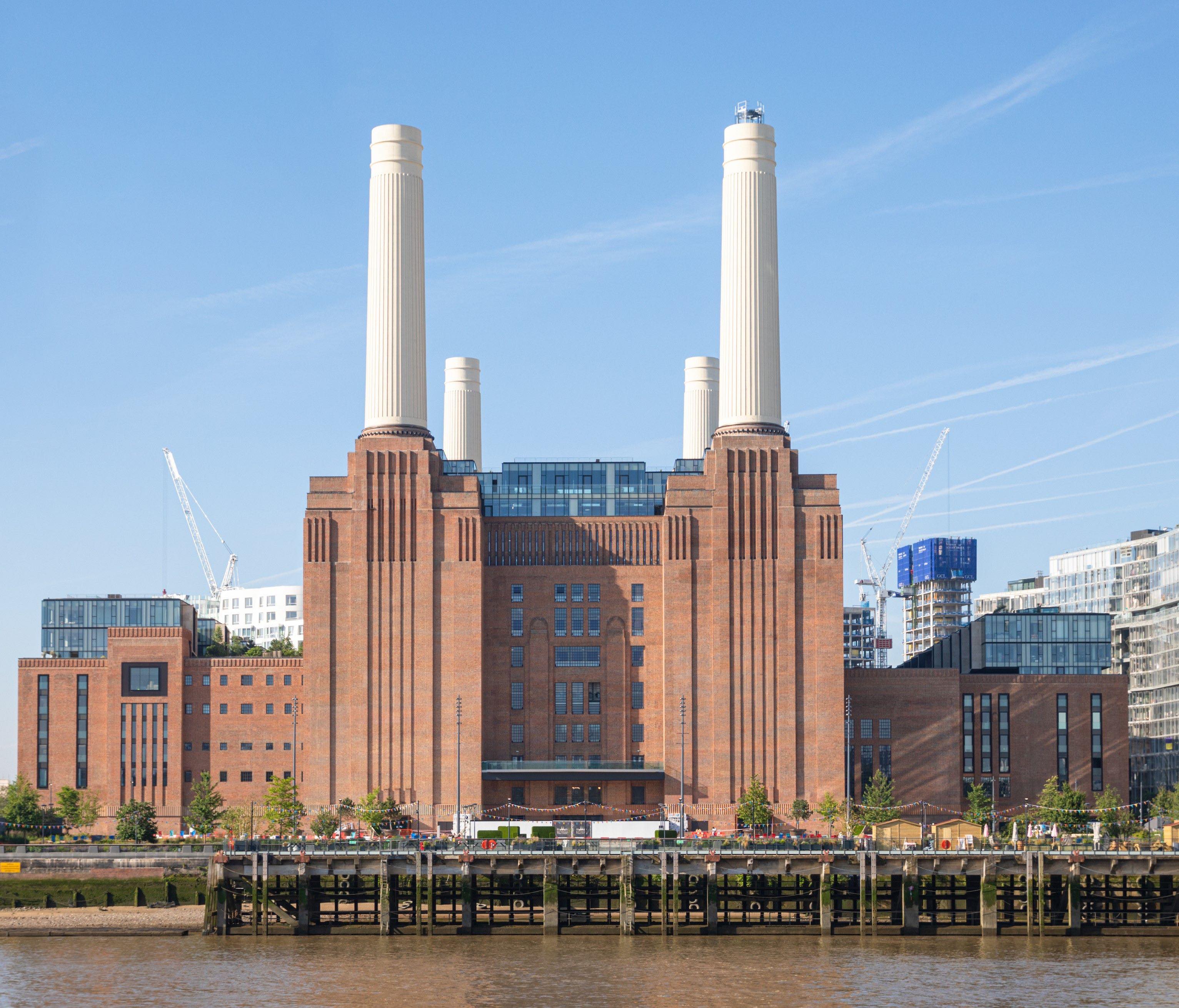
What is there to see and do? Mainly eat, drink and shop. Though it is described not as a restaurant quarter or shopping mall but as a ‘neighbourhood’, it does its best to ensure you never need to leave: there’s at least a couple of gyms, a cinema, crazy golf, theatre, luxury hair salon, even a dentist. Bear Grylls (who owns one of the building’s swanky flats) has partnered with a gym downstairs which presumably helps cover the mortgage.
There are some interesting higher-end restaurants, including Amalfi Coast-inspired Fiume, as well as budget-friendly favourites in Tonkotsu and Roti King. And there is much more which looks appealing, albeit not entirely comprehensible – the ‘UK’s first art’otel’ and an ‘urban winery’ both had me flummoxed, but they’re all clearly excited so let’s let them be.
The eateries know their audience. Guests are urged to ‘Celebrate the small 4 p.m. wins’ with 4 p.m. to 7 p.m. happy hours every weekday at Megan’s, which looks to largely be populated by people who got rejected for Soho House membership. There’s a list of dog-friendly restaurants – one bar is ‘more than happy to welcome you both to their relaxed, all-day experience from morning coffee to nightcap’. (It doesn’t specify whether the double Scotch on the rocks for the pooch costs the same as your own.)

Not everything is open yet. Things to come in 2023 and beyond include a second Arcade food market from the unstoppable JKS restaurateurs, and a Gordon Ramsay venue called Bread Street to join his already opened street pizza restaurant. The developers are talking the site up as one of the capital’s most exciting restaurant hotspots, though of course PR speak should be taken with a pinch of salt: I started reading with interest about ‘the premier roaster and retailer of specialty coffee in the world’ before realising the opening in question was Starbucks.
Shops are, predictably, dominated by big-name high-street brands. The inclusion of Abercrombie & Fitch which long ago lost its appeal feels a dreary choice. There’s a good bookshop specialising in art and architecture volumes. The Battersea General Store, meanwhile, is making Twitter waves for selling £1,000 bottles of wine which may be exciting for some. There is also plenty of entertainment and event space. The Coaling Jetty is pleasant, with regular yoga classes and presumably group spirit chanting. It’s all a bit theme park – a bit ‘who needs to be in Zone 1 when it’s all right here without even leaving?’. But it’s nice all the same. And the improved public access – a 450 metre riverside pathway and six-acre park in front of the power station – are boons.
The question is whether people will come. It has managed to attract major firms into its office space. Apple has chosen the site as its HQ in the UK, moving from Mayfair. The wider development of the area hasn’t all been plain sailing: a much-anticipated footbridge from Pimlico to Nine Elms looks to be dead in the water, with residents on the Pimlico side deciding hordes of south Londoners disrupting their quiet life wasn’t worth the trade-off of being closer to the Nine Elms Waitrose. But footfall will be helped massively by the two new Underground stations.

Developers highlight other parts of the Nine Elms redevelopment which includes the US embassy and luxurious flats (including the now-famous sky pool bridging across two of them, 35 metres up). A bigger draw is likely to be the proximity to Chelsea, a 20-minute walk away. What’s more, Battersea Park – London’s answer to Central Park – is right on the doorstep. Together with the High Line-inspired gardens, soaring Art Deco brick towers, dog walkers and ‘brunch with the gals’ groups, this is the closest London gets to New York. Which will delight millennials and Gen Z and probably repulse everyone else, something I imagine suits the developers just fine.
So I would say it’s a mixed picture. Some of the site’s new-builds surrounding the power station itself fall into the ‘make it metal, glass and zig-zaggy and people will come’ trend. But nothing can take away from the fact that this redevelopment has, at long last, marked the rebirth of one of the capital’s most distinctive landmarks. It was a travesty to have the great hulking edifice crumbling on the banks of the Thames, as it did for almost three decades. Like London’s other great power station, which reopened as Tate Modern in 2000 and has become one of the capital’s most visited attractions, Battersea Power Station is likely to be a hit. That the building is restored is hugely cheering. And if it manages to breathe life into the wider area it will be nothing but good news – even if it is full of girls having boozy brunches at Megan’s.
This old thing: the new fashion brag
The skirt I’ve worn most often recently is long, blue and as comfortable as it is flattering. ‘Why, thank you,’ I reply with a satisfied smile when I’m complimented on its delicate floral print and the way it swishes as I walk. ‘It’s Dorothy Perkins, 2011.’
I may not be able to distinguish Dolce & Gabbana from Dior or have set foot in a clothes shop fitting room since 2020, but when it comes to the newest form of fashion bragging, I excel. Nowadays, you see, it’s not the number on the price tag that counts, but the number of years you’ve owned the garment you’re wearing – and my wardrobe is stuffed with clothes that predate Megxit, Brexit, Instagram and half of Madonna’s children.
So why do I find myself an unlikely style guru? Well, because we’re in a cost-of-living crisis, obviously, with inflation and supply chain problems meaning womenswear is already 37 per cent more expensive than it was five years ago.
The impact on the environment increasingly also takes the lustre out of new purchases. According to the United Nations Environment Programme, the fashion industry accounts for up to 10 per cent of global carbon dioxide output – more than international flights and shipping combined – and is responsible for a fifth of the 300 million tons of plastic produced globally each year.
My wardrobe is stuffed with clothes that predate Megxit, Brexit, Instagram and half of Madonna’s children
In addition to feeling financially and ecologically virtuous, however, there are altogether less altruistic drivers behind this sartorial trend. Being able to wear clothes from a bygone era is often a signifier you haven’t succumbed to middle-aged spread – a way of showing that you’re still in touch with your youth. It is not only a massive ego boost, but the ultimate humblebrag.
Just ask Gwyneth Paltrow who, ahead of her 50th birthday last month, wrote on her Goop website that she’d dug out a designer frock at least a decade old, in a sentence masterfully constructed to make her sound effortlessly thin, preternaturally youthful and rich, yet resourceful: ‘I wore the shortest skirt I’d worn in ten years just the other day: it was this old Chanel dress I found in the basement, and it worked.’
The less flashy former Blue Peter presenter Konnie Huq, 46, revealed in 2020 that she hadn’t bought any new clothes in ten years because she had remained the same dress size, while actress and environmental activist Jane Fonda, who dressed in the gown she’d worn to the 2014 Cannes Film Festival to the Oscars in 2020, announced that year that she ‘would never buy another article of clothing’. The Princess of Wales, 40, is also never afraid to be seen in the same outfit twice, and repurposed an Alexander McQueen gown that she first wore to a Bafta event in Canada in 2011 for her appearance at the Earthshot Prize ten years later.
You could argue that celebrities are cheating by re-wearing designer garments that boast superior stitching and the sort of expensive cut that can withstand changing fashions. With no old couture gowns in my basement, I like to raise the stakes with high street staples that have been assaulted by baby vomit and thrown in a hot wash more times than Paltrow has had raw dinners.
And because most of my clothes cost no more than £100 (OK, £50) in the first place, every year I pull them on without them falling apart feels like an added accomplishment. That the embroidery on the leg of my Zara trousers (circa 2016) is coming unstuck only adds to their vintage appeal.
Some of my clothes are hard to date; others, such as the six-year-old Topshop camisole and Diesel jeans I bought from Selfridges in a post-Brexit referendum result daze, and the 14-year-old oversized French Connection shirt I wore on a date with my now husband, altogether easier.
Like my celebrity counterparts, I have largely remained the same weight since I was a teenager, although elasticated waists do offer insurance against excess chocolate (most notably in my 12-year-old Gap maternity skirt, one of my all-time favourite garments). I find keeping old clothes encourages discipline. My current most coveted item is not in a department store but on my wardrobe shelf: a 2014 pair of Topshop jeans that I’ll need to drop 5lb to be able to breathe comfortably in.
Clothes that even if I were to live on brown rice might compromise my decency get handed to my 11-year-old daughter, still four inches shorter than me. The 15-year-old short yellow French Connection dress I met her father in is one of her favourites, and the 18-year-old Topshop mini skirt I’d fall out of London bars in throughout my twenties better suited to her shorter frame.
Am I a hoarder? I don’t think so, although I do feel an emotional attachment to items that remind me of key stages of my life. And I’ve found that, for all the understandable furore surrounding cheaply manufactured clothes, most are a lot more robust than we give them credit for. As my dad, still wearing Marks and Spencer shirts from the 2000s, put it: ‘Things just don’t tend to wear out, do they?’
Nor am I necessarily as unfashionable as I might sound. A quick look at this autumn’s key trends reveals I have most of them covered, from floor-skimming hemlines, courtesy of my Dorothy Perkins skirt, to brightly coloured ‘dopamine dressing’, which my eight-year-old pink silk Banana Republic blouse could have been made for. The minimalism of the 1990s, I’ve read, is also back – although the 24-year-old boob tube I lived in at university is staying firmly in my drawer. I have to draw a line somewhere.
Old Fashioned values: a cocktail recipe to live by
Take your time. Measure twice. Finish what you start. How will you have time to do it again if you don’t take time to do it right the first time? Work hard at work, then come home. Loosen your tie and relax. Make a highball or mix a cocktail for your wife and yourself. Share the end of the day.
We are brothers and we write here of a drink and the man who taught it to us, our father. Teaching us how to make it, he also taught us something of how to live. He was a chemical engineer, and so the formula was important. The drink was the Old Fashioned (or Old Fashion; it doesn’t matter), and this is how he made it.
You will need: half a teaspoon of sugar, four to six drops of Angostura bitters, half a shot of tap water, the juice of about one-third of an orange (hand-squeezed), and one or two store-brand red maraschino cherries with a short teaspoon of cherry juice.
It is a drink of anticipation, made one at a time, side by side. It is like live performance: never exactly the same twice in a row but, when well-practiced, approaching perfection
Technique: in a cocktail tumbler heavy enough to feel it when you pick it up, stir the sugar, bitters and water until the sugar crystals dissolve. Stir in the orange and then the cherry and the juice. And don’t forget the bourbon. This is a bourbon-only drink. House or well bourbon is fine, nothing any more pretentious than Old Grand-Dad or Ten High. Save your Basil Hayden’s and Larceny for late-night sipping. Pour in one or two shots, depending on your audience. Last comes the ice (cubes, never crushed) and a brief final stir. Garnish with a half-slice of orange precisely incised at 45 degrees to hang properly on the edge of the glass. Serve on a cocktail napkin, for the glass will sweat.
The ice quickly dilutes the balance of your concoction, so you must attend to enjoying it. Do not set it aside overlong while you mess with the grill. The Old Fashioned is the result of many ingredients, and multiple steps in a particular sequence. It is a drink of anticipation, made one at a time, side by side. Do not even think of a pitcher. It is like live performance: never exactly the same twice in a row but, when well-practiced, approaching perfection. Or pretty close.
The Old Fashioned is a strong drink demanding respect, but it is not just whiskey on the rocks. It is a patient gathering and transformation of ingredients from around the kitchen and liquor cabinet – a multi-sensory process, not a production. Stirring takes time and results in clinking. This is why you may not use bottled simple syrup, which is easier than granular sugar but far too quiet.
The lesson came to us, father-to-son. Perhaps such learning is also imparted mother-to-daughter, but we are, well, old-fashioned, and find it hard to imagine at least with regard to the bar: our mother, who certainly partook of a cocktail, never made one, and we have no sisters. The lesson came to us in a certain chronology. The elder of us was first introduced to the ritual after graduating high school in 1966. Underage yes, but safely at home. Though later a historian, he remembered the sequence, as he was recently reminded, out of order. The younger of us, who was also first introduced to the ritual at his high-school graduation seven years later, and who became a surgeon, remembered it with confident precision.
We both remember two other pegs. In 1995, before a dinner at Keen’s Chop House in New York City to celebrate our father’s 75th birthday, the younger of us arrived at our rooms equipped with all the ingredients for the homemade Old Fashioneds of yore. The Harvard Club supplied only the ice. Then, in 1997, near the end of our father’s life, as he sat in his chair in the living room listening to the clinking of his sons making cocktails, he was heard to say as if in valediction: ‘Hey, that sounds good!’
Remember those signs that used to admonish carefulness at every level crossing: Stop, Look, Listen. Don’t outsource your Old Fashioned to a bar. Learn to do it yourself. Then taste that very first sip. Whether or not it rewards you with a memory like ours, we guarantee that the experience will repay your patience. And then you too will have mastered a craft worthy of passing on.
This article was originally published in The Spectator’s World edition.
Keto no-no
I recently got engaged. After the celebratory Champagne and indulgent restaurant meals my fiancé and I enjoyed in our month of post-betrothal bliss, reality set in: soon I must fit into a wedding dress.
Of course, dresses come in all shapes and sizes, just like brides. But have you seen the price of a wedding photographer lately? I’d like to look my best.
These days, the main weight-loss food trend seems to be the ketogenic diet. Like the Paleo and Atkins diets, eating keto means cutting carbs. Unlike these other diets, keto isn’t high in protein; it’s high in fat. The idea is that depriving yourself of carbs and protein will cause your body to burn fat for energy — starting with the bacon and eggs you ate for breakfast and ending with your thighs.
As someone who routinely checks out of the grocery store with more cheese than vegetables, this sounded good, so I looked up a few dishes. The food blog The Spruce Eats has a variety of keto recipes for beginners, so inspired by summer farmers’ market bounty, I tried a zucchini bread made with almond and coconut flours and a sugar replacement called “Swerve.”
A note on shopping for keto ingredients: they are expensive. A two-cup package of Swerve runs you $8, while the titular ingredient of my zucchini bread costs 75 cents. Even with wheat prices soaring, King Arthur is still cheap compared to its bespoke, gluten-free alternatives.
My zucchini bread was disgusting. Swerve imparts a flavor I can only describe as “cold” — like drinking Listerine for dessert. An hour after trying a hot-from-the-oven slice, my mouth was still tingling with a sort of minty carbonation from this supposedly natural sweetener.
I tried a keto lasagna. I quickly learned during this experiment that a keto lifestyle means making even basic ingredients from scratch: spice rubs, sauces and, in this case, noodles, which must be re-invented carb-free, usually with a food processor, somehow. My lasagna calls for two pounds of cauliflower to be minced in the Cuisinart, sauteed, mixed with eggs and cheese, and baked until noodly. Perhaps the key to keto’s success is that it simply delays you from eating with prolonged meal prep. After the initial cauliflower-noodle fuss, the lasagna tasted pretty normal, if not as structurally sound as a casserole relying on an OG sheet of carby pasta. If I weren’t suffering significant digestive discomfort from my encounter with Swerve, I would have enjoyed my pie more. Ground beef, tomato sauce and ricotta: what’s not to like?
I happen to be marrying a doctor, who was horrified when he found out about this experiment. The keto diet, he pointed out, was invented not for weight loss, but as a treatment for epileptic kids. Though I do feel like I’m going to have a seizure when I look at our to-do list, he’s right that keto probably isn’t a healthy choice for me. Planning a wedding is stressful enough; I might be willing to do it without bread or cookies, but I’m not going to do it without wine.
This article was originally published in The Spectator’s October 2022 World edition.
Rishi Sunak thanks his supporters
There’s not much for the Tories to cheer about at the moment but there was little sign of the blues last night in Leicester Square. Members of Rishi Sunak’s campaign packed out the Londoner Hotel to toast their king over the water with glasses of English sparkling wine. In what his supporters insist was an event long in the diary, MPs, spinners and activists gathered to hear the man himself give a belated thanks to all those who had backed him.
Fresh off the back of his Treasury farewell on Wednesday night, Sunak was on his best behaviour, declining the chance to declare vindication at his triumphant rival’s recent woes. Instead, he told the crowd about his gratitude and called the leadership race – in which he lost by 15 points to Liz Truss – the ‘best professional experience of my life’. If so, Mr S would hate to see the worst. He also found time to make some jokes, quipping that his speech would be short as ‘Liam was no longer writing them’ – a nod to longtime aide Liam Booth-Smith – and adding that he ‘wasn’t sure what to wear this evening’ so luckily he had ‘some fashion tips from Nadine’, a reference to her caustic criticisms of his Prada shoes during the race.
Most of the big guns of the campaign were there in attendance, with Mel Stride, Oliver Dowden, Mark Harper and Richard Holden among the MPs in the room. Given the calls in today’s Times for a Sunak-Mordaunt premiership, could attendees have been given a preview of the next Tory cabinet? Watch this space…
Nick Cannon and the art of the baby daddy
It seems that every time I read the Daily Mail, singer/actor/television host Nick Cannon is welcoming another child.
“Nick Cannon shares adorable snaps of his newborn daughter while preparing for the birth of his 11th child,” a DM headline reported on Tuesday.
Every time he meets his latest baby, Cannon seems blown away by the miracle that is life. And every time I see a photo of his latest child, I am blown away by the insanity that is Nick Cannon’s life. Is he a model baby daddy or a phony skeeze?
Cannon’s football team of offspring is the product of — intimacies? (“relationship” seems like a stretch) — with six women. “In 2021,” reports Insider, “Cannon had four children with three different women in less than a year.” (To Cannon’s credit, four of his brood are two sets of twins, so he only impregnated these women a total of nine times.)
Now, with just these facts to go on, many would justifiably assume Cannon is something of a cad. But as I noted before, he professes excitement each time his family tree grows another branch, and as far as I can tell, he follows through on what he considers his “job” of caring for all his kids.
“Another Blessing!!!” Cannon proclaimed in an Instagram post last month, along with a slow-motion video of his family. “As my journey on this planet becomes more and more remarkable and unfathomable, all I can do is thank God and continue to ask the Most High to order my steps. He has given me stewardship and dominion over a family dynamic that to some is unimaginable. But more importantly he has blessed me with loving individuals to guide me with care through this purposeful life.”
That lengthy post (I’ve only quoted half of it) was published on September 30 to celebrate the arrival of his latest child, Rise Messiah Cannon. Fifteen days prior, Cannon “secretly” welcomed baby Onyx with LaNisha Cole. According to the Daily Mail, which must have a Nick Cannon’s Offspring beat reporter on staff, Cannon “is also currently preparing for the birth of his 11th child with Abby De La Rosa.”
I’m not sure why Baby Onyx was welcomed “secretly,” or why his “secret” was broadcast on social media, but De La Rosa attested to People magazine that being one of Cannon’s women ain’t such a bad gig (except for the public scrutiny). She said that when she got together with Cannon, his track record for relationships “had intensified” and she faced backlash for being involved. Cannon “had a lover over here that, they were going strong and they had been involved for years. Then he had another beautiful family over here that he has. And then he has his ex-wife, who’s the queen of all queens.” Nonetheless, De La Rosa said, “I love where I’m at.”
When Cannon celebrated his birthday a few days ago, his baby mamas took turns wishing him well. One of them said Cannon is “the best thing that’s ever happened” to her, while De La Rosa said she and her children are “beyond grateful” for Cannon and all that he does. She also gifted her baby daddy a kite with a photo of him and their twins on it. Cannon thanked her, writing, “Anybody who knows me knows one of my favorite and most therapeutic pastimes is flying kites, especially with my children!”
Cannon has his share of haters, or perhaps more precisely, skeptics. On the kite post, for instance, many users chimed in with implications that Cannon’s happy harem is a lie, while others implied he is behaving irresponsibly. “Please fly those kites, instead of…..” wrote one. “This is mess and you know it,” wrote another. “My father was a libra man and just caused destruction with all his children from different women. This is not a fairytale and you have to see it’s not. Stop posting this mess and just live your life.”
Obviously, people tend to use social media to project the perfect life, and Cannon could very well be a sleazebag with an excellent PR firm. It’s hard to believe the hunky-dory polyamorous “blended family” really works, as King Solomon couldn’t even figure it out. But all those baby mamas chose to co-parent with him, repeatedly. And they have yet to call him out for dereliction of daddy duty.
Cannon also seems — judging from interviews, social media posts, and some of his music — to revel in fatherhood, with constant photos of his kids and captions bragging about their accomplishments. He says he Facetimes them when he’s out of town, picks them up from school when he’s there, and tries to manage what they see online.
Perhaps Cannon has taken to heart the adage that if you want something done right, you have to do it yourself. He once said, “I want my kids to understand that every child isn’t as fortunate as they are. I want [them] to grow up helping others. I was raised by my grandmother. We were low-income, but she was always taking in foster kids. She would help anyone, and it was a good lesson for me growing up.”
So maybe Cannon wants a world full of generous people, and he’s taking it upon himself to make them. Whether Nick Cannon is an egotistical psycho or a good and loving, albeit misguided, dad is anyone’s guess. But the fact that Cannon is very boldly proclaiming his faith in God and the value of every single life he helps create, especially in a day and age when abortion is center-stage, is remarkable.
I guess my conclusion is: if you’re going to be a “non-traditional” baby daddy, be like Nick Cannon.
The Russia-Iran axis that’s menacing Ukraine
Russia’s brutal war in Ukraine is coming up on its eighth month, and the costs to the Kremlin’s military have been immense. Increasingly isolated on the world stage, Vladimir Putin has joined the world’s club of pariah states, the only group willing to give him support. Chief among his allies is the Islamic Republic of Iran, a state with similarly imperialistic designs and global isolation. This axis has been brewing for some time — the two nations worked together extensively in Syria, for example — but the relationship has reached new heights as the Russian armed forces buckle under the strain of war.
Perhaps the most potent symbols of this relationship are the hundreds of Iranian drones flooding into Ukraine to fill a gap in Russia’s weapons inventory. While Russia has operated reconnaissance drones of its own design, it has not previously had a substantial supply of either weapons-carrying drones or loitering munitions (suicide drones). Yet Iran has now provided both. The two main drone variants are the Mohajer-6 and the Shahed-136. As is to be expected, Iran denies that it has given Russia drones, despite clear evidence that it has.
The drones were transferred to Russia in August, but the US had warned of the impending transaction a month earlier. Hundreds are supposedly in Russian hands, and Ukrainian President Volodymyr Zelensky has indicated the Kremlin is seeking to purchase up to 2,400 more of the Shahed-136 alone. First used in mid-September, the Shahed-136 has proven to be the most problematic for Ukrainian forces, presenting a challenging target for radar and air defense systems due to its low operational altitude. The Russians have employed them in swarm attacks — a tactic that involves deploying a large quantity of drones at once against a particular target area to overwhelm air defenses — with some success, hitting the Kyiv region multiple times over the past two weeks.
It also appears that there are Iranians in Ukraine itself helping the Russians deploy the drones. Fortunately for Ukraine, the Shahed-136 is relatively primitive as far as drones go, and the Ukrainian military has downed a significant number of them — possibly as many as 60 percent of those launched on October 10. Nevertheless, the drones are still doing serious damage, primarily hitting critical infrastructure rather than military targets.
Ukraine has downgraded its diplomatic relationship with Iran over the drones, and the US has sanctioned select Iranian companies. But these actions are not going to break the Russia-Iran axis. Benefits of the axis are not just flowing Russia’s way either. Both countries have been deepening economic ties, potentially lessening the blow of Western sanctions in the future.
In August, Russia sent an Iranian satellite into space, which could bolster Tehran’s surveillance capacity and represent a threat to Israel in particular. Tehran is also on a path to joining the Shanghai Cooperation Organization, headed by China and Russia, which would further its relationship and integration with its autocratic partners. This, combined with Iran’s announcement that it will hold naval exercises with China and Russia, indicates a larger authoritarian axis is metastasizing.
If the partnership continues to deepen, the danger for the West increases. Iran may well obtain a nuclear weapon in the near future, particularly as it faces increasing domestic unrest (as North Korea knows, a nuclear weapon goes a long way in ensuring regime survival). For those who still harbor hopes for a deal, Russia will have little interest in helping to curb its ally’s nuclear program, making a renewed agreement all but impossible. Even if that were not the case, Iran’s recent actions — such as planning to assassinate US officials — should rule out further nuclear talks.
Iran and Russia can support one another in blunting the impact of severe Western sanctions, and if both grow closer to China, the impact will be dampened even more. A gang of autocratic nations is always more dangerous than a single isolated one, not least because each is more willing to take risks when it knows its friends are behind it. The US should recognize that the Russo-Iranian axis exhibited in Ukraine is just the start of a long-term and menacing challenge.
Literary journal in flames after interview with Spectator writer
All is not well at the literary journal Hobart Pulp, Cockburn has learned — and it’s all down to one of our mischievous Spectator contributors. His words have caused violence, apparently, as nearly the entire staff of the journal have resigned in protest.
Last month, Alex Perez sat down with Hobart Pulp‘s top editor, Elizabeth Ellen, to discuss the state of the literary and publishing scene — ranging from MFAs to woke writers to how he got his start in writing. Perez, a Latino writer who graduated from the prestigious Iowa Writers Workshop, had some choice words about the cowardice of writers and editors today.
The interview, originally posted to the Hobart Pulp website last month, didn’t make much of a stir until this week, when its editors and contributors began to take notice.
Dutifully, the Hobart Pulp editors were keen to show Perez and readers just how brave they are by posting a flamboyant resignation letter to the front page of the journal’s website. Before being taken down from the site, it read:
The content that started all this was regressive, harmful, and also just boring writing. The misogyny and white supremacy were treated with empathetic engagement, and that sucked beyond measure. All this led to attention being taken from the work we are proud to have published, much of it by the very writers Perez denigrated in his interview.
All of us remain grateful to the writers who trusted us with their work. We are sorry that this situation took away from your joy and overshadowed your vibrant, important writing. The departing editors have saved all previously published work and are seeking a solution for archiving it. Our priority will always be in preserving and promoting the writers whose words made our work meaningful.
Some writers have tweeted they want their stories taken down from the Hobart Pulp website. One Twitter user wheezed, “Please remove a story of mine in your archives. EE, I hope you’re proud of yourself for destroying the goodwill and community that so many others have worked to build.” Another fierce soul tweeted, “Truly embarrassed about sharing space with that misogyny fest of an interview with Perez.”
Cockburn is impressed to find that the journal’s editor, Ellen, is standing strong. She posted:
I never wanted to run this ship. Frankly, I’d rather spend my time writing. It also is more than a little heartbreaking to watch a mutiny. I have undying respect for the founder of this journal. That one might feel one’s livelihood at risk due to an interview one didn’t even read, is odd, if not troubling, but perhaps, evidence of our times. Since 2003, or thereabouts, I worked alongside the founder on this journal, in pretty much every aspect, and in 2006, with his help and support, founded its book division, Short Flight/Long Drive books.
I am excited to continue on with both Hobart and SF/LD in 2023. I think it is important to have a place in art, in literature, in which fear is not the basis of creation, nor the undercurrent of discussion, where “The Lottery” is not a real life, played out story.
Cockburn has a suggestion for any writers not horrified about the prospect of “sharing space” with Alex Perez: pitch The Spectator World…