-
AAPL
213.43 (+0.29%)
-
BARC-LN
1205.7 (-1.46%)
-
NKE
94.05 (+0.39%)
-
CVX
152.67 (-1.00%)
-
CRM
230.27 (-2.34%)
-
INTC
30.5 (-0.87%)
-
DIS
100.16 (-0.67%)
-
DOW
55.79 (-0.82%)
Is Germany turning against the EU’s Green Deal?
Last week it was President Macron who was rowing back on green measures. In a speech he asserted that Europe has, for now, gone far enough – if it introduces any more regulations without the rest of the world following suit then it will put investment at risk and harm the economy. This week, the European People’s Party – a centre right grouping which includes the German Christian Democrats, the party of Commission President Ursula von der Leyen – seems to be joining in.
Germany now seems to be taking over from France as the seedbed of opposition towards zero carbon policies
The party is reported to be considering withdrawing its support for the European Commission’s Green Deal. That is the set of proposals which includes, for example, an EU-wide target for eliminating net carbon emissions by 2050. Whilst 11 EU countries have already set themselves legally-binding targets to reach net zero by 2050 (or 2045 in the case of Germany and Sweden), if the Green Deal were to go there would be no obligation on the other member states to follow suit.
Also included in the Green Deal are commitments to cut carbon emissions by 55 per cent by 2030; for 40 per cent of energy needs to be met by renewable energy by 2030; and for road transport, aviation and shipping all to be subjected to emissions trading. The Green Deal also encourages rewilding of farmland.
Germany now seems to be taking over from France as the seedbed of opposition towards zero carbon policies, not least because it has more severe policies – and because its self-imposed, earlier target of reaching net zero by 2045 is increasingly looking out of kilter with reality. The country has been retreating from low carbon power as nuclear stations have been decommissioned and they, as well as Russian gas, are replaced with coal. Nearly a third of German electricity is now generated by coal power, compared with just over 1 per cent last year in Britain. As in Britain, the Germany government is basing its net zero strategy heavily on replacing fossil fuel central heating with heat pumps.
Pushback from Germany is already evident in the EU’s decision to water down its plan to outlaw internal combustion engines in cars by 2035 – they will now be allowed so long as they can be powered by synthetic fuels manufactured from hydrogen and carbon dioxide. Then, last week a new party, ‘Burger in Wut’ (Citizens in Anger or BiW) took 9.6 per cent of the vote in state elections in Bremen. As with the Dutch Farmers-Citizen’s Movement (BoerburgerBeweging, or BBB) which came top of the country’s regional elections in March in protest at the government’s efforts to close down farms in order to meet nitrate targets, it was the speed of BiW’s rise which caught many unawares.
Germany can claim to be the home of environmental politics. The original Green party, led by Petra Kelly, was founded in 1980 and won 5.7 per cent of the national vote in West German elections just three years later. If the Christian Democrats and wider European People’s Party do block the Green Deal then Germany will be seen to be leading the resistance to green policies instead.
Prince Harry loses his police protection legal challenge
It turns out that Home Office can get some things right. The department’s lawyers have today triumphed in their battle to thwart Prince Harry’s legal challenge over his right to make private payments for police protection. Legal eagles for the renegade royal wanted a judicial review of the rejection of his offer to pay for protection in the UK, after his security arrangements changed when the prince stopped being a ‘working royal’ in 2020.
But this morning a High Court judge ruled that Harry could not also seek a judicial review over whether to let him pay for the specialist police officers himself. Poor lamb. The decision came after Metropolitan Police chiefs told the the court that their officers are not ‘guns for hire’ for the rich and famous. They maintained that allowing Harry to pay for the protection of officers – potentially armed ones – would set an ‘unacceptable precedent’.
‘An unacceptable precedent’? Not the first time Harry has heard those ways…
Muslim activists can’t cancel The Kerala Story
Britain’s cinemas are in danger of becoming the new front line of protests from angry religious mobs demanding the cancellation of any film that meets with their disapproval. The latest disturbing example of this form of attempted censorship by diktat came when angry Muslim protesters disrupted the screening of a controversial Bollywood film in Birmingham on Friday. Their target was The Kerala Story, a film which portrays the southern Indian state — where just under a third of the population is Muslim — as a hub of Islamist terrorism and forced religious conversions. It has been condemned by some critics as crude Hindu nationalist ‘propaganda’ aimed at destroying ‘religious harmony’. Maybe, maybe not. But surely this is something that cinema audiences are entitled to decide for themselves.
The film has been dogged by controversy from the beginning. A trailer claiming that it tells the ‘heart-breaking and gut-wrenching stories of 32,000 females’ joining Isis was withdrawn after criticism that it was exaggerated, even though the filmmakers maintain their claims are based on years of research. Alt-News, an Indian fact-checking website, said it found ‘no evidence’ to support the figures. A US State Department report found that there were ’66 known Indian-origin fighters affiliated’ with Isis as of November 2020. However, the demand to ban the film from being shown in cinemas in Birmingham and across Britain is not really a dispute about facts and figures on religious conversions or the motives behind them, nor is it much to do with an argument about the scale of the terrorist threat in India. It is about the power to have the final say on what is permissible on screen when it comes to Islam.
As if the long-running dispute between India and Pakistan over the disputed territory will be resolved in Cineworld, Birmingham
The protesters were led by Shakeel Afsar, a property developer who chooses to self-identify as a Kashmiri independence activist. In a short video uploaded to 5Pillars, a British Muslim news website, Afsar is seen demanding to speak to the manager of the cinema about the ‘Islamophobic’ nature of the film. Islamophobia, in this particular definition, would appear to be anything Afsar deems it to be.
‘This film is lies,’ he claimed. ‘We will not allow it,’ a protestor can be heard yelling. Ponder that statement for a moment — what this tiny collection of activists will, or will not, allow. A free and open exchange of views is not part of the agenda. Afsar was eventually escorted out of the cinema, chanting: ‘Free Kashmir’. As if the long-running dispute between India and Pakistan over the disputed territory will be resolved in Cineworld, Birmingham. Just as divorced from the real world is Muslim Engagement and Development, described as an advocacy group, which encouraged supporters to lobby cinemas to cancel the screening of the film, claiming it would ‘no doubt fuel Islamophobic tensions and divisiveness’. Who exactly is inflaming such tensions — if indeed they exist — in this instance?
It is troubling to think that these bullying tactics might be succeeding. Afsar successfully led a campaign last year to drop The Lady of Heaven, a film about Fatimah, one of the Prophet Muhammad’s daughters, from cinemas. Hundreds of people protested at venues in Bradford, Bolton and Birmingham that were showing the film, which was quickly pulled from cinemas. It is troubling that these people feel entitled to declare themselves the final arbiters of the acceptable parameters of debate on Islam in Britain.
No one from any religious community, however insulted or hurt they might feel, can be allowed to dictate what can or cannot be seen in a cinema or indeed anywhere else. If someone of a particular religious persuasion doesn’t like a film they don’t have to watch it. Freedom of expression on religion — the right to debate religious ideas and beliefs without fear — is too important to barter away in a fruitless attempt to placate the perpetually offended. That is why Britain has resisted any attempt to introduce blasphemy laws. It should not be left to cinema chains alone to fight back against attempts to censor films on religious grounds.
Ministers and senior politicians from all parties need to take up the cudgels on behalf of basic values. People must be free to choose what they want to see at their local cinema and not have their choices dictated by the whims and demands of angry religious protesters.
The Seattle mayor’s CHOP cover-up
Ah, Seattle, that environmentally obsessed city where all is decorous, the sidewalks immaculately swept, the parks rigorously trimmed, proverbial for its shimmering lakes and charming rows of variegated tents housing those of no fixed abode — and recently, too, for a municipal government with much the same level of restraint as a bus being driven downhill by the Marx Brothers.
Readers may be familiar with the strange phenomenon of a civic treasury that marries heady rhetoric about its prudent stewardship of public money with a cynical disregard for the suckers who actually foot the bills. Surely our bureaucrats know no greater pleasure than when it is given to them, as the poet has it, to scatter plenty o’er a smiling land and read their fortune in the people’s eyes, or, failing that, to drop a million or two without any recourse from the hapless taxpayer.
Our story begins in June 2020, that era of social distancing mandates and mass race protests on American city streets, when the almost heroically inept mayor of Seattle, one Jenny Durkan, informed CNN: “We’ve got four blocks here that [are] like a party atmosphere. It’s not an armed takeover… I don’t know how long it will last. We could have the Summer of Love.”
The mayor’s sanguine words referred to an enclave on the edge of the city’s business district, known variously as “CHAZ” or “CHOP” (for “Capitol Hill Organized Protest”), established after the George Floyd riots that enlivened so many American communities that summer. One defers to Durkan’s evocation of the spirit of 1967, with its intoxicating hint of young women swaggering around in Courreges miniskirts to a soundtrack of the Grateful Dead, but I have to say the analogy that struck me most on my own tour of the area was to the old Checkpoint Charlie.
It’s true that CHOP lacked the more grotesque accoutrements of that Cold War edifice. So far as I could see there were no guard towers, floodlights, alarms, landmines, metal spikes or attack dogs. But the essential vista of a zigzagging maze of concrete blocks patrolled by armed guards, loomed over by a wooden sign advising the traveler that he or she was leaving one world and entering another, would have been instantly familiar to anyone who found themselves in Berlin between the years 1961 and 1989. Also perhaps belying the hippy ideal, two individuals died and seven others were wounded by gunfire during CHOP’s three-week existence.
The mayor herself may have come to reassess her role in the whole CHOP exercise, because it has now surfaced that she was among several elected officials who illegally deleted thousands of emails and text messages on the issue. We know this because the “city of Seattle” last week agreed to pay a cool $2.3 million to settle a lawsuit brought by two former employees who said they had felt compelled to resign as public-records clerks in the mayor’s office rather than continue to follow her diktats in the matter. In their suit, the ex-staffers alleged they were mistreated for objecting to how the office handled requests by reporters and others for such records. They said they were “subjected to scorn, ridicule, abuse and general contempt.” As a Seattle taxpayer, I know how they felt.
This being America, there was of course generous provision made for members of the legal profession involved in the case. According to the settlement, each of the aggrieved ex-employees will receive $25,000 for their distress. The rest of the $2.3 million is for “general damages and third party fees.” It turns out the city also dropped the small matter of $800,000 in payments to out-of-town attorneys before throwing in the towel and agreeing to settle.
When coming to consider the reasons for indignation at the story, the Seattle resident is somewhat spoilt for choice. There’s the matter of the officially tolerated anarchy of the CHOP project in the first place; the sheer fecklessness, to put it no stronger, of our city officials and their drain on the public exchequer; the supine reporting of the local media, for whom it’s all just one of those things bound to happen from time to time in the otherwise well-oiled machinery of our municipal government; and of course those lovable “third parties” and their own call on the city coffers.
Or there again, maybe a mere $3 million or so qualifies as small beer in a Seattle city budget estimated at $7.4 billion for the year 2023-24, in which Ms. Durkan’s successor, Bruce Harrell, assures us his “top priority” lies in rooting out waste and avoiding unnecessary expenditure. The mayor’s diligence with the public purse doesn’t, however, extend to taxpayer-funded items such as the $7 million currently earmarked for “decarbonizing libraries and community centers to combat growing impacts of climate change,” nor the $1.5 million gift to something called the “Regional Peacekeeper Collective,” described in the budgetary fine print as “a group that engages in restorative justice”, nor for that matter the you-couldn’t-make-it-up grant of $1 million to help delinquent public-housing tenants resist the bailiffs sent to serve eviction notices on them by another tentacle of that same city organism, a state of affairs that might strain the creative powers of even our greatest satirists.
It would be nice to report that the Seattle media, on learning of this latest scandal, might see fit to adjust their normal tone of bovine inertia to the more sharply focused one of the war horse in the Book of Job who “saith among the trumpets, Ha, ha; and smelleth the battle afar off, the thunder of the captains, and the shouting.”
But no. As usual, it’s all uncritical worship of officialdom and slavish devotion to the whims of government; in particular to that defining fetish of our times, the sanitary dictatorship devoted to the cult of health. Not a word of reproach for the ex-mayor who continues to draw public retirement benefits on the order of $116,000 a year for the rest of her life, in addition to any small fees she might be able to dredge up through her civilian career as, somehow unsurprisingly, a “civil litigator” with, as she puts it, “a passionate commitment to individual rights over those of government.”
And this is how we all live today.
Martin Amis and the idolatry of style over substance
To be a bookish young man in the late twentieth century was to be a Martin Amis fan. I was sixteen when I read The Rachel Papers, and it thrilled me as much as any novel ever has. In some ways more. For here, in its narrator Charles Highway, was a whole way of life. One could be into books, in an ambitious, obsessive way, and also be a cool dude, who smoked fags, chased girls, dispensed witty put-downs, sneered at squares. Here was a comprehensive ideal, mixing high and low, art and fun, the mind and the body, tradition and now. The novel is largely set in West London, and I remember the thrill of a scene set in Notting Hill Gate’s W.H. Smith’s. I knew it well! I belonged to Literature!
One of the lines I remember from that novel is when Charles gives a coin to a beggar who says ‘Gob less’; Charles replies ‘I’ll try’. How cool, to render ‘God bless’ ‘Gob less’. How cool, to reply ‘I’ll try’. And how cool in a general way, to toss a coin to a beggar, like a prince to a peasant, and twist the response so wittily, in a way that slightly puts God in his place. That’s who I wanted to be, aged sixteen and seventeen.
Martin Amis was a magician with words. But was he anything more than a children’s entertainer?
I lapped up a few more of his books. Above all, I was drawn to the voice of swagger, hauteur, disdain, of effortless intellectual superiority. Was Amis aware of the cruelty of such a voice, and sending it up? Up to a point – to be generous. There were a few glimpses of a more humane perspective, but they were quickly and wittily batted away. I remember a blind man in London Fields being helped across the street and then crying. He was used to people being cruel or oblivious – it was when they were kind that it got to him. In fact much of his comedy comes from an awareness that life has a sad, grim side that must be made light of, lest it take over.
It was now clear that Amis was only an averagely good novelist
I progressed, of course, to Nabokov, Amis’ own hero. Humbert Humbert, Lolita’s narrator, is the ultimate witty stylist, the cruel superior artist. As with Amis, it’s hard to say whether Nabokov is adequately critical of his creation. We are meant to admire this voice, full of verbal verve and aesthetic joy, despite the nasty arrogance. But Nabokov is at least clear about the tension – he makes his narrator a paedophile and murderer. The problem is that Amis wants to rescue Humbert’s voice from perdition. One can live for style, one can delight the world with one’s verbal fireworks – even if there’s a bit of cold arrogance involved, it’s an ideal to aspire to.
Once I was in my mid twenties, Amis’ appeal was fading. I liked The Information – there was a fierce muscular force in the prose. But it was now clear that he was only an averagely good novelist – he was really a stylist, a prose-poet. And I admired the same intensity in his criticism. But in criticism, as in novel-writing, style isn’t really enough. You also need convincing ideas as to how literature is meant to relate to life. I was not convinced by Amis’ vague creed, that style can save us. Even if ‘style’ has a sort-of-moral dimension, and demands attention to particularity and a hatred of cliche, it still isn’t enough.
In many of the tributes this week, I sense the desire to prop up a creaky cult of style as salvific. One acolyte, James Marriott, recalls being thrilled by his collection of critical essays, The War Against Cliché.
‘He taught us to write: to avoid repetition and alliteration in our prose, to be on guard for inept jangling rhymes, and even to try not to use two words of a similar etymological derivation on the same page. There is a difference morally, you see. For literature matters like life. We were warned against, ‘not just clichés of the pen, but clichés of the mind and clichés of the heart’.
Partly thanks to Amis, this creed has become the vague orthodoxy of British (male) writers. There is moral worth in good writing, in prose that is tight, taut, bold, smart. In a way it’s the last refuge of the macho wordsmith. In fact some female writers are full acolytes too: Zadie Smith springs to mind.
But it’s not true, or not very. In the Venn diagram of morality and good writing, the overlap is small indeed. An aversion to literary cliche, to poor prose, is a paltry basis for a moral vision. For example, Amis dismissed religion on the grounds that it was the domain of received opinion, second-hand thinking, cliche. It’s a judgement that sounds swish and impressive for a brief moment, until you reflect that all human culture is a dialectic of inheritance and innovation, and that there are more things in heaven and earth than are dreamed of in this fag-end of lit-crit.
How nice it would be if the overlap were bigger, and one could focus one’s prose-style, confident that morality would fall into line with such a noble project, for how can a brave wit and a writer of elegant intelligent fearless prose be a flawed person? Such a desire ought to fade with adolescence.
England’s junior doctors to go on third strike this year
England’s junior doctors will go on strike for the third time this year after talks with the government broke down yesterday. The industrial action will last 72 hours, taking place between 14 and 17 June.
So far, BMA members have staged two walkouts, one for three days and another for four. In the last strike, which lasted 96 hours, just under 200,000 routine appointments and procedures were cancelled. With a record 7.3 million people on NHS waiting lists, the health service does not have the capacity to deal with staff walkouts. But the BMA has been frank with the government: the union has said it will continue strike action for at least three days a month until their legal mandate runs out in late August, before which time they will have to ballot their members again.
Medics in England are calling for full pay restoration of 35 per cent. This figure, according to the BMA, is the sum of the 26 per cent pay cut they have seen in real terms since 2008, plus inflation. At present, health secretary Steve Barclay has offered England’s junior doctors a pay rise of 5 per cent, which has been snubbed as ‘not credible’ by the doctors’ union. The co-chairs of the BMA’s junior doctors committee, Dr Vivek Trivedi and Dr Robert Laurenson, say that over the last three weeks they have held talks with the health secretary in an attempt to avoid further strike action, which collapsed yesterday after Barclay reportedly refused to restore junior doctors’ pay to 2008 levels.
Commenting, Trivedi and Laurenson said:
‘In the end, the government would simply not accept the fundamental reality of the pay cuts junior doctors have faced. This was made clear when they finally made their pay offer of 5 per cent. Not only is that nowhere near addressing pay erosion over the last 15 years, it would not even have matched inflation this year.’
Retorting, the government has slammed the BMA for refusing to compromise. Its spokesperson said it was ‘surprising and deeply disappointing’ that the BMA had announced further industrial action while ‘constructive’ talks were continuing. ‘Unfortunately, it seems the BMA is unwilling to move meaningfully away from their unaffordable headline demands on pay.’ And the government has since said that while another meeting was planned with the BMA tomorrow, Barclay will only engage if this third round of strike action is called off.
The health secretary faces trouble on a number of fronts as the BMA has begun balloting senior doctors (consultants) on taking strike action over pay and pension disputes. The Royal College of Nursing has today started balloting its members for a second time to secure a mandate for another six months of industrial action. It’s a tough old time for NHS workers — and Steve Barclay really does have his work cut out for him if he truly wants to keep the health service afloat.
What Succession gets wrong about politics
This post contains Succession season four spoilers.
Succession is probably the most realistic of the prestige TV shows. Instead of shows like The Sopranos and Yellowstone that try to raise the emotional stakes by leaving us with a body count every episode, I like how Succession delves deep into one or two complex situations every season, letting them marinate over time, much like how a major business acquisition might play out in the real world. The Sopranos is possibly the best show ever made, but I don’t actually believe that a real-life mob boss has to deal with the number of unique life-or-death situations that Tony Soprano does every week. Succession seems like a more realistic portrayal of the amount of drama, and type of drama, you would actually find in the high-stakes business world.
This also extends to the drama of a network decision desk on election night, as portrayed in last week’s election episode. I haven’t personally been inside a network decision desk, but as someone who’s experienced the ebbs and flows of numerous election nights, the pacing and feel of the ATN newsroom that night felt exactly like that of a knife’s edge election like 2000 or 2016.
But if Succession seems to nail the internal dynamics at a place like Waystar Royco really well, what it doesn’t do nearly as well is capture the outside world’s reaction. Perhaps intentionally, the entire cast seems to exist inside a sterilized bubble. Very rarely do people outside the Roys’ immediate inner circle make an appearance, and when they do the treatment is not very convincing. This also goes for the fallout from Tom acting at Roman’s behest to call Wisconsin — and thus the election — for right-wing populist candidate Jeryd Mencken.
Would PGN and other mainstream news outlets have called the election for Mencken?
The election episode revolves around a realistic and terrifyingly worst-case scenario of a firebombing of a vote center in Milwaukee. One hundred thousand mail-in ballots have been destroyed, and at one point Shiv and the decision desk guy (clearly based on Fox’s Arnon Mishkin) argue that if they fell along similar lines as Milwaukee ballots generally do, they would flip the state from red to blue. On election night, there is talk of a re-vote, a remedy almost without precedent and one which would be thoroughly litigated in court. Regardless of the likelihood of the Democrats’ legal challenges succeeding or not, no network decision desk in their right mind would call a state under these circumstances.
Of course, the Waystar brass goes ahead and does that just that. In the episode, this has the feel of an impulsive and ballsy outlier move, and the presumption is that it might shift the Overton window just enough so that other news nets follow and go along in declaring Mencken as president-elect. There’s even an ATN chyron calling Mencken the “president-elect” and giving his “victory” speech. The hope here is that Mencken, thanks to the solid Roman has done him, will step in and block the Matsson acquisition.
On its own, this is a plausible storyline. What’s not plausible is that PGN, the “mainstream” CNN-ish network, and other mainstream news organizations would actually play along. And if they didn’t, Mencken would not have legitimacy as president-elect, at least not yet. ATN would have stood alone, with only Mencken’s ATN-viewing base believing he’d won. Not until the Supreme Court ruled on the spoiled Wisconsin ballots would there have been any certainty on the next president. Of course, there’s an exact precedent for this: in 2000, with the Court’s ruling in Bush v. Gore.
The show leaves the question of Mencken’s legitimacy ambiguous. Is it 2000, with both sides girding for a protracted legal battle, or 2016, when the unthinkable has in fact happened and a far-right populist (legitimately) won the election? The actions of protesters in this week’s episode suggest it’s more the latter than the former, and that Mencken has actually won a tainted victory that’s kicked off violent protests in major cities. Other media outlets question the ATN call — from a PGN scoop dishing on Tom to a two-page tick-tock in the New York Times — but do they actually go along with it, or don’t they?
This question matters, because without Mencken as the president, or with significant uncertainty as to whether he was elected or not, he’s not yet in a position to decide the future of Waystar Royco. And this plot device appears to be the entire lead-up into the finale.
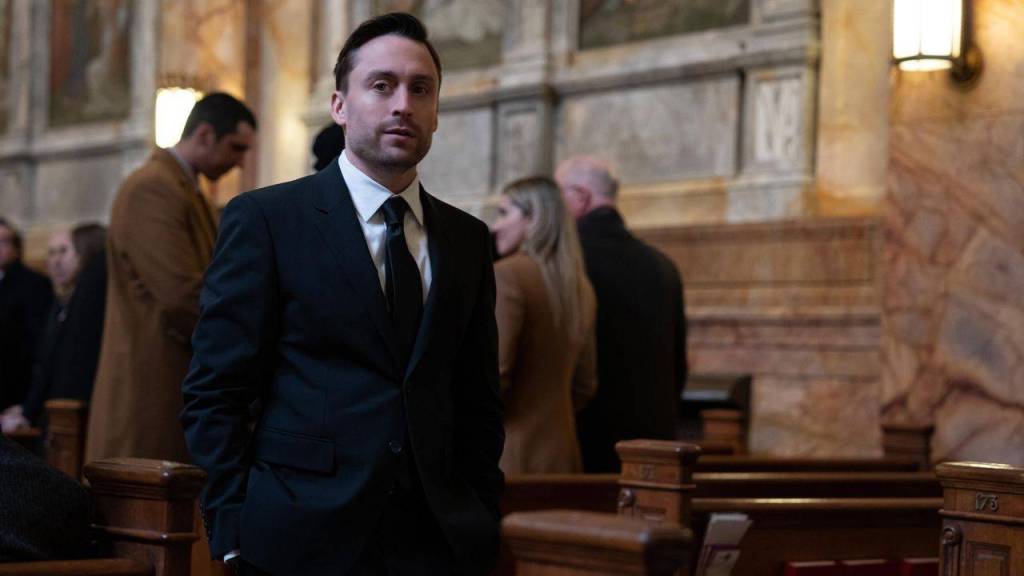
Is this how the day after the craziest election in US history would go?
The day after the election happens to be Logan Roy’s funeral, with Jeryd Mencken in attendance. Day one of a legal contest following an election is probably the nuttiest day you’ll have as a candidate, but it makes sense that he would the attend a funeral for as towering a figure as Logan Roy. If anything, his staff would want to give him a break, and it gives him a chance to look presidential.
But everything else about this doesn’t make sense. Like, where is Mencken’s Secret Service detail? Why doesn’t he seem to have a significant entourage? Why wouldn’t there be metal detectors at the entrance of the church? With a major presidential candidate in attendance and protests in the area, why don’t the police appear to have blocked off the street? And why do the protests appear to be just random, and not more directed at the Waystar/ATN brass responsible for Mencken’s rise? There was a scene where the siblings’ car is roughed up by protesters, but this seems to happen purely at random, and the protesters move on. The show could have heightened the sense of danger that the family was in as a result of the election call. Instead, any inkling of this is limited to a fight between Kendall and his ex-wife, or Roman deliberately wandering into a mass of protesters at the end of the show. If he’d walked the other way, he would have remained untouched.
That’s a metaphor for how the entire show treats the external consequences of the show’s protagonists. When it comes to the outside world, the siblings appear to be passive bystanders, anonymous trust fund kids, rather than the celebrities they would probably be in the wake of Logan’s death. Tom and ATN have made an election call that have plunged the nation into crisis, but they move about Manhattan the next day as if though they were hedge fund managers mildly inconvenienced by bandana-wearing antifa roaming about. A major part of their existence is not only the internal drama which is the rightful focus of the show, but the external pressures that celebrity status and media attention bring, but we rarely if ever get a sense of the latter.
Going to back to Jeryd Mencken, while it makes sense for him to make an appearance at Logan’s funeral, why on Earth is he milling about hours later at the reception? And doing so standing in one corner of the room, alone? Doesn’t he have better things to do that day? Doesn’t he have people he can hand this off to? The question of Waystar’s succession is indeed an important one for Mencken’s media strategy, but wouldn’t Mencken be more preoccupied with actually being able to take office? Or, plan his transition or hold a news conference, which is what normal presidents-elect would do the day after the election?
Mencken is loosely based on Donald Trump, so perhaps he’s following his model of direct personal engagement with media executives. But the context here is off. The day after the election would have any president-elect reigning supreme, not milling about at a cocktail party. In Maggie Haberman’s Confidence Man, we get a readout of a meeting where Trump grills Rupert Murdoch about his successor — actually getting an answer out of him. But this is a thirty-minute or hour meeting on any other day in the Oval Office. Even a question this important would have to wait for another day — a day when the United States’ succession drama is actually settled. It’s totally implausible to imagine the question of the new administration’s competition policy being all-consuming the day after the election, especially under those circumstances. And that violates the realism or near-realism we have come to expect from the series, even in how it’s treated politics for most of its run.
This article was originally published on Patrick Ruffini’s Substack, the Intersection.
What we know about the rioting in Cardiff so far
A traffic collision in the Ely area of Cardiff, Wales on Monday evening sparked rioting overnight that continued for nine hours until the police managed to disperse it. At least twelve police officers were injured in the incident. The trigger for the unrest appears to have been rumours spread on social media that a police chase was responsible for the crash, reportedly involving two teenage boys riding an off-road bike or scooter.
The police deny that a chase occurred, saying that officers only became aware of the collision after being called to the scene. The crash occurred shortly after 6 p.m. yesterday, with unrest continuing in the area until 3 a.m. this morning.
According to reports, rioters set cars in the neighbourhood alight, with images circulating of at least two vehicles ablaze at the scene. Those taking part in the unrest also allegedly set fire to wheelie bins and rubbish as they moved through the streets.
While attempting to control the night of ‘violent disorder’, police were also attacked by rioters, described as masked youths, who threw rocks and other missiles at officers. Riot police were called out, as were police on horseback, in an effort to disperse the crowds. Police were also seen guarding the local police station out of concern it might be targeted.
Speaking on BBC Radio 4’s Today programme, South Wales police and crime commissioner Alun Michael confirmed that at least twelve officers had been injured during the riot. He said: ‘[The collision] appeared to spark, for reasons that are not clear, the disorder in which something like a dozen officers were injured and the connection between the two is far from clear, so obviously there’s going to be an investigation to establish what happened.’ At least one passerby was also injured after they were also attacked by rioters who falsely believed them to be an undercover police officer.
Scenes from the riot were live-streamed on YouTube, with the feed capturing masked rioters hurling fireworks at police. The number of people rioting is still unconfirmed, although police have said that a number of arrests have been made in connection with the incident.
In a statement this morning, South Wales Police confirmed that the two boys involved in the accident were killed, and suggested that ambulance staff attending the scene may also have been attacked.
Assistant chief constable Mark Travis said: ‘These are scenes we do not expect to see in our communities, particularly a close-knit community such as Ely. We received a large number of calls from residents who were understandably frightened by the actions of this large group who were intent on causing crime and disorder. The level of violence towards emergency services and the damage to property and vehicles was totally unacceptable.’
Unconfirmed reports suggest that such was the level of rioting that emergency services had difficulty accessing and taking the two victims of the traffic accident to hospital. Separate police investigations into the crash and riot have been launched. More to follow.
Jeremy Hunt is yet to get a grip on government borrowing
All eyes are on tomorrow’s inflation rate figures, which need to start falling fast for Rishi Sunak to make good on his pledge to ‘halve inflation’ by the end of the year. But this morning we got an update on the one pledge from No.10 that was never likely to be made good on: the promise to get national debt falling.
This morning’s figures show us the extent to which those numbers are going in the wrong direction. Public sector borrowing in the month of April rose to £25.6 billion, almost £12 billion more than April last year. This makes last month the second-highest borrowing April on record.
Rather than the pandemic years becoming a one-off spending spree, we increasingly see in the data how they ushered in a new era of substantial borrowing for a variety of measures. In his statement on the figures this morning, chancellor Jeremy Hunt notes the government was ‘right’ to borrow ‘billions to protect families and businesses against the impacts of the pandemic and Putin’s energy crisis’. But the support was only a glimpse of what was to come months later, when the Energy Price Guarantee was announced – a scheme that rivalled many of the Covid policies for its level of intervention (and also its price tag).
While the borrowing figures for the last fiscal year have been revised down slightly – to £137.1 billion, down by roughy £2 biillion – public sector net debt, both in total and as a percentage of GDP, is only moving in one direction: up. But the start of the new fiscal year suggests another year of record high borrowing, with Capital Economics this morning estimating that the ‘Chancellor is already on track to overshoot the OBR’s full-year borrowing forecast of £132 billion'.
Amongst all the new spending announced over the last year, it is higher debt servicing payments that are also hiking up the monthly borrowing costs. Due to the Britain’s particular sensitivity to index-linked gilts, borrowing costs surged once again to £9.8 billion in April this year, ‘£3.1 billion more than April 2022 and the highest April figure since monthly records began in 1997'.
Today's figures put pressure on the government to carry on its narrative from last year when it first came into No.10: that the public finances have got too out of control and it's time for restraint and discipline. But it's not the narrative that they want to bring into an election season: both Sunak and Hunt are well aware that more giveaways (and certainly some kind of tax cut) are going to be necessary to be competitive. Today's numbers are a harsh reminder of the trade-offs that might have to take place to offer such things – one of them being the overall health of the public's finances.
Netflix’s Queen Cleopatra girlbosses against historical fact
The most controversial aspect of Netflix’s new drama-documentary Queen Cleopatra — not least in Egypt — was the casting of a black actress, Adele James, in the title role. After all, one of the few things that seems certain about Cleopatra’s early life is that she was a Macedonian Greek. Luckily, though, the show had a powerful counterargument to this awkward and Eurocentric fact. As the African-American professor Shelley P. Haley put it with a QED-style flourish, back when she was girl, her beloved (if uneducated) grandmother once said to her: “I don’t care what they tell you in school, Cleopatra was black.”
Watching Queen Cleopatra felt alarmingly like witnessing the death of scholarship
And of course, given the series’ entirely unhidden agenda, being a black woman also means that Cleopatra “ruled with unparalleled power,” “bowed to no man” and was basically great at everything. In the talking-heads sections, we were assured again and again what a strong and empowered feminist she’d been. In the drama bits, we saw her whooping male ass in sword fights; proving that she was “first and foremost a scholar” by looking thoughtful beside a pile of manuscripts; poring over military maps while asking her generals, “if we target the northern defenses, do we leave ourselves vulnerable at our eastern ports?”; giving Julius Caesar handy architectural tips about his new library; and airily besting Cicero in political debate.
Not that any of this prevented her from also being hot in the sack. In the words of another supposed scholar — and apparent clairvoyant: “Julius Caesar would never have met a woman like Cleopatra with complete control and confidence in her own possession of her sexuality and her identity.”
If you looked carefully amid the fantasizing and wish-fulfillment, the program did sometimes offer some actual history, with particular reference to the rise of Rome and the related decline of Egyptian power. The obvious trouble, however, is that because of its weirdly unashamed lack of objectivity, you couldn’t trust any of it. Perhaps this is a bit much to lay on a rubbishy Netflix four-parter, but watching Queen Cleopatra felt alarmingly like witnessing the death of scholarship.
This article was originally published in The Spectator’s UK magazine. Subscribe to the World edition here.
What is Lee Anderson up to?
A new week brings with it a new backbench group. The New Conservatives are a dozen MPs who are drawn from the 2017 and 2019 intakes. They want a fundamental realignment of the party so it better reflects the interests of voters in the Midlands and across the red wall in the north. Prominent members of the group include Danny Kruger, Miriam Cates and Lee Anderson, the straight-talking red wall favourite who previously told The Spectator he backed the return of capital punishment.
The presence of Anderson has ruffled some feathers among his fellow Tory MPs
In an interview with the Times, Kruger said that while precise policies are still being formulated, the group do have a broad agenda. They want Rishi Sunak to achieve the 2019 manifesto target of lower migration figures, end the inequities of fiscal drag, reverse cuts to the size of the armed forces, tackle what they view as the ‘woke agenda’ and put more emphasis on apprenticeships over universities. Kruger was keen to stress that this is not a personal challenge to the Prime Minister and should not be seen as any threat to his leadership. ‘We are very much behind Rishi. We think he has the opportunity to win big if he leans into the realignment of politics that happened at the last election.’
The presence of Anderson, the deputy party chairman, has nevertheless ruffled some feathers among his fellow Tory MPs. One backbencher on the Conservative right said it was ‘mad’ to allow a MP with an official position to campaign on policy and not lose their job. Some MPs have complained to their whips about Anderson’s involvement in the New Conservatives. One MP says: ‘There’s a lot of unhappiness about it’. His defenders point out that he waived any salary as deputy party chairman in February, instead taking up a £100,000 a year job as a GB News contributor. This lead into the slightly grey area of whether a non-salaried member of the ‘payroll’ vote can back a group demanding specific policy changes.
That debate comes at a time when several ministers are being criticised over ‘freelancing’ government policy. Anderson’s involvement in the New Conservatives is a reflection of the campaigning nature of many of the 2019 intake. Rather than call for a tougher line on policy, a deputy party chairman would usually be expected to be out on the broadcast media repeatedly talking about the Prime Minister’s priorities. This was a large function of James Cleverly’s role when he was deputy under Brandon Lewis.
Is Macron losing France’s war on drugs?
The story that dominated much of the French media last week was the vicious assault of a shopkeeper in Amiens. A gang kicked and punched Jean-Baptiste Trogneux outside his chocolate shop in a savage attack that left him bruised and nursing a couple of broken ribs. It was, alas, an all too common incident in a country where violent crime has been rising steadily for a number of years.
What made this assault newsworthy was the fact that Trogneux is the great-niece of Brigitte Macron; she and her presidential husband condemned the attack, as did figures from across the political spectrum, many of whom tried to exploit the poor man’s injuries for their own ends on television or social media. Far from being political activists, the four people in custody are, by the admission of their own lawyers, social misfits with very low IQs. Dangerous, in other words, but not a threat to democracy.
The spread of the murderous violence is testament to the growing impunity of the cartels
The assault certainly didn’t warrant the prominence it received in the media, overshadowing several other far more serious acts of violence that erupted across the country in the days before and after.
The previous Saturday in Villerupt, a town of 10,000 inhabitants in eastern France, a man opened fire on a crowd of people, wounding five, three of them seriously, in what police believe was a drugs-related shooting. The man in custody is well-known hoodlum, having a rap sheet totalling 140 offences.
Over on the other side of France, in Nantes, three shootings in 48 hours last week left one dead and two wounded. Police believe a territorial drug war was the motivation for the attacks. The same explanation was given for the triple killing in Marseille at the weekend, taking the drug-related homicide count in the Mediterranean city for the year to 21. There was another shooting in Marseille last night, although the three victims are expected to survive their wounds.
Among the dead this year in Marseille is a 43-year-old mother of five, shot in the head by a stray bullet in front of her daughter earlier this month. ‘This is a national phenomenon that requires national solutions’, said Eddy Sid, from a police union, after the death of the woman. ‘We are faced with a mafia-like octopus that has ramifications. Drug traffickers from Marseille have set up shop in Nice, Dijon…’
Sid could have listed many other cities in France, along with provincial towns such as Orléans, Angers or Valence, 125 miles north of Marseille, where three people were shot dead earlier this month in separate shootings.
The spread of the murderous violence is testament to the growing impunity of the cartels, whose influence has increased in parallel with their wealth. The drugs trade is now a €3 billion industry in France, generating the same turnover as the Nestlé company.
The police and customs officials are waging a valiant war against the cartels: last year they seized an unprecedented 157 tonnes of drugs. Among the haul was 27 tonnes of cocaine, much of it coming from Guyana and the Caribbean, and 273kg of synthetic drugs including fentanyl. ‘This drug is still not very prevalent, but we need to prevent its spread,’ said Gabriel Attal, the Minister of Public Accounts. ‘Our American counterparts are alerting us [about its addictiveness].’
Drug use in France is widespread. There are estimated to be 18 million occasional users of cannabis (only the Czech Republic smokes more cannabis in Europe than the French), 2.1 million cocaine users and 500,000 heroin addicts. More money and more personnel are being provided by the State to help combat the drug cartels in France and abroad, but the tentacles of the ‘octopus’ to which the police union leader Eddy Sid referred, now stretch disturbingly deep.
In an interview with Le Monde newspaper last November, Laure Beccuau, the prosecutor of Paris, and head of France’s national agency against organised crime, painted an alarming picture of a Republic being insidiously overwhelmed. ‘Today, the level of the threat is such that we can detect risks of the destabilisation of our rule of law,’ she said. ‘Without exaggerating, without fantasising…the reality of the infiltration of our societies by criminal networks exceeds all fictions.’
Frédéric Ploquin, a reporter specialised in organised crime, claims that years of strategic naivety have brought France to this point. ‘Local councillors thought that public tranquillity could be bought by leaving the small drug-dealing areas alone,’ he said in an interview last week. ‘Twenty years later, they are reaping the rewards of chaos. We’ve moved into another dimension. The Kalashnikov generation is taking over.’
If the Kalashnikov automatic rifles come from the east – principally the Balkans – drugs are imported from the west. They arrive in France from the other side of the Atlantic at ports where officials have been targeted by the cartels.
Last year five custom officials in France were convicted of corruption and Laure Beccuau admitted that it’s only a matter of time before more palms are greased, if they haven’t already been. ‘The next step is the corruption of the police or magistrates…the infiltration of officers engaged in the fight against crime,’ she told Le Monde.
There was a great deal of pontificating after the attack on Brigitte Macron’s nephew from politicians of all stripes. In grave tones they talked of ‘lines being crossed’ and democracy being imperilled. But it’s not a handful of knuckle-dragging yobs who are undermining democracy in France; it’s the drug cartels.
Twice during his presidency, Emmanuel Macron has told his people that they are at war: first against Covid and then against Russia. His predecessor, François Hollande, deployed the same word in 2015 when describing the threat posed by Islamic extremists.
It may soon be time to admit that France is in a new war, and one that for the moment it is struggling to win.
Elon Musk, George Soros and the blurring of life and art
Was Elon Musk antisemitic when he compared George Soros to Magneto, the apparently Jewish, Marvel Comics supervillain? Whatever one’s view on this question, Musk’s comments may be taken as a pointed marker of a time in which life and art are increasingly indistinguishable.
Musk claimed in a tweet to his 140 million followers that Soros is akin to the X-Men anti-hero Magneto, of comic book and movie fame. Like Magneto, Musk said, Soros ‘hates humanity’ and ‘wants to erode the very fabric of civilisation.’
Not flattering, but the claim that it’s antisemitic, because the atheist billionaire Soros, aged 90, is ethnically Jewish, bears interrogation.
The comparison of Soros to Magneto is cutting. Some readers of The Spectator are doubtless familiar with the canon of X-Men, but for those who may be rusty on the details, Magneto, who is played in the movie version by Sir Ian McKellen, is the leader of a terrorist gang called the Brotherhood of Evil Mutants. It’s bent on world conquest.
What triggered Elon to compare Soros to Magneto? Soros had just dumped his remaining shares in Tesla (on which he apparently recorded a loss), which may have been taken by Musk as an insult or provocation. But in recent months, Musk has repeatedly drawn attention to how Soros’ money is being used to reshape the United States’ criminal justice system, which Musk claims has helped to elect progressive district attorneys with a laissez-faire attitude to antisocial behaviour and recidivist criminality. This is blamed by many for helping to fuel an ongoing collapse in public order across major American cities.
The comparison of Soros to Magneto is cutting
This might be legitimate criticism if it was not for the Jewish angle. Musk did not just compare Soros to a supervillain in general (although even had he done, he would have faced the same criticisms) but to a specifically Jewish supervillain, who took up his career of evil following the death of his parents in the Auschwitz concentration camp.
Musk’s dump on Soros attracted predictable reactions, including from outfits themselves supported by Soros, such as the Institute for Strategic Dialogue, which has taken more than $1 million (£800,000) from George Soros’ Open Society Foundation. ISD claims that Twitter has become a cauldron of antisemitic hate speech since Musk bought it.
Jonathan Greenblatt, the chief executive of the today heavily progressive Anti-Defamation League (which Musk has said should drop the ‘Anti’ from its name) declared Musk would embolden extremists ‘who already contrive anti-Jewish conspiracies and have tried to attack Soros and Jewish communities as a result.’
Was Musk within legitimate boundaries to note the curious parallel lives of real-life Soros and the fictional Magneto? Both are charismatic mavericks with huge talent and energy. They also both have extremely complex psychologies formed by their shared, highly traumatic experiences. In X-Men, Magneto sublimates his rage by plotting world domination. Soros, who spent the war in Budapest, acquits his survival by redistributing his colossal wealth in the pursuit of left-wing political causes, apparently dedicated to prevent anything like the Holocaust from ever happening again.
It’s his money, so even conservatives might think he’s entitled to spend it as he pleases. But it would be unreasonable to contend that nobody can criticise how he spends it – or wonder whether all of his decisions are informed by clear-eyed perceptions and sensible judgements, even if one chooses to assume his intentions are good. Indeed evidence that Soros’s philanthropic agenda is exacerbating social problems as opposed to addressing them is becoming increasingly hard to ignore.
Equally, the rush to accusations of antisemitism when anybody says anything bad about Soros may itself contribute to fuelling antisemitic sentiments, since it not only puts Soros beyond any criticism, but wrongly implies his inviolable position is shared by all Jews.
Soros aside, there are ironically also comparisons between Magneto and Musk. Magneto’s superpower consists of an ability to telekinetically magnetise metal and hurl it at his enemies, not unlike Musk himself with his Falcon rockets and driverless cars.
Like Magneto, Musk remains unrepentant. A few days after his controversial tweet, Musk sarcastically withdrew his Soros comment, but not to grovel. He now claimed he’d been unfair to Magneto.
Musk, of course, was the inspiration of another Marvel smash hit, Iron Man (2008), starring Robert Downey Jr. But that film was made when he was still an uncontroversial technologist.
In his new, more political role as the most powerful opponent of the Woke Left, faced on this basis with the unremitting barrage of invidious accusations for which they are known, he has come to possess a more relatable superpower: namely not caring what they think.
As he told CNN last week, quoting another pop culture classic: ‘There’s a scene in The Princess Bride – great movie – where he [Montoya] confronts the person who killed his father. And he says, ‘Offer me money. Offer me power. I don’t care.’’ Musk adds: ‘I’ll say what I want to say and if the consequence of that is losing money, then so be it.’
The price others pay for our next-day deliveries
When I was not more than nine or ten years old, I sent off in the post for a free poster that I’d seen advertised in a comic. It depicted Superman, whom I held in high regard, scragging a distinctly second-tier villain called Nick O’Teen; the relic of some lame early-eighties anti-smoking campaign. For reasons I can’t now fathom, I burned to have this on my bedroom wall. I remember it now not because of the poster, but because the wait for it to arrive. ‘Allow eight weeks for delivery’, it said. And it really did take eight weeks to show up – which, when you’re nine and you really, really want a Superman poster, might as well be a lifetime.
The very idea of waiting that long for anything, now, will be incomprehensible to a nine-year-old. It’s incomprehensible to an adult. Even next-day delivery is starting to seem a bit sluggish. Online shopping listings, these days, often promise same-day delivery if you get your order in in the morning. And this lightning fulfilment, this near-as-dammit introduction of teleportation to the online consumer economy, what’s more, comes, or seem to come, nearly for free. A couple of extra quid, at most; or bundled in with your Prime account.
If you’re getting something brilliant at a knockdown price someone, somewhere else, is paying for it
It’s like magic. Bing-bong, you answer the door, and your goodies materialise in your hand. Abracadabra. We don’t give much thought to what‘s going on in the false bottom of the top hat, under the false panel in the cabinet, behind the curtain. We’re vaguely, if at all, aware of the febrile hum of an unimaginable logistics network pulsing somewhere in the world out there, but it’s not anywhere near the front of our attention.
There was a glimpse behind the curtain at the end of last week, though, with the Sunday Times‘s report into how a DPD driver, Kamil Zieba, was sentenced to three and a half years in prison after admitting death by careless driving. He mowed down a 69-year-old woman on a roundabout in Brighton in 2020. He was careering over kerbs and pavements, and his dashcam recorded him using his phone, rolling fags, making notes, eating and drinking at the wheel. His victim was so badly torn up by the collision that her son, when he visited her in hospital, did not at first recognise her.
Mr Zieba’s careless driving is in large measure, no question, his personal responsibility. Nobody can blame DPD for his rolling cigarettes on the move. But the evidence before the court suggested he was undeniably also incentivised by the demands of his job to drive carelessly (he was working for DPD through a third-party contractor). It’s hard to see how it could be otherwise.
The court heard that he had been frantic to keep up with his delivery schedule. He was expected to deliver 180 parcels per shift – one every two and a half minutes on average – and if he did not perform as demanded he could face the sack. By way of encouragement, the company had a ‘traffic-light’ system, where a driver’s handheld device would glow red if they were falling behind. The court heard that Mr Zieba had been in the red, and at the time of his collision had managed to claw himself back into amber only by playing fast and loose with the rules of the road. Drivers like him, it’s reported, will work up to eleven-hour shifts without taking a break in order to fulfil their orders. He was getting paid a pound a parcel.
DPD have emphatically denied that there is any pressure on their drivers during their delivery routes. The problem may lie not just on punishing delivery schedules, but in lack of proper regulation. By law, HGV drivers are not allowed to be behind the wheel for more than nine hours a day, and must take a 45-minute break every four and a half hours. Delivery van drivers, with their lighter vehicles, are at present exempt from these strictures.
That lack of red tape is all very business-friendly, and helps bring value to the customers for all those next-day gewgaws – right up until the cost of it is an elderly lady being flattened on a roundabout by a tired, frantic driver pushing past the limits of his abilities seemingly for fear of losing his job. And be it noted that, if you are said elderly lady, it doesn’t make much of a difference to you whether you’re hit by a three-ton delivery truck or an HGV. That cost, as far as DPD and the other parcel delivery services like them go, is what I believe economists refer to as an externality.
There are lots of those in our new, exciting, globalised world. For every appealingly priced T-shirt in a fast-fashion outlet on Oxford Street, there’s a sweatshop worker in the third world enjoying the benefits of deregulation; for every bargain online there’s a warehouse worker peeing in a bottle. Rule of thumb: if you’re getting something brilliant at a knockdown price someone, somewhere else, is paying for it.
Saying ‘that’s just market forces, baby’ doesn’t seem to me an adequate response. The market does what it does with ruthless impersonality – and that’s both why it’s great, and why it needs to be restrained by sensible regulation. The sort of regulation that says you can’t spend eleven hours behind the wheel and be put under pressure to deliver a parcel every two and a half minutes, because that’s obviously crazy, and will have dangerous consequences.
That’s not ‘red tape’: that’s common sense and common decency. And if it means we have to wait a few extra hours for our deliveries, or pay a few extra quid for the privilege of something showing up faster, well: so be it. If nine-year-old me can wait two months for a parcel, 49-year-old me can wait two days.
Blooming expensive: the growing cost of a garden
As Cicero is often (mis)quoted as saying, if you have a garden and a library, that is all you need. And since the pandemic, our love of a garden has only got greater. Yet these days it’s often less about getting your hands dirty in the flowerbeds and more about having somewhere to kick back and enjoy a good book or drink rosé with friends.
But while visitors are swooning over raised beds and begonias at the RHS Chelsea Flower Show this week, the price of having a garden of one’s own is higher than ever – especially if you want a generous one. According to the latest research by estate agent Savills, properties (whether houses or flats) with big gardens cost 39 per cent more per square foot than those with the smallest ones, showing a strong correlation between the size of outdoor space and the price paid for indoor space. The analysis reveals that buyers are paying around £424,000 for a 1,200 sq ft house (a typical three-bedroom home) with a large garden, compared with £260,000 for one with a small garden or no garden at all.
‘The value of private outdoor space is a pandemic legacy trend that’s become permanently ingrained in the home-buyer’s psyche’
In London, the average back garden is 150 sq m, according to government data. In Kensington and Chelsea and neighbouring Westminster, the average drops below 100 sq m. The boroughs with the biggest outside spaces are Bromley (average: 328 sq m), Barnet (280 sq m) and Harrow (266 sqm), according to Savills. In rural areas, the premium is less pronounced – homes with the largest gardens cost 8.3 per cent more than the local authority average – but in an urban area it’s 12.9 per cent.
Lockdowns may be a fast-receding memory, but we are still prepared to dig deep for a garden, says Frances McDonald of Savills: ‘The value of private outdoor space is a pandemic legacy trend that’s become permanently ingrained in the home-buyer’s psyche. Demand for homes with larger gardens has increased significantly over the past three years.’
Around a fifth of households in London have no access to a garden, according to the ONS, and flats without outside space struggled to sell during the pandemic. Demand has since bounced back but there’s still a big value gap. Ben Hunt of Winkworth in Hammersmith says that garden flats typically command a premium of around 7-10 per cent over those without outside space – such as this two-bedroom example in Herne Hill, south-east London, on the market for £650,000.

In central London the garden premium is around 12-15 per cent, says Robert Sturges of Chestertons, with post-pandemic demand fuelled by hybrid working patterns and increased pet ownership. But not all gardens are equal. Top of the wish list for buyers is a south-facing, level space, says buying agent Nigel Bishop of Recoco: ‘A steep or sloping garden can put people off – steps can be a no-no.’ Not everyone wants a large garden, either. ‘Most flat-hunters prefer a small garden or patio area that is easy to maintain but large enough to entertain guests,’ says Nigel.
Outdoor kitchens and built-in seating areas are de rigueur, and al fresco dining is the focus of the Hamptons Mediterranean Garden at Chelsea this week. It’s designed by Filippo Dester of the Garden Club, which specialises in urban and small gardens. Inspired by Dester’s northern Italian home, the Hamptons Mediterranean Garden includes aromatic herbs and the drought-resistant macchia shrub.

Dester says a pergola is an affordable way to create an entertaining space in a small urban garden, providing shade but also shelter from rain (this is not Italy). ‘Use a simple timber or metal structure on which climbing plants are trained, and a canopy can be fixed,’ he says. He also recommends using plants as a key element to create a welcoming, softer space. ‘Small trees can add a sense of scale and privacy. Scented herbs in large pots can be freshly picked when cooking or mixing cocktails, adding a fun, interactive layer to garden entertaining.’

Palms and bamboo add a Mediterranean feel to the courtyard garden (above) in a four-bedroom house for sale in Brighton for £2.495 million, while a larger than average garden (below) at a four-bedroom terrace in Wimbledon, on sale for £1.2 million, offers a verdant spot to relax.

Yet gardens in the capital are not getting greener – many are paved or decked over, with the loss of lawns and trees diminishing their role in preventing surface flooding and helping to keep the city cool. The 2010 report London: Garden City? looked at their changing composition and found that in just a decade an average 11 sq m of vegetation had been lost per back garden, with hard surfacing and buildings such as sheds up by 26 and 55 per cent respectively (and that was way before the pandemic boom in garden rooms).
Jo Thompson, garden designer and consultant on the communal kitchen garden at the Chelsea Barracks development in south-west London, says increasing biodiversity and adapting to climate change are now key trends. ‘But as well as drought-tolerant plants for hot summers we need to think about colder winters too. I’m hoping to see solutions to water management, and also the use of different, recycled planting mediums.’ See her garden at the Hampton Court Palace Garden Festival in July.
Why now is the time to visit Aldeburgh
I have been reading Ronald Blythe’s Next to Nature which came out in October, just a few months before the great man’s death aged 100. And so a weekend holiday in Suffolk was calling to me. I went to Aldeburgh, on the coast, north of the river Alde. The town appears to be thriving – full of bustling cafés and London money. It is fashionable and chic. In many respects it is a world away from Blythe’s Akenfield. But there is much here to charm you.
I lingered by a wonderful second-hand bookshop, Reed Books 4, its window display with Peter Kent’s Fortifications of East Anglia, George Ewart Evans’s The Farm and Village and Hugh Barrett’s recounting of a rural Suffolk morning in Early to Rise. Is this what Scruton meant by oikophilia? Here was heart-warming local pride. Here was love for this place, which made me want to love it too.
In one happy hour on a bright Saturday morning, several dozen browsers crammed through the rickety bookshop door – a throng of activity you expect nowadays only in a rush-hour Pret. A lad behind the counter barely looked up from his book. He must get through hundreds of pages a day. A glamorous woman swept in asking after the 1994 biography of Quentin Crewe, clearly with every expectation that it would be there, somewhere. Something about that bookshop made me feel hopeful.
I walked to the beach. It had an austere, even desolate, haunting beauty. A sadness; the memory of when sprats and herring outnumbered people. Wooden boats littered, or graced, the sand. A little sign thanked Alan Burrell, a local man who had repainted them – as if to tell the tourists, and remind the residents, about the proud fishing community that Aldeburgh once was. I was drawn to the lifeboat station tower and its noticeboard with richly descriptive tales of heroism at sea:
CG paged to report a lone dinghy sailor in difficulties off Barber’s Point… The goose neck had failed, and the sailor had been in the water several times. On the last occasion he had been unable to re-board the dinghy but was able to swim to a nearby mud bank where he was still in danger due to the riding tide. Aldeburgh’s D-Class, the Suzan Scott, was launched
A dog in the sea off the Martello Tower. Its owner was preparing to enter the water to effect a rescue. The person, it was revealed, was asthmatic
I could hear ‘Sailing By’ as if playing in my ears. Or Britten’s ‘Peter Grimes’. And moments later, magically, there it was right in front of me: a blue plaque at Crag House where Britten lived and worked from 1947-57.
Amid all of this sits The Suffolk. It is a former 17th-century coaching inn that houses a wonderful restaurant called Sur-Mer with an adjoining wine bar and six newly opened bedrooms. There are all the things you would expect – cashmere mattresses, chic furniture sourced from local antique dealers and a rooftop terrace with sea views – and then the things you wouldn’t: like complimentary snacking rights in a common pantry stocked with local produce including Fishers Gin (up the road) and Pump Street Chocolate (a few miles inland). For the bathrooms they’ve even managed to find a toiletry brand – Haeckels based in Margate – that makes Aesop feel passé.

The owner is a charming young man called George Pell who cut his teeth, and I suppose ate his first snail, at London’s L’Escargot. When Covid hit, he packed it all in and headed to Suffolk with his Parson Jack Russell, Oscar. He made the move to launch L’Escargot Sur-Mer as a way of saving staff jobs during the pandemic. But one suspects, as he tells me about one of his seafood suppliers (‘old Billy Pinney, his family have lived for generations down in Butley Creek’), that Mr Pell rather enjoys the quieter life of early morning river swims and 50 pages of Paul Theroux before bed that he’s made for himself here. Good on him.
At the wine bar before dinner it feels very much the place to be in Aldeburgh on a Saturday night, among a mix of out-of-towners and locals. I start with a ‘Sur-Mertini’ (made dirty with oyster liquor) and six of those Butley Creek oysters – and from the bar snacks, a little basket of smoked mussel tempura, addictive as popcorn. I resist the black ham and Baron Bigod croquettes (the cheese is from just up the A12), but only because of what’s to come.
Into the main restaurant and the dressed Suffolk crab was delightful; the seared scallops with pickled crown prince squash, dare I say it, was even better. For mains: Great Glemham hogget, with lamb fat Lyonnaise for her; halibut with a lobster velouté for me. Dessert was an outstanding banoffee baked Alaska, and I don’t even like baked Alaska. You get the idea. The wine list is appealing. If I had one criticism it would be the lack of English wines on the menu: Shawsgate, Shotley and Valley Farm are all close by. Guests staying over can drink in excess knowing they have a Full Suffolk to wake up to the next morning.
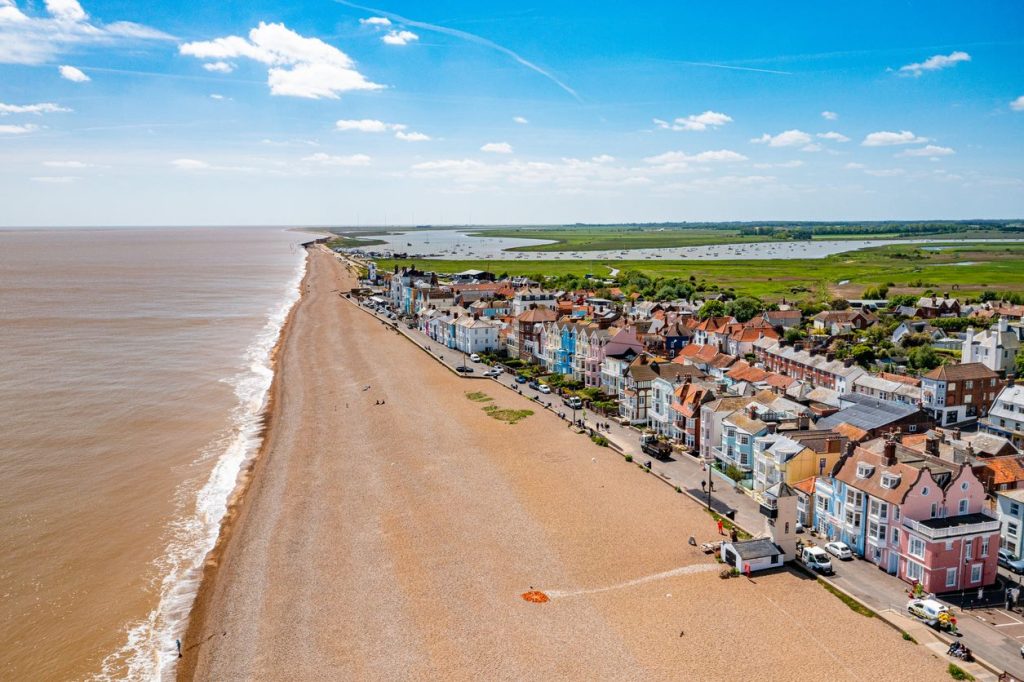
There is much to while away a weekend in Aldeburgh. If you want to make it a longer stay, there are additional places to dine: when Rick Stein came he visited The Lighthouse in Aldeburgh, and the Crown Inn at Snape in nearby Saxmundham. I cannot vouch for either but Stein does know his fish. We see the delightful Tudor, timber-framed Moot Hall. Stop for a pint in the Mill Tavern opposite. There are bohemian parts to this town; creatives have congregated here. There is craft beer and I spot a street café doing Thai food. But there is also a board on the street detailing the frying times of the local chippies – each one crammed come midday, hungry and happy punters packed in like sardines. We join the queue for Aldeburgh Fish and Chips.
And so a happy weekend ends, where it should, on the beach. There is a memorial to Ukraine made of pebbles near water’s edge. It feels alien here; like something belonging to my weekday world. And so I turn my eyes from it, and resume eating my fish and chips out of paper, gazing out to sea.
Getting there: From London – London Liverpool Street to Ipswich (1h 5m); Ipswich to Saxmundham (37m); taxi to Aldeburgh (15m). If driving up from London, stop off for lunch at Butley Orford Oysterage.
Killers of the Flower Moon could be Scorsese’s best film yet
There are a few things in this world that you can truly count on: death, taxes and Taylor Swift’s love life attracting headlines. To their number can be added the certain knowledge that, when Martin Scorsese collaborates with either of his two muses, Robert De Niro and Leonardo DiCaprio, the results are somewhere between fascinating (Gangs of New York; New York, New York) and stone-cold cinema classics (Goodfellas; The Wolf of Wall Street).
Yet apart from a droll promotional film for a Macau casino (The Audition), the three men had never worked together. This has, finally, changed, as the trio unite for what looks like another Scorsese crime classic in the form of the three-and-a-half-hour epic Killers of the Flower Moon.
When Scorsese collaborates with either of his two muses, Robert De Niro and Leonardo DiCaprio, the results are somewhere between fascinating and stone-cold cinema classics
Premiering at this week’s Cannes Film Festival but not released in the UK until October, the picture is based on a non-fiction book by David Grann. It concerns a notorious series of murders that took place among the Osage Nation in the 1920s in Oklahoma after oil was discovered on what was traditionally tribal land. Judging by the first trailer that has been released for the picture, Scorsese (who co-writes with Eric Roth and also directs) has elicited grim, menacing performances from both DiCaprio and a terrifying-looking De Niro, and has an impressive discovery in the form of his female lead, Lily Gladstone, who plays DiCaprio’s character’s wife, Mollie.
Martin Scorsese is, for my money, America’s greatest living director. Every single picture he has made in the past five decades is worth watching, and several are utter highlights of modern-day cinema. Yet he is now 80 years old, and there can only be so many masterpieces left. Let’s hope that Killers of the Flower Moon is as thrilling, complex and unforgettable as the rest of his work and exemplary of Scorsese’s legacy.
This article was originally published in The Spectator’s World edition.
Kevin McCarthy is making Biden work
Welcome to a later-than-usual debt-ceiling brinkmanship special edition of the DC Diary. The mood music was encouraging as Kevin McCarthy and Joe Biden sat down for talks in the Oval Office this evening. “We still have some disagreements, but I think we may be able to get where we have to go,” said Biden to pool reporters. “We both know we have a significant responsibility.” McCarthy was similarly positive.
Hours earlier, treasury secretary Janet Yellen wrote to lawmakers telling everyone what they already knew: that the US is “highly likely” to run out of money to pay all its bills if “Congress has not acted to raise or suspend the debt” as early as June 1. Not news, exactly, but an effort to focus minds. Earlier in the day next day, McCarthy told reporters on the Hill that “we could get a deal tonight, we could get a deal tomorrow, but you’ve got to get something done this week to be able to pass it and move it to the Senate.”
Positive noises from both sides plus a clock ticking closer to midnight: the signs pointed to the possibility of a breakthrough meeting this evening. But no white smoke appeared above the White House when talks ended at around 7 p.m. Instead, more encouraging talk: “I think the tone tonight was better than at any other time we’ve had discussions, McCarthy told reporters immediately after the meeting, before singing the praises of the president’s negotiating team. “We both agree that we want to come to an agreement,” he added. “There’s nothing agreed to.” As for the major differences that remain, McCarthy ruled out any tax rises, something Biden had suggested in his remarks to reports just before the meeting.
So far, McCarthy has maneuvered expertly in this debt fight. He united an unruly conference to pass legislation on the debt limit — something the White House was betting he would not manage. (As Reihan Salam wrote in the Atlantic recently, the Limit, Save, Grow Act offers a mild kind of fiscal conservatism; the tea party is very much over.) Democrats have been flat-footed ever since, with the president having to abandon his insistence that only a “clean” vote on the debt limit would do. McCarthy would then notch up another win, cutting out Democratic lawmakers and Senate Republicans to put himself center stage alongside Biden.
The strategy is paying dividends for McCarthy personally — a recent poll put his net approval rating at +8 — while it is internal divisions among Democrats, not Republicans that have come to the fore in recent days.
Over the last week, Biden has veered from echoing Republican and moderate Democrat messaging on the need to cut spending to flirting with the unconstitutional 14th Amendment option preferred by his party’s left wing. “I think we have the authority,” Biden said in Hiroshima Sunday before jetting back to Washington. In the past, administration officials have described the move as something that would trigger a “constitutional crisis” (Yellen) and that the White House would not entertain (Karine Jean-Pierre).
The sudden change of tone was only the latest demonstration of Biden’s wobbly position in these negotiations. Biden’s attempt to characterize Republican calls for fiscal constraint as MAGA extremism has been rendered unconvincing by McCarthy’s legislative accomplishment and evidently willingness to reach a deal.
After this evening’s meeting, Patrick McHenry, the North Carolina lawmaker and McCarthy’s lead negotiator, said he sensed a “lack of urgency” from the White House. But the White House appears to realize that McCarthy has them right where he wants them: with a failure to reach a deal hitting the president and his party at least as hard as the Republicans. That political reality, brought about by McCarthy, is what got Biden to the negotiating table. And it is what means he has every reason to find a way to a deal in the coming hours and days.
On our radar
JEREMY CLARKE, 1957-2023 Jeremy Clarke, who wrote The Spectator’s Low Life column for twenty-three years, died on Sunday morning at his home in Provence. He was sixty-six. In his tribute to Jeremy, Fraser Nelson writes: “Our readers have lost not just a columnist but a friend — and he will be mourned as such. He was one of the greatest writers ever to appear in our pages. But he was also so much more.”
GORSUCH ON PANDEMIC RESTRICTIONS Supreme Court Justice Neil Gorsuch called America’s Covid-era restrictions one of “the greatest intrusions on civil liberties in the peacetime history of this country.” The unsparing verdict came in a statement from the judge attached to an unsigned order in response to an appeal to the end of Title 42, the pandemic measure used to simplify and speed up border expulsions.
SCOTT ANNOUNCES, THUNE ENDORSES, TRUMP… ENCOURAGES? Tim Scott announced he is running for president today in a speech in North Charleston, South Carolina. (Ben Domenech offers his take on Scott’s candidacy here.) The senator’s bid got a launch-day boost from John Thune: the GOP number two in the Senate endorsed Scott. Trump welcomed Scott to the race, using the announcement as a chance to prod Ron DeSantis. “Tim is a big step up from Ron DeSanctimonious, who is totally unelectable,” said Trump in a post on Truth Social. “I got Opportunity Zones done with Tim, a big deal that has been highly successful. Good luck Tim!”
*** Sign up to receive the DC Diary in your inbox here ***
Biden’s ‘thaw’ is all jaw-jaw
The G7 Summit in Hiroshima, Japan, which concluded on Sunday, put out a statement that took China to task for its hostile economic practices and destabilizing behavior. But President Biden struck a different tone. He ended his trip by suggesting that US-China ties would “begin to thaw very shortly.”
The comment follows meetings between national security advisor Jake Sullivan and China’s Wang Yi intended to bring about that very “thaw.” The administration has also floated the idea of lifting sanctions on Chinese minister of national defense Li Shangfu, who was hit with them in 2018 due to his directing the purchase of Russian defense articles. Supposedly, this is to entice the Chinese back into greater communication between both countries’ militaries, which Beijing has refused for months.
Biden risks repeating a classic mistake of American foreign policy, particularly by progressives, whereby the US makes conciliatory gestures and offers significant concessions with little tangible or commensurate benefit. Military-to-military communication is critical, not least because it helps to minimize the chances of miscalculation. If connections can be re-established, then they should be. However, China is the one being reckless here: it is refusing to communicate — and hoping to use its refusal to goad Washington into giving Beijing what it wants. Communications were present until recently, but Li has been sanctioned for years, so the connection between the two issues is manufactured by China.
Biden can suggest thaws however much he wants, but because the CCP — not America — is the problem, there is not much the president can do unless Xi Jinping decides he wants better relations.
–John Pietro
Does Jill Biden get to pick the next NATO chief?
British defense secretary Ben Wallace has confirmed the worst-kept secret in Westminster: he’s the likely UK candidate for the secretary-general of NATO. Speaking in Berlin on Wednesday he told reporters: “I’ve always said it would be a good job. That’s a job I’d like.” It’s a position that falls vacant in October and Wallace has a good claim, having been in his role for nearly four years, one of the few to emerge with credit from the Kabul evacuation, and has won plaudits for fighting the Whitehall machine to equip Ukraine before Putin’s invasion last year.
Cockburn learns however that a surprising obstacle is standing in his way: the first lady of the United States. Jill Biden wants a woman in the role. And she thinks a senior female figure from one of the Baltic states, which believe that if Ukraine falls they will be at war next, would fit the bill.
The role of the first lady is something of an American oddity. But Cockburn can’t help wonder why Dr. Biden — an intellectually underwhelming academic with a PhD in educational leadership — might think she has insight into western security, especially at a time when NATO is doing almost everything possible to stop Russia in Ukraine. But “woke is woke” and there’s never been a woman NATO secretary-general. For Team Biden, the enemy is the patriarchy as much as Putin.
So who, in Jill Biden’s identity politics worldview, is the right woman for the job? Word is that Dr. Biden may have her eye on Kaja Kallas, prime minister of Estonia since 2021. She’s at the hawkish end of the spectrum (arguably she marks the end of that spectrum) and comes as close as she dares to accusing Emmanuel Macron of being a Putin apologist.
The Germans, already worried about public opinion in the East, would be deeply resistant to giving the outspoken Kallas such a platform — fearful that she’d give Moscow all the ammo they want to portray NATO as a hostile force on the brink of invading Russia. Wallace is robust but more circumspect and diplomatic. But he’s a he.
Three of NATO’s thirteen bosses have been Brits and Wallace (whose parliamentary seat is being abolished) has long harbored dreams of following in the footsteps of Ismay, Carrington and Robertson by becoming the fourth. He could attract some support from surprising quarters: the French lack an obvious candidate and their defense minister Sébastien Lecornu is a fan of his British equivalent.
It’s far from clear that Kallas would even take the job: she’d have to resign as Estonian PM in order to take the $340,000-a-year top NATO post, and she might prefer to stay the stick to the job she was elected to do. The post might then fall to another female candidate who happens to take the first lady’s fancy.
There is no formal process for selecting the secretary-general. Given that America pretty much spends as much on defense as the rest of NATO put together it’s usually Washington’s call: but no one likes to say so formally. Norwegian Jens Stoltenberg has held the post since 2014. He is due to step down in October, meaning his successor could be chosen at the next NATO summit in Vilnius in July.
NATO’s chief military officer, the supreme Allied commander in Europe, is traditionally an American, serving alongside a European secretary-general. But if the White House wants someone as “Sec Gen,” then the White House usually gets its way. And with Joe Biden’s mind often, ahem, elsewhere these days, it’s understood that Jill Biden increasingly calls the shots.
–Cockburn
From the site
Spectator Editorial: The campaign against the Supreme Court’s legitimacy
Ann Coulter: Why won’t conservatives ask Trump tough questions?
Alexander Larman: Martin Amis and the end of a great comic tradition
Poll watch
PRESIDENT BIDEN JOB APPROVAL
Approve 41.5% | Disapprove 53.7% | Net Approval -12.2
(RCP average)
WHAT DO AMERICANS THINK OF ESG?
Positive view 22% | Negative view 19% | Unsure 59%
(Gallup)
Best of the rest
Frances Stead Sellers, Thomas Simonetti and Maggi Penman, Washington Post: The short life of Baby Milo
Jesse Walker, Reason: The left-right spectrum is mostly meaningless
Matthew Hennessey, Wall Street Journal: Growing up is hard to do
Andrew X. Evans, Year Zero: Taught for America
Ross Douthat, New York Times: What the writers’ strike means for the future of Hollywood
Ally Mutnick and Holly Otterbein, Politico: Key Republican recruits hesitate to jump in if Trump is the nominee
Sign up to receive the DC Diary here.
Bud Light remains for sale in virtually every Trump Organization business
As the Bud Light War enters what feels like its fifth year, Cockburn has further evidence that America’s “wokest” brew has an unlikely ally, giving it beachheads at some of the world’s swankiest properties. The Trump Organization, which boasts properties in several continents, offers Bud Light and/or Bud Heavy at its properties in locations ranging from Chicago to Los Angeles to Scotland.
A Cockburn review on Trump Organization menus show that the beer goes from £6.50 in Scotland, to $7 at his iconic Trump Tower in New York City, to $9 in Chicago, to $10 in Vegas.
Trump’s Bud Light offerings go beyond just his hotels. Want some suds while you’re golfing? Trump National Golf Club in Los Angeles, for example, has you covered at only $7 a beer, or a six-pack for $35.
The Trumps’ beer business bottom line may help explain why Donald Trump Jr. staked out the unusual position in the GOP of pushing back against the Dylan Mulvaney-inspired Bud Light boycott… because the company gives more donations to Republicans than to Democrats.
“We looked into the political giving and lobbying history of Anheuser-Busch, and guess what? They actually support Republicans,” the Trump scion said on his show. “In woke corporate America, Anheuser-Busch supports Republicans.”
Likewise, Trump Sr. has been silent, by his own loquacious standards. British paper the Independent suggested this may be because he has up to $5 million of Anheuser-Busch InBev stock, which has plummeted since conservatives started boycotting it following its partnership with trans influencer Mulvaney.
Trump, a famous teetotaler, can’t singlehandedly bring Bud Light’s stock prices back, so the next best thing for his bottom line is soft-pedaling any criticism of it, while rivals like Governor Ron DeSantis press onwards with calls for full-scale boycotts.
“Why would you want to drink Bud Light? I mean like honestly, that’s like them rubbing our faces in it, and it’s like these companies that do this, if they never have any response, they are just gonna keep doing it,” DeSantis told Benny Johnson.
The contrast between Trump and the rest of the Republican Party is one that his intra-party allies are already seizing on to Cockburn. One Trump foe even pointed to how Trump spokeswoman Karoline Leavitt recently said that Trump would have made a deal with Disney instead of fighting the company like what DeSantis did as evidence of how woke capitalism may prove to be a bigger weakness than the former president is expecting. From Bud Light to Disney, they sense weakness.
To be clear, Cockburn doesn’t care what you drink, only that you do drink. Cheers!
What Suella Braverman needs to do to keep her job
As luck would have it, the Home Secretary was down to answer departmental questions in the chamber this afternoon, and a lot of those questions were on her speeding ticket. ‘I hope this isn’t going to be a repetitive session,’ said Suella Braverman in the Commons, before offering exactly that for an hour.
Braverman had not come with a different answer to every question, regardless of the details each MP was asking for. Instead, she said the exact same thing, in the exact same tone, over and over again. She had been speeding in the summer. She regretted that. She paid the fine and took the penalty. ‘Mr Speaker, last summer I was speeding. I regret that. I paid the fine and took the points. In relation to the process, in my view I’m confident nothing untoward has happened.’ She also claimed that ‘at no point did I attempt to evade sanction’.
The thing is, this didn’t answer the central question, which is that while she didn’t attempt to evade a sanction, she is alleged to have sought a private speed awareness course and to have asked civil servants if they could help arrange this. That would be a breach of the ministerial code, which is why the matter is being pursued so vigorously by her opponents.
Braverman also went on the attack against those opponents, arguing that the reason they were taking any interest in this at all was that they didn’t have their own policies and they didn’t like what she was doing to try to stop small boat crossings. ‘Let’s be honest about what this is about,’ she told the Commons. ‘The shadow minister would rather distract, really, from the abject failure by the Labour party to offer any serious proposal on crime or policing.’ She added that Labour ‘would rather the country does not notice their total abandonment of the British people’.
She had some noisy supporters behind her who cheered these comments. But within the Conservative party there is a split over Braverman. As I explained in the Observer at the weekend, a good number of MPs think the Home Secretary is embarrassing herself with her public interventions. But others do agree that the current campaign against her on speeding is because she is championing policies that are hugely popular with their constituents, if controversial in Westminster. The problem for Rishi Sunak isn’t so much whether Braverman did break the ministerial code as it is whether she can fix the small boats problem in time for the election. He pledged to restore integrity in government, but voters are more likely to forgive breaches of that if they think ministers are doing their jobs properly and stopping illegal migration.