-
AAPL
213.43 (+0.29%)
-
BARC-LN
1205.7 (-1.46%)
-
NKE
94.05 (+0.39%)
-
CVX
152.67 (-1.00%)
-
CRM
230.27 (-2.34%)
-
INTC
30.5 (-0.87%)
-
DIS
100.16 (-0.67%)
-
DOW
55.79 (-0.82%)
Who is really to blame for Italy’s devastating floods?
Italian prime minister Giorgia Meloni cut short her presence at the G7 summit in Hiroshima this weekend to visit the flood devastated Romagna in north east Italy. In Rome, at about the same time, climate change activists poured black vegetable dye into the Trevi Fountain in protest against government support for fossil fuels, which they say are ‘the cause’ of the floods.
One thing is certain: Italy will not stop the destruction wrought by such floods with electric cars, wind farms and heat pumps. Nor, in the short to medium term – and possibly never – will such things on their own prevent climate change either. What Italy needs is proper flood defences.
Me, my Italian wife and our six children, live in the countryside with our dog and donkey at the epicentre of the flood zone near Ravenna, in north east Italy, half a mile from a big river and a mile from the sea. Thanks to a simple quirk of fate, or a miracle, our house and the surrounding fields have not been flooded.
Not so lucky were my wife’s mother and brother in the city of Forlì, 20 miles away. Even though they live a mile from the nearest river, they had half a metre of water in the ground floor rooms of their house. In all, 36,000 people have been evacuated from their homes – most in an around Ravenna – of whom two thirds remain so.
Many of the coastal areas of the Romagna, especially around Ravenna, are reclaimed river deltas and salt marshes. The city was the last capital of the western Roman Empire and the remains of the port, which once housed the Roman fleet, are located in a place that is now six miles from the sea.
I have always feared that, one day, it will be the sea that reclaims the land and destroys our house. When the wind is in the right direction I can hear it roaring across the fields like a motorway. This time, however, it has been the rivers that have caused destruction, though they have spared us personally. For now.
The torrential rain – half a year’s worth in 36 hours – burst the banks of 21 rivers in the region, nearly all in the Romagna. It turned roads into rivers, and left cities, towns, and villages under up to two metres of water.
Incredibly, only 14 people have died. But vast areas of agricultural land have been turned into gigantic temporary lakes and, for the foreseeable future, rendered useless. In the Apennines, 30 miles from us, there have been hundreds of landslides that have cut off towns and villages. In the Emilia-Romagna region, whose capital is Bologna, more than 600 roads remain completely or partially closed.
Many on the left are blaming not just man-made climate change for the catastrophe but even Italy’s right-wing prime minister for what has unfolded on her watch. The guru of the Italian left, Roberto Saviano, author of the cult book about the Neapolitan Mafia Gomorrah, tweeted: ‘To deny climate change as this government does (…) is a deadly serious act thanks to which today thousands of Italian citizens (…) are paying a heavy price.’
Such a statement is frankly ridiculous. Meloni has been in power for only seven months – and the left were in power before her, more or less of continuously since 2011. But anyway, while she, like so many of us, might wonder if climate change really is man-made, or if green solutions will actually change the climate, she does not deny it is taking place.
It is hard to blame her when the UN’s IPCC itself – the climate change oracle – is far from clear about the nature of the beast, as a close reading of its much vaunted 2021 report reminds us. Even with ‘strong and sustained reductions’ in the global carbon footprint, it concludes, ‘it could take 20-30 years for global temperatures to stabilise.’
So even with net zero, we are probably stuck with extreme weather events, says the IPCC, as the temperature will merely stabilise and not come down. Or am I missing something?
As for the damage done by these floods, if anyone is to blame it is the left, not Meloni. Why? Because since the Second World War, Emilia-Romagna has been the left’s stronghold where it has governed regionally and locally, first via the Partito Comunista Italiano (PCI) and now its heir the Partito Democratico (PD). Italy’s communists were so proud of how they ran the economy in the Emilia-Romagna that they even coined a phrase to describe it: Il Modello Emilio-Romagnolo (the Emilia-Romagna Model). Theirs was an early, albeit more hard left version of the public-private partnerships promoted by Bill Clinton and Tony Blair when they launched their Third Way.
Clearly, this model has failed to provide sound flood defences. And nor did it provide the much-needed reservoirs to receive flood water in case of emergencies. As a recent front page headline in the right-wing newspaper Libero proclaimed: ‘Sotto Acqua Il Modello PD!’ (‘PD Model Under Water!’).
There is a well known Italian proverb which is apposite – ‘Piove, governo Ladro!’ – whose literal meaning is: ‘It is raining, the government are thieves!’ Whatever happens, even when it rains, it is always the government’s fault. It was a favourite catch phrase of Italy’s most famous communist thinker Antonio Gramsci, whose major contribution to Marxist ideology was to argue that the aim should be to take over above all not the means of production but the means of thought. But blaming Meloni for these floods – rather than those who failed to build adequate flood defences – simply won’t cut it.
The fascinating obsession with Phillip Schofield’s downfall
The rift between Holly Willoughby and Phillip Schofield, long-standing sobbing/giggling presenters of This Morning, has been one of the big talking points of recent weeks. A torrent of Holly ‘n’ Phil headlines has covered every twist and turn: Holly’s shock This Morning departure! (She clocked off ten minutes early to attend a function.) Shock This Morning farewell from Holly and Phil! (They’re taking a summer holiday like they do every year.) These headlines were all false tempters, but I’m only slightly ashamed to say I found myself clicking on every single one.
Now, though Schofield really has gone for good: I was so used to these all-mouth-and-no-trousers false dawns that my first reaction to seeing the headline that Schofield was to leave This Morning with immediate effect was to think it would be qualified with something like ‘until Monday’s show’. But no: in a statement this weekend, Schofield confirmed the news. ‘I understand ITV has decided the current situation can’t go on,’ he wrote.
There have been micro-flashes of tetchiness on air, which don’t match the public image
It’s still unclear exactly what has caused the dispute between the pair, as everything is implied, or put up from ‘TV insiders’ and nameless sources. But, whatever the truth, one thing is beyond doubt: our particular and prolonged obsession with Schofield. What might explain it? I think it’s because people resent saints. Nice people who turn out not to be all that nice, from Sister George to Mother Teresa, are a beguiling prospect. They get us salivating. We pretend we like nice people, but in reality they embarrass and unsettle us because we aren’t perfect and we see no reason why anybody else should be. There’s probably an evolutionary reason for this: a chance to test our social reflexes, to catch at a wonky halo. We love to catch a glimpse of clay around the foot.
In the case of Schofield, in particular, there have been micro-flashes of tetchiness on air, which don’t match the cuddly public image. In the arena of daytime TV and This Morning specifically, it’s hard to imagine there are any hidden facets to Richard Madeley, a huge part of whose appeal comes from vocalising whatever thought, however bizarre, is flashing across his synapses at any given moment. Eamonn Holmes, likewise, cannot conceal the slightest flicker of emotion from registering on his face.
But the amiable Schofe was revealed to be holding something back – and it was a biggie. In 2020, he came out as gay. The problem, of course, wasn’t his sexual orientation – it was that he’d had an oblivious wife, whom he had been married to for 30 years. There was something unsettling about Schofield’s televised coming out ceremony. There were questions about why it was suddenly necessary. The way in which it was covered in the newspapers was also curious. Schofield was rewarded for his honesty with Mandela-level tears and tributes. But these stuck in the craw; after all, what about his poor partner? What happened to Schofield’s family just didn’t fit with the TV presenter’s ‘mother’s pet’ image: plain shirts, big friendly smiles, and no ‘side’.
The press picked up a sceptical scent, like blood in the water, from the public. This perhaps explains the fallout from the Queen’s coffin ‘queue jumping’ scandal. If this had happened a few years before, this story wouldn’t have had legs. But people were now more sceptical about Schofield. As a result, the attempts to contain the story carried less weight.
All this created a rebound effect on Willoughby, whose own image – the perfect big sister – was now threatened. There are rumours that she was not informed until very late in the day about the trial of Schofield’s brother on child sex abuse charges, and that she was rapidly tiring of her co presenter. A strange public statement from Schofield last week, where he talked about her as his ‘rock’ – always a bad sign, this naff and slimy phrase – looked like the last straw.
The prospective replacements for Schofield on the This Morning sofa, Alison Hammond and Dermot O’Leary, both feel more like fully rounded human beings. They are agreeable and fallible, imperfect people who could be your mates, not twee, shining angels. We can live with people like that on TV, as we do in life. Saint Philip and the blessed Holly are like all sweet things: too much, and they make you feel a bit sick.
It’s time to ban young children from restaurants
When you have small children just getting them out of the door can be traumatic. Finding and applying each shoe can be enough to provoke a tantrum – and not just in the parent. And no, they can’t bring their Power Rangers swords, because we are going out to lunch and everyone knows that plastic swords and restaurants don’t mix.
Eventually you will arrive at the restaurant, although it will 20 minutes later than the booking. As you push the buggy inside, the establishment falls quiet like the Slaughtered Lamb in An American Werewolf in London. There’s a scrape of chairs – a pause – then the chatter resumes. But in that moment everyone is thinking the same thing: please don’t sit next to us.
You are led to a table by a waitress who feels like a goddess – she has the power to make or break the mealtime of all she surveys. At the table, usually in the darkest, remotest and most joyless corner of the restaurant, the fun begins – coats are discarded; the buggy is folded away or pushed aside to be a tripping hazard; a high chair is wedged in against the back of a diner behind, performing an impromptu Heimlich manoeuvre on them and doubtlessly spilling a drink all over them, too.
Small children and restaurants go together about as well as potassium and air. They hate each other. And everyone else in the room hates them too
If your fidgeting children haven’t already upset the water jug, then this is the moment. The next victim will be a glass of wine – smashed to smithereens as soon as it arrives by a flying menu card that the kids can’t read but can fight over. The waitress immediately disappears to get a dustpan and brush and large roll of blue paper to mop up the mess.
Once the destroying stops, the complaining begins. ‘I’m bored,’ one will yelp before administering a sadistic Chinese burn to the other. The youngest will then erupt in agony – tears springing from his eyes as you attempt to decide between the fillet steak or the leg of lamb and whether that should be dauphinoise potatoes or twice-cooked chips.
Then the waitress returns and begins cleaning away the wine and broken glass – only to cut herself. She races away clutching her arm as if she’s been set upon by dogs. You, meanwhile, still have no glass of wine, even though its nearly 2 p.m. on a Sunday and God alone knows you’ve earned it. Eventually, the table is cleared of hazardous shards, and you’ve all avoided having to take anyone – granny included – to A&E. Forty-five minutes after arriving you are finally presented with a glass of wine by the waitress whose hand is now swathed in blue plastic tape and supported by sling.
You order, a process that resembles a nutritional interrogation and requires several returns to the kitchen to establish the antecedents of certain ingredients, down to molecular level. All the while the children refuse to settle. One moment you snatch the cutlery away from Child A just before he impales himself with it; the next you are removing the salt cellar from Child B just as he draws a face on the table with its contents. By the time you’ve ordered everything on the table is piled in a heap at one end out of reach of Child B, who is bawling ‘Pepppppper!’ at the top of his voice.
When the whimpering fades, you make an attempt at conversation with your spouse – only to be interrupted by another Chinese burn. But it’s when you see your eldest prancing across the restaurant waving two napkins like a Morris dancer, with no shoes on, that you throw in the towel.
You hand your phones to the children and you become those people. It’s for the best, you remind yourself, as you offer your offspring up to the gods of Samsung and Apple in exchange for peace, digital Danegeld. As they sit their agog, their little brains melting quietly, the disapproving looks and sideways glances begin. But what do you care? Pah! You say ‘cheers’, clink glasses and remark about what a nice time everyone’s having.
The children’s food arrives – organic chicken nuggets, priced to the point of pain – and you butcher it into tiny non-choking pieces because even though the blighters can open jars with their teeth you constantly worry that a waffle or a cumbersome strawberry will be the end of them. Then, wonder upon wonder, your fillet steak arrives with pepper sauce and sides; the children are eating, too – albeit with their hands – and you take up your knife and fork. At last. It might not look like it, but right now, you are Napoleon after Borodino…
One moment you snatch the cutlery away from Child A just before he impales himself with it; the next you are removing the salt cellar from Child B just as he draws a face on the table with its contents
Suddenly there’s a tug at your arm: ‘Daddy. I need a poo.’ By the time you return your steak is cold, the pepper sauce is congealed and funnily enough – after padding about playing ‘I Spy’ in a poorly ventilated disabled loo, your appetite has been eviscerated.
You get through pudding, coffee, and then coats are fought back on. Once the staff have gratefully closed the door behind you, you remember that this is exactly what happened last time. And it’s a sign. You shouldn’t do it. You should stop trying to take your small children to restaurants. Small children and restaurants go together about as well as potassium and air. They hate each other. And everyone else in the room hates them too. The problem is that we forget this and we delude ourselves with a fantasy that it’s feasible. But it isn’t. It’s folly.
So we should save parents from themselves. Like denying cigarettes to the under-21s, we should ban all children – say, under the age of eight or nine – from restaurants (with exceptions for the likes of McDonald’s, or Nando’s). While this isn’t for the benefit of child-haters, they will be overjoyed, and – who knows – even the restaurants themselves might profit since having fewer tiny brutes ruining it for everyone else might allow others to enjoy themselves more.
Yes, a ban sounds a bit 1970s, but the truth is that young families have a better time at home: the toys are there, the environment is kid-proofed and you know what’s in the food you’re serving. Plus, for the amount of money you have to part with in a restaurant these days you can probably buy a rib of beef the size of a Mondeo – and what’s not to like about that?
Finally, you also have the television on at home. And as every parent knows, when it comes to pleasing young children, Peppa Pig is far more important than Michelin stars.
In defence of public displays of affection
The Duke and Duchess of Sussex had a rather awkward moment recently when they were caught on the ‘kiss-cam’ at a basketball game in Los Angeles. The couple, sitting in a private box (but in very public view), were faced with a decision: to kiss or not to kiss.
Harry went in for the kill (his 26th?), leaning over to his wife for a kiss. But Meghan simply laughed and patted his arm. There, there, little prince – not today. The couple haven’t been shy about public displays of affection in the past, and this was somewhat of a departure from her days on camera frolicking in her role as Rachel Zane in Suits. But people change and, I suppose, that was acting.
So what would you have done in a similar situation? It’s true, the public display of affection – or PDA – has a bad reputation. The mention of it may even send a prickle up your spine. It’s considered naff and cringey; a faux pas to be made in one’s youth, not to be repeated in later years. PDAs are something to be mocked, no? Remember so-and-so at the Christmas party? Ha.
But since the pandemic there has been, I believe, a shift. We spent months without human contact, without touch or connection. And we have been making up for it ever since. Next time you are out and about in a city – preferably on a warm, sunny day – look around. PDAs of all kinds are everywhere. It’s astonishing. There’s hand-holding, linked arms, kissing and my personal favourite, the hand-in-partner’s-back-pocket. Cute.
During the pandemic we spent months without human contact, without touch or connection, and we have been making up for it ever since
It’s not just a frivolous topic, either. The PDA was brought into the political realm last year at the Qatar World Cup when LGBTQ+ fans were warned against showing their lovers any affection at the tournament. Foreign secretary James Cleverly urged British fans to respect Qatari culture, with the Foreign Office actually advising against public displays of affection – although after some backlash Fifa assured fans that they could, in fact, behave as they wished at official World Cup venues.
I used to be firmly in the anti-PDA camp, but I admit that since finding love, I’ve changed my mind. Why not hug, kiss and be affectionate to your partner? Because of what other people might think? Bah, you must be joking – who cares about them?
As long as you are acting with decorum (in other words, nothing you’d be embarrassed for your grandma to see), by all means give your other half a kiss in public. Don’t hold back. Don’t think about beady-eyed onlookers. Chances are they want what you have.
As I write this, I’m alone in Nice. I find myself people-watching and envying those small acts of intimacy without my partner with me. So go forth and show your affection – God knows that a bit more love is what the world needs.
The campaign against the Supreme Court’s legitimacy
Ask anyone about politics these days and you’re likely to hear that our government institutions are in crisis. And not just government institutions, really, but American institutions: the nuclear family isn’t what it used to be; the local community group is drying up; the glazed donut bacon double cheeseburger is harder to find than in our glory days.
But in particular it’s our government institutions that are in crisis — which is why the Supreme Court is so important. As Congress buckles under the pressure of endless fundraising and cable news navel-gazing, as the presidency stagnates with its shambling commander in chief and massive bureaucracy, at least the Court still seems to work. In fact, it can seem like an oasis of deliberation in a political scene gone mad. All of this makes the recent attacks on the Court’s legitimacy that much more troubling.
This month marks the one-year anniversary of the Dobbs decision, in which the justices struck down Roe v. Wade and handed the abortion issue back to the states for the first time in half a century. And in fairness, the fallout has not been as bad as some predicted. There have been acts of vandalism and violence, yes, but no broader civil conflict, no Bleeding Kansas recast with pro-lifers and pro-choicers. For the most part, the states have stepped up, both through their legislatures and lawsuits before their judiciaries.
Yet the Supreme Court’s legitimacy has been called into question. It was only this spring that Congresswoman Alexandria Ocasio-Cortez argued that the Biden administration should “simply ignore” a court injunction that halted the availability of the abortion pill mifepristone. She wasn’t alone: several midwit journalists echoed her call, while Twitter egg Keith Olbermann called for the same on a ruling regarding guns.
All this has created a feedback loop whereby progressives demand indifference to the Court, then hold their conch shells to their ears and fret that the country is growing indifferent to its rulings. The Court is said to be suffering a “crisis of legitimacy,” though outside of the commentariat it’s hard to see where. Just under half of Americans still trust the judiciary, according to polling by Gallup, which is an all-time low but still leaps and bounds higher than just about anything else in the year 2023.
What we have isn’t a crisis of legitimacy so much as a campaign of delegitimization. It’s been waged for years, as Republican efforts to change the makeup of the Court have borne fruit. We saw it in the circus of the Brett Kavanaugh hearings back in 2019. We saw it in calls to pack the Court, an idea so radical that no less a meddler than FDR backed off it. And we saw it last year in the protests at Supreme Court justices’ homes, in the death threats sent to the Court, and, almost certainly, in the leak of an early draft of Samuel Alito’s Dobbs opinion. As this magazine goes to press, a flurry of mostly specious stories about the court’s conservative justices have been published in quick succession by left-wing outlets. This is very clearly journalism with an agenda: the goal is to chip away at the legitimacy of the court.
It’s important to remember that there’s a difference between critiquing the Court and delegitimizing it. Inspired by the left-leaning Warren Court and the Roe decision, conservatives once upon a time were deeply critical of the judiciary for assuming too much power, writing books with titles like Men in Black: How the Supreme Court is Destroying America. Yet despite this heat, it’s difficult to remember a single call by a credible rightwing figure to ignore the Court, let alone pack it. What conservatives did was much more practical if painfully slow: assemble a judicial farm team; get justices on the bench; change the Court from the inside rather than destroy it.
It worked, and it may be that some conservatives are now guilty of hypocrisy, given that they cried “judicial activism” only to go quiet once the Court agreed with them. Yet better that than what’s happening on the other side. When Andrew Jackson refused to acknowledge a Supreme Court ruling recognizing the sovereignty of the Cherokee Nation, it went down in history as a radical and racist usurpation of power. When Jackson’s fellow Democrats now pledge a similar cold shoulder, they get mostly shrugs. In this age of ends-justify-the-means politics, such tribalism is simply routine.
Which is a shame because, even as the Court has grown more political, it remains our most consensual branch of government. The 2021-22 term, which included the Dobbs decision, saw the justices decide almost thirty percent of their cases unanimously, about the same number as those that broke down 6-3 along “partisan” lines. The halcyon times of Antonin Scalia and Ruth Bader Ginsburg giggling over cocktails after work might be over, but a certain comity can still be found. It’s certainly stronger at 1 First Street than across the road at the Capitol building or half a mile away at the cable news stations.
The real problem with our federal government isn’t that the Supreme Court is too strong; it’s that the presidency is much too strong and Congress much too weak. Which brings us back to AOC. Maybe instead of undermining our system of government, she should take some advice that applies just as well to plenty of her fellow legislators: get off Twitter and do your job.
This article is taken from The Spectator’s June 2023 World edition.
Confessions of a media chronicler
We held the party for my new book, Traffic, at Umberto’s Clam House, by the office of our new news organization, Semafor. Umberto’s is best known as the site of a notorious 1972 mob hit — “they blew him down in a clam bar in New York,” Bob Dylan sang of Joey Gallo. I’d worried the space was too small, but it was perfectly packed and noisy, with blue oil paintings of crabs on the walls. I broke off a conversation with CNN president Chris Licht to take a call from a recently fired anchor from another network. When I came back our executive editor Gina Chua began the short program by spilling who I’d been talking to. I mumbled my way through the relevant thanks, finished, and realized I’d forgotten to thank my wife Liena, who half-wrote the book with me in conversations and edits. I asked my kids whether they thought this was a problem. They informed me that it was, and so I got back on a chair to issue a correction.
The room was full of my book’s subjects — the earliest editors at BuzzFeed and Gawker, and my colleagues at BuzzFeed News during its great run. About half of them now work for the New York Times. The great English investigative journalist Heidi Blake, a Pulitzer finalist there, happened to be in town to finish her first New Yorker piece. Arianna Huffington turned up late and closed the party out. The book, as I told her, begins with her looking like a clueless interloper on the downtown new-media scene, and ends with her looking like one of the few people who knew what they were doing.
Like everything my co-founder Steve Clemons touches, Semafor’s Friday night party kicking off the weekend of the White House Correspondents’ Dinner drew an iconic Washington crowd: members of the Senate and the House, the CEOs of Axel Springer and Vox Media, and some ambassadors. The Norwegian envoy assured me that the previous week’s Succession had, indeed, been filmed on location in Romsdalen. And like everything these days: everyone we invited showed up. On time. And stayed, listening to music that an old friend informed me was too good for this crowd. I was afraid the fire marshals would shut it down. I was perhaps most starstruck by Heather Cox Richardson, a liberal American historian who is the most successful writer on Substack, despite her lack of Twitter self-promotion. She spends most of her time in coastal Maine, so I was surprised to see her in the DC swirl. She told me she likes to observe, but doesn’t inhale. Most of the guests were gone by 10 p.m., but the afterparty was still going when I retreated upstairs at midnight. The location was my partner Justin Smith’s (no relation) home in Kalorama. It’s protected by Secret Service because he’s across the street from a former president. I stay there when I’m in town (saving money for our startup, of course).
Saturday’s main event, aside from the actual dinner, is something called the Garden Brunch, a thirty-year institution held at the vast home of the late Washington Post publisher Katharine Graham. It’s colder than I expected, so I borrow a sporty blue jacket from Justin, who is slightly taller and substantially more stylish than I am, and walk over looking like I’m wearing my father’s clothes. The brunch always reminds me of the Iraq era, when I first came to Washington: we were eating canapés, we learned, for the troops. During the Trump years, these events turned out also to be in honor of the free press — us! This year Maryland governor Wes Moore, a star of an extremely strong next generation of Democrats, spoke, and the actor Liev Schreiber shared his thoughts on patriotism.
Oh. Was this supposed to be about the black-tie dinner itself? I went regularly for a time — it’s an incredibly source-rich environment — and was there in 2011, when Obama, wired as he waited for news from the special forces raid on Osama’s Pakistan compound, took it out on Donald Trump in the audience. It was hilarious at the time. This year, like much of Biden’s presidency, blew low expectations out of the water. The president had good material which he delivered pretty well. The best were at his own expense, but he also cracked that the Fox News team was “here because they couldn’t say no to a free meal” after their massive payout to Dominion Voting Systems. But startups can’t just get tables at the dinner, and so I got to escape to Makan, a new Malaysian restaurant in Columbia Heights, with Dave Weigel.
But the best room I was in the whole week was probably the first car of the 2 p.m. Amtrak back to New York on Sunday. Amtrak’s First Class is impossible to explain — there is just no reason to pay extra for it, so you’re either there because first class travel is in your contract, you take the train a lot and got an upgrade (my case) or because your flight was canceled and there were no other seats. My car was like the inside of a television set: Licht, the CNN boss, was in 7F, not far from Fox News host Martha MacCallum. The liberal writer Molly Jong-Fast, 11A, tweeted bitterly about Fox News host Steve Doocy, across the way in 13D. CNBC’s Jim Cramer had 13A. CNN’s Dana Bash sat across from me in 14D. I’d never met Doocy, though many years ago I wrote some forgotten piece about Fox and he spent some time on air lambasting me, which I found delightful. In person, he was equally charming. I suggested he have me on Fox and Friends to talk about my book. He asked if it contained recipes, and when informed him it didn’t, demurred. On the way out, Cramer tipped the porter with a handful of twenties and we all headed out into the rain.
This article is taken from The Spectator’s June 2023 World edition.
Inside RFK Jr.’s kooky White House quest
After Linda Como, a sixty-four-year-old administrative assistant from Quincy, Massachusetts, was fired from her hospital job for refusing to be vaccinated against Covid, she discovered Robert F. Kennedy Jr.’s anti-vaccine activism, and it resonated with her. But that’s not the only reason Como came to the Boston Park Plaza hotel one morning in April to see Kennedy launch his long-shot 2024 presidential campaign.
“I grew up in Boston, went to Boston public schools, so you know the Kennedy family,” Como told me. “They’re like the royal family. So I’ve always been a fan of the Kennedys.”
Kennedy lore runs deep in Boston. This is where Robert Kennedy’s father Robert F. Kennedy and his uncles John F. Kennedy and Edward M. Kennedy launched their careers; where the family patriarch, Joseph P. Kennedy, made the fortune that financed the family’s political ambitions. And it’s where RFK’s third child became the first Kennedy to run for president since his uncle Ted in 1980.
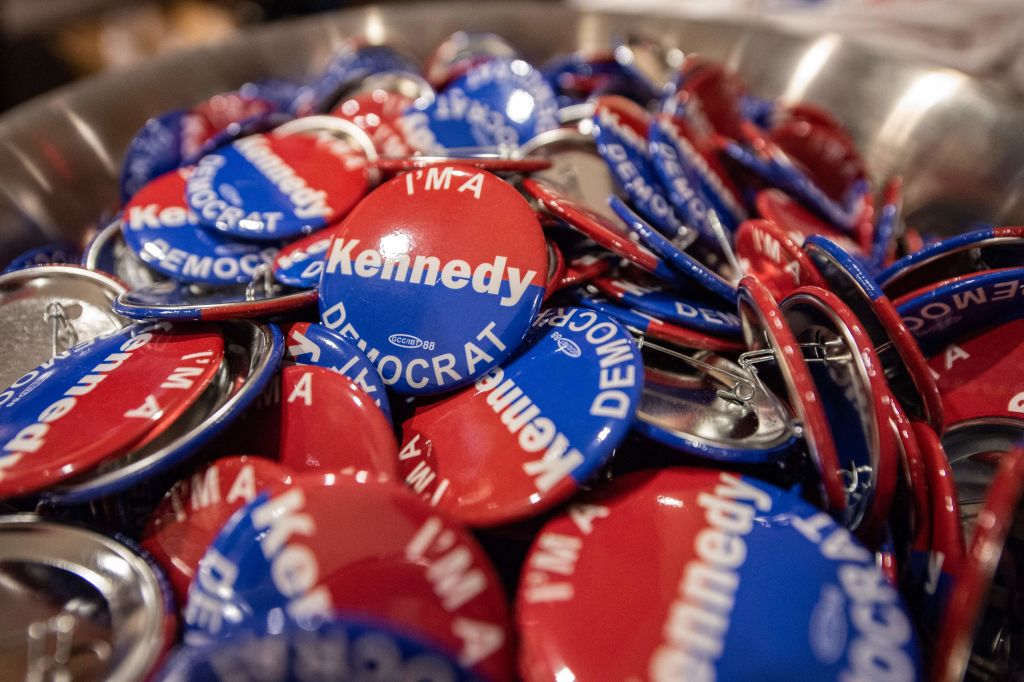
I arrived at the Park Plaza two hours ahead of time and found a long line of people waiting to get in. Though the New York Post later reported the presence of a significant number of “hot MILFs,” I didn’t notice them. Instead, the crowd seemed to skew older and a bit crunchy — a lot of New England boomers in sensible shoes. The event’s staging, on the other hand, was modern and slick. Screens set up next to the stage and in the overflow room showed a series of family photos — tanned Kennedys in boat shoes on the water, etc. A brass ensemble played a version of the Dropkick Murphys’ “I’m Shipping Up to Boston.” The merch tables were laden with signs and bumper stickers saying, “I’m a Kennedy Democrat” and “Heal the Divide.”
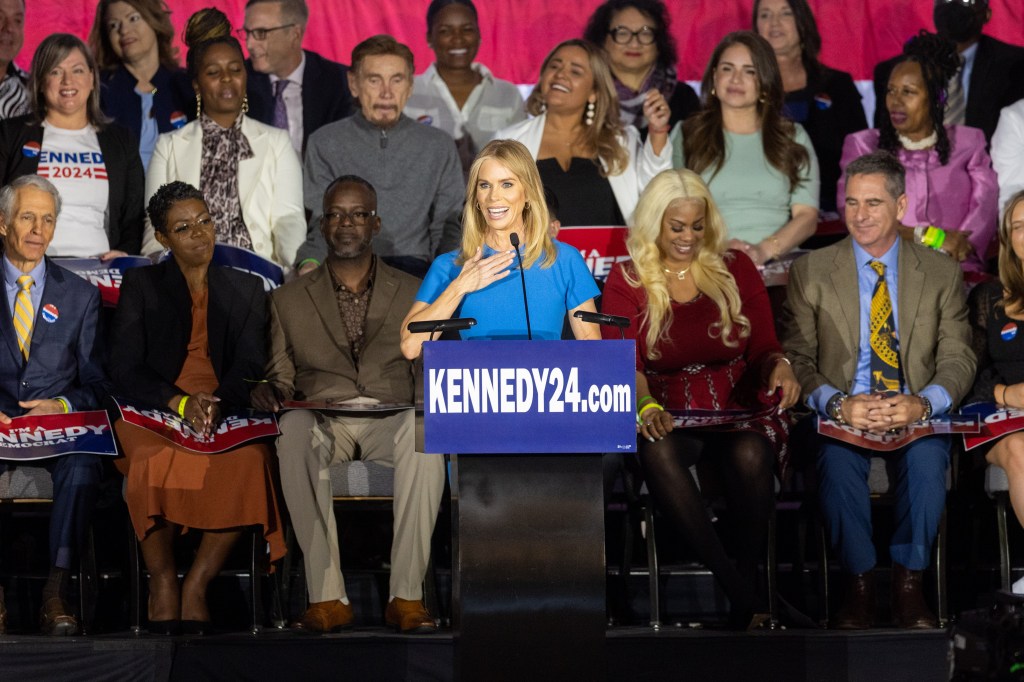
Kennedy’s wife, the actress Cheryl Hines, gave a very brief introduction. Hines plays Larry David’s wife on Curb Your Enthusiasm; her husband’s views have sometimes put her in an awkward position — when he compared vaccine mandates last year to Anne Frank’s ordeal during World War Two, Hines criticized him publicly, calling his comment “reprehensible.” But on the day of the launch, Hines looked every inch the supportive political wife as she took the stage in a turquoise sheath dress, though she spoke briefly, saying merely that her husband would soon “come out and make a very important announcement.” She introduced former Ohio congressman and leftist stalwart Dennis Kucinich. Kucinich is running the campaign, and his wife Elizabeth is also involved.
The entrance of Kucinich brought the house down; this was the biggest political name present. He compared Kennedy to Revolutionary War hero Paul Revere, “moving from town to town, warning us if water is unsafe to drink, warning us if our air is unsafe to breathe, warning us when our food is unsafe to eat, and warning us when pharmaceuticals are unsafe to use.” The launch came the day after the anniversary of Revere’s midnight ride; in his speech Kennedy tied the American rebels’ cause to his own: “The spear-tip of that rebellion was a fury that the colonists had against the merger, the corrupt merger, of state and corporate power.”
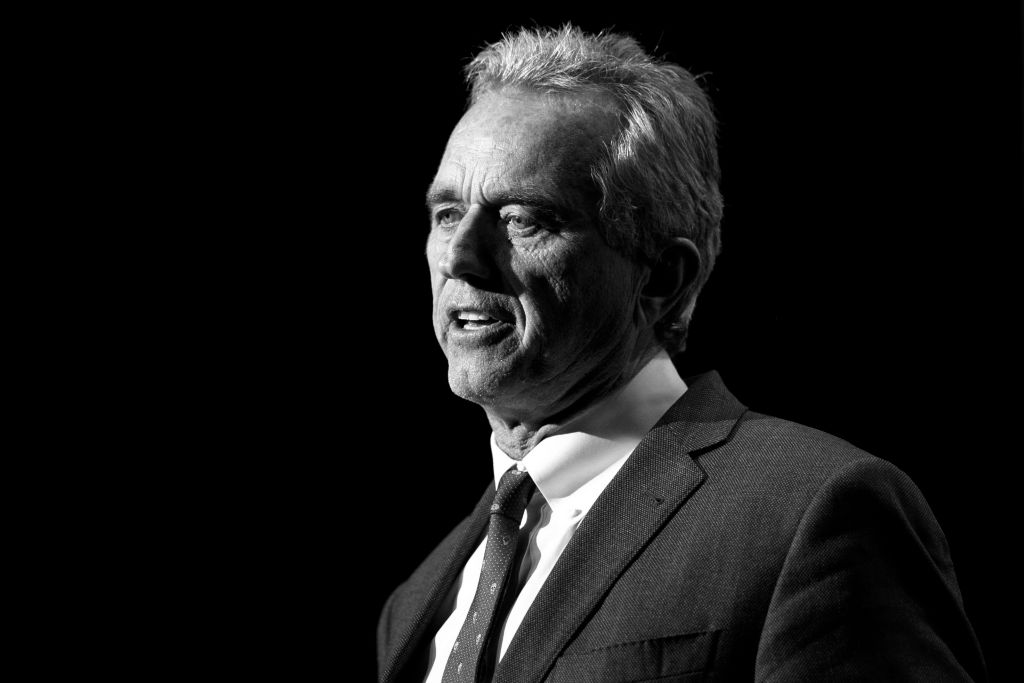
The older generation of Kennedys, or their speechwriters, had a knack for language. John F. Kennedy: “Ask not what your country can do for you — ask what you can do for your country.” Robert F. Kennedy: “Each time a man stands up for an ideal, or acts to improve the lot of others, or strikes out against injustice, he sends forth a tiny ripple of hope, and crossing each other from a million different centers of energy and daring those ripples build a current which can sweep down the mightiest walls of oppression and resistance.” Ted Kennedy: “For all those whose cares have been our concern, the work goes on, the cause endures, the hope still lives, and the dream shall never die.” This gift may have skipped a generation.
RFK Jr. spoke for nearly two hours, with no teleprompters, not appearing to read from notes, either. He segued from vaccines to lockdowns to the environment to the media to the war in Ukraine, croaking the words in his unusually strangled voice (the result of spasmodic dysphonia, a neurological disorder). He told the audience in great detail about lawsuits he worked on during his lawyer days, and shared his perception that no one his age has “full-blown” autism. After forty-eight minutes, he promised “I’m about halfway done with this speech. This is what happens when you censor somebody for eighteen years. I’ve got a lot to talk about.”
Kennedy had a successful career as an environmental lawyer, bringing high-profile suits against corporate polluters. But he is more widely known now as a critic of Big Pharma and, in particular, vaccination. He wrote in 2005 that he had been approached by parents who believed vaccines had caused their children’s autism, and began looking into it. At that time, the contemporary anti-vaccine movement was in its infancy. A British doctor, Andrew Wakefield, published a 1998 paper that posited a link between the measles, mumps and rubella (MMR) vaccine and autism in children. The study had significant flaws: a tiny sample size of twelve subjects, no control group, and the fact that Wakefield had been hired to do the research by a lawyer for parents of autistic children who were seeking to sue drug companies. No credible link between the MMR vaccine and autism has ever been established and the Lancet retracted Wakefield’s paper in 2010. At the time Kennedy says he was approached, the battle lines hadn’t been as sharply drawn as they are today; in 2005 both Rolling Stone and Salon published a multi-thousand word essay he wrote condemning a kind of mercury used in vaccines as a preservative. In 2011 Kennedy founded the nonprofit World Mercury Project (now Children’s Health Defense) that became an important node in the anti-vaccine movement.
But his anti-vaccine activism didn’t become the next great mainstream liberal cause in the vein of his environmental work. Instead, the tone and content of Kennedy’s activism marginalized him in mainstream circles, where he has for years been considered a conspiracy theorist, particularly in the wake of Covid.
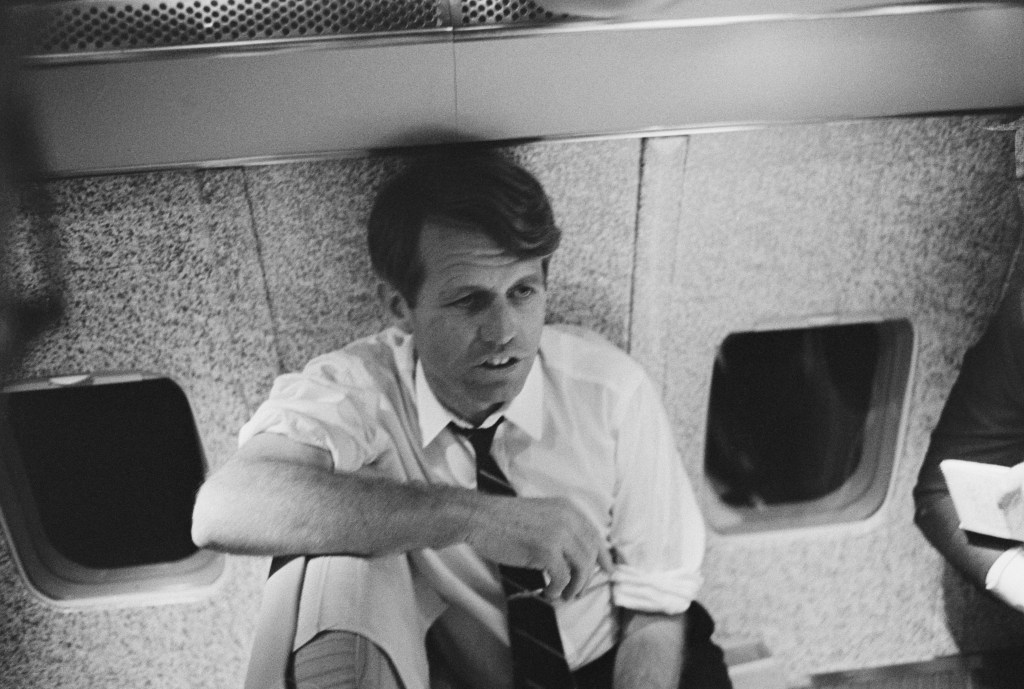
“Some look for scapegoats, others look for conspiracies, but this much is clear; violence breeds violence, repression brings retaliation, and only a cleaning of our whole society can remove this sickness from our soul,” RFK Sr. said in a famous speech after the assassination of Martin Luther King Jr. “For there is another kind of violence, slower but just as deadly, destructive as the shot or the bomb in the night. This is the violence of institutions; indifference and inaction and slow decay.” RFK Jr. clearly believes he is carrying on his father’s legacy of opposing institutional wrongdoing. But there is a fundamental difference between him and the previous generation of Kennedys. Despite their individual scandals and tragedies, they were all about possibility and hope, or at least the appearance of it. This was the family of Camelot, the moonshot project, the dream that would never die. They channeled the hopes and fears of a confident, if turbulent, postwar America, that believed things were getting better.
RFK Jr.’s message is that things are getting worse. Where the previous Kennedys typified the go get ’em ethos of the television age, RFK Jr.’s message evinces the pessimism and paranoia of the digital one. Here is the Kennedy our era deserves. His vision is ultimately a negative one, of a society on the brink of total capture by nefarious actors. And it reflects the mood of an increasingly vocal number of Americans who have lost faith in institutions and hope for the future. RFK Jr. probably can’t win. But his campaign could show how much that loss of faith, especially since Covid, has changed the political landscape.
I spoke to Kennedy on the phone the week after the launch. First I had texted Kucinich, to see if he could help arrange the interview. Then I texted Kennedy, who responded almost immediately: “You can call now.” At that moment, Kucinich called me and explained that he would recommend I be given the interview. He would coordinate with the press team and make sure everyone was across this. He did not know that the candidate had already decided to grant it, but I appreciated his enthusiasm. (Then I saw that Kucinich had texted me a presumably accidental pocket-recorded audio clip of a woman saying to him “I don’t think she’s friendly.”) Kennedy was between obligations, heading to New Hampshire the next day to meet union leaders and give a talk about Covid vaccine mandates at Dartmouth, and was multitasking by eating lunch at the same time he spoke to me. His lunch was avocado salad, white bean soup and risotto with clams. I asked him about the process of writing his speech. “I never wrote it,” Kennedy said. “I just said it.” Did he sketch out the structure, at least? “I did the structure in my head,” he said. “And then I just started talking.”
It would be logical for Kennedy to base his rationale for running on the uptick in anti-vaccine sentiment during the Covid years, but he downplayed this aspect. “I think most Americans are more interested in pocketbook issues and in freedom issues, and in restoring our democracy,” he said. “People in this country are desperate. They feel this system is rigged against them. I think they’re thinking more about, you know, just how to feed their families and make ends meet than they are about vaccines.”
But he does acknowledge, and embrace, the golden ticket of his Kennedy name. “I think that my family name is certainly a huge advantage,” he said. “Name-recognition is an advantage in any kind of democratic contest. And my name is one of the most recognizable in modern political history.” According to a source who was on the call, a week before his launch Kennedy debated with his team whether to use his nickname “Bobby” for campaign purposes, fearing that it would look too much like he was riding his father’s coattails or that the name itself was too juvenile-sounding. “When someone showcased proposed campaign materials employing the name ‘Bobby,’ I explained that I’ve always asked people to introduce me as ‘Robert’ in formal or official settings — as did my father,” Kennedy said in a text message. “Otherwise, I don’t care what people call me — not even ‘antivax.’”
Either way, Kennedy nostalgia is a factor. “I loved his father. I’m old enough to have loved his father. I was fifteen years old when he was killed,” said Tricia Santi, who is sixty-nine, the same age as the candidate. Santi drove down from Maine for Kennedy’s Boston rally. “And just to see another Kennedy come forward at this time and do this is amazing to see.” Santi is a “holistic healer” and has followed Kennedy’s work for years.
“All these people were alive when John Kennedy was assassinated,” said Santi’s husband Aram Aslanian, seventy, gesturing around at the other attendees waiting to get in the hall. “I was fifteen years old when Bobby was killed. What happened was, the country stopped telling the truth. They started lying after they killed the president. The CIA, the FBI — they killed the president. But nobody wants to talk about what happened as a culture. Our culture began to keep secrets.” RFK Jr.’s campaign, he said, is “a chance for Americans to swing back and tell the truth.”
The Kennedy brand name is still strong enough to attract some voters who don’t share Kennedy’s views. Joseph Pereira, fifty-eight, a businessman from Fall River, Massachusetts, was at the rally wearing a Kennedy for President pin he made himself. He got the Covid vaccine and doesn’t agree with Kennedy’s position on vaccines. His family has always held the Kennedys “in high esteem,” he said, because JFK signed a bill that enabled them to immigrate to the US from Portugal. Pereira worked on Ted Kennedy’s campaigns. And he’s now a fan of Robert Jr. Biden and Trump are “too old,” he said. “Bobby’s sixty-nine. I think he’s going to bring a new approach to politics. And I think that’s what we need. We need people who are bold enough to question authority.”
“I think if you weigh everything, all of the issues, I think the vaccines are not going to make that much of a difference,” Pereira said.
Early polls have shown RFK Jr. attracting as much as 21 percent of Democratic primary voters. But it’s uncertain how much that support owes to his name ID and voters’ lukewarm feelings about Biden, and how much those voters know about Kennedy otherwise. Moderate Democrats with fond memories of his father and uncles might not appreciate his frequent outreach to the populist right, which has embraced him as a fellow traveler during the Covid era.
Just a few days before his launch, for example, Kennedy spoke at Hillsdale College, an epicenter of Trump-era conservative intellectualism. Former Trump strategist Steve Bannon has sung Kennedy’s praises on his War Room show, and floated the idea that Trump should choose him as his running mate. CBS reported recently that Bannon had encouraged Kennedy to run, a claim Kennedy denies. “I’ve never talked to him about running,” he said, saying that other than appearing on his show a couple of times, he has only met Bannon once in person. This was when Kennedy was invited to take part in a “vaccine safety” panel Trump convened at Trump Tower during the transition after the 2016 election. But Kennedy is perfectly comfortable with speaking to the right, and sees it as a bonus. He was good friends with Roger Ailes, who hired him to host a long-forgotten wildlife documentary the pair shot in Kenya in the 1970s. Kennedy appears on Fox News regularly, including on Tucker Carlson’s show the week before Carlson’s surprise firing. “Some people criticize me, but how are we going to convince people if we don’t talk to them?” he told me. “The most important people who you can talk to are people who you don’t agree with.”
In framing this as a reaching-across-the-aisle exercise, Kennedy was evoking the legacy of his family elders, particularly his uncle Ted. “He would bring Orrin Hatch and John Kasich to our homes on weekends as these were some of his closest friends, and they were people who were absolutely antithetical to him and all of their political ideologies,” Kennedy said. “And he was able to do that — he was able to be so effective as senator — because he was able to make that distinction between politics and ideology. He never compromised his values. But he recognized that you had a lot of common values with people who are in the other party.”
But Ted Kennedy wasn’t going on red-pilled MAGA livestreams; he was hammering out legislative deals. The younger Kennedy says there is no deeper meaning behind his frequent appearances in conservative media. It’s because “the liberal media won’t let me on to talk,” he said. “I’m censored in the liberal media.” Running for president, though, has changed this; he said he had hundreds of media requests since his announcement, and was planning to go on Good Morning America and CNN. Kennedy subscribes to a Chomskyan view of the media as a top-down machine controlled by powerful interests, and though he reads widely, he doesn’t trust a lot of what he reads. “I would trust the New York Times about not anything to do with war or with the intelligence agencies or with pharmaceutical drugs,” he said. (That takes out quite a bit of the paper’s coverage.)
He doesn’t trust a lot in general. Kennedy is often described in the press as an anti-vaccine conspiracy theorist, and of course he rejects this as a smear. “The term ‘misinformation’ is just a euphemism for any statement that departs from government orthodoxies,” he said. But he does literally believe in conspiracy explanations for important events, including the assassination of his father in 1968. Kennedy doesn’t believe that the man convicted of the crime, Sirhan Sirhan, actually did it, and has called for Sirhan’s release from prison. He told Tablet recently that he believes the culprit was a security guard assigned to RFK the day before the shooting, in a CIA plot triggered by his father’s desire to re-open the Warren Commission investigation of JFK’s assassination.
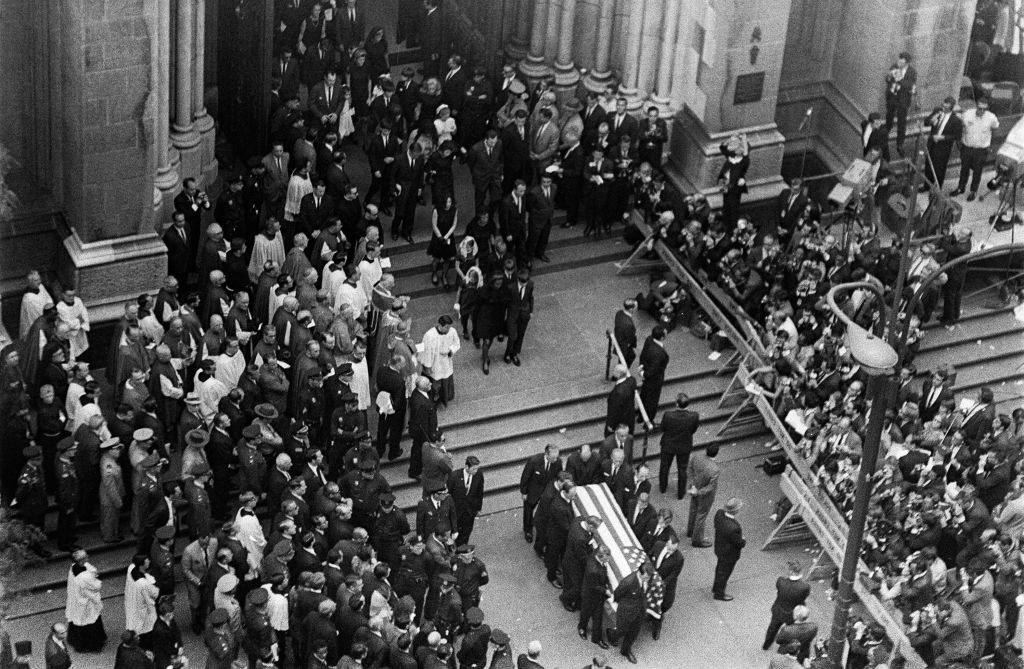
Robert Kennedy Jr. was fourteen years old when his father died. His father’s entrance into the campaign had helped push the incumbent, Lyndon B. Johnson, out of the race. RFK had built an antiwar, pro-civil rights coalition and won the crucial California primary the day of his death. In his kickoff speech, the younger Kennedy explicitly compared his situation to his father’s: an upstart candidate taking on a calcified sitting president and building a coalition.
Kennedy told me that when he was deciding whether to run, his children worried that it would threaten his safety. “There are things that are worse to me than death,” he said. “And principally to me that would be that they were going to grow up in a nation that was diminished, that didn’t have constitutional rights, a country that they didn’t feel as proud of as the country I grew up in.”
Other than three of Kennedy’s six children and Hines, the Kennedy quotient at the campaign launch was low. Some of his siblings have publicly distanced themselves from Kennedy’s activism, though he said this hasn’t affected their personal relationships. It’s unclear to what extent Hines will continue to be involved. “I hope” she will, Kennedy told me. “She’s a huge asset for me.”
This isn’t an ideal time to launch a Democratic primary campaign. President Biden announced his re-election campaign in April, and since he’s running for re-election the party probably won’t hold primary debates, a potentially crucial venue for dark horse candidates like Kennedy or Marianne Williamson to raise their profiles. It also limits the number of available staff willing to work on an outsider campaign.
Kennedy’s supporters are filling the gap in various ways. His campaign team is made up mostly of friends and allies from the anti-vaccine movement. Kennedy told me the campaign’s resources were being “crowdsourced,” but it may be difficult. A source with direct knowledge of the campaign told me that the campaign has had trouble renting email lists to use for fundraising, either from the right or the left, and is relying on its own list of 20,000 names. Contrast this with the legendary 2.5 million-strong Bernie Sanders email list. (Asked about the email fundraising, Kucinich said “our internal discussions have been the opposite” and called the lists I was referring to “stale.”) It complicates matters that the campaign’s natural demographic is “the crunchy crew in the antivax and medical-freedom movement that I think is hard to pigeonhole in political lines. I don’t think they’re motivated by partisanship,” this source said. “They’re trying to reach that demographic, but there’s not an obvious way to talk to them.”
There is already a super PAC promoting Kennedy’s candidacy. Called American Values 2024 after the title of Kennedy’s 2018 memoir, it took out a full-page ad in the Boston Globe to promote the Boston kickoff event. It’s being run by John Gilmore, who left his role leading the New York chapter of Children’s Health Defense to found the committee. Gilmore believes that the anti-vaccine movement (he prefers the term “vaccine safety”) has grown strong enough in the wake of Covid to power a political movement.
“Our movement as a result of Covid has become enormously larger than it used to be,” he said, estimating that it was “orders of magnitude bigger” now than it was twenty years ago when you could “sort of cram the whole movement into a van.” The growth of Children’s Health Defense is one example; the AP reported in 2021 that the charity doubled its revenue in 2020.
“It’s an issue that can and has decided elections and probably will be a major factor in the presidential election, and it hasn’t been up to this point,” Gilmore said.
Kennedy’s biggest opportunity is likely to be in free-thinking New Hampshire, traditionally the first primary state on the calendar and one that has energized anti-establishment campaigns like Ron Paul’s in 2012. Biden’s push to get South Carolina to hold the first primary next year could mean he’s not on the ballot in New Hampshire if it goes first anyway, which it will do unless its legislature changes a relevant law by June this year. This wouldn’t be enough to really interfere with Biden’s path to the nomination, but it would draw attention to Kennedy and thus to a messenger — and movement — that Democrats would rather not highlight. Kennedy insists, though, that his is no protest campaign. “I’m in it to win it,” he said. “I’m not thinking of Plan B.”
This article is taken from The Spectator’s June 2023 World edition.
Blink and you’ll miss this libertarian moment
Political years are the opposite of dog years: they pass by in a blaze, with entire epochs elapsing in the course of a few news cycles. Ideas, even movements, fade abruptly, recalled only years later when you clean out your garage and stumble on that old tricorn hat from your Tea Party days.
If you want to know how jarring political change can be, consider that at this time in the 2016 election cycle — around the late spring of 2015 — the predicted frontrunner for the GOP nomination was Rand Paul. This was no coincidence. In those days, we were said to be in the middle of something called a libertarian moment. Voters were leery of Barack Obama’s deficit spending, Washington’s endless wars, the NSA surveillance that had been unveiled by Edward Snowden. And only Paul, a self-described “libertarian-ish” senator from Kentucky, had given eloquent voice to this skepticism of the state.
If you want to know how jarring political change can be, consider what happened next. Paul came under fierce fire during the GOP primary debates from a guy called Donald Trump, who took many of Paul’s libertarian issues — antiwar, anti-security state — and rolled them into a more visceral and smash-mouth populism. This populism was simultaneously comfortable with strong government on issues like entitlements and immigration. It was this formula, which we’d now call MAGA, that tapped the mood of the Republican base. Paul dropped out after the Iowa caucuses.
Thus did the libertarian moment end, with many wondering whether it had ever begun. Yet it wasn’t the first time a libertarian moment had been declared. Back in 2010, when the Tea Party erupted against Obama’s big-government meddling, the GOP was said to be moving in a more libertarian direction. And the shock debut of Ron Paul’s (Rand’s father) on a 2008 primary debate stage, where he denounced the Bush administration’s warmongering and attracted a wave of youth support, felt much the same.
Yet somehow the libertarian moment never seems to clock a full sixty seconds. It emerges in the media as a modish key to understanding a changing GOP, only for government to continue to grow bigger. So it is that once again we find ourselves in what might be called a libertarian moment. Yet is this actually the case?
Start with the fact that on so-called social issues, the country is trending in a libertarian direction. Support for marijuana legalization is high, and while at the state level this has resulted in a patchwork of legal frames, pot remains fully illegal in only four states. The gay marriage issue is largely settled, with 71 percent voicing support to Gallup in 2022. And while the public’s view of abortion remains more complicated — allowing the procedure on demand, as many on the left call for, has never been popular — there’s little question the recent Dobbs ruling helped pro-choice Democrats in last year’s midterms.
There’s also the fact that Republicans on Capitol Hill are behaving like the Tea Party never ended. The main points of contention in the fight over Kevin McCarthy’s speakership all had to do with government spending and reducing concentrated political power. McCarthy’s opponents demanded that the House: refuse to raise the debt ceiling without a spending cap; keep earmarks banned; and create a special committee to target “weaponized government.” The speeches from Republicans — pro-McCarthy and con — were all about reining in the state; “right-wing” in that moment seemed to mean “less Washington.”
Meanwhile, polls find that government spending remains unpopular at least in the abstract. Support for a muscular American response in Ukraine is waning. The middle class is stampeding into low-tax, low-regulation states such as Florida. So how about it? Has another libertarian moment begun?
Against any slide towards libertarianism has to be pitted another issue: crime. Five years ago, this was one of the libertarian movement’s greatest strengths. A falling crime rate, police brutality and America’s extraordinary level of incarceration had combined into broad support for criminal justice reform, which culminated in the First Step Act, signed into law by, of all people, Donald “Let’s Execute Drug Dealers” Trump. Yet as crime began to spike during Covid, the momentum changed. Nowadays, you can find Congress blocking local laws that ease penalties on criminals. Libertarian ideas such as decriminalization and harm reduction are blamed in many West Coast cities for crises of addiction and disorder.
Even beyond their purported issues, these libertarian moments have long seemed to me more like progressive moments. Yes, Americans are becoming more live-and-let-live on certain social matters, but then they aren’t especially wound up about the national debt or a bloated executive branch either. And any claim of a libertarian tilt has to take into account our elites’ shift in manners, away from liberality and tolerance, toward cancel culture and stifling speech. The average American is hardly woke. But it’s difficult to cast your eye across the country and see a groundswell for individual liberty either.
It’s become hip for a certain type of very-online trad to say that libertarianism is dead, dead, DEAD! — that what the public really wants is more blue laws and imported Hungarian nationalism. This is drivel, of course, and always has been. But as the so-called New Right hits some speed bumps, it’s not clear what libertarianism looks like in this weird national moment either. And as Kevin McCarthy strikes poses in yet another debt-ceiling fight, does anyone seriously think the state is going to get any smaller?
This article is taken from The Spectator’s June 2023 World edition.
How to stop the flow of guns south
Latavia McGee crossed the US border with three friends on March 3. The North Carolina resident was looking for the Mexican clinic for her tummy-tuck operation when she came under gunfire. Two of the group, McGee’s cousin Shaeed Woodard and friend Zindell Brown, jumped out of the back of their vehicle and tried to flee but were cut down by bullets. The third friend, Eric Williams, stepped out the driver’s side and was shot in the leg. The gunmen, who worked for the drug-trafficking mafia known as the Gulf Cartel, ran over, loaded the Americans onto a pickup truck and then held them in vehicles and stash houses for days. Woodard and Brown wouldn’t make it through the kidnapping; McGee watched them die from their wounds.
“I talked to him the whole time,” McGee said of Brown, weeping, on CNN. “I just told him I’m sorry because I asked him to come with me, and he’s like, ‘It’s OK, I’m your brother, I’m supposed to be there for you. I love you.'” Mexican police found McGee and Williams alive in a shack near the border on March 7.
While the vast majority of murders in Mexico are never solved, the suspects behind this atrocity were handed quickly over to the Mexican police — by the Gulf Cartel itself. The mob left the five men handcuffed by a car with a note that apologized and said the attack had been a mistake. “We ask the community to be calm because we are committed that these errors, caused by a lack of discipline, will not be repeated,” it said.
Mexican police also seized one of the guns used, a Diamondback AR-15, and gave the serial number to officials in the US Bureau of Alcohol, Tobacco, Firearms and Explosives. ATF traced the firearm to Texas, where Roberto Lugardo Moreno, a resident of Harlingen, had purchased it in 2019. Prosecutors allege that Lugardo was a “straw buyer,” someone with a clean record who gets guns for criminals and had been paid $100 by the Gulf Cartel to acquire it. He was arrested and held pending a trial.
The fact that a weapon wielded by cartel triggermen was traced over the Rio Grande is unsurprising. In the entire country of Mexico there is only one gun shop. Run by the army, the Mexico City store requires customers to hand in seven types of paperwork, including proof of a clean record and a letter from their employer, and wait months for the sale to be approved. But between 2007 and 2021, 192,000 weapons seized by Mexican security forces were traced to US gun shops and gun factories. The Mexican government believes this is only the tip of the iceberg and estimates that more than 200,000 firearms are trafficked over America’s southern border every year.
While gunrunning south has been a problem for decades, it has recently shot to the top of the US-Mexico agenda. In 2021, the Mexican government sued key US gun companies for negligence over the traffic. In 2022, a judge dismissed the case but the Mexican government appealed and filed a second suit against individual gun shops. When a team of top Mexican officials flew to Washington in April to discuss security issues, foreign secretary Marcelo Ebrard said, “Mexico’s priority is to stop the trafficking of guns from the US to reduce the firepower of criminal organizations” as well as fight the drug trafficking north. Following the meeting, the White House promised to “target southbound firearms flows.”
The issue is especially pertinent amid the severity of the fentanyl crisis and calls by some Republicans to classify Mexican cartels as terrorist groups and unleash the US military on them. In 2021, there were a record 107,000 overdose deaths in the United States and traces of fentanyl were found in 71,000 of the victims. US Customs and Border Patrol agents seized a record 6,600 pounds of fentanyl in the first quarter of this year, with the Sinaloa Cartel and Jalisco New Generation Cartel dominating the trade.
In January, Dan Crenshaw, a Republican from Texas, and Mike Waltz, a Republican from Florida, introduced a bill in the House to authorize military force against the cartels in retaliation for the overdose epidemic. “The cartels are at war with us — poisoning more than 80,000 Americans with fentanyl every year, creating a crisis at our border, and turning Mexico into a failed narco-state,” Crenshaw said. “It’s time we directly target them.”
While their military approach might raise eyebrows, these hawks are at least right that the fentanyl crisis and the violence of cartels are serious issues that need to be addressed. But following this logic, Washington more than ever needs to drain the “iron river” of guns that pours into Mexico. Any serious US effort to curb the cartels should start with the gun trafficking problem. The United States could significantly reduce the southward flow of guns without curtailing the Second Amendment or getting into thorny debates about assault rifle bans.
I have been covering the cartels in Mexico for more than two decades and spent four years reporting on a book on gun trafficking, Blood Gun Money. The research took me to a prison in the sprawling city of Ciudad Juárez, and the inmate Jorge whom Mexican soldiers had caught with a stash of weapons he had smuggled over the border. Many small groups such as the one Jorge ran traffic guns over the border, working with and supplying weapons for the cartels.
A soft-spoken, slim man with a goatee, Jorge began trafficking guns when he was just nineteen and struggled to look after his wife and baby with the money he made in construction in his town in Chihuahua state. He had a US visa and went to Dallas to buy clothes and boom boxes to sell for a markup back home. On one of these trips, a friend asked him to get an AR-15; when he delivered it the friend asked for many more.
Jorge became part of a three-man team, including a friend in Dallas who helped him get the weapons and the man in his hometown selling them. He would buy the rifles in Texas for approximately $500 to $700 apiece and sell them for over $2,000. He bought a dozen or so guns on each trip, stashing them in fridges and stoves as he drove into Mexico.
Jorge bought most of these rifles at gun shows, seeking out those that didn’t ask for identification in order to leave no paper trail. “There’s a black market right there at the gun show. You buy from the person who doesn’t ask for any paperwork,” he said. “If you go over to a person, ask for the price, and then they say, ‘I need your license,’ then you say, ‘I don’t want it,’ and go with someone else. The seller who tells you they don’t need anything, that’s where I used to buy.”
Jorge carried on trafficking for almost two years, selling hundreds of guns for triple their purchase price, buying a house in cash and enjoying an extravagant lifestyle. “At the beginning I felt bad, but I got used to it. In the end I didn’t care,” he said. “It’s the way you can have a good time. You sell weapons, you earn money and you have fun. I bought a brand-new truck, a motorbike, women, drugs. I had everything.” He only stopped when he got into an argument with his cousin, who promptly informed on him to soldiers. “If I hadn’t gotten snitched on, I would maybe still be working on the same thing.”
Following Jorge’s story, I traveled to a huge Dallas-area gun show with 700 stalls. Most sellers were licensed dealers who asked for identification. But I also found the private sellers who offered guns without requiring any paperwork at all. Under what is known as the “private sale loophole,” people who are collectors or just want to get rid of an old gun are allowed to sell weapons without asking for identification or doing a federal background check, which is the screening process used to stop convicted felons from acquiring weapons. However, I saw people who were not just hobbyists but were abusing the loophole to offer large numbers of brand-new weapons. “No tax, no paperwork, out the door,” a seller said. “That one’s unfired. We got one magazine with it.”
There are a number of documented cases of people abusing the loophole to knowingly sell large numbers of weapons to criminals. In Florida from 2009 to 2010, Vietnam veteran Hugh Crumpler purchased 529 guns from shops and resold them at shows without paperwork. Following their sale, federal agents traced them to a group of Honduran traffickers; they were implicated in five shootings from Colombia to Puerto Rico.
One way to shut down this dangerous enterprise would be to require universal background checks on all sales. Polls show there is strong support for them; in 2022 Morning Consult and Politico found 88 percent in favor of them and only 8 percent opposed. Yet even without these, the ATF could more aggressively pursue anyone “engaged in the business of selling without a license,” especially if a clampdown had broad political backing.
The second big way the cartels acquire weapons is through straw buyers — the accusation Lugardo faces in the recent attack on the Americans. Prosecutors say he was paid just $100 to get the gun, which matches amounts in many other cases I have seen. The reason that the fee is so low is that for a long time there have been few consequences, with those buying them often getting probation for simply lying on the form. “They’re not going to get any jail time. What’s the deterrent factor?” said Steve Barborini, a former ATF agent.
Such soft penalties for straw buyers could be changed following the Bipartisan Safer Communities Act approved in June 2022. While the media coverage fixated on the clauses regarding mass shooters, almost all missed section 12004, which focuses on firearms trafficking and establishes that straw buyers can be given up to fifteen years in prison. However, the challenge is to see the law enforced, which again could be helped with political pressure.
A further hurdle will be intercepting and preventing the sale of “ghost guns,” often made from kits sold on the internet; they have, of course, no serial numbers. I visited the ATF offices in Los Angeles right after they had busted a gang whose small factory churned out guns with black and red parts. A gang member was caught with red ink all over his hands — literally red-handed. “Right now, what we’re seeing is Southern California is approximately 30 percent of the firearms that we seize or buy off the street are non-serialized homemade guns,” said ATF spokesperson Ginger Colbrun. “These guys are making them hand over fist… It’s fine if you are a hobbyist and you want to make your gun, and that’s your thing but it’s prohibited people taking these.”
Mexican cartels also like ghosts. In 2014, police in the state of Jalisco raided a pair of workshops where criminals affiliated to the Jalisco Cartel had assembled a hundred rifles. For a long time, the gangsters have been able to buy gun kits off the internet with no ID or background checks because they’re only parts, not finished products. However, a new “Frame or Receiver” rule from the ATF went into effect in August, requiring the same procedure for gun kits as for regular guns. Yet again, the agents need to enforce it and political will could help this.
Firearms that use whopping .50 caliber bullets — ammunition for military machine guns — are coveted by the cartels. While these guns are a fairly niche product in the United States, costing upwards of $8,000, cartel gunmen want them to fire at security forces. They pierce the metal of police cars and can disable the engine on a large boat. Video of a 2019 firefight shows one blowing the leg off a Mexican soldier. In states such as Arizona straw buyers can get them with a simple identification. An extended background check, even of twenty-four hours, would deter many of the cartel affiliates from walking away with these weapons of war.
While the United States can do much to tackle the problem, Mexico also has a huge amount of work to do to stop gun trafficking. Immense corruption aids the vast proliferation of guns south of the border. In the infamous barrio of Tepito in Mexico City, I interviewed an army veteran-turned-gunseller who began selling firearms when he served, returning seized weapons to the street. His officers ran the racket.
“We had a saying,” he told me. “‘There is no general who can withstand a cannonball of a hundred million pesos.’” (I later found out this is a variation on a saying by Álvaro Obregón, a Mexican revolutionary general and president. He was assassinated in 1928.)
There are many such cases of seized guns being resold. In 2019, a man in Cuernavaca was caught on camera killing two labor leaders with a Glock .9 millimeter. It turned out the gun had previously been seized by police, but mysteriously disappeared from the vault.
Sometimes, the security forces sell their own guns. When federal troops took over the police base in Acapulco in 2018, they discovered that 342 guns, or 19 percent of their armory, were missing. Other towns have suffered the same fate. Between 2006 and 2018, there were officially 15,592 guns that went missing from Mexican police or soldiers, Mexico’s defense department reported.
Latin American security forces are also the source of many of the heavier weapons. In 2010, thieves sold twenty-two RPG-7s from a Honduran military armory, and the weapons began turning up among Mexican gangsters. Truckloads of M-67 grenades have been stolen from stockpiles in El Salvador and trafficked north. They actually originated in the United States, given to bolster the Salvadoran government in that country’s civil war back in the 1980s.
Still, if Latin American security forces were selling all their guns to criminals, they would be on the streets disarmed, but they still manage to have enough for their own personnel. Per year, Mexican police and soldiers are officially losing fewer than two thousand guns. Meanwhile, there are hundreds of thousands of cartel affiliates in Mexico. So while the theft from Mexican security forces provides a few of their weapons, trafficking from the United States provides far more.
The violence in Mexico often takes on the dimensions of an armed conflict. There were more than 30,000 murders last year in a country of 127 million; firearms were used in 70 percent of the deaths. The violence is not spread evenly — some cities, such as Mérida, can be relatively safe; others like Tijuana and Fresnillo are among the most homicidal on the planet.
Cartels use the guns to run full-on paramilitary forces and drive through towns in convoys of trucks with men in khaki showing off their firepower. In 2019, when police and soldiers arrested Ovidio Guzmán, the son of the drug lord El Chapo, an estimated 700 to 800 Sinaloa gunmen took to the streets until he was released. When a force of 3,500 soldiers rearrested him this year, cartel gunmen fired on a passenger plane trying to leave the airport.
It’s in the interest of the United States not to have such an unstable county on its doorstep. Americans crossing over become victims. Refugees flee the bloodshed and apply for asylum in the United States. And violent mafias run the human smuggling and drug trade. Mexico has to take the responsibility of restoring order. But that task would be massively helped if the gunmen did not have an unlimited supply of guns rushing south along the “iron river.” As the Mexican government wrote in its lawsuit: “This flood is not a natural phenomenon.”
This article is taken from The Spectator’s June 2023 World edition.
Will DeSantis lose if he runs to the right of Trump?
“Negative partisanship” is a notorious feature of American politics. In presidential elections especially, voters don’t vote for the party and candidate they like; they vote against the party and candidate they fear. This is one reason third-party politics is a waste of time. If voters want to prevent the worst outcome, they will always choose the most viable alternative over the best alternative.
For Joe Biden in 2020, it was enough that he wasn’t Donald Trump. For Trump in 2016, it was enough that he wasn’t Hillary Clinton. Next year, we’ll find out whether the voting public now views Biden as more like Clinton or still considers him better than Trump.
Perhaps it’s a grim comment on the state of America, but for all the obvious advantages presidential incumbency conveys, the public’s decision in 2024, like its verdict in 2020, may come down to what voters like least about the last four years.
When Trump was the incumbent, America was wracked by riots and ravaged by a pandemic. The economy that boomed until Trump’s final year was sunk by Covid. Biden promised, if not a fresh alternative, at least a return to relative placidity — no more mean tweets, no more endless Russiagate coverage. Anything was better than that.
“Anything,” however, has turned out to mean dizzying inflation and an escalating culture war, with shooting wars ending badly or beginning anew. Trump can draw a sharp contrast between the prosperity of his term and the price shocks of the Biden era, as well as between the winding-down of wars on his watch and Biden’s disgrace in Afghanistan and aimlessness in Ukraine.
But before Trump can test the hypothesis that serving as president has made Biden less popular, he has to see off a handful of rivals for the Republican nomination. After 2016, a common theory had it that Trump only became the GOP nominee that year because the rest of the field was so fragmented.
Remember when there were so many candidates that Republican debates had to be split into multiple tiers — and even then not everyone got in?
The first primary is still half a year away, but this time the field looks to be much smaller, and there’s only one clear plausible alternative to Trump.
Governor Ron DeSantis pleased economic conservatives by keeping Florida open for business during the Covid crisis. He pleased social conservatives with his opposition to abortion and transgenderism. And he pleases the New Right with his willingness to use state power to hit back at the Walt Disney Company.
DeSantis appeals to conservative critics of foreign entanglements with his sometimes skeptical remarks about US involvement in Ukraine. He says things that reassure hawks, too. There could be a contradiction here, yet it’s also possible there isn’t, that DeSantis is neither a crypto-neocon nor an “isolationist.”
As president, he would have to be careful not to wind up like Biden, without the virtues of either restraint or competent engagement. As a candidate, however, DeSantis can choose a little from column A and a little from column B. Most ideological conservatives, stung by the excesses of the neocons yet far from embracing the noninterventionism of Ron Paul, may not differ from him in this. If his position is a little ambiguous, so is theirs.
All this positions DeSantis to run to Trump’s right, and the Florida governor’s most outspoken online supporters have been happy to take the ex-president to task for deviations from right-wing orthodoxy. At times, Trump has supported gun-control measures and criticized anti-abortion Republicans for being too hardline. He also regularly defends Social Security and Medicare (though, curiously, the right’s saint of saints, Ronald Reagan, did much the same).
If DeSantis has a claim on the principled conservative vote in the GOP primaries, and if a certain type of negative partisanship operates within the party itself, driving all the foes of Trump to rally around a single alternative, what’s to stop the governor from taking the nomination?
The answer just might be that orthodox conservatism is far less popular in the Republican Party than the right likes to think. Certainly the roll call of previous nominees suggests as much. Dwight Eisenhower, Richard Nixon, Gerald Ford, Bob Dole, the two George Bushes, John McCain and Mitt Romney were all much less than true-blue conservatives. And Trump himself, as the DeSantis chorus reminds us, bucked conservative orthodoxy many times. He still won in 2016.
At the presidential level negative partisanship within a party seems to take the form of nominating candidates who are not beloved by ideologues. The GOP nominates trimmers, not ultra-Reaganites, and Democrats nominate Hillary Clinton and Joe Biden, not Bernie Sanders.
Of course, each party believes the other only nominates extreme socialists or fascists. And each party’s nominees pay at least lip service to the principles of the ideological left or right. But to judge a tree by its fruit, one would have to conclude that Republicans don’t like conservatives all that much — indeed, Trump’s success in running against the Republican establishment suggests Republicans don’t even like the Republican Party.
Which is exactly what negative partisanship would lead you to expect. Republicans don’t love the Republican Party; they fear and loathe the Democrats. Donald Trump’s personal brand is more popular within the GOP than the party’s own brand, or conservatism’s. An anti-Democrat, somewhat anti-Republican and not consistently conservative candidate may be exactly what GOP voters want. If so, DeSantis’s true-blue ideological appeal will cost him the nomination.
This article is taken from The Spectator’s June 2023 World edition.
Why won’t conservatives ask Trump tough questions?
The US economy is faltering, crime is through the roof, the border is a disaster, everyone hates the vice president and Democrats are not backing off one inch on transgenderism. Only one Republican could lose to President Joe Biden next year. But Democrats’ trump card is, well, Trump.
Infallible two-step Biden re-election plan. Step one: trick Republicans into nominating Trump. Step two: that’s about it.
I still don’t think Trump will be the nominee, but never underestimate Republicans’ ability to embrace the worst possible thing, especially with conservative media wildly cheerleading the worst possible thing.
As we know from the Fox News internal communications released in the Dominion lawsuit, the one thing conservative media learned from Trump is how to grift supporters. They didn’t learn that restricting immigration is a winning issue. They didn’t learn that a wall is wildly popular. They didn’t learn that tax cuts aren’t the vote-magnet Republicans swore they were. The only thing they learned is that your own bottom line is more important than your country.
As President Trump was about to sign his third spending bill in 2019, with no wall funding, most conservative media stayed silent on the massive betrayal. Meanwhile, Matt Drudge and I went ballistic. A two-inch Drudge Report headline from December 2018: “WALL FUNDING OFF TABLE.” That month I wrote that Trump “must know that if he doesn’t build the wall, he has zero chance of being re-elected and a 100 percent chance of being utterly humiliated.” Gutless President in Wall-less Country.
At that point — when there was still time to save Trump’s presidency — the New York Times reported that Trump was beside himself with me for “viscerally attack[ing him] for caving on the wall,” but was delighted by the continued slavish support from “Sean Hannity, Laura Ingraham, Tucker Carlson and Rush Limbaugh.” I don’t know how you can keep hailing Trump as a hero and claim to give a crap about the mass third-world immigration destroying our country.
In any event, on Election Day 2020, we found out that even an army of unquestioning Trump defenders couldn’t fool all the people all the time. (Guess which demographic group Trump lost in 2020 compared to 2016? Only one: white men.)
Today, we have smart Democrats (Biden’s re-election team) and dumb Republicans (Fox News and conservative talk radio) working hand-in-hand to ensure Trump gets the nomination. Either Trump will lose (a dead certainty) and take the House and Senate down with him, or he’ll get re-elected and do nothing again, except at the bidding of two of America’s most esteemed intellects, Ivanka Trump and Kim Kardashian.
Conservative media insist on telling us Trump is the greatest! He’s unbeatable! Poor Trump! It wasn’t his fault! How about asking him what he accomplished in four years as president? Here are my suggestions, plus a cheat sheet with true and accurate answers, something you’ll never get from him or Fox News:
How many times did you vow to build a wall during the 2016 campaign?
Answer: at least 200.
How many miles of new wall did you build on our 2,000-mile southern border the entire time that you were president? (Not “replacement fencing” or walls in the “pre-construction phase.”)
Answer: forty miles.
Didn’t you promise to start building the wall on “Day One” of your presidency?
Answer: yes — that was me!
On what day of your presidency did you actually build the first mile of wall?
Answer: sometime between Day 790 and Day 1,200.
When you had a Republican House and a Republican Senate your first two years in office, how much money did you get to build the wall?
Answer: zero dollars.
Please tell us the difference between “anchor babies” and “birthright citizenship?”
Answer, which Trump absolutely, positively will not know: birthright citizenship means that children born in the US to legal residents, other than ambassadors, are automatically US citizens, according to longstanding Supreme Court precedent. “Anchor babies” are children born to illegal aliens on US soil, who for unfathomable reasons are treated as if they are citizens too — despite the fact that no court or Congress has ever expressly authorized such an absurdity.
Did you sign an executive order ending this scam — as you promised to do when campaigning for president in 2016 and again before the 2018 midterms?
Nope. Never got around to it.
How many times did you campaign with the “Angel Moms” — parents whose children were killed by illegal aliens — in 2016?
Answer: too many to count.
Once you were president, did White House aides — handpicked by you! — berate the Angel Moms and refuse to let them meet with you?
Answer: Yup, Mercedes Schlapp and Kellyanne Conway are tigers!
How many policy advisors in the Trump White House agreed with your campaign promises on immigration?
One, but Jared Kushner ignored him.
If Trump had an ounce of self-awareness, he would not run. And if conservative media had an ounce of patriotism, they would not be flacking for him. Alas, neither of them give a crap about the country. We can only hope that American voters still care about America.
This article is taken from The Spectator’s June 2023 World edition.
The legal challenge to assisted suicide
Lonnie VanHook was preparing to board the train to Oregon when his body gave out. The Navy veteran is accustomed to these sorts of betrayals. He is quadriplegic and legless to boot; a rare form of cancer is eating away at his skeletal-muscle tissues and bladder. He awoke in a facility surrounded by medical professionals wearing the plastic countenances of concern and sympathy they picked up during the med school lessons on bedside manners. During the interaction, Lonnie told them about the reason for his upcoming trip. You can picture the Oakland native rolling his eyes as he has prepared for the rebuttal. The doctors, no doubt, exchanged astonished glances. Lonnie, what were you thinking?!? You don’t need to take the train. We can do that right here!
California legalized assisted suicide in 2016 after a photogenic brain cancer patient went to Oregon to kill herself. Each year a couple hundred Californians follow suit; some two-thirds of those who request lethal medication will end up ingesting it, according to the latest state report. But Lonnie says that he was pressured to choose euthanasia when he was in no condition to make a good decision. He was only saved from starving himself to death while awaiting his prescription through the intervention of his longtime doctor. He has joined a groundbreaking lawsuit brought by disability advocate groups arguing that California’s End of Life Options Act discriminates against those with disabilities.
The plaintiffs accuse Democratic governor Gavin Newsom of fostering a “two-tiered medical system” that “unlawfully and irrationally discriminates by steering people with terminal disabilities towards physician-assisted suicide and all others towards life-preserving suicide treatment services.” Challenges to assisted suicide have failed in the past on standing grounds, as courts have embraced the seemingly irresistible, “if you don’t want X, don’t get one” that passes for legal scholarship in the United States. The theory behind VanHook’s suit rests on a class-based discrimination argument; by definition those with terminal illnesses are protected by the Americans With Disabilities Act.
Those protections are more necessary than ever given America’s acute mental health crisis — a crisis acknowledged in debates over education and guns and opioids and Covid, but for some reason almost entirely ignored when it comes to legalized self-destruction. On October 8, 2021, Newsom signed a law requiring insurers to provide mental health care within ten business days. That was three days after Newsom signed another law to decrease assisted suicide wait times from fifteen days to forty-eight hours.
“You may have to wait months to get a wheelchair or adequate housing. Even in a mental health crisis, you may have to wait seventy-two hours — but you can get these suicide pills in forty-eight hours,” says Matthew Vallière, executive director of the Institute for Patients’ Rights, one of the plaintiffs in the suit. “Only in cases of disability does California say, ‘we won’t give the standard of care for suicide prevention — we’ll instead help them kill themselves, and the state will pay for it.’”
In the United States, assisted suicide is legal in ten states and the District of Columbia. A bill to legalize the practice in Nevada just passed the state senate. Opponents are borrowing a page from their ideological adversaries, who successfully weaponized the courts to bypass unwilling legislatures in other locales. The practice was banned in Canada until its highest court deemed self-annihilation a human right. It was originally limited to those with terminal diagnoses, and a mere thousand or so Canucks died by euthanasia in the first year of legalization. By 2021 the number had increased tenfold; in middle of the Covid-19 pandemic, 3 percent of all deaths in Canada occurred by euthanasia. This was not because cancer had suddenly spiked in the Great White North. It was because in the five years since the law was enacted, political and legal wrangling allowed Canada’s medical aid in dying system to incorporate not just those diagnosed as terminally ill but the perpetually ill too.
This was not without controversy. A Paralympian war hero was pressured to choose euthanasia when the healthcare system objected to paying for medical equipment to transfer her from her bed to her wheelchair. A depressed man was euthanized for “hearing loss” because he refused to wear his cochlear implant; his family says he “lacked the capacity” to understand the request process. Despite these and other horror stories Canada’s Medical Assistance in Dying (MAiD) program is readying for expansion. It is poised to allow those with mental illness and suicidal ideation to see the job through in the coming months and is in the process of exploring a provision that would allow minors to choose euthanasia.
There is nothing to stop an assisted suicide regime once it has been put into place, particularly when the very people charged with serving patients have incentives to look the other way. And boy, does assisted suicide deliver. Canadian researchers have estimated that every $1 spent on euthanasia will save as much as $23 in healthcare costs — savings that could add up to about $140 million each year. A 1998 study on assisted suicide’s potential impact on the United States health system found it would save the equivalent of $1.2 billion each year. It is unsurprising that the American study was co-authored by the barely closeted eugenicist Dr. Ezekiel Emanuel, most famous for his role as an Obamacare architect.
The recent pandemic gave the public health establishment an excuse to begin treating daily life as a triage unit where medical resources could be allocated by the value judgments of doctors; assisted suicide makes that a permanent feature of everyday life for the disabled. Lonnie intends to put a stop to it.
“Mr. VanHook wants to continue living; he would not choose assisted suicide while exercising sound judgment,” the suit says. It will be up to the federal courts to heed his cry for help.
This article is taken from The Spectator’s June 2023 World edition.
Are electric vehicles really the future?
It’s a cloudless spring day, made for a country drive. Chartreuse trees explode with pollen and glow to near neon. I wind past pastures and stone and brick farmhouses and amiable old barns that could set the scene of a Beatrix Potter story, elatedly adding to the hum of provincial enterprise by perfecting my rev-matching skills over the rolling hills and 8mph switchbacks that mark PA-74.
The quiet two-lane road spits me out into city limits, and suddenly I’m crawling through a crowd at the Carlisle Collector Car Auction.
I’m here to learn what classic car enthusiasts think of electric vehicles, or EVs. In 2021, President Biden issued an executive order establishing that, by 2030, half of new passenger cars sold must be all-electric or hybrid, going up to two-thirds by 2032. California plans to outlaw the sale of internal combustion engine (ICE) vehicles completely by 2035. Yet the data-analytics company J.D. Power reports that today, EVs “account for less than 1 percent of the 250 million vehicles, SUVs and light-duty trucks sold in the United States.” In 2022, EVs accounted for just 6 percent of new car sales, despite a $7,500 “clean vehicle” tax credit intended to incentivize consumers to buy electric and hybrid vehicles.
In the shade of a turquoise Ford Fairlane’s three-foot-long tailfin I ask Gary, from upstate New York, his views.
“We don’t have the electric structure to charge where I live,” he says. “If everybody charged their electric vehicle right now, we wouldn’t have heating or cooling in our houses.”
Gary has worked in construction for more than forty years and is concerned about battery waste and how we’ll mine all the lithium we’ll need for an electric future. “You need diesel machines to mine. I’ve run a lot of equipment, and you couldn’t go more than twenty minutes with an electric bulldozer.”
What’s more, Gary is a shade-tree mechanic. His idea of working on an EV? “Not fun. What’s fun about it? You’d need a schematic. I can buy an engine or transmission real cheap, and I can fix it myself.”
Gary finds comfort in his conviction that “Big Oil is not going to stop buying from those sheikhs in Saudi Arabia.”
I turn to a pair of Virginia men admiring a sensational 1970s-era Cadillac Coupe de Ville convertible the color of pea soup — with a matching interior. “I seen a lot of them electric cars catch fire,” one says with a shrug. “I guess they both got their problems.”
I size up the Cadillac’s all-business chrome grill, its sharp chrome bumper and chrome accents, stylized skirt and endless angles, and I think: at least if this thing caught fire, it would take ages to burn up.
Someone who calls himself “the Hillbilly Hoarder” tells me he hopes gas-powered cars become rare and collectible — for obvious reasons. Then Charles Brandon Boyd, a gregarious car dealer from North Carolina with an eagle eye for people wandering car lots in search of something, politely intervenes to share some industry secrets.
Boyd, wearing a Chevrolet polo shirt with the EV emphasized in contrasting thread, has just returned from all-day meetings in Las Vegas with Chrysler, Dodge, Jeep and RAM “to talk about the conversion we’re getting ready to see from ICE to EV, and before that, we met with General Motors about the same thing.
“The problem with General Motors,” says Boyd, “is that $26 billion has been spent, and they only have around 2,000 electric vehicles on the road today. The math isn’t working right now.”
Boyd says car manufacturers are experiencing “a lot of R&D struggles. This is new to everybody. The rollout is so fast. Is it premature? Absolutely it’s premature. Are we ready for this? There’s no way we’re ready for this. It’s an exciting time to be alive, and as a car dealer, I’m for this — the right way. Not a cram job. Not push, push, push, push.”
It seems American drivers are themselves duly skeptical of EVs. A University of Chicago Energy Policy Institute poll released in April found just “two in five would consider purchasing an electric vehicle as their next car,” with 80 percent of respondents citing a lack of charging stations as a main reason. The prohibitive cost of EVs, which are 20 percent more expensive, on average, than ICE vehicles, was another big discouraging factor.
Boyd asserts that customers are curious about EVs, but he doesn’t have any to sell. Chevy has ended production of the Volt. Ford’s electric truck, the F-150 Lightning, was on a stop sale for a month this year because of a potential battery problem.
A lot of EV fever, says Boyd, “is Washington and administrative-driven,” yet bureaucrats are trying to put the car before the horsepower.
“You can have all the EVs you want, but if you don’t have a place to get power and charge them, what’s the point in having them? We don’t have the infrastructure, the grid. Transformers in neighborhoods don’t have the capacity to charge them.”
“Range anxiety,” as it’s known, “is alive and well,” adds Boyd, “and that’s the number-one question and concern I hear about EVs.”
Andy Campbell knows more about range anxiety than possibly anybody in the US. As the head of PR and marketing for DiamondBack Covers, a truck-bed cover manufacturer Andy describes as “early adapters at heart, techy and forward-thinking,” he volunteered to test out the company’s electric truck (a 2022 F-150 Lightning Lariat) with a family road trip from Pennsylvania to California with his wife Rebecca and three-year-old son Oliver.
“It was going to be a twenty-six-day trip,” Andy tells me from the passenger seat of the Lightning. “Within an hour, we thought about turning around and me dropping [my family] off. I offered Rebecca a flight home multiple times.”
Crossing Pennsylvania’s Laurel Highlands, the Campbells watched the Lightning’s range deplete in real time. “The range would drop by three miles, and you only went a quarter-mile uphill,” Andy recalls. “If you have a high resting heart rate, this truck will drive you over the edge.” He offers as an analogy the feeling of seeing your iPhone’s battery turn yellow. “Imagine that, on your car, but in the middle of the desert.”
Within three hours of starting their trip, the Campbells found themselves in a hotel, because the only nearby charging station provided them just seventeen miles of range per hour of charge. Andy didn’t plan their route around charging stations on the way out, “because I didn’t think it would be that problematic. On the way home, that’s all I planned around.”
The journey west involved a lot of time spent at Walmarts using Electrify America charging stations that provide a power supply just for EVs from a gated-in transformer. These chargers are “pretty good,” says Andy, but there are “crappy chargers everywhere” because so few people are driving EVs, and “even if you know it’s horrible, it’s still better than nothing.
“Every charger is green or orange and fluorescent and ugly in the middle of a parking lot and it looks like Blade Runner,” says Andy. The Campbells didn’t get to see Lake Tahoe as planned, because there was not a big-enough power station right there. They did drive around Park City, Utah, however, and the Lightning performed as a truck should, with plenty of traction in two feet of snow.
I don’t know what it’s like to fly an airplane, but I imagine it’s similar to driving an electric truck: it felt floaty, for lack of a better term, and fast. At least, that’s what it felt like when I was behind the wheel of the Lightning. When Andy and I trade places, my head hits the headrest when he hits the — battery? “It has independent rear suspension, so every wheel and tire [is isolated],” Andy explains. “It’s a big truck, it’s heavy, and then it’s quiet, and it makes everyone carsick. It just doesn’t feel natural.”
The Campbells left the Lightning with a partner and Andy retrieved it later, driving back from Utah on his own. It took him nearly five days, “trying as hard as I could to get back” for his dad’s birthday. When he made the exact same trip in a Ford F-150 Tremor (with an ICE), driving the exact same way, sleeping in the back of the truck, “never eating, never going anywhere” and following the same route, he made it home in just over thirty hours. As for the birthday celebration, “I failed to make it,” he says.
A gas-powered truck with a full tank can conceivably travel 550 miles; the Lightning, with the “extended range” package, is billed as going 320 miles on a full charge, but if it’s cold outside, your range drops significantly.
The Lightning, Andy concludes, “is not a road trip vehicle.” It takes the spontaneity of exploration out of travel. Each charging stop takes at least thirty-five minutes, “if you’re lucky, and if you’re not lucky — hours.” What’s more, he muses, “Spontaneity is sometimes forced upon you: my wife is in labor, but my vehicle only has two miles of charge on it.” Andy acknowledges the electric-truck family road trip was “tough,” but he says he’d do it again under different circumstances. “To make it work, you have to be willing to do weird things that typically only a young person would do,” like pull over whenever and wherever and rest in the back.
Climate and energy experts I’ve spoken to have commented on how unrealistic it is to plan on eliminating the ICE and of the dangerous “Cubanization” of the American fleet if manufacturers are forced to go all-electric. (Older cars are inherently less safe.)
I think back to the Carlisle car auction, to the nostalgic smell of gas burning from cars of the pre-catalytic converter era and the rumble and squeal of tuned exhausts. I compare the bloated, marshmallowy form of a Tesla to the swanky curves of a bubblegum pink Ford Thunderbird I fell in love with at first sight. It is an exciting time to be alive, as Charles Brandon Boyd the car dealer said. But I’ll have to attend many more Carlisle Collector Car Auctions before I master my heel-and-toe technique. And my list of sights to see on cross-country road trips is a mile long. As far as I’m concerned, the future can take its good old time in charging ahead.
This article is taken from The Spectator’s June 2023 World edition.
They wanted to break the internet. It broke them
Their declared intention was to break the internet. In November 2014, the winter issue of Paper magazine, a stalwart of the New York arts and music scene for thirty years, featured an image immediately declared iconic by social media: Kim Kardashian, her neck wrapped in pearls, popping a Champagne cork and catching the bubbly white stream that jets over her head in the coupe glass propped on her prominent derrière. And that was just the cover — the internet quickly shared photographer Jean-Paul Goude’s more pornographic images of an oiled-up Kardashian stripping out of her black evening gown to show off her famous buttocks, before going full frontal with a slightly unnerving smile.
The gambit worked to the tune of 16 million views for Paper in a single week. The image became an oft-parodied internet meme. It was the basis for an SNL sketch and soon afterwards Kim’s then-husband, Kanye West, had to take a mental-health break. The conversation was successfully dominated. “For our winter issue, we gave ourselves one assignment: Break The Internet,” the editors of Paper wrote. “There is no other person that we can think of who is up to the task than one Kim Kardashian West. A pop culture fascination able to generate headlines just by leaving her house, Kim is what makes the web tick.” And they were right.
Less than a decade later, Paper shut down, firing its entire editorial staff in early 2023. Amanda Fortini, now a writing fellow at the University of Nevada-Las Vegas, piped up on Twitter to note its passing: “RIP Paper Magazine. I wrote the Kim Kardashian ‘Break the Internet’ story for them, the one that accompanied the infamous photos. Or as I refer to it: the story that 16 million people clicked on and almost no one actually read.”
The Paper layoffs are a drop in the bucket in the grand scheme of things. Over the past several months, media companies have gone through a great unspooling, a long overdue series of layoffs and closures that have seen the once-mighty laid low. BuzzFeed News, once the most dominant force in new media, when fledgling journalist Andrew Kaczynski broke story after story embarrassing the Mitt Romney campaign, is no more.
VICE, the hip, video-heavy outlet, has unspooled in rapid fashion. CNN gutted their entire Headline News network, as well as multiple prominent hosts and commentators. Insider and NPR both laid off 10 percent of their workforce. The Washington Post cut staff thanks to dwindling revenues. Vox Media, the publisher of New York magazine, SB Nation, Vulture, the Verge and other sites, has cut hundreds of jobs. Disney and ABC News cut thousands, prompting political data-egghead Nate Silver to say he’ll be parting from his FiveThirtyEight website when his contract is up.
There’s also been chaos around the preferred platform of nearly every journo. The infamous “blue check” mafia of Twitter addicts has been infuriated by the purchase of the social media site by contrarian rocket enthusiast Elon Musk, who seems focused on answering the scientific question “what if a megabillionaire was also a giant troll?” Musk has wreaked havoc on the site from the perspective of those in the media who used it to self-promote, virtue-signal and find new people to fuck or fuck with, all while rejecting the journalist-NGO industrial complex of censorship most of the former blue checks believe essential to saving democracy.
The overall picture is of an industry in chaos, uncertain about economic forces and ad revenues, and of publications increasingly competing not just with each other, but in a new media landscape that drives people away from the internet’s once-thriving model: clickbait-focused entities that could drive attention, swinging for the fences on a headline, and going viral consistently enough to keep the lights on and the executives content.
“Just a few years ago, they all thought they were on a rocket ship,” Howard Kurtz, a longtime media analyst and now host of Fox News’s MediaBuzz, told me. “But it started breaking apart in midair, and nobody knew what to do to keep it from blowing up entirely.”
Part of the story is a natural backlash against the kind of ephemeral content that made these rocket ships go. It was certainly possible to sustain a BuzzFeed-style model in 2012 — when people would click on “what cheese are you” quizzes and the like — and believe it might be the future. Instead, tried and true approaches to news have won out. People are willing to pay for high-quality journalism that gives them something they can’t otherwise access. The success of the New York Times is just one example of this — their paywall, launched in 2011, was initially derided as a desperate attempt by a relic to hold on within the digital era. Now it has more than 10 million paying subscribers, and the old Gray Lady has carved out space in newsletters and podcast categories in a way few anticipated.
People will pay for good content, it turns out — if you make it meaningful, timely and easy to buy. The success of Substack, the newsletter platform that has become a landing place for writers and creators who charge the monthly equivalent of a latte for access to their content, has allowed a return of the blog-style individual reporter with a journalistic focus. Substack is small but its prominent participants — including Bari Weiss, Matt Taibbi and Michael Shellenberger — now occupy positions at least as powerful as those of columnists at the New York Times.
Yet there’s tension here too. When Elon Musk bought Twitter, he leaked information about its background dealings to Weiss, Taibbi, Shellenberger and others, setting in motion a review of Twitter’s previous practices and a series of highly controversial reports on it. Musk increasingly views Substack as a threat to Twitter, even shutting down the ability of Twitter users to link to the newsletter website at one point. I asked for the thoughts of one Substacker. The answer: “Elon needs to understand that this isn’t competitive; we’re all media rebels who are doing what corporate media won’t.”
When it comes to anti-corporate media rebels, nowhere is more crowded than the world of podcasting. While Joe Rogan and his Spotify deal, reportedly worth as much as $200 million, are the most prominent example, podcasts are legion and feature a broad range of views, many deemed problematic by the “anti-misinformation” media-government establishment — what Shellenberger and others have taken to calling the “censorship industrial complex.” It represents an attempt by government, old guard media and nonprofits to do by force what they cannot achieve via markets or “fact-checking” shops — silence voices with which they disagree. In the wake of problems with Covid coverage and the New York Post’s Hunter Biden story, the implications for the coming election are concerning to say the least.
“This is an inflection point for media, where everyone’s looking to get their ducks in a row pre-2024,” Steve Krakauer, producer for The Megyn Kelly Show and a longtime media critic, told me. “BuzzFeed, VICE, Insider, Vox — these are all companies that never really figured out their business model. They were trying to emulate businesses that are themselves failing. They wanted to be like one of the big guys. But social media is not the same entry to content that it once was, and they bet on a distribution model that was baked in at Facebook and other platforms, getting into bed with social platforms that didn’t actually monetize their content. Those platforms turn off the fire hose and you’re dead.”
Much of this change might have come sooner. But the reckoning was staved off by a fundamental misunderstanding of industry challenges, as well as the pandemic years and the rise of Donald Trump, which trapped so many people in the hamster wheel of social media. Caught in the Trump wave and the pandemic maelstrom, these publications fought to ride the whirlwind of allegation and debate to higher click counts. But when those stories failed to pan out — when Russiagate went up in smoke, and it turned out much of what the top health officials were saying about Covid was debatable at best — people turned to alternate sources, and the clicks dried up.
So BuzzFeed buys HuffPost for next to nothing, and now HuffPost is the traffic winner for lefties who want their own version of the Drudge Report — which is still around too, by the way. The future of media turned out to be a flash in the pan, and “breaking the internet” an all-too-brief sugar high. In an odd way, the media has reverted to where it was a quarter century ago. Substackers are just Blogspotters with mailing lists; the New York Times rules all from on high; Andrew Sullivan is still hanging around somewhere; and readers are very much in the mood of late-Nineties Homer Simpson: “Your ideas are intriguing to me and I wish to subscribe to your newsletter.”
Fortini’s piece on Kim Kardashian — the one no one read at the time — seems today like an indictment of the industry itself. “As she talks, I notice that her skin, which is the golden color of whiskey, is free of wrinkles, crow’s feet, laugh lines, blemishes, freckles, moles, under-eye circles, scars, errant eyebrow hairs or human flaws of any kind. It’s like she comes with a built-in filter of her own.” A filter that seemed too good to be true — and ultimately was.
This article is taken from The Spectator’s June 2023 World edition.
Is America a republic in name only?
Is the United States a one-party state? Surely not. Just look at the ballots the next time you vote. There are nearly always Republican as well as Democratic candidates, and often there are candidates from other parties as well (Green, Working Families, Libertarian, etc.).
But when you go beyond the labels, what do you find? Tucker Carlson, a recent victim of the uniparty monopoly, put it very well. “Suddenly, the United States looks very much like a one-party state,” he said in a post-Fox video. “That’s a depressing realization,” he added. “But it’s not permanent.”
I think he is right about both things: the depressing reality that the United States looks more and more like a one-party state and the fact that the situation is not, at least not necessarily, permanent. Every honest person understands that conservatives are allowed to take office but not allowed to take power in the United States.
The reasons for that are complicated and I don’t propose to go into them here. Someplace I have nattered on about how our system is really a one-and-half party system, with Democrats ruling and Republicans tagging along to provide cover for the dominant consensus.
I think that is true, but the political situation in the United States has gone far beyond the semi-decorous strictures of that earlier dispensation. To understand where we are now, we probably have to reach far back in time.
At the end of Book VI of his history of Rome from the first through the third Punic wars, Polybius, an eyewitness to the destruction of Carthage in 146 BC, steps back to reflect on the course of Empire. All things, he writes, are subject to change and decay, natural things but also states. When Polybius wrote, the Roman Republic was at an apogee of power and influence. Not only Carthage but also Corinth, the chief power in the Greek world, were destroyed in that fateful year of 146. What was to come next? “What will happen,” he writes, “is evident.”
When a state has weathered many great perils and subsequently attains to supremacy and uncontested sovereignty, it is evident that under the influence of long-established prosperity, life becomes more extravagant and the citizens more fierce in their rivalry regarding office and other objects than they ought to be.
Sound familiar? “As these defects go on increasing,” Polybius writes, “the causes of the deterioration will be lust for power combined with contempt for political obscurity, and personal ostentation and extravagance. It will be called a democratic revolution, however, because the time will come when the people will feel abused by some politicians’ self-seeking ambition, and will have been flattered into vain hopes by others’ lust for power.”
Polybius thought that Rome’s very success bred the impulses that, over time, destroyed the Republic, substituting talk about freedom and democracy for the real things, which would have been eclipsed partly from the unbridled ambition of individuals, partly from the hollowing-out of institutions that had been co-opted and perverted.
A hundred years later, in book five of his Republic (only fragments of which survive), Cicero looked back from the ruins of a polity that disintegrated just as Polybius warned it would. His starting point is a line from the poet Ennius: “On ancient customs and old-fashioned men, the state of Rome stands firm.” Those ancient customs and old-fashioned men might once have formed the backbone of the Republic. But their day had come and gone.
The compactness and truth of that line are such that the poet who uttered it must, I think, have been prompted by an oracle. For neither the men on their own (in a state which lacked such a moral tradition) nor the state on its own (without such men in charge) could have founded or long maintained so great and wide-ranging an empire. “Long before living memory, our ancestral way of life produced outstanding men, and those excellent men preserved the old way of life and the institutions of their forefathers.”
But that was then. Cicero writes, “after inheriting our political organization like a magnificent picture now fading with age, not only neglecting to restore its original colors, we did not even bother to ensure that it retained its basic form and, as it were, its faintest outlines.”
Anyone who reflects on what has happened to the American government, which was born with a commitment to individual liberty and a fierce commitment to limiting the size and intrusiveness of government, will look around at what has become of the American experiment and see the attenuations Cicero warned about everywhere in evidence. “What remains of those ancient customs on which the state of Rome stood firm?” he asked, “We see them so ruined by neglect that not only do they go unobserved, they are no longer known. And what shall I say of the men? It is the lack of such men that has led to the disappearance of those customs.”
Living at a time when the regulatory state makes puppets of us all, when a national secret police, aka the FBI, quietly terrorizes ordinary citizens and a huge surveillance apparatus watches over them, we too are living posthumous lives amid the shells of the institutions that once animated our political life. “Of this great tragedy,” Cicero wrote, “we are not only bound to give a description; we must somehow defend ourselves as if we were arraigned on a capital charge. For it is not by some accident — no, it is because of our own moral failings — that we are left with the name of the Republic, having long since lost its substance.”
This article is taken from The Spectator’s June 2023 World edition.
Can the Heritage Foundation unite the right?
Last September I was sitting in the crowd at the annual National Conservatism Conference, lamenting the fact that my hotel room had no hot water, when Dr. Kevin Roberts, the president of the Heritage Foundation, took the stage at Miami’s JW Marriott for his plenary address.
Nationalists and populists at the conference were suspicious of Dr. Roberts’s presence. The “New Right” had spent the past few years accusing the right-wing establishment, including the cache of center-right DC-based think tanks like Heritage, of selling out ordinary Americans for profit and influence. These think tanks were too focused on writing whitepapers, was their charge, and didn’t understand what had happened to the country: a working class has been economically hollowed out by free trade, unfettered immigration and automation, and culturally alienated by a monolithically liberal elite.
But with just one statement, Roberts put the crowd at ease: “I come not to invite national conservatives to join our conservative movement, but to acknowledge the plain truth that Heritage is already part of yours.”
Roberts was not conceding that Heritage, which he had been appointed to run a year earlier, had abandoned its longstanding commitment to free markets and limited government in order to find a new home with the populist right. In fact, as he explained in a recent phone interview, he and Heritage remain “skeptical” of “the political right getting much more engagement with unions,” something many on that end of the spectrum argue for. In Miami, Roberts was trying to explain to the NatCon crowd — and the conservative movement more broadly — that he wants the Heritage Foundation to be the organization that brings together disparate factions on the right into one powerful entity that can beat back the left.
“Heritage is reminding everyone of our kind of informal mantra, which is to add and multiply,” Roberts told me, adding that any perceived inconsistencies between Heritage now and its Reaganite roots are “a reflection of adapting to the political circumstances around us.”
As the uber-online might say, Roberts understands the moment. Of course, not everyone is buying in. There are plenty of populists who feel that Heritage’s shift is a disingenuous ploy. And there are many more establishment conservatives who lament what they see as Heritage’s drift away from its founding principles. The fact that the Heritage board is letting Roberts play political peacemaker with the New Right signals that the think tank is hungry for relevance again — and is willing to be a bit less rigid in pursuit of that goal.
Heritage had struggled to regain trust in the conservative movement for several years after it pushed out its president, former senator Jim DeMint, in 2017. The Heritage board became convinced DeMint was too political for the role, in part because he was on good terms with the populist then-president, Donald Trump, and helped staff his administration. Another charge was that DeMint had abandoned Heritage’s intellectual and academic tradition. After his dismissal, numerous members of Congress said they would no longer work with Heritage since it had knifed their old friend.
Ed Feulner, a founding trustee of Heritage and its president from 1977 to 2013, served as interim president after DeMint left, until the board appointed Kay Coles James to the role in 2018. James was a relatively uncontroversial but uninspiring leader who had helped lead the Trump transition team and was supportive of the president’s “urban agenda,” but also spoke critically of some of his rhetoric. (At a Heritage Christmas party for the media during her tenure, James pointedly told the press that, unlike others, she did not believe they were “fake news.”) James stepped down from her position in October 2021 and joined newly elected Virginia governor Glenn Youngkin’s office.
That’s when Roberts took the reins. So far, he seems genuine in his attempts to build a new conservative coalition. The so-called “cowboy Catholic” says that his upbringing in southern Louisiana taught him about the importance of the working class, as well as how to suss out false friends — a useful skill in Washington.
“I’ve learned from experience doing a bunch of different things in my career that any time someone thinks that you or your organization or company are being disingenuous, there’s nothing you can say that will persuade them otherwise. And so the only retort I have to people who are making that [charge] is that time will tell,” he declared.
I asked Roberts point blank about the perception that Heritage was washed up, that it had become irrelevant and was no longer trusted to address the concerns of everyday Americans. He was not offended by my characterization and acknowledged that the perception presents a real challenge to rebuilding the organization’s legitimacy.
“That’s why I took the job,” he told me. “As a movement conservative, I heard those things too. I kept those thoughts to myself because I love Heritage. A lot of those constructively critical comments come from great love for the institution. To some extent, I think it was true not just for Heritage, but for all of the legacy think tanks.
“We really did want to rejuvenate Heritage in the spirit of service to the movement,” he added.
Roberts made clear when he was chosen that he wanted to be the leader who would strike the right balance between Heritage’s rich history of deep academic research and political lobbying.
“A think tank, at its best, doesn’t merely leave its thinking on paper,” Roberts told RealClearPolitics when his appointment was announced.
In pursuit of his goal of widening Heritage’s tent, Roberts rekindled some old friendships. Heritage now routinely sponsors events with the Conservative Partnership Institute, the DeMint-founded nonprofit that trains and places congressional staffers. Roberts joined Oren Cass, the founder of American Compass — a New Right think tank — for a public discussion about the future of conservatism. On his podcast, The Kevin Roberts Show, Roberts’s guests have spanned the right’s ideological gamut.
Naturally, Heritage’s willingness to overlap with conservative populists has made the organization some new enemies. A chorus of neoconservatives and “classical liberals” are lobbing the same insults at Roberts that were once thrown DeMint’s way. Jonah Goldberg accused Roberts of ushering in “Old World conservatism” at Heritage. A report from Goldberg’s media outlet, the Dispatch, asserted that “Heritage has transitioned from being the home of conservative intellectuals to an institution that forces its thinkers to take a backseat to the base.” The primary complaint addressed in the article was that Heritage should not have opposed a $40 billion supplemental aid package to Ukraine, a decision that led some members of its foreign policy team to jump ship to other think tanks.
“I will say on neoconservatism, it is our desire to eliminate most of that strain of thought from the conservative movement. Not the people,” Roberts said. “We’re hopeful that we’re persuasive on our third way of foreign policy.”
This “third way” refers to Heritage’s novel approach to foreign conflicts: as Roberts describes it, “neither interventionism nor isolationism.” Critics suggest this is a massive departure from Heritage’s foreign policy tradition. Sort of. The organization’s experts may have defended the “just” Iraq War, but by 2013 they were warning against an unwinnable military intervention in Syria, long before Roberts took over.
A week before I spoke to Roberts, the Heritage Foundation celebrated its fiftieth anniversary at the Gaylord Hotel in National Harbor, Maryland. There were 2,300 people at the closing Friday night dinner, which boasted a keynote speech from Tucker Carlson — just a few days before he got the boot from Fox — and a surprise musical performance by country musician Dierks Bentley. The prior week, Heritage hosted former British prime minister Liz Truss to give its 2023 Margaret Thatcher Freedom Lecture.
Alongside these events, Heritage was sponsoring a leadership summit hosted by the Bull Moose Project, a New Right training organization for young political candidates led by Aiden Buzzetti, Ziven Havens and David Carlson. Speakers included West Virginia treasurer Riley Moore, the Center for Immigration Studies’s Mark Krikorian, and 1776 Project PAC founder Ryan Girdusky. Again, Heritage took heat from neoconservatives and NeverTrumpers online who accused them of abandoning their policy tradition.
“Heritage seems to be unable to make up its mind about what side of the conservative spectrum they are on. Truss is a staunch free-marketer and limited government conservative yet they invite the Bull Moose Project as well as Viktor Orbán to talk as well?” a self-proclaimed neoconservative quipped on Twitter.
“Unfortunately, you can’t make everyone happy,” Roberts said in response to the recent criticism. “It would be nice if we could.”
“I don’t mean this dismissively toward our critics, but I don’t care about the criticism,” he continued. “Of the 2,300 people who were at the Friday night event with Tucker, there were probably some there wondering, ‘Why Tucker?’ And then what happened by the end of the night?”
What happened was that Carlson received a standing ovation and everyone I spoke to at the dinner thought it was one of the most important speeches they had ever heard. During the speech, Carlson asserted that it’s “obvious” that many of our current political battles are not about partisanship but about good versus evil. It reportedly rankled his then-boss, Rupert Murdoch, but inspired Roberts, who told the American Conservative that “the Holy Spirit was clearly present Friday night in Tucker’s comments, and it was profound.”
While various factions on the right take potshots at Roberts’s political maneuvers, Heritage is busy embarking on one of its most ambitious projects ever. Project 2025, which Heritage is working on in concert with fifty-five other conservative groups, is building up a database of vetted conservatives to help staff the next presidential administration.
“Every time Heritage is at an event, which is every day, practically, around the country, we’re asking people to submit their names. I know our other coalition partners are doing the same,” Roberts said. “We’re all checking at the door our organizational self-interest.”
There will be plenty more nitpicking about Heritage’s new flexibility, but there is no question that they’re a serious part of the conversation again.
This article is taken from The Spectator’s June 2023 World edition.
Welcome to the crypto winter
Last year, Austin scored a major coup when it landed Consensus 2022, a big in-person conference focused on the digital finance industry, specifically cryptocurrencies like Bitcoin and Ethereum.
CoinDesk, a news and research company focused on the cryptocurrency industry, chose the Texas capital for its return to an in-person conference and it arrived splashy and huge, taking over not only the Austin Convention Center but several adjacent hotels and event spaces, its 17,000 attendees swarming downtown.
This was June of last year. Three months earlier, South by Southwest, the city’s long-running big tech and culture conference had been a veritable playground for NFT enthusiasts, and dozens of panels hyped the transformative importance of the blockchain. This was before the crypto and NFT wave broke. Earlier last year, a bunch of Super Bowl ads had hyped crypto companies that, by the end of 2022, had either gone bankrupt or allowed speculating newbies to lose a lot of money when the digital currency markets crashed hard.
Consensus 2022 felt like a giant bubble protecting its attendees from the dark storm clouds around their world. It featured a giant “Long Live NFTs” mural, the debut of CoinDesk’s own cryptocurrency, DESK, and music performances by Disclosure and the duo Method Man & Redman. I wondered then if attendees were willfully ignoring the evaporating goodwill from anyone outside their industry or if they were just perpetuating the scam to draw a few last suckers in.
The mood was very different at Consensus 2023 this April, where the mostly twenty- and thirty-something attendees were a mix of expensively-suited entrepreneurs, T-shirt-clad promoters of this coin or that, and the odd person costumed in disco gear or exaggerated cowboy attire. Udi Wertheimer leaned into the branding of the company he co-founded, Taproot Wizards, by wearing a big, sparkly wizard hat at his panel. This time around, the outside world had intruded on the festivities. The crypto crowd was back in Austin, but the conference was understandably less sprawling and ambitious than a year earlier. Most of it was contained in the Convention Center itself with just a small amount of spillover to a nearby gallery space and a few satellite parties.
There were fewer off-site events; expo-hall swag was mostly limited to candy and T-shirts; and one lunchtime meetup I attended for Latinos in the industry had neither food (what, no tacos in downtown Austin?) nor alcohol; just one sad coffee dispenser and cups atop a sober bar.
(Call me shallow, but you can tell a lot about the state of a tech sector by how much its representatives spend at conferences on details and presentation: well-known entertainers or celebrities, booth swag, free food and drinks, eye-catching activations or expo-floor setups.)
But while the frills were fewer, the mood wasn’t downcast. Instead, it was defiant in the face of a wave of bad news for all things crypto. Despite a major exchange disaster, warnings from the SEC against major crypto players and a “crypto winter” that had decimated cryptocurrency values since the last Consensus, attendees were no less convinced that they were building the financial system of the future.
Kevin Rose, a longtime tech maven and broadcaster who founded Digg, spoke on a panel that asked, “What Will History Say About This Moment in Web3?” capturing the prevailing mood across the three days of programming. “We’re still in early days,” Rose said. “People might not even remember the downturn. NFTs could return in a market that is pervasive, people won’t remember that it was scammy. To judge a technology or a founding team based on three, six, eight months I think is premature.
“What is the new norm now that everything has gone to shit? Nothing about the technology is broken,” he added. Those who really care about the so-called “Web 3.0” space, which promises more decentralized ownership of the online world, are going to remain committed, even religiously so, even if a lot of people outside tech now perceive cryptocurrency as a Wild West of scams and exchange collapses.
Speakers and signage around the event encouraged attendees to keep working (“WHAT WILL YOU BUILD?” challenged one omnipresent video blip), to keep buying and hoarding those coins, to continue to think about ways blockchain technology could revolutionize the world economy and supplant struggling banks. The new hope: ride up what may be a new crypto spring as some cryptocurrency prices have rebounded from their major drops last year. Quietly invest and build in the winter and reap the profits of a hot crypto summer sometime in the future.
Even as hope springs eternal at Consensus, and patience is high even as the mainstream tech industry lays off hundreds of thousands of workers, attendees I spoke to and speakers I listened to did acknowledge the huge challenges that lie ahead.
They include persuading the general public that the crypto industry isn’t a giant scam; finding ways to make the blockchain more useful; harnessing technology like AI without it getting out of control; and gaining legitimacy through government regulation.
Yes, you read that correctly. The decentralized crypto industry, which for years was defined by its libertarian zeal, now wants the feds at its door. A survey taken by CoinDesk and presented on the last day of the conference showed that attendees believe regulation is the most important issue facing crypto in the US, followed distantly by “public image.”
Crypto companies have been weighing whether they should stay in the US after receiving mixed messages from the SEC about its enforcement of securities laws. The question at the heart of the uncertainty: are cryptocurrencies like bitcoin securities or are they commodities? The SEC has not given clear guidance; at Consensus speaker after speaker said that companies need more clarity in order to move forward. Banking, they said, is a challenge for crypto companies; they are not seen as safe investments and have trouble getting even basic corporate banking services in the US and other countries.
Consensus speakers noted they didn’t have much faith that the executive branch would intervene; neither former president Donald Trump nor President Joe Biden have made any commitments to the industry. But late Friday afternoon, at the very end of the conference, a political news drop gave some hope. Congressional crypto enthusiasts Representative Patrick McHenry (via video) and Senator Cynthia Lummis (in person), both Republicans, told a panel that they are working on holding joint public hearings and putting together bills that would address digital-asset regulation.
“There’s lots of turmoil around traditional and digital assets, and reticence around this subject for lawmakers,” Lummis said. “We need responsible, understandable regulation of digital assets. We intend to roll our piece of legislation on the Senate side sometime in the next six to eight weeks.”
As badly as the Consensus crowd wants regulation, it won’t fix some of the issues that have been inherent in the industry since bitcoin began blowing up, and the coin market began to be seen as a big speculative gamble. For one thing, crypto boosters need to stay out of their own way and stop making things worse.
In his panel, Kevin Rose warned that infighting, including arguing about new projects on Twitter, doesn’t help the industry. “We can’t keep putting each other down,” he said, “we need to lock arms and work together.”
Infighting’s not the only problem; hype is another. The crypto crowd are not good at expectation management. In an interview at Consensus, entrepreneur Balaji Srinivasan, a leading crypto enthusiast, had to walk back his March prediction that bitcoin would reach a price of $1 million by June 17 (as this magazine went to press, it sits at less than $30,000 per bitcoin). He said he may have lost the $1 million bet he made, but he told the audience, “I may be wrong, but I’m burning a million to tell you they’re printing trillions.”
Throughout the event there was much discussion of the possibility that as US banks fail at an accelerated rate, cryptocurrencies like bitcoin could be seen as safer long-term investments. But if the industry is going to present itself as a haven for people’s dollars and business operations, it’s going to have to demonstrate it can be trusted. The FTX exchange collapse last winter exposed extremely shady business practices, to put it mildly. Online exploits lose crypto users hundreds of millions of dollars regularly. Even so-called “stablecoins,” supposed to be the safest assets in the space, can implode spectacularly. So perhaps the sector should clean itself up and avoid even the hint of scams or false promises, even those intended as innocent marketing. A crypto company called Hundrx hosted a launch event at Consensus. “And guess what?” its invitation promised, “Elon Mask will be there to speak!”
For bleary-eyed attendees partying and talking crypto till the Austin wee hours every night, the intentional typo was easy to miss: “Mask,” not “Musk.” But given that Musk moved Tesla’s headquarters to Austin and lives in town, it was understandable that attendees might RSVP expecting to get some face time with the city’s most famous billionaire, who is a fan of cryptocurrencies. Who or what was “Elon Mask?” Not the man many attendees hoped.
Consensus 2023 exhibited a great deal of energy and positivity; the industry will need lots of both to win back the faith of major investors, regulators, lawmakers and all those small-time customers who watched the Super Bowl, thought they were seeing the opportunity of a lifetime, and lost money they will never get back.
This article is taken from The Spectator’s June 2023 World edition.
Sunak holds Braverman’s fate in his hands
Suella Braverman is in the firing line, following reports the Home Secretary asked civil servants for advice on arranging a private one-to-one driving awareness course to help her avoid a speeding fine and points on her licence. Braverman is accused of breaking the ministerial code by directing civil servants to assist with her personal affairs. In a sign that Braverman could face an investigation into the matter, the Prime Minister is to have a conversation with his independent ethics adviser, Sir Laurie Magnus, tomorrow when he returns from the G7 summit.
So how much trouble is Braverman really in? Both her critics and supporters have been out in full force over the past 24 hours to advance their case. The allegations date back to a speeding fine Braverman received when she was serving as Attorney General. She was offered the choice of either a fine and points on her driving licence, or a speed awareness course. Originally, she picked to do the speed awareness course.
However, on being appointed Home Secretary by Liz Truss, the then prime minister, Braverman asked civil servants about arranging a course for just her, citing security concerns about doing one as part of a group. An ally of Braverman says that she was seeking advice for what a Home Secretary should do in such a situation. However, Braverman was told that this was not a matter for the civil service so she then asked a government adviser for assistance on the matter. When the course provider came back to say that it was not possible, Braverman opted to take the fine and accept the points.
Sunak is returning to domestic trouble back in Westminster
Braverman’s opposite number on the Labour benches Yvette Cooper has since accused the Home Secretary of trying to ‘use her position to avoid a legal penalty’. However, if there is an investigation into Braverman by Magnus, it will likely try to find out whether she broke the ministerial code by directing civil servants to help with her personal affairs – and whether she complied with the Nolan principles (seven ethical standards) for public life.
The backdrop to this is a growing row over the government’s position on net migration – with new figures due out on Thursday – and Tory unhappiness over a speech Braverman gave on the issue last week, which saw the Home Secretary accused of being on leadership manoeuvres. In a sign that tensions are starting to spill out into the open, the Guardian reports tonight that Braverman has had a strained relationship of late with Chief Whip Simon Hart. As I write in the magazine this week, there are some in Downing Street who find the Home Secretary a handful; her speech last week did little to help. But she does have support. No. 10’s deputy chief of staff Will Tanner – a former Home Office aide – spoke in favour of tighter immigration policy (what Braverman championed in her speech) before he entered Downing Street.
Sunak is returning from a positive summit on the world stage to domestic trouble back in Westminster. Inside government, the story is viewed as unhelpful, but the jury’s out on whether it really counts as career-ending. There are plenty of Tory MPs who would like Braverman out of the cabinet – with MPs on the left of the party taking issue with her rhetoric and seeing her as unruly. However, there are many MPs to the right who would view the departure of Braverman as proof Sunak was going soft on the key issue of immigration. It means that, whatever next step Sunak takes, he is likely to anger one wing of his party. After a bumpy few weeks for Tory unity in the aftermath of disappointing local election results, losing a Home Secretary would be a brave move.
Moving house sucks
Moving sucks. It’s hard on your body, mind and wallet. It’s stressful — so much so that people consistently report it in the top ten most stressful events of their life. There are a million moving parts, a never-ending to-do list. Cross state lines and that list gets even longer. The List haunts you the entire time you pack, inexplicably growing with every item you check off.
Packing supplies. Call movers to get quotes. Logistics: how are we getting the cars there? Shipping? Driving? The dog should drive. The baby should fly.
I moved almost every year and a half growing up, so the sound of packing tape gives me PTSD. When that sound made my eleven-month-old daughter cry, I became a believer in generational trauma.
After moving around most of my childhood, teens and well into my twenties, I made a point of giving myself some stability. Mission accomplished: in the sixteen years I spent in Los Angeles, I only moved three times — and one of those times doesn’t really count because it was across a courtyard. If you can walk a pot of soup to your new address, it’s less moving, more relocating.
Set up the utilities at the new place. The cable box needs to be returned.
It’s been nearly eight years since I’ve moved, the longest I’ve ever lived at any address in my life. In that time I’ve gone from freewheeling party girl to married woman with a husband, dog and child. I’ve also apparently become a pack rat.
It’s unsettling to dismantle your life and peek into every nook and cranny after decades of gathering stuff. Our stuff reveals so much about us — for better or worse. In my case, it appears that I have the mentality of a person who lived through the Great Depression.
I can’t forget to change the address for Bark Box. Cancel the dog food delivery.
Moving around as much as I did, I was never able to fully embrace my borderline hoarder tendencies. I don’t live in a place that has pathways through stacks of newspapers and books, but I can easily see how you end up there.
I’m staring at unopened packages of cocktail napkins someone brought over for a Super Bowl party. I’m unable to release them from my hands.
Why do I have so many cocktail napkins? I haven’t had a drink in nine years.
“Throw. Them. Away,” says my husband, who will happily fill up every dump in America.
“But what if we need them?” I plead.
“I never realized my wife was a member of the Greatest Generation until now,” he says.
Who will take all the flour from my pandemic sourdough craze? What was that all about anyway? Why were we all making bread?
My friend Whitney comes over to help me break the seal on packing my kitchen — easily the most deceptive of all the rooms.
Packing the books gave me a false sense of security. I thought I was easily 60 percent done and it’s more like 10 percent.
“This is scarcity mentality!” She yells at me as I look at the expiration date on each individual jar of my spices. “Rule number one — throw away all your spices.”
I can only part with those which are expired. Baby steps.
I’m ten days into packing the damn kitchen. The moving trucks come in four days. Instead of finishing the job, I’m making chocolate chip cookies. The to-do list constantly runs through my mind. I’m packing in my sleep.
I need new health insurance. The baby needs a new pediatrician. Change of address. Update all your credit cards. Turn off the utilities. A new vet. End any subscriptions coming to the house. We need to make sure we’re labeling every box with what’s inside.
The time spent playing Tetris in real life is starting to do my head in. And I’ve waited to tackle the graveyard of dreams — my garage. Facing the hobbies that once were or never got started is as much an emotional process as a physical one. At one time I fancied myself a surfer girl and have the longboard and wetsuit to prove it. There are the golf clubs gathering cobwebs and the tennis racket, shoes and adorable tennis outfits. Who did I think I was? A nepo baby?
There are boxes of scripts that I wrote, draft after draft. What am I holding on to these for? If anything, they are just a painful reminder that I failed at my original mission when I moved to Los Angeles — to make television shows. Somehow I ended up making a janky YouTube show in my garage instead. I should burn these scripts — but that arrogant writer in me will not let them go.
The piano needs a home. It’s worth less than it will cost to move. I’m emotionally attached because I got it as a present for myself to celebrate making it two years sober — but it’s also a reminder of how I got fleeced out of $2,000 at two years sober. I was so excited and so dumb.
Two weeks into the process of packing and we are still packing. How is this possible? How did we fit so much into this little house? No matter how often we have purged, we still have too much stuff. It’s shameful.
Should we keep this? Who cares. What’s in the box? Who cares.
This article is taken from The Spectator’s June 2023 World edition.
The afterlife of Christopher Hitchens
In 2011, a terminally ill Christopher Hitchens faced death with droll stoicism: “To the dumb question ‘Why me?’ the cosmos barely bothers to return the reply: ‘Why not?’” he wrote. As his health declined and the end drew nearer, the skeptical Hitchens stuck to his atheist guns, clear-eyed in his confidence that death was final.
Hitchens died in 2011, but his work and reputation live on. No paradox there, of course, but just how large Hitchens looms twelve years after his death would surely have surprised even this immodest author. It’s certainly a surprise to me, a reformed Hitchens fanboy. The face of twenty-first-century atheism is having quite the afterlife.
Hitchens was a famously prodigious writer, and his publishers have been just as busy in the decade after his death. Essay collections have been assembled and reassembled and published posthumously. Twelve of his works were reissued by Atlantic Books in 2021, including his famous hit-jobs on Bill Clinton (No One Left to Lie To), Henry Kissinger (The Trial of Henry Kissinger) and Mother Teresa (The Missionary Position).
On social media, fan accounts churn out a steady reissue of Hitchens witticisms, usually accompanied by a picture of a ruminative looking Hitch puffing on a cigarette or holding a glass of whisky (“Mr. Walker’s amber restorative”). Also on the feed: writers who call Hitchens a friend (some, I suspect, with weaker claims than others) lamenting his missing voice in a given debate: he would agree with them, of course, but make their point more eloquently.
Then there are the books trying (and mostly failing) to do unto the Hitch what the Hitch did to others. Among them: God is Great!, The Rage Against the Light: Why Christopher Hitchens was Wrong, Unhitched: The Trial of Christopher Hitchens. Maybe the most dishonorable contribution to the Books About Hitchens shelf is The Faith of Christopher Hitchens, the 2016 work by evangelical author and Hitch’s occasional theological sparring partner Larry Taunton, in which he suggested that Hitchens’s atheism was shakier than it seemed.
In 2021, there was another fuss about Hitchens’s legacy; his widow, the poet Carol Blue, and his agent, Steve Wasserman, wrote to his friends to warn that “a self-appointed would-be biographer, one Stephen Phillips, is embarked on a book on Christopher,” and urging them not to cooperate. There is still no sign of Pamphleteer: The Life and Times of Christopher Hitchens. Not that Hitchens obsessives had to wait long for their next fix: 2022 brought Christopher Hitchens: What He Got Right, How He Went Wrong and Why He Still Matters by Jacobin columnist Ben Burgis. This year, we have Matt Johnson’s How Hitchens Can Save the Left: Rediscovering Fearless Liberalism in an Age of Counter-Enlightenment.
Faced with this growing pile of Hitchenalia, the obvious question is “why?” What is it about Hitchens that makes him the subject of such fascination? In the case of Johnson’s recent plea for the left to rediscover its enlightenment values, why not How Voltaire Can Save the Left or How Orwell Can Save the Left? Adding to the mystery is the fact that Hitchens’s preoccupations — proselytizing atheism, nation-building in Mesopotamia and opposition to “Islamofascism” — have slipped off the agenda. And Hitchens, though he left a mountain of great journalism behind, never wrote a truly great book.
Part of the answer is simply Hitchens’s talents: whether onscreen, onstage or on the page, his sharp wit, intellectual dexterity and encyclopedic recall made him a must-watch and must-read public intellectual. Another is his ideological journey, from Trotskyist agitator to liberal hawk and close pal of Paul Wolfowitz. There’s something for almost everyone there.
But one morbid and under-appreciated factor at work here is timing. His departure was recent enough for Hitchens to still seem of our time but long enough ago for him to feel removed from the debates that dominate the present. Hitchens died before the so-called Great Awokening that bubbled up in the mid-2010s, before the discombobulating events of 2016 and long before the pandemic. Admirers can construct an idealized version of the Hitch rather than grapple with the disappointment of finding him on the other side of a given issue.
Timing matters when it comes to medium as well as message. Hitchens was at the peak of his fame when every television appearance, from blockbuster public debates to late night C-SPAN phone-ins, could be uploaded to YouTube. The site is stuffed full of “Hitchslaps”: highlight reels of his put-downs and owns are well-suited to a younger generation with internet-fried attention spans. He was gone before the media landscape splintered, before Twitter and Facebook became the primary forums for public debate. Social media, with its flattening effect as well as its opportunities for oversharing and its tsunamis of ill-judged and uncharitable jibes, has vaporized the mystery and glamor that once surrounded writers and public intellectuals. It’s hard to imagine a writer today being as cool as Hitchens undeniably was. But then maybe I’m overthinking it. Why Hitchens? Why not?
This article is taken from The Spectator’s June 2023 World edition.