-
AAPL
213.43 (+0.29%)
-
BARC-LN
1205.7 (-1.46%)
-
NKE
94.05 (+0.39%)
-
CVX
152.67 (-1.00%)
-
CRM
230.27 (-2.34%)
-
INTC
30.5 (-0.87%)
-
DIS
100.16 (-0.67%)
-
DOW
55.79 (-0.82%)
Why do we forget Britain’s role in the Korean War?
Today marks the 70th anniversary of the Korean War Armistice. Sadly, in the British media it will be forgotten that Great Britain and its Commonwealth forces, roughly some 104,000 troops in total, were America’s junior partner in the United Nations force that took on the defence of South Korea.
The United Nations’ call to arms was made possible by the absence of a veto from the Soviet Union (which had temporarily walked out of the UN assembly because of its refusal to recognize the People’s Republic of China). It became necessary after Kim Il Sung, the revolutionary founder and leader of the communist Democratic People’s Republic of Korea (DPRK) and grandfather of the country’s current leader Kim Jung Un, invaded South Korea on 25 June 1950.
All wars get forgotten, but some get forgotten more than others. In the case of the Korean War, one wonders why?
In terms of British military lives lost, the Korean War accounted for 1,129 deaths, making it the third most costly since the second world war. Only the Malayan Emergency (1,442 deaths) and ‘the Troubles’ in Northern Ireland (1,441 deaths) brought more British military casualties. The British Army’s losses were, apart from Turkey with 720 deaths, second only to those of the United States’ 33,629 military deaths and were twice as high as any of the thirteen other countries that joined the United Nations force in Korea.
To put it in context, more British troops died in Korea than in the conflicts of the Falklands War (237) the Gulf War (45), Balkans War (72), Afghan War (457) and Iraq War (178) combined. In addition, Commonwealth forces suffered heavy losses: Korean War deaths included 339 Australians, 516 Canadians, 45 New Zealanders and 37 South Africans. Other countries’ contingents, including Turkey, France, Greece, Columbia, Netherlands, Thailand, Belgium and the Philippines, lost 1,733 soldiers. The media inattention to the Korean War is even more surprising because, unlike the Malayan Emergency, it was not an insurgency but a significant Cold War superpower conflict which cost the lives of an estimated 1.5 million civilians and 927,000 combatants.
Nevertheless the start of the war did pique the interest of the British intelligentsia. Malcom Muggeridge, the Manchester Guardian journalist who did much to publicise the horrors of the mass starvation caused by Soviet collectivisation, was on holiday in Monte Carlo when the war broke out and rushed back to the UK in panic. In his diary he wrote that people were ‘frenziedly following the Korean news’. Similarly, the novelist Graham Greene reported that people were transfixed about ‘whether the war is on or off in Korea’. No doubt many feared that this would be the start of a third world war.
Soon however, a war-weary British public slouched into general apathy. The Korean War became known as ‘the Forgotten War’. As William Swarbrick of 20th Field Regiment, Royal Artillery, recalled:
When I came home after being away for 12 months there was no home coming party. When I met friends and they said that they hadn’t seen me for a while, I told them I had been to Korea. They usually asked where it was in the world. I don’t think that many people knew about the Korean War….
Of course, all wars get forgotten but some get forgotten more than others. In the case of the Korean War, one wonders why? It was not as if there were no pulsating events or larger than life characters involved. On the communist side, key decision makers included Stalin, Mao and the chief instigator of the war Kim Il Sung, who had managed to persuade his superpower backers to come to his aid.
On South Korea’s side, the UN forces were commanded by the narcissistic monomaniac, American General Douglas MacAthur. President Harry Truman hooked him out of Tokyo, where he was was working on the post-war reconstruction of Japan in his position as the supreme commander of the Allied powers.
In a flanking naval landing manoeuvre at the Battle of Inchon, MacArthur broke out of the North’s containment of UN forces at Pusan and put Kim Il Sung’s army to flight. It was the one unquestionably brilliant victory of an otherwise questionable military career. Not surprisingly given his character, MacArthur overplayed his hand. He was sacked in spectacular fashion by President Harry Truman for trying to expand the war to China by taking his forces, against explicit orders, up to the Yalu River which delineated the Korean border with China.
On 1 November 1950, a patrol of the 8th US Cavalry reported being under attack from unidentified troops. Seemingly without notice, waves of Chinese troops wearing padded cotton tunics had appeared out of the mists. MacArthur had foolishly ignored the warning given by Mao’s foreign minister Zhou Enlai that if the UN crossed the 38th parallel, the People’s Liberation Army (PLA) would attack.
As ever, it was a war of misunderstandings. During Mao’s visit to Moscow in December 1949, Stalin told him that the Americans were too afraid to fight another war. In fact, the US response was instantaneous. ‘By God I’m going to let them have it,’ President Truman stormed when he learnt of Kim Il Sung’s invasion of the South. After losing China to communism in 1949, a failure for which he was being blamed by a Republican-controlled Congress, Truman had no option but to combat what was seen as a further global expansion of Soviet influence.
Misunderstandings even took place among the UN allies. At the Battle of Imjin River, English Brigadier Tom Brodie of the Gloucester regiment was part of a 12-mile front held by the 29th British Independent Brigade. When he told his American commander that ‘Things are a bit sticky, sir,’ his classic English understatement led to the Gloucesters being unsupported and stranded on Hill 235.
Led by Cornishman Colonel James Carne, the surviving Gloucesters defied three whole Chinese divisions comprising 27,000 troops and were credited preventing the fall of Seoul to the communists. For his part in the legendary episode, Carne was awarded a Victoria Cross, as was Lt. Philip Curtis of the Duke of Cornwall’s Light Infantry, albeit posthumously.
A British film of this heroic action, A Hill in Korea (1956) is as forgotten as the war itself; a pity since it gave early screen credits to later film stars such as Stanley Baker, Robert Shaw and Michael Caine, himself a Korean War veteran. Caine, a national service infantryman in the 1st Fusiliers would later recall the horrific nature of the war:
Thousands of Chinese advancing toward our positions, led by troops of demonic trumpet players. The artillery opened up but they still came on, marching toward our machine guns and certain death.
Caine, a communist sympathiser before the war, Caine became a determined anti-communist afterwards.
The thin British cultural residue of the Korean war compares unfavourably with America and indeed China. America has the iconic black comedy series M*A*S*H about a US Army medical unit. There is also the brilliant John Frankenheimer cold war thriller The Manchurian Candidate (1962), which plays on the fact that captured American and British troops were brainwashed by the Chinese.
Meanwhile Xi Jin Ping’s China has recently used the Korean War to plug Chinese nationalism. The film The Battle of Lake Changjin (2021), the costliest production in Chinese history, celebrates an epic Chinese victory won at appalling cost as the PLA drove the Americans back from the Yalu River.
In Britain, the Korean War and its British casualties are as much orphaned on the political right as on the left
To western historians, this episode of the war is known as the Battle of Chosin Reservoir. It was a valiantly fought retreat. Though when an American war reporter asked 1st Marines Major General O.P. Smith whether his surrounded forces were retreating, he supposedly replied, ‘Retreat, Hell…we’re just attacking in another direction.’ Fought in windchill temperatures of -70o C, the Battle of Chosin Reservoir has been described as the coldest battle in history.
Despite its memorable personalities and epic battles, there will be no VE Day or VJ Day type celebrations on Thursday. Labour party amnesia on the subject is understandable: the Korean War, which was endorsed by Prime Minister Clement Attlee, eventually split the party. There were concerns not only that a rising defence budget would impinge on welfare spending but also that participation in the war would be perceived as imperialistic. Some on the left, of course, were pro-communist.
When Sir Winston Churchill returned to power in 1951, he twisted the knife. In defending himself against charges of warmongering in his statements to the US Congress, Churchill responded, ‘We have only followed and conformed to the policy for which the late government were responsible.’ Aneurin (Nye) Bevan and 56 other Labour MPs voted against rearmament. It was the first major Labour-Conservative split on foreign policy since the ending of World War II. Nye Bevan’s resignation from the Labour party in 1951 hobbled it for a decade.
That the BBC will not be celebrating the armistice on Thursday will therefore come as no surprise. Instead, the corporation’s ‘wokerati’ will celebrate a historical cause much closer to their hearts: a BBC 2 documentary called David Harewood on Blackface.
The fact is that the Korean War does not, as Dr. Grace Huxford, lecturer in modern history at Bristol University and author of The Korean War in Britain (2018), points out, fit neatly into the historical narrative of Britain’s post-war reconstruction. For the left in particular, the building of a welfare state and the creation of the National Health Service are the issues that count in post-war British history.
Dr Huxford also notes that the Korean War highlights ‘Britain’s increasing redundancy on the world stage’. This may explain why the Korean War and its British casualties are as much orphaned on the political right as on the left. A perusal of the website of the Conservative MP for Gloucester, Richard Graham, gives no indication that he will be celebrating the heroic actions of the ‘Glorious Gloucesters’ on Thursday’s Korean War Armistice Day anniversary. Neither do there appear to be any plans for celebrations by the British government, our defence minister, Ben Wallace, or the embassy in Seoul.
By contrast, according to the North Korean Central News Agency, both China and Russia are sending senior delegations to Pyongyang. The Russian delegation will be led by defence minister Sergei Shoigu in a ‘congratulatory visit’ for what is falsely described as North Korea’s victory in the ‘Grand Fatherland Liberation War’.
Today’s anniversary is a celebration by the communist superpower allies, which only serves to underline Britain’s shameful neglect of its participation in the Korean War. Britain’s Korean War dead and their families deserve better.
Football fans’ loyalty no longer lies with clubs, but players
The world’s top footballers now have a bigger following than the clubs they play for. Fans are beginning to support superstar players as they move around from club to club rather than sticking with a team – and this threatens the very foundations of the sport.
Devotion to a team – for centuries a (largely) peaceful way of channelling our tribalism – is disappearing
Streaming and social media are largely to blame. After Pelé signed for the New York Cosmos in the mid-1970s, only 40,000 US football enthusiasts would flock to the old Giants’ stadium. Earlier this month when Lionel Messi joined Inter Miami in Florida, the club’s co-owner David Beckham claimed that Messi’s unveiling had 3.5 billion views online. Such a feat was unthinkable only a couple of years ago and it means that players like Messi develop into megastars with their own gravitational pull.
The growth of international broadcasting and the social media boom means more and more fans can follow their heroes from breakfast to training, matchday to holiday, and ultimately, club to club. Old loyalties are being challenged as younger fans experience the game in a completely new way.
It’s unrealistic to expect these star-struck fans to choose a team over a player. Around 12 million football lovers in South Korea, nearly a quarter of the population, have picked Tottenham. They have no particular attachment to north London or the 140-year-old club that calls it home. But the country’s biggest celebrity, Heung-Min Son, scores goals there. When Tottenham matches are broadcast in South Korea, there’s an icon above the scorecard to show whether he is playing or not. One of Tottenham’s players, Eric Dier, was vilified on Korean social media after he was caught on camera arguing with Son. These fans are loyal to their compatriot, not the club. If Son is transferred, they’ll follow him without a backward look at Tottenham.
You can’t blame the players. They’re professionals and will move when they’re sold, uprooting their families’ lives. What’s changed is that they take droves of fans with them. In 2018, when Cristiano Ronaldo swapped Real Madrid for Juventus, the Italian club sold $60 million worth of shirts in 24 hours, more than half the amount that they’d sold in the entire previous season. Ronaldo is the most followed person on Instagram and recently overtook a Kardashian to become the highest-paid on the platform. Around 600 million people refresh their feeds every day to get an insight into his life, some 100 million more than his rival Messi, who’s the second most followed. Ronaldo’s branding is just as important as his footballing prowess.
For his most recent transfer in January, Ronaldo went to the Saudi Arabian team Al-Nassr. Few people had ever heard of the club, yet it still sold $50 million worth of kits in two days. Al-Nassr put Ronaldo straight to work. Within two weeks he fronted a Riyadh All-Star XI against Messi’s then club, Paris Saint-Germain. Some critics questioned why an exhibition match was being played during an intense mid-season. Ronaldo and Messi’s fans didn’t seem to care. Millions watched the world’s two best footballers go head to head. The fact that the fixture had nothing at stake didn’t matter. Fans wanted to see the players, not the teams.
But this comes at a cost. Football has had a century or more of club support built around local communities, with loyalty often passed down from father to son. If we lose this inherited loyalty, we lose the joy and despair that come with following a team through thick and thin, through decades of failure as well as glory.
Back in America, the football league can’t wait to put Messi in its all-star team. The execs are eyeing up a rematch between Messi and Riyadh’s Ronaldo. This time the fixture will have two made-up teams playing a match that doesn’t matter. Many see it as the Harlem Globetrottification of football.
It’s no wonder really that such players have been co-opted into the ranks of American stardom. At Messi’s debut in Miami, US sporting royalty turned up to see him score a last-minute winner. American football’s Tom Brady, tennis’s Serena Williams and basketball’s LeBron James cheered him on. LeBron, by the way, is his sport’s most popular player by some margin – and in the National Basketball Association (NBA) too, more than a quarter of fans are more loyal to a player than their club. Two in five would prefer their favourite star to be crowned ‘Most Valued Player’ than their team to win the NBA championship. These attitudes have slowly defanged the leagues and weakened traditional club rivalries in American sports. Devotion to a team – which for centuries has been a (largely) peaceful way of channelling our tendency towards tribalism – is disappearing.
It’s the younger supporters who are most susceptible. The European Club Association found that of the people who followed football ‘for the player’, the majority were aged between 13 and 35. It explains why in England almost half of 16- to 24-year-olds support at least two teams and a third follow three or more. And with so much money being used to build the Saudi league, the number of star players leaving Europe will only accelerate.
Paris Saint-Germain have just accepted a £260 million bid from another Riyadh-based club, Al Hilal, for their ace striker Kylian Mbappé. His new club have reportedly offered him a world-record salary of £605 million. However, the Saudis know they’ll be buying a large chunk of Mbappé’s hundreds of millions of social media followers too. What will become of the clubs who lose their stars this way? It’s hard not to feel the game will lose some of its beauty when the clubs lose their appeal.
Relief Rally put the Ascot heartbreak behind her at Newbury
‘God it’s hot,’ said a Newbury waitress escaping into the lift from rain-soaked crowds jostling in the bars last Saturday. ‘Yes,’ I agreed. ‘It’s steaming.’ ‘Oh no,’ she replied. ‘That’s just the ladies waiting for Tom Jones,’ and the veteran Welsh warbler was indeed scheduled to be the after-racing entertainment.
The race is framed to give some comparatively cheaper horses
the chance of a good payday
People go racing for different reasons and for punters one significant clue on Weatherby’s Super Sprint Day was the presence of trainer William Haggas. An invariably courteous interviewee when he is on the premises, the Newmarket maestro is by his own admission not one of those trainers who see jolly slap-up lunches at the races as part of the package they offer. He would rather be at home most times plotting future opportunities for his four-legged clients.
His day began well with Al Aasy winning the ten-furlong Listed Steventon Stakes in the hands of Jim Crowley. The Shadwell-owned six-year-old had earned a reputation for not relishing a battle, which explained why he was allowed to start at 100-30 but he was always going easily and quickened nicely in the final furlong. Said his jockey afterwards: ‘Well, we’ve all been called names sometimes, haven’t we?’ His candid trainer agreed of Al Aasy: ‘Physically he’s been a battle and mentally he’s not straightforward.’ But he added: ‘That’s very satisfying for everyone. They badgered me to run him over a mile and a quarter. I wouldn’t but I finally succumbed.’ What was worth noting was William’s observation that Al Aasy still didn’t look right in his skin but ‘he is coming’. Expect him to be back winning Group races soon.
The worst moment this year for Haggas and his stable jockey Tom Marquand came in the Queen Mary Stakes at Royal Ascot when Relief Rally was beaten a nose by the American filly Crimson Advocate. As her trainer says: ‘She was in front a stride before the line and in front again a stride after but not on the line.’ With a super-quick filly who cost only 58,000 guineas as a yearling it did not take him long to target the Weatherby’s Super Sprint, a race he had won twice before with Superstar Leo and Jargelle. The race that carries £250,000 in prize money has special entry conditions. Instead of conventional handicapping on past performance, weights are allocated so that each horse running carries 1lb less for every £5,000 less than £65,000. With a penalty for wins at Windsor and Salisbury, Relief Rally carried 9st 0lb in Saturday’s race but such was her trainer’s evident confidence that she still seemed a reasonable bet as an even-money favourite in a field of 20, seven of them from the Hannon yard which has sent out 11 previous winners of the speciality event. The Hannon-trained Dapperling made the running but when Tom Marquand brought Relief Rally with a run up the near side, she powered away to win by three lengths. Afterwards Tom declared: ‘My heart was broken at Ascot but it’s been glued back together a bit after that. Winning the Supersprint is a big deal and this filly won’t now be remembered for what happened at Ascot, which is great.’ Her trainer is now aiming her for the Lowther Stakes at York – ‘We need to make her a Stakes winner and then we can enjoy her’ – and the end-of-season sprint in Paris, the Prix de l’Abbaye. If she runs there she is likely to be weighted too low for Tom to be able to make it but Mrs Marquand – one Hollie Doyle – might make an ideal substitute.
Trainers are there to find the best opportunities for their horses but there is a certain irony in that the first two home in this year’s Weatherby’s Super came from the multi-horsepower yards of Haggas and Hannon. The race is framed to give some comparatively cheaper horses – and by implication the smaller-scale yards and less rich owners who patronise them – the chance of a good payday. Relief Rally, however, is owned by Simon Munir and Isaac Souede, largely renowned until now for their high-class chasers and hurdlers, the second-placed Dapperling by large-scale owners Jim and Fitri Hay. Divide their assets by the number you first thought of and the four popular owners would almost certainly still pass the qualifying mark for an account at Coutts, their politics permitting.
One handler not at Newbury to see the success of one of his most consistent charges was Michael Dods, the Darlington-based trainer of Commanche Falls and a number of other top sprinters. Three furlongs out in the bet365 Hackwood Stakes, jockey Connor Beasley wasn’t feeling comfortable and had little room for manoeuvre, but when he went for a gap Commanche Falls responded and put his head down to bring the pair an 11th sprinting success together. When I asked him about the trainer’s absence, part-owner Doug Graham replied: ‘Commanche Falls has won us two Stewards’ Cups, a Listed Race in Ireland and now a Group Three, and Michael hasn’t been there for any of them. We’re happy for him to stay away!’
The beauty of a serious Burgundy
It was the English summer at its most perverse. We were drinking Pimm’s while hoping against hope for better news from Old Trafford. As the clock ticked and the rain was unrelenting, one of our number emitted a groan which seemed to start from his boot soles. ‘Why can’t there be a bit of global warming in Manchester?’
The girls were growing restive. ‘I can just about put up with you lot discussing cricket, but not if it’s an excuse to talk about the weather’ was one eloquent complaint. A fair comment, so we changed the subject, while keeping a surreptitious weather eye on Manchester. All unavailing. The caravan of tension now moves on to the Oval. How much more can the human nervous system endure?
When I last drank it, I concluded that it was one of the finest wines I had ever drunk
The conversation moved on to Anthony Powell. To general surprise, I confessed that he was one of my unreadables, along with Moby-Dick – never got beyond Nantucket – Daniel Deronda and Tristram Shandy, whose ‘jokes’ require a 300-yard run-up. I agreed that the world Powell describes is fascinating, but for me he fails to evoke it. This is no Chips Channon: by Proust, but out of Galsworthy.
Then again, de gustibus. The Anthony Powell Society has produced a little volume containing short pieces about wine. In one extract, Powell complained about a Royal Academy dinner at which the main speaker was Laurie Lee. By the sound of it, he had enjoyed far too extensive a repast to make a good speech. Powell was ready to be unimpressed; ‘Writer whose whimsical autobiographical novels I have found utterly unreadable.’ As regards Cider With Rosie, I concur, but for me As I Walked Out One Midsummer Morning is worth the whole of the Powell oeuvre.
The historical pieces in Anthony Powell on Wine are readable: the extracts from his Journals less so – the prose is covered in a thin film of dust. I remember declining to review them because I had no wish to inflict pain on the old Pooh-Bah and could not have gone further than the faintest of faint praise. One extract reprinted here reads: ‘We got back in time for tea, which was satisfactory.’ That is more than can be said for the editorial decision to reprint such banality.
Anyway, the washed-out cricket was followed by a treat which washed away the taste of frustration. I have mentioned a rich and secretive Californian friend whom I once steered in the direction of a cellarful of serious Burgundy. He decided that it was time to visit London and inspect his trophies, including a 2002 Chambertin-Clos de Bèze from Armand Rousseau. Though he has no intention of selling any of the treasures, he was delighted with the way they had appreciated in value. Now it was time to check the taste.
When I last drank it, for the first time, I concluded that it was one of the finest wines I had ever drunk, and that the House of Rousseau lived up to its reputation as probably the greatest Burgundian producer of the present era. There was no reason to change one syllable of that verdict.
When my pal first ventured into Burgundy, he did not know much about wine and was surprised to learn that a 20-year-old bottle could be regarded as a promising youngster. I reassured him that his prizes were still approaching their prime, and would remain there for years. I did offer to make regular tasting inspections to check that all was well in the vinous nursery – the favours one does for friends – but he declared that this would be unnecessary. He planned to be in town more regularly.
We drank other bottles which would be rated excellent in any other company. But that Clos de Bèze deserves to stand on its own: a very high place in my all-time wine XI.
How to increase your home’s value – with a sandwich
It is a tenet of neo-liberal economics that there is no such thing as a free lunch. This is obvious baloney. There are free lunches everywhere. The problem is that those free lunches are no longer served to people doing useful work. They are instead handed out to the owners of a few favoured asset classes through untaxed gains. We have created far more tax breaks for rent-seeking than for productive work… and then we wonder why Britain has a productivity crisis.
Under a future Sutherland regime, there would be no tax paid on beer drunk in a pub
I must admit I enjoy a few free lunches myself – literally. I own a small crash-pad in Deal, in what was until recently the undiscovered paradise that is East Kent (suggested slogan: ‘The friendliness of northern England, the climate of northern France’). Every time I arrive, I set off down the high street and splurge on food from several of its many fine delicatessens: heritage tomatoes (£4), olive focaccia bread (£4.95), small-batch coffee (£6.50), that kind of thing. My wife, who has a narrower conception of home economics than I do, will then ask: ‘How much did that all cost?’ And I reply: ‘Nothing at all. In fact I’m probably up on the deal.’
By splashing out on expensive foodstuffs, I help ensure the proliferation of desirable retail outlets in the town. Desirable not only to me but to visitors from London. You see, joining me in the queue for the olive focaccia are two vapid tossers from Fulham visiting for the weekend. And the next day one of them is going to say: ‘Gosh, Jonty, you can buy sourdough here for more than £5 a loaf. I suddenly feel safe. Let’s buy a house here.’ They visit the estate agent next to the place selling hand-crafted orzo, and that’s when my plan pays off.
Cost of lunch – £35. Increase in value of our property – £100. Result – happiness. Indeed my support of mildly overpriced artisan retailers has been so successful that in 2013 the Telegraph named Deal its ‘High Street of the Year’. The only problem is that this increase in my wealth comes at the price of endlessly shifting money from the productive economy to the extractive economy. But it’s the property owner not the bread maker who gets the tax break.
Why is this? My theory is that, since the death of Bernard de Mandeville in 1733, all economists, and by extension everyone in the Treasury and the Bank of England, are by temperament either frugal (they disproportionately enjoy saving) or else are tightwads (they experience disproportionate pain in spending). Adam Smith was a genius, yes, but let’s not forget he lived with his mum. (These are scientific categories: in 2008, the economic psychologist George Loewenstein calculated that about 24 per cent of the population were skinflints – people who find the pain of parting with money so great that they underspend.) Skinflints find it much easier than spendthrifts to attach a spurious moral virtue to their behaviour, resulting in an absurd bias towards encouraging accumulation not consumption.
Why are there no tax breaks for spending as well as saving? We have Pigovian taxes on forms of consumption deemed to be bad: booze, fags, increasingly cars and flights. Yet there are no Mandevillian tax breaks on consumption which brings positive externalities. Under a future Sutherland regime, for instance, there would be no duty paid on beer drunk in a pub. That is because, by drinking in a pub, you are supporting an institution which benefits everyone around you, which by drinking a can of beer at home you are not. After leaving the EU, we are free to do this kind of thing. It’s the man making the focaccia who needs a break, not the person who owns the house next door. Taxing property gains and supporting food makers? Who would do such a thing? Um, Singapore.
Hunter’s messy day in court
Most observers (myself included) expected Hunter Biden’s appearance in a Delaware court today to be a fairly routine affair. The president’s son would show up, plead guilty and get off with a slap on the wrist for tax and gun offenses that deserve far harsher punishment. Instead, a chaotic day ended with the plea deal falling apart, a judge issuing an eyebrow-raising opinion on the terms offered to Hunter, and a not guilty plea from the president’s son.
The fate of the plea deal was up in the air throughout the day, with the two sides clashing over what the deal would mean for future charges against Hunter (whose lawyers seemed to want him to get a Get Out of Jail Free card), then hashing out a clarified agreement, before US District Judge Maryellen Noreika said she needed more information before giving the deal her approval.
For a White House desperate for the Hunter mess to go away, today’s chaotic proceedings would have been an unpleasant surprise. Not that White House press secretary Karine Jean-Pierre was prepared to deviate from her script: “Hunter Biden is a private citizen,” Jean-Pierre said in today’s briefing, repeating her stock response to any questions surrounding the president’s son. Normally she waits for the rare question about the president’s son to deliver the line. Today, she got it out of the way before any hands went up.
Perhaps the most damning part of the hearing for the president was Judge Noreika’s skepticism about the deal, which she described as possibly “unconstitutional,” “not worth the paper it is printed on” and “not standard, not what I normally see.” Judge Noreika’s skepticism appears to center on the fact that the deal could offer Hunter immunity from future prosecution even as possible foreign agent charges loom over the first son.
Today’s messy proceedings were the Hunter Biden saga in microcosm. The White House, the Democratic Party and some in the media are desperate for it to go away and assuming it will, but the inconvenient set of facts relating to the president’s son’s chaotic conduct make for a bigger story than they hoped, or realized.
On our radar
THE TRUTH IS IN CONGRESS A former Air Force intelligence officer testified in a House Oversight Committee hearing on UFOs today. The whistleblower said the US has likely been aware of “non-human” activity since the 1930s.
FED RAISES RATES The Fed said it “remained highly attentive to inflation risks” as it raised rates to a twenty-two-year high.
Ron on the ropes
Let’s move on to with something we can all agree on: things aren’t going well for Ron DeSantis. The Florida governor himself appears to recognize as much, grinding through a painfully drawn-out campaign reboot. It started with a rethink of Team DeSantis’s cunning strategy to ignore the media from which most voters get their news. The latest phase came yesterday, when a third of the DeSantis campaign team was let go. (Unsurprisingly, a penchant for meme videos featuring Nazi iconography did not help staffers’ chances of being kept on.) But the leaner, meaner DeSantis operation will have its work cut out. Not least because of their candidate’s repeated unforced errors. Today’s slipup: suggesting that he might think about appointing antivax kook RFK Jr. to the FDA or the CDC. What happened to the governor who won over Florida moderates with sensible Covid policies like not shutting schools for two years?
-OW
Commander-in-teeth
The Biden family seems to care more about its dogs than the men and women who work to keep them safe every day. After numerous biting incidents, often but not exclusively of Secret Service agents, their dog Major was expelled. Now it may be Commander’s turn to hit the road — the question is how many agents need to get bitten first.
The New York Post reports that over the course of four months, September 2022 to January 2023, the German Shepherd bit seven people, and there are likely more incidents outside that block of time. Cockburn finds it a bit strange that neither Joe nor Jill are willing to take the proactive step of muzzling their dogs — after all, hasn’t this White House been all too eager to muzzle Americans?
According to the Post, the worst attack occurred on November 3, when a Secret Service agent was bitten on his arm and thigh and had to go to the hospital. Shortly thereafter, on November 10, another agent was bitten on the thigh; a month after that on December 11, yet another was injured on the arm and hand. That just scratches — or bites? — the surface of the pain Commander has inflicted on his victims. Cockburn is just speculating, but could the cocaine found in the White House be Commander’s…?
The White House released a statement saying that it “is a unique and often stressful environment for family pets, and the First Family is working through ways to make this situation better for everyone.” Those “ways” supposedly include “additional leashing protocols and training, as well as establishing designated areas for Commander to run and exercise.”
That is all well and good, but Cockburn has a better idea: get a dog that doesn’t snap at every living thing that isn’t its owner — and let the German Shepherds live with a family who will dedicate the time to show them discipline and tend to their needs.
The White House is surely stressful, but Cockburn can’t recall this kind of violence from many of the (quite numerous) pets that have previously inhabited the property.
–Cockburn
From the site
Kara Kennedy: Has Gavin Newsom blocked Meghan Markle?
Peter W. Wood: Shakespeare in black and white
Mark Judge: The end of the Washington Post
Poll watch
PRESIDENT BIDEN JOB APPROVAL
Approve 41.8% | Disapprove 53.5% | Net Approval -11.7
(RCP average)
DIRECTION OF THE COUNTRY
Right direction: 25% | Wrong direction 63%
(Economist/YouGov)
Best of the rest
Ramesh Ponnuru, Washington Post: The future isn’t what it used to be
Stef W. Kight and Erin Doherty, Axios: DeSantis’s small-dollar donation ratio ranks near bottom of GOP field
Judge Glock, Texas Tribune: Texas A&M suspended professor accused of criticizing Lt. Gov. Dan Patrick in lecture
Adam Kotsko, the Atlantic: Moralism is ruining cultural criticism
Lisa Lera and Katie Rogers, New York Times: The very private life of Melania Trump
Adam Kredo, Washington Free Beacon: The Malley investigation, explained
Sign up to receive the DC Diary in your inbox on Mondays, Wednesdays and Fridays here.
Why I’m sceptical about a superconductor breakthrough
A team of South Korean scientists has pre-printed a paper asserting that they have achieved superconductivity at room temperature and atmospheric pressure. The paper has led to widespread speculation that this is the most significant physics discovery in decades, with huge implications for energy, medical technology and computing. Even Jordan Peterson is asking if room-temperature superconductivity has become a reality.
If the paper is true, it is indeed big news.
The authors of this latest paper are not hiding the light of their excitement under any bushels of modesty
But there are widespread doubts as to whether it will prove true. The paper comes from an unknown team at a start-up institute with little track record in the field, it has not been peer reviewed and its charts are frankly a mess. So the betting is it will prove to be just a familiar hype-and-disappoint cycle of the kind that plagues the field of energy physics.
But there are good reasons to think that the phenomenon itself might be possible one day; that it’s not a physical impossibility.
Superconductors do exist: they can carry electrical currents without resistance, generating no heat and experiencing no losses. Heike Kamerlingh Onnes got the Nobel prize 110 years ago for discovering that if you plonk some mercury in liquid helium, at minus 269C, it loses all resistance to electrical current.
But given how difficult it is to make liquid helium, and to maintain such low temperatures, this remained a curiosity of little practical use. Then in 1986 scientists at IBM found that certain oxides could superconduct at higher temperatures. An oxide of three metals, yttrium-barium-copper, superconducted at a balmy minus 170C, above the temperature of liquid nitrogen, a much cheaper refrigerant to make. That made it useful in big magnets, for instance in scanners.
Then in the past decade hydrogen sulphide and lanthanum hydride proved to be superconductors at even higher temperatures, but only at immensely high pressures, equivalent to more than a million and a half times atmospheric pressure. Again, interesting but impractical. A still warmer, high-pressure result announced in 2020 has since been retracted.
Now comes a claim of superconductivity at ambient temperatures and pressures. If it’s true and if the material, which is made of lead, copper and oxygen, is reliable and cheap to make – very big ‘ifs’ in this field – then suddenly storing and transmitting electricity would become much cheaper and more efficient. Power stations would no longer need to match output to demand but could store electricity away in cheap batteries as if it were a pile of potatoes.
Ever since the cold-fusion fiasco of the late 1980s, when it was incorrectly claimed that nuclear fusion could take place at room temperature, I have taken announcements that a new energy technology can suddenly solve all our problems with pinches of salt. I have lost count of the number of times I have been urged to ‘believe’ in the almost magical properties of new fuel cells, tethered solar panels in space or some new physics that will abolish the energy conundrum once and for all.
The authors of this latest paper are not hiding the light of their excitement under any bushels of modesty: ‘We believe that our new development will be a brand-new historical event that opens a new era for humankind.’
Hmm. Remember the ‘projector’ that Gulliver met at the Grand Academy of Lagado, Jonathan Swift’s satire on the Royal Society: ‘He had been eight years upon a project for extracting sunbeams out of cucumbers, which were to be put in vials hermetically sealed, and let out to warm the air in raw inclement summers. He told me, he did not doubt in eight years more, that he should be able to supply the Governor’s gardens with sunshine at a reasonable rate; but he complained that his stock was low.’
Here’s what a superconductivity expert, Professor Jorge Hirsch at University of California at San Diego said today about the new paper: ‘It’s not superconductivity. It’s experimental artifacts, wishful thinking and poor judgment (in the best scenario).’ Experts can be wrong of course, but I am not betting on it.
Ian Botham should take cricket’s problems more seriously
Lord Botham – chair of Durham County Cricket Club and a life peer appointed by Boris Johnson in 2020 – has challenged the findings of the Independent Commission for Equity in Cricket (ICEC) report, which highlighted cricket’s elitism and class-based inequalities, as well as widespread discrimination in terms of ethnicity and gender.
Admitting that he had only read ‘bits’ of it, Botham nonetheless dismissed the report as ‘nonsense’, which he claims he ‘threw on the floor’. Ironically, the report was only published online. One assumes he has a well-stocked printer.
Botham’s main complaint seems to be that he wasn’t central to the process. ‘No one’s interviewed me, no one asked me for my thoughts’, he said. ‘I don’t know of anyone that was asked and interviewed before this report was put together’.
Yes, there’s a lot of ‘me’ and ‘I’ in there. It’s worth remembering that 4,000-plus other people from within the game did give evidence. Contributions came from people at the very grassroots of cricket, right up to the England men’s and women’s captains, including Ben Stokes, the current England men’s captain and Durham’s most illustrious player. Some 79 per cent of the respondents to the ICEC survey were ‘white British’ and 50 per cent of the total reported discrimination of some kind within the game.
As it happens, Botham was also invited, not once but twice (along with all chairs of first-class cricket counties) to contribute to the report. On top of that, Botham’s own county, Durham, submitted written evidence.
It is surprising, to say the least, that Botham seemingly missed two invitations to respond and apparently didn’t know his team were busy compiling a written contribution. Botham did not reply to a request for comment on why he did not respond to the ICEC’s invitation.
Many of us will be familiar with friends or colleagues who are not entirely across the detail and yet still feel entitled to pontificate. Sometimes this can be brushed aside, but Lord Botham is a person of considerable power and influence. His intervention has the potential to be deeply damaging.
Botham has a major say in how public money is spent: he has overall responsibility for the development of cricket in his county and the wellbeing of all the young people who aspire to play for it. He also has a significant voice among the other chairs of the first-class counties of England and Wales (18 in total). Moreover, Botham’s considerable achievements as a player mean his views carry weight within the cricket fraternity and the public.
The ICEC report highlights serious inequalities that blight cricket. These problems need to be urgently addressed if the game is to be a meaningful ‘national’ summer sport.
The message is: relax folks, no need to read on
Importantly, the report contains not just evidence of discrimination and injustice, but many recommendations for meaningful change. For example, it gives steps to improve opportunities for state school children (the vast majority of our population) to progress through cricket’s ‘talent pathway’ and play for England.
One might hope that a member of the House of Lords and former state school cricketer would treat these issues seriously, and perhaps Botham will – but his contribution so far makes no mention of these matters.
Botham’s comments also, regrettably, give licence to others to essentially ignore the report. The message is: relax folks, no need to read on, no need to worry about the evidence, no need to confront the challenge. Botham’s remarks are the first, and thus far only public pronouncement by any of cricket’s county chairs. Now might be a good time for other cricket leaders to clarify their position.
Kevin Spacey is finally free
This morning in a London court, a jury handed down a verdict. The actor Kevin Spacey stood accused of nine counts of sexual assault, which had sparked up in the aftermath of #MeToo; six years later, the jury acquitted him of all of them. Though he had remained stoic during the trial, he cried as the final “not guilty” was read aloud. The two-time Oscar winner, star of House of Cards and American Beauty, former artistic director of the famous Old Vic theater and reluctantly outed gay man was free. He turned sixty-four years old today.
To some, this is a massive miscarriage of justice. Kat Tenbarge of NBC — often quick to outrage— tweeted that, given the male-majority jury, this was “a reminder of how men treat other men, too, when they make sexual assault allegations.” The complaints against Spacey had emerged at the height of the #MeToo movement, with Harvey Weinstein’s heinous crimes finally coming to light, and Star Trek actor Anthony Rapp said he felt compelled to come forward about Spacey, and did so to BuzzFeed.
Few questioned Rapp’s story much. After all, everyone hates Hollywood, and knows it is home to some disgusting, abusive perverts; one had already been revealed in Weinstein — and they were going to find more. More stories about Spacey would follow.
Spacey’s awkward, even slightly creepy romantic manner was not news to those who worked with him in the London theater scene, or on Hollywood movie sets, but the sentiment was that these advances were awkward, and a bit pathetic, but not assault. Sometimes they just seemed funny, as awkward sexual approaches often are. Joe Rogan demonstrated this best some years ago, when the texts of one of Spacey’s “victims” came out, which revealed a very different side to the story.
But this was 2017. Trump was president, #MeToo was on fire and the world was angry, so Spacey was fired from House of Cards, cut out of Ridley Scott’s All The Money in the World and kicked from Hollywood. He would make it all the worse with his infamous apology tweet.
In the first paragraph, he noted that he did not remember the evening with Rapp — extreme inebriation will do that — but that, “if I did behave then as he describes,” then Rapp was owed an apology for that “deeply inappropriate drunken behavior.” In the second paragraph, he came out as a “gay man” and that he wanted to now live “honestly and openly and that starts with examining my own behavior.”
For those who assumed his guilt, this was the ultimate insult. He appeared to be admitting to being a pedophilic sexual predator, but then was blaming it on being gay!
But re-reading it today, the truth in Spacey’s poorly timed, terribly considered apology is clear. This was a famous gay man, who had lived and struggled in the celluloid closet and acted in awkward ways often because of it. He was finally trying to be free of it — to live as himself — and hopefully have a simpler romantic life moving forward.
The “closet” sounds so polite, so benign; and today, it is. To “come out” is a party; a reveal simply that you aren’t quite who others thought you were, usually accompanied by lots of rainbow graphics and “YASSSS” comments. The rainbow-positivity-cladding of everything today is a bit wearisome; but the greatest developments of the modern gay rights movement has not been the legal protections it has afforded families — however wonderful that is — but lessening the pressure to stay in a lie.
Coming of age in a less tolerant era, gay men of Spacey’s generation had to hide who they were, and find love in secret. They couldn’t invite their crushes to the prom, and have first dates at bowling alleys, and have heartbreak to talk about with their friends. It’s no wonder some of them became men who didn’t know how to flirt properly.
After today’s verdict, there is no evidence that Spacey is the predator many made him out to be. When Spacey was forced to come out, he didn’t have to live a lie anymore. Hopefully, with this court decision, he can start living in that freedom.
What has North Korea done with Travis King?
Silence is not a common feature in the North Korean regime’s playbook, and this year is no exception. Only this past week, North Korea’s flurry of ballistic missile launches has been complemented by a cornucopia of threats from senior officials – including Kim Yo-jong, the sharp-tongued sister of Kim Jong-un – who have upped the ante in their anti-US rhetoric.
The ruling regime repeated that dialogue with the United States is off the table. Not only that, the North Korean defence minister also warned that the deployment of a US ballistic missile submarine – the USS Kentucky – to South Korea could ‘fall under the conditions’ for the isolated state to use its nuclear weapons.
It is likely that King may become a bargaining chip, albeit not a hugely useful one
One area in which North Korea has refrained from issuing its notorious bombastic braggadocio, however, is in relation to the fate of US soldier, Private Travis King. Over a week since he unexpectedly crossed the inter-Korean border, the regime has remained tight-lipped on the subject.
Earlier this week, the United Nations Command, which oversees the Joint Security Area – where King made his dash – announced that ‘delicate talks’ are ongoing with its North Korean counterparts. Just as any information on King’s whereabouts and fate, the frequency and content of these conversations remain mired in ambiguity.
What has become less murky, however, is the story behind King’s getaway. Having faced disciplinary action whilst stationed in South Korea, his cross-border sprint was likely an impulsive, irrational decision. Although King is not the first to voluntarily venture into North Korea, the incident has occurred at a tense geopolitical time, with North Korea shunning any political engagement with South Korea and the United States.
Most defections of US soldiers into the hermit kingdom occurred following the ceasefire that halted the Korean War on 27 July 1953. Two of the most infamous defectors, James Dresnok and Charles Jenkins, fled to the North in succession in 1962 and 1965. Both men became propaganda tools, playing American villains in North Korean films, some of which were directed by the film fanatic Kim Jong-il, son of the then-leader, Kim Il-sung.
Even if Pyongyang’s past treatment of US citizens might shine some light as to King’s possible future, his case remains somewhat unique. In contrast to the tragedy of Otto Warmbier – who was returned comatose to the United States in 2017 – King was neither captured nor accused of political crimes whilst on North Korean territory. With its borders closed since January 2020, there remains a slim chance that North Korea could, after a month or three, release the serviceman following a spell in coronavirus-induced quarantine. Doing so would relieve its of another foreign policy burden.
But we should be realistic, which often means being pessimistic. These are early days. No possibility can be ruled out when dealing with this delinquent state. The dynastic Kim regime’s foreign policy negotiating strategies have long-been premised on getting what it wants, when it wants it. Pyongyang could exploit the timing of the incident to its favour.
It cannot be ruled out that the North may be intentionally keeping the US and its allies in the dark as it prepares to celebrate the far-from-jubilant platinum anniversary of the Korean War tomorrow. As the North Korean narrative goes, which it repeats ad nauseam, it was Pyongyang who catalysed the ‘ignominious defeat’ of the ‘US imperialists’ during the war. Tomorrow’s military parade in Pyongyang will also be in full view of Russia’s Minister of Defence, Sergei Shoigu.
After the celebrations are concluded, it is likely that King may become a bargaining chip, albeit not a hugely useful one. Beyond nuclear weapons, the regime’s never-ending thirst for money has been anything but quenched. A cash-for-human exchange accompanied by a visit of a high-level US emissary has been a common past North Korean tactic for releasing captured US citizens. How the government might justify such a visit given its border closures remains to be seen.
Yet, North Korea could also continue to resist dialogue with the United States and release King for a smaller benefit – perhaps as a quid pro quo for more docile US and allied responses to the North’s increasingly belligerent provocations. We should, of course, be wary of making links between such a diverse range of issues, not least King’s crossing and North Korea’s nuclear ambitions. But the fact that a spate of missile launches followed the King incident is hardly a coincidence.
At the end of the day, King remains a citizen of North Korea’s ‘hostile’ archenemy, a state which the government has always claimed is plotting to overthrow the regime and start a war on the Korean Peninsula. As the Deputy Commander of the UN Command, Lieutenant General Andrew Harrison, aptly but frustratingly put it: ‘None of us know where this is going to end.’ It is not just where, but also how and when.
The doctrine of intersectionality is a dud
The almost complete absence of anything remotely resembling an intersection in the progressive doctrine of intersectionality poses a problem for those on the left who adhere to its idiotic credo. Put crassly, intersectionality implies that anyone who is not straight, white and male shares an equal burden of oppression and should thus put aside footling differences of opinion and unite against the ghastly and brutal hegemony.
If Malaysians were in favour of gay relationships then they’ve had 60-odd years to repeal the laws
There are no greater agents of oppression than imperialism and colonialism and indeed these twin behemoths of wickedness are solely responsible for the misery inflicted upon the gay, non-white groups of today. That this is patently untrue and is revealed to be so every day forces those who believe in intersectionality to metaphorically put their hands over their ears, stamp their little feet, and lie through their teeth.
The eminent, and in many ways admirable, gay rights campaigner Peter Tatchell was up to this lying business on the radio last week. He had been invited on to Radio Four’s Today programme on Monday to comment on the latest antics of Matty Healy, a thick-as-mince gob on a stick who is the lead singer of the mystifyingly successful band the 1975. Playing a festival in Malaysia, Healy ranted about the country’s stringent anti-gay laws, kissed another male member of his awful band in protest against them and was immediately told by the authorities that the whole festival was cancelled. It was a typical bit of witless grandstanding from Healy which quickly drew criticism from Malaysia’s LGBT community for quite possibly making their situation worse. No intersection for Matty, then.
But it was Tatchell’s comments which interested me more. He did not mention that Malaysia was an Islamic country. He said, instead, that Malaysia’s laws prohibiting homosexual relationships were a consequence of Britain’s colonisation of the country and its time as part of the British Empire. In other words, had it not been for those straight white men of imperialism, Malaysia might today bask in a sunlit upland of untrammelled buggery. This is a lie, and Peter knows that it is a lie – but he has to cleave to that lie because without it, the intersectionality stuff falls to bits once again. It is true that under the British Empire there were laws passed to make homosexuality illegal, but that is not why Malaysia abhors homosexuality today. If the locals were very much in favour of gay relationships then they’ve had 60-odd years to repeal the laws – perhaps Peter thinks they were too busy tapping rubber trees to do so, or had simply forgotten.
Instead of repealing the laws, though, the majority Muslim Malaysian government has very much strengthened them – for example, in 1994 authorities banned homosexuals from appearing on state television. Then, in 2010, the Malaysian film board decided that homosexual characters could be portrayed in films, but only if they were seen to repent. In short, homosexuality is seen by the Malaysian government, quite explicitly, as ‘un-Islamic’, which is why it attracts such rigorous penalties, such as 20 years in prison plus several strokes of a rattan cane across the backside. The British Empire has absolutely nothing whatsoever to do with it, and Tatchell must know this.
Mind you, he does have form for implying a very unlikely (and indeed entirely absent) intersection between the LGBT community and Muslims, a belief which falls to pieces every time he campaigns against Israel (which has a great big Pride march every year) and in favour of Palestine (not widely renowned for its Pride marches or kindness towards the LGBT community).
Meanwhile, the aforementioned Healy – a recovering skag head – has been accused of having a ‘white saviour complex’ by a leading member of Malaysia’s LGBT community for taking it upon himself to reform the country’s legislation single-handedly. It is not a term I would use as it is yet another terminological inexactitude deployed by the woke left: what they call the ‘myth’ of the white saviour is usually more of a reality than a myth.
But Malaysians in general have a right to be annoyed, do they not? What Healy is really displaying is a kind of neo-imperialism of the same kind demonstrated by the BBC when it covers such stories in Dubai, Uganda or Malaysia – and the same kind which propels the United Nations to force upon nations which really do not want it a supposedly ‘progressive’ approach towards LGBTQI stuff. Once again, the leftish ideology falls apart. If you are woke and perhaps work for the United Nations or the BBC, it will be an article of faith to you that white western thought – in literature, science, geography, history – has come to dominate the world as a consequence of imperialism and that we need a vigorous bit of decolonising.
Societies disparagingly considered ‘primitive’ by whitey have, in truth, so much to teach us, and their evaluations of the world – in books, in belief systems, in what we call science – should at the very least have equivalence with the stuff produced by us lot in the affluent north. This mindset may even lead you, as it did the New Zealand Royal Society, to conclude that the Maori explanation for the origins of life on Earth are every bit as viable as the, er, actual one. Our culture should not take precedence, you see.
And if you work for the BBC or the UN, you believe all this – except when it comes to the LGBTQI business. Then the narrative shifts a little and it’s a simple case of ‘you are wrong and we are right, and there’s an end to it’. And the only way they can make this distinction is by insisting, wholly erroneously, that it was whitey who made the Malaysians – and the Arabs and many of the Africans and most of Oceania – averse to gay rights.
What does the European centre-right stand for?
Friedrich Merz, the leader of Germany’s Christian Democratic Union (CDU), dropped the bomb last weekend. In a TV interview, Merz opened the door for collaboration with Alternative für Deutschland (AfD), the nationalist-populist party that is home to Germany’s cabal of crackpots and right-wing extremists. He didn’t say what form such co-operation would take, but talked about finding ways to run local councils when the AfD won democratic elections – which happened a few weeks ago when Hannes Loth won a mayoral race in a small town in Saxony-Anhalt.
The reactions to Merz’s comments came thick and fast. Politicians from the left questioned his democratic credentials. He’s the ‘wrecking ball of democracy’, said Sara Nanni of the Greens. It didn’t help that Merz had ruled out any form of national – even regional – collaboration with the AfD: his own colleagues also blew off steam. Markus Söder, the powerful leader of Bavaria’s Christian Social Union (CSU) and likely candidate to lead the CDU-CSU union in the next federal election, was quick to distance himself. Kai Wegner, the dull former insurance salesman who won this year’s Berlin mayoralty, said the CDU should never collaborate with a party whose ‘business model is hate, division and exclusion’.
The reality for Europe’s centre is there is no other path to government than to grit their teeth and partner up
Merz clearly had an agenda. The AfD has had a string of successes in recent local elections and is polling well nationally. It’s now the second largest party in the country, consistently ahead of Olaf Scholz’s governing Social Democratic party. Remarkably, the AfD has almost doubled its support since the last election in 2021. By contrast, Merz – a lacklustre former BlackRock executive – isn’t making much headway. His Christian Democrats are sterile and visionless, still reeling from the long reign of Angela Merkel. The party hasn’t benefitted much from the government’s unpopularity, because voters rightly think the CDU is responsible for soaring energy costs and high inflation. Instead, Merz has been trying to tap into the buzz around the AfD. A few weeks ago, he talked about his own party as ‘the alternative for Germany with substance’.
Across Europe, the centre-right have been testing the boundaries of their respective cordons sanitaires – the political demarcation against parties considered to be beyond the pale. Petteri Orpo, the leader of Finland’s conservatives, has just formed a coalition government with the Finns, a nationalist-populist party. Its neighbour Sweden has been governed since October by a liberal-conservative coalition with parliamentary support from the Sweden Democrats, which has roots in the country’s neo-Nazi movement. In the European parliament, the centre-right European People’s party is talking about forming a right-wing bloc with Giorgia Meloni’s Brothers of Italy and the Polish Law and Justice party.
There’s a logic to the new centre-right strategy. Nationalists and populists are growing their electoral support: in many countries they are so big that the arithmetic of government majority makes them impossible to dismiss. They may still be seen as noisy and chaotic, with little to add to the national conversation beyond strident anti-immigration views, but these parties now offer more than puerile populism. Around Europe, they compete with the established centre-right for the same voters – predominantly non-metropolitan, middle- and lower-income voters who reject open borders, net-zero policies and the new mutations of political correctness. The reality for many in Europe’s centre is that there is no other path to government than to grit their teeth and partner up.
But that may not be a good strategy either. Merz’s flirtation with the AfD didn’t last long. Less than a day after the interview he had to backtrack because the internal opposition grew too big. Conservatives and nationalist-populists aren’t alike, and those in the centre-right who get too close to the extremes often get burned. This week in Spain, the centre-right Partido Popular did well in the national election but failed to get a majority for a right-wing bloc because voters didn’t like the idea of having Vox, a national conservative party, in government.
Italy is another example of centre-right failure. Forza Italia, the party founded by the late Silvio Berlusconi, made a pact with anti-immigration nationalists a few elections ago, thinking it could bank on the support for Lega and Brothers of Italy to shore up a government led by the centre-right. The centre-right is now a small support base for the nationalist right. Who is eating whom?
The Nordic case for centre-right coalitions with nationalist-populists also looks weak. Orpo’s government is under pressure after Riikka Purra, the finance minister and leader of the Finns, had to admit that she has posted racist and violent views on social media in the past. Finnish voters may be hard-skinned and used to nasty political speech, but there is a price to be paid for established parties when they take populists into government.
In Sweden, Ulf Kristersson’s government is making progress on policies of law and order but has little else to offer voters with right-wing convictions. It’s going after profit-making independent schools with an agenda that is close to the left and the populists. Pro-business reforms are absent – as are policies to strengthen civil society and communities. Tax cuts have been kicked into the long grass. Kristersson hasn’t much of a policy for cutting excessive welfare spending and growing state dependency – partly because the Sweden Democrats don’t like such policies. His suggestion to centre-right-leaning voters before the last election was that they should hold their noses and accept the alliance with the Sweden Democrats: a centre-right government would pursue a centre-right agenda, not a populist one. Centre-right voters are still holding their noses, but don’t see many of the promised results.
Merz’s Christian Democrats have a good chance of winning the next election. But they have to come up with a case that makes the centre-right a clear political alternative. Nationalism is not a conservative creed: just as George Orwell observed, it’s inseparable from the hunger for state power. Now the centre-right in Germany, like many of its equivalents elsewhere in Europe, is moving closer to the nationalists because it has no sure idea what it stands for any more.
How Labour won back Britain’s millionaires
The battle for the next Labour manifesto is already under way. ‘I will stay up to 2 a.m. if I need to,’ warned one member of the shadow cabinet ahead of last week’s national policy forum meeting in Nottingham. The trade unions and grassroot members were pushing for radicalism, Keir Starmer for moderation.
The squeals of the Labour left are seen as useful by Starmer’s team
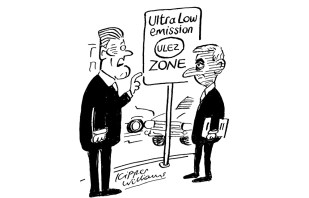
Starmer misses no opportunity to make the point that realism, not revolution, is the path to power. He was quick to blame the party’s narrow defeat in the Uxbridge by-election on Sadiq Khan’s support for the extension of London’s Ultra Low Emission Zone. ‘In an election, policy matters,’ he said. ‘And we’re doing something very wrong if policies put forward by the Labour party end up on each and every Tory leaflet.’
Every time there is an internal Labour fight, Starmer gets his way. What he may lack in charisma, he has made up for in his skill as a machine politician: he has the party’s system where he wants it. He has no factions to whom he believes he has to kowtow. So there will be no lifting of the two-child benefit limit, no free school meals for all primary school children, no radical extension of workers’ rights. Furious, the Unite union withheld its support for Labour’s draft manifesto. Momentum, the one-time Corbynite torchbearers, went further, declaring that ‘Britain deserves better’.
The squeals of the Labour left are seen as useful by Starmer’s team, taken as ‘proof’ that the party is ready to ‘change the country in government, built on the rock of economic responsibility’. Yet the reason Starmer can be confident in making such statements is because of the financial stability Labour now enjoys.
Two years ago, Starmer’s party had only one month’s wages left in its reserves. Labour was almost bankrupt from Corbyn-era legal fees and debt from bizarre events like the flop Labour Live festival. When Starmer took over, 100,000 pro-Corbyn members also quit the party taking their membership money with them.
As leader, Jeremy Corbyn funded the party through a growing membership and a close link to the unions. Private donors were hard to find – the number of people giving six-figure sums fell to fewer than ten. His predecessor, Ed Miliband, did slightly better, but his largest donations still came from the unions. Anyone who had enough money to donate feared being rinsed.
Given that Starmer has decided the path to power means moving Labour to the right, he needs the financial plan to accompany it. This means returning to the Blairite model: relying on Labour-leaning millionaires. ‘It’s back to Blair – get a load of centrist dads and run with it,’ explains one insider. So David Evans, Labour general secretary, has had his fundraising role pared down as a result of a desire in the leader’s office for a faster pace on raising private donations. A new operation – spearheaded by the Blairite peer Waheed Alli, who himself has given £500,000 to the party, half of it under Starmer – was set in motion.
The party’s consistent poll lead has proved a turning point. ‘If power looks close, that’s when the money rolls in,’ says one old-timer. When a Labour win looks inevitable, those who seek decent ties with the future government open their chequebooks. Last year represented a breakthrough: the first year since records began that Labour was given more by private donors and businesses (£6.4 million) than by the unions (£5.1 million). It was also the highest amount the party has raised from private sources in a single year since 2008.
The new donors fall roughly into three categories – the most eye-catching of which is defecting Tory backers. Labour has been on a business charm-offensive for some time. It’s rare to find a London-based chief executive who has not been offered breakfast with Rachel Reeves at least twice. All she has to do is listen as business leaders complain that a supposedly Conservative government has left them with surging corporation tax and, overall, the highest general tax in living memory. They ask: can a Labour administration be so much worse?
Reeves’s team and other senior Labour people have done a good job identifying the Tory donors most likely to wobble. ‘A lot of old Tory supporters really despise the government these days,’ says one Starmer ally. Alan Parker, head of advisory firm Brunswick (who asked Gordon Brown to be godfather to his son) has done his bit at introductions to the disillusioned. ‘They seem to be targeting centrist Tories rather than the dyed in the wool ones,’ says one figure privy to the advances. Reeves’s deputy, Pat McFadden, has been known to introduce himself at such meetings as the first minister to be sacked by Jeremy Corbyn, which helps to get his audience on his side.
The events are an exercise in reassurance. ‘They try to give you a very Blairite vibe,’ reports an attendee. In a sign of the party's pro-business attitude, it was members of the shadow cabinet rather than the government who sounded the most sympathetic this week towards NatWest after the bank's CEO Alison Rose stood down over the closure of Nigel Farage's account.
Early defectors include Gareth Quarry, a businessman who donated to David Cameron and Theresa May. He has given Labour £100,000, citing scandal in a Tory party ‘riven with arrogance and complacency’ which led him to the ‘gradual realisation that inequality in this country has got ever more marked’.
Quarry is joined by the hedge fund manager John Armitage who previously gave more than £3 million to the Tories and has switched to Starmer on the grounds that the Tories are in ‘deep shit’ and only Kemi Badenoch as leader could make him reconsider. Kasim Kutay was a Tory donor in the Cameron era but says he backs Starmer whom he calls ‘the first truly serious alternative’ in a ‘long time’. Not that the Tories are too upset. Kutay, who donated £40,000 last year, is the CEO of Novo Holdings, the ultimate parent company of the Danish healthcare giant Novo Nordisk, which was suspended in March from the Association of the British Pharmaceutical Industry for two years over ‘serious breaches’ of its code after the firm was accused of trying to ‘buy influence’ (something the company denies).
It’s rare to find a London-based chief executive who has not been offered breakfast with Rachel Reeves
Just as Brexit was the gateway drug that took Labour Red Wall voters over to the Tories, it has also had the reverse effect for certain Remainer businessmen. Old Blairite donors are returning to the fold. The Tony Blair Institute is playing a key role behind the scenes and is likely to help provide staff should Starmer take power. Lord Sainsbury gave £2 million last year, following a hiatus in his donations during the Corbyn era. The former chair of the supermarket chain was a big donor under Blair and Brown, but switched his allegiance to Remain campaigns during the referendum. His daughter – the philanthropist Fran Perrin – has chipped in with £1 million and is also helping the party with general fundraising.
Other Blairites coming back include Lord Levy and Sir Victor Blank, who gave Reeves £175,000, making him the shadow chancellor’s biggest personal donor. Lord Levy and Blank are another two of the donors who have a distinctly anti-Brexit feel. Before the referendum, Blank – an ex-Lloyds TSB chairman – described the prospect of the UK leaving the EU as ‘horrific’.
There’s Anthony Watson, too, a former Nike executive and Stonewall donor, who has described himself as ‘very pro-EU’. Gary Lubner, head of the global vehicle glass repair film Belron, has given £500,000 to Labour so far this year, with suggestions that he plans to reach £5 million in total before the 2024 general election. Lubner, the South African son of Jewish refugees, has praised Starmer for his attempts to rid the party of anti-Semitism but ultimately seems driven by a desire to put the Conservatives out of power ‘for a long time’. Of the Tories’ sins, he criticises the party’s migration strategy but sees the greatest as Brexit. ‘In the long list of Tory failures in the last 13 years, Brexit is top of the list,’ he recently said. ‘It’s a disaster. There’s nothing good about it. Nothing.’
Even though Starmer and his front bench insist there are no plans to reverse Brexit, Remainer donors believe a Labour government would at the very least ‘listen to business’ on softening the current arrangement significantly. They hope Labour would do more to align UK regulations with those of the EU, getting as close as it can without formally re-entering the single market, customs union and European Court of Justice.
The final category of donors are the eccentric campaigners. Take Dale Vince, the 61-year-old founder of Ecotricity (and former New Age traveller), who has donated £1.5 million to Labour over the past decade – more than half of it under Starmer. One senior figure in the Tory party describes him as ‘the gift that keeps on giving’, because Labour isn’t the only organisation that Vince donates money to. He has also funded Just Stop Oil, Extinction Rebellion and Animal Rising, the group that disrupted the Grand National. The chair of the world’s first vegan, carbon-neutral football club in Forest Green Rovers, Vince has said that climate change denial is ‘denying the holocaust that is coming’. He insists he does not ‘ask for anything’ in return for his patronage but says he will only give it to groups ‘trying to do some good in the world’.
Even a phone call between Vince and Starmer in May quickly caused a headache for the Labour leadership, leading Sunak to claim that ‘eco-zealots at Just Stop Oil are writing Keir Starmer’s energy policy’. Undeterred, Vince responded by saying he would match any money given to Just Stop Oil for 48 hours. It cost him £340,000. Starmer seems a little less enthused by the attention. His team played down the call as a simple ‘thank you’.
Starmer may now be able to say that the unions aren’t the ones calling the shots. But as Labour gets closer to power, questions over the influence and demands of its new paymasters will only grow louder.
NatWest’s attack on Nigel Farage was a political hitjob
The Coutts scandal can be traced back to the day, two years ago, when the bank proudly announced that it had achieved ‘B Corp’ status. B Corp is a little-known non-profit which operates a scheme a bit like Stonewall’s Diversity Champions Programme. Companies that sign up and jump through the necessary hoops will receive a certificate declaring that they’re ethical and inclusive.
Business and politics should be kept separate, yet woke capitalism wants to fuse them together
B Corp’s website declares: ‘Certified B Corporations are leaders in the global movement for an inclusive, equitable and regenerative economy.’ It adds that its scheme seeks to measure ‘a company’s entire social and environmental impact’.
When Coutts announced itself a B Corp, it was essentially saying that the bank had been politicised, which should have been a warning of what was to follow. Nigel Farage was excluded from the bank as part of its inclusivity agenda. His politics did not align with the bank’s values, so he was punished and ‘debanked’.
A bank should be concerned with finances, not politics. NatWest’s attack on Farage was a political hit-job, but the board of NatWest, which owns Coutts, seem to have thought their actions were reasonable. Their main regret seems to be not that all this happened, but that it became public.
Before she had to resign as chief executive, the NatWest board was declaring ‘full confidence’ in Dame Alison Rose. Once, it would have been a sackable offence for a junior in a bank to break client confidentiality. Yet when the chief executive herself admitted to doing so – in talking to a journalist about Farage’s finances – she thought, even briefly, that she could carry on. Old-fashioned banking values seemed to have been forgotten.
This is not a row about Farage. It is a shocking exposé of the culture that has prevailed in Coutts and NatWest. The banks sought to exercise political power and abandoned their duty to their clients. This mentality, sometimes described as ‘woke capitalism’, is alarmingly widespread. It typically sets in when the HR departments of large corporations believe they have to enforce ‘environmental, social and governance’ issues. This quickly morphs into a political agenda and declarations of corporate ‘values’.
Rather than promoting diversity, it ends up imposing political homogeneity. We see, for example, companies asking employees to celebrate a Pride month that many think reinforces damaging stereotypes. Or Black History Month, which many black Britons believe foists a narrative on them on the basis of their skin colour. On a wider level, woke capitalism can mean that employees are judged, promoted or even penalised for holding or dissenting from certain views.
The Bloomberg writer Adrian Wooldridge pointed out in a cover story for this magazine in April how these tactics are eroding meritocracy. Employees are being judged on their backgrounds or their espousal of political opinions rather than the ability to do a job. At Coutts, this ideology mutated to the point where the bank was compiling 40-page documents on the political views of one of its clients and listing baseless slanders against him. Until Farage himself exposed this, no one at the bank seems to have considered such a dossier unusual, let alone outrageous.
Business and politics should be kept separate, yet woke capitalism wants to fuse them. ‘Partnership between government and business is the cornerstone of a sustainable growth economy,’ proclaimed Rose earlier this month as she was inaugurated as a member of Rishi Sunak’s business advice board. This is quite wrong. Government should create a level playing field and see that basic regulation is enforced – and then get out of the way.
One big difference in Rose’s case is that NatWest is part owned by the taxpayer – a legacy of the 2008 banking bailouts. This meeting of banking and politics has had inevitable and far-reaching consequences. The UK government ended up taking an 84 per cent stake in NatWest at the height of the financial crash and has been reducing this slowly – it is currently at 39 per cent. The main job of any NatWest chief executive should be to ensure that its shares rise in value and that the taxpayer is eventually reimbursed. There seems no hope of that. Years of missed opportunities have left NatWest’s shares at about half the 500p level of the original bailout.
The drift of large corporations towards a set of values born out of US business schools really matters. Not least because B Corp status encourages companies to change their corporate structures so that they are run not for the interests of their shareholders but for all ‘stakeholders’, which is supposed to include ‘customers, workers, suppliers, communities and the environment’. If this means companies working to undeclared political agendas, it raises several serious issues.
NatWest has emerged from the Farage scandal not as an ethical champion but as an organisation that is willing to abuse its corporate power and use its customers to promote a particular set of political values. We can at least be grateful that we now know how deeply the rot had set in. This is, if nothing else, grounds for a debate about how to protect customers, employees and consumers from a political agenda that has gone unscrutinised and unchallenged for too long.
Coutts has forgotten what the job of a bank is
We now have a reluctant apology from Dame Alison Rose, followed by her even more reluctant resignation. Her departure is a major achievement, but the reluctance is a symptom of the problem. How could she possibly have thought she could stay after she was caught breaking a client’s confidentiality and spreading untruths about him (untruths which the BBC checked with her before publishing)? How could her chairman, Sir Howard Davies, have possibly thought that she could? And still we have nothing from Coutts, the bank that tried to trash Nigel Farage in the first place. Coutts is a B Corp, meaning a corporation which signs up to the commandments of current virtues, such as sustainability and inclusion. On its website, it headlines its B Corp work with the words ‘Doing well by doing good’. Its executives may not be aware of that phrase’s appearance in Tom Lehrer’s satirical song, ‘The Old Dope Peddler’:
Ev’ry evening you will find him
Around our neighbourhood.
It’s the old dope peddler,
Doing well by doing good.
He gives the kids free samples
Because he knows full well
That today’s young innocent faces
Will be tomorrow’s clientele.
The old peddler of Coutts’s woke dope is its chief executive, Peter Flavel, who introduces the website’s sustainability section by quoting Coutts’s founder, Thomas Coutts: ‘To be, not to seem.’ ‘To become B Corp-certified,’ he goes on, ‘has been one of our proudest moments – in a real sense, evidencing our purpose in action.’ What was the bank’s purpose in action in closing Mr Farage’s accounts? ‘Meet the Board’, says the Coutts website invitingly, but we can’t. Since the story broke, I can find no public comment by Mr Flavel or the bank’s chairman, Lord Remnant. In an interview with ESG Clarity, given before all this, Mr Flavel said that being a B Corp meant the board could ‘hold ourselves to account on how we are running the business’: Coutts is ‘a company that wants to do the right thing towards all stakeholders’. Yet there has been no sign of the Coutts board holding the executives to account and no explanation. How is it that chairmen and boards exist in law to ensure companies are properly run, yet freeze when people produce evidence that they aren’t?
These ‘purposes’ and ‘values’ devised for B Corps are simultaneously wrong and otiose. It is not the job of a bank to ‘be the change you want to see in the world’, a matter on which people legitimately differ. Its job is to serve its customers. Another private bank – in its case, a family one – is Hoare’s. Its longstanding stated purpose is simple: ‘To be good bankers and good citizens.’ This makes the important connection between a bank and the welfare of society, but wisely does not specify or preach or become political. It therefore maintains its aim much better than Coutts. All these rich white men who suck up to B Corp doctrines see this obeisance, perhaps, as a survival tactic, but in fact they are lambs – or elderly sheep – to the slaughter. Lesson: never bank with a B Corp.
The other day, I watched a financial institution in action. Now that my mother is very old, I help with the management of her affairs. I went to the local branch of the Nationwide Building Society where she banks. (It is not, by the way, a B Corp, and all the pictures it uses on its website are of its actual members.) I joined the queue. Behind the two tills sat a friendly clerk and the friendly manager. Every single audible customer present, including me, was there with a minor inquiry generated by an error or shortcoming of our own – a forgotten pin number, a miscounting of sums which required adjustment, a statement lost. Many were old. All were treated with respect and patience, lightened by unintrusive backchat. The atmosphere was peaceful and trusting, as in a good GP’s surgery. Nationwide is one of the few building societies which did not demutualise. It, not Coutts, knows how ‘to be, not to seem’. My visit gave me a glimpse of the world most high streets have lost and most banks have abandoned.
Last week, I met Ukraine’s ambassador to Britain, Vadim Prystaiko. Two days later, President Zelensky sacked him. I have no reason to think these two events are connected, but the sacking is a pity. Mr Prystaiko did go a bit far. He described the President’s rebuke of Ben Wallace, the Defence Secretary, as ‘unhealthy sarcasm’. (Mr Wallace had protested at Britain being expected automatically to deliver whatever Ukraine needs.) Ambassadors should not say such things publicly, particularly when there’s a war on. But Mr Prystaiko has been an eloquent and active exponent of his country’s cause and achieved real success. I would say he was the most influential foreign ambassador in Britain since Ray Seitz did the job for the United States 30 years ago. Surely he could have had his knuckles rapped rather than his job removed? His sacking is a reminder that Ukraine has still not completely shrugged off its pre-war reputation for inadequate civil institutions. It needs western help building them.
I received this email on 18 July, Nelson Mandela Day: ‘Flooring Hut is excited to announce its future commitment to honouring the legacy of Nelson Mandela through initiatives that combine the principles of social responsibility with their expertise in flooring solutions… In alignment with his values, Flooring Hut recognises the power of making a positive impact in society. Through their unique position in the flooring industry, the company aims to leverage their expertise to improve the lives of individuals and communities in their local area of Worthing, West Sussex.’ Don’t laugh. This is no sillier and much more positive than Coutts’s rambling internal memos about why, being ‘inclusive’, it should exclude Nigel Farage.
Susan Hall: Sadiq Khan is a misogynist
‘I love a fight. I was going to say debate, but it’s more of a fight to be honest.’ Susan Hall is looking forward to taking on Sadiq Khan at the London mayoral hustings. When we meet for her first interview after securing the Conservative nomination, it is five days after the Uxbridge by-election. Hall is buoyed by an unexpected Tory triumph, thanks to discontent with Khan’s plans to extend the Ultra Low Emission Zone (Ulez). ‘Out on the doorstep,’ she tells me: ‘I thought the questions would be all around Boris but I had nothing. It was all around the Ulez expansion.’ She hopes to replicate a similar result next May.
‘There aren’t really many policies. I won’t promise anything unless I know where the money is coming from’
‘Fight’ is one of Hall’s favoured words: she uses it 14 times in less than an hour. It explains how she went from being a 100/1 outsider to becoming the first woman nominated for the mayoralty by a major party. What did she make of the Evening Standard splash which greeted that milestone, featuring what one Tory MP called a ‘contemptible’ image of Hall grinning, arms raised theatrically aloft? ‘I thought: I won’t put that picture on Tinder. Can you imagine waking up next to that? No, no. But they’ll throw lots at me and they always will. I’ve got very thick skin – as was evidenced in that picture.’ Was it sexist? Hall declines to use the word: ‘Just get on with the job. They will throw far worse at me.’
She certainly has experienced worse. Her first job after leaving school was toiling away as a teenage mechanic, the only woman in a 1970s garage. ‘In those days, they did not approve of women anywhere near cars.’ She later met her husband – who, in an inversion of the stereotypes of the time, was a hairdresser. The couple ran a Harrow salon, which went on to employ 20 people, and raised two children. They eventually separated. ‘The Tories have unfortunately got too much of a reputation for being the toffs. And they’re not. We’re normal.’
Tackling crime is at the heart of her blue-collar campaign. ‘Walking along the streets, I have never felt as unsafe as I do now. The more these villains can get away with things, the more emboldened they feel.’ Hall says that she has personal experience of these issues: prior to entering politics she received death threats when her business was being terrorised by some local thugs.
London under Khan is ‘absolutely’ in decline, she says. ‘Just look around – we’ve got people marauding around with machetes.’ If elected, she would put £200 million into the Metropolitan Police by clamping down on City Hall’s staff-related costs. The manner of Cressida Dick’s very public sacking by Khan last year appalled her: ‘He is a sexist misogynist. He should never have dealt with her in that way.’ Following recent scandals, she worries that the Met now lacks the authority of old. ‘We’ve got to get the police so they’re not forever apologising for what they’re doing [and so] that they’re more of a police force than a service.’
The lesson Hall took from Uxbridge is the need to curb some of the more ambitious elements of the net-zero agenda. ‘We must be mindful and we must do what we can but things like the Ulez expansion are literally going to hit the poorest in the community.’ Tory MPs are divided over whether current plans to ban the sale of petrol and diesel cars by 2030 ought to be dropped. For Hall, the answer is clear: ‘I think 2030, while it’s a wonderful aim, is not going to happen. We haven’t got charging points, there are so many issues around it. It’s an admirable aim but I don’t think it will work.’
Rishi Sunak, though, is for now committed to the 2030 deadline. Will Hall be prepared, like Boris Johnson before her, to use the Mayor’s bully pulpit to defy a Tory premier in No. 10? ‘Yes. I’d be speaking up for Londoners 100 per cent. I am a low-tax Tory, so I’m not always very happy. But yes, if you are the Mayor of London you speak for Londoners, end of. Even if that means fighting with the government, fighting with anybody else. I’d be like a mother. I will fight for my London, bloody right I will.’
She backed Truss over Sunak last summer ‘because I’m a massive low-tax Tory’, but says ‘he’s absolutely doing his best and I understand why taxes aren’t coming down yet. I do hope they address inheritance tax.’
Hall is a stark contrast to some of London’s more well-heeled Tories whom she defeated for the nomination. ‘I’m very proud of the fact that I think we’ve done it for less than five grand. And I dread to think about the amount that the others put into it.’ She freely admits that blue-sky thinking isn’t her thing: ‘There aren’t really that many policies. I will not promise anything unless I know where the money is coming from.’
On national issues, she supports the Rwanda scheme, believes migration is too high and argues that ‘Brexit is more of a success than we’re making out’. Should Sunak and the Tories be more vigorous on culture-war matters? She pauses. ‘We are a very broad church. Probably I’d be slightly more forceful in my views.’ Hall has particular contempt for Khan’s Diversity Commission to review the capital’s statues: ‘Don’t pull down our history. I’m proud of London as it is. You want to explain things. Don’t touch it.’
For 20 years, the conventional thinking has been that only by running to the left of the national party can a Conservative win in the capital. Labour have already done their best to depict Hall as a ‘hard-right’ Tory. But she sees it as a backhanded compliment. ‘Clearly they’re concerned – otherwise they wouldn’t have gone so hard. They want to annihilate me in the first place.’ She smiles. ‘Well, they can dream on. I’m not going anywhere.’
The horror of being branded a PEP
When I asked my husband if he knew what PEP meant he said: ‘It’s an emergency combination of HIV drugs that can stop the virus if you’ve been putting your todger where you shouldn’t.’
Trust him to get hold of the wrong end of the stick. To him as a doctor, PEP meant Post-Exposure Prophylaxis. But I was talking about Politically Exposed Persons – a concept abused by banks to deny people accounts, as happened to Nigel Farage.
Dominic Lawson, once editor of The Spectator, wrote in the Daily Mail about his wife being refused a bank account because her brother is a Viscount – but one without a seat in the Lords.
The PEP has seeped into financial regulations, acquiring the status of the Black Spot. The idea was to prevent money laundering by making banks aware of foreign customers and the source of large influxes of money. Since 2017 it has applied to British citizens as well as to retired dictators, thanks to the Money Laundering, Terrorist Financing and Transfer of Funds (Information on the Payer) Regulations. These are a law made by means of a statutory instrument, signed by David Evennett and Andrew Griffiths, two of the Lords Commissioners of HM Treasury. They’d certainly qualify as PEPs.
These regulations say PEPs are individuals ‘entrusted with prominent public functions’. They include, it says, heads of state, members of parliament and the supreme courts, ambassadors and high-ranking officers in the armed forces. It fingers family members and close associates of the PEP.
The phrase has the perverse consequence of making, say, the President of the UK Supreme Court subject to suspicious examination, unlike the car-dealer down the road. Even MPs, who, heaven knows, are very ordinary mortals, have had bank accounts closed, being deemed PEPs. When I was at school a childish joke was to ask: ‘Are you a PLP?’ If you said yes, you would be heavily leant on, as a Public Leaning Post. If you said no, they’d run away shouting: ‘You’re not a Proper-Living Person.’ Now in playgrounds perhaps girls run screaming from the contagion of PEPs.
I sledged Steve Smith for England
In this summer of sporting dramas, every patriotic sports fan likes to think he’s done his bit to help. I went up to Manchester with my brother last Thursday and in the evening we found ourselves in an Indian restaurant with the England wicket-keeper Jonny Bairstow at the next table. I feel sure it was Edward’s and my manly cries of ‘Good luck, Jonny’ as he left that helped him bat so brilliantly for his 99 not out. Though I suppose it could have been the vindaloo that fired him up.
My major influence on the Ashes series came a few days earlier, when I bumped into the Australian all-time-great batsman and scourge of England, Steve Smith. This was on the balcony of the All England Club at Wimbledon, where he was having a quiet chat with some friends. I introduced myself to the baffled group and we all agreed that watching tennis was a welcome relief from the unbearable tension of the cricket. Then I told Smith we hoped he’d enjoy the rest of his tour but would he mind just twice at Old Trafford taking his eye off the ball. ‘That’s not going to happen!’ Polite laughter, and off we went. As sledging goes, I admit it was hardly in the Steve Waugh category. But take a look at the score book. Steve Smith scored 41 and 17. Every little helps.
And what, you may ask, was a man whose tennis peak was playing doubles for his club third team in the Middlesex League (West) doing on the balcony of the All England? It was not my low volleys that got me there, but a speech I made at a dinner some years back, for which two seats in the Royal Box, on two occasions, was the reward. I was nervous about going the first time, thinking it might be like a snobby golf club, with rules and ties and copies of the Daily Mail. I couldn’t have been more wrong. Friendliness is the house style. This begins with the chairman, Ian Hewitt, who is like everyone’s favourite uncle (you half expect him to press five bob into your hand when you’re leaving) right down to the youngsters who smilingly offer drinks and canapés.
It rubs off on the guests as well. On the day we went, these included the Covid whizz Sir Patrick Vallance, the cricketer Chris Cowdrey and the actor Sir David Suchet, who I was lucky enough to sit next to at lunch. All was jollity and light. Late in the afternoon, my son and I were invited to move down into the front row of the box. I remembered watching Wimbledon on our black and white television as a child: Roy Emerson, Manuel Santana, Christine Truman… I think I believed at the age of ten that only the royal family was allowed into the box and that some of them even lived there. Now it was us, leaning over, inches from the action, feeling like Nero at the Colosseum. At one point, Carlos Alcaraz framed one high up into the air above us. I was hoping Chris Cowdrey would get under it. To be honest, it was a pretty easy catch, but I’m sorry to report that Lady Vallance put it down.
It’s not all sport. Daily emails from my publisher remind me that I have a new book out in September. The Seventh Son is set in the modern day and it concerns a sleight of hand in a London fertility clinic. The child who is born is not like any other human. Every publication time, my publicist and I agree we’ll never do the festivals, the podcasts and all the touring grind again: too exhausting and of questionable benefit to sales. But then I remember 25 years ago when I made this point to Caroline Michel, then a young editor, now an eminence of British literary life. She replied: ‘If you don’t go, Sebastian, someone else will take your place and sell those copies.’ So I guess I’ll buckle down and hope to see you out there. Meanwhile, here’s my all-time favourite festival question: ‘Do you write with your left hand, or your right?’
British politics today offers no home to a Radical Utilitarian – or as my children insist, a Centrist Dad. A close friend of mine is a lifelong Conservative and says he’ll vote for them again. He reasons that the party has exhausted its supply of conmen and dimwits as leaders willing to corrupt, humiliate and impoverish the country. ‘Don’t look back, look ahead,’ he says. ‘Sunak’s a step up. Plus, a Starmer-Reeves government would pass a lot of silly modish laws and provoke a populist counter-movement of Faragistic ugliness on the right.’ Fair enough. But surely governments of such appalling deceit and incompetence as we’ve had lately need to be taught a lesson. And will my tiny pencil cross in the box bring them belated self-knowledge, shame and repentance? No. But, like my word in Steve Smith’s ear, it’s all I can do.
Why the media despises country music
Cuss out a cop, spit in his face
Stomp on the flag and light it up
Yeah, ya think you’re tough
Well, try that in a small town
See how far ya make it down the road
Around here, we take care of our own
That’s a sampling of the lyrics to “Try That in a Small Town,” the new Jason Aldean single that led left-wing Twitter trolls to try to “cancel” the country music star. Critics claimed the song was racist, particularly because the music video was filmed in front of the Maury County Courthouse in Tennessee (which was the site of a lynching back in 1927) and features news clips of BLM and antifa riots. Plenty has been said defending the song, and based on my previous musings about the nation’s issue with violent crime, it should be obvious that I agree there’s nothing wrong with the lyrics or the video.
The Aldean incident is more interesting to me, though, because it reveals an unfortunate trend among the mainstream media as it relates to the country music industry.
Over the years it’s been quite obvious that the media doesn’t take country music seriously. They rarely review new albums from country stars and generally dismiss all modern country music — especially the stuff playing on the radio — as Nashville claptrap unfit for their cosmopolitan ears. Country fans know to rely on their streaming algorithms and podcasts and YouTube channels dedicated to the genre to stay up to date on new releases and hit songs. They also know that what gets played on the top radio stations is hardly representative of the breadth of music available.
When the media does deign itself to talk about country music, it’s usually to advance the narrative that the industry and its fans are exclusionary racists and misogynists. They merely use country music and its fans as a convenient scapegoat for supposed societal ills.
The Aldean song was a perfect opportunity for them to make this point. The media previously victim-blamed Aldean for not speaking up strongly enough in favor of gun control in the aftermath of the Las Vegas shooting, which broke out while he was performing at a music festival, and excoriated his wife for opposing sex changes for children. Of course “Try That in a Small Town” was a racist dog whistle, the left reasoned, because he and his wife are politically conservative. They are everything wrong with country music, and by extension, small-town America.
Next let’s look at the conversation about Luke Combs’s cover of Tracy Chapman’s “Fast Car,” which rocketed to number two on the Billboard Hot 100. Chapman, who rarely speaks to the press, said she was happy for Combs’s success with the song and was grateful that it was being introduced to a new generation of fans. But the media insisted that Chapman, despite likely making bank off of the royalties of the cover, was a victim. Why? Chapman is a black lesbian, and Combs is a white man.
“Although many are thrilled to see ‘Fast Car’ back in the spotlight and a new generation discovering Chapman’s work, it’s clouded by the fact that, as a black queer woman, Chapman, fifty-nine, would have almost zero chance of that achievement herself in country music,” Emily Yahr wrote in the Washington Post.
Never mind that the song received three Grammy nominations, winning the award for Best Female Pop Vocal Performance, the year it was released. And that Combs has spoken quite beautifully about his respect for the song and its creator. To the legacy press, Combs’s cover was just proof that all country artists do is rip off black music for their own benefit.
The media slobbered over the opportunity to trash Morgan Wallen, who was already a bona fide star before any of his scandals — which included flouting Covid restrictions (gasp!) and drunkenly calling a white friend the n-word. His recent single “Last Night” topped the Billboard charts, and it’s been two years since a neighbor filmed him dropping the racial slur, but the media still refuses to discuss Wallen’s career separately from the incident. They truly believe that Wallen’s fans support him because they too are racist, not because normal Americans are exhausted by the media’s constant attempts to cancel everybody who makes a mistake. In mainstream reviews of Wallen’s newest album, One Thing at a Time, music critics griped that he wasn’t apologetic enough for the n-word incident in his lyrics. Incidentally, the New York Times review linked above also compared Wallen’s song “Everything I Love” to the sounds of Johnny Cash and Waylon Jennings, while somehow failing to mention or missing entirely that the song directly samples the Allman Brothers. Slot that in as another piece of evidence that these people have zero idea what they’re talking about.
The Jason Aldean, Luke Combs and Morgan Wallen stories are convenient ways for the media to prop up its thesis about the country music industry being horribly racist while glossing over the plethora of awesome music.
Last year, TIME awarded Mickey Guyton the Breakthrough Artist Award, even though she only had one or two moderately successful radio hits and is a fairly mediocre artist. Guyton is a media darling not on her merits but because she released a couple of songs about how hard it is to be a black woman and blamed her lack of stardom on country music’s systemic racism. (The obvious response here is to point out that Charley Pride was the best-selling performer for RCA Records except for Elvis Presley in the mid-1970s, which you’d be hard pressed to argue was a better time for race relations in the US.)
Meanwhile, the media also loves to profile people like Kacey Musgraves and Maren Morris, whose music could hardly even be considered “country” anymore, yet complain about entrenched sexism because their newer songs don’t get played on country radio. The Brothers Osborne were just another country band until the lead singer came out as gay, at which point he was heralded as a trailblazer in the genre.
Country artists, even the objectively great ones, typically don’t get noticed by the mainstream press unless they are involved in some kind of controversy or are considered queer or unique enough to endorse some kind of divisive, identity-politics agenda.
It’s hard to divorce the media’s attitude toward country music and its fans from its posture toward Trump supporters in 2016. They have a general contempt for working-class and/or rural Americans who are more focused on their day-to-day existence than popular narratives about systemic racism, LGBTQ+ hate or whatever other victim class conveniently pops up. It is offensive to them that someone could enjoy a simple beer-drinking song by a generic white guy at the end of a long work day, or that someone who sings about Appalachian life might be more resonant than a South African queer cowboy cosplayer.
The media is no doubt also disturbed by the fact that what country music artists sing about — enjoying the simple life, love, loss, God and patriotism — appeals to the roughly 42 percent of the American populace that ranks country as their favorite genre. The US Census supposes that there are approximately 100 million loyal country listeners. I suspect that the left-wing media is not so much angry at Jason Aldean for releasing a song that rejected crime and rioting as they are pissed at this massive fanbase for failing to find anything wrong with it. The embrace of “Try That in a Small Town” is a reminder that about half of the country has a serious problem with the dominant ideology of the media and that urban journalists have zero control over what and how these Americans think.