-
AAPL
213.43 (+0.29%)
-
BARC-LN
1205.7 (-1.46%)
-
NKE
94.05 (+0.39%)
-
CVX
152.67 (-1.00%)
-
CRM
230.27 (-2.34%)
-
INTC
30.5 (-0.87%)
-
DIS
100.16 (-0.67%)
-
DOW
55.79 (-0.82%)
Is France’s loss Russia’s gain in Niger?
France is preparing to evacuate its citizens from Niger following the coup d’état in the west African country on 26 July. The French embassy in Niamey – the capital of Niger – said in a statement that the air evacuation ‘will take place very soon and over a very short period of time’.
Last week’s coup, in which general Abdourahamane Tchiani of the elite presidential guard seized power from president Mohamed Bazoum, is the latest turmoil in a region that has become dangerously destabilised in the last three years. There have been coups in Mali and Burkina Faso which, like Niger, were former French colonies but have turned against their erstwhile master.
There were demonstrations on Sunday in Niamey in which Russian flags were brandished and French flags were burned, and some protestors gathered outside the French embassy. A small number attempted to enter the compound but were repelled by tear gas. President Macron subsequently warned general Tchiani that his response would be ‘immediate and uncompromising’ if French citizens in Niger were harmed.
Putin will be well satisfied with the coup in Niger
On Monday, the junta claimed that embassy security guards had injured six protestors during the previous day’s demonstration, and it also accused France of meddling in its affairs.
‘In its search for ways and means to intervene militarily in Niger, France with the complicity of some Nigeriens, held a meeting with the chief of staff of the Nigerien national guard to obtain the necessary political and military authorisation’, said a statement released on television. France’s foreign minister, Catherine Colonna, refuted the accusation, declaring that their ‘only priority is the safety of our nationals’.
Tchiani says that he deposed Bazoum because of ‘the degradation of the security situation’, a reference to the ongoing conflict with the region’s jihadist groups. He also cited corruption and the ailing economy as reasons for taking power from Bazoum, who was elected president in 2021 in Niger’s first democratic transition of power since it gained independence from France in 1960.
Although Bazoum was regarded favourably by the West, he was seen in a less positive light by many of his 24 million people, nearly half of whom live in poverty. Their hard lives have been made more desperate by attacks from Islamist groups linked to the Islamic State group and al-Qaeda. They have become increasingly active in Africa in the last decade, carrying out atrocities that France, despite sending troops to the region, failed to eradicate. The coups in Mali and Burkina Faso were justified by this failure, the military promising to do more to protect the people from the Jihadists.
Instead of French boots on the ground in these countries, it is Russia’s mercenary Wagner Group which are now working with the new regimes. Nonetheless, Vladimir Putin’s strategy of constructing an anti-Western bloc in Africa has suffered as a result of his invasion of Ukraine. According to Thierry Vircoulon, a research fellow at France’s institute of international relations, and who has written extensively about Russia’s attempts to grow its influence in Africa, its image ‘as a military power has been shaken’ as a consequence of the war. The conflict has also reduced the shipment of arms to Africa, Putin’s preferred method of making new friends on the continent.
All the same, Putin will be well satisfied with the coup in Niger. The country is the world’s seventh biggest producer of uranium, which is essential for the nuclear industry, and a quarter of its production is exported to Europe. Last year, Macron announced an ambitious relaunch of France’s nuclear programme, with the construction of 14 new reactors, and the loss of its supply of uranium would be a blow.
Another reason for alarm within Europe is the possibility of another migrant surge across the Mediterranean as a result of the coup. Niger’s neighbour to the north, Algeria, has expressed its ‘deep concern’ at the situation because Niger is the principal gateway for illegal immigration from sub-Saharan Africa. In the last decade, the two countries have worked together to stem this flow, and this year alone Algeria has turned back 9,000 migrants from a dozen African countries. This cooperation is likely to now end and the consequences will be felt in Algeria and also in all likelihood Europe.
Watch: Labour MP flounders on Costa mastectomy ad
Should a healthy young person having a double mastectomy be celebrated? That certainly seems to be the implication of a new advert by Costa Coffee, which features someone showing off their new scars while holding a cup of the chain’s overpriced swill.
Less clear though is what the Labour party thinks, given its ricocheting stance on trans issues. Happily the party’s resident bloviator Lloyd Russell-Moyle was on hand this morning to shed some light on the issue – or perhaps not…
Appearing on Julia Hartley-Brewer’s TalkTV show, the Brighton MP at first defended the advert by suggesting that all bodies should be ‘celebrated’. Pressed by Hartley-Brewer if that meant he would celebrate someone amputating their leg unnecessarily, the MP pivoted, instead suggesting that we didn’t know the ‘motivations’ of the person in the ad, before eventually saying that it was ‘judgmental’ for people to decide what someone’s body should look like.
Unfortunately, for Russell-Moyle the interview returned to the dreaded leg amputation question. Clearly sensing that his current position on bodily autonomy meant that he didn’t have, errr, a leg to stand on, the MP refused to answer the question, saying it was ‘facetious’. Eventually even Russell-Moyle was forced to concede that taken to the extreme his argument did ‘sound ridiculous’.
Whoever thought that Labour had such an ambiguous stance on unnecessary leg amputations?
Watch here:
Coutts gives Nigel Farage his account back
Is Nigel Farage’s war with Coutts finally over? The former Brexit party leader has claimed that the bank – which closed his account over concerns about his political views – has now offered to reinstate his account. The interim chief executive of Coutts, Mohammad Kamal Syed, wrote to Farage to give him the good news.
Speaking on his GB News programme, Farage said: ‘He has written to me to say I can keep both my personal and my business accounts. And that’s good and I thank him for it.’
But it seems that might not be the end of the row. Farage said the fallout has caused him ‘enormous harm’ and that he is now seeking compensation:
‘It has taken up a huge amount of my time and it has cost me, so far, quite a lot of money in legal fees so I have today sent a legal litigation letter to Coutts where I want some full apologies, I want some compensation for my costs, but – more important than all of that – I want a face-to-face meeting with the bank’s bosses. So the fight goes on.’
Mr S thinks this is a fight that Coutts might regret ever having started…
Blame the breed, not the owner: the truth about American Bully XLs
My dog is great with children, I will give her that. The family pet and I don’t really get on, and since I last wrote on the subject of ‘Twiggy’ I’m afraid there has been no great budding human–canine love story; I won’t be played by Owen Wilson in the biopic of her life any time soon. She is warm and affectionate around people but has a relentless desire to hunt – rats, pigeons, squirrels and mice have all on occasion fallen prey, much to the distress of some members of the public.
This ends up causing great inconvenience because Twiggy regularly gets trapped or lost while out hunting, and we have to waste hours looking for her. On one occasion in Epping Forest we spent ages digging her out of a massive hole she’d got herself stuck in, nobly assisted by a passing Weimaraner which had instinctively come to help a fellow dog in distress. After some struggle we finally lifted Twiggy out, and the Weimaraner immediately started trying to hump her.
Twiggy regularly wakes us up with her incessant barking because there are foxes in the alleyway behind us; but when, last November, a burglar broke into our back garden to steal two bikes, she gently slept through the night without a care in the world. She just has no interest in human threats and clearly doesn’t feel that it’s her responsibility.
Dog breeds have different natures, yet the leading authorities in the British dog world seem to be in denial about it
It’s not the dog’s fault, of course; it’s just the way she is. My wife has done a very good job of training Twiggy, but she is a Portuguese Podengo – a sighthound noted for its ‘less domesticated’ behaviour and its desire to hunt. It is, however, a loving family pet if you don’t mind the occasional afternoon spent wandering around the woods calling her name.
Rather than objecting to a dog out of principle, I probably should have done more to choose a breed that suited my temperament. We once had a Labrador staying with us, a dog with no interest in attacking any animal and who just wanted to lie on the sofa eating carbohydrates, very much more my spirit animal; in fact it had such a compulsive eating problem that I was forced to retreat to the shed to have my meals away from him.
Dog breeds have different natures, something that would seem self-obviously true and yet which today the leading authorities in the British dog world seem to be in denial about, in particular when it comes to one of the unspoken trends of recent years – the huge increase in dog attacks.
This spike in dog-bites-man violence has led to a 50 per cent increase in hospital admissions for dog bites over ten years, the biggest rise being among children under the age of four. Overall the number of fatalities has gone from an average of 3.3 in the 2000s to 10 last year, while dog attacks have risen recently from 16,000 in 2018 to 22,000 in 2022, and hospitalisations have almost doubled from 4,699 in 2007 to 8,819 in 2021/22.
The underlying story behind this escalation of violence is that much of it is the work of just one breed: the American Bully. And as we enter the summer holidays, the peak period for dog attacks, it’s worth pondering why the experts in the dog world are in such denial about the issue.
Public awareness of the American Bully problem has grown in recent months, spurred by some especially horrific attacks, as well as a widely-read article by legal academic and YouTuber Lawrence Newport. Lawrence looked at the data on dog attacks and observed that ‘a notable pattern emerges. In 2021, two of the four UK fatalities were from a breed known as the American Bully XL. In 2022, six out of ten were American Bullies. In 2023, so far all fatalities appear to have been American Bullies.’
There are dogs I would never allow my children to go near under any circumstances – namely the American Bully XL
American Bullies, Newport explains, ‘are a breed resulting from modern mixes of the American Pitbull Terrier. They are known for very high muscle mass, biting power, and impressive strength, and come in several variations. Those that are bred for the greatest strength, weight and size are known as a part of the American Bully XL variety.’
Pitbulls are banned in Britain for a good reason, and in the US are responsible for ‘60–70 per cent of dog fatalities’; yet under the Dangerous Dogs Act 1991 ‘the American Bully XL is currently permitted.’
What is surprising, Newport writes, is that ‘if you argue these dogs are dangerous, you will get a flood of comments from people…saying it’s the owner’s fault, not the dog’s. You might even be thinking this yourself, right now. But this is wrong. While many Brits would contend that ‘Guns American Bully XL’s don’t kill people, people do’, the reality is different.
‘Labradors retrieve. Pointers point. Cocker Spaniels will run through bushes, nose to the ground, looking as if they are tracking or hunting even when just playing – even when they have never been on a hunt of any kind. This is not controversial. Breeds have traits. We’ve bred them to have them.’
Pitbulls were created for bull-baiting, and when that was banned, they came to be bred to hunt down rats in a locked pen. ‘This required more speed, so they were interbred with terriers to make Pitbull Terriers. In addition to this, they began to be used for dog fighting: bred specifically to have aggression towards other dogs, and to be locked in a pit to fight (some are still used for this today). These were dogs likely kept in cages, away from humans, and bred for their capacity to earn money for their owners by winning fights. These were not dogs bred for loyalty to humans, these were dogs bred for indiscriminate, sustained and brutal violence contained within a pit.’
One reason for the widespread denial about breed violence might be simple animal sentimentality, a particular trait of the British. Newport cites the case of two American Bully types recently shot by police, an incident which led to a million signatures on a petition calling for the officers to be prosecuted, even though the dogs had attacked other dogs and had previously attacked at least one person: ‘Not only this but the woman who had her dogs attacked by the pair said she was “mortified” that they had been shot and had been “crying ever since”. There are plans for a nation-wide vigil for the dogs.’
As Newport points out, it is not a dog’s fault that it’s been bred for certain traits, but it also doesn’t help those buying puppies to pretend that they are dealing with a blank state, for ‘potentially good owners are left at a severe disadvantage by the statements of advocates for Pitbulls and American Bullies’.

They are told ‘that American Bullies are naturally good with kids and family, that they are naturally non-violent, and that this isn’t a risk. Positive descriptions of American Bullies (and their XL variety), de-emphasising their violent tendencies, run the very real risk of obfuscating future owners of the traits in the breed and thereby stopping those owners from correctly understanding and controlling their dog.’
There have been plenty of diligent dog owners who nevertheless found themselves in danger. ‘Whether it’s an experienced dog walker that warned others to stay away to save themselves whilst she was mauled to death, or the killing of an experienced dog and cat kennel owner described as “the most caring man”, or a mother that had the American Bully for a week before it killed her baby by taking it directly from her arms. It is not the owners. It is the breed.’
Newport suggests that the American Bully XL be added to the Dangerous Dogs Act, something within the Government’s remit, and he may succeed; the policing minister has recently said that banning the Bully is an option. This would almost certainly save lives, and there is evidence that anti-Pitbull laws actually work. On the other hand, he’s up against the most powerful force in British society – animal lovers – added to which there is widespread denial about breed differences, even among experts.
Pitbulls are banned in Britain for a good reason
Newport writes that ‘the UK Kennel Club considers the Dangerous Dogs Act to be unacceptable insofar as it bans any breeds, arguing instead that “no breed of dog is inherently dangerous” and, instead…“any dog in the wrong hands has the potential to be dangerous”’.
The RSPCA, arguably the most well-known and powerful charity in Britain, recently stated that ‘focussing on the type of dog, rather than their individual actions, is a flawed and failing approach. Dog aggression is highly complex, and taking a breed-focused approach is fundamentally flawed.’
The charity also campaigns against breed-specific legislation because it is both an injustice for the animals and because dog bites have continued to go up since the Dangerous Dogs Act, one of many examples where the British dog lobby uses similar logic to the American gun lobby.
Contrary to what these groups believe, scientist Stuart Ritchie wrote in the i last week that there is considerable evidence of behavioural differences by breed, including one study of 46,000 dogs which showed ‘what you’d expect just from cultural stereotypes: terriers are more aggressive and prone to chase little animals; scent-hounds are extremely trainable, and so on’.
Ritchie wrote that: ‘The claims made by members of the Dog Control Coalition and others shift between breed not being a “reliable” predictor of risk, and it not being a predictor of risk at all. Everyone would agree that breed isn’t a perfect predictor of behaviour – far from it. And everyone would agree that within a breed there can be huge variations in personality. But I don’t know how you can look at the research – flawed as it is – and claim that it has nothing at all to do with how a dog will act, on average.’
Ritchie also found studies suggesting that Pitbulls don’t just bite more children, but also that their bites are far more violent (more often targeted at the face rather than the hands). This is called a ‘myth’ by campaigners, but it could be that their myth-busting is an example of anti-intuition, of experts denying obvious common sense. Where expert pronouncements clearly defy logic, people are often much better off trusting their instincts.
When the horrible death of dog walker Natasha Johnston was first reported there were all sorts of theories about how she was killed by the entire pack, including dachshunds, and that this was explained by some complex canine psychology. This seemed obviously implausible, and indeed the tragic story turned out to be far more predictable – she was most likely killed by her own dog, an American Bully XL.
One theory for why the blank slate rose in popularity is that large numbers of people now grow up in small families and away from nature, and so are blind to the obvious genetic influences on personality. All personality traits are in some way under genetic control, so the effects of breeding the most violent members of a population over successive generations would be huge and self-explanatory. But even in urban environments it’s obvious that some types of dogs are just extremely dangerous by nature.
In a recent report on dog violence, the Daily Mail stated that ‘84 per cent of parents leave their kids unsupervised around their pets’, but this is rather unsurprising; we leave our children unsupervised around Twiggy because, annoying as she is, a Podengo would almost never attack a child. But there are breeds I would feel uncomfortable leaving my kids around if I didn’t know the owners or dogs – Staffies, German Shepherds or Rottweilers, all of which possess great strength and higher levels of aggression. And then there are dogs I would never allow my children to go near under any circumstances – namely the American Bully XL. And for that we shouldn’t automatically blame the people in charge. Sometimes it’s not the owners, it’s the breed.
This article first appeared on Ed West’s substack, the Wrong Side of History
The collateral damage of lockdowns on children is still emerging
There has been plenty of evidence published over the past three years of the severe effects on children’s education and wellbeing of closing schools during Covid lockdowns, but a new study by the Institute of Fiscal Studies (IFS) and University College London (UCL) has a slightly different emphasis – linking children’s social and emotional development with the employment situation of their parents.
Overall, it found that 47 per cent of parents reported that their children’s social and emotional skills had declined during the pandemic – with just a sixth of parents reporting that there had been an improvement. The effect was more severe along younger children – 52 per cent of children of 4-7 year olds reported a decline in social and emotional skills, compared with 42 per cent among 12-15 year olds.
Children were more likely to be affected if their parents’ employment situation changed
However, in contrast to other studies, this one did not find that children from disadvantaged backgrounds suffered more – in fact, the effect seemed to be least among children whose parents are in the lowest income quintile, and greatest among those in the 4thincome quintile. The survey relied on parents’ replies, however, rather than independent assessments, so there may be an element of different levels of expectation in children’s development.
What the study did find, on the other hand, was that children were more likely to be affected if their parents’ employment situation changed. This was particularly the case even if their parents had been furloughed, and so were being kept afloat financially. The difference was not all that great, however – social and emotional skills were reported to have fallen in 51 per cent of children whose parents had been furloughed, compared with 45 per cent of children whose parents had not been furloughed.
A lot of research and comment on children’s wellbeing during Covid has focused on the closure of schools. But as this study hints there is another side to the subject: what was happening in the home while children were confined there. It ought not to be a surprise if children fared worse in homes where parents were suffering a significant amount of stress for their employment and financial situation.
There are still ministers and advisers involved in the Covid response who think Covid lockdowns were a success – or who, like Matt Hancock, think we should have faster and more severe lockdowns in future. As the IFS/UCL study shows, the evidence on the collateral damage of lockdowns is still being produced.
Bring back normies!
The Cambridge Dictionary defines ‘normie’ as ‘a normal person, who behaves in the same way as most other people in society’.
Merriam-Webster tells us it refers ‘to one whose tastes, lifestyle, habits, and attitude are mainstream and far from the cutting edge, or a person who is otherwise not notable or remarkable’.
Oh, how I miss normies. Flicking through the streaming channels recently, I took a swerve from Domina and The White Lotus – both excellent – and found myself rewatching two old British sitcoms, Sykes and Duty Free, for the first time since their original transmissions. (Duty Free and The White Lotus are strangely similar in some regards, if you squint a lot, both being concerned with the change in sexual behaviour that occurs when people book into sun-kissed hotels.)
I’d written them off in my mind as lightweight and corny. And yes, they are lightweight, but they’re inventive and insightful too. But the big difference is that – unlike modern TV – the characters, settings and writing are all hardcore normie.
Sykes is about a brother and sister who share a house. That’s the concept – that’s it. They have a snobbish neighbour. The stories are about things like being reluctant to kill a mouse, refereeing a local football match, hiring a riverboat. Duty Free is about two married couples on holiday in Marbella, the husband of Couple 1 tempted to have a fling under the sun with the wife of Couple 2. That’s all.
Where have all the normies gone? Even the bread-and-butter soaps and hospital/police dramas of today are filled with outlandish characters and situations. There is yet another serial killer currently on the loose in Coronation Street; the half-brother of poor Gail Platt, who was married to another serial killer not so very long ago. Between these events her daughter-in-law was knifed on the cobbles, although not before she’d clubbed her ex-boyfriend to death and buried him under Gail’s patio.
The curse of ‘representation’ recently saw a character in Casualty cheerfully announcing to her coworkers that she was going in for a double mastectomy, to which news they barely turned a hair. And these are the terrestrial, everyday stories of ordinary folk. The global (for which read American) series are packed with the disturbed, the mega-wealthy, and the bizarre. Not Going Out and Two Doors Down remain, but they are old brands and even they are full of eccentrics and oddballs.
The last remaining bastion of normieness on TV are the bits in quiz shows Pointless and The Chase where the contestants introduce themselves.
I used to find these interludes monotonous and irritating; now I treasure them as oases of sanity. When someone called Emma from Dundee reveals that she’s a receptionist at an opticians’ with two kids and a husband called Doug, I want to cheer.
When ABBA released their new album in 2021, the subject matter of the songs – a nice family Christmas, regrets about divorce, a happy return to the small town of your birth – were a positive balm. Despite the murders that form its backdrop, Channel 5’s recent Madam Blanc – based around a tentative romance between two utterly ordinary people – feels dangerously seditious in our age.
These are the people we encounter in real life all day every day. But they are not ‘represented’. There are no organisations advocating for the inclusion of normies, and yet – in our high-concept culture – we hardly ever see them.
For people like me, normie culture served a function as vital orientation
As something of an oddity myself growing up – or so I was always being told, and this was back in the day when it was, believe me, never a compliment – I feel for similar incongruous souls reaching their maturity today. In the time of Sykes and Duty Free I got to feel excitingly countercultural. When strangeness is the prevailing ideal, when status points are accrued, not lost, from being socially awkward or not entirely heterosexual, how much more of a struggle it must be to hold on to your individuality and self-worth. I can’t begin to describe how much more thrilling it was to be ‘different’ when people weren’t forever throwing parades for you, and were showering you with dirty looks and raised fists rather than plaudits and apologies.
For people like me, normie culture served a function as vital orientation. You need a normie world to exist alongside, to provide you with a firm footing. You need meat and potatoes; a plate of salt and pepper is no meal at all.
Now the contagion has spread so that even former normies have gone rogue. Carol Vorderman has switched from undisputed Normie Queen to student union bar polemicist. Previously anodyne TV personalities like Kirstie Allsopp have suddenly de-normied, posting bizarre interventions on gender or comparing the new Twitter logo to a swastika. Two of the greatest normie exemplars, Philip Schofield and Huw Edwards, have turned out to be not very normie at all.
Such is our de-normified culture that even these transformations haven’t come as particularly enormous shocks. If Judith Chalmers had launched herself into a massive, four-letter strewn attack on the poll tax in 1990, or if Wogan had angrily snapped that a woman could have a penis in 1986, the nation would have been struck dumb.
As it stands, the sight of normies is now a shock – whether it’s exasperated drivers ripping banners from the hands of Just Stop Oil, or the provincial high street vox pops where people don’t just regurgitate received 2023 London opinions.
We need to see normies, or we get a very skewiff impression of life and of politics. We forget them at our peril. Because, without them, what the hell are we?
What skinheads did for reggae
Let’s play a game of word association. I’ll start: ‘skinhead’. Hmm. I think I can guess which words instantly occurred to you: ‘thug’ perhaps, ‘hooligan’ probably and possibly even ‘racist’? Yet for anyone who remembers the original incarnation of skinheads, another word will always spring to mind: ‘reggae’.
If you believe that Britain’s love affair with reggae began in the late 1970s with Bob Marley, I’m afraid you’re out by several years and several million record sales. It began in the late 1960s with a happy confluence of Caribbean immigrants, Trojan Records and skinheads. Many West Indian migrants lived on London council estates alongside white, working-class teenagers who’d become disaffected with how far out and flowery the music scene had become.
Reggae quickly became the music of the youth club, fairground and football ground. And football was where the trouble started
The Beatles had gone from I Want to Hold Your Hand to I Want to Take Some Drugs. And The Who had released Tommy, a ‘rock opera’ about a deaf, dumb and blind boy being sexually abused by his uncle. It was little wonder that teenagers found themselves bewitched by the jaunty, Jamaican rhythms coming from their neighbours’ Blue Spot radiograms.
That’s how I first heard the music to which I’ve been addicted ever since. My Uncle Basil was playing 007 by Desmond Dekker which he said reminded him of ‘home’. Home for him was Kingston, Jamaica, so of course Basil wasn’t my real uncle. Calling your parents’ friends ‘uncle’ and ‘auntie’ is a tradition that seems to have disappeared but it would have been disrespectful to call them Ivy and Basil but too formal to address them as Mr and Mrs Reid. So our neighbours from two doors down were auntie Ivy and uncle Basil.
It was out of this cross-cultural closeness that skinheads evolved, principally through that shared love of reggae. Although I was about five years too young, this was the first youth cult that I was desperate to be part of. It wasn’t all cropped hair, braces and Dr Martens (also known as DMs but never, ever as Doc Martens). There were Crombie coats, two-tone tonic strides, button-down Ben Sherman shirts and heavy, welted brogues.
I only ever got as far as the haircut, courtesy of my dad’s mate, a gruff Irishman known as Jim the barber. Jim, who wasn’t exactly Vidal Sassoon, gave every male in our neighbourhood exactly the same short crop. Whereas I’d always resented the brutality of Jim’s clippers, suddenly I was delighted. I loved the crop I had and the clothes I didn’t have, but most of all, I loved the reggae, booming out from next door but one.
After 007, Desmond Dekker’s next hit was Israelites. This was the big one. It went straight to number one and suddenly reggae was huge. Trojan Records licensed and rush-released all the hottest tunes from Jamaica but they were carried into the charts and into UK culture on the shoulders of skinheads.
The record company was down the road from us in Willesden, so local skins would go straight there to get the latest sounds before anyone else did. The fact that they hadn’t heard them was immaterial. If Trojan were putting them out, they must be good.
Double Barrel by Dave and Ansel Collins also topped the charts while other Trojan 45s like Jimmy Cliff’s Wonderful World, Beautiful People, Love of the Common People by Nicky Thomas and Bob and Marcia’s Young, Gifted and Black were played constantly on Radio 1.
Reggae quickly became the music of the youth club, fairground and football ground. And football was where the trouble started. The vast majority of early 1970s football hooligans were skinheads but that’s only because the majority of early 1970s teenagers were skinheads. It was easily the most dominant style of the day so hooligans and non-hooligans were bound to adopt it.
Within a couple of years, however, the hooligans had moved on. Once reggae was mainstream enough to spawn a big novelty hit like The Piglets’ Johnny Reggae, the hooligans grew their hair and donned baggy flares to embrace Slade, T Rex and David Bowie. They were the same people, still beating the hell out of each other on the terraces, but there were no newspaper headlines about vicious glam rock hooligans.
Skinheads may have faded as a subculture but they’d imbued a love of reggae into this country that continued without them. Trojan hits like Ken Boothe’s Everything I Own, Dandy Livingstone’s Suzanne Beware of the Devil and Skanga by Rupie Edwards all bear testament to this. Oh, and still no sign of Bob Marley. At least not anywhere near the charts.
Whereas Desmond Dekker was watched by millions on Top of the Pops, Bob Marley and The Wailers appeared on The Old Grey Whistle Test years later, watched by practically nobody. That’s not to say they weren’t fabulous – they were – they just weren’t particularly popular. The fact that they emerged via The Old Grey Whistle Test tells you all you need to know.
Theirs was a different kind of reggae – serious, weed-infused and therefore not unlike prog rock. They barely made a dent on either the singles or album charts. Instead, interest in Bob Marley shot up after his death in 1981 and he deservedly became a global phenomenon following the release of Legend – a greatest hits compilation – three years after that.
So if you love that album, if you’re a fan of UB40 or have been to a Madness gig and sung along with Suggsy, you have skinheads to thank for all of it. Trojan Records introduced a happy cultural change to an unsuspecting kingdom, which is really the opposite of what a Trojan horse is supposed to do.
Flavour of the month: August – rich dogs, secret marriages and the shortest war in history
Our monthly trivia round-up started with July, named after Julius Caesar – now we reach the segment of the year named after the emperor Augustus. It’s the month with the shortest war in history, the theft of the Mona Lisa, and the execution of William Wallace. You won’t believe what happened to his left leg…
The Anglo-Zanzibar war takes place. It is commonly cited as the shortest war in history, lasting a mere 38 minutes
- 2 August 1932 – Birth of Peter O’Toole. The actor often wore two watches. Asked why, he replied that ‘life is too short to risk wasting precious seconds glancing at the wrong wrist’.
- 3 August 1919 – Birth of Helen Viola Jackson. She would live until December 2020, making her the last surviving widow of an American Civil War veteran. As a teenager in Missouri, she had helped the elderly James Bolin with household chores, and as a way of saying thank you he offered to marry her so that she would receive a widow’s pension on his death. (This practice was not unknown.) They married in 1936 when she was 17 and he was 93. After the wedding, which the couple kept secret, Jackson continued to live with her parents. Bolin died three years later, but his daughters threatened to ruin Jackson’s reputation, so she decided against claiming the pension. She never married again, and only revealed the story when planning her own funeral in 2017.
- 8 August 1963 – The Great Train Robbery takes place, on Ronnie Biggs’s 34th birthday. One of the jurors at the robbers’ trial was called Mr. Greedy.
- 9 August 2016 – death of Gerald Grosvenor, the 6th Duke of Westminster. He was once asked by the Financial Times if he had any advice for young entrepreneurs wanting to become rich. ‘Make sure,’ he replied, ‘they have an ancestor who was a very close friend of William the Conqueror.’
- 12 August 2014 – Death of Lauren Bacall. Before her husband Humphrey Bogart was buried, she placed a whistle in his coffin. It was a reference to her line from To Have and Have Not, the first film the couple made together. ‘You know how to whistle, don’t you?’ asks Bacall. ‘You just put your lips together and blow.’
- 15 August 1939 – Premiere of The Wizard of Oz. The dog who played Toto (a Cairn terrier named Terry) was paid $125 per week. The actors who played the Munchkins were paid $50 a week.
- 21 August 1911 – The Mona Lisa is stolen from the Louvre in Paris. After the crime, people queued up simply to see the empty space on the wall where the painting had once hung.
- 23 August 1305 – Sir William Wallace is executed for high treason at Smithfield. His head was dipped in tar and impaled on a spike on London Bridge, while his limbs were sent to different towns and cities as a warning to anyone thinking of copying his rebellion. His left leg went Stirling, from where it eventually ended up in Aberdeen. It was buried in the wall of St Machar’s Cathedral, where it remains to this day.
- 24 August 1957 – Birth of Stephen Fry. One of the questions on the BBC show Shooting Stars (asked by Bob Mortimer) was: ‘True or false? When Stephen Fry gets an erection, it is known as a fry-up.’
- 27 August 1896 – The Anglo-Zanzibar war takes place. It is commonly cited as the shortest war in history, lasting a mere 38 minutes. The British had demanded the removal of the new Sultan of Zanzibar, Khalid bin Barghash. He refused, so at 9.02 a.m. Royal Navy ships positioned in the harbour opposite his palace opened fire. There was some attempt at retaliation, but in a little over half an hour it was all over.
- 28 August 1937 – The Toyota Motor Corporation is incorporated. The founder’s surname was actually Toyoda, but the family made the change because ‘Toyota’ written in Japanese takes eight brush strokes, and eight is considered a lucky number.
- 30 August 1917 – Birth of Denis Healey. His middle name was Winston, a tribute by his parents to Churchill (then minister of munitions). John Lennon had the same middle name for the same reason, while Gary Lineker has the middle name Winston because he shares Churchill’s birthday.
How Bali realigned my chakras
I am not normally one for spirituality and my previous attempt at yoga rendered me a sorry heap on the living room floor. So I am perhaps an odd choice for a luxury wellness retreat to Bali. All I really knew about the island was that David Bowie – more in touch with his chakras and their relative misalignments than I – requested to be buried there. But having spent a week in Bali, I now understand where he was coming from.
My stay began at the St. Regis resort in Nusa Dua on the south side of the island. We arrived in the lobby to the sound of the rindik – a traditional bamboo xylophone – and were flanked on either side by rows of hotel staff, as if, I suggested at the time, we had just broken the record for the number of goals scored in a Premier League season. This reference was lost on most of my wellness companions who preferred the parallels to the greeting scene in HBO’s White Lotus. Even the rindik’s delicate tune was reminiscent of the show’s opening theme, or so they told me.
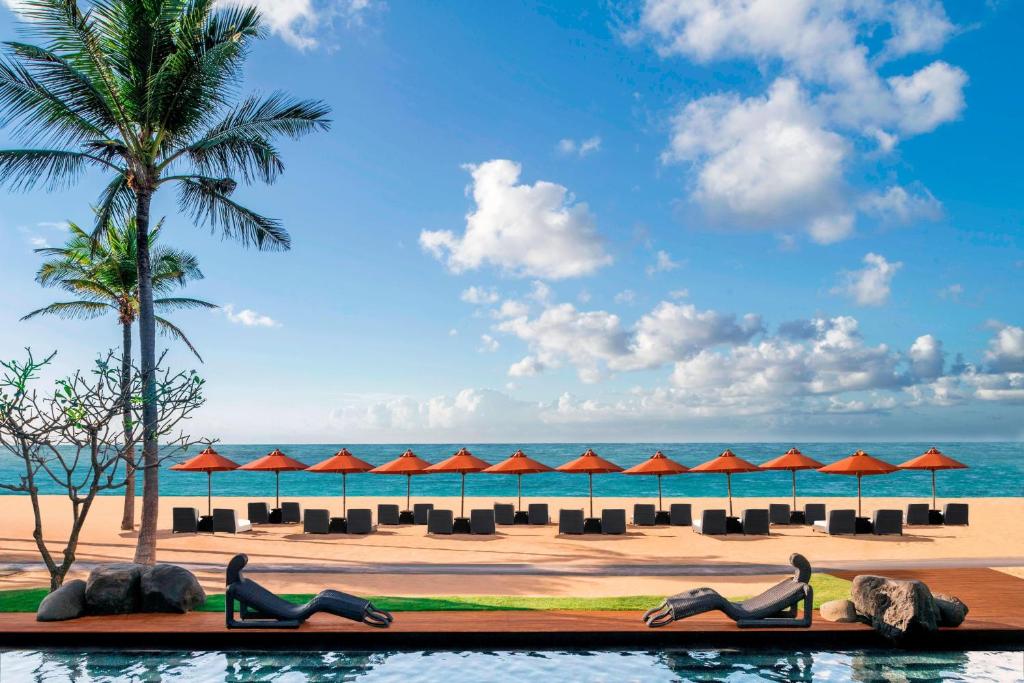
A flower motif is repeated throughout the hotel; etched into light fixtures, emblazoned on mirrors and carved into tiles. I later learned that this is a charming reference to Canang Sari – a floral Hindu offering to the gods in thanks for the balance in the world. Often these flowers appear outside shops, temples and homes, and foreshadow the evening’s offering.
The hotel is vast and impressive. It follows the idea of Nyegara Gunung which literally means from ‘ridge to reef’ or the sacred journey from mountain to sea. The grand reception area rises from the forest and flows into a village-like network of luxury villas set above a white sand beach.
The villas – of which there are standard and premium options – are stunning and replete with more areas for sitting than you could realistically ever use. The best I found was the cushioned and gazeboed area next to the private pool.
It all felt a little bit flash for the sacred philosophy of Nyegara Gunung, but that didn’t really matter. Perhaps this is just a higher class of spirituality: morning yoga sessions on the beach, traditional Balinese massage at the Iridium spa and sharing plates at the Dulang restaurant. Here we enjoyed a ‘royal plate’, a spinning wheel of seven different mains including lobster with sambal and bonito fish baked in banana leaf.

When we visited in May, the hotel was approaching the high season but still at a healthy 60 per cent capacity. The last time they were full was during the G20 summit, hosted around the corner from the hotel last November. The marketing manager remained coy when I asked which head of state booked out the entire resort, which naturally set me off speculating. I’m sure Macron would have enjoyed floating around the 3,668 sqm saltwater lagoon or that Meloni would have demonstrated greater balance at stand-up paddle board yoga than I did. Perhaps sleepy Joe unwound from difficult negotiations by napping on the private beach.
After two glorious nights at St. Regis, we travelled to Mandapa which is a different beast altogether, one of five only Ritz-Carlton Reserves (I think a ‘Reserve’ just means fancy). The hotel contains 35 suites and 25 villas with a private pool set within a natural depression in the jungle. The compound is bordered by the Ayung River and at its centre is an old temple. There is also small rice paddy.
Relaxing the mind, body and soul in the middle of a jungle was surprisingly easy for even the most inflexible guest. It was helped by regular visits to the wellness area and my daily rotation between the hotel’s four restaurants. The best was Kubu, set in a bamboo palace on the riverbank. Here my enthusiasm for chef Bayu Retno Timur’s sambal was keenly noted by my patith (a 24-hour butler) and I returned home one night to find a bag full of the glorious spicy stuff on my pillow.

The hotel will make an itinerary for guests so that they can make the most of their stay: from spa treatments to white water rafting. Scheduled for us was a sunrise climb of nearby Mount Batur. Enshrined in Balinese culture as the ‘mother’, its volcanic tantrums provide fertile ground for rice crops. It is also where over half of Bali’s water originates, which travels through a network of bamboo pipes down to the island’s rice terraces. The hike is well worth the early start even when the weather is cloudy, which it was when we made the summit. In the brief moments when the wind whipped the clouds away, a glimpse of the view produced cheers from those intrepid enough to wake up at 2 a.m.
Any remaining apprehension towards spirituality promised to be remedied by the final activity: sound healing. At the start of the week, even the mention of holy vibrations would have caused my eyes to somersault, but I was reliably informed that my overthinking was a product of a blocked crown chakra. Who knew?
Despite wanting to remain immune to the ritual, in truth I found the whole thing calming. Who’d have thought a man banging discordant noise out of a series of bowls could leave one so serene? I felt a warm hum for the rest of the trip, which was only undone by the 15-hour return flight.
The St. Regis Bali Resort– prices start from £396 per room, per night
Mandapa, a Ritz-Carlton Reserve – prices start from £810 per room, per night
The Dartmoor appeal win is a victory against wealthy landowners
This evening, activists will gather under Haytor, Dartmoor’s iconic landmark rocks, to celebrate what feels like a rare victory for the right of citizens to roam. Today, the court of appeal has overturned an earlier decision that ended an assumed and ancient right: that which allowed you to lay your hat and your home without permission more or less anywhere on the park’s 368 square miles. I declare an interest as someone who both lives on the moor and who often disappears with my tent into southern England’s last wilderness for a natural mental health spa — and I am one of many who have been waiting for this appeal outcome for far too long.
In January 2023, a millionaire landowner and hedge fund manager Alexander Darwall challenged the widely held interpretation of the 1985 Dartmoor Commons Act that ‘outdoor recreation’ included the right to camp overnight. In what must count as one of the most perverse judgements in recent times, he won. This outcome essentially redefined recreation as solely ‘ambulatory’, much to the frustration of the coalition of right-to-roam activists who rose up to oppose his land grab.
Mr Darwall has by any reasonable measure plenty of space to stand and stare unmolested. He is the owner of almost 16,000 acres of Sutherland in northern Scotland — as well as 4,000 monetised acres of southern Dartmoor. But no matter: he stood firm in his argument that wild camping on his land was damaging the environment.
To have Dartmoor’s wild attractions tamed by people rich enough to interfere with this right for their own selfish reasons is intolerable.
That didn’t wash. ‘This was always one landowner’s naked attempt,’ said a spokesperson for The Stars Are For Everyone, ‘to find any pretext to roll back the public’s right to connect with nature on national parkland.’ Her dismay resonated with many, including me.
To be strictly accurate, the overturned ruling specified that wild camping could be continued — but not as a right. Instead, it would be subject to the landowner’s consent. But this was a crucial change which had huge significance for those who simply wanted to vanish off the path when the notion takes them and pitch up for the night on common land. I’ve met dozens of people who wild camp in this way. They are a charmingly eclectic bunch, overwhelmingly responsible, who disappear without trace the next morning.
The park has also been the proving ground for generations of Devon schoolkids — including mine — who take part in the annual Ten Tors endurance event. The right to roam kindles a lifelong duty to look after the environment. Those children learn about the bleak majesty of this place, and how to respect it. To have its wild attractions tamed by people rich enough to interfere with this right for their own selfish reasons is intolerable.
Moreover, the right to camp overnight is not absolute. There are sensible rules in place, including distance from roads, that must be observed. You deserve everything that’s coming to you if you deliberately make your bed on the north moor’s firing range when it’s in action. And while the behaviour of a minority of people during lockdown who despoiled some areas of the moor within or outside the ever-changing Covid guidance was reprehensible, it was no excuse for an assault on the rights of the rest of us.
Open access to the countryside was only established after the Kinder Scout Mass Trespass in 1932, and it cannot be taken for granted in any of its forms. It is also a precious commodity available to everyone without regulation in an increasingly noisome world. Putting your house on your back in all weathers and setting forth into our ‘big empty’ is a marvellous way to reconnect with nature and repair the ravelled sleeve of care. Today’s restoration of an ancient principle on Dartmoor should not only be welcomed, it should be extended to all our national parks. It is long overdue.
Inheritance tax has become yet another stealth tax
Most people will not see their estates subject to inheritance tax. Still, most people oppose the principle of the tax altogether. New polling from Ipsos confirms, once again, how loathed the death tax is: 23 per cent of people perceive the tax as ‘fair’ (tied for the lowest ranking, alongside stamp duty). Meanwhile 43 per cent of people see the tax as ‘unfair’ (the highest ranking, even more hated than income tax paid by the lowest earners).
It won’t go down well, then, that almost 50,000 additional households are expected to be dragged in to paying inheritance tax, nearly four times the expected increase according to HMRC forecasts seen by the Daily Telegraph. This increase is expected to take the number of households affected by the tax to more than 280,000 by the end of 2027-28.
Freezing these thresholds has been the government’s preferred method for getting more taxpayer income into the Treasury
Of course there is the issue of stated versus revealed preference when it comes to this tax. Just a few weeks ago, Ross Clark made the case for prioritising income tax cuts over inheritance tax. He noted that the UK’s horribly distorted housing market is allowing children to inherit million pound households without being taxed a penny, while those whose parents may not have climbed onto on housing ladder cannot imagine how they might ever be able to afford a home, as the taxman keeps taking their disposable income away.
It seems the public may be sympathetic to this assessment. While they rank inheritance tax to be ‘most unfair’, only 14 per cent said they would ‘most prefer’ to see this levy cut. Instead, 44 per cent opted for an income tax cut for workers earning below £50,000, followed by 34 per cent for council tax, 26 per cent for VAT, 20 per cent for fuel duty, and 19 per cent for National Insurance.
So, while the ethics of the death tax don’t sit right with people, there is perhaps some broader recognition that the tax cuts most likely to affect them personally are not those related to passing down wealth through the generations.
But the two issues are fundamentally linked, because the government has decided to claw more money away from people through the same method: freezing tax thresholds. This guarantees fiscal drag, pulling people into higher tax brackets as inflation and pay raises race ahead of frozen thresholds.
It’s the ultimate stealth tax. People are often surprised to discover they are on the line for paying the higher rate of income tax or, in the case of inheritance tax, find themselves over the individual £500,000 allowance.
This is all by design. Over the past several years, freezing these various thresholds has been the government’s preferred method for getting more taxpayer income into the Treasury. And it’s working: the Office for Budget Responsibility estimated after the March Budget that the freeze on income tax and National Insurance thresholds would raise almost an additional £30 billion by 2027-28. By that time, 3.2 million more people will be pulled into paying income tax, while 2.1 million people will find themselves paying the higher rate of tax. All this revenue flows into the Treasury’s coffers without ministers having to announce any formal tax increase.
But there’s no denying the droves of people who find themselves paying more tax. Unfortunately for the government, it’s the taxes people practically and emotionally care most about. They’re paying attention – and they won’t like what they find.
The very stable primary
Is Donald Trump unbeatable? That has been the big question hanging over the Republican presidential primary ever since the former president announced his candidacy last November. And, even before the first debate has taken place, it is a question to which “yes” looks like an increasingly plausible answer.
Since the early campaign got underway in earnest, the contest for the Republican nomination has been remarkably stable. Trump has held a commanding lead, Ron DeSantis has lagged behind him in a clear but distant second, failing to breakthrough as many thought he might after declaring his candidacy. Meanwhile, no one else has registered enough of a polling surge to announce themselves as a serious alternative.
Insofar as there has been any movement in the race so far, it has been in Trump’s favor. And his commanding lead is evident in a New York Times/Siena College poll published today. It finds 54 percent of Republican primary voters backing Trump, with DeSantis on 17 percent. No one else can register more than 3 percent.
In his analysis of the poll, Nate Cohn puts Trump’s commanding lead in clear terms: “In the half century of modern presidential primaries, no candidate who led his or her nearest rival by at least twenty points at this stage has ever lost a party nomination. Today, Donald J. Trump’s lead over Ron DeSantis is nearly twice as large.”
Republicans keen to move past Trump have been eager to avoid a crowded field that might pull votes away from DeSantis and allow Trump to win the nomination with a plurality. Such fears now seem woefully wide of the mark, but for all the wrong reasons: DeSantis has done little to show that he can eat into Trump’s lead, while the former president is within reach of an outright majority.
The poll will make for grim reading at DeSantis headquarters. Voters were asked to compare Trump and DeSantis on a range of attributes. Trump is seen as a stronger leader, better at getting things done, more electable and more fun. DeSantis is seen as marginally more likable (an irony given that the received wisdom identifies him as unlikable and uncharismatic) and more moral.
As worrying for the president’s opponents is the poll’s breakdown of the factions within the primary electorate. It describes 37 percent of the likely electorate as the MAGA base, Trump’s ride or die supporters, another 37 percent as “persuadable” and 25 percent as being not open to Trump. That means a single candidate must win over the anyone-but-Trump vote as well as the lion’s share of the persuadables. None of the current names have shown any suggestion they can lead that disparate coalition.
Like a studio sports analyst at halftime hoping you keep watching regardless of the one-sided score, this is the point at which I remind you it’s still early, it’s all to play for and so on. After all, a foregone conclusion of a primary is bad business for those of us who write about politics. And, in fairness to the “it’s still early” crowd, Trump’s legal problems do add real uncertainty to the process. But the simple truth is that Trump, a former president with a loyal following, is in a very strong, possibly unassailable, position. When I hear anyone arguing otherwise, it usually sounds like motivated reasoning.
But allow this Trump-skeptic to identify one silver lining: if DeSantis is disappointing those who thought he was the man to slay the Trump dragon, he is doing so quickly. In time for other Republican rising stars to reconsider their decision to sit 2024 out. Today’s poll might not prove Trump is unbeatable. But it gives us little reason to believe any of the current candidates are up to the job.
On our radar
TRUMP ON THE FIRST PRIMARY DEBATE “Let them debate so I can see who I MIGHT consider for vice president.”
TRUMP ON MCCONNELL’S PRESS CONFERENCE EPISODE “That was a sad thing to see. He had a bad fall, I guess, and probably an after-effect of that. But it was also sad that he gave trillions and trillions and trillions of dollars to the Democrats to waste on the Green New Deal, destroying our oceans and destroying our great, beautiful vistas and plains all over our country with windmills that are very expensive energy. So that’s a very sad thing also.”
Arctic freeze
The Arctic promises to be one of the most important regions of the world in the coming decades as countries begin to exploit both its resources and transit routes. But, as the Wall Street Journal points out in a recent article, the US is ill-equipped to address these developments, with only a paltry two icebreakers capable of dealing with the frigid north. Three more are planned, but the Journal reported in November 2022 that construction is well behind schedule. Meanwhile, Russia has about thirty-six Arctic-capable icebreakers with others coming online, and China has four — despite not having any Arctic coastline.
The US ships, old and troubled, are not up to the task of defending America’s Arctic interests, with the only ship periodically deployed to the Arctic regularly sitting in maintenance due to mechanical issues, the Journal says. They are also not sufficiently armed to engage in hostilities should that be necessary. While the new ships under construction for the US Coast Guard are a step in the right direction, they will be nowhere close to enough to deal with the emerging threats to Arctic security.
The Journal’s report details the emerging cooperation between China and Russia in the region, with China playing “a supporting role for Russia.” A joint Russia-China naval group sailed into US exclusive economic zone waters in September 2022, with a comparable event happening with Chinese naval vessels in August 2021. Russia also operates and is building numerous military facilities on its northern coast.
To illustrate the significance of the region, it would take half as long to sail from Japan to the Netherlands via the Arctic compared to traditional sea routes. That would translate to meaningful cost savings and easier supply lines, making it an unacceptable economic and security risk for the Russians and Chinese to control such a critical route.
–John Pietro
Congressional ink
President Joe Biden, our octogenarian in chief, spent this weekend shirtless at a beach. But he’s not alone in showing that the kids’ grandparents are all right. While Congresswoman Rosa DeLauro is eighty years old, that didn’t stop her from getting tatted this weekend with her grandkid and showing it off for all the world to see.
DeLauro’s granddaughter is “off to college in the fall and this strengthens our bond,” she announced. DeLauro’s office did not respond to our questions about her previous history with tattoos, but she is already suggesting that more are on the way. “I have four more grandkids who still haven’t turned eighteen yet so be on the lookout for more new ink!”
The Connecticut congresswoman’s tat is her latest contribution to fashion on the Hill. Almost ten years ago, Benny Johnson shined a bright spotlight on DeLauro’s fashion sense in a BuzzFeed quiz: Hipster Or Member Of Congress?
–Cockburn
From the site
Fredrik Erixon: What does Europe’s center-right stand for?
Peter W. Wood: In defense of cranky professors
Bridget Phetasy: Why antivax is back
Poll watch
PRESIDENT BIDEN JOB APPROVAL
Approve 42.4% | Disapprove 54.2% | Net Approval -11.8
(RCP average)
US CONFIDENCE IN THE MILITARY
Percentage of Americans who have either a great deal or quite a lot of confidence in the military
1993 67% | 2003 82% | 2013 76% | 2023 60%
(Gallup)
Best of the rest
Colby Itkowitz, Sabrina Rodriguez and Michael Scherer, Washington Post: Democrats worry their most loyal voters won’t turn out for Biden
Alex Thompson and Hans Nichols, Axios: Why Biden’s team soured on Marc Elias
Ben Smith and Maxwell Tani, Semafor: The fragmentation election
Tabby Kinder, Financial Times: How Silicon Valley is helping the Pentagon in the AI arms race
Gabe Kaminsky, Washington Examiner: How Republican 2023 hardcover books sales stack up
Annie Linskey, Wall Street Journal: Biden ignores political perils and embraces scandal-plagued son
Sign up here to get the DC Diary in your inbox on Mondays, Wednesdays and Fridays.
Will Italy leave China’s ‘atrocious’ Belt and Road Initiative?
For some time now the world has being growing increasingly wary of China’s Belt and Road Initiative (BRI), but rarely has any member of the scheme launched a broadside quite like that of Italy’s defence minister, Guido Crosetto, who described his country’s decision to join as ‘improvised and atrocious’. In an interview at the weekend, he said that the BRI had brought little benefit to Italy and one of the most pressing question his government now faced was how best to escape its clutches.
The BRI is often described as an international infrastructure project, through which the world will be blessed with Chinese-built roads, railways, ports and power stations. In reality it lacks any real coherence and is better understood as a multi-billion dollar tool for Beijing’s broader economic and geopolitical goals, an umbrella under which all manner of projects are grouped. Much of the criticism rests on the huge and unpayable debts it is creating, the leverage it gives Beijing, and its lack of transparency. In the case of Italy, Crosetto’s main criticism is that it has simply failed to deliver. He told the Corriere della Sera newspaper that Beijing was the only winner, since exports to Italy had surged, while there was little impact on goods going the other way.
Italy joined the BRI in 2019, under the government of Giuseppe Conte. The agreement was signed during a high-profile visit to Rome by President Xi Jinping, during which Xi was fawned over and feted. Opera singer Andrea Bocelli performed at a state dinner for Xi and his wife hosted by Italian President Sergio Mattarella. Italy became the first G7 country and the largest economy to join the BRI, which was seen at the time as a major diplomatic breakthrough by Beijing. Italy faced strong criticism from the United States and European Union, which saw the scheme as a Trojan horse for the Chinese communist party to press its interests and influence.
Italy now has until December to give formal notice of withdrawal, otherwise it automatically renews in March next year. Prime Minister Giorgia Meloni has also suggested she wants to leave, triggering threats from China, for whom the loss of Italy would be a serious diplomatic blow. Beijing said quitting the BRI would damage Italy’s credibility and reputation. Chinese officials have been frantically lobbying and meeting with Italian politicians and business leaders, a factor that might well have contributed to Crosetto’s outburst at the weekend.
In his interview, Crosetto said Italy needed to work out how to get out of the deal without damaging relations with China, a feat that would appear to be something of a challenge. He also said he was concerned about Beijing’s ‘increasingly assertive attitudes’ and its ambition to build the world’s largest military. ‘They don’t hide their goals, they make them explicit,’ he said.
Italian attitudes towards China soured markedly during the Covid-19 pandemic. A report by Italy’s parliamentary security committee revealed that Italy had been the target of CCP disinformation and conspiracy theories, including a claim that the virus had originated in Italy. The CCP used bots and fake social media accounts to take credit for help with masks and assistance that had been provided by others. A video, posted by Chinese officials, apparently showing grateful Italians on their balconies and in the street applauding the Chinese national anthem, turned out to have been doctored. Much of the footage was lifted from news reports of applause for medical workers, and was underlaid with the anthem and repeated audio of a man shouting ‘Grazie Cina!’
The BRI has grown to encompass 13,427 projects across 165 countries, according to AidData, a research group. The CCP has traditionally felt more comfortable dealing with thugs and kleptocrats, but Italy’s departure would be a blow to the BRI and to Beijing’s prestige. The scheme is already coming under heavy strain, with China cutting back on loans and struggling to deal with soaring debt. Both Russia and China have in the past found Italy a pliable economic partner. The CCP is now mobilising its diplomats and sympathisers in an effort to keep it that way, but might be about to discover that now even Italy has had enough.
Sunak’s new oil and gas licences face a fight against the odds
Just Stop Oil (JSO) has taken the news that the government will issue hundreds of new North Sea oil and gas licences badly. The Prime Minister is ‘worse than a war criminal,’ according to JSO. But the reality is that Sunak’s announcement is a smart move: oil and gas and its derivative industries are still some of the UK’s most important and some of its largest export industries.
The UK still relies heavily on oil and gas, not only for individual and commercial transport but also to heat most of our homes and to produce our food (both to operate farming machinery and make fertilisers and pesticides). We also use it for ingredients for our petrochemical, pharmaceutical and plastics industries and to produce concrete, bitumen and other key substances used to build our towns and cities. But most importantly, about 40 per cent of UK electricity comes from gas-fired power stations.
Will the CMA take a similar hardline position on this net zero obsession taking hold at banks?
All of us rely on electricity produced using gas. Windfarms are little use without gas-fired backup electricity. When the wind drops, gas-fired electricity makes up the shortfall in renewable production. Unlike gas, nuclear power stations can’t be quickly ramped up and down to make up for a decrease or increase in wind power. Last year, gas provided just under 40 per cent of UK electricity while wind provided just under 30 per cent.
But there are still some hurdles to jump before any new oil and gas will be flowing through our pipes. The first question is whether the government also intends to drop its eye-watering 75 per cent ‘windfall taxes’ on oil and gas companies, presently in place until 2028. Without a change in this tax, there is a high probability that the new licences will be purchased but not used until after 2028. So much, then, for the government’s claim that the new licences are necessary for UK energy security.
There is also the question of who will finance and insure these new projects. Nigel Farage’s bank account with Coutts was closed because of the Environment, Social and Governance (ESG) regulation mindset that has taken hold of financial institutions. Other individuals and businesses have suffered a similar fate. NatWest, which owns Coutts, isn’t only targeting politicians. The bank announced back in February, under Dame Alison Rose’s leadership, that it would stop lending to the UK oil and gas sector. The bank went further and said that after 31 December 2025 they would not renew, refinance or extend existing arrangements. That is less than 2 years away.
So NatWest, the UK’s fourth largest bank and still about 40 per cent publicly-owned, plans to pull the plug on this critical industry just as the government wants us to convert to electric vehicles, electric heat pumps, computer screen-based employment, cloud-based document storage, electronic payment systems and even digital money. Yet none of this works without a reliable source of electricity.
Admittedly Nat West’s oil and gas funding is less than 1 per cent of their outstanding exposures, but firms bidding for the new North Sea licences will find that other banks and investment companies may have similar policies. Mark Carney’s Glasgow Financial Alliance for Net Zero (GFANZ) has signed up over 550 financial institutions to join their net zero asset managers’ initiative, their net zero asset owners alliance, and their net zero banking alliance.
Therefore, finding financial backing to develop those new oil and gas licences may be hard or even impossible. Unless, of course, the purchasers are already large multinational oil and gas companies able to finance themselves. If so, this makes it hard to see how new entrants can join the oil and gas industry.
New licence holders may too have trouble finding insurance for their new oil and gas platforms in the North Sea. Many of the world’s largest insurance companies have also adopted damaging anti-industry policies as members of the UN’s net zero insurance alliance (NZIA). NZIA membership demands that companies pledge to remove all greenhouse gas emissions from their investment funds as well as their insurance and reinsurance underwriting portfolios.
Luckily the United States has taken a hard line on this scheme. When members of the US House of Representatives threatened the insurance companies with an anti-trust lawsuit, ten of the world’s largest insurance companies dropped out of NZIA. Will the UK’s Competition and Markets Authority take a similar hardline position on this net zero obsession taking hold at banks, fund managers and insurance companies?
After all, if banks won’t lend to oil and gas companies, funds won’t invest in them, insurance companies won’t underwrite them and the government continues to tax them at 75 per cent, then the chances of the government’s new oil and gas licences being developed seem exceptionally low. And life in the UK will be exceptionally grim when our electric heat pumps, lights, card payments, computers, cars, bikes, tubes, and trains stop working every time the wind drops. Bliss.
Cardi B is dangerous with a mic — literally
2023 has the summer of unruly concertgoers. So far, bras, phones and a woman’s ashes have been thrown, pelted, and flung at the likes of Bebe Rexha, Drake, Kelsea Ballerini, Kid Cudi, Pink and Harry Styles. Now that Cardi B has become the latest victim, the celebrities are finally fighting back.
On Saturday, Cardi B was performing her 2018 hit “Bodak Yellow” at Drai’s Beach Club in Las Vegas when a concertgoer threw her drink at the rapper. Cardi B immediately hurled her microphone into the audience before unleashing a string of expletives. Cockburn commends Cardi for her excellent aim — she hit the culprit squarely in the chest.
Cardi had warmed up her throwing arm the night before. While performing at Drai’s Nightclub on Friday, Cardi threw her microphone at a DJ who cut her song off early. Last year at London’s Wireless Festival, she also used her mic as a weapon. While chatting with fans in the front row, she allegedly felt someone grabbing her hair causing her to bludgeon them with her mic.
Cardi’s experience with rowdy fans has been less dangerous than some, but her reaction has been bigger than any. In July, a fan threw a phone at Bebe Rexha’s forehead, splitting her brow and bruising her eye. Rexha was brought to a nearby hospital and required stitches. As for Cardi, it’s unclear if any of the drink even got on her, but that doesn’t matter — if the audience throws something at her, she will fight back.
Cockburn hopes that Cardi can serve as an example for celebrities everywhere who have been assaulted on stage. So far, other singers have been all talk and no retaliation. The rapper Latto threatened “want your ass beat?” after she was hit by a projectile in Germany. Drake called out a woman who threw her purse at him. Adele lectured her audience at Caesars Palace about “show etiquette.” Only Cardi has taken her self-defense into her own hands — will more follow suit?
How did the Scottish Greens end up with so much influence?
There are often complaints that the Scottish parliament lacks the ‘big beasts’ of other European counterparts. It is not a complaint, however, which can reasonably be levelled at Fergus Ewing. Ewing is a giant of Scotland’s independence movement and a giant of Scottish politics.
But perhaps the thing which is most interesting about Fergus Ewing is that he is not a socialist. He has that in common with much of the traditional SNP support, and much of the SNP support outside the central belt — but it increasingly marks him out from the Scottish government, led by his very own Scottish National party.
Last Wednesday, Ewing appeared on Holyrood Sources, the weekly podcast that I jointly host. He was free-flowing and articulate, as we have come to expect, and not long into the podcast he raised the issue of what he called his party’s ‘dalliance’ with the Scottish Greens. It is important to note that Scotland’s Greens are especially unique, even amongst their European peers. Significantly more left-wing and focussed on social rather than environmental matters, the Green Party may be the pound-for-pound most successful party in Holyrood’s history: with 6 per cent of the parliament’s seats and 8 per cent of the national vote, the party has extracted an extraordinary ransom. Their influence over Scottish government policy in recent years has been striking.
From gender reforms to rent controls to highly protected marine areas, it is becoming impossible to know where the Green party ends and the SNP begins.
With two Green ministers, along with an informal veto over a raft of policy, it is entirely reasonable to place Scotland in the mix of Europe’s most left-wing governments. Whilst we might have historically viewed the SNP as a party of social democracy akin to those in Scandinavia and northern Europe, we must consider the Scottish Greens far more similar to the hard-left parties of southern Europe.
Speaking with Ewing on the podcast, it struck me that First Minister Humza Yousaf finds himself in an odd position given his party’s coalition. Does he consider himself to be closer to the son of Winnie Ewing — a man who bleeds yellow from his half-century in the SNP — or to Ross Greer, the backbench Green MSP who doubles-up as the strategic and intellectual force behind his party’s platform? My own presumption, given the recent direction of party policy, is that it is the latter man, Greer, whom Yousaf considers more of a political and ideological bedfellow.
There are a couple of obvious consequences to that. Ewing and Greer have become the embodiment of the rural vs urban debate which is proving an increasing chasm both within the SNP and in the country as a whole. Should Yousaf continue to double-down on the Green coalition, what then happens to the SNP and to its vote distribution across Scotland? Time will tell or, more appropriately, elections will.
The other obvious consequence is one which does not require the clarity of time. There are Green fingerprints all over Scottish government policy but this hasn’t stopped the Scottish government running into trouble as a result. Yesterday, the Scottish Mail on Sunday reported that the collapse of Circularity Scotland, the private company that was to enforce the deposit return scheme, collapsed last month with debts and liabilities of £86.2 million. There are subsequent concerns that the taxpayer could be left to pay the bill.
But the delayed deposit return scheme aside, from gender reforms to rent controls to highly protected marine areas (HPMAs) to the proposed ban of gas boilers, it is becoming impossible for ordinary voters to know where the Green party ends and the SNP begins.
There is a chance that Prime Minister Rishi Sunak’s visit to Aberdeenshire today, where he has announced funding for 21,000 North Sea jobs as part of a carbon capture scheme, could cause a split between the Greens and the SNP given their differing stances on how best to transition to net zero. The SNP Westminster group leader Stephen Flynn MP has welcomed news that the Acorn carbon capture project will receive funding and Neil Gray MSP, the Scottish government’s energy secretary, has said that ‘today’s announcement represents welcome, if long overdue, recognition of the enormous potential of the Acorn project’. He has urged the UK government to ‘avoid further delay…to secure the technology’s fastest possible deployment’.
Meanwhile the Scottish Greens climate spokesperson Mark Russell has said that carbon capture ‘is no substitute for investing in renewable jobs and industries and energy efficiency’ and that the technology ‘must not be used as a justification for more north sea drilling’. Could pressure from the Greens alter the SNP’s position? Very possibly — and how interesting that would be.
But Ewing is most troubled by another policy area which is significantly impacted by Greens: road building. The dualling of the A9 between Perth and Inverness, a road on which last year an average of one person every month was killed, is official Scottish government policy and has been for some time. A variety of mitigating circumstances have been cited for the party’s failure to deliver — with both the pandemic and funding issues serving as particularly useful shields.
In truth though, this is less about funding than about prioritisation. The road can be built if the government wants to build it. That becomes the central question. Does the government — this SNP-Green government — want to? Ewing appears to think not and looking at the facts, it is increasingly difficult to disagree with him. As I write, just over 10 per cent of the road has been dualled, there is no target end date and the Greens vehemently oppose the building of trunk roads. Ewing is angry, to put it mildly, and has stated that the SNP would not deserve to be in office if it fails to follow through.
The Bute House Agreement (the official name of the SNP-Green coalition deal) is fast becoming the most consequential issue in Scottish politics. It is certain to hold until the general election of 2024 and very likely to hold until the Scottish parliament election of 2026. The state in which it will leave the SNP after that, however, is anyone’s guess.
Meghan and Harry versus the Beckhams
David and Victoria Beckham are the latest celebs to be Markled. In case you don’t know what this is, Cockburn includes the Urban Dictionary definition below:
Markled: To be “Markled” is when a new friend appears in your life, bombards you with attention and favor requests, once you are secure in the friendship things settle down, however, after a period of no communication you attempt to contact your friend only to be ignored and ghosted without warning, explanation and every avenue of open communication is now closed and you are effectively deleted from the friends life once you have served your purpose and are no longer of any use to her as she has now ascended the next rung of the social ladder.
Back in 2018, when Meghan and Harry were collecting celebrity friends to elevate their status at their wedding, David and Victoria Beckham were among the lucky few. But later, it remained unclear how well the couple even knew these so-called “friends.” George and Amal Clooney, who were center stage at the Windsor wedding, had never even met the couple beforehand. When asked by another guest, “How do you know Harry and Meghan?”, the Clooneys reportedly replied, “We don’t!”
However, whatever friendship the Beckhams and Sussexes did have seems to have dwindled. Meghan and Harry were not guests at the wedding of the Beckhams’ son Brooklyn to US heiress Nicola Peltz in April last year. According to reports the pair weren’t even invited, but Prince William was. Neither of the Sussexes were present at one of the biggest celebrity events of the year last weekend, when Lionel Messi made his debut for David’s Inter Miami soccer team. Kim Kardashian, tennis legend Serena Williams and a host of other big names partied in the VIP boxes.
In the case of the Beckhams, the word on the street is that Meghan and Harry Markled them because of a suspicion the couple may have leaked stories about the Sussexes, an accusation that left David “absolutely bloody furious,” according to the Mail on Sunday. A source close to the Beckhams told the paper: “David and Victoria went to Meghan and Harry’s wedding and were very supportive when Meghan arrived in the UK. Any making up now is so unlikely.” Supposedly the accusations came in the form of a heated phone call.
David, it’s worth remembering, is thought to be desperate for a knighthood. Much was made of how the former England soccer captain lined up for hours to pay his respects to the late Queen in September, and he posted a lengthy tribute to King Charles upon his coronation. Beckham, currently an OBE, is believed to have jeopardized his chances after emails in which he badmouthed the honors committee were leaked in 2017. Needless to say, distancing himself from Harry and cozying up to Charles and William would make a knighthood likelier.
Meghan and Harry are infamous for losing staff. Looks like they are losing friends at the same rate…
How we could reach net zero without dumping oil
Rishi Sunak has shown no indication that he is considering dumping the government’s legal commitment to achieve net zero by 2050. Nor, so far, has he indicated that he will relax any of the controversial targets for the next decade or so, such as banning new gas boilers or petrol and diesel cars. But his visit to Aberdeenshire today does mark a very sharp change in direction from the government’s green policy in Boris Johnson’s day. Sunak’s policy can be summed up in three words: Just Continue Oil.
For years, government policy has been predicated on the idea that oil and gas are declining, doomed industries and that therefore there is little point in investing or supporting them. Instead, the future lies in renewables. Now Sunak say he intends to issue hundreds of new oil and gas licences in the North Sea. Moreover, these are not just intended to satisfy immediate demand, to fill a hole while Britain transitions to a glorious green future. The most telling words from Sunak today are these: ‘Even when we’ve reached net zero in 2050, a quarter of our energy needs will come from oil and gas.’
Sunak’s policy can be summed up in three words: Just Continue Oil.
How could we achieve net zero while still using large quantities of fossil fuels? Sunak, along with energy secretary Grant Shapps, who made an announcement to this effect at The Spectator’s energy summit in April, has revived the government’s interest in Carbon Capture, Utilisation and Storage (CCUS). This involves extracting carbon dioxide from the exhaust streams of power stations, or even plain air, and turning it into either liquid or solid form so that it can be stored, hopefully, for ever after. The UK government has set aside £20 billion for investment in two CCUS plants: one in Humber and another in North East Scotland.
For many environmentalists this is sacrilege. They have convinced themselves that oil and gas are evil industries beyond all redemption, and they must simply be closed down. One senses Just Stop Oil protesters will be vibrating with rage this morning.
But it is not just eco-activists who have been left upset by Sunak’s announcement: Conservative MP and former energy minister Chris Skidmore has released a rather scathing statement on Twitter. ‘This is the wrong decision at precisely the wrong time, when the rest of the world is experiencing record heat waves,’ he wrote, continuing:
It is on the wrong side of a future economy that will be founded on renewable and clean industries and not fossil fuels. It is on the wrong side of modern voters who will vote with their feet at the next general election for parties that protect, and not threaten, our environment. And it is on the wrong side of history, that will not look favourably on the decision taken today. Worrying, this decision has also been announced when MPs are on recess, unable to hold the government to account. I will be writing to the Speaker to call for an emergency debate as soon as we return.
There are those who believe that Sunak is onto something, however: Myles Allen, Professor of Geosystem Science of Oxford University, is a noted advocate, believing CCUS to be an imperfect but inevitable part of the solution to eliminating net carbon emissions.
The government, though, has a bit of previous on CCUS. George Osborne set aside a more modest £1 billion for a demonstration plant, but the money was withdrawn in 2015 by which time only one project was still in the running. What has changed? CCUS is not an experimental technology — it has been used successfully in the oil and gas industries since the 1970s as a means of extracting carbon dioxide in order to pump it underground and so force more oil or gas out of declining wells. As of September last year, there were 196 (including two suspended) CCUS facilities around the world. But it has yet to be proven on a commercial scale when it comes to using the technology to remove large quantities of carbon dioxide from the air.
The problem is the cost, both financially and in terms of lost energy. There are also concerns about leakage, and how stable carbon dioxide reservoirs will prove. If the gas were to bubble up from the deep over time there would be no point in it, and it could even be dangerous (although there have been few concerns about storage facilities currently in use).
Yet critics who say CCUS is an ‘unproven’ technology have a habit of overlooking the fact that their own plans for net zero also involve multiple technologies which are unproven on a commercial scale. There is also the possibility of reducing the effective cost of CCUS by finding a use for the captured carbon dioxide – the ‘u’ in CCUS. It could, for example, potentially be used in solid for as a building materials.
The truth is that if we are to get anywhere near net zero, CCUS is likely going to have to play a very important part thanks to hard-to-decarbonise industries such as steel and cement. And if we have to develop CCUS for that, then there is surely a chance that gas and coal power – in conjunction with CCUS – will prove an economic alternative to renewables or nuclear as low-carbon sources of power. Not that this will wash with the likes of Just Stop Oil…
Not all cyclists support Sunak’s war on traffic control
My fiancée wants to put a sign up outside our house demanding that the speed limit be reduced to 20mph. I’d rather she didn’t. Drivers have enough to cope with already.
Such is the peer pressure emanating from the neighbours, however, in collaboration with my fiancée, that the decision is likely to be taken out of my hands. Shortly, I fear, I’ll be master of a house with ’20 is plenty’ sign on the gate, accompanied by a picture of a snail.
Just because sticking up for motorists worked in Uxbridge doesn’t mean it will work across the country
I offer this vignette because the government is reportedly mulling a crackdown on councils that seek to impose 20mph speed limits, ‘bus gates’ – bus-only shortcuts – and ‘low-traffic neighbourhoods’ (LTNs). It comes in the wake of the Uxbridge by-election, which was turned into a referendum on Ulez, and in which the voters returned the Tories because they were perceived to be pro-motorist. The Prime Minister is seeking to capitalise on this momentum, curbing the spread of anti-car zealotry among local councils in an attempt to ring-fence society’s final vestiges of common sense.
The problem, however, is that not everybody agrees with him. Or me, for that matter. As regular readers will be aware, I write as a cyclist. I’m typing this on the train to London, my legs sore from the 75 miles I covered over the weekend on my racer, my Brompton nestling contentedly in the vestibule.
You’d have thought I’d be rabidly pro-LTN. But like most cyclists, I’m also a motorist. While on two wheels, I go out of my way to ride considerately, often pulling over to allow cars to pass rather than endure the gnawing guilt as they crawl along behind me at 20mph. I know their frustration, and such gestures of chivalry are my contribution to cyclist-motorist harmony. I suppose you could call me a pro-motor-MAMIL (middle-aged man in lycra).
When it comes to the traffic outside my front door, I feel similarly. Neighbours, I say, let’s be chivalrous. Let’s give motorists their space.
The car is, above all, a symbol of freedom. Not that it’s a very good symbol: it guzzles gas and kills people and gets stuck impotently in traffic jams. But it also offers you the ability to go where you want when you want to, or to pack up and leave for a new life. Restraining the beast to a counter-intuitive 20mph on a clear road because of the frenetic hand-wringing of the local busybodies seems to me like a castration.
My fiancée, however, disagrees. She doesn’t like it when our windows rattle as some boy racer thunders past. She gets stressed by the delivery lorries that squeeze past our house on their way to the rear entrance of the local supermarket. And she hates the clouds of exhaust that roll across the pavement and lick their tongues into the corners of our front garden and under our front door.
But her support for the 20mph limit is less simplistic than it seems. As a motorist, she is a committed petrol head who loves nice machines and gets a trill out of racing sports cars at track days. The speed and sexiness of a decent motor gets her blood pumping. Like me, she’s very much pro-car in general; but also pro-pedestrian in certain parts of town.
This microcosm of complexity presents the Prime Minister with a challenging picture. Just because sticking up for motorists worked in Uxbridge doesn’t mean it will work across the country. Ulez has radicalised people living in affected areas of London; the sudden imposition of a £12.50 daily levy is enough to send the most mild-mannered man berserk.
Outside of Ulez boundaries, however, traffic control is less of a wedge issue than the Tories seem to think. Polling has shown that parents of young children support anti-car measures, particularly outside schools, but this is not reflected so clearly across society.
The fact is, most people are both pedestrians and motorists; they aren’t Spartans one way or the other. When confronted with a particular intervention, like the 20mph speed limit, they may disagree, but they all want roughly the same thing. As pedestrians, they appreciate safe, clean neighbourhoods; but when behind the wheel, they don’t want too many traffic-calming obstacles or have to gnash their teeth at punitive speed limits. Seizing upon the issue as an election-winner might prove a little hubristic.
Ancient worms and the problem with climate politics
The poet Elizabeth Bishop, when she was feeling blue (which she often was), used to find comfort in thinking in geological rather than human time. If the vast aeons amid which we wink in and out of existence render our lives insignificant, so too do they render our suffering. As someone else said: nothing matters very much, and few things matter at all.
These little worms, I think, can give us a welcome sense of perspective. A worm’s-eye view, if you will
I’m sure these thoughts, or something very like them, will have been the first to have gone through the small brains of the nematode worms which woke up the other day having been asleep for 46,000 years. Along with ‘what now?’ and ‘can you people for Chrissakes keep it down?’ and ‘what about a cup of tea?’ These worms, more even than the question of Nigel Farage’s bank account, were the star of this week’s news cycle: above all, because they really couldn’t give a hoot about the news cycle itself.
Did you miss it? Scientists, basically, discovered a pair of these worms deep-frozen at the bottom of a long-forgotten gopher burrow 130 feet below the Siberian permafrost. These worms, they established, had nodded off some time in the Pleistocene, when mammoths and Neanderthals were still kicking about the place and parking fines had yet to be invented. And after very much more than 20 centuries of stony sleep, the scientists plopped them in some warm water and they woke abruptly up like Golden Age Captain America in roundworm form. What a trip!
The worms lost no time in making the most of their time-travelling experience and started to reproduce. Asexually, that is (well, not all of us are perky first thing in the morning): they knocked out a whole brood of little wrigglers through parthenogenesis, and then (having lived many millions of times their natural waking lifespan of a few days) went to their well-earned rest. Their descendents are wriggling on to this day: a whole species, apparently, saved from extinction by a good long nap.
These little worms, I think, can give us a welcome sense of perspective. A worm’s-eye view, if you will. What, to a nematode worm that has been asleep since the Pleistocene, are the results of the Uxbridge by-election? Would this nematode, relatively unsophisticated though its brain may be, not look with wonder (should the matter be patiently explained to it) on the two main political parties of this country proposing to rethink their entire environmental policies in fright at the result of a West London vote? Would this worm, indeed, not look with a curled lip at the former Home Secretary, Priti Patel, calling for the government to shelve its net zero commitments altogether in the wake of the vote?
Leave aside that Ulez isn’t anything to do with global warming, net zero or the environment as a whole: it’s about trying to reduce the number of asthmatic kids and elderly people being poisoned by vehicle emissions in London. In the vague way of these things, it’s nevertheless associated in many people’s minds with green wokery, so that’s roughly the basket it falls into politically. And is there a starker instance of the perverse incentives that bedevil this government – any government – attempting to hedge against long-term environmental damage of one sort or another?
Electoral cycles are few years long; they are at the mercy of news cycles a few hours long; and the long-term future of the planet, which is to say, all of us, is at the mercy of climatic changes that used to be measured in centuries and are now measured, God help us, in decades. We’re just woefully ill-equipped to deal with this sort of thing by institutions set up to respond to whatever gets people re-elected a couple of years from now, and to hang the long term. This isn’t a party-political point, incidentally: Tony Blair was very keen on buying shiny new hospitals on tick with PFI, knowing he’d be long out of office before those really started to bite the public finances.
But it’s very much a point that our nematode friend, with their (seems the right pronoun, what with the parthenogenesis and all) long view, invites us to consider. Unless you believe that all this funny weather is a coincidence, and that the scientific consensus on global warming is some sort of hoax cooked up by woke globalists intent on the Great Reset, and are (for that matter) unconcerned that the very permafrost in which we met our vermicular buddy is itself melting like billy-oh… well, you’ll tend to want this government, or any government, to do something to stop it. Borrowing from our grandchildren is one thing; letting them boil is rather worse. And it’s worrying that our politicians, on the whole, recognise this but seem powerless – operating as they do in mayfly cycles of electoral advantage – to actually do anything very concrete about it.
There’s always an excuse, and the excuse is always that it’s not quite the right time: not just yet. The economy’s tricky right now; there’s a segment of voters in a sticky key marginal who’ll get clobbered – and the clobbering that they will get, because they are alive and well and speaking to the gatherers of opinion polls, weighs heavier on the mind than the rather greater clobberings that their descendents are going to get if nothing is done. We’ll definitely, actually, do something about it just as soon as the time is right. But then, blow me, here comes another by-election and we’ve read the runes, and, well, sorry.
The best time to stop emitting carbon, to adapt the old saying, is 50 years ago, and the best time is now. And of course we can argue about when and how, and the fairest way to manage it, and the best way to replace it, and whether electric cars are a boondoggle and carbon credits a scam. But the overall direction of travel is clear, and it needs to be determined by people prepared to think in geological time rather than news-cycle time. Just ask the worms.