-
AAPL
213.43 (+0.29%)
-
BARC-LN
1205.7 (-1.46%)
-
NKE
94.05 (+0.39%)
-
CVX
152.67 (-1.00%)
-
CRM
230.27 (-2.34%)
-
INTC
30.5 (-0.87%)
-
DIS
100.16 (-0.67%)
-
DOW
55.79 (-0.82%)
The Terry Venables I knew
You didn’t have to like football to feel some sort of affinity with Terry Venables. He had bags of East London charm, oodles of enthusiasm and glossy good looks (as long as you didn’t mind the gold medallion around his permanently tanned neck).
As it happens, I like football very much – so it was an easy decision when, six years ago, El Tel’s wife, Yvette, invited me to stay in their Spanish hotel, La Escondida, in the Font Roja National Park, about 45 minutes inland from Alicante. The idea was that I would write about it in the Daily Mail.
Sailing close to the wind was in Venables’ DNA – one of the many reasons why footie fans loved him
My wife came, too – and she hates football. Flamenco was the theme on the first night. Standing near the entrance to the kitchen was a man wearing a Hawaiian-style shirt and sporting a neat, greying beard.
This was Terry. He was smiling broadly but beads of sweat were forming on his brow. Diners – residents and non-residents – were making their way on to the hotel’s terrace and taking their seats at tables dressed in white linen.
All was not well. We established this when my wife asked Terry if Yvette was around for a chat.
‘She’s in the kitchen because the chef’s ill and, as you see, we’ve got lots of people coming over,’ he said. ‘And they need to be fed.’ ‘Can she cook?’ asked my wife. ‘No,’ said Terry, with a twinkle.
This struck me as classic Terry Venables. Sailing close to the wind was in his DNA – something the FA couldn’t abide but one of the many reasons why footie fans loved him. If Diana was the ‘people’s princess’, Terry was the ‘people’s manager’.
Service that night was relentlessly slow. In fact, no food turned up for nearly an hour, during which Terry made a tour of the dining area, introducing himself with a handshake, posing for photographs and answering blindingly obvious questions from people like me, such as ‘who’s your all-time favourite player?’ (‘Bobby Moore is right up there’) and ‘what’s your biggest regret?’ (‘Oh it has to be Gazza – lovely boy, special talent – missing by inches to beat Germany in the Euro 96 semis’).
Terry’s parents used to run a pub called the Royal Oak in Chingford, Essex. They might have been amazed that their son was involved with an enterprise such as La Escondida.
Venables and his wife had bought what was a run-down hostel, with 500 acres of olive and almond groves, plus a derelict manor house with its own 13th century defensive tower, some 18 years before my visit.
At one point, the idea was to turn it into a football academy, hence the expansive lawn leading down to the swimming pool – but I doubt there was much of a business plan for that idea. Terry and Yvette sold up in 2019 and returned to the UK. I have a photo of the three of us standing by an olive tree.
‘Will you write something nice?’ asked Terry. It was a rhetorical question. ‘Of course you will,’ he said, squeezing my hand harder than I had expected.
The evolving phenomenon of ‘Brexit regret’
It was reported this weekend that the great trans-Pacific trade deal (CPTPP), the one that Lord Cameron just boasted would ‘put the UK at the heart of a group of some of the world’s most dynamic economies’, will boost our economy by practically nothing at all. The OBR reckons CPTPP will put 0.04 per cent on our GDP over fifteen years.
The bilateral deals with Australia and New Zealand, meanwhile, are predicted to give a 0.1 per cent uplift. This is better, but still, hardly the piratical free trade bonanza we were encouraged to expect. A gold-plated special-friends deal with the USA shows no signs of materialising.
To what extent has pro-Brexit feeling shifted from being a political phenomenon to being a psychological one?
The same OBR continues to predict that we’re all going to be 4 per cent worse off than we would have been had we stayed in the EU. Even if you regard the OBR as a cabal of gloomadon-popping Rejoiner propagandists, these figures should give you pause, shouldn’t they?
Unless they are wrong by orders of magnitude – unless the OBR aren’t just putting a thumb on the scales but making their figures up completely, and in face of all the evidence – these trade deals are duds. In fairness, there are countercurrents: Nissan has just said that Brexit has not damaged its UK operations and they’re staying here for the long haul. But ‘not as bad as we’d feared’ is a step down from ‘a great improvement’. The general trend seems clear.
Even the viewers of GB News, not on the whole the most Europhile constituency in the country, seem to be cottoning on. A poll for the channel last year on whether viewers would vote for or against Brexit again, given the chance, returned 55 per cent for Remain against 45 per cent for leave. That caused a cherishably awkward moment for the presenter who, imagining it would say the opposite, had to read it out on air.
There are multiple visions of Brexit, as we should acknowledge. One is the free-trading, devil-take-the-hindmost, bonfire-of-the-red-tape, Singapore-in-the-North-Atlantic concept. Another is the protectionist, save-our-NHS, British-jobs-for-British-workers version. Still another is the politico-theological one, in which it doesn’t matter if we’re richer or poorer: we have something incalculably precious called ‘sovereignty’, which we didn’t have while we were bound to our neighbours by voluntary treaties, and we have now.
The 2016 vote was carried over the line, it should be uncontroversial to observe, by a muddled combination of all three, notwithstanding that in many respects they are contradictory. So we were to have lower taxes and lots of extra money for the NHS, frictionless trade and tight control over our borders – plus, because passport colour is a visible index of freedom, blue passports.
That was the apotheosis of the doctrine of cakeism. Those who favoured vision three – or, at least, who moved the goalposts there swiftly when the promises of visions one and two failed to materialise – certainly didn’t make clear at the time that this whole project was about an abstract concept. ‘Take back control’ was a slogan that winningly captured the abstract, theological side of the argument; –but it was backed by a series of more material hopes. And as the GB news poll seems to indicate, the failure of those material hopes weigh on the minds even of those voters fully on board with the original project.
The question that preoccupies me now is: to what extent has pro-Brexit feeling shifted from being a political phenomenon to being a psychological one? Nobody likes to admit they’ve been taken for a mug. And there can be nothing more aggravating than having every fresh failure of the project, every humiliating reverse, greeted with an almost gleeful ‘I told you so’ from the sort of people who told you so; and, worse, who were precisely the sort of people who you decided to vote for Brexit, in part, in order to spite.
The psychological aspect of it matters. It determines how big a core of voters there will be for whom there’s no material condition that could cause a change of heart. They will be the Brexit equivalent of tankies after the collapse of the Soviet Union insisting that communism hasn’t failed because communism was never properly tried.
This hardcore bunch will always find it easier to blame saboteurs, sell-outs, smug latte-sipping metropolitan liberals and the rest of the familiar gallery of caricatural enemies for our failure to reach those sunlit uplands than to look searchingly in the mirror. They aren’t persuadable. And, fine, we must leave them to stew.
Had Brexit been a success, by the way, there would have been versions of exactly the same people on the other side. I can’t imagine Steve Bray packing up his megaphone and going home when it became clear we were outperforming the EU. I can’t see hordes of ‘Follow back, pro EU’ (FBPE) types changing their social media profiles to the Union flag when they saw us signing brilliant trade deals worldwide, the NHS was flush with cash and our immigration policy fixed for good and all.
I like to imagine that a good many of us Remainers, though, would have had the grace to eat humble pie and admit we were wrong in whole or in part. Certainly, the GB News poll indicates that among Leave voters there are a growing number with the moral courage and pragmatism to do just that. Those are the persuadables. And the persuadables are the ones who matter.
The nice thing about the ‘will of the people’ is that it changes, and liberal democracies of the sort in which we lived before 2016 and in which we still live are specifically designed to accommodate that. So: where do we go from here?
The despair of Deliveroo
Self-pity and Deliveroo go hand in hand. You can’t have the latter without the former. It’s impossible to watch a rain-drenched driver fight with his moped’s side stand – while you sit torpidly in your pants by the window – without the heavy feeling of self-loathing. There’s something shameful about it, something pathetic.
If Dante were alive now, he’d add another layer to hell: Deliveroo users. And I’m one of them. If using Deliveroo is a sin, call me Hester Prynne. I too have tasted the nectar. I too have dribbled over a box of tungsten nuggets and a semifluid dipping sauce.
I’m not anti-technology. I’m anti-technology that makes us a worse version of ourselves
We know it’s not a good idea. We know that we can’t afford it, that it makes us lazy, that it’s the culinary equivalent of a quickie with a halfhearted escort. We know that it’s one of the many modern inventions designed to make us dependent on technology. But still, we surrender to it like background characters in a Huxley novel.
And just like Uber, Amazon Prime, Pornhub, and YouTube shorts, these delivery apps are embedded into the fabric of modern life. Hang on. Don’t worry. I’m not about to go off on a Unabomber-inspired rant. All I’m saying is that we need to evaluate the world we’re creating for ourselves: an increasingly expensive and gluttonous one.
Takeaways used to be an occasion – a luxury. The whole concept of a takeaway rests on comfort. You can sit three feet from your bathroom and two feet from your television while the sweet aromas of the Akash Tandoori seep into your furniture. It’s a bi-monthly thing. Maybe a weekly occurrence if you’re the busy sort. That’s it. The rest of the time it’s a hardy attempt at navigating the stove or the treat of eating out. But things have changed. Over 160,000 restaurants are on Deliveroo. This doesn’t account for the tens of thousands of others that use Just Eat, Uber Eats, Hungry Panda or any other indolence-inducing app. They even have supermarkets on these things – though that’s actually a good thing.
These apps are laughably expensive, but it’s not just the rich who use them. They’re used by everyone. Why? Because why not? Who can be bothered to walk ten minutes to the chip shop? Who wants to get off the sofa, put on real clothes, and walk to the supermarket? What’s the point? I don’t care where my food comes from as long as it comes to me.
It would be wrong to say that the food on these apps is bad. It’s not. Even prestigious restaurants have signed up – though I use ‘prestigious’ and ‘restaurants’ tentatively. Dishoom, the lauded Bombay-inspired food chain, is on there. Because who wants their food hot when you can pay hiked-up prices, a service fee, a delivery cost and have it spill all over your carpet? I love holding a wet, broken bag and shouting at my girlfriend to grab the cutlery as Chicken Ruby leaks all over the sofa cushions. What else am I meant to do with £60?
The food is never as good when it’s delivered. Half the time the drivers are delivering someone else’s order or getting your KFC mixed up with Mildred’s weekly shop. When the correct order does arrive, we act like hot food is a rarity, as if we’re lucky to bite into something that isn’t lukewarm and changing its state of matter.
When we order takeaway in person, we can complain. These apps just refer you to the ‘help’ section where a team member – possibly AI – will fail to understand a word you’re saying.
‘My chicken is raw.’
‘Hello, Zak! My name is Susannah. How can I help you today?’
‘My chicken is raw.’
‘What seems to be the problem?’
‘The chicken. It’s raw.’
‘How can I help?’
‘My chicken is so pink it’s getting ready to see the Barbie movie!’
If you don’t throw your phone at the wall, you might get a refund. Usually, it’s in the form of in-app credit. Who wants that? The other week, I ordered some fried chicken. My girlfriend asked me why her wing had a tail. I explained that it probably wasn’t chicken to begin with. I won’t name the place for fear of the great fried chicken syndicate suing me shirtless, but you’ve probably eaten from there before – or a place that looks just like it.
That’s another problem with these apps: quality control. You never know what you’re getting. The photos of the food are as truthful as an estate agency’s slideshow of a ‘spacious one-bed in Morden’. Most of the restaurants use the same stock image that looks like an Iceland advert.
It’s easier to predict the quality of food in person. Walking past a curry house devoid of furniture – just a microwave and a year-old copy of FourFourTwo on the table – is a visible red flag. You know what you’re about to put your bowels through.
You can’t really do that with takeaway apps. It’s also created a generation of incompetent cooks. The only people who cook at home are food bloggers and those of us trying to get laid. I saw a video last week of some jumped-up machismo motivational speaker. He said he hadn’t cooked a meal since he was 18 and that the time it takes to cook is time you could be making money – money he could spend on another set of false teeth. Behind the steroid bulge of his eyes, I detected a sense of emptiness. People like him – and they’re growing in numbers – live empty lives. No time to cook. No time to clean. No time to take a walk. No time to eat. No time to watch a film, enjoy a book or listen to an album. No time for anything other than getting what they want right now.
And these takeaway apps are expanding. They have the potential to be as damaging to the food industry as Netflix is to Hollywood. I’m not anti-technology. I’m anti-technology that makes us a worse version of ourselves. I don’t want to wake up at 50 in a floating plastic chair – because I haven’t moved since I was 36– and find the robot from Wall-E feeding me liquid MacDonald’s through a straw.
It’s 23.10. It’s cold and I’m hungry. Tesco is closed. I could order in. Uber Eats has another promotional offer on. But I can’t. I won’t. My bank can’t take it. My stomach can’t take it. My self-worth can’t take it. There’s some tasteless pasta sauce in the cupboard. I think it’s about time I fired up my stove again.
I found peace at the gun range
I like ice hockey, 7-Eleven Big Gulps and the choice of six lanes on the Interstate. I like almost everything about America except the guns, which is why I decided to challenge my prejudices at a pistol range in Fresno, California. Walking in, I was welcomed by ‘Don’t tread on me!’ stickers and signs in military stencil fonts. I had anticipated hearing gunshots, but the irregular, endless bangs were worse than I’d expected.
I loaded the magazine with five bullets, pulled back the slide and felt an unnatural sense of gallantry
‘We’re from Britain and would like to try a gun,’ explained my friend. We signed some waivers and a friendly assistant called Tom reached back to the pistol rack behind him and replaced one of the handguns with my driving licence. It felt like we’d opened a bar tab.
A tutorial ensued and I absorbed roughly half of what Tom said, worrying instead that the pistol would fire randomly while bouncing around in his hands. ‘It’s the Europeans who actually listen’ Tom said to a colleague.
We were equipped with earplugs and safety glasses, then handed our Glock and bullets in a plastic carrier case. We stepped into the range. There were about ten lanes, each fitted with bulletproof dividers to form booths. Still, the surrounding space felt communal. To my right: a stocky gentleman with enough bullets to keep him occupied till sunset. To his right: a dolled-up soccer mom firing rounds with conviction. And to my left, Tom was jogging our memories, telling us how to correctly wield the weapon.
I didn’t feel ready, despite his assurances. I worried that the Glock could malfunction. What if there was a faulty bullet? Or the soccer mom suddenly found the paper targets boring and went berserk?
Tom left. I had imagined he – or another attendant – would be present alongside us amateurs. But perhaps it was better this way. Had this been in Britain, someone would have been peering over my shoulder, putting me off. It’s why I’d refuse to do axe-throwing again in London – the staff were constantly fussing about my stance and the way I swung the axe.
The Glock wasn’t heavy, but it felt substantial when gripped tightly. I loaded the magazine with five bullets, pulled back the slide and felt an unnatural sense of gallantry when lifting the gun at the paper target – a confidence that I hadn’t earned. My eyes locked onto the front sight. I knew the time to shoot had come.
All my doubts and worries vanished. I wasn’t sparing a thought for my friend, Tom or the neighbouring booths. I had one thing in mind: shoot and do so correctly, without distraction.
Bam. I was knocked backwards by the recoil. The bullet shell flew into the air and bounced off my hand and onto the floor. I looked back at the target and squinted. Headshot. I fired four more shots, with a little pause in between. The slide locked back into place. I’d emptied the chamber. I carefully lowered my arms and sighed.
I was relieved that I had tamed the Glock. Yes, it was explosive, loud and I felt a little on edge watching others fire. But when I held the pistol, I knew it was under my command. As we worked through the remaining 40 bullets, the cycle of tunnel vision and relief continued.
After we left the shooting range, retrieved my licence and returned to the comfort of our car, I felt a flurry of pleasure. Rarely is a congruent focus of the mind and body required in daily life. If it is, it is even rarer that a mistake could be fatal. But I shot when it felt right to and that felt like therapy as much as like sport.
‘Yuck, guns’ a friend responded after I shared a photo of my tolerable aim. Before that trip to Fresno, I would have agreed. But I’ve realised that while there may be an unsettling glorification of firearms in America, shooting can be therapeutic too.
For one night only, I was back on the DJ decks
Hard to imagine now but I was once a hot club DJ. I now need to go to bed on the same day I got up but once upon a time – in fact, hundreds of times upon a time – I dropped big tunes at famous clubs including Le Beat Route, the Camden Palace and Stringfellows. I was knee-deep in cocaine and hookers but had no interest in either. My only interest was the glory I gleaned from filling a dancefloor with shiny, happy people.
Being irredeemably shallow and easily flattered, I faux-reluctantly agreed
Playing clubs was relatively easy. Revellers were keen to dance, especially those who arrived, shall we just say, ready-stimulated. Far harder were the countless parties and weddings in featureless function suites, council estate community centres and the backrooms of pubs that made the Queen Vic look like Claridge’s. There is no crueller shame than an empty dancefloor, where nothing you play will coax any guest to shake a leg until Dr Alcohol has done his work. Your only friend is time, so you have to use it wisely and skilfully until eventually, a handbag is placed on the dancefloor and three girls start dancing around it.
You then need to keep them there and encourage others to join them. Not verbally – nobody wants to hear your sprightly repartee – but musically. You have to build the atmosphere slowly, keeping an eye on your demographic and playing what you think they might enjoy. Take requests by all means but unless a high percentage of guests are male, long-haired and double-denimed, ignore the bloke who keeps saying, ‘Got any Quo?’
All this came back to me as I entered The Windermere, a rambling old pub near Wembley for my mate Pete’s daughter’s 21st birthday party. It was in the function room at the back – a venue I’ve played many times but not since there were Cortinas in the car park.
Surprisingly, the place was mostly unchanged – apart from the DJ equipment. Instead of big heavy decks and weighty crates of vinyl, all the DJ needed was a laptop containing thousands of tracks and a software program to mix them together into one seamless set. Though such sets are often mixed in advance with little thought to whether the punters will actually enjoy them.
Such were my musings when Pete, at least four pints in, seemed to read my mind. ‘Why don’t you have a go?’ he grinned. This was ridiculous. I hadn’t ‘played out’ for years and I told him I wouldn’t have a clue how to operate the software. But Pete was having none of it. ‘It’s a laptop’, he said, ‘How hard can it be?’ For a technological dimwit like me, very hard indeed but Pete then played his trump card. ‘You were so brilliant at our wedding’, he said, ‘Do it for me and Kath’.
Being irredeemably shallow and easily flattered, I faux-reluctantly agreed and once I’d been shown how it all worked, I realised how absurdly simple being a DJ has become. Drag and drop a track onto the virtual turntable and press play. That’s about it. Among the laptop’s compendious library of dance tracks I didn’t recognise, I still found plenty that I did. So I dragged them out of retirement and dropped them into place.
Bang! The opening salvo of The Trammps’ ‘Disco Inferno’ roared out of the speakers and the number of people on the dancefloor immediately doubled, as did their average age. The kids watched with a mixture of horror and awe as their parents partied like it was 1979.
I dropped one 20th century floor filler after another and the kids quickly went for it too. God, I was enjoying this but I’d been very lucky. It was already 10.30 so I’d unwittingly timed it to enjoy all the glory but none of the grief.
Cuing up The Gap Band’s ‘Oops Upside Your Head’ I couldn’t wait to see the utter bewilderment on the twentysomethings’ faces as the fiftysomethings inexplicably sat on the floor and pretended to row a boat. To my delight, however, their progeny were only too keen to join them. I’d also been lucky because the rowing boat roisterers were all pretty well lubricated. Though the same couldn’t be said for their knee joints, so it was a good job their kids were on hand to help them up again.
When I wound things down with Judy Boucher’s ‘Can’t Be With You Tonight’, younger eyes widened again, this time at their first sight of a time-honoured mating ritual known as the slow dance. I wondered how many of these couples had met this way and how many of their kids owed their very existence to a slow dance.
As I drove home, I thought how much the whole concept of DJing had changed. But when I thought of all those people on the dancefloor for Oops Upside Your Head, I realised that nothing had changed at all.
What Palestine supporters could learn from the anti-Semitism march
Imagine having to be reminded not to be racist. Imagine if officialdom itself felt it necessary to whisper in your ear: ‘Lay off the racial hatred, yeah?’ That’s the mortifying fate that befell ‘pro-Palestine’ marchers on their latest big demo in London yesterday: the Metropolitan Police handed them leaflets pleading with them not to ‘incite hatred’ or express support for Hamas.
The shame of it. If there was a march so morally iffy its attendees had to be reminded not to cheer a medieval terror group that recently carried out the worst act of anti-Jewish violence since the Holocaust, I simply wouldn’t go. There’s a delicious irony amid the grimness: the radical left loves to damn the Met as institutionally racist, and yet here was the Met having to tell the left to tone down the Jew hate.
Once again decent Brits will be saying, loudly and unequivocally, that Jews do not stand alone.
There will be no need for leaflets like that on today’s march against anti-Semitism. Thousands of people are heading into central London not to flirt with racism, but to condemn it. Not to rub shoulders with Hamas sympathisers, but to slam Hamas for its anti-Semitic barbarism. Not to damn Britain as morally irreparable – as some ‘pro-Palestine’ marchers have done, mainly because of Britain’s support for Israel – but rather to appeal to the moral decency that still courses in the veins of this great country.
The noisy minority have had their say every weekend for the past six weeks. Now it’s time for the silent majority to speak. Now it’s time for those of us who abhor anti-Semitism, long for the defeat of Hamas and who believe Israel has every right to defend its people and its democracy from violent neo-fascism to raise our voices in the streets.
I have been on many demonstrations in my life. But I can say without a flicker of doubt that today’s march will be the most important I have ever attended.
The fallout from Hamas’s pogrom of 7 October exposed an alarming moral faultline across the Western world – not only over Israel/Palestine but over Western civilisation itself. Britain and other nations seem split between a loudmouth activist class that thinks the West corrupt, racist, oppressive, and probably deserving of attack by ‘resistance’ movements like Hamas, and a less loud swathe of society that is watching this orgy of fashionable self-loathing with growing horror. Today, the latter group finally has a chance to say: enough.
The main reason I’m attending the demo is to let the Jews of Britain know they are not alone. The silence from so-called anti-racists as anti-Semitism soared in the wake of 7 October was shameful. We’ve seen Jewish schools attacked, Jews harassed as they leave their synagogues, posters of the Jewish children kidnapped by Hamas defaced and destroyed. And yet from the chattering class’s self-styled warriors against racism, there has been a chilling, shaming silence.
These are the kind of people who think it’s racist to ask a person where they’re from. Who can forget the days-long storm they whipped up when Lady Susan Hussey asked charity worker Ngozi Fulani, ‘Where are you really from?’ And yet they say nothing when Hitler moustaches are drawn on the faces of kidnapped Jewish toddlers. Or when their own fellow marchers gleefully chant about ancient massacres of Jews. Or when the word ‘Gaza’ is daubed at the entrance of a Holocaust museum.
These are the kind of people who wring their hands over the racism of ‘cultural appropriation’. Who unwittingly contribute to the gaiety of the nation with their mad prohibitions on the wearing of sombreros or Native American headdresses. And yet they say nothing when people culturally appropriate the uniform of the demented anti-Semites of Hamas and parade through central London. Dressing like a Mexican – bad. Dressing like a member of a proscribed terrorist organisation – knock yourself out.
Our zany student unions are at the forefront of the rage against white folk wearing ethnic clobber. And yet when the Union of Jewish Students recently sent a template letter condemning anti-Semitism to every student union in the land, only five signed it. The blue-haired moral guardians of campus life are more offended by a drunk rugby lad in a Latino hat than they are by the violent, visercal return of Jew hatred.
And these are the kind of people who cheered the #MeToo movement. Who describe everything from a wolf whistle from a building site bloke to an unwanted come-on in a bar as proof of ‘rape culture’. Yet when actual rape – not rape culture, rape – was unleashed by the monsters of Hamas against the women of Southern Israel, they stared at their shoes. As Nicole Lampert put it, it’s ‘MeToo unless you’re a Jew’.
The hollowness of the preening ‘anti-racism’ of our betters stands starkly exposed. It is now abundantly clear that for them ‘anti-racism’ is little more than a tool of moral distinction, a means of differentiating themselves from what they presume to be the bigoted masses. Such elitist showboating is worse than useless in the face of real racism, as we have discovered these past six weeks.
So now, those of who really do hate racism have to step up. Think about the message that is sent to Britain’s Jews when our influencers and intellectuals go dumb in the face of soaring anti-Semitism. When the opinion-forming set that rages against racism day in, day out has so little to say about anti-Jewish racism. When the cry of ‘MeToo’ suddenly evaporates following the brutalisation of Jewish women by racist, misogynistic terrorists. It tells them: you don’t matter. You are lesser citizens.
This is intolerable. It is unforgivable. Today’s march is as important as the great stand-off on Cable Street in 1936, when ordinary people stood shoulder to shoulder with Jews against Oswald Mosley’s fascists. For once again decent Brits will be saying, loudly and unequivocally, that Jews do not stand alone. That we have their backs. That this remains a good, fair and enlightened country. See you there?
Dublin is a city on the edge
At 1.30 p.m. last Thursday, a horrific knife attack was perpetrated outside a school on Parnell Street in Dublin’s north inner city. Three children and an adult female were viciously stabbed by the attacker who has now been confirmed to be an Algerian male who acquired Irish citizenship and has been living in the country for the last 20 years.
Both the attacker and his four victims have been hospitalised. One of those victims, a 5 year old girl, remains in a critical condition, while her female carer, who tried to stop the knifeman, remains in the Mater hospital.
If it wasn’t the horrifying knife attack on Thursday that set this all off, it would have been simply something else
Dublin’s north inner city has long been known as ‘bandit country’. Having seemingly been abandoned by successive governments, this part of the city, which stretches into Dublin’s main thoroughfare of O’Connell Street, has spent the last few years descending into a seemingly never-ending cycle of decay and despair.
Drug dealing is openly performed on the streets. Muggings, assaults and car thefts are now so ubiquitous that they don’t even make the news anymore. It’s rare to see a police man on the street. Added to this, the last few years have also seen the area suffer through the worst gangland feud in the nation’s history: the war between the Kinahan and Hutch gangs stretched resources to breaking point and resulted in an almost complete lack of street-level policing.
Thursday’s savage attack on young children, however, and the subsequent violent response from the locals has shaken the nation to its core. The motivation for the attack has yet to be established and the Gardai were initially quick to dismiss any concerns that there was a terrorist motive behind the atrocity.
Subsequently, however, Garda commissioner, Drew Harris, has refused to rule out that possibility. As the attacker is still in hospital recovering from wounds inflicted on him by bystanders who intervened to prevent any more children from being stabbed, it will take some time before the exact reasons become clear.
The attack was shocking. But the response that followed was truly horrifying. Within minutes of the stabbings being reported on social media and local news channels, large crowds gathered outside the school in Parnell Street, chanting ‘get them out’ – a clear denunciation of the immigrant communities who have developed in the area.
Within hours, matters took a turn for the worse. The initial group of right wing, anti-immigrant demonstrators were joined by hundreds of locals and the worst riots Ireland’s capital has ever witnessed truly began in earnest. What had, in the afternoon, been seen as a terrible attack on innocent children, quickly became a full on city-wide panic.
A Luas carriage (Ireland’s public tram service) was torched. Numerous buses were vandalised and set ablaze. Even a Garda patrol car was set on fire as the rioters then began looting shops in the area. Arnotts department store, a city centre staple for generation of Dubliners, was ransacked, as was the local branch of Foot Locker and any other shop in the area that hadn’t shuttered their windows.
Tellingly, the largest book store in the country, Easons, which has its flagship store a hundred yards away from the centre of the riots on O’Connell Street remained untouched. This was a reminder of the old, grim joke that the safest place to be when a city is engulfed by riots and looting is to be in a book shop because the people involved are more interested in stealing free trainers and TV sets than they are in acquiring a copy of WB Yeats.
But what caused such a sudden and violent outburst? Social media undoubtedly had a role to play. Within minutes of the initial knife attack, Twitter and Tik Tok were full of rumours that this was definitely a terrorist attack, even though there was no evidence – and there still isn’t, it should be remembered. This provoked people to gather at the scene of the crime, chanting ‘we want our country back’.
Garda commissioner Drew Harris and Taoiseach Leo Varadkar were quick to denounce the ‘lunatic’ minority of racists for causing the damage. While that is certainly true, it doesn’t tell the full story. After all, the hundreds of people who smashed windows, torched buses and trams and police cars, weren’t protesting against the finer point of Ireland’s immigration laws.
But there has undoubtedly been growing anger, particularly in already deprived, urban working class areas such as Dublin’s north inner city, that immigrants are treated better than the indigenous population. Even Ukrainians, who have arrived in vast numbers and initially received a warm welcome, are now reporting that welcome has become rather frosty.
There is also a housing crisis the like of which the country has never seen before. Many Irish people under the age of 30 now sullenly accept that they will never get to own their own home. Coupled with a cost of living crisis that has hit Ireland harder than any of its EU neighbours, the nation has been a powder keg waiting to explode for quite some time. And it appears that time is now.
Veteran Irish journalists who covered the riots in the north of Ireland during the Troubles have freely admitted that they were genuinely frightened by the scenes they witnessed on Thursday night. A city which was recently voted one of the friendliest and most welcoming capitals in the world descended into chaos and unbridled anarchy in a matter of hours.
Not surprisingly, the likes of Sinn Fein have demanded that both the government and Drew Harris should resign immediately. Normally, that could be dismissed as simply an opposition party trying to score cheap political points. But in this instance, they may have a point.
The Garda’s response was little short of pathetic and the images of cops retreating from the rioters were quickly shared online in a jubilant fashion. Even the most ardent civil libertarian would have known that this was a moment when the authorities should have clamped down hard, and quickly. Instead, when they were seen running away from the mob, it merely gave the trouble makers a free pass to continue to cause mayhem.
Events quickly spread across the river Liffey from the north inner city to the more salubrious environs of Dame Street and Grafton Street. There, Irish Independent reporter Adrian Weckler witnessed a group of teenage girls shouting ‘get Brown Thomas’ (a swanky store that is to Dublin what Harrods is to London).
There is a genuine fear that this was not merely an isolated eruption of criminality, but was instead an ominous indication of what is to come. A generation of young people, utterly broken by both austerity and the ramifications of lockdown, frustrated by what they see as favourable treatment to immigrants have simply lost all respect for authority. The tragic element in all of this is that if it wasn’t the horrifying knife attack on Thursday that set this all off, it would have been simply something else.
In all my years as a proud Dubliner, I have never seen the city so on edge. This weekend, numerous venues and restaurants simply shut down in fear of further violence. The city is currently a ticking bomb and I fear that things will only get worse.
The stakes are high at London’s anti-Semitism march
Whether Muslim, Jewish, Christian or atheist – and whatever your nationality – there is ample reason to stand up to the death cult that has worn the face of Al Qaeda, Islamic State and Hamas. We’ve had suicide bombs of our own in Manchester and London. We’ve also had our fair share of beheadings and stabbings on our streets. Muslims have, globally, been the biggest victims of jihadist attacks; now is the time for all people of good will to stand against such gratuitous nihilism in the streets of London.
We have seen this already in Israel. On 7 October, up to 70 Arab-Israelis were murdered by the Islamist killers. That same day, Bedouin Arabs from the nearby town of Rahat risked their lives to save scores of Jews from the music festival and Kibbutz Be’eri. Another Arab-Israeli who was hiding with Jewish friends left their safe house to plead in Arabic with the Hamas men to spare them. He was killed.
If people of all faith can stand against jihadism over there, surely they can do the same in our country?
On the front lines, Arabs like my friend Mohammed Kabiya are now fighting for Israel in Gaza. Another is Captain Ella Waweya, the most senior Muslim officer in the IDF, who has become something of a social media sensation in Arabic. In the political sphere, the leader of Israel’s main Arab party, Mansour Abbas, has been statesmanlike in drawing Arab and Jewish Israelis together against Hamas since 7 October. Of course, this is not the whole story: there is significant extremism and division in the country as well.
But the point I’m making here is not about Israel but about Britain. If people of all faith can stand against jihadism over there, surely they can do the same in our country? Today will see what could turn out to be the biggest demonstration against anti-Semitism in living memory in London, and the biggest since the Battle of Cable Street. Earlier this month, up to 200,000 people marched in support of the Jews in Washington; more than 180,000 have marched in France.
Now it’s Britain’s turn. Organisers are expecting between 40,000 and 100,000 people, but perhaps many more will attend than that. Much is at stake. In previous pro-Palestinian marches, particularly those around Armistice Day, we saw national symbols attacked and derided with as much alacrity as Jews were disparaged. This tells us a lot. There are many people who go along with the pro-Palestine mob out of the best of intentions, only wanting an end to the deaths of the innocent. But they end up being led by the nose by those who loathe the core values of liberalism, democracy and freedom common to Israel and Britain.
If ever there was a time to stand up and be counted, this is it. Much has been made of fears that the rally may attract the far right, led by Tommy Robinson. Let’s put this in perspective. The marches have featured open displays of support for Hamas; they have been shot through with anti-Semitism and expressions of war and have included widespread acts of intimidation by the mob. The pro-Israel marches, by contrast, have been peace-loving from top to bottom. Nobody has been calling for the death, dispossession or marginalisation of anybody. They have all been calling for life.
In this context, if the far-right attempts to attach itself to the cause for its own reasons that will be profoundly unwelcome but also fundamentally unrepresentative of the peaceful, life-affirming pro-Israel movement. Indeed, the leaders of today’s march have explicitly said that Robinson is ‘not welcome’ at today’s event. So let’s not get distracted by an issue that is being weaponised by the other side in bad faith.
Anti-Semitism in our country has risen sharply since the atrocities last month, and today is a chance to protest against it. My own Jewish grandfather fought bravely and proudly for Britain in the RAF during the second world war, taking part in the D-Day landings. He died in 2012, but in many ways he was typical of Anglo-Jewry. For his sake and for mine, for the sake of British Jews of all colours and stripes, and for the sake of the great silent majority that knows evil when they see it, huge numbers are joining the march against anti-Semitism on Sunday. They are doing Britain proud.
The next stage of Israel’s war will be even deadlier
On Friday a four-day ceasefire between Israel and Hamas began, as the first hostages taken by Hamas were released by the terrorist group. Under the deal struck, 50 Israeli women and children will be released in exchange for 150 Palestinian prisoners, who will be freed over the four-day period. Additionally, the Israeli government said the lull in hostilities will be extended for an additional day for every ten more hostages Hamas releases.
In theory, the cessation of hostilities between Israel and Hamas could last until all 240 hostages are released. And some may hope that the complex ceasefire arrangements might lead to an extended truce. But in reality, it is likely that the war will begin again soon, with the Israeli government vowing to not stop fighting until Hamas is destroyed and its terrorist network is obliterated.
When the fighting begins again, the Israeli army will turn south and head into what Hamas regards as its stronghold. And the war will change significantly.
Israel knows that a lull in fighting or ceasefire – they amount to the same thing – plays into Hamas’s hands. Up until now the attacks against Hamas had been unrelenting and unlike anything the terrorist group had experienced in the past. But every day that passes without fighting taking place will allow Hamas the time to regroup, rearm and remerge from the tunnels knowing that they are safe from attack.
As far as Israel is concerned the temporary pause in fighting is simply delaying the inevitable. Eylon Levy, a spokesman for the Israeli government, told the BBC:
‘This war has to end with the end of Hamas. We are going to totally destroy Hamas’s terrorist and governing infrastructure inside the Gaza strip and we are coming after every Hamas rocket launcher, every tunnel and every Hamas terrorist. If we don’t do this, if we don’t end it this time, there will be a next time and the next time will be worse because Hamas will be emboldened to attack us again. It’s promising openly that it wants to perpetrate another October 7th massacre. It’s proven it has the capability to do so.’
But to achieve that aim the IDF will have to enter southern Gaza and the fighting is likely to be much more ferocious and bloody.
The cities of Khan Yunis and Rafah, which sits close to the border with Egypt, are known strongholds of Hamas and Palestinian Islamic Jihad, whose members are also signed up to the destruction of Israel.
The south also contains several large refugee camps and the area below the Wadi Gaza is now packed with almost two million civilians.
The concentration of such a large number of civilians in a relatively small area would suggest that the IDF’s strategy of a lengthy bombing campaign before sending in ground troops is impossible, unless Israel is prepared to accept casualties at a rate which dwarfs those already suffered by Gazans. Figures supplied by the Hamas controlled health ministry, but which are disputed by the IDF, state that over 14,000 Gazan civilians have been killed in the conflict.
To take the south, thousands of ground troops will have to fight through Palestinian neighbourhoods where it will be almost impossible to distinguish between terrorists and civilians. If this scenario unfolds, casualties on both sides may well be considerably higher than those suffered so far.
It is safe to say that so far the war has not quite unfolded in the way that many observers, myself included, predicted. Although Israeli soldiers have been killed – mostly in hit and run attacks – the high number of predicted casualties has failed to materialise. By contrast, the IDF claims to have killed thousands of Hamas fighters in the six weeks following the October 7th atrocity which left 1,200 Israelis dead and over 3,000 injured.
But even if thousands of Palestinian terrorists have been killed – and Hamas and the PIJ had a combined force of at least 30,000 fighters – where have the remainder gone? Are they still hiding in the estimated 300 miles of tunnels beneath the Gaza strip? Or have they fled south in preparation for the next phase of the war?
Avi Melamed, a former Israeli intelligence official, agrees that Israeli operations in Gaza are about to change. and become increasingly challenging for the IDF.
He says: ‘The fight for Southern Gaza will likely be even more complicated for Israel as it looks to continue its model of isolating, securing and clearing each location of Hamas fighters, tunnels, strategic positions and weaponry. The South has more refugee camps, now cities unto themselves and major hotbeds of Islamist terrorist activity, including both PIJ and Hamas battalions, and Khan Younis and Rafah are also hotbeds of activity by both groups.’
Meanwhile the war in Gaza has opened up something of a rift between Britain’s armed forces and the position of the British government.
A senior British military officer told me earlier this week that many senior officers believed that Israel’s response to 7th October attacks were a ‘gross over-reaction’. The officer also said that many senior officers had openly questioned the UK’s ‘unequivocal support’ for the conflict in Gaza.
The officer, a veteran of the counter-insurgencies in both Iraq and Afghanistan, added: ‘Israel’s desire must be the long-term security and prosperity of the state and its people. But the Israeli government’s actions, if anything, are imperilling that.’
When asked what he thought the appropriate strategy might be, he said: ‘I think I would have gone with some massive targeted precision strike, with accepted collateral damage, understanding that it would have limited effect perhaps on tunnels and operation centres but would have provided the population with a visible response, while at the same time proactively targeting Hamas leaders outside of the region in Mossad sponsored extrajudicial assassinations.’
He added: ‘Time is not on Israel’s side. The unfolding humanitarian crisis which is developing in Gaza may very well derail its entire strategy, which is why Israel is moving very quickly in seeking the return of the hostages.’
What is clear is that the next stage of the war is going to be even tricker for the Israeli Defence Forces.
KCL’s sinister diversity and inclusion policies
Last week the King’s College London LGBTQ staff network, called Proudly King’s, demonstrated its intellectual level and its view of women by tweeting a picture of a woman holding a banner saying ‘TERF FART (Feminist Appropriating Radical Transphobes)’. If you thought that endorsing this kind of behaviour would make you less likely to be promoted to professor, you might be surprised to see the King’s academic promotion criteria.
To apply for promotion to Reader or Professor, academics at King’s must write five pages on research, teaching and administration and one further page devoted to ‘Inclusion and Support’. Academics are told to use this section to describe how we ‘create an inclusive environment’ and ask us to discuss ‘activity undertaken to support the university’s equality, diversity and inclusion ambitions’. The guidance gives examples, including participating in Proudly King’s and with other groups such as ‘Athena Swan, Race Equality and Stonewall LGBTQ groups’.
Exactly why King’s wants its academics to participate in Stonewall activities is unclear. Stonewall has compared women campaigning for sex-based rights to antisemites; lesbians campaigning for sex-based rights to racists; and described calls for ‘respectful debate’ as questioning ‘trans people’s right to exist’. Stonewall has even campaigned against the UK’s Equality and Human Rights Commission (EHRC) because of its attempts to uphold women’s sex-based rights.
It is wholly inappropriate for a university to single out one particular political perspective for special treatment in their promotion process. It sends a clear message that speaking against this political perspective is frowned upon, with an inevitable chilling effect on freedom of speech.
It also raises obvious legal concerns. The Higher Education (Freedom of Speech) Act places a duty on universities to secure the academic freedom of their staff to express their views without ‘the likelihood of them securing promotion… being reduced’. The Equality Act also outlaws indirect discrimination against staff who hold protected gender-critical beliefs.
Academic freedom is central to the functioning of a university. Without it, research has no credibility. If staff prioritise the political preferences of the EDI team over impartiality and scientific integrity, their research is worthless.
This is not a hypothetical issue. Examples of activist interference in science abound. The question on trans status in the last census was made all but useless by choosing a wording that was attractive to activists but all but incomprehensible to non-native English speakers. The Tavistock’s Gender Identity Development Service (GIDS) pursued an activist-led approach to gender medicine that ignored routine and consistent data collection meaning that outcomes could not be accurately tracked. For years sports bodies pursued a fantasy approach to science where testosterone levels were deemed the only significant difference between males and females.
By embedding bias within the promotions process, King’s leadership are embedding a pattern of discrimination within the university against gender-critical beliefs. For example, earlier this year a research ethics committee at King’s objected to my plans ‘to find the views of athletes and volunteers on the question of when males should be allowed to compete in the female category in athletics’ because, by using the words male and female, I was guilty of ‘misgendering’. Perhaps right now my colleagues on that ethics committee are using this as an example of their commitment to inclusion as they complete their promotion applications.
Given its dubious legality, why did King’s implement this promotion process? King’s decision-making process has not been made public, but, to me this question seems easy to answer. As part of their Stonewall Workplace Equality Index submission King’s were asked ‘Does the organisation proactively recognise contributions to LGBT inclusion activity during employee performance appraisals?’ King’s answered this by directly quoting the offending guidance from our promotion application.
King’s won a gold award from Stonewall in the Workplace Equality Index. King’s was also 14th in Stonewall’s Top 100 employers, and second in higher education, just behind Cardiff university. Cardiff is a tough act to follow, mind: they defended violent threats to staff who dared to suggest the university leave Stonewall’s schemes as ‘free speech‘ even after one academic had their car window smashed.
King’s defence appears to be that the LGBTQ network is not the only way we might show our inclusivity. Other options suggested in the guidance include our staff network Elevate which ‘specifically addresses the challenges and barriers faced by those who identify as women and as non-binary’. King’s says that it is ‘proud of the work’ done by Elevate, but looking at their website Elevate appears to be little more than a shell. The ‘Projects’ and ‘Events and Activities’ sections of its website say simply ‘more details coming soon’. Its list of senior sponsors is ‘TBC’. Its only output to date appears to be a menopause toolkit featuring a menopause policy which omits the words woman and female entirely.
Women seeking promotion at King’s can also consider working for our Athena Swan network. Athena Swan is an award scheme in higher education that once promoted women in science, but which now promotes gender-identity theory. Athena Swan have removed the word woman from their founding principles, and even advised universities to even stop collecting data on the sex of staff until it was pointed out that this guidance was unlawful.
There is a clear pattern. All officially sanctioned opportunities at King’s for women to campaign for equal pay and promotion, also appear to require them to campaign against their sex-based rights.
This is unfortunate as there is plenty of work to do at King’s on equal pay and promotion. In my own department of mathematics, there are 31 professors. Only two are women.
Science, and science at King’s has a long history of discrimination against women. Rosalind Franklin is one of King’s most celebrated alumna. Her ‘Photograph 51’ taken in 1952 revealed the helical structure of DNA. However, Franklin did not enjoy her time at King’s, not least because men would not admit women to their common room. Women have been admitted to our common room for some time now. Perhaps it is time to take the next step and also allow them to speak.
Opec’s split is good for the West
It largely slipped under the radar, but there was a rare bit of good news for hard-pressed consumers and businesses this week: the next meeting of Opec+, originally scheduled for today, has been pushed back almost a week amidst rumours of splits between its members.
Most people struggling with inflation and the cost of living probably don’t look for salvation in the depths of the international and business pages. Few organisations cast a longer shadow over economic life in the West than the Organisation of Petroleum Exporting Countries (Opec) and its tag-alongs in Opec+.
Ever since it was first established in 1960, the purpose and mission of this organisation has been to coordinate global oil production in the name of fixing prices. In this, it has been extraordinarily successful: with the exception of a worldwide production glut in the 1990s and 2000s, it has been able to keep oil artificially expensive since 1974.
The result? Higher energy bills and costs of doing business in the West, and lots of extra revenue for a collection of deeply unsavoury and often hostile regimes.
Any fractures in the group could therefore have profound strategic implications, above and beyond bringing down our energy bills. The price of brent crude has already slumped after the postponement of today’s meeting was announced, and is now trading at £63.84 per barrel – down from around £71 in October.
So what’s going on? We naturally haven’t had anything official out of Opec+, but speculation is that there are deep divisions between core members, especially Russia and Saudi Arabia, and many of the bloc’s African members, such as Angola, Congo, and Nigeria, who want to lift the current caps on their production.
On the one hand, both the autocracies urgently need to keep global prices high – and none more so than Russia. Having originally expected to simply roll over what he views as a lost imperial province, Vladimir Putin now finds himself bogged down in a ruinously expensive war of attrition in Ukraine.
Although its spending on the war is a state secret, Reuters reports that Russia has doubled its defence budget to £80 billion, a third of all public spending. Other estimates claim that during intense phases of the conflict, it has cost Moscow between £395 million and £795 million a day.
Never having developed a diverse capitalist economy, and now burdened with historically-severe western sanctions, Russia is entirely dependent on her oil exports. Yet Russian crude is relatively expensive to produce; if global prices fall too far, that last lifeline could be wiped out.
Saudi Arabia’s position is not quite so existential. But Mohammed bin Salman, the ruling Crown Prince, also needs big oil margins to finance a string of grandiose infrastructure megaprojects.
His Vision 2030 programme, intended to cement the Kingdom’s position at the heart of the Arab and Islamic worlds, includes no less than seven extraordinarily grandiose ventures. Just one of these, Neom – a 170km urban development intended to be the world’s first ‘linear city’ – is estimated to cost at least £400 billion, and is already more than a decade behind schedule.
According to expert estimates, Riyadh needs oil prices to stay north of $80 (£63) a barrel to fund these initiatives and balance its budget. If not, bin Salman will be uncomfortably aware of the fate of other regional autocrats, such as the Shah of Iran or Emperor Haile Selassie of Ethiopia, who put futurist ambitions ahead of the needs of their people.
Given this context, it’s not surprising that both Saudi Arabia and Russia have each voluntarily cut production, above and beyond the restrictions agreed by Opec, and are pushing for further reductions.
Their African partners, however, are in a very different place. For them, oil exports are essential not to finance wars or super-cities, but to develop and modernise their economies.
Not only are they much less in sympathy with the geo-strategic objectives behind Opec’s recent behaviour, but they also benefit less from the restrictions. This was most obvious at the previous summit, where the bloc bought off the United Arab Emirates, which wanted to expand its own production, by further reducing the quotas of African states.
Any alliance that so obviously treats some of its members as second class was always going to run into trouble. But global conditions will be adding to the pressure.
On the supply side, there is fresh pressure on prices from the United States, which is ramping up production and stockpiling huge reserves – adding 8.7 million barrels just last week. At the same time, the economic slowdown in Europe and China – the world’s second-largest oil consumer – means that both markets are forecast to have lower oil demand in the months ahead.
Our next step should be to reach out to those Opec members who are increasingly losing out
Opec has always been a fractious cartel, its members united by little more than a common interest in manipulating oil prices. But when times are good – and when you have a stranglehold on the world’s most important resource, they often are – it’s proved relatively easy to patch things up and paper over any disagreements.
That may be a thing of the past. Russia and Saudi Arabia have over-extended themselves to the point where fixed prices are not just a route to excess profits but increasingly essential to their regimes, just at the point when demand is contracting and western democracies such as Canada, Norway, and the US are taking steps to ramp up their own production.
Our next step should be to reach out to those Opec members who are increasingly losing out from the bloc’s arrangements, with a view to forging new partnerships and tempting them to break with the axis of autocracies at the heart of the cartel. Because ultimately, a divided OPEC is good for the West – and the world.
The mad cult of Doctor Who
When Doctor Who returned to wild acclaim in 2005, after 16 years off-air and about a generation of being regarded as an embarrassment, I remember turning to a fellow long-time apostle and saying of its legions of new young fans: ‘Well, maybe this time around they won’t be quite as mad as we were.’ They turned out to be much madder – and have only become more so in the years leading up to the show’s 60th anniversary this week.
With any object of cult devotion that aims for popular appeal, the question arises: are the nutty fans worth it? Can a person take the hit to their status when they enjoy something a fringe element loudly drools over? The existence of extremist devotees hasn’t stopped mass audiences tapping into the Marvel films or the ever-expanding Star Wars franchise. But I think the Doctor Who fans of today may be a special case.
The general atmosphere of its fandom has all the relaxed bonhomie of a Maoist struggle session
Before 2005, there was a kind of happy hobbyism to Doctor Who fans. Yes, there was inevitably a very high level of what is now called ‘neurodiversity’, a heavy percentage of the boffin and the buff. Science fiction of all kinds, with its arcane technical lore and fantasy worlds, is catnip to socially awkward folk. But there were many sparky, creative people in Doctor Who‘s fandom, unlike other bad-all-the-way-down eccentric cults such as the Reverend Jim Jones’s People’s Temple or the Liberal Democrats.
But then the 21st century revived Doctor Who – initially to incredible success. (I was part of that revival and wrote six episodes of it.) And gradually the fans changed from amiable oddbods to seriously deranged. The undersocialised, smartphone-addled middle class kids of the new century are a worrying phenomenon all round, but Doctor Who gave some of them something to believe in.
As time went on, I started to notice a different kind of madness that, this time, was genuinely concerning; a shallow breathing, eye swivelling, febrile quality that was quite new. As with many other 21st century fan ‘communities’ – from knitting circles to Young Adult authors – the atmosphere soured. The shadow of identity politics brought denunciations and excommunications, and YouTubed outbursts of either extreme love or extreme hate, of the kind you’ll find described in textbooks about borderline personality disorder.
Alarmingly, the newbies were taking this slightly shonky children’s adventure series as Holy Writ, frequently saying things like ‘the Doctor would not approve!’ or framing its bog-standard cheerful liberalism to be somehow unusual, thundering ‘this has always been a progressive and inclusive show!’ as if all other kids’ TV was packed with fascist propaganda. They obsess over now-unacceptable gags or racial stereotypes from episodes made decades before they were born.
We, the makers of the new version, didn’t help matters. Adding a Harry Potterish ‘child of destiny’ angle – that only certain youngsters were good enough to be one of the Doctor’s helpers – was a bad move, it transpired. That unintentionally attracted – in modern vernacular, ‘empowered’ – the entitled egocentricity of damaged children, who love to think they are special.
As the revival went on, it incorporated tortuous adult relationships and attempts at emotional reality and political and moral depth. All this for what had always been a delightful piece of fluff for ten year olds, was a disaster – both for ratings, and for the young viewers.
Late childhood and early adolescence is a crucial time; the culture you take in during this period will stay with you forever – as has been proven by many of those who watched Doctor Who during these formative years. The show doubled down on its dangerously childish world view, where ethnic hatred and terrorism can be defeated by a stirring monologue. Viewers were captivated – and convinced that there was a lesson in the show for reality.
The makers of Doctor Who made another mistake. It’s very tempting when audience figures slide to focus on the core of who you have left, the people who are still enraptured, in the mistaken belief that this strange rump is your audience. The more recent series of Doctor Who did an Ouroboros deal with the devil, and combined bum-clenchingly embarrassing moral lectures with recondite plots that were impenetrable even for people who knew all the lore.
The stereotype of the Doctor Who fan as the slightly smelly nerd in the corner has become inaccurate. It’s far, far worse than that now. People I know that have worked on it – and who, unlike me, are impeccable progressives – have had death threats. I’ve seen production staff shaking with fear at Doctor Who conventions. The general atmosphere of its fandom has all the relaxed bonhomie of a Maoist struggle session or Act IV of The Crucible.
To parents out there, on its 60th anniversary, as it returns again, I would say: keep your children away from Doctor Who. The thing itself isn’t scary. Let’s be honest, it never was really. But many of its followers should have you hiding behind the sofa.
Germany’s Reichsbürger movement is anything but a joke
They don’t believe the German state exists, they make their own passports and they want the German monarchy restored. It’s tempting to dismiss the so-called Reichsbürger movement as a bunch of deranged conspiracy theorists. But the movement is growing, increasingly well-connected and willing to use violence to overthrow the state.
In their latest crackdown on extremist Reichsbürger circles, the German authorities on Thursday conducted a coordinated raid involving around 280 police officers in eight of the country’s 16 states. They targeted 20 residences, involving people aged between 25 and 74 who are suspected of having formed a group around a 58-year-old Bavarian man. He had been arrested before, in November 2021, and is accused of running a Telegram channel through which he incited his 22,000 subscribers to commit crimes. Police officers, for instance, may be ‘summarily executed,’ according to the man. He also pronounced ‘death sentences’ against German ministers of government.
The Reichsbürger group targeted by the raid stands accused of organising an attempt to cause a breakdown of governmental communication systems and destabilise administrative structures. They encouraged mass communication of their members with German authorities via emails and telephone calls to cause overload. The recipients reported to have been confronted with conspiracy theories, accusations of war crimes, insults and even death threats. Police confiscated phones, computers and a replica gun.
As this latest example of a failed attempt to bring down the government shows, the threat the Reichsbürger scene poses to the stability of the German state is by no means existential. The domestic security service estimates that 23,000 people belonged to the movement last year. But collectively they committed 1,358 crimes, some of them violent. Collectively, the Reichsbürgers also have significant access to firearms, even though the authorities have retracted 1,100 licences from members since 2016. Dozens still legally keep guns and rifles in the state of Baden-Württemberg alone.
There is also a worrying amount of illegal weapons in the hands of the conspiracy theorists. Earlier this month, a 55-year-old Reichsbürger named as Ingo K was sentenced to 14 years and six months in prison for fourteen acts of attempted murder, grievous bodily harm and attacking enforcement officers. Police suspected that K had possession of an illegal weapon. But when they attempted to raid his house last year, he fired over forty shots at them with a Kalashnikov rifle, injuring three officers. Eventually K surrendered, and police found a walk-in armoury with rifles, machine guns and ammunition. The judge said he was shocked by the suspect’s ‘sheer, boundless hatred for all things to do with the state.’
The Reichsbürgers are a fairly disjointed movement that encompasses people who range from those merely sceptical towards state authority in general to individuals willing to kill to bring it down. It’s unlikely that they will be able to mobilise and organise forces large and efficient enough to pose a systemic danger to the German government, but they are capable of causing significant damage regardless.
What unites its members is what makes them so dangerous: an unwillingness to accept the legal authority of the German state. In their view, the German reich was not abolished in 1918 when its last emperor, Kaiser Wilhelm II, abdicated. So they claim the imperial constitution of 1871 still applies, including the former reich’s (much bigger) borders, its currency and its laws. Others set the cut-off point in 1937, the year the Allies used in their war conferences as the time before Nazi Germany’s acquisition of territory through aggression and war. Yet others feel that the German state has never had any authority over anyone who hasn’t explicitly agreed to this. But despite these differences, the conclusion of such considerations is always the same: the German state has no legitimacy and those seeking to uphold and maintain it are fair game for acts of sabotage, aggression and even murder.
The police have to win every time to render them harmless
Naturally, the police are an obvious target of such rejection of state power. Earlier this year, another policeman was shot and injured during a raid on a group suspected of plotting a coup. But other people and state institutions are also in danger. In 2022, a retired teacher was arrested on suspicion of planning the abduction of health minister Karl Lauterbach with her terrorist Reichsbürger cell called United Patriots. They would then have gone on to cause chaos with attacks on the national grid in order to overthrow the system and reinstate the reich constitution of 1871.
In December 2022 another raid on the Reichsbürgers made headlines, one of the biggest in modern German history. At the centre of it was a 69-year-old man, who was suspected of being the leader of the military branch of a Reichsbürger group. A former paratrooper in Germany’s armed forces, he had managed to recruit other ex-service personnel for a planned coup, prosecutors said. The plan was allegedly to use allies in the police force, in the military and in politics to overthrow the government and install the 71-year-old aristocrat Prince Heinrich XIII of the House of Reuß as Head of State.
As ludicrous as their conspiracy theories and botched putsch attempts may seem, their irrationality doesn’t make the Reichsbürger any less dangerous. They may not be a fundamental threat to political stability in Germany but the networks, access to firearms and blind hatred of some of their sub groups are classic ingredients for terrorism. The police have to win every time to render them harmless, the Reichsbürger only once to show that they are anything but.
Why Russell Norman was a restaurant genius
Polpo, Russell Norman’s celebrated and original Italian restaurant in Soho, was in full flow when I visited for the first time: busy, loud, glasses full and meatballs rolling. I had returned to London after some years away in my early twenties, and had little money. Polpo welcomed diners with its buoyancy and affordability. It was a good restaurant for everyone. Importantly, it was one that we could afford.
There is much to say about Norman, a pioneering and visionary restaurateur who died suddenly at the age of 57 on Thursday. I’ll leave the more personal and intimate conversation to those who knew him well. What I want to say is that it is a rare and fine cause to open restaurants that are quite so approachable. Before Polpo they hardly existed in London and today they are expected.
The first Polpo opened in 2009 and immediately changed things. Small plates were not yet everywhere; waiting staff in fashionable restaurants were supposed to appear well turned out, not almost effortless; tables were booked, not chanced upon. Diners who were used to white linen questioned the use of brown paper on tables. You can bristle against small plates being everywhere, at no-reservation policies being everywhere, but at their heart they are democratic ideas. Norman once conceded that his food wasn’t complex, it was comforting and simple. The Instagram bio for one of his restaurants reads ‘Noisy. Not too fancy. Don’t expect too much.’
More than a decade on, and Norman’s restaurants have been and gone. There is still a Polpo in Soho. Who knows how many £5 negronis have been sipped (he’s to thank for their comeback). Brutto, his latest, launched to much fanfare in 2021 and the Brutto cookbook was only released a few weeks ago.
He leaves behind a grand legacy
Brutto, by all accounts, is a considered fixture. As with Norman’s concepts before it, it is a highly fashionable place. Tables are not always forthcoming, but persistence pays off. A lunch last year brought tortellini in brodo with a generous broth, anchovies, and a pork tonnato to the tune of someone who really did know hospitality and what it should be about: openness, care, generosity, good food. Even on a Tuesday lunchtime, the dining room was rammed. Only the other day I enjoyed one of his negronis with a food critic who admired him and whose recognition is not easily bestowed. Naturally, Norman would always make time for his guests, whomever they were.
He leaves behind a grand legacy. And Brutto will, I hope, endure in the hands of his son; an unfussy place for people in search of something, but also somewhere for those less romantic and for those who just want to have a bowl of pasta or a Florentine steak that isn’t bank-breaking.
When restaurants can be stuffy and exclusive, Norman’s Brutto was a beacon. Rabbit pappardelle? Around £15. Sausages and lentils? Just a pound or two more. Negroni? Always a fiver. Diners have much to thank him for.
New York Times sweetheart Calla Walsh turns violent
It’s not often that the New York Times has a prophetic vision. In 2021, the paper ran a fawning profile of Calla Walsh, a high-schooler leading an “army of sixteen-year-olds” against Massachusetts’s Democratic establishment. Now all grown up, Walsh has become a general to a fierce group of agitators.
Walsh, now a committed communist, was arrested on Monday morning at a defense contractor facility in New Hampshire along with two other women. The three were arraigned on Tuesday on charges of riot, sabotage, criminal mischief, criminal trespass and disorderly conduct.
The women, along with a larger group of pro-Palestine protesters, had surrounded the Elbit Systems facility, which is allegedly involved in Israel’s military campaign. Police said protesters badly damaged the building, including smashed windows and spray paint that read “free Gaza” and “genocide profiteers.” Police noticed smoke coming from the roof, where they found the three women with an incendiary device and smashed skylights and HVAC equipment.
Of course, the NYT never meant to portray Walsh and her army negatively. They were just a perky team of teens who could “do anything online,” including a shake-up of Massachusetts politics. The article described Walsh as an “influential new force in democratic politics” whose online presence helped incumbent Senator Edward J. Markey fend off a primary challenge from Joseph Kennedy III. Still, the Times insisted Walsh was a relatable teen, babysitting her little brother and flunking her calc tests.
But Cockburn isn’t surprised to see what Walsh grew into. Beneath the high-schooler running Taylor Swift fan accounts, was an emerging mob boss. The article describes how Walsh kept detailed spreadsheets of every Democratic candidate she thought was too far right, ready at a moment’s notice to drag them through the Twittersphere. Walsh was also infamously disloyal. In 2021, when Senator Markey blamed both Israel and Palestine for rising tensions in the region, Walsh dropped him with ease along with a thinly veiled warning. “It was never about him as an individual. We have moved beyond this being about one candidate. He owes us much of his victory, so we do have leverage over him,” she told the NYT.
Since her profile in the Gray Lady, Walsh has become even more extreme. She calls police “pigs” on social media and her fellow protesters “comrades.” She currently works with the National Network on Cuba, which aims to end the US blockade on Cuba, and serves as a contributor for People’s World, a Marxist-Leninist publication.
This isn’t the first run-in with the law Walsh has had either. A few weeks ago, she was one of nine protesters arrested at the same facility. Activists pelted the building with smoke pellets and eggs before turning on the police. Walsh was issued a $20,000 cash bail when arraigned Monday due to her previous arrest.
Will Farage return to haunt the Tories?
The rise of Ukip and the highway to Brexit was greatly smoothed by the widespread perception that British governments had lost control of immigration. For many years, we purists in matters of nation-state independence struggled to articulate a stand-alone ‘sovereigntist’ argument that would catch fire with the wider public. But then Tony Blair threw open the UK labour market to millions of workers from the A8 EU accession countries, without even taking advantage of the transitional controls offered to existing member states by Brussels. As enormous numbers of Poles, Slovakians and others came to Britain to compete for working class jobs, suddenly we were in business.
It is often forgotten how long it took Nigel Farage to break-out of the fringe right-wing zone in which the British media kept him corralled. But it was well into the 2010s before right-of-centre newspapers became willing to quote him extensively. Without all the main parliamentary parties being seen to fail on immigration control – first Labour and then the Conservative-Lib Dem coalition – I doubt it would have happened.
As we know, genies cannot easily be put back into bottles and so it has proven with Farage. And yet he has not been a fixture in frontline politics, instead diversifying into broadcasting first with LBC and lately with GB News. His direct political activity has waxed and waned for 15 years or more.
In 2009, he led Ukip to second place at the European elections but stood down as leader before the 2010 general election having correctly discerned that it would be a tough gig. A return followed, which encompassed outright victory at the 2014 European elections and a spectacular 13 per cent vote share at the 2015 general election. But within weeks of the Brexit referendum success of 2016, he quit the party leadership again. And so it was that Paul Nuttall found himself in the hot seat for a 2017 election at which Ukip’s clothes had been stolen by the bigger parties rendering its prospects very poor.
The preening brigade of liberal Conservatives could hardly have set things up better for him
Once Theresa May had been exposed as a betrayer of Brexit, Farage brilliantly put together the insurgent Brexit party to finish off her premiership by squeezing the Tories down to a 9 per cent vote share at the 2019 European elections. After a bruising experience at the general election a few months later, he handed on the party – now rebranded as ‘Reform UK’ – to Richard Tice. It is fair to say that, until a few weeks ago, it had struggled to make much impact.
What should be discerned from this gallop through the Farage years is not that he is an arch-opportunist so much as a canny campaigner who understands when conditions are conducive and when they are not. When he embarked for Australia and the I’m A Celebrity jungle, there were already signs that political space was opening up for him again. Tory-leaning voters were becoming increasingly scratchy about their party’s record on everything from taxation to public services, net zero to that old staple of immigration.
Since he has been away, new evidence of political climate change has come in at an accelerating pace. Suella Braverman got sacked for telling the truth about multiculturalism, ‘hate marches’ and Rishi Sunak’s failings. The Prime Minister made the Remainer-in-chief David Cameron Foreign Secretary – in charge of UK relations with the EU once more. The Supreme Court torpedoed the Rwanda policy and Braverman exposed Sunak’s hesitancy in pursuing it. This week, Sunak’s enormous breach of faith with the Conservative voting tribe on legal immigration has been exposed as well. Even in the absence of Farage, Reform UK has surged at Tory expense and is now averaging nine per cent in polls. Important Tory commentators have pulled the plug on Sunak, with the Daily Telegraph’s Allison Pearson telling readers: ‘The Conservative party is dead to me.’
Across Europe, right-wing populists are making big electoral gains amid growing angst about Islamist militancy. Geert Wilders in the Netherlands is just the latest example.
With a British general election coming up next year, this is surely the sweet spot to end all sweet spots for a new right-wing insurgency. If the jungle sojourn goes well for Farage – and, so far, it seems to be – then he will return even more famous and potentially on the brink of national treasure status. Under his leadership it is not hard to envisage the Reform poll rating doubling and the Tory one falling from the low 20s down into the teens.
The prospect of dishing out a second punishment beating to a Cameroon Conservative party and being seen once more as a political gamechanger is going to be very tempting indeed for Nigel Farage. The preening brigade of liberal Conservatives could hardly have set things up better for him.
The notion of Farage one day joining the Tories has recently been widely floated by MPs on the party’s right, by Rishi Sunak and even by himself. Some on the party’s liberal flank shudder at the prospect. Were they properly alert something much more threatening would be causing them to gulp: their old tormentor may soon be coming home with a view to a kill.
Why are the Spanish so loyal to the EU?
An upright Englishman, some years after marrying into a Spanish family, finally breaks his cardinal rule. In a moment of sudden daring at an extended family lunch, he challenges the totem of the Spanish renaissance: the Euro. The stunned silence that follows this blasphemy is filled by one of his in-laws: ‘Aha! Just what I expected… I know exactly what you are… You’re an euroescéptico!’ ‘Eh-oo-ro-es-THEP-ti-co’, she repeats slowly, each of the seven syllables a hammer blow to the poor Englishman’s standing.
As this scene from the novel Spanish Practices suggests, the Spanish people’s faith in the European Union is often as blind as it is widespread – not a breath of criticism is permitted. In the referendum held in 2005, a massive 76 per cent of voters approved the treaty establishing a European constitution – although it then had to be replaced by the Treaty of Lisbon when voters in France and the Netherlands rejected it. Meanwhile school textbooks in Spain portray the EU as an unquestionably good thing.
Unsurprisingly, many Spaniards regard Brexit as a sort of national suicide. Its inevitable aftermath, the mainstream media likes to suggest, is an ever deeper economic and social crisis. When the topic comes up, my Spanish friends nod sadly to show their sympathy with my suffering and then tactfully change the subject.
In many ways this devotion to the EU is understandable. Auden described Spain as ‘crudely soldered on to Europe’ and that sense of not really belonging grew during the long decades of General Franco’s military dictatorship. When the longed-for membership of the European Economic Community arrived in 1986, Spaniards felt as if their country had, at long last, been accepted as a modern European democracy. Now no one would be able to say that ‘Africa begins at the Pyrenees.’
Decades later Spaniards continue not only to accept but to actively rejoice in the ongoing loss of sovereignty that membership of the EU brings. And there’s a good reason why they want to hand over power to Brussels: over the last 200 years good governance in Spain has been conspicuous by its absence. That’s why Spaniards nod enthusiastically when someone quotes philosopher Ortega y Gasset’s famous dictum: ‘Spain is the problem and Europe the solution.’ Their well-founded mistrust of home-grown politicians goes a long way towards explaining their touching faith in foreign leaders.
And in many ways that faith has been rewarded: cash for roads, airports and other infrastructure projects has poured in – and now there’s 140 billion euros from the post-pandemic European recovery funds. And if Spain has usually been a rule taker rather than a rule maker, well, as a relative newcomer to this exalted company that’s only to be expected. Anyway, the Germans and French surely know best.
There have been disappointments for some of course. In 2017 after Catalonia held an illegal referendum on independence and then made its unilateral declaration of independence from Spain, the separatists naively expected the European Union to welcome them with open arms. After all, they were committed to the EU project and, given its prosperity, Catalonia would be a net contributor to the budget. Brussels, the separatists reasoned, would doubtless save them from the Spanish state’s cruel oppression. It was some time before the realisation dawned that, as one ‘independentista’ succinctly put it, the EU didn’t give a damn.
If the cold shoulder the EU gave the separatists in 2017 shocked Catalans and gratified the rest of Spain, the boot is now very firmly on the other foot. Spaniards, outraged by the amnesty Prime Minister Pedro Sánchez is granting Catalan separatists in return for their parliamentary votes, have asked the EU to intervene. However, in a sparsely attended debate in the EU parliament on Wednesday, Didier Reynders, the EU justice commissioner, declared that, at least for now, this is ‘an internal matter for Spain’.
If the EU is reluctant to get involved, then millions of Spaniards for whom the amnesty undermines the rule of law will be bitterly disappointed. And it will compound an earlier disappointment: the refusal of EU countries to extradite Catalan separatists wanted by Spain after the illegal referendum and unilateral declaration of independence in 2017. Perhaps Spain, traditionally the most pro-EU nation of all, is about to become a bit more euroescéptico itself.
Sanctions against Russia haven’t failed
One of Russia’s toxic TV presenters recently cackled that Western sanctions ‘have only helped Russia wean itself off dependence on foreign imports and given a boost to our own producers’. At a time when Russia’s third quarter growth has actually exceeded expectations, hitting 5.5 per cent, it is worth noting what sanctions can and cannot do. The bottom line is that sanctions have not failed – but were never going to be the silver bullet solution to Kremlin aggression some claimed at the start.
As in so many aspects of the West’s response to the 2022 Ukraine invasion, unrealistic early boosterism has led to subsequent, and arguably equally unrealistic, despondency. Daleep Singh, US deputy national security adviser for international economics, had claimed that the Russian economy would quickly be in ‘freefall’. Certainly there was a serious initial impact: Kremlin spokesman Dmitri Peskov recently admitted that ‘there was a threat of a collapse, we really had to mobilise all resources and internal forces in order to prevent this collapse’. But Russia’s technocrats have proven themselves rather more competent than its generals, and although no one had anticipated the scale of the Western response, they had been wargaming such a situation for years.
This is the point: sanctions are adding costs and bottlenecks to the Russian war economy
As things stand, the Russian economy seems to be doing inordinately well. Even though this year’s massively-increased defence spending may account for a third of the federal budget, the economy could grow by 3 per cent this year, even above of the 2.2 per cent the International Monetary Fund anticipates.
Much of this growth, however, is down to ‘military Keynesianism’ – the massively increased spending on the war. There have also been all sorts of indirect effects, with salaries inflated by the need to lure more workers into the factories, to the way the substantial bonuses paid to the families of fallen soldiers have tended to boost consumer spending in the impoverished regions from which so many of them came.
Capital flight from Russia, though, is undiminished and the value of the ruble on international markets has plunged. The interest rate, meanwhile, has reached 15 per cent as the Central Bank tries to get a handle on inflation. More to the point, while sectors connected with the war may be booming, others are near collapse, and the scope for further expansion is limited, not least by a dearth of investment capital.
It is clear that personal sanctions on various Russians have had no real impact on policy. But it is foolish to try and make some simplistic judgement as to whether or not the wider sectoral sanctions on the economy have ‘failed’.
Have they destroyed Russia’s capacity to wage war or forced Putin to withdraw from Ukraine? Patently not, but the experiences of Iran and North Korea should have demonstrated to everyone that authoritarian regimes can withstand sanctions for a long time, not least by transferring the pain to their cowed and controlled citizens.
That does not mean they have not had an effect, though. Russia is, for example, able to bypass the G7+’s attempts to impose a $60 (£48) per barrel price cap on its oil exports by selling outside the bloc and using gambits such as its ‘ghost fleet’ of unregistered tankers. However, this has entailed all kinds of additional costs and risks, from paying hefty fees to rogue traders to using uninsured vessels. Likewise, Russia is still managing to source microchips for its drones and cruise missiles, but through a complex network of third-party re-exporters or by buying modern fridges and the like through ‘grey market’ channels and removing and repurposing the hardware. This works, but is an expensive, time-consuming and inefficient way of acquiring essential components that Russia itself cannot make.
This is the point: what sanctions are doing is adding costs and bottlenecks to the Russian war economy. Of course, the Russians have a track record for ingenuity in responding to tough circumstance, from Central Bank chair Elvira Nabiullina’s firm fiscal policy, through the smugglers and facilitators bringing in sanctioned goods, to the entrepreneurs exploiting new markets, from pseudo-McDonalds to domestic clothing lines.
Systemically, though, this cannot go on at this pace for ever. There is no real spare capacity for the further expansion of the defence-industrial economy, for example, with unemployment down to a record 3 per cent low. Although the National Welfare Fund is officially worth $145 billion (£155 billion), there are questions as to its real value. In September, Finance Minister Anton Siluanov set out plans to borrow $42 billion (£33 billion) from it, and said that only $69 billion (£55 billion) would then be left. Perhaps most strikingly, the 2024 budget is built on the assumption that defence spending can be cut back in 2025. If, as most now assume, the war rolls on, the Kremlin will be scrabbling for funds to pay for it.
There are new measures being proposed, such as the EU’s efforts to prevent Russian diamond exports. But there are no further substantive sanctions the West could probably place on Russia that would not have a seriously negative impact on our own economies. However, there is much that can be done to tighten up the existing ones, closing the loopholes that ingenious sanctions-busters have found. Above all, though, the sanctions need us to be patient. In and of themselves, they were never going to win the war – but over time, bit by bit, they will help Russia lose it.
The EU has only itself to blame for Geert Wilders
On the same day that the Dutch went to the polls my teenage daughter went to Strasbourg on a school trip. Once in the EU parliament she and her classmates were given a guided tour by a French MEP; she was charming, by all account, a member of the Progressive Alliance of Socialists and Democrats.
My daughter’s class had their photo taken as a memento of the visit and underneath it was captioned: ‘Europe is important because, together, we can protect our way of life’.
Her class outing was part of an initiative organised by Together.eu, whose slogan is ‘For democracy’. Their mission statement explains that they are ‘dedicated to getting as many people as possible involved in the democratic life of Europe.’
Surely then they would have been satisfied with the turnout in the Dutch elections, where 78 per cent of the electorate cast a vote. Then again, perhaps not, given that the winner in a sensational result was Geert Wilders of the Party for Freedom (PVV).
Suddenly democracy has lost some of its appeal. Iratxe Garcia, the president of the Progressive Alliance of Socialists and Democrats commiserated with the beaten left-wing candidate, Frans Timmermans, and vowed that ‘we will stand firm and united to defend our values against the far right and its normalisation.’
Timmermans is the incarnation of the grey Brussels bureaucrat. For nine years the 62-year-old served as vice-president of the European Commission, the man who more than any other has championed the Europe’s Green Deal. Two years ago Timmermans described Greta Thunberg, the Swedish environmental radical, as a ‘hero’ for her environmental activism.
On the other great issue of our times, mass immigration, he’s on record stating that Europe is the ‘continent of solidarity, and our doors will remain open for those in need of protection… migration is and will be a permanent feature of our life.’
In a speech in Brussels almost exactly seven years ago Timmermans rubbished the idea that Europe could do anything about protecting its borders: ‘No matter what people may want you to believe: there is no sea wide enough, no fence high enough, to prevent people from coming if desperation takes a hold.’
Since Timmermans uttered those words, Europe has begun what the Guardian described in an editorial September as a ‘drift rightwards’.
Not surprisingly the Guardian has not digested Wilders’ victory well. In a profile of the man it described as ‘the Dutch far-right figurehead’, it referenced some of his more objectionable comments, such as calling Moroccans ‘scum’ and his description of Islam as ‘an ideology of a retarded culture’. However, the paper also alluded to why Wilders made this remark, prompted by the brutal murder in 2004 of Theo van Gogh. The documentary maker was slain by an Islamist because he made a film that criticised the treatment of women in Islam. In the immediate aftermath of the killing the Guardian reported from Holland that ‘even politicians on the left spoke last week of ‘harsh truths’ on immigration.’
They may have spoken ‘harsh truths’ but that was as far as it went. Nothing was done to check uncontrolled immigration to either Holland or Europe. On the contrary, from 2011 onwards the number of migrants accelerated, from 4,450 illegal border crossings on the Central Mediterranean route in 2010 to 181,459 six years later.
Instead of addressing this phenomenon, the political and cultural left embraced mass immigration and became increasingly intolerant of those who raised objections, branding them ‘far-right’, ‘fascist’ and ‘Islamophobic’.
In Thursday’s profile of Wilders, the Guardian said that while he had recently toned down some of his opinions about Islam he had still campaigned on ‘extreme’ issues, among which were ‘restoring Dutch border control, detaining and deporting illegal immigrants’. Is border control ‘extreme’?
One of the first European politicians to congratulate Wilders was Marine Le Pen in France. She told a radio interviewer that the Dutch people had spoken, and their message was that they ‘want us to master immigration, which is seen…as massive and totally anarchic today.’
The EU boasts to visiting schoolchildren that it ‘protects our way of life’ but the reality is it does no such thing. Protecting a way of life, such as Europe’s, means controlling the borders to ensure that terrorists and extremists don’t enter with evil intentions. This has not happened.
As I wrote in January ‘Europe’s leaders are failing in their duty to keep people safe’. Since those words, there have been appalling atrocities in Annecy, Brussels and Arras, all perpetrated by non-Europeans.
That is why Geert Wilders won the Dutch election; it explains why Giorgia Meloni is Prime Minister of Italy, and Marine Le Pen has 88 MPs in the French Assembly. Their voters aren’t fascists; they’re fearful about what the future holds.
Ed Sheeran’s time is up
Who’s the worst pop star of modern times? Some might say that Adele sounds like a moose with PMT – and Sam Smith certainly has his knockers. But I’d be tempted to plump for Ed Sheeran.
The 32-year-old is the most successful pop star of our time, with a voice best described as pasteurised ‘urban’ delivered with an insistent, hollow enthusiasm. Sheeran makes background music which has been inexplicably pushed to the foreground, elevator music elevated to a ludicrous degree. He has sold more than 150 million records; two of his albums are in the list of best-selling albums of all time. In 2019, he was named Artist of the Decade, with the most combined success in the UK album and singles charts in the 2010s. His 2017–2019 world tour became the highest-grossing of all time; this year, for the sixth time in eight years, he was named the UK’s most-played artist. He has a net worth of around £300 million; unsurprisingly, for a man who makes such cautious, bourgeoise music, a lot of it is tied up in ‘property.’ It’s hard to imagine him blowing the lot on wine, women and schlong as caution could be his middle name, were it not Christopher. But has this garden-gnome-shaped bubble finally burst?
Sheeran is as unlikely to have teenage girls screaming with desire as a Tellytubby
Although Sheeran’s new album Autumn Variations went to number one, it didn’t stop there long compared to the exhaustive presence of the previous six. It wasn’t long before it crashed out of the top 40. Even the Guardian and the i paper have had enough, the latter’s reviewer described the first half of his show – showcasing this latest venture – as ‘near irredeemable’ and ‘robotic, like ChatGPT doing an impression of human feeling without quite understanding how emotions work’. The new record’s lyrics really do sound shockingly bad:
‘I can’t help but be destructive right now. It’s been weeks since I saw your outline.’ (Outline!)
‘I can’t help it but I love you so. I can’t take this letting go. I still feel like we could work it out or something.’ (Or something!)
‘This is not the end of our lives, this is just a bump in the ride. I know that it’ll be alright.’ (Alright!)
The weirdly inappropriate ‘England’ seems to illustrate how out of touch being really rich makes you:
‘There’s a peace and a quiet in this island of ours / That can’t be mirrored by anywhere else.’ Sing that by the Cenotaph on a Saturday afternoon.
Mind you, the old stuff – which the i‘s critic said was the good bit, in the second half – was awful too. In my recent play Awful People, co-written with Daniel Raven, a middle-aged and middle-class songwriter tries to move with the times and ends up being inspired by Sheeran to write:
‘Took her to a Nando’s, mates like Han and Lando
But something in her eyes just tells me I’m her man, though
The waiter Piri-Piris us and things start getting serious
I’m layin’ on the charm in a way that’s not mysterious
We flirt till it hurts, eat some frozen yogurts
And have a good laugh when I spill some on my sweatshirt
Then it’s time to split the cheque – her equal rights and status are things I respeck…’
This is actually a good deal too skilful for the mewling muppet, whose mania for being seen as a Normal Bloke gave rise to the grim ghastliness of songs such as Galway Girl. Authenticity is surely at the root of Sheeran’s mediocrity: the erroneous belief that it’s better to be honestly dull than to deceive and inspire.
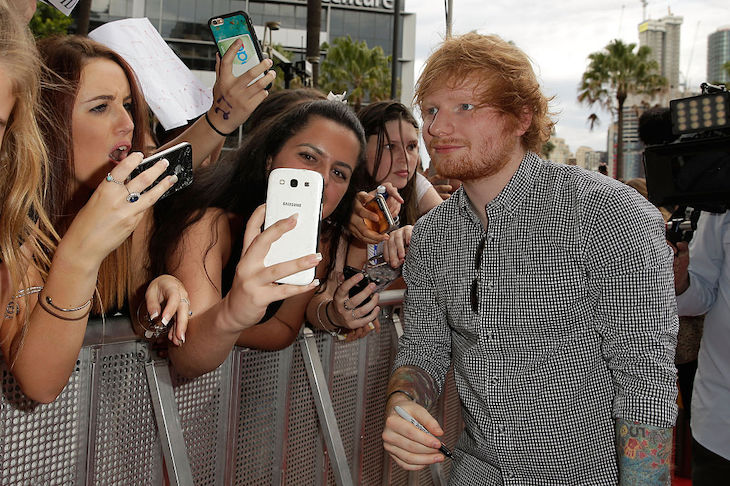
I once wrote that pop stars should either be sexy or profound – ideally both, as with Debbie Harry, but such wonders are rare – and if Sheeran is shallow intellectually, sexually he’s like a bucket of cold bromide. He’s what a rock-and-roll-hating parent would have done to Elvis, given half a chance; taken away all the bumping and grinding and wiggling and leering until what was left was as unlikely to have teenage girls screaming with desire as a Tellytubby. (Which he reminds me of, come to think of it – and his fans would be around the right age to have come under the influence of the cuddly quartet and their crooning inanities.) Yes, I get that something magical happens when a young man, however unsightly, picks up a guitar, allowing him access to a quantity and quality of women undreamt of when he was just walking and talking like a normie; two words – ‘Mick’ and ‘Hucknall.’ But hearing Sheeran sing about sex is like having a supply teacher instruct one on the finer points of fellatio: it’s just wrong.
Politically, Sheeran is a predictable product of his class. The child of an arts curator and a jewellery designer, privately educated, he was opposed to Brexit and – along with Sting – signed a letter drafted by bitter multi-millionaire Bob Geldof warning of the damage done by leaving the EU. This loss to the Brains Trust also described himself as a ‘fan’ of Jeremy Corbyn, opining in 2017 ‘I love Corbyn. I love everything Corbyn is about…he cares about all classes, races and generations’ – shortly before receiving an MBE from Prince Charles. He is, of course, a believer in ‘rewilding’, announcing awhile back that he planned to purchase farmland to plant ‘as many trees as possible’ to offset his carbon footprint after years of flying.
I get that it’s somewhat comedic when we sexagenarians try to understand what gets Modern Youth going. And I admit I’ve been spoilt; I was lucky enough to be young when pop titans – Bolan, Bowie, Bryan Ferry – ruled the airwaves and bedroom walls alike. But modern music is rubbish; this isn’t a pensioner peeve, it’s a fact, unless you’re a Magical Thinker who believes that women can have penises. In the decade of my teens, the 1970s, I was lucky enough to experience the glory days of – deep breath – glam rock, Philly, Motown, disco and punk. The biggest male and female acts of the 1970s – if you combined sales, cred and sheer star quality – were David Bowie and Diana Ross. Now? Sheeran and Adele. You’d have to be certifiable to say that the latter compare.
Of course music goes through the doldrums, like anything else. But the crucial element of Woke-scolding is what makes this slump different and probably permanent. For the first time, young people are having less sex and consuming fewer stimulants than their elders. Instead they are spending long periods of time crouched over their keyboards, glumly interfering with themselves. Wokeness and Covid between them have created Generation Killjoy; punk, disco and glam would all be *problematic* in some way now – too white, not the ‘right’ kind of black, too light-hearted about gender-bending. Gareth Roberts sums up Sheeran well, if over-generously; ‘He’s *all right* which nowadays makes him a megastar. If he’d been about in 1973, he’d have four minor hits and disappeared.’
But most of all, Sheeran exemplifies everything that’s gone wrong with popular music since the middle-classes got their plump pink hands on it; the colonising of rock – previously the best escape route for ambitious and gifted proletarian youth – by privileged poltroons.