-
AAPL
213.43 (+0.29%)
-
BARC-LN
1205.7 (-1.46%)
-
NKE
94.05 (+0.39%)
-
CVX
152.67 (-1.00%)
-
CRM
230.27 (-2.34%)
-
INTC
30.5 (-0.87%)
-
DIS
100.16 (-0.67%)
-
DOW
55.79 (-0.82%)
Why are House of Lords clerics so anti-Tory?
The bishops can smell blood in the water. Sensing how badly the Conservatives are doing in the polls, the two archbishops and 24 bishops of the Church of England in the House of Lords appear to have thrown aside any pretence of political objectivity and impartiality and have pitched themselves all-out against the government. This has been building up since the advent of the Tory-Lib Dem coalition in 2010, but the way that the bishops have taken their gloves off in the present session of parliament is shocking.
Anglican bishops occasionally argue that they opposed the last Labour and coalition governments just as much as they do the present Conservative one, but consider these statistics. In 1999-2000 they opposed Tony Blair in 27.1 per cent of divisions on whipped business, which in 2000-01 dropped to 15.8 per cent. Gordon Brown had to face 50.4 per cent opposition in 2007-08, and 60 per cent in 2008-09, however. Sometimes, such as on the issue of the Iraq war or how long the police could hold terrorists without charge, the bishops would indeed oppose Labour, but it tended to be from the left.
The coalition government was heavily opposed by the bishops: by 74.6 per cent of their votes in 2010-12, 81.8 per cent in 2012-13, 83.5 per cent in 2013-14, and 78.6 per cent in 2014-15. Yet once the Lib Dems were no longer in government, they went into full-scale attack mode. In 2019-21 they opposed the Tory government 94.7 per cent of the time, and in 2021-22 it was 95.6 per cent. Even more ideologically aggressive in this present session, the bishops have cast no fewer than 274 votes opposing the government and only five in support, that is 98.2 per cent of the time. They are on the rampage.
The bishops have cast no fewer than 274 votes opposing the government and only five in support
Astonishingly, more Labour votes have been cast with the government in the Lords this session than bishops’. The Archbishop of Canterbury, who has criticised government immigration policy as ‘ungodly’, has even brought about a vote to amend the government’s Illegal Migration Act during its passage, which is almost unprecedented.
There are of course serious constitutional implications for such a large part of the upper chamber to range itself so heavily on one side of politics, while presenting itself as a sage and balanced honest broker. Tories are anti-disestablishmentarians by conviction, but for how much longer, considering that the bishops skew at the rate of more than 54 to one against them? In the 117 divisions in which I have voted, I have never once seen a bishop in the division lobby that I’ve walked through. (They wear splendid Reformation-period surplices, and so are hard to miss.)
Any bishop who stands up in the Lords chamber has the automatic right – by convention, though not by law – to be heard before any other peer. Indeed, any other peer hoping to speak has to sit down whenever a bishop rises, and thus often misses a chance to do so during ten-minute Oral Questions. Since there is now no real chance that the bishop will say anything supportive of one side of British politics, how much longer can this convention survive?
This precedence is presently given to the Bishop of Manchester, for example, who has voted against the government 39 times this session, and only once for it. Also the Bishop of Durham (30 times against, once for), the Bishop of Southwark (25 times against, not once for), the Bishop of Chelmsford (15 times against, once for) and the Bishop of St Albans (16 against, once for). The House presently listens to them respectfully as if they were oracles, but there is a strong and growing feeling that they should be given no greater precedence in debates than any other partisan political grouping, such as the Greens.
When bishops do take advantage of this right of precedence, they range far from Church or religious matters. The Bishop of Leeds has spoken on 158 occasions, on matters such as Boris Johnson’s meeting with Alexander Lebedev; the Sue Gray report; the size of the civil service; voter ID; economic crime and corporate transparency; lithium batteries; the UK Internal Market Bill; EU withdrawal; aid to Gaza; the BBC, and much more. He gives us a useful running commentary on socialist thought on every issue of the day, which of course is his perfect right, but why should he take precedence over every other peer from any other party?
For an organisation that rightly champions diversity so much, there is no diversity of political opinion on the bishops’ bench: the Bishop of Durham believes the government’s asylum policy is ‘immoral’ and ‘shames Britain’; the Bishop of Bristol voted for higher thresholds for serious disruption on the Public Order Bill; the Bishop of Gloucester thinks it unsafe to send female asylum seekers back to Albania; the Bishop of Leeds has equated Boris Johnson’s attempt to prorogue parliament to Vladimir Putin’s attitudes towards international law; the Bishop of Southwark believes stopping the boats would ‘impoverish the UK’ and accuses Israel of pursuing ‘the permanent inequality and disenfranchisement of Palestinians’, while the Bishop of Manchester claims that ‘everyone’ in his diocese opposed the Minimum Service Levels Bill over strikes.
When it comes to Brexit, Palestine, and illegal migration, there is a predictable uniformity of opinion on the bishops’ bench. It is often pointed out that the House of Lords, with 779 active members, is the largest parliamentary body in the world except for the National People’s Congress of China; what is less commented upon is that the bishops have the same level of ideological diversity as that found in Beijing.
The bishops’ left-liberal views are of course unrepresentative of Church of England congregations, where between 55 and 66 per cent of Anglican worshippers supported Brexit, whereas every prelate in the Lords supported Remain. In the Times’s recent survey of the Anglican priesthood, some 13.2 per cent said they were Conservative, which is also considerably higher than the 1.8 per cent of times that the bishops vote with the government.
If the leftist trending of the Church of England had led to an increase in worshippers it might have been justified, but exactly the opposite has happened. Since the left-liberal takeover of the upper echelons of the Church in the 1960s and 1970s, the number of Britons who attend Anglican services at least once a month has halved, from 1.37 million in 1980 to around 600,000 today. It is a kind of ecclesiastical version of the truism about corporations: ‘Go woke, go broke.’ Yet despite presiding over this collapse in their own backyard, the bishops believe that now is the time to go on the offensive against the elected government of the country.
There are constitutional implications for a large part of the upper chamber to range itself on one side of politics
The Anglican Church has 26 reserved seats in the legislature, while none are reserved for other faiths. When once there would have been Tory voices raised against redistributing Anglican seats in the Lords to other religions, the way that the bishops are behaving as a hardened anti-Tory cadre will ensure that some of those voices will be silent, or even supportive of redistribution.
Were seats to be based on attendance at religious ceremonies, the Anglicans would rate only three or possibly four seats in the House of Lords, and since there are plenty of conservative-minded Sikh, Catholic, Jewish, Muslim and Pentecostalist religious leaders, the prospect of Tory legislation being blocked and delayed might be correspondingly lessened. While the Anglican bishops remain essentially the Labour party at prayer, there will understandably be fewer and fewer Tories prepared to defend the status quo.
The current behaviour of the bench of bishops might force Tories to consider reform, as balance, equity and fair-mindedness, which is what one used to expect from the Church of England, has been entirely lacking in its bishops’ apparent bid to derail the programme of the democratically elected government. Their very radicalism is thus undermining their own chances of surviving in their present form.
Overseas prisons will be disastrous for British inmates
Our prisons are overcrowded, dangerous and out of control. The prison population is rising faster than we can build new cells. Prisoners spend far too much time in their cells, developing mental health problems instead of skills. On Tuesday, the Ministry of Justice announced that it has the answer.
Perhaps surprisingly they didn’t announce more new prisons, or a recruitment drive or to a new scheme to release non-violent prisoners earlier on home detention curfew or ‘tag’. In fact, the new policy is to send prisoners overseas. No, I didn’t have ‘bringing back Transportation’ on my Conference bingo card either. The press release states that the government will look to partner with other European countries in order to rent their prison space.
The decision to start sending prisoners overseas is an admission of failure
It’s hard to understand how we’ve reached this point. The MoJ is right that the ‘average prison sentence has increased by 57 per cent since 2010’ and this is driving our prison population up. But the prison population peaked in 2011 at 88,000 and is actually slightly lower now. So how, when the Tories have been in power since 2010, have they mismanaged the prison system to such an extent that we are no longer able to house all our prisoners in the UK?
The Prison Service budget was cut by 20 per cent during the austerity years. In 2010 there were almost 34,000 ‘operational’ or front-line prison staff. According to the latest figures there are now just 27,811. Those prison officers we do have are much less experienced – 36.3 per cent have less than three years experience. As recently as 2017, over 60 per cent of prison officers had more than ten years experience. Now fewer than 30 per cent do.
In this context it’s unsurprising that prisons are unable to rehabilitate, offer education or even maintain basic order. And now, even after building new prisons and converting 2,400 single cells to double occupancy, we’ve run out of room. All of this makes the decision to start sending prisoners overseas an admission of failure.
Further, even on its own terms, this is bad policy. Foreign national prisoners are already able to apply to serve their sentences in their home countries, so this policy would primarily affect British inmates. 57 per cent of prisoners have literacy levels below those expected of an 11-year-old. Few of them are likely to be fluent in European languages.
Prison is a hard enough experience in your own country. Trying to navigate bureaucracy when you don’t speak or read the language is almost impossible. During my time at HMP Wandsworth I met a lot of foreign nationals who struggled to even choose food or work the phone system.
Even if these British overseas prisons operate in English, we will still be sending prisoners to strange countries, making it impossible for them to maintain family ties or complete in-person accredited courses necessary for their rehabilitation. Prisoners who receive visits from a family member are 39 per cent less likely to reoffend. How many families will be able to afford a journey to another country in order to visit? This policy will do nothing to improve our woeful reoffending rates.
The government mentions similar experiments undertaken by Belgium and Norway, such as Norgerhaven, where conditions are much better than the typical British prison. This will present political challenges as well. How will the public respond to British prisoners serving their sentences in countries like Holland where beer is available from the canteen?
Of course, it’s party conference season, modern Transportation would require new legislation, and the general election is looming next year. Perhaps there’s no serious intent to implement this policy. Perhaps the Justice Secretary, Alex Chalk, believes that sending prisoners overseas is a vote winner.
Unfortunately it’s hard to imagine who will find it appealing. European prisons will not be more punishing than the UK’s. The loss of family ties and access to rehabilitative courses will increase reoffending.
A wealthy, developed nation like the UK ought to be able to operate a functioning prison system which has enough experienced staff and capacity to protect the public, operate safely and ensure that prisoners are less likely to reoffend on release. Instead we have a desperate attempt to outsource and offshore a problem rather than putting the time, effort and money in to solving it.
The Hateful Eight hand the House to the Democrats
In Quentin Tarantino’s The Hateful Eight, a posse of violent ne’er-do-wells forced by circumstance into a house together descend, through duplicity, avarice and lies, into bloody chaos which leaves everyone dead. The title is a fitting one for the eight Republicans who crossed party lines to vote with House Democrats, unanimous in their belief that they are better off without Kevin McCarthy as speaker. In doing so, they ensured the House is controlled by Democrats in all but name.
As the speaker race begins, the odds favor Steve Scalise or Jim Jordan — both more satisfying to the right wing than McCarthy, but far less capable of fundraising as he did to protect the tenuous hold of moderates in blue states. But no matter who replaces McCarthy, the center of gravity for Republican leadership in Washington that stood with House leadership for the past nine months is now in the Senate. With the upcoming elections likely to return Mitch McConnell to majority leader status, or pass the baton to one of the three Johns, it stands to be there for the foreseeable future.
That is not, to say the least, good for the next generation of conservatives.
As historically shocking events go, this one was absolutely predictable. From the moment that McCarthy gave way on the issue of vacating the chair, it was clear that the rules of the Republican Conference — which demand that a majority of the conference be agreed before such a motion is made — would do nothing to hold back someone as single-mindedly and personally opposed to McCarthy as Matt Gaetz.
As former House Speaker Newt Gingrich noted yesterday, in an op-ed calling for Gaetz and his compadres to be expelled from the conference:
Gaetz is violating the House Republican Conference rule that states the motion to vacate “should only be available with the agreement of the Republican Conference so as to not allow Democrats to choose the Speaker.” The agreement made when McCarthy became speaker doesn’t supersede the conference rules. Gaetz still needs a majority of the conference. Gaetz knows he can’t possibly get a majority of the House GOP conference to his side. He is simply violating the rules in the pursuit of personal attention and fundraising.
This is not about ideology. When McCarthy cut the deal that he did in January with members of the House Freedom Caucus, he did so by finding ways to work with some of the most hardline fiscal conservatives in the body. Chip Roy, Thomas Massie, Marjorie Taylor Greene and others all backed McCarthy yesterday because he had, in large part, given them what they wanted: the ability to craft the rules guiding the process and a much stronger voice in crafting legislation. For nine months, McCarthy effectively treated these ideological warriors as part of the team — a far cry from leadership’s past approach of crushing or sidelining them.
For the Hateful Eight, this wasn’t good enough. And since their demands were effectively impossible to achieve — in fact, they regularly worked to ensure they were impossible — they decided it was better to give the House over to Democrats now, rather than wait til next year’s elections. It’s a bold strategy, Cotton. Let’s see if it pays off for them.
A great subject squandered: Golda reviewed
Born in Tsarist Kyiv in 1898, Golda Meir grew up with what she called a ‘pogrom complex’. That perhaps explained why later, as Israeli prime minister, she had such harsh words for Palestinians and Arabs. But then she had harsh words for a lot of people. Moses, she complained, ‘took us 40 years through the desert in order to bring us to the one spot in the Middle East that has no oil’. Women’s Lib, she averred, was ‘foolishness’, since the real discrimination was that men were unable to bear children.
She cuts a lugubrious figure, walking alone down long corridors, lighting one solemn cigarette after another
An inspired phrase-maker, a phenomenal organiser, a patriotic socialist who, as Labour minister, had practically created Israel’s welfare state, Meir makes an inviting subject for a biopic. And Golda starts in the right place, with the prime minister (Helen Mirren underneath three-and-a-half hours of make-up) walking through a crowd of protestors on her way to the 1973-4 inquiry into the Yom Kippur War. Was Golda the saviour of her country, having readied the army for a potential invasion by Syria and Egypt despite the complacent do-nothing advice of her intelligence officials? Or was she out of her depth, having done too little, too late to anticipate a catastrophic attack that took 2,500 Israeli lives?
The protestors’ faces, however, are blurred, and throughout the film the Israeli people – the real protagonists – are strangely absent. When Golda addresses the nation, we see her speaking to the cameras, but there is no shot of families at home, crowded around the TV and wondering whether they face annihilation. The director Guy Nattiv has said he wanted to reproduce the claustrophobic atmosphere of the Tel Aviv HQ, and he succeeds. But claustrophobia only works if it is accompanied by a certain amount of dramatic energy.
True, Mirren channels Golda’s brisk authority, putting generals in their place and strongarming Henry Kissinger (Liev Schreiber) into sending American materiel. For most of the film, though, she cuts a lugubrious figure, walking alone down long corridors, lighting one solemn cigarette after another, entering rooms without any discernible impact. The real Golda’s waspishness is replaced by a gloom so all-enveloping she makes Gordon Brown look like Harry Hill. Nor does anyone else inject much dynamism into the film. Even when the American air convoy arrives by night, a decisive moment in the war and a scene with great cinematic potential, it is presented in static terms, with the top brass all standing stock-still on the roof craning their necks at the sky.
The visual inertia wouldn’t matter so much if the screenplay wasn’t of such variable quality. At its nadir, General Ariel Sharon appears as a grunting man-child. ‘You’ll get your chance one day,’ Golda implausibly tells him, ‘and they’ll make you prime minister for it.’ As we reel at this prophecy, she adds sagely: ‘But remember: all political careers end in failure.’
There are things to enjoy. Rami Heuberger plays Moshe Dayan persuasively as a battle-scarred hero losing his grip but still peerless in his understanding of war. It’s amusing to watch Camille Cottin as Golda’s private secretary Lou Kaddar, loyal, tender-hearted, quietly unshakable – i.e. the diametric opposite of her character in Call My Agent! The early scenes of rising panic are well-constructed.
And we do get a few decent lines, the best by far when Golda negotiates with Kissinger at her kitchen table. He reminds her that he is ‘an American first, Secretary of State second, and a Jew third’. Golda: ‘You must remember, Mr Secretary, that in Israel we read from right to left.’ Then again, it isn’t actually the film’s line. It’s one of Golda’s.
Shocking: Channel 4’s Partygate reviewed
If there were special awards for Most Subtlety in a Television Drama, Tuesday’s Partygate would be unlikely to win one. You could also argue that, in contrast to most of its characters, it didn’t really bring much to the party. And yet, in a rare challenge to the law of diminishing returns, the more it pounded away with its sledgehammer, the more effective it became.
Despite the programme’s commitment to a thoroughly researched veracity that extended to the use of on-screen footnotes, the framework for the pounding was supplied by two fictional characters. Grace Greenwood (Georgie Henley) was a shining-eyed true Johnson believer from Darlington, who couldn’t believe her luck at ending up with the cool kids in No. 10. Providing the worldliness was the terrifyingly poised Annabel D’acre (Ophelia Lovibond), who might as well have been wearing a tiara with the word ‘Entitled’ inscribed in diamonds.
The more Partygate pounded away with its sledgehammer, the more effective it became
Having got over her puzzlement as to where Darlington was, Annabel explained to Grace (and to us) how the Downing Street staff knew each other – mainly from Oxford. She also enlisted Grace’s help in buying extra booze for a party held in May 2020 when, as the programme made characteristically clear: a) Britain had recently announced the highest Covid death rates in the world; b) most people were assiduously following the lockdown guidelines; c) the police were breaking up the gatherings of any who weren’t; and d) one couple had just made themselves hazmat suits so as to hold their new granddaughter.
And this, on the whole, was how this one-off drama proceeded from then on. Scrupulously annotated scenes of drunken Westminster poshos dancing together were juxtaposed with news footage of the most extreme examples of the impact of Covid rules on ordinary folk. A former member of the Black Watch celebrated his 100th birthday by forlornly waving at his family. People at funerals were forbidden from consoling their newly widowed mothers. Any number of grans died alone.
And all the time, Boris Johnson kept the rules coming – at least when he wasn’t (at ‘Party No. 7’) welcoming his underlings to ‘the most unsocially distanced occasion in the UK’.
For a while, the only people in Downing Street wondering if this was a little on the dodgy side were the cleaners. ‘They don’t even wear masks,’ said one as they tidied up another huge batch of empty bottles. But eventually Grace’s non-posho status enabled her to share their misgivings. ‘Is there anything we don’t hold a party for?’ she wondered as three more took place on the same night (and not long before a young man in Leeds was fined £10,000 for organising a snowball fight). ‘It’s our job to make the rules… not to follow the rules,’ Annabel duly told her. The big finish was a brisk anthology of the real-life Boris’s 2022 declarations that ‘the guidance and rules were followed at all times’.
When Partygate was in its early stages, I rather expected that this review would major on its lack of nuance. Ultimately, though, its anger seemed so obviously righteous – and its recitation of chapter and verse so increasingly shocking – that I couldn’t imagine even the most Cavalier of viewers not being in touch with their inner Roundhead.
The drama series Boiling Point follows on from the 2021 film of the same name set in the particularly accident-prone kitchen of an upmarket London restaurant. Back then the boss was the drink- and drug-addicted Andy Jones (Stephen Graham), who ended the movie having a well-earned heart attack. Now most of his former staff have joined his assistant Carly in her new venture, which has the possibly ambitious idea of giving traditional northern cuisine a five-star London twist.
The film was done in a single shot, as was Sunday’s ten-minute adrenaline rush of a pre-title sequence. After that, things did settle down a bit – but only a bit, because even when permitting itself the luxury of discrete scenes, Boiling Point proceeds at quite a lick, giving us a blizzard of characters, plots and kitchen-related disasters without ever skimping on the quickfire dialogue or the mouth-watering shots of high-speed food preparation.
The only bad news for viewers was that Andy’s continuing recuperation meant that we had few sightings of Stephen Graham. Not until the closing scenes did Andy appear, living his new life of drinking lots of beer in front of the snooker – or ‘living the dream’ as some of us might call it.
Weirdly, however, Andy was not among them – and the episode ended with hints that he might be about to rally, renew his relationship with Carly and pick up his knives once more. If he does, I’d firmly suggest, a show that’s already off to a fine, sure-footed start will soon get even better.
Godot with gags: It’s Headed Straight Towards Us, at Park200, reviewed
It sounds like a barking-mad student sketch but the final product is marinated in wisdom and maturity. It’s Headed Straight Towards Us is a mellow riot of a play. The setting is a rocky glacier in Iceland during the filming of a corny sci-fi movie. Hugh (Sam West) is a cerebral thesp who specialises in playing butlers and high-status toffs. On set, he meets his best friend from drama school, Gary (Rufus Hound), whose career has declined to the point where he’ll accept any role going. Tragic Gary used to be a star who earned a fortune as a cockney villain in the 1980s but he succumbed to alcoholism and ill discipline, and he now has little in common with Hugh who lives in London with a couple of pet dogs and a solicitous male lover. He’s horrified when Gary barges into his luxurious campervan and demands companionship and gallons of wine. But gradually the old pals start to bond as they gloat over the excesses and pratfalls of their former colleagues.
Hugh is fixated by Daniel Day-Lewis who, he says, ‘made 14 pairs of riding boots while filming The Last of the Mohicans’. Gary simmers with hostility towards the mothers of his many children and he convinces himself that the young runner (played by the excellent Nenda Neururer) is his long-lost daughter. The script is a lot smarter than it wants to admit. In truth, this is a symbolist drama that examines two halves of a single character. Hugh stands for circumspect intelligence, Gary for knee-jerk instinct.
The ancient binaries are beautifully revived in a crisp, witty script from Nigel Planer and Ade Edmondson. They end their story on a bleak note that calls to mind the most wretched depths of 20th-century existentialism. But there’s laughter added. It’s like watching a Ionesco classic without enduring the weight of footnotes, asterisks and impenetrable marginalia. If you like, it’s Godot with gags. Superb direction by Rachel Kavanaugh. And a semi-miraculous set by Michael Taylor that manages to suggest the orgasmic convulsions of an earthquake that rumbles beneath the Icelandic permafrost. Could the show manage a West End transfer? Tricky. The lead actors, begging their pardon, are not quite starry enough. Perhaps the authors, Planer and Edmondson, would make a better job of convincing potential investors to take a punt.
Octopolis is a slick new romcom set on a university campus. The main character, George, is a widowed marine biologist who spent her career pestering a captive octopus in the name of science. She and her deceased husband liked to withhold food from the poor beast until it changed colour. Once it had performed this trick, they gave it a morsel of nourishment while they wrote up their notes in scholarly essays. It never occurred to them that they were guilty of animal cruelty.
George is visited by a thrusting young anthropologist, Harry, who lectures her on the topic of civilisation and its progress from magic to religion, and finally to science. Fascinating stuff but it belongs in a seminar room, not a theatre. Eventually, the two boffins leap into bed together and their erudite jabber continues as they navigate the terms of their hurried affair. The script feels a little tricksy because the characters read out the stage directions as well as their dense, wordy dialogue. At its best the show perfectly captures the mindset of ambitious university types. They’re garrulous and argumentative, ceaselessly curious and maddeningly logical; and they can be fickle, narcissistic and emotionally brutal too. If you know a teenager whom you wish to inoculate against a career in academia this play will prove highly effective.
But the story is unsatisfactory as a romance. We hear too much about the love-lorn squid-fancier, George, and not enough about her strapping young paramour. Where did he come from? On what terms are they cohabiting? Is the action set in an office, a laboratory, or a campus bedsit? Or is it a bit of all three? Above all, we need to know what drove Harry into the arms of a lonesome fish-botherer who looks about 15 years his senior. And the romance comes to fruition far too fast. As soon as the affair begins, George mentions ‘love’ without realising how scary that word sounds in the exhilarating early stages of a fling. She’s in her fifties but she acts like a giddy teenager ravished by a dashing film star.
The writer, Marek Horn, evidently appreciates the finickity intellectual habits of academics but his pedantry doesn’t extend to the play’s title. The word ‘Octopolis’ means ‘eight cities’. The term he wants is ‘octopodopolis’ which means ‘a city of eight-legged things’. If you found that philological aside interesting, you’ll like this play. If it you didn’t, you won’t.
An awfully long night for a band without any bangers: The National, at Alexandra Palace, reviewed
Over the past few years, the National have become the most important band in modern rock music. The strange thing is that this has happened at a point when their own work has perhaps lost a little of its earlier intensity. They’ve become important because they have come to represent something to other artists: a kind of adventurous but accessible integrity. The brothers who are the musical core of the band – guitarists Aaron and Bryce Dessner – have been so in demand that they have worked with, between them, (deep breath) Taylor Swift, Ed Sheeran, Michael Stipe, Sharon Van Etten, Bon Iver, Philip Glass, Steve Reich, Paul Simon, Sufjan Stevens, Nico Muhly, Jonny Greenwood, Bruce Springsteen and Ryuichi Sakamato. And those are just the ones you might have heard of. Then there are the three festivals that Aaron helps run. Their tentacles are everywhere.
At 90 minutes I’d have been transported. At an hour more, I was wondering when I might get home
It’s easy to see why everyone fancies a piece of them. At Ally Pally – hands down the worst major concert venue in London: terrible sightlines, awful sound – they showed their gift for music that manages to be as accessible and unspecifically emotional as Coldplay, without ever feeling as though they are scrambling around for the lowest common denominator. The band – the Dessners, plus singer Matt Berninger and sibling rhythm section Bryan and Scott Devendorf, supplemented by a couple of horn players – showed their mastery of tone and texture, and on the set-closing trio of ‘Pink Rabbits’, ‘England’ and ‘Fake Empire’ they were breathtakingly good.
But I’ve never been able to buy into them completely. I’ve seen them a lot over the years, and like a group I truly love, Yo La Tengo, I never know which way I might turn when I see them live: will I be bored rigid, yearning for songs that actually go somewhere rather than churning intensely on the spot, or will I be hypnotised by the mood and luxuriant sound of it all? At Ally Pally, I was halfway between the two: they played for just shy of two-and-a-half hours, which is an awfully long time for a band short on copper-bottomed, undeniable bangers. At 90 minutes I’d have been transported. At an hour more, I was wondering when I might get home. My feeling is that the best National-adjacent record is Taylor Swift’s Folklore because you can be pretty sure she wanted definite purpose to all the gauzy beauty.
Then there’s Berninger’s collection of tics, which veers a little close to self-parody, and his odd, distracting vocalisation (he seems to swallow the ends of words which means he rarely seems to be singing complete sentences). The lyrics, too, were poised in a strange place between profound and meaningless: ‘Bloodbuzz Ohio’, one of the very few undeniable bangers of the night (with a perfect, mysterious title), has a chorus that runs: ‘I was carried to Ohio in a swarm of bees/ I never married, but Ohio don’t remember me.’ It must mean something, right?
Still, when I looked at Instagram the next morning, it seemed as though every single person I knew had been at the show, and everyone thought it was one of the greatest things ever. So I’m perfectly prepared to concede that this is about my shortcomings rather than the National’s.
Watching PiL at the Forum in Kentish Town, the thought occurred: oh, this is just like going to see the Who. Not that PiL sound like the Who: more that John Lydon, like Pete Townshend, is trapped in a furious persona he created decades ago. He has to wheel it out for the delectation of beered-up geezers who don’t seem terribly interested in the vulnerability and pain and terror at the heart of the best songs, but want instead to throw their plastic pint pots and push each other around.
Lydon keeps on working – there was a pretty decent new PiL album this year. The best songs, though, were the ones from their second album, Metal Box, which still sound like a dream turning into a nightmare in real time. And the most moving moment came after the music had stopped, when Lydon – freed at last from having to tell people to eff off – asked the crowd to shout an ‘Aloha!’ for his late wife Nora. When they did, he screwed up his eyes and his shoulders shuddered. And he didn’t look like a caricature, furious, or confrontational. He looked human and weak and entirely unlike the Lydon he usually offers to the world.
Why everyone should go to life-drawing classes: Claudette Johnson interviewed
While looking at Claudette Johnson’s splendid exhibition Presence at the Courtauld Gallery, I kept trying to pin down an elusive connection. Her works are large drawings (sometimes very large – one reclining figure is more than two-and-a-half metres wide), and each one zooms in on a single figure seen in close-up, often larger than life-size. They reminded me of something, but for a while I couldn’t place it. About halfway round I got it. They look a little like fragments from the cartoons Renaissance masters made as templates for painting. These, too, tend to concentrate on the human body on a monumental scale.
Those who dedicate themselves to drawing and work from live models are scarce. Johnson does both
Claudette Johnson is female and she is black, neither of which are as unusual in the art world as they were when she began her career in the early 1980s (one respect in which the world has become better since then). But she is a highly unusual artist for another reason. Those who dedicate themselves to drawing and work from live models are scarce nowadays, and Johnson does both.
There are quite a few artists around who depict what David Hockney likes to call the ‘visible world’ (sometimes described as ‘figurative’), but these days they are more likely to work either from photographs or imagination. When we met, Johnson told me why, despite the difficulties, she prefers to sit and draw in front of a living, breathing person. In fact, she does this partly because of the difficulties. Working from life, she explained, is not only more challenging but also more embarrassing (which was one of the reasons why Francis Bacon used photographs rather than living sitters). ‘When I’ve worked with someone I didn’t know particularly well,’ she said, ‘there’s always an initial period of awkwardness.’ That’s not hard to understand. After all, artist and model are in close physical proximity and in her case, as she works slowly, the process goes on for weeks on end. To add to the embarrassment, one of the two people in the room is scrutinising the other’s appearance very closely.
Sometimes, Johnson begins with ‘sketches or lighter-weight drawings’ to get over ‘the nervousness of looking intently at somebody I don’t know very well’, and also to fend off negative reaction (‘Ooh. Is that what you are seeing?’). Sometimes she confesses to issuing instructions: ‘Do not look at that when I leave the room!’
Then there are the technical complications of working from life. A photographic image never alters but, as many artists have noted, reality does so constantly. Johnson finds that ‘the light changes through the session, therefore I have to shift my description’. Also a photograph is already flat, whereas obviously a human being is not. But Johnson finds that ‘transferring a three-dimensional figure into a two-dimensional space, creating that illusion of depth and volume and solidity, fascinates me’.
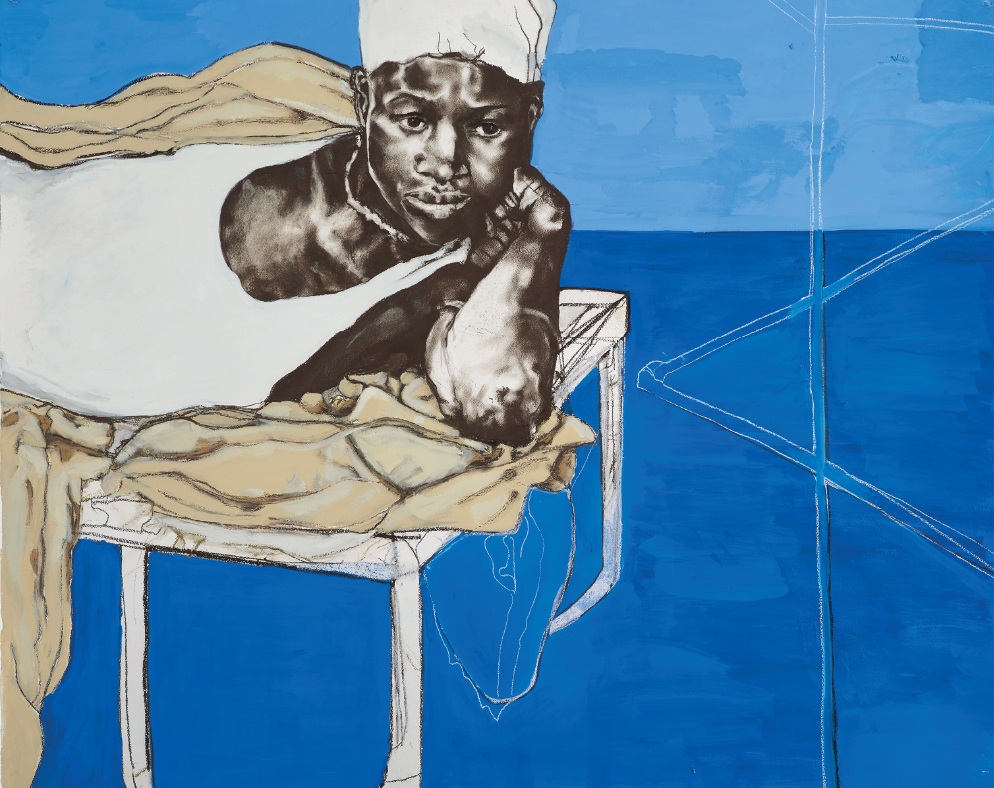
It is a moot point whether her works should be classified as drawings or paintings. Perhaps they are both. Sometimes they include areas of brushwork as loose and free as a Pollock or De Kooning. The whirl of brush strokes that make up the dress worn by the ‘Figure in Blue’ (2018) could be extracted and displayed as an abstract painting. Johnson admits that she ‘loves handling paint’ enjoying its ‘fluidity’. But really, she goes on, she thinks of herself ‘as someone who draws’.
The frontier between these two kindred art forms is not a sharp one, more of a spectrum. But the distinction isn’t solely an academic one. It affects how artists think of themselves and what they do. The late Paula Rego once told me that she was at heart a ‘drawer’ (for obvious reasons the traditional term ‘draughtsman’ isn’t a good fit either for Rego or for Johnson).
Rego found her ideal medium in pastel, as did Edgar Degas, another archetypical painter/draughtsperson. This is, of course, a medium in which you can draw in colour. Johnson frequently uses pastel for the faces and flesh of her subjects and gouache or watercolour for their clothes or (alternatively) the settings in which they appear. The woman in ‘Untitled (Yellow Blocks)’, 2019, for instance, is standing in front of a series of rectangles of yellow, some paler some darker, but the figure herself is entirely monochrome and executed in pastel.
Some painters aren’t all that good at drawing. Bacon’s friend Lucian Freud used to say that ‘Francis couldn’t draw at all, but he was so brilliant he made you forget it’, which was a good way of putting it. With Rego, Degas and Johnson too, as one can see from all the works in this exhibition, drawing comes first.
She is another specific variety of artist in that her interest is almost entirely in the human face and body, which, she points out, is among the most intricate objects we ever set eyes on – and certainly the one that we, as fellow humans, know most intimately. ‘People forget that the geometry of the body is more complicated than any building or man-made structure you can think of. The way things sit together. You cannot lie and be convincing about the body. Everybody knows if a line is wrong or if the foreshortening isn’t quite there.’
Perhaps the most distinctive aspect of Johnson’s art is that for many years her subjects were exclusively black women (in the past decade she has added black men to her repertoire). There were reasons for that choice. At art school she was the only black student in her year, and she wanted to make herself more visible. ‘But more widely I felt that black women were invisible, especially in art.’ In western painting of the past, ‘we’re on the periphery, we’re offering the flowers, we’re holding the fruit. We’re there to put into relief the white woman who’s at the centre – Manet’s “Olympia” being the obvious example – or we’re just absent.’
Drawing from life is a marvellous way truly to see other people because to do so you have to look at them really, really hard. In doing so for more than 40 years, Johnson has made images of a group of people who – it is perfectly true – were largely overlooked in western art. And in doing so she has made pictures that are at once monumental and intimate, fresh and contemporary while fitting into a long tradition.
Her achievement is clear from the exhibition at the Courtauld, which includes works spread over four decades. She began strongly and seems, if anything, to be getting stronger as she goes on. Working from life seems continually to refresh artists who work in that way.
When I asked Johnson whether everyone should go to life-drawing classes, she at once answered: ‘Yes!’ The reason is that through drawing you learn so much about human beings. ‘Everything is normal, everyone is interesting, everything is exciting to explore!’
Ebullience and majesty: Opera North’s Falstaff reviewed
Opera North has launched a ‘Green Season’, which means (among other things) that the sets and costumes for its new Falstaff are recycled. On one level, that’s nothing new: this eternally underfunded company has been performing miracles of sustainability for years now, and there’s usually at least one production each season that looks like it’s been cobbled together from the lumber room. A few seasons back, when ON rebooted their ‘little greats’ season of one-act operas, they mixed ’n’ matched sets between wildly different operas, with cheerful abandon.
Sir John lives in a caravan and quaffs sack in his underpants – shades of Jez Butterworth’s Rooster Byron
Still, it’s a perfectly laudable aim, even if it requires some Olympic-level mental gymnastics regarding the content of the operas themselves. The director, Olivia Fuchs, is more than up for the challenge. ‘I think it could be true that Falstaff is giving us a lesson in how to live within limited means and have fun,’ she observes in the programme book. Meanwhile on stage, Falstaff promptly defaults on a bill for six chickens, 30 bottles of sherry, three turkeys, two pheasants and an anchovy. Fair play: if that’s a viable strategy for reaching Net Zero, it’s one that we can all get behind.
Fuchs is an excellent director – pretty much the best in the UK, these days, when it comes to Janacek – and although she talks about setting the action in ‘the aspirational world of 1980s middle-England’ there isn’t a mean bone in this Falstaff. English archetypes abound. Sir John (Henry Waddington) lives in a caravan and quaffs sack in his underpants – shades of Jez Butterworth’s Rooster Byron. You just know that Richard Burkhard’s slick-haired, tight-suited Ford made his pile selling second-hand Jaguars. The Merry Wives are first seen on a tennis court where Fenton (Egor Zhuravskii) is the young, sexily bedraggled coach and Nannetta (Isabelle Peters) is an all-singing Joan Hunter Dunn.
Under Fuchs’s direction these two come across as a wholly believable pair of infatuated teens, equal parts awkwardness and innocent lust, and Zhuravskii’s serenade in Act Three is exactly the idyllic aside that it should be (the librettist Arrigo Boito compared the Fenton/Nannetta romance to ‘sugar sprinkled on a tart’). The guts of the plot – and what an abundant spectacle they make here – concern Falstaff and the Fords, and Kate Royal was a laughing, sparkling Alice: as light on her feet as she was sensuous in her singing. There’s a sultry, well-oaked tang to Royal’s soprano that should have warned Falstaff that he was out of his depth: but something majestic lies beneath the preposterous surface of Waddington’s fat knight – an eloquence that made Falstaff’s brief moment of self-awareness at the start of Act Three strike deeper than usual.
Meanwhile, the leftover 1980s costumes gradually ran out, and by the final scene we might have been watching a production set in Shakespeare’s day. Herne’s Oak was constructed entirely from antlers (sustainable, you see: the deer at Harewood House just leave the things lying about) – a properly impressive effect from designer Leslie Travers. Garry Walker conducted Verdi’s score like a symphonic scherzo, ebullient and with bounding momentum. Oh, and the whole thing was sung in English, in the late Amanda Holden’s remarkably deft translation, so the audience laughed at the jokes in real time. In the closing fugue, when the cast stepped through the multicoloured ribbon-curtain (a final, droll touch of retro) to address us directly, the connection felt real.
Purcell and Dryden’s King Arthur is usually called a ‘semi-opera’, overstating its dramatic qualities by a factor of at least 50 per cent. The story is set in Kent, where King Arthur and his blind fiancée Emmeline battle the invading Saxons while avoiding the nymph-infested fountains and enchanted clefts so characteristic of the M20 corridor. My wife is into Restoration theatre in a big way, and I rely on her to explain to me that, for example, Grimbald the Earthy Spirit represents… well, it’s usually the Jacobites. Were Jacobites a clear and present danger in 1691? ‘The whining pretender is sure to displease,’ intones Dryden’s libretto. Anyway, it usually seems to be them.
Purcell’s score has little to do with the plot. It’s a collection of incidental pieces and masque-like sequences in which assorted classical deities plus the brilliantly named Cold Genius hymn the glories of the Revolution Settlement and (in one remarkable sequence) the wool industry. For this concert performance by the Early Opera Company, Lindsay Duncan narrated the absent story, skilfully rewritten by Thomas Guthrie, and she made it sound as though it meant something. And so, in fairness, did conductor Christian Curnyn and the five soloists, who moved elegantly between solo and ensemble numbers, with the bass-baritone Edward Grint powering grandly through the texture. The orchestra glided from lilting dance rhythms to languorous song; their ensemble sound was luminous and full. Imagine saying that about a period-instrument performance even 20 years ago.
Marina Abramovic’s show is only of interest to diehard fans
‘Do women have to be naked to get into the Met Museum?’ More than 30 years after the Guerrilla Girls posed this question on their feminist poster, the answer suggested by the Royal Academy’s Marina Abramovic retrospective – touted as the first solo show by a woman artist in the main galleries – is: ‘They don’t have to, but it helps.’
Abramovic achieved fame in the 1970s with a series of gruelling performances that tested the limits of her mental and physical endurance. But without the nudity, performances such as ‘Freeing the Body’ (1975), in which she danced till she dropped, and ‘Lips of Thomas’ (1975), in which she consumed a kilo of honey and a litre of wine before flogging herself, incising a communist star on her stomach and lying on a cross made of ice, would not have attracted the same degree of attention.
It’s hard to imagine a better antidote to Abramovic than Sarah Lucas
It’s no accident that a performance involving nudity is the talking point of this show. Now 76, Abramovic no longer performs in person but has trained up a roster of young artists in her method to revive four signature works. Two of them are presented by nude women; a third, ‘Imponderabilia’ (1977), recreates a legendary performance in Bologna in which Abramovic and her then partner Ulay stood like human caryatids in a gallery entrance obliging visitors to squeeze between their nude bodies until the polizia arrived to spoil the fun. The boys in blue won’t be descending on Burlington House as the door in question is well within the gallery precinct, and embarrassed visitors are given the option of slipping round the side.
The whole exhibition is sanitised. The pile of rotting cow bones Abramovic scrubbed clean in ‘Balkan Baroque’ (1997), stinking out the basement of the Italian Pavilion at the Venice Biennale, lies clean and dry on the gallery floor. Her more violent performances are documented in photographs, while videos of less shocking ones play on screens: ‘Freeing the Voice’ (1976), in which she screams herself mute, fills adjoining galleries with the sound of souls in torment.
What’s it all about? Purgation. The artist’s suffering, we’re told, is cathartic, helping us overcome our fear of pain and death. No wonder it’s purgatory. But the big problem with this show as an art exhibition is that it contains almost nothing of visual interest. Abramovic’s performances were always closer to spectacle than art. A few repeat performers can’t breathe life into this archive of an exhibition: their contributions have all the thrill of a tribute act, only of interest to diehard fans. Fortunately for the Academy there are plenty of those. It’s rumoured that the artist may appear at some point to engage with her public in the Academy courtyard. Perhaps as a grand finale she could have herself fired across it from a cannon, then this damp squib of a show could go out with a bang.

It’s hard to imagine a better antidote to Abramovic than Sarah Lucas: she was always the least pretentious of the YBAs and her irreverence seems immune to ageing. Her retrospective at Tate Britain, Happy Gas, is a reunion of all her trademark lines: cellulite-dimpled ‘Bunny’ sculptures made of stuffed tights; concrete casts of giant marrows with names like ‘Kevin’ and ‘Florian’; everyday objects clad in appliquéd cigarettes; and bawdy visual puns confirming allegiance to British working-class humour. A ‘Man’s Wanking Armchair’ (2000) with a mechanical arm faces a wall of blown-up spreads from the Sunday Sport with misogynistic headlines like ‘Fat, Forty and Flab-ulous’ (1990). Too skint at the time to afford art materials, she decided an artist didn’t always have to make things: sometimes it was enough to point them out.
It was a shortage of funds that first made her turn to tights as a modelling material; now she can afford to combine them with bronze. The spine of the show is a parade of headless bunnies sprawled across chairs in various stages of abandon. If Abramovic takes inspiration from the baroque, Lucas looks a lot further back: ‘Sugar’ (2020), sprouting multiple breasts formed of stuffed tights with knots for nipples, is a cross between Diana of Ephesus and the Venus of Willendorf. The worry is that more recent works in polished bronze will be taken seriously.
Early photos of the fresh-faced young Lucas with that famous banana are followed in the final room by a series of blurry recent shots of her wreathed in tobacco smoke which she describes as ‘hellish’. Better hell than purgatory. Incidentally, the Academy has a short memory: the first woman to be given a retrospective in the main galleries was Liz Frink in 1985. Frink slipped through the glass ceiling without fanfare. What’s more, she was offered the presidency and refused because it would have interfered with her work. If that’s not sticking it to the patriarchy, I don’t know what is.
Stone is the solution to many of our architectural problems
The story of ‘The Three Little Pigs’ is hammered into us all from an early age. But its moral lessons obscure its more literal advice about building: skimping on materials is a false economy. It’s a lesson learned too late for schools built with reinforced autoclaved aerated concrete (Raac). Who would’ve predicted that concrete made cheaper by cutting it with air, puffed up like a Malteser, would end up crumbling like one too? It’ll soon prove that the initial cost savings of Raac will be wiped out multiple times over once the risk to life and expensive, disruptive repairs have been taken into account. Getting materials wrong almost cost the little pigs their bacon. Is it any surprise that we are returning to building in solid, dependable masonry?
While we build extensively in brick, tarting up mediocre developments in a half-hearted response to local context, stone masonry doesn’t require multiple mines for its ingredients, or energy and emissions-intensive firing; stone is simply quarried and cut to size, at a fraction of the environmental impact of brick, let alone that of concrete. For a construction industry charged with causing 40 per cent of the UK’s carbon emissions, stone seems to be a no-brainer, lying readily beneath our feet.
Stone is quarried and cut to size, at a fraction of the environmental impact of brick, let alone that of concrete
I speak with the architect Amin Taha, who, along with his engineer collaborator Steve Webb, is among the leading evangelists for stone, and has been making the environmental case for using it as a load-bearing material. We meet at 15 Clerkenwell Close in London, the building that is his home, the office of his architectural practice Groupwork and his manifesto for stone architecture. Five years after its completion, it has settled in gracefully, with creeping vines colonising its façade. And what a façade – among drab offices and flats, Amin’s building retains its original, elemental radicalism: limestone blocks stacked into a grid of beams and posts, with the satisfying solidity of a megalithic structure. There is no mistaking this stone for some effete decorative veneer; it holds up the building, just as it did for the long-lost limestone Augustinian abbey that once stood here.
Before we even start our conversation, Amin puts me to work, handing me a stone block to hammer open a crate of samples just arrived from a quarry in Spain. There is a garden next to the building, and Amin has been filling it up with bits of stone, gradually turning it into a sample library for architects eager to learn more about using the material.
Perhaps that learning is sorely needed. ‘Architects, and I’m no exception, are pretty badly educated about materials and their cultural and architectural history,’ Amin laments. He pins the blame on a moment in the 1790s when architects reinvented themselves as a gentlemanly profession. Eager to distance themselves from tradesmen, they abandoned tectonic, hands-on learning. Stonemasons’ apprenticeships were out. Instead ‘we’re just going to learn how to draw; preferably the classical orders, preferably Greek.’ The preoccupation with drawing still survives in architectural education today.
I ask if the fallen, half-carved Ionic column in front of the building references this. In fact, it’s one of multiple inside jokes, one of which refers to architects’ fetishisation of stone ruins, such as how Joseph Gandy’s paintings depicted John Soane’s then-unbuilt buildings as ruins-to-be. ‘They were saying: your ruins will be like the Romans’, they’ll be the legacy of a great empire.’
Does he think stone is still tinged with conservative or even imperial connotations? ‘For some, stone was inseparable from edifices that represented attitudes that led to war. After two world wars, they wanted to sweep aside that past and embrace the new.’ In the heady haze of technology’s ‘white heat’, was Raac one embrace too far? ‘We all experiment in life, and we make errors.’ At least with stone construction we can rely on an experimental record dating literally back to the Stone Age.

For Amin, stone’s cultural baggage is trivial. ‘It doesn’t and shouldn’t have any political connotation. We can cut it out and do what we want: classical details, gothic revival, or something more contemporary.’ When viewing Amin’s building – a raw expression of how that stone is split and sawn according to the quarry master’s judgment – alongside the Portland stone classical pediments of St James’s Church across the road, it’s solid proof of the neutrality of stone in the culture war of architectural styles.
Embracing materials of progress – steel, concrete, glass – also meant losing quarries and skills passed down generations; stone now costs more than it should. But Amin can already see demand for its eco-credentials turning the tide. So why aren’t architects just using it? Amin traces the problem back to the same root: ‘We’ve trained architects to draw beautiful façades, effectively a piece of wallpaper that is tacked on to the structure.’ Design stages, planning, consultants and even fees are structured in a way that treats materials as interchangeable annotations on drawings rather than entirely different ways of building. Structural stone construction requires architects to go that extra mile.
Planners, too, quite literally had a bone to pick with the location of naturally occurring fossils in Amin’s limestone façade. I ask if the planning system, forged in post-war years around mass-produced building ‘products’, is a barrier for materials with natural variations. He agrees. Those in power would do well to remember that buildings deemed ‘officially beautiful’ by various housing ministers, such as the limestone Royal Crescent in Bath, were accomplished without overbearing planners.
While Amin’s building narrowly escaped its trumped-up demolition order from Islington Council in 2019, it will eventually reach the end of its life. But not so for the limestones from which it is built. Stone’s longevity and reusability is ancient wisdom: think about how bits of Roman column were reused as spolia in Renaissance Italian walls, or the importance of the ‘stone robbing’ of Norman castles to create places like Castle Combe. Why bother quarrying when you can use stone that’s already cut and carved?
It’s yet another traditional building practice being revived for sustainability reasons, further diluting stone’s environmental impact across multiple lives. I speak to Juliet Haysom, an artist and educator at the Architectural Association. Juliet’s brother Mark runs the family business, a quarry and masonry works, source of Purbeck-Portland stone, which has engaged 11 generations of Haysoms.
Juliet, with Aude-Line Dulière, was behind Placeholders at the London Design Festival 2021. As part of the controversial V&A extension by Amanda Levete Architects, the Aston Webb screen on Exhibition Road was opened up, and the fine Portland stone ashlars removed and left to languish in storage. These were rescued from being crushed into gravel by Mark’s business, who relocated the stones to his quarry in Dorset. The opportunity came for their return when Juliet and Aude-Line proposed reassembling the stones into street furniture outside the V&A.
Kensington and Chelsea council set out to spend about £1.25 million on ‘hostile vehicle mitigation’ measures on Exhibition Road, commissioning solid granite benches quarried in India, tooled in Italy, before being shipped to London. It’s perverse when stones that had come from that very road were ready to be used. When the Suez Canal obstruction delayed the new granite, through serendipity and Juliet and Aude-Line’s negotiations, Placeholders filled the gap.
I can’t see how new (probably machine-milled) granite can compare with the patina of age: the ashlars embody hours of Edwardian stonemasons’ skilled labour. They also bear witness to more than a century of London’s history: ‘That wall had retained the evidence of two incendiary bombs from WW2, with some stones having shrapnel patterns,’ says Juliet. Like in Venice’s patere – marble reliefs from the Byzantine mainland reused as wall decorations – repurposing stones is not just economical, but a material reminder of places, buildings and lives past.
It’s no surprise that our bureaucracies are a barrier here too. ‘Rather than requiring complete standardisation before permitting reuse, we need to trust the connoisseurship of those who work with stone,’ says Juliet. ‘There’s so much embedded expertise. How some stone is cut vertically or horizontally affects its appearance and strength. There’s skill needed to identify stone, which varies in properties within the same bed. It’s not a handbook or colour chart you can follow.’ As recent years have shown, building regulations themselves are far from infallible. Perhaps there’s deeper knowledge in a stonemason’s intuition we’ve yet to unearth.
As I scroll idly on Instagram, I notice one of Charlie Gee’s posts, a 20-year-old stonemason who has amassed half a million followers with videos flaunting his chiselwork and his chiselled physique. It seems this connoisseurship extends to sex appeal. If even Gen Z can rediscover this traditional material’s allure, then its comeback might as well be set in stone.
Bridge | 07 October 2023
The Vilnius Cup – the Grand Prix of Poland – is a highly enjoyable, strong annual tournament, impeccably organised by Erikas Vainikonis. Thirty-two teams played to qualify for the eight-team final which team SUSHI dominated, cruising undefeated through the playoffs to claim the €3,000 prize by a big margin. Congrats to Nathalie Shashou and Nick Sandqvist and their A-list teammates Frederic Wrang and Antonio Palma.
Nathalie was on fire all through the final, as shown by the neat little hand above (see diagram).
Nathalie’s 2NT showed exactly 6-4 in the minors: with 6-5 or 5-4 she would have bid 3♣, and with 5-5 she would have jumped to 2NT over 1♥.
How would you play 3◆ when West leads a Heart to the Jack?
While we could, in theory, work out every play at the table, most of us are not that clever or that quick; Nathalie came up with a brilliant solution. Her best move after ruffing the Heart at trick one is hardly obvious.
She could try a Club to the Jack, but you can bet your bottom dollar that the defence will play three rounds of trump, and she will lose a Spade, two trumps and two Clubs, as she won’t get a ruff in dummy.
Nathalie neatly placed the Queen of Clubs on the table (!), and the defence was paralysed; they have to win and draw trumps or she would get a Club ruff in dummy and even make a couple of overtricks.
But now the Jack of Clubs served as an entry to take the Spade finesse, and all she lost was four tricks in the minors.
Suella Braverman is a force to be reckoned with
After Suella Braverman announced her candidacy for the Tory leadership on ITV’s Peston show in the summer of 2022 the liberal left laughed at the very idea. Someone even asked Robert Peston online: ‘How did you keep a straight face when Suella B said she’d stand for Prime Minister?’
Well, as Bob Monkhouse once observed of those who scoffed at his youthful declaration that he wanted to become a comedian, they’re not laughing now.
Braverman’s Conservative conference speech confirmed what her recent Washington speech suggested: that she has become one of the most compelling figures in UK politics, unignorable indeed for the British left who find themselves lapsing into paroxysms of rage every time she opens her mouth.
The Home Secretary has a talent for an explosive soundbite that will propel her to the top of the news agenda. In the Commons last year she referred to the small boats problem as an ‘invasion’ of southern England. In Washington last week she spoke of the multiculturalism so beloved of the metropolitan elite as having failed. Yesterday’s key provocation was a reference to the world facing a ‘hurricane’ of mass migration.
In an apparent recognition by Labour that its hysterical reaction to her language has in the past done it no favours with the electorate, the party’s shadow home secretary Yvette Cooper this time avoided going into full scale moral outrage mode. Instead, she claimed Braverman had ‘totally lost control’ of the immigration system and was ‘devoid of practical policies’. This was the very criticism levelled by the new darling of the Conservative conference Nigel Farage and also by Priti Patel, her predecessor at the Home Office.
Given the Tories have been in power for 13 years, the idea that radical language on big policy areas now is ‘just talk’ ought to have traction with voters. And yet I can’t see that working against Braverman. So uncompromising is she and so prepared to utter hard truths that the electorate will – and already has to an extent – pick up on the idea that she is having to work with one hand tied behind her back.
It is obvious that were she running Downing Street then she really would be prepared to do whatever it takes to stop the boats and to greatly reduce legal immigration as well. In the former case if that necessitated leaving the European Convention and the Refugee Convention too, or setting up a camp on Ascension Island and transporting illegal arrivals there, she is the one major figure the electorate knows it could count on not to shy away from such action.
And in the eyes of a big chunk of voters, especially the lost tribe of disenchanted right-wingers who voted Tory in 2019 and must be wooed back, that adds up to a powerful case for wishing she was prime minister instead of the incrementalist-in-chief Rishi Sunak.
Yet Sunak seems to understand that rather than be threatened by this Brexit Spartan who was instrumental in the downfall of Theresa May and Liz Truss and then in blocking a return for Boris Johnson, he can benefit from her newfound superstar profile.
Keeping relations with her on an even keel and not explicitly ‘slapping her down’ will ensure that at least some of the metropolitan left will continue communicating the idea to voters that the government is the most hardline administration Britain has ever seen when it comes to migration matters, rather than the total opposite.
Along with Sunak’s repositioning on net zero, his ending of the ‘war’ on the motorist and allowing Kemi Badenoch to spearhead an alternative war against woke extremism, this starts to look like clear blue water that can reinvigorate the Tory base.
If it works and he pulls off an unlikely victory next year then Sunak will gain hugely in authority and then no minister will be unsackable. If it doesn’t then off he will presumably pop to California, leaving Braverman to be someone else’s problem or quite possibly the leader of the pack.
The horses to watch in 2024
The definition of good luck in Russia is state security knocking at your front door and demanding ‘Ivan Denisovich?’ when you are able to reply ‘Ivan Denisovich lives two doors down.’ Sometimes you just have to be thankful it is someone else’s bad day. Steaming around the M25 on Saturday towards Newmarket’s Juddmonte-sponsored Cambridgeshire Handicap day, I suddenly noticed there was no traffic on the other side of the motorway. Soon I realised why: a huge overturned truck was blocking all three lanes. As I passed mile after mile of frustrated motorists, some leaning on their car bonnets for a smoke, I realised that if it had been on my side I would have been lucky to get to headquarters for the last race. Instead I knew my luck was in, and I would make it to one of my favourite fixtures with its three Group races for two-year-olds that start to reveal the potential champions of 2024.
The father and son partnership of Simon and Ed Crisford have been building quality for some time. Their Havana Grey colt Vandeek was unbeaten in three races and though some, including the maestro Aidan O’Brien, were ready to make excuses for O’Brien’s opposing River Tiber, who finished behind him in the Prix Morny in France, I was convinced that he would stay that way in the Group One Juddmonte Middle Park Stakes. He did so in breathtaking style, taking the lead a furlong out in the six-furlong contest with a real injection of pace which induced his jockey James Doyle to call him ‘a pure ball of speed’. Said James: ‘He’s an electric horse and he coped with the quicker ground well, which opens all sorts of options.’ For his jockey he is a sprinter in the making rather than a 2000 Guineas horse, but he doesn’t look like your typical chunky speedster. As Simon Crisford pointed out, Vandeek is a tall, leggy colt who stands over a lot of ground and there is one other factor that might help him stay further: his temperament. Vandeek is not only on form the best two-year-old we’ve seen anywhere this year, he is also the most relaxed. Said his co-trainer: ‘He was flat-out asleep today until noon. We couldn’t get him up to go to the races. His mind is so good and makes our job easy.’ The key to stable thinking will be whether they bring him back to try seven furlongs in the Dewhurst.
The Cheveley Park Stakes, the fillies’ equivalent so often claimed by trainer Aidan O’Brien, this time went to Porta Fortuna, trained by his son Donnacha. Donnacha has no doubts about Porta Fortuna’s staying potential and will run her next in the Breeders’ Cup juvenile fillies mile at Santa Anita but she is a filly who needs good ground to show her best. Said winning jockey Oisin Murphy: ‘Years ago, Donnacha and myself were training to be jockeys at Ballydoyle together so it’s good to come full circle.’ I was more impressed, though, by the run of Jeff Smith’s Ghostwriter in the Group Two Royal Lodge Stakes over seven furlongs. Already a winner at Newmarket’s July course and at Ascot, the handsome Invincible Spirit colt ran on well in the hands of Richard Kingscote. Trainer Clive Cox, as he is the first to admit, has been known largely for his success with sprinters and has never yet had a runner in the Derby. Now that could change. Said Clive: ‘This fellow is improving with every run. His dam won over a mile and a half and it’s possible he will get that trip too. This cements what we thought and the dream is alive for next year.’
The most rewarding victory for me, though, came with the result in the 34-horse cavalry charge that is the Cambridgeshire itself. Early in June, after a visit to the Lambourn yard of Daniel and Claire Kubler, I urged Spectator readers to watch out for their classy handicapper Astro King who had been unluckily denied victory in a York handicap in May when their favourite jockey Richard Kingscote ran into all sorts of traffic problems. Since then, Astro King had run second in the John Smith’s Cup at 50-1 and won the Sky Bet Finale Handicap, both at York. He had a tall order in the Cambridgeshire as the top weight carrying 9st 12lb but I was sure he had the class to make the frame and had backed him ante post at 16-1. Finding him at 20-1 on the day, as the hot favourite Greek Order shortened to 9-2, I kept the faith and doubled my bet. Given a beautiful ride by Kingscote, Astro King led inside the final furlong and held off a spirited challenge from Greek Order to become the first top-weight victor this century, giving his advancing yard their highest-profile success yet. Said a delighted Daniel: ‘There’s only one Cambridgeshire. We could have run him in a Listed race but they are worth £50,000 while this is £100,000 to the winner.’
The BB and I are escaping the Soviet States of Surrey at last
‘You’re only allowed one roll of packing tape per customer,’ said the lady in the local hardware store.
The builder boyfriend was holding five rolls, at £2 each, thinking it was reasonable to buy a tenner’s worth, or even that she might be pleased, in line with the normal rules of commerce.
But this lady and her husband are notorious for not allowing you to buy the precious things of their shop. I had to beg them to sell me six laundry bags a few weeks ago.
Now we had gone through all the tape we had bought from the self-storage firm where we got our packing boxes and we had to do a run to this local store for local people, in a small parade of shops in a chocolate-boxy Surrey Hills village.
After somehow managing to buy five rolls, the builder b made the mistake of informing the lady he might be back for more, whereupon she pulled her cardigan tightly around her and, as her husband looked up aghast from where he was stacking the already full to bursting shelves, she informed the BB: ‘You won’t be allowed back to buy more. You’ve already got too much. It’s one roll per customer.’
I managed to buy one plastic container for my desk contents, by convincing the man I didn’t want the largest box. ‘Those are the best ones,’ he said, doubtfully, when I pointed to the stack. ‘That’s fine, I’ll take one of the smaller ones.’
How anyone gets so insular an hour from the King’s Road is beyond me.
‘One roll per customer. Is this Russia or something?’ muttered the BB as we walked back to the car. ‘It’s the Soviet States of Surrey,’ I pointed out.
With the house sale through, the packing collided with the cancelling.
Nothing would let me cancel it online, of course. From BT to British Gas it was virtually impossible to close any accounts to go overseas because they all wanted a new address they could supply.
I started with the BBC licence fee because I thought I would enjoy that, but it turned out to be a joyless process. Cancelling was only offered in the smallest of small print and even then the only option looked instant. What if the builder boyfriend wanted to watch Bangers and Cash in the few days before we vacated?
I did not dare press cancel in case there was not an option after that to input a date you wanted to cancel from – because I bet they come round in that detector van the second you have the temerity to say you don’t want any more State Television.
I was going to have to ring a dozen hellish phonelines, or cancel every direct debit on the last day when Pickfords would be here and I would be going screaming mad.
The purchase of our house in Ireland was held up, because the solicitor had not yet had time to drive the contract to the client for him to sign. How wonderful.
I was careful not to demand they just email it, get him to sign, scan and email it back.
If Ireland was the sort of place where people did not go to see each other, we would not be going.
‘This will take as long as it takes,’ I thought, ‘because we are now on Irish time.’
But a week later, with all our packing done, and me and the builder boyfriend and the dogs sitting among the boxes watching reruns of Benidorm to celebrate our last few days of Freeview television that was nothing to do with the BBC but they wanted money for anyway, I did think: ‘Blimey O’Reilly will they ever get in the car and get the vendor to sign the papers?’
I texted the agent to say I was about to move into a motel and serve notice on our horses’ field. At some point, we would be camped on a grass verge near junction ten with our ponies tethered, like gypsies.
‘Storm Agnes is here and it’s pretty wild on the roads,’ she replied, as the builder boyfriend and I were doing the horses that morning. The BB looked up from chaining the gate shut as I read out her message. ‘Storm Agnes? They’ll be getting Storm Melissa soon.’
But the agent worked a miracle and the papers were signed in spite of the weather in the wild west Cork countryside.
Lots of lovely messages wishing us well with the move. But my favourite, which I will treasure always, is a card sent anonymously emblazoned with ‘Good Luck’ and a shamrock on the front, opening to reveal the scrawled message: ‘Go on then, get lost!’
It put a smile on our faces. I’m convinced it’s a good omen.
Why the Greeks invented virtue
I had a good talk with my NBF, Owen Matthews, at The Spectator’s writers’ party, and we agreed on the two subjects we talked about: Russia and women. I won’t exaggerate the enormity of our aggregate knowledge – and the way we have deployed it in our service, especially where the fairer sex is concerned. Suffice to say that it is far beyond the comprehension of most individuals who concern themselves only with money.
Speaking of loot, I have a gent’s bet with a friend that Sam Bankman-Fried of FTX infamy – accused of having stolen billions while attempting to recover his financial blunders – will get away with a wrist slap. Bankman-Fried maintains his innocence. The question no one seems to be asking is how his parents – a pair of Stanford University part-time law profs – could afford to post a $250 million bail for their bum-clenching, unkempt son. The latter’s bail has been revoked because he contacted future witnesses, so now the proud parents fly over every week in order to hold his little mitts. The trial starts this week.
Here’s the Bankman-Fried mother – a woman who would not look out of place in a remake of the Rocky Horror Show – wailing against those Nazis out to get her son: ‘This is McCarthyism in its relentless pursuit of total destruction.’ The way I see it, a mother has every right to defend her child, but not to blindly blame the law for going after what is alleged to be one of the biggest frauds ever.
But back to higher subjects than crypto loot; to Florence’s Piazza della Signoria in around 1500 AD, where intellectuals met and debated matters of importance. My NBF Owen Matthews might have felt at home with real Renaissance men, but I’m not so sure I would have coped. I might have managed in Athens, perhaps, because in the Greek agora they argued about reason, so I could wing it. But the Italians were talking about the physical world, about galaxies and stars and planetary systems that confuse me to this day. The genius of the Greeks was that they stuck to things they knew about, like turning basic self-awareness into a philosophy of the nature of time and place. Here’s Sophocles’ Oedipus: ‘Time destroys all things; no one is safe from death except the Gods.’ Chronos is the Greek word for time, but it was also the name of the god who devoured all his children. The Greeks thought life was too short – and it certainly was back then – and happiness too fleeting, and that’s the reason they never hesitated to make whoopee or postponed gratification.
Now there is no way I would embarrass myself by saying such things while sitting in the Piazza della Signoria in around 1500 with Renaissance guys and my new friend Owen Matthews. Perhaps Owen could hold his own by describing the vastness of Russian territories, and the untold riches that hide behind and underneath the vastness. What could poor little ole me say to impress them? That democracy leads to anarchy that requires one-man rule that leads to tyranny and so on? This cycle was called anakuklosis, revolution, as in a wheel. The ancients believed that man was held in the hands of fate, fate being a spinning wheel that raised some men to be kings and heroes and brought them down again after another spin.
How did the Greeks counteract the blind circumstance of the spin? Easy. They thought up virtue, virtue being the only force to overcome lady luck – or whatever you want to call it. Not bad for people without televisions, cars, mobile telephones, or even rap music; just a few flutes and harps. The emblem of virtue was first and foremost Hercules, slayer of monsters, all-round hero and symbol of the individual’s ability to determine his own fate. Again, the Greeks did not do badly for people who had never heard of Russell Brand. Virtue originally meant courage in battle, but it came to include integrity in all spheres. After a while, virtue vs fortune became the number one game, the superbowl of life. The Greeks saw everything as a contest: the philosophers against the forces of ignorance and darkness, as in the myth of Prometheus, Plato’s struggles against the forces of opinion.
I’ve read a lot about Russian history, but mostly recent Romanov stuff. All I can add to any American disinformation put out daily by the Military-Industrial Gangster Corporation is that when Napoleon invaded he was certain the Russian serfs would follow him to bring down the Tsarists. But although they were starving, the peasant serfs, slaves in reality, burnt their own crops denying the invaders sustenance. Napo could not believe the reports, and paid for his folly with 300,000 dead.
So, next time you hear that Russia is disintegrating, pick up a history book. Otherwise, London was fun, and after the Speccie party I went to Bellamy’s for a great steak dinner, offered to me by the innkeeper Gavin Rankin. My next stop in London will be Marina Lambton’s book party. I once slept in her bed but alas she was not in it. Her father Timmy (four million acres) Hanbury had assigned me her room during the cricket weekend. Because of her absence, I was almost voted man of the match.
What hath Matt Gaetz wrought by tipping over the House apple cart?
What’s worse than chaos? How about a power vacuum? All the beautiful people are bewailing the ouster of Kevin McCarthy as speaker of the House yesterday because it is supposedly “thrusting the House into chaos.”
Right on cue we have the New York Times skirling that “Far-Right GOP Faction Throws House Into Chaos.” Cant watchers: notice the deployment of the term “far-right” as an intensifier. Not only chaos but chaos from a source the Times can get away with castigating as far right. (Extra credit: would the Times describe a dramatic action by the Squad as “far left”? If not, why not?)
On November 2, 1963, a CIA-instigated coup sparked the assassination of Vietnam president Ngô Đình Diệm. The trouble was, they had no one with whom to replace Diem. The results were not edifying.
How about Matt Gaetz and his seven Republicans who joined with 208 Democrats to vote to vacate the speakership? It was an unprecedented action. Never before had the Speakership been vacated by vote (though there have been a few attempts). Have they a successor in mind? House Majority Leader Steve Scalise is said to be angling for the job — and good on him if he succeeds.
If we’re talking about chaos, however, my favorite candidates whose names have been mentioned so far are Donald Trump and former House Intelligence Committee chair Devin Nunes. One needn’t be a representative to qualify for the job, and the ensuing spectacle should either be tapped would certainly be entertaining.
But let’s leave that delicious if improbable fantasy to one side. What hath Matt Gaetz wrought by tipping over the apple cart of House “leadership” and “stability?” His chief complaints were that McCarthy was making “secret side deals” with the Biden administration to fund the Ukrainian war and, more generally, that McCarthy perpetuated an irresponsible funding regime whereby the House conducted its business by “omnibus” continuing resolutions rather than formulating a budget in which legislators could say yea or nay to specific line items. (Fun fact, Congress hasn’t passed a budget in twenty-seven years.)
I think there is a lot to what Gaetz had to say. McCarthy had such a hard time winning the speakership last January because his party commanded such a narrow majority. Consequently, a small group of conservatives (that’s English for what the New York Times calls “far right” or “hardcore”) wielded more influence in the constitutionally sluggish go-along-to-get-along body.
What happens now? A lot of Republicans are unhappy with Gaetz. Newt Gingrich, for example, called him a “traitor” to the party and suggested he be expelled from the House. (I wish Newt had been that exercised over the behavior of Jamaal Bowman for “obstructing an official proceeding” by pulling a fire alarm in order to disrupt a vote last week.)
I think there are two big but conflicting issues here. On the one hand, Gaetz demonstrated once again that Republicans find it difficult to unify and act with one voice. I say “Gaetz demonstrated,” but was the lack of unity entirely his fault? He was not the speaker; Kevin McCarthy was. Ask yourself this: would the Democrats have behaved with such abandon while Nancy Pelosi was speaker? The answer is no.
On the other hand, Gaetz, for all his melodrama, called attention to some big problems with the way the Congress has been conducting itself. The House is the place where spending is decided upon. The US is currently staggering under a $33 trillion debt. Spending is out of control. Oversight is as illusory as our southern border. Yet the House proceeds along its merry way perpetuating a “business-as-usual” that is no more sustainable than that “rules-based-international-order” people keep invoking as a mantra.
It is interesting that the House has appointed Representative Patrick McHenry, a McCarthy ally, as speaker pro tempore. His powers are pretty much limited to declaring the House in recess and entertaining nominations for the speakership. But he has managed to accomplish an outstanding janitorial task that McCarthy was too delicate or too craven to perform. He ousted Nancy Pelosi from her plush Capitol office so he could occupy it. A symbolic gesture, true, but gratifying nonetheless.
It will be a while before the dust settles from this (to use Karl Marx’s evocative term) “plastic moment.” Matt Gaetz’s assault will probably not be good for House Republicans. By challenging their complacency, Gaetz may also undermine their authority. That is why Newt Gingrich, among others, was so exercised.
The question is, though, whether the Republican status quo is beneficent or just a repackaged, lower-temperature version of what the Democrats have on offer: incontinent spending, foreign adventurism and capitulation to transnational globalist corporatism.
Matt Gaetz may have sown the wind. I do not think we’ll know for sure about the whirlwind until November 2024.
The Republicans are telling the world they can’t govern
Congressman Matt Gaetz pulled the alarm but, unlike the stunt by his fellow House member Jamaal Bowman – who recently set off a fire alarm to delay a vote – there really was a fire. Gaetz set it himself, with help from seven other Republicans on the party’s populist right. Now the whole party has to deal with the smoking ruins.
Make no mistake: the entire Republican Party will pay an enormous price for this manoeuvre
Because the majority party has only a slim edge in the House of Representatives, any small, cohesive group among them can wield huge leverage. They can threaten to sink legislation or oust the Speaker by voting ‘no’, knowing their party doesn’t have enough votes to carry the day without them (or help from Democrats).
That’s exactly what this ‘veto coalition’, led by Florida’s Matt Gaetz, did. When they issued the threat to close the government a few days ago, the tactic failed, but only because Democrats voted with most of the Republicans to keep it open. Why did Democrats help? Because the White House told them to, knowing the president would pay a political price if the government shut down, even temporarily. That’s why Biden’s White House wanted the Continuing Resolution (CR) passed.
When Speaker Kevin McCarthy called a floor vote on the CR, the right wing of his caucus was outraged, partly because McCarthy called their bluff, partly because they didn’t get the concessions they wanted.
The vote on Tuesday to remove McCarthy as speaker was the populist right’s revenge. They secured only eight Republican votes against McCarthy, but that was enough. It is also a backhanded compliment to McCarthy’s Democratic predecessor, Nancy Pelosi, that she managed her caucus successfully with an equally narrow majority.
Make no mistake: the entire Republican Party will pay an enormous price for this manoeuvre. It’s one thing to remove a speaker; it’s another to remove him without no obvious way to resolve the resulting impasse. Each day it lasts tells American voters, ‘Republicans don’t know how to govern.’ They know how to use a bullhorn. They know how to stop legislation. They know how to jettison a speaker. But they don’t know how to pass legislation or find a new speaker. That’s a disastrous message to send to voters.
As the Republican House majority confronts this mess, they have only two conceivable paths to end it by selecting a speaker. Given their narrow majority, they need first, a candidate who wins votes in the Republican caucus and could be elected without any Democratic votes, and second, a candidate who wins a large plurality of votes in the caucus and becomes speaker because enough Democrats help them in the floor vote, either by voting with the Republicans or remaining absent.
There are formidable roadblocks on both paths, which is why Gaetz’s move to dump McCarthy was the legislative equivalent of Edvard Munch’s painting, ‘The Scream.’ Or, to put it in a more American idiom, it was dumber than a bag of hammers.
To see why it was such a futile, theatrical gesture, let’s consider each path. In the first one, Republicans settle on a candidate with near unanimity. That won’t happen, or at least not very soon. If it happens at all, it will occur only after days of building pressure from Republican voters and donors — and the party’s leading presidential candidate. Even then, the party might not converge on a unity candidate. Remember, moderates in the caucus can do exactly what Gaetz and his seven colleagues did; they can serve as a ‘veto coalition.’
In blocking candidates, these representatives on the centre-right wouldn’t be acting simply for spite. Over a dozen of them won in districts carried by Joe Biden. They fear any close association with the party’s right wing would sink them in 2024. Kevin McCarthy understood their dilemma, which is why he refused to give in to Gaetz earlier.
What about the second path, the one in which a Republican retains the speaker’s gavel thanks to some Democratic votes or abstentions? That could happen, but it would come with two major consequences. First, it would leave Gaetz’s faction exactly where they were before driving out McCarthy. Their motto is ‘Damn this party for doing deals with Democrats.’ Indeed, McCarthy himself might return. The other consequence is that Democrats wouldn’t provide their votes for free. They would demand concessions. Whatever price the new speaker paid would infuriate some members of his caucus. That’s one reason the victor might keep those terms secret, as some allege McCarthy did to secure Democratic votes for the CR.
Who loses in the mess? The whole country loses because its government is dysfunctional. The Republicans lose because they set the fire and can’t extinguish it. The Democrats win. They can advertise themselves as the party of stability and continuity, while Republicans are erecting a huge sign with the message, ‘We can grumble but we can’t govern.’
That message is a gift to Democrats, who are going into the next election with a sluggish economy, inflation, an open border, urban decay and an aged president. Biden’s unpopularity is surpassed only by his vice president. They needed a gift. And Matt Gaetz gave them a big one.
Suella Braverman vows to shut asylum hotels
The blue-collar Conservative Common Sense Group’s event at Tory conference yesterday evening felt more like a celebrity visit than a political fringe. Following her conference speech, Home Secretary Suella Braverman was met with chants of ‘BRA-VER-MAN’ and rapturous applause from her Tory fanbase as she came on stage at the event, hosted by the Daily Express.
Excited cheers then broke out as she made her big announcement: that asylum hotels – currently costing the government around £8 million a day – would soon be closed down.
In her speech, the Home Secretary made a quick dig at Nicola Sturgeon’s gender reforms before asserting that she backed Rishi and was confident the Tories could still win the next election:
‘Let me also say that we can win the next election. Because Rishi Sunak is a common-sense conservative. Leading our country effectively, passionately, energetically displaying and setting out an inspiring vision of how great our country can be stabilising the economy, ensuring that long term decisions are being made in the interests of common sense Conservatives and the British people, whether it’s on net zero, whether it’s on taking on Nicola Sturgeon on her gender reforms.’
And yet the most pressing issue of the evening was not in fact policy related at all. Earlier today, Braverman was pictured standing on a guide dog’s tail in the exhibition hall.
Addressing the crowd – and the controversy – she therefore made a hasty apology ‘to all dogs’, and assured those listening that: ‘I don’t think any dogs were harmed in the filming of my visit’.
Let’s hope that’s not a tall tale…
Why does the BBC think we need a Today programme podcast?
Is there really room in the crowded market for a new podcast about politics, presented by two male Oxbridge graduates? The BBC thinks so: the team behind Radio 4’s Today programme is launching a new weekly podcast hosted by Nick Robinson and Amol Rajan. This is a ‘bold commitment from the BBC to continue to build the Today brand’, according to the, erm, BBC.
In case you are waiting for the punchline or the big reveal, there is nothing different about The Today Podcast. Its presenters will ‘give their take on the biggest stories of the week’, though the audience is also promised a range of guests and ‘insights from behind the scenes at Radio 4’s Today’. Nevertheless, in a 56-second clip released on X (formerly Twitter) at the weekend, Robinson and Rajan took the challenge head-on and asked themselves what made the new show unique.
In Robinson, Rajan told us, we have a former BBC political editor of vast experience, who has travelled with prime ministers and knows the rhythm of British politics almost by instinct. Meanwhile, Robinson told us, Rajan is a former newspaper editor who understands how modern media works and is changing, ‘not old media-land’. Underpinning their complementary skills is the BBC, with all its ‘knowledge and expertise and experience’.
Is Radio 4 just too late to the party with The Today Podcast?
If Robinson and Rajan think the jostle of political podcasts lacks experience, eminence or star quality, they are wrong. Current BBC political editor, Chris Mason, co-presents the Newscast podcast, and Andrew Marr, who held the job from 2000 to 2005, appears on the New Statesman’s podcast, while his LBC show is also repeated in podcast form. As for former newspaper editors, it does not take long to find the opinions of Lionel Barber (FT), Alan Rusbridger (Guardian), George Osborne (Evening Standard) or, indeed, the same Andrew Marr, who edited the Independent more than 15 years before Rajan himself.
Relying on the BBC brand to sell this podcast is also unwise. I’m a fan of the BBC but there is a lot about the corporation which needs examining, not least its cack-handed senior leadership, obsession with diversity and inclusion and questions over its funding by a mandatory licence fee. Yes, it has produced and broadcast some of the best television and radio ever made, and the World Service, which reached 365 million people weekly, has an enviable global reputation for trusted and impartial reporting. But its image has suffered recently, with the chairman, Richard Sharp, resigning over his failure to disclose his involvement in a loan paid to Boris Johnson; its uncertain handling of accusations of impropriety against newsreader Huw Edwards; and a general feeling that the corporation has a fundamental London-centric, middle-class bias.
Is Radio 4 just too late to the party with The Today Podcast? One of the most frequent criticisms of public-sector organisations is that they are unwieldy and slow to react to changes of direction. Because they are often bureaucratic and risk-averse, they cannot innovate and change at the rate of the private sector, often therefore lagging behind. The launch of this podcast seems like a perfect example of this phenomenon. What’s more, the BBC already has at least a dozen offerings in the field, including Political Thinking with Nick Robinson and, in recent years, Amol Rajan Interviews… But the strength of Today is surely that it is agenda-setting, that it is one of the major springboards for the day’s news, and taking away that immediacy from a weekly review of current events feels like tying one hand behind the back.
The field of political podcasts has a saturation point. Perhaps we have not yet reached it; we may not realise until it is too late, and there will be casualties. The mixed reception which greeted Political Currency with George Osborne and Ed Balls, both huge political figures and overseen by big producers Persephonica, suggests that the audience is at least approaching the stage of the fatal ‘waffer-theen’ mint. The danger for the BBC, and for its intrepid presenters, who will be given a can to carry if anything goes wrong, is not that the podcast will be bad. The trouble is that it needs to be much, much more than that for anyone to listen and care.