-
AAPL
213.43 (+0.29%)
-
BARC-LN
1205.7 (-1.46%)
-
NKE
94.05 (+0.39%)
-
CVX
152.67 (-1.00%)
-
CRM
230.27 (-2.34%)
-
INTC
30.5 (-0.87%)
-
DIS
100.16 (-0.67%)
-
DOW
55.79 (-0.82%)
The Tories’ biggest missed opportunity
In about a year’s time, maybe less, the British people will collectively hand the Tory government their P45s. Rishi Sunak will be mildly disappointed for about five minutes and then move on to a cushy billet in a Silicon Valley tech firm. The Cabinet members will mostly return to the backbenches. Some of them will be able to wangle regular gigs in the newspapers or on TV, where they will argue for the red meat policies that they failed to pursue in office.
And so will pass one of the most incredible missed opportunities in British political history. A Tory majority of a size not seen since the Thatcher years has been used to achieve a great deal of nothing at all. There was not a single measure from Tuesday’s King’s Speech that could not plausibly have appeared in a Labour manifesto.
The Tories talk a good game. Ever since the early Cameron era, in the dog days of New Labour, they have floated reform of the Human Rights Act. There have been countless promises to cut police paperwork, to get them focused on real crime, and to put ‘more bobbies on the beat’. The party has promised to cut immigration at every election since 2010. More recently they have been loudly opposed to wokeism.
But there is no follow-up. The government seem unwilling or unable to use the levers available to address the structural and systematic causes of the problems they lament, and inexplicably afraid of the opprobrium of people who hate them and will never vote for them anyway. This week’s kerfuffle over Home Secretary Suella Braverman’s article in the Times is a perfect illustration of both points. Ms Braverman was correct. Public order policing in the capital is in a bad way. It is perhaps defensible – the Met would say that by treating some large-scale demonstrations with a certain indulgence, they are ensuring good community relations and avoiding large-scale disorder – but it is surely unsustainable in the longer term for the police to turn a blind eye to lawbreaking by particular groups. The hysterical reaction to her very moderate and measured arguments has been highly instructive.
But in politics it is not enough to be right. You need to have a plan and you need to get things done. If the Home Secretary is concerned about these matters, she has actual power to address them. She is not a pundit, fulminating uselessly on a Fleet Street op-ed page. She is not Disgusted Of Tunbridge Wells, spluttering into his marmalade over the latest instance of the country going to the dogs. She has extensive authority over the domestic affairs of this country.
They are content to play by the rigged rules drawn up by the Blair revolution; they do not care that the aim of modern liberal politics is to make conservative politics impossible.
But instead, she writes an opinion piece, letting the media make the story ‘Tory splits over Braverman’s attack on police’ rather than ‘Sectarian Islamist activists plan yet another weekend of disruption’. If she thinks there is a problem with the police’s operational priorities and with the rise of Islamism, she should be working quietly and diligently to fix those problems: to rein in radical mosques and organisations, to control immigration from countries where radical Islam is a problem, and to sort out the police.
All that said, the decision to effectively throw her under the bus by other senior figures in the government demonstrates the other part of the problem: the rank cowardice frequently shown by senior Tories in the face of bad faith criticism from their political opponents. Number 10 has briefed against Braverman; Chancellor Jeremy Hunt has distanced himself from her remarks. One has to wonder what on earth they think they will achieve by doing so. The government is becalmed in the polls, twenty points behind. Some projections suggest that they may have fewer than 100 seats after the next election. There is literally nothing to lose at this point from urging the police to take a more robust attitude to sectarian marches in central London on Armistice Day. They might even gain back the confidence of conservative-minded voters who have given up on them in disgust.
The common factor behind these two aspects of the Tories’ inertia problem is that they do not have the stomach or the intelligence to dismantle the Blairite settlement, which has the effect – if not the intention – of making rightwing politics very difficult. We have seen this year how human rights law has hamstrung the government’s attempts to address the Channel migrants crisis, and to deport foreign criminals. The Equality Act has embedded a doggedly egalitarian moralism throughout most of the public sector and a good deal of the private sector, making them institutionally left-wing. The Malicious Communications Act 2003 and the Public Order Act 1986 both contain loosely drafted provisions that are now used by the police and the courts to suppress ‘offensive’ speech in a way that would have considered outrageous not long ago. Just in the last week or so we have seen two appalling cases: a Tory MP, Bob Stewart, received a criminal conviction for being mildly rude in an argument, and several former policemen received one for sharing an off-colour joke in a private WhatsApp chat.
The Conservative government could undo all this quite easily. But they don’t. As far as I am aware, they did not raise a squeak of protest about either the Bob Stewart case or that of the retired policemen. This suggests that they are objectively happy with this state of affairs – which is conceivable – or that the possibility of unpicking it through their still-substantial majority in the Commons has just not occurred to them. They are content to play by the rigged rules drawn up by the Blair revolution; they do not care that the aim of modern liberal politics is to make conservative politics impossible. They dare not even try to level the playing field, to write their own rules, to reject fake ‘constitutional norms’ invented by civil servants less than twenty years ago.
Electoral oblivion, whenever it comes, will be richly deserved.
After Hamas, who will control Gaza?
Who will rule Gaza once the war is over? Israel, so far, hasn’t provided an answer. The country’s prime minister Benjamin Netanyahu has been clear that his aim is to wipe out Hamas. He said this week that Israel will claim responsibility for security in Gaza for an ‘indefinite period’, in order to stop Hamas from rearming and establish long-term security. But Israel is unlikely to have the stomach to stay in Gaza as casualties mount. So who will step into this vacuum?
One possible solution is for the Palestinian Authority (PA) to take over as the ruling body in Gaza. The PA governed over the Palestinian territories following the 1994 Oslo Accords and resulting peace treaty until they lost to Hamas in the 2006 elections. The conflict that followed the elections resulted in two separate authorities: the PA in the West Bank and Hamas in Gaza.
If the Palestinian Authority were to return to govern Gaza, it would be perceived as an Israeli-backed pawn
The advantage of restoring the PA is that Palestinians will once again be united under one leadership. The PA is also more moderate than Hamas and has established a reasonably effective cooperative relationship with Israel on economic and security issues.
As a result, the West Bank has enjoyed lower unemployment and higher quality of life than Palestinians in Gaza – despite ongoing tensions and violent exchanges between Palestinians and far-right Jewish settlers in the West Bank. The West Bank is, however, not free from terrorist groups who also coordinate their attacks with Hamas.
The downside – and sticking point – is that the PA is deeply unpopular among Palestinians. A recent poll found that if elections were held just before the war, 24 per cent would vote for Hamas’s leader Ismail Haniya. Only 12 per cent would vote for Mahmoud Abbas, president of the PA. Abbas is 87 years old, ill and extremely distrusted. He is unlikely to be able to act as the effective leader needed at a time of reconstruction efforts and recovery from the war.
The same poll also found that Marwan Barghouti, who is incarcerated in an Israeli prison for terrorism offences, is the most popular candidate. He would have received 32 per cent of votes. A poll from 2022 showed that if the choice were between Haniya and Barghouti, the latter would have got over 60 per cent of votes.
Although Barghouti is the more popular choice, Israel would, understandably, be reluctant to release the arch-terrorist who was the driving force behind the second intifada 35 years ago, and who is currently serving five consecutive life sentences for murders. If the PA was led by him, it’s also unlikely to be moderate, meaning Israel would fail to achieve the security it needs. Apart from Barghouti, though, there is no clear leader to replace Abbas, whose exit from Palestinian politics is sure to start a power struggle between different factions.
There’s another problem with the PA taking over: if it were to return to govern Gaza, it would be perceived as an Israeli-backed pawn, undermining its legitimacy even further. As such, it is highly unlikely that it will be able to keep the various Palestinian terror organisations still in existence under control.
Another option for who should rule Gaza was presented by Ursula von der Leyen, president of the European Commission. Von der Leyen stressed this week that the strip must no longer be ruled by Hamas and that there should not be a long-term Israeli military presence in the territory. A possible interim plan, she said, could involve a multinational peacekeeping force in charge of security, while the day-to-day governing is carried out by local officials not linked to Hamas. Such officials already operate in Gaza and receive their paycheque from the PA.
Although peacekeeping forces can be effective in other regions, Gaza presents unique challenges. Forces may struggle to disarm militant groups, such as Palestine Islamic Jihad, who will seek to stockpile weapons after the war, with significant help from Iran. Stopping these groups requires complex intelligence and highly trained forces capable of seizing shipments of arms at sea and preventing underground smuggling. Peacekeepers will also be needed to stop terrorists from firing missiles into Israel. As the international peacekeeping force based in Lebanon, Unifil has shown by failing to stop similar attacks launched by Hezbollah against Israel, this is no easy task.
The truth is that there are no easy options for Israel or Gaza. The PA under Abbas does not have enough public legitimacy to sign a peace agreement, even if Abbas were to agree to one – which is unlikely. The best case scenario is a reasonable level of stability and security for Palestinians and Israelis. A change of leadership in Israel would also help matters: from a coalition with members of the extreme-right who have inflamed the conflict to a coalition of moderate parties and a prime minister who enjoys the public’s trust. Israel is clearly focused on wiping out Hamas. But Netanyahu is far less clear about what he thinks should step in to take its place.
In defence of ‘nuisance’ buskers
I’ve always been partial to buskers. I’m sympathetic to beggars of most kinds – except the aggressive rotters, of which there are relatively few – as they enable us to actually show kindness as a daily action rather than merely show off on social media about ‘empathy’. If you can beg and play a merry tune at the same time, all the better.
Buskers are often talented; I met composer Robin Watt when he was a busker, and I’ve often been amazed by the brilliance of the girl singers who frequent Brighton’s East Street restaurant quarter in the summertime. Looking at the state of the Top 20, infested with cruise ship moo-ers like Sam Smith and Adele, I’d say that there’s probably more talent on the streets right now than there is in the charts. So I’m not sympathetic to those people in Norwich who, according to the Daily Mail, are complaining about being bothered by ‘sub-standard and tone-deaf musicians, many of whom crank their amps up too high, drowning out conversations up to 150ft away.’
As anyone who’s ever watched The X Factor knows, really bad singers are terrifically entertaining
What’s wrong with these people? Have they no sense of humour? As anyone who’s ever watched The X Factor knows, really bad singers are terrifically entertaining. I’m one myself; I love to sing as I work at my steaming machine in the anteroom at the charity shop where I volunteer, and when I hear customers tittering, I sing even louder. Hearing a drunkard singing is one of life’s great aural pleasures – and of course produced one of the season’s loveliest songs, Fairytale of New York.
Norwich is, apparently, one of the few places in Britain which doesn’t require street performers to have a licence; now, thanks to the killjoy contingent, they are reviewing this. Those in favour of this move who spoke to the Mail seem a dismal lot; a man who used to run a pet-food stall moaned ‘It is a nightmare listening to them every day. Some only know about six songs, which they sing over and over up to ten times a day each. One only sings stuff by Take That.’ If you can’t appreciate the oeuvre of Take That – one of the greatest pop groups of the twentieth century – then your taste must be right down there with the rancid tang of your pet-food. Some are stuck up. A classical guitarist whined:
‘I’ve been busking less and less and one of the main reasons is a couple of very loud buskers who stay on the same pitch all day and dominate the city centre. We call them “bully buskers” because they force everyone else out.’
I must admit that when I hear the word ‘bully’ these days, I reach for my BS-detector; it’s been weaponised to the degree where most people using it (like those wussy civil servants who complain about being ‘bullied’ by various Tory Home Secretaries) are simply over-privileged poltroons too used to getting their own way and offended when anyone talks back to them.
It’s telling that one of the people the Mail spoke to who is against the curtailing of busking has a name which might indicate that they come from a more repressive country. Jin Lim said charmingly: ‘It is generally a happy sound to have in the background. Some of it is very good and I prefer to have it instead of listening to nothing.’ While a cheerful young professional musician chirped: ‘Norwich is one of the last places in the country where you don’t need a licence. I would like to see it stay like that. I know people have moaned. But the market has been there since Iceni times and it has existed side-by-side with bards, buskers and even prostitutes. If they bring in licences for buskers in Norwich, I will not try and get one. People should be allowed to go out and sing.’
What a lovely, lively, live-and-let-live attitude – unlike the Mail reader who complained online about the ‘rude, disrespectful buskers who turn their amps up so loud that kids in the street are covering their ears.’ If you want to talk public disturbance, let’s talk about ‘kids’ in public places, especially badly behaved brats in restaurants and spoilt little swine screaming their heads off in supermarkets. I, for one, would be far happier if children under 12 were confined to soft play areas and parks – but I don’t demand that they be banned from the watering holes I frequent because I am not an intolerant busy-body. Though I’m 64 and should be getting grumpier, as I get older I find that intolerant people really get on my wick; I’m especially baffled by clowns who move to dirty, busy cities – and then complain that it’s not like Lark Rise to Candleford. Brighton is full of such silly snobs, moaning about people drinking on the beach, dancing on the lawns and basically pursuing any more exciting outdoor option than walking the dog.
There’s loads of great buskers on YouTube; my favourites include the girls singing Prince’s Kiss on a tube train, the one in Berlin joined by Jimmy Somerville to sing Smalltown Boy and a very young Toni Watson, who went on to be the dance act Tones and I. Her 2020 hit Dance Monkey would go on to outsell the previously top-selling single in her native Australia – Bing Crosby’s White Christmas. Of course, some buskers are neither use nor ornament; Billy Bragg, the world’s worst singer, started out as one, and we all know what sort he’d have been – the kind you pay handsomely to stop murdering Streets of London one more time.
But on the whole, buskers are better there than not. The idea of the less appealing ones being banned from the streets of our cities sits uneasily alongside the crank ambition of a growing number of councils to confine the masses to 15-minute compounds, a sinister idea no matter how you slice it. As James Woudhuysen wrote in Spiked: ‘Advocates like to present 15-minute cities as “people-centred”. But we should be sceptical of these claims, given that they only seem to come from high-placed politicians, wealthy institutions and out-of-touch academics. And it was only after lockdowns that the previously unthinkable idea of confining people to their local areas for the greater good was able to gain currency.’
If our musical beggars are decimated, I think we’ll miss them, as we’ll miss everything which is messily human and has been cleansed in the name of ‘community’ – once such a cheerful word, associated with singing and chests, and now redolent of self-appointed big-mouths speaking for people who haven’t been consulted on the matter at hand. Compared to this cold, controlled vision of our city streets, I think that even endless ghastly renderings of Imagine might be preferable.
Rishi Sunak is in office but not in power
Can Rishi Sunak still catch a break or has the plughole spiral of British politics now dragged him firmly into its unsparing ambit? It is just possible that he will come up for a lungful of air on Wednesday, when the Supreme Court delivers its long-awaited verdict on whether the Rwanda scheme is legal. More likely, the justices will rule the plan incompatible with their ever-more elastic interpretations of European Convention rights, sending him whirling further downwards.
Suella Braverman probably won’t be Home Secretary by then. Or, if she is, she will probably walk should Sunak fail immediately to come round to her view that we must now leave the Convention and its supervisory court in Strasbourg.
This is a Prime Minister heading into winter not doing any of the things he told us were his top priorities when Jack Frost was last nipping at our toes: not halving inflation, not growing the economy, not reducing debt despite his desperate protestations to the contrary, not bringing down NHS waiting lists and not stopping the boats.
Sunak completely missed the target
His legislative programme, outlined in the King’s Speech, did not merely fall foul of the lack of any unifying common theme – as legislative programmes tend to do – but did not even have exciting individual elements in it. He is also not being an effective national leader in the face of those accursed ‘events’ that Harold Macmillan once identified as the biggest challenge for any prime minister.
Sunak completely missed the target when it comes to giving a strong lead about the shocking outpourings of Islamist militancy on the streets of our major cities. Worse than that, it did not even seem to occur to him that he needed to loose off a shot at all. He just carried on geeking at his AI conference, culminating in a surreal soft-ball interview with Elon Musk.
The US president Theodore Roosevelt coined the term ‘bully pulpit’ to describe the opportunity that a democratic mandate and occupation of the highest office in the land affords a statesman to direct the national conversation. But Sunak lacks a mandate of his own and has no forceful personality with which to drive the agenda. Often he gives the impression that he lacks opinions about the best direction of travel across vast swathes of policy areas.
So he is adrift on currents of other people’s making: in office but not in power, as was said of late-stage John Major by Norman Lamont. Major checked out to watch cricket at the Oval after his landslide defeat. Many backbenchers fear that Sunak is already California dreaming, months before his looming appointment with the UK electorate.
Whatever fashionable opinion may declare about the vulgarity of Braverman, nobody can doubt what she stands for or her determination to pursue goals that she communicates in broad brushstrokes and in technicolour. The same clarity of purpose applies in the case of Kemi Badenoch, who is playing much more of a team game and may be the ultimate political beneficiary of Braverman’s divisive hyperactivity.
Sunak, by contrast, continues to follow the old nostrums of ‘centre groundism’, constantly triangulating between two voter tribes who despise each other and increasingly despise him as well. According to YouGov, 80 per cent of people who voted Conservative in 2019 wanted to see the Armistice Day pro-Palestine march banned. After a month of mob calls for jihad, intifadas and the destruction of the state of Israel this should not come as a surprise to any student of Conservative opinion.
Of course, this isn’t the precise point of friction between Sunak and Braverman. But gut Conservatives will have detected that he backed down in the face of establishment resistance while she did not. Meanwhile the Centrist Dad vote has hopped over to Labour and isn’t coming back anytime soon, despite his Mr Reasonable entreaties.
The thing to bear in mind about Braverman is that she is a proven killer of floundering premiers: one of the Brexit Spartans who ensured Theresa May’s departure; an immigration sceptic whose resignation helped speed Liz Truss on her way; the key assassin of Boris Johnson’s brief hopes of a restoration.
Her personal following on the backbenches may not be huge, but it is much bigger than the 'half a dozen MPs' punted by her enemies on the Tory left and quite possibly big enough to spark a confidence vote in Sunak given his drastic under-performance since the summer.
As one backbencher on the right puts it: ‘Having yet another leadership contest would be ludicrous. But the atmosphere has changed in the last fortnight. Things are falling apart so fast that it is starting to look like the worst option apart from all the others.’
You can’t cancel Picasso
In the sunlit courtyard of the Picasso Museum in Málaga, Bernard Ruiz-Picasso is telling me about his grandfather, the greatest artist of the 20th Century. ‘He’s very inspiring – a powerful artist and thinker,’ says Bernard. ‘He was super-cool, and also super tough.’
Not so long ago, such an uncontentious compliment would have seemed entirely unremarkable. Yet in today’s censorious climate, few things are so clear-cut. For a century, Picasso has been lauded – the finest draughtsman since Michelangelo – but now he’s a figure of fierce controversy. Fifty years since his death, could we be about to witness the cancellation of the man who personified modern art?
It seems Picasso’s relationships with women were frequently controlling, and sometimes abusive
When Picasso died in 1973 at the grand old age of 91, the only controversial thing about him were his artworks. After several decades as the most famous artist on the planet, many art lovers still recoiled from his work. It was a mark of his genius for constant innovation that, even in the 1970s, a man who started painting in the 1890s was still seen as avant-garde. His pictures never lost the capacity to shock and startle, however many times you saw them. As his grandson, Bernard, says, ‘You can go back again and again.’
Pablo Picasso reinvented figurative art and confounded every artistic convention. But the backlash of recent years against him has nothing to do with his astounding artworks – one of which, Femme à la montre, fetched a £113 million at auction this week – and everything to do with the way he treated the women in his life.
‘Was Picasso a misogynist?’ pondered the Guardian in 2015. Earlier this year, the Brooklyn Museum mounted an exhibition, co-curated (‘from a feminist angle’) by stand-up comic Hannah Gadsby, called ‘It’s Pablo-matic’. In her stand-up show in 2018, Gadsby claimed Picasso suffered from ‘the mental illness of misogyny.’ Two years ago, protesters paraded around the Picasso Museum in Barcelona, wearing T-shirts bearing the slogan ‘Abuser of Women.’ The BBC’s new Picasso documentary labours under the tediously sententious title The Beauty and The Beast.
To be sure, there’s a good deal of evidence that Picasso treated some of the women in his life pretty badly. ‘He submitted them to his animal sexuality,’ wrote Marina Picasso, in her book Picasso – My Grandfather. ‘He tamed them, bewitched them, ingested them, and crushed them onto his canvas. After he had spent many nights extracting their essence, once they were bled dry, he would dispose of them.’
It seems his relationships with women were frequently controlling, and sometimes abusive. His talented mistress, Dora Maar, suffered a nervous breakdown. The mother of two of his children, Françoise Gilot, claimed he held a lit cigarette against her cheek.
As a rich and famous man, Picasso held all the cards, and as he became richer and more famous the age gap between him and his lovers grew. When he started seeing Marie-Thérèse Walter (the mother of his daughter, Maya), she was 17 and he was 45. When he started stepping out with Françoise Gilot, she was 21 and he was 61. When he hooked up with Jacqueline Roque, his second wife (and, subsequently, his widow), she was 27 and he was 72. ‘Picasso’s feelings for women oscillated between extreme tenderness and appreciation on the one hand and violent hatred on the other, the mid-point being dislike if not contempt,’ wrote his peerless biographer, Patrick O’Brian.
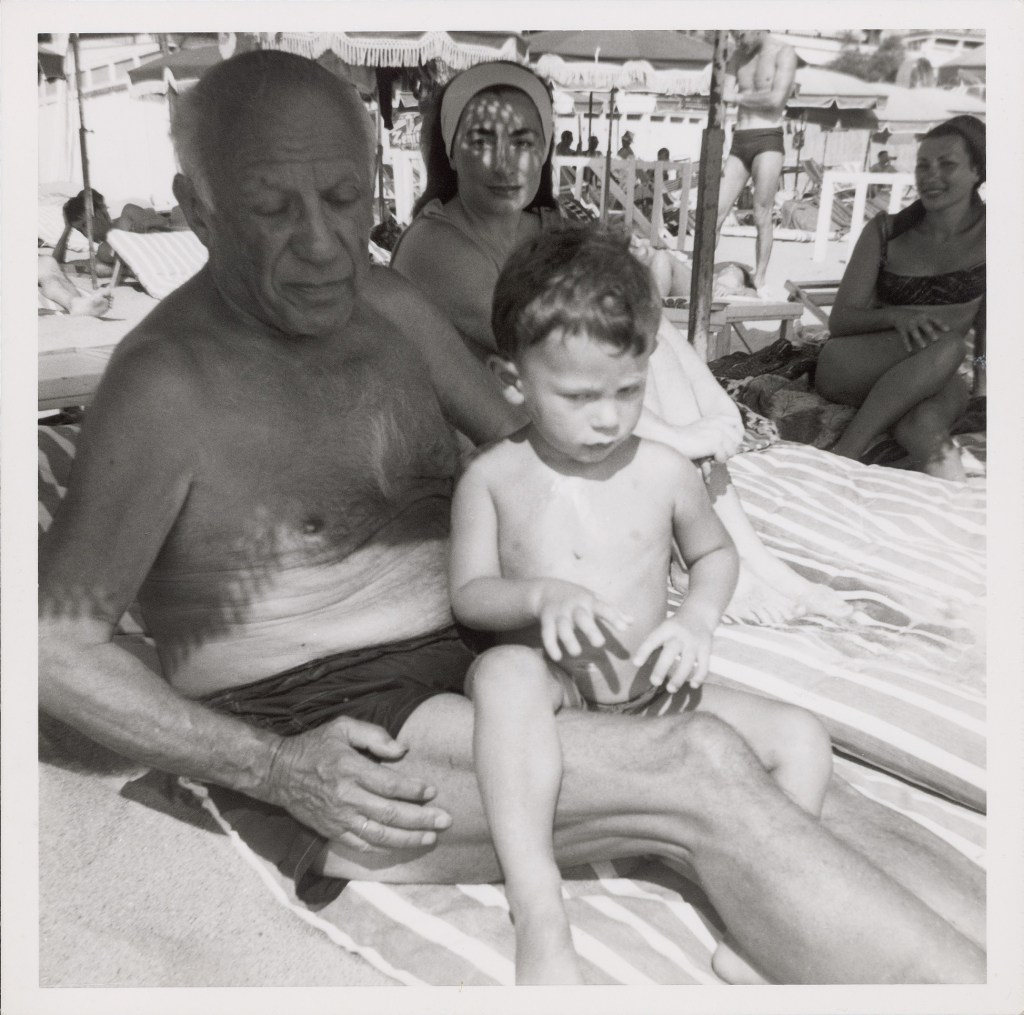
Bernard Ruiz-Picasso remembers his grandfather very differently, a wise and amiable old man who played with him on the beach when he was a toddler, who loved to watch the circus and the wrestling with him on TV. ‘He was simple, he was kind.’ Patrick O’Brian noted his ‘great capacity for affection.’
Mindful of the poverty of his youth in Paris, he gave generously to former lovers who’d fallen on hard times. Sure, he wasn’t blameless, but he never tried to hide his faults. ‘His art is really his biography,’ says Bernard. ‘He said everything about himself, even the bad moments – when he painted my grandmother, Olga, totally hysterical, screaming – and maybe he had a part in that.’ It’s all there in the paintings. His art was an open book.
‘Art is not chaste,’ said Picasso. ‘Or if it is chaste, it is not art.’ Art history is littered with the stories of great artworks made by flawed and fallen men, yet from a purely artistic point of view, do any of their moral failings really matter? Caravaggio was a murderer. Should we remove his paintings from art galleries? Is it really all that difficult to separate the artist from the art?
It’s sadly symptomatic of our strident age that we now feel compelled to judge artists as moral arbiters, as if artistry and morality were somehow intrinsically intertwined. Should the knowledge that Marie-Thérèse Walter and Jacqueline Roque both killed themselves change our view of Picasso’s portraits? Maybe we’d be better off knowing nothing about them at all.
Wandering around Málaga, Picasso’s birthplace, you’re reminded of the perils of imposing contemporary values upon artists from different times and places. Picasso was born way back in 1881, when attitudes towards women were positively archaic, particularly here in Andalusia. ‘Can you imagine?’ says Bernard. ‘In the 1880s, it was very, very different.’
It’s sadly symptomatic of our strident age that we now feel compelled to judge artists as moral arbiters
Picasso grew up in a bourgeois home of modest means – a cramped apartment on a busy square, now an atmospheric museum. Although his father, an undistinguished artist, was relatively liberal by 19th century standards, like virtually every other boy of his background, Pablo was weaned in a household where women had scant education, few rights, and bore all the burden of childrearing, as well as every other domestic chore. For married and unmarried men, a visit to the local brothel wasn’t so different from a visit to the local pub today. Men regarded women as maidens, matriarchs or whores. A woman was, to all intents and purposes, the property of her husband. Looking back, it’s a wonder that Picasso didn’t turn out even more chauvinistic.
To supplement his meagre income as a jobbing artist and art teacher, Picasso’s father, José, moonlighted as the curator of Málaga’s unassuming art museum. Thanks to Bernard Ruiz-Picasso, José’s great-grandson, that sleepy gallery, housed in an antique building in the heart of town, has now been transformed into Málaga’s spectacular Picasso Museum.
Sitting here today, in the fierce sunshine, talking to Bernard about his famous grandfather, it feels as if a wheel has turned full circle. Pablo went away to make his name and became the world’s most feted artist, and now his priceless paintings adorn the walls of this restored museum, which has revived his hometown’s fortunes – a catalyst for Málaga’s unlikely renaissance as a cultural capital.
Pablo Picasso made his home in France and after the Spanish Civil War (in which he supported the Republican government against Franco’s Fascist insurgents), he vowed he’d not revisit his native Spain while Franco remained in power. Sadly, Franco outlived him by two years, and so Picasso never returned home.
Franco died in 1975, as did Bernard’s father, Paulo (Pablo’s eldest child) and so Bernard, born in 1959, inherited a significant amount of Picasso’s art collection when he was still a teenager. With his mother, Christine (Paulo’s widow) he set about reuniting Picasso with his forsaken Spanish homeland.
In 1993, Bernard and Christine opened their Picasso Museum here in Málaga, in José’s old gallery, filled with a selection of their Picasso paintings. Twenty years ago, this wasn’t an obvious location for a new art gallery. As Bernard says, ‘Malaga was pretty poor at the time.’ The collection is a riveting survey of Picasso’s eclectic career, from Cubism to Classicism, and all the other isms inbetween, reinvigorating every genre, making every artistic style his own. Especially poignant are Picasso’s childhood portraits of his son, Bernard’s father, Paulo, painted in the first tender flush of fatherhood.

A short walk away is the Museo Casa Natal, the flat where Picasso was born and raised. There are keepsakes from his early days, faded family photos, stiff and formal, but the most interesting thing is what it reveals about Picasso’s relationship with his father.
Legend has it that José was a talentless hack and his son was a child prodigy, but this wasn’t strictly true. José was a proficient teacher who gave his gifted son an invaluable foundation. He inspired him to follow in his footsteps. He taught him everything he knew.
He was a decent artist, too. One of his workaday paintings had a profound effect upon little Pablo. ‘He once made a huge picture of a dovecote crowded with pigeons,’ remembered Picasso, in later life. ‘Hundreds of pigeons!’ This picture is now hanging in the Casa Natal, but even though the painting is impressive, it only features eight pigeons, not the hundreds Picasso recalled.
Picasso was also prone to hyperbole when it came to describing his own artworks. ‘I have never done children’s drawings – never,’ he declared. ‘I remember one of my first drawings. I was maybe six, or even less. In my father’s home there was a statue of Hercules with his club, and I drew it, but it wasn’t a child’s drawing – it was a real drawing.’ That drawing survives, virtually the only artwork that remains from his childhood here in Málaga, and what’s remarkable about it is how unremarkable it is. Picasso wasn’t six when he drew it. In fact, he was already nine. Tentative and stilted, it’s exactly what you’d expect from an average student of that age.
In 1891, when Pablo was ten, José got a job as an art teacher in Galicia and moved his family away from warm and sunny Málaga to La Coruña, in wet and windswept northern Spain. The family spent several miserable years there. It was there that Pablo began to paint. In 1895, José brought the family back to Málaga for a few months, en route to a new job in Barcelona, and during their short stay Pablo, now aged 14, painted an old fisherman, a portrait of astonishing maturity and sophistication. José gave Pablo his paintbrushes. He knew he had nothing more to teach his son.
In the bustling plaza outside the Casa Natal there is a statue of Picasso, old and bald, sitting on a bench. Sightseers sit here and pose for selfies alongside him, but in fact this effigy is a polite fiction.
After that final summer here, Picasso only made a few more fleeting visits, the last time when he was 19. Barcelona became his new hometown, and then Paris. After he became a star, he never saw Málaga again. Yet after all these years, Andalucia still feels central to his story – its savage bullfights, its cruel machismo, its atavistic Moorish roots. ‘A man belongs to his country forever,’ said Picasso.
Meanwhile, back at the Picasso Museum, the queue of visitors stretches right round the block. These visitors don’t really care whether Picasso was a misogynist. They know great art is amoral. They’re here to see the man who ripped up the rule book, who confounded the art establishment, and created some of the most arresting and enduring images the world has ever seen.
Britain’s synagogues have never been fuller
It has been just over a month since the Hamas massacres on 7 October. For British Jews, these past few weeks have been a month of prayer gatherings and vigils; desperate longing for the hostages’ return and an end to the torturous conflict. A month of pain, loss, confusion and worry.
Our lives have changed forever. We have had to change not just the way we think of Israel but how we think of Britain. The past month has exposed an ugly underside. We once thought we lived in a tolerant society. Now we are asking: ‘Can we safely share our Jewishness here?’, and ‘do we belong?’.
As Jews we are familiar with tragedy, threat and betrayal. ‘Always make sure you have your passport in date’, my mother used to tell me. Fortunately, today we are still very far from escape. But the recent rise in anti-Semitism makes us feel like we have moved another step closer.
In the darkest times, however, is when the embers of the Jewish spirit burn brightest. Amidst the tragic loss of life and bloodshed, there are revolutions starting. There is a revolution of Jewish identity and unity.
Although security threats are at their highest, the synagogues have never been fuller. ‘We’ve not seen our synagogue this full since the Pittsburg shooting’, noticed a friend, with a sad laugh. Charities distribute thousands of shabbat candles every Friday, WhatsApp groups encourage psalms to be recited around the clock and hundreds of women gather each week to bake ceremonial challa bread and pray. One local barber, for the first time ever, vowed to close his shop on Shabbat as a sign of solidarity. Members of the community vow to support his business in return.
We are so grateful for our non-Jewish supporters. They give us anchors of safety
‘I have never felt my Jewishness the way I do right now’, said a lady, at the kosher butcher, buying chicken soup: ‘Ironically just when we’re under attack.’ Another ex-colleague reached out to me. She had never embraced her Jewish heritage before but now she feels she has to ‘pick a side’. She feels the pain of being vilified and misunderstood but feels that it is worth it.
We are so grateful for our non-Jewish supporters. They give us anchors of safety. In the evening, after I’ve put my children to bed I look for my own reassurance. I scroll through texts from friends. ‘I am not sure how I can be there for you… But here I am’, reads one from a friend from my student days who is not Jewish. ‘Don’t lose heart’, reads another, ‘am here if you need me’. Neighbours and community rabbis who are too religious to have any access to social media are quoting Douglas Murray. We notice and appreciate our allies in the wider community.
Pressure builds daily as Israel loses global sympathy and the bloody conflict unfolds. Friends in Israel feel supported there and weirdly they feel safer, even when they run into their bomb shelters. Their sense of connection makes them feel alive. The Jewish community’s unity now feels even stronger in contrast to the splintered in-fighting about Israel’s judicial reform that was rampant prior to the attack. This month, these differences have been put on hold. Faith and togetherness are our community’s protection against threat and we have to cling to them with all our might.
Gaza and the terror of tank warfare
As Israel encircles Gaza City, the Israeli Defence Forces (IDF) is conducting what we in the British Army call Fibua, or Fighting In Built-Up Areas. Less ceremoniously, it’s known as Fish – fighting in someone’s house – or Fish and Chips – fighting in someone’s house and causing havoc in people’s streets. But the flippant name belies the danger – and terror – of these operations.
My taste of Fibua came in 2004 during tank operations in Al Amarah in southern Iraq. While my experience might be a little out of date, the fundamentals of urban combat for tanks haven’t really changed. The tank is a formidable weapon. But when you’re inside one you feel anything but assured: it is impossible to see enough and adequately get your bearings when you have the turret hatches closed down. All you have to go on are the letter-box sized periscopes around your commander’s cupola ring, and the constrained image from your gunnery sight. As the RPGs (rocket propelled grenades) and anti-tank weapons thud into the side of your tank, the turret swings around desperately trying to find who is firing. It quickly becomes discombobulating – not least when, in your right earpiece you have the battle group radio network blaring, and in your left earpiece, the other two tank commanders in your troop ranting at you.
Then there is the existential fear of taking a wrong turn; try doing a three-point turn in a 70-tonne tank in a narrow street hemmed in by buildings. As you desperately try to manoeuvre your way out of a tight spot, your tank (and its crew whom you are responsible for) as well as the infantry vehicles you are escorting (and are also responsible for) are sitting ducks for ambush. The mapping in your clammy hands becomes your entire universe, nothing else matters.
Israel’s forces are masters of tank warfare. The IDF honed its skills across the decades during conflicts such as the 1973 Yom Kippur War, against a coalition of Arab military forces led by Egypt and Syria, and repeated wars with Lebanon and Gaza that included significant Fibua.
The capabilities of the latest iterations of the Merkava series of main battle tanks used by the IDF are considered roughly equivalent to that of the British Army’s Challenger 2. Both tanks do a fine job of providing protection, manoeuvrability and firepower, while the Merkava has a few tweaks optimised for urban warfare. It has the ability to carry infantry in its rear, who can dismount through a rear hatch to provide protection against enemy anti-tank measures. It also wields two machine guns – often the most appropriate weapon in close quarters Fibua when the main armament can’t be used.
Israel’s tanks can also call on air support to come to their aid if things turn nasty. The scale of the air campaign against Gaza has illustrated the amount of airborne firepower at Israel’s disposal, while its staunch ally, the US, is no doubt providing further hardware. President Joe Biden has asked Congress to pass a $106 billion (£87 billion) emergency spending package that includes funding for Israel, Ukraine and Taiwan.
At night, things becomes exponentially harder. Ghoulish green shapes appear in your tank’s night vision
In Iraq, the US gave us the services of call sign Basher-75, an AC-130 gunship. ‘You’ve got fire from the sky,’ intoned the impossibly cool voice of the Basher 75 operator over the radio. ‘Keep your heads low, it’s going to get hot down there.’
Boy, did it ever. It was horrible. It was also wonderful. But air support can only go so far once you and your military forces are deeply enmeshed in the urban environment, due to the risk of fratricide and unacceptable civilian casualties.
At night, things becomes exponentially harder. Even streets you are familiar with morph into a different landscape. Ghoulish green shapes appear in your tank’s night vision system with what looks like a rifle in their hands or something on their shoulder. To make matters more challenging for the Israelis, the urban environment in Gaza is obscenely more complex than what we faced in Iraq. Israel’s forces are also up against a far better equipped and trained enemy.
‘Over the past decade Hamas has developed a labyrinth of tunnels that are fortified and connected literally across the entirety of the strip, and especially heavy in Gaza City,’ Rob Givens, a retired US Air Force Brigadier General, writes in Responsible Statecraft.
‘The majority of combat will take place in Gaza City proper which has a greater population density than New York,’ he notes. Civilians ‘are everywhere’ causing the Israelis ‘immense targeting problems’.
I don’t envy the job the Israeli tank commanders have to do.
Tory WhatsApp wars resume
Ding, ding, ding! The latest round of fighting has just concluded in the weird and wonderful world of Tory WhatsApp groups. In a series of messages obtained by Sky News, various backbenchers turn on each another in the ongoing fall-out from Suella Braverman’s row with the Metropolitan Police. Some were supportive; others critical but one thing is for sure – none of them are very happy.
Veteran right-winger Sir John Hayes kicked off the exchange by declaring that it was ‘so sad to see protests being allowed on the Remembrance weekend’, arguing that it was ‘wholly inappropriate’ and urging colleagues to ‘speak for the law-abiding, patriotic majority by saying so’. Others then weighed in. Karl McCartney attacked Bob Neill for going public with his criticism of Braverman, saying he would be getting Christmas cards from Yvette Cooper, her opposite number. He was joined by Danny Kruger, who backed Braverman’s right to criticise the Met’s operations. He said that it was no longer enough to have a ‘quiet word’ with the police when there were issues and instead advocated for ‘proper challenge’.
Their support was countered by others in the group. Jackie Doyle-Price suggested that her fellow Conservatives respect the right to protest, adding that ‘colleagues making noise about them are simply advertising them and make them bigger as a consequence.’ Her veteran colleague Sir Bernard Jenkin meanwhile asked if he was the only one ‘who thinks it is it most unfortunate that the chief of Met Police is being placed under pressure from the government, which threatens to compromise public confidence in his operational independence?’ The row has rumbled on throughout the last 24 hours before, inevitably, being leaked. This was, er, in spite of a warning not to conduct the discussion on WhatsApp because ‘some colleagues are untrustworthy disgraceful leakers.’
Best message of the day though has to go to Will Wragg, the baby-faced Boris-basher, who declared ‘I’ve had enough of this rubbish’ on the group chat. If the Tories carry on this way for another 12 months, Steerpike suspects the electorate will say the same on polling day…
Gorillas in the mix: in search of Rwanda’s silverbacks
Two hours into a muddy hike through Rwanda’s Nyungwe rainforest and though I’ve been barked at by a baboon, crossed rivers of fire ants and stepped over a foot-long centipede, I have yet to see any chimpanzees, which is the reason I’m here.
My guide and our team of trackers are on the path ahead, armed with machetes, rifles and a walkie talkie. We’re looking for an alpha male called Kuyu. His morning calls echo in the distance and my guide tells me we’re not far from him. I hope he’s right. I am covered in Mosquito repellent clothing, I’m hot, tired and my enthusiasm is waning.
‘Look up,’ says my guide, and he gestures at a dark shadow that glides across the tree canopy above. We’ve found them! A tracker grabs me with one hand and with the other swings his machete and cuts through the bush. I lift the hood of my jacket over my baseball cap and pull the drawstring cords tight before I dive into the overgrowth. High up above I spot one chimpanzee, then two, three, four. Kybibi, a son of the alpha, comes down for a closer look at his visitors. We’re face-to-face, just ten feet away. I ask the tracker if I’m safe – he assures me I am: ‘Kybibi is a massive flirt.’

After warming themselves in the morning sun, Kuyu’s family begin to descend gracefully from the treetops, like spiders from a web, and vanish into the bush. We give chase, but chimpanzees are fast and the terrain makes it difficult to keep up. Their calls begin to sound further and further away so we return to the resort, the One&Only Nyungwe House on the edge of the national park. The hotel is in the middle of a working tea plantation and there are brightly clothed pickers dotted throughout the green fields. In the lobby I’m handed a warm tea, the leaves freshly picked.

Although there are a dozen primate species in Nyungwe, there are no gorillas – Rwanda’s biggest tourist draw. To see them, I need to travel five hours north the Virunga mountains. The route weaves around the eastern side of Lake Kivu which borders with the Democratic Republic of Congo.
For a moment I forget I’m in landlocked Rwanda. It looks more like Capri. I’m told this is where those who can afford summer holidays in Rwanda come. Lakeside boutique hotels are popping up from the Cleo to Serena to Chateau Le Marara, a giant white castle that would not look out of place in the Swiss Alps, and the country’s first floating hotel, the Kivu Queen. At dusk you can rent a kayak and join the ‘singing fisherman’ as they head out for the evening’s catch, using their chorus to keep their rowing in time.
As I arrive at One&Only Gorillas Nest in the foothills of the Volcanoes National Park, I’m greeted with enormous entrance gates that remind me of Jurassic Park. I start humming the film’s theme tune, but I’m soon drowned out by the raucous sound of beating drums waiting to greet me at the end of the drive.

Over a night cap, Dr Julius Nziza, Head Veterinarian of the Gorilla Doctors tells me what to expect on my trek tomorrow. He also tells me how the American conservationist Dian Fossey led a heroic war on poachers which pulled the species back from the brink of extinction. Today, there are just over 1,000 mountain gorillas left in the world – and more than half of those are here. Former poachers now work as trackers – or porters – dedicated to the protection of wildlife.
A permit for gorilla trekking will set you back $1,500, ten times what it costs to spend time with the chimpanzees – but unlike chimpanzees you’re guaranteed to see gorillas. For a small fee you can hire a porter who will offer to carry your bag and help you across rough terrain in search of your assigned gorilla family.
The next morning at ‘Gorilla basecamp’ I’m put into a group of eight – the maximum number allowed when visiting Rwanda’s gorillas. Francois Bigirimana, our expert guide and a close friend of Fossey, tells us we have an hour’s hike ahead of us. Luckily we don’t have to trek too far – at the base of the mountain we come across our first gorillas.

‘Don’t move – he’s about to charge.’ Francois steps back to take my picture, capturing my startled expression and the open-mouthed 400lb mountain gorilla behind me.
The silverback – who’s called Lisanga, Francois tells me – raises himself up high and beats hard on his chest – a sound that can be heard a kilometre away. ‘He’s showing off for his new wife,’ says Francois, gesturing towards a female gorilla in the undergrowth. She doesn’t look that impressed with her new husband – or us.
Francois, who calls himself ‘half-man, half-gorilla’, mimics Lisanga’s grunts as he leads me through the foliage in search of the other 15 members of the Kwisanga (meaning ‘to feel at home’) gorilla family. The noises, apparently, are to let them know that friends are approaching.

Eventually we meet the Kwisangas: a handful of blackbacks (young males) and females, fluffy babies (which lie across the back of Lisanga’s brother) and the family’s patriarch, a giant silverback called Kigoma. Francois tells me to keep a good distance and for the next hour I watch the females groom giant Kigoma, as the young blackbacks swing from branch to branch and the babies play what looks like a game of chase. Kigoma, cleaned and ready to move, stands tall and stretches, showing off his incredible size – and reminding us why’s he’s in charge.
When I ask Francois if there are still problems with poachers, he tells me ‘no one messes with gorillas any more’. I’m not surprised.
Black Tomato can arrange 8 nights in Rwanda including a curated itinerary with stays at The Retreat in Kigali, One&Only Nyungwe House and One&Only Gorilla’s Nest. For more information see visitrwanda.com
Senator Jim Justice? Don’t be so sure…
Immediately after longtime West Virginia senator Joe Manchin bowed to political reality and called it quits on his re-election, Republicans celebrated that it virtually guarantees their party an elusive win next year.
In fact, some were already proclaiming that the state’s First Pup, Babydog, and her owner, Governor Jim Justice, are cruising to victory next November.
But that’s not necessarily the case — it’s not next November that Justice should be concerned with, but rather next year’s GOP primary. Justice, who finally secured Donald Trump’s valuable endorsement, faces Congressman Alex Mooney and a field that may now swell given the GOP’s virtual certainty to pick up the seat.
Mooney might not have Trump’s backing, but he’s a fierce defender of the former president and has the deep pockets of the Club for Growth going all out for him in a primary that will be less focused on “electability.”
“Alex Mooney was practically built in a lab by Club for Growth and this race is an example of their entire reason for existing, to elect fiscally conservative candidates over fiscally moderate ones in safe Republican seats,” a longtime West Virginia observer told me, adding that “now that Manchin is out and this is a complete guarantee flip to Republicans, the NRSC and allies are heavily incentivized to leave Justice to fend for himself while they focus on Montana, Ohio, Nevada, Arizona and Pennsylvania.”
What’s bad for a Republican like Justice is even worse for Democrats around the country, who can’t count on Manchin dragging tens of millions of dollars in outside spending (from both parties) to the country roads of West Virginia.
A West Virginia veteran noted to me that “with Jim Justice having the Trump endorsement, he’s going to be even more passive about campaigning,” and that Mooney has a track record of beating more liberal Republicans in primaries: “aggressive Mooney backed by Club for Growth against Justice (aka David McKinley 2.0) resting on his Trump endorsement with no national bailout coming means you’ll watch this race tighten and tighten. In the end, flip a coin.”
The one near certainty is that whoever walks away with the GOP nod will be a senator for as long as they’d like.
-Matthew Foldi
On our radar
RETURN TO EPSTEIN ISLAND Tennessee senator Marsha Blackburn issued a subpoena for flight logs from a private plane belonging to the deceased convicted sex offender Jeffrey Epstein. The plane, nicknamed the “Lolita Express,” was allegedly used in the trafficking of underage girls and boasted many high-profile guests, including former president Bill Clinton.
IN TRUMP WE TRUST A new Bloomberg poll suggests the NYT/Siena survey of voters showing Trump leading Biden in swing states was no fluke. Bloomberg’s poll not only shows Trump ahead in those key states, but reveals that voters trust him more on the economy, foreign policy and immigration. Even on abortion, a bread-and-butter issue for Democrats, Trump only trails by four points.
NEW YORK TIME’S UP? Pro-Palestinian protesters staged a sit-in at the New York Times headquarters on Thursday demanding the paper’s editorial board call for a ceasefire in the Israel-Palestine conflict. Israel has separately accused NYT photojournalists who embedded with Hamas on October 7 of having advanced knowledge of the terrorist group’s attack plans.
Biden team manages expectations for Xi meeting
President Joe Biden is scheduled to meet Chinese president Xi Jinping — in person for the second time of Biden’s presidency — on Wednesday of next week as the two attend the Asia-Pacific Economic Cooperation summit in San Francisco. According to the New York Times, the pair will discuss “Taiwan, election interference and the war in the Middle East.”
Also on the agenda, per the Times, will be “ways to strengthen ties,” as advisors say the meeting will “[feature] a host of topics on which the two fiercely competitive countries disagree.”
Expectations for the world leaders to make “any major breakthroughs,” as ABC puts it, are low.
“There won’t be anything that will move the relationship in a different direction,” Oriana Skylar Mastro, a fellow at the Freeman Spogli Institute for International Studies at Stanford University, told the Times.
During a press briefing, an anonymous US official gave reporters a meaningless preview of the meeting:
We’re clear-eyed about this. We know efforts to shape or reform China over several decades have failed. But we expect China to be around and to be a major player on the world stage for the rest of our lifetimes.
Speaking to ABC, Jude Blanchette, chair of China Studies at the Center for Strategic and International Studies, provided an equally vague analysis (if it can be called that) of the forthcoming tête-à-tête, claiming Biden and Xi are looking “to intentionally keep that bar low.” Blanchette added:
What’s going on here is an attempt to have a deep conversation where the two sides directly share their concerns, but more importantly that the meeting unlocks, especially in the Chinese system, space for further engagement in constructive work.
This meeting sounds like a waste of time; nevertheless, there could be two benefits for Biden: tempering expectations by intentionally keeping the bar low is a great warm-up to his presidential re-election campaign. And if the conversation runs dry, he could always hit Xi up for some more Chinese wire transfers to fund said campaign.
–Teresa Mull
Podium politics
Five GOP presidential candidates took the stage during Wednesday night’s NBC News debate, while again the frontrunner, former president Donald Trump, held his own rally offsite in protest of the process. On stage in Miami, though, things were at least a little spicier than the last iteration. Vivek Ramaswamy came out swinging, calling on RNC chairwoman Ronna McDaniel to resign and scorching the bias of the NBC-affiliated moderators. He later turned his sights onto his opponents, throwing a two-for-one jab about Dick Cheney and high heels at both Nikki Haley and Ron DeSantis.
Although DeSantis and Haley have been at each other’s throats since Haley rose in the Iowa polls following the second debate, they found some common ground on Wednesday. DeSantis agreed that Ramaswamy had gone too far when the tech tycoon, in reaction to Haley criticizing his presence on TikTok, pointed out that Haley’s daughter was also on the platform. “I think kids are out of bounds,” DeSantis offered.
Could this be a strategic olive branch? After all, DeSantis allies seem quite keen on the idea of the other candidates dropping out to strengthen the Florida governor’s chances against Trump. The only problem with that strategy is they also have to take out Ramaswamy, who seems completely uninterested in being a “team player” for the political establishment and is still punching above his station in the polls.
-Amber Duke
Beshear’s sore winners
Kentucky governor Andy Beshear’s team isn’t letting the bad blood stay on the campaign trail. The incumbent governor won re-election Tuesday night after what became a nasty race against Attorney General Daniel Cameron, with the latter gentleman facing racial attacks from a left-wing PAC. Now, Beshear’s campaign officials are rubbing salt in the wound, which is generally considered bad form in the campaign world.
“I think Daniel Cameron should be ashamed and embarrassed by the race he ran and so should his team,” Eric Hyers, a top strategist to Beshears, said Wednesday morning. “It was gross, disgusting, and just very, very craven, and I’m glad they lost and it wasn’t that close. They deserve to be embarrassed.”
Republican consultant Brandon Moody slammed Hyers’s comments on X, calling him an “insufferable little prick.” Hyers, who also served as the Biden campaign’s Michigan state director in 2020, countered that Moody’s opinion didn’t matter because he didn’t attend “Henry Berg’s funeral,” referring to a Kentucky-based transgender activist who died by suicide last year. While normal people might view that as a non-sequitur, apparently Beshear campaign officials took umbrage with Cameron’s decision to campaign against gender reassignment surgeries for minors and viewed that as a direct attack on Berg and his mother, a Democrat who serves as in the Kentucky legislature.
Ah, state politics. Never change!
-Cockburn
From the site
Ben Domenech: Joe Manchin has every reason to run for president
Roger Kimball: Why Trump’s rally mattered more than the GOP debate in Miami
Sign up to get the DC Diary in your inbox on Mondays, Wednesdays and Fridays.
Why is the Welsh parliament condemning Israel?
This week, the Welsh parliament announced that it ‘condemns the Israeli Government’s indiscriminate attacks on Gaza’ and ‘calls on the international community to…bring pressure to bear on the Israeli Government to end the siege of Gaza which contravenes international law and the basic human rights of Palestinian civilians’. Those were the terms of a motion laid by Plaid Cymru and passed by Members of the Senedd by 24 to 19, with 13 abstentions. The motion was not entirely without merit: it condemned Hamas’s attacks on Israeli civilians and called for the hostages to be released. But this story nonetheless offers a signal from the devolution crisis that no one in Downing Street or Whitehall wants to acknowledge.
Whether you agree with the terms of the motion or not is irrelevant. The more pressing question is why the Welsh parliament is debating motions on reserved matters such as foreign affairs. True, this was a foreign affairs debate, not foreign affairs legislation, which would be struck down by the courts if it was ever attempted. But the question remains: why are MSs laying motions on subjects only Parliament can legislate on and about which only the UK Government can make policy?
At Westminster, there is only complacency
There is an indulgent view of this sort of thing, heard inside both the Labour and Tory parties, which says that no harm is done when devolved legislatures merely debate reserved issues and don’t try to go any further. After all, the Scottish parliament debated an SNP motion on the eve of the Iraq War that said ‘no case for military action against Iraq has been proven’, that ‘no United Kingdom forces should take part in any military action without a United Nations mandate’, and that going to war absent such a mandate ‘would be contrary to international law’. Holyrood voted down the motion but, even if it had passed, it wouldn’t have prevented the UK Government from proceeding as it did.
This perspective ignores a rather important aspect of foreign affairs: the foreign part. Do votes such as these promote clarity or confusion internationally about the UK’s position on the issue in question? Do they make it easier or harder for the Prime Minister to present his policy choices as those of the United Kingdom as a whole? Do they make the UK look more united or divided? We have an answer in the case of the Welsh vote on Gaza.
Following the vote, the Palestinian Mission to London, which represents the Palestinian Authority in dealings with the UK Government, released a statement welcoming the Senedd’s decision. The statement went on to quote comments made by MSs during the debate (on preferring a political to a military solution, on deaths of children in Gaza, on what the UK should do) and indicate its agreement with each of them. When a foreign government is endorsing a vote on foreign policy by a devolved UK parliament, even if it has no legislative force, it is hard to argue that said parliament is not becoming involved in foreign policy.
The risk that this could, in the right circumstances, harm the UK’s international relations is not negligible, particularly in regard to a conflict as sensitive as that between Israel and the Palestinians. Yet at Westminster there is only complacency.
Another signal, this one less dramatic, from the devolution crisis. In the last ten days, the Scottish government has posted nine tweets from its corporate X/Twitter accounts promoting Scottish independence. This is not including official ministerial accounts. The tweets all promote the latest Scottish government white paper, ‘Building a New Scotland: migration to Scotland after independence’. This paper is the sixth in the New Scotland series and comes despite the constitution being reserved, the UK Government opposing another independence referendum, and the Supreme Court having ruled that a Bill to hold a unilateral referendum would be outwith Holyrood’s powers. Why, then, is the Scottish government still producing pro-independence propaganda and why are civil servants promoting it on social media?
I have been arguing for a Royal Commission on devolution to coincide with the 25th anniversary of the opening of the Scottish parliament and what was at the time the Welsh assembly. The remit would be to examine the implementation of devolution, identify its flaws and successes, and recommend reforms to improve devolved institutions and make sure they work in a way that enhances rather than undermines the political and constitutional unity of the UK.
A Royal Commission could consider and recommend a number of remedies to devolved bodies interfering in reserved matters like foreign affairs and independence. A comprehensive solution would be to amend the Wales and Scotland Acts to the effect: ‘Parliamentary and government resources may not be expended in relation to reserved matters’. A schedule could specify that ‘resources’ referred to any financial outlay, expenses, facilities, equipment, staff, research or communications. It could also specify reserved topics such as foreign affairs, the constitution, war, national defence, the monarchy, etc.
A more surgical approach might be to legislate an amendment to the standing orders of Holyrood and the Senedd: ‘Parliamentary business may relate to reserved matters only in so far as they impact the devolved responsibilities of the parliament or the powers of ministers or the Law Officers. Questions, answers and debates about the substance of reserved matters are out of order.’ This could be accompanied by amending the civil service codes for Scotland and Wales to forbid civil servants working for the Scottish and Welsh governments from undertaking any activities relating to reserved matters.
These are not merely theoretical questions, and nor should they concern only Conservatives. If Labour forms the next government, it will likely do so thanks to gains made at the expense of the Scottish Nationalists. A wounded SNP, with two years left before the next Holyrood elections, could be expected to use the Scottish government and the Scottish parliament to frustrate the agenda and policies of a UK Labour government. Where it could not frustrate, it would have no compunction in surfacing issues, such as the Palestinian conflict or immigration and asylum, that are particularly sensitive for Labour. A Royal Commission is in the best interests of constitutional good government but it would also be politically prudent.
Suella Braverman’s clumsiness makes Met reform less likely
Suella Braverman’s career as Home Secretary may be over very soon. But a long tail of it will be the criticism she has made of the Metropolitan Police. It was unprecedented for a Home Secretary to make the claims she did of ‘picking favourites’ and bias. In the long-term, reforming the police might have become harder.
Only a few months ago, the prevailing mood in Westminster was that the Metropolitan Police was in need of reform, not just because of its seeming inability to root out rogue coppers following the murder of Sarah Everard, the conviction of David Carrick, and the revelations of misogyny from the Charing Cross Police Station, but also because of the way it policed the vigil for Everard.
Patsy Stevenson was one of the women arrested that day. The striking photo of heavy-booted officers pushing her to the ground was plastered all over the newspapers. She has since been awarded substantial damages. Yesterday, she said that while she had no truck with Braverman’s description of the pro-Palestine protests as ‘hate marches’, she did think the Home Secretary’s line about the police needing to be more even-handed was ‘fair’. She said her reading of the vigil was that the police reacted to ‘the people with the microphones talking about anti-police rhetoric’ rather than trying to uphold Covid regulations.
Braverman hasn’t been the speediest when it comes to police reform: she has been nagged repeatedly by her own side and Labour to introduce the regulations the police say they need to be able to dismiss bad coppers quicker. She – and any successors – will find it harder now to hold the police accountable for the reforms forces should be making anyway.
But will picking a fight with the Met be easy for Labour if they win the election? Keir Starmer and Yvette Cooper are a mixture of sticklers for standards and very cautious in character, and they may find there are other, bigger, priorities which make it very easy to let the Met carry on as it is for longer, especially if emphasising its operational independence now offers a useful point of differentiation from the Conservatives.
Politics tends to be at its worst when it takes big pendulum swings, and Westminster seems to have snapped from one argument about the Met needing reform to a protective crouch on its behalf. That may be the worst part of the fallout from Braverman’s piece, and one that is felt long after she is replaced.
Could the world go to war again?
Armistice Day is an appropriate moment to reflect on why democracies triumphed in the two world wars that blighted the twentieth century. The simple answer is because – however much they hesitated – they believed in what they stood for and were able to will their victory. As the French philosopher, future Resistance member and champion of post-war liberal democratic values, Raymond Aron, wrote in June 1939:
‘I believe in the final victory of the democracies, but on the one condition, that they should want it.’
So Britain could mobilise its population for war to an extent unequalled by totalitarian states, without using totalitarian methods.
For all the loose talk of World War III, global wars are only predictable with hindsight
Should western democracies once more be forced into war, it is by no means clear that they would have the self-belief and Aron’s will to win. That requires the cohesive feeling of national community, built up over centuries and forming a heritage of shared memories, still to be intact. That, in turn, requires not only its citizens having things in common, but also putting to one side the worst excesses of their past rather than dwelling on them. By that means they achieve what the nineteenth century French historian, Ernest Renan, called the ‘daily plebiscite’ necessary for a nation to exist now and into the future.
Western democracies had that. Yet in recent years they have succumbed to a fit of deconstructing their common heritage, emphasising division in past and present. In undermining the comparative advantage they had over authoritarian regimes, they are playing into the hands of their rivals and making war more likely.
Even during the Cold War, when western democracies were prey to internal dissenting voices, the vast majority of their citizens believed in their shared values and futures. That faith acted as a deterrent to potential challengers. Western armaments and shared values ensured that the Cold war stand-off did not descend into world war. As Raymond Aron quipped of the Cold War: ‘Peace impossible, war improbable’.
What would he have made of the state of today’s international relations with western democracies again at loggerheads with authoritarian regimes determined to change the international order? The glaring difference is the state of western democracies and the gangrenous erosion of their shared values and sense of community and their declining will to defend what remains of them. The authoritarian regimes that seek to change the international order smell the weakness of the West, as did the Axis powers in the 1930s. For the moment they can afford to wait: China to increase her military build-up, North Korea to hone its nuclear delivery systems, Iran to develop its nuclear weapon. All wait and watch as western democracies slide into ever more self-loathing and self-harm, and, as in the 1930s, avoid facing reality and taking the necessary steps to defend themselves, beginning with self-belief.
As that happens, so third party states, the Global South for instance, will begin opportunistically to calculate the cost-benefit of siding against the West. Russia made its move too soon in invading Ukraine. Putin rightly sensed the West’s declining belief in its shared heritage, but acted before its resolve had sufficiently waned.
Yet for all the loose talk of World War III, global wars are only predictable with hindsight. Teleology alone assures us that the First World War would break out in 1914. After all, Europe had been at peace for four decades. And though the international system was divided into two blocs of alliances stand-offs and flashpoints came and went. The 1911 Franco-German diplomatic confrontation over Morocco was defused. The internecine Balkan Wars of 1912-13 and 1914, in which the rival international alliances had a stake, came to naught. The German fleet was scheduled to join the British fleet on manoeuvres in the summer of 1914. In the spring of 1914 the Permanent Under-Secretary of the Foreign Office had never seen ‘calmer waters’. Examples of détente were legion.
Even prior to World War II, potential international crises did not escalate. The Spanish Civil War did not cause Britain and France to intervene on the Republican side against the Axis-backed Franco forces. Meanwhile Munich promised ‘peace in our time’.
But what was common to the genesis of both world wars was a sense of opportunity based on perception of their own and their rivals’ strengths and weaknesses. In the summer of 1914, Imperial Germany preferred to risk war rather than, in its eyes, countenance further decline of its Triple Alliance against a rising Triple Entente. For Hitler’s Germany, the perception of decadent, irresolute and appeasing French and British democracies determined him to seize the moment. That both calculations proved erroneous in the end is immaterial given that world wars ensued.
Today, given the West’s dismal pathology, rivals for its increasingly threatened global mastery will be calculating how and when to erode further the democracies’ shrinking comparative advantage. Its weakness signals opportunity and invites challenge. Democracies may in the end prevail, but the consequences would be appalling.
A cautionary tale about Wikipedia censorship and the Twitter Files
For the illiberal left, it’s not enough that you submit to their cultural revolution. You must also underwrite it.
This happens not only at the state level, with issues such as abortion and public-school curricula, but at the private level as well. A good recent example includes efforts by certain Wikipedia editors to censor mentions of a journalism award handed out recently to the journalist behind the so-called Twitter Files.
Wikipedia: glad-handing for donations on the front end, while certain “master editors” censor factual events on the back end!
On November 1, journalist Matt Taibbi received a journalism award for his efforts to uncover the incestuous relationship between Big Tech and censorious federal apparatchiks. More specifically, for his part in casting a light on the government’s clandestine coordination with Twitter to censor inconvenient speech, the National Journalism Center, where I serve as program director, and the Dao Feng and Angela Foundation awarded Taibbi and his colleagues — former New York Times op-ed staff editor Bari Weiss and author Michael Shellenberger —a shared prize of $100,000 for excellence in investigative journalism.
In accepting the honor, Taibbi himself reiterated the purpose of the honor: to recognize journalism that challenges power rather than protect it.
“The journalism profession has become hopelessly politicized in recent years,” he said in his acceptance speech. “Editors now care more about narrative than fact and, as many of the people in this room know, there are now fairly extreme penalties for failing to toe party lines. This begins with pressures within the business to conform and continues with algorithmic targeting of advertisers.”
“Most of these algorithmic penalties are based on a complex credentialing system, a process Google calls ‘surfacing authoritative content,’” Taibbi continued. “This basically means that if you’re not recognized by certain ‘authoritative’ organizations, your work will not appear in features like Google News, Facebook’s news feed, the ‘For You’ bar on Twitter, or in many institutional search engines. This has the effect of de-amplifying politically unorthodox content, from conservative sites like the [Washington] Examiner or the New York Post to Consortium News or even the World Socialist Web Site. These sites are essentially consigned by algorithm to a separate set of Dewey Decimal shelves in the basement of the world’s library.”
This is the key point: these groups have been relegated to the basement precisely because they tend not to go along with “consensus” views; because they have a willingness to publish materials some find “offensive”; because they ask inconvenient questions. The shunning they experience from the corporate press and other “respectable” organizations has nothing to do with fact and reality, or a love for truth. It’s all about controlled narratives, ego, pride and ideology. This is why legacy media tend to package together outright lunatics with those who are merely skeptical of “consensus” positions — because lumping the latter with the former encourages onlookers from asking the further questions.
“It’s my hope and belief that the Dao Prize,” Taibbi concluded, “by giving such work recognition, can help begin the process of bringing suppressed factual journalism out of the basement. It’s my hope journalists will someday look back at this moment as a turning point.”
Since he first reported on the Twitter Files, Taibbi, who describes himself as a “run-of-the-mill, old-school ACLU liberal” and whose work previously included bylines at Rolling Stone magazine and multiple appearances on MSNBC, has been mocked, disparaged, slandered and accused of all sorts of ethical lapses by members of the corporate press. His peers should be envious that he uncovered a conspiracy between the federal government and Twitter. Instead, they have accused him of everything from being a stooge for billionaires to embellishing the details of the Twitter Files story for personal financial gain.
And all because he reported that two powerful and largely unaccountable entities were conspiring quietly against you.
The effort to malign Taibbi’s character, thus undercutting the creditability of his reporting, extends even to his Wikipedia page, where a “master editor” by the name of “SPECIFICO” attempted to remove mentions of Taibbi winning the National Journalism Center award for excellence in journalism.
“This is a partisan group of no distinction,” the editor argued. “Not a notable or credible award.”
The editor continued, explaining the edit, writing, “I reverted the addition of this item. Please] see the reason [in] my edit summary. It should not be re-added prior to consensus for inclusion.”
Another more sensible editor responded, “I am curious. How does one determine that an award is not ‘credible’?”
“SPECIFICO” declined to be specific.
In the end, more sensible heads prevailed, and the award is now visible on Taibbi’s page — but only after considerable debate about whether the award, which is considerable, deserved to be mentioned at all.
Mentions of the award never should have been scrubbed from the profile in the first place. Indeed, as one Wikipedia editor wryly noted, the initial censorship that clearly “intended to undercut the achievement” is an example of the exact type of thing Tabbi warned about in his acceptance speech.
“As Taibbi notes,” the editor writes, “the Dao Prize is a ‘significant new prize for old-school, fact-based reporting. The journalism profession has become hopelessly politicized in recent years.’ Wikipedia does not need to follow that trend.”
But this is how the modern illiberal left operates, if even reflexively. It’s to undercut, dismiss and shout down. If they can censor you entirely, then all the better. That they tend to do this while also demanding your hard-earned money is a detail that’s difficult to overlook. They twist the noose a little tighter, all while asking you to donate to the gallows upkeep fund.
For the modern illiberal left, submission is nice, yes. But it’s the ritual humiliation that really makes it worth getting out of bed in the morning.
Is California the new China?
Recently, Gavin Newsom, the greasy-haired governor who may or may not run for president, made a trip to Beijing to meet with Xi Jinping. It went swimmingly, according to various reports.
When it comes to US-China relations, “divorce is not an option,” Newsom, who divorced from Kimberly Guilfoyle in 2005, told CNN on November 8. America’s answer to Justin Trudeau argued that the US and China must “reconcile our strategic red lines.” The idea of being cozy with China, a country that actively uses cyber espionage to undermine the US economy, may strike many as odd, even dangerous — but not Governor Newsom. In fact, according to reports, he is so inspired by his trip to China, that he now wants to bring a CCP-like “social credit system” to the Golden State.
The fifty-six-year-old recently announced the creation of California’s new “Cradle-to-Career” (C2C) system. According to this official statement, the system will integrate “over 1 billion data points — providing unprecedented insight and transparency,” ostensibly “to improve career outcomes for millions of Californians.” C2C’s integration of data, notes the statement, “will provide the public, researchers and lawmakers unprecedented insight that could improve education and quality of life for millions of Californians.”
But it could also make citizens’ lives many times worse. After all, these data points, like oil from the ground, must be extracted.
Which brings us back to China’s “social credit system.” By integrating a multitude of data points, the CCP monitors, manipulates and modifies the behaviors of its 1.4 billion citizens. As someone who previously lived and worked in China, I am intimately familiar with its credit system. In short: individuals and businesses are all given a score. If they fall below this arbitrary number, all sorts of bad things occur. For example, a person with a poor credit score may find himself unable to enter certain venues, purchase airline tickets or enroll his children in specific schools. The system provides a unified record of all citizens and businesses; it can be monitored and updated in real-time. In other words, you could have a healthy credit score in the morning and find yourself unable to apply for a loan in the afternoon.
According to the aforementioned C2C statement, by “leveraging billions of data points, California’s Cradle-to-Career data system will be a game-changer for improving the quality of life for millions of Californians and highlighting ways to improve opportunity in the classroom and access to the workforce.”
The Golden State, we’re assured, “is leading the nation in equitably connecting our education system to the workforce to ensure every Californian has the freedom to succeed.”
On closer inspection, however, the system will give lawmakers access to intimate information broken down by race, geography and, of course, gender, to, as the statement suggests (or warns) “illuminate and address areas of strength and needed growth and any inequities.” C2C’s partners include the California Department of Education, the Department of Health Care Services, the Department of Social Services and University of California’s Office of the President.
Like something straight out of China, where five-year plans are all the rage, Newsom’s C2C is a comprehensive five-year plan designed to vacuum up as much data as possible, from the cradle to the grave. This will include data on early learning and care, public and/or private schools attended, universities attended, workforce participation and social services sought. All Californians, from the time they exit the womb, will be monitored closely. They will be mined, mercilessly and methodically, for data. The more data decision-makers have on citizens, the more they can control them.
Newsom’s C2C system must be viewed through a broader lens. The vast majority of Americans, not just those living in California, are having their data harvested and their privacy violated. Last year, for example, a sobering investigation by the Georgetown Law Center on Privacy and Technology clearly demonstrated the many ways in which the Immigration and Customs Enforcement, or ICE, employs highly sophisticated surveillance systems to spy on tens of millions of Americans. As the report noted, even those who live in states with strict privacy-protecting laws were being targeted. Like China, the US now has about one surveillance camera system for every four citizens. It has become very common in recent years for leading US politicians to denounce China’s authoritarian ways. No doubt, some of these politicians are sincere. But, as is clear to see, many important lawmakers in the US admire the CCP’s inhumane methods of surveillance. California’s new C2C system may very well be the future of America.
What Harry’s legal win could mean for press regulation
The phone-hacking saga has just been given a new lease of life after a judge ruled that Prince Harry can take the Daily Mail to court over claims that it used ‘unlawful information gathering’ in stories about him. The newspaper has never been involved in the historic hacking claims, and said evidence to the contrary assembled by the Duke of Sussex and six other high-profile claimants was ropey and that it was brought ‘far too late’ for the trial to take place. The High Court today disagreed: Mr Justice Nicklin said the newspaper group hadn’t delivered a ‘knockout blow’ to the ‘claims of any of these claimants’.
This matters. Newspaper sales are declining in Britain and so far more than £1.1 billion (£900 million alone to lawyers) has been paid out by Rupert Murdoch’s News UK to those claiming they had been hacked by the Sun and the News of the World – even if the evidence was circumstantial.
This case is likely to add to the drumbeat for state regulation of the press
Associated Newspapers Ltd (publisher of the Daily Mail, Mail on Sunday and MailOnline) had been refusing to settle with claimants, seeing this as a racket. It said it would bear the cost of a trial rather than become the next victim of the hacking-claims industry (which I wrote about in The Spectator recently).
Now, Lord Rothermere, owner of the Mail and Mail on Sunday, will be dragged into a long court battle: the sort that Murdoch has paid a lot of money to avoid. Rothermere’s newspapers are accused by Harry and six others, including the stars Sir Elton John and Liz Hurley, as well as Baroness Doreen Lawrence, of hiring private investigators to use listening devices, ‘blagging’ private medical records and accessing and recording private phone conversations.
Today’s ruling has been described by Hugh Grant, a Hacked Off campaigner, as a ‘significant blow to the Daily Mail’. This case is likely to add to the drumbeat for state regulation of the press, a policy included in the last Labour manifesto – and one that Keir Starmer has refused to rule out, should he take the keys to No. 10 next year.
This article is from The Spectator’s Lunchtime Espresso. Sign up for the daily briefing email for free here.
In praise of Humza Yousaf’s Israel response
Humza Yousaf is one of the most prominent Muslims in public life. This is tangential to his being elected SNP leader and First Minister of Scotland, but has handed him an unexpected role during the recent Israel-Gaza crisis. It’s one that he is taking seriously and, in my view, discharging well.
Yousaf doesn’t discuss his faith often – few leaders do – but he takes it seriously and released a picture of himself praying with his family in Bute House on his first day in the job. At a time when politicians tend to cover up their faith, it was quite a move – he was saying (as his rival Kate Forbes has said) that faith does have a role in public discourse and politicians are allowed to ‘do God’. Having a Hindu Prime Minister and (for now) a Buddhist Home Secretary underlines Britain’s status as a multi-faith rather than secular democracy. There’s a difference, and that difference is made when Muslims, Jews, Hindus and Christians in the public eye decide not to treat their faith as a dirty secret.
‘Your grief is my grief,’ he told them
The Hamas atrocities and the ensuing events are personal for Yousaf, whose Dundonian wife, Nadia, has a Palestinian father. Both of her parents were trapped in Gaza as Israel retaliated following Hamas’s attack on 7 October. The couple only managed to escape this week via the Rafah crossing into Egypt. So Yousaf talks with a personal connection about the plight facing the thousands embroiled in the war unleashed by Hamas. The couple have said they are ‘heartbroken at the continued suffering of the people of Gaza’. At a time when neighbouring Egypt and Jordan are reluctant to accommodate the estimated one million displaced Gazans, Humza has offered Scotland’s services. He has no remit to do so (asylum is reserved to the UK government) but tugging at the leash of the union is the job of an SNP leader.
Since entering Bute House, Yousaf has been mindful that his family connections could lead to questions about his feelings towards Jews and he has left no room for ambiguity. One of his first visits as First Minister was to Jewish leaders in Glasgow to assure them that ‘in the fight against antisemitism, the Jewish community in Scotland should be in no doubt that they have an ally in me as First Minister’.
He has been as good as his word. Soon after the 7 October atrocity he joined mourners at a synagogue in Newton Mearns, outside Glasgow, and met the family of Bernard Cowan, a Scottish Israeli murdered by Hamas.
‘Your grief is my grief. I stand here tonight to mourn with you all the innocent lives wasted in violence. I pray in solidarity with you all that the guilty are punished and the innocent protected. I want you to be in no doubt whatsoever that I, and the government I lead, stand with you and with all communities who are mourning the loss of innocent life.’
He then said something else, which I thought deserved more coverage than it got at the time:
‘When I pray tonight I will not only be praying for my in-laws, but praying for Bernard Cowan, and for all those innocent men, women and children who have been killed or harmed – be they Israeli or Palestinian. May God have mercy on all of them.’
It’s not often you hear any political leader in Britain using the words ‘when I pray tonight’ but Yousaf did – and made clear that, as a Scottish Muslim and husband to a wife of Palestinian heritage, he was praying for the Jewish victims of the Hamas atrocities. And he did so, he said, because Islam teaches the condemnation of the slaughter of the innocent: just as the Bible and Torah do. As he said:
‘It says in the Quran, my Holy Book, that if someone kills one innocent person, it is as if he killed the whole of humanity. No religion on earth condones the killing of innocent men, women or children. To those who wish to return us to the darkest ages of religious hatred – I say, you will not prevail.”
One of the problems with religion being largely absent from our national debate is that speeches like this are seldom reported. Social media pushes the debate to extremes and promotes voices on the extremes: that’s how the anger algorithms work, but this can mean the quieter acts of solidarity and respect go unnoticed. It’s the multi-faith tolerance, not the conflict, that defines British society. At a time when many are seeking to promote a ‘clash of civilisations’ narrative – talking up the idea of Muslims as having values somehow hostile to British values – it’s worth remembering that actual British tradition has been one of cohabitation and cohesion on a scale other countries struggle to manage.
Last month, Yousaf issued a joint statement with Jewish leaders and imams:
‘We express today our mutual respect and understanding, recognising our common humanity, and with love and compassion, knowing that our hearts are full of pain. We also acknowledge the suffering caused to innocent life as a result of recent events and wholeheartedly pray for the full recovery of the many injured and for those who have lost loved ones.‘
I wish Yousaf nothing but failure in his ambition to separate Scotland from the rest of the UK. But since the outbreak of war in Israel, he has conducted himself with dignity and courage by providing a voice for moderation, unity and solidarity with the Jewish community.
Which presidency does Joe Manchin want more?
Elves and Epstein with Peter Thiel
“Peter Thiel has lost interest in democracy,” a lengthy profile from Barton Gellman at the Atlantic announces. The piece reveals that Thiel, the techno-libertarian billionaire behind the Senate runs of Blake Masters and J.D. Vance, has no intention of donating to politicians in the 2024 election cycle.
What does Thiel consider to be a better use of his money? Triumphing over death. “He has spent enormous sums trying to evade his own end but feels that, if anything, he should devote even more time and money to solving the problem of human mortality,” Gellman writes. Thiel draws a lot of his vision from The Lord of the Rings:
“How are the elves different from the humans in Tolkien? And they’re basically — I think the main difference is just, they’re humans that don’t die.”
“So why can’t we be elves?” I asked.
Thiel nodded reverently, his expression a blend of hope and chagrin.
“Why can’t we be elves?” he said.
Also slipped into the piece: Thiel’s theory on whether disgraced financier Jeffrey Epstein was a government asset: “Thiel told me he thinks Epstein ‘was probably entangled with Israeli military intelligence’” but was more involved with “the US deep state.’”
Gellman attempts to speak to many of Thiel’s contemporaries, such as LinkedIn’s Reid Hoffman. An effort to get a quote from Elon Musk, whose SpaceX was saved by a $20 million Thiel investment, goes less well: “I tried to reach Musk at X, requesting an interview, but got a poop emoji in response.”
Johnson scrambles to fix fundraising woes
Following his ascent to the speakership, Louisiana’s Mike Johnson showed his gangbusters fundraising chops, raking in over $1 million in online donations — but some of his colleagues sounded alarms about his ability to bring the GOP’s heavy hitters on board.
New York Republicans in particular expressed concerns about Johnson replacing Kevin McCarthy, who allies view as the “LeBron James of fundraising.” But Johnson has kept McCarthy’s sprawling super PAC, the Congressional Leadership Fund, in order, and he’s increasingly relying on McCarthy’s money man, Jeff Miller, for help — two clear signs that those in the new speaker’s orbit have a sense of the challenges ahead.
Miller, who’s helped McCarthy raise tens of millions of dollars for House Republicans, is now helping Johnson get the GOP gang back together — joining Miller at an event scheduled to raise well into the seven figures for Johnson’s Leadership Fund include the chair of the NRCC, Richard Hudson, one of his rivals for the speakership, Jim Jordan, and prominent GOP committee chairs such as Jason Smith, Mike Rogers and Mike Bost.
McCarthy was on track to raise several hundred millions of dollars for House Republicans in the next year. Johnson has his work cut out for him — but the pieces are starting to fall into place.
Matt Gaetz, documentarian
Shy and retiring Florida congressman Matt Gaetz will tell you that his crusade to oust Kevin McCarthy as speaker last month was due to broken promises regarding Ukraine funding and votes on term limits — and had nothing to do with his bruised ego or urge to self-promote. In support of this claim is a press release this morning: “Congressman Matt Gaetz Releases Gaveled Out Documentary on the Removal of Kevin McCarthy from Speakership.”
The thirteen-minute short consists largely of news footage of Gaetz from last December onwards, laying out the constraints under which he was hoping the new Republican speaker would operate. There is also a voiceover. Cockburn can’t see the congressman bagging a prize at Sundance any time soon.
Which presidency does Joe Manchin want more: USA or WVU?
With yesterday’s news that Joe Manchin is abandoning the Senate, pundits sprinted to proclaim — based in large part on his own words — that he’s set to run for president. As Cockburn’s colleague Ben Domenech pointed out earlier this morning, he has every reason to do so.
But there’s another presidency that Manchin may have his eye on, as Cockburn first reported earlier this year: taking over West Virginia University.
The school’s aging president is on the outs, and Cockburn checked in with a series of West Virginia veterans to see if Manchin still wants to run his alma mater as he heads into the twilight of his career.
“Joe wants that job real bad,” one told him. With President Gordon Gee leaving next year, it’s possible Manchin could ever still mount his quixotic presidential quest and have time to take over his state’s flagship institution before the 2025 school year kicks off.
A lot of the DC press corps views Manchin through a DC lens, but most Charleston observers have known about his WVU yearnings all year long. With one domino out of the way, Manchin may be closer to the job he’s actually wanted this whole time…
Sign up here to receive Cockburn’s gossip column in your inbox on Fridays.
‘Humanitarian pauses’ will help Israel defeat Hamas in Gaza
As the IDF continues to close in on Hamas in the heart of Gaza, the US announced that Israel will implement daily four-hour ‘humanitarian pauses’ in fighting in the north of the strip. Hours after the announcement yesterday, during a press conference, the Israeli defence minister Yoav Gallant spoke rather differently about the pauses. He stated that Israel would not stop the fighting against Hamas until all the hostages held by the group had been returned. Only then could proper humanitarian pauses go ahead.
The inconsistent messaging from the American and Israeli sides regarding these humanitarian pauses reflects the American administration’s frustration with Israel’s refusal to pause the fighting. The US wants pauses that will allow for more humanitarian aid and enable more Palestinian civilians to get to safety. They also believe that Hamas will be more inclined to make concessions about release of Israeli hostages if the pauses go ahead.
Pauses without any clear concessions from Hamas are also extremely unpopular with the Israeli public
Israel has made it clear that a full ceasefire will not happen. It was also reluctant to agree to any pause, at all but eventually bowed to American pressure. This was despite its concerns about a loss of momentum in the fighting against Hamas, and its hope that, as the IDF continues to apply pressure on Hamas, they will be more likely to agree to the release of hostages.
Pauses without any clear concessions from Hamas are also extremely unpopular with the Israeli public, hence the vagueness of Israeli officials. The IDF spokesman Rear Admiral Daniel Hagari described them as ‘tactical pauses’ that are limited both in time and also geographically to specific neighbourhoods. Outside those areas, IDF manoeuvres will carry on.
Israel can certainly make use of these pauses, should they enact them. In the last few days, tens of thousands of Palestinian civilians have moved through the humanitarian corridor extending from northern Gaza to the safer southern area.
The IDF has urged civilians to leave for their own safety, while Hamas has tried to get them to remain in order to use them as human shields. A higher number of civilian casualties additionally serves Hamas because it places Israel under increased international criticism and pressure to end the war. When persuading civilians to stay didn’t work, Hamas started blocking them from leaving by setting up road blocks and taking away means of transportation. There have also been reports that Hamas has opened fire on those trying to escape.
Fewer civilians remaining in northern Gaza will help the IDF advance its fighting by giving the army more freedom to use greater fire power without worrying about civilian casualties. The exodus of Palestinians therefore places Hamas in a more dangerous position. The IDF is aware that terrorists may try to take advantage of the situation by embedding themselves amongst the civilians fleeing the area. In his press conference, Gallant said – vaguely – that Israel employs several means to stop this from happening.
The IDF is closing in on Hamas’s ‘military quarter’ where its main infrastructure is, including their reported headquarters under the Al-Shifa hospital. Several high ranking Hamas commanders have been killed, limiting the organisation’s command and control capabilities.
Although Hamas is showing no signs to giving up, it seems to be in trouble. Terrorists are staying hidden in tunnels, emerging only to defend critical facilities – where they are met with fierce firepower. Missile strikes on Israel have also decreased in the past few days.
Hamas’s difficulties are making them increasingly critical of the limited attacks launched at Israel by the Lebanon-based militant organisation Hezbollah. Much to their disappointment, Hezbollah’s leader, Hassan Nasrallah said last week that the war is ‘100 per cent Palestinian, not regional’. Hamas could certainly use Hezbollah’s help – the group is much more powerful and could distract Israel from its efforts in Gaza. However, as pressure mounts in the strip, it is possible that Hezbollah – an Iranian proxy in Lebanon – may change its tune and escalate its attacks.
Israel has also been under attack from the Iranian-backed Houthis in Yemen. They have fired several missiles towards Israel, all of which have been intercepted by American and Israeli systems. Attacks have also come from within Syria, including a drone that hit a primary school in the city of Eilat in the south of Israel. Israel has retaliated, but had the drone killed any of the 5 to 7 year olds that were at school at the time, Netanyahu would certainly have significantly escalated the war against Hezbollah.
Talks of a longer pause in the fighting in return for the release of Israeli hostages, and perhaps a prisoner swap between the two sides, are ongoing. Although, until recently, reluctant to reach a deal, Hamas may feel pressured into one. The future of the conflict is still unpredictable though. All it takes is one successful strike from Lebanon, Syria or Yemen to kill Israeli civilians and ignite a regional war.
Prince Harry wins his latest legal battle – but at what cost?
Prince Harry has won a small victory in his High Court battle: a judge ruled this morning that his privacy case against Associated Newspapers, the publishers of the Daily Mail and Mail on Sunday, can proceed to trial.
Harry is part of a group of seven, including Doreen Lawrence and Sir Elton John, who have accused the newspaper group of all manner of reprehensible behaviour, including listening in on private telephone conversations, accessing confidential records and even planting bugging devices within vehicles. Associated denies the accusations, calling them ‘preposterous smears’. It asked the judge hearing the case, Mr Justice Nicklin, to dismiss the case without trial. But Nicklin refused to do so, paving the way for a return to the witness box for Harry.
The battle is won, but the war remains ongoing.
There is no doubt that the news is, unequivocally, a win for Harry and his co-plaintiffs, all of whom have been vocal about the invasions of privacy that the tabloid press have visited upon them. Members of the public retain a great deal of sympathy for Baroness Lawrence, whose son Stephen, was murdered in a racist attack in 1993. But does that sentiment extend to Prince Harry? At the very least, it’s hard to keep up with the various cases that he is involved with. At the last count, the former Netflix star is engaged in litigation with Associated Newspapers, the Home Office (over security arrangements for his family in Britain), Associated once again (over libel claims relating to his Home Office legal action), Mirror Group Newspapers and News Group Newspapers, publishers of his bête noire the Sun. Harry’s case against the latter was partially dismissed in July, but the bulk of it will still proceed to trial in January 2025.
The question now is what, exactly, the Duke of Sussex hopes to gain from all the legal action that he has so vigorously contested. He would argue, as he has done before, that he is attempting both to stand up for his and his family’s privacy, and that by taking on the venal forces of British tabloid journalism – and winning – that he will not only ensure that false and inaccurate stories about him are not published, but also that he is a sufficiently powerful and high-profile figure to stand as a champion of those without the same level of influence. His grandmother and father always presented themselves as dedicated to public service; perhaps, in his own way, Harry might say that he is doing the same, albeit with what Jonathan Aitken once vaingloriously called ‘the simple sword of truth’.
Yet Harry has strained public sympathies over the past few years. What might once have been seen as an understandable anger with his enemies has now broadened into such a widespread dissatisfaction with any number of nemeses that he runs the risk of seeming petulant and thin-skinned.
Today’s news will undeniably be welcome for him, but the Duke runs the risk of spreading himself far too thin with these cases. What’s more, at the back of his mind, there is the uncomfortable knowledge that he has to win every single action he is involved in. The alternative can only be humiliation, and a persistent irritation with this most litigious of members of the royal family, who has long since ignored the Firm’s edict to ‘never complain, never explain.’ The battle is won, but the war remains ongoing.