-
AAPL
213.43 (+0.29%)
-
BARC-LN
1205.7 (-1.46%)
-
NKE
94.05 (+0.39%)
-
CVX
152.67 (-1.00%)
-
CRM
230.27 (-2.34%)
-
INTC
30.5 (-0.87%)
-
DIS
100.16 (-0.67%)
-
DOW
55.79 (-0.82%)
Why wokeness really is like fascism
If you had to choose a political word of the decade you could do worse than ‘woke’. Because these days ‘woke’ – and its various subsidiary forms: ‘wokeness’, ‘wokery’, ‘wokerati’, ‘the great awokening’, ‘woquemada’ – seems ubiquitous, and very much part of the verbal furniture. And yet woke has a surprisingly short history as a notable term. Though it was birthed in the 19th century, with noble origins surrounding the struggle for civil rights, it achieved its present, greater and much-changed salience as late as the 2010s – the Oxford English Dictionary only included it in 2017.
The argument that woke cannot be defined is bogus. It is difficult to define, but that is a different thing
Since then, the word, initially deployed by people on the left as a badge of pride – epitomising their awareness of social justice – has become more of a boo word, used by people on the right, generally expressing dislike or contempt for perceived leftwing idiocies. In this usage it becomes a kind of swearword and one that can be spat with gratifying, four-letter venom. As the word woke has been ‘weaponised’, so the woke left have fought back (these lexical skirmishes are a fascinatingly fierce corner of the wider culture wars). Generally, the pushback involves two arguments: one, there is no strict definition of what woke is, rendering it useless, and two, it is now used so much it is doubly meaningless.
Both arguments have merit; however, they ultimately fail, because the exact same arguments can be made against the term fascism. As historians of 20th century politics know very well, fascism is fiendishly hard to define. It doesn’t help that the word has such an eccentric etymology: Mussolini coined it from the Roman word for bundled sticks: ‘fasces’. Nor does it help that, unlike other grand creeds and ideologies, fascism lacks a truly foundational text. There is no Little Red Book or manifesto for fascism.
Nevertheless, thinkers have endeavoured over the years to define it and generally they settle on check-lists. If a political force ticks most of these fascist boxes – patriarchy, militarism, misogyny, worship of nation or creed, cults of violence and so on – then we can agree it is fascist. Hardcore islamism, for instance, ticks virtually every box: hence the term islamofascism. Can we do that with woke? I reckon we can, and, intriguingly, we can use one of those checklists, created by Umberto Eco in 1995, which he used to define fascism. In brief, here it is, adapted for woke:
- ‘The cult of action for action’s sake’: i.e. it’s not enough to be quietly anti-racist, you must be actively and overtly anti-racist: you must show your allyship.
- ‘Disagreement is treason’: see the way Terfs are treated in the transgender wars, see the way any dissenting voice is treated in woke academe: they are not just people of a different opinion, they are traitors to be cancelled.
- ‘Fear of difference’: everyone must concur, free speech is passé and sinister, there is only one opinion allowed, there is no more debate to be had.
- ‘Appeal to social frustration’: all inequality is based on oppression/colonialism/sexism/racism/transphobia (etc.).
- ‘The obsession with a plot’: wokeism sees white supremacist and imperialist power structures at everywhere, even buried in every white soul.
- ‘The enemy is both strong and weak’: those who benefit from white Pprivilege – i.e. white people or people who are white-adjacent, such as Jews and East Asians – simultaneously hold all the power, and yet suffer from white fragility.
- ‘Pacificism is trafficking with the enemy’: doing nothing is not enough, you must ‘do the work’ of self realisation until you accept your white/Jewish/East Asian racism; ‘silence is violence’.
- ‘Machismo and weaponry’: violence and terror against those coded as oppressors is glorified or excused (see 7 October, punching Terfs).
- ‘The use of newspeak’: wokeness constantly redefines language to suit its ideology – see the ever-changing terminology applied to non-white people, from the once fashionable Bame (now almost verboten) to ‘people of colour’ to Bipoc, and beyond.
The Umberto Eco list is not perfect. I’m sure most observers could add a few more; I would add that typical wokeness also displays:
- An obsession with racial and sexual identity and skin colour (even as these are themselves seen as mere social constructs); raising them, in importance, above all other attributes of humanity.
- A pathological need to order people in complex hierarchies of ‘oppression’.
- An aversion to demonstrations of logic and reason (a.k.a. ‘factsplaining’); indeed woke exhibits a positive relish for the illogical and emotional as more authentic and real – see ‘lived experience’ versus actual experience; note that ‘my truth’ is superior to the truth.
The argument, therefore, that woke cannot be defined is bogus. It is difficult to define, but that is a different thing. And just because something is tricky to pin down, does not mean we should abandon the attempt. Fascism is a cruel and menacing ideology even if it doesn’t have a handy Fascist Manifesto encoding all its core beliefs, that does not mean we can dismiss it as non-existent.
What then of the other argument against the angry employment of woke: that it is now so overused that it becomes meaningless? There is some truth in this. One rightwing tabloid recently accused British builders of being ‘woke’ for taking an interest in history or discussing their masculine feelings. There are many other farcical examples. But again this mirrors the overuse of the word fascism. From the facile Rik Mayall character in that ancient sitcom the Young Ones to shouty kids marching down Whitehall today, ‘fascist’ is a boo word so overused by the left that it has been applied to any policy to the right of Corbyn’s Labour, anyone who thinks the police might actually do good things, or anyone who even thinks, for a terrible moment of voting Tory. Despite these juvenile exaggerations, true fascism exists and recognising where it exists is important. We only have to look at the mullahs in Tehran beating women to death for not wearing hijabs or take the measure of Putin’s imperialist, nationalist, militarised Russia, to see that fascism – real fascism – has not gone away.
Is it too much to see wokeness as a threat equivalent to fascism? On the face of it, perhaps – until you consider those woke US university presidents in Congress who were unable to condemn calls for the genocide of Jews on campus. How did they reach that insane, dangerous position? Because wokeness subtly instructed them to think this: Jews, in the intersectional woke hierarchy, are inherently colonialist oppressors, therefore they are unworthy of the protection given to more deserving minorities. And this is also where wokeness crucially differs from fascism. Fascism is brutal and overt: it attacks from the front and it glories in its aggression. Wokeness, by contrast, is stealthy, insidious and tentacular. It corrodes from the inside out. And the corrosion is spreading, daily.
How to survive the post-Christmas slump
Elizabeth David was a cookery writer who led the British palate away from the grim days of stodgy, post-war rationing towards the adoption of a fresher, more Mediterranean diet. But she saved the most resonant advice of her six decade writing career for an observation on how to survive a typical British Christmas. Describing the festive period here as The Great Too Much that has also become The Great Too Long, David wrote:
A ten-day shut-down, no less, is now normal at Christmas. On at least one day during The Great Too Long stretch, I stay in bed, making myself lunch on a tray. Smoked salmon, home-made bread, butter, lovely cold white Alsace Wine. A glorious way to celebrate Christmas.
‘An Italian friend of mine once told me that in Sardinia a peasant woman had said to her, “Christmas without a roast cat wouldn’t be Christmas.” Each to his own tradition’
It’s hard to think of a more elegant recipe for a slatternly day in bed. The suggestion is the footnote to the introduction to Elizabeth David’s Christmas, which celebrates its 20th anniversary this year. Published posthumously in 1992, it marks David’s final work proper, in the sense that it’s substantially made up of previously unpublished original material compiled from notes towards a book she had been working on for many years. And it’s a quite delightful book.
There are reminiscences of early family Christmases in a vast country house, with servants manning the kitchens rather than a mother. Then she describes her first Christmas dinner alone, in wartime Cairo, where she worked for the Admiralty and where her Egyptian domestic help keeps setting fire to the NAAFI-issue pudding between each course, such is his excitement at this novel idea.
As to the food itself, there are things that have fallen from fashion but sound like they are crying out to be revived: a delicate tomato consommé, cream of mushroom soups, prawn paste, spiced beef, brined geese and ducks, a refreshing tangerine ice. Then there’s the wildly impractical, never-to-be-revived or simply gross: vast pressed whole ox tongues, a giblet casserole, a dessert of spiced stewed prunes, a green salad with sprouts, advice on how to decapitate a suckling pig in order to accommodate it in a domestic oven, followed by the suggestion that the meat from the head might appeal to children.
On this note, my second favourite line is this, which comes amid a passionate denunciation of bread sauce: ‘An Italian friend of mine once told me that in Sardinia a peasant woman had said to her, “Christmas without a roast cat wouldn’t be Christmas.” Each to his own tradition.’ Or perhaps that should be: chacun à son chat. Of course modern tastes suggest that, rather than cooking him, we are more likely to invite the cat to join us in the bed – while being mindful to keep him apart from the smoked salmon sandwich.
This book is more an esoteric exploration of winter festival food than a practical guide; and David is as much a food historian here as a dispenser of detailed recipes. For example, she devotes many more pages to a dessert that she concedes no one any longer eats – frumenty – than she does to, say, roasting turkey. This pudding, essentially sweetened stewed whole wheat grains, dates back to pre-Christian Britain, thus predating Christmas itself.
Yet there is only a single, short recipe for whole roast turkey and in this David abruptly drops the bombshell that she cooks hers on its side – firstly on one side, then the other – without thinking to even explain why. And of course her methods frequently seem old fashioned: that turkey is stuffed with raw pork, cooked for three hours – and there’s barely a mention of resting. Whereas these days food fashion dictates that you don’t put stuffing anywhere near the bird, that it spends half that time cooking – and then rests for hours.
Her expectations can be quaint too: some of the meat recipes assume one has a professional relationship with a ‘poulterer’. But the cumulative effect is a sensuous and evocative read. David, a longtime Spectator contributor, suffered a birthday during The Great Too Long Stretch, on Boxing Day. The idea of taking to one’s bed recurs a second time in the book, from a 1959 piece in Vogue: ‘If I had my way – and I shan’t – my Christmas Day eating and drinking would consist of an omelette and cold ham and a nice bottle of wine at lunchtime, and a smoked salmon sandwich with a glass of champagne on a tray in bed in the evening.’
But by the time she was writing her Christmas book in the 1970s and 1980s, the idea of a day in bed with wine had apparently evolved from an unrealistic aspiration to an actual annual ritual. And good for her.
It is without doubt my favourite such observation in all Christmas cookery writing, narrowly edging out Delia Smith’s advice during her chronological run-through of how to do the big Christmas meal, and suggesting, between prepping the chipolatas and the sprouts: ‘Then you are free for a few minutes to go and have a pre-lunch glass of champagne. You deserve it.’ Fine advice, which I followed this and every other year, but not as magnificent as ‘take the whole bottle and go to bed – all day.’
The Tories’ only hope is tax cuts
In the old days, when the Conservatives were chalking up opinion poll ratings in the forties, their strategists knew they needed robust offers on four key subjects in order to secure their electoral base. These were Europe, law and order, immigration and taxation. Brexit has largely removed the need for the first, on the second the Tories are not taken seriously – having just scrapped short jail terms and presided over a collapse in everyday policing – while the least said about their catastrophic record on the third the better.
This just leaves tax cuts. Having presided over record taxation, it will be difficult to sell the idea that the party is zealous about allowing people to keep more of their own money. But the electorate is aware that fighting Covid cost a fortune and also carries a retained suspicion of the Labour party on tax matters.
All the signs are that the traditional Tory audience is no longer willing to indulge in a suspension of disbelief
So here we go then. The morning papers are full of speculation about impending tax cuts in the pre-election Budget of Spring 2024. Top of the list, according to the Telegraph, is the potential scrapping of inheritance tax. A radical proposal on so-called death duties has got the party out of a tight spot once before when it was used with great success to scare Gordon Brown off going for an early ‘honeymoon’ election in 2007. But right now, with only 4 per cent of estates paying inheritance tax, it seems like a measure targeted at homeowners in Home Counties and elsewhere in the south of England – a defensive policy designed to shore-up the Maidenheads and Basingstokes but with an opportunity cost of allowing the Mansfields and Bassetlaws to be lost overboard.
Another measure being considered, at least according to the Times, is reforming stamp duty to help first-time buyers. This is certainly a charge detested by those stretching themselves to get on the housing ladder. The main economic case against it is that it serves as a tax on labour mobility. On the other hand, the impact of getting rid of it would not be to bring owning a home within the reach of millions of disaffected younger adults – only measures that will increase housing supply or reduce population growth can do that. Rather, it would push purchase prices up even further as competing bidders used funds once reserved to cover the stamp duty charge to increase their offers.
Other ideas mentioned in the Telegraph are to U-turn on Rishi Sunak’s freezing of tax thresholds or cut the headline standard rate of tax, currently 20 per cent. The latter measure would help everyone in full-time employment but would surely come across as too easily reversible to reawaken tribal faith in the Tories. The former measure – raising the tax threshold bands – would be awkward personally for Sunak. However a cut on the higher rate threshold, which kicks in just above £50,000, could help to solve a horrendous tax trap that is destroying incentives for ambitious middle earners. Currently the combined impact of a 40 per cent tax rate, the scraping back of child benefit between £50,000 and £60,000, a 9 per cent graduate loan repayment charge and another 2 per cent in national insurance contributions is leading to marginal tax rates above 70 per cent for many in this income range.
Pushing the 40 per cent threshold up to, say, £70,000 would largely solve this and also serve as a radical, ‘cultural’ tax change that could energise the economy. Labour would also need to decide whether to oppose the measure on grounds of it being targeted at the top fifth or so of earners. And setting tax traps for Labour is clearly a large part of what the Tories are up to here. Back in the run up to the 1997 election, Gordon Brown played a canny game by ruling out income tax increases and pledging to stick to Tory spending limits for at least the first two years. In so doing he disarmed a potential re-run of the ‘Labour tax bombshell’ poster campaign that saved the Tory’s bacon in 1992. Rachel Reeves is likely to recommend caution this time round as well.
In tax matters, as in so much else, all the signs are that the traditional Tory audience is no longer willing to indulge in a suspension of disbelief. Still, at least CCHQ’s strategists have taken the public gaze away from migration matters for the next day or two. And from their point of view, that is better than nothing.
SNP ferries farrago gets worse for taxpayers
A new year brings the same old headaches for hapless Humza Yousaf. There’s plenty of problems awaiting the in-tray of Scotland’s flailing First Minister from drug deaths and school standards to Michael Matheson’s iPad data. But perhaps no policy area sums up his party’s failures in office than the ongoing farce over CalMac ferries.
The state-owned ferry network has been plagued by issues in recent years, with extensive delays and costs ballooning in the building of two ships at the Scottish Government-owned Ferguson Marine shipyard. Just this week its chief executive admitted that MV Glen Sannox – the partially-built ferry already almost six years late and £100 million over budget – has now been delayed for at least another two months and might not be deployed for the crucial summer tourism season (again).
And to add insult to injury, new figures confirm the toll that CalMac’s incompetence is taking on Scottish taxpayers. According to a Freedom of Information request by Scottish Labour, ferry compensation payouts to affected passengers have increased almost eightfold in the past six years. CalMac stumped up £454,000 in 2022-23 – almost eight times less than the £57,000 since 2017-18. No rush in fixing the fleet, eh chaps? Pity the poor islanders affected by the farrago.
Still, it’s good to see that the SNP’s best and brightest are taking the issue seriously. After all, the party’s business spokesman Douglas Chapman – Dunfermline’s answer to James Dornan – appears to think that the affected islanders are just ‘banging on about a couple of CalMac ferries ad nauseam.’ His colleague Pete Wishart meanwhile bemoans how ‘Ferries, ferries, ferries, ferries, ferries’ is so frequently a topic at First Minister’s Questions.
Perhaps it wouldn’t have to be if the SNP-run fleet wasn’t quite so useless…
The Spectator’s TV of the Year 2023
Ross Anderson, life editor
Silo, Drops of God and Hijack
As I wrote early this year in our pages, Apple TV+ is probably the most under-appreciated streaming service available, with a very high batting average for its output. Bad Sisters was far funnier than I expected, The Super Models was just fantastic, and Boom! Boom! The World vs. Boris Becker is almost as long as its title, but is also the best sports documentary I’ve seen in years. But the three best shows I watched though it were Silo, Drops of God and Hijack. Silo is a dystopian thriller, where the world’s population lives in an underground silo, with many questions about how they got there, few answers and a cracker of an ending; Drops of God sees the estranged daughter of a wine-mogul and his pupil competing for his enormous inheritance; and Hijack is a dumb, fun Dad-thriller, high on drama, tension and bingeing-pleasure.
Amber Duke, Washington editor
The Last of Us
The Last of Us was my top show this year because usually I just watch Sopranos re-runs, but I couldn’t resist the temptation to see another video game adaptation fail miserably. Unfortunately — or fortunately — for me, the first season hit all of the horror, tension and character building that makes the game series so enticing and hard to put down. Pedro Pascal was a bit overexposed in 2023 but his emotionally walled-off portrayal of Joel showed his acting range and proved why he’s been getting so much attention lately. The big test will be if the second season of the show can outdo the video game sequel, which most players agree was a bit of a disappointment. Either way, it was nice to have another Sunday night show to look forward to.
Charles Lipson, contributing editor
South Park
The best TV, by far, is South Park. Though it may resemble a children’s cartoon show, it features that rarest of creatures: comedy that lampoons the verities of leftist ideology. How could Harry and Meghan possibly respond to the devastating humor of South Park‘s “World-Wide Privacy Tour?” What could the Disney Company and Lucasfilm do besides sputter and threaten lawsuits when South Park gave them the treatment in “Joining the Panderverse?” “Pander” is the right word for what those companies have done to destroy iconic, once-profitable franchises. South Park captures the zeitgeist by transforming the cartoon show’s little white stars into black, adult women.
Ben Brantley, former New York Times theater critic
Beef
The Korean writer and director Lee Sung-jin’s ten-episode series, which traces the ever-expanding fallout of a road rage incident, is one of those show that keeps you asking, “They’re not really going to go there, are they?” But, oh yes, Beef keeps progressing further and further out on a limb and then lets its characters, and its plot, spiral into free fall. As risky as it might sound, the approach is fiendishly appropriate to a work about how anger divides and multiplies, transforming the seemingly trivial into rabid obsession, and id turns ego inside out. Starring Ali Wong (best known as a stand-up comic) and Steven Yeun (an Oscar nominee for Minari) as characters of Asian descent at very different levels of American-style success, Beef manages to explore all sorts of varieties of classism, racism, greed and ambition, and the ways in which such elements combine and combust, pushing resentment into homicidal hostility. It is as painful and exhilarating a watch as television offered this year. As monomaniacal adversaries, Wong and Yeun blur emotional boundaries until unadulterated hate blossoms into something obscenely like love. The seriously damaged state in which they end up is sick, terrifying and all too convincing, a funhouse mirror for a divided nation that has never been angrier.
Jacob Heilbrunn, contributing editor
A Spy Among Friends
The Cambridge 5 may have betrayed their country, but they remain a splendid cultural export. The latest offering is Alexander Cary’s nifty television drama A Spy Among Friends, which features a riveting portrayal of Kim Philby.
Alexander Larman, books editor
Succession
Succession concluded with a bang, although I cannot be the only person who thought that its stunning third episode — perhaps the best portrayal of sudden grief I’ve ever seen on television, or anywhere else for that matter — overshadowed the remainder of the series. And Jeremy Strong’s intelligent, soulful performance as Kendall, the heir apparent who finds the rug pulled under his feet at the last, will live on for a very long time in my memory. Otherwise, it’s been an oddly disappointing year, with everything from Sex Education to Ted Lasso falling at the final hurdles, and — of course — the plethora of Marvel and Star Wars series now becoming increasingly unruly and unmanageable.
Matt McDonald, managing editor
Sex Education
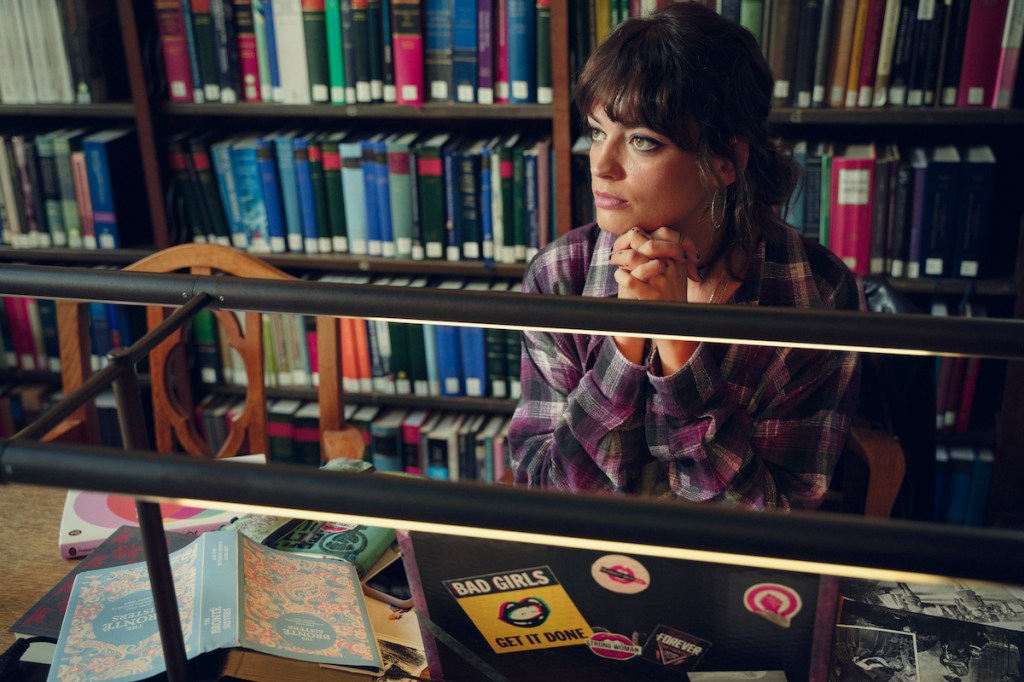
The two television episodes that affected me the most this year were about death. I’m sure someone else will write about Succession here, so I’ll keep my comments on the third episode of the final season brief: when you watch someone die of a heart attack, you experience time seeming to slow down. The gear change that the usually fast-paced, fast-cutting show pulled off by showing that happen in real-time is powerful; it lingers.Elsewhere in British-made shows for American audiences, the final season of Sex Education put Maeve Wiley through her paces. A sex-positive, all-inclusive, vocally progressive program set in a sixth-form college might not be the kind of thing readers of The Spectator are usually prepared to pay heed to — but Wiley, as played by Emma Mackey, is the show’s emotional core, and her performance in a funeral episode that lays bare the class differences between her character’s family and her peers offers gut-punch after tragic gut-punch. Everything that can go wrong does go wrong — short of actually dropping the coffin. Binge the series like I did and you’ll be shedding tears by its climax.
Chadwick Moore, contributing editor
Jury Duty and Down For Love
Two of 2023’s most enjoyable television shows offer a marked departure from an entertainment culture dominated by caustic egos and grasping influencers — and a rejection of TV writing that too often defaults to snark, empty banter and complacent self-absorption.
Amazon Studios’ thrice-Emmy nominated Jury Duty — a comedic reality show that details the inner workings of an American jury — follows Juror #6, Ronald Gladden, who is unaware everything unfolding around him is an elaborate hoax and all his fellow jurors are hired actors. While laugh-out-loud funny, it’s Gladden’s unusually pure-hearted nature, his complete lack of sophistication and self-consciousness, that becomes the show’s driving, and endearing, force. You leave not only wishing there were more Ronald Gladdens in the world, but with a new appreciation for just how much talent it takes to pull off a good TV show, or just a great prank.
Similarly in the theme of innocence, there’s Netflix’s Down for Love, a five-part reality show that follows several New Zealanders with Down syndrome as they navigate dating and relationships. The show — which ends too abruptly with no conclusion (and, unfortunately, features one creepy sex therapy scene) — is a lesser but still heartwarming cousin to 2019’s Love on the Spectrum, a dating show following Australians with autism. An American counterpart, Love on the Spectrum US was released in 2022 and, like Down for Love, both became instant audience favorites.
Critics might find such shows schmaltzy and pathetically optimistic. They are, delightfully so.
Teresa Mull, assistant editor
Newhart
My pick for favorite television this year is an old show I’ve only recently discovered. Newhart was a hit before I was born, and watching the show now is a therapeutic escape to a simpler time (read: pre-smartphones) I saw the tail-end of. Star Bob Newhart (who confusingly stars as Dick Loudon in the show) is still with us, aged ninety-four. I’d like him to know that his sarcastic humor, juxtaposed with Tom Poston’s awe-shucks simpleness, continues to make even this fast-forward world as quaint and pleasant as the Stratford Inn was forty years ago.
Is the New York Times’s Gaza mayor op-ed worth condemning?
If there is one thing the New York Times is good at these days, it’s offending the public. Conservatives are often enraged at the Gray Lady from the sidelines, while its subscribers feel betrayed by anything the paper publishes from right of the center-left. This year, the Times wrapped up a particularly offensive Christmas gift — an op-ed by Gaza City mayor Yahya R. Sarraj condemning the Israeli military.
The Times published Sarraj’s essay, “I Am Gaza City’s Mayor. Our Lives and Culture Are in Rubble,” on Christmas Eve. According to the city’s mayor, Israeli’s bombardment of Gaza has resulted in more than 20,000 deaths and the destruction of Palestinian cultural institutions. “The unrelenting destruction of Gaza — its iconic symbols, its beautiful seafront, its libraries and archives and whatever economic prosperity it had — has broken my heart,” he wrote.
In his piece, Sarraj poses a number of seemingly rhetorical questions, such as, “Why did the Israeli tanks destroy so many trees, electricity poles, cars and water mains? Why would Israel hit a UN school?” and “Why can’t Palestinians be treated equally, like Israelis and all other peoples in the world? Why can’t we live in peace and have open borders and free trade?” A discerning editor at the Times might have pushed back and suggested the inclusion of the responses: because Hamas broke the ceasefire on October 7 by marauding into Israel and murdering 1,500 innocent people — and because Palestinian leadership has rejected every attempt to agree upon a two-state solution in the last eight decades. Instead Sarraj’s questions are left hanging in the air as if they are unanswerable.
The response to the Times piece from conservative outlets has been swift and unrelenting. A MailOnline write-up pointed out that the NYT had been “accused of promoting ‘Jew hatred’,” while the New York Post highlighted the controversy around the “decision to grant a platform to Sarraj.” The Washington Examiner condemned the Times for “amplifying the voice of a highly ranked Hamas member”— in the piece, Sarraj cops to the fact that “the Hamas administration appointed me mayor in 2019.” But isn’t a big part of free speech publishing the opinions of people who offend? Previously the Times has published Recep Tayyip Erdoğan, the president of Turkey who has jailed over two dozen journalists, and Sirajuddin Haqqani, the deputy leader of the Taliban. It did so because, ostensibly, the purpose of the New York Times is to tell us about world affairs — and hearing from the people who shape them is a decent way of doing so.
Cockburn is old enough to remember when the shoe was on the other foot and the Times published Senator Tom Cotton’s “Send in the Troops” op-ed. Conservatives rejoiced and liberals cried at Cotton’s audacity to call for military force against Black Lives Matter protests. Times employees threw such a tantrum that opinion editor James Bennet was forced to resign, all because the Times got squeamish about its capacity to offend. Cockburn, like all those right-of-center titles, was appalled by the pearl-clutching over “platforming” in that sorry episode. He’s perturbed to see those professedly pro-free speech outlets employing the same tactics…
Why can’t the Tories come up with a good nickname for Keir Starmer?
When a nickname really hits its target, there is a satisfying beauty about it: a quippy sobriquet that catches the attention and goes to the heart of some aspect of a person’s character. It is a measure of the Conservative party’s inability to get a convincing hold on Sir Keir Starmer that they have tried tag after tag – Captain Hindsight, Sir Softy, the dismal Captain Crasheroony Snoozefest – but none has yet found its mark.
To real nail Starmer and come up with a nickname that sticks, the Tories should perhaps look across the pond for inspiration. Donald Trump, for all his faults, is in a category of his own when it comes to damning an opponent with a nickname. Crooked Hillary (Clinton), Sloppy Steve (Bannon), Sleepy Joe (Biden), Lyin Ted (Cruz) and Low-Energy Jeb (Bush) were all monikers that were hard to overcome.
Thatcher’s ‘Iron Lady’ epithet was originally meant as an insult
Political nicknames didn’t start with Trump, of course. Modern British politics is stuffed with inspiration for those trying to sum up Starmer. But Tories trying to capture something of the Labour leader in a memorable phrase should be careful: nicknames can end up backfiring.
Margaret Thatcher’s epithet of ‘the Iron Lady’ was originally intended as an insult. A year after she became leader of the Conservative Party in 1975, Thatcher gave a typically trenchant anti-Communist speech which accused the Soviet Union of seeking world dominance. A run-of-the-mill Red Army mouthpiece, Krasnaya Zvezda, hit back in unremarkable terms under the headline ‘Zheleznaya Dama Ugrozhayet‘, ‘Iron Lady Wields Threats’. By chance, Reuters’ Moscow chief picked up the phrase, Thatcher saw it and grabbed it with both hands, and repeated it in a speech on 31 January 1976. It stuck, because it was brilliantly apposite – an instant political persona.
A previous Conservative prime minister, Harold Macmillan, had similarly benefited from what began as a slight. He had succeeded Sir Anthony Eden in 1957 as the disastrous Suez Crisis played out, and entered Downing Street without optimism, telling the Queen his government might not last six weeks. But he survived, he steadied his party, and the economy started to boom.
In September 1958, the Evening Standard’s cartoonist ‘Vicky’ (Victor Weisz) sketched the PM as a superhero, caped and soaring into the air above the dismissive caption: ‘How to Try to Continue to be Top Without Actually Having Been There’. He dubbed the character ‘Supermac’. Somehow it worked. The country was emerging from the long shadow of post-war austerity and Macmillan, though an anxiety-ravaged intellectual in his sixties, had a weird streak of Edwardian showmanship. Unexpectedly, the nickname summed him up, and a year later he led his party to a decisive third election victory.
A pithy summation can be damaging too. H.H. Asquith, prime minister from 1908 to 1916 and the last man to lead a Liberal majority government, came to the premiership in his pomp. He was 55, a distinguished KC who had been raised in the glory of Jowett-era Balliol College, Oxford, in the 1870s, and had served first as home secretary then chancellor of the Exchequer. He worked quickly and efficiently but believed in an enviable work/life balance, and was fond of good drink, congenial company and, increasingly passionately but without hope, his daughter’s friend Venetia Stanley.
It is impossible to pinpoint when Asquith picked up the nickname ‘Old Squiffy’, a pun on his name but also a reference to his drinking. It might not have mattered, but his premiership was dogged by challenges and then engulfed by the First World War. In 1912, on a trip to Sicily, Asquith seems to have fallen wholly in love with Stanley, 35 years his junior, and the personal and professional disappointments drove him to drink more heavily. Within Westminster, ‘Squiffy’ became a self-perpetuating reputation: he was occasionally found incapable in the evenings, and some women preferred to keep a table between themselves and the emotional PM.
But by the time the war had come, music hall legend George Robey was singing to guffawing audiences:
Mr Asquith says in a manner sweet and calm:
Another little drink won’t do us any harm.
They laughed because they knew what he was singing about. By the end of 1916, when David Lloyd George sought to displace Asquith as head of government, Squiffy had neither the credibility nor the energy to resist.
Some epithets miss the target in the way Tory efforts with Starmer have done so far. Private Eye dubbed Edward Heath ‘Grocer Heath’ in 1964 after he angered shopkeepers by abolishing resale price maintenance. Characteristically of the Eye, it would not let the identification go; writing in this magazine in 2016, Richard Ingrams, one of the Eye’s founders, was still calling Heath ‘Grocer…as he will always be for me’. But it never really achieved universality, because it said little about the core of the man. Heath was a stiff, awkward man, over-aware of his own dignity, but he was also clever and hard-working, a gifted musician and an Admiral’s Cup-winning yachtsman. ‘The Grocer’ shone a light on none of these characteristics.
Reaching further back in time, you find nicknames which might have resonated at the time but, given the intervening decades or centuries, now mostly perplex or confound. A.J. Balfour, the brilliant but intellectually aloof and detached premier who succeeded his uncle the Marquess of Salisbury in 1902, was known as ‘Pretty Fanny’, supposedly for his delicate manners. The diminutive Whig Lord John Russell, prime minister from 1846 to 1852 and again from 1865 to 1866, supported the Great Reform Act 1832 only as a last measure of liberalisation and thenceforth carried the name ‘Finality Jack’. George III’s favourite, John, 3rd Earl of Bute, was widely disliked but elbowed his way briefly into the premiership in 1762-63 and gave punning rise to a more general term for a stupid person: ‘Jack Boot’.
Some unhappy PMs never achieve nickname status in their time: the records are largely silent on Andrew Bonar Law (1922-23) and the Earl of Rosebery (1894-95). The best must have spontaneity but, more importantly, they should have a shaft of authenticity, striking a chord that eventually brings a nod of recognition. After that, it is the luck of the draw: you can vault upwards through pithy and potent publicity, or you can carry a mark, some sign of a defect, which you will never shake off. Perhaps the reason the Tories haven’t managed to capture Starmer in a single nickname is that he’s plain and forgettable. But, if so, that’s bad news for Labour if it hopes voters will make him prime minister next year.
Did Richard Dawkins’s ‘New Atheists’ spark a Christian revival?
The battle between New Atheism and religion was never likely to have a clear winner. It was never very likely that the arguments of Richard Dawkins and co would topple the towers of theology. Nor was it likely that the atheists would provoke the sleeping giant of faith into rising up and crushing the impertinence for good.
I suppose atheists can claim that their cause is making steady progress, with organised religion continuing its gentle decline in the West, but the more honest among them might admit that the energy of their movement fizzled out long ago. Secular idealism opted for identity politics instead, making the pontifications of white male know-it-alls sound dated and uncool.
Believers, on the other hand, are likely to be more bullish. They might observe that New Atheism was widely disdained by agnostic thinkers, and that one or two prominent atheists have changed their tune, most recently Ayaan Hirsi Ali. But maybe they shouldn’t be too bullish either. Most of the agnostics who have criticised New Atheism have stopped short of advocating religion. A good example is Tom Holland. New Atheism prodded him to write a defence of Christianity’s centrality to the West, but he hasn’t come out as a believer. Much the same is true of Jordan Peterson. Atheism may have fizzled out, but no bold new theology has emerged.
I therefore have my doubts about a new book called Coming to Faith Through Dawkins. It claims a bit too much: that the hubris of New Atheism has backfired comically, and sparked a new mood of Christian confidence. It’s a collection of essays by people who were keen on Dawkins for a time, and then became Christians.
It’s not surprising that there are plenty of such people. Any God-curious youth in the 2000s was bound to engage with Dawkins, and maybe Sam Harris and Christopher Hitchens too. For a few of the contributors, Dawkins’ work really did spark an interest in religion, one that turned from hostile to positive. But most of the contributors had a religious upbringing, and Dawkins was just their rebellion phase.
It’s mostly standard evangelical testimony, but there are a few thoughtful voices. A historian of science called Sarah Irving-Stonebraker includes Peter Singer in the discussion. As a secular humanist, she expected to agree with his utilitarianism, but was alarmed that it dispensed with the principle of human sanctity: ‘The equality of all human beings is not a self-evident truth, as Singer and other world-class secular philosophers are happy to remind us.’
Dawkins, she observes, is less clear on the issue. He presents natural selection as the truth about life, and then says that of course we should defy it by acting humanely, but doesn’t bother exploring the roots of the latter assumption.
This is the real flaw in New Atheism: it inherits a vague rational humanism that it has to pretend is natural, or common-sense. It’s an important task of Christian apologetics to point this out, to insist that the moral assumptions of our culture have Christian roots. But most Christian apologists fail to focus on this and get bogged down in tedious arguments about first causes, and try to make a rational case for God, and even the historical likelihood of the resurrection. Most of these contributors take this approach, some citing the apologetics of William Lane Craig and Alister McGrath (who is this book’s co-editor).
To my mind, this is deeply unhelpful. It sinks to Dawkins’ level. A wise apologetics is minimalist. It calmly exposes the moral muddles of rational humanists, their weak grasp of the history of ideas. But it doesn’t overstate the role of intellectual argument in belief.
People don’t come to faith through arguments. They come to faith because they find that they like religion – the stories, the songs, the art, the speech-forms, the culture. They might also like the intellectual side of religion, but this is mixed in with everything else. For example, I might be intellectually persuaded by something that a theologian says, but this is tied up with my wider appreciation, which is more aesthetic or emotional than rational, of the core Christian themes that he or she develops. Most apologetics overlooks this wider embedding and overstates the role of abstract rationality, and makes theology look brittle and little.
Mad dogs and Putin’s shells: A dispatch from Kherson
Browsing the shelves at Tsum, a supermarket in the centre of Kherson in Ukraine, you could be forgiven for thinking you were in Whole Foods in Kensington. The deli and the grocery are as well stocked and diverse as any in London and, in the patisserie, the smell of freshly baked brioche permeates the air. Every day, people walk the aisles, gathering not only essentials but exotic fruits, kombucha and even Christmas decorations. In many ways, Tsum is emblematic of this city’s resilience in the midst of war. On the upper floors, its windows are either smashed or missing altogether; at street level, its doors are appended with large protective sheets of wood. Yet inside, life goes on much as it did before. Step outside and the booms and crumps of artillery, aerial bombs and grads reverberate constantly across the city. Although its residents can leave at any time, and many already have, Kherson feels very much like a city under siege.
The Kherson region is cut almost in half by the Dnipro river, with Kherson city on its Western bank. From the other, the shelling is ceaseless. Day and night, artillery pounds the city with a relentlessness that feels both random and indifferent. But the Ukrainians too are unrelenting in their own way, doggedly refusing to give in to fear. Between the explosions, life in Kherson persists. Cafes stay open most of the day and hair salons continue to operate unabated, the low hum of hairdryers and the sound of the radio punctuated by the rumble of artillery and occasional rattling of windows.
Kherson wasn’t always like this, the wild dogs once had loving owners
A few blocks from the river, the theatre is staging a production by a local playwright, advertised only by word of mouth. As with much else in Kherson, this is the influence of the fear of being made a target of the Russian artillery. In a basement deep within the building, a hundred or so people gather, huddled together to watch the play in a cellar directly under the boards of the stage above. There is sophisticated lighting and sound design and the show, which would not be out of place on a West End stage, goes on undeterred by the encroaching sound of the war upstairs. There is a sense of stoicism about the whole thing, as actor and audience put themselves at great risk, determined to keep the city’s arts scene going. Life in Kherson is saturated with these instances of intentional normality.
Driving around the city at dusk is a deeply disquieting experience. By 4pm, the streets are empty, the hallmarks of life retreating into dense, squat Soviet era residential blocks that flank wide nineteenth century boulevards. By 5pm, the city is enveloped in darkness, an unsettling silence broken only by the reverberation of nearby explosions and the howling of wild dogs. There are no street lamps here: to light the streets would make targeting infrastructure too easy, and so park and pavement remain dark, illuminated only by moonlight until morning. Entire apartment blocks stand dark and imposing against the night sky, stippled with warm light radiating from the occasional kitchen window. Sporadic silhouettes are the only sign that anyone is still here. The sounds of shelling continue through the night.
Kherson wasn’t always like this, the wild dogs once had loving owners and a haircut was not always a revolutionary act. Before the full-scale invasion, Kherson was a resort city, frequented, in particular, by Russian tourists. As Ukrainian forces eke out a foothold on the far side of the river, encroaching metres at a time on Russian positions, the city itself is made up only of civilians. There is a punitive nature to these attacks that is hard to describe. When the city finally was liberated following nine months of occupation, Ukraine’s president Zelenskyy stood just metres from the supermarket to address the nation. Within minutes of the end of his address, the shelling began. One year on, it has yet to stop. In recent months, the Russians have redoubled their efforts, unleashing an unprecedented amalgam of weaponry upon the city. It is a grinding, inexorable assault, less shock and awe and more a tireless and punishing wearing down of its inhabitants for no ostensible strategic purpose. People here understand that they are the target, that the army on the other side of the river don’t much care what or who they hit – to hit something, anything, is enough.
In Kherson, fear and resilience go hand in hand, inextricably bound by the resolve of those who live here. The makeshift basement theatre, the supermarket, the hair salons and gyms are sanctuaries, not just literally, but in a more profound sense too. Here, normal life is a deliberate act of defiance. The temerity of old and young alike, navigating daily the war torn streets of Kherson in the face of incessant artillery fire is a kind of resistance. It is here in Kherson, as ordinary people defy the extraordinary circumstances thrust upon them, that the unwavering resolve of the human spirit prevails, finding a way through like a sapling from an old oak through a crack in scorched earth.
Why Ukraine’s attack on the Novocherkassk warship matters
It was not quite in time for Christmas (which Ukraine now celebrates on 25 December, after switching this year from the Russian Orthodox Julian calendar), but Kyiv will still be celebrating today’s apparently successful Storm Shadow missile attack on a landing ship in a Crimean port. There are no seasonal ceasefires on either side in this increasingly bitter conflict.
The Ropucha-class landing ship Novocherkassk (BDK-46) had already had a rather unhappy war. In March 2022, it was damaged by Ukrainian shelling when docked in Berdyansk in occupied southern Ukraine. Later in the year the Novocherkassk, along with its sister ship, the Tsezar Kunikov, were reportedly immobilised by a lack of spare parts thanks to sanctions.
The Feodosiya attack was calculated not only to damage specific military assets, but to ram home the message that nowhere on the peninsula is safe from Ukrainian action
On 26 December, as it was anchored at the Crimean port of Feodosia, the Novocherkassk seems to have been hit by one of a number of British-supplied Storm Shadow air-launched cruise missile fired from two Ukrainian Su-24 bombers (which the Russians claimed they subsequently shot down). Moscow has confirmed that the Novocherkassk was damaged, but Kyiv claims it was destroyed. Footage from Feodosia shows large explosions and fires.
On one level, it is legitimate to ask whether this is a big deal. It is not the first time Feodosia has been hit, nor is the loss of a landing ship militarily crucial – given that the days when Russia could plausibly mount amphibious operations against Ukrainian targets are long gone. These large vessels still have some role as transports – Kyiv claimed the Novocherkassk was carrying Iranian Shahed drones, although it is hard to see why, as it had not recently visited other ports and it would be a pretty illogical place for long-term storage. These ships are also relatively easy targets. Novocherkassk’s sister ship, the Minsk, was hit in a similar attack while at anchor off Sevastopol in September, for example. Still, this attack by Ukraine is noteworthy for several reasons.
First of all, there had been suggestions that Ukraine had originally been supplied shorter-range Storm Shadows compliant with the Missile Technology Control Regime arms control regime, which limits the export of missiles with a range exceeding 190 miles. But this strike seems to confirm that Ukraine has the more capable version with a 340-mile range. Although it is not clear how many of these £2 million missiles Ukraine still has, they will continue to give Kyiv a powerful and long-range capability.
Secondly, the attack demonstrates that Kyiv is committed to a strategy of making occupying Crimea as untenable as possible for Russia. Even were Russian defensive lines to be breached or broken, a direct ground attack on the peninsula would be bloody and hard. Instead, the model is the liberation of Kherson in November 2022. After an assault there failed, the Ukrainians concentrated on isolating the city and hammering its supply lines, until Vladimir Putin’s generals were able to convince him that they had no choice but to withdraw.
Crimea is not Kherson, to be sure, and it would take a truly dire situation to drive Russia from it, not least because Putin likely considers the peninsula politically existential. Nonetheless, for the present at least, Kyiv’s best chance of regaining Crimea seems to be by making it too difficult and expensive to hold. The Feodosiya attack was calculated not only to damage specific military assets, but also to ram home the message that nowhere on the peninsula is safe from Ukrainian action.
After all, wars are political operations. These attacks are not only intended to unnerve the Kremlin, they are also meant to reassure both Ukraine and its western allies that they still have momentum. At a time when Moscow is claiming to have seized the disputed town of Maryinka; when Ukrainian defence minister Rustem Umerov is proposing lowering the combat mobilisation age from 27 to 25; and when there is increasing pressure on Ukrainians abroad to heed the call-up (and Estonia may even be willing to deport draft-dodgers), there clearly is a need for some good news. Along with President Zelensky’s recent claims that three new Russian Su-34 fighter-bombers had been shot down (which has yet to be confirmed) the Novocherkassk also represents something of a bid to encourage Ukrainians, and reassure wobbling allies that the war is still worth waging.
UK becomes first G20 country to halve its carbon emissions
A major milestone has just been passed: Britain has become the first major country to halve its carbon emissions. The rapid pace of UK environmental progress means that our output is now below 320 million tonnes – less than half the 652 million tonnes of our 1970 peak. This is in spite of Britain now having a far larger population than 50 years ago and an economy more than twice the size.
Had things gone the other way – if our carbon emissions had doubled, for example – this would be front page news. But I’m not sure you can expect to read about this good news anywhere other than The Spectator. There are no campaign groups tracking it, no politicians likely to trumpet it. The info is tracked by the Global Carbon Project and is one of many metrics collected in the energy section of The Spectator data hub. Here it is, showing (as you’d expect) a drop during the lockdowns, but by 2022 showing a drop driven by efficiencies that takes our emissions lower in a normal year than they were when the economy was being shut down.
The above is quite a simple graph: a country’s total carbon emissions. You can click on 'per capita' to see it that way too. Yet a quick Google search shows how hard it is to find this historical perspective anywhere online – and how easy it is to find negative metrics. This is a shame because it means a generation of young people are being brought up only ever hearing one side of the story: that there is a climate crisis that shows little chance of being solved. In fact, Britain is leading the G20 in decarbonisation, even when you factor in imports (the so-called ‘consumption’ table).
So how has this been achieved? By the three drivers of green progress: tech, capitalism and consumer choice. Fuel is expensive, hence innovation means every year devices that use energy are improved so they use less and cost less: even petrol cars travel 50 per cent further on the same fuel as when Blair came to power. Home heating efficiencies (and far-better insulation) means the fuel used by the average home has gone down by 41per cent. The pain of high bills would have been a lot greater if it were not the rapid advances of the last five decades.
You can see this across the board. Progress in agriculture mean that fertiliser use peaked in the mid-1980s. Since then, the total amount of nitrogen used in fields has almost halved and the amount of phosphate is down by two-thirds. Air pollution levels have collapsed; London air is purer now than in medieval times. All of which can be seen on the Spectator data hub.
This provides important context for the NetZero debate. The UK itself generates less than 1 per cent of emissions - so very little that we do, now, will move the global dial. We're doing more than anyone else which should raise questions as to how much pain to inflict on the average householder through more green taxes.
The below chart shows how much progress the rest of the G20 has made from their carbon peak.
The first five countries – Argentina, China, India, Indonesia and Mexico – are showing no reduction at all because they are at peak carbon right now and setting new records each year. But this needs to be seen in connection with their likely trajectory: when they peak, they’ll be able to fall a lot faster than Britain did due to far-better technology. And coal-guzzling China? As Cindy Yu says in her recent cover piece, China is on track to have its carbon emissions peak by 2030 and aims to be carbon neutral by 2060. Once countries hit the peak, they’ll be able to fall faster due to better tech. As Cindy writes, ‘It took London 50 years to halve its air pollution; Beijing seems to have done the same in five.’
All told, it’s a striking trend – and a useful balance to the often-hyperbolic negativity that is normally used when covering this important story.
The shameful legacy of Tony Blair’s Hunting Act
Most laws enacted nearly 20 years ago become uncontroversial with the passage of time. The Hunting Act, though, is not one of them. As hunts gather today for their traditional Boxing Day meet, the latest chapter in this ongoing story involves fresh claims about Labour and past ‘cash for commitments’. Central to these is the allegation that the pledge to ban hunting with hounds in the 1997 party manifesto was effectively purchased by a £1 million donation.
Shortly before the election, the Labour party received that figure from Political Animal Lobby, now known as Animal Survival International. It has always been a fair assumption that such a large sum had a significant impact on Labour policy, particularly on hunting. But until recently we could not say that definitively. Now, however, we can. First, Peter Mandelson admitted earlier this month on a Times podcast that the donation was ‘pretty transactional’ and put the party under ‘some sort of pressure’ over the manifesto. Then Brian Basham, the man who physically collected the cheque for the Labour party, wrote a letter to the Guardian declaring that he resigned immediately afterwards because of his concerns that such large donations were ‘deeply corrupting’.
Such a murky story ought not to merely be a matter of titillation to historians and political obsessives. Having spent 30 years in the House of Commons, I know just how reluctant politicians are to reflect on the impact of our law-making. We close the book on one debate and open the next, probably hoping, subconsciously, that if things do not go as planned, we will have moved on before the results become obvious and questions are asked. Yet even so, the complete failure to investigate the consequences of the Hunting Act has been astonishing.
None of the animal rights groups that gave huge donations, spent millions more on campaigning and made endless grandiose claims have spent a penny considering the actual impact of the legislation they desired. None of the MPs who put hunting at the top of the political agenda for almost a decade are now willing to discuss what their obsession has achieved, let alone dwell on the myriad of important issues that we could have studied during the 700 hours of parliamentary debate.
For the damage inflicted by the Hunting Act continues to be felt to this day. In a new book – Rural Wrongs – the journalist Charlie Pye-Smith forensically details the impact of the law on the countryside and especially the species it was intended to protect. In the uplands of England and Wales, where the use of hounds is often the only practical method of control, fox numbers have increased. As a result, the numbers of threatened ground nesting birds like the curlew are now hurtling towards extinction. In the lowlands, where the use of rifles aided by modern technology is extremely effective, foxes themselves have become an endangered species as they are treated as vermin because they no longer retain their protected status as a quarry species.
In those areas where the much-misunderstood practice of hare coursing traditionally took place, the brown hare once abounded; now their numbers have dwindled. In some places they are even actively discouraged, as hares attract undesirable bands of poachers who continue to run their dogs with impunity. In the West Country, staghound packs continue to control the population of red deer herds as best they can, within the restrictions imposed by the law. But their use has been seriously hampered, such as in cases where they would have traditionally been used to end the suffering of the increasingly high number of deer injured in road traffic accidents.
Given all this, you might have hoped that Keir Starmer – the man who now leads my former party – would be ready to at least review the impacts of the ban, given his willingness to embrace an admirably fresh approach on many rural issues. Yet sadly, Labour’s mutually destructive relationship with hunting seems set to continue. I had hoped that a future Labour government would not repeat the mistakes of the past in allowing class prejudice and pressure from animal rights groups to dictate the direction the party takes. But the policy adopted by the most Labour conference for the next manifesto aims to strengthen the Hunting Act, rather than replace it.
Apart from all the damage to wildlife and rural communities, this is simply bad politics. Labour needs rural seats to win a majority and needs to persuade rural voters that it has moved on from the divisive politics that saw it beaten so soundly in 2019. A war on the countryside, as past experience has shown, contributes to electoral defeat, not victory.
Has the West forgotten about Ukraine?
When Hamas murdered 1,200 people on October 7, I was in eastern Ukraine, researching a long piece for the Telegraph on how the summer’s counter-offensive had gone. The death toll in Israel’s 9/11 was equivalent to just a week or two’s heavy fighting in the Donbas. Yet immediately it was clear that the massacre 3,000 miles away would mark a new phase in Ukraine’s conflict: no longer would it be the sole international crisis in western leaders’ in-trays.
Until now, one of things that has buoyed morale here is the sense that the world is cheering Ukraine on, and that despite the privations and bloodshed, a glorious Victory Day awaits. Since October 7, the narrative has changed. In Europe and America, funding for the war no longer seems certain, especially if Donald Trump returns to the White House next year. On the streets of London, the protests denouncing evil colonisers are once again talking about Israel, not Vladimir Putin’s murderous land grab. In Kyiv, President Zelensky is arguing with his generals over a 500,000 mobilisation order, while in Moscow, which nearly saw a coup just six months ago, Putin looks back in charge. It’s as if some Kremlin spin-doctor is suddenly writing the script. Most insultingly of all, the counter-offensive is now routinely dismissed as having ‘failed’, as if Ukraine might as well now forget all about winning.
That is not how the war is talked about in Ukraine – although the counter-offensive itself has never been quite the buzzword that it is in the West. Much as it may obsess armchair generals back home, it’s not always the best topic to raise with the real generals in the field. Ask them how the ‘big push’ is going, and you imply they’ve taking it easy for the last 18 months. Ask why the counter-offensive hasn’t scored a major breakthrough yet, as Washington officials did within just a fortnight of it starting, and you sound not just like a backseat driver, but the irritating kid in the child seat going: ‘Are we nearly there yet?’
Privately, Kyiv always knew that if Russian forces put up even a basically competent defence (which they have) then this summer’s campaign was never likely to be a more than a start. It would, essentially, be a blood-drenched exercise in field research, allowing Kyiv to try out its new western armour and figure out what worked best. Those tanks will be back in action, though, once the fighting season resumes next spring – backed, this time, by US-donated F16 jets that should finally be operational.
Daniel Ridley, an ex-British soldier who now runs the Trident Defence Initiative, a private training programme for Ukrainian troops, argues that the counter-offensive was overhyped by western leaders. They thought fancy Nato kit would change the game overnight, and became crestfallen when some of it was chewed up in Russian minefields.
‘To be honest, the counter-offensive only really went on for a few weeks back in the summer,’ he says. ‘It’s partly the West’s fault, they gave the Ukrainians false confidence and western wonder-weapons, but manned by Nato-trained units where 80 per cent of the recruits had no combat experience.’
Many Ukrainian soldiers don’t even see the western-donated Leopards and Challengers as being that crucial. Many of the tank crews I met during my recent trip were still in upgraded Soviet-era T64s – the military equivalent of a Trabant. Yet they were content to stick with what they knew well, rather than risk grappling with fancy new kit in the heat of battle. ‘A tank is just a machine,’ a commander with Ukraine’s 93rd Brigade told me outside Bakhmut. ‘What’s important is your skill in using it, not how modern it is.’
They also dispute that the war is at a stalemate. True, in the southern Zaporizhzhia region, the main focus of the summer thrust, the Ukrainian lines have only gained ten miles or so – way short of the 50 miles they need to reach the Sea of Azov and isolate Russian forces in Crimea. But when every yard of turf is defended to the hilt, even that’s an achievement.
Nor are the gains all about land. Russia’s ability to protect Crimea is being steadily eaten away by sea-drone and air attacks on its Black Sea naval fleet, such as the one on Boxing Day that damaged one of its warships at the port of Feodosiya.
Where Ukraine is weaker than Russia, though, is in the crude metrics of artillery shells and troops. The EU is unlikely to supply more than half of its target of a million shells to Kyiv by next spring, despite pledges to ramp up production. A Ukrainian artillery team operating British howitzers near Bakhmut told me they’d had to stop using them because of a shortage of 105mm shells. And while Russian casualties are horrendous – 120,000 deaths is the rough guess, compared to 70,000 for Ukraine – it hasn’t produced the expected blowback on Putin. The Russian death toll already dwarfs the 15,000 killed during Moscow’s botched occupation of Afghanistan, long cited as the nail in the Soviet Union’s coffin. So far, though, it has sparked no serious social unrest, let alone any challenge to Putin’s rule.
Instead, Putin’s strategy seems to be that Russia should take pride in out-suffering its enemies, just as the Soviet Union did when it lost more than eight million soldiers defeating Hitler. Indeed, the higher the casualties on Moscow’s side, the more Putin may be able to peddle the myth that Russia is re-enacting its second world war glory.
Yet western leaders may be mistaken if they presume that Ukraine can simply be pressured into peace talks. For all that Washington or Brussels tries to bend Mr Zelensky’s ear, any move to the negotiating table needs sign-off from the Ukrainian public. They have already fought, won and lost far too much to be in a mood for compromise, according to Alina Frolova, deputy chair of Kyiv’s Centre for Defence Strategies.
‘There is still no readiness to negotiate, as neither the military nor the population are currently willing to back President Zelensky on that,’ she told me last week. ‘It’s not being discussed in serious political circles here, even if people like Trump are talking about it.’
Last week, the EU voted to open membership talks with Kyiv – regarding the offer, perhaps, as an important sweetener if Ukraine is ever to swallow the bitter pill of negotiations with Moscow. But Brussels may want to think carefully about the consequences of admitting Ukraine to the club if much of its population feels humiliated, angry and robbed of rightful victory by a timid West.
Ukraine, after all, will be no small addition to the EU fold. It has nearly 44 million people – more than Poland (38 million) and the size of Romania, the Czech Republic and Hungary combined. In an EU of nearly 500 million, Ukrainians would wield significant voting power, and a certain moral authority too. Nobody will be able to lecture them about ‘privilege’ or EU values, not when they’ve died in droves to protect those values. But just like Europe after the first world war, there’ll be a generation who bear the scars of conflict, who could well be a volatile addition to Europe’s political constituencies. Better to usher them in gorged on the fruits of victory rather than embittered by the taste of defeat.
While jostling with Israel for the West’s attention, Ukrainian diplomats may also politely argue that their ‘existential threat’ is rather greater. In recent weeks, Israeli embassies have held private screenings for politicians of the ‘Hamas Massacre Tapes’, a horror movie compiled of clips from dead Hamas fighters’ bodycams and victims’ phones. I watched it myself while reporting in Israel last month, and believe me, it’s hideous. But October 7 was essentially a cross-border incursion by a terrorist group. Ukraine’s was very much an invasion.
Finally, lest Ukraine now seem like yesterday’s news, cast your mind back to those scary early weeks of the invasion, when defeat seemed a foregone conclusion. In fact, it was barely 72 hours before it became clear that Kyiv was standing firm, and that Russian forces had bitten off more than they could chew. Had Ukraine’s fate hung in the balance for rather longer, western nations might be less tempted to treat it as another distant war that can quietly be forgotten about. Instead, the talk that the tide is now turning in the conflict seems to elicit not much more than a collective shrug from the western public. Millions of have taken to the streets over Israel-Gaza, on both sides of the debate. Where’s the mass marches for Ukraine, urging governments to stay the course?
In February I may be back in Ukraine again, covering the conflict’s second anniversary, when Zelensky will probably give a press conference. He did one on the anniversary this year, where he was asked how he’d feel if the fighting was still raging a year later. For once, the great orator seemed lost for words. ’That’s a drama that I don’t even want to think about,’ he said.
Back then, that gloomy scenario did indeed seem unthinkable. The war was still going Ukraine’s way. Hopes were high for the counter-offensive. Now it’s all but a certainty.
The trouble with Boxing Day
You are bloated and binged. Your bloodstream is 35 per cent blood, 60 per cent a mix of Nurofen Plus, Gaviscon and acetaldehyde and 5 per cent Quality Street. You will either be making more mess, or clearing up the mess that everybody else is making more of. There are tiny pieces of plastic everywhere, perhaps even in you. If you’re with your family, all of them, including you, will have reverted to their personality and status of 1993 at the latest. Television – merely horrible and chiding throughout the rest of the year – has suddenly dumped on you a ginormous dollop of sickening sugar and thick, choking starch.
The name Boxing Day comes from the lost Christian tradition of distributing presents in boxes to the poor of one’s parish. This has been replaced by the new tradition of a mass descent on the Westfield Shopping Centre in Shepherd’s Bush to buy presents in boxes for oneself.
Must everything be a binge? Sadly, yes. We inevitably retain the animal instincts of the Neolithic Era, so our bodies automatically behave as if we are not guaranteed to eat so richly again. This is perhaps the glaringly obvious reason for our rates of obesity. Unless and until an injection of Wegovy becomes a weekly commonplace like doing the bins or the lottery, we are stuck with that.
If you’re with your family, all of them will have reverted to their personality and status of 1993
But on Boxing Day we could, if we really set our hearts to it, pace ourselves just a bit. Festive overeating, like so many of the self-obsessive banes of modern life, occurs because we are affluent and bored. We want something to do to feel alive, or half-alive.
There is another big issue with Boxing Day. Looming above it is the dread consideration that we will barely have time to recover before New Year’s Eve, and another bout of binging. The big, nothing-in-moderation, HAVE FUN NOW feast days of our calendar are jammed tight. Why, in the middle of months of grey nothing, do we have three closely adjacent days of state-sanctioned razzmatazz?
We have lost the old stations of the agricultural year, from Hocktide (April/May) to Lammastide (August) to the Harvest Festival (September), which used to spread the jollity and bonding more evenly, and definitely more communally. In their place we have a scattering of drily secular and meaningless Bank Holidays, again all gummed up in the sunshine months. And we’ve totally dropped the essential fasting-before-feasting element that we see in Lent, Ramadan or Yom Kippur. Fasting in those traditions is a penance, a time for reflection on gratitude, a reminder of the tenuousness of the food supply. We have filled that vacuum in our ritual life by reinventing fasting as an apparently super-scientific way to shift our fat.
We forget, too, that we only started celebrating 1 January as the beginning of the new year in 1752. Before then it took place on the much more sensible 25 March, when you can just begin to feel buds bursting and blossoms blooming. January as the start of the year is a more recent innovation than the Act Of Union, newer than Shakespeare. This explains our cluttered calendar.
March is when we really need the boost. November and December are made bearable by anticipation for Christmas, the tinsel and glitter in the dark, the little fires of Halloween and Guy Fawkes Night (although those are also ludicrously close together). As it stands, after New Year we are dropped back into the worst weather of the year with no sparkles to adorn the muddy slush, and only the dim prospect of drab, anonymous Easter to cheer us. The horrid smears of dread and flatness that are January and February – ‘Don’t you come around’, Barbara Dickson pleaded in 1980, and so say all of us – would be lifted by looking forward to a late March New Year, with all the rising sap and resurrection shuffle of Spring. Then we could really enjoy Boxing Day again, relax into it fully, and not shudder and clutch our bellies in a gluttonous pit stop between two blow-outs.
The do’s and don’ts of Christmas thank you letters
My late great-aunt would arrive for Christmas from Edinburgh with a stash of pre-written thank you letters. She’d leave gaps for the specifics of the present and the rest was a scramble of generic, suitably gushing adjectives. The turkey pan would still be soaking and my great-aunt not yet north of the border when you’d be ploughing through her two-sider. My own list of overdue thank you letters – weddings, children’s birthday presents, an impromptu late August BBQ – sit on my to-do list like immovable marker pen, never quite shifted.
Great Aunt Pammie’s clinical efficiency is not something I’ve inherited. But in an age of WhatsApp, there seems to be an absurdity to the paper thank-yous. It’s the impromptu flash of a message the morning after a dinner party glimmering with praise which gives you the smug satisfaction that your slow-cooked ragu was just the ticket, not the dutiful letter which lands through your letterbox after a week of silence. Similarly, the WhatsApped photo of your goddaughter breathless with excitement, fumbling the Polly Pocket you gave her on Christmas morning, is a far greater reward than two lines on a card in January – which has the air of a 1960s school child who’s been made to write lines.
When someone says ‘you mustn’t write’ as they deliver a present, don’t take their word for it
Then there’s the tendency of a letter to relay details to the wedding host which they’re unlikely to have forgotten (‘delicious smoked salmon and rack of lamb, followed by pavlova’). After all, they are the ones who will have shelled out for 150 rounds of it. Or the dangerously dull straying into an inventory of proceedings (‘fantastic brass band, speeches and dancing’).
Writing in the American magazine the Ladies’ Home Journal in February 1894, Mrs Lyman relayed: ‘The “bread and butter” letter as it is sometimes called, because it is supposed to be a letter of thanks for what bread and butter stands for, should be written within 24 hours after arrival at one’s destination, to the hostess whose hospitality one has been enjoying.’
This side of the pond, and 130 years on, time is still of the essence. The longer you leave it the better it needs to be. I recently found my husband desperately googling the history of the Home Counties’ church where his Army friend married in August to bulk out the letter. Had he rattled it off on the Monday after he could have got away with ‘very smart guard of honour on the steps of St Mary’s’ in reference to the church.
And a word of warning: when someone says ‘you mustn’t write’ as they deliver a present or wave you off at the end of an evening, don’t take their word for it. If your host or present giver is a thank you letter proponent, their memory of who has and hasn’t sent one will be terrifyingly encyclopaedic. (And a WhatsApp won’t count.)
There are, of course, exceptions to the tediousness. There are the master letter writers who keep the thank you parts short and use them as a vessel for something much more delicious, a long letter of news and anecdotes which trump any dopamine hit of a flowery WhatsApp message. Or those that are admirably succinct (‘Dear Mr. von Fuehlsdorff: Thank you for your champagne. It arrived, I drank it and I was gayer. Thanks again. My best, Marilyn Monroe’).
It’s here that Debrett’s, which declares ‘thank you notes should always be relentlessly positive and any inconvenience or difficulties associated with the occasion should never be revealed’, is missing a trick. Finding out that you accidentally put your guest next to their disgraced teenage boyfriend at dinner, or that they ripped their dress on the dance floor, is exactly the kind of detail that makes a letter worth reading.
However absurd, there’s a reassuring discipline to the whole charade of the written thank you: the same forces at work that stop you opening 24 advent calendar doors on 1 December or spooning the icing off a birthday cake in one fell swoop. Those hazy days after Christmas when you – and your children, under duress – dutifully tick off thank you letters serve as some sort of calming penance for the preceding days of frothy excess, an excuse to hide with pen and paper.
Keeping track of presents being torn open by three small children simultaneously on Christmas morning, I have found, can feel like a sweat-inducing game of Whac-A-Mole. ‘WHICH CARD CAME OFF THAT ONE,’ you yell as the Lego tumbles, the growing list weighty on your mind. But complete it by the end of the year to start January with an empty thank you inbox – and conscience – and you’ll have a feeling akin to the last day of your GCSEs. Utter freedom.
Can Jilly Cooper wreck your life?
What do the names Octavia, Prudence, Harriet, and Imogen all have in common? If you don’t know the answer to that, you’re probably – unlike our current prime minister – not a fan of Jilly Cooper.
Cooper has just published her latest bonkbuster Tackle, one of the doorstep-sized Rutshire Chronicles series that also includes Riders and Rivals. These books are set in a fictionalised Cotswolds and are as reliably comforting as a tin of Quality Streets. But in the good old, bad old days of the seventies and early eighties many of us came to this writer through her ‘name-books’ – six romantic novels (and one collection of short stories) which always had a young woman’s Christian name as the title.
I’ve drawn immoderate pleasure and comfort from Cooper’s name books over the years
Were it not for my older sister, it’s doubtful I would have come across them at all. They seemed designed for hormonal schoolgirls and frisky, daydreaming secretaries. Caught with them at boarding school aged ten, I got glowering looks from the teachers – ‘Not suitable reading matter!’ – and quickly learnt to stash them under my mattress and read them at night with a torch.
While my fellow pupils lived in a world of the football game Subbuteo, Wisden and Willard Price stories, I was already dreaming of metropolitan romance, cosy wine bars in Sloane Square and one day owning a Westminster flat in ‘harmonising greys and rusts, with abstract paintings… thousands of books, and the sort of vastly elaborate hi-fi system you need a licence to drive’ – like the barrister Pendle, one of the characters in Prudence.
The format is as predictable as a Bond film. An amiably flawed young woman – we’ll call her Felicity – working in something like advertising, sales or a public library, meets, by chance, an homme fatale. He leads her on a merry dance through Belgravia, Mayfair and the fashionable regions of London’s Zone 1 (Muswell Hill, when mentioned, feels as far away as a Bangladeshi slum). In the books, this initial man is always problematic: he’s too volatile, elusive and not to be trusted. But Felicity, bless her, ‘faint with lust’, is hooked.
Then, a few chapters into the book, this initial man invites Felicity off somewhere and she enters, in true Shakespearean fashion, a ‘magic forest’. This may be a crumbling pile in the Lake District, a Cote d’Azur hotel or even a narrowboat on Britain’s waterways. It’s an enclosed world – a kind of Big Brother petri dish for the upper-middle classes – where for days or weeks Felicity will be trapped with half a dozen witty, sexually unbuttoned malcontents and get some concentrated experience of life. Alcohol and cigarettes (better if they’re French) are never far away (it’s the seventies), and there are riotous parties where the sniping, scintillating comments fly back and forth like lacrosse balls. It’s here that Felicity usually meets man number two – the real deal alpha who smoulders onto the page, showing up initial man as a flimsy imposter.
Jilly Cooper’s ‘real deal alphas’ (RDA) are all of a type. They are tall and broad-shouldered, have long powerful legs, forbidding moods and guarded but tender hearts. Their minds are on higher things like their glittering careers (foreign correspondent/mogul/novelist) and, barring the odd black coffee or triple brandy (a sign of the ubermensch in Cooper), they care as little for their diet as their hairstyle.
Their relationships with Felicity tend to start badly: she has fripperies they disapprove of and she loathes them right back, dismissing them as bullies. They say things like ‘Get in the car!’ or ‘You’ve had quite enough!’ or ‘Cut it out! You’re behaving like a child!’ But soon comes a moment of crisis for Felicity (she shivers, weeps and vomits) and our beetle-browed hero unexpectedly shows chops as a father figure. One RDA, in Octavia, even gives the title figure a spanking for loose morals. But he’s good enough to have broad hairy forearms and tuck in her blankets afterwards, so she delivers him her heart.
Nobody reads Jilly Cooper’s name books just once – Tanya Gold once wrote ‘they are like houses I have lived in’; I know these heroes better than many of my friends. My personal favourite is probably Matt O’Connor in Imogen, a shaggy Irish journalist whose bashed out articles light up the Sunday supplements. Matt’s a mover and shaker in the adult world – we know this because he speaks French, wins at gambling and has, we hear, ‘beaucoup d’allure’. Each day he guts the newspapers over Pernod, even Figaro and Paris Match, and says big-cocked, damn-your-eyes things like ‘this business in Peru’s going to explode at any moment. They want me to fly out tomorrow.’
Nobody in life has ever seemed more adult to me than Matt O’Connor. In many ways at 53 I am still waiting to become him. I have a feeling, though, he didn’t grow up reading books like this.
Though we know Felicity will end up with our man, there are plenty of obstacles, not least his apparent indifference to her (revealed at the 11th hour, rather optimistically, to be mere self-protective bluffing all along). A love rival too pops up to complicate things, usually an actress or supermodel, skilled at the savage put-down and willing to do anything to see off a competitor. Prudence has a peach of a villainess in character Berenice de Courcy: an American feminist, immaculately dressed with gleaming black hair and a wardrobe by Hermès. Berenice talks about herself incessantly, speaks in psychobabble, dislikes shabby English houses, rigidly controls her boyfriend’s diet and dreams of one day assuming power and sacking the housekeeper. Royal family watchers would be forgiven any perceived similarities: the novel was written in 1978, several years before Meghan Markle was born.
These books have left their mark on me, I realise that. Where do my assumptions come from, that red wine is the ultimate comfort drink or French food the snazziest? That tax inspectors and American academics are ghastly, or that a real man doesn’t care what he looks like? Perhaps from experience, but from Jilly Cooper’s books as well.
Do young people still read them in 2023? Should they? Were those teachers right after all? I’ve drawn immoderate pleasure and comfort from Cooper’s name books over the years, though one of the disappointments of growing up is discovering what would be blindingly obvious to any adult: they’re about as true to life as Chicken Run.
That high-ceilinged and autumnal Zone 1 flat never materialises, nor does the womblike little wine bar to shield you from all ills. Most of life, you find, is spent twiddling your thumbs in Zones 3 or 4 (in all senses) and in the field of romance the 11th hour feels too much like the tenth. As for that ‘magic forest’, even if you briefly find it, the denizens keep their secrets and, unless you’re drunk, rarely zing and sparkle as you hope. But that’s what her novels are: fairytales you never quite grow out of.
Maybe Cooper’s beloved Cotswold villages – where Liz Hurley, Kate Moss and Jeremy Clarkson lay their heads – are whooping it up 24-7. But for most of us, the only place we can find Jilly Cooper’s warm, enfolding world is where we always did: between the covers of her books.
Sean Young has lessons to share
The year was 1991. Actress Sean Young was trending — which in the Nineties means tabloids were dumping on her. The scandal: she barged onto the Warner Bros. lot dressed as Catwoman for an audition for Batman Returns. Two years earlier, Young was set to play Batman’s love interest in the first film, but she fell off a horse on set, fracturing her shoulder, so director Tim Burton replaced her with Kim Basinger. Young believed she deserved an audition for the sequel’s villain. After all, she was Sean Young. She played Chani in David Lynch’s original Dune (a role a not-yet-born Zendaya would reprise in a remake). She made love to future Yellowstone star Kevin Costner in No Way Out. Sure, Blade Runner flopped in its initial release, and the Wachowskis hadn’t yet cast Carrie-Anne Moss and a series of other black-haired Young lookalikes as heroines in sci-fi flicks like The Matrix, but by 1991, everyone knew Young’s role as cigarette-puffing, TERF-banged, maybe-robot Rachael was influencing a generation of blockbuster filmmakers. She was a star.

But Burton refused to see her, the media howled — and now, Hollywood was buzzing about that oh-so-difficult actress.
Publicists would tell Young to shut up (she is a woman in 1991, after all), but Young had a better solution. She went on The Joan Rivers Show and strutted across the stage in a Catwoman costume.
“How dare you not even return the Catwoman’s phone calls,” Young hissed at the camera. “Seems to me old Timmy takes himself pretty serious now, so I’m going to do you a favor and help you check into reality for a minute!”
The audience laughed. Young ripped off her cape, collapsed on a chair beside Rivers and sank back into reality. She giggled at her stunt. Decked out in a yellow pantsuit, Rivers cackled right back at her. They were two biddies poking fun at a scandal.
At least, they were for now. Halfway through the show, after a commercial break, Rivers welcomed Dr. Judy Kuriansky to the faux-living room set. The studio audience went silent. “She’s here to help us better understand much better what celebrities face when dealing with the anxiety and the stress and the agony of defeat,” Rivers explained. She turned to Dr. Kuriansky: “[Young] is putting herself on the line. Is it healthy?”
“Very!” Kuriansky said.
Young gasped, broke into tears and fell into Kuriansky’s lap. “I’ve wanted someone to say that for so long,” Young wailed. Sure, she mocked herself. Sure, she laughed. But she hurts beneath all the giggles. She’s relieved to hear someone call her normal. But, then, she paused. This couldn’t be true. She looked up, confused after too many years in La-La Land: “Why is it healthy?”
“Because [Sean] is not afraid about saying what you want and going for it,” Dr. Kuriansky said. “Sometimes you’re going to get in trouble for it.”
“Mostly, they say that I’m crazy!” Young said.
And boy did they. It’s hard to imagine now in the age of Free Britney and everyone from Paris Hilton to Pamela Anderson repositioning themselves as victims in memoirs, but Young’s career imploded. She was canceled before cancel culture existed, but many of her scandals were ahead of their time. In the Eighties, she tussled with actor James Woods before the media turned on him for his conspiracy theories. She rebuffed Harvey Weinstein’s advances years before Gwyneth. The first week of shooting Dick Tracy, she rejected Warren Beatty’s come-ons, so he allegedly fired her. (All the men deny the accusations, and Beatty has claimed he fired Young for not seeming “maternal.”) Instead of staying mum or waiting decades to recount her traumas in a Netflix documentary, Young often broadcasted the names of the men who did her wrong in real-time.
“The truth is, I took it upon myself to get pissed off about it and take it to the TV screen,” Young says. “The guys and the rest of them didn’t like that. And when you piss anybody off, there are consequences. There were consequences for me then — and I paid them.”
But Young has finally come back in the most unexpected of place, far away from Hollywood, playing B-movie star Susan Cabot in Ode to the Wasp Woman, a collection of off-off Broadway one acts about doomed film stars (think: Alfalfa from Little Rascals and Superman actor George Reeves). The play recounts how Cabot, an actress best known for her role as a giant wasp woman, gave birth to a dwarf, who murdered her after an interview with grocery store alien-and-bat boy tabloid Weekly World News went wrong. As Young’s character describes her life on stage, she was a “B-movie actor whose life was like the movies.” Or, as the George Reeves character says, she was one of many Hollywood “victims of victims.” The performance received raves in the New York Times, New York Post and more. Cindy Adams called it “an Off-Broadway renaissance.” If anyone was destined to go from playing a D-lister off-off Broadway to a Ryan Murphy vehicle, it’s Young, but she insists she ignored the positive notices: “If you don’t wanna believe the bad stuff, you can’t look at the good stuff.” It’s a lesson she learned the hard way.
I first met Young in 2017. At the time, I was a twenty-five-year-old cub reporter for a digital media outfit, and rumors were swirling across LA about Young appearing in the Blade Runner sequel. (She ended up with a short cameo.) I tracked her down. After phone calls, Facebook messages and other forms of reporter harassment, we met for lunch next to her yoga studio on a white patio at a Santa Monica restaurant that smelled like candles and gasoline. A very LA scent if there ever was one. She brought her young adult son, Quinn, along for the interview, who laughed with her and spoke throughout our lunch. For a then nineteen-year-old boy, he seemed happier to spend time with his mother than most boys his age.
Unlike her Eighties competitors — Basinger, Nicole Kidman, Daryl Hannah — she avoided plastic surgery. A few wrinkles lined her face, but she could still emote. Her old opponents might still act, but she was still beautiful.
Young was uninterested in discussing being ahead of her time. “[Now, they’d say], ‘Oh right on, girl. Stand up,’” she said. “A lot of people say, ‘I took the first selfie.’ What I regret most in my early career is that I didn’t have enough self-protective instincts. What I had was when people behaved badly, I was outraged by it. I was just kind of like, ‘What is wrong with you?’”
In other words, she’s still a talker, capable of delivering one-liners. I asked her rapid fire questions; she delivered:
On Warren Beatty: “Nightmare.”
On James Woods’s downfall: “Great!”
On barely being in the Blade Runner sequel: “Sore subject.”
On the Eighties: “Everyone was on coke, except me. Everybody was on coke. It was nasty, but it was a business.”
On agents: “The waitresses of Hollywood.”
On why she liked the Eighties: “The checks, I definitely liked making money. I don’t know that I would’ve been able to do that well in any other field. I know I would’ve made a great waitress.”
Bored or trying to manipulate me to soften her image — it’s hard to know with an actress — she turned to her son and told him to take over the interview.
It’s Young’s turn. “What’s the biggest misunderstanding about her?” I asked. She swatted a fly. “Honestly, I don’t care anymore.”
“You always had a don’t-give-a-fuck attitude,” I concluded, thinking of a YouTube video of a very pregnant Young dancing Meredith Brooks’s “Bitch” with her toddler son. They swirl across the living room, Young shaking her hips, rubbing her belly and shouting, “I’m a bitch! I’m a lover! I’m a sinner and a saint.” It’s a triumph, one of Young’s best performances. She captions the video on her YouTube channel, “Maybe we should all reconsider what our definition of a bitch is.”
But Young, to my shock, corrected me: “That’s a strong defense,” she admits. For the first time in our hour-long conversation she looks down at her lap instead of me. “It was extremely harmful — and it had a big impact.”
“What got you kicked out [of Hollywood]?” I asked.
“Maybe it was like mercury retrograde?” she said.
Perhaps it was. It definitely was for me in 2017. My story never ran. The week my article was supposed to be published, an email was leaked where I called a woman fat. My employer tossed me under the bus and fired me. A stalker doxxed me. I was a Twitter main character for a day. It was a very Sean Young ordeal, but I was shocked when she direct messaged me on Twitter about it.
“[sic] oh Mitch, I just realized you are in a press storm,” Young wrote. “I read that you got fired. I am so sorry to hear that. I hope you are doing Ok. Please let me know how you are.”
Her message was one of the ones that got me through that time. I persevered and reinvented myself, partially thanks to sage words from an OG victim of cancel culture.
Young performs Ode to the Wasp Woman in a literal temple to acting, the Actors Temple, a literal temple that doubles as a playhouse off-Broadway. The place smelled like moth balls and holy water, like a Catholic school. Paintings of rabbis lined the stairwell.
The cast prepared in a white room across from the audience bathroom in the basement. There’s no real backstage at the Temple, so Young enters the show, floating down the aisle, arms outstretched. Her early scenes revolve around preparing Cabot’s dwarf son, Zippo, for their World Daily News interview. Cabot pre-plans what they will say in the interview, down to pretending a famous actor is calling her. She’s concerned the reporter will present her as a has-been mother of a dwarf freak, even though she claims she cured his dwarfism through medical intervention.
With the wrong actress, the scene would be absurd. (You think of scribe Joe Estherzas claiming the worst received lines from his Showgirls script were the ones he cribbed from actual strippers in Vegas.) But Young makes the strange believable. As she irons a shirt for Zippo, she stares into the audience, her eyes glistening with tears. There’s a glamor but a depth to her face you don’t see in other women. (2023 Madonna would pay to look like sixty-something Sean Young.) When her character says, “everybody loves a comeback” about her World Daily News interview, she says it without irony. Young is no longer the Norma Desmond of the Eighties. She’s Gloria Swanson, making a comeback in a meta role, but she doesn’t lean into any of the meta-ness or irony. You can feel her believing every word her character says.
To prepare for the role, Young read everything she could about Cabot. Her childhood in foster care. A battle with post-traumatic stress disorder. Years in seclusion, trying to cure her son’s dwarfism before he beat her to death with a weight.
“She’s nothing like me as a person cause I’m rather positive,” Young says. “She was more traumatized. It’s a character that’s interesting, something different. However, there are parallels with the press and Hollywood.”
I thought about these parallels as I watched the play. I was sitting in a temple, watching a play, to profile Young; Cabot welcomes a Weekly World News reporter into her home for an interview. Young brought her young adult son to our first interview years ago; Cabot lives with her son. Young is amid a revival, playing Cabot; Cabot believes an interview could launch her back onto the B-list. But that’s where the similarities end. During the Weekly World News interview, Zippo interrupts, revealing it’s all staged. The journalist flees; Cabot screams at Zippo. Then, she falls into pity. She hates her son but loves him and longs for his affection. After all, she believes she cured his dwarfism. Zippo, though, thinks Cabot is smothering him, so he smothers her in a manly way, bludgeoning her to death so he can finally have peace.
Cabot is like a multiverse version of the Sean Young story where it ends poorly. Many believe the Sean Young story ended in tragedy, but through her attitude, the same I-don’t-give-a-fuck persona that got her in trouble in the first place, Young was able to find peace — a peace that, in the long run, eluded her many male opponents who now sit in jail cells or alone, canceled and out of work in Hollywood mansions. Young’s knowledge of what her life could have been adds depth to her rule. A tabloid freak story comes across as human.
Young, though, is the only cast member who could bring method acting to the temple. Most of the cast is young. Backstage, after performances, Young bonded with Payton Georgiana, a young blonde actress who played Barbara Peyton, a B-movie actress better known for her literary memoir, I Am Not Ashamed.
One night, Georgiana asked Young for advice.
“As a young, beautiful actress, develop boundaries because what happens when you’re young and you’re beautiful is people aren’t necessarily that nice to you,” Young says. “My biggest advice would be shut up. Shut up. You don’t help yourself. Just relax, baby.”
Young seems more relaxed than ever. After the play’s run ended, Young called me, as she merged on the turnpike, headed from New York to Philly. I had avoided asking her about Catwoman — it seemed like more of a sore subject than Blade Runner: 2049 — but given it would probably be our last call, it seemed like a time to ask.
“When you went on Joan Rivers, was that an act of rebellion, or did you feel like you were suffering?”
“Honestly, I thought it was funny!” she said. “I thought it was really, really funny, but these, these insecure dickheads at these studios, they just didn’t see the humor. they really didn’t. And I did not realize that that they were so humorless. I really didn’t. I thought it was absolutely fucking hilarious. I love that video. Of course, I should play Catwoman, and if these guys had had any sense, any time from that point until now, they would have given me the part again because [the controversy], it was so perfect, but they’re not really good businessmen… They’re not very intelligent.”
Given the controversy, Catwoman would have been the best role for her. (Lord knows, the struggling DC Cinematic Universe could use some press.) But she still got to use the controversy all these years later. In Ode to the Wasp Woman, her trauma — as she called her fame in People magazine — was put to use.
Young is a survivor with lessons to share. She’s taught me some myself. Towards the end of our call, I thank her for the direct message she sent me in 2017, but she doesn’t even remember it. She laughs. “Forgive me because this is one of the reasons why I survive: I don’t sweat the small stuff.”
Is the West at war in the Red Sea?
Britain and the US are getting ever more drawn in to the conflict in the Red Sea, as Iran-backed Houthis fire missiles at commercial ships. The USS Carney has downed 14 attack drones launched from Houthi-controlled territory and the Royal Navy destroyer HMS Diamond is also there shooting down missiles.
The Houthis are firing from Yemen, and the Iranian regime is reportedly sending them real-time intelligence and weaponry. The Houthis claim that they are only targeting ships headed to Israel, but evidence suggests otherwise. On Saturday a ship travelling from Saudi Arabia to India was struck. Christmas Eve was one of the busiest days yet: US Central Command said that it had ‘shot down four unmanned aerial drones originating from Houthi-controlled areas in Yemen’.
This affects all of Europe – any choking of shipping routes could mean shortages across the continent. Many ships are rerouting 3,000 miles around the Cape of Good Hope, rather than going through the Bab-al-Mandeb strait. Energy prices could soar especially if the Houthis decide to attack the Strait of Hormuz, through which most oil from the Arabian peninsula travels.
So much for western unity
So is it time for a united response? It seemed so on Thursday when the Pentagon announced 20 countries were joining its Operation Prosperity Guardian. US Defence Secretary Lloyd Austin said this was a matter of ‘freedom of navigation for all countries’ and confirmed that Spain had joined Britain and France in this alliance.
But now, Spain has pulled out, saying it would rather participate in Nato-led missions or a EU-coordinated operation than one led by the US. One of the country’s deputy prime ministers accused the White House of being enormously ‘hypocritical’ in its Middle East diplomacy. Why is America more concerned about protecting commerce than it is about calling for a ceasefire in Gaza, Yolanda Díaz asked.
So much for western unity. What went wrong? Díaz is the leader of the socialist Sumar party, and is one of Pedro Sánchez’s new coalition partners. Sánchez made the call earlier this year to align with parties on his left: he described the Vox party as ‘far-right fascists’ and opted not to go into coalition with the conservative Partido Popular, which would have delivered a coalition more representative of the electorate’s wishes.
The new coalition in Spain will only muddle the EU’s unity, as this week has shown. If Hungary has been winding up Brussels from the right, expect Spain to now do so from the left. Sanchez’s government could seek to pressure Brussels into being more critical of Israel, and attempt to move the bloc towards calling for a ceasefire at the UN. Spain’s latest leftward drift is yet another example of the difficulties, perhaps even impracticalities, of creating a common foreign and defence policy out of 27 wildly diverse member states.
The King’s speech was more Christian than his mother had dared
King Charles has been a victim of his own success. His first Christmas broadcast last year, which was both affecting and socially conscious, attracted 10.6 million viewers, making it not only the most-watched monarch’s seasonal address since viewing records began, but also the most popular single programme to air over the festive period last year.
The cynical might argue that its success was partly down to rubber-necking curiosity – would Charles mention his family’s rift with Prince Harry? – and partly because of the relative paucity of must-watch television in our increasingly bifurcated age. Still, it was a triumph both of presentation (the new monarch is a far more natural and committed performer than his mother ever was, let alone his hapless grandfather) and, in its own modest way, of content. How could this year’s instalment compare?
Predictably enough, the hashtag #NotMyKing trends on Twitter. The presence of both Prince Andrew and, bizarrely, Sarah Ferguson in the Royals’ entourage at the annual Christmas service at Sandringham has excited the usual – and, it must be said, justified – negative comment. It was left to the broadcast, filmed from the Centre Room at Buckingham Palace, to steady the ship. It was trailed in advance that the theme would be that of service once again, and that it would be a conservative, no-horses-frightened address. (Personally, I’d be up for a waspish, witty attack on the seemingly infinite follies of his son and daughter-in-law, but alas, regal precedent has intervened.)
Beginning with a brass band of the Grenadier Guards playing the National Anthem from the balcony of Buckingham Palace, the King began with talk of shared meals, of faith and ‘the joy of fellowship’, before he went on to remember ‘those who are no longer with us’ – as much a reference to his estranged younger son as his mother, perhaps? – before moving into explicit Biblical allusion by discussing the story of Jesus in the manger. This then allowed him to talk of those going the extra mile to care for one another, ‘because we know it is the right thing to do.’ He praised those who serve their community, and then talked of how ‘the essential backbone of our society’ was present during his coronation earlier this year, and that service lies at the heart of the Christmas story.
It was far more explicitly Christian than his address last year – and more so than his mother had dared to be for several years – and returned to his 2022 theme of how we must support those less fortunate than ourselves. Some might see this as a dig at his Prime Minister, the multi-millionaire who has raised the tax burden to the highest that it has been in living memory, but the heartfelt ecological theme of the message – ‘the one home which we all share’ – was backed up by the way in which Charles noted that the original Christmas message was initially brought to the world by shepherds. There was a timely allusion to ‘increasingly tragic conflict around the world’, but the King spoke of the universal values that we share – ‘the Abrahamic families of religion’ – and concluded by praising those who seek the good of others, ‘the friend we do not yet know’, before the usual warm wishes.
It will, of course, be seized upon by republican elements as the out-of-touch wittering of the privileged – it is very easy to suggest that we must all help and love one another if you are never going to face the suffering and difficulty that you allude to – but, as with his well-delivered and thoughtful address last year, the King has shown that he is unafraid to be his own man. He is venturing into areas that his mother might have only hinted at.
#NotMyKing? Perhaps. But, for the rest of us, we might tuck into the turkey quietly grateful for the presence of a thoughtful, compassionate monarch in these wildly uncertain times.
Christmas traditions and the lost practice of ‘mumming’
Christmas, we are often told, is rich in traditions invented by the Victorians (or even later), and it was a rather austere affair before Charles Dickens. But while it is true that the Victorians gave us many of our Christmas traditions in their current form, English Christmas traditions before the Victorian era were simply different, not non-existent – and they were every bit as exuberant as what came after, if not more so. One of those long-lost pre-Victorian traditions of Christmas is mumming; something which was as synonymous with Christmas 200 years ago as a fat man in a red suit with a proclivity for housebreaking is today. Mumming was a form of folk drama with its roots in the midwinter custom of guising – the wearing of masks for folk performances during winter festivals – which is found across Europe and may well have very ancient origins indeed, although it is first attested from the 13th century.
However, while the word ‘mumming’ just means masking or concealing one’s identity for a performance, in early modern England it came to refer to a specific type of seasonal folk drama. The first evidence for the shape of this drama emerges in the 18th century, and the poet John Clare described the form the drama took in his home village of Helpston (then in Northamptonshire) in 1825:
The [protagonist] of the drama steps in first, and … describes himself to be a no less personage than the King of Egypt. His errand appears to be to demand his lost son, who seems to have married a lady not worthy of the heir of Egypt, or to be confined in prison … And if they refuse his enquiries his champion Prince George is called on; who, after talking a great deal of his wonderful feats in slaying dragons and kicking his enemies as small as flies, begins a dialogue with his majesty. Then the Fool is introduced with his bell, who gives a humorous description of himself and his abilities, when all three join in the dialogue and instantly a quarrel is created between the King and [another performer] … and they draw their swords and fight. The Fool gets between them to part them, and pretending to be wounded falls down as dead; when the other confesses that the wounded Fool is the King’s own son in disguise, whose rage is instantly turned to sorrow. And the Doctor is called in and a large reward is offered him if he can restore him to life; who, after enumerating his vast powers in medical skill and knowledge declares the Fool to be only in a trance. And on the Doctor’s touching him he rises and they all join hands and end the drama with a dance and song.
The four key characters of the King of Egypt, Prince George, the Fool, and the Doctor are found in virtually all versions of the mummers’ play – since, as a folk drama, the mummers’ play was learnt orally and varied in details of plot in every locality (when I made a study of mummers’ plays in the Soke of Peterborough, I found a quite different play was performed in villages just a few miles apart). Even the name given to the performers varied – they were not always the mummers, but sometimes the ‘waits’ or the ‘morris dancers’ (a term then without the specific meaning it has today). One character whose name and identity fluctuated was the Fool, who was sometimes ‘the Devil’ or ‘Beelzebub’ – although he remained a figure of fun, and always carried a bell and had a grotesque appearance and a hunchback. Indeed, John Clare noted that the Devil/Fool was sometimes called ‘Punchinello’, a reminder of the relationship between mumming and Punch and Judy.
Punch and Judy is not a descendant of mumming, but both Punch and Judy and pantomime – which still clings on as a Christmas staple – may well share a common ancestor in the slapstick Italian commedia dell’arte, which reached England in the late 17th century via itinerant performers. While Punch and Judy took commedia dell’arte in the direction of a one-man puppet show (retaining its grotesque stock characters and comedic violence), mumming represented an amateur, garbled folk-performance of half-remembered visits by Italian performers, albeit with a particularly English twist. Mumming’s cousin pantomime, meanwhile, has roots in Victorian theatre and music-hall culture. And while pantomime retains the stereotyped plots and stock characters characteristic of mumming, as well as mummers’ utter disregard for ‘the fourth wall’ and engagement with the audience, the plots of pantomimes quickly diverged from commedia dell’arte.
If today’s Christmas pantomime performances seem chaotic, spare a thought for the people of Regency England at Christmas time, who were subject to the likelihood of an entire pantomime being acted on their doorsteps by inebriated local performers throughout the month of December. Mumming was feral pantomime: spontaneous performance of an orally transmitted script with little regard for dramatic authenticity or convincing acting. Each character introduced him or herself with the words ‘Here comes I …!’, leaving little room for ambiguity. But as with Punch and Judy and pantomime, the familiarity of folk drama is the point. It carried with it the comfort of a seasonal ritual; and again, as with Punch and Judy and pantomime, the ribaldry of audience participation was half the fun. No one watched the mummers with the attentiveness of a theatre critic.
A few modern traditions of spontaneous outdoor performance at Christmas time, such as the dreaded arrival (to some, anyway) of carol singers on people’s doorsteps and scratch choirs singing seasonal numbers at Christmas markets perhaps offer a hint of what it was like to watch a mummers’ play – but they are pallid replacements for a tradition that, ultimately, was unacceptable to the Victorians’ moral reformation. Like seasonal fairs, mumming fell victim to a burgeoning civic culture of respectability in which spontaneous drunken folk-drama became gradually socially unacceptable. But the later Victorians were also fascinated by the folk culture they had killed; in the 1880s and 1890s local newspapers were filled with memories of the mummers at Christmas time, and sometimes an elderly resident could be found who remembered his part in the drama and recounted snatches of traditional dialogue from his youth. These newspaper reports are now invaluable to the researcher, of course.
Mumming is occasionally revived today, and there are thriving groups of mummers in individual towns and villages around the UK. But it would be hard to argue that mumming has recovered its cultural significance, or is likely to do so. The demise of mumming is a reminder that seemingly universally beloved seasonal traditions, synonymous with the season, can quickly fall into obscurity under social or economic pressure (how many people today have heard of the Michaelmas goose, let alone cooked one at the end of September?) And the fate of mumming might lead us to wonder which of today’s familiar Christmas traditions might one day meet with the disapproval of future generations and end up deleted from our collective cultural memory.