-
AAPL
213.43 (+0.29%)
-
BARC-LN
1205.7 (-1.46%)
-
NKE
94.05 (+0.39%)
-
CVX
152.67 (-1.00%)
-
CRM
230.27 (-2.34%)
-
INTC
30.5 (-0.87%)
-
DIS
100.16 (-0.67%)
-
DOW
55.79 (-0.82%)
A (partial) defence of the ‘Jewface’ Oscars
How could I be Jewish, my friend wondered out loud, when I didn’t have the… She paused as she mimed a big old nose, coming far out from the face in a grotesque outward bulge. I was shocked. My friend was a sophisticated Cambridge graduate, yet still she had imbibed the anti-Semitic cartoons that have caricatured and justified violence against Jews for time immemorial.
That was in 2004, long before most people knew what critical race theory and BAME groupings were. It was also a time in which one of the most popular shows on TV, Little Britain, featured actors in blackface: characters played by Matt Lucas and David Walliams included an obese Caribbean woman called Desiree DeVere, portrayed in blackface, and a portly Thai bride called Ting Tong. Lucas and Walliams have since said sorry for those performances:
Jewface will continue to be fine, and all other ‘face’ not
‘David and I have both spoken publicly in recent years of our regret that we played characters of other races. Once again we want to make it clear that it was wrong and we are very sorry,’ Lucas tweeted following the outrage over the killing of George Floyd in 2020.
But the Jewish exception has continued in matters of ‘face’. Nobody in their right mind in Hollywood or TV or theatre land would dare for one moment to use a non-black actor then daub them in dark paint to make them seem black. Not in any context, at all, ever.
Fake Jewish noses on non-Jewish actors, however, are fair game and even, perhaps, worthy of an Oscar. This week, the pretend schnozz-tastic films Golda, starring Helen Mirren as Golda Meir, and Maestro, starring Bradley Cooper as Leonard Bernstein, were nominated for Best Hair and Makeup. Neither Mirren nor Cooper are remotely Jewish, and neither have particularly big noses.
Both Golda Meir and Bernstein, however, happened to. And so quite an impressive set of prosthetic technologies were deployed to make both gentile actors look like the big-nosed Jews they were bringing to life.
I should be outraged at this Oscars for Jewface, given how brazenly it shows the double standard. And secretly I am a bit annoyed that these two titans of Jewish history happened to have large noses (again, giving false grist to the anti-Semite caricaturist mill). But, actually, I am not that bothered. The reality is this: two extremely brilliant actors have done an excellent, serious job playing Meir and Bernstein.
Mirren, cast by the director Guy Nattiv, immersed herself in Israel’s history and pulled off a blinder as one of the least traditionally sexy-looking, but most impressive women of the 20th century. Cooper did such a good job that Bernstein’s family defended his casting, ‘Jewface’ included, given that, they said, he did Bernstein real justice. The result? Thanks to these prosthetics, audiences were brought that bit closer to the history of what they were watching.
None of this means the double standard is acceptable. If, as I and many other Jews believe, Jewface is merited by a serious treatment in the name of art or history, then the anti-Semitism only lies in the refusal to apply the same standards to all other minorities.
In blunt terms: so long as Jewface is OK, as the Oscars committee has confirmed it is, then blackface and Indian face and trans-face must also presumably be OK. If the best actor for a black role is white, or east Asian, then the judges of the Oscars would, in a saner world, be OK with their appearance being tweaked in a similar way to that of Mirren and Cooper. Mirren, after all, ended up looking like Golda, shnozz and all, and Cooper’s new big nose made him that much more like Bernstein. So the same rules should be applied to others.
Of course, given that the double standard shows no sign of abating – Jewface will continue to be fine, and all other ‘face’ not – we should call it out for what it is: anti-Semitism. Or maybe it’s just the excessive worship of the sensitivities of everyone else that is the problem. Either way, the double standard, bad as it is, means that art is working as it should in at least one tiny domain. In casting the very best people instead of those who share a real-life ethnic background, the permissibleness of Jewface shows how it should be done, and should lead the way for everyone else – and would, in a world less unhinged than ours.
The ludicrous saga of India’s butter chicken war
Butter chicken, one of India’s best-known dishes and a favourite all over the world, is at the centre of an extraordinary curry war in India. Two rival restaurant chains have asked the courts to rule over who invented the recipe for the signature dish, made with tender pieces of chicken in a tandoor oven, mixed in a rich tomato, cream and butter sauce. It’s a dispute that has captured the attention of the nation, with television stations covering the story and widespread debate across social media.
It amounts to a somewhat bizarre legal battle that’s piqued the interest of millions of ordinary Indians
The 2,572-page lawsuit was brought by the Gujral family who run Moti Mahal, a famous Delhi restaurant that counts India’s first prime minister, Jawaharlal Nehru, as well as former US president Richard Nixon, among famous customers to have sampled its menu. The family claim that their grandfather, Kundan Lal Gujral, invented the curry in the 1930s when he opened his restaurant in Peshawar, in what is now Pakistan. They say the original was created by their grandfather to use up leftover tandoor chicken. After India was split during partition in 1947, the restaurant moved to Delhi. As well as seeking rights to the grand title of butter chicken inventor, the Gujral family is seeking some £188,000 in damages.
The rival claim to inventing butter chicken comes from the Daryaganj restaurant family. It counters that a late relative, Kundan Lal Jaggi, worked with Gujral to open the Delhi restaurant in 1947, and that it was there that butter chicken was first created. This, they insist, gives them the right to describe their restaurant as home to the first serving of the dish, a right they claim to have trademarked in 2018.
All in all, it amounts to a somewhat bizarre legal battle that’s piqued the interest of millions of ordinary Indians. It is a culinary mystery set in a series of curry houses, ranging from Pakistan to India, with a lengthy cast list of characters, some deceased, and all armed with conflicting accounts of what took place.
The hunt will be on for the crucial witness testimony of someone who can somehow link the butter chicken name to a dish they consumed decades earlier. Other than that, who can categorically state, without fear of contradiction, how the critical ingredients came together, where and when, and under whose expert instructions? Much of it comes down to circumstantial evidence at best. In the end, even the courts might have their work cut out to be sure who gave the world the butter chicken it now loves so much.
The next hearing has been scheduled to take place in May. Given the slow pace of India’s courts, the feuding restaurant families may have to wait some time for a final decision. The legal dispute is serious enough but at the same time faintly ridiculous. It seems just a touch mad to descend to such lengths over who has naming rights to a curry. Even so, the saga has inadvertently highlighted just how many Indians from all walks of life are caught up in – or eager to resort to – litigation, even in the most minor disputes.
India has an estimated 50 million cases pending in the lower courts, highlighting the huge backlog in the system. The backlog has doubled over the past two decades, and at the current pace it would take more than 300 years to clear. There is a shortage of judges, with roughly 20 judges per million of population. Thousands of non-judicial staff positions in the courts remained unfilled, and lengthy delays to court proceedings are a regular occurrence. No one should hold their breath that a verdict in the butter chicken dispute will be handed down any time soon.
Indians have become accustomed to the lengthy wait for justice. It is a little like ordering a curry in a very busy restaurant: it never quite arrives because the place is chronically under-staffed and jam-packed with customers who have been waiting even longer.
Should foreign governments own UK newspapers?
The Emirati / RedBird IMI bid for the Daily Telegraph and The Spectator is opening up a wider conversation: how much of our national infrastructure should autocracies be allowed to buy? The Emiratis have been on a bit of a spree in recent years. They have 10 per cent of Heathrow airport, 15 per cent of Vodafone, 49 per cent of the Dogger Bank wind farm, Man City FC and now they want the Telegraph and Spectator. It would be the first time that a dictatorship would own a newspaper in a democracy, thereby setting a precedent. Much is riding in whether the UK government approves the deal.
LBC radio has just held a phone-in on the topic hosted by Ali Miraj, pegged to a new poll showing two-thirds of the public are against such deals. I opened the debate. Foreign owners, I said, are not a problem: Nikkei owns the FT. The issue is government ownership: a free press means freedom from government. You can listen to my case at the end of this blog; I’ve made similar points before. What I was interested in, and what I’d like to write about now, is what others had to say.
First was Hassan in Kensington. ‘Media is an important part of our society. It’s not just another business, it is designed not just to hold foreign governments to account, it is designed to hold every centre of power to account, whether local or abroad.’ He voiced dismay at seeing Richard Sharp, a buddy of Boris Johnson, being made BBC chairman. ‘We have seen how important an independent media is.’ But Qatari-owned al-Jazeera, he said, did offer ‘very useful’ contrast to BBC.
Josh in Chiswick said that no foreign government should own media but ‘I’d say the same for key infrastructure.’ He saw the Evening Standard as a cautionary tale, given the Lebedev family’s links. He said this contradicted my point about how papers represent the opinion of readers not owners: the Standard came out for the Tories, but Sadiq Khan won. Lebdev, of course, became a Tory peer.
Josh then made a point that you see a lot on social media: that right-wingers don’t seem to like tasting their own takeover medicine. ‘You can’t be part of an organ that champions [free market] ideology and then suddenly call for restrictions on ownership.’ But free marketeers have always called for restrictions: to prevent monopolies and guard against undue state interference. When governments or their proxies actually buy companies, that’s not the free market at work. That’s nationalisation, as Charles Moore has argued. Protecting national security also means keeping certain critical assets – including the democratic apparatus like the free press – out of dictators’ hands.
RedBird IMI says that while the Emirati government provides most of the money, it does so as a passive investor with no strategic input. Jeff Zucker, to whom I’d report as editor, has said he’d resign if there was any attempt from Abu Dhabi to interfere. But who would I then report to? And how likely is it that Abu Dhabi would pony up hundreds of millions of pounds to buy the Telegraph and Spectator and then vanish? Does this theory pass the smell test?
Russ in Leyton said ‘for me, it boils down to whether Redbird’s assurances of editorial freedom can be assured in the long term.’ (An independent editorial board has been promised for the Telegraph but not the Spectator.) Russ said he shares ‘consternation at the idea of any government owning a significant slice of our media landscape.’ Now, Zucker strikes me as a professional, respectful of The Spectator’s traditions. I don’t think he’d distort the magazine’s character and as editor I would not agree to any suggestion that we do. But under the proposed deal, either he or I could be replaced in two shakes of a camel’s tail.
Then we had Shahid in Hemel Hempstead who said: ‘I’m not buying the the explanation that the opposition is because it’s a foreign owned government. If that was the case […] then why on earth are the likes of China and France allowed to own our nuclear power stations, especially China?’ I’d argue that the press, in particular, should not be owned by any government. But the point about Chinese ownership of UK critical infrastructure is well made. A few who phoned up LBC also argued (in effect) that right-wing publications are anti-immigrant and this informs objections to bid.
Aaron in Liverpool pointed out a flaw in my argument. I say that press barons don’t impose their opinions on readers because papers who lose touch with the readers go bust. Surely this logic could be used to defend foreign government ownership? (My view is that governments have different priorities which is why so much that they run doesn’t work. As proprietors, they’d put influence over profit.)
It’s suspicious, Aaron said, that the Emirati royal family would actually want to own a national newspaper. “Democratic governments don’t tend to own assets like newspapers,” he said. “It’s only really a dictatorship that would enable themselves to buy infrastructure or newspapers. I can’t see the British government owning a newspaper in America or France.” Again, a point well made. Norway has a big sovereign wealth fund. It’s unthinkable that this would be used to by Le Monde or La Stampa.
Duncan in Romford pointed out that alliances change. ‘I don’t want any foreign government owning a British newspaper because even though they might be friendly governments at the moment, supposedly sharing our democratic values, there’s absolutely nothing to prevent them changing in the future.’ Again, an important point .The Emiratis are UK allies. But have been getting closer to Russia in recent years and last month welcomed Vladimir Putin as a ‘dear friend’ when he visited. The Emirati royals have seen, in Putin, a friend in need. They have bought his oil, hosted Russian businesses and done plenty to fuel the Russian war machine. As I asked recently, how much of Britain should Putin’s “dear friends” be allowed to own?
We need to remember that the readership also has the power to walk
Mark in Tunbridge Wells
Mark in Tunbridge Wells closed the debate by pointing out that journalists ‘can always walk’ if they don’t like the ownership. ‘We need to remember that the readership also has the power to walk. The reason the Spectator in particular is such a good trophy asset is because it’s done so very, very well over the last 10 to 20 years or so, particularly online.’ People wouldn’t read it, he said, if it were to go downhill.
I agree, which is why I do not see RedBird damaging The Spectator on a week-by-week basis. The Arabs would not demand we run a camel-racing section or that we change our approach to Israel. Jeff Zucker strikes me a someone who would be a supportive, laissez-faire boss. So I’m not arguing that the magazine would be vandalised by its would-be new owners: if they invest in the right things, I can see it thriving. But always with a cloud of suspicion hanging over us.
Think of The Spectator’s campaigns. In 2013 we rejected David Cameron’s attempt at state regulation of the press with a cover saying “No!”. If we did that again, it would be seen as a message from the Emirati government. During lockdown, we returned the furlough money to the taxpayer as we realised we didn’t need it. If we did that again, it would be seen as a bung from Sheikh Mansour. For 200 years we have campaigned for press freedom from government. How hypocritical it would be for us to do so while under the ownership of a dictatorship. As Andrew Neil said, The Spectator was formed in 1828 to campaign for democracy. It would be odd to see it bought by a regime that rejects democracy in 2024.
Some argue that Emirati money would supercharge The Spectator and that we’d be the Man City of publishing. But we have no need of a sugar daddy. As Mark in Tunbridge Wells said, we have done very well over the last 10 to 20 years: thanks to you, our readers. The Spectator was valued at £20 million when I became editor in 2009 and has just been sold for £90 million. If RedBird were to sell us again, they’d likely get even more. Some UK publications really are tanking and badly need cash injections. We’re not one of them. Nor is the Daily Telegraph, whose profit levels have risen fivefold since 2018. We need an owner who believes in us, believes in our growth and lets us reinvest more of our income (ie, accept lower profits for a while). But I suspect any new owner would let us do so, as the business is so compelling.
We don’t often write up radio phone-ins, but LBC has just held an important conversation. Media ownership affects all of us. Readers will want to know what strings are attached to the radio stations, newspapers and magazine they read and listen to. MPs have been slow to realise the importance of this. ‘With some rare exceptions, security implications of foreign investment were a low or no priority for most economies until about a decade ago,’ said a recent OECD report. That is, now, changing. Parliament could do a lot worse than hold a debate along the lines of that opened up this evening by LBC. There is plenty at stake.
Paul Waugh loses Rochdale selection
It’s the race that has had all of Westminster gripped. No, not the Republican presidential primaries in New Hampshire; nor the mayoral contest between Susan Hall and Sadiq Khan. Instead, all eyes this week have been on Rochdale, where the local Labour Party today met to decide their candidate for the forthcoming by-election. The contest is being held following the sad death of the incumbent Labour MP Tony Lloyd, who won it in 2019 with a majority of 9,968.
The three-man shortlist for the Rochdale selection attracted particular interest from the parliamentary lobby after it was revealed that longtime member Paul Waugh had thrown in the ring. Waugh, the chief political commentator for the i newspaper, was born and raised in Rochdale and announced his candidacy after a few days of agonising over whether to leave journalism. But in a surprise result, Rochdale members voted to reject the veteran hack and instead plumped for Azhar Ali on the first round of voting.
Proof, perhaps, that when it comes to candidate selections, the Starmer army don’t always get their way…
Biden’s media allies want to talk about Trump’s cognitive issues
As another Trump presidency starts to look more likely, the incessant conversations about age are bubbling back up.
Roundtable discussions about “cognitive capabilities” took a hiatus over the last few years in the mainstream press, as a slow-jogging, hair-sniffing, Joe Biden restored normalcy to the White House.
Normalcy, for those who haven’t been paying attention, looks like said octogenarian falling up the stairs of Air Force One, falling asleep at COP26, forgetting the names of his own cabinet members and of course, being escorted around the White House lawn by the Easter Bunny.
Like clockwork, the same Biden loyalists in the media who dutifully ignored Joe Biden’s very obvious mental decline since he began his third quest for the presidency in 2019 are now pretending to be concerned about Trump’s mental fitness.
The criticisms about Trump’s age aren’t unfounded. He is seventy-seven after all. Last week while ranting about former speaker Nancy Pelosi, Trump mistakenly kept referring to Nikki Haley. It was a gift to Haley who cut a campaign ad highlighting Trump’s mix-up.
That much makes sense. Of course Haley, who just turned fifty-two, wasn’t going to miss the chance to milk Trump’s gaffe for all its worth. Like her or hate her, there is no denying that compared to the two likely nominees, Haley is the young blood.
Now for what doesn’t make sense: San Francisco’s octogenarian Marie Antoinette coming out of the woodwork to take a victory lap over Trump’s flub. Speaker Emerita Nancy Pelosi went on MSNBC and tried her best to mock Trump’s cognitive decline. In a “Who’s on First?” inspired turn of events, Nancy, while attempting to point out Trump’s confusion, confused Trump with Biden.
Not to be outdone in the lacking self-awareness Olympics, Joe Biden took to X to get in on the fun. He — or more likely the poor souls tasked with running his social media accounts — reposted a Nikki Haley ad focusing on Trump’s mistake and wrote, “I don’t agree with Nikki Haley on everything, but we agree on this much: she is not Nancy Pelosi.”
Have neither Pelosi nor Biden, in their combined 164 years, ever heard of the expression about throwing stones in glass houses? The guy who called Taylor Swift “Britney” can’t sit this one out?
Biden’s cheerleaders in the press are also sounding the alarms about Trump’s age and fitness. Rachel Maddow shared her takeaways after Trump’s New Hampshire victory speech. Keep in mind, Maddow prefers to condescendingly explain Trump’s speeches to her audience rather than actually showing them in full and letting people come to their own conclusions. After all, she wouldn’t want to air his remarks and risk one of her viewers having an original thought.
“Donald Trump is not leading the Republican Party and leading the Republican field because of his youthful vigor,” she told MSNBC host Jen Psaki.
No one knows more about presidential vigor — or lack thereof — than Jen Psaki. Biden’s former press secretary once told a panel on MSNBC that they could rest assured Biden was taking the bank collapses seriously because he delivered a brief teleprompter address at 9 a.m. “Biden never does anything at 9 a.m.,” she said proudly.
When it comes to conversations about slurred speech and bizarre behavior, these keyboard warriors don’t have a leg to stand on. They lost all their credibility running cover for the eighty-one-year-old ice cream fanatic.
The fact-checkers who courageously defend our democracy from darkness didn’t bother pushing back when Joe’s minions in the White House bragged about his energy and enthusiasm. They did not bother following up when during an interview with CNN, Dr. Jill defended her husband’s mental acuity by asking, “How many thirty-year-olds could travel to Poland, get on the train?”
For the record, I happen to know several thirty-year-olds who can board transatlantic flights and get on trains.
Yet now these crack scribes are putting their white coats back on and readying their diagnoses as they dissect Trump’s every move during his speeches, which, you might notice, tend to be considerably longer than the current president’s.
The critiques of Trump’s cognitive capabilities will only grow louder as the election gets closer. His political opponents have hit on a good strategy because these attacks clearly get under the former president’s skin. But I can’t blame him for that. None of these armchair analysts made a peep over the last four years as the world fell apart and the president napped on the beach.
The Scottish government’s bizarre egg donor drive
A bright pink box fills my screen; soon it’s filled with blue cartoon sperm swimming towards a large, wobbling egg, where they congregate to spell the word ‘joy’. Alongside it is a message, which reads: ‘By becoming an egg or sperm donor, you could give the joy of starting a family to more than 200 people in Scotland, who need help becoming a family.’ It’s accompanied with the hashtag ‘JoyLoveHope’.
I’m looking at a digital advert, part of a series rolled out across radio and the internet in Scotland from 2021 until last year, where it culminated in National Fertility Week. Advertising for egg donors (and sperm donors) is a common – if ethically questionable – practice, and many private clinics do it. But this advert is different. It’s from the Scottish government.
To have a government involved in the soliciting and collection of women’s eggs is nothing if not dystopian.
This week, it emerged that Holyrood spent £186,000 on the advertising drive, which it said was necessary to hike the number of altruistic donations in the country. (In Scotland, unlike in England, egg donors can’t claim £750 in compensation for the weeks of treatment they must go through in order to prepare them for the donation.) Messages pushed by the government in the advertising drive included telling potential donors that ‘NHS Scotland needs egg and sperm donors for those who need your help to create a loving family’.
To donate eggs, a woman must be aged between 18 and 35 and be able to commit to a programme – under which women go through the same treatments as in the first stages of IVF – for three months before their eggs are collected. It is an invasive procedure not without risks (one being ovarian hyperstimulation syndrome, a survivor of which was left in hospital for two weeks and said it ‘nearly killed’ her) – but you’d be hard pushed to find them outlined on the Fertility Scotland website, a service commissioned by NHS National Services Scotland on behalf of Holyrood. Equally, the site makes no real reference to the fact that any child born will share your DNA – and that child, your biological son or daughter, may well be in touch in later life, because once they turn 18 they are entitled to information about the donor. And none of the adverts immediately mention the psychological impact of becoming a mother to a child who won’t be yours.
To have a government involved in the soliciting and collection of women’s eggs is nothing if not dystopian. Helen Gibson, the founder of Surrogacy Concern who obtained the staggering cost of the Scottish government’s advertising drive through a Freedom of Information request, told me she was ‘appalled to learn that the Scottish government were targeting their own people, as young as 18, for egg retrieval and sperm donation’. She added: ‘This is not territory the state should stray in to, and many will question whether £186,000 spent on advertising for gamete donors is an appropriate way to spend public money. In doing this, the Scottish government risks creating a situation where the public feel entitled to the eggs and sperm of others.’
The Scottish government has said that it ‘launched the recent national donor gamete campaigns to help alleviate’ the shortage of donor eggs and sperm in the country, and that ‘all donations are made through a desire to help those people in Scotland who need help becoming parents’. But state interference in matters as personal as egg donation – and the potential life that is created by their use – is deeply worrying. And asking women to donate their eggs out of ‘love’ preys on sentimentality for something that is deeply individual, and raises the question of ethics in the healthcare sector: when was the last time you saw an advert asking you to donate a kidney to a total stranger for the same reason?
The Scottish government’s advertising drive is a worrying glimpse into a future where the state thinks it can lay claim to women’s bodies. Genuine altruistic egg donation is an incredible gift for the families it helps to create. But it’s an incredibly personal decision and not something that should be pushed by the state. Whether the intentions behind such a drive are good doesn’t really come in to it when human wellbeing (present or future) is at stake.
Will we ever learn the lessons of the Holocaust?
As a child, I had to wash my hands before I was shown books of photographs depicting the ghettos and death camps so that I didn’t leave fingerprints on the pages. This wasn’t a Jewish custom, just the way things were done in our house. Looking back, however, it felt part of the rituals of memorial designed to prevent the atrocities of previous generations from slipping into the sands of time.
The Jews – the only people to have been persecuted in every single century of their existence – hold a culture rich in traditions of remembrance, all freighted with duty. Never mind books of photographs. On Passover we stayed up all night to relate the story of the enslavement in Egypt and the redemption. On Tisha B’Av, we fasted to commemorate the destruction of the Temple in 70AD, which precipitated the Jewish exile from the land of Israel. Holocaust Memorial Day – which is today – does not have such a formal religious significance, but it bears similar moral obligation. However distant the events of the Shoah, however grainy the footage, and however comfortable our lives become, it has been a duty to never forget.
This year we don’t need a duty. The animating darkness of the Shoah is once again among us. But it wasn’t just the Nazi genocide that was revived on October 7. In Baghdad in 1941, Jewish bodies were mutilated; in Kishinev in 1903, Jewish babies were torn to pieces by the mob; in 1834, in the mystical city of Safed in northern Palestine, Jewish women were stripped and raped; in the Iberian Peninsula in 1391, Jews were butchered in their thousands; in York in 1290, Jews were burned alive in Clifford’s Tower. Aside from the cosmetics of modernity, there is one difference. Throughout history, the slow progress of everyday bigotry had climaxed in an orgy of violence; in 2023, an orgy of violence gave way to everyday bigotry.
Around the world, Jews face graffiti on their schools, homes and places of worship – a slogan about Gaza was scrawled outside my house – and weekly marches calling for their eradication. (In a television interview this week, the Hamas leader Khaled Mashal dismissed talk of a two-state solution with the words, ‘from the river to the sea’) On a cultural level, the spread of the new anti-Semitism has continued apace, beginning in the elite institutions and among the youth and seeping outwards.
A poll in the United States found that two-thirds of young people saw Jews as ‘oppressors’ and thought they should be treated as such. And what do we do with oppressors? As I wrote in my book, the core mechanism of anti-Semitism has always been the same: demonisation demands destruction. If the Jews of the Nazi imagination were malign by their very nature, it was logical to endorse the harsh but urgent project of exterminating them. If the Jews of medieval Europe had killed Christ, it was logical to drive them out, murder them or convert them under torture. Likewise, if the Jews are unable to help themselves from indulging their natural taste for genocide, ethnic cleansing, white supremacy, colonialism, occupation, apartheid and revelling in the blood of children – if they are repeating, even, what the Nazis did to them – they forfeit their right to a homeland. They forfeit their right to go about their lives free from bullying. They forfeit their right to exist.
The ability to masquerade as a virtue has always been one of the hallmarks of anti-Semitism. None of the perpetrators of the past considered that they were in the wrong. They believed they were erasing moral corruption for the good of the world. Similarly, it does not seem likely that the Hamas savages, who filmed their crimes on GoPros and exulted to their parents on the phones of their victims, felt any guilt. I suppose it is possible that the western progressives who make excuses for the atrocities, or cast doubt on them altogether, experience the occasional prick of shame in their hearts. But perhaps I’m wrong. Perhaps they remain so convinced of the supposed virtue of their Israelophobia that their moral degradation, seen so clearly by the rest of us, remains obscure to them.
The very people who build their identities around #MeToo and #believewomen and #silenceisviolence, who hyperventilate at the sin of misgendering, who can detect a microaggression at twenty paces, who require trigger warnings for performances of Romeo and Juliet, who see racism everywhere, have suddenly developed a stomach for such things, have suddenly been able to cite ‘the context’. As Howard Jacobson put it: ‘It would seem that a massacre is not small enough to be a worry.’
Rather than unite behind a beleaguered democracy on the front line in the war on jihadism, these people blame the Jews for their own massacre, warning them that to mount a defence against such unvarnished evil – as other democracies have done against Islamic State or the Third Reich – would make them guilty of crimes against humanity. When is collateral damage not collateral damage? When it’s the Jews doing the killing. While other democracies wage war, the Jews wage genocide. In London, New York and elsewhere, mobs took to the street even before Israeli jets were in the skies. What were these people demonstrating against? The Israelis had done nothing but get themselves slaughtered. That first day lifted the mask. The activists were demonstrating for something.
As the months went by and demands for the genocide of Jews rang out weekly across our cities, it became clear that at the core of the protests were those who glorified an act of depravity refashioned as anti-colonial resistance. (When Hamas mutilated corpses, butchered babies and toyed with severed heads, it was a reaction to Jewish oppression. When they committed bestial sexual violence, they had been pushed to it by imperialism. Anyway, who could guarantee that the footage had not been fabricated?) The thousands of progressive moderates were prepared to turn a blind eye to blood-curdling chants and placards simply because their political identities were at stake. Tens of thousands saw Gazans suffering on television, wanted an end to the killing and thought it likely that the Jews were to blame. What’s that term again? Ah yes. Unconscious bias.
The thousands of progressive moderates were prepared to turn a blind eye to blood-curdling chants and placards simply because their political identities were at stake.
George Orwell wrote: ‘One of the marks of antisemitism is an ability to believe stories that could not possibly be true’. Once again, this has been confirmed by the October atrocities. Before our eyes, the viral strain of Holocaust denial has found a new expression in Hamas massacre denial. The Palestinian killers filmed themselves committing their crimes and shared the footage wantonly. How much more evidence do you need? But denial is never about the evidence. It is about piling humiliation upon the Jews by casting doubt on their suffering. The anti-Semite, an old saying goes, accuses a Jew of theft merely for the pleasure of seeing him turn out his pockets.
Other more subtle lies are now commonplace. Take the notion that Gaza was an ‘open-air prison camp’, used so often to endorse the Hamas savagery. How could people seriously believe that Gaza had been a sealed territory for decades, while also criticising Israel for no longer providing extra water, food and fuel into the Strip? How could they at once demand that Israel resume deliveries of lorryloads of aid and condemn the Jewish state for keeping Gazans in a state of starvation for years?
Today, actual footage of the Hamas atrocities is dismissed as airily as evidence of the gas chambers. Today, the ‘moderate’ Palestinian leader Mahmoud Abbas wrote a PhD thesis arguing that that no more than one million Jews had been killed in the Holocaust; the Zionists had inflated the numbers to win sympathy for their cause; and Israel only seized and tried Adolph Eichmann, the architect of the Final Solution, to prevent him from revealing the role of the Zionists in the genocide.
So much for the similarities. But we must not forget the wonderful difference: In 2024, the Jews have a nation-state. Menachem Begin, the founder of Likud and a former prime minister of Israel, said: ‘I am not a Jew with trembling knees. I am a proud Jew with 3,700 years of civilised history. Nobody came to our aid when we were dying in the gas chambers and ovens. Nobody came to our aid when we were striving to create our country. We paid for it. We fought for it. We died for it. We will stand by our principles. We will defend them. And, when necessary, we will die for them again.’
If Holocaust Memorial Day this year holds a lesson for the world, it must be this: The appetite for the Jews is never sated by swallowing the Jews. As in the time of Hitler, so today. We face an enemy. On Saturday after Saturday, mobs in Britain bay for the blood of Israel as a totem of western liberal values. They chant for the Houthis, they deface the cenotaph, they tear down the Union flag. This is not Israel’s problem. It isn’t even a Jewish problem. It is our problem. If we are to save our societies from themselves, the time to take a stand is now.
It will be difficult for Israel to ignore this ICJ ruling
Yesterday, the International Court of Justice (ICJ) delivered an interim ruling on South Africa’s genocide case against Israel. Its decision is likely to please neither side of the debate, but seems broadly balanced: it criticised Israel, but failed to demand a suspension of the conflict.
The court, which sits in The Hague, was formed in 1945 and is one of the principal organs established by the Charter of the United Nations. It is the UN’s highest court.
On 29 December, South Africa brought its proceedings in the ICJ under Article 9 of the Genocide Convention of 1948. It claimed that Israel was engaging in genocidal acts against the Palestinian people in Gaza. The Convention provides that genocide is to be defined as acts ‘committed with the intent to destroy, in whole or in part, a national, ethnical, racial or religious group.’ These acts include killing, or causing serious bodily or mental harm, to members of the group; deliberately inflicting on the group conditions of life calculated to bring about its physical destruction in whole or in part; and imposing measures intended to prevent births within the group.
The decision of the court is a preliminary ruling which does not determine the question of whether genocide is occurring in Gaza. However, the ICJ concluded that what are known as ‘provisional measures’ should be granted in order to protect the civilian population in Gaza from harm, indicating that the steps Israel had taken to mitigate harm during the conflict were insufficient.
The ICJ painted a stark picture of conditions in Gaza, particularly in circumstances where Israeli Prime Minister, Benjamin Netanyahu, had outlined that the war may continue for many more months. The court also highlighted a number of inflammatory statements from Israeli politicians, including its defence minister, Yoav Gallant who had described Hamas as ‘human animals’ and said that ‘we will eliminate everything.’
In reaching its conclusion on the measures to be adopted, the court ruled that Israel must take ‘all measures within its power’ to prevent the commission of genocide in relation to Palestinians in Gaza. It called on Israel to ensure that its military forces do not commit genocide; ordered that it must prevent and punish any incitement to genocide; and that it must preserve any evidence of breaches of the Genocide Convention. Israel was also required to enable the provision of basic services and humanitarian assistance. Finally, it was ordered to report to the ICJ on all measures it had taken, within a month. But the ICJ stopped short of calling for an immediate ceasefire, as requested by South Africa. The ruling is binding in international law; although the ICJ has no legal means of enforcing its rulings.
As a British/Israeli national, I suspect that neither the tone, nor the substance, of the judgment will go down well in Israel. Spokesman, Eylon Levy described the claim as an ‘absurd blood libel’ and the Israeli Government had employed a strong legal team seeking to have it thrown out on procedural grounds. In the UK, Rishi Sunak condemned the ‘horrific irony’ of Israel being accused of genocide.
The Israeli Government has longstanding and reasonable concerns about the political biases at the UN. However the ICJ is a legal body, and its reasoned judgment will be more difficult for Israel and its allies to ignore. It is significant that the ad hoc Israeli judge on the court, Aharon Barak (a former President of the Israeli Supreme Court) voted in favour of the measures designed to stop incitement and to provide humanitarian assistance.
The ruling is a compromise. The ICJ refused to impose all of the provisional measures called for by South Africa; and it could be argued that the main effect of the provisional measures is to require Israel to meet obligations that it has already said that it will. The court also wisely noted its grave concerns about the fate of the Israeli hostages, who remain in Gaza. It called for their immediate and unconditional release.
Despite concerns raised by the ICJ, one should not conclude that Israel will be found guilty of genocide. The court will return to that question at a later date. It noted the appalling attack which led to the war and the fact that Israel states that it is acting in self-defence and has a responsibility to protect its citizens. Proving genocide will be very difficult. In my view the case does not hold up – it is not sufficient to simply argue that there have been a large number of civilian casualties during the course of a war – there must be intent.
The ruling is clearly a shot across the bow for Israel and may result in further political pressure being brought to bear by its allies in the West
In that context, it is worth noting that the tragic toll on civilians caused by the war in Gaza is hardly unique. During the West’s unsuccessful ‘war on terror’ it was estimated by the Watson Institute at Brown University that over 940,000 people died as a result of direct war violence. The indirect death toll is estimated at between 3.4-3.6 million people in Afghanistan, Pakistani, Iraq, Syria and Yemen, most of them civilians, as a result of the destruction of public services, infrastructure, and environmental damage, as well as the spread of disease. In 2017, during the battle for Mosul against ISIS, it is suggested that 40,000 people were killed, mainly civilians. Many were killed in air strikes, or by artillery fire.
The truth is that any war in a residential area is likely to result in large numbers of deaths, unless the civilian population is allowed to leave. In the case of Gaza, it is notable that there are two borders. However, in November 2023, the Prime Minister of Egypt was quoted as having said: ‘We are willing to sacrifice millions of lives to ensure that no one encroaches upon our territory.’ This point is little remarked upon.
So what happens next? The ruling is clearly a shot across the bow for Israel and may result in further political pressure being brought to bear by its allies in the West.
If Israel agrees to comply with these provisional measures it may have to adapt its approach in Gaza. Israeli politicians would also be well advised to tone down their rhetoric and make clear that their war aims are simply the return of the hostages and the removal of Hamas from power. Any future ruling on the question of whether the ICJ believes Israel is guilty of genocide remains some years away. In the short term, the conflict will continue.
Would I die for Britain? No thanks
The West’s military posture has moved from ‘thick’ to ‘suicidal’. The recent speech of General Sir Patrick Sanders, the head of the British Army, in which he suggested that Britain needs a ‘citizens army’ to see off Russia, has forced the Government to deny that it wishes to introduce conscription – in advance of a great power conflict that Grant Shapps says is perhaps five years away.
The media is casually debating ‘would Britons refuse to serve?’, on the basis that Gen Z is too neurotic to fight. The better question is ‘should we serve?’, on the grounds that our generation of leadership is so staggeringly dumb. What did Phil Ochs sing? ‘It’s always the old to lead us to the wars/ Always the young to fall…’
This crisis is on the little Brezhnevs who run the West, who failed to invest in the regular defence forces and baited Putin into invading Ukraine. Yes, primary responsibility for the war lies with that fascist thug in the Kremlin. But we also flirted with Kiev for years, dangling over it the baubles of EU and Nato membership, inviting a reaction from Russia. When it came, with the annexation of Crimea in 2014, we did nothing – almost encouraging Putin to finish the job in 2022.
(The one man who did hold the line was that notorious isolationist, Donald Trump. Putin attacked under Obama, went silent under Trump, then had another go under Joe Biden. But, of course, voting Republican is a reckless act, yada yada.)
Having decided that Ukraine’s war is our war, the West has urged the fledgling nation to spill vast amounts of blood in its self-defence without providing it with the necessary arms to win, because we are unwilling to run a war economy. One vignette: the expansion of an arms factory in Troisdorf, Germany was blocked last year by the local authority because it wanted to build homes and offices instead (Nimbies Rule, Ok?) By contrast, Russian arms factories work triple shifts, six days a week, and the Asiatic empire was always likely to beat Ukraine because it is many, many times bigger. The longer we delay negotiations, the worse the peace settlement is likely to be.
Soldiers rarely fight for abstractions; they do it for ‘home’.
Despite its obvious disadvantage, the West seems determined to compound its former errors by bringing Ukraine into Nato at the earliest opportunity. It is starting to sound suspiciously as if policymakers want a wider war – hyping up a wild scenario in which Putin, having wrecked his economy and risked a coup over invading Ukraine, will double-down and try to conquer the whole of East Europe as well (‘In for a kopek, in for a ruble’). Should this happen, and if Nato then declares war on Russia, the very notion of a citizens army will become swiftly irrelevant. Fighting would end within five minutes. No one would win except the cockroach kings of the fallout zone.
But if we must contemplate this perverse fantasy – the war game rattling around the heads of the MoD – one must ask precisely what we would be fighting for? I’m not against national service in principle; the defence of the community is an honourable cause and it can teach us life skills. And I would happily sign up should my country be directly attacked, to defend Britain’s territory, history and people. Soldiers rarely fight for abstractions; they do it for ‘home’.
But the 21st century elite is sold on an ideological project – hyper liberalism – of which many of us feel absolutely no part and would not be inclined to spill a single drop of blood. How should we define this war against Russia, China, Iran, Equatorial Guinea and any other government who wants a piece?
A war for freedom? I’m not sure we’re into that anymore: Britain is a country of bureaucracy gone mad, where speech is policed and small businessmen are sent to jail by the post office.
A last stand for Western civilisation? What civilisation? Do you think the average conscript would have a clue who Plato was? Could name that Beethoven tune, recite the Lord’s Prayer or distinguish between a Michelangelo and a Monet? Our culture has degraded into American pap, and even our curators and professors tell us it is morally rotten – built on the backs of slaves, intrinsically racist, probably homophobic.
Meanwhile, politicians pull off one blunder after another, from Iraq to the Credit Crunch to the hysteria of lockdown, and then ask for our trust in the most deadly endeavour imaginable; a gamble with life and limb that is plainly above their pay grade. Put bluntly, would you allow your conscripted sons and daughters to be sent into the trenches on the orders of Rishi Sunak or Keir Starmer? The elite has wrecked the future of the young and now asks them to consider sacrificing their lives to defend the ruin. No thank you.
Brighton shows why you shouldn’t vote Labour
I surely wasn’t the only citizen of Brighton and Hove who breathed a sigh of relief when the Green council was turfed out by Labour last May after years of misrule. To be fair, it had been a bit of a semi-farcical pass-the-parcel situation for quite some time. Labour caved to the Greens in the summer of 2020 after the leader of Brighton and Hove City Council, Nancy Platts, wrote to her team to tell them they were handing over power ‘in the interests of democracy and the city’. Regrettably, there was also the taint of allegations of anti-Semitism that had come to surround the Labour council, though she obviously wasn’t about to dob her lot in for that one.
Sadly such noble sword-falling came with a side order of showing off. Councillor Platts boasted that her administration ‘should be proud of our achievements since 2015′. She wrote, ‘We have helped steer the city through an unprecedented public health crisis and focused our efforts on economic recovery; backing our local businesses and supporting our most vulnerable residents…and set up a climate assembly to achieve our goal of becoming a carbon neutral city by 2030.’
The Brighton experience is a lesson for the country
When Labour took over eight months ago, many Green-loathers like myself were pleasantly surprised by the new leader, Bella Sankey. An attractive, well-dressed young woman of dual heritage, she seemed a world away from the standard knit-your-own-yurt B&H councillor.
In her acceptance speech, Sankey paid tribute to her Nigerian-Irish father, who worked as a builder – hooray! – on the maternity wing of the Royal Sussex County Hospital, Brighton, where Bella was born in the 1980s during the rule of – boo! – Mrs Thatcher:
‘My mixed heritage family found a safe and welcoming home here in this city where you can dare to be different.’ Then it got a bit word-soupy: ‘As a mixed heritage woman, I know that diversity is strength. So I’m proud to be elected as part of the most diverse set of councillors that our city has ever known.’
She continued with a bit of grandiose grandstanding: does Brighton really have a ‘global reputation for creativity, excellence, compassion, fairness and fun’? I thought that was New York and Narnia! When she paid tribute to the former Labour councillor Brian Fitch, an ex-mayor, who recently died, it got decidedly gloopy:
‘I’m aware that I stand here on the shoulders of many giants, who over centuries, both inside and outside of this chamber, have known this city, loved this city and transformed this city and who will continue to inspire us all as we take this city forward.’
I’m sure Brian Fitch was a lovely fellow, but a giant? Still, Sankey displayed an admirable anger at the outgoing Greens, hitting back at the party’s Brighton MP Caroline Lucas, ‘Thanks for the congratulations. But your party has been an unmitigated disaster for our city. And they needed to be kindly shown the door.’
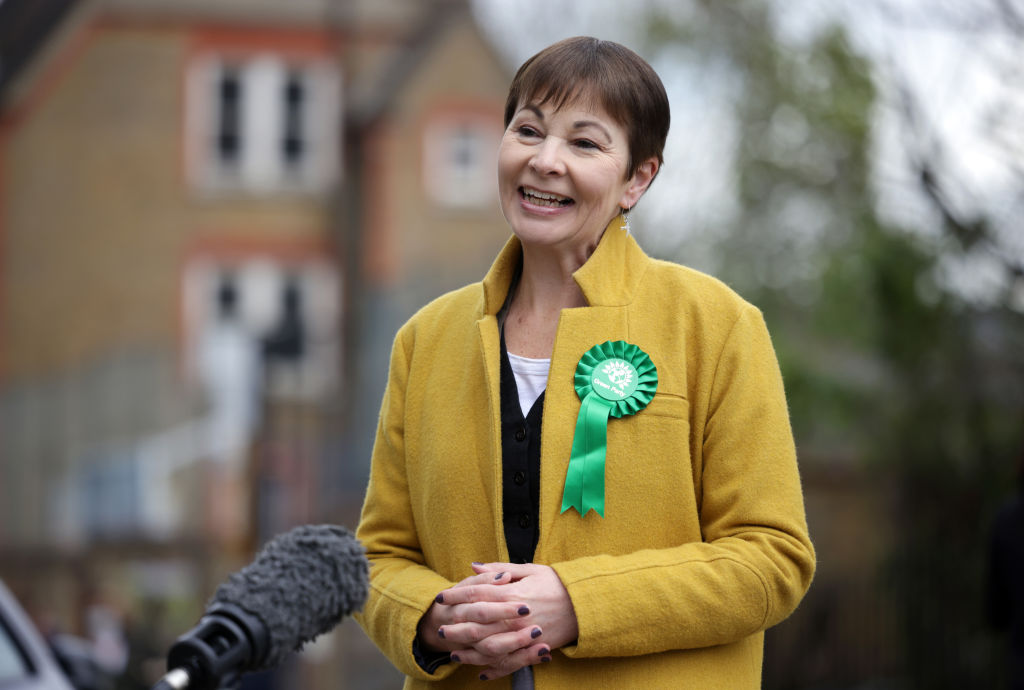
The next thing we knew, Labour were making pleasingly cross noises about the ‘re-wilding’ which made our fair city such an eyesore under the Greens, with cascades of weeds bothering pets, the elderly and the disabled. The issue apparently gave our leader sleepless nights, until this week when she announced that the weeds are to go under the chemical cosh.
But however much sense Sankey has shown when attempting to keep the streets free of pests, that seems to be just about the only beneficial thing her council has planned for B&H. The pleas of many local parents to rid our schools of pesty wokeness have fallen on deaf ears. Classrooms have become petri dishes for social experiments in defiance of parental wishes. Is it really possible that, a few years ago, one school in Brighton, labelled as ‘the coolest state secondary in town’, once had as many as 40 children who did not identify with their sex at birth with another 36 saying they were ‘gender fluid’? Or is this social contagion, as eating disorders are now often understood to be, among sad teenagers desperate to identify as something or anything, rather than feel lonely? Whatever it is, the council are hindering rather than helping these confused adolescents. Sometimes it seems as though there is an almost sadistic element to the way right-on teachers torment distraught parents.
Isn’t it odd to send people who think diversely off for re-education, or re-‘training’?
And another thing, after boasting that ‘diversity is strength’, isn’t it odd to send people who think diversely off for re-education, or re-‘training’? This is what the Sainted Bella did after Councillor Alison Thomson retweeted posts supporting JK Rowling and the feminist Germaine Greer. Even though the culprit apologised unreservedly, Chairman Sankey frowned, ‘I have also taken the decision to remove Councillor Thomson from her lead role on city centre renewal while further investigation is carried out and subject to her completing training.’ Because nothing says not being qualified to work on renewing city centres like believing in women’s rights.
But not even the re-training of the hapless Thomson was enough for one Green councillor, Chloe Goldsmith. She asked how Labour would ‘meaningfully demonstrate’ to lesbian, gay, bisexual, transgender, intersex, questioning/queer, asexual plus (LGBTIQA+) people that the party would stand up for them. This brought another avalanche of woo-woo affirmation from Labour, with the situation continuing ad infinitum.
Purity spirals are never pretty, even in times of plenty. With local councils going bust all over the country, they seem positively surreal. Though less visceral than the battle for the bodies of children between parents and teachers, Labour also seems to have inherited the Green suspicion that the original sin might well have been the invention of the wheel. The extortionate cost of parking here has driven businesses to distraction for a long time. The number of empty shopfronts in once-bustling Brighton city centre is shocking to see, though their deserted doorways do provide welcome shelter for our armies of homeless people: the third largest number in England after London and Manchester, despite our far smaller population.
You’d have thought that we’d learned about the perils of throwing public money away at a time when services are being slashed with the vigour of Edward Scissorhands attempting to escape from a burning sheet factory. The council is still owed a whopping £47 million by the clowns who own the pathetic and pointless Brighton i360 tower. Opened in 2016, it looms over the seafront like a monument to municipal stupidity.
For some reason, though, the council seem keen to blow yet more public money in order to facilitate the ‘Valley Gardens’ folly which will cause mayhem on the seafront for years to come. A revamp of the area has been in the works for years, with roads redesigned and bus shelters converted into cafes and art spaces. As the formidable independent councillor Bridget Fishleigh put it:
‘This is exactly the same scenario as the i360 – residents pointed out the multiple flaws but the council pushed on regardless. We have been told repeatedly by this council that the coffers are empty and a huge budget shortfall is expected this year – so why is Labour getting the city into even deeper debt with an ill-conceived traffic scheme that will create even more congestion and pollution, rather than focusing on their stated remit of supporting the most vulnerable in our society?’
Gary Farmer of the Old Steine Community Association representing a district which will be blighted by this flight of fancy said, ‘It is as if the Greens have not left office…[the scheme] will further damage the city’s economy and reputation.’
It’s been something of a case of out-of-the-Aga-and-into-the-hot-air-fryer
Bella Sankey says ‘I love Brighton and Hove. And this city runs through me like a stick of rock’. But a stick of rock would show more sensitivity than she has through her pandering to the city’s relatively small cross-dressing community compared to the 50 per cent of the population who are women.
Next week, Sankey will host another of her patronising ‘Reimagine Brighton’ events, where the public show up believing that they can have their say. This time the idea is to ‘brainstorm’ on the theme of ‘safety in the city – how can we ensure women and girls feel safe?’ Well, ensuring only women – rather than men who think they are women – can access Brighton’s rape crisis centre might be a good start.
And so, since the brave new dawn when we saw the Greens off last spring, it’s been something of a case of out-of-the-Aga-and-into-the-hot-air-fryer. Sankey appears to be taking the two dumbest Green hobby-horses – the twin terrors of gender-woo tyranny and a phobia of cars – and running with them. It’s like there’s an ongoing competition between the Greens and Labour to see who can finish off B&H in the shortest time. Labour stand a good chance of winning the award if their majority collapses this year – or if they simply go bankrupt, as some fear they might.
This isn’t just a bit of local bother. With Labour on course to win a national landslide this year, the Brighton experience is a lesson for the country as to what happens when the carrot of apparent common sense is dominated by the big stick of woke silliness. The Conservatives are useless and need to pull themselves together (preferably under the stewardship of the splendid Kemi Badenoch). But when I think of the coming election, a twist on the old Belloc rhyme comes to my mind: ‘Always keep a-hold of nurse/For fear of finding something non-binary, net-zero worse…’
Tickets for Making Marilyn, Julie Burchill and Daniel Raven’s new play, are now on sale
Why is the UN sticking up for Just Stop Oil protestors?
Do you remember when you couldn’t get your child to school on time because of a Just Stop Oil slow march? Or when you got gridlocked on the M25 because someone had draped themselves over one of the gantries? There’s a man from the United Nations who, it seems, rather likes the idea of us going back to those times.
Michel Forst, a French UN functionary with the grand title of ‘special rapporteur on environmental defenders (Aarhus convention)’, published a two-page report this week following a brief visit to London. In it, he referred to ‘extremely worrying information’ about Britain’s ‘increasingly severe crackdowns on environmental defenders’, by which he meant Just Stop Oil and those like them.
The notion that Just Stop Oil is somehow being punished for exercising their Aarhus rights is preposterous
It was unacceptable, he suggested, to punish such ‘peaceful protesters’ for public nuisance, or to crack down on them for conducting slow marches deliberately designed to make roads unusable. Forst said it was wrong to prevent environmentalists accused of criminal offences telling juries all about climate change so as to enable the latter to make an ‘informed decision’. He was also ‘troubled’ that the courts had issued injunctions preventing criminal acts, with people being imprisoned for breaking them. The Frenchman found it equally distressing that environmental protesters should be ‘derided by some of the mainstream UK media and in the political sphere’ so as to subject them to threats and abuse from ‘unscrupulous persons’.
This whole paper is consistently wrong-headed. Only someone from the rather unreal surroundings of the UN could write such a document.
For one thing, the reason why most people are happy to accept peaceful protest is that it is, well, peaceful. It aims to persuade, not to impose views willy-nilly. Does Forst think that peaceful protest should include forcibly stopping other people from going about their business to make sure your view prevails? If so, he’s wrong: it doesn’t.
As for the suggestion that something must be done about the ‘deriding’ of environmental protesters, it’s hard to see this as anything other than a naked call for more governmental restrictions on free discussion.
Forst’s overall suggestion sails close to suggesting that minority pressure groups should be treated differently. Such an idea is not so much humanitarian as unhinged.
Coming from someone working for an international organisation, this report is a worrying attack on democracy. By and large, we in Britain are pretty tolerant of the odd boisterous demonstration. Most of us feel that you shouldn’t stop protesters speaking their mind in an attempt to persuade the rest of us to agree with them, and many perhaps even vote accordingly.
Whether the UN likes it or not, the reason the government took the measures it did last year against bodies such as Just Stop Oil or Extinction Rebellion was precisely that they had gone way beyond this. Their tactics involved not so much seeking to get their view across, as to coerce an elected government into adopting measures that nobody apart from a tiny minority wanted implemented.
Their demands would have made the entire nation that elected that government miserable. People were rightly exasperated with that. That is democracy in action. Forst would do well to bear that in mind.
It’s also worth a slightly closer look at how this report appeared at all. Forst’s title refers to the Aarhus convention. This fairly benign 1998 treaty, ratified by over 40 states including the UK, requires governments to give people access to environmental information and a say on decisions made about environmental matters affecting them. Forst’s mandate relates to the observance of Article 3(8) of that convention, requiring states to ‘ensure that persons exercising their rights in conformity with the provisions of this convention shall not be penalised, persecuted or harassed’.
The difficulty here should be obvious. The convention gives environmentalists the right to say what they think, but nowhere does it mention a right to engage in obstructive protest, or deliberately and criminally disrupt other people’s lives in order to force compliance with their environmental message. The notion that Just Stop Oil or their friends are somehow being punished for exercising their Aarhus rights is preposterous.
The conclusion is pretty inescapable: the worthy special rapporteur appears to be using his mandate, not to ensure that the UK keeps its treaty commitments, but as a means to demand that our government leave Just Stop Oil and the like alone, with the effect they would be free to impose their will on the British people.
Where we go from here is unclear. The instrument appointing Forst technically gives him the power to issue ‘protection measures’, that is orders directing states (yes, you read that right: directing them) to refrain from penalising environmental defenders. We may yet see such a measure land on Rishi Sunak’s desk. If it does, Sunak must politely, but forcefully, tell Forst that Britain observes the Aarhus convention, that the threat to environmental defenders exists only in his fevered imagination, and that how we enforce our criminal law is frankly none of his business.
The danger of returning the Ghanaian ‘Crown Jewels’
I put the case in last week’s Spectator that museums in this country have been gripped by a sort of infectious madness. Since I wrote that article the number of cases of museumitis has piled up further, and there are worrying signs that the infection is spreading into Europe. It has been announced that 32 of the Ghanaian ‘Crown Jewels’ are to be sent from the British Museum and the Victoria and Albert Museum to Asantehene Otumfuo Osei Tutu II, the current king of the Asante, to be exhibited in the Manhyia Palace Museum in Kumasi. The idea is to put them on exhibition there for three years, after which they will be returned (as things stand). But the V&A has indicated that the loan may be renewable, with no end date. These are beautiful objects made, mainly in the nineteenth century, out of the famous gold of Ghana which first attracted Portuguese explorers to that part of West Africa in the late fifteenth century. They include a beautifully crafted bird, a golden peace pipe and a golden lyre.
No one seems to be denying that the loans are a trial run for a much bigger and more controversial loan that might very well also become permanent i.e. the Elgin Marbles. The intention is to evade the terms of the act of parliament that prevents the British Museum and some other major museums from alienating their property. It is quite possible that this not so little difficulty will be removed by law if a Labour government decides to give the Marbles to Greece. Part of the argument (which many of us dispute) for returning Elgin’s purchases is that the Turkish rulers of Greece had no moral or legal authority to sell them. But the way these African treasures arrived is much more complex. Some were obtained as compensation for a British raid on the Asante capital. Some of the objects seem to have found their way on to the antiques market and were obtained through sale or auction. Some were passed on by the last British colonial administrators of what was then known as the Gold Coast.
Before people jump to the conclusion that this case is very similar to that of the much-publicised Benin Bronzes, several distinctions must be made. The Bronzes were seized at the end of the nineteenth century following an attack on the Oba’s palace in what is now Nigeria, and were used in bloody rituals that according to contemporary reports included the sacrifice of large numbers of slaves (one British aim was to put to an end the slave trade in that region). In any case there are thousands of the Bronzes, enough to fill the store-rooms of any number of museums. But the golden lyre was a gift from the Asante ruler to a British diplomat. It is not totally idiotic to suggest that returning diplomatic gifts is a breach of protocol, even after two centuries.
The same reservations apply to the news that the Spanish Culture Minister, Ernest Urtasun, has invoked Spain’s ‘colonial framework’, and intends to launch a programme for the restitution of objects in the country’s museums. The Prado, surely Spain’s most spectacular museum, has already questioned its ‘ethnocentric vision’ in an exhibition with the troubling title ‘Return Journey: Art of the Americas in Spain’. High on the list of objects for return is certain to be the pre-Colombian Quimbaya Treasure preserved in the Museum of America in Madrid. It contains 122 gold and copper figures. Colombia is known to want these artefacts to be sent back, even though they were a gift to the Spanish royal family way back in the nineteenth century. Once again it seems entirely graceless to demand the restitution of freely-donated objects where the legal title of Spain is not in doubt. No one, though, cares very much about the route by which returned objects arrived. Archbishop Welby sent back to Nigeria two modern busts given to one of his less blinkered predecessors, Dr Runcie, which were nothing to do with the Benin Bronzes, as Lambeth palace had to admit. Frankly, that verges on rudeness. On the Antiques Roadshow Ronnie Archer-Morgan prompted the possessors of a magnificent cloak given by the Emperor of Ethiopia to their grandfather, the British governor of Somaliland, to say they would gladly send it back to Ethiopia. Well, if people don’t want such treasures I suppose they don’t deserve to have them.
So let’s all give back every present of any significance to a museum and show how little esteem we have for those who gratefully accepted these gifts, and in many cases passed them on to a museum rather than simply taking them to the auction house. Let’s make it as difficult as possible for people from across the world to see Asante gold, the Benin Bronzes or the Rosetta Stone. That means pulling down the shutters on large parts of the history of humanity, just when the valid argument is being presented that large parts of great continents such as Africa and South America have a long history that is well worth studying – and therefore worth seeing on display in the great world museums. It also means requiring the British Museum and the V&A to make rock-solid arrangements concerning the return to Britain of any and every object sent out of the United Kingdom for display. Otherwise the proposals from the British Museum and the V&A are what a colleague of mine used to call the thin end of the avalanche.
Is the RNC about to back Trump?
A new report from the Dispatch claimed that David Bossie, a Republican National Committee member and former advisor to the Trump campaign, had drafted a resolution that would effectively end the primary and put the RNC symbolically behind former president Donald Trump. The draft resolution was immediately met with concerns that only two states had voted in the GOP primary and that the RNC should preside over a fair process, although it would not have ended the primary nor changed how state parties ran their elections. But remaining GOP contenders Nikki Haley and Trump both came out against the plan, with Trump posting on Truth Social that he wanted to win the “old-fashioned” way by earning the required number of delegates to secure the party’s nomination at the RNC’s convention. Bossie withdrew the resolution after Trump’s post.
Although the question of whether the RNC might vote to officially back Trump before the conclusion of the primary is now nullified, Bossie’s proposal has raised other issues related to Trump’s relationship with the RNC and its chairwoman, Ronna McDaniel. I previously reported in The Spectator World’s January magazine how Trump was responsible for McDaniel’s elevation to her current position atop the RNC and how, now, Trump allies are the most critical of her tenure leading the party. Although she has faced several challenges to her leadership, most notably after the 2022 midterms when conservative lawyer Harmeet Dhillon ran against her re-election, McDaniel has received the repeatedly tacit endorsement of Team Trump. As one GOP strategist put it to me, Susie Wiles — a senior advisor to Trump — could call RNC committee members and get them to oust McDaniel within five minutes. Consultants I spoke to posit that Trump has been so accommodating to McDaniel because she has used RNC money to help him pay his legal fees and because he doesn’t want to give the perception that he was responsible for installing an ineffective leader.
However, there are signs that Trump is starting to sour on McDaniel. He refused to participate in any of the RNC-sanctioned primary debates, declaring himself the de facto incumbent while McDaniel argued that she had a duty to oversee a fair nomination process. McDaniel did say on television that the GOP should unite behind Trump after he defeated Nikki Haley by double digits in New Hampshire’s primary, but some Trump surrogates slammed her online for not attending the former president’s watch party in Nashua. There are whispers that the Trump campaign is not thrilled that McDaniel tried to have it both ways; pretending to be neutral in the early days of the process, and then turning around and effectively endorsing Trump after two early state victories. Either way, most GOP insiders agree that this will be McDaniel’s last term as chairwoman of the RNC — the question now is if she may be pushed out even sooner.
-Amber Duke
On our radar
MARIANNE OUT? Democratic presidential contender Marianne Williamson is not dropping out of the 2024 race, contrary to reports claiming she was suspending her campaign.
DON’T MESS WITH TEXAS Texas governor Greg Abbott is blocking access for federal border patrol agents to cut down the state’s razor wire at the southern border pending a February 7 court date that may settle the issue.
LEARN TO CODE? Mass layoffs are rocking the media in early 2024, with staffers at the LA Times, Business Insider, Sports Illustrated, TIME and others facing joblessness amid the industry’s financial downturn.
White House party crashers
Team Biden tried to have a party to boost morale heading into the 2024 cycle, but the White House’s staff members who oppose the administration’s policy on Israel had other plans — crashing the shindig with drum circles and shrieks of condemnation of “genocide Joe.”
Their demands are simple: an end to American support for Israel. According to one protester’s recounting, “every single one of [the Biden staffers] tried to sneak away from back exits and creep through the woods to avoid being called out again, to no avail.”
Unfortunately for the protesters, their demands are backed by almost no one in America — including the Democrats. This week’s attempt by anti-Israel activists to have New Hampshire Democrats write in “ceasefire” in their party’s primary fell flatter than a misfired Palestinian rocket at a hospital in Gaza.
One of the groups protesting “Butcher Biden” is the US Campaign for Palestinian Rights, which is a Virginia-based organization that is the fiscal sponsor of the Palestinian BDS National Committee; according to Israel, US-designated terrorist organizations like Hamas, Palestinian Islamic Jihad, the Popular Front for the Liberation of Palestine.
Senator Thom Tillis provided a helpful road map to anyone in the Biden administration who has the slightest interest in defending civilization when he told a trembling terrorist sympathizer to pound sound in the halls of the Senate this week.
–Matthew Foldi
Meta: don’t ban kids from our apps
The kids are not alright! The Florida House passed a bill this week which would “require many platforms to prohibit anyone younger than sixteen from creating an account and require them to use a third party for age verification services,” per Politico. “At the same time, it calls on social media companies to terminate accounts for users in the state under sixteen.” It’s now under consideration in the state Senate.
It is unclear at this point which apps the bill applies to — though TikTok, Instagram and Snapchat are the likeliest candidates. The move follows a deluge of investigative reporting that reveals how addictive and harmful social media can be to teens — though let’s face it, it’s not all that great for adults either.
Meta has been running a campaign since November pushing Congress to take action federally: “Parents should approve their teen’s app downloads, and we support federal legislation that requires app stores to get parents’ approval whenever their teens under sixteen download apps,” wrote Meta global head of safety Antigone Davis in a blog post. You may have seen TV ads from the same initiative on behalf of Instagram: Cockburn caught one last night. (Naturally, the tech giant chooses to identify as “Instagram” rather than the “too-corporate” Meta or the “election-ruining” Facebook.)
Of course, Meta’s solution to the problem involves Congress taking the burden of responsibility away from them — and unlike Florida’s, it still lets the kids download the apps. How convenient! -Cockburn
From the site
Cockburn: Kari Lake razes the Arizona GOP
Amber Duke: How Ray Tierney brought law and order back to Long Island
The SNP’s Covid reckoning
We now know from evidence to the Covid Inquiry that Scottish government ministers were as prone to offensive language as Dominic Cummings. Nicola Sturgeon called Boris Johnson a ‘f***ing clown’, and Humza Yousaf called a Labour MSP a ‘twat’. If the government’s mass deletion of WhatsApp messages was designed to insulate it from embarrassment, it clearly hasn’t worked.
The SNP-supporting legions on social media are of course outraged that anyone should be upset at the language politicians use in private. Everyone thought Boris was a clown, so what’s the issue here? It’s not as if they were having parties in Bute House, is it? And these revelations might seem trivial compared to the other fatal mistakes made by the Scottish government in handling the pandemic – like decanting the untested elderly into care homes for example. But they do matter, if only because of the way the Scottish government revelled in the embarrassment of UK ministers last autumn when sleek Hugo Keith KC was relishing the opportunity to refer to ‘f***pigs’ and suchlike on live TV.
The SNP affected shock and horror at the nastiness, arrogance and misogyny revealled in the UK government’s WhatsApps. The SNP’s Westminster leader, Stephen Flynn, when asked about Scottish ministerial WhatsApp rashly said: ‘I’d be quite confident, that the content of those messages will be starkly different than what we’ve seen from Westminster politicians.’ Talk about hostages to fortune.
And sweary language aside, we don’t know what breaches of Covid rules might have been revealed in the tens of thousands of deleted WhatsApps. We do now know that Humza Yousaf was given guidance on how to get round mandatory mask-wearing at gatherings by holding a drink in his hand. How many other work-arounds were being provided by the National Clinical Director, Jason Leitch? We’ll never know because they were erased by his ‘pre-bed ritual’ as he described his daily deletion habit.
Humza Yousaf has been like a rabbit in headlights
Nicola Sturgeon was famously caught breaching her own Covid rules by not wearing a mask in a pub after a funeral.The First Minister was not fined, even though mask-wearing was an offence in Scotland at the time under the SNP’s more-draconian-than-thou approach to social distancing.
Well, anyone could have made the same mistake. ‘She’s only human’, chorused the SNP leader’s cheerleaders. Of course she was. But at the same time, Police Scotland were arresting and fining 82-year old grannnies for attending birthday parties even after they’d been double vaccinated. No work around for them.
As the testimony from the epidemiologist Professor Mark Woolhouse pointed ou, the damage done by absurdist lockdown rules is incalculable. The closure of schools, the outlawing of beaches, exercising for an hour only. Draconian social distancing rules applied south of the border too of course. But there was a performative aspect in Scotland as Professor Woolhouse observed. The Scottish government’s regime always had ‘to be more cautious than the one in England’.
This culminated in the ‘elimination strategy’ inspired by the First Minister’s telegenic adviser Professor Devi Sridhar. The idea that Scotland could have achieved ‘zero Covid’ was absurd, as anyone in possession of a UK map would see. But it promoted the subliminal message that in some way Scotland’s connection to the rest of the UK was toxic.
We know from cabinet minutes in August 2020 that the SNP government actively considered how best to politicise the pandemic. What we don’t know is how they planned to do it, because of course that has all been carefully deleted. All credit however to the UK Covid Inquiry and Jamie Dawson KC, for making the best of the limited material they were given.
Humza Yousaf has been like a rabbit in headlights all week, unable to rebut oppositon claims of blatant cover up and illegal destruction of official records. He is no longer even trying to defend Sturgeon’s and other SNP ministers’ deletion policy. Instead he’s promised the inevitable inquiry into what happened. But we don’t need an inquiry to tell us that that the integrity of the SNP government has been deleted.
What would Alasdair Gray think of Poor Things?
It’s awards season in the movie industry and the film Poor Things, based on the novel by the late Scottish writer and painter Alasdair Gray, is flying high. To date, it has received more than 180 nominations in various award categories, including 11 Oscars and 11 BAFTAs, and has chalked up 51 wins.
What Alasdair would have made of the film version of Poor Things, I don’t know. He could be a hard man to please. It has certainly brought his extraordinary imagination to an entirely new audience. I imagine Alasdair would have disapproved of the film leaving its Scottish roots behind (although Willem Dafoe has an odd stab at a Scottish accent). But the film does full justice to Alasdair’s dazzling vision and I can only think he would have thoroughly approved of Emma Stone’s gleefully fearless portrayal of Bella Baxter.
I met Alasdair Gray when I was a student at Glasgow University, around 1969, when I rang the doorbell of his West End flat to ask him to come and read some of his work for our literary society. He invited me in for tea but was stammering so badly that I began to think a reading was a terrible mistake. Then suddenly, he adopted a performance persona and started quoting the opening lines of Milton’s Paradise Lost (‘Of man’s first disobedience, and the fruit of that forbidden tree…’) and he did so fluently and without the slightest hesitation.
Years later, when I was a radio drama producer at Radio Scotland, Alasdair came in to record a tribute to his playwright friend, Joan Ure, shortly after she died. When the recording engineer heard him stammering away, he went white with fear. I said to him: ‘Just wait!’ Sure enough, when the cue light came on, Alasdair read the entirety of his script without the slightest stumble. At the end, when the red light went off, he said anxiously: ‘W-w-was tha- that that all right?’
There are endless Alasdair Gray stories. In the 1980s I encountered him in the Ubiquitous Chip, the fashionable restaurant in the West End of Glasgow. He was painting murals there in exchange for generous payment in meals. (Being Alasdair, he spent the money lavishly, inviting his many friends to join him for suppers.) On this occasion he was painting his distinctive images on the wall behind an ornamental pond and had laid a plank across the pond to enable him to reach the wall. We chatted briefly and I went to join my dining companion. A few minutes later, there was a loud splash and a startled cry. Alasdair had stepped back to admire his work.
When we started work on the BBC film The Story of a Recluse early in 1987, I met him again at the Ubiquitous Chip. The script was based on an unfinished Robert Louis Stevenson story, which Alasdair had completed in a speculative manner. Bill Bryden, then head of drama at BBC Scotland, thought the script wasn’t working and I was asked to take over the production because I knew Alasdair well and it was felt I could negotiate script changes with him. I had been told that Alasdair had point-blank refused to rewrite it and I anticipated a difficult lunch.
However, as we sat down, the first thing he said was ‘If you give me £1,750, I’ll write anything you like.’ It turned out he had put on an exhibition of the paintings of himself and four friends, spent £1,750 on the catalogue and failed to make any money. Now the printer wanted to be paid and Alasdair needed the money. Job done.
I hired the brilliant Scottish director Alastair Reid and we met up with Alasdair at Hawthornden Castle, outside Edinburgh, where he had gone to write. The castle had been purchased by a member of the Heinz family and turned into a writers’ retreat. The warden was a young man busy writing his own first novel – Ian Rankin, working on the first Rebus. The retreat was magnificent, but poised on the edge of a precipitous cliff, with low balustrades on the balconies. When I saw the amount of alcohol that was provided in the evenings, I feared we might lose our author before he completed his mission. Alasdair was certainly a prodigious drinker, but somehow survived.
For the film, he now wrote himself and his producer and director into the decidedly postmodern script. Actor David Hayman played Alastair Reid as a completely manic director, arguing with his writer; Bill Paterson played me as (of course) a measured and sensible producer; we had a negotiation with the actors’ union, Equity, in which we agreed that only Alasdair Gray could play Alasdair Gray. He was literally uncastable. Alasdair duly came to Edinburgh to film with us, including a scene where he narrates the story while the Forth Rail Bridge is noisily being constructed behind him.
The evening after his location filming, Alasdair got very drunk, lost his hotel room key and lay down to sleep in the corridor outside his room. A kindly night porter found him and let him in. Next day, as he came to check out, Alasdair realised he didn’t have enough money to pay his bill, and he had, of course, no credit card. Without telling anyone, he abandoned his luggage in the foyer and left the hotel to find a bank. His disappearance caused a mild panic and I received messages on location that he had gone missing.
Meantime, Alasdair had signed a cheque in the bank and watched the money being counted out on the counter in front of him. The teller asked him for his bank card. He didn’t have it. He was then asked for any proof of identity. He had none. Instead, he left the bank, found a book shop, bought a copy of his book Lean Tales, returned to the bank and showed the teller the self-portrait that adorns that book. They gave him the money.
The Story of A Recluse starred Stewart Granger, a post-war Hollywood heartthrob, in one of his final roles. It also featured Scottish stalwarts Gordon Jackson and Andrew Keir, but these days is probably of most interest for its fledgling star: Peter Capaldi. Peter had graced Bill Forsyth’s film Local Hero a few years earlier but had actually begun his career, like me, at BBC Scotland, where he worked in the graphics department and designed the original T-shirts when I started a radio comedy show in 1981, called Naked Radio.
Rodge Glass, Alasdair’s biographer, tells me that Alasdair was unhappy with the final outcome of Story of a Recluse but does not know why. Certainly, Alasdair never complained to me. The broadcast itself was on BBC2 on Christmas night 1987 and was very successful, despite a bizarre incident. A few minutes into the transmission, there is a fake breakdown in the film, when the action stops and Alasdair himself appears on screen to explain why he wants the story to go in another direction. This ‘breakdown’ was very clearly signposted to the transmission engineers but, obviously, not clearly enough. The duty engineer in Television Centre leapt to his control and stabbed up the BBC test card for a few seconds, until he realised his error and the transmission resumed. He was most apologetic when I rang up to scream at him, so much so that I ended by wishing him ‘Merry Christmas’. In any case, the viewers seemed to think it was a deliberate device, enabling Alasdair to interrupt the action. If Alasdair had thought of it, it might well have been deliberate.
Rodge Glass points out that Alasdair was often an unreliable witness. In his book Of Me and Others, he mentions me as a BBC producer, but actually confuses me with a colleague, Norman McCandlish, whom he felt was letting him down over a different project. This was unfair on Norman, but I’ve always felt it motivated Alasdair when he came to name his main character in Poor Things: McCandless.
I have on my wall a portrait, given to me by Alasdair, of his first wife, Inge. They had a fraught relationship (in fact, at one point Alasdair rented my flat for a few weeks while they were separated) but it is a striking image which I have cherished for forty years. Alasdair Gray was, unquestionably, one of Scotland’s most talented and original artists. With Poor Things his work is finally reaching a genuinely global audience.
What the UN court’s genocide verdict means for Israel
The International Court of Justice has handed down a preliminary ruling instructing Israel to prevent a genocide from happening in Gaza. Judge Donoghue, speaking at the court in The Hague, said the country must take ‘all measures within its power’ to prevent acts that breach the genocide convention and must ensure ‘with immediate effect’ that none of its soldiers are involved in any acts which contravene it.
Israel was also ordered to take immediate action to improve the humanitarian situation in Gaza. The convention defines genocide as acts committed ‘with intent to destroy, in whole or in part, a national, ethnical, racial or religious group’. The ICJ ruling is legally binding, however there is no vehicle to ensure that Israel implements its orders; the country could simply ignore it.
Israel was also ordered to take immediate action to improve the humanitarian situation in Gaza
This ruling comes after a South African legal team presented the court with a dossier of evidence that the country’s military campaign in Gaza showed clear ‘intent’ to commit a genocide. The court has, so far, only been asked to decide whether there is plausible evidence to suggest that Israel has committed a genocide in its war with Hamas. As a result of today’s ruling, Israel must provide a report to South Africa within a month on what action it is taking to uphold the order.
South Africa, in a 84-page pre-trial dossier, accused Israel of committing a genocide against Palestinians in Gaza by creating conditions of life ‘calculated to bring about their physical destruction’. The filing also said it was looking at the military action ‘in the broader context of Israel’s conduct towards Palestinians during its 75-year-long apartheid, its 56-year-long belligerent occupation of Palestinian territory and its 16-year-long blockade of Gaza’.
However, the court has stopped short of agreeing to South Africa’s demand for an immediate ceasefire. The measures announced today have been implemented to help provide some relief for Palestinians in Gaza – but the ICJ will take years before it reaches a definitive ruling on whether or not Israel’s military campaign constitutes a genocide.
Kari Lake razes the Arizona GOP
Cockburn was sad to scratch out the AZGOP Freedom Fest from his calendar, which was due to take place tonight and be headlined by former president Donald Trump. “Regrettably, the AZGOP Freedom Fest 2024 has been canceled as President @realDonaldTrump is required to attend to court obligations.”
He was hoping to see the nation’s most self-immolating state party up close, in a week where their top Senate candidate Kari Lake leaked a private recording she had made of a conversation with Arizona GOP chair Jeff DeWit. In the recording DeWit appears to be offering to pay Lake to drop out of the Senate race and run for governor again in two years instead.
After the Daily Mail’s story on Lake’s leak, DeWit resigned — though in his letter doing so, he said, “I question how effective a United States senator can be when they cannot be trusted to engage in private and confidential conversations.” DeWit must have forgotten Lake’s past as a journalist: clearly she’s always on the hunt for a Pulitzer!
The sorry episode is emblematic of how many obstacles Lake faces to become a US senator. In her failed run for governor, she told McCain Republicans to “get the hell out”: the late senator remains very popular in his home state — and Lake has yet to make serious in-roads in her attempts to win over his fans, who she would need to triumph in the general. Cockburn clocked Lake twice earlier this week at the Sheraton in Nashua, New Hampshire, for Trump’s primary victory party. She was dressed in white, “like the Miss Havisham of VP picks.” Will her political career have a similarly fiery ending?
Meta: don’t ban kids from our apps, let parents do that instead
The kids are not alright! The Florida House passed a bill this week which would “require many platforms to prohibit anyone younger than sixteen from creating an account and require them to use a third party for age verification services,” per Politico. “At the same time, it calls on social media companies to terminate accounts for users in the state under sixteen.” It’s now under consideration in the state Senate.
It is unclear at this point which apps the bill applies to — though TikTok, Instagram and Snapchat are the likeliest candidates. The move follows a deluge of investigative reporting that reveals how addictive and harmful social media can be to teens — though let’s face it, it’s not all that great for adults either.
Meta has been running a campaign since November pushing Congress to take action federally: “Parents should approve their teen’s app downloads, and we support federal legislation that requires app stores to get parents’ approval whenever their teens under sixteen download apps,” wrote Meta global head of safety Antigone Davis in a blog post. You may have seen TV ads from the same initiative on behalf of Instagram: Cockburn caught one last night. (Naturally, the tech giant chooses to identify as “Instagram” rather than the “too-corporate” Meta or the “election-ruining” Facebook.)
Of course, Meta’s solution to the problem involves Congress taking the burden of responsibility away from them — and unlike Florida’s, it still lets the kids download the apps. How convenient!
The honorable Zynator from Pennsylvania
End the Zynsanity! The Biden administration’s square-off with Texas and other Republican states over the border has heightened talk of “civil war” this week — but frankly New York senator and nanny-statist Chuck Schumer’s effort to force a government crackdown on Zyn seems a likelier catalyst.
“I’ll see you at the wall Chuck Schumer. This is our Alamo. And I won’t be alone,” wrote Texan Fox News host and Zynball wizard Will Cain for the site this week. “You just created millions of single-issue voters (maybe). Get ready to reap the whirlwind. Get ready for the Zynsurrection.”
There’s only one hope to stop nicotine-addled Zynsurgents, cheeks stuffed with 6s, from tearing America to shreds: a bipartisan rejection of Schumer’s thirst for government overreach. Step forward hulking Pennsylvania Democrat John Fetterman.
“I’m going to err on the side of more freedom and personal choices for those kinds of things,” Senator Fetterman told a huddle of reporters yesterday.
Fetterman has struck out against Democratic Party orthodoxy as he’s spent more time in Washington. Will more colleagues on his side of the aisle follow his example?
Marianne: I’m going nowhere
Reports of the death of the Marianne Williamson campaign are greatly exaggerated! A number of tweets last night claimed that the TV spiritualist, who came third in the New Hampshire Democratic primary with 4 percent, was suspending her 2024 bid for the White House. Not so fast, said Marianne.
“I have NOT said I am suspending the campaign,” she tweeted. “I was candid about discussing the challenges that a grass roots campaign faces at such a moment as this. Believe nothing until you’ve heard it from me.”
Marianne did manage to beat the “ceasefire” write-in campaign by 3,500 votes, which, she told The Spectator’s Matt McDonald Saturday, she thought was “self-indulgent” and “performative.” The show goes on!
More from Cockburn this week
MAGA ecstasy at the New Hampshire Trump victory party
Woody Allen pens new short story for the New Criterion
Trump bars Haley donors from the ‘MAGA camp’
Watch: Angela Rayner heckled by Palestine activists
It looks like the ructions over Labour’s Palestine position aren’t ending anytime soon. Since the horrifying Hamas massacre on October 7th last year, Labour leader Keir Starmer has refused to call for an immediate ceasefire in Gaza, instead making the case for a ‘sustainable ceasefire’ – which would involve Hamas handing over the remaining Israeli hostages and stopping its rocket fire into Israel.
That position has been met with predictable outrage from the left, which has accused the Labour leadership of colluding in a genocide.
Now it looks like the row is spilling over into MPs’ constituencies. According to a video posted by Manchester Palestine Action, activists interrupted a Labour fundraising event in Stockport this week. As Shadow Deputy Prime MinisterAngela Rayner spoke at the event, a man began shouting, and saying that his family had been killed in Gaza. After he was escorted out by security, another woman sitting at the back of the hall began to heckle Rayner too, asking how the deputy leader could call herself a feminist. She was then joined by several shouting activists.
Watch here:
"I LOST MY FAMILY IN GAZA!" A Palestinian who lost his mother, brother & nieces to Israel's bombing in Gaza confronts Angela Raynor & the Labour Party at a Stockport fundraiser.
— MANPalestine Action (@ManPalestine) January 25, 2024
How can the Labour Party & any party not call for a ceasefire when Israel's genocide has killed 25000… pic.twitter.com/LvEbVIyw5x
Alabama’s nitrogen gas execution is indefensible
Let’s park for a moment the morality of the death penalty. You know what you think. It’s one of those issues that is as divisive as it gets, and along all the predictable lines. It’s the method that exercises me.
Last night, Alabama executed Kenneth Smith by the administration of nitrogen gas. Smith, who murdered a pastor’s wife in 1988, was strapped down as officials put a tight fitting, commercial industrial-safety respirator mask on his face. A canister of pure nitrogen was attached to the mask and set flowing. One local journalist who witnessed the execution said Smith struggled and thrashed about – well as much as the restraints on him made possible – for four or five minutes. Indeed, his struggle for life may have lasted some 20 minutes. Five minutes may not seem a long time, but you just try going without breathing for that long. He eventually suffocated; it is plain that he struggled desperately for air, as we all would have done.
Is that a surprise? Vets in Europe say that nitrogen should not be used to kill large mammals unless they are first sedated; the American Veterinary Medical Association says that rats show signs of panic and distress when given nitrogen. If this is, as the state of Alabama says, ‘the most humane method of execution known to man’, I should hesitate to witness the alternatives. Actually, we know that the electric chair – another bid to use the latest technology in its day – often didn’t work as intended. Don’t look it up.
Smith had already survived one execution in November 2022, when those attempting to administer a lethal injection couldn’t find a suitable vein, so that was that. Even in Britain when public executions were popular entertainment there was a principle that the same man could not be hanged twice; if it didn’t work first time, off you went, thanking God for your survival. But Alabama doesn’t even have the tough love of eighteenth century England.
Let’s stick to the question of what method of execution is the least bad. The guillotine has a good deal going for it. Remember, it was devised by one Joseph-Ignace Guillotin as the most humane method of execution available to the Revolution, and from 1789 to the abolition of the death penalty in France in 1977 this was the standard method. And it was quick. The weighted oblique blade came down on the neck of the victim, who was secured to ensure that it would land in the right place. Death was as instantaneous as possible. Granted, it looks a little theatrical, but if I were Kenneth Smith, I shouldn’t have hesitated a second before choosing the preferred method of the Terror to the exciting experimental approach with nitrogen.
Smith eventually suffocated; it is plain that he struggled desperately for air
Some way behind is hanging. That, too, is quick when it is carried out properly. But to be blunt, it takes skill to do it well, skills absent now: a precise calibration of the weight and height of the prisoner with the drop. Albert Pierrepoint, one of the last executioners in England, had to go through a long apprenticeship before he could do his job properly. And he executed any number of people, from Lord Haw Haw to the Blackout Ripper. But he had professional pride. As he wrote in 1977:
‘He is a man, she is a woman, who, the church says, still merits some mercy. The supreme mercy I can extend to them is to give them and sustain in them their dignity in dying and death. The gentleness must remain.’
It is that respect even to condemned prisoners which was lacking for Kenneth Smith. The point of the death penalty is to kill the prisoner, no? It’s not to torture him. And it doesn’t take a liberal wuss to look at death by nitrogen and see that it is torture.
The reason Alabama deployed this innovative method of execution was because of the difficulty of obtaining the substance of lethal injections (which in any event didn’t work for Smith, not having an obvious vein). But we have quite a range of substances which might have done the job better. Ask Dignitas.
There are any number of methods which any of us would prefer to being gassed. Death by firing squad would be less bad. Or how about a bullet in the back of the neck, the Soviet method? Or simply giving the man a bottle of whiskey and a gun and letting him put the weapon to his mouth? If you are going to kill your convicts, couldn’t you involve them in the decision about the method?
As I say, there are mixed views on the death penalty. I can’t, however, see any scope for debate about this gruesome execution. It is an embarrassment to advocates of the death penalty and a disgrace to Alabama.
Jurgen Klopp’s departure is a disaster for Liverpool
The news that the Liverpool manager Jurgen Klopp is to quit his job at the end of the season is a bombshell. No one expected it, not right now, nor anytime soon. The questions will come thick and fast, with all kinds of daft conspiracy theories about what is really behind his departure not too far behind. Football is like that.
Klopp’s decision to go comes shortly after Liverpool qualified for the final of the Carabao Cup. It is all the more unexpected because he completed a major rebuild of the playing squad last summer (usually something that suggests the coach has the long-term in mind), and Liverpool are currently sitting top of the Premier League, and still in the FA Cup as well as the Europa League. That’s a potential quadruple right there. So, why go now?
It is hard to convey just how much Klopp has achieved
This is the version of events from the man himself. ‘I can understand that it’s a shock for a lot of people in this moment, when you hear it for the first time, but obviously I can explain it – or at least try to explain it,’ he said in a statement on the club’s website this morning.
‘I love absolutely everything about this club, I love everything about the city, I love everything about our supporters, I love the team, I love the staff. I love everything. But that I still take this decision shows you that I am convinced it is the one I have to take. It is that I am, how can I say it, running out of energy…I know that I cannot do the job again and again and again and again.’
So, it’s exhaustion then that’s prompted Klopp’s decision to call it quits. It’s a rare admission from an elite manager, but then Klopp has always spoken his mind. The demands of football management are relentless, and managers are not machines.
Klopp has had the wisdom and self-awareness to pick his moment, for reasons that make sense to him. Few managers get to pick their time of departure: a sacking is usually what brings a manager’s tenure to a close. Only the few giants of the game are in ultimate control of their managerial destiny. Pep Guardiola of Manchester City is arguably the only other elite manager who gets to choose when he leaves his job. His rivalry with Klopp during recent seasons has brought added excitement to football in this country. It is a shame that it is to end sooner than any football fan would have wanted. How long before the great Guardiola calls time at Manchester City?
It is hard to convey just how much Klopp has achieved, on and off the field at Liverpool. He arrived at Anfield in 2015, and in the nine years since, he has taken Liverpool back to where they belong as a domestic and European football force. Most importantly of all, he led the club to the Premier League title in 2020, ending a wait of more than three decades to return to the summit. He also won the Champions League, as well as reaching the final of the competition three times. The trophy haul also includes the FA Cup, League Cup and Club World Cup.
It is a staggering transformation in the club’s fortunes. Liverpool looked lost until he came on to the scene. Klopp might have won even more on the domestic front, if it wasn’t for Manchester City’s impossibly high standards and consistency under Guardiola. The Spaniard has won more than the German but it is Klopp who sets the hearts of football neutrals racing. He has an infectious personality, brimming with enthusiasm and comes across as wearing his heart on his sleeve. His warm embrace of his players, and the ritual chest-pumping in front of the Anfield faithful after yet another victory, speaks of a mutual love and respect that few others in the game command.
Liverpool’s owners, Fenway Sports Group, put a brave face on the shock news, insisting it will be ‘business as usual’ until the end of the season. They can only hope: a manager announcing his departure mid-season always hits the players in unexpected ways, sometimes leading to a drop in performance levels. Only time will tell. One thing is guaranteed: Klopp is an almost impossible act to follow.