-
AAPL
213.43 (+0.29%)
-
BARC-LN
1205.7 (-1.46%)
-
NKE
94.05 (+0.39%)
-
CVX
152.67 (-1.00%)
-
CRM
230.27 (-2.34%)
-
INTC
30.5 (-0.87%)
-
DIS
100.16 (-0.67%)
-
DOW
55.79 (-0.82%)
The Battle for Britain | 3 February 2024
Why are bosses so suspicious of remote working?
The swimmer Michael Phelps is the most decorated Olympian of all time, with 28 medals, 23 of them gold. He is a former world record holder in the 200m freestyle, 100m butterfly, 200m butterfly, 200m individual medley, and 400m individual medley.
But let’s just analyse his world-record time for the 200m freestyle – an amazing one minute and 42.96 seconds. Amazing, that is, until you do the maths. Over 200 metres I make that 6.99km/h or 4.34mph. Here’s my problem. I am a fat 58-year-old man, and I can run faster than that. In wellies. In Alabama there are 300lb, heavily tattooed chain-smokers who can pull a Mack Truck for 200 metres faster than Phelps can swim it.
It’s true that Michael Phelps is an amazing swimmer. But as a form of locomotion, swimming is rubbish
It’s true that Phelps is an amazing swimmer. But as a form of locomotion, swimming is rubbish. You expend a huge amount of energy to attain the kind of speed which sees you overtaken by a toddler on a tri-cycle. We applaud him for his achievement when we should be deriding him for expending his energies in such a peculiarly inefficient way.
All of which is a roundabout way of saying that effort is not a good proxy for effectiveness. When judging work, we often assume that the hardest-working people are the most productive but, as Olympic swimming shows, this is not always true. Indeed, if Phelps had read his Peter Drucker (‘There is nothing so useless as doing efficiently that which should not be done at all’) he might have abandoned swimming for a more energy-efficient mode of propulsion such as the pogo-stick or the gondola.
And here’s what bothers me. I keep reading articles in the newspapers which read: ‘It’s time to get back into the office full-time.’ And I can’t help wondering whether the authors’ suspicion of remote work partly arises from the fact that it’s less effortful. It’s a kind of Puritan bias. Or, to use the language of behavioural science, ‘the effort-reward heuristic’. If it’s easier it can’t be as effective.
Yet in the past 30 years we have imposed equally disruptive changes on office workers without remotely equivalent scrutiny. Email, it seems to me, is a massive productivity sink. Typing is vastly slower than speaking; worse still, it is asynchronous. Try arranging a meeting with four other people over a (synchronous) Zoom call and you’ll fix a date in two minutes. Try doing the same thing over email and it will take several days of back-and-forth exchanges. Yet no one really likes email, and it seems to make life harder for everyone, so every-one assumes it is good.
Or consider the open-plan office. I am the vice chairman of a large ad agency. In the 1970s, I would have had an office worthy of Mussolini, with a walk-in humidor and my own personal mixologist. Now I walk into the office and am given a power socket and a chair, and not even the same chair I had the previous day. Again, there is quite a bit of evidence that open-plan offices, like email, stifle productivity, but again no one really likes an open-plan office, and it seems to make life harder for everyone, so everyone assumes it is good.
Now finally, thanks to a pandemic and the internet, we have stumbled on a new mode of working which people actually like. Yet so little faith do we have in people’s ability to use their time wisely, we assume that the mere fact people like it makes it less unproductive. I am far from being a cheerleader for wholly remote work, but we should at least have the sense to be cautiously optimistic. Imagine if we had reacted the same way to the industrial revolution: ‘Look at that lazy bugger standing in that locomotive pulling levers. We need to bring back the rickshaw!’
Dear Mary: how can we stop friends inviting ‘locals’ to their house party?
Q. At my request, a friend arranged an invitation to lunch at an exclusive sporting club in a well-known resort. The friend did not accompany us, and on arrival my wife and I discovered our host to be a very senior member of the club and we were expected to join him at his own table. As lunch drew to a close and conversation flagged, I asked if I could walk around and inspect the various pictures of celebrity members, sportsmen, statesmen etc, which adorned the walls. In the course of my peregrination I was recognised by other club members who were eager to engage me in conversation. After a while my wife came up to me and told me our host was becoming annoyed at my absence. I hastened back to the table, but too late: from then on – and despite my apologies – our host was visibly frosty. As my letter of thanks and apologies remains unacknowledged, the holiday season approaches and another encounter may threaten, Mary, I seek your advice.
– G.A, Miami
A. You assumed that familiarity with other members would act as a form of endorsement – but a member of Palm Beach’s Bath & Tennis Club has kindly stepped in to clarify the protocol in an ‘exclusive sporting club’. She writes: ‘Old-fashioned clubs are a big deal. Hierarchy within matters. As a guest you are obliged to take your social cues from your host. Disappearing from your table and enjoying the opportunity to chat to other members, for a length of time that was awkward enough for your wife to feel the disapproval from your host, was a cardinal sin. Your obvious pleasure in meeting so many friends with whom you preferred to chat was bad manners, plain and simple. My guess is you will not be asked again and therefore your present concern will be resolved. By the way, your host will have had to pay hefty guest fees and the large bill for your lunch!’
Q. We live in London and like going to stay with old friends in the country but they inevitably get locals in for Saturday night. I understand the social impulse to enliven one’s area with new faces, but it means we don’t really relax in the way we could do if it was just the four of us. What should we do?
– F.B., London W11
A. You could pre-empt this nuisance by insisting on taking your hosts out to a local restaurant on the Saturday night.
Q. A friend, widowed some ten years ago and now in her late fifties, would like ‘someone in her life’, as she puts it. Can you recommend a non-swiping site for a rather shy artist to meet someone on her wavelength?
– S.D., Suffolk
A. She should learn to play bridge. This will open all sorts of new doors and remove the spectre of desperation associated with dating sites.
The miracle of limoncello
Consider the paradox of lemons. In Italy, one associates them with scented groves. A few years ago, Helena Attlee wrote the book The Land Where Lemons Grow, in which citrus fruits become a golden thread running through the history of Italian agriculture. Yet though the lemon is arguably the most beautiful of fruits, its tart taste is bracing. A spremuta di limone finds a swift route to any shaving nicks.
Most limoncello is produced on the Amalfi coast but there is an outlier from Godalming
But the lemon can be sweetened, in the form of limoncello, an after-dinner drink of no great subtlety, good for pouring over puddings but hardly a match for the fortified wines of the Iberian peninsula. That said, there is an exception. Most limoncello is produced on the Amalfi coast, that enchanting region south of Naples. But there is an outlier, which comes from Godalming.
A friend of mine, Andrea Cali, has political opinions so extraordinary that only an Italian could hold them. He is a disciple of an Italian economist and sometime cabinet minister, Antonio Martino, who claimed that he would be in favour of a united Europe as long as it did not have a government. Antonio was a committed anarcho-libertarian, as is Andrea, though he also holds a torch for the Bourbon monarchs of the Kingdom of the Two Sicilies.
They were indeed maligned rulers,libelled by both Verdi – in Tosca – and Gladstone, who described their realm as ‘the negation of God erected into a system of government’. That would have been true of the pre-Risorgimento Papal States, but the Two Sicilies muddled along in a perfectly acceptable fashion, no worse governed than they have been since.
Anyway, Andrea, who holds a chair at the University of Naples, founded 800 years ago by Frederick II, stupor mundi, makes limoncello, which he calls lemon cello. The lemons are imported from Amalfi, and they look glorious. Most limoncello is around 30 per cent proof, whereas Andrea’s is 41.3, and power adds weight and depth. It is easily the best of the breed that I have ever tasted. His website is introduced by a Haydn cello concerto: how appropriate. His lemon cello is entitled to graduate away from the women and children’s post-prandials to the serious end of the drinks tray.
Seriousness leads on to religion. The other day, a friend said: ‘Your column is a curious blend of grog and God.’ Unused as I am to compliments, I took that as one. Recently, I argued that the appeal of religion depends on meaning and death. Christianity deals with both. But those of us who cannot believe must accept that we are lost in the meaninglessness of an implacably infinite universe, and that although some biophysical accident has endowed us with reason, this is a mere sparrow’s flight. We are doomed to death like all other animals.
In last week’s letters, the Rt Revd Tom Wright sought to rescue me from stoicism and gloom by taking his stand on the Gospel of St John. Bishop Tom is one of the most distinguished intellectuals in the C of E. He could explain to us what the first verse of John means. ‘In the beginning was the Word, and the Word was with God, and the Word was God.’ Tom tried to entice me with the first miracle, also in John: the marriage at Cana, when the water was turned into wine. Hmm: as for miracles, I am with Lytton Strachey. ‘When Newman was a child he “wished he could believe the Arabian Nights were true”. When he came to be a man, his wish seems to have been granted.’
The miracle by which lesser ingredients are transmuted into magnificent drinks is as far as I can go. God is entitled to respect. But grog, such as Andrea’s, inspires belief.
Is retro-fitting really ‘retro?
I read in the New Yorker about people who make sound effects ‘in a large, retrofitted barn, painted baby blue’. It made me wonder again how people imagine retrofitting works. It seems to be the work of time-travellers. Do they think that refitting a barn now implies that a photo taken of it 50 years ago would show the new fittings?
Retro– signifies ‘backwards’. I am quite retro. I like looking at the past. My husband is almost entirely so. He lives in it.
Six centuries ago a child of ten was expected to understand what the retrograde movement of a planet entailed. A planet such as Mars appears to pause in its motion eastwards and loop in a contrary direction before resuming its eastward course.
Today we like to think the planets orbit the sun. The closest, Mercury, moves sometimes in its elliptical orbit more rapidly than it spins. From a point on its surface, the sun appears to begin rising, then sets before rising again. I tried to explain this to my husband by circling his armchair while turning round and round, but it didn’t help.
Retrograde began to be used metaphorically in a pejorative sense, with the virtuous opposite being progressive. That was how retrograde and progressive were used by Francis Bacon in the 17th century. Thomas Love Peacock, in Headlong Hall, had Mr Foster observe that the human mind ‘will necessarily become retrograde in ceasing to be progressive’.
Since the 1980s we have had available the term retronym, applied to things from the past to distinguish them from inventions not yet made. So we can call a 19th-century clock ‘analogue’ even though digital clocks were then unknown. Yet we happily use retro words for actions overtaken by newer technology and sail from New York on a screw-driven ship.
To me, retrofitting seems like postfitting, just as the addition of sound effects to films is part of post-production.
Who’s afraid of population growth?
In ten years’ time, there’s a good chance that the main concern in the western world will be the threat of population collapse. Fertility rates are falling everywhere and no government has found a way of reversing the trend. Plenty have tried. South Korea has so far spent $200 billion on tax breaks and lowering childcare costs and has succeeded only in beating its own record for the world’s lowest birth rate, year after year. In Italy, the situation is close to a crisis, and in France it’s not much better.
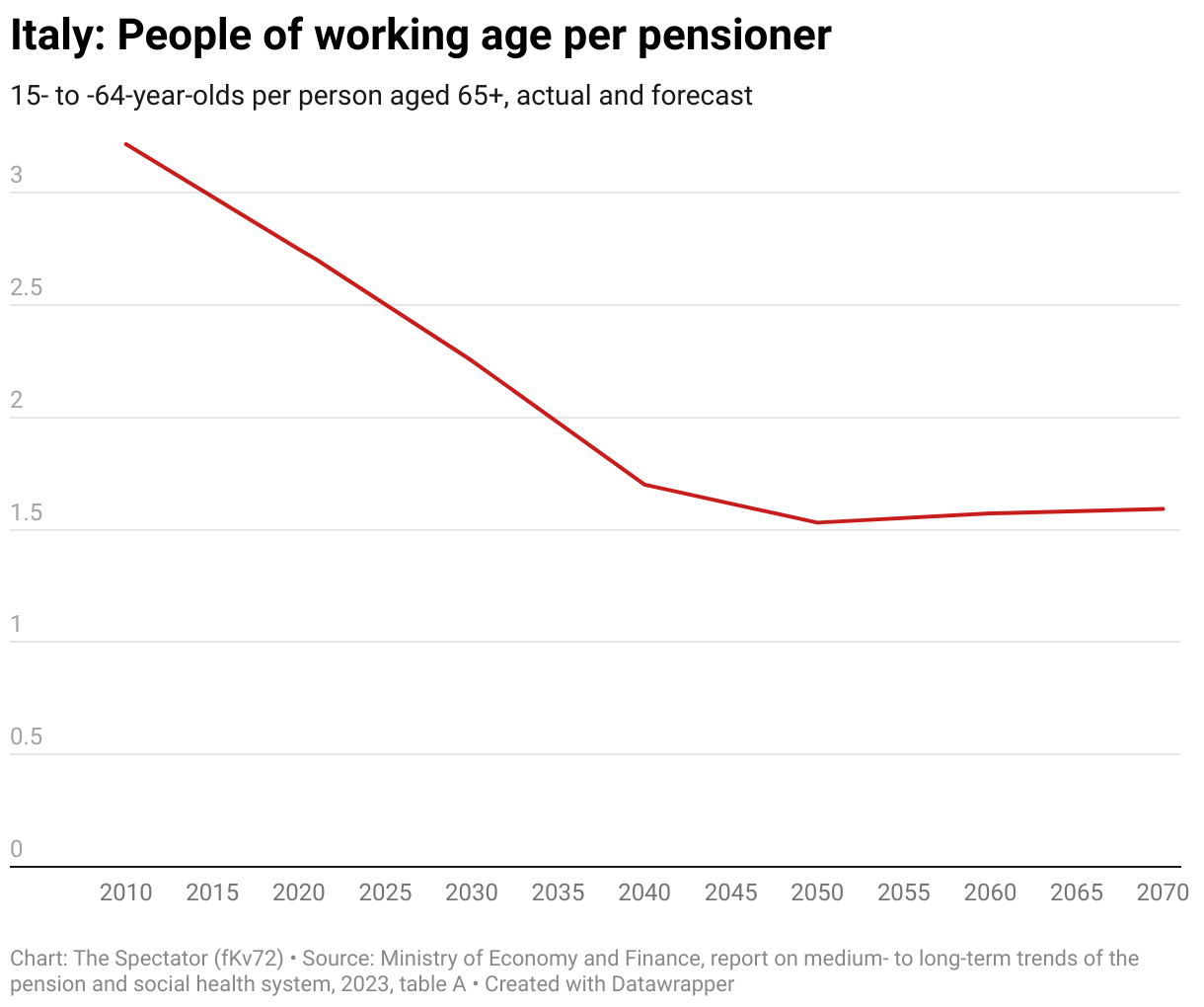
If this continues, the welfare state model, which depends on a decent worker-to-pensioner ratio, will collapse. There will not be enough tax revenue to finance pensions. A recent study in Italy showed that for every pensioner there are three people of working age, but by 2050 the ratio is projected to be closer to 1:1. The promise of a decent state pension would have to be withdrawn.
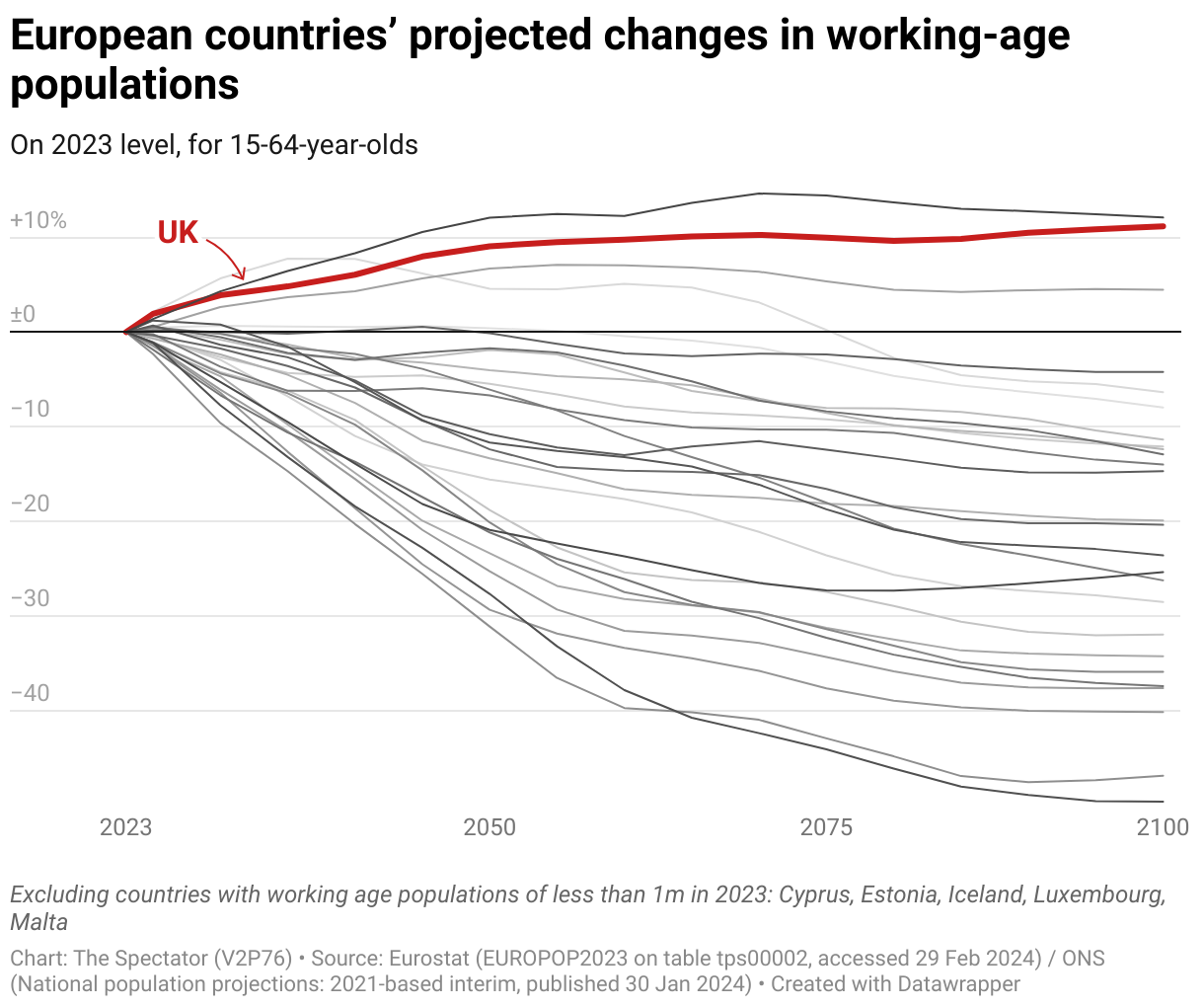
Japan’s Prime Minister Fumio Kishida refers to his country’s falling birth rate as an existential threat. Giorgia Meloni says the same in Italy. For Marine Le Pen, a plan to increase the birth rate is part of her economic policy. The ‘increase in childless families’ is lamented by the AfD in Germany. This is likely to be a theme in the European parliament this year because in almost every country in Europe the working-age population has already started to decrease. This decline is expected only to accelerate.
This is not the case, however, in Britain. We learned this week that our working-age population is projected to keep rising. The figures were greeted with dismay, viewed as a result of out-of-control immigration. But which is the worse problem to have – too many people or too few? As South Korea has found out, no amount of panicked policy initiatives have succeeded in encouraging couples to have more children. As countries become richer, people choose to have smaller families or none at all.
Newcomers to the UK tend to have larger families, which is the main factor in maintaining our birth rate. Almost a third of all British babies are born to immigrant mothers. In London, it’s closer to 60 per cent. This has not prompted the country to come apart at the seams. Instead, we have created a multi–faith society whose cohesiveness is envied by much of Europe.
Japan’s Prime Minister refers to his country’s falling birth rate as an existential threat
Some European populists advance the idea of a ‘great replacement’ plot by political masters to deliberately swap natives for lower–paid, more biddable migrants. But another explanation is that we now live in a world where people are on the move. Every day, 1,400 people emigrate from Britain and 3,200 newcomers arrive. Is this a great replacement – or the demographic response to a globalised world?
The problems arise when more people leave than arrive: a decline in population numbers is what brings crisis. Glasgow’s Herald newspaper has this week highlighted the plight of the Scottish Highlands, which it is calling the ‘new Highland clearances’. The exodus of young people, to either move abroad or elsewhere in the UK, has been going on for generations but is now reaching crisis point. While the London-based press frets about too many arrivals, there’s a clear opportunity for tax breaks or other financial incentives to persuade more people to settle in this beautiful corner of the world.
The UK is in a bind. A failure to address the welfare crisis – with 5.5 million on out-of-work benefits during a worker shortage – is drawing in a million migrants a year. This puts pressure on housing, due to the inability of the government to fix a broken system controlled by a small cabal of housebuilders and an ocean of red tape. The best way of lowering immigration is to have a welfare, tax and benefits programme that matches up jobless Britons with the vacancies in their areas.
Welfare reform is a huge undertaking, fraught with political risk. The Conservatives are not tackling it with any urgency. Labour does not fancy the task either, which is perhaps why it does not acknowledge the scale of the out-of-work benefits problem (18 per cent in Manchester, 20 per cent in Glasgow and Liverpool, 25 per cent in Blackpool). The inability to mobilise a national workforce will suck in others from abroad, as well as force up welfare costs and taxes.
But this will remedy itself: the sheer cost of the 4,000 a day who claim sickness benefits will bankrupt the next government. The need to address the problem is urgent, if politically painful. For countries such as Japan and Korea, there is no easy remedy to population loss.
The current high number of immigrants to the UK – many of them highly skilled people who are more likely to work and pay taxes than native Britons – nevertheless poses challenges. We need to build more homes and manage integration better, but these are issues that arise as a result of the country’s success. Compared with the crisis of working-age population decline in the rest of Europe, there are worse problems to have.
Portrait of the week: vapes banned, Sunak fasts and royals leave hospital
Home
Lord Cameron of Chipping Norton, the Foreign Secretary, set off on his fourth visit to the Middle East after saying: ‘We – with allies – will look at the issue of recognising a Palestinian state, including at the United Nations.’ The Democratic Unionist party agreed to return to the power-sharing government in Northern Ireland, in return for a change in the law surrounding the Windsor Framework post-Brexit agreement with the European Union. Separately, from the end of January veterinary certificates were legally required for fresh food and plant imports from the EU to England. The population of the United Kingdom would reach 70 million by 2026, the Office for National Statistics forecast, and by 2036 would reach 73.7 million, after 7.6 million people had left the country and 13.7 million arrived. At the weekend, 388 migrants in small boats crossed the Channel, bringing the total for January to 1,169, compared with 1,180 last January.
The government told Vodafone that its relationship with its largest shareholder, the UAE-controlled group Emirates Telecommunications, posed a risk to national security. The government announced that it would ban the sale of disposable vapes. Rishi Sunak, the Prime Minister, said fasting from 5 p.m. on Sunday until 5 a.m. on Tuesday each week was ‘an important discipline’. Train drivers went on strike; train operators decided not to use a new law requiring minimum service levels. The King left hospital after three nights, following treatment for an enlarged prostate. The Princess of Wales left hospital after 13 nights, following abdominal surgery; she was expected to spend months recuperating. Three-quarters of measles cases reported in an outbreak in England since October were found to have been in the West Midlands. George Freeman MP said he had resigned as a minister because he could not afford to pay his mortgage on a salary of £118,300.
Nottingham Police and Leicestershire Police referred themselves to the Independent Office for Police Conduct after it emerged that assaults by Valdo Calocane had been alleged five weeks before he killed three people in Nottingham, for which he has been sentenced to be detained at a high-security hospital. Two boys, aged 15 and 16, were fatally stabbed in south Bristol. A man with a crossbow was shot dead by police at Surrey Quays, Southwark.
Abroad
President Joe Biden of America said it would ‘hold all those responsible to account’ after three American troops were killed and at least 34 wounded at a base in Jordan near the Syrian border by a drone operated by a Shia militia supported by Iran. Donald Trump said: ‘We are on the brink of World War III.’ A tanker, the Marlin Luanda, operated by a company registered in Britain, was set on fire in the Gulf of Aden by a missile fired by the Houthis. America, Britain, Germany, Italy, Japan and other states suspended funding for the UN agency for Palestinian refugees, Unrwa, after allegations that some of its staff had taken part in the attacks on Israel by Hamas on 7 October, which killed about 1,200 people. Unrwa sacked nine people. The International Court of Justice at the Hague, an organ of the UN, responding to a case brought by South Africa, ordered Israel to take all measures to prevent genocidal acts in Gaza. More than half of Gaza’s buildings had been damaged or destroyed, according to analysis published by the BBC; about 1.7 million people – more than 80 per cent of the population – had been displaced.
Turkey ratified Sweden’s application to join Nato, leaving Hungary as the only one of its 31 members not to have done so. Russian forces advanced in the eastern Ukrainian town of Avdiivka, now reduced to ruins. On the eve of a general election in which he will not be allowed to take part, Imran Khan, the former prime minister of Pakistan, was sentenced to ten years in jail in a case concerning alleged leaking of diplomatic correspondence; the next day he was jailed for 14 years on charges of corruption. Bullfighting resumed in the world’s largest-capacity bullring, in Mexico City, after a suspension since 2022. A judge in Delaware annulled a $55.8 billion pay award to Elon Musk in 2018 by Tesla. ‘Never incorporate your company in the state of Delaware,’ Musk tweeted.
A court in Hong Kong ordered the liquidation of the debt-laden Chinese property giant Evergrande. French farmers blockaded roads to Paris with tractors; Belgian and German farmers protested in a similar way. Trade talks between Britain and Canada broke down over cheese. CSH
Your country needs you, Gen Z

Angus Colwell has narrated this article for you to listen to.
Gen Z doesn’t look like it wants to fight for Britain, but last week, General Sir Patrick Sanders, the Chief of the General Staff, said we might have to. He suggested that people my age should be prepared to join a ‘civilian army’ in case we go to war with Russia. But could we handle being cut off from our phones and friends? Do we have the fellow-feeling necessary to defend our country? What if we won’t submit to authority?
There are any number of reasons why my generation might reasonably not want to enlist. Accommodation will be uncomfortable and the food will be grim, according to army discussion forums. The application process will take 18 months, and at the end it’s just a 50 to 60 per cent acceptance rate. Then if you do serve, the future of war looks bleak. One in three soldiers fighting in the Russia-Ukraine war has died or been injured. An academic who is also a reservist tells me: ‘AI and drones mean every-thing can be seen all at once, so the next conflict could be medieval in nature: hand-to-hand trench warfare in urban environments.’ Your fate is also in the hands of politicians, who in the past two decades have given us soul-destroying and often counterproductive wars in Afghanistan, Iraq and Syria.
We may have just the skills the army needs. We’ve spent a decade training via first-person shooter games
The main objection to war among Gen Z, however, is simple: ‘I love not dying,’ says Harry, a university student. Another Gen Z-er, adds: ‘Yes, I’d be called a coward if I didn’t fight, but what use is it being a hero if you’re dead?’
Giving your life for your country is no longer a given. Is wokeness to blame? One senior defence source reckons so. ‘It is making all this harder,’ they say. ‘The army is a bit rough: you get shouted at, and fewer young people want that.’
Nigel Farage agrees. He told me that ‘we have poisoned the minds of our younger generation with constant anti-British messages’. No wonder no one wants to serve.
Quite a few Gen Z-ers I spoke to said that they wouldn’t fight for our current political class. One friend went so far as to say: ‘I’d rather die fighting our own government.’ Another added that she ‘couldn’t fight for the people who are currently representing our country’. This is a big issue, according to one MP: ‘When you look at the mess that is modern politicians, why on earth should people want to put their life on the line for the likes of us? Those of us who are politicians should respect what we are asking them to do.’
But it could be that Gen Z has the skills that the army desperately needs. We’ve spent years gainsmaxxing at PureGym. We know the protein content of a chicken breast to the milligram. We’ve spent more than a decade training via first-person shooter games and we’ve seen so much of Gaza on TikTok that we can’t be shocked any more.
And some of us do actually believe that this country is still worth fighting for. Alex, a 21-year-old who is studying at Durham, thinks we have to be ready to defend our principles: ‘If you believe in the values that we are supposed to hold dear – democracy, freedom of speech – then I think you have an obligation to defend that. You can’t enjoy those privileges for your whole life and then as soon as you’re asked to defend them, you say no because you don’t agree with the current government.’ Gen Z-er Tom says he would rather ‘die on his feet than live on his knees’, and thinks his contemporaries are too naive about our enemies. Charles, who served in the RAF’s University Air Squadron, said he was driven by a ‘low-level sense of duty, maybe even generational guilt. Others have fought to preserve my current way of life. I should be prepared to do the same for future generations.’

Simon, who has been an officer in the RAF for three and a half years, says serving is a way to influence and respond to global events. But he admits that everyone’s idea of duty is different: ‘Others quite legitimately may view themselves as having a duty not to risk their life when their friends and family want them alive.’
For some, duty doesn’t come into it – the army is the end in itself. Lucy, who’s finishing her degree at Bristol and thinking about applying, says that she ‘couldn’t be less patriotic’. Yet she’s interested in joining the army because ‘I have no idea what I want to do after university, and it’s a commendable thing to do’. Plus they’re giving the impression that ‘they’ll take anyone’.
Should Lucy start scrolling through army subreddits and discussion forums, she might find herself less keen. For my generation of servicemen and women, the work is often no fun any more. An increasingly corporate culture has made serving more like any other job (‘Would you risk your life for Shell or BT?’ says one reservist). Yet, as a former general told me: ‘If there’s a good war on, recruiting is rarely a problem.’
Perhaps the reason so few Gen Z-ers say they want to fight in a war is because life in the army sounds boring. In barracks across the land, soldiers will be tidying their rooms, staring at the ceiling and preparing for another parade. They probably wouldn’t mind a scrap.
Inside the fight over Labour’s green spending plans
Who’s afraid of the Green party? Within Labour, the answer varies depending on which member of the shadow cabinet you speak to. Some laugh off the idea that the Greens present an electoral threat from the left, because of the two-party system. As one party veteran puts it: ‘Labour has two opponents. In England, it’s the Tories. In Scotland, it’s the SNP. It’s that simple.’ The prevailing view among many of Keir Starmer’s disciples is that left-wing voters – Green or not – will be so desperate to oust the Tories that they will vote for Labour no matter what.
Concern about a Green threat tends to be code for saying Starmer is not radical or left-wing enough
On the other side of the shadow cabinet table are those who think there is a risk in the Labour party looking Tory-lite. ‘I do worry about the Greens,’ says one shadow minister. ‘There’s a chance that voters go there instead.’ A recent YouGov MRP poll in the Telegraph suggests the Greens pose a threat to shadow culture secretary Thangam Debbonaire. It projected that the Greens are just four points behind Labour in the seat she is contesting, Bristol Central. ‘There’s a reason she’s not been sent on the morning rounds to defend Starmer’s position on Gaza,’ says one Labour figure.
The internal debate also provides a helpful way of finding out how MPs feel about the current direction of the party. Concern about a threat from the Greens tends to be code for saying Starmer is not radical or left-wing enough.

Nowhere is the quandary more apparent than the confusion over the pledge Labour made three years ago to borrow £28 billion a year to reach clean power by 2030. The scheme makes up a large part of Labour’s economic strategy, yet rising borrowing costs mean it has already been scaled back once. In the words of one party figure, the spending commitment has become an ‘albatross around our neck’. The Tories plan to run an aggressive campaign arguing that the pledge will inevitably lead to tax rises. For some in the shadow cabinet, even hearing the figure repeated is a source of frustration. ‘It is very Labour to talk about how much we are going to spend rather than what it will actually do,’ says one shadow minister. Darren Jones, shadow chancellor Rachel Reeves’s deputy, says the pledge has been rendered out of date by rising borrowing costs and the level of private sector capital.
The party is in a no man’s land on the policy as speculation runs on and the £28 billion figure is mentioned sporadically by Starmer. There has consequently been some briefing against his chief of staff, Sue Gray, who is accused of being sympathetic to the pledge to avoid an embarrassing U-turn. But some shadow cabinet members see this as a classic example of the Labour old boys’ club blaming the woman rather than the man she works for. ‘Sue is a true sister,’ says one supportive colleague.
The general expectation in both the Labour party and Conservative HQ is that Starmer and Reeves will junk the headline figure after the Spring Budget, blaming the Tories for using up all the fiscal headroom.
What about the risk of scrapping it? As a Labour strategist once put it: ‘When people ask me how we solve the Green party problem – well, that’s when you get Ed Miliband and his green ukulele to turn out.’ But ditching the £28 billion price tag would be seen as Miliband losing the argument. There are already rumours swirling that Jeremy Corbyn is planning to launch a new party aimed at winning over voters angered by Starmer’s stance on Gaza and Labour’s backtracking on green issues.
While the Greens won just 2.7 per cent of the vote at the last general election (double their vote share in 2017), the ‘green universe’ of voters is much broader. Many voters are environmentalists to a degree. Research for The Spectator by Focaldata estimates that seven million voters are ‘green-curious’. Of this group, 43 per cent would vote Labour; 20 per cent for the Lib Dems; just 15 per cent for the Greens and 8 per cent for the Tories at the next election.
These green-curious voters fall into five categories. First, the ‘Radical Red’ Greens, who are Labour-loyal, environmentally conscious activists who tend to be graduates. They rally behind policies such as the introduction of a four-day week and prioritise climate change along with health and housing.
Then there are the ‘Green Populists’, caught between the Green party and Labour. They believe that Labour represents the working class but think the Greens better reflect their interests on immigration, welfare, job security and climate change. They are the most likely of the five groups to support the Green party in the next election.
Next come the ‘Green Moderates’. They dislike Greta-style jeremiads and tend to be more pragmatic. Among this group, support for Labour is rising. The idea of a Green New Deal type of programme – popular with big business – fits with their eco-activism.
The smallest faction is the ‘Evergreen Optimists’. These voters regard themselves as positive and open-minded. They believe in the political system and prioritise policies over party victories. This group is likely to vote Green.
Finally, there are the ‘Urban Random’ Greens, a cohort of young Londoners who are notably a little more right-wing than the other groups. They are sceptical of some green principles including net-zero targets and ultra low emission zones. They favour the Lib Dems to the Green party on climate issues. More than half of those in this group who voted Green last time say they won’t at the next election in a sign that the party’s policies have become too radical.
Polling suggests Labour, for now, holds sway with many ‘green-curious’ voters. It’s why many in the party think it is better to risk a bust-up with them than damage the party’s economic credentials. Yet Labour’s internal fight over its green commitments goes beyond concerns about an immediate electoral risk. It is about what Starmer and his party ought to stand for.
How the Tories gave up on liberty
Rishi Sunak stood glowering over a school table and listed, with disdain, the flavours of the vapes that lay on the table in front of him. ‘Grapefruit,’ the Prime Minister declared. ‘Bubblegum. Strawberry. Berry Burst.’ Pupils at Haughton Academy were then invited to express their own disgust: ‘Bright colours,’ observed one student. ‘Appealing to younger people,’ said another.
‘Do you think that’s right?’ the Prime Minister asked the circle of 13- and 14-year-olds. ‘No,’ they dutifully answered. Sunak told the students, in a video posted to his Instagram account, that the ‘good news’ is that he is announcing a full ban on disposable vapes and a crackdown on packaging and flavours that might be particularly popular with the young.
The question is whether someone’s after-dinner cigar or trip to the shisha café is anyone else’s business
What he failed to mention is that the vapes he brought in for show-and-tell are already illegal for children to buy.
The Tobacco and Vapes Bill will, in addition to restricting vapes for adults, make it illegal for anyone born after January 2009 to purchase cigarettes. The ban could also apply to cigars, shisha, tobacco pouches and heated tobacco products. It’s expected to come to parliament this month, and – given the wide support for the ban across all major parties – there is a chance that it will be passed without serious debate.
The plan was first announced by Sunak at Conservative party conference last year. It was strange timing – the Leader of the House, Penny Mordaunt, had just called on party activists to ‘stand up and fight for the things upon which the progress of humanity depends: freedom’. But it seems people have been enjoying some freedoms a bit too much. Too many people choose cherry-flavoured vapes for the government’s liking.
It’s difficult to take away established rights and legal products from adults who already enjoy them. What this government plans to do instead is to take them away from those who are less likely to complain. You don’t miss what you never knew.
The original plan to mandate a ‘smoke-free generation’ was the brainchild of Jacinda Ardern, who was going to impose this type of phased ban in New Zealand. Her idea was immediately scrapped by the new right-wing coalition government, which has pledged to use the income from cigarette duty to cut taxes elsewhere. Britain now stands alone in planning to phase out smoking completely.
The Prime Minister will no doubt be looking at the polls, which show the popularity of illiberal policies. Even the most meddling politician would have struggled to propose a smoking ban before the pandemic. But the public became used to heavy-handed interventions such as lockdown. It turned out there was widespread support for relinquishing personal freedom and responsibility and handing control to government. There still is: a poll at the end of last year showed that roughly a quarter of respondents want nightclubs shut and a cap of six people for social gatherings.
It wasn’t so long ago that, as chancellor, Sunak privately lamented invasive lockdown restrictions. It wasn’t a minister’s job to determine whether a scotch egg constituted a ‘substantial meal’, he thought. But now it will be his ministers deciding whether the public should be allowed cola- or strawberry-flavoured vapes. ‘How do I get on that committee?’ quips one Tory MP.
When the economy is stagnant, and a cost-of-living crisis rages on, why pick this fight? Smoking is already dying out. Smoking rates are at their lowest levels on record, especially among the young. And the ban would almost certainly be unenforceable in any case. Any further restrictions are more likely to push the dwindling number of smokers towards the black market, which supplies one in ten cigarettes smoked in Britain. Expect that number to rise if there’s no way for future adults to legally purchase tobacco products.
More important than any single piece of evidence is that adults should have the right to make personal choices about how they live their lives. Smokers will die younger on average, but this is a risk they are informed about on every cigarette packet. Since the ban on smoking in indoor public places was implemented, that risk has largely become a private choice, and personal lifestyle choices are not the government’s concern. It’s not simply smoking that MPs are about to phase out of existence, but the principle that a person should be allowed to determine his or her own destiny.
It’s absurd that in a few decades, a 45-year-old will be allowed to legally buy cigarettes and a 44-year-old banned. But the real question is whether someone’s after-dinner cigar or trip to the shisha café is anyone else’s business. In wartime Britain, Churchill said his ‘rule of life prescribed as an absolutely sacred rite smoking cigars and also the drinking of alcohol before, after and if need be during all meals and the intervals between them’. The only thing sacred in Whitehall today is the National Health Service, but not even its protection can be used to justify a smoking ban: the £10 billion tax revenue from cigarettes more than offsets the cost of treating smoking-related diseases.
That ‘sacred rite’ is being extinguished based on the personal tastes of members of the government. Once it is, what else might follow? Sunak has made clear that his bans stop at smoking. ‘There is no safe level of smoking,’ he claims, unlike food and drink consumption, where he says ‘I firmly believe in people’s right to choose’. (The Prime Minister personal preference is to fast for 36 hours a week.)
This ban will deprive 18-year-olds, then 35-year-olds and, one day, 90-year-olds of personal choice
It’s not obvious that the party 27 points ahead in the polls sees it that way: foods high in calories, fat or salt might be viewed by Labour as just as easy a target as flavoured vapes. Only last month, Sir Keir Starmer declared he is ‘up for the fight’ to defend ‘the nanny state’, as the party looks into banning certain food adverts before the watershed. There’s a fiscal incentive for this as well: Labour needs to find the cash for its many promises, and while the sugar tax introduced under the May government has had no impact on obesity rates (as was predicted), it has provided a boost to the Treasury. The continued purchase of sugary drinks had led to an increase in revenue every year since the tax was introduced – £355 million in the last financial year.
This won’t be the nanny state as we’ve known it. Labour will have a new mechanism, created by the Tories: a two-tier system of rights where, based on an arbitrarily selected age, some adults will have full consumer rights while others have them curbed. Backers of the smoking ban insist this is a policy that protects children. But there are laws already in place to stop tobacco sales to children. This ban will deprive soon-to-be 18-year-olds, then 35-year-olds and, one day, 90-year-olds of personal choice.
Britain developed many modern ideals of liberty. This is a worthwhile legacy to uphold, though sometimes a difficult one. Defending liberty can mean defending ‘bad’ things: the right to offend, to drink, to get fat, to vape, to smoke. Who will mount that defence when the Bill is debated this month? Polls show the smoking ban is almost as popular as lockdowns were. This thrills some Tories, who have not had a popular policy for a long time (it seems it’s easier to take away the rights of young people than it is to build them some homes), but polls are a dangerous metric when it comes to granting or revoking liberties. Respect for individual autonomy has long been a necessary feature of democracy. With this ban, MPs across the parties will vote to erode that respect.
‘Liberty means responsibility,’ said George Bernard Shaw. ‘That is why most men dread it.’ The Conservative party is supposed to champion the notion of freedom. It has slowly come to dread it instead.
How the Houthis wage war through poetry
Poetry is politics in the Yemen. When the last Imam of Yemen, who was also the hereditary ruler, was deposed in a coup in 1962, it was a local poet who announced the change of regime on the radio, in verse of course. And the current al-Houthi regime in the north of the country, like all its predecessors, asserts its legitimacy, confounds its enemies and rallies its supporters through poetry.
As an aspect of their cause, they have consciously avoided high-Arabic poetry – a literate, urban cultural form – and have made use of the zamil tradition, which immediately speaks not of the palaces of emirs and princes, but takes the listener to sit beside the farmers and Bedouin shepherds in the villages and hills.
Zamil poetry shapes the great events of life – from weddings to war
Zamil oral poetry is, under a variety of names, an Arabia-wide practice. Banish any memories you might have of poetry recitals here – the small gathering of shy writers reading myopically from their slim volumes. Instead imagine a vast tent in which a cocksure young warrior, one hand on his sword, the other puncturing the air, is chanting his verses to a striking rhythm set up by a drum and supported by the melancholic melody of a flute, the entire audience excitedly singing along to the refrain-like couplets.
This is zamil (plural zawamil) which, unlike the literate traditions of Arabic poetry, is not governed by precise rules of metre and internal rhyme, but is ready to be shaped for any of the great events of life. It might be used to celebrate a wedding – and to generously introduce the two families to each other; there might be duels between rival poets brandishing rival politics with humour or deadly zeal (zajal); there can be eulogies for the dead (madih), praise of the tribe (qitah), denigration of the enemy (hija’) and hamasah, calls to war.
Marvellously it may be used by a revered old sheikh in an arbitration, not so much when making a judgment over a dispute, but in the lead up to the settlement of an argument to summarise and praise both sides.
Winds – either gentle lovable breezes or violent tornadoes turning the dry wadi floor into a devastating flood – are ever popular analogies. The much-burdened camel is an irresistible image for the experience of the common man.
At its best this oral poetry becomes the articulate, free-talking spirit of the community, relishing intimate details of the local landscape, the local dialect, mythology and slang which may be incomprehensible to the next-door valley, let alone the rest of the Arab world. Yemen is thick with local identities, complete with recognisably different accents and old memories of self-governing sheikhdoms and rival dynasties. Yet the most-loved verses escape their locality and can have a vast reach, originally through cassette recordings, but now to an ever-wider audience through the medium of the mobile phone and the internet. Today’s viral offerings combine solo voices of passionate integrity with gritty chorus refrains sung by male warriors.
One of the most popular young male singers championing the al-Houthi cause is Issa Al-Laith. His poems ‘Prophet Muhammad Unites Us’ and ‘Force of Great Might’ could make a useful introduction. This zamil tradition in the Yemen is exactly mirrored by nabati, created by the rural, semi-literate Bedouin across eastern Arabia, and now much cherished by an X Factor-style annual television competition called Million’s Poet, which is screened across the Gulf. The work of Hissa Hilal, a veiled Saudi Arabian woman and mother of four, who reached the final of the 2010 edition of the show with her nabati poem ‘Against Extremism’, is another good place to start.
The scholar Steven Caton, who had recorded zawamil in the obscure highland villages of northern Yemen in the 1980s, was astonished to hear them chanted 30 years later by tens of thousands of demonstrators when the Arab Spring engulfed the country in 2011.
The Houthi, whose war poetry has recently gone global, were part of an alliance of popular forces brought together in opposition to the corrupt governance of president (and ex-general) Ali Abdullah Saleh. They had first emerged as an organised movement in their home city of Sa’da in 1992, defending their own Shiite traditions from the aggressive preaching of Wahhabi Sunni missionaries from neighbouring Saudi Arabia. In 2004 their leader, Hussein al-Houthi, was killed and 800 of his followers were imprisoned by the government, igniting armed resistance in their mountain homeland in the north-west, which continued over the next six years (from 2004 to 2010) under the leadership of his brothers.
So the al-Houthi had every good reason to join the protest marches of the Arab Spring in 2011, which by 2014 had evolved into a three-cornered civil war, with the remnants of the corrupt old regime propped up by an aggressive Saudi-Gulf military coalition. This civil war raged from 2015 to 2022. For seven years the Houthi, under the leadership of Abdul-Malik Badruldeen al-Houthi endured air strikes, drone attacks, naval blockades and marine landings, but now and then managed to lob a rocket at targets in Saudi Arabia and the Emirates. The whole country suffered, with 150,000 Yemeni killed in the war, and an additional 230,000 dying through associated famine and disease, before a temporary truce called a halt to hostilities in 2022.
To survive against the extravagantly funded armies of their oil-rich enemies, the al-Houthi have transformed northern Yemen into a militant regime and allied themselves with the Iranian ‘Axis of Resistance’. Their poetry is the most successful part of their propaganda which stresses their piety, bravery, learning and poverty compared with the corruption, wealth, laziness and hypocrisy of their enemies, whom they portray as betraying their fellow Arabs with their open alliance with Israel, the USA and UK, and liken to Yazid, a hated caliph from the 7th century. Memories are long in the Islamic world, and the Houthi poetry contains constant references to the great Shia heroes – to the example of Imam Ali and the martyrdom of Husayn at Karbala – for it is part of the Shia tragedy that in every generation, the good suffer.
Poetry is the most successful part of Houthi propaganda which stresses their piety and bravery
The al-Houthi follow a very mild version of the Shia faith, first brought to Yemen by their ancestor, Yahya ibn al-Husayn, who was buried beside an old mosque in the ancient city of Sa’da in 911 ad. A direct descendant of the Prophet Muhammad, Yahya followed the teachings of his own saintly grandfather, who was emphatic that to rule with injustice and oppression is a heresy of Islam, and that it is the duty of all true believers to remove themselves from such injustice.
He taught that a true leader of the Muslims should be chosen from the many descendants of the Prophet, identifiable by his possession of 14 virtues, which start with piety, bravery, learning and poverty. This ideal leader – the ‘guide to the truth’ – is acclaimed by the zamil poets.
Tanks, jets, drones and rockets are no more than visual backdrops to the still provincial, rural identity of the poetry, with its traditions of poverty and faith. Resembling a fusion of the redneck hillbilly populist sentiments of the Appalachian Mountains and the spirit of a Highland Jacobite chieftain from the pages of Robert Louis Stevenson, the Houthis’ ongoing disruption of Red Sea shipping has brought the millenia-long poetic traditions of the Arabian peninsula to our attention.
Ought we not have some shrine to the pips?
Next week marks the centenary of the pips. On Monday at 9 p.m. a documentary will be broadcast on Radio 4 debating whether the six little tones which ring in each hour ought to be axed as obsolete or preserved for tradition’s sake. Some contributors will speak of them as annoyances – ‘the cockroaches of broadcasting’ is a memorable phrase – and others will ask what could possibly replace them. By the end of the programme, whatever your view, you will have the pips lodged firmly between your teeth.
If we so worship the pips, ought we not to have some worthy shrine to their existence as well?
The first pips, which represent the Greenwich Time Signal, were transmitted at 9.30 p.m. on 5 February 1924. Discussions had been held the previous year between the BBC’s John Reith, astronomer royal Frank Dyson, and Frank Hope-Jones, chairman of the Wireless Society of London, about catering to the public desire for accurate time-keeping. The broadcast of the chimes of Big Ben at New Year had proven popular, and one of the clocks at the Royal Observatory, Greenwich, made by the same manufacturer, Dent of London, was chosen to be adapted to produce the six notes, initially all of the same length, spaced one second apart.
The final pip in the sequence, which marks the new hour, was later lengthened to orientate listeners who tuned in while the signal was sounding. The devices – by then there were several – had been relocated to Abinger in Surrey during the second world war and thence to Herstmonceux in Sussex. Everything changed in 1990, when the BBC created its own pips box using signals from the GPS satellite network. Next week’s documentary opens with presenter Paddy O’Connell tracking down the unremarkable-looking device in a cold basement of Broadcasting House.
This revelation rather undercuts the romantic argument for retaining the pips on the basis of their history. If you’ve visited the Royal Observatory you will know that the early clocks look as beautiful as they sound. A ‘time historian’ interviewed for the programme praises the pips for providing a soundtrack to our lives and even ‘the tempo of our existence’ – but if we so worship them, ought we not to have some worthy shrine to their existence as well?
The argument for saving them is akin to that for saving most harmless old traditions: the case against is cold and practical. The signal is now slightly behind time, due to the nature of digital broadcasting, and no longer provides the accuracy listeners first desired. Presenters trip over themselves to avoid crashing the pips; Mishal Husain likens the challenge to that of driving a speeding car towards a roadblock. ABC Sydney dropped its pips last year and, according to the station manager, has never looked back.
An accompanying 2018 drama, When the Pips Stop, is being repeated next week on Radio 4 Extra. It is less a paean to the pips than to Radio 4 as a cultural institution. Two recently orphaned adult sisters are living on a remote Scottish island with nothing but the radio for company when, all of a sudden, Radio 4 stops. This is a disaster, because the sisters haven’t spoken to each other for more than two years, and are evangelical about the station. One claims that the sum of her worldly knowledge has come from Radio 4. She pictures radio waves floating above the waves of the sea carrying music and ideas to the island through ‘a miracle’. The Shipping Forecast had long since taken the place of bedtime stories and prayers in her life.
The writer Oliver Emanuel, who died in December from brain cancer at the age of 43, won the Tinniswood Award for ‘best audio script’ for the play in 2019, and it’s easy to see why. The tension between the two sisters as they are forced together in the silence is perfectly drawn, as is the oppressiveness of the landscape that hems them in. Why has the radio failed? Where is the daily boat? Has there been some disaster on the mainland? Who can say without the pips and the news which follows?
BBC bosses might embrace it for its praise of the varied programming and international appeal of Radio 4, but the drama is saved from being saccharine by the fact that it’s the absence of the radio that forces the two sisters to reconnect. Radio 4 salvages their relationship by failing rather than playing. The story’s resolution diminishes any sense that it was intended purely as panegyric. It takes such an extreme case, we may suppose, to justify stopping the beloved pips.
Like swallowing a pack of Parma Violets: CUTE, at Somerset House, reviewed
It’s funny how badly some 1960s films have dated. Watch What’s New Pussycat? today and you feel faintly sick. Never mind the chorus line of high-kicking cartoon cupids in the title sequence, what about the lyrics of Tom Jones’s theme song? ‘So go and powder your cute little pussycat nose…’ Yuck.
Tim Berners-Lee, asked what uses of his invention he hadn’t foreseen, replied with one word: ‘Kittens.’
But if you think we’ve moved on, you’d better not visit CUTE. Coinciding with the 50th birthday of Japanese cartoon character Hello Kitty, Somerset House’s latest exhibition – ‘a landmark exploration of the irresistible force of cuteness’ – takes as its starting point the craze for funny cat memes unleashed by the internet. Tim Berners-Lee, when asked what uses of his invention he hadn’t foreseen, replied with one word: ‘Kittens.’ His response is quoted at the start of the show in a gallery of rainbow-coloured cosplaying kitties designed using AI by Graphic Thought Facility.
Since the launch of Caturday on imageboard 4chan in the mid-2000s, cats have bred on the web like, well, rabbits and merchandising companies have monetised the fad. Japanese company Sanrio was ahead of the curve with Hello Kitty. With her kitten ears and whiskers, a red bow and cute little pussycat nose – but no mouth – the character was created in 1974 as a rival to Mickey Mouse aimed at the Japanese schoolgirl market. But in the 1990s she went global and, with a total revenue of $80 billion, she has overtaken Mickey and friends at $70 billion. A room featuring 50 years of candy-coloured Hello Kitty merch from cushions and cases to toasters and hairdryers – including a pair of shoes with Kitty heels Grayson Perry would die for – leads through to a space upholstered in pink Hello Kitty plushies into a Hello Kitty Disco where you’re invited to ‘lose yourself in cuteness’ to a playlist of ‘iridescently luminous pop music’.
It’s not all fluff; the show has claims to seriousness. In the catalogue Dr Joshua Paul Dale, a specialist in ‘Cute Studies’ at Tokyo’s Chuo University, references Locke and Rousseau and the ‘baby schema’ identified by Konrad Lorenz as an evolutionary trait ensuring the survival of the cutest. It’s the cartoon look: big head, big wide-set eyes, short limbs and soft body. It dissuades parents from murdering their offspring. Mickey Mouse was 45 when Lorenz won the Nobel Prize in 1973; Disney got there first.
Dr Dale traces the cute aesthetic to a Japanese artistic tradition going back to a 12th century ‘Scroll of Frolicking Animals’, but while they aped human activities, the animals in Japanese prints were never physically anthropomorphised. It was Louis Wain who first gave his cats the sparkly saucer eyes we see in contemporary Japanese manga and anime.
Kittens are the definition of cute – an abbreviation of ‘acute’, meaning sharp – because they’re cuddly, with claws. There’s an edge of danger to the English meaning of cute that’s missing from the Japanese equivalent, kawaii. Looney Tunes’ canary Tweety, based by his creator Bob Clampett on a photo of himself as a baby, is the cute character par excellence because while looking defenceless he outwits – and presides over the torture of – his feline stalker, Sylvester. He also pioneered the textual offshoot of LOLcats, LOLspeak, with its infantile pronunciation and grammar – ‘I did, I did, I did taw a puddy tat!’ – but he’s absent from this Sanrio-sponsored exhibition, which would be more interesting if its Japanese bias didn’t skew its perspective on a global phenomenon.
By the time I reached the second-floor galleries I felt like I’d swallowed a pack of Parma Violets
As it is, the show’s super-sized serving of kawaii – closer to ‘sweet’ than ‘cute’ – is cloying. By the time I reached the second-floor galleries I felt like I’d swallowed a pack of Parma Violets, and this was only the start of the serious stuff – ‘the cute in art’. But with themed clusters of ‘culturally significant objects’ dotting the galleries, it was hard to separate the art from the merch, other than by size. Art critic Gabriella Pounds suggests in the catalogue that ‘in a larger culture mired in negativity and fatalism’ the show’s artists ‘reflect an important and growing movement towards softness, hopefulness and sincerity’. Really? Aya Takano’s ‘The Galaxy Inside’ (2015) may be soft and hopeful but I’m more inclined to trust the sincerity of Mike Kelley’s ‘Ahh…Youth!’ (1991), an identification parade of thrift shop teddies including a mugshot of the artist’s spotty teenage self. Given that Kelley once condemned ‘the modernist cult of the child’ as a ‘crock’, one wonders what he’s doing in this company.
There are hints in the catalogue that exposure to cuteness might be designed to soften us up so we’re easier to manipulate. Studies have shown that cute imagery improves productivity – something Aldous Huxley’s Brave New World didn’t anticipate – and bins decorated with puppies and kittens attract more recycling. But the exhibition skates over the surface of a complicated subject. The lesson of Tweety is that cute can bite back: tangle with it and you could slink off in defeat, like Sylvester, with half your fur missing. Not a cute look for a cat.
Meandering, flat and witless: Plaza Suite, at the Savoy Theatre, reviewed
Plaza Suite is a sketch show by Neil Simon set in a luxury New York hotel in 1968. The play is rarely revived and it’s never been staged in the West End before. Simon’s idea (which Noël Coward accused him of stealing from his play Suite in Three Keys) is to place a trio of unrelated stories in the same hotel room. Simon struggles to find good endings for his set-ups and he keeps scribbling page after page of chit-chat in the hope of stumbling on a decent exit-line. He can’t do it. The dialogue sounds true to life but it’s also meandering, flat and witless – the sort of drivel you’d overhear in a vet’s waiting room. The hotel suite, designed by John Lee Beatty, is a sumptuous gold fantasy with flock wallpaper, sparkling chandeliers and a host of sidelights wearing little tasselled bonnets. In the 1960s, this gorgeous spread might have looked elegant and sophisticated but now it screams Trump Tower.
The first sketch is about Karen and Sam, a wealthy suburban couple, who bicker and fuss for ages as they settle into their room and prepare to celebrate an important wedding anniversary. Nothing is happening. Their aimless twaddle has no suspense or narrative direction, and the mood doesn’t change even when Sam’s hot young secretary shows up with news about Sam’s business. She orders him to abandon the dinner and come to the office to work late with her. Then she leaves. Sam tells Karen that he’s having an affair with the secretary and he begs Karen’s forgiveness. The play is already 45 minutes old and this is the first thing to happen on stage. Forty-five minutes! That’s nearly as long as it takes Keir Starmer to explain what a woman is.
In the closing moments, Karen makes a decision and the story ends on a poignant note of Chekhovian despair. But don’t slash your wrists just yet because the next sketch is coming up. This is shorter and much funnier. A movie producer, Jesse, wants to seduce his old high school flame, Muriel, who is unhappily married and wasting her life in the small town where they grew up. Muriel is desperate to conceal her desire for sexual excitement while sending out subtle hints of encouragement to Jesse. He plays it straight and tries to tempt her into the bedroom where the seduction is symbolically represented by a comic dance. A better writer might have inserted a gag or a narrative surprise here. The skit is good fun if you want to watch Matthew Broderick (Jesse) and Sarah Jessica Parker (Muriel) frolicking around like a pair of excitable teenagers.
The stars reappear in the final sketch about a nervous elderly couple whose daughter spoils her wedding day by locking herself in the bathroom just as the nuptials are about to begin. Plaza Suite will interest social historians more than fans of comedy who may find the female characters baffling or even ‘triggering’. All the women are portrayed as giggling airheads without careers, hobbies or opinions of their own, and who exist happily in a world dominated by men. You’ll also need to research American newspapers and currency values from 1968. Broderick and Jessica Parker are married in real life and it’s very obvious, without betraying any secrets, which of them is enjoying herself more.
Blood on Your Hands is a new play about the mental health of abattoir workers and it starts as a sugary romance between teenage sweethearts Dan and Eden. They spend cosy evenings in their love-nest enjoying takeaway burgers and watching TV. But the affair collapses for some obscure reason and Eden joins a group of militant vegetariennes who picket the abattoir and hurl insults at Dan as he arrives for work. Eden breaks into the compound and empties a bucket of blood over Dan’s head, which looks like an attempt to gain his attention and win him back. A promising start. But the love story peters out and the drama focuses on a weird friendship between Dan and a mopey old immigrant, Kosty, who has numerous children back home in Ukraine. Dan and Kosty chat about moisturising cream, cracked palms and drinking cheap beer in local pubs, but their conversation doesn’t feel like real male dialogue. Dan faces additional problems from a bullying boss and an old school friend who mocks his lack of financial success.
In the closing scene, we learn that Dan has been suffering from a mental disorder which he concealed so brilliantly that it didn’t feature in the dialogue at all. This confusing play presents itself as a tale about the meat industry but it really wants to examine male friendships and the futility of life as an unskilled worker in a dead-end town. A strange and painful experience.
A stellar night at Celtic Connections
Sometimes I think, in the end, only the voice truly matters. Dress it however you wish, zhuzh it up with textural condiments: cool electronics, warm strings, harsh noise, romantic rhythm, ambient atmospherics. It’s all decoration. The human voice is what we respond to most fervently and instinctively in popular music.
This – far from infallible – notion occurred to me while attending a concert celebrating 50 years of the Scottish Chamber Orchestra as part of Celtic Connections, Glasgow’s annual (and always inventive) festival of roots music. Led by American conductor Eric Jacobsen, the SCO opened with a lively rendition of Mendelssohn’s Hebrides Overture before providing supple, sympathetic support for four voices. Each was unique and evocative. One was truly transportive.
When Buchanan sings, Glasgow is reborn as a widescreen cinematic landscape
Though there was no headline act, the ovation which greeted Paul Buchanan when he sauntered on stage after the interval – looking like an elegantly ageing arts tutor in some underfunded Russell Group uni – gave the game away. Waiting for the audience to settle, Buchanan read my mind: ‘What if it’s not any good?’ he said.
Stage appearances from the former Blue Nile singer and songwriter are rare. In his home city, they come stacked with contextual significance. Across just five albums – four with the Blue Nile, one solo – Buchanan has rendered Glasgow as a city worthy of romantic re-imagining. It sometimes seems that his entire creative raison d’être is to provide an aural response to the question posed in Alasdair Gray’s Lanark: ‘Glasgow is a magnificent city. Why do we hardly ever notice that?’ The answer: ‘Because nobody imagines living here… If a city hasn’t been used by an artist, not even the inhabitants live there imaginatively.’
Well, Buchanan has used it, in the same way Frank Sinatra used New York. When he sings, Glasgow is reborn as a widescreen cinematic landscape, every citizen walking the streets knee deep in their own arthouse movie. In his voice there is black rain and red sandstone; reflected car headlights and blurred neon; wide avenues, cobbled lanes; melancholic dusk and gleaming dawn.
We hear these stirrings in his short set, featuring four songs arranged for orchestra by Kate St John. ‘Let’s Go Out Tonight’, in particular, from the 1989 Blue Nile album Hats, was ravishingly romantic. The jewel-like miniature ‘Mid Air’ was impossibly fragile, while a new song, ‘Snow’, suggested an imminent solo album will not stray far from these streets.
Buchanan returned for an encore, but before that there had been other fine voices to reckon with. As the singer in Lau, the expansive and innovative folk trio, Orcadian Kris Drever has a voice you would follow into battle – or perhaps strike to warn your village of an impending attack. Not to suggest that it’s loud or showy, but boy, it’s clear and strong, brimming with truth and authority. On an epic, spell-like rendition of the traditional folk tune ‘The Cruel Brother’, with Aoife O’Donovan and Inge Thomson on backing vocals, Drever sang as though the centuries-old tale of fratricide and bloody vengeance had happened just that morning.
Later, US singer-songwriter O’Donovan performed pieces from a new work ‘America, Come’, which explores the women’s suffrage movement. It was more fun than it sounds. O’Donovan sang with a warm, assured resonance and her set featured the most full-blooded arrangements of the evening, which made fine use of the local CREATE chamber choir, drums and electric bass. Even then, only some of her melodically interesting songs cut through.
First on the bill was Celtic harpist Maeve Gilchrist, originally from Edinburgh, now Brooklyn-based. She didn’t sing, but her playing did. Gilchrist has many voices – rippling, dreamy, complex, surging, rhythmic – and had barely revved up into full expression when her short set was over.
For an encore, everyone returned to perform ‘Happiness’, the opening track on the Blue Nile’s third album, Peace at Last. Drever sang a verse and played the simple refrain on his guitar. Buchanan chimed in. The choir joined him. So did some of us. The results were practically hymnal.
Then the ensemble trundled off, the house lights flickered on, and the audience booed (this was booing as praise; love expressed as disappointment). Buchanan duly strolled back into view, sheepishly confessing that they had no other songs to perform. This seemed an avoidable oversight. He sang ‘Mid Air’ again, even more pin-drop perfect this time, before the whole bunch came back to play ‘Happiness’ for the second time in ten minutes.
It was a strangely ragged conclusion to a stellar night. Pianist and Celtic Connections artistic director Donald Shaw shrugged: ‘I told Paul people would want to hear more than four songs…’ We’d have stayed for 40. The power of the voice, you see.
Top oratorio-mongering: Elijah, at the Barbican, reviewed
As a young music critic, Bernard Shaw poked fun at anyone who thought Mendelssohn was a genius. Shaw conceded that Mendelssohn was capable of touching tenderness and refinement and sometimes ‘nobility and pure fire’, but his music was marred by kid-glove gentility, conventional sentimentality and – worst of all – ‘despicable oratorio-mongering’. Shaw’s pet hate was St Paul, with its ‘Sunday-school sentimentalities and its music-school ornamentalities’. He was only slightly less catty about Mendelssohn’s other oratorio, Elijah. Although he acknowledged its ‘exquisite prettiness’, he concluded that its composer was ‘a wonder whilst he is flying; but when his wings fail him, he walks like a parrot’.
Nobody needed reminding that Pappano is one of the greatest opera conductors of our age
Now the pendulum has swung, but not all the way. Elijah is acclaimed for the monumental sweep of the choruses, the exquisite woodwind sonorities – it was written soon after the incidental music to A Midsummer Night’s Dream – and some sweet melodies. But it lasts nearly two-and-a-half hours, for God’s sake, and it’s hard to forget Shaw’s jibe about music schools: the modulations have a seamless textbook quality, without a whisper of dissonance.
But I did forget it at the Barbican on Sunday night, thanks to an electrifying performance by the London Symphony Chorus and Orchestra under Sir Antonio Pappano. Nobody needed reminding that he’s one of the greatest opera conductors of our age. In the overture, his thrusting tempo made Mendelssohn sound like Verdi. During the recitatives, the intervening chords hit like thunderbolts; surely a fatal stabbing was in the offing.
Elsewhere, he applied surges of rubato to repeated chords that reminded me of Berlioz. But what he really showed us was that, despite the tidy harmonies and dusting of caster sugar, Mendelssohn hadn’t entirely lost the charisma that produced the teenage miracle of his Octet.
The chorus was on fire, at full size but ferociously agile, more than a match for the snarling brass (Mendelssohn’s expert orchestration again). A chamber choir from the Guildhall lightened the textures; the soloists were all in good shape, though Gerald Finley’s Elijah lacked the prophetic rage of, say, the young Bryn Terfel and was sometimes overpowered by Pappano’s slashing accompaniment.
I’m afraid my heart sank when I saw that Dame Sarah Connolly was the mezzo, since I’m allergic to her voice – when she’s speaking, that is: she’s bitter about Brexit and won’t shut up about it. But the flash of steel when she sings is perfect for oratorios – which may sound like a back-handed compliment, but that’s what Elijah is, after all. She’s been at the top of her game for more than 30 years. Incredible.
And so an evening of despicable oratorio-mongering passed thrillingly. To say that this bodes well for Pappano’s tenure at the LSO is putting it mildly. And it was some consolation for what happened on Friday night at Milton Court, where the Academy of Ancient Music gave a period performance of all the Brandenburg Concertos. Unfortunately the period they recreated wasn’t 1721, when Bach presented his ‘Six Concerts Avec plusieurs instruments’ to the Margrave of Brandenburg. It was the 1960s, before musicians had learned how to play ‘authentic’ instruments, as they were called at the time.
I wonder if the root of the problem is that Cummings is just too nice
In the First Concerto, Bach has two horns playing across the rhythms of the orchestra, triplets against semiquavers, and generally leaping about virtuosically. That’s a risk if you use valveless hunting horns, as period groups do, since they weren’t designed to play lots of notes and nearly always sound laboured. It’s even more risky if, like AAM director Laurence Cummings, you reduce the other parts to an anorexic minimum. As it was, the horns’ noisy distress spread around the group, with ear-splitting wobbles from the oboes, dodgy intonation from the strings and a general whiff of vinegar.
The valveless solo trumpet in the Second Concerto – another insanely difficult part – didn’t fare much better. Cummings scampered happily through the harpsichord cadenza in the Fifth, but by then it was too late – and in any case, issues with tuning resurfaced in the Sixth.
I wonder if the root of the problem is that Cummings is just too nice. At the end of that carriage-wreck of a First Concerto he wandered around congratulating each and every musician. Imagine if they’d been playing for Sir John Eliot Gardiner. They’d need police protection.
It’ll haunt you forever: The Zone of Interest reviewed
I don’t know if it’s a Jewish thing, but I’m certainly always bracing myself for the latest Holocaust film. There have been some horribly dim ones, such as The Reader or The Boy in the Striped Pyjamas, both of which invite you to sympathise with the perpetrators and you know what? I won’t if it’s all the same to you. (Don’t get me started on Schindler’s List; we’ll be here forever.) But Jonathan Glazer’s The Zone of Interest dispenses with the usual conventions. There is no humanising or even dehumanising. There is no pretence at insight. It was what it was; look at how ordinary these mass murderers were. Treated like this, it’s somehow more horrifying and terrifying than Nazis stomping all over the place being evil. It’s extraordinary, powerful, and will haunt you today, tomorrow, and maybe for all your days to come.
It’s extraordinarily powerful and will haunt you maybe for all your days to come
The starting point for Glazer (Sexy Beast, Birth, Under the Skin) was Martin Amis’s 2014 novel of the same name, as well as his own visit to the gas chambers where he noted that the family home of Rudolf Höss – Auschwitz’s commandant – was so near to the death camp that the two places even shared a wall. Life one side, genocide the other. Nice. How could a family live like this? Easily, it turns out.
The film opens with Mica Levi’s dread-laden score and a black nothingness, and then bright sunshine as we join Rudolf (Christian Friedel), his wife Hedwig (Sandra Hüller), and their brood of blonde, healthy children picnicking by a lake. The water sparkles. They splash in the shallows and hunt for wild strawberries. Birds chirp. It’s idyllic. Eventually they make their way home and then it’s the next morning with Rudolf coming down in his SS uniform. This is when we first see how Auschwitz, with black smoke rising, looms over the beautiful, impressively large garden that is Hedwig’s pride and joy, and where the gardenias grow to the size of dinner plates. Rudolf puts on his death cap and goes to work. But we never see him at ‘work’. Not a single death is shown.
This follows the everyday domestic goings-on of the Höss family. It’s Rudolf’s birthday. Hedwig’s mother comes to stay. Rudolf reads the children bedtime stories. That sort of thing. There’s the sight of the occasional prisoner cleaning Höss’s boots or digging ash from the camp’s ovens to use in the garden as a fertiliser. (Nice.) But while kept mostly out of sight, the Jews are never out of mind. Everything happening beyond the garden wall is shown in a myriad of small ways. Hedwig takes delivery of a fur coat that obviously once belonged to a Jewish woman who has been murdered. She tries it on and also tries on the lipstick she finds in its pocket. A son counts his collection of gold teeth – extracted from corpses.
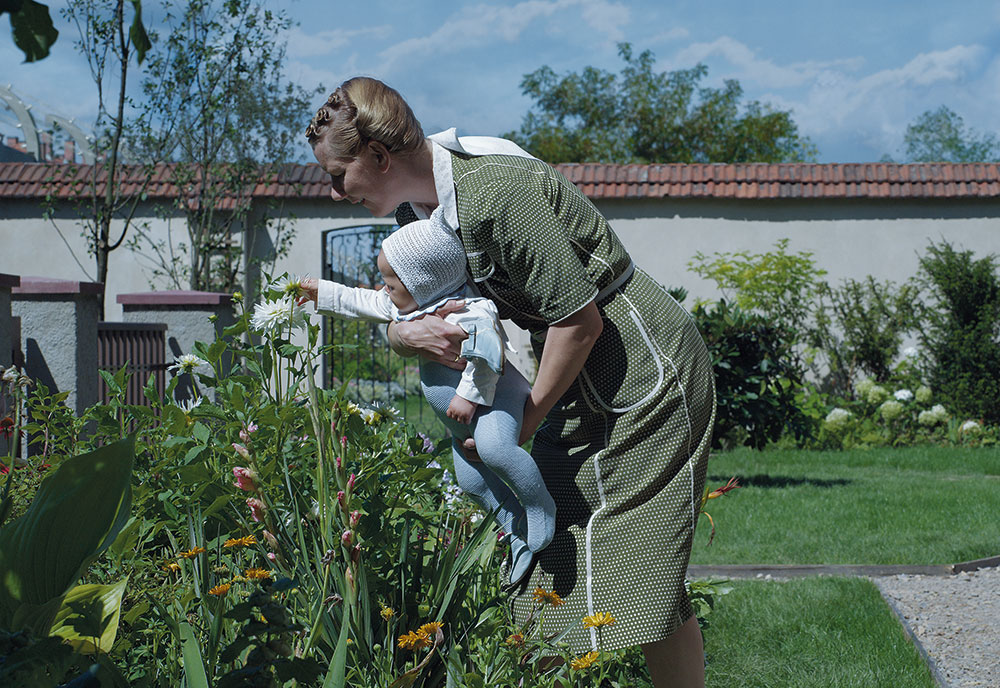
At one point Rudolf is in one room matter-of-factly discussing new, more efficient ways of killing, while Hedwig is gossiping with her friends in another. One says she found a diamond in a tube of toothpaste from the camp. ‘How clever do you have to be?’ she asks. ‘Yes, they are very clever,’ says another friend. The word ‘Jew’ is rarely said – but they all know who they’re talking about. And while we never venture into Auschwitz, we hear it. Always.
The sounds from that place, my God. There are shouts and screams and gun-shots and cracks and pops and guard dogs barking – the soundscape by Johnnie Burn is shattering. But the family tune all that out; they’ve disassociated. There’s something both specific and universal to this, in the sense that complicity can simply be a matter of looking the other way.
The film never feels false or manipulative. It was ten years in the making and included building a replica Höss house near the original one and starting the garden from scratch. Glazer also took the decision to use no artificial lighting – he thought it might ‘glamourise’ the Höss family – and no camera crew was ever present within the house. Instead, it’s hidden cameras and long takes, leading us to feel as remote from them as they are from it. They are never ‘relatable’.
Lastly I should say it isn’t true that Höss murdered three-and-a-half million Jews because as he said at Nuremberg: ‘[It was] only two-and-a-half million – one million died of disease and starvation.’ It is always good to put the record straight.
The unique hell of being a wartime bomber pilot
Some years ago I did a short series of interviews for The Spectator with war veterans about their combat experiences. Most had found them exciting, fulfilling, even enjoyable: ‘I wouldn’t have missed it for the world!’ said infantryman Mike Peyton, who likened it to doing the black ski run at Tortin in Verbier. But the one who had nothing good to say about it was RAF bomber pilot David Hearsey.
‘All those films where you see fliers gather in the mess for a sing-song round the piano: didn’t happen in my squadron,’ he told me. ‘Our base was grim, cold and windblown. Everyone was miserable and terrified and barely socialised with anyone outside their crew. What was the point? They were all going to die sooner or later. As a rough rule of thumb you’d be dead by your fifth mission.’ Still, it could have been worse, he admitted. ‘In the RAF, you flew at night, you were given your target and your bombing window, so you could plot your own route and do the job any way you wanted. But the US bomber crews had to fly in daylight in tight formation all the way there and all the way back getting shot to pieces. They had a really raw deal.’
The perspective shifts from cockpit to cockpit, white-knuckled pilots shuddering involuntarily
Indeed they did. And Masters of the Air – which is produced by Steven Spielberg and is an air-war successor to Band of Brothers and Pacific – captures the relentless grind, the jaw-clenching anxiety and the pant-wetting horror of those terrifying missions quite brilliantly. Avoiding the cliché of the usual introductory episode where you see the disparate recruits go through their training, this series instead opens in medias res with the rookie crews on their first mission over Germany in 1943. And it’s hell. The perspective shifts from cockpit to cockpit, white-knuckled pilots shuddering involuntarily at the black bursts of flak either side of them. Surely, it can only be a matter of time before…
And suddenly it has happened. You’re inside one of those metal coffins just as the shrapnel bursts through the cockpit, shredding the pilot and co-pilot and causing a ball of flame to barrel down the fuselage towards the (thus far oblivious) tail gunner. All the wings are on fire. The plane plummets through the formation, narrowly missing another aircraft still ploughing forward on its perilous course. No parachutes are seen to open. Ten men dead. You had to complete 24 more suicide missions like this before – if you were lucky – you were rotated home.
Bomber warfare – pace The Dam Busters – does not lend itself as well to the screen as infantry combat. One mission is much like another (it’s only the depth that varies), faces are obscured by masks, and intercom dialogue is barely intelligible. But the series strikes a satisfying balance between verisimilitude and involving drama.
One episode focuses on the pressure put on a single navigator, probably not much older than 20, who is suddenly plunged into the unenviable task of leading several squadrons on a mission to destroy a U-boat pen in Norway and bring them safely home. He’s played by Anthony Boyle – one of a number of Irish (see also Saltburn’s Barry Keoghan) or British (Callum Turner) actors putting on American accents for the duration.
But it’s not really one of those things you watch for the acting or – despite the odd love interest or the pub scene where (annoyingly for the British viewer) one has to watch an uppity RAF pilot being put in his place by a handier-with-his-fists Yank – the domestic drama. The scenes of rural Britain are evocatively portrayed – Land Girls steering herds of cattle through pastoral idylls, curious urchins, the colour tones like a washed-out wartime photograph – but really, it’s all just foreplay for the combat sequences.
The young men who sacrificed their lives in often futile missions have found their fitting memorial in a series which recreates, in vivid and visceral detail, exactly what they had to go through. Imagine, for example, being one of the gunners and having your protective heated suit ruptured by shrapnel. It’s -50°C up there; your urine freezes to your legs; your hands get frostbite so badly you have to go hospital on landing.
If your plane is hit and by some miracle you manage to bail out, you then face the prospect of either being machine-gunned as you descend, being immolated in the fiery furnace of the target you have just bombed, or lynched by mobs of angry, bereaved German citizens itching for vengeance.
How could any of them ever sleep? How did they not go mad with fear? How did these young men keep on going, mission after mission? The subsequent eight episodes – based on the true story of the 100th Bomb Group, known as the ‘Bloody Hundreth’ because it took so many losses – will no doubt enlighten us. It won’t make for easy viewing. But we owe it to those boys to watch unflinchingly – and to pray that our teens and twenty-somethings never have to endure its like.
Why do choreographers keep adapting films they can’t possibly improve upon?
Ballet has always suffered from a shortage of stories that can communicate without the medium of the spoken word or a lengthy synopsis in the programme. Recourse has often been made to familiar fairy tale and legend, but recently popular films and novels have also become a favoured source – Matthew Bourne, for instance, has fed off both The Red Shoes and Edward Scissorhands, while Christopher Wheeldon turned to Like Water for Chocolate and Cathy Marston to Lady Chatterley’s Lover. The question that seldom seems to be asked in such cases is a basic one: can dance bring anything to the table, and can its language enlarge the source or create a new dimension? If the answer is pretty much no, then why bother?
That, alas, is my gut response to Natalia Horecna’s raid on Fellini’s early masterpiece La Strada. What was the point? The sentimental tale of the blessedly simple-minded Gelsomina and her tragically abusive relationship with the fairground strong-man Zampano seems so much richer and deeper on the screen than it does in her cartoon version, which makes a number of cardinal errors. Two ministering angels dressed like fancy waiters are redundant; the protracted epilogue is bathetic and incoherent; despite the best efforts of the dancer Mick Zeni, Zampano’s complex of brutality, tenderness and remorse is only pallidly suggested; and a clumsily concocted hotchpotch extracted from the oeuvre of Nino Rota (composer of the music for Fellini’s film) provides no context to what we see on stage.
What keeps the enterprise afloat is the wondrous Alina Cojocaru as Gelsomina. Cynics might say that playing the innocent waif is her stock-in-trade and there are certainly moments here when her doe-eyed manner is nothing more than cutely whimsical. But Horecna’s fluent choreography gives her scope for dancing that is never less than meltingly voluptuous, as free as the air and yet thrillingly precise when it pauses or poses. Who else today can match the expressivity of her arms or her gloriously pliant back? She embodies ballet’s purest poetry.
On a less exalted plane, the performances throughout the supporting cast are admirable, and it was a special pleasure to see Cojocaru’s husband Johan Kobborg, still crisp, slender and buoyant at the venerable age of 51, as Zampano’s unicycling rival Il Matto. But the show is overall a disappointment.
One of the many admirable activities of the Place, the pioneering dance centre near King’s Cross, is its annual festival offering 22 nursery slots to young practitioners with a desire to experiment and explore. The audience never knows quite what it’s going to get and in a field weighed down by repetition of the same-old, that swift turnover is very refreshing: you may well be baffled, entranced or repelled, but you will not be bored. And if it bombs, no great harm done.
Each evening presents three sets of hopefuls. First up when I went was a trio of girls impersonating coyly giggling geishas who morph into valley-girl bitches before becoming violently predatory – a variation of the trope of lady into fox. Then came two disaffected young men in hoodies and trackies, addressing the fashionable theme of toxic masculinity and its soft underbelly.
Last and best was a solo by Vasiliki Papapostolou. Inspired by Jeremy Bentham’s panopticon, his model for a prison in which every cell was visible from a central surveillance point, she presents herself as a human machine whose every finger twitch, every smile or frown is dictated by the tick of a slowly accelerating metronome. Efforts to resist, including a brief outburst of ecstatic freedom, are swiftly quashed. Papapostolou moves though it all like a zombie dervish: the effect is both grotesque and discomfiting.
Can anyone save the Post Office?
Angry farmers offer a theme for the week – starting with the French at close quarters. Leaving the Eurotunnel at Calais en route to a wedding in the Alps, my car party encounters agricultural rage in the form of convoys of stationary trucks at all the port’s major exit points, as tractors blockade the autoroutes and police do nothing to shift them. Echoing recent protests in Germany, Poland and Romania, French farmers want better price protection, cheaper diesel, more import barriers, more aid from Brussels and less green regulation.
We’re lucky not to be sprayed with manure, as was happening elsewhere. The protests have support from the powerful CGT union on the left and Marine Le Pen on the right, the latter calling the Emmanuel Macron regime ‘the farmers’ worst enemies’.What’s most significant is that polls say farmers also have the sympathy of almost 90 per cent of French voters across the political spectrum. But in consumer economies dominated by supermarket buying power and government pursuit of free trade, there is no mechanism, or serious public will, or political incentive, to translate sympathy into higher food prices. So it’s easy to understand why these producers of vital sustenance, whatever the weather, whatever the politics, always feel they come off worse. No wonder they love to enmerder the motorists.
Canadian cousins
Trade talks between the UK and Canada have been suspended because our own farmers object to imports of hormone-treated beef and our Canadian cousins want hefty tariffs on British cheese and cars. Overall numbers are not large: £7.3 billion worth of Canadian goods vs £11.8 billion from the UK; within that total, the controversial cheese counts for less than £20 million.
But it’s obvious in principle that we should seek amicable, free-flowing trade relations with an ally such as Canada whose geopolitical interests and personal ancestries are so close to ours, as I witnessed in Toronto a couple of months ago. And yet it’s also obvious, as with the 2021 deal with Australia to which the UK’s National Farmers’ Union strenuously objected, that protectionism will raise its head every time, in every sector and direction.
Talks with India intended to win access for UK services as well as lower tariffs on goods are in their 14th round and running out of time before elections in both countries. Meanwhile, President Joe Biden has scotched any hope of a US-UK trade deal while he’s still in office. Leaving aside the thorny issue of whether we’ll ever be better off seeking our own deals outside the EU, let me table a different question. In this post-globalisation era, are not domestic food and energy security far more important national objectives than the mirage of free trade?
Post Office runners
Headhunters are searching for a chairman of the Post Office to follow Henry Staunton, who held the title for just over a year but has been shown the door by Business Secretary Kemi Badenoch. Almost anyone with an honest face, a sense of social duty and a basic grasp of governance would be an improvement on the recent run of Post Office bosses, but let me offer some names for the bookies.
Dame Sharon White, due to step down from running the John Lewis Partnership in a year’s time, must be a dead cert for this shortlist – but Dame Alison Rose, recently of NatWest, is still a little too toxic. If there’s nothing like a dame when it comes to filling such a sensitive vacancy, I’d put shorter odds on Dame Jayne-Anne Gadhia, the former Virgin Money boss who now chairs the non-executive board of HMRC.
But when gravitas is required, lords are good too – and I’d venture a fiver on Lord Bilimoria, the Cobra Beer entrepreneur turned champion of small business. Or better, the former barrister and MP who campaigned on behalf of wrongly convicted sub-postmasters long before their cause became fashionable: step forward the wise owl Lord Arbuthnot of Edrom.
Wounded tiger?
The only surprise about the liquidation ordered by a Hong Kong court of China Evergrande Group, the world’s most indebted property developer with more than $300 billion of liabilities, is that it took so long to happen. A liquidation petition was first filed by an aggrieved investor 18 months ago, the company’s bonds are all but worthless, and its billionaire founder is under criminal investigation.
What happens next depends on whether Chinese mainland courts support their Hong Kong brethren or – under orders from above – muddy the process for as long as it takes Beijing to concoct a bailout of China’s entire real estate sector, in which no one knows either how many other busted big players might follow Evergrande or how many banks have been ruined by lending to them. As to how all this affects China’s behaviour as a global economic empire-builder and regional military threat, we don’t need an ancient Chinese proverb to tell us the wounded tiger is always more dangerous.
Escape route
The French tractors moved on to surround and ‘starve’ Paris – and if you’re stuck there as supplies run out, restaurant tips from me won’t help. But if the siege engines return to Calais, my advice is to tell your satnav to find the suburban Route de Coulogne which joins a scenic single-track canal towpath towards Saint-Omer and onwards until you can rejoin a highway.
We were tempted to pull in at a rough but promisingly named canalside bar, Au Train d’Enfer (‘The Hell Train’), for banter with local trade unionists. But dinner awaited 400 miles ahead in the elegant Hotel aux Terraces at Tournus, amid prosperous Burgundian terroir. The other side of France, as it were – and well worth a long day in the car.