-
AAPL
213.43 (+0.29%)
-
BARC-LN
1205.7 (-1.46%)
-
NKE
94.05 (+0.39%)
-
CVX
152.67 (-1.00%)
-
CRM
230.27 (-2.34%)
-
INTC
30.5 (-0.87%)
-
DIS
100.16 (-0.67%)
-
DOW
55.79 (-0.82%)
Sunak’s Rwanda Bill finally passes parliament
After eight hours of debate on the Rwanda Bill, peers finally threw in the towel shortly after midnight. The two chambers have been engaged in a mammoth game of ping-pong for the past week, culminating in yesterday’s showdown on two final amendments. On the first of these – Lord Browne’s exemption for Afghan interpreters – the government made a concession shortly before 9 p.m. But on the second – Lord Anderson’s proposed monitoring committee to judge whether Rwanda – they did not. The crossbench peer eventually relented at 11:53p.m, conceding the time was nigh to ‘acknowledge the primacy’ of the elected chamber. And with that, the Rwanda Bill became law, pending Royal Assent from the King.
Among ministers and party managers, there was a sense of relief and pride last night that the much-derided legislation had finally became law. One pointed to the battles over the bill back in December and January, when Mark Francois and the so-called ‘five families’ were urging the government to ‘pull the bill’. There were still some Tory opponents last night in the Commons, with former Justice Secretary Robert Buckland last night backing both amendments and Jeremy Wright, the ex-Attorney General, also voting for Anderson’s monitoring committee. But for all the Tory in-fighting of the past 12 months, the whipping operation has remained effective on a hugely contentious piece of legislation. The Bill passed its final Commons hurdle by 320 votes to 276 – a majority 44.
So, what next? Detentions of migrants is expected to begin with the next few days, as part of Sunak’s plan to get flights off the ground by early July. Each migrant will be subjected to a four-step process of ‘notification, administration, relocation and transportation’. After being alerted that they are due for deportation, they will then be moved to new accommodation ahead of their flight abroad. But various charities like Care4Calais and others will launch legal challenges ‘as quickly as possible’ against moving people to Rwanda. Hundreds of volunteers will help identify people who are set to be removed to offer them legal support to try and keep them in the UK.
Among Tory MPs, opinions vary as to the likely success of Sunak’s legislation. ‘This is his “Emperor has no clothes” moment’, said one rightwing critic last night, noting the warnings of Suella Braverman and Robert Jenrick. Another who thought of intervening in last night’s debate chose not to on the grounds that ‘Everything that needs to be said, has been said already.’ After months of debate, there is a sense that now is the time for the government to prove its plan works. No-one knows that more than the Prime Minister, who popped in to see his MPs at drinks hosted by the Chief Whip. With difficult local elections due in nine days’ time, every effort will be made to keep the party as unified outside the Commons as it was last night inside it. The hope will be that MPs and voters will now have a sense that there is a plan in motion – even if there is still some way to go.
Catch up on the latest Coffee House Shots with Kate Andrews, James Heale and Katy Balls:
Could Europe send troops to Ukraine?
It is 2026, and in a downbeat speech at the Kremlin, Vladimir Putin finally announces a withdrawal from Ukraine. Russian troops have done their best – or worst – but a fresh influx of well-trained Ukrainians have finally prevailed. The Donbas is now in Kyiv’s grip, Crimea’s fall only days away.
What has turned the tide, though, is not just the long-awaited F16s, or Washington switching the funding back on. Instead, it is the presence of thousands of European troops across Ukraine’s western half, protecting cities, ports and borders, making Ukraine feel reassured and Russia unnerved. As Kyiv celebrates, Europe quietly pats itself on the back too: after 80 years clutching America’s coat-tails, it finally stepped up to win a war in its own backyard.
The big question is this: what would happen when bodybags started coming home?
As future wargaming strategies go, this one may not be uppermost in Rishi Sunak’s mind when he flies to Poland today to discuss Ukraine with Donald Tusk. For a start, it rather downplays the small issue that putting western troops east of Poland’s border might spark world war three. Yet should Mr Sunak happen to browse the policy journal Foreign Affairs while on the plane to Warsaw, he would learn that in the world of thinktanks, at least, the unthinkable is finally being thought.
In an article published in the journal yesterday, ‘Europe – but Not NATO – Should Send Troops to Ukraine’, three influential military academics argue that there is now ‘a growing bloc of countries open to direct European intervention in the war’. The nations in question have not exactly put it like that so far. France’s President Macron, who first broached the question of intervention back in February, has merely said it can’t be ‘ruled out’, while Poland’s foreign minister, Radek Sikorski, believes it is ‘not unthinkable’.
Intervention, the authors insist, is not as apocalyptic as it sounds. For a start, Article 5 wouldn’t be triggered because the countries would be acting in Europe’s name, not Nato’s. And rather than heading straight to Bakhmut to scrap full-on with the Russians, the Euro-force would stay hundreds of miles back – most likely west of the River Dnipro, the waterway that that divides Ukraine in two.
By doing so, they’d signal that they had no intention of starting a fight – only to defend cities like Kyiv should Russia try capturing them again. Their presence would, though, free up large numbers of Ukrainian troops to join the fray further east. Meanwhile, the Euro-force would massively boost rear-echelon support, be it training Ukrainian troops, repairing broken armour, or manning air-defence batteries against incoming Russian missiles.
So what could possibly go wrong? Not much, according to the authors, who say ‘the risk that deploying European soldiers will escalate the conflict is overblown’. Indeed, their proposal gets enthusiastic backing from Glen Grant, a former UK defence attaché to the Baltics, and one-time adviser to Ukraine’s defence ministry.
‘It’s a very good idea, and the western nations would learn valuable lessons from it too, even it was just helping with logistics and maintenance,’ he told me. ‘If Ukraine starts to lose the war, we’re going to have to do this anyway, so we’re only bringing it forward.’
It is not, however, quite as straightforward as it seems. Simon Woodiwiss, a former British Army infantry officer who fought with Ukraine’s International Legion and who now runs ObjectiveUkraine, a Kyiv-based security consultancy, is also broadly supportive. But he’s not so sure that European boots in western Ukraine would free up vast numbers of young, fit Ukrainians to fight further east. ‘The average of the guys at the front is 43 already, and they’re the ones who want to fight – those currently further back are more likely to be the less enthusiastic ones,’ he points out.
Other questions include whether Nato really has much to teach Ukrainian troops, given how much drones have changed the battlefield, and how little Nato tactics seemed to help in the summer’s counteroffensive. How easily, too, could Nato take over backroom tasks like logistics and procurement? According to Woodiwiss, Ukrainian military supply systems operate to their own uniquely chaotic rhythms, which would leave the average European military quartermaster in tears.
The big question is this: what would happen when bodybags started coming home? Troops stationed in significant numbers would be an obvious target for Russian missiles, and with no Article 5 to protect them, the Kremlin would surely be tempted to attack. Mr Grant says that any contributing European government would have to accept possible loss of life. He believes, though, that the benefits outweigh the risks, and that shedding blood would show Europe’s commitment in a way that giving weapons or money never can.
Politically, blood is much more expensive than treasure. For many European nations, anything beyond a few dozen fatalities would be unchartered political territory in modern times. In the West’s Afghanistan campaign, for example, America, Britain and Canada bore the brunt of the 3,500 casualties, while most European participant nations lost 50 or less.
Were deaths in Ukraine to start mounting in the hundreds, let alone the thousands, the clamour to pull troops out Ukraine would quickly grow. All it would take would be for one nation to buckle, and Mr Putin could say – with some justification – that when the going got tough, Europe wasn’t that resolute after all.
Why are the English embarrassed about St George’s Day?
How should the English celebrate St George’s Day? England is a country with plenty to boast about, but doing so is somehow not particularly English. The result is that 23 April is usually a day that passes most of us by. It’s a pity.
The centuries-old flag of St George was for too long the preserve of the far right
Embarrassed, we often seek expressions of Englishness in the sheepish and the mimsy. Egg and chips, rain coming on, mustn’t grumble, you’ve got to laugh, fancy a cuppa, watching the footy, how we love queueing. Thirty years ago, John Major was mocked for speaking of ‘the country of long shadows on cricket grounds, warm beer, invincible green suburbs, dog lovers and pools fillers’. His invocation of George Orwell’s ‘Old maids bicycling to holy communion through the morning mist’ was thought more outdated still. So now we parody ourselves rather than be beaten to the punch.
That, in itself, is very English, redolent of the country of the reflexive ‘sorry’. But we can do better than that on this St George’s Day.
Look at the great cathedrals dotting the English countryside, from solid Romanesque Durham to the soaring vaulted nave of Westminster Abbey. Listen to English poetry, from Geoffrey Chaucer to Simon Armitage. Listen to the cadences of the King James Bible. Above all, take in William Shakespeare, drown in him. If a nation left his body of work and no other trace, it would be counted among the greatest.
Take the common law and jury trials, standing before our peers knowing that the king’s justice is being exercised as it has so long been, imperfectly but again and again. Magna Carta was not a pristine expression of equality, but think about what it said, 800 years ago. It is extraordinary:
‘No free-man shall be taken, or imprisoned, or dispossessed, of his free tenement, or liberties, or free customs, or be outlawed, or exiled, or in any way destroyed; nor will we condemn him, nor will we commit him to prison, excepting by the legal judgement of his peers, or by the laws of the land. To none will we sell, to none will we deny, to none will we delay right or justice.’
Look at English humour, from the scatalogical ribaldry of James Gillray to the dainty verbal gymnastics of Stephen Fry and Hugh Laurie.
‘The English, the English, the English are best: I wouldn’t give tuppence for all of the rest!’ Flanders and Swann were satirists and they knew that the English hug self-satire closer than anything. But we needn’t be ‘best’ still to reflect on the good things about us. I say this as a man born and raised in England, but from countless generations of Scots and educated partly in Scotland. If I’m forced to choose, I will always say Scottish, but part of me remains an Englishman.
In 1965, the historian A.J.P. Taylor wrote that ‘a generation ago, ‘England’ was still an all-embracing word. It meant indiscriminately England and Wales; Great Britain; the United Kingdom; and even the British Empire.’ We are, rightly, more particular now, speaking of the United Kingdom, of Scotland, Wales and Northern Ireland (even ‘Ulster’ is no longer a simple descriptor), but along the way England has stood back, uncertain of her role and place. The centuries-old flag of St George was, for too long, the preserve of the bone-headed far right, and it was only in the 1990s that it began to crawl back to respectability. A taint still lingers for some.
Yet it should be perfectly possible to acknowledge historical wrongs and to respect our neighbours, allies and former foes and their identities, without utterly suppressing our own. To do so is mad. To say there is no such thing as ‘the English character’ or ‘English values’ is as good as saying there is no England at all. These values, characteristics and virtues need not be unique, nor always and everywhere exhibited, but they can still be real. Every nation has them, because they form the basis of a common narrative, a shared sense of self, the foundation of the nation itself.
We are at our most English when we squirm at affirming our identity in a way that hardly any other nation in the world would understand. In the words of the greatest Englishman of all, Sir Winston Churchill, let us go forward together.
Shylock and the Nazis: the truth about Shakespeare’s most infamous character
None of William Shakespeare’s characters are more controversial than Shylock. The moneylender from The Merchant of Venice may be the most famous Jew in Western culture other than Jesus. But what kind of Jew is he? Is he a collage of stereotypes who has been useful to antisemites, including the Nazis? Or does he represent the Jew as cruelly vilified, a tragic victim of persecution?
Shakespeare, who was born 460 years ago today, could never have envisaged the way in which the events of the 20th century would change the way we look at Shylock. Yet it’s impossible now to watch The Merchant of Venice without thinking of the Holocaust. To write poetry after Auschwitz is barbaric, Theodor Adorno wrote. Auschwitz has also changed the way in which we think about Shylock.
The Nazis saw Shylock as a useful tool of propaganda
There’s no doubt that the Nazis saw Shylock as a useful tool of propaganda. In 1933, there were more than a dozen productions of the play; another 30 followed over the next five or so years. In 1938, shortly after Kristallnacht, the play was aired over German radio. In 1943, when the Nazis declared Vienna ‘Judenrein’ (free of Jews), the renowned Burgtheater celebrated with a performance of The Merchant of Venice. Shylock was played by Werner Krauss, who had also performed in the notorious Nazi propaganda film Jud Süss (1940). A Viennese newspaper critic described Krauss’s appearance as such:
‘With a crash and a weird train of shadows, something revoltingly alien and startlingly repulsive crawled across the stage. . . . The pale pink face, surrounded by bright red hair and beard, with its unsteady, cunning little eyes; the greasy caftan with the yellow prayer shawl slung round; the splay-footed, shuffling walk; the foot stamping with rage; the claw-like gestures with the hands; the voice, now bawling, now muttering—all add up to a pathological image of the East European Jewish type, expressing all its inner and outer uncleanliness, emphasising danger through humour.‘
The theatre critic Siegfried Melchinger saw the play and made the connection clear: ‘Behind the Jew we can see the wicked man of the fairy tale, the unearthly man-eater, the bogey man, who, just like the witch, will finally have to be shoved into the oven.’
But such foul depictions did not start in Germany in the years during Hitler’s rise to power. Even in the early performances of Shakespeare’s The Merchant of Venice, Richard Burbage portrayed Shylock as grotesque, wearing a red wig to associate him with the devil. The emphasis on his Jewishness as the reason for his financial exploitation arose during the debate in England over the Jewish Naturalisation Bill of 1753, at a time when the actor Charles Macklin deliberately chose to dress in Jewish costumes in his performances of the character in Drury Lane. Humanising Shylock only began with two great Shakespearean actors of the 19th century, Edmund Kean, who brought dignity to Shylock, and Henry Irving, whose tragic Shylock was an austere, dignified patriarch of the chosen people, seeking vengeance only because he had been abused.

Actors may have started to humanise Shylock, but it was Christian theology that Shakespeare used to shape the plot of the play. A villainous Shylock more concerned about his money than humanity drew from Judas’s betrayal of Jesus for silver. In the play, the character of Portia, proclaiming the virtues of Christian mercy against Jewish pedantry, ultimately used a legalistic argument (‘shed thou no blood’) to defeat Shylock, deprive him of the ‘pound of flesh’ he demanded and and punish him without mercy. Through this, Shakespeare was using, but also challenging, Christian stereotypes.
Gotthold Lessing, a leading intellectual of the German Enlightenment known for his philosemitism, wrote the play Nathan the Wise in 1779 as a retort to the antisemitic image of Shylock. Modelled on Lessing’s good friend, the Jewish philosopher Moses Mendelssohn from Berlin, Nathan combines compassion, forgiveness, and generosity with nobility and a powerful intellect. He is not shrewd, like Shylock, but wise. Yet at the end, neither Shylock nor Nathan is left with children who remain Jewish; bad or good, the Jew has no future.
Despite its reputation as antisemitic, the Victorian novelist Maria Edgworth used The Merchant of Venice in her work to overcome negative stereotypes of Jews. In her popular 1817 novel, Harrington, the protagonist attends a London production of The Merchant of Venice where he sees a beautiful woman in a neighbouring box shedding tears as she watches tragedy befall Shylock. His dislike of Jews, instilled in him from childhood, is transformed and he falls in love with the woman, a ‘Jewess’.
In Yiddish productions, Shylock’s fate was tragic, sometimes mitigated by having Jessica return to her father. After the Holocaust, the ‘pound of flesh’ took on new meaning. The great Yiddish actor Maurice Schwartz changed the courtroom scene: Shylock was awarded his bond and raised his knife to carve a pound of flesh from Antonio – then paused, silent, and dropped the knife, calling out, ‘Ikh ken nit, ikh bin a yid.’ Jews don’t kill. The Jewish audience of Holocaust survivors wept.
A sympathetic Shylock was also depicted in productions in apartheid South Africa that identified Black Africans with Shylock’s fate. Blacks were persecuted and vilified, their land and culture stolen from them, just as Shylock was dehumanised and left destitute.
A very different reading of the character arose in China, where The Merchant of Venice remains popular and available in several translations. Under Mao and the cultural revolution, the play presented Shylock as a feudal usurer and Antonio as a despicable rising capitalist. More recently, as economic policies shifted, Chinese productions have shown sympathy for the racial and religious oppression Shylock suffered and approval for his capitalist efforts.
The Jewish audience of Holocaust survivors wept
Arab rage over Zionism most dramatically politicised the play. An Arabic translation was first performed in Cairo in 1922, focusing on the monetary rather than religious elements and omitting Shylock’s forced conversion to Christianity. Instead, his usury was equated with Zionism: the demand for a pound of flesh symbolised the Zionist appropriation of Palestine, leaving Arabs to identify with Antonio as victims of the Jews. A 1945 Arabic revision of the play, The New Shylock, portrayed him as a bloodthirsty member of a network of Jews purchasing Arab land as their pound of flesh. The trial scene was a debate over the Balfour Declaration, with Shylock demanding a pound of flesh from Britain.
The Merchant of Venice was the first play staged in Hebrew at Tel Aviv’s Habimah Theatre in 1936, during the early weeks of the Great Arab Revolt. To derogatory cries of ‘Hep-Hep’ Shylock appeared wearing a yellow badge. He was portrayed as a heroic symbol for Jewish perseverance despite persecution, and his victimisation as a rationale for Zionism.
For the Israeli Left, though, Shylock could also represent defeated Arabs. In a famous scene in the 1986 Israeli film Avanti Popolo, set during the 1967 war, Israeli soldiers in the Sinai desert come across two stranded Egyptian soldiers, begging for water. One of the Egyptian soldiers, an actor in civilian life, falls on his knees and recites Shylock’s famous speech, ‘I am a Jew! Hath not a Jew eyes?’ to which the Israeli soldier responds, ‘He’s got his roles confused.’ Both Egyptian and Israeli soldiers, the film argues, are stranded and are at the mercy of politicians.
How does a play inspire both antisemitism and its repudiation? Is Shylock cruel because he is a Jew or do Christian mockery and scorn incite him? Alexander Granach, a great German-Jewish Shakespearean actor of the 1920s and 30s, embraced Shylock as the essence of ‘spiritual strength and great loneliness’. Karin Coonrod’s 2016 production held in the Venice ghetto had six actors portraying a multifaceted Shylock.
The play has been read both as an indictment of Jews and as a critique of Christian society’s cruelty toward them. Shakespeare’s brilliance is his demand that we refuse binary categories and resist reductions of the play to a narrative of oppressor and victim. Although Shylock’s great speech (‘Hath not a Jew eyes’) concerns Jewish bodies, the play focuses on his inner life: his response to being spat, spurned, and cursed by Christian society, and demands our attention to its moral cost to that society. The enigma of Shylock – as stereotype or victim – will continue to endure, hundreds of years after its author died.
I was the NME’s squarest journalist
Before I went to medical school I had a hip alternative life. In the 1980s, as a 17 year-old schoolgirl, I wrote for the New Musical Express. My friends assume I had a great time with sex, drugs and rock ‘n’ roll, but the truth is I was such a cautious Carla that I didn’t touch the former two at all, and I scurried off home to be in bed immediately after each gig I reviewed.
Each time they gave me a rolled up bank note and left me to snort in private, I blew
Part of the reason was because I had strict parents. My dad was a benevolent patriarch who was older than many dads and had spent his youth as a cultured Persian immigrant in London, going to classical concerts and philosophy lectures. He looked on first bewilderment and then with fury as my older sister, then me, then my younger brother, trooped off to new wave gigs and played The Clash loudly in our bedrooms. I remember him gazing mournfully at a poster of The Stranglers on my brother’s bedroom wall and saying balefully ‘so now you like to strangle people.’
My mother was more broadminded about pop music but unfortunately she had never taken to me. It was an open secret that she hated me and various family members remarked on it in a matter of fact way. My maternal grandfather, visiting from Iran, once took me aside and told me, apropos of nothing, that when my mother was pregnant with me, she had wanted a boy and was very disappointed when she had a second daughter. And my brother once wrote to me from a holiday he was on with our father revealing that our dad had told him ‘your mother hates Leyla’. It wasn’t a drama for me as a kid, it was just a fact of life, but it did mean I kept everything a secret from her. I was afraid and obedient in front of her, acceding to her demands and cowering when she threw household objects at me. As a small kid I remember clutching my dad’s knees as my mother battered his head with a pan. But dysfunctional families make writers.
School was a release but I was a mischievous bunny when young, sellotaping notes to teachers’ backs and suggesting my classmates all hum the same note during a boring history lesson. I was a silent wraith at home, escaping to my bedroom where I could read. And although being naughty and talkative at school was fun, I was terrified of big girls’ games. No sex for me until I was 21, when I felt I had to lose the darned V and did so with a besotted music journalist (you were sweet, Mark). But during the era of going to gigs, reviewing records, and interviewing pop stars as a 17-to-19 year-old, I was as chaste as a nun. A couple of blokes from the NME pursued me sexually, but despite having a huge crush on the first (hi, Paul) and snogging the second in his grubby council flat (cheers, Ian), I was terrified of the idea of sex.
Ditto drugs. When I was sent to Glastonbury with two fellow NME journalists and a photographer, they were generous enough to offer me goes at the speed that kept them awake for 48 hours on the trot. Studying for chemistry A level together with other sciences and maths, I was much too aware of potential deleterious effects, so each time they gave me a rolled up bank note and left me to snort in private, I blew. What a waste. Partly I was put off because my sister had avidly consumed everything from dope through acid and heroin, and was living in a squat on her own by the time she was 20. My parents paid for her to live in a decent flat but it didn’t stop her frying her brain and ultimately jumping in front of a tube train aged 22. I still can’t use Hampstead tube station.
But this was later. During the time I was writing for NME, my sister was still at home. We shared our music taste, and after blowing all her money on drugs, she would take my records and I would later find the cat curled asleep on the vinyl, the sleeves long discarded, with fag ash in the middle.
I was so shy that I couldn’t even have a conversation. When the first NME journalist to pursue me took me on a date, I was so afraid of my mother’s vase-throwing wrath that when he asked me if I wanted to go for a drink after Superman 2, I told him I had to go home. I should have taken the opportunity to have my first snog. Later, when Pursuer 2 invited me to see Grace Jones play in Camden (what an amazing show), and, weeks later, meet him in his Camberwell pit, I was incredulous at how good it felt to be touched, even though I restricted it to upper body. I could sense his frustration bulging through his trousers.
I was so shy that I was a crap interviewer. My first interview was with Aztec Camera, but I couldn’t understand their Scottish accents, and ended up smiling weakly and saying ‘yeah’ to everything they said. The interview was never published. Days later, I bumped into one of them on the tube – I think it was Malcolm Ross, who also played with Joseph K. I vaguely recognised him as someone from the music world, and decided in my haste that he must be a fellow NME hack. He smiled and said hello, asking me how I was. I still couldn’t understand what he was saying, and grinned inanely and said yes, I was going to the office too. At the next station, I realised I was going in the wrong direction, and said ‘whoops’, and leapt off in a fluster. Very cool, Leyla.
I was probably the most square music journalist there has ever been. Funnily enough, decades later, I have gained the confidence and bravado to talk and listen to anyone. I would be a great interviewer now. But music journalism is for the young. I loved my taste of it.
The young are missing out on a proper breakfast
More proof, if it were needed, of the gastronomic generation gap. It seems one in ten young persons has never had a full English/Irish/whatever cooked breakfast and one in five only has it once a year. They are, of course, missing out on one of the pleasures of life. The cooked breakfast and afternoon tea are, with pudding, the great contribution of these islands to food.
As to what constitutes a good breakfast, I refer you to what I consider the perfect cookery book: The Cookery Year, published by the Reader’s Digest in the 1970s. There, Theodora Fitzgibbon, a wonderful Irish food writer, briskly summarises it thus:
Porridge or cornflakes may be followed by fried bacon and eggs, with sausage, tomatoes and mushrooms. Kippers are universal favourites, so are herrings in oatmeal, kedgeree and smoked haddock poached in milk and butter. Grilled kidneys or cod roe with Irish potato cakes are also delicious. Boiled, poached or scrambled eggs are popular, and no breakfast table is complete without toast, butter and marmalade.
There, folks, is a high point in culinary civilisation. I’d particularly draw attention here to the now neglected aspects of the feast. Kedgeree is a cinch to make – flaked smoked haddock, onion, rice and cream, with quartered eggs on top (sounds horrid; tastes wonderful) – and is yum for lunch as well as breakfast. Potato cakes are easy-peasy too: hot mashed potato mixed with flour and butter and a bit of milk and fried, ideally, in bacon fat. Kidneys are dead cheap and good devilled, i.e. spiced up. That’s the thing about breakfast; it fills you up relatively economically.
And what constitutes the full English? I had a full Welsh the other day in a nice country house hotel, and on the plus side, it had the option of a slab of black pudding (in Ireland there’d be white also). There was good streaky bacon (nicer than back) and handsome sausages. But there were two discordant elements that you get everywhere now: hash browns and a little dish of baked beans. Let’s stand firm here: these have no place in a breakfast. Hash browns are unnecessary (and anyway no substitute for potato cakes) and beans though fine by themselves on toast just get in the way of the good stuff.
But the element of the breakfast that I should most like to reform is the tomato. More often than not they’re grilled and half cooked on top, raw below. The best way to cook tomatoes for breakfast is to fry them, ideally in a little dripping, and crucially, to cover the pan with a lid while they’re cooking until soft and the skin comes off easily. That way they give off their delicious juices (which mingle sublimely with egg) and you scoop them up with the bacon or sausage. The best bit is mopping up the juices with good bread.
Sydney Smith rounded off his ode to the perfect salad with the words: ‘Serenely full, the epicure would say: “Fate cannot harm me; I have dined today”.’ Well, you can say as much with a good breakfast.
What happened to the London bus?
To understand Sadiq Khan’s tenure as Mayor of London, you need only ride one of his buses. Eight years of repeating that he is the ‘proud son of a bus driver’ have not yielded a single improvement to the experience of travelling by the famous red bus. In fact, many things are worse.
she suggested I couldn’t have lived in London for very long and then burst into tears
Tap your card and find your way to one of few seats unsullied by chicken bones, unfinished soft drinks and disposed of vapes. Sit down and endure the tinny sounds your fellow passengers deem acceptable to broadcast from their handheld portals to hell. Request that they use headphones and risk being stabbed. Even if you can avoid all this, you can’t escape being infantilised by the recorded announcements.
‘No standing on the upper deck or stairs please’. ‘Please hold onto the handrails when the bus is moving,’ in case you believe you are surfing. For feckless mothers: ‘Please stay with your buggy for your child’s safety’. For those who can resolve contradictions: ‘Please look up and offer your seat to anyone who needs it more than you. Remember, not all disabilities are visible.’ And the one that makes you want to commit a hate crime: ‘The driver has been told to wait at this bus stop for a short time to help even out the service’.
I once questioned a driver if it was reasonable for passengers to be made late for work to remedy the buses running in twos. In response, she suggested I couldn’t have lived in London for very long and then burst into tears, presumably because she thought she may have committed a hate crime.
The drivers seem to have got worse. In part this is because every member of the public is treated as a potential assailant and so he (though quite often she) now resides in a plastic cage. But greet him when you embark and he will tend not to look at you. Ask him for basic information about the route or local area and he cannot tell you. Ask him to leave his cage to deal with feral children and he will play coward – I long to witness one of them popping a stink bomb through the air holes. Some wear their own uniform to work – the tracksuit. Most drive off from running passengers and leave grannies eating dust. The only residual function of the bus driver is to drive the bus. Even this he does as if fleeing the scene of a crime.
It is a curious fact that the Mayor has never run a campaign for Londoners to sign up as bus drivers, given he regards being the son of a one as notable and is so fond of advertising. Train in four-to-six weeks, earn more than the London Living Wage, provide a necessary service. Surely a better deal than going to an inner city college and coming out with some bogus qualifications. Why hasn’t the Mayor commissioned a fabulously paid City Hall tsar to produce some hackneyed copy for a bus driver recruitment ad? ‘Your community needs you to drive’, Kitchener style.
Board a bus outside of London, however, and you will find another country. Miraculously, drivers in the shires live in the area. In the great cities they will be Glaswegian, Mancunian, or Geordie. They wear their uniform with pride and are open to a friendly natter. They are not sealed off behind plastic screens, except, understandably, in Glasgow. Even in American cities, where boarding a bus is like being sucked into a Hieronymus Bosch painting, they are yet to fully enclose the driver. Indeed on a recent trip to Boston, I took the bus to Harvard and back. Both drivers were stern but polite. Both explained the route and insisted I rode for free. Perhaps we get the buses we deserve.
Commons sends Rwanda Bill back to the Lords
The Commons has just voted on the latest ping of the Safety of Rwanda Bill pong, after peers sent back just one amendment, which would prevent Rwanda from being declared a safe country for asylum seekers without the Secretary of State making a statement to parliament having considered the verdict of an independent monitoring committee. MPs rejected that amendment 312-237. So back up it goes to the Lords.
Lord Browne withdrew his amendment to exempt from deportation those who had helped the British armed forces because the government conceded on this point (though the minister in the Lords insisted it wasn’t a concession because that’s how politics and pre-school works). It is also not a major concession because the government is already reviewing eligibility and only covers Afghans with links to certain units.
So we are now down to just one – still very major – point of difference. Peers backed this amendment 240 to 211, and so it is back. Illegal Immigration Minister Michael Tomlinson has dismissed the amendment as ‘nothing new’, deploying his usual refrain of ‘enough is enough’. But in a sign that the standoff is beginning to lose steam, the last Tory rebel standing, Robert Buckland, told the Commons that ‘there comes a time when the unelected house does have to cede to the authority of the elected house’.
On the ground at the People’s University for Palestine (formerly Columbia)
New York
I’m on Columbia’s campus today. Sorry, I mean, “The People’s University for Palestine.”
I graduated from the university in May 2020. My alumni ID allows me access. A couple of days ago, student protesters started occupying the South Lawn, in front of Butler Library. The police force was called in. Some arrests were made. The police were able to clear the eastern half of the lawn, but the western half remains occupied. Students have pitched tents. Hand-painted signs hang from clotheslines that stretch around the lawn.
“Welcome to the People’s University for Palestine.” “Free All Palestinian Prisoners. Ceasefire Now.” “While You Read Gaza Bleeds.” “Admitted Students Enroll in Revolution.”
Palestine flags and keffiyehs are everywhere. And trans flags, of course.
“Japan for Palestine.” “Hindus for Intifada.” “Israel Is a Terrorist State.”
I walk the perimeter of the encampment, filming it on my iPhone. So many of the “occupiers” are women, I notice. In the northwest corner, ten or so are spread out on the grass, painting signs and posters. One paints a large tree. It’s a beautiful spring day — bright and sunny and in the mid-sixties.
How desperate these students are to reenact the 1968 protests, I think to myself. To be a part of something. To feel righteous. I was once one of them.
Many of the students are masked. “Admitted students enroll in revolution,” the sign said. And yet they don’t want to show their faces. I’m sure some are afraid of being doxxed — of having their identifying information published online. But why? So that they aren’t “canceled?” So that they can still secure a job at Goldman Sachs after they graduate from the People’s University for Palestine?
I didn’t think revolutionaries were afraid to show their faces.
Continuing around the perimeter, a young, masked woman just inside the encampment asks me to stop filming. I politely decline her request.
Now I’m in the Blue Java Café in Butler Library.
Earlier, I had stopped to chat with four students who lingered outside the encampment. I was no longer filming. I wanted to see how they felt about what was going on. They were clearly with the “resistance”: they were white, blond and accessorized with the appropriate regalia — bracelets and beanies and scarves.
They insisted everything be off the record. One student in particular seemed pretty paranoid. Her parents were probably investing a lot of money in her education. If she jeopardized her future job prospects, there would be hell to pay. I assured them that I wouldn’t identify them.
Last night, in bed, I watched a video that Sahar Tartak, the editor in chief of the Yale Free Press, had posted on X: it was nighttime in front of Butler. The occupiers had spotted “Zionists” in the camp. They linked arms and were slowly advanced in order to push the Jewish counter-protesters off of the lawn. A black student led the call-and-response. He was masked, but, judging by his voice, I would be surprised if he didn’t identify as transgender. The throngs of students — mostly women, it appears — repeated his words.
“WE ARE GOING TO SLOWLY…” WE ARE GOING TO SLOWLY…
“WALK AND TAKE A STEP FORWARD!” WALK AND TAKE A STEP FORWARD!
“SO THAT WE CAN…” SO THAT WE CAN…
“START TO PUSH THEM…” START TO PUSH THEM…
“OUT OF THE CAMP!” OUT OF THE CAMP!
“ONE STEP FORWARD!” ONE STEP FORWARD!
“ANOTHER STEP FORWARD!” ANOTHER STEP FORWARD!
“WE ASK…” WE ASK…
“THAT YOU PLEASE RESPECT…” THAT YOU PLEASE RESPECT…
“OUR PRIVACY…” OUR PRIVACY…
“AND OUR COMMUNITY GUIDELINES…” AND OUR COMMUNITY GUIDELINES…
“WHICH YOU HAVE SO FAR DISRESPECTED…” WHICH YOU HAVE SO FAR DISRESPECTED…
“AND LEAVE OUR CAMP!” AND LEAVE OUR CAMP!
“ONE STEP FORWARD…” ONE STEP FORWARD…
The leader is now centered in the frame of the video. He looks at the camera.
“Have you got enough video? ’Cause I look very pretty,” he says.
The women around him laugh. Some snap their fingers.
“You guys don’t have to do this, you know?” says a counter-protester, perhaps the one who is filming. “You’re all here because we’re here. Why are you…”
“We were here before you came here,” snaps the leader. He cackles, then continues his call-and-response as the counter-protester tries to speak.
“REPEAT AFTER ME!” REPEAT AFTER ME!
“I’M BORED!” I’M BORED!
“WE WOULD LIKE YOU TO LEAVE!” WE WOULD LIKE YOU TO LEAVE!
“REPEAT AFTER ME!” REPEAT AFTER ME!
“I’M BORED!” I’M BORED!
A young man in a keffiyeh steps in front of the camera to block the leader from being recorded. A young woman standing next to him politely tells the counter-protester, “We’re just actually trying to have a community meeting in a sec.” The young man adds, “We’re asking you nicely if you will please leave.”
“Why can’t we be on the lawn?” says a female counter-protester.
“Because you’re not respecting the safety…”
“You know I pay to go here?” she says. “And I pay for this lawn to be manicured, I pay for the lights to be on, and if you’re a student, you’re also paying for that.”
The video ends.
I returned outside to take some more photos. From atop the Sundial, a man speaks into a loudspeaker. A large crowd has gathered. He talks about the referendums for the university to divest from Israel. Columbia students voted to divest, he said. The crowd cheered. But, he added, Students for Justice in Palestine was silenced, and the university ignored the referendum. “Shame!” screamed the crowd.
“And now students at the encampment are suspended!” he added.
“SHAME!”
In 1968, the university placed on probation six anti-war student protesters inside Low Library. This outraged the student body and helped activate the larger revolt that soon followed.
“Divestment has been debated,” the man with the loudspeaker continued. “The discourse has happened at the university. And the student body at Barnard and Columbia College have decided to divest!” The crowd cheered. “Divestment is not a question anymore. It’s overdue,” he said.
“There are some things we should just not debate,” he said. “Just like we refused to debate the validity of white supremacy, we refuse to debate the humanity of Palestinians.”
“Gaza Solidarity Encampment: Community Guidelines,” written on a tall posterboard at the entrance to the encampment. I am told I must ask the students for permission to take a picture. I ask the young women holding up the poster for permission. They grant it.
- We all commit to remain grounded in why we enter this space — as an act of solidarity with the Palestinian People
- No desecration of the land, no littering
- We recognize our role as visitors, and for many of us, colonizers, on this land. We camp on colonized Lennapehoking [sic] land and recognize Columbia’s complicity in the displacement of the Black and Brown Harlem Community
- No drug/alcohol consumption inside the camp. We want to ensure people feel comfortable in this space — Please keep substance use outside the camp!
- Respect personal boundaries — tight quarters are not an excuse to cross physical boundaries without affirmative consent
- We commit to never photograph or videotape another community member without their affirmative consent.
- We commit to never share the names of details of anyone we meet in this camp. We keep us safe, which includes refusing to comply with any demands if the NYPD or Columbia admin try to force us to disclose the identities of any fellow campers
- We commit to assuming best intentions, granting ourselves and others grace when mistakes are made, and approaching conflict with the goal of addressing and repairing
- Please think of community members when making decisions about autonomous actions. Not everyone has consented to the same level of risk, but everyone will be impacted by decisions community members make
- Do not engage with the counter-protestors
“Please contact a CUAD [Columbia University Apartheid Divest, a coalition of student groups, including SJP] organizer to suggest guidelines or changes to the list above. Free Palestine!”
I stopped to talk to a woman who stood alone on campus walk. She was white and appeared to be in her late forties. She had an accent I couldn’t place. She told me that she was a human rights graduate professor. She didn’t give me her name. I told her I was an alum and that this my first visit to campus since the encampment began. I told her that it was unsettling.
“Does it look peaceful to you?” she asked me.
We both looked out ever the encampment.
“Yes, for the most part,” I said.
“What part doesn’t look peaceful?”
I looked again. “No, it all looks pretty peaceful right now,” I said.
“See how peacefully students can protest when the police aren’t involved?”
Later, I learn that Israeli professor Shai Davidai, who hoped to lead a peaceful counterprotest, was denied entry to the campus by Columbia’s COO, Cas Holloway. Davidai reported on X that his Columbia ID has been deactivated.
Yesterday, Jewish students received an email from a Columbia rabbi. He recommended they stay home from campus because he feared it was now unsafe for Jews.
“Yes,” I might have told the human rights professor. “Pro-Hamas students can protest peacefully — when Jews stay off of campus.”
At the entrance to the encampment, I see Jack (Judith) Halberstam. Halberstam is a professor in the Department of English and Comparative Literature and the Institute for Research on Women, Gender and Sexuality. In her 2011 book, The Queer Art of Failure, now considered to be a part of the queer theoretical canon, Halberstam promotes failure for queer people — that is, unemployment, slacking off, ignorance, stupidity and even self-cutting. Halberstam wrote, “Failure allows us to escape the punishing norms that discipline behavior and manage human development with the goal of delivering us from unruly childhoods to orderly and predictable adulthoods.” The “disappointment, disillusionment, and despair” that are sure to result from failure might suck, wrote Halberstam, but at least we can “use these negative affects to poke holes in the toxic positivity of contemporary life.”
Halberstam wrote that success should be left “to the Republicans, to the corporate managers of the world, to the winners of reality TV shows, to married couples, to SUV drivers.” Easy for Halberstam, a published author and a well-paid (I imagine) professor at an Ivy League university, to say. Something tells me the kids who take Halberstam’s advice — the “queer” kids who thrive on nihilism, the kids who rebel and who self-mutilate — might not find failure to be as enjoyable as Halberstam has found it to be.
I am not at all surprised to see Halberstam here. It is all the same fight. Anti-West, anti-America, anti-Israel, anti-capitalist, anti-normativity, anti- anti- anti-. Neo-Marxism. The oppressors versus the oppressed.
Later, I return to Butler to charge my iPhone. As I’m exiting the library, a young woman with a long dark ponytail enters the vestibule. She quickly drops her bag, takes out the flag of Israel and wraps it around her. We make eye contact. She smiles defiantly and then walks outside, onto the quad.
Who would want to buy Selfridges?
A stake in Selfridges – the most iconic department store in the vast retail emporium of Oxford Street – is again up for grabs. It is the latest chapter in an ongoing financial crisis engulfing its Austrian co-proprietor Signa Group, the property empire built by self-made billionaire, René Benko.
The original deal for Selfridges dumped at least £1.7 billion in debt onto the group, which owns four UK department stores, as well as de Bijenkorf in the Netherlands and Brown Thomas and Arnotts in Ireland. Central is now looking for ways to take greater control of Selfridges: last year, it took majority ownership of the Selfridges operating company with a £317 million debt-for-equity deal which diluted Signa’s stake. It is reportedly in talks with several sovereign wealth funds (everyone’s favourite sugar daddy). Middle East and Chinese investors are reported to be interested, with the Public Investment Fund (PiF), Saudi Arabia’s sovereign wealth fund, said to be in the running. It has also been suggested that the Qatar Investment Authority is interested. Sovereign wealth funds like buying up trophy assets and, let’s face it, there’s fewer bigger trophies than Selfridges. But they should be careful what they wish for.
Selfridges, like many other businesses, was hit hard by the pandemic as travel restrictions reduced the number of foreign visitors coming to the UK. The scrapping of VAT-free shopping in 2021 also dented sales. Things have picked up recently, with a return of commuters and tourists to high streets. Even so, the retail sector is not the sure bet it once was and questions are growing about what the future holds for the big department stores.
It is all a world away from 1909, when the American entrepreneur Harry Gordon Selfridge opened his Oxford Street emporium. He had one intention: to found a great department store. Selfridges thrilled shoppers when it opened its doors: the first day drew enormous crowds, with live music and abundant floral displays. It even boasted a library for customers. Selfridge was determined his store would be a ‘a civic centre, where friends can meet and buying is only a secondary consideration’. Buying is, I would suggest, no longer a secondary consideration: it is the only consideration in today’s retail universe.
The store remains true to Selfridge’s original vision in continuing to sell a huge range of goods. It still tries to entice a sense of awe and wonder with its Christmas window displays and in-store entertainment. Yet the real game in town is to flog high-end and super-expensive fashion and beauty products, from the likes of Burberry to Hermes and Fendi. Shoppers – those with more money than sense – are welcome to splurge hundreds of pounds on boxes of chocolates. A designer hoodie or a pair of shorts might easily set you back by several hundred pounds. Most garish of all is the watch department, where a Rolex, new or pre-owned, can cost as much as the price of Angela Rayner’s old house in Stockport. Who is buying this stuff? We can guess.
The once world-famous food hall is nowadays nothing more than a mish-mash of ridiculously priced groceries. It’s hard to know who the target market is for this pap. The financial crisis enveloping the store has raised fresh questions over plans to overhaul the food hall, with no tangible progress since the plans were announced in August last year. This has been put down to the long-term nature of the project rather than any question over the ability to fund them. All in all, there is something oddly soulless about the flagship store, 500,000 square feet of floor upon floor packed with goodies that few people can afford and even fewer need. Happy days indeed.
The bigger question is whether any of this matters. After all, no one has to go into Selfridges if they don’t want to. It matters, only in that it tells us something about one more quintessentially British institution that has lost its way and at the mercy of overseas investors with deep pockets. Harrods is owned by the Qatar Investment Authority. Harvey Nichols, once Princess Diana’s favourite shopping haunt, is now in the hands of a Hong Kong luxury goods company. The financial crisis at Selfridges reveals a much bigger existential crisis: who and what are Britain’s once iconic department stores for?
Congress speaks up on anti-Israel campus protests
Raucous anti-Israel protests at Ivy League Columbia University — which have spread to other campuses following the administration’s crackdown on encampments erected by student activists — are becoming a hot topic on Capitol Hill.
Republicans are eager to point out the protests are merely a symptom of the larger rot within academia; college administrators for years tolerated left-wing activists breaking university policy (and often rewarded them for their efforts) while resisting the representation of conservative voices on campus. This posture has allowed radical, hate-filled movements to foment among increasingly progressive student bodies.
Students for Justice in Palestine and Boycott, Divest, Sanctions groups have been prominent on many campuses for years, but gained even more steam after Hamas’s attacks on Israel on October 7. Student organizations praised the terrorist group as “freedom fighters” and used the slaughter of more than 1,000 Israelis to ramp up their calls for universities to divest their endowments from companies that do business in Israel. Representative Elise Stefanik has brought multiple university presidents to Congress to grill them about the anti-semitism pouring out from some of these groups, from students tearing down posters of Hamas’s hostages to rallies celebrating the “martyrs” who committed acts of terror against Israel.
The Columbia situation, though, has ignited the situation to new levels. Democrats in Congress now find themselves divided over whether the Columbia encampment is a policy-violating vehicle for Jew hatred or an important fight for free speech. Representative Ilhan Omar’s daughter Isra Hirsi, a Barnard student who participated in the protest, claims she was left homeless and hungry after being suspended from school. Members of the progressive “Squad” rushed to her defense. “How does a student with no disciplinary record suddenly get to a suspension less than twenty-four hours after a nonviolent protest?” Representative Alexandria Ocasio-Cortez asked on X.
Senator John Fetterman, a vocal advocate for Israel, took the opposite approach to the chaos on campus: “I fully agree with the White House — these ‘protests’ are antisemitic, unconscionable, and dangerous. Add some tiki torches and it’s Charlottesville for these Jewish students. To @Columbia President Minouche Shafik: do your job or resign so Columbia can find someone who will.” The White House statement Fetterman referred to said the form of protests seen “have absolutely no place on any college campus.”
Despite rebukes from the Biden administration and numerous members of Congress, campuses are struggling to put an end to this wave of activism as “solidarity” protests break out across the country. Columbia is holding classes virtually over concerns for Jewish student safety, Yale arrested dozens of student protesters and Harvard shut down Harvard Yard to the public. It’s unclear if and when the protests will subside.
-Amber Duke
On our radar
SCOTUS MAY SHOOT BIDEN BAN The Supreme Court agreed to hear arguments this fall on whether the Biden administration’s ban on the sale of build-it-yourself “ghost gun” kits exceeded executive authority. The Biden administration brought the appeal after a lower court struck down its ban.
‘CRIMINAL CONSPIRACY’ Opening arguments started in former president Donald Trump’s criminal trial Monday, as the prosecution accused him of committing “election fraud” by allegedly covering up non-disclosure payments to adult film star Stormy Daniels as legal rather than campaign expenses.
NOEM NAVIGATES ABORTION South Dakota governor and possible vice presidential pick Kristi Noem attempted to echo Trump’s line that abortion should be left to the states during a Sunday interview on CNN. She said that she is personally pro-life and is reticent about exceptions because she doesn’t think a “tragedy should perpetuate another tragedy.”
Is Biden wasting time in Florida?
President Joe Biden heads to Tampa on Tuesday, where he’ll be speaking at a campaign event about abortion. His visit takes place just a week before the Sunshine State’s six-week abortion ban will take effect.
“From Arizona to Florida, more and more Americans are seeing up close the devastating impact of Trump overturning Roe v. Wade,” Morgan Mohr, senior advisor for reproductive rights for Biden’s campaign, said in a statement. “While Donald Trump continues to brag about unleashing these extreme and dangerous bans, President Joe Biden is running to restore reproductive freedom.“
The question is: why waste time in Florida? The latest Florida Atlantic University PolCom Lab survey shows Donald Trump leading by eight percentage points. And that’s a generous one for Biden, considering that Emerson College’s last poll shows a fourteen-point gap.
By all available metrics, Florida is far from a swing state this time around. Thus, it may seem like time spent there, not in Arizona, Pennsylvania or even Georgia, is unwise.
Part of the campaign’s reasoning, though not outwardly displayed, may very well be money. As the Miami Herald reports, Biden’s visit to the “donor-rich” state comes after he raised more than $6 million in a single fundraiser hosted by Democratic donor Chris Korge.
At the same time, while investing time in the state may seem strategically imprudent at first, with Florida voters having the opportunity to protect abortion rights this November via a ballot initiative, Biden may be up to something. It’s bold, but if he manages to make the election all about abortion, he could deliver some surprises.
–Juan P. Villasmil
Democrats wave the flag
House Democrats were so excited to send $60 billion in aid to Ukraine that a group of them waved the country’s blue and yellow flag and chanted “Ukraine! Ukraine!” during a 366-58 vote taken over the weekend to allocate the funds.
The Daily Wire points out this money, along with “about $17 billion for Israel, $9 billion for humanitarian aid and $8 billion to support Taiwan” fails “to address President Joe Biden’s border crisis.”
Plenty of House Republicans pushed back against their flag-waving colleagues. On the House floor, Representative Anna Paulina Luna of Florida demanded the Dems “put those damn flags away.” Representative Jim Banks of Indiana wondered on Twitter/X, “When was the last time you saw 200 Democrat politicians proudly waving the American flag?”
Republican lawmakers aren’t the only ones upset at the unpatriotic display. According to the Wire, “Fox News reporter Bill Melugin shared text messages that he received from ICE and Border Patrol officials following the passage of the spending package, some of which said: ‘Unbelievable,’ ‘We’re screwed,’ and ‘So messed up.’”
The aid package is now under consideration by the Senate.
–Teresa Mull
Sunak’s bungled Rwanda scheme won’t save him
Like a cowboy builder sucking his teeth about unanticipated complications on the job, Rishi Sunak has just pushed back another deadline. The Prime Minister was meant to get flights off to Rwanda this spring but has now given himself until July. And this isn’t even the main job. The actual grand design he is supposed to be working towards is to ‘stop the boats’.
For Labour a no-score draw on the issue will be a favourable result
If sending irregular migrants off to Rwanda helps secure that then so much the better, but it would be remiss not to point out that illegal arrivals via cross-Channel dinghies have increased this year, more than wiping out the limited and wind-assisted progress made in 2023.
The decidedly punchy performance Sunak put in at a press conference this morning was surely designed to get him through the local elections on Thursday next week. ‘If Labour peers had not spent weeks holding up the Bill in the House of Lords to try to block these flights altogether, we would have begun this process weeks ago,’ he claimed.
Despite his timeline having turned to dust once already, Sunak was again unequivocal: no foreign court would be allowed to get in the way. An airfield had been put on standby and slots booked with commercial charter planes. ‘No ifs, no buts, these flights are going to Rwanda,’ he said.
Since the Rwanda scheme was launched by Boris Johnson and Priti Patel on 14 April 2022, nobody has lost money or credibility by predicting it would fail. Two years later and opposition figures from Left and Right continue to load their chips onto red.
Nigel Farage led the way, telling GB News: ‘I promise you, not a single person is going to Rwanda. This is a complete charade.’
In an article for the Daily Telegraph, Labour’s shadow home secretary Yvette Cooper had already branded the Rwanda removals plan a ‘gimmick…distracting everyone from the serious policies we need to tackle the problem’. To judge from damning reader comments, many people had spotted that her own approach to combating illegal immigration was so threadbare as to make The Ragged-Trousered Philanthropists sound like a luxury interiors catalogue. ‘The only way Labour will stop the boats is to give them all asylum from France,’ one correspondent pithily observed.
Yet there is no doubt that public support for the Rwanda plan has ebbed away over two years of predictable legal setbacks and missed deadlines. For Labour a no-score draw on the issue, in the sense of the public have zero faith in the approach of either main party, will be a favourable result, allowing it to emerge unscathed on its weakest suit.
Farage’s rationale for being certain that nobody will be sent is based on the Human Rights Act having already incorporated the standards set in Strasbourg into British law. So British judges are bound to find in favour of those appealing against removal to Kigali, he reckons.
In his shoes I would not be quite so certain that nobody at all is going to be removed. That sets Sunak a very low bar for proving him wrong. But what is now clear is that the Rwanda plan is not going to provide a durable deterrent at sufficient scale to ‘stop the boats’.
To go into the next election having just got it underway and without it yet being seen to have failed is probably as good as things can get for Sunak. In which case my own money would be on the job falling even further behind schedule.
A couple of flights sparsely populated by a few dozen migrants who carelessly failed to engage sufficiently canny lawyers may get airborne around September time. But they’ll be back when Labour pulls the plug on the whole scheme.
Catch up on Coffee House Shots with James Heale, Katy Balls and Kate Andrews:
How NPR became a national laughing stock
The smug world of public radio in the United States received a smart slap in the face last week. It was delivered by Uri Berliner, a long-time NPR reporter, who went public with his inside story of how NPR cooks the news. NPR responded by suspending him and then securing his resignation. As this unfolded, NPR’s recently appointed president, Katherine Maher, faced ridicule for her own past statements.
National Public Radio, NPR, is a cousin (or perhaps a grandchild) of the BBC. It was created in 1970, just shy of 50 years after the Beeb started sending its signals into the stratosphere. By the late 1970s, it had established itself as a staple of the college-educated American middleclass, with its afternoon news programme, All Things Considered, and its wake-up programme, Morning Edition. Just as the BBC became known for a standard of speech, NPR became known for an ‘NPR voice’. It is an empathy-saturated hush with floral accents.
This month, Uri Berliner, a long-time NPR reporter and business editor, did the unthinkable: he published an essay airing his dissatisfaction with NPR’s handling of the news. Berliner was not a mouse in some NPR corner. He had gathered broadcast journalist awards by the bucket, and he was one of the easily recognised ‘authorities’ that NPR drew on week-in-and-week-out. So his remonstrance was not something that could be overlooked.
Just what terrible things did he say? Actually he said nothing that the American public did not already know: that NPR in the last eight years has gone crazy left, and for that reason has been abandoned by a large portion of its former audience. Berliner dates NPR’s descent into madness to the 2016 presidential election. The arrival of Donald Trump in the White House broke the spirit of NPR’s trust in the universe. NPR had supposed that, with incidental exceptions, progressive ideals would be triumphant. Historical inevitability was on the side of Hillary – and all the good things Democrat activists recognise as right and proper.
The election of Donald meant that the forces of darkness had been let loose, and NPR was suddenly forced to put aside the niceties of (more or less) honest reporting. Berliner parcels his words carefully: ‘2016 was greeted at NPR with a mixture of disbelief, anger, and despair. (Just to note, I eagerly voted against Trump twice but felt we were obliged to cover him fairly.)’ But we get the point. NPR went all in with its support for the Hilary-driven fabrication that Trump has colluded with Russia in the 2016 election. NPR came to rely uncritically on the California Congressman Adam Schiff. When Schiff ultimately washed up with nothing, NPR simply changed the subject.
Berliner detailed a litany of similar offences where NPR reported emphatically stories that were mere figments. The Mueller report was hyped until it turned out to declare Trump innocent. The Hunter Biden laptop was ‘Soviet disinformation’ according to friends of Biden, and that was good enough for NPR. Covid came from the wet market in Wuhan, and those who suggested it might have escaped from a lab were ill-informed, irresponsible, and bigoted. By his own account Berliner complained about these sorts of journalistic malpractice. When he spoke up in staff meetings, he was treated kindly, and then ignored – the kindly uncle possessed of cranky opinions.
Berliner’s parade of NPR horribles is limited to the few that roused his indignation. He ignores the many that probably rest easy with his own politics. He gives only passing mention of the wallpaper of ideological conformity.
I first heard NPR in 1978, as a graduate student at the University of Rochester. For the next 20 years I was as reliable listener as if I had its FM frequency in a lobe of my brain. I recognised the liberal bias, but it was a stimulating irritant – cayenne pepper – in the coverage of events. Compared to commercial networks, NPR really was a sophisticated and intelligent alternative. But at some point the ration of stimulating pepper to irksome spin became too much for me. I would still occasionally tune in, but it became a game of waiting to see how long it would take before for I heard the first bit of political deceit. Year by year the intervals decreased. These days there are often next to no gaps at all. Straight news has been banished from NPR and replaced with ‘narrative’. And the narrative is no longer even thinly disguised as objective reporting. It is the distilled essence of wokery.
The great reward of following this trail is that it leads to Katherine Maher. Great Britain, this is a challenge. I doubt even your best satirists – Swift, Waugh, or Amis – could invent such a character. Here she is a video explaining why she rejects the ethos of ‘free and open’ sharing of information on the Internet:
I have come to the opinion and the perspective that ‘free and open’ was a way of looking at the world that was inherently limited relative to what we were trying to achieve. ‘Free and open’ has the best of intentionality but in the end what ‘free and open’ often ended up being, particularly in the case of Wikipedia, was recapitulating many of the same power structures and dynamics that exist off-line prior to the advent of the internet.
She goes on to warn that ‘the ways to ascribe notability often really comes from some of those white male westernised constructs around who matters in society.’
You do not learn to talk like this by hanging out with regular folks at the coffee shop or the bowling alley. Katherine grew up in Connecticut, but for college went to the American university in Cairo where she studied at the Arabic Language Institute’s Arabic language intensive programme. She also studied at the Institut français d’études arabes de Damas in Syria. Somewhere along her educational journey she became fluent in the globalist, anti-western, feminist gabblefarb of the post-modern international elite. This means that she is utterly tone-deaf to American culture and to ordinary American standards of right and wrong. Which makes her a perfect pitch with today’s hyper-insular NPR.
Conservative commentators are feasting on her resume, and revelling in her public statements replete with every leftist cliché currently in circulation. If anyone can bring NPR to its well-earned grave, it is her.
Dear Britain, please take Prince Harry back
In the annals of recent royal history, few narratives have unfolded with as much drama and tumult as the saga of Prince Harry’s departure from Britain. We (Americans) now find our country the official domicile of an entitled and disgruntled British Prince. Harry filed documents last week to say so. I’m already hearing rapturous cries from our British friends: ‘He’s yours now and good riddance.’ We already have Joe Biden flinging open our border to the masses. Now, to add insult to injury, we have a guy who has made unwelcome intrusions into our domestic politics, and seems to be having trouble with his visa application.
So, fine. Britain has had enough of its unhappy former golden boy. But here in America, we are not far behind in our feelings.
The Duke’s recent change of primary residence from the UK to the US, backdated to 29 June, 2023, (the Sussexes’ departure date from Frogmore Cottage) marks not only a physical relocation but a symbolic break from his family, nation, and heritage – none of which seems to preoccupy him. His decision, driven by purported safety concerns, seems more likely to be fuelled by anger, frustration and shame to the point where the Duke has even considered adopting American citizenship. It is astonishing that a prince of the blood would even flirt with accepting foreign citizenship, but Harry is an outlier in so many senses.
His abandonment of royal duties and flight across the Atlantic represent not only a rupture in the fabric of the Royal Family, but it leaves a void in a threadbare bench of working royals sadly challenged by illness. So too, it lets down a nation that could make use of his service, were that service deemed fit for purpose. Once regarded as a beloved member of the royal family, Harry’s gradual estrangement from his homeland has naturally put off many Britons. Reactions across traditional and social media hardly conceal support for marginalisation of the disruptive and distracting Sussexes from Britain.
The Prince’s actions defy belief. On the one hand he claims to love his family, but in his autobiography, Spare, he savages them mercilessly. He stood by while his wife accused his family of racism. He exposed private information, and through publication of his memoir even disrespected his beloved grandparents. How can the Duke ever be forgiven considering his actions look like an appalling breach of trust? He must never be allowed to do so again. Now firmly ensconced in the USA alongside his wife, Meghan Markle, Harry assured the broadcast Good Morning America he was ‘loving every single day’ in the US. But this sentiment does not flow automatically the other way.
While American gossip tabloid audiences follow every new Sussex branding scheme with bated breath, many of us view their exploits with eyerolling disdain. Their penchant for creating distraction, chaos and controversy wherever they go is intolerable. Nor does America need yet another coin-operated B-list celebrity wading into politics. No wonder the couple have become the butt of jokes – from cartoons to comedians – for it is risible – no, preposterous – for lifestyle brand influencers and unsettled foreign princes to inveigh on election misinformation, paid family leave, or America’s free speech protections. Allegations surrounding the disclosure of illegal substance use in the Duke’s autobiography have triggered an investigation into the handling of his US visa, raising questions about both Harry’s handling of the application and the Biden administration’s review of his case.
So, fine. Britain has had enough of its unhappy former golden boy. But here in America, we are not far behind in our feelings. We share the same revulsion when someone appears to sell out one’s family for profit. Moreover, in America, hard work and talent are prized commodities. If the Sussexes’ Hollywood experience is any indication, they are sorely lacking in both of these qualities. The suggestion that they are ‘talentless grifters’ will stick with the pair forever. Now having bit too many times the hand that fed them, Harry and Meghan find themselves casting about for relevance and purpose… selling jam but without Jerusalem.
As Prince Harry newly affirms the USA as his place of residence, many Brits are rejoicing. Ever-more Americans are less cheerful. The common sense of Nigel Farage springs to mind. After Harry’s 2021 assault on the US Constitution’s commitment to free speech, he tweeted: ‘For Prince Harry to condemn the USA’ First Amendment shows he has lost the plot. Soon he will not be wanted on either side of the pond.’ And here we are.
Jon Sopel’s Rwanda Bill blunder
It’s hard these days being a teller of truths. So many of the leading lights in British broadcasting have found in recent years that they’re unable to do so in the less-than-lucrative halls of the BBC. Among those who have joined the exodus from the Corporation in recent years was Jon Sopel, who left in early 2022 to take up a role at Global with Emily Maitlis and Lewis Goodall. There the trio fearlessly dissect issues on which they all agree, on the wildly successful News Agents podcast.
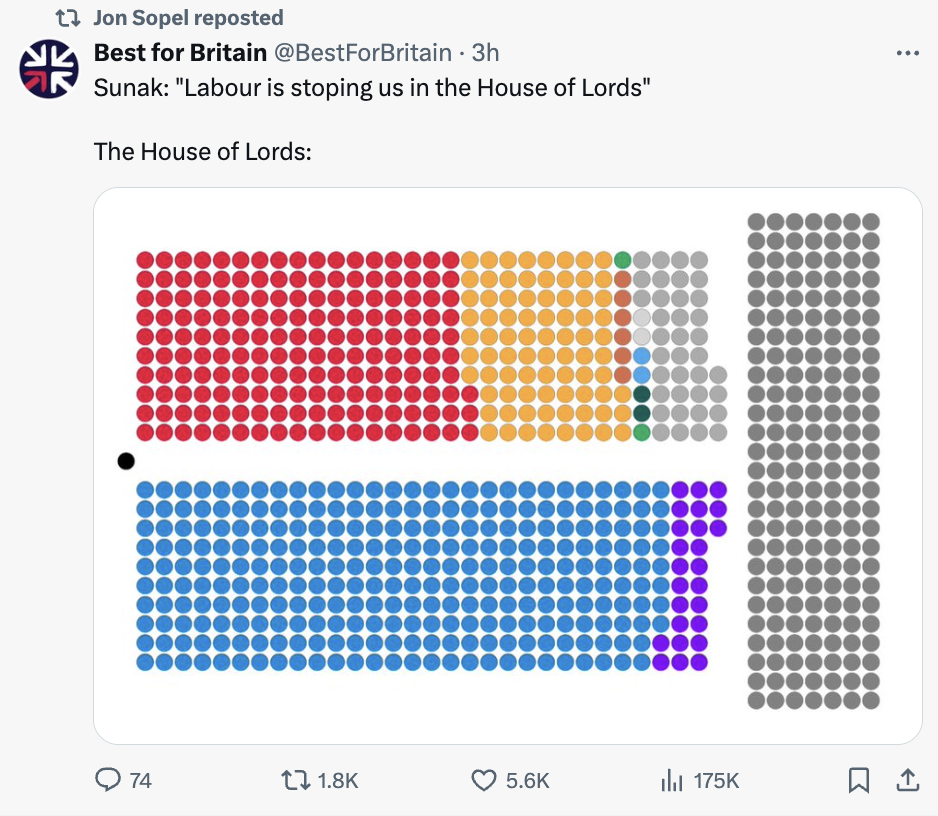
Yet in his haste to stick it to Sunak on the Rwanda Bill, it seems that Sopel has blundered quite spectacularly. Following the Prime Minister’s press conference this morning, in which Sunak turned his guns on Labour peers in the Upper House, Sopel sneered that:
Given Tory majority in House of Lords bit rich for Rishi Sunak to blame Labour for delay to passing #Rwanda Bill. It’s because so many on his own side and crossbenchers reject the legislation
Unfortunately for the former Corporation man, the Tories do not, in fact, have a majority in the second chamber. There are just 277 Conservative peers out of a total of 788 listed on the House of Lords website – or 35 per cent of those who can currently vote. So from where did Sopel obtain his misinformation? Perhaps the fanatically pro-European ‘Best for Britain’ campaign, whose content he shared earlier.
As Lyndon Johnson said, the first rule of politics is to learn to count…
Why Biden’s plan to sanction an IDF battalion could backfire
The Biden administration is planning to announce sanctions against a part of the Israel Defence Forces (IDF). On the one hand, this would be the latest in a series of US and European sanctions targeting Israeli settler organisations linked to violence against Palestinians. On the other, it’s an unprecedented legal action by the United States against the Israeli military itself.
One of the long-running divisions in Israel society is between Haredi (ultra-Orthodox) Jews and the rest of the public. Originally a tiny minority, Haredi Jews now form nearly 14 per cent of Israel’s population. The biggest tension is over the issue of military service: while most Jewish men are drafted into the IDF at 18 by law, Haredi men are exempt. Courts have repeatedly ruled that the exemption is discriminatory, and Israeli governments have tried to show judges and the wider public that they’re working on increasing Haredi draft numbers through non-coercive means.
To most Israelis, sanctioning any part of the IDF during Israel’s worst war in decades is a wedge too far
The Netzah Yehuda battalion was created for this purpose. One of the big Haredi objections to military service was that the IDF was too much of a temptation: their youths would be exposed to women, non-religious Jews and secular ideas. Netzah Yehuda was supposed to be a ‘safe space’ for Haredi men, with a focus on religious observance and extra-strict kosher food. The hope was that, with special provision for their cultural needs, Haredi enlistment would rise.
It was a failure. Netzah Yehuda struggled to get the eye-catching enlistment statistics that the IDF and government needed. So instead of the Haredi community, they began to look elsewhere for recruits.
The most extreme Israeli settler groups, often known informally as the Hilltop Youth, are made up of political religious zealots. Often involved in vandalism and violence against both Palestinians and Israeli security services, many have already been in trouble by their mid-teens. The IDF doesn’t like to draft Hilltop Youth types, considering them too much of a risk, which also adds to their sense of isolation from wider society.
The Hilltop Youth aren’t Haredi. But many of their religious needs are very similar: no women, the strictest levels of religious observance, etc. So the IDF started to fill Netzah Yehuda with youths from this community, settler kids that wanted to serve but that the rest of the army didn’t want to touch. On paper, ‘Haredi enlistment’ was up and suddenly the programme looked like a success.
Unsurprisingly, a brigade with a large number of ideologically-motivated extremists was a potential source of trouble, which makes the next decision hard to understand: Netzah Yehuda was stationed in the West Bank, protecting the same settlements and outposts from which many of its members hailed. In several documented incidents, Netzah Yehuda soldiers were accused of mistreating Palestinians, including beatings, sexualised violence, electrocution and harassing Israeli protesters. Netzah Yehuda members have been convicted of some of these offences, serving time in military prison or ordered to pay compensation.
In January 2022, Omar Assad, a 78-year-old Palestinian-American dual citizen, was detained by Netzah Yehuda troops and left bound and gagged on his stomach for up to an hour. When the soldiers returned, he had died of a heart attack. The Biden administration took an interest in the case, pushing Israel for answers and opening an initial investigation under the Leahy Law.
The Leahy Law is a granular bit of legislation that bans military support to specific army units of US allies, when the unit is credibly implicated in human rights violations. Because it blocks US aid to these units, it’s a law that effectively only applies to allies, who are the ones getting the aid in the first place. Last year, the Australian SAS was investigated under the Leahy Law after allegations of war crimes in Afghanistan.
The IDF reassigned Netzah Yehuda away from the West Bank altogether in December 2022, but the damage seems to have been done. If Barak Ravid, the Israeli reporter now on the White House beat who broke the story, is correct, any day now the Biden administration will effectively announce its first sanctions against a part of the Israeli military.
These aren’t criminal sanctions. They would only prevent the battalion from receiving US money and equipment. But the move, still not officially announced, is already provoking a strong reaction in Israel. It has been condemned not just by prime minister Benjamin Netanyahu but also by centrist minister Benny Gantz and opposition leader Yair Lapid.
In the last few months, the US has led Western efforts to target Israeli settler groups that have been linked to violence. The UK and EU have followed the Biden administration’s lead, imposing travel bans and financial freezes on some of the most extreme individuals and organisations. These moves haven’t been particularly controversial in broader Israeli society, and seem to be part of a wedge strategy by the US administration designed to isolate the Israeli far right.
To most Israelis, though, sanctioning any part of the IDF during Israel’s worst war in decades is a wedge too far. The subtleties of Netzah Yehuda versus other battalions has been lost in translation, and all the public is hearing is that Biden, who helped foil last week’s massive Iranian missile attack, is now turning on Israel.
Since it was reassigned out of the West Bank, reports of abuses by Netzah Yehuda soldiers have all but vanished. The sanctions proposed by the US are focused, understandably, on past behaviour rather than the future. But after panicked calls from Israeli leaders to their US counterparts, I wonder if the Biden administration might reconsider, and direct its sanctions in a way that serves to unite Israelis against the far right, rather than unify them in support of the IDF as a whole – including Netzah Yehuda.
Parliamentary researcher charged with spying for China
Chris Cash, the parliamentary aide accused of spying for China, is to be charged with espionage offences, the Crown Prosecution Service (CPS) said today. Nick Price, the head of the CPS special crime and counter-terrorism division, confirmed that it has has now ‘authorised the Metropolitan police to charge two men with espionage offences’. Price said Cash, 29, and his alleged accomplice Christopher Berry, 32, would be charged with providing prejudicial information to a China. They will appear at Westminster magistrates court this Friday.
‘Criminal proceedings against the defendants are active,’ Price declared in a statement. ‘No one should report, comment or share information online which could in any way prejudice their right to a fair trial.’ Cash was closely linked with Tom Tugendhat, the security minister, and was employed as a researcher by Alicia Kearns, who chairs the Commons foreign affairs committee. She has already tweeted that she will not be adding any further comment to her original Sunday Times response because ‘as this matter is now sub judice it is essential that neither I, not anyone else, say anything that might prejudice a criminal trial relating to a matter of national security.’
Cash has previously insisted that he is ‘completely innocent’. In a statement released by his lawyers at Birnberg Peirce, Cash said in September: ‘I feel forced to respond to the media accusations that I am a “Chinese spy”. It is wrong that I should be obliged to make any form of public comment on the misreporting that has taken place.’ When he was arrested in March 2023, a handful of ministers were informed but details of the alleged security breach were not made public until the Sunday Times broke the story in September.
Desperate manufacturers are struggling to shift electric cars
By 2024, UBS confidently predicted in a October 2020 report, the cost of manufacturing an electric car would have fallen so sharply that it would be on a parity with the cost of a petrol or diesel car. If you have looked on Auto Trader recently you may well have been fooled into thinking that this has come true.
A quick search offered me a brand new Peugeot e-2008, its price slashed from £38,495 to £26,495. Or I could have a Vauxhall Mokka-e, down from £41,895 to £29,793. According to the car trading platform, 77 per cent of new electric cars on its website are being advertised at a discount – in some cases, as the above figures show, bringing them down close to the sort of price you would pay for a petrol or diesel equivalent.
Electric cars have established themselves as a premium project for well-off, environmentally-concerned motorists
But the discounts currently on offer are not really a reflection falling manufacturing prices. It is true that metals prices fell sharply last year – down 60 per cent on their late 2022 peak in the case of lithium batteries – reducing raw materials costs. But that shouldn’t be misread: lithium has now bottomed out and is still more expensive than it was in 2021.
The real reason for hefty discounts on electric cars is desperation. Since 1 January, manufacturers have been under the zero emissions mandate (ZEV), which demands that 22 per cent of the cars they sell in 2024 are pure electric cars. Should they fail to reach this target, they will be fined £15,000 for every vehicle by which they fall short.
How are they doing? Not very well, it seems. In the first three months of 2024, according to the Society of Motor Manufacturers and Traders (SMMT) electric cars accounted for only 15.5 per cent of the market – virtually unchanged from the same period in 2023. Moreover, the target is not going to stay at 22 per cent. In 2025 it will rise to 28 per cent, then in stages to 80 per cent by 2030 and 100 per cent by 2035. Unless electric car sales pick up dramatically in the next few months, manufacturers are going to find themselves with an enormous bill at the end of the year. The situation is worse for many carmakers than the above figures suggest because some carmakers, like Tesla, are already electric-only. That means that the sales being achieved by others must be well below 15 per cent.
It wasn’t supposed to turn out this way. Analysts were not expecting manufacturers to miss the 22 per cent target. Just last December, S&P forecast that sales of electric cars would surge by 41 per cent in Europe in 2024, and by 66 per cent in the US. In Europe, it was believed, EVs would be accounting for 22 per cent of the market across 2024.
Yet consumers are proving a lot more resistant to electric cars than the industry believed, with many citing the lack of charging points. Electric cars have established themselves as a premium project for well-off, environmentally-concerned motorists who enjoy access to off-street parking, but they are having serious problems widening their appeal to the mass market. There were recently reported to be 90,000 unsold EVs piling up in motor dealers’ forecourts in the US. Meanwhile, Chinese-made EVs are being diverted to Europe as tariffs of 27 per cent kept them out of the US. But the EU doesn’t want them either, and is also discussing punitive tariffs on Chinese-made cars – which isn’t exactly going to help Europe reach its decarbonisation targets.
For the moment, manufacturers are discounting the price of EVs, but in the coming months something is going to have to give. Either the government will relax the ZEV mandate as it has already relaxed other net zero targets – or manufacturers are going to find themselves in serious trouble.
Lessons from the foreign aid votes
The past week has presented a fascinating object lesson in the continued tension over the direction of foreign policy and national security in the MAGA era, on what matters and what doesn’t, and who matters and who doesn’t, when it comes to finding a true forward-looking Trump-Reagan fusion. I wrote about this in the context of reviewing the new book by Matt Kroenig and Dan Negrea, who wrote a Ukraine-focused piece for Foreign Policy last week. But that’s just writing, not voting — and this week brought votes that include more useful indicators of what’s going on.
First, the most populist fringe of MAGA lost repeated and significant tests within the House, in opposition to the speaker they chose to elevate over Kevin McCarthy, who maintained his support from Donald Trump throughout. Trump never lifted a finger of serious objection to any of these foreign aid bills except to voice his repeated belief that Europe should pay more (they should, but many of them already are) and some handwaving of disagreement on TikTok’s forced divestment, which everyone knows isn’t driven by some deep-seeded ideological objection. The popularity of all these positions can be disputed, but they do generally represent the majority position of Republicans — and no one expects to suffer electorally for the votes they took on Ukraine, Israel, Taiwan or TikTok.
So what’s to be taken away from a very loud faction on the right just losing outright and the rest of the members in a very pro-Trump MAGA-driven House feeling free to vote the way they did? You can measure the real opposition on Ukraine not by the 112 Republican votes against aid, but actually as being around fifty-five members — the number of Republicans who voted against the Rule to advance the complicated package. Between the Rules votes, Ukraine, TikTok and FISA, these are areas where some of the populists may be taking positions that are less popular than they represent in their normal “the people versus the swamp” framing.
One way to look at it is a simple miscalculation on leverage — that with a border deal deemed impossible at this late stage of an election year, people who stuck to that line ended up forcing the conference to fold. Another is that developments with Israel, Iran and China have reset the foreign policy conversation in the past six months, drawing focus away from Ukraine and allowing Republicans to return to their hawkish standard. Republicans are most comfortable criticizing Democratic administrations for being too weak, and in each area this is what world events and the Biden administration allows them to do.
Overall, the conclusion reached in Washington this weekend will be seized upon by many people who declare themselves to be the greatest advocates for Donald Trump as indication that the Republican Party needs to be burned to the ground, or that Mike Johnson should be vacated, or that this is just the swamp reasserting itself. But that’s clearly not the case. Instead, it’s a sign that the GOP, which is now the party of Donald Trump, remains the party willing to spend significantly on the military when they believe it’s important, and unwilling to show a weak hand in defense of Israel or in opposition to China. And if Trump disagrees, he certainly never vocalized it. There’s a lesson in that, too.
Suella Braverman is wrong to call for Mark Rowley to go
Why did Gideon Falter cross the road? Or try to? That is a question that went viral this weekend. A video emerged of Falter, who leads the Campaign Against Antisemitism, being threatened by police for trying to cross a pro-Palestinian protest in central London. He was wearing a kippah and carrying a prayer shawl bag, and had reportedly just emerged from a synagogue with some friends and was trying to get home. Police officers had spotted him leaving the pavement on a collision course with protestors and intervened. A tense standoff unfolded, with an officer telling him in that his ‘openly Jewish’ appearance was ‘antagonising’ the crowd. A calamitous initial response by the Metropolitan Police which, in effect, said that being recognisably Jewish was ‘provocative’ compounded calls for the force’s beleaguered boss Sir Mark Rowley to resign.
Cultural change is a marathon, not a sprint
Did Falter intend to provoke the response he got? If so, he was right to do so. He demonstrated vividly the risk of being recognisably Jewish in our capital city in 2024. However, this incident is no reason for Rowley’s head to roll.
Many people have taken to social media to suggest that the police officer who is mainly seen dealing with Falter will be ‘mortified’ by his actions. Not only is this misplaced, but it misunderstands just how impossible a task the Mayor of London and Home Secretary have set Sir Mark and his officers. The officer in question knew that Falter was liable to be assaulted had he tried to cross the road through a noisy demonstration of pro-Palestine marchers. He also knew there was insufficient capacity to deal with the likely aftermath of such an incident. We have seen much footage of overwhelmed police on previous protests ‘de-arresting’ suspects involved in public order offences after their detention. The Peelian principle of policing without fear has been replaced by the policing of ratios. The plain fact is that there was not enough resources to allow a Jewish man to safely cross the street in his own city. And so the officer bent over backwards to try to accommodate Mr Falter with other alternatives. In the end, perhaps sensing his determination to assert these rights, the officer threatened to have him arrested.
Mr Falter and others, including Suella Braverman, have called for Sir Mark’s head over this. Braverman was taken to task on Monday’s BBC Radio 4 Today programme by Mishal Husain for basing this conclusion on a video she had only seen clips of. It was not an edifying listen.
Having now watched the extended footage, twice, nothing has changed my mind about the outrageous context of this incident: that visibly Jewish people have to be threatened with arrest to be kept safe and nothing is done about the perpetrators of the menace, since there are simply too many of them. There is a recurring pattern of appeasement-policing of mass protests, that Braverman used to justify her argument. It would not have mattered whether Braverman saw edited highlights of the incident or the full monty. She was right to draw attention to the big picture on this.
Yet Braverman is wrong on Sir Mark’s position being untenable. Mark Rowley has been Met Commissioner for 18 months. He was brought in to try to restore the Met’s shattered reputation after the mishandling of many high-profile scandals. He has been active in his stated intention to rid the Met of unsuitable and criminally minded officers in the ranks who have soiled the Met’s vaunted position as Britain’s premier police service. Cultural change is a marathon, not a sprint.
He has fumbled the ball in previously stating that more laws are needed to police the regular mass protests. What is plainly the case in this weekend’s example, however, is that Rowley’s frontline colleagues are unable to police existing laws that see vile displays of hatred and anti-Semitic impunity infiltrating every protest outing.
Sir Mark must be left to the enormous unfinished task of re-professionalising London’s police service. He needs the resources to do so, as well as the political will from the Home Secretary and the Mayor to convince Jewish people they can be safe in London. The clock is ticking but this is no time for an early departure.