-
AAPL
213.43 (+0.29%)
-
BARC-LN
1205.7 (-1.46%)
-
NKE
94.05 (+0.39%)
-
CVX
152.67 (-1.00%)
-
CRM
230.27 (-2.34%)
-
INTC
30.5 (-0.87%)
-
DIS
100.16 (-0.67%)
-
DOW
55.79 (-0.82%)
The painful truth about Gen Z
An older friend once described his freshers’ week in some detail: a botched proposal, two inadvertently-acquired tattoos and more alcohol than he cared to remember. Mine was rather different: I was confined by the pandemic to a 3×4 metre room with solitary meals in an exam hall canteen. Corridors determined household bubbles (there were two of us) and ‘going out’ meant yet another riveting walk.
We’re WFH-obsessed quiet quitters who retreat behind email at the first opportunity
For many young people, substantial chunks of education or early working life were marred by similar experiences. With all these setbacks, you’d think we might have raised a generation of hyper-resilient go-getters, eagerly and adequately braced for the inevitable challenges of the real world. But many people don’t think that’s the case.
Steven Bartlett describes Generation Z – those, like myself, born between the late 1990s and the early 2010s – as ‘the least resilient’ cohort yet. The Economist frets in a recent article that, for Gen Z, ‘the popular view is that smartphones have made them miserable and they will live grimmer lives than their elders’.
My contemporaries and I are often branded delicate and half-hearted. We’re seen as easily offended, work shy and devoid of basic social skills. We’re WFH-obsessed quiet quitters who retreat behind email at the first opportunity. Constant job-hopping, absenteeism from work and school, and surging rates of mental health complaints have now become the norm.
Some might attribute this to cushy parenting or woke indoctrination. Alternatively, criticising the youth of the day is nothing new, and every age group has different aspirations and challenges. Is what we see today yet another round of the generation game, a classic case of kids-these-days critique?
Perhaps the painful truth about Gen Z is that there really is something amiss. When I look at many of my peers, it’s plain to see that too many find it hard to adapt. Prioritising standardised testing over problem-solving and critical thinking in schools leaves many of us ill-prepared for the real world. Our national obsession with university burdens too many of us with significant debt (£60,000, in my case) for degrees with minimal career relevance. This rigid system discourages risk or ‘unconventional’ pathways.
We’re also just not comfortable with feeling uncomfortable. Raised in echo chambers and a cancel culture that silences alternative thinking, minimal exposure to healthy debate then erodes our ability to challenge consensus or respectfully disagree.
Meanwhile, the modern fixation on examining mental health and constantly dissecting emotion, even the good bits, instills an inevitable sense of fragility. That’s not to say serious conditions aren’t genuine or that the old days of keeping quiet were any better, but hormones and teenage angst have always and will always exist. We need to get better at separating the significant from the everyday.
Smartphones and incessant connectivity have fuelled a generational desire for instant gratification and a lack of perseverance. Using TikTok too often destroys someone’s attention span. This may seem trivial, but it has real-life consequences; peers shun live television due to adverts, or insist on finding ‘the one’ through countless swiping. Even corporate job applications have now been gamified.
This mindset severely impacts work culture, meaning we are losing the ability to remain focused on challenging tasks or stick with unsatisfying roles. Seven in ten of us expect to move on in the next year. Ambition has also increasingly manifested through side hustles for a rising number of us. Brown-nosing the boss is out; Depop, Shopify and even OnlyFans are in. While entrepreneurial zest is admirable, immediate reward now trumps longterm ambition.
The cumulative effect is a generation conditioned to avoid discomfort, unaccustomed to perseverance, and ultimately ill-prepared to adapt to life’s inevitable challenges. Throw in a constant anti-establishment rhetoric describing society as flawed and oppressive, alongside numerous social media platforms and 24/7 influencers further distorting our perception of the world and ourselves, and you can begin to understand some of the factors that have shaped our lives to date.
When I look at many of my peers, it’s plain to see that too many find it hard to adapt
Fifty years ago, the generation gap was defined primarily by culture, music and fashion. Today, this divide has been exacerbated by technology and a social information paradox, forcing monumental shifts in the way we live, think and interact. Risk is minimised. Truth is subjective and independent thought constrained. Civil society is more divided and uncivilised than ever before. We live disconnected from others, constantly urged to introspect at the detriment of engaging meaningfully with the world around us. The consequences should surprise no one.
I sometimes hear people defend Gen Z as disruptive or innovative. Such claims are simply not true: the reality is far less romantic. Of course, my generation is not all the same, but on the whole we are gritless. We do lack determination. There is nothing to celebrate about loss of resilience or ambition.
For older generations, it’s easy to look back nostalgically on simpler times. But, for Gen Z, the world that surrounds us today is the only reality we have ever known. However, society is not doomed. It is still possible to create a culture where independence and risk-taking are encouraged, where broader ideas are discussed freely and openly, and where we feel more genuinely connected to each other.
Similarly, as a generation, we also have some incredible advantages: we’re digital natives, globally connected, equipped with a natural entrepreneurial spirit and already actively engaged in civic discussions. Some of the happiest and most resilient people I know are young: athletes who avoid excessive screen time and actually go outside; activists of all colours who spend their weekends campaigning here or debating there; risk-takers who shunned university for multiple (now) failed ventures. It ultimately falls upon us as individuals to harness these advantages, to stand out from the crowd, to embrace possible discomfort, to learn to persevere and to take risks, more so than ever before.
If we can cultivate resilience and determination fit for the modern age, then there is hope. Perhaps by then it’ll be our turn to lament the next generation.
Bibi’s plan for a post-war Gaza
Sharp differences within Israel’s governing coalition have emerged into the open in recent days. On the face of it, the dispute centres on preferred post-war arrangements in Gaza. But the rival stances also reflect underlying, contrasting views concerning the conduct and aims of Israel’s now eight-month long military campaign in the Gaza Strip.
The divisions have begun to receive attention in recent days because of Defence Minister Yoav Gallant’s public statement criticising the government for ‘indecision,’ regarding the ‘day after’ in Gaza. But the dispute is not new. Gallant has for months been advocating in cabinet for a plan his ministry has developed, concerning how Gaza will be governed after the war. Details of this plan were published in March. It envisages the establishment of a self-governing authority in Gaza, assembled with the involvement of five to seven thousand Gazans loyal to the Ramallah Palestinian Authority. Israel would maintain freedom of action in the area of security, as it does in the West Bank. The list of Gazans to be involved in the plan was assembled with the assistance of Majed Faraj, the PA’s intelligence chief. The plan was envisaged to be implemented in stages. Israel would establish safe zones in areas of Gaza that it conquered. The new authority would then begin to operate in these areas, which would gradually be expanded.
In fact, what this direction involves is something like the status quo ante bellum, with a much weakened but not destroyed Hamas.
Israeli media reported in March that Netanyahu rejected this plan. For his part, the prime minister and his supporters dismiss the notion of establishing any post-war arrangement until Hamas’s military capacity is destroyed. National Security Adviser Tsachi Hanegbi, in a recent interview with Israel’s Channel 12 news, noted that the allies did not set up a post-war government in Germany in World War 2 until the Nazi regime’s army had been defeated in its entirety.
Gallant, in his public statement, expressed concern that the current ‘indecision’ was leading to a ‘dangerous’ course that could result in ‘Israeli military and civilian governance in Gaza.’ Netanyahu, in response, declared that he would not allow a role for the Palestinian Authority in a post Hamas Gaza. He would not, he said, replace ‘Hamastan’ with ‘Fatahstan.’ (Fatah is the ruling party in the Palestinian Authority).
An interesting point to note in this exchange is that both Gallant and Netanyahu appear to be attacking straw men.
Netanyahu accuses Gallant of seeking to return the Palestinian Authority to Gaza. But the Defence Minister’s plan appears designed precisely to avoid any direct governing role for the Ramallah authority.
Gallant, meanwhile, accuses Netanyahu of seeking to establish a new Israeli military administration in Gaza. The defence minister finds the notion of Israeli military governance in Gaza to be ‘dangerous.’ But it is difficult to see how his own plan could be implemented without at least a preliminary period in which Israeli forces become the de facto governing force in the Strip.
More importantly, the reality on the ground in Gaza belies any suggestion of an emergent renewed military administration. Indeed, the current chaotic situation, in which the Hamas authority re-emerges as soon as the IDF departs any part of the Strip, is possible precisely because military control and governance has not been established. Israel’s 98th Airborne Division is currently engaged in fierce clashes in the Jabalya refugee camp in the northern Gaza Strip. Israeli forces engaged in this area in late 2023, but did not seek to occupy it. As a result, Hamas re-entered the area. Israel is now fighting for it again.
There are elements within Israel’s governing coalition, certainly, which do seek the re-establishment of Israeli military rule in Gaza. National Security Minister Itamar Ben-Gvir and Finance Minister Bezalel Smotrich of the Religious Zionism faction both openly advocate this outcome. They also want the re-commencement of Jewish settlement in the Strip. Netanyahu needs their support for his own political survival. He is therefore unlikely to publicly reject their preferred direction. But events on the ground do not suggest that he is seeking to implement it.
So if Netanyahu rejects any role for the Palestinian Authority in Gaza, but also does not appear to be implementing a full Israeli military re-occupation of the Strip, what in fact is his preferred strategy?
His stated goal, of course, is ‘total victory’ over Hamas. In reality, though, what appears to be emerging is a situation in which a truncated, half broken but still viciously repressive Hamas continues to be the de facto governing authority in Gaza. Israel, meanwhile, maintains freedom of operation throughout the Strip, striking Hamas and its leaders at will, with the involvement of only a limited number of forces. At the same time, an IDF zone of control along the Gaza border (on the Gazan side) prevents further October 7 style attacks on Israeli border communities.
Unless a clear decision is made in another direction, this looks to be the emergent reality for Gaza. If Netanyahu stated that he seeks the entry of the PA into Gaza, his coalition would be likely to collapse. If he expressed his support for military reoccupation of the Strip, the response of the US Administration would be immediate and harsh. Expressing support for neither enables the Israeli prime minister to get back to being the tactician and conflict manager that he likes to be and that he has always been (at least outside of his books and his speeches). He can’t openly commit to this policy either, however, because it constitutes much less than an Israeli ‘total victory’ over the Gaza Islamists. In fact, what this direction involves is something like the status quo ante bellum, with a much weakened but not destroyed Hamas. It is a return to what Israelis used to call ‘mowing the grass.’ Whether this is a wise route to take is an entirely different discussion. But away from the public declarations and the straw man arguments, this is where Israel appears to be headed.
The brutal philosophy of Tyson Fury
Tyson Fury, the towering British behemoth with the quick wit and even quicker fists, is ready to fight Oleksandr Usyk. Unlike Usyk, however, Fury is not just a pugilist; he’s a spectacle. He’s one of boxing’s greatest assets because he’s not just in the business of winning fights.
Fury’s journey from rage to riches is as compelling as any Hollywood script, and he’s proven himself as much a showman as a slugger. His trash talk is legendary, a verbal ballet of insults that leaves opponents flustered and fans roaring. In this arena, he’s often compared to another icon of the fight game: Conor McGregor. Both men share a knack for the theatrical, but while McGregor’s star burned bright and fast, Fury’s has evolved with time, growing more formidable with each bout.
McGregor’s rise in the UFC was meteoric. The Irishman talked a big game and, for a while, backed it up. He transcended the sport, becoming a global superstar with his antics and audacious predictions. McGregor was the ultimate showman, but like many fireworks, his brilliance was fleeting. As his career progressed, the cracks started to show. His once-unassailable dominance faded, marred by controversies and diminishing returns in the octagon.
Legal issues began to pile up like unpaid parking tickets. There was the infamous dolly-throwing incident at a UFC media event, an outburst that painted McGregor not as a fearless warrior but as a man unhinged. Assault charges followed, along with accusations of sexual misconduct. The allegations were denied and no charges were brought, but each new headline chipped away at the mystique of the invincible fighter. His social media antics, once seen as clever marketing, increasingly resembled the ravings of a man desperately clinging to relevance.
In the ring, McGregor’s aura of invincibility was further tarnished. Losses to Khabib Nurmagomedov and Dustin Poirier showcased a fighter who had perhaps lost a step, whose focus seemed more on the trappings of fame than the grind of training. The narrative shifted from the invincible champ to a once-great fighter struggling to reclaim past glory.
Fury, on the other hand, is a different breed. Behind the jokes and the clownish exterior is a ruthless machine, a devastating fighter who has only improved with age. His early career was marked by personal demons – mental health struggles, substance abuse, weight gain – that almost derailed him completely. But Fury’s comeback is the stuff of legend. Like a seven foot tall phoenix rising from the ashes, he returned to boxing not just as a competitor, but as a champion.
Consider his trilogy with Deontay Wilder. The first fight was a showcase of Fury’s resilience; knocked down twice, he still managed to secure a controversial draw. The rematch saw Fury at his destructive best, dismantling Wilder in a masterclass of boxing. And the third fight? A slugfest for the ages, with Fury sealing his dominance in emphatic fashion. It’s this trajectory – from the brink of self-destruction to reclaiming his place atop the heavyweight division – that sets Fury apart.
Unlike McGregor, whose later career has been a shadow of his early glory, Fury has aged like fine wine. Each fight adds a new layer to his legacy. His technique has sharpened, his power has remained a constant threat, and his mental fortitude has become his greatest weapon. Fury is the total package: a skilled boxer with a granite chin and the heart of a warrior.
What makes Fury truly special, though, is his understanding of the fight game as both a sport and a spectacle. He knows how to sell a fight, how to get under his opponent’s skin, and how to deliver when it matters most. His antics – from serenading his wife in the ring to dressing as Batman at press conferences – are not just for show; they’re part of a calculated strategy to keep the spotlight firmly on him.
Behind every joke, every outrageous comment, lies a fighter who has seen the darkest depths and emerged stronger. Fury’s ability to marry the absurd with precise sportsmanship is what makes him boxing’s greatest asset. In an era where the sport often struggles for relevance, Tyson Fury ensures that boxing is anything but boring. He’s a modern gladiator, a performer who delivers the whole package, and in the grand theatre of boxing, there’s no one quite like him.
What makes Fury truly special, though, is his understanding of the fight game as both a sport and a spectacle.
One cannot discuss Fury without discussing his father, John, an ex-boxer himself. A larger-than-life character who embodies the archetypal tough-love patriarch, John Fury is no stranger to the rigours of life inside and outside the ring. It is this hard-earned wisdom that he has imparted to his son, acting as both a guiding light and a stern taskmaster.
John Fury’s influence goes beyond the mere application of boxing techniques or training regimens. Fury Snr cares about instilling a mindset. He has always emphasised the importance of family, loyalty, and mental fortitude. These are not abstract concepts for the Furys; they are part of their everyday lives.
The elder Fury’s philosophy is brutally simple: life is a fight, and you must be prepared to throw and take punches, both literal and metaphorical. This ethos has permeated Tyson’s approach to his career and personal battles. When Tyson ballooned in weight, spiralled into depression, and succumbed to the lure of drugs, it was John who helped pull him back from the brink. With a blend of brutal honesty and unwavering support, he reminded Tyson of who he is and what he’s capable of, cutting through despondency with the sharp edge of paternal authority. John Fury is the backbone supporting the Gypsy King, ensuring that despite the ever-present shadows of his own mind, Tyson Fury remains not just on the straight and narrow, but on a path to glory.
Where to eat, drink and stay in Cape Town
Setting an early alarm while on vacation never comes easily to me, but making time to wander Babylonstoren’s fruit and vegetable garden before the day’s searing heat took hold was no problem. One of the oldest Cape Dutch farms, set at the foot of Simonsberg in Cape Town’s Franschhoek wine valley, it’s a sprawling, fantastical, technicolor utopia — positively Eden-like, with a lot more than apples to tempt you. Scarecrows made from terracotta plant pots wave from fields teeming with 300 edible crops, fat pomegranates growing alongside tangy tamarillos, willow trees swaying in the breeze. Each morning, the estate’s waiters go out with garden staff to harvest fresh produce, picking everything from the food you see on the menus to the violets that decorate the tables at farm-to-fork restaurant Babel and the Greenhouse. A vineyard and cellar tour shows exactly how 340 acres are used to produce thirteen different grape varieties, which can be tasted, too. The highest vines — Pinot Noir and Chardonnay — lie against the Simonsberg mountains a staggering 800 meters above sea level.
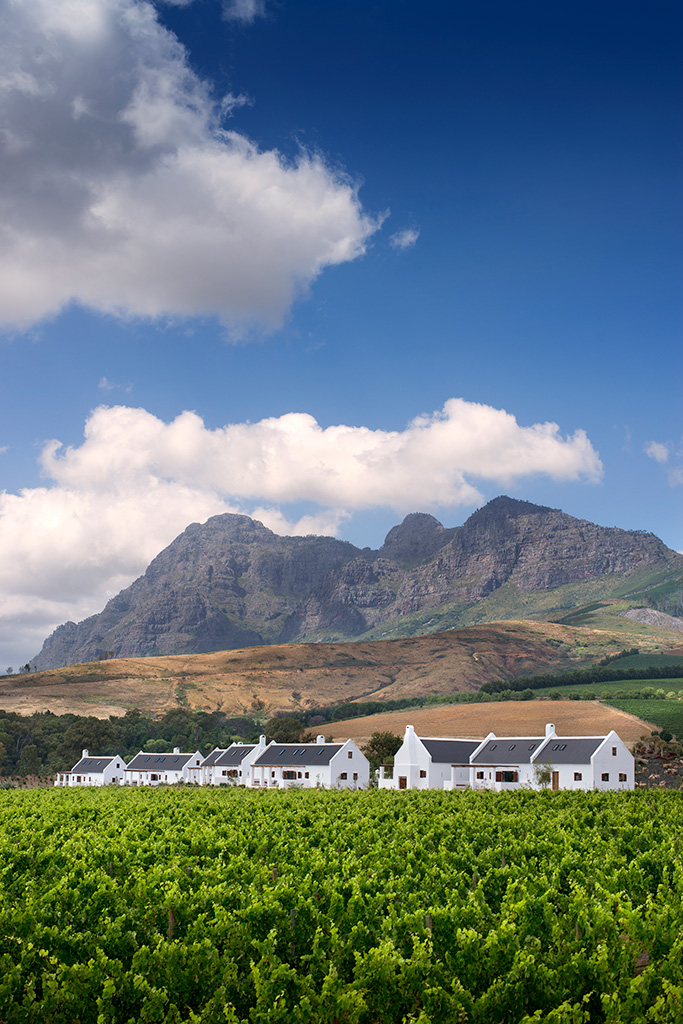
To make things preposterously pleasant, you can sleep over, too — at least one night in a beautifully appointed, whitewashed Fynbos Cottage or larger Family House becoming quite necessary if you plan to explore the estate’s bakery, butchery and boutiques — and that’s before you’ve booked a workshop, wine tasting or treatment in the state-of-the-art spa building. Time spent at Babylonstoren is emblematic of all the very best elements of a Cape Town stay; passionate people helping you make the most of the area’s marvelous natural abundance, and often incredible weather.
A record number of seasonal expats (or “swallows,” as they’re commonly known) flew in to nest there in December 2023. I joined them, swapping my cold hometown for the southern hemisphere’s embarrassment of riches, and ended up staying for two months. These are the spots I’d recommend booking, before everyone else does.
If you like… wine
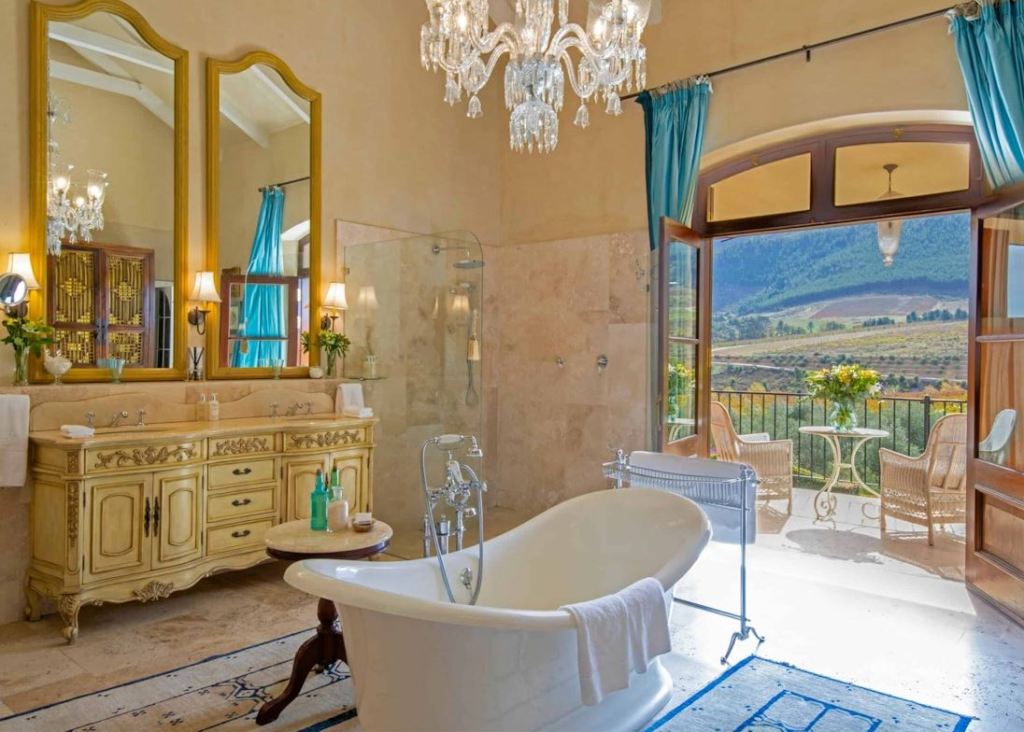
Stay: Franschhoek stalwart La Residence raises the already sky-high bar for luxury stays on private working farms in the Western Cape. Opulent and secluded, its private. thirty-acre estate is surrounded by mountains and vineyards, iconic yellow pool umbrellas shading the who’s-who of Cape Town taking a break from city life. Artisanal produce is a given in the gourmet capital of South Africa, here served with the world’s best wines under regal high ceilings in a Tuscan-style farmhouse, verdant views stretching all around. My sumptuous room invited pure indulgence, with a private garden area and deep freestanding bath with a view of the mountains.
Eat: Chef Richard Carstens helms the exquisite seasonal restaurant Arkeste, guests seated on sun-dappled outdoor decking. We hitched up our dresses to tackle the scenic (read: hilly) bike ride there from La Residence, toasting our efforts with Chamonix Old Vine Steen planted from a Chenin Blanc vineyard in 1965. The à la carte menu spans the likes of white pepper squid risotto with parsnip, wakame and yuzu for starters, followed by red wine-glazed springbok with greens and blueberries or citrus-glazed linefish with rouille in a bouillabaisse sauce. Truly idyllic.
Drink: The famed Franschhoek Wine Tram comes by every hour and follows a loop of stops at wine estates that allow just enough time for a wine tasting, before passengers hop back on for a quick change of scenery. And another glass. And another…
If you like… art
Stay: Future Found Sanctuary sits quietly in Hout Bay, in the shadow of majestic Table Mountain — a stylish and biodiverse gem so perfect, it’s hard to share. Two separate buildings, architectural masterpieces Maison Noir and Villa Verte, house owner Jim Brett’s extensive art collection, acting as destination galleries in and of themselves with jaw-dropping interiors by prestigious art gallery Southern Guild. Handily located twenty minutes from the delights of Camps Bay and central Cape Town, the serene split-level gardens manage to feel a world away from any bustle. There’s a huge focus on wellness, with five healing gardens spread across seven acres, plus a natural pool for refreshing morning dunks. An expansive menu of regenerative treatments like tai chi, breathwork, kinesiology and acupuncture is truly transformative (a nighttime yoga and sound bath session afforded me my best sleep of the year) while a four room spa and steam room facilitate journeys exploring the five senses. Heaven.
Eat: On days your private chef hasn’t prepared a rainbow of plates piled high with the finest locally foraged ingredients, there’s an abundance of other-worldly restaurants to explore nearby. Tear yourself away from your heated swimming pool to dress up for special occasion spot La Colombe on the iconic Silvermist estate in wine region Constantia — this is French-meets-Asian fine dining doing the absolute most. Even opting for the “reduced” menu, we left spoiled rotten, after gorging on tuna “La Colombe,” quail with crayfish, and karoo lamb with turnip and harissa.
Salsify at the Roundhouse is a fifteen-minute drive away, enjoying a unique position overlooking the (freezing — be warned) Atlantic Ocean. Like all the best restaurants in the area, its menus are driven by the seasons, the stand-out, ten-course Chefs Menu melding diced yellowfin tuna with basil emulsion and ponzu gel, and Durban langoustine with samp mielies salsa. The building’s walls tell a story, too, originally built as a guardhouse for the Dutch East India Company.
Drink: Sunday brunch at The Pot Luck Club is a local institution, elevated dishes (and a stunning elevated dining room, reachable by lift) drawing stylish crowds to get a little tipsy. Bespoke cocktails are deftly muddled by blisteringly cool, tattooed bar staff, proud to talk you through their house-made purées and syrups (they more than delivered when I simply asked for something strong, with a lot of Campari). More than twenty wines from revered local estates are available by the glass, showcasing interesting varietals. Your starter might be an Arnold Bennett (baked smoked haddock omelet) or a masa taco, combining beef sirloin with chimichurri and smoked jalapeño. Spilling out into Neighbourgoods market afterwards is a lot of fun, music blasting as locals leaf through vintage finds at outdoor market stalls.
If you like… culture
Stay: DORP hotel on Signal Hill, delivers culture (and quirkiness) in spades. Is it kooky, unpredictable and a little off-the-wall? Yes. Is it lavish, design-led and suitably indulgent? Also yes. Proclaiming “D” for Decency, “O” for Originality, “R” for Respect and “P” for Psycho, signs on the walls set the tone of a stay here. Rooms in whimsical green, pink and cream color palettes are tastefully put together, cavernous baths and small balconies enjoying sweeping of the Table Mountain, Devil’s Peak and the Twelve Apostles, peeping through Kloof Nek. Separate wing Onderdorp allows for bigger group bookings wanting good-value longer stays right in the thick of it, near important landmarks like the District Six museum.
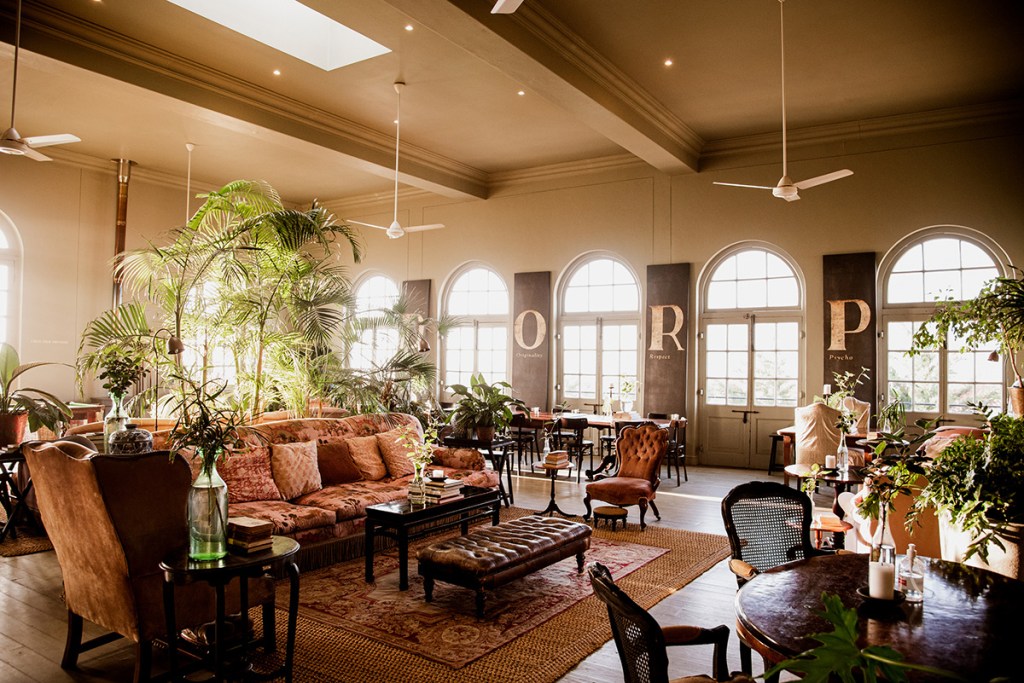
The Salon is the beating heart of the hotel, where guests gather to talk and play games on squashy armchairs. Refreshingly, no booze is served at all, out of respect for culturally-rich Bo Kaap’s devout Muslim community, but you can bring your own if you so choose. Sensual buffet breakfasts by candlelight and homestyle sharing platters (the roast chicken is incredible) feel comforting and familiar. The urge to somehow recreate the hotel’s intangible, irreverent feel when you fly back home comes on strong. Happily, a boutique sells linen bathrobes and homewares, so you don’t have to pinch anything.

Drink: Before you hit The Athletic Club & Social to brush up on your South African sporting history — or rather, flirt with Dutch and German tourists — stop in at Elgr, a dark and sultry destination spot on Kloof Street. Most know the place best for the Neapolitan-style pizzas flying out of the wood fired oven, designed as great accompaniments to the dizzying cocktail menu. You might try a “Limited Creative Expression,” like a Royal Sour with Don Julio, Grand Marnier and Hone or one of the mixologist’s signatures. I liked the 2 Chai 4, muddling butter-washed Woodford bourbon with house-made spiced chai and milk froth — served hot.
Eat: A restaurant I repeatedly send friends to is Ouzeri, its name referencing Greek taverns that fling out small plates to soak up never-ending shots of ouzo. You can really feel the chef’s connection to top local producers, most evident in one dish I think about on a regular basis — “cream of the crop” halloumi dished up in its own whey, jazzed up with fresh, dry mint from Cyprus. Octopus with potato and caramelized garlic, alongside fakes (lentil soup) with grilled orange summer pumpkin in sherry vinegar and Greek salsa verde, makes the perfect order — all flown in from Greece. But seriously, the halloumi alone is worth making a reservation — and booking your flight.
There’s nothing racist about Anglo-Saxons
One of the aims of progressives in higher education ought to be to use their privileged position to spread knowledge to their fellow citizens. In the all but forgotten world of the original socialist movement, radicals aimed in the words of the Workers Educational Association (founded 1903) to bring ‘education within reach of everyone who needs it’.
How does this noble aim fit with the constant and needless urge to police and rewrite the language 99 per cent of the population use? To create elite discourses, to exclude and obfuscate, to launch linguistic heresy hunts, to preen yourself on knowing the latest jargon, and to punish the untutored for no valid intellectual reason whatsoever?
The latest example comes from the Cambridge University Press. It has decided that ‘Anglo-Saxon’ is no longer a description of the Germanic tribes who invaded southern Britain after the departure of the Romans, fought the Vikings, became the subjects of Norman colonial overlords, and gave us much of our language, but is in some unspecified manner racist.
It announced a few days ago that it is renaming its ‘Anglo-Saxon England’ academic journal ‘Early Medieval England and its Neighbours’.
I am going to draw on the work of scholars in a moment. But before I do, let me make one broad point: the argument is drivel.
The best you can say about the publishers is that they are bowing to American cultural imperialism: the one imperialism we are not meant to resist.
As the historian Dominic Sandbrook told the Cambridge University Press on X (Twitter) ‘Be honest. You changed the title because you are total drips and didn’t have the courage to say no to a handful of mad Americans’. And that is about the size of it.
In a series of articles in the Critic, Samuel Rubinstein filled in the details. In 2017 a Canadian academic Dr Mary Rambaran-Olm was elected vice president of the International Society of Anglo-Saxonists (ISAS). In her victory speech, she called herself a ‘woman of colour and Anglo-Saxonist,’ which was fair enough.
She then, like so many others caught up in the great awakening, fell into the delusion that you can change the world by policing language. She then denounced ‘Anglo-Saxon’ as a racist term and resigned because she could no longer possibly be associated with Anglo-Saxon studies in any form.
Sensing the danger to their careers, the members of the International Society of Anglo-Saxonists hastily voted to change its name to the ‘International Society for the Study of Early Medieval England’ in recognition of ‘the problematic connotations that are widely associated with the terms ‘Anglo-Saxon’ and ‘Anglo-Saxonist’ in public discourse.’
Such as what?
Well, they continued, Anglo-Saxon ‘has sometimes been used outside the field to describe those holding repugnant and racist views, and has contributed to a lack of diversity among those working on early-medieval England and its intellectual and literary culture.’
Seriously, when has this happened?
Answer came there none. As Rubinstein says, no evidence was put forward to support the view that the accurate use of the term Anglo-Saxon deterred anyone from studying pre-Norman England. The suspicion must be that none exists.
No matter. In our neurotic times, the most dangerous move a careful academic can make is to demand evidence.
Her destructive aims achieved, Dr Rambaran-Olm retired like a tricoteuse to concentrate on her knitting. ‘I’m a literary historian who specialises in the Middle Ages.’ She now tells anyone who wants to listen. ‘It just so happens that I really love crocheting and knitting too, and I decided to marry two of my passions.’
From a British point of view the hectoring was yet another example of American cultural imperialism. There is no good defence of the argument that Anglo-Saxon is a racist term. The best you can say is that ‘WASP’ – ‘white Anglo-Saxon protestant’ – was used in 20th century America to describe the dominant caste in the US. But as ‘whiteness’ now includes Catholics and Jews it has become archaic.
Even if you accept that, what have old American race politics to do with the study of English history?
In December 2019, several dozen scholars wrote a letter defending the use of Anglo-Saxon, and deplored the turning of a cogent historical term into a boo-word for half-educated fanatics.
‘The transformation of “Anglo-Saxon” into a shibboleth whose use or shunning will distinguish the bad from the good will only create further destructive divisions,’ they wrote.
‘The term “Anglo-Saxon” is historically authentic in the sense that from the 8th century it was used externally to refer to a dominant population in southern Britain. Its earliest uses, therefore, embody exactly the significant issues we can expect any general ethnic or national label to represent.’
For British people, including the UK based staff of the Cambridge University Press, accommodating Dr Rambaran-Olm requires rewriting our world.
Essex comes from the kingdom of the East Saxons, while Wessex was the kingdom of the West Saxons. Must they be renamed?
Cambridge is in East Anglia, the kingdom of the Angles, established in the sixth century. Must Cambridge publishers renounce it as potentially racist?
There is a tradition in English writing that echoes folk memories of the ‘Norman Yoke’. We are meant to use Anglo-Saxon English words because they are simpler and truer than the Frenchified alternatives the Norman conquerors brought.
‘Never use a foreign phrase, a scientific word, or a jargon word if you can think of an everyday English equivalent,’ advised George Orwell.
‘Bad writers, and especially scientific, political and sociological writers, are nearly always haunted by the notion that Latin or Greek words are grander than Saxon ones, and unnecessary words like expedite, ameliorate, predict, extraneous, deracinated, clandestine, sub-aqueous and hundreds of others constantly gain ground from their Anglo-Saxon opposite number.’
Is his advice now to be considered racist?
I suspect not because the worst condemnation of the Cambridge University Press one can make is that it is not staffed with serious people. They are not engaged in a scholarly reconsideration but are merely currying favour with dogmatists and hoping for a quiet life.
Years ago, Hopi Sen, an activist working for the Labour government at the turn of the millennium explained how progressive institutions can be manipulated in what he described as ‘the step to the left‘ manoeuvre.
You are in a meeting filled with the progressively minded: in this case Anglo-Saxon historians. Everyone agrees to a policy until someone ‘takes one step to the left’ and in an accusatory voice denounces the organisation for its betrayal of the true values of the left.
In this case, the very use of the term Anglo-Saxon is a betrayal because it is racist and adds to the barriers in the way of ethnic minority participation. No one can explain why. But everyone caught out by the step to the left manoeuvre can fear with justice that they too will be accused of racism if they ask for evidence.
Fear leads to compliance. People, who are happy to take on reactionaries, are frightened of being called reactionary themselves. The scholars who warned of the creation of ‘a shibboleth whose use or shunning will distinguish the bad from the good’ had a point. People in progressive institutions are genuinely frightened of being shunned or denounced.
But that is not all of it. Others think it rude to discount the complaints of the people with the loudest voices, even when the loudest voices are bellowing nonsense. Encouraged to be kind, they lack the self-confidence to argue back.
As so often with progressive attempts to play with language the result is elitist. In the UK there are millions interested in our history. Anglo-Saxon England is wound into our language, county boundaries and place names. Now because of a false allegation they will no longer understand the labels historians attach to the period. The complaint against university educated progressives manipulating language is that they alienate the very people they wish to help.
At the time of writing there is a trend among NGOs to move from using ‘ethnic minority’ to ‘global majority’ by which they mean non-white people. Leaving aside the term’s incoherence – what have Nigerians and Filipinos got in common? – the overwhelming majority of working-class people, including members of the ethnic minority working class, would not recognise the term.
If an NGO says in an advert, that it welcomes applications from the ‘global majority’ the very people it wishes to attract will not understand its message.
Like ‘early medieval England,’ ‘global majority’ is the product of elite concerns.
English swear words are overwhelmingly Anglo-Saxon in origin. You will still hear BBC types say X or Y’s conversation was ‘laced with Anglo-Saxon profanities’.
Does the Cambridge University Press want us to say ‘early medieval English profanities’ instead? If it does, the only sensible Anglo-Saxon response is to tell the Cambridge University Press, the International Society for the Study of Early Medieval England, and all those who agree with them to fuck off.
A crackdown on bad cyclists can’t come soon enough
Doesn’t it sound wonderful? The police are eyeing a device that could immobilise electric bikes and electric scooters in a split second by zapping them with pulses fired from special backpacks. The prospect conjures up an image of righteous ‘ghostbusters’ – as per the 1980s sci-fi film – able to stop the new breed of motorised troublemakers in their tracks.
The device – which is being partly developed by a Ministry of Defence Laboratory – is both tantalising and simple, as the best ideas are. Electromagnetic pulses would trick the batteries that power these vehicles into thinking they are overheating, so they cut out, leaving their riders to make a run for it with their loot on foot.
If you can flout one law with impunity, why not another?
As exciting as this report in the Times sounds, though, we are not quite at the point of seeing these devices in operation on our city streets, alas. This is first and foremost because the latter-day proton backpacks are still at a developmental stage and, as we all know, the passage from drawing board to reality can be long and winding. Even if it were to be rushed into production, the record of the public sector, including the police, is hardly unblemished when it comes to introducing new technology.
There is also the small matter of training and expertise. With these zapping devices, success requires considerable precision on the part of the person who fires, which also takes us back to our old friend ‘health and safety’. Along with the tests needed to find out how well the zappers really work, there must be tests to ensure, quite rightly, that any electromagnetic pulses that might be misfired don’t cause mayhem on the streets, still less immobilise errant pedestrians. All in all, we could be in for a long wait.
That said, however, something has to be done to reduce the attractiveness of these vehicles to criminals and – no less important – to clarify and enforce the law as it does or doesn’t relate to these vehicles.
The government has also this week vowed to crack down on killer cyclists: causing death by dangerous cycling could carry a life sentence under plans being backed by ministers. The legislation, still at an early stage, should help give the police another weapon in their fight against errant cyclists.
Something clearly needs to be done to address the issue of bad cycling, not least when it comes to dealing with those riding more powerful, and sometimes illegal, e-bikes. One problem, of course, has to do with the ease of escape for criminals on an e-bike or e-scooter. But even when caught, there is a judicial grey zone that currently protects these vehicles and their riders.
E-scooter rental schemes were introduced in 2020 on a trial basis; anyone who bought one could use it legally only on private roads. The initial trial period for e-scooters expired, but was effectively extended on the nod until at least the end of this month. Not for us, a Paris-style referendum. As for people not being allowed to use them on public roads, go into any big electronics or bike store and you will see phalanxes of e-scooters and e-bikes. If there is this sort of market for them, does either seller or buyer actually believe that they will be used on only on little patches of wasteland or country estates?
I wonder how many people have been fined for riding a private e-scooter on a public road? A lot fewer, I would bet, than car drivers transgressing Low Traffic Neighbourhoods.
For a law to exist without being enforced, however, leaves the law discredited. If you can flout one law with impunity, why not another? The question of using these e-scooters on the road is not the only inconsistency. Everything to do with e-bikes and e-scooters in relation to the law urgently needs at very least clarification.
One absolute basic is the difficulty of pinning responsibility on any one person. If mopeds have to be licensed, why not e-bikes and e-scooters? Why shouldn’t someone who has been injured or had their own vehicle damaged by an e-bike or e-scooter be able to trace the owner, if not the user? Bad behaviour is bad with mere pedal power – add electric power and it takes on a whole new dimension. If local authorities set 20mph speed limits for cars and motorbikes, in part as a safety measure, how can this not apply to cycles too, powered or not?
Two recent cases have highlighted some of the glaring deficiencies of the law as it stands. The latest was the quashing of the manslaughter conviction handed down to a pedestrian who had challenged a cyclist riding on the pavement. The cyclist, Celia Ward, had died after falling from her bike in Huntingdon, Cambridgeshire, and the pedestrian, Auriol Grey, was held responsible. An effect of the judgment, as I wrote at the time, was to risk handing cyclists more rights than pedestrians. The appeal judges ruled unanimously this month that the conviction was unsafe and the judge had been wrong in his direction to the jury.
The other was at an inquest which was told that a cyclist could not be prosecuted after knocking down a pedestrian who later died after suffering head injuries because, although he was exceeding the prescribed speed limit (in London’s Regent’s Park), the limit applied only to cars. This is absurd. If there is a speed limit, it needs to apply to all road users, even if few pedal cyclists approach anything like 20mph. If motorists can face prosecution for causing death by dangerous driving, cyclists, e-cyclists and e-scooterists should too. Most drivers, like most cyclists, do not set out with the intention of causing harm, still less killing someone. But if they do, should they not face the same force of the law?
This host of inconsistencies is the reason why, even as we hail the rougher justice that could be applied by police zapping the bike batteries of suspected felons, the wider legal picture should not be neglected. The law as it applies to bikes, e-bikes and e-scooters, and whatever sort of conveyance might come next, needs to be updated to reflect the reality on the roads. Those on two wheels should be held as responsible for their conduct as those on four or more.
Are we heading for a new Cold War in Antarctica?
Russia’s reported discovery of 510 billion barrels of oil in Antarctica has led to warnings of a new ‘Cold War’ of sorts. ‘Russia could rip up a decades-old treaty and claim oil-rich Antarctic land,’ Yahoo News told its readers. The Daily Telegraph said ‘Russia (has) sparked fears of an oil grab in British Antarctic territory’.
Russia is a major polar player
The reaction to the find – which was made in evidence submitted to the House of Commons Environment Audit Committee – suggested there was potential for conflict. Some of this alleged oil is thought to be in the Weddell Sea, a remote body of water that happens to be part of what the UK would term ‘British Antarctic Territory’, or, as their counterparts in Buenos Aires and Santiago would prefer to refer to it, the Argentine and Chilean Antarctic Territories. The prospect of Moscow eyeing up the possible resources of a portion of Antarctica claimed and counter-claimed by three other nations set alarm bells ringing.
Russia’s quest for Antarctic oil turns out to be a little more complicated than some of those enthusiastic reports implied. But they are fundamentally right in one regard: Russia is engaged in activities that challenge the norms, rules, and values of the much-lauded 1959 Antarctic Treaty.
The Treaty has, over the past 65 years, been signed by over 50 states including the UK, US, Russia, China, India, and sets out some clear expectations. All signatories have committed themselves to peaceful activity, championed science and agreed to work with frameworks and conventions that help to regulate activity such as fishing and environmental protection. The Antarctic Treaty System relies on consensual governance and all parties agree to put their differences about ownership to one side. Crucially, they also agreed to a protocol on environmental protection in 1991 and signed up to a permanent ban on mining.
Russia is an awkward actor in Antarctic governance. It tends to be brazen in its behaviour and often issues statements at the annual Antarctic Treaty consultative meetings and related fisheries meetings that are obstructive. The 2022 meeting in Berlin was particularly awkward with the Russian delegation demanding that the final report contain the following statement: ‘The Russian Federation expressed its outrage at the characterisation of its activities in Ukraine as unprovoked and unjustified…It stated that its military operation in the Donetsk and Luhansk regions of Ukraine was necessary to protect Russians from Ukrainian aggression’.
But Russia is also hard to ignore. It is a major polar player which maintains scientific stations around Antarctica. It tends to be suspicious of claimant states like the UK and also mindful that newer polar powers like China have established their own network of stations. China is a major fishing nation and views the Southern Ocean as a strategic resource frontier. Russia, on the other hand, does not have a large distant water fishing fleet like China. Instead, in recent years, Russia has used the polar marine geosurvey expedition and vessel Alexander Karpinsky, both controlled by Rusgeo (a state geological company), to carry out seismic surveys of regional Antarctic seas. In one statement released in 2020, the company noted that based on their surveying work, they thought that ‘potential hydrocarbon resources in the identified sedimentary basins are estimated at approximately 70 billion tons’. This 70 billion tons is the equivalent of 510 billion barrels of oil.
None of this exploration is new, however. Russia has been surveying in the region for years and the Karpinsky has been a regular visitor in and out of the polar gateway port of Cape Town. The South African newspaper, the Daily Maverick, has conducted some sterling investigative journalism, and helped to expose further how South Africa is aiding and abetting the sanction-hit Russian Federation.
The real challenge is what to do about all of this. For now, Russia is not mining in Antarctica. But what it is doing is more than ‘scientific research’.
The reason for Russia’s activity is rooted in a conspiratorial view that ‘dominant’ polar powers such the US and its close allies including the UK want to restrain Moscow. The Antarctic has never been just a gigantic scientific laboratory for Russia. It is a resource frontier in which the country must ensure its interests are not compromised by those who have greater capacity to exploit it. Russia is keen to ensure that marine conservation is not used to shut down its potential to benefit from fishing. President Putin’s announcement that the Vostok science station was being modernised in January 2024 was deliberately framed to highlight its potential and encourage other nations to work with it. Aspiring BRICS nations such as Iran and Saudi Arabia might be high on the list of possible collaborators alongside the ever-present Belarus. Iran has recently issued statements articulating its Antarctic ambitions.
What can the UK do about the news that Russia is conducting seismic surveying in the Weddell Sea? It should use the forthcoming Antarctic Treaty consultative meeting in India next week to press the Russian delegation yet again about its activities. The UK and allies should demand that Russia reaffirm its commitment to the permanent mining ban and share further information about the future voyages of the Karpinsky. Ideally, the UK would try wherever possible to use its polar science capabilities to build tentative bridges with parties including Russia, and find ways to push forward marine conservation, land ecology, ice sheet modelling and other forms of climate change-related research.
But there are always dangers to confronting Russia – a country that believes the West is determined to weaken it. Russian delegations in Antarctic meetings do walk out. Russia has been accused of being obstructive long before the full-scale invasion of Ukraine added further zest. Three years ago, Russia proved to be a thorn in the UK’s side by refusing to endorse fishing catch limits in and around the island of South Georgia. The UK ignored Russia’s provocation and issued fishing licences which provide vital revenue for the UK territory’s government in South Georgia. The net result was to anger the US who criticised the UK’s unilateral action. Given the next polar meeting is being held in India, there is a real chance that Antarctic Treaty delegations split along BRICS and non-BRICS coalitions.
The UK needs more than ever to develop and publish its Antarctic strategy and be explicit about what its core interests are. The Foreign Office (FCDO) have an Antarctic strategy but have never published it. Encouragingly, FCDO Minister David Rutley confirmed recently that he had commissioned officials to develop a strategy ‘for public release, later this year in the autumn, that will define the UK’s longstanding interests in the Antarctic and set out our ambitions for the region’. The EU is expected to follow suit with a similar strategy this autumn too.
Russia’s interest in the Antarctic isn’t going to go away any time soon. Britain has a real opportunity to lead a coalition that would preserve the continent’s place as neutral ground before raw geopolitics interferes further. It would be wise not to squander it.
Britain’s diplomacy with Russia needs a rethink
A week after the UK expelled the Russian defence attaché, Colonel Maxim Yelovik, for being ‘an undeclared intelligence officer’, Russia predictably responded on Thursday by expelling my successor, Captain Adrian Coghill, from Moscow. He has a week to leave. Russia has also promised to retaliate to visa restrictions placed on Russian diplomats by Britain, and the to the removal of diplomatic status from buildings around London allegedly used for nefarious activities.
Using the pretext that Yelovik was an ‘undeclared intelligence officer’ sets an impossibly high bar for of future Russian military attachés in London.
Over recent decades, naval, army and air attachés have been routinely expelled by both Britain and Russia as diplomatic relations have fluctuated – most recently following the Salisbury poisonings in 2018. But this latest round of tit-for-tat expulsions is a new low. It formally ends, for now, the permanent UK military presence in Moscow that has endured some very tough times since 1941. Although senior UK ministers claimed expulsion of the Russian attaché would deter Russia’s ‘reckless and dangerous activities’ in Europe, this is a mistake which will hamper understanding of the Russian military, denude the hard-pressed embassy in Moscow, and will do little to prevent ongoing Russian political warfare.
Britain and Russia have been intertwined for centuries, but ‘periods of allegiance have been for pragmatic reasons, rather than any deep affinity’, as Lord David Owen wrote in 2021. There has been a sense here that bloody, autocratic, continental, Orthodox Russia is the anthesis of peaceful, democratic, maritime, Protestant Britain. Mutual suspicion, distaste for Russia, and a tendency to regard it, as a 16th century English diplomat wrote, as ‘a vast shadowy realm cursed by a hideous climate and populated by uncouth men and fantastic beasts’ has hindered our understanding of this vast, unruly country.
Because of this fraught relationship, the need for deeper understanding of the largest army in Europe, and fear of the Russian menace, Britain first decided to attach a permanent cadre of British officers to the British embassy in St Petersburg in the late 19th century. Their task then (as now) was to advise the ambassador on political-military affairs, act as the senior military conduit between the two capitals, and analyse Russian military developments. Despite extraordinary advances in access to information, there remains no substitute for being ‘in country’ to facilitate direct relations, find out what is going on, and if necessary to provide challenge to thinking back in London.
The decision to break relations should not have been taken lightly. The final straw seems to have been allegations of a Russian hand behind suspected espionage and sabotage in the UK. But Russia and its military aren’t going away. It possesses the largest nuclear power in the world and continues to modernise its arsenal. Russia is actively striving to expand the size of its military and improve its quality. President Putin replaced his defence minister with an economist this week to control soaring military expenditure and squeeze more bang for his buck from the inefficient and corrupt Ministry of Defence. He remains deeply committed to his genocidal war to subjugate Ukraine. His army have launched a series of new attacks along the front line. Removing the last vestige of British military expertise from Moscow at this juncture is unwise.
Throughout the Cold War, maintenance of strategic military ties between two permanent members of the UN Security Council and largest military powers in Europe was assessed by successive British governments as having greater benefit than severing them in response to repeated Russian provocations. The same logic drove us to retain attachés in Germany right up until the outbreak of both the first and second world wars, and in the Soviet Union until its collapse.
This time, less wise heads have prevailed. Being tough on Russia is of course never politically unpopular, especially in the run-up to an election. Labour predictably rowed in behind the government. The usual hawkish voices lauded the decision to expel Yelovik. However, as Mark Galeotti put it in The Spectator when previously arguing against expulsion of the Russian ambassador, reducing ‘already-limited on-the-ground expertise and ability to gather information and connect to ordinary Russians does not seem likely to help anyone but Putin’.
The Home Office also lobbied hard for the Russian attaché’s expulsion since 2018 – efforts fought off by the former defence secretary Ben Wallace. They’ve finally succeeded with the acquiescence of the less pugnacious Grant Shapps. But even if Russia’s intelligence capability in the UK is tactically reduced, Putin’s strategic intent to divide, dishearten and weaken the West endures. This expulsion won’t change that.
In 2022, this government’s own Integrated Review recognised that ‘well-established channels for dialogue and de-escalation with Russia are currently limited and under significant strain’ but said that ‘strategic dialogue was required to prevent miscalculation and misunderstanding’. When announcing the expulsion of the Russian attaché, the Home Secretary assured MPs that the UK would ‘protect our ability to have lines of communication with Russia, even during these most challenging of times, routes for de-escalation, of error avoidance and the avoidance of miscalculations’. This task will now fall on our ambassador but, without a de facto formal link or a military advisor in the country, it remains to be seen if Russia is open to his entreaties. This route is also a poor substitute for direct links between the two defence ministers and chiefs of general staff.
It is unclear how defence relations can now be re-established. All Russian defence attachés without exception come from Russian military intelligence, known colloquially as the GRU. Using the ridiculous public pretext that Yelovik was an ‘undeclared intelligence officer’ now sets an impossibly high bar for any acceptance of future Russian military attachés in London.
The last time the UK completely severed its military relations with Russia was following the murder of the sole remaining British attaché, Captain Francis Cromie, in St Petersburg in 1918. Military relations were not re-established until 1941. At this exceptionally volatile and unstable time in European history, an enduring Russian threat, and exceptionally strained bilateral relations, I hope it doesn’t take a similarly long period for the British government to see sense.
Could the Koreans save Anglesey’s nuclear power project?
The funny thing about nuclear power stations is that few places actively want one, but almost anywhere that’s lost one is desperate to bring it back.
When I visited the island of Anglesey, or Ynys Môn, last year I was struck by how much people wanted a new nuclear power station to replace the recently decommissioned Wylfa.
In its heyday, Wylfa power station not only produced almost half of Wales’s electricity, it also provided dirt-cheap reliable power to the nearby Anglesey Aluminium smelting plant. Both meant decent paying skilled jobs for locals. Both have since shut down.
A boom in tourism to the island has helped stem the loss of jobs, but it’s come at a cost. Young people who would have once worked at Wylfa or Anglesey Aluminium are now forced to leave the island – unable to afford housing on hospitality wages as second home buyers move in.
There was a plan to replace Wylfa with a new nuclear power station, Wylfa Horizon, built by Hitachi, but it collapsed when the Japanese conglomerate pulled out. Financing ultimately killed the £15 billion project, yet it was far from the only problem.
Even if the funding could have been sorted, the plant would still have needed planning permission. In a 906 page report, released in 2021, the Planning Inspectorate recommended rejecting the project.In effect, it decided that creating thousands of jobs and enough low-carbon electricity to power six million homes was not enough to outweigh the impact on local seabirds. Like Hinkley Point C, Hitachi’s advanced boiling water reactor design was a first of its kind for the UK.
There’s hope yet for Anglesey. At the Budget in March, Jeremy Hunt announced the government would buy the site from Hitachi as part of a £160 million deal. The Financial Times recently reported that officials from the department for energy security and net zero are speaking to South Korea’s nuclear national champion Kepco about building a new nuclear power station on the site.
Why is our government so keen to speak to the Koreans? Put simply, it’s their track record. South Korea builds nuclear power plants for less than any other country in the world.
Britain Remade, the campaign group I work for, looked at every single nuclear plant built (or under construction) since the year 2000. The analysis showed that not only does South Korea have the lowest inflation-adjusted costs per megawatt produced, they can build nuclear power plants for six times less than it is costing us to build Hinkley Point C.
One nuclear analyst told me that this analysis actually understates South Korea’s cost advantage. Not only are South Korea’s plants built cheaply per megawatt, they are extremely reliable too. According to data from the International Atomic Energy Association, South Korea’s plants are on average more than five times less likely to lose capacity due to unplanned outages (such as engineering faults) than their French and British counterparts. Only Belarus has a worse record for lost nuclear capacity than the UK.
When it comes to building nuclear power stations, like almost everything, practice makes perfect. The countries that build more for less money are the countries that build the same thing again and again and again. A crucial difference between the way the UK builds nuclear plants expensively and South Korea builds them cheaply is that Korea builds fleets. The recently completed Shin Hanul 2 was the seventh Korean-designed APR-1400 nuclear reactor to come online.
Not only do the Koreans get better each time by learning from experience, the pipeline of projects allows for a large domestic skills base to build up. The uber-expensive Hinkley Point C, by contrast, was the first nuclear power station Britain has built in 29 years. In many ways, it was also a first of its kind as well, because the Office for Nuclear Regulation insisted on 7,000 changes from the original design.
South Korea’s Kepco don’t just build cheaply in their home market. Around a quarter of the United Arab Emirates’ power comes from the South Korean built Barrakh nuclear power station. The Emirati nuclear power station had all the hallmarks of a white elephant mega-project: the country had no domestic nuclear skills base and a penchant for indulging in big-money vanity projects. And yet, it came in at a third of the cost of Hinkley Point C.
Still, there’s a key difference between South Korea, the UAE and the UK. It’s our approach to regulation. In South Korea, engineers are allowed to get on with projects with little oversight. There are clearly advantages to this set-up – Britain’s high costs are driven in part by over-regulation – but there are drawbacks. It was revealed that many of the components in one South Korean reactor were counterfeit and managers falsified results to cover up that a number of control cables actually failed initial safety testing. The head of one of Kepco's subsidiaries was forced to resign for bribing a presidential aide. Although the scandal cost Kepco close to $9 billion, the punishments from the national regulator were relatively soft and some fired officials were rehired.
Such a cosy relationship between regulator and supplier is inconceivable in Britain. Our regulators focus exclusively on safety and environmental protection even when it creates significant problems for the developer. And if they didn’t, legal challenges inevitably follow. There is surely a middle-ground that can be found. One where British regulators no longer force developers to spend millions of pounds to save a few fish, as happened with Hinkley Point C, but where a strong safety culture is maintained.
To build South Korea’s APR-1400 (or the newer version, the APR+) reactor in the UK, Kepco will need to pass the Office for Nuclear Regulation’s (ONR) Generic Design Assessment. When EDF went through the process, they ended up having to make 7,000 changes to meet the ONR’s standards. The Korean reactor design is attractive precisely because it is tried and tested and doesn’t carry the risk of a brand new design. If the ONR forces it to make thousands of changes though, many of those cost advantages would disappear.
In their Nuclear Roadmap, the government recently committed to relying more on international assessments when approving new reactor designs. This is a good idea that will speed things up, but we should go further. There should be an explicit directive to avoid design modifications as long as they have been approved elsewhere, unless it is absolutely necessary due to the UK’s geography. Not only would this help keep construction costs low, it would also mean our regulator could focus on the most high-impact work such as reviewing the designs of companies like Rolls-Royce SMR.
Just as important is reforming our planning system. In its bid to win planning permission, Hitachi produced tens of thousands of pages of environmental documentation and carried out extensive consultations. Let’s make sure this work wasn’t all for nothing. A new nuclear project on the Wylfa site shouldn’t have to start from scratch. And let’s avoid the Hinkley Point C and Sizewell C debacles where hard-won planning permission was relentlessly challenged in the courts by anti-nuclear activists.
Can the South Koreans help us build new nuclear power plants cheaply? Yes, but only if we let them. If we throw the same regulatory and planning hurdles at them that caused costs to balloon at Hinkley Point C, then the wait for a new nuclear power station on Anglesey will go on.
There is another reason to move fast. Wylfa is a perfect site for a new nuclear plant for many reasons. It has a strong bedrock that makes construction easier, easy access to plentiful cooling water, and there already is a grid connection. But most crucially, it has the support of local residents who cherished the good skilled jobs that came with it. That local support has a half-life. Every year it decays as locals who can still remember the transformative effect Wylfa had are replaced by new arrivals who moved to the island for a quiet life. Time is running out.
How the SNP broke Holyrood
Twenty-five years have passed since the opening of the Scottish parliament and the issue of just how well devolution is working is a rather awkward one for the current SNP-led government. This week, both the Scottish Conservative and Scottish Labour parties have made entirely clear that reform is needed. Labour believes that Scottish mayors might be the answer; some Conservatives want a complete overhaul of the way laws are scrutinised. The question is: would either solution work?
The fact that the SNP broke the Scottish parliament is hardly new. It became clear in 2014, during a meeting of Holyrood’s European and External Affairs Committee. An expert witness, law professor Adam Tomkins and former Scottish Conservative MSP, had the audacity to contradict the SNP’s narrative about relations with the EU post-independence. It was at a time that the SNP, led then by Alex Salmond, was in full campaign mode and, with the ‘indyref’ just around the corner, the nationalists were firefighting on a number of fronts where they had no credible answers – from currency to pensions to borders. On the issue of Brexit, whose referendum would take place two years later, Salmond asserted that his government had obtained solid legal opinion that an independent Scotland would retain membership – when it had nothing of the sort.
And on the subject of UK assets, Tomkins dared to voice the unpopular opinion that, should Scotland leave the UK:
The UK’s diplomatic corps, embassies and international relations—and the machinery that delivers all that—would become the diplomatic corps, embassies and international relations of the rest of the UK. The public institutions of the UK would become the public institutions of the rest of the UK. It is important for people to understand that that would not be a question for political negotiation in the event of a yes vote; it is a matter of law.
None of this supported the SNP’s repeated assertions that independence would be seamless and that Scotland would retain all the benefits it enjoyed as part of the UK. SNP MSP Willie Coffey criticised the law professor for his attitude, before fellow Nat and committee convenor Christina McKelvie shut off Tomkins’ microphone and brought his evidence to a premature end. It was, and remains, one of the most shameful and instructive moments in the 25-year history of devolution — made possible by the SNP’s dominance of Holyrood.
After all, Holyrood’s committees were supposed to provide the scrutiny and challenge that might come from an upper house. In a parliament elected by a voting system – a mix of first past the post and proportional representation – designed to encourage the need for coalition and cooperation, it should have been impossible to cajole or overrule them. But when the SNP won an unprecedented overall majority in the 2011 election, the party took its pick of all the major convenerships and stuffed committees with hall-wits whose loyalty was not to the pursuit of truth but to the aims of the SNP. This small but significant example is just one of many that indicate Scotland’s parliament is in desperate need of reform.
The most shameful and instructive moments in the 25-year history of devolution was made possible by the SNP’s dominance of Holyrood.
In recent history, the most obvious case would be the handling of the pre-legislative consultation on Scotland’s gender reforms by committee members. The equality, human rights and social justice committee – under the convenership of the SNP’s Joe FitzPatrick and his deputy and Green MSP Maggie Chapman – all but ignored the many people and organisations with concerns about the law, preferring to pack evidence sessions with representatives of government-funded activist groups that were fully committed to change. The consequences of this? The committee failed to properly explore the implications of proposed gender reforms, like self-identification, on the UK-wide Equality Act. It produced a piece of legislation so poorly considered and badly drafted that after MSPs passed it, Scotland Secretary Alister Jack was compelled to block it in an unprecedented use of Section 35 of the Scotland Act.
If Scotland is to see good governance in the future, the current system must be overhauled. Scottish Labour leader Anas Sarwar said this week that his version of devolution reform involves repairing ‘relationships between the Scottish and UK governments’, having fairer funding for councils and introducing a ‘Local Democracy Act’ which would create regional mayors. Scotland Secretary Alister Jack suggested on Wednesday that laws made in Holyrood should even be scrutinised by the House of Lords. Meanwhile Scottish Tory MSP Murdo Fraser comes down somewhere in the middle, drawing extensively on work done by his colleague Donald Cameron – now Baron Cameron of Lochiel – while he was serving at Holyrood.
Fraser has produced a document with the Reform Scotland think tank titled: ‘A Blueprint for a More Effective Scottish Parliament’. In one of his most interesting proposals, the Conservative MSP suggests that committee convenors should instead be elected, rather than appointed, and paid a supplement for their responsibilities. It’s certainly one way of ensuring fairer treatment of proposed legislation and could help stop governments that believe they are all-powerful from having too much influence. Another idea that Fraser pays credence to is the case for an increase in the number of MSPs from the current figure of 129. Although a tough proposal for a government to spin to fed-up voters, there is sense to it – and he may see cross-party support, given that SNP MSP Fergus Ewing has previously called for a fourth Highland seat while current Presiding Officer Alison Johnstone told the Scotsman on Saturday that increasing the number of MSPs in Holyrood ‘should be looked at’.
It’s not in the current SNP government’s interests to change things right now, given the Scottish parliament appears to work in their favour. But after the 2026 Holyrood election, however, the nationalists may be less powerful than they are now – if countless polls are to be believed – and Scotland’s other parties must act decisively to change the set up of their parliament. As Holyrood has attracted more powers, there is more to be scrutinised. And if there is to be any form of good governance in Scotland, the scrutiny must be fair.
It’s already going wrong for Vaughan Gething
Plaid Cymru’s sudden decision to end its co-operation deal with Labour in Wales piles even more pressure on the First Minister, Vaughan Gething. It caps a tumultuous week for Gething, who on Thursday sacked one of his ministers in a row over a leaked text message. The collapse of the deal with Plaid leaves Welsh Labour reliant on other parties in the Senedd to push through vital legislation. The first minister has been in post for barely two months, but the controversies have been coming thick and fast. His political honeymoon period has been brief, at best.
Why has Plaid chosen to walk away from the deal with the government at this point? The agreement was due to run out at the end of the year anyway, so why the sudden rush? Rhun ap Iorwerth, the Plaid leader, blamed a ‘change in attitude’ from the government meant that ‘a number of things had been brought into focus’. Specifically, he questioned the ‘judgment’ of the first minister in choosing not to return a controversial £200,000 leadership campaign donation.
Gething has insisted all along that the donations were properly declared, that rules have not been broken, and that no money will be paid back. The Plaid leader’s criticisms stretch beyond the donations controversy. He said also that he was ‘worried by the circumstances’ around the sacking this week of Hannah Blythyn, the minister for social partnership, for allegedly leaking text messages to the media. She denies doing so. The sacking came after a story that was first published in Nation.Cymru which revealed that Gething told ministers he was deleting messages from a pandemic-era group chat. The first minister disputes this version of events, saying the messages related to ‘unkind comments’ that were potentially embarrassing, made on a group following a Labour group meeting. The row doesn’t exactly suggest an administration focused on the concerns uppermost in the minds of Welsh voters.
Gething tried to put a brave face on today’s bombshell developments, saying he was ‘disappointed Plaid Cymru has decided to walk away from their opportunity to deliver for the people of Wales’. They obviously don’t see it quite that way. There’s no disguising that this is a big blow to Welsh Labour, and even more so in its timing. The three-year co-operation deal between the two parties was agreed in December 2021 under Gething’s predecessor Mark Drakeford, after the Senedd election where Labour secured 30 seats but not an outright majority. It was not a formal coalition, but it meant Labour and Plaid worked together in a number of agreed policy areas. Crucially, the deal meant that Plaid supported Welsh Labour ministers in getting their budget through the Senedd – essential for the functioning of any government. What happens now is anyone’s guess. Labour will probably now be forced to turn for support from the sole Welsh Liberal Democrat in the Senedd. It is hardly a recipe for stable or decisive government.
Gething only became first minister in March this year after winning a lacklustre leadership contest against his opponent, Jeremy Miles. Since then he has been embroiled in controversy after controversy, almost on a weekly basis. There have been persistent rumours about unhappiness within Labour ranks over the failure to squash the donations controversy. It is hard to see how his administration can really function effectively without the support of Plaid’s 13 members. The Conservatives have already hinted at bringing forward a potential no-confidence vote. All in all, it leaves Gething wounded and vulnerable, with the turmoil surrounding his leadership showing no sign of ending any time soon. It is all a far cry from Gething’s promise when he was sworn in as first minister that he wanted to lead a Wales of ‘hope, ambition, and unity’. So far, he has delivered only chaos and instability.
Why students at historically black colleges aren’t protesting
Earlier this week, the New York Times asked an intriguing and surprisingly overlooked question: why aren’t black students on historically black college campuses protesting against Israel and marching for Palestine? It’s an important query — made all the more urgent by President Biden’s commencement address this coming weekend at Morehouse College in Atlanta, one of the nation’s preeminent historically black colleges and universities.
Considering the seemingly endless ways African Americans have pledged their allegiances to the suffering in Gaza — and Palestinians in general — America’s 107 HBCUs should be exploding with anti-Israel rancor. But they’re not — in fact, notes the Times, there have been no Columbia-like encampments and few students marching while draped in Palestinian flags. Why not?
As the Times sees it — much as they see everything — black students are simply too poor and historically marginalized to risk violently protesting in public. Black students — who comprise the vast majority of HBCU scholars — enter higher education “lower on the economic ladder and are more intently focused on their education and their job prospects after graduation,” wrote the paper.
Black young people are likelier to have student debt upon graduation than their white counterparts; HBCU students — which have included everyone from Oprah Winfrey to Vice President Kamala Harris to my own grandparents — “understand that they have some different kinds of stakes,” explains Walter Kimbrough, the former president of Dillard University, an HBCU in New Orleans.
The stakes are different at HBCUs, but not just because of black students, but because of Jewish students, as well. Or, more precisely, the lack of Jews studying at HBCUs. While the Times may speak to the very real economic and cultural pressures keeping black campuses quiet, the equally (if not more) meaningful reason they’ve remained protest-free is because HBCU campuses are also nearly free of Jews.
Harvard, Columbia, New York University and UCLA all feature Jewish student bodies far, far beyond their percentages of the general American population. Columbia, in particular, is 23 percent Jewish — nearly ten times the Jewish numbers for the entire US. Little wonder Columbia has seen the most virulent anti-Israel protests since the October 7 Hamas attacks.
There’s little question anymore that college protesters chanting for Palestine are actually chanting against Jews and Israel. But the accompanying bullying, violence and intimidation only makes sense when there are actual Jews around. Why chant “from the river to the sea” at an HBCU when most students probably could care less?? Far better to scream it at terrified Jewish kids blocked from getting to class by keffiyeh-clad junior-jihadis.
And it’s not just black colleges that have seen scant Jewish student numbers translate into equally minimal anti-Israel vitriol. Schools with strong Christian roots — and, accordingly, modest Jewish student bodies — have also mostly avoided protests. Utah, for instance, not only has few Jews, the state’s colleges and universities — like Utah itself — are disproportionately Mormon.
Not only does this mean less Jewish students for the Gaza crowd to imperil, but “Mormon heritage is traditionally Zionist, and adherents claim a strong kinship with Judaism,” wrote Axios last month, bravely daring (unlike the Times) to link the lack of Jews with lack of protests. What’s more, Axios noted, Utah’s traditional piousness has resulted in a population and culture that are “non-confrontational, conformist and deferential to authority” — and this has trickled down into campus protest efforts. In November, for instance, organizers of a pro-Palestine walkout at the University of Utah saw their school sponsorship revoked within twenty-four hours.
A quick look at the sixty-plus schools across the US where pro-Palestinian protests have broken out reveals almost none of them to be Christian-affiliated — and none are HBCUs. True, Catholic schools such as Chicago’s DePaul University and the University of Notre Dame in Indiana have been hit by pro-Gaza actions. But the church has advocated on behalf of Palestinians for decades as part of its larger social-justice messaging.
No major media outlet has reported on the fractures now splintering blacks and Jews than the Times, Which makes their omission of Jews here feel all the more deliberate. The Times was right, however, to highlight the economic factors at play here. It’s not just that black students must contend with economic uncertainty — HBCUs must as well. Their average endowments are less than half those of non-HBCUs, which leaves them far less willing (or able) to tolerate costly protests. Moreover, while HBCUs may graduate the “black elite,” that elite is still black — an arrest while protesting could quickly derail their entire futures.
The real elitists here are the moneyed marauder ransacking campuses such as Columbia’s who are privileged enough to not have to think about their futures. They’re also not thinking about Hamas or Gaza or even the Palestinians. They’re thinking about Jews, because without them the entire protest movement reveals its fragility and folly. Jews know this, but so too do blacks — the majority of whom are remaining at the sidelines of the Israel-Hamas fracas, despite what the Times may say.
When President Biden addresses Morehouse College this weekend he’ll likely be met with a comparatively subdued and sympathetic crowd. Part of the reason is because the Morehouse has warned students not to protest. And, of course, because that crowd will include very few Jews.
Mayorkas’s daughter is on ‘national security threat’ TikTok
After offering explanations for why TikTok presents a danger to US security, Homeland Security secretary Alejandro Mayorkas admitted Friday that his college-aged daughter uses the controversial app.
At a “signature event” held by the Economic Club at the capital’s Marriott Marquis Hotel, the club’s president, David Rubenstein, sat for a lengthy conversation with the secretary. On immigration, Rubenstein pressed him, asking about asylum policy, increasing encounters and whether having a physical barrier would have helped curb illegal crossings. This reporter asked Mayorkas if the administration was preparing for any policy changes given they recently hired two new senior-level officials. “No, I think that personnel changes are something of regular order in any organization,” Mayorkas replied.
The answers weren’t anything we haven’t heard before, but when the conversation moved to TikTok, things got interesting. Rubenstein disclosed that his firm, the Carlyle Group, had invested in TikTok’s parent company, ByteDance. He also noted that although “a number of people from Homeland Security, CIA and/or NSA, as well as Capitol Hill, have said that TikTok is a danger to our national security, the public hasn’t been given much detailed information.”
“How much of a threat to our national security is TikTok?” Rubenstein asked.
Mayorkas responded, “The People’s Republic of China acts adversely to the interests of the United States in different ways. One of those ways is through the dissemination of disinformation — the intentional dissemination of false statements. TikTok is of extraordinary value through which to disseminate disinformation to millions and millions of people.”
Rubenstein pressed. “But newspapers can disseminate misinformation, why is it that if it is over social media, it had to be banned, but when newspapers say the same things that are over TikTok, it wouldn’t be banned because of the First Amendment? Why isn’t the First Amendment protecting the TikTok social media?”
“Well, it’s not to me an issue of the First Amendment. It’s an issue of security,” Mayorkas said (perhaps ironic given his lack of action on the security issue at the southern border). “We are talking about a company and an algorithm that is controlled by a foreign state that acts adversely to the interests of the United States, and we have an obligation to protect Americans.”
Rubenstein continued to push back, arguing that it sounds to him like Mayorkas is claiming that “people aren’t smart enough to know [when something] is disinformation.”
“We are talking about young people that have access to TikTok,” Mayorkas replied. “I will probably posit that in this country we don’t have the level of digital literacy that we all want. We are all vulnerable to disinformation.”
Mayorkas was finally asked if any of his children use TikTok despite the clear threat he believes it poses to young Americans. “I don’t think our older daughter goes on TikTok. Our younger daughter does,” Mayorkas admitted, before referencing an old law school maxim: “the law purports a useless act… if I admonish our nineteen-year-old daughter to not access TikTok, I’m not sure I will succeed.”
-Juan P. Villasmil
On our radar
ALITO FLAGGED Democrats are calling on Supreme Court Justice Samuel Alito to recuse himself from a January 6 case over a recent incident in which an American flag was seen flying upside down at his home. Alito told Fox News that the flag was temporarily flown that way in response to neighbors who harassed his wife, including calling her the “C-word.”
CONGRATS, GRAD! Barron Trump, the youngest son of former president Donald Trump, graduated high school Friday. President Trump was able to attend his son’s graduation ceremony after Judge Juan Merchan relented to his request to be out of court for the day.
PELOSI ATTACKER SENTENCED David DePape, the man who broke into the Pelosis’ home in San Francisco and attacked Paul Pelosi with a hammer, was sentenced to thirty years in prison. DePape was convicted of assault and attempted kidnapping of a federal official.
Cat fight in Congress
Marjorie Taylor Greene’s claws were out in full girl-fight force once again, but this time, her opponent was not fellow Republican representative Lauren Boebert (at least not directly). During what the Hill has described as “an hour of disorder,” “chaos” and “madness,” MTG and Alexandria Ocasio-Cortez repeatedly hurled the “baby girl” condescension at one another.
The uproar happened during a House Oversight and Accountability Committee hearing concerning holding attorney general Merrick Garland in contempt of Congress. Representative Jasmine Crockett of Texas criticized MTG for asking a question regarding Judge Juan Merchan’s daughter.
In response, MTG told Crockett, “I think your fake eyelashes are messing up what you’re reading.”
Then, all the cats were out of the bag. Per the Hill:
“How dare you attack the physical appearance of another person,” [said AOC].
“Are your feelings hurt?” Greene responded.
“Oh girl, oh baby girl, don’t even play,” Ocasio-Cortez shot back, leading Greene to say “oh really, baby girl?”
Other highlights from the hearing include Crockett referring to “somebody’s bleach-blonde bad-built butch body,” Representative Anna Paulina Luna yelling at Crockett to “calm down” and telling Crockett her behavior was “not cute,” and Crockett declaring, “If I come and talk shit about her y’all gonna have a problem.”
The panel ultimately voted to allow MTG to continue speaking, but Bobert “crossed party lines to vote against allowing the Georgia lawmaker to proceed during the hearing. Boebert was sitting two seats away from Greene during the vote.” Me-ow.
–Teresa Mull
White House blocks Hur recording
Special counsel Robert Hur’s February 2024 report on President Joe Biden’s mishandling of classified documents — which memorialized the line “well-meaning, elderly man with a poor memory” — was a disaster for the Biden campaign. Naturally, they are doing everything possible to keep that story out of the news cycle.
The White House has asserted its executive privilege to block congressional committees from accessing audio recordings in which Hur interviewed the president. House Republicans said they needed the recordings to prove Hur’s assertion in his report that Biden was essentially not mentally fit enough to be held accountable for his mishandling of classified documents.
The executive privilege claim came after House Republicans were looking forward to holding attorney general Merrick Garland in contempt for withholding the recordings.The privilege assertion sparked outrage from the right, especially considering that many Democrats have opposed Donald Trump’s claim of executive privilege when blocking access to a request of more than 770 pages of presidential documents.
“The absence of a legitimate need for the audio recordings lays bare your likely goal — to chop them up, distort them, and use them for partisan political purposes,” White House counsel Ed Siskel wrote in a letter to Republican House leaders Thursday morning. “Demanding such sensitive and constitutionally-protected law enforcement materials from the executive branch because you want to manipulate them for potential political gain is inappropriate.”
Here’s a translation: “We don’t want to give the recordings because they make our guy look bad.”
–Cockburn
GOP tackles crime
As we finish another week of Trump trial drama, Republicans in Congress decided to go squarely on offense on a panoply of other crime-related issues. This shift coincided with National Police Week, where thousands of cops from across the country descended on DC.
At the core of their focus, particularly from the House’s Homeland Security Committee, was the surge of tens of thousands of military-aged males entering the country from China. The roughly 27,000 who have crossed the border recently represents a staggering 8,000 percent increase since early 2021, and a former State Department official said in response to questioning from Congressman Mike Ezell, a former sheriff, that it is “statistically undeniable” that this surge is “putting America at a greater risk.”
Some Republicans seized on a report that the Department of Homeland Security directed Border Patrol agents to reduce the forty questions they used to ask to border crossers to five “basic questions.” Their Democratic counterparts, however, claimed that this focus was a racist exercise in xenophobic “invasion rhetoric and fearmongering.”
While it’s easy for some, like the Democrats on various committees, to dismiss the border crisis as a far away problem, Republicans also brought in the sheriff of Loudoun County, Virginia, Michael Chapman, who represents a jurisdiction that has seen a surge in high-profile illegal immigrant crime. But the problems run even deeper than that, Chapman testified.
In one three-week period, one high school in his county had nine fentanyl poisonings, he said. Loudoun County is almost 2,000 miles from the southern border.
–Matthew Foldi
What we won’t learn from the Hartlepool terrorist attack
Just a week after Hamas’ deadly raid into Israel on 7 October, the conflict in the Middle East inspired a terror attack in a northern English town. Ahmed Alid, today sentenced to 45 years in prison for the attack, directly invoked Gaza as he stabbed two people. He maimed Javed Nouri, a fellow asylum seeker with whom he shared Home Office-approved accommodation in Hartlepool before killing 70-year-old Terence Carney when he found him in the street. It was a brutal rampage by a man ‘hell-bent’ on violence. The judge described the murder as ‘a terrorist act’.
Alid burst into his housemate’s room, stabbing as he slept, yelling ‘Allahu Akbar’ as he did so
The details of his rampage are horrifying. Alid first burst into his housemate’s room, stabbing him repeatedly as he slept. He yelled ‘Allahu Akbar’ as he did so. He then left the shared house, prowling the streets for more victims. He found Mr Carney out for his regular morning walk and set upon the elderly man in the street. He was apprehended by police later, looking for further victims with a knife still tucked in his waistband.
When under arrest, he was uncowed and unrepentant. Police said he made clear that he wanted to kill more. He reportedly gave a speech in Arabic, calling for Gaza to ‘be an Arab country’, later telling police his actions were because: ‘Israel had killed innocent children’. More chillingly, he claimed he would have continued his attack and found more victims had he not injured his hands stabbing Mr Nour and Mr Carney. After pleading not guilty to murder and attempted murder, he was finally convicted last month.
Many will have missed this attack. Reporting around the incident has been subdued until now. This is, in part, due to reporting restrictions designed to protect the trial, but even within these limitations, it seems curiously under-discussed. From the initial incidents to the trial, there were only relatively brief mentions outside of the local press. It feels less discussed than, for example, the recent knife rampage in Hainault, in east London. Perhaps now, with the conviction in place, its significance will be more widely understood.
Alid’s violence in Hartlepool is perhaps the most dangerous example of a wave of extremist responses to the Israel-Gaza war. Legitimate protests around the actions of the Israeli government have been marred by those showing support for Hamas. Several people have been convicted of openly supporting the proscribed group, both in public and online. This week, three men appeared in court accused of plotting a terror attack against Manchester’s Jewish community. These incidents are not simply about Britain’s connection to the conflict but represent the realities of the ‘globalisation’ of the conflict, with attacks on civilians anywhere in response to a war the country has only limited influence over.
Beyond that, the Hartlepool attack highlights some of the worst fears about the government’s handling of asylum and refugees. Alid had come to the UK from Morocco and was in the process of seeking asylum. That he could carry out an attack like this seems like a real failure of vetting, monitoring, and security. It’s the latest in a line of attacks perpetrated by those who had arrived seeking refuge.
The failed bombing of a Liverpool maternity hospital in 2021 was carried out by a man whose asylum claim had been rejected. The 2020 Reading attacks which killed three were carried out by a refugee from Syria. Though such incidents are still very rare, each shows the catastrophic risk that comes with getting it wrong. That one of the victims this time was a fellow migrant, seemingly targeted for converting to Christianity, shows that even the most compassionate of asylum systems would have to take these risks seriously.
Yet our bodged-together approach to asylum is primed for these sorts of failures. Away from the government’s tough rhetoric on Rwanda, the reality is a system wholly inadequate for the task.
Processing times have grown hugely, with commensurate backlogs. Even before the legal and practical complexity of what you do with those who fail in their claims, it is simply taking too long to identify unsuitable claimants. Furthermore, a reliance on temporary accommodation serves migrants and local communities poorly. Perhaps the only winner is Graham King, the accommodation magnate with a Home Office contract for housing migrants, who this week entered the Sunday Times Rich List.
Over the last few decades, we have grown morbidly used to the ebb and flow of terror attacks. Those like Hartlepool, with just a couple of casualties and where reporting restrictions rapidly apply can sometimes get forgotten. Like the failed Liverpool attack, the London-centric nature of UK media can sometimes play a part in this. Whatever the reasons, it is important not to miss the trends and the lessons coming from these. Such tragedies are all the worse if nothing is taken from them, and Hartlepool points to two things.
The first is the dangerous impact that the conflict in the Middle East could be having here. Those like Ahmed Alid already drawn to extremism might be galvanised by the war, and the rhetoric around it. The timing here, and Alid’s own words, suggest it was a critical factor. Second, the dangers of violent extremists looking to exploit routes of asylum are real, and it diminishes the safety of the public, including other migrants when the Home Office fail to manage this.
Alid will now spend nearly half a century in jail. For Nour and Carney’s family, the repercussions of the attack will be lifelong. Their suffering, and its causes, should be properly noted – and now the trial is over, it’s perhaps time for a real discussion on the lessons that come from this incident.
Labour and Unite go to war over oil
There is nothing new about battles between the unions and a Labour government. But could a Starmer government be upset by a growing union rebellion from an unexpected quarter? In a move which has been remarkably underreported in England, the union Unite has launched a campaign against Labour’s policy of refusing licences for new oil and gas extraction in the North Sea.
The campaign, called ‘No ban without a plan’, demands that Labour suspends the policy. If successful, it means a future Labour government would continue, like the Conservatives, to grant new licences, until it has come up with a plan to create at least 35,000 new ‘energy transition jobs’ in Scotland – equivalent to the current roles held by oil workers. The union’s General Secretary Sharon Graham has accused Keir Starmer of following a policy which would allow Britain to ‘be held to ransom by Saudi Arabia or other nations’ and adds:
Labour needs to pull back from this irresponsible policy. There is clearly no viable plan for the replacement of North Sea jobs or energy security… Unite will not stand by and let workers be thrown on the scrapheap. North Sea workers cannot be sacrificed on the altar of net zero.
Opposition to Labour environmental policy is often assumed to be coming mainly from the right: from the Conservative right and Reform. Labour’s standard approach is to portray opponents of net zero measures as dinosaurs. The Unite campaign blows that assumption out of the water and shows that workers in the oil and gas sector are becoming increasingly restive about the prospects of losing their jobs, and aware that the promise of ‘green jobs’ to replace those in fossil fuels has failed miserably to deliver.
According to the trade body Offshore Energies UK the number of jobs in the oil and gas sector has plunged from 117,900 to 74,100 over the past decade. Over the same time the number of jobs in Scotland’s low carbon and renewables sector has grown only from 23,200 to 25,700.
Unite’s campaign is of most immediate relevance in Scotland where Labour has ambitions to take advantage of the SNP’s weakness. While the SNP is refusing new oil and gas licences, the Conservatives could well end up the beneficiaries: the party is projected to hold onto seats in Aberdeenshire, the heart of the oil and gas industry. However, there is also the potential for union opposition to Labour’s green policies across Britain. GMB general secretary Gary Smith told The Spectator last year that Ed Miliband’s policy of decarbonising the national grid by 2030 is impractical.
While Labour’s policymaking lies in the hands of its young, green, metropolitan vote, its purse strings remain tightly held by the unions, who seem to be taking a very different line on green issues. Keir Starmer is going to find himself caught uncomfortably in the middle.
Welsh government in crisis after Plaid pull the plug
Throughout the last 25 years of devolution in the UK, one thing has remained consistent: Welsh Labour’s stranglehold on Cardiff Bay. But in recent weeks, the party’s grip on the Senedd has been shaken by a series of controversies, culminating in today’s news that Plaid Cymru is pulling out of their power-sharing agreement. The two parties signed up to the three-year deal in 2021. However the Welsh nationalists have this afternoon withdrawn with immediate effect – seven months before the agreement was due to officially end.
In a statement, Plaid’s leader Rhun ap Iorwerth said he remained ‘deeply concerned’ that the Labour First Minister Vaughan Gething had failed to pay back the controversial £200,000 donation, and was ‘worried by the circumstances’ around the sacking of Welsh minister Hannah Blythyn over alleged leaked Covid-era text messages. He also expressed discomfort at Labour’s approach to parts of the co-operation agreement, including the decision to delay council tax reform. Plaid’s decision cannot have been an easy one: they will lose their special advisers and access to civil servants.
Gething now faces the most precarious moment of his eight-week administration. The First Minister has summoned all Labour Members of the Senedd to a crunch talks at 5 p.m today. If, as seems likely, the Welsh Conservatives call for a vote of confidence in Gething then it will be decided on a knife-edge. Labour currently holds 30 of the 60 seats in the Senedd. One of those is Hannah Blythyn who, by a delicious irony, now holds Vaughan Gething’s future in her hands. Much could depend on what Jane Dodds, the sole Liberal Democrat MS, decides to do in the coming days.
There are eerie echoes of Humza Yousaf and the SNP government here. In both cases, a popular incumbent of a long-serving government departed following a lengthy stint. There was then a hard-fought campaign for succession, narrowly won by a younger heir with just 52 per cent of the vote. The victor was then plunged into various crises, culminating in their coalition deals collapsing.
Vaughan Gething will just be hoping that his reign does not now end in the same way that Humza Yousaf’s did: with his enforced exit after mere months as First Minister.
Why Geert Wilders won’t be the next leader of the Netherlands
‘A new wind will blow through our country,’ said Geert Wilders, as he declared that his anti-Islam, anti-immigration Party for Freedom (PVV) would enter government for the first time in history.
Late on Wednesday night, Wilders announced that the PVV will join with the People’s Party for Freedom and Democracy (VVD), the New Social Contract party (NSC) and the Farmer-Citizen Movement (BBB) to form a highly unusual right-wing coalition. Although Wilders’s party gained the most votes in the 2023 election, he will not be the next Dutch prime minister.
Still it is a remarkable change of circumstances for the Netherlands’ longest-standing MP, who stood on a manifesto calling for a ban on Islamic schools, mosques and the Quran, as well as a referendum on leaving the EU. Wilders has been a political outcast in the Netherlands for a decade, with the major parties shunning him due to his conviction for insulting Dutch Moroccans and his anti-constitutional views on Islam.
Now he’s at the heart of government. ‘The PVV, my own party, is coming into government, into the centre of power and we are enormously proud of this,’ he said on Thursday morning. ‘At a stroke, we go from being the biggest opposition party to the biggest party of government.’
The PVV won the election last November by riding on a wave of popular discontent brought on by the deeply unpopular coronavirus lockdowns, successive government scandals, an asylum shelter crisis, plus the cost of living and housing crises.
A turning point came during the election campaign, when the leader of the VVD said she would no longer be against joining a coalition with Wilders’s party. Wilders, in response, began appearing on liberal television programmes saying he would put his anti-Islam policies ‘on ice’. He seemed, to some commentators, somewhat ‘Milders’.
His strategy seemed to pay off. Many of the PVV voters I spoke to after the shock election result said they had made a protest vote. Everyone I interviewed mentioned their difficulties in getting affordable housing. The housing crisis has been brought on by the government inviting market speculation and failing to build enough, an ageing population living in family homes for longer, and immigration adding a million people to the country’s population since 2014.
But despite becoming the largest Dutch political party at the election, with 37 of the 150 seats, the most extraordinary thing about Wilders’s government is this: he was unable to win enough cross-party support to become prime minister of the Netherlands.
The price of agreeing to the coalition was that this will be an experimental, ‘extra-parliamentary’ government. The leaders of all four parties will sit in parliament. Half of the ministers will be appointed as outside experts from business.
Instead of a detailed coalition accord, the four parties presented a ‘headline’ agreement of 26 pages. Votes and debates will be fought out in parliament, and also in the Senate – where the coalition does not have a majority.
Although the genial, former Labour minister, Ronald Plasterk has been floated as a suggestion, no prime ministerial candidate has yet been formally announced. ‘That is for another moment,’ said Wilders on Wednesday afternoon.
One of the main themes in the accord is the introduction of ‘the toughest asylum policy ever’. As part of this, an unpopular law spreading asylum seekers across rural areas will be scrapped, as will permanent residency for migrants. There will be more immigration restrictions for family members of migrants, asylum seekers will no longer have priority for social housing, unsuccessful asylum seekers will be expelled, and the Netherlands will ask the European Union for an opt-out from its migration pact. The coalition proposes declaring an ‘asylum crisis’ law and to stop processing applications for asylum for two years. This would be unlawful unless the EU agrees. The four parties have also pledged to reduce student migration, by increasing fees for non-EU students and capping numbers.
As well as migration, there are proposed tax breaks for working people, a reduction in health costs from 2027, and promises to build homes. There is a pledge to build four (instead of two) new nuclear power plants while scrapping green measures such as obligatory heat pumps and motorway speed limits. There are also parliamentary reforms proposed to protect whistleblowers, to increase regional representation and to improve the separation of state and judiciary.
The question is how many of the flashy measures can really be achieved, given that the Netherlands has to conform to EU law and needs to make budget cuts of some €15 billion.
Initial reactions to the coalition have been mixed. Nic Vrieselaar, senior economist at Rabobank, said industry is concerned the ‘business climate’ of the Netherlands will suffer, while environmentalists like Marjan Minnesma, director of Urgenda, criticised the green cuts. It’s all very well to pause climate change action, some point out, but the Netherlands will be one of the first countries to go under if sea levels rise, while up to a million of its houses (and kilometres of road) already have sinking foundations linked to increasing periods of drought.
Frans Timmermans, the leader of the Green Left-Labour alliance, the second-largest parliamentary party, called the agreement ‘catastrophic’, saying Europe will never agree to exemptions on nitrogen-based pollution or asylum for the Netherlands.
Over the centuries, this energetic, innovative and hard-working country has achieved extraordinary things through its links with the world. But it now has an inward-looking coalition agreement that could well make the country poorer. Given that ‘expats’ and immigrants are being blamed for problems caused largely by government policies, how many more skilled and high tax-paying foreigners will be tempted to move here (especially given the challenges of learning Dutch)? This is a particular problem as the Netherlands has a huge labour shortage.
The four party leaders, after a largely sleepless night, looked happy to have reached an agreement – particularly since Wilders is now polling at new highs. There’s a parliamentary debate to come, several weeks to appoint ministers and decide a prime minister and then the coalition will begin.
‘We can make a go of it, and the motto we four came up with, if you read the accord, is hope, guts and pride, the motto of our political cooperation,’ said Wilders. ‘We can be proud of this country again, of the beautiful Netherlands.’
The sun is shining for him, he said. It remains to be seen how much power this uneasy coalition can generate while it lasts.
Stay-at-home parents don’t need free nursery places
Except for households blessed with rather generous incomes, most mothers these days have to work to keep a family decently fed and housed. Some kind of subsidised childcare is therefore an unfortunate necessity. The government recognises this, and has just introduced a new scheme. When fully up and running, it will give parents working full-time who earn less than £100,000 a free 570 hours a year of child-minding or early education for each child between nine months and four years. Plus it will (in effect) also hand them a basic rate tax deduction if they want to spend a further £10,000 per year on it. This will be over and above a free 570 hours available to any parent of any child aged three or four.
Generous? On the contrary, not nearly enough, says a body called the Early Education and Childcare Coalition (EECC) in a report produced this morning. Free childcare needs to go to all children up to their fifth birthday without exception, whether or not the parents are working. Furthermore, the report says steps need to be taken, presumably by way of further subsidy, to reduce childcare costs to 5 per cent of average household income. Anything else, they say, unfairly deprives the poor of the advantages of early education.
Parents at home are entirely free to undertake the ordinary tasks of bringing up their offspring
This is an idea any government needs to approach with great caution. Not simply because it comes from a group of organisations with progressive axes to grind such as the Fawcett Society, the Rowntree Trust and the National Children’s Bureau. Or that it has perhaps predictably already received the enthusiastic support of the UN nomenklatura in the form of the chief executive of Unicef UK.
For one thing, it’s hard to see how this is a responsible use of taxes paid in large part by those on far-from-plutocratic incomes. There is big money involved here. The government currently spends a shade over £4 billion a year on early years childcare, a sum due to hit £8 billion under the new dispensation. The EECC’s plans would doubtless add another few billion to that. With working parents there is a rationale for subsidising childcare: whatever you think of the benefits to society or the economy of having as many mothers working as possible, not providing the subsidy would make supporting a family much more difficult. But this does not apply to non-working parents. No doubt they would welcome support of this kind, but if they are at home they do not need it: they can already look after their children without distraction.
Of course, we are told that all this is backed by the public: 71 per cent want children to have early years education in all circumstances, 67 per cent think investing in childcare benefits the country, and so on. But surveys like this are nearly always self-serving and depend on the question you ask. If you slanted them in a different way, for example by querying whether taxpayers should subsidise parents who can bring up their children at home but prefer to subcontract the job, or whether childcare support should go to those most in need of it, you may well get a different answer.
But there is a rather more serious point behind all this. A decent society obviously sees children as a communal charge and, in the last resort, accepts that it has to provide them with a state safety net. But if it is wise, it also emphasises that the primary obligation to see to their welfare lies within the family.
No doubt children are a joy – but their upbringing also needs to be seen as a very solemn responsibility to those who produce them. Parents need to be told to take this enormously seriously, and to accept that it invariably requires large personal sacrifice and effort on their part. By all means come to the aid of mothers who need to be able to leave their children to work in order to be able to put food on the table. But parents at home are entirely free to undertake the ordinary tasks of bringing up their offspring, playing with them and introducing them to the world. This they need to be encouraged to do. Paying them comparatively substantial sums, in essence, not to do this but instead to outsource the job sends them entirely the wrong message.
Indeed, the suggestion that such parents should be paid not to bring up their children personally, and that denying them the right to such payments unfairly disadvantages their children, carries with it two other interesting implications. One is that the organisations behind the report to some extent share a progressive distrust of the traditional family, and think deep down that bringing up young children is something in many cases best led by professionals and experts (not for nothing does the report call for a the establishment of a ‘graduate-led workforce’ in childcare by 2028). The other is more brutal. If we say that working-class parents who spend most of their time at home, either because they do not work or have to put up with some dead-end part-time job, need to receive a subsidy to pay someone else to bring up their toddlers, the implication is clear: plebs like these aren’t really up to the job of parenting at all. Anyone in a working-class or just-about-managing family who hears or reads about this report might care to bear this in mind.
Taylor and Elon, sitting in a tree?
Elon Musk has often clashed with members of the tech press — irritated by their “targeting” of him over minor matters such as how he runs his businesses and who he fires. He has a longstanding feud with contentious Washington Post tech columnist Taylor Lorenz — but is that all for show?
That’s the astonishing claim of self-described “investigative journalist” Nicole Slaski, @coolndizabled on TikTok. In a video this week, Slaski talked about how she’d been speaking to a Thiel Fellow, John H. Meyer, who alleges he has been “falsely” imprisoned for arson — and says that Meyer had told her that Lorenz and Musk were in fact romantically involved with each other.
Slaski says she has “Taylor Lorenz tea” and talks about how the Post columnist “feels like planted opposition,” before, in an “allegedly”-punctuated screed raises Meyer’s assertion that Lorenz “pretends to hate Elon Musk” when in fact they “canoodle” and “hang out in a way that is not just friends.” Her video also highlights deleted tweets from Meyer that assert that Musk and Lorenz “secretly fuck and make babies.” Slaski says she attempted to reach out to Lorenz via Twitter to seek confirmation on the scandalous allegations, but never heard back — perhaps because the rumor appears to be single-sourced by a convicted arsonist?
Cockburn, dogged hack that he is, did manage to get a hold of Lorenz, in an attempt to set the record straight. “The idea that women journalists sleep with the powerful men they cover is a long running sexist trope,” Lorenz told Cockburn. “Elon Musk and I have never even met IRL and I do not comment on my personal life. I’d encourage everyone spreading this false rumor to log off and touch grass.” Lorenz also replied at length in her own TikTok.
Where Elon goes, controversy follows. This isn’t even the first salacious rumor Cockburn has heard about Musk’s intimate relationships with former New York Times staffers this year…
Acts of sexual Congress
The United States government can resemble your local high school, complete with parties, petty rivalries and sex — lots of it. Georgia congressman Rich McCormick is facing a searing allegation from his soon-to-be ex-wife that he has been cozying up to Texas congresswoman Beth Van Duyne.
The relationship between the two Republicans has been long-rumored, but it was all but confirmed earlier this week when Van Duyne’s name was unsealed in court records. Originally, she had been referred to solely as McCormick’s “colleague” by his wife.
The McCormicks have seven children together, but that didn’t stop the fifty-five-year-old congressman from being spotted “reach[ing] over to gently squeeze Van Duyne’s arm in a tender moment between the pair captured on camera,” per the Daily Mail, which first scooped the split. How very Jane Austen.
But according to the Georgian’s staff, this isn’t particularly shocking, since the lawmaker and his spouse have been “separated for quite some time. He has kept that private and will continue to keep his personal life out of the media spotlight.” While McCormick is married, for now, Van Duyne has been single for over a decade.
When historians cover this particular Congress, the sexual conquests of its members may last longer than any actual pieces of legislation. There was, famously, the Senate sex tape scandal first reported by Cockburn, but who can forget how Lauren Boebert reached across the aisle in a movie theater?
Scott free?
The world of golf was rocked Friday morning after news that world number one and two-time Masters champion Scottie Scheffler had been arrested on his way to the PGA Championship. According to reports, there was a misunderstanding regarding traffic flow surrounding an earlier accident — and Scheffler was detained after trying to drive past police officers. He has been released and sent out a statement about the situation. A source close to Scheffler tells Cockburn that everyone in his circle is praying for the police officer who arrested him, as they understand he was “probably stressed and in a difficult situation.”
Mediaite at fifteen in NYC
Loyal readers will know that Cockburn loves a party, particularly any prone to free-flowing Champagne and gossip. So, of course, Cockburn found himself rubbing elbows with a bevy of media celebs at the fifteenth anniversary bash for Mediaite, the site that covers the broadcast media industry’s coming and goings.
These parties are always a parade of well-coiffed talking heads greeting you with “Good to see you” rather than a “Nice to meet you,” even though you’ve never laid eyes on them outside their nightly news slots. It’s a charming ritual, really, with Cockburn getting at least three such greetings from the likes of Joe Scarborough, Bill O’Reilly and Geraldo Rivera.
The evening’s fashion memo? Lots of khakis and blazers. The identical outfits and unintentional twinning must have been mildly mortifying for the media titans.
Aidan McLaughlin, Mediaite’s editor-in-chief, stood guard near the bar to make sure his drink was always replenished as he held court and received congratulations from the main characters of his site.
Founder Dan Abrams worked the room and even made time to stop to say hello to your intrepid correspondent. Asked what he’s going to do now that he’s sold one of his companies, true crime network and film production company Law & Crime, in a nine-figure deal, he hinted at no sign of stopping. Why does he keep going? “For the love of the game,” he confided. Some just can’t resist the lure.
Abrams’s latest venture is a drinks review site slash events company, no less, called Bottle Raiders, which sponsored the bash. Alongside the full bar, guests sipped tastings of Pappy Van Winkle and other unattainable liquors.
And adding a touch of familial warmth, Cockburn watched a line of Mediaite employees pay their respects to Abrams’s parents, who were also in attendance. The dutiful son frequently checked on them — “Dad, do you want some wine?” — making sure they were well-hydrated.
Elsewhere, Maxwell Tani from Semafor, Sara Fischer from Axios, Tara Palmeri from Puck and Shawn McCreesh, newly of the New York Times, worked the room, hunting scoops.
On the other side of the room, the NewsCorp folks congregated, with the likes of Charlie Gasparino, Lydia Moynihan and Kat Timpf huddled in various conversations with well-wishers.
As Cockburn left he watched CNN’s Jim Acosta walk out with a backpack slung over his suit jacket, like a college student out hunting for jobs.
Bob Menendez, husband of the year
If you’re in a hole, stop digging — and tell everyone that your wife is being treated for breast cancer. That is, at least, what Senator Bob Menendez seems to be doing, as his bribery trial steadily progresses. Until his team issued a press release regarding his wife’s ailments, her medical problems had been undisclosed.
“She will require follow up surgery and possibly radiation treatment,” Senator Menendez said, additionally referring to the “advanced stage” of the disease. In addition to rolling out this sensitive information, Menendez’s actual legal strategy has been introducing his wife to the underside of a bus.
From the start of his trial, Menendez’s legal team insisted that Mrs. Menendez had financial dealings of which he was unaware.
But hey, Menendez still shows that he’s not a completely awful husband, making sure to at least say that he is “of course, concerned about the seriousness and advanced stage of the disease.”
The Menendez family Thanksgiving dinner may get even more awkward when considering that his nepo-baby son is being primaried, in large part due to his father’s alleged misdeeds. Bob Menendez is accused of accepting absolutely absurd bribes from Egypt — including, infamously, gold bars.
The Biden-Trump debates won’t measure up to the past
It’s happening. Presidents Joe Biden and Donald Trump will debate. Of course, the Biden team is making sure the debates are dominated by the left-wing media and held in studios with no citizens present.
Given this surprisingly undemocratic arrangement, it occurred to me it might be useful to look at the most famous candidate debates in American history.
In 1858, while running for the US Senate in Illinois, incumbent Senator Stephen A. Douglas agreed to debate his opponent, Abraham Lincoln, seven times — once in each congressional district in which they had not yet spoken.
Douglas was frustrated. Lincoln had spoken in Springfield and Chicago one day after Douglas and just torn apart all of Douglas’s arguments leaving him with no chance to respond. So, even though he was the incumbent, Douglas thought he was better off to debate Lincoln and they agreed to a series of debates from August 21 to October 15, 1858.
These were the most consequential political debates for office in American history. When they were over, Lincoln was a national figure. Douglas lost the popular vote for the US Senate, but the state legislature was reapportioned so the Democrats had the votes to elect him despite him earning fewer votes. Two years later, Lincoln defeated Douglas for president.
Each debate lasted three hours. One candidate would start for an hour, while the other candidate would then have ninety minutes. The first candidate would then have thirty minutes to respond. They had a timekeeper, but no one to asked questions or moderated the debates.
Big crowds showed up for the three hours of political entertainment across the state. The newspapers estimated 12,000 in Ottawa, 15,000 in Freeport, 1,500 in rural Jonesboro, 12,000 in Charleston, 15,000 in Galesburg, 12,000 in Quincy and 5,000 in Alton.
Every debate was transcribed and printed in full in the leading Democratic and Republican newspapers. C-SPAN developed the best version of the debate by bringing together the Democratic and Republican newspaper versions and blending them together into the most likely unified version.
Lincoln had the debates printed as a book which went all over the country. This was a key to launching his presidential campaign two years later.
By comparison, our modern debates are totally Mickey Mouse. The news media dominates the conversation and defines the topics. Candidates (the ones actually running for election) are limited to brief answers on the media-defined topics. It is a pathetic decline from the great speeches of 1858.
Furthermore, the idea that the debates should be in sterile studios — with no audience of citizens — is a direct rejection of the right of the American people to participate. Lincoln and Douglas debated in front thousands — many of whom were standing. Having the debate in an empty studio is simply anti-democratic, anti-populist elitism. It fits the Biden and American left perfectly.
I am glad both candidates have rejected the national debate commission. I agree with Ben Domenech who wrote this week in the Transom:
[The] Commission is a horrendous invention that has created some of the worst anti-democratic moments in political history, including Candy Crowley fact-checking Mitt Romney with falsehoods, Chris Wallace losing his shit because Donald Trump was loud and rude, and defending the honesty and honor of Steve Scully because he was definitely hacked and not just lying about his inability to use Twitter. The Commission is horrible, and even Bob Dole said they are biased as hell. Good freaking riddance.
However, beyond abolishing the commission, I think we should demand that the presidential debates be open to the American people.
The format President Biden proposed is as anti-Trump and biased as the trial in New York City (although President Trump had to agree to the format on a practical matter to start the dialogue about debates). Trump will in effect be debating Biden and two liberal reporters in both venues. Three-to-one is bad even for someone as articulate, knowledgeable, and tough as President Trump.
Add to this, the environment will be helpful to Biden and harmful to Trump. The sterile, empty studio will help keep Biden on script and shield him from having to deal with human beings reacting to what he says. Meanwhile, Trump’s great strength is drawn from an active audience. The Biden team realized having no audience helped Biden during the pandemic-era 2020 debates, so they want to pretend it’s still a valid requirement.
For all of President Biden’s talk about democracy, you could hardly imagine a less democratic, anti-participatory model than the one on which he is insisting.
Why not instead have one debate a month from June through October? That would be two fewer than Lincoln and Douglas. Why not have the debates in open venues where American citizens can participate?
Michigan is a key swing state, and the University of Michigan has the largest football stadium in America. It seats 109,000 people. Why not give the Republican and Democratic Parties 54,000 tickets each? Let the stadium be filled with interested Americans who are willing to bring excitement, passion and civic engagement back to self-government?
Five public debates like that could help rekindle interest in the issues and the democratic process more than any time in modern history. If Biden really cares about democracy, here is his chance to prove it. These debates would be emotional, raucous and filled with excitement. Isn’t that what self-government should be like?
It is time for the elites to stand aside and allow the American people to participate in their election process. Presidential debates should serve the American people — not politicians and the elite media.