The Wiki Man

The plan with three brains

This month Daniel Kahneman turned 80. Long revered among experts in the decision sciences, his work reached much wider public attention with the publication of the bestseller Thinking Fast and Slow.The central tenet of the book, what he calls a ‘useful fiction’, is that we obviously have more than one way of thinking. The ‘fast’ way — imagine answering ‘What is two plus two?’ — is unconscious, effortless, decisive and fast. The second — ‘What is 17 times 34?’ — is conscious, effortful, dithery and slow. There’s nothing new about mental dualism, of course.

What the O.J. Simpson jury didn’t know (and schools should teach)

During the O.J. Simpson trial, the prosecution made much of the fact that Simpson had a record of violence towards his wife. In response, Simpson’s legal team argued that, of all women subjected to spousal abuse, only one in 2,500 was subsequently killed by the abusive husband. It was hence implied that, since the ratio of abusers to killers was so high, any evidence about the accused’s prior violent behaviour was insignificant. This sounds plausible. However, there is another way to consider the statistics.

Will self-driving cars know what to do in the middle lane?

I am convinced that when I took my driving test in 1983 I was asked by the examiner, ‘What lane of a three-lane motorway should you use when driving at a speed of 70 mph?’ And I am equally sure that the ‘correct’ answer to this question at that time, as given by the early 1980s version of the Highway Code, was ‘the middle one’. My memory is that the three lanes of a motorway back then were designated 1) the slow lane, 2) the fast lane and 3) the overtaking lane. Whenever I mention this, however, no one else remembers anything of the kind. Rather predictably, about one in three people then takes the bait and embarks on a long rant about people ‘hogging the middle lane.

What I learned in a Qatari jail cell

This column nearly didn’t appear. Another 24 hours and I would have trumped the late Jeffrey Bernard with the single sentence ‘Rory Sutherland is in prison.’ Having just spent a day in jail or police cells in Qatar for using an electronic cigarette on a plane, I thought I would just write one piece of technological advice for any Spectator readers who might find themselves in a similar situation. Sit down today, take out your mobile phone, and memorise four or five important phone numbers. Better still, delete those few important numbers from your phone so you are forced to dial them from memory. Because when you’ve been arrested and your mobile phone is dead at 3 a.m., it is not the time to be wondering ‘Now was that 07786 or 07886?

How James Goldsmith’s wisdom on mistresses could revolutionise mobile phones

I wouldn’t worry much about the future of the British economy. Because I have a simple plan to make the UK the world’s leading exporter of mobile phones. They will be manufactured by a new consortium including Alfred Dunhill, Cordings and Bowers & Wilkins. The idea came to me when I was watching coverage of the new scandal in France, where a government security officer was photographed at 8 a.m. delivering a bag of croissants to Hollande’s love nest. My first reaction was disgust — I mean, how bad must things be in a country when even the president can’t get a cooked breakfast?

Rory Sutherland: Why don’t Americans have kettles?

I enjoy reading reviews of kitchen gadgetry. Clever new kitchen products are often under-appreciated. Many rituals around food preparation are intended to signal personal effort, rather than to produce edible food with a minimum of fuss. There is hence a tendency towards bogus authenticity among amateur cooks which causes them to eschew labour-saving devices in favour of doing everything in a faux-Victorian fashion. Professional chefs, who must produce food in quantity every day, do not suffer this delusion: one Michelin-starred chef, when asked to name his favourite item of kitchen equipment, replied ‘the microwave’. Two new devices I particularly recommend are the air-fryer and the soupmaker. Both are commonplace in parts of Asia but were until recently unknown in Britain.

Rory Sutherland: If there’s no answer, the question’s probably wrong

Until the late 1960s, the advertising agency J. Walter Thompson ran something called a ‘copy test’. It was a series of questions designed to uncover people with the kind of perverse imaginative talent necessary to work in their creative department. One question, for instance, was ‘Describe, using no more than 50 words, a piece of toast to a Martian.’ Hundreds of people would write lyrical or technical descriptions in English. One person famously secured a job by writing ‘Floop, floop! Gribble ptáng chiz’nit greep floopiwop.

How Grand Theft Auto prevents crime and violence

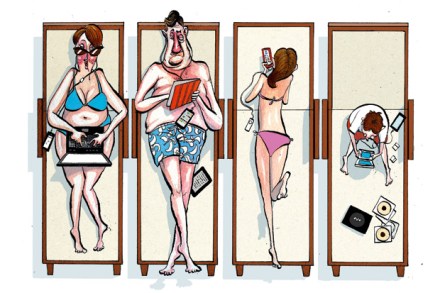
It was about a week ago, at 8 p.m., when our blackout happened. In the 1980s people would have headed for the bedroom or out to loot the local off-licence. In 2013, however, our first reaction was to check the battery health of our mobile phones. This relationship between sex, crime and consumer electronics may be important. The recorded fall in sexual activity among those aged 16 to 44 in the recent National Survey of Sexual Attitudes and Lifestyles was widely attributed to the ‘growth in social media’ and to our new habit of taking smartphones and tablets to bed. Plausible as this sounds, I don’t think the survey proves any such causation. It might be an effect of multi-channel television.

Rory Sutherland: The one issue where we accept the idea of genetic determinism

Some people are gay. Get over it’ — this was the slogan for a campaign against homophobia. A series of YouTube videos follows the same approach: a cameraman asks people on the street, ‘When did you choose to be straight?’ The subtext — that sexual orientation is innate, not chosen — has undoubtedly succeeded in promoting tolerance. The only strange thing here is that the argument leans heavily on genetic determinism which in almost any other field of debate is anathema to most liberal opinion. Imagine putting up a poster with the legend ‘Some children are brighter than others. #Truth.’ Or ‘Women are crap at parallel parking. Just live with it.

Rory Sutherland: How to improve journey times without HS2

I am still waiting for someone to refute my argument that it would be possible to reduce the journey time between London and Manchester or Birmingham for many rail passengers by between 20 and 40 minutes — and to improve effective capacity — at about 0.001 per cent of the cost of HS2. This would be done simply using software, not hardware. Last Thursday I travelled to Manchester to give a talk in the afternoon. The journeys up and back were flawless. But they did take 40 minutes longer than necessary — in both directions. Why? A month before, once I knew that I had to travel to Manchester, I did what every sane person would do. I booked an ‘Advance’ ticket there and back on specified trains.

My £30k alternative to HS2

Someone in New York told me this story. I admit that I didn’t believe it when I first heard it. But a little online research seems to confirm that it is true. It concerns a group of people who had bought early versions of the Tesla Model S, a $90,000 high-performance electric car much loved by Silicon Valley’s rich set. The earlier versions of these cars behaved slightly differently from a standard petrol vehicle. In particular there was no ‘creep’. For the benefit of European readers irrationally wedded to the stick shift, I should explain that ‘creep’ is a feature of almost all cars with automatic transmission.

The real reason for rotten online reviews on TripAdvisor

‘Sorry, I’d love to go the pub this evening, but I have to go out. It’s my wife’s wedding anniversary.’ This Freudian slip was uttered by one of my colleagues a few years ago. It sprang into mind when I was casually browsing reviews of restaurants and hotels on TripAdvisor. I always head for the negative reviews first. Not for what they tell you about the venue, but for what they unintendedly reveal about the reviewer. Sarcastic quotation marks and periphrasis are always a bit of a give-away: ‘...there was a floating rubber object in the toilet bowl!!! After complaining at reception we were given another room and a full refund. Staff were very apologetic about the incident.

Nobody takes a flight from London to Manchester. So why would we take HS2?

From Edinburgh airport there are more than 45 flights a day to London. And, I imagine, the same number back. You can fly from Edinburgh to London Heathrow, -London Gatwick, London Luton, -London Stansted and London City — even to the optimistically named -London Southend. Glasgow offers a similar choice. I have often used these flights. I live about 25 minutes’ drive from Gatwick, so when I go to Edinburgh my -favourite plan is to take a morning train up and then fly or take the sleeper back. Since Manchester is bigger than Edinburgh, I had naively assumed that I would be able to do something similar for an upcoming trip there. I decided to fly from Gatwick and take the train back. ‘You can’t. There aren’t any flights from Gatwick to Manchester any more.

My mansion tax solution: hit rich foreigners. But no one else

I am surprised no more attention has been given to Martin Vander Weyer’s suggestion in The Spectator two weeks ago that a mansion tax should be levied on those buyers who pay no other UK tax. Why has it taken so long for anyone to raise this idea? Where tax paid against income should be set against tax paid on property? Let’s consider this question in psychological terms. Assume that you are eager to buy a particular house but someone else decides he wants to live there too. He is twice as rich as you are and so comfortably outbids you. Whatever the other person’s moral worth, you know two things. He has become rich under roughly the same system as you. And he has, in the process, paid more tax than you. Now consider another scenario.

Think fracking’s bad for the countryside? Just look at farming…

I’m off to Balcombe this weekend. In fact I might even carry a placard and paint my face with a clever pun, like ‘F*** off!’ or ‘Go f*** yourself.’ Because it’s time to add my voice in opposition to a greedy industry which threatens your ground-water, exudes greenhouse gases, leaches chemicals into the earth, destroys the beauty of the landscape and imperils our native fauna and flora wherever its grasping hand is felt. This extractive activity fills the air with noxious smells and clogs the roads with slow-moving vehicles; its safety record is appalling, with a high rate of work-related injuries and famously low worker pay.

Why smartphones work better in Soweto

A friend of mine insists that when Alfred Hitchcock’s Psycho first opened in Britain, the emotional impact of the most famous murder in cinematic history was slightly diminished. As Norman Bates’s knife came into frame, British audiences of 1960 were still recovering from the shock of a scene they had witnessed a few minutes earlier when they were shown a hotel room that had its own shower. I can still just remember a time when it was normal to walk along a hotel corridor to take a bath or use the loo. And the folk memory of these regional variations still lingers. I don’t think anyone in Britain still packs loo rolls to take to the continent, but people did.

Never seen the need for a class system? Take a long-haul flight

Usually it is annoying when you have to board an aeroplane via a shuttle bus rather than an airbridge. The exception is when the plane is a 747. That’s because, with the single exception of Lincoln Cathedral, the Boeing 747-400 is the most beautiful thing ever conceived by the mind of man. Any chance to see one at close quarters is a delight. But aside from the engineering, the most beautiful thing about a long-haul airliner is the economic wizardry which keeps it flying. On board are a variety of seats from the sybaritic to the spartan for which people have paid wildly varying amounts of money, even though each seat will reach the same destination in the same length of time. You may find this class division offensive.

Why the NHS is like a kitten

Of all the strange behaviours of the rich, owning horses long struck me as the most bizarre. A horse, when you think about it, is a hopelessly unsuccessful attempt to combine a pet with a form of transportation. So whenever anyone mentioned that their daughter wanted a horse, I always recommended they bought a Range Rover and a kitten instead. The two would cost much less to run, and provide far more in the way of utility, pleasure and companionship. Or at least that’s what I used to think. I always loved cats and thought horses rather stupid. But then it dawned on me: cats have effectively hacked us. The relationship between a horse and a human is a reciprocal one. They perform useful work and we supply them with food and shelter. It’s a straightforward business deal.

Don’t abolish The Knowledge!

Now that most taxi drivers use satnavs, should ‘the Knowledge’ be abolished? Shouldn’t we ditch the requirement that all London black cab drivers spend several years acquiring an insanely detailed knowledge of London before obtaining a badge? In cabbie folklore, the model for the Knowledge was first suggested by Prince Albert. True or not, there is something German about the notion that every tradesman should have a qualification. And the test is teutonically stringent: more than 70 per cent of applicants fail or drop out. It demands that the prospective driver memorise 25,000 streets and 20,000 landmarks within six miles of -Charing Cross.

Why I’m hiring graduates with thirds this year

Whenever I return to my old university, I am always struck by how incredibly focused, purposeful and studious everyone seems to be. It fills me with despair. It’s hard to tell the difference between a university and a business school nowadays. Where are all the hippies, the potheads and the commies? And why is everyone so intently serious and sober all the time? ‘Oh, it’s simple,’ a friend explained. ‘If you don’t get a 2:1 or a first nowadays, employers won’t look at your CV.’ So, as a keen game-theorist, I struck on an idea. Recruiting next year’s graduate intake for Ogilvy would be easy. We could simply place ads in student newpapers: ‘Headed for a 2:2 or a third? Finish your joint and come and work for us.