Columns

Will Duncan Smith make work — not welfare — the logical choice?

James Forsyth reviews the week in politics For one night only, the band was back together. On Monday night, Tony Blair — looking toned and tanned — addressed the Institute for Government, the think-tank set up by his ally Lord Sainsbury. Cherie was in the front row, resplendent in a white salwar kameez. Blair’s two loyalist Cabinet allies, Tessa Jowell and Andrew Adonis, were also in attendance. There was even a question to the former prime minister from a fellow member of Ugly Rumours, Blair’s university band, to add to the reunion feel. This former rocker is now a civil servant at the Department for Work and Pensions. Most of what Blair said was technocratic not political; he talked about the ‘process lessons’ he had learned in government.
How far do you truly believe? Perhaps it’s a waste of time even to ask the question

Readers familiar with Idomeneo might have shared my pleasure (and bemusement) at a performance of Mozart’s early opera at the Coliseum in London last week. The English National Opera production, which staged most of the action in what appeared to be a top-quality modern hotel, was ludicrous (I found the waiters distracting, but then I often do), but no more ludicrous than any other imaginable 21st-century staging of an 18th-century account of an ancient Greek tale. No, what perplexed me was the part played in the narrative by the gods.

What we need is a glorious alliance between all sorts of people who hate each other

I once wrote a column about Camden Council, the total bastards, stealing my car. Never had a response like it. Lawyers got in touch, offering their services. Motorist groups wanted to sign me up. Readers wrote in, offering other tales of total Camden bastardy, or similar bastardy from elsewhere, and Tom Conti invited me round for a coffee. It was the first time I properly realised that modern Britain does, after all, possess a fearless, freedom-loving backbone. It’s just peculiarly preoccupied with things like parking tickets. No disrespect intended to the glowering love interest from Shirley Valentine, but I always thought freedom was supposed to be sexier than this.

I feel the need to offer Wikipedia some ammunition in its quest to discredit me

James Delingpole says You Know It Makes Sense The most excruciatingly awful thing I have ever done in my entire life happened in my penultimate year at school. At the time I was learning classical guitar and occasionally I would meet up with one of my English teachers, ‘Mattie’ Simpson, so that we could play duets together. On the fateful day I’m about to describe the piece we were practising was Bach’s ‘Air on a G String’. Now my other main activity at the time was cross-country running. Like many of the boys in my house I would train regularly and hard, killing myself up and down the Malvern Hills before hurrying home for tea where I’d fill my knackered, sweating carcass with round after round of peanut butter on toast.

The Miliband brothers may yet drown each other in a butt of malmsey

James Forsyth reviews the week in politics From a distance, Tony Blair might be able to persuade himself that the Labour party contest now underway is the fulfilment of his dreams. The ‘brothers’ everyone is talking about are not trade union heavies but two Oxford PPE graduates who have worked their way up through the New Labour machine. But to listen to what they say, there is scant evidence of Blair’s election-winning philosophy. The candidates are outbidding each other on making punitive levels of taxation on the rich permanent, denouncing Labour’s rapprochement with big business and committing to abolishing tuition fees. Not that anyone is listening much to what they say.

When several things go wrong at once, we rarely consider that it may be a coincidence

I turned to this week’s press coverage of the latest pre-Budget economic forecasts only after a punishing battle with my motorcar. A morning’s home car mechanics left me bruised, cut, frustrated and covered in diesel, but — as it turned out — philosophically refreshed for the debate about Britain’s economic future. I drive a grey 1999 Vauxhall Brava pick-up truck: a useful if charmless workhorse, and until recently a trusty companion. But on leaving the truck near the railway station I accidentally locked the steering column lock, then found myself unable to unjam it, despite ten minutes’ violent wiggling with the ignition key and the wheel. On returning to the parked vehicle I tried another key and finally, with a bang and jolt, disengaged the lock.

Electoral reform is the dark cloud on the coalition’s horizon

James Forsyth reviews the week in politics It is a sign of how well things are going with the coalition that the civil servants left the room towards the end of the Cabinet meeting on Tuesday and let the politicians get on with it. The first ‘political Cabinet’ — when its members talk about party business rather than government business — was a brief affair; it only lasted about five minutes and consisted of everyone agreeing that until Labour came up with a credible position on cuts, their joint enemy was going to be isolated. But a full political Cabinet has been scheduled for the end of next month. When the coalition was first formed, no one quite knew what would happen to political Cabinets.

Men fight for their ‘mates’ — it is the secret of why they so love war

One of the nicest, gentlest fellows I’ve ever met is a man named Mike Dauncey. He’s so terribly polite that he can’t bring himself to swear even in extremis and if you had to guess what he did before he retired, you’d probably say ‘country parson’. In fact, though, Brigadier Mike Dauncey DSO is a bona fide war hero, known as the ‘sixth Arnhem VC’. Only five were in fact awarded at the battle. Mike was put up for the sixth, only to have the letters ‘VC’ crossed out on his citation and amended to ‘DSO’ by one BLM (that’ll be Bernard Law Montgomery) who felt that, heroism or no heroism, five VCs were quite enough for one debacle.

What I need is a world view — the problem is that I’m looking for it all over the place

This is going to be a wibbling and self-indulgent column, so don’t say you haven’t been warned. There are various reasons for this, but chief among them is the fact that I’m on holiday right now, in St Tropez. It’s possible that you already know this, if the Spectator overlords have decided to put one of those ‘dateline: St Tropez’ bits at the top, but it’s also possible that they thought it was a bit wibbling and self-indulgent for that, and didn’t bother. And anyway, I’m not actually in St Tropez, but in an idyllic hill village a few miles outside. This is a state of affairs I hope will long continue, what with the modern St Tropez being full of plastic surgery, boat fumes, and the temptation to buy overpriced sunglasses.

Laws’s resignation is a disaster for the coalition in all but one respect

James Forsyth reviews the week in politics Straight after David Cameron had announced his final offer to the Liberal Democrats — a referendum on Westminster’s voting system in exchange for entering into coalition — I bumped into a member of the Tory Cabinet. I asked him if he thought that the offer was unnecessary seeing as a ‘coalition of the losers’ between the Labour and the Liberal Democrats was so unlikely to succeed. This Tory disagreed. He argued that the reward — the reunification of the right — was well worth the risk. My companion soon warmed to his theme.

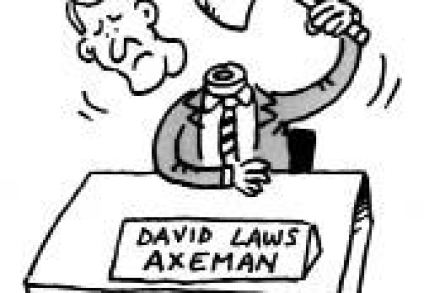
Did David Laws have to jump, or did we push him?

In the world of political commentary, to quote Enoch Powell’s dictum that for politicians to complain about the press is like ships’ captains complaining about the sea has become almost tedious. But the brisk finality of that remark is too useful to dispense with. Is it, though, correct? Observing the awful story of David Laws’s resignation unfolding over last weekend has caused me to question whether Powell’s really is the last word on the subject. On one thing Powell was right: it is not for politicians to complain. That Mr Laws has not complained (and, I think, genuinely doesn’t complain) has made him the more admirable, and admired.

The coalition may be united, but in the Commons its adversarial politics as usual

James Forsyth reviews the week in politics In this era of ‘new politics’, one might have expected a new, more consensual style of debate in the Commons chamber. But judging by the opening days of the debate on the Queen’s speech, we have got quite the opposite. MPs are keener than ever to shout each other down, to cheer their own side and barrack the other. The one difference from the last parliament is that many of the new Labour MPs make their point by clapping rather than bellowing the traditional ‘hear him, hear him’. Oddly enough, it is the coalition — the very apogee of this new more consensual politics — that is making MPs behave like this. The Tory-Lib Dem alliance has raised the partisan stakes for all three parties.

Don’t fear the RIPA: regulations have to be enforced, sometimes even covertly

You can’t trust the disabled. A lot of them are faking it. In the last year, there were 16,535 blue badges and 21,000 free bus passes cancelled by local councils, due to fraudulent use. Bloody disabled. They’re having a laugh. Imagine you were a local council. Don’t be squeamish. You can be a Tory one, if you like, from somewhere nice. Anyway, you’re this council, or a bit of it, and you have your suspicions that somebody is using a blue badge who shouldn’t be. Some young bloke, say, who got it off his Gran and now uses it, allegedly, to park each day outside his office.

Will any leadership candidate tell Labour the hard truths it needs to hear?

James Forsyth reviews the week in politics The entry of a forty-something, privately educated white male Oxford graduate into a political contest normally does little for its diversity. But when Ed Balls jumped into the Labour leadership race he did at least expand the pool beyond members of the Miliband family. Even now, all three candidates read the same subject at the same university. If Andy Burnham joins the fray, though, there will be a non-Oxonian candidate. Burnham went to Cambridge. For the People’s Party, the self-proclaimed champions of the working class and diversity, it is a bit embarrassing that all the likely candidates to lead it are Oxbridge-educated white males. But this problem goes beyond appearances.

The Will of the People does not exist. It is the abominable snowman of politics

I shall now attempt something in which I fully expect to fail. My pessimism is not unfounded. I’ve been trying to put across this case for 30 years, without ever seeing in my hearers’ eyes that glint of recognition that signals the successful communication of an idea. Failure to convey an argument that I’m sure is important and right has been frustrating. But this is the fate of advocates of theories that challenge the very terms of a debate. The same difficulty is encountered by advocates for atheism; may well be encountered if the Hadron Collider in Geneva fails to verify the existence of the Higgs-Boson sub-atomic particle; and was among the reasons the miasma theory of the transmission of diseases lingered so stubbornly in the face of counterfactual evidence.

Yes, Scotland skewed the election result — but that shouldn’t make us anti-union

You never really hear much from unionists, do you? I don’t mean the Irish ones, with their leery hate and wannabe milf wives and surnames which you always assume are going to be Paisley. You never really hear much from unionists, do you? I don’t mean the Irish ones, with their leery hate and wannabe milf wives and surnames which you always assume are going to be Paisley. I mean the original ones. Act of Union unionists. The Scottish ones. Haven’t they let things slip, a bit? I’m a unionist, I think. Only, let’s be honest, a fat lot of good I’m going to do. You want meandering musings, perhaps with a dubious quip about milfs up top, I’m up for it. Only, right now, I think we unionists need more than that.

It is left to me to point out this regrettable, overlooked fact: Dave blew it

This is a column I never thought I’d have to write. I’d assumed that the conclusions to be drawn from the general election were so bleeding obvious that I could leave all the post-match analysis to the experts, while I distracted you with something more cheerful like, say, a piece about Fergal Keane’s brilliant new book on the battle of Kohima. Apparently not, though. It seems that my job today is to point out an awkward fact that seems to have eluded about 98 per cent of political commentators in the mainstream media and 99.99 per cent of those Conservatives who invested their faith in Project Cameron: Dave blew it. No, really. He did.

Now that the election is over, let the arguments and explosions begin

James Forsyth reviews the week in politics ‘He who controls the past, controls the future’ as George Orwell reminded us. This means that a battle breaks out in every party after every election to explain the result, to determine which policies helped and which policies hindered. Win or lose, the various factions inside parties race to establish a narrative that is helpful to their cause. Straight after Labour’s landslide win in 1997, it was declared that ‘we campaigned as New Labour and we will govern as New Labour’. The Blairites were so eager to establish this point that they even considered putting it into the Queen’s speech.

Why has the war in Afghanistan barely been mentioned during this election?

During this election campaign a figure of speech passed from novelty to cliché: ‘the elephant in the room’. Various elephants — spending cuts, the national debt, the reform of the NHS — were nominated for the role. But one poor beast never even got into the room. The Afghan war has been distant from our thoughts. Dismal trumpeting sounds have been barely audible from savannahs far away. This was the subject from which, after a polite cough, everybody moved away. The only party prepared publicly to question the wisdom (as opposed to the conduct) of this war has been the British National Party. We should be ashamed. We’re embroiled in a murderous conflict from which we feel unable to discuss escape.